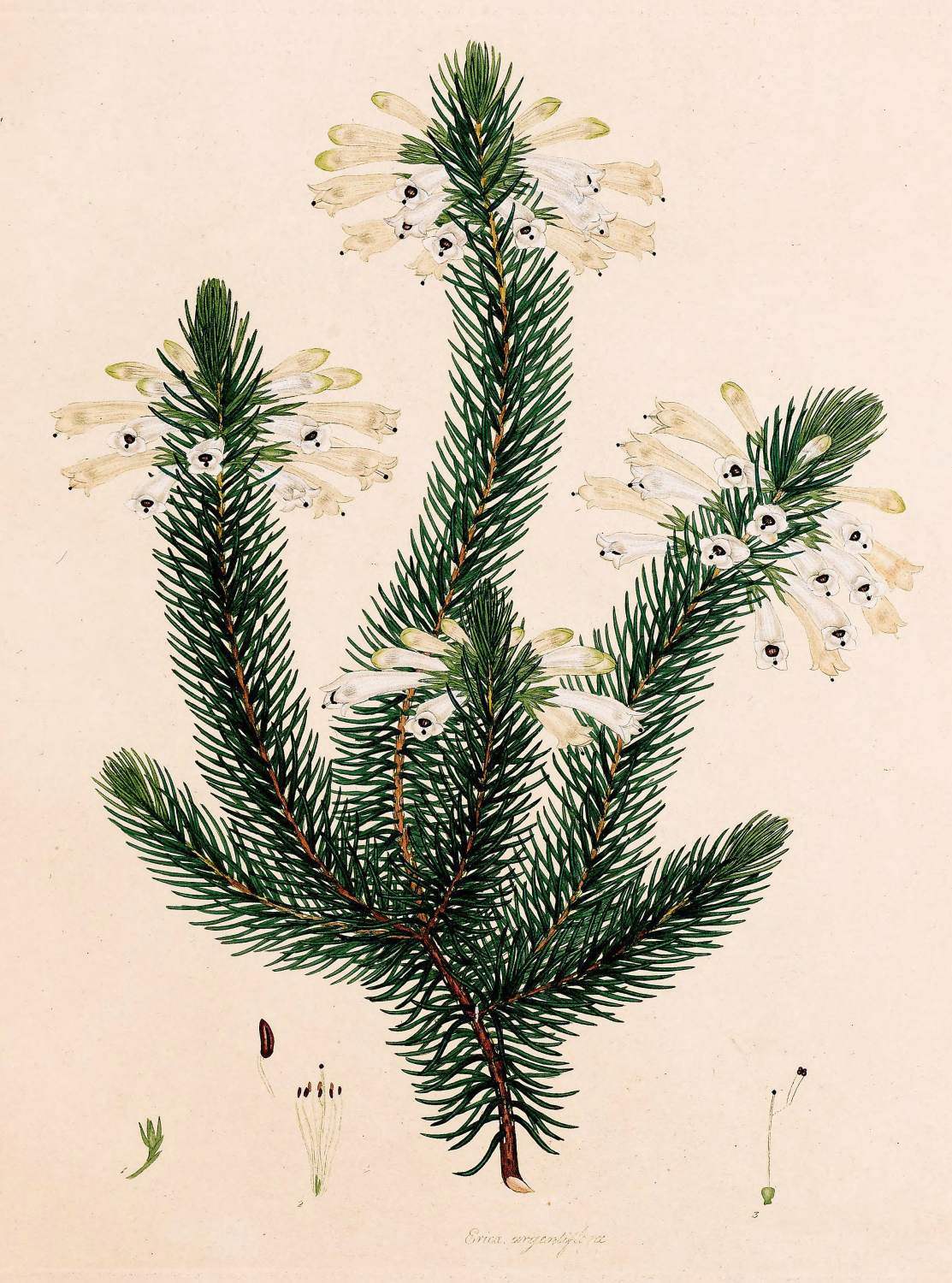
ERICA argentiflora.
Reading edition
CHARACTER SPECIFICUS.
Erica, antheris muticis, inclusis: floribus horizontaliter verticillatis.
DESCRIPTIO.
Caulis fruticosus, erectus, sesquipedalis, ramis simplicibus.
Folia sena, linearia, apice leviter incurvata, supra plana, subtus sulcata.
Flores horizontaliter verticillati prope ramorum summitatem: corolla clavata, uncialis, oris laciniis patentibus.
Germen tiaræforme, sulcatum, ad basin nectariis melliferis instructum.
Habitat ad Caput Bonæ Spei.
Floret a mense Junii ad Octobrem.
REFERENTIA.
1. Calyx. 2. Stamina et Pistillum, antherâ unâ lente auctâ. 3. German et Pistillum, stigmate lente aucto.
SPECIFIC CHARACTER.
Heath, with beardless tips, within the blossom: flowers growing horizontally in whorls.
DESCRIPTION.
Stem shrubby, upright, a foot and half high: branches simple.
Leaves by sixes, linear, slightly turned inward towards the end, flat on their upper surface, and furrowed beneath.
Flowers grow horizontally in whorls near the summit of the branches: blossom club-shaped, an inch long: segments of the border spreading.
Seed-bud turban-shaped, furrowed, and furnished at the base with honey-bearing nectaries.
Native of the Cape of Good Hope.
Flowers from June till October.
REFERENCE.
1. The Empalement. 2. Chives and Pointal, one tip magnified. 3. Seed-bud and Pointal, summit magnified.
The flowers of the Erica argentiflora are of a delicate transparent white, most difficult to imitate on a white ground. Our drawing was made from a plant in the summer of 1814 at the Hammersmith Nursery, where it flowered with abundance of light graceful blossoms, that continued successively from June till October. But the precise time of any of the Ericas flowering is quite indefinite. I have frequently seen many species in full bloom in one collection, and out of flower in others. Where they are indigenous, their periods of inflorescence are no doubt much more determinable than they can ever be in such a versatile clime as Britain, under different modes of culture.