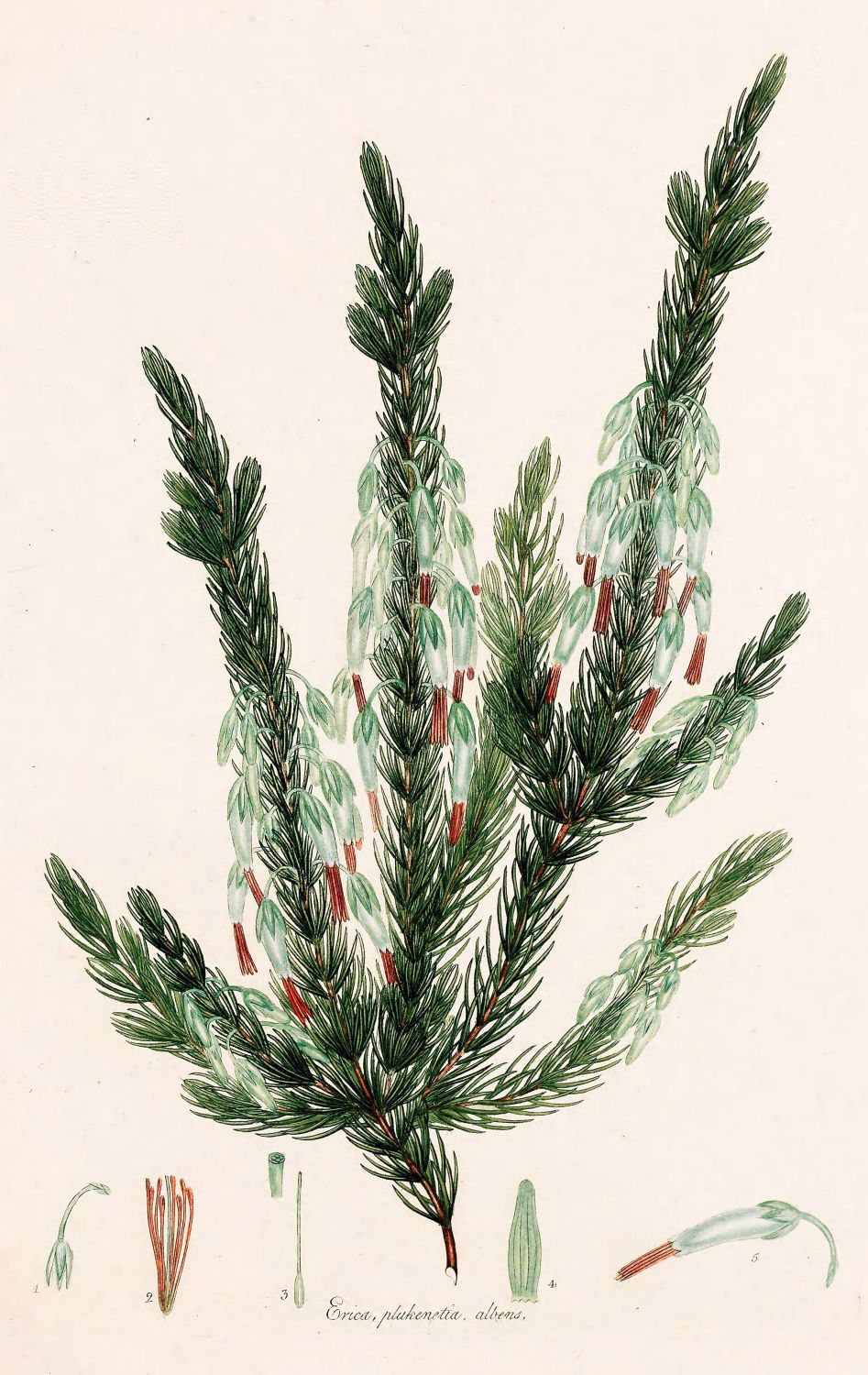
ERICA Plukenetia, albens.
Reading edition
CHARACTER SPECIFICUS.
Erica, antheris muticis, exertis, longissimis: floribus pendentibus: foliis ternis, fasciculatis.
DESCRIPTIO.
Caulis erectus, sesquipedalis, fruticosus: rami subsimplices, ramulis brevissimis tecti.
Folia terna, fasciculata, linearia, arcuata, acuta, glabra.
Flores subsolitarii, pendentes a ramulis, in medio ramorum crescentes, et spicam laxam formantes: pedunculis longis, bracteis tribus minutis ad basin instructis: corolla conica, exalbida, laciniis erectis.
Germen tiaræforme, sulcatum, ad basin nectariis melliferis instructum.
Habitat ad Caput Bonæ Spei.
Floret a mense Maii in Septembrem.
REFERENTIA.
1. Calyx. 2. Stamina et Pistillum. 3. Germen et Pistillum, stigmate lente aucto. 4. Germen lente auctum. 5. Flos varietatis magnæ.
SPECIFIC CHARACTER.
Heath, with beardless tips, without the blossom, and very long: flowers hanging down: leaves by threes, bundled together.
DESCRIPTION.
Stem upright, a foot and a half high, shrubby: the large branches nearly simple, and covered with numerous small branches.
Leaves by threes, bundled together, linear, bowed, pointed, and smooth.
Flowers nearly solitary, hanging down from the small branches, growing near the middle of the large branches, and forming a loose spike: footstalks long, and furnished at the base with three small floral leaves: blossom conical and whitish: segments of the border upright.
Seed-bud turban-shaped, furrowed, and furnished at the base with honey-bearing nectaries.
Native of the Cape of Good Hope.
Flowers from May till September.
REFERENCE.
1. The Empalement. 2. Chives and Pointal. 3. Seed-bud Pointal, summit magnified. 4. Seed-bud magnified. 5. Flower of a large variety.
The flowers of this Erica possess a negative sort of colour, that forms a good contrast to the purply red of the other species of Plukenetia, but when out of flower it is not easily distinguished from them. Our drawing was made from the Hibbertian collection. We are doubtful whether the plant is not at present lost to us, not having seen it for several years. We have long ago figured it in the octavo work, and should have then published it in our folio edition; but wished to give a fine specimen of the large-flowered variety in preference. We have not, however, seen one plant of it since, except that from which the gigantic flower in the dissection was taken at Mr. Rollinson’s Nursery at Lower Tooting, which was rich in foliage, but had scarcely any blossoms.