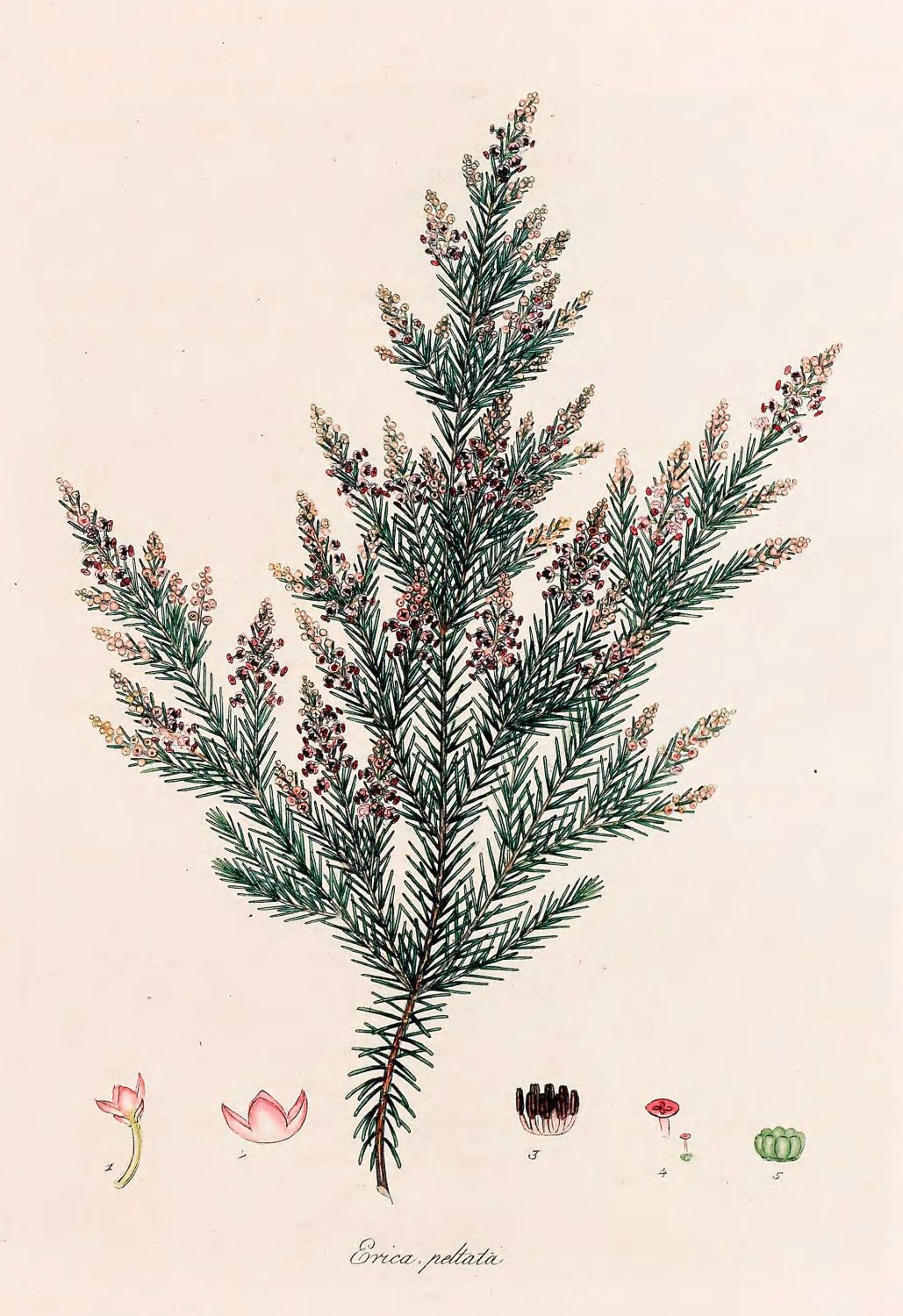
ERICA peltata.
Reading edition
CHARACTER SPECIFICUS.
Erica antheris muticis, subexsertis: stylo exserto, filiformi: stigmate peltato, magno: floribus axillaribus, terminalibus: foliis ternis: ramis numerosis: caule erecto.
DESCRIPTIO.
Caulis subpedalis: rami et ramuli numerosi, filiformes, adscendentes.
Folia terna, erecto-patentia, linearia, recta, obtusa.
Flores axillares, terminales: pedunculi longi, bracteis calyci adpressis: corolla campanulata, parva, carnea, subcernua: stylo filiformi, longo: stigmate peltato, magno.
Habitat ad Caput Bonæ Spei.
Floret a mense Julii in Octobrem.
REFERENTIA.
1. Calyx lente auctus. 2. Corolla lente aucta. 3. Stamina lente aucta. 4. Germen et Pistillum, stigmate lente aucto. 5. Germen lente auctum.
SPECIFIC CHARACTER.
Heath, with beardless tips, just without the blossom: shaft without, thread-shaped: summit shield-shaped and large: flowers grow from the axillæ of the leaves, and terminate the branches: leaves by threes: branches numerous: stem upright.
DESCRIPTION.
Stem nearly a foot high: the large and small branches are numerous, thread-shaped, and ascending.
Leaves by threes, between erect and spreading, linear, straight and obtuse.
Flowers grow from the axillæ of the leaves, and terminate the branches: peduncles long, with floral leaves pressed to the cup: blossom bell-shaped, small, flesh-coloured, and nearly nodding: shaft thread-shaped and long: summit shield-shaped and large.
Native of the Cape of Good Hope.
Flowers from the month of July till October.
REFERENCE.
1. The Empalement magnified. 2. A Blossom magnified. 3. The Chives magnified. 4. Seed-bud and Pointal, summit magnified. 5. Seed-bud magnified.
In the Genus Erica it is sometimes very difficult to find an appropriate or unoccupied specific title. This little shrub furnishes no less than four to choose from: this choice has already given the additional title of exserta to that of peltata, from the trivial circumstance of the pointals protruding a little more in some plants than others: a mere casualty, probably depending on its strength or culture. The flowers are so very minute, that the pointals are the most conspicuous, resembling shields in miniature. The anthers are large, compared to the small size of the flowers, and so fertile, that when in full bloom if shaken, they emit such a quantity of pollen as would afford the specific titles of fertilis or farinosa.
Our drawing was made at Mr. Lee’s last summer (1823); but we have seen it in bloom as long ago as 1806.