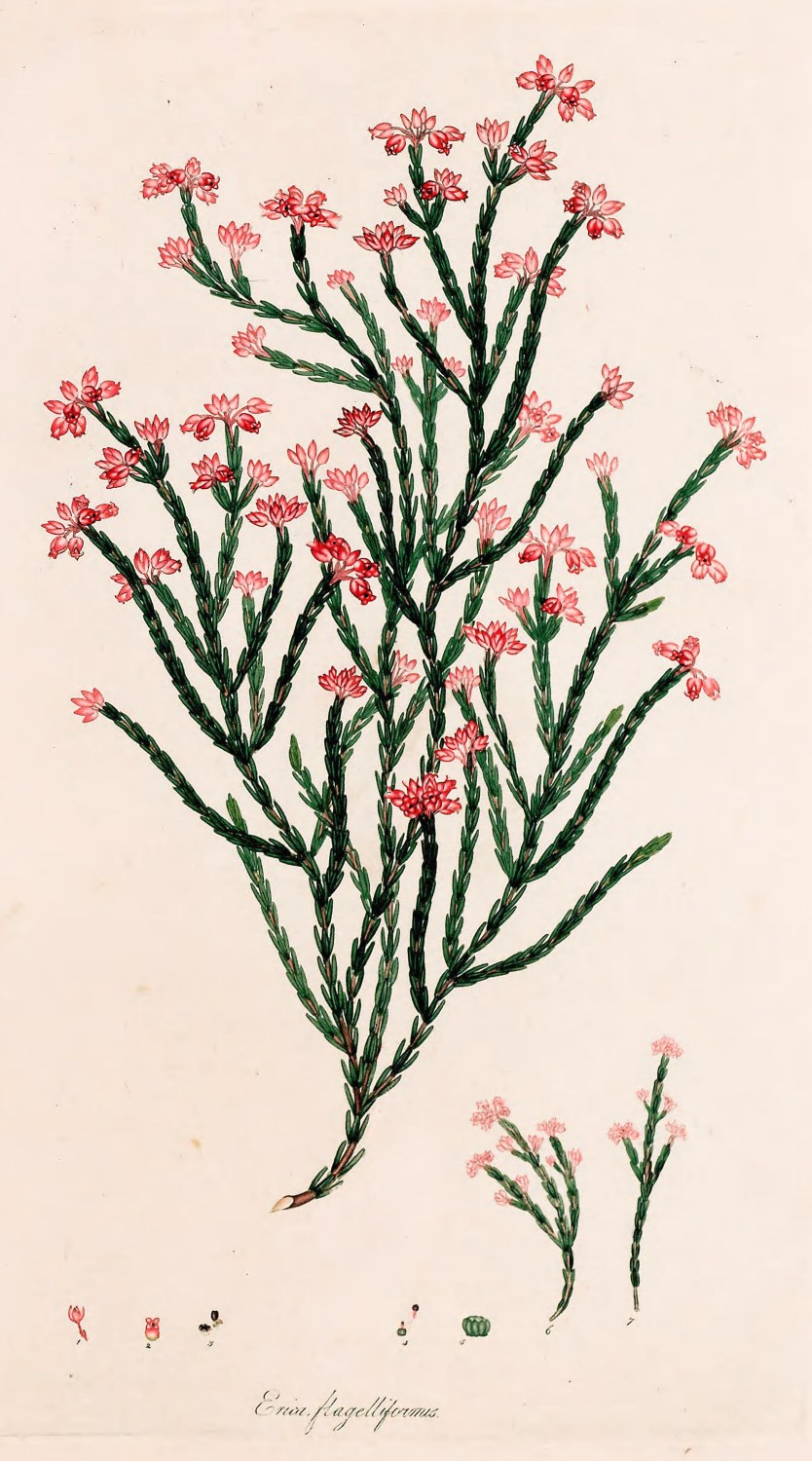
ERICA flagelliformis.
Reading edition
CHARACTER SPECIFICUS.
Erica, antheris cristatis, inclusis: flores ramos terminant in umbellis: foliis ternatis: ramis virgatis.
DESCRIPTIO.
Caulis virgatus, pedalis: rami et ramuli filiformes, flexuosissimi.
Folia ternata, erecta, crassa, obtusa, cauli adpressa.
Flores ramos terminant in umbellis; pedunculi carnei: perianthium tetraphyllum: foliolis spathulatis, acuminatis, carneis: corolla urceolata, saturate carnea, ad basin pallida: oris laciniis patentibus.
Germen tiaræforme, sulcatum, ad basin nectariis melliferis instructum.
Habitat ad Caput Bonæ Spei.
Floret a mense Junii in Augustum.
REFERENTIA.
1. Calyx. 2. Corolla. 3. Antheræ et Pistillum, anthera una lente aucta. 4. Germen et Pistillum, stigmate lente aucto. 5. Germen lente auctum. 6. Ramus varietatis parvæ. 7. Ramus varietatis minoris erectæ.
SPECIFIC CHARACTER.
Heath, with crested tips, within the blossom: flowers terminate the branches in umbels: leaves by threes; branches twiggy.
DESCRIPTION.
Stem twiggy, a foot high; the large and smaller branches are thread-shaped, and very flexuose.
Leaves by threes, straight, thick, obtuse, and pressed to the stem.
Flowers terminate the branches in umbels; footstalks flesh-coloured: empalement four-leaved; leaflets spathula-shaped, pointed, and flesh-coloured: blossom pitcher-shaped, of a deep flesh-colour, but paler at the base: segments of the border spreading.
Seed-bud turban-shaped, furrowed, and furnished at the base with honey-bearing nectaries.
Native of the Cape of Good Hope.
Flowers from June till August.
REFERENCE.
1. The Empalement. 2. The Blossom. 3. The Chives and Pointal, one tip magnified. 4. Seed-bud and Pointal, summit magnified. 5. Seed-bud magnified. 6. Branch of a small variety. 7. Branch of a smaller upright variety.
This Erica is figured from a drawing made in the gardens of G. Hibbert, Esq. as long back as the summer of 1806, where it was raised from Cape seed amongst many others, and considered as nearer allied to the E. calycina than any other species. There was only one more plant of it, and that was of a very straggling growth, hanging down over the sides of the pot in all directions, making a very picturesque appearance, and to which we should certainly have given the preference, if we had not considered it more a casualty of culture than as a permanent character,—which we had not the opportunity of ascertaining, as both the plants died in the autumn,—we apprehend, from an excessive inflorescence,—and have never since re-appeared. Among the dissections we have given branches of two small seminal varieties, almost distinct enough to require a separate figure.