Volume 1 — “WESTWARD, HO!”—THE SYNDICATE SURRENDERS.—INCIDENTS OF 1909.
Reading edition
Belasco, accompanied by several friends, left New York on February 7, 1909, for San Francisco, where he arrived on the 12th and where he remained for nearly a month. He had been apprized that the health of his father was failing and that, in the course of nature, his death was likely to occur soon. His expedition was prompted by filial affection and it was undertaken with a heavy heart. His visit, however, greatly cheered and benefited his aged parent, and the sojourn in his native city was made a time of festival and happiness. On February 24 a dinner was given at the Bismarck Café by surviving pupils of the Lincoln Grammar School, of the classes from 1865 to 1871, at which Belasco was the principal guest; and on the 27th a supper was given in his honor at the Bohemian Club. He has written for me this account of his visit:
“...The only really sad time was when at last I had to say ‘Good-bye’ and come away: that was a sorrow. But I would not have missed the visit back home for all the world! The happiness of seeing my old father and the pleasure my coming gave him are priceless memories to me, and I like to think my visit helped him to hold on: he lived nearly two years longer. I would have gone back the next year, but I was warned against the agitation our parting would bring to both of us.... I was so hospitably received on every hand that I entirely forgot my enterprises in New York and I felt like a boy again, without a worry. Although it was less than three years after the earthquake-fire, prosperity was in evidence everywhere; the spirit of the people was simply wonderful, and it sent me home encouraged and inspired to attempt greater things. I am proud that I was born in San Francisco, and I cannot say too much for the hospitality and overwhelmingly friendly reception accorded me.... The night at the Lincoln School Dinner was wonderful. There were about seventy of the ‘boys’ there, and dear old Professor Bernhard Marks, who had been the principal and who was nearly eighty, presided and called the roll, just as he used to do when we were all lads. Sometimes a silence followed a name; many times there came the answer ‘Dead,’ and now and then somebody responded ‘Present.’ I cried! Then the principal put us through our paces again, at the old lessons, and dealt out cuts on the hand with very little of the old-time vigor. After that there were speeches, and so many lovely things were said about me that I was too embarrassed to reply properly: I remember that I began by saying it was the happiest night of my life—and then stood there with tears running down my cheeks! But I managed to say a few words that pleased them, and then there were many calls for me to recite ‘The Madman’ and at last I got up to do it. I started in with restraint, to
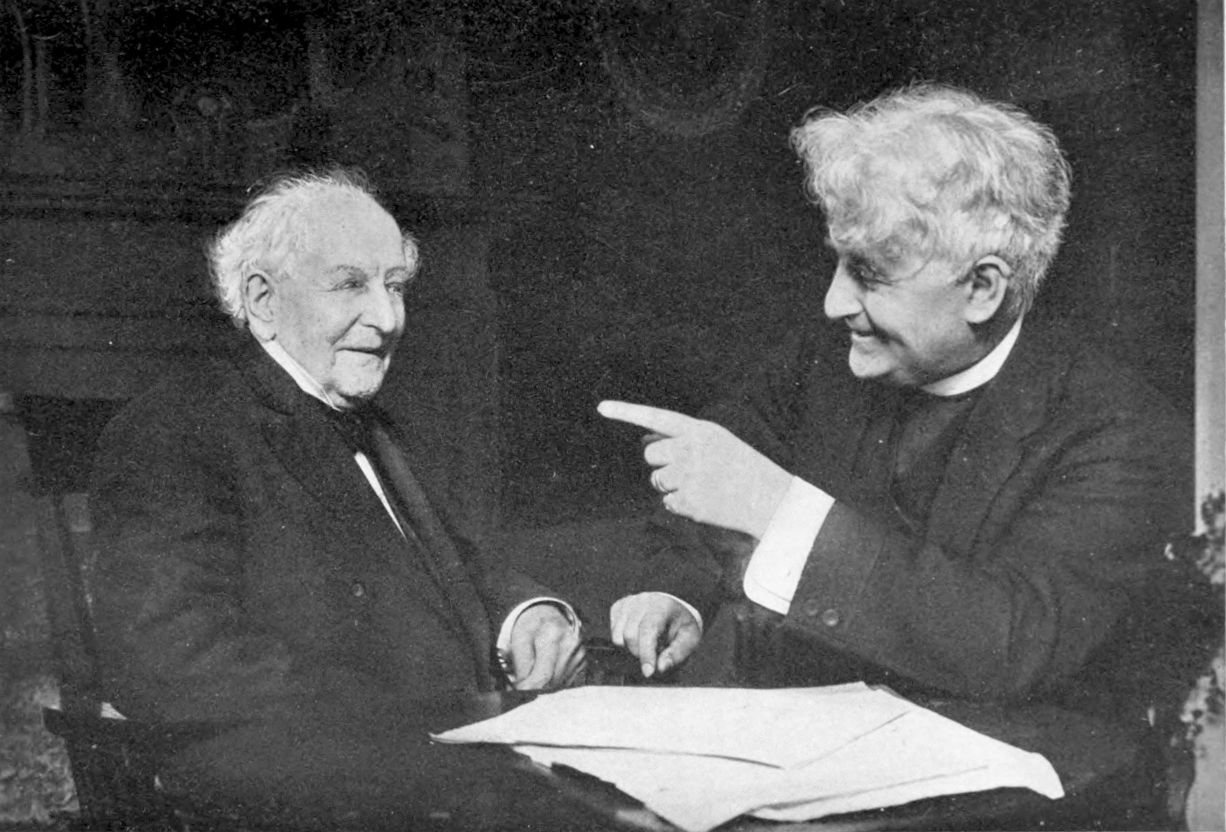
Photograph in Belasco’s Collection.
DAVID BELASCO AND HIS FATHER, HUMPHREY ABRAHAM BELASCO, IN SAN FRANCISCO, FEBRUARY, 1909—THEIR LAST MEETING
give it properly, as I would now, but the ‘old boys’ wouldn’t have it. They began to catcall and cry ‘Nix! Nix!’ ‘The old way! the old way!’ and they made me get up on one of the tables and begin all over again and give it in the good old way, raving and shrieking and tearing my hair, as I used to do when a boy, when the audiences used to say I’d break a blood-vessel if I kept on! So I went through with it, though it was pretty hard work, and they were so delighted they made me give ‘The Vagabonds’ for an encore, but I ‘stuck’ dead, halfway through that, and couldn’t go on to save my soul, so they let me off....
“I didn’t know the names of all those who came, but by and by I would recognize a glance of an eye or the turn of a head and recall that I knew that fellow when he was a boy. They were so much altered—one of the greatest scamps of the school was a staid, respected banker, and another was a portly physician of the highest standing, and so on. It was all very interesting to me—and at times very pathetic and touching....
“My night at the Bohemian rather overwhelmed me—when I looked about and saw many of the leading men of San Francisco and remembered the days when I couldn’t even get into that club! They gave a play in my honor, by Dr. Shiels, and there were many charming speeches and I made my acknowledgments as well as I could, and then they gave me a cartoon, painted by Neuhaus. It shows me kneeling at the shrine of The Owl [the symbol of the Bohemian Club], presenting my offering, ‘The Rose of the Rancho,’ to their patron bird of Bohemia.”
I have endeavored to obtain reports of the speeches at these festivals but have been unable to do so. At the Lincoln Grammar School Dinner the speakers were Professor Marks, Charles A. Miller, Joseph Greenberg, James I. Taylor, Charles F. Gall, and J. J. McBride, all of San Francisco, and Arthur L. Levinsky, of Stockton. Among the speakers at the Bohemian Club supper were Dr. J. Wilson Shiels, Joseph D. Redding, Charles J. Fields, Willis Polk, Waldemar Young, and Mackenzie Gordon.—Belasco left San Francisco for New York on March 2 and arrived there on the 7th.
In the spring of 1909, soon after he returned from his visit to San Francisco, the Theatrical Syndicate practically surrendered in its fight to exclude Belasco from the theatres which it dominated. The reason for this surrender was, of course, purely selfish. The Belasco theatrical productions were not only the best that were being made in America but, also, they were among the most profitable. He had long been firmly established in public favor: he was managing two splendid theatres in New York: he controlled, directly or indirectly, others in other cities: each season he had grown more influential: it was a manifest impossibility to crush him: many janitorial managers of theatres in different parts of the country were bitterly dissatisfied because his popular and remunerative productions were not “booked” in their theatres: the obvious course of commercial expediency was to terminate a losing conflict and utilize and prosper by the leading theatrical manager in America: to the Syndicate, as to Petruchio in Grumio’s description of him, “nothing comes amiss so money comes withal,” and the greatest wonder is not that it forgave Belasco the heinous crime of working for his own advantage but that, at heavy financial loss, it so long debarred him from the “first-class territory.” The upshot of the various considerations indicated was an understanding between the parties in opposition (namely, the booking agency of the Messrs. Klaw & Erlanger, representing the Syndicate, on the one side, and Mr. and Mrs. Harrison Grey Fiske and Belasco, on the other), whereby,—as set forth in a statement issued by Fiske,—it was arranged that “Klaw & Erlanger and Fiske and Belasco will hereafter, whenever mutually agreeable, play attractions in each other’s theatres.” Since that understanding was reached, April 29, 1909, they have, as far as I know, done so.
I am far from regarding any association between Belasco and the Theatrical Syndicate as being either for his best interest or for that of the American Stage. Belasco, however, thinks differently, and in a recent conversation with me he summed up his feeling about the Syndicate in these words: “In the conferences initiated by our lawyer Mr. Gerber [David Gerber was attorney for Belasco as well as for Klaw & Erlanger] it was found that we could enter upon business relations for the betterment of the American Stage without any sacrifice of principle or integrity, and I think our arrangement has been beneficial for the Stage. I am older than I used to be; I have no ill-feeling; our relations are very friendly, and I am satisfied to ‘let the dead past bury its dead.’” That is very well—but, as it happens, all that was truly urged by Fiske and Belasco (among others) in opposition to the Theatrical Syndicate before the business understanding above recorded remained equally true after it; newspaper files and many legal instruments are accessible and anybody can consult them who wishes to do so; the public record cannot be evaded. I am thoroughly familiar with the annals of the Syndicate and I do not agree with Belasco in his present friendly and favorable attitude. On the contrary, I am satisfied that the influence of the Syndicate upon matters of dramatic art must, in the nature of things, remain vulgar and degrading, and in matters of business oppressive and sordid, to the end of the chapter. Public opinion, however, and that of the newspaper press has long been indifferent on this subject, and I am now convinced that it is only by the passing away of the men who compose the Syndicate (in whom, happily, “nature’s copy’s not eterne”) and the accession to theatrical management of men of higher character and ideals and finer intellect that the American Theatre will be measurably redeemed from its impaired estate.
Belasco’s course, meanwhile, in dealing with the Syndicate has been incorrectly described as “a surrender” on his part and he has been much misrepresented therein. From the first of difference and dispute he maintained his right to independence in the conduct of his managerial business. In various conversations with me, many years before the arrangement with his opponents was reached, he declared, in substance, half-a-score of times or more: “I have no wish to try to interfere with these people [meaning the Syndicate] in their business. What I am fighting for is my right to book my productions with whatever managers want to book them, for my best advantage.”
A newspaper intimation that Belasco, while booking through the Syndicate agency, would “fear to offend the Trust” brought from him (1909) the following specific disclaimer of subserviency:
“Please deny for me, emphatically, the statement that I ‘hesitate to give offence to the Theatrical Trust.’ My position regarding the Theatrical Trust is too well known, I hope, for anyone to believe that!”
Mr. Lee Shubert, who controlled theatres competing with Syndicate houses in which Belasco productions were presented for a long time after the Syndicate agreed to book for him, made the following comment on the understanding:
“So far as myself and my associates are concerned we cannot disapprove of a development which shows advancement of the policy of the ‘open door,’ for which we have fought. It is gratifying to us to note that the tendency toward a general letting down of the bars, which were up so long and so unjustly against independent producers, is so emphatically in evidence in the change of attitude both on the part of Erlanger and Belasco and Fiske. We have produced and procured our own attractions, and will continue to do so with such measure of success as may be ours. I have contended always that the time would come when the bars must be let down and successful producers welcomed wherever they were willing to play their attractions.... We are independents, and Messrs. Belasco and Fiske are independents. Whatever steps they may take in an independent way we cannot with consistency disapprove. It is really of little moment to the public, which cares little about whose attractions it may pay to see and in what theatre it may see them so long as the attractions are worth the money.”
One immediate result of the Fiske-Belasco arrangement with the Syndicate was the settlement out of court of the lawsuits over “The Auctioneer,” implicating Klaw & Erlanger, Belasco, and Joseph Brooks, and the withdrawal of the appeal by Belasco, in that matter, which had been filed April 13, 1906.
A painful incident of this year (1909) was a bitter attack on Belasco made by his former friend and professional associate Mrs. Leslie Carter. That singular woman, having appeared in John Luther Long’s absurd play of “Kassa” and made a failure, was pleased to ascribe that regrettable result not to a bad play and a tiresome performance but to the malign influence of Belasco! A long and silly “statement” was issued in her behalf to the effect that there was a plan on foot to interfere with “her career” in that play, and it was intimated that Belasco was the instigator of this alleged nefarious scheme. Later Mrs. Carter gave out another screed, which was circulated throughout the press of the country, reflecting in the most gross and unwarranted way upon the man who had made her theatrical career possible, and in which she declared: “If I were going to die and could save my life by playing again for David Belasco, I would not do it!” As nothing could ever have induced him to resume the management of Mrs. Carter this declaration was a trifle superfluous. Belasco’s only comment on this matter was explicit: “It is,” he said, “absolutely false that I have sought, or desired, in any way, to injure Mrs. Carter. It is monstrous that such a thing should be said against me, and monstrous that anybody should dare to ask me if it is true.”
During the summer of 1909 Belasco proposed to his old friend Lotta that she return to the stage under his management (she had retired from it about 1890) and make a farewell tour of the country. “I urged her all I could,” Belasco writes, “because I knew I could make her reappearance and tour a sensational success and that the public would be delighted to see the little Lotta of other days. At first I wouldn’t take ‘No’ for an answer, and for a while Miss Lotta was inclined to accept my proposal. But, finally, she declined, saying: ‘I’ve seen so many people make the same mistake, when they’ve grown old and outlived their public, of coming back to appear in the parts that were written for them in their youth. “Other days, other ways.” It is better to let my old friends remember me as they saw me many years ago. I shall never act again.’” That was a wise decision. No doubt there would have been much friendly interest in a formal farewell by Lotta; but the elfin charm of her youth was gone and the venture would have inspired sadness: “Yesterday’s smile and yesterday’s frown can never come over again!”