Volume 1 — CONCERNING WARFIELD, JEFFERSON, THE ELDER SOTHERN, AND THE “ONE-PART” CUSTOM.—AN AMAZING RECORD.
Reading edition
In commenting on Warfield’s great, indeed phenomenal, success and popularity in “The Music Master,” Belasco writes: “I have no doubt that he could become a one-part actor and appear as von Barwig perennially, just as Jefferson played Rip Van Winkle and Sothern Lord Dundreary. However, neither he nor I approve of this plan.” It is singular, indeed, what a strange, delusive, ineradicable effect the parrot-like repetition of words sometimes creates. Belasco,—like the majority of other persons who mention the subject,—has got it firmly established in his mind that Jefferson and Sothern were what he designates as “one-part actors” (actors who, as he expressly states, follow a professional course of which he does not approve), and he will, I suppose, go to his grave serene in the conviction that such was the case and unconscious of the injustice he does both those great actors. Yet Sothern gave hundreds of performances in “Sam,” “David Garrick,” “The Crushed Tragedian,” “Home,” and “An English Gentleman” after his great success in “Lord Dundreary”; while Jefferson’s repertory embraced well over 100 parts; for every five performances he gave of Rip he gave about three of Bob Acres, in “The Rivals,” and,—to the delight of audiences throughout our country,—he acted, hundreds of times, as Dr. Pangloss, in “The Heir-at-Law”; Caleb Plummer, in “The Cricket on the Hearth”; Mr. Golightly, in “Lend Me Five Shillings” (which, by the way, was the last part he ever played); Dr. Ollapod, in “The Poor Gentleman”; Hugh de Brass, in “A Regular Fix,” and Mr. Woodcock, in “Woodcock’s Little Game.” Every exceptionally successful actor is more popular in some one part than he is in any other, and as it was with Jefferson in Rip Van Winkle and Sothern in Dundreary so also is it with Warfield in von Barwig. Yet Warfield certainly is not a one-part actor,—though for every part he has played in the regular Theatre, aside from that one (exactly four, that is), Jefferson and Sothern each played anywhere from fifteen to twenty-five parts. Warfield, since his initial triumph as von Barwig, thirteen years ago [1917], has acted in a revival of “The Auctioneer,” and in “A Grand Army Man,” “The Return of Peter Grimm,” and “Van Der Decken.” Yet, time and again, wisely and rightly, Belasco has revived for him “The Music Master,” and always the public,—whether in the greatest cities of the country or the smallest “one-night stand” which he has visited,—has hailed him in that piece with joy and flocked in crowds to witness his touching and lovely performance. During the season of 1906-’07, when he fulfilled engagements in that play, of four weeks each, at the Majestic Theatre, Boston, and the Academy of Music, New York, the respective managers of those houses caused to be prepared, attested under oath, and delivered as souvenirs to Belasco statements which show that in eight weeks $171,179.25 was paid for the privilege of seeing Warfield’s impersonation of von Barwig. That is an amazing record, surpassing any similar and fairly comparable one known to me, and, therefore, I here transcribe the items of receipt:
MAJESTIC THEATRE, BOSTON.
Week ending October 6, 1906 (seven performances),$16,443.50.
Week ending October 13, 1906 (seven performances),16,227.75.
Week ending October 20, 1906 (eight performances),18,676.50.
Week ending October 27, 1906 (eight performances),20,864.00.
$72,211.75.
ACADEMY OF MUSIC, NEW YORK.
Week ending February2, 1907,$21,857.25.
“““9,“22,249.75.
“““16,“25,149.25.
“““23,“29,711.25.
$98,967.50.
During the engagement at the Academy of Music, in 1907, the highest price charged for a seat was $1.50.
[Perhaps nothing more conclusively manifests the unbreakable hold of Warfield on the affections of the American public, in this play, than the facts that in the present season (1917-’18), notwithstanding the stress of war and that the character he portrays is a German, his audiences everywhere have, seemingly, been limited only by the capacity of the theatres in which he has appeared and that, as Mr. Belasco kindly informs me, his average gross receipts have been well over $14,000 a week.—J.W.]
The first engagement of “The Music Master” at the Belasco Theatre lasted until January 7, 1905, when it was withdrawn to make way for Mrs. Carter in “Adrea.” On January 9 it was acted at the old Bijou Theatre, and remained there until June 3.
Belasco was subjected to a peculiarly impudent and contemptible persecution when Joseph Brooks (the factotum of Klaw & Erlanger and, as asserted by Belasco, a mere “dummy” for that firm) attempted to maintain a claim of partnership with him in the production and presentment of “The Music Master.” The contract signed by Brooks and by Belasco, in 1901, providing for professional exploitation of David Warfield, assigned the contract made in November, 1900, between Belasco and Warfield, to the Belasco-Brooks “partnership”; and
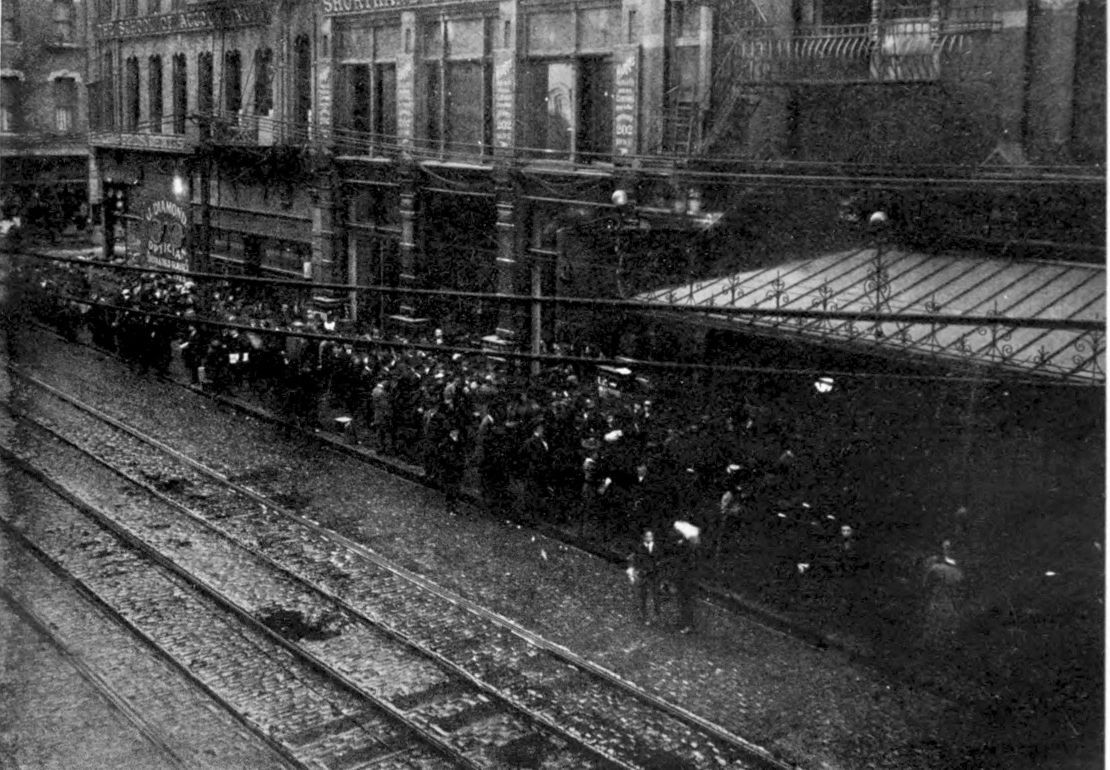
Photograph in Belasco’s Collection.
SCENE IN FRONT OF THE BELASCO THEATRE, PITTSBURGH, PA.
Ten o’clock in the morning, December 6, 1906: Opening of the sale of tickets for David Warfield’s engagement in “The Music Master”
the Belasco-Warfield contract, which covered the seasons of 1901-’02-’03, provided for a renewal at the end of that term. Brooks, accordingly, after “The Music Master” had been written on Belasco’s instigation and in large part by him and after it had been produced solely at his expense and risk, claimed a one-half interest in that prosperous venture and sought an injunction to prevent the play from being presented except under management of “Brooks & Belasco.” His claim was flatly disallowed in a decision of the New York Supreme Court, rendered by Justice Leventritt on October 31, 1904, in the course of which the court said:
“...Undisputed proof by affidavit is offered that the [three] theatrical seasons contemplated [in the Belasco-Warfield contract] ended about the first of May or at all events before the first of June. The alleged renewal was made by the plaintiff Brooks several weeks after this latter date.” Furthermore, held the court, “Whether the option [of renewal] in fact passed to the firm [of Belasco & Brooks]; whether, if it did, the plaintiff could exercise it, are questions open to grave doubt; but, conceding the right of the plaintiff Brooks, the papers show an exercise of the option after the close of the third theatrical season and insufficient proof of a custom that the right survived the termination of the season.... To enjoin a successful actor’s lucrative performance of a successful play under (sic) such circumstances, when in addition no question of financial responsibility is presented, would be to grant, in advance of trial, on insufficient proof, the very relief which the action itself seeks. Motion denied, with ten dollars costs.”
Belasco’s feeling about “The Music Master” and his esteem of and loyalty to his friend Warfield are pleasantly shown in a declaration which he made about them several years ago:
“From the time the play opened until the present day I have had many offers for it. George Edwardes promised an enormous guarantee if we would come to England. George Newnes, proprietor of ‘The Strand Magazine,’ said: ‘I am not a theatrical manager, but I want to bring your play and Mr. Warfield to England.’ Cyril Maude, Arthur Bourchier, and Sir Herbert Beerbohm-Tree all applied for the acting rights. Another great fortune could be made out of the piece were I to allow it to be played in stock and moving pictures, but I have turned a deaf ear to all inducements. ‘The Music Master’ is for David Warfield; more than that, The Music Master is David Warfield.”