Volume 1 — AN OPERATIC PROJECT.—PETTY PERSECUTIONS.—AN ARREST FOR LIBEL.
Reading edition
While demolition of the Republic Theatre and construction of its successor were in progress Belasco made an unsuccessful attempt to fulfil a purpose which he had cherished for several years,—the purpose, namely, to cause the writing of, and to produce, a series of true comic operas, American in theme but similar in character to the brilliant and delightful combinations of satire, melody, and fun which made famous the names of Gilbert and Sullivan. “I hoped,” he said, “to find a pair of American authors that could be developed into at least something like such a team as Gilbert and Sullivan, and for a while I thought I should succeed,—but it was too much to hope for.” As part of his plan for this operatic enterprise Belasco engaged the well-known singer Miss Lillian Russell, for whose talents he entertained high respect: “I know,” he has said to me, “that Lillian Russell could have done far finer things than ever she has done—and I wanted her to do them under my management.” Inability to obtain any musical play for Miss Russell’s use which was satisfactory to him finally compelled Belasco to release her from engagement and to abandon a project which, adequately performed, would have been of great benefit to our Stage.
From the time when it became publicly known that Belasco had assumed the management of a theatre of his own, in New York, until 1909, when self-interest at last reopened to him the long closed theatres dominated by the Theatrical Syndicate, he was made the object of an almost continuous series of attacks, annoyances, and persecutions, often merely petty, sometimes extremely serious, the origin of which is not always demonstrable but the motive of which, unmistakably, was to defame, hamper, and injure him in his professional vocation. Thus, a few days before the opening of his new theatre he was accused in several newspaper diatribes of having “stolen” the services of three prominent actors,—namely Lillian Russell, Blanche Bates, and David Warfield,—then under engagement to him, from other theatrical managers, regardless of prior contracts. The dispute on this subject has been top-loftically described as a tempest in a teapot, but as the accusation is, in fact, one of most dishonorable and illegal conduct the entire refutation of it should be recorded. Miss Russell wrote about the matter as follows:
“I am very proud to have it known that Mr. Belasco is to be my future manager, but it is doing him a great injustice to assert that he tried to get me away from other managers with whom I was under contract. He, emphatically, did nothing of the kind. Everything was done in the most amiable spirit among all concerned, and, as a matter of fact, he and I were brought together, in a business relation, entirely by outside parties.”
From Miss Bates came a letter in which she said:
“I was entirely free from all contract obligations when Mr. Belasco first made me an offer to come under his management. I left Liebler & Company quite voluntarily, as I did not care to go to London with ‘The Children of the Ghetto.’ I was therefore out of an engagement when Mr. Belasco sent for me to create the leading part in a new comedy.... I was given the greatest opportunity of my life in ‘Madame Butterfly,’ and I have grown from leading woman to a star under his management. And because I know that my artistic future is safer in his hands than with anyone else I would not for a moment consider an offer from another manager.”
And Mr. Warfield sent to Belasco by telegraph from Boston this request and statement:
“Please deny for me that I had one more year [of service under contract] at Weber & Fields’. I came to you having always had an idea you could better my position.”
A week before the first presentment of “The Darling of the Gods” in New York an allegation even more injurious was made against Belasco when several newspapers of the metropolis published affirmations by a female author, known as Onoto Watanna, to the effect that characters and incidents from two stories by her, “The Wooing of Wistaria” and “A Japanese Nightingale,” had been appropriated by Belasco and incorporated in “The Darling of the Gods” and that two acts of that play were pirated from a dramatization of one of those stories.
To these aspersions Belasco made prompt rejoinder by institution of a suit against Mrs. Bertrand W. Babcock, asking $20,000 damages for malicious libel. Mrs. Babcock was arrested, December 3, 1902, on a warrant issued in this action and held in $500 bail. At the time of her arrest Belasco made a statement as to his motives and feelings in bringing suit in which he said:
“My purpose in causing the arrest of Mrs. Babcock (Onoto Watanna) is to stop, once and for all, the groundless persecution to which I am subjected whenever I dare to present a new play. That my productions are thorns in the sides of several managers I am perfectly aware, but through Mrs. Babcock, who will now have to give an account of her claims against me in court, I hope to reach the real instigators of this attack against my integrity as a manager and a man. I have never met Mrs. Babcock in my life nor have I read either of her books, to one of which Klaw & Erlanger have announced that they have purchased the dramatic rights. The first I heard of Mrs. Babcock was about two months ago, at which time my play had neither been put in rehearsal nor read to any one who could possibly have told her of its plot, characters, or incidents. At that time she informed a prominent morning newspaper man that the firm of Klaw & Erlanger were very anxious to have her bring a suit against me for plagiarism. I laughed at the whole matter, for, knowing that ‘The Darling of the Gods’ was entirely original with Mr. John Luther Long and myself, I could not conceive of any person being foolish enough to make such a charge. But it was the last shot in my enemies’ locker. From the day I started work on this production I have been harassed in every direction. I am almost as anxious to get this case into court and settled at once and for all as I am to have the ‘Du Barry’ controversy clinched. All I claim is the right of any citizen to pursue his business unmolested.
“This whole affair from start to finish is a conspiracy to throw a nasty slur on my name as a playwright and manager on the eve of a new production in which I have invested a great deal of money: and with the courts to help me I intend to unmask a few of the real culprits. Furthermore, I find now that Mrs. Babcock’s story ‘The Wooing of Wistaria’ was not published until last September. Our play was finished early in June. By causing the arrest of this woman I hope, in addition to justifying myself, to establish a precedent whereby other playwrights, when they happen to be successful, may be able to take drastic means to protect themselves against similar persecutions.”
On February 6, 1903, at a hearing in this libel suit of Belasco’s, before Justice Leventritt, of the Supreme Court, Mrs. Babcock, in effect, withdrew the libel complained of (denying that she had made the defamatory allegations ascribed to her), and the order of arrest previously issued against her was, in consequence, vacated. The purpose of the aspersions made was, undoubtedly, that stated by Belasco.—A dramatization of Mrs. Babcock’s story of “A Japanese Nightingale” was produced by Klaw & Erlanger, at Daly’s Theatre, New York, November 19, 1903, with Miss Margaret Illington as Yuki, its chief female personage: the production of that play, it was generally understood in theatrical circles at the time when it was made, was designed to exhibit the authentic investiture and interpretation of a tragedy of Japan and thus to display the artistic and managerial superiority of Messrs. Klaw and Erlanger to Belasco: it was acted at Daly’s forty-four times and then withdrawn.
On May 30, 1903, the 186th performance of “The Darling of the Gods” occurred at Belasco’s Theatre, which was then closed for the season. On June 6, at Minneapolis, Minnesota, Belasco brought to an end a tour by Mrs. Leslie Carter and a theatrical company of 147 other players, presenting his “Du Barry,” which began at Brooklyn, New York,
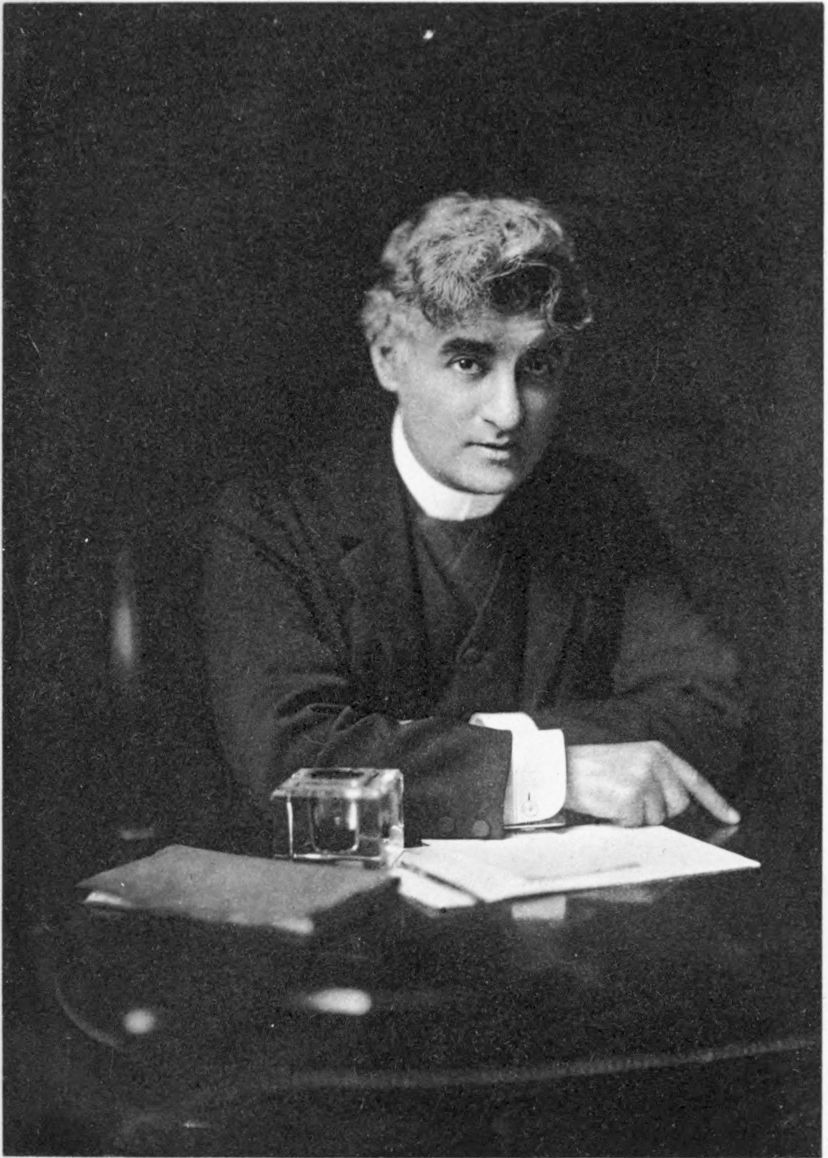
DAVID BELASCO
About 1889-’90
Photograph by the Misses Selby. Author’s Collection.
December 2, 1902, which comprehended forty-two cities (extending as far south as Galveston, Texas, and as far west as San Francisco), and which involved travel of more than 10,000 miles, during most of which the company was luxuriously transported on special trains.