Volume 1 — OPENING OF BELASCO’S STUYVESANT THEATRE:—“A GRAND ARMY MAN.”
Reading edition
Belasco opened his Stuyvesant Theatre, October 16, 1907, with a play entitled “A Grand Army Man,” written by himself in collaboration with Miss Pauline Phelps and Miss Marion Short,—that is, rewritten and made practical by Belasco, working on the basis of an amateur essay in dramatic authorship provided by those ladies. That play was first acted on any stage at the Hyperion Theatre, New Haven, Connecticut, September 23, the same year. It presents neither surprising ingenuity of construction nor uncommon felicity of style, but it tells a plain story in a plain way. The chord that is struck in it is that of romantic, almost paternal, altogether manly and beautiful affection. As a work of dramatic art it appertains to the class of comedies represented by such plays as “Grandfather Whitehead,” “The Porter’s Knot,” and “The Chimney Corner,”—plays in which the theme involves unselfish love and the sentiments and emotions that cling to the idea of Home. In that respect it reverts to a style of drama once, fortunately, dominant—at a time when the American Stage was illumined and adorned by such actors as Henry Placide, John Gilbert, John Nickinson, Charles W. Couldock, William Warren, and Mark Smith. The authors of it provided Warfield with a vehicle of dramatic expression that exactly conformed to the bent of his mind. The plot is simple, but by reason of being natural and being fraught with true, as opposed to false, emotion, its simplicity nowhere declines into insipid commonplace. The chief character, Wes’ Bigelow, is a veteran of the Grand Army of the Republic. He has never married. In youth he has loved a girl, but has not won her, and she has become the wife of one of his comrades. Years have passed, and the American Civil War has occurred. That comrade has been slain in battle. The widow has died: but she has left a child, that comrade’s boy, and Bigelow has adopted and reared him. The substance of the play is his experience with the fortunes of that ward.
It happens sometimes that a man whom a girl has rejected, and who remains unmarried because of his absorbing love for her, will fix his affection on her child,—she having married a more favored suitor and produced a family,—and will love that child as if it were his own. That happens to Bigelow. The son of his loved and lost idol is the light of his eyes and the joy of his heart. There is no labor that he will not do and no sacrifice that he will not make for the lad, of whom he ardently prophesies success and honor. The boy, Robert, has been intrusted with money, the property of the Grand Army veterans, and, instead of placing it in the bank, as directed to do, he has used it in speculation, and lost it. When the knowledge of that fault comes to the veteran he is, at first, stunned by it; then enraged; and then broken by the conflict between the sense of shame and the struggle of affection. He tries to thrash the boy with a horse-whip, but in that manifestation of wrath he fails: his cherished pet cannot have done wrong; has only erred through accident; can surely be redeemed; must, of course, make amends,—and all will be well. The case comes to trial, before a judge who, privately, is hostile to Bigelow, and measures are taken to insure conviction. The veteran offers to replace the money that has been taken by his ward,—supposing that the complaint will then be dismissed. That money he has obtained by sale of his personal effects, and also by means of a mortgage imposed on his farm. The old soldier makes an impassioned, pathetic appeal to the court, but the hostile magistrate cannot be appeased. Robert is convicted and is sent to prison for one year. A little time passes, and Robert’s sweetheart, the daughter of that malicious judge, leaves her father’s abode and seeks refuge with Bigelow and the kind old woman who keeps house for him. Robert is pardoned, at the intercession of the veteran’s military comrades, and he comes back, to his guardian and his love, on New Year’s Day.
Nothing could be more simple than that unpretentious idyl of Home. It is in situations of simplicity, however, that an actor is subjected to the most severe tests of his inherent power, his fibre of character, his knowledge of the human heart, his store of experience, his resources of feeling, and his artistic faculty of expression. Warfield endured that test, allowing the torrent of feeling to precipitate itself without apparent restraint, and, at the same time, controlling and guiding it. Such artistic growth he had evinced in his impersonation of the Music Master, and he evinced it even more effectively in his assumption of the Grand Army Man,—going to Nature for his impulse and obeying a right instinct of Art in his direction of it. In the portrayal of the noble, sweet-tempered, yet fiery old soldier he aimed especially at self-effacement, at abnegation of every motive or trait of selfishness. On finding that his boy loves the daughter of his enemy, and is by her beloved, the veteran is, almost at once, disposed to placate that enemy and favor those young lovers. There is, to be sure, a little reluctance, a little struggle in his mind; but that is soon over. The actor denoted that struggle and that surrender in a lovely spirit. In the tempestuous scene of Bigelow’s horrified consternation, the agonized conflict between anger and love, when the misconduct of the boy is exposed and confessed, and the old man, after trying to beat him as a felon, clasps him to his heart as only the victim of an unfortunate, venial error, the anguish and the passionate affection of a strong, even splendid, nature were expressed with cogent force. The appeal spoken in the courtroom,—an outburst of honest, simple, rugged eloquence, all the more fervid and poignant because unskilled and fettered,—had the authentic note of heartfelt emotion. In circumstances those situations, which are the pivotal points of the play, recall certain supreme effects in “Olivia” and “The Heart of Mid-Lothian,” but Warfield’s histrionic treatment of those situations was fresh and his achievement in them displayed him as an actor to whom the realm of pathos is widely open and who can move with a sure step in the labyrinth of the domestic emotions,—one of the most perplexing fields with which dramatic art is concerned. All observers know how easy it is, in treatment of themes of the fireside, the family, the home, to lapse into tameness. An actor must possess an ardent and beautiful spirit, and must be greatly in earnest, who can sustain such themes and invest them with the glow of passionate vitality. Some of the best of the managers and actors of an earlier, and as I believe in many ways a more fortunate, generation might well have been proud of placing before the public such a play and such an impersonation as Belasco and Warfield provided in “A Grand Army Man,”—a play and an impersonation instinct with fidelity to common life and yet far removed from commonplace. Warfield, as a player, possesses in a marked degree the charm ascribed to John Bannistere (one of the greatest serio-comic actors in theatrical annals), that he wins you immediately by seeming to care nothing about you. His identification with the character of Bigelow was absolute and he never, for even a moment, lapsed out of it. It had been long since such complete absorption, such living inside of a fancied identity, had been seen on the stage. The blending of humor and pathos was exceedingly fine, and it touched the heart even while it brought a smile to the lips.—“A Grand Army Man,” together with “The Music Master,” was acted at the Stuyvesant Theatre until May 2, 1908, when Warfield’s season closed. On the opening night Belasco, called upon the stage by a brilliant and enthusiastic audience, made a brief speech, saying:
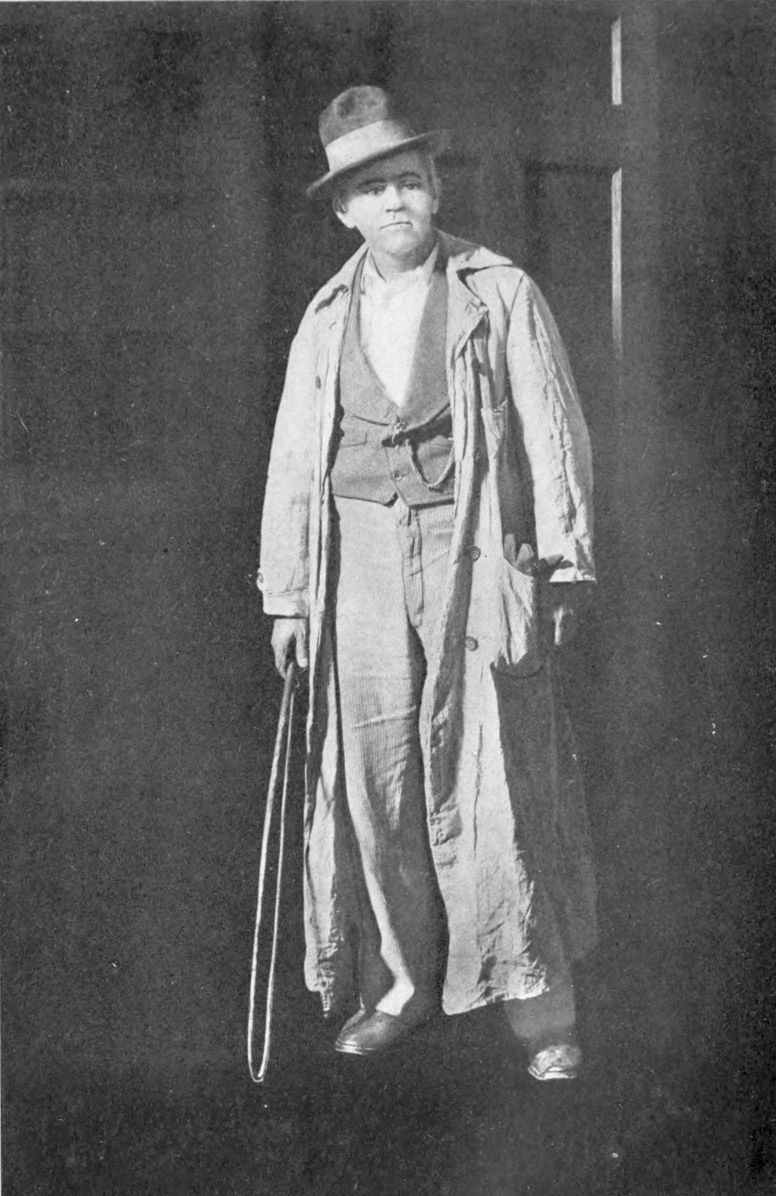
Photograph by Byron. Belasco’s Collection.
DAVID WARFIELD AS WES’ BIGELOW, IN “A GRAND ARMY MAN”
“I am very grateful, ladies and gentlemen, that you have given me this opportunity to speak a few words of welcome to you—of welcome warm as heart can make it, to each and every one of you, the friends who have been kind enough to honor me by coming to this little house-warming to-night in our new, and, I hope, our permanent, home. It is a privilege to come before you; to see you here; to see and recognize, as I do, so many of the faces of those who have given me their support ever since I came here from that dear, far-off city of the West where I was born. It gives me such great happiness, ladies and gentlemen, to see you here; to know, as I do know by your generous applause, that you like the play we have produced for you and that you still love, as I am sure you do, that splendid actor and loyal and dear friend of yours and mine, Mr. David Warfield, who is playing here so beautifully to-night. Ladies and gentlemen, I hardly am able to express myself to you. In one of the great plays in which I myself used to act, many, many years ago—and which, before I die, I hope to have the privilege of placing before you, here, in New York—there is a speech that has kept coming back into my mind all this evening, as I have listened to your applause and tried to think what I could say to you:
“‘You have bereft me of all words, Only my blood speaks to you in my veins.’
“But I think that you must know what I wish to express, that you must understand without any words what it means to me to have you here to-night, and to know that all the lies and all the perjuries that have been printed and spoken against us cannot shake your approval and support. We need it! Remember, we are only a handful, fighting against a mighty Trust: but, ladies and gentlemen, this little theatre flies the flag of independence, and as long as we have your approval and support and sympathy nobody can dictate to us and nobody can ‘put us out of business.’ And I am sure that we shall have you with us just as long as we deserve it, and we shall strive to deserve it and to serve you and the beautiful Art we all love just as long as we live. I thank you, again and again, for all of us,—for Miss Phelps and Miss Short, and for Mr. Warfield and for my company and all my associates as well as for myself,—and again and again I bid you heartily welcome to this little new theatre.”
This is the original cast of “A Grand Army Man”:
Wes’ Bigelow David Warfield.
Judge Andrews Howard Hall.
Captain Bestor Reuben Fax.
Jim Bishop George Woodward.
Cory Kilbert Of the James Lackaye.
Let’ Pettingill G. A. R. Stephen Maley.
Comrade Potter Tony Bevan.
Comrade Tucker Thomas Gilbert.
Comrade Tate Henry F. Stone.
Robert, Wes’ Bigelow’s adopted son William Elliot.
Rogers Wellman Taylor Holmes.
Hickman John V. Daly.
The Drummer-Boy of the Rappahannock John Morris.[5]
Hallie Antoinette Perry.
Letitia Marie Bates.
Mrs. Bestor Amy Stone.
Alida Bestor Veda McEvers.
Mrs. Pettingill Jane Cowl.
Mrs. Kilbert Louise Coleman.