Volume 1 — A DRAMA OF PSYCHOLOGY.—“THE CASE OF BECKY.”
Reading edition
Belasco produced “The Case of Becky” for the first time, October 30, 1911, at the New National Theatre, Washington, D. C., but it was not until October 1, 1912, that, at the Belasco Theatre, the piece was first made known in the metropolis. It is a psychological “study,” in dramatic form, based on a play by Edward Locke, entitled “After Many Years.” Locke (who entered Belasco’s employment to study stage management and who for a time acted a small part in “The Music Master”) read his play to Belasco,—who, perceiving in it possibilities of novel and striking dramatic effect, at once accepted it, with the understanding that it should be rewritten under his supervision. That stipulation was agreed to and partially fulfilled,—the rewriting being (as in a great many other similar instances) done largely by Belasco. The members of the company which eventually acted in the drama could conclusively testify to this fact, since much of that labor was performed in their presence, at rehearsals.
The name finally bestowed upon this piece is “The Case of Becky.” It is in three acts, requires only two scenic settings, implicates seven persons, and is an ingenious and interesting play on a painful but important subject,—namely, disease or disorder affecting human personality. The chief characters in it are Dr. Emerson, an eminent physician who employs hypnotism in psychiatry; Professor Balzamo, an itinerant and unscrupulous hypnotist of extraordinary power, and a girl named Dorothy. This girl is the victim of a dreadful metempsychosis and is often mysteriously changed from her normal, lovable personality,—in which she is sweet-tempered, affectionate, gentle, and refined,—into a common, mischievous, vindictive hoyden who is designated as Becky. Dr. Emerson is laboring to reëstablish her permanently in her normal consciousness by means of hypnotism,—an object which, ultimately, he attains. It is incidentally revealed that many years earlier Balzamo, exercising his hypnotic faculty, has compelled Emerson’s wife to leave her husband and travel with him, as a subject for use in brutal and degrading exhibitions of hypnotism. While in that helpless bondage the daughter, Dorothy, has been born (her psychic disorder being attributable to the prenatal effect of abuse of her mother) and the miserable woman has died. Chance has installed Dorothy as a patient in the home of her father, who, while ministering to her in affliction, does not know her
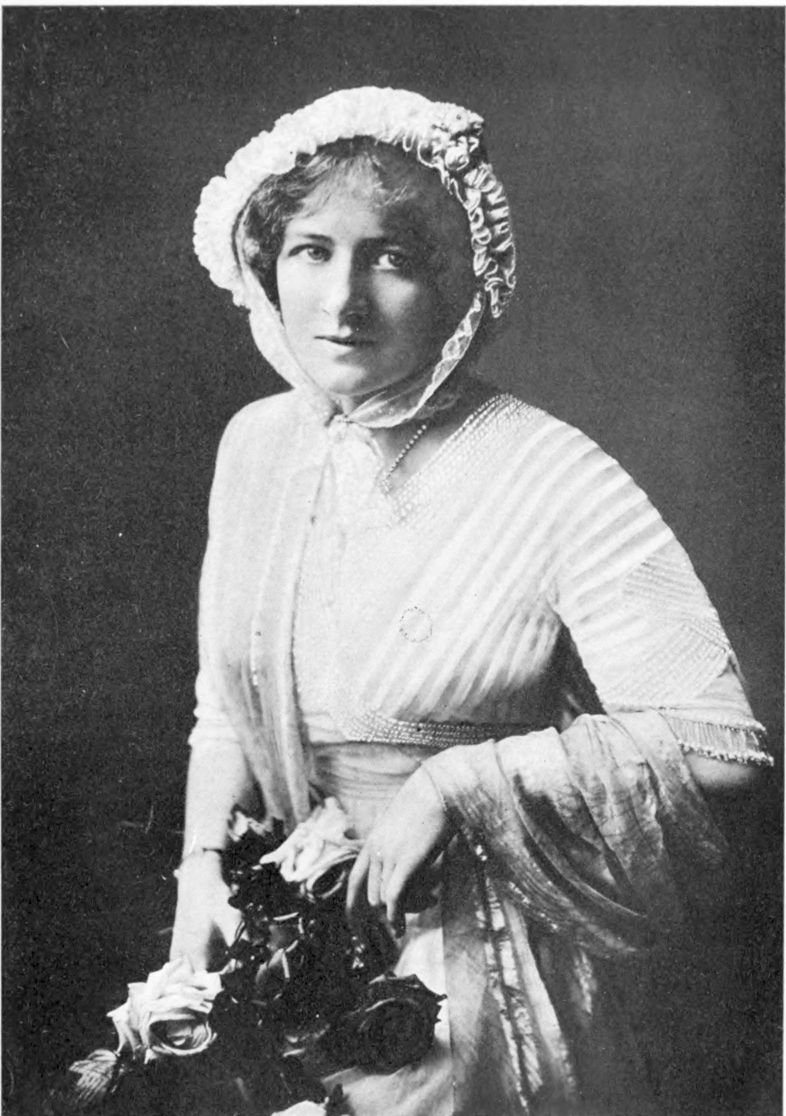
FRANCES STARR AS BECKY, IN “THE CASE OF BECKY”
Photograph by White. Belasco’s Collection.
as his child. Balzamo, learning the whereabouts of the girl and desirous of recovering custody of her, in order to utilize her as a subject, visits Emerson and seeks to reëstablish his control over Dorothy, begun when she was a little child. The Doctor is led to suspect the originative facts in “the case of Becky” which are unknown to him; a conflict of wits and powers ensues between him and Balzamo; the latter is, by a trick, subdued and thrown into hypnosis,—in which state he is compelled to confess the truth and is then deprived of his hypnotic power.
Belasco, writing about this singular play—in which he presented Miss Frances Starr for more than two years—has recorded:
“I had begun work on the manuscript of my play for Miss Starr called ‘Jennie’ when I received a letter from Mr. Locke about ‘After Many Years.’... It was rewritten and renamed ‘The Case of Becky,’ and in the writing of it we were guided by Dr. Morton Prince’s ‘The Dissociation of a Personality.’ I felt that in a hypnotic study of this kind I must not resort to the broad theatricalism of ‘Trilby’ or ‘Dr. Jekyll and Mr. Hyde.’ I was dealing with a dual personality, and I gave Miss Starr the arduous task of slipping from innocence into viciousness, in the presence of an audience, without resorting to any outward trickery. Those hypnotic scenes were written while the company was rehearsing on the stage.”
It is interesting to note that the method prescribed for Miss Starr by Belasco, in acting Dorothy and Becky, is the same which Henry Irving declared should be employed in acting Jekyll and Hyde: Irving bought the English dramatic rights to Stevenson’s story about that dual character, intending to put his theory about impersonating it into practice, but he never did so.—This was the cast of “The Case of Becky”:
Dr. EmersonAlbert Bruning.
Dr. PetersHarry C. Browne.
John ArnoldEugene O’Brien.
Professor BalzamoCharles Dalton.
ThomasJohn P. Brawn.
Miss PettingillMary Lawton.
Dorothy (“Becky”)Frances Starr.
“I was as much surprised as I was delighted,” said Belasco, “by the popular success of ‘The Case of Becky,’—which was entirely unexpected.” His delight was considerably moderated by the prompt appearance of a couple of discontented playwrighting amateurs, alleging plagiarism. Their names were Amelia Bachman and George L. McKay; they asserted that “The Case of Becky” was taken from a drama which they had written, called “Etelle”; their suit was brought in June, 1912; it was tried, May 13 and 14, 1913, before Judge Julius M. Mayer, in the United States Circuit Court, and it was decided against them, “upon the merits,” on July 9. That decision was appealed, the appeal was argued before the United States Circuit Court of Appeals, April 6, 1914, and decision in favor of Belasco was affirmed. In rendering the original decision Judge Mayer said:
“...The writing of the play by Mr. Locke was the natural outcome of his interest in themes dealing with hypnotic influence and multiple personality, and when he was attracted by ‘How One Girl Lived Four Lives,’ by John Corbin, and [by] Dr. Prince’s book, he was at work on ‘The Climax,’ a play in which hypnotism or mental suggestion is the predominant feature.
“I am also satisfied, beyond any doubt, that Mr. Belasco never saw, read or heard of ‘Etelle’ prior to his acceptance of Locke’s play and Miss Bachman testified that her play had its foundation in the idea suggested by John Corbin’s article. That being so, and the facts found by me being as stated, it follows that complainants have no case. ‘The Case of Becky’ is, in substantial respects, different from ‘Etelle.’... It is to be expected that two playwrights, working independently from a common source, may develop similarities in their plots, but ‘The Case of Becky’ displays the skill of the experienced playwright in a number of important particulars and details not found in ‘Etelle.’”