Volume 1 — THE CREATION OF DRAMATIC EFFECTS.—DIFFICULTIES WITH THE RIVER OF SOULS.
Reading edition
Supreme dramatic effects are, as a rule, produced in the Theatre as results of patient, prescient labor, using known, definite means to definite foreordained ends,—as, for example, in such perfect histrionic epitomes as Shylock’s return through the lonely midnight streets to his deserted dwelling, as arranged by Irving; the momentary shuddering horror of Mansfield’s King Richard the Third, when, alone, in the dusk, seated upon the throne to which he has made his way by murder, he sees his hand bathed blood-red in a seemingly chance-thrown beam of light; the exquisitely poetic and lovely scene of the serenade, in “Twelfth Night,” invented by Daly, in which the theme of the comedy is pictured without a word; or the long, dreary vigil of Madame Butterfly, waiting
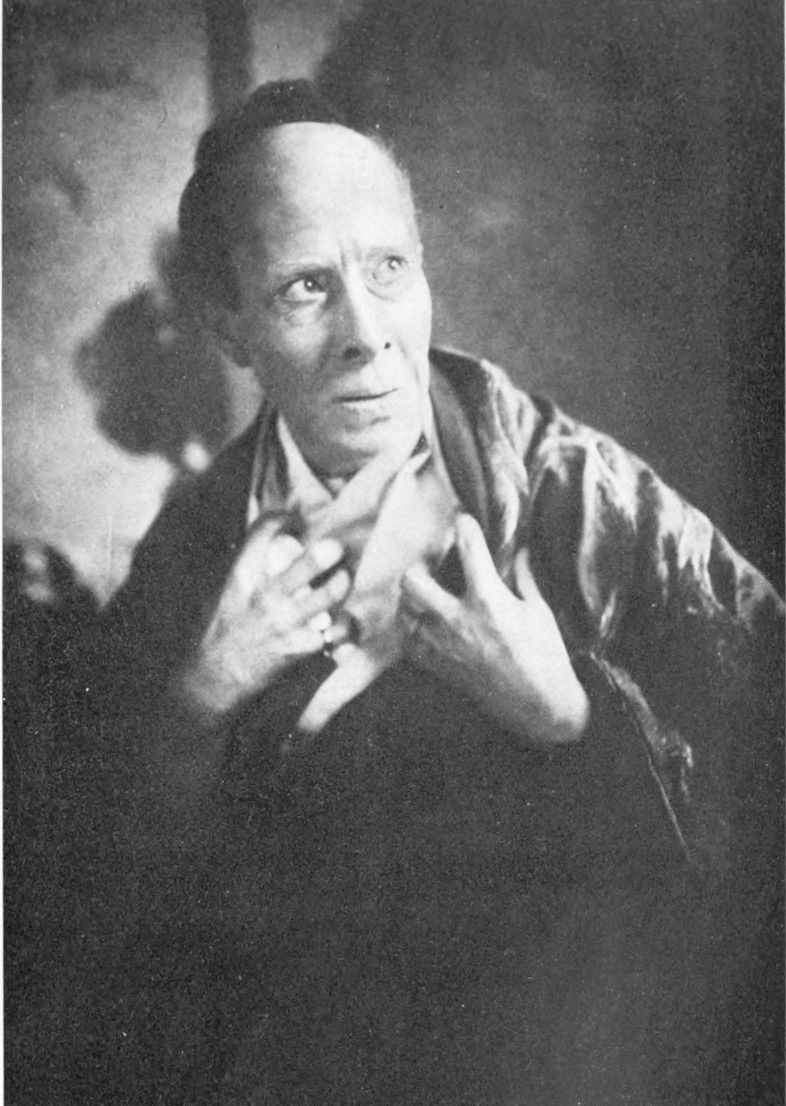
Photograph by Livingston Platt. Belasco’s Collection.
GEORGE ARLISS AS ZAKKURI, THE MINISTER OF WAR, IN “THE DARLING OF THE GODS”
through the night for her recreant lover, devised by Belasco. Sometimes, however, even the most resourceful of stage managers, though possessed of perfectly clear purpose, find themselves baffled and balked in every endeavor to embody a picture in action and create a designed effect: it is with them as it is with a painter who, while knowing exactly what he desires to depict and, theoretically, exactly how to paint it, nevertheless fails again and again in his attempts to do so, until, as sometimes happens, chance seems to point a way to achievement. Such an experience came to Belasco, in his execution of the imaginative and lovely scene of the River of Souls, in this Oriental tragedy. Writing of it, he records the following interesting recollection:
“There was one scene in ‘The Darling of the Gods,’ called the River of Souls, which drove me almost mad and very nearly beat me. It was a sort of purgatory between the Japanese Heaven and the Japanese Hell. I engaged twenty young girls who were supposed to represent the floating bodies of the dead, but they wouldn’t float. No matter how hard I tried, the twenty souls looked like twenty chorus girls. Night after night, I kept the young ladies and a number of carpenters at work, but the illusion could not be carried out. The play was produced in Washington, and during the last rehearsal the River of Souls was the blot on the production; in fact, I had postponed the opening for three nights because of this scene. At last I made up my mind to give it one more trial and if it could not be improved to cut it out. Dawn found Miss Bates asleep in a stage-box, the company curled up on properties, the carpenters and electricians ready to drop, and the River of Souls as bad as ever. So I threw up my hands. ‘Thank you, ladies and gentlemen,’ I said, ‘out goes the River of Souls.’ I gave the order to strike [to clear the stage of scenery]. At that moment all set-pieces were pulled apart, the gauze curtain was down, and two calcium lights were at the back of the stage. As the scene-shifters drew up the back drop a carpenter walked across. His shadow was thrown several times on the shifting gauze in a most spectral fashion. ‘Stop!’ I called out. ‘Stop where you are! Don’t move! Don’t move!’ The poor carpenter halted in his tracks: he must have thought me mad. ‘We’ve got it!’ I exclaimed. I sent out for coffee and rolls, and called another rehearsal at six in the morning. I must say everyone rejoiced with me. When we finished breakfast I had the gauze so arranged as to catch the shadows of the young ladies whose souls were supposed to be floating between heaven and hell. I threw away the expensive paraphernalia, and instead of permitting the young women to be suspended in the air they walked behind the gauze, stretching out their arms as though floating through the strong rays of light. I have shown many different scenes, but none so baffling as this and none more impressively effective.... When I met Sir Herbert Beerbohm-Tree, who produced ‘The Darling of the Gods’ in London, he said that as he read the description of this effect in the manuscript he had not believed it could be carried out.”
“The Darling of the Gods” was one of the most costly and least profitable of all Belasco’s many lavish productions: the original investment exceeded $78,000 and the expenses of presentment were so great that, notwithstanding it was acted to immense audiences, at the end of two years he had gained with it only $5,000.