Volume 1 — THE SEASON OF 1909-’10: “IS MATRIMONY A FAILURE?”—“THE LILY”—AND “JUST A WIFE.”
Reading edition
Belasco produced three new plays in the season of 1909-’10,—“Is Matrimony a Failure?”, “The Lily,” and “Just a Wife.” “Is Matrimony a Failure?” is a clever farce, adapted by Leo Ditrichstein from a German original, “Die Thür ins Freie,” by Oscar Blumenthal and Gustav Kadelberg. It relates to the ancient, evergreen subject of conjugal friction,—which, in this instance, seems intolerable but proves indispensable,—and it implicates ten married couples and one pair of prospective connubialists. The scene is a pleasant country town in New York. A coterie of husbands has grown restive under what is deemed to be an excessive exercise, by their wives, of matrimonial authority. A lawyer named Paul Barton visits the town to settle the estate of an old Justice of the Peace, recently deceased, ascertains that the wedding ceremonies of the various couples implicated were performed by that official’s clerk, in the absence of his employer, and declares them to be illegal. The husbands decline to validate their marriages unless their wives agree to permit them greater freedom than they have enjoyed, and, leaving their homes, establish themselves at a neighboring inn,—where they soon find that, however irksome may have seemed the dominion of their wives, it is immensely preferable to the total lack of their society. More particular rehearsal of the complications, cross-purposes, and conflicts woven about this posture of circumstance would be superfluous: they were not less comic and amusing because the legal quirk upon which the original play was based is inapplicable under the law of the State of New York. The farce was exquisitely set and admirably played,—especially by that excellent light-comedian and lovable man, the late Frank Worthing,—and it enjoyed acceptance bounteous and remunerative. “Is Matrimony a Failure?” was first acted at Atlantic City, New Jersey, August 29, 1909, and, in New York, at the Belasco Theatre, on the 23d of that month,—with the following cast:
THE HUSBANDS.
Skelton PerryFrank Worthing.
Hugh WheelerW. J. Ferguson.
Frank BoltJames Bradbury.
Albert RandEdward Langford.
Jasper StarkJohn F. Webber.
David MeekF. Newton Lindo.
Dr. HoytRobert Rogers.
George WilsonMarshall Stuart.
Lem BordenGilmore Scott.
Herman RinglerFrank Manning.
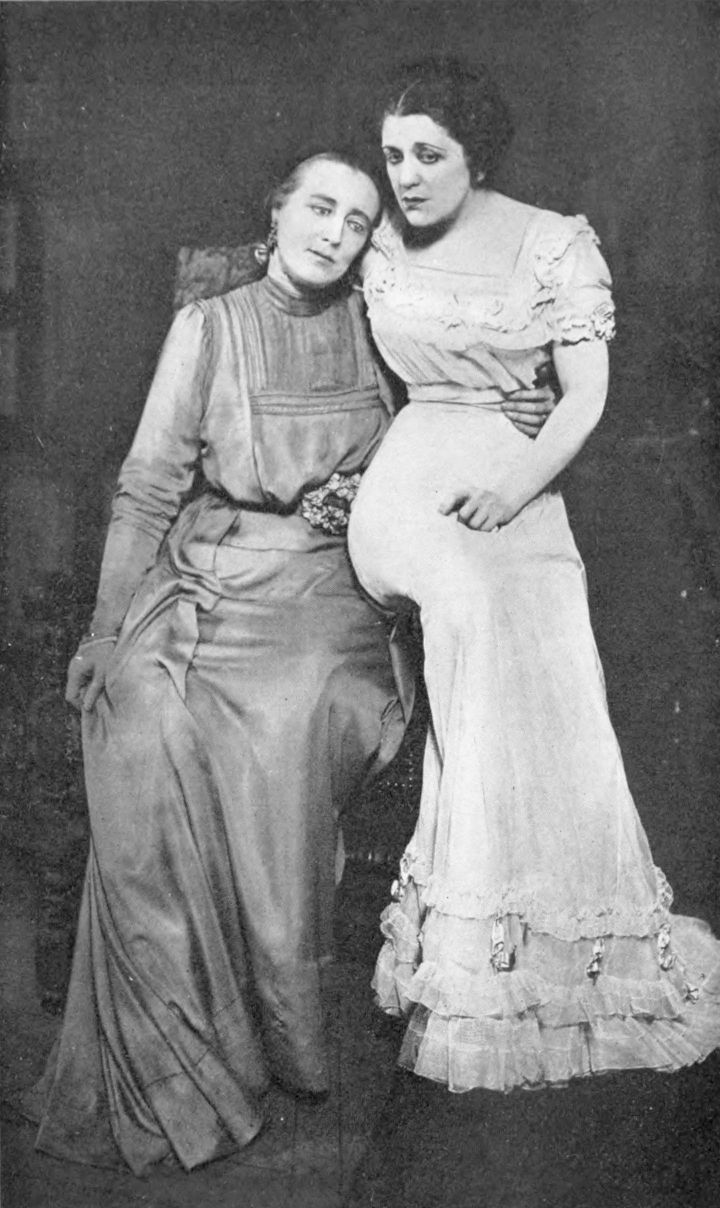
Photograph by White. Belasco’s Collection.
NANCE O’NEILL AS ODETTE DE MAIGNY AND JULIA DEAN (THE YOUNGER) AS CHRISTIANE DE MAIGNY, IN “THE LILY”
THE WIVES.
Fanny PerryJane Cowl.
Kate WheelerLouise Mackintosh.
Madge BoltAnne Sutherland.
Alice RandLouise Woods.
Annie StarkLou Ripley.
Lucy MeekGretta Vandell.
Helen HoytBlanche Yurka.
Julia WilsonHelen Braun.
Natalie BordenJulia Reinhardt.
Sadie RinglerJosie Morris Sullivan.
———
Paul BartonWilliam Morris.
Lulu WheelerJane Grey.
CarrieHelen Ferguson.
“Jane Cowl,” said Belasco, “had been with me for several years, understudying many parts in different plays, acting ‘bits,’ and working hard. I felt that she had earned her chance, and I gave it to her in ‘Matrimony.’ Her performance was splendid and she has been successful ever since.”
“The Lily” is a play in four acts, adapted by Belasco from a French original, “Le Lys,” by MM. Pierre Wolff and Gaston Leroux. It was produced for the first time, December 6, 1909, at the Belasco Theatre, Washington, and was first acted in New York, at the Stuyvesant, December 23. The story of this play is one of domestic tyranny, possible in France but impossible in America, and one which, accordingly, inspired only tepid interest in the American public,—although the treatment and presentation of it were in a high degree theatrically effective. This is the substance of that story: The Comte de Maigny, a profligate Frenchman who is also a father and a widower, tyrannizes over his children. The eldest of those children, Odette, is “the lily,”—a woman of thirty-five who, in girlhood, has been parted by her father from the man she wished to marry and who has become a mere domestic convenience, dwelling in lonely celibacy as her father’s housekeeper and lavishing her affection upon her sister, who is ten years younger. That sister, Christiane, is destined by their father for the same barren existence, but she meets a strolling artist, who wins her love and with whom, because he cannot wed her,—being already married to an uncongenial woman who will not divorce him,—she enters into an illicit relation. De Maigny has contrived to arrange a loveless marriage between his son and the young daughter of a man of great wealth,—being intent thus to obtain money for libidinous self-indulgence. The relation of Christiane and her artist becoming known to that person, he breaks off the marriage of his daughter with Christiane’s brother, not explicitly stating his reason but with ambiguous givings out which intimate it. The chief scenes of the play then follow. The infuriated licentiate badgers his unfortunate daughter, who, at first, lies to protect herself, until, at last, he elicits from her a rebellious, exultant declaration of the truth. Then, in the fury of his disappointed cupidity, he is about to beat her, when the long-suppressed, meek-seeming but actually passionate Odette, opening her valves under an immense and rising pressure of emotional steam, intervenes, denouncing the conventions of society in general and the iniquities of de Maigny in particular, certifying to the propriety of her sister’s conduct in the wretched circumstances existing, and declaring her purpose to protect that sister in her natural desire for “love and happiness.” Christiane then departs with her lover and the expectation of deferred matrimony, and her disgruntled parent, practically ejected from his home, goes off to Paris, whining that a waiter will probably close his eyes in death,—a pious kindness which the spectator hopes may be performed at an early date.
The play, of course, was devised for the sake of the sudden, blistering outburst by the elderly spinster—which in representation is undeniably effective—and, in the French original, for the sake of emitting some specious special pleading in extenuation and justification of illicit conduct. As to the doctrine which Odette declares in this play and which Christiane and her unhappily married swain exemplify,—the doctrine, namely, that when two persons who love each other are held asunder by cruel chance of social circumstance they are warranted in setting aside convention in order to come together,—its utter fallacy is too obvious for detection. Practical application of it, however, has often provided variously dramatic results: pathetic exposition of some of its possible consequences, to helpless, innocent persons, is made in Collins’ great novel of “No Name.” Belasco, in presenting his modified version of “Le Lys,” sought to evade the ethical issue, but he added one more to his long list of plays perfectly environed and admirably acted. Miss Nance O’Neil, who appeared in it as Odette, has been designated as a “tragic actress” (which she is not) and has been extravagantly extolled. She possesses rough natural ability, animal strength, vocal capacity, some sensibility and considerable power of forceful simulation. Most of her performances have been monotonous: in this one, in which, practically, she had only one scene and in which, furthermore, she had the advice and assistance of a consummate stage manager, she was interesting and impressive,—uttering the verbal explosion
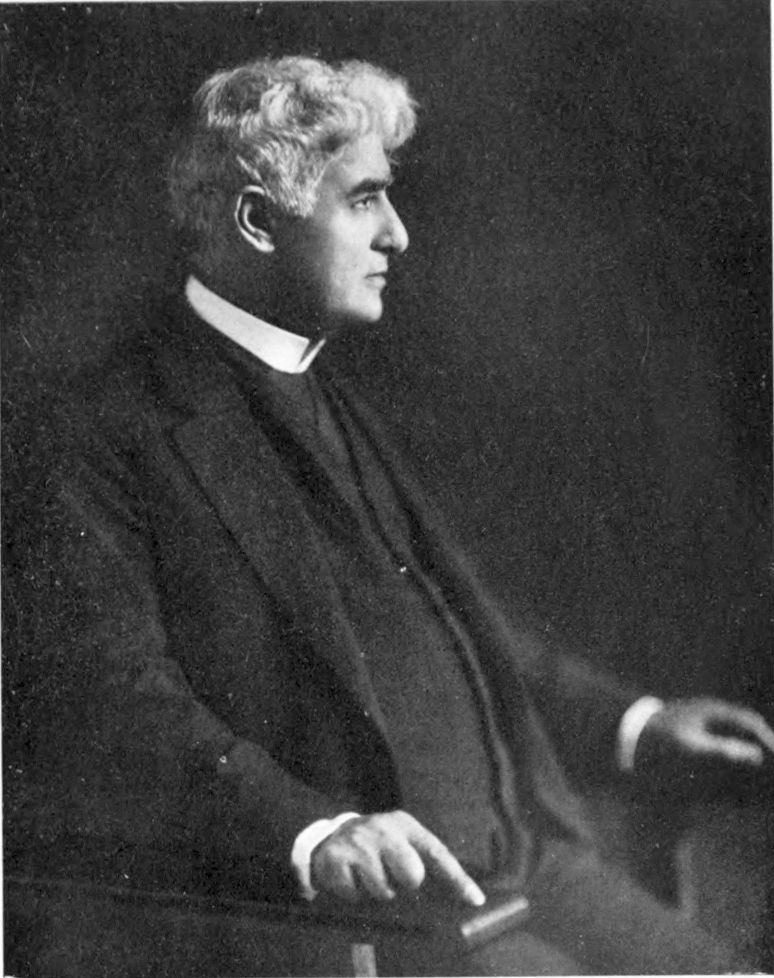
Photograph by the Misses Selby. Author’s Collection.
BELASCO, ABOUT 1911
of voluble vehemence addressed to de Maigny with fine abandon, passionate intensity, and powerful effect.—The cast of “The Lily” is appended:
Comte de Maigny Charles Cartwright.
Vicomte Maximilien de Maigny Alfred Hickman.
Huzar Bruce McRae.
Georges Arnaud Wm. J. Kelly.
Bernard Leo Ditrichstein.
Emile Plock Dodson Mitchell.
Joseph Marshall Stuart.
Jean Douglas Patterson.
Michel Robert Robson.
Odette De Maigny’s Nance O’Neil.
Christiane daughters Julia Dean.
Lucie Plock Florence Nash.
Suzanne Ethel Grey Terry.
Alice Aileen Flaven.
“Just a Wife” was written by Mr. E. Walter and was first acted at the Colonial Theatre, Cleveland, Ohio, January 17, 1910, and at the Belasco Theatre, New York, on the 31st of that month. As a playwright that writer has exhibited a persistent, morbid preoccupation with the subject of illicit sexual relations which suggests the possible utility of vigorous open-air exercise, the cold sitz-bath and potassium bromide. In this play a libertine named John Emerson, who has consorted with a widow named Lathrop until their relation has become a public scandal, by way of “keeping up appearances” marries an impecunious vestal from South Carolina, named Mary Ashby. As he immediately installs Mrs. Emerson in a luxurious rural habitation somewhere on Long Island and practically deserts her, this expedient would hardly seem to be of much social service. However, after neglecting his wife for about six years, Emerson grows weary of his mistress, quarrels with her and runs away from her to visit his wife. The mistress, much incensed, follows him, and a sort of three-cornered debate,—protracted, sophistical, and indelicate,—on the sexual relation is held at Mrs. Emerson’s country residence, in the course of which that lady manifests a sweet temper and admirable self-control. After it is over, Mrs. Lathrop (to whom it has been intimated that in men the ruling passion is sex impulse and that she is growing somewhat elderly) goes away in a peaceful and much chastened mood. Mrs. Emerson then snubs her neglectful spouse and signifies that he may not hope to possess her as his wife until he has recognized the supremacy of Love, which it is implied he will soon do. It is all very edifying, of course,—especially as the author of it, apparently, knows as much about love, as distinguished from carnal concupiscence, as a tomcat on the tiles does. This was the cast:
John EmersonEdmund Breese.
Bobby AshbyErnest Glendinning.
Maxcy Steuer“Bobby” North.
WellesleyFrederick Burton.
Mary Ashby EmersonCharlotte Walker.
Eleanor LathropAmelia Gardner.