Volume 1 — IN THE MATTER OF STAGE LIGHTING.
Reading edition
A much needed addition to the technical literature of the Theatre is a comprehensive, authoritative, and just account of the origin and development of modern stage mechanism and of the art of stage lighting. The pioneer achievements of Edwin Booth, at Booth’s Theatre (opened, February, 1869), and of James Steele Mackaye and Augustin Daly are, as a rule, blandly ignored in writing on those subjects, and the movement for “Stage Reform” which began in Austria in 1879-’80 is taken as the starting-point. If ever such an account is written, laborious experiments and fine achievements by David Belasco, especially in the latter field, will, of necessity, occupy a conspicuous place in it. His active practical interest in the problems of stage lighting began as early as 1876 and it has not abated. The first attempt in America to use electric light for stage illumination,—at least, the first attempt of which I have found a record,—was made at the California Theatre, San Francisco, February 21 to 28, 1879. Belasco was there at that time and carefully observed the experiment, which was not notably successful.[3] From 1879 to 1902 he closely studied all methods of lighting and experimented much: since 1902, when he opened his first theatre and obtained satisfactory facilities for the work, his experimentation in that field has been incessant. The lighting system at the Stuyvesant Theatre was designed by Belasco in collaboration with his chief electrician, Mr. Louis Hartman, and was installed under their supervision. When that theatre was opened, the lamps of the footlights on the stage, and also those in each of the overhead “border light strips,” were arranged in seven sections, each section connected upon separate resistance, in order that any desired part of the stage or any figure or group of figures might be illumined or shadowed as desired. There were five sets of the border lights, with 270 lamps in each; there were eighty-eight connection pockets in the fly galleries and upon the stage through which large or small “bunch lights” could be connected as required; the switchboard (one of the largest, if not the largest, then in use in an American theatre) was equipped with seventy-five dimmers, in order that the lights should be under perfect control. Since the opening, in 1907, the lighting system has repeatedly been altered and improved. The most radical change is one made about two years ago [1917], whereby footlights are entirely dispensed with. The objection to footlights is, of course, an upward thrown shadow: this, however, can be satisfactorily dealt with, and, in my judgment, it is seldom if ever advantageous wholly to discard them. Belasco, however, thinks otherwise: his productions are the only ones made without footlights, which I have seen, in which the absence of those lights is adequately compensated. In his present theatre there is a contrivance, placed in the front of the first balcony, which, while the curtain is down, appears to be an ornamental glass panel about six feet long. When the curtain is raised, however, shutters in the front of that panel are opened by an electrical device operated at the switchboard on the stage, and a singular bright light, which is transmitted without casting perceptible rays, is diffused upon the stage, bringing the
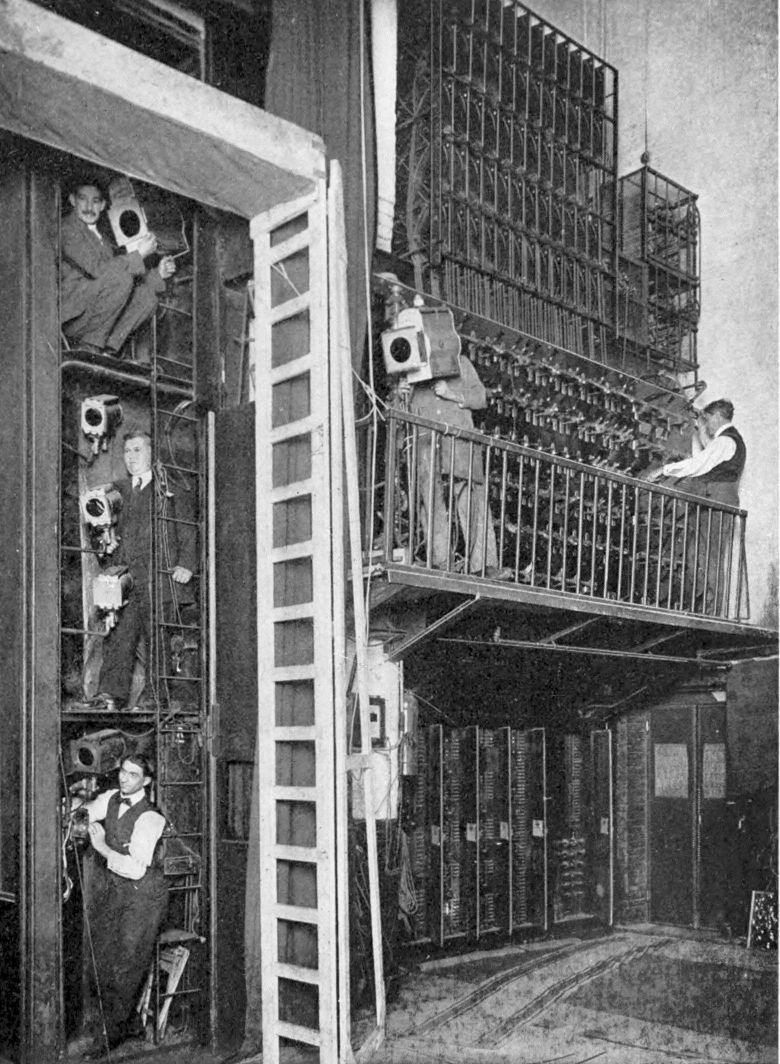
Photograph by White. Belasco’s Collection.
SWITCHBOARD OF THE SECOND BELASCO THEATRE, NEW YORK
actors into clear vision.—It is not practicable to pursue this subject further in this place; but readers will, perhaps, realize the importance Belasco attaches to the art of lighting as an adjunct to acting and the care he lavishes upon it when they are informed that the experimental workshop in his theatre is operated all the year round and that in many instances the expense of his light rehearsals alone has exceeded the total of all other costs of production. Perhaps the most perfect example of stage lighting ever exhibited was provided in Belasco’s presentment of “The Return of Peter Grimm,”—and that was the result of nine and a half months of persistent experimentation. Dilating on this subject, Belasco has said with justified wrath:
“I think that we may fairly and without vanity claim to have revolutionized stage lighting. I confess that I have at times felt some annoyance when I have been informed by young writers in the press,—who were not born until long after I had made great improvement in lighting,—that in dispensing with footlights I have ‘imitated’ Mr. Granville Barker, Mr. Max Reinhardt, and various other so-called ‘innovators.’ Such statements are nonsensical. My first regular production without ‘foots’ was made in 1879,[4] when I staged Morse’s ‘Passion Play’ in San Francisco. And I did without them in several other productions, at the Madison| Square Theatre, in ‘The Darling of the Gods,’ and in ‘Adrea.’ When I produced ‘Marie-Odile’ there was a lot of newspaper talk on this subject, but the talkers were such poor observers that they didn’t know I had been using the same system of lighting I used in ‘Marie-Odile’ for more than three months before, in ‘The Phantam Rival’! A little of Mr. Barker’s work as a producer has been seen in this country and he has had success in England. He seems to be a very talented man and I always admire ability and so I admire him and am glad to see him succeed. But without unkindness I must say that I have no need to ‘borrow’ from Mr. Barker; and as he must know that I never have done so I wonder a little that he has not rebuked these writers who would push him up by pulling me down. Many of the appliances we use in my theatre are invented and made in my own shop; many others are made outside, to specifications we provide. My new system is, I believe, a great step toward the perfection of stage illumination. By means of it footlights, in my opinion, are made unnecessary for any play, and they are no longer a part of the illumination of my stage. All the light comes from above, as in nature; but in order to accomplish this I built an entirely new proscenium arch. A great iron hood, following the lines of the stage, hangs behind the proscenium. The hood contains lights of varying power, and by means of reflectors, invented and manufactured in my own shop, the illumination is diffused without casting shadows. The glare of the footlights is a thing of the past so far as I am concerned. My stage was also reconstructed so as to extend out into the auditorium over the orchestra pit. These changes bring the audience into more intimate touch with the scene on the stage.”