Volume 1 — BELASCO AND DAVID WARFIELD:—THEIR FIRST MEETING.
Reading edition
“Under Two Flags” was acted at the Garden Theatre until June 3, 1901, when that house was closed for the season and Belasco turned his attention to preparations for the appearance of Mrs. Carter in a new play and for the bringing forward of David Warfield as a star in the legitimate
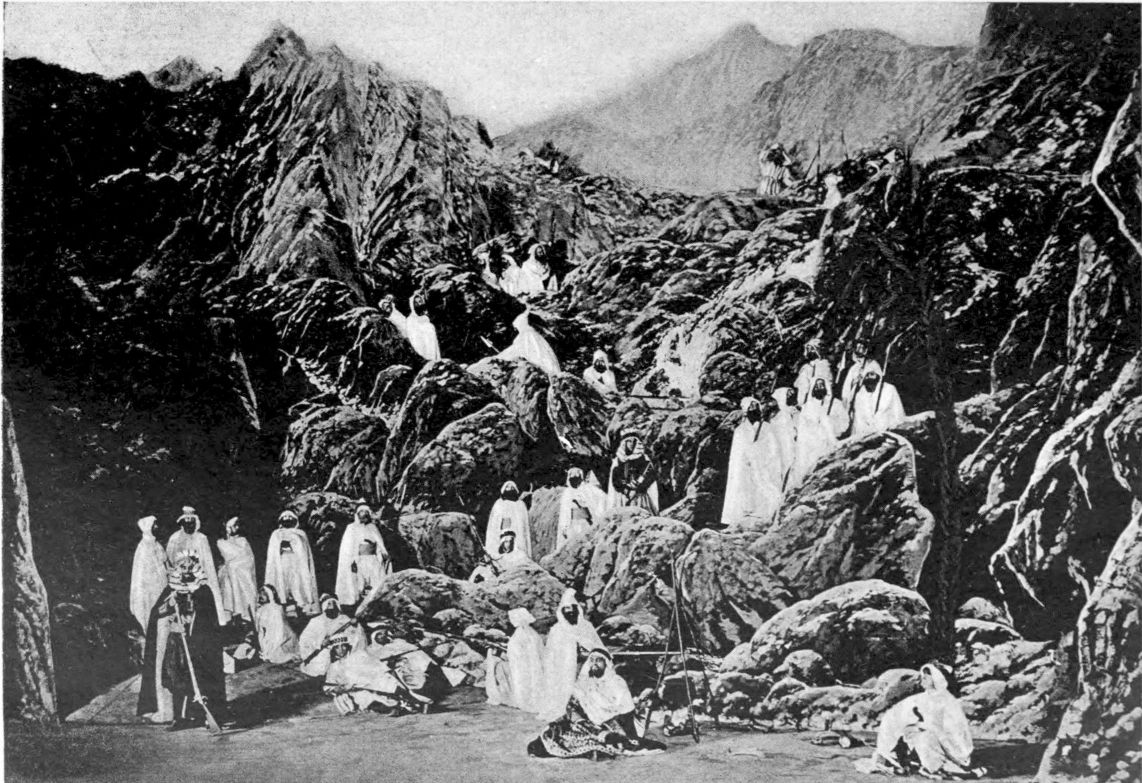
Photograph by Byron. Author’s Collection.
A SCENE IN BELASCO’S “UNDER TWO FLAGS”
Theatre. That actor, then a popular variety hall performer and a member of the burlesque and travesty company maintained by Messrs. Weber & Fields at their theatre in New York,—in Broadway, between Twenty-ninth and Thirtieth streets,—had negotiated with Belasco, about August-September, 1900, relative to acting under his management and on November 2, that year, they entered into a formal agreement whereby Belasco undertook the direction of Warfield’s professional career. Their contract was made to cover a first period of three years: it provided that Warfield should be presented as a star, beginning about September or October, 1901, and that he should be paid a weekly salary of $300 and should receive, further, 20 per cent. of the net profits of his professional exploitation during the first year, 25 per cent. during the second year, 30 per cent. during the third year, and 50 per cent. thereafter, if the contract should be renewed. This engagement also expressly required Belasco “personally to supervise the performances to be given” by Warfield as well as to provide a play for him to act in. The professional alliance thus begun between Belasco and Warfield has proved, for both parties to it, one of the most fortunate ever made in the Theatre. The personal friendship between them began many years earlier: Belasco has given the following glimpse of its beginning:
“There was an usher at the Bush Street Theatre—a bright little fellow with a most luminous smile. He is still small, and his smile is still luminous. I did not then know his name, but I had heard that among his family and friends he was quite an entertainer, being able to sing, to mimic and to recite. One day I was at home, in my front room on the top floor, when I heard a voice in the street below. I leaned out, and there on the corner, standing on a box which scarcely raised him above the gaping onlookers, was the little usher from the Bush Street Theatre, reciting to a curious crowd. I went down and stood near until he had finished. Then I went up to him and asked him his name. ‘Dave Warfield,’ said he, giving me the smile that lived long afterwards in Herr von Barwig, during all the rehearsals of ‘The Music Master,’ and that was our first meeting.”
David Warfield was born in San Francisco on November 28, 1866. He began theatrical life as a programme boy, in the Standard Theatre of that city. Later he became an usher in the Bush Street Theatre there. His first professional appearance was made as a member of a travelling theatrical company at Napa, California, in 1888, as the specious, rascally Jew, Melter Moss, in “The Ticket-of-Leave Man.” That company was disbanded at the end of one week, and thereafter Warfield appeared at several San Francisco variety halls, and in a piece called “About Town,” and gave imitations of actors whom he had seen,—among them Tommaso Salvini and Sarah Bernhardt,—and of “types” that he had observed in the streets of his native city. In 1890 he removed to New York and obtained professional employment, for a short time, in Paine’s Concert Hall, in Eighth Avenue. His next engagement was to act Hiram Joskins, in a play called “The Inspector,” produced by Mr. William A. Brady: that employment lasted two months. In March, 1891, he performed as Honora, in “O’Dowd’s Neighbors,” in a company led by Mark Murphy. In the season of 1891-’92 he acted with Russell’s Comedians, under the management of John H. Russell, appearing as John Smith, in “The City Directory.” In 1892-’93 he was seen as Washington Littlehales, in “A Nutmeg Match.” In September, 1895, he became associated with the New York Casino Theatre, where he remained for three years, acting in “About Town,” “The Merry Whirl,” “In Gay New York,” and “The Belle of New York,”—pieces which are correctly described as medleys of tinkling music and nonsense. In those “entertainments,” frivolous and often vulgar, Warfield presented several variations of substantially the same identity,—an expert semblance of the New York East Side Jew. In 1898 he joined the company of Messrs. Weber & Fields, and at their theatre, where he remained for three seasons, he appeared in various rough and commonplace travesties of contemporary theatrical successes, generally presenting, in different lights, his photographic copy of the huckstering, acquisitive, pusillanimous Jew of low life. One notable variation of that type was his assumption of The Old Man, in a burlesque of the offensive play of “Catherine.” Among the salient characteristics of his acting, in whatever parts he played, were fidelity to minute detail of appearance and demeanor and consistent and continuous preservation of the spirit of burlesque,—a spirit which combines imperturbable gravity of aspect with apparently profound sincerity in preposterous situations and while delivering extravagant, ludicrous speeches. True burlesque acting is a fine art and admirable as such, and Warfield was heartily approved in that field; but at the time when Belasco undertook to make him a star in the regular Theatre nobody, I believe, except the shrewd and prescient manager,—not even Warfield,—foresaw that within a few years he would have become one of the most popular serio-comic actors of the modern American Stage.