Volume 1 — A NEW PROJECT:—THE SECOND BELASCO THEATRE.
Reading edition
Although Belasco held the Belasco Theatre under a lease with an option of renewal, he was at all times during the early years of his theatre management conscious of a certain weakness in his position: an unforeseen disaster—a fire, for instance,—might leave him with many theatrical enterprises and no metropolitan theatre to present them in. “Besides,” he writes to me: “not only was I always confronted by the fact that the lease of my Forty-second Street house might not be renewed, but also it was natural that I should desire to have a theatre all my own, in the making of which I could carry out, fully, my ideas of stage construction, lighting, and seating.” The result of this desire and of his wary vigilance to maintain managerial freedom is the second Belasco Theatre (which originally was named David Belasco’s Stuyvesant Theatre), which was built by Meyer R. Bimberg (18—- 1908), on designs made by Belasco and under his personal superintendence. The cornerstone of that theatre was laid on December 5, 1906. David Warfield came from Philadelphia, where he was acting, to participate; Miss Bates came from Boston; Miss Starr was at the time filling her first engagement in New York in “The Rose of the Rancho.” Belasco, those players, his business associates, and a numerous company of friends gathered round the site of the new theatre. Miss Starr deposited in a niche beneath the bed of the cornerstone a copper casket containing various records and programmes of Belasco’s productions, photographs of himself and of the chief players then appearing under his direction, and a miscellaneous assortment of souvenirs, cards, and “good luck pieces” contributed by various friends. Miss Bates then spread the mortar upon which the stone was to be laid and uttered this touching sentiment as she did so: “Here’s hoping that Mr. Belasco will stick to all of us, and we and all his friends will stick to Mr. Belasco, as this mortar will eternally stick to this stone.”
The cornerstone was then swung into place, settled, and declared to be “well and truly laid,” whereupon Belasco’s daughters, Reina and Augusta, each broke a bottle of champagne against it, saying, in unison, “David Belasco’s Stuyvesant Theatre.” The dramatist Bronson Howard (who had risen from a sick-bed to attend this ceremony) then spoke, saying:
“My dear Public and Friends: This is one of the greatest pleasures of my whole life—to be here to-day to dedicate the theatre that David Belasco is building. He has always given of his best in the past and you know what he is doing now. This theatre and the plays that it will house will live in the Future even as Wallack’s, Daly’s, and Palmer’s, of the Past, live now in the Present. Here, where we stand to-day, will stand the future Temple of Dramatic Art in America. David Belasco has played a great part in the advancement of the drama in this country and he will play a greater one. He has never disappointed us and he never will. His heart and soul will be in every brick of this theatre and in every production he makes on its stage.
“Belasco and I have been friends and co-workers for many years. We first met when the gods were favoring me most,—when, long, long ago, he came, a young man out of the West, with black hair and eager face, to begin his career here. I was fortunate enough to put into his hands, in his first position as stage manager, at the Madison Square Theatre, the manuscript of my play ‘Young Mrs. Winthrop.’ I want to tell you an anecdote connected with that. I expected, when I gave it to him, that I should be obliged to do a lot of work on it; but after he had had it a few days he came to me and told me of many beautiful things in my play that I did not know were there! I decided, then, to keep away and did not see the play until the dress rehearsal. I found I had done well to leave it all to him. [Turning toward Mr. Belasco and stretching out his hand to him.] Come here, David! I am proud to clasp your hand, to utter a word of thanks for all you have done for us, for the workers in the Theatre; to congratulate you and say ‘God bless you and give you success!’”
Writing of this occasion and of his new theatre, Belasco says:
“With all my associates gathered round me I felt like the Vicar of Wakefield when he got out of gaol and once more assembled his family round his hearth!
“How quickly a theatre grows old-fashioned! Every summer I make improvements in this house and have already spent enough money to build another theatre. At the present time of writing I have just installed a new lighting system, the result of years of experimenting by Louis Hartman, my valued old friend and electrician, who is to be found in the theatre from morning until night, and whose only pleasure is in his work. I think we have revolutionized stage lights, and I have no doubt that our innovations will find their way to foreign countries.... As my whole life is passed in my theatre, I have a studio there of several rooms devoted to my work and collections. In the latter I take great pride....
“I have picked up much interesting furniture for my workroom, but, despite the joy I take in these things, I write with greatest comfort on a little sewing-table covered with green baize,—a relic of my attic days.... I really know of no other manager whose delight in his playhouse is greater than mine.... Here I spend my life and here I shall, I hope, end my days.”
The second Belasco Theatre (originally called David Belasco’s Stuyvesant Theatre, by which name it was known until the fall of 1910) stands on the north side of West Forty-fourth Street, between Broadway and Sixth Avenue, on lots Nos. 111 to 121, inclusive. The site has a front of 105 feet and a depth of 100 feet. The building is of red brick and white stone, simple and graceful, in the style of architecture denominated as Colonial. It was, originally, three stories high, with a rectangular, tower-like eminence at the southwest corner. The entrance from the street is into a small lobby, at the right of which are large swinging doors opening into a clear space which extends, behind the orchestra seats, parallel with Forty-fourth Street, from side to side of the auditorium. In this playhouse,
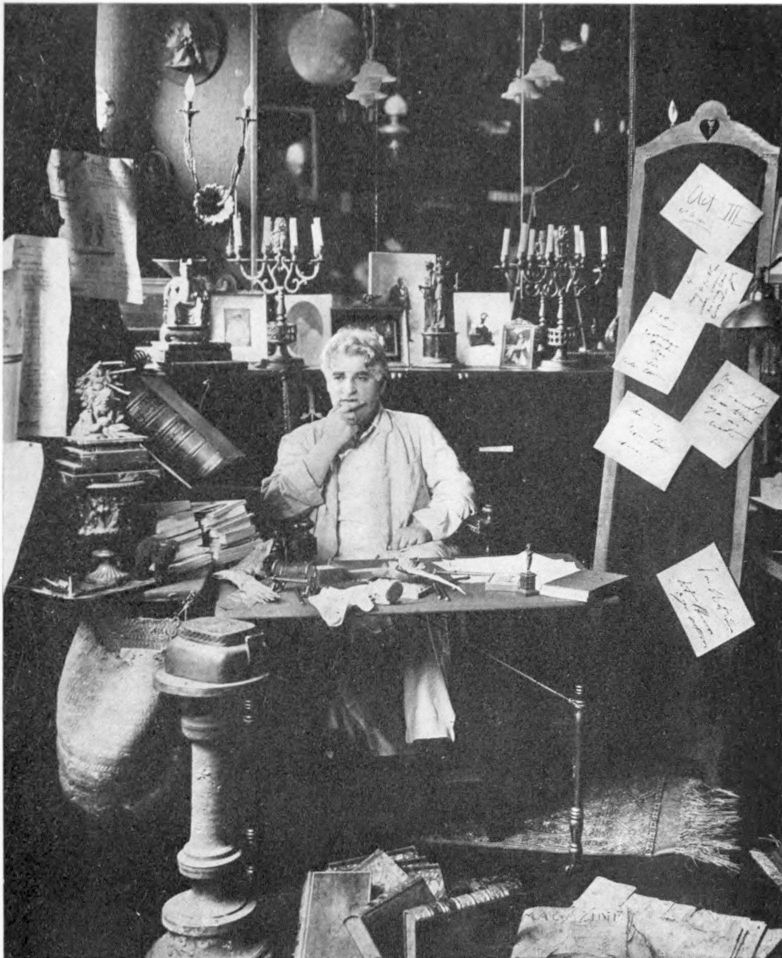
Photograph by Byron. Author’s Collection.
BELASCO IN HIS WORKSHOP
Inscription on Back:
“Genius doesn’t burn this morning, dear friend!—D. B.”
as in the first Belasco Theatre, there is a handsome screen of carved wood and crystal glass at the rear of the orchestra, which protects the audience from drafts of air. The orchestra and balcony chairs are of heavy wood, upholstered in rich, dark brown leather, the back of each chair being embossed with the emblematic bee. The decoration of the interior is opulent and dark in tone,—deep browns, blues, and greens with dull amber and orange being the prevailing colors. There is a large painting above the proscenium opening and on either side are several mural paintings, of various sizes, with here and there a rich tapestry hanging. The groups and figures in these paintings are symbolical,—Music, Grief, Tranquillity, Allurement, Blind Love, Poetry, and the like being depicted. The ceiling is raftered into twenty-two panels, which are set with rich-colored stained glass and illumined from above. Each panel contains two shields, with heraldic mantling,—among the coats-of-arms displayed being those of Shakespeare, Goethe, Schiller, Racine, Molière, Goldsmith, Sheridan, and Tennyson. The seating capacity of the theatre is now (1917) about 1,000 persons,—430 on the orchestra floor, 320 in the balcony, and 240 in the gallery. There are no supporting pillars in the auditorium, the balcony and gallery being constructed on cantilevers, so that an unobstructed view of the stage is afforded from every part of it.
The stage was carefully designed with the purpose of facilitating in every possible way the setting and shifting of scenery. It is eighty feet wide and twenty-seven feet from the curtain-line to the back-wall. The proscenium opening is thirty-two feet wide and thirty feet high. The “gridiron” is seventy-six feet above the stage; the fly galleries, of which there are two, one on each side of the stage and thirty feet above it, have forty-five feet of clear space between them. In recent years an adjustable apron, five feet wide, has been constructed in front of the curtain-line, covering the musicians’ pit. The stage can be opened at any desired spot, and the centre of it is an elevator-trap, ten feet from front to back and twenty feet long. Upon this trap the paraphernalia of an entire scene can be lowered to, or raised from, the level of a cellar floor, thirty feet below the stage.
The original cost of this theatre, including the land upon which it stands, was more than $750,000, and various alterations and improvements made in it down to the present time (1917) have increased the total investment to nearly $1,000,000. In the summer of 1909 a one-story and mezzanine addition was built upon the roof of the Stuyvesant, in which Belasco has made his studio,—a strange, romantic place in which he has assembled priceless objects of art and antiquarianism. That studio (an adequate description of which would necessitate weeks of examination and would, alone, fill a large volume, and which, here, can be given only passing notice) is entered by a narrow, low, heavy-latticed door from the business offices of the Belasco Company. The first room is a small, low-roofed one, in itself somewhat suggestive of an old cathedral crypt. Along the walls are ranged shelved cases containing a wondrous collection of specimens of precious glass, the most recently made piece of which is more than eighty years old. A sort of alcove opens from this room, at the right side, which is stored with scores of relics associated with that arch-villain the great Napoleon,—a collection which includes a lock of his hair, cut from his head after death, and in which Belasco takes special pride and joy. Beyond the entrance room is a larger one; beyond that are low, dim passages; a library with stairs to a gallery; a dining-room; an odd little bedroom, exquisitely furnished in Japanese style,—with a miniature Japanese garden built outside its window,—and luxurious facilities for bathing. These passages, rooms, and stairs,—ceilinged with multi-colored banners, carpeted with soft, rich rugs, and almost everywhere lined with shelf on shelf of books,—are somewhat maze-like to a stranger, and in them is gathered a vast, confusing medley of collectors’ treasures: here, a sinister, black-steel armor; there, a stand of French halberds; beneath that old table, an unmatchable set of rapiers; upon this one, nearly twoscore different styles of dagger; yonder, a huge carved wooden chest, blackened with age and stuffed with antique velours; against it, a great two-handed sword,—“such a blade as old Charles Martel might have wielded, when he drove the Saracen from France”; across that opening, an antique wooden window-lattice, with heavy shutters, taken from an English house built more than 700 years ago; beside it, a chair once used by England’s King Henry the Eighth; against this wall, a stone mantel brought from Italy, with a hearth made of tiles stolen by slaves from the Alhambra. In the walls are many odd nooks and hidden cupboards, which open by the release of secret springs,—in which, when illumined by small, concealed lamps, are revealed collections of jewelled rosaries; or of crucifixes wrought in ivory, ebony, and iron; or of specimens of the potter’s art; or of trinkets once worn or owned by members of the gentle Borgia Family. The stranger, wandering through this reclusive domain,—into which few strangers ever are permitted to penetrate,—opening low Gothic doors, will blunder into angular hutches or long, low tunnels filled with shelves and cases of rare pamphlets and old books; will pause with awe before a superb window of purple stained glass; or gaze with wonder on a massive globe suspended in a well over which a translucent canopy is so arranged that it takes and intensifies all the changing colors of the covering heavens; or will come with startled delight upon a grot in which a small fountain of crystal water flings its spray over a little pool half-filled with violets, sweetpeas, and full-blown roses.
Belasco, unlike many other collectors, has an intimate personal knowledge of every article in his collection; can recall at once where, when, and how each was acquired; and, notwithstanding the number and seeming confusion of the different pieces, knows exactly where each one is placed and instantly perceives and vituperatively denounces any disarrangement of them such as occasionally is caused by members of that pestiferous sisterhood which plies the duster and the brush without sense of the sacredness of an antiquarian’s sweet disorder,—a sisterhood which has stirred up consternation and wrath since long before Mr. Oldbuck’s time. His writing is done there among his treasured collections, now in one corner, now in another, upon a small, battered, baize-covered cutting-table, such as ladies use for sewing, which he carries about from place to place as the fancy suits him. And there, also, his principal recreation is found when, wearied by labor or oppressed by care, he turns to contemplation and enjoyment of the heaped-up beauty which he has gathered about him.