Volume 1 — BELASCO’S “THE RETURN OF PETER GRIMM.”
Reading edition
In drama, whether prose or verse, the device has frequently been used of bringing back to our material world the spirits of persons who have passed out of mortal life, and causing them to pervade the scenes with which they were associated in the body. That device is employed in Belasco’s “The Return of Peter Grimm,” in which David Warfield made his first and, thus far, his only approach to the realm of Imagination [since this passage was written Warfield has appeared, 1915-’16, as Van Der Decken, in a drama by Belasco on the subject of “The Flying Dutchman.”—J. W.]. Peter Grimm, a prosperous, self-willed, kind, good old man, who in the government of his family and the arrangement of his worldly affairs has made serious errors,—the most deplorable of them being the separation of his ward, a docile, affectionate girl named Kathrien, from a youth who loves her and whom she loves, and her betrothal to his nephew, Frederik Grimm, a hypocrite and a scoundrel,—is suddenly stricken dead, of heart disease, and, after a little time his spirit returns to the place which was his earthly home, intent on retrieving those errors, discomfiting the rascal by whom he has been deceived, and making his foster-child happy. Warfield, personating Peter Grimm, first presented him as a mortal, afterward as a spirit. The character,—honest, sturdy, opinionated, worldly-wise, somewhat rough and imperious, yet intrinsically genial,—was correctly assumed and expressed, but the actor’s denotement of spiritual being was neither
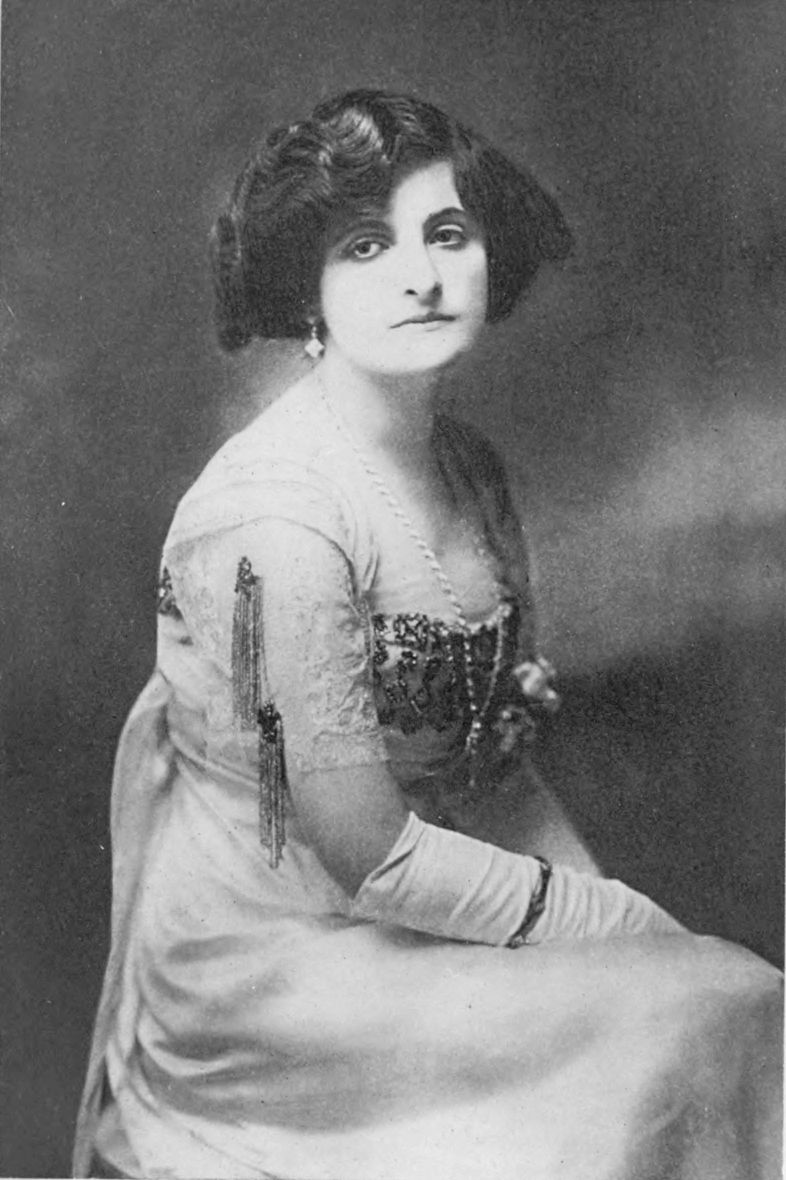
REINA BELASCO. MRS. MORRIS GEST
Photograph by White. Belasco Collection.
imaginative nor sympathetic, and it did not create even the slightest illusion.
The purpose of the dramatist seems to have been to intimate a notion, comfortable to the general mind, that spiritual existence of beings once mundane is merely a continuation of their everyday condition in this world. In the absence of knowledge on the subject that assumption is as tenable as any other. Persons who are commonplace in what we call Time may reasonably be held to remain commonplace in what we call Eternity. No one knows. The Book of Destiny has not been opened. But the rationality of assumption which makes of “that undiscovered country” only a prolongation of this earthly scene at once dissipates, especially for dramatic purpose and effect, all atmosphere of spirituality, all glamour of the ideal, which happily might be superinduced by imaginative treatment of a mysterious subject. However prosaic the quality of a disembodied spirit may remain, it seems reasonable to assume that there must be some essential difference between the material body and the spiritual body, and the person undertaking to represent a spirit could succeed, if at all, in denoting that difference not by stage tricks but only by mental power and affluence of emotion, by weird strangeness of individuality, by exquisite sensibility, by magnetism, and by the artistic skill to liberate those forces and so elicit and control the sympathy of his auditors. Warfield’s personation of Grimm gave not the faintest intimation of spirituality, and there was not one gleam of imagination in his presentment of the spirit.
Few actors have ever succeeded in conveying to an audience any really convincing, absorbing sense of spiritual presence. The dramatist of “Peter Grimm” probably did not intend that any such sense should be conveyed. Warfield, apparently, did not attempt to convey it, and if, as appears true, it was the actor’s purpose to present Grimm as essentially the same person after death as before, then his personation, undoubtedly, was the rounded result of a definite plan, and was, as such, entirely successful.
The part of Peter Grimm has been described as one of great difficulty. It is, on the contrary, very easy. Its requirement is sincerity. Grimm, as a spirit, clothed as in mortal life, must move among persons who were his friends, unseen by them, unheard when he speaks, eagerly desirous to influence their conduct, but practically helpless to do so, except at moments when accession of extreme sensibility on the part of one or another of them provides occasion, until, at last, force of circumstances and the impelling guidance of the dead man achieve his purpose. Acted in the spirit precisely as in the flesh, as a good old man, the part makes no draft upon the resources of mind or feeling or upon the faculty of expression that any good actor might not easily satisfy. The situations wherein Grimm, ostensibly, is ignored by the other persons on the stage in fact revolve around him and are dependent on his presence; he engages the sympathy of the audience practically to the exclusion of all the other characters, and the almost universal interest—whether assenting or dissenting—in anything relating directly to the theme of spiritual survival after death, together with the novelty of a ghost displayed in the environment of every-day, centres observation on Grimm and his personator.
Warfield’s performance, notwithstanding the prosaic atmosphere of it, was interesting, and his excursion into the realm of the occult was, at least, calculated to stimulate thought on a serious subject. In this, as in many other matters, the degree of approval gained by the play and its performance will ever be variably accordant to taste. To some persons, no doubt, the ideal of a newly dead child being borne away on his spirit-uncle’s shoulders, singing about “Uncle Rat has gone to town to buy his niece a wedding gown,” and musically inquiring, “What shall the wedding breakfast be? Hard-boiled eggs and a cup of tea?” will be delightful. Others, equally without doubt, will fail to find it impressive.
“The Return of Peter Grimm” was acted for the first time, January 2, 1911, at the Hollis Street Theatre, Boston; and for the first time in New York, October 18, the same year, at the present Belasco Theatre. This was the original cast of that play:
Peter GrimmDavid Warfield.
Frederik GrimmJohn Sainpolis.
James HartmanThomas Meighan.
Andrew MacPhersonJoseph Brennan.
Rev. Henry BatholommeyWilliam Boag.
Colonel Tom LawtonJohn F. Webber.
WillemPercy Helton.
KathrienJanet Dunbar.
Mrs. BatholommeyMarie Bates.
MartaMarie Reichardt.
The ClownTony Bevan.