Volume 1 — VARIOUS LETTERS AND INCIDENTS OF 1905.
Reading edition
In June, 1905, Belasco, accompanied by Mr. Roeder, sailed for England, his purpose being to purchase, if possible, or else to arrange to build, a theatre for his own use in London,—as Daly had done many years before. This ambitious project, however, proved impracticable of execution and, though he has never finally abandoned it, he found himself forced by circumstances to set it aside and he soon returned to America. While he was in England the subject of his fight against the dominion of the Syndicate was discussed in various newspapers: in one of them I find the following letter:
(David Belasco to “The London Referee.”)
“Hotel Russell, Russell Square, “London, W. C., June 17, 1905.
“To the Editor of ‘The Referee’:
“Sir:
“A sympathetic article in an evening paper, speaking of the methods of the American Theatre Trust, and their efforts to crush me, also stated: ‘Let there be no misunderstanding. Mr. [Charles] Frohman may be entirely exempted from inclusion in this indictment. His operations in London are in direct competition with those of the Trust.’
“In order to prevent any ‘misunderstanding’ I would like to ask: ‘Why should Mr. Frohman be exempted from this indictment?’ In my suit brought against Messrs. Klaw & Erlanger in New York, in April last, among other things for the purpose of exposing the methods of the Theatrical Trust, there was produced in court the original Syndicate agreement, made in August, 1896, and renewed in August, 1901. This agreement was signed by Charles Frohman, Klaw & Erlanger, Al. Hayman and Nixon & Zimmermann, and according to the evidence is still in operation. Further comment is, I think, unnecessary.
“I am, “Faithfully yours, “David Belasco.”
Soon after his return to New York Belasco received a message from the great singer Mme. Ernestine Schumann-Heink, who had been much impressed by his presentment of Warfield in “The Music Master,” who desired to adventure on the dramatic stage, and who proposed that Belasco should undertake her management and write a play for her use. This he gladly agreed to do, and the play, which was to have been a sort of sister piece to “The Music Master” and was to have been called “The Opera Singer,” was planned and in part written; but the demands on Belasco’s energies and time were more than any one person could meet and he was regretfully forced to relinquish that project. “It hurt me to let go,” he said: “I had a good story. Mme. Schumann-Heink had great natural talent for acting, and I believe that if I could have carried it through, working in a tremendous scene for her, as a singer on the opera stage, we should have set the country wild. But—there is a limit, and I was pretty near to mine, so that little scheme went up in smoke!”
The following letters all are characteristic of Belasco in varying moods:
(David Belasco to Blanche Bates.)
“Belasco Theatre, New York, “April 3, 1905.
“My dear Blanche Bates:—
“I have received a note from Mr. William Courtleigh of the Actors’ Society in which he asks if it is possible for you to appear with Mr. Wm. Gillette at their benefit. I have promptly said ‘No.’ In the first place, you are not going to support Mr. Gillette. You would do all the hard work—yelling, shouting and running about like a maniac,—while he sat calmly smoking his cigar, with a calcium light upon him. Besides, this would be no novelty, as Gillette did the same thing at the Holland Benefit and I saw the poor little ———— girl disgrace herself. There is nothing at all in these ‘benefits,’ and I hope you are pleased that I got you out of this one.
“With all good wishes, “Faithfully yours, “David Belasco.”
(David Belasco to John Luther Long, in Philadelphia.)
“Belasco Theatre, New York, “April 26, 1905.
“My dear John:—
“I have just received the beautiful Tennysonian verses. I shall dramatize them, of course, and you were bully to send them to me.
“But really, Jonathan, haven’t we given that gang of grafters a shake-up? It cost me a lot of money,—but (thank Heaven!) I had it to spend, and could unmask them. If I have done a wee bit of good in helping to clear away the rubbish, I am more than rewarded.
“Good luck to you, and my best affection!
“Faithfully, “David Belasco.”
(David Belasco to Mrs. F. M. Bates.)
“Belasco Theatre, New York, “July 13, 1905.
“My dear, dear Mrs. Bates:—
“I am so sorry I did not see you the other morning when you called at the theatre, but I have been nearly crazy with neuralgia for the past week.
“I am a little bit behind on Blanche’s play, and am hurrying off to Shelter Island to take off my coat and go to work on it. Tell our Blanche it is a bully play, and that the character of ‘the girl’ is sky-high—fits her from her head to her feet! I expect to have it in shape shortly now, and in her hands to study. I am getting together a bully cast for it. I really think the new play is my very best, and I know she will be happy. Give her my love.
“Faithfully, “David Belasco.”
(David Belasco to Blanche Bates, in San Francisco.)
“Belasco Theatre, New York, “July 20, 1905.
“My dear Blanche B.:—
“Your letter received.
“I got a little behind on the play; you know I had to run off to London to do big things for the future, and when I got back I went under with my old attacks of neuralgia. You know how I suffer with them, and really, this time the pain was excruciating. I’m glad to say that I am all right again and I am working night and day, hoping that it is the best play I ever wrote. Your part fits you from your dear little feet up to your pretty head. It’s a bully part, and I know you will like it. If you don’t,—well, you need never kiss me again! I call the play ‘The Girl of the Golden
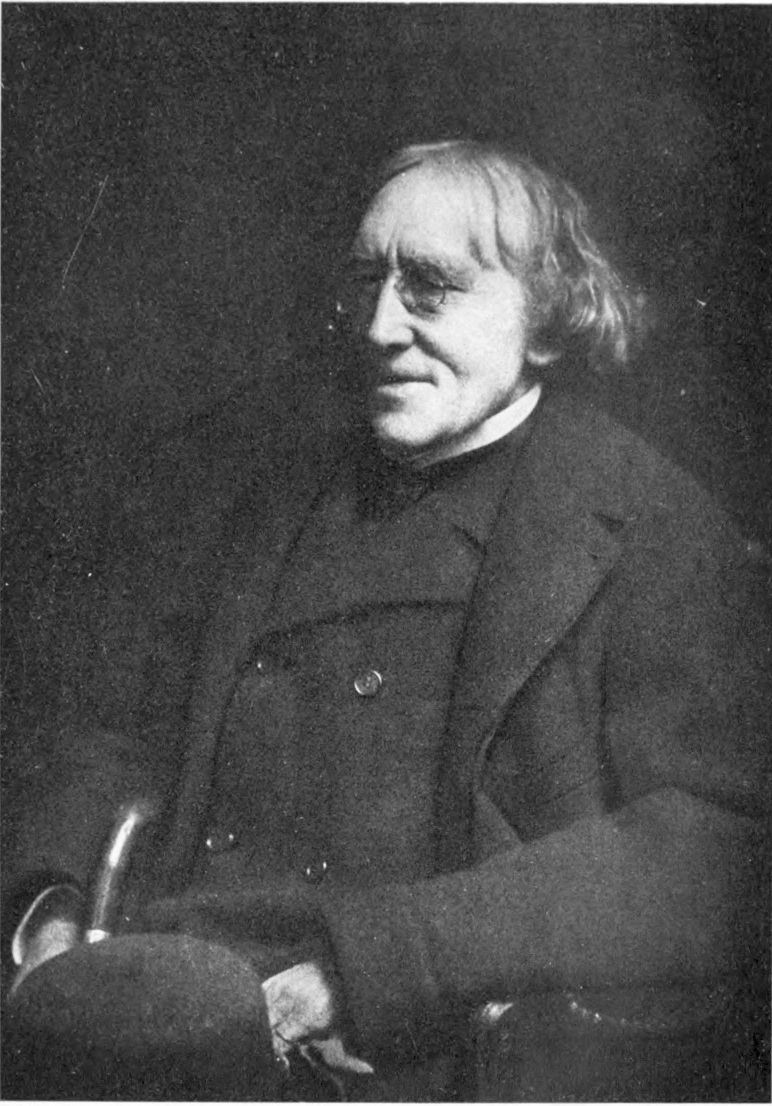
Photograph by William Crooke, Edinburgh. Author’s Collection.
HENRY IRVING IN THE LAST YEAR OF HIS LIFE—1904-’05
West.’ The characters call you ‘The Girl.’ The models of the play are fine—the last scene of all, ‘In the Wilderness,’ is a gem. There are some beautiful speeches in the play—very ‘Batesesque’; the lines just crackle and all the situations are human.
“Yes, send along the photo, and I will have a poster made of you.
“Entre nous, we open in Pittsburgh, before coming into New York, playing there for two weeks at the new Belasco Theatre, as the stockholders have named it. It will be a great night.
“Just keep well, enjoy your summer, and the moment I have finished the play,—which will be in about three weeks,—I will rush it into your hands.
“With love, hugs, kisses and things,
“Faithfully, “David Belasco.”
(David Belasco to Frederick F. Schrader, in Washington, D. C.)
“Belasco Theatre, New York, “July 22, 1905.
“My dear Mr. Schrader:—
“Many thanks for your letter and for your kindly interest. I am so glad that the press out West has taken up the question of the Theatrical Trust so splendidly. It helps us in the big fight. There is a hard year before us, and if we win I think we shall have succeeded in breaking the tyrannous ring. The London press was bully. I was interviewed extensively and succeeded in getting many leading papers interested. They have taken up the Trust question seriously over there. I hope you read ‘The Referee.’ They began a series of Trust articles in the number before the last. The article was written in a very forcible style.
“Regarding the theatre in Washington, what you write is very interesting and I shall be most happy to hear more about it.
“Mr. [Fuller] Mellish called to see me, and there is an understanding that at the first opportunity I shall gather him in. Then,—he may remain with me for life, if he wants to.
“With kindest regards to yourself and your wife, I am,
“Faithfully, “David Belasco.”