Volume 1 — THE ADVENT OF FRANCES STARR.—BELASCO’S “THE ROSE OF THE RANCHO.”
Reading edition
Frances Starr was born at Albany, New York, June 6, 1880, and made her first appearance on the stage as Lucy Dorrison, in Robertson’s “Home,” with a stock company, in that city, under the management of the late Frederic Bond. During the next six years she gained experience in various stock companies,—at the Murray Hill Theatre, New York; in San Francisco, in Boston, and at Proctor’s 125th Street Theatre, New York,—and, February 12, 1906, she appeared, in association with Charles Richman, as Nell Colfax, in “Gallops,”—a weak echo of Boucicault’s horse-racing plays of “The Flying Scud” and “The Jilt.” Belasco first saw her when she was acting at the Murray Hill, and his attention was again called to her by his brother Frederick, who, in 1905, wrote to him from San Francisco, praising her in high terms. Writing about Miss Starr, Belasco has given this account of her employment by him—certainly the most fortunate event of her life:
“When I first saw her play I watched her performance with the closest attention. Her entrance was greeted by a spontaneous outburst of applause. She was just a young girl then, a sweet-faced girl, delicately formed, with a beautiful forehead and fine, intelligent eyes. I was most favorably impressed by her performance, but at the time I had no part for her.... Her opportunity came during the second season of ‘The Music Master.’ Miss Minnie Dupree was to leave the company before the close of the season and I needed some one to take her place. I remembered Miss Starr and, with my friend and stage manager, William Dean, I went to the Garrick to see her in ‘Gallops.’...” In that play “the hero staked his all on a horse race, and the future happiness of the young lovers hung in the balance as the race took place. The heroine and a coaching party were near the track, and Miss Starr stood on the steps of the coach, facing the audience. As the race was being described Miss Starr’s facial expression was so remarkable that she held the audience for several minutes. The various expressions of hope, despair, and joy came and went according to the movements of the horse. The tumult of applause was a tribute not to the play nor to the scene, but to the perfection of Miss Starr’s art. And as an exhibition of pantomime I have seen nothing to surpass it.... I decided that I must have her under my management, and I gave instructions to Mr. Dean to send for her to ask her to sign a contract as soon as possible. Just before the final curtain fell the young actress looked at me, and as our eyes met I fancied I read in them the question: ‘Have I pleased you?’ On the way back to my theatre I was haunted by the pathetic appeal so silently thrown across the footlights, and I determined to do what I could to save one little girl the sleepless night I felt sure was in store for her. ‘Dean,’ I said, ‘don’t wait until morning. Telephone Miss Starr to-night and say I wish to see her to-morrow.’ Mr. Dean advised me to wait. He thought it would be poor judgment on my part to show any eagerness; that Miss Starr would be sure to take advantage of it and raise her salary, but I insisted and he telephoned to her. As I expected, she was in her room, anxious, nervous, and wondering if my visit to the theatre would mean an engagement for her. Later, she told me of her relief and happiness when the telephone call came. It did not save her from a sleepless night after all, but her wakefulness was the result of joyous anticipation rather than anxiety. The appointment was made for 10.30 in the morning. When I arrived at 9, Mr. Dean came to me, smiling broadly. ‘Miss Starr is in my office,’ he said; ‘she has been waiting since 8 o’clock.’ I found her even more attractive than I had imagined. Her hair was soft and light, her eyes deep blue, varying into gray, and the changing expressions of her earnest face were delightful. She was pale and tearful. ‘It has always been my wish to work for you,’ she said. I learned that her manager at the Garrick Theatre intended to ‘star’ her in a play, but she expressed a willingness to come with me if only in a ‘bit’ five lines long. I offered her the leading part of Helen in ‘The Music Master,’ and she was delighted. I told her to go to Mr. Dean and make business arrangements. ‘I don’t care what salary I get,’ she exclaimed. ‘The only agreement I want is that you don’t change your mind.’ I insisted, however, that a contract be signed, and when Mr. Dean made it out she wanted to put her name to it at once, but I advised her to take it home and read it over. She took it away with her, but afterwards confessed that she stopped in a telegraph office on the way to her hotel and signed it!...”
The first play in which Belasco presented Miss Starr as a leading performer, heading an important theatrical company—less than six months after he had seen her in “Gallops”—was “The Rose of the Rancho.” This piece is based on an earlier one, by Richard Walton Tully, called “Juanita,” which had been produced in Los Angeles with the excellent actor John H. Gilmour in the principal male part. Mr. Tully’s play was verbose, diffuse, and coarse in texture. Belasco, after once rejecting it, being in urgent need of a vehicle for Miss Starr, read it again and agreed to “accept it, provided I might have the privilege of rewriting it.” This “privilege” Belasco has exercised in many instances—to his loss and the immense advantage of various inconsequential and ingrateful amateurs of dramatic authorship. His stipulation was acceded to by Mr. Tully, and Belasco, working as usual under the stress of haste and the distraction of many projects, revised, curtailed, amended, and reconstructed “Juanita,” which, in its final form as “The Rose
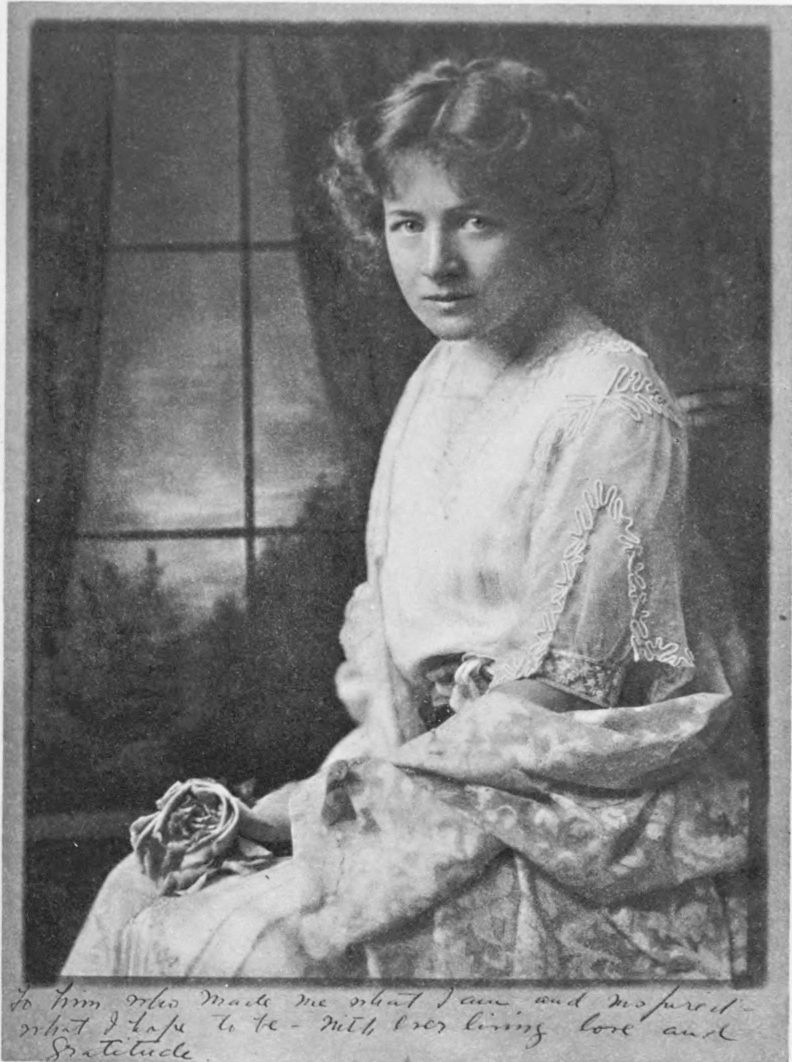
FRANCES STARR
Inscription:
“To him who made me what I am and inspired what I hope to be,—with ever living love and gratitude.”
Photograph by Strauss Payton. Belasco’s Collection.
of the Rancho,” gained abundant success. It was first acted, under that name, at the Majestic Theatre, Boston, November 12, 1906, and was brought out in New York, at the Belasco Theatre, November 27: it held the stage there until June 29, 1907.
There is, in this play, a glance at a disgraceful episode in American history,—the technically legal, but outrageously unjust and brutally tyrannical, seizure of the estates of Spaniards in California, after the Mexican War; but the purpose was not so much to relumine a remote and half-forgotten rascality as to display the incidents of a romantic love story associated with the nefarious proceedings of that distressful and turbulent time and place. That purpose Belasco accomplished in pictorial settings of uncommon beauty. The scenery of Southern California is inexpressibly charming, because it combines tranquil loveliness with awful grandeur and is everywhere invested with poetic mystery. The stupendous and austere mountains, the boundless, lonely plains, the balmy orange groves, the graceful palm trees, the fragrant magnolias, the abundance of wild flowers, the glorious blue skies and the pure, sweet air,—these and many other beauties unite to make that region a paradise. It is in Southern California that the Rose of the Rancho blooms, and Belasco, who knows and loves that country well, made his stage a garden of luxury and a dream of splendor to convey that charm—presenting a series of pictures which have never been excelled and seldom equalled. The investiture of this play, indeed, blending old Spanish architecture with a semi-tropical wealth of natural beauty, was literally magnificent and considerably excelled the worth of the play itself. This is a synopsis[2] of that fabric,—from which it will be seen that the theme is, to some extent, the same as that treated in Helen Hunt Jackson’s prolix and tedious novel of “Ramona”:
The scene is laid amid the sleepy, picturesque Spanish missions of Southern California. The plot deals with the great tragedy that underlies California history—the taking of the Spanish inhabitants’ homes by land-jumping Americans. The Rose of the Rancho is Juanita, the youngest daughter of the Castro family. Through pride and indolence the Castros have neglected to make their property secure to them by filing an entry with the American land agent, and things have come to a serious pass with them. One of the most notorious land-jumpers in the state, Kinkaid, of Beaver, Neb., has come to San Juan, with his outfit, to take the whole valley. At the same time another American has appeared on the scene,—Mr. Kearney, of Washington,—a government agent sent to investigate the land disputes.
Previous to the rising of the curtain upon the beautiful mission garden the latter has met and fallen in love with the fascinating Juanita. Because of enmity toward all gringoes she refuses to treat him civilly, but she meets him by accident every day, unknown to her mother, who arranges (according to the custom) that Juanita shall marry a young Spanish spark, from Monterey—Don Luis de la Torre. The girl’s father was an American, and there begins a struggle between her loyalty to her mother, her Spanish relatives and friends, on the one side, and the young American who comes with the offer of his love and aid, on the other. Juanita, given her first kiss, lets the blood of her father direct her actions. She gives the data necessary for a registration to Kearney, who has no authority to interfere with Kinkaid, but who sends his friend, Lieutenant Larkin, to Monterey to make the entry for the Castros. Kearney remains behind to delay Kinkaid as long as he can. Larkin agrees to bring back the state militia for Kearney’s protection. Meanwhile, the mother has learned that her daughter has tossed a geranium to a gringo (signifying, “I love you”), and Juanita is locked in her room.
The Second Act takes place in the patio-court of the old Castro ranch house. In spite of the danger that threatens, the mother is giving the engagement party she has planned. Juanita’s friends are present. There are Spanish dances and the throwing of cascarones, and Don Luis appears to claim his bride. Juanita is defiant, and when they are about to betroth her she declares herself to be a gringo and the promised wife of a gringo. For this her mother disowns her, and is about to turn her out of the house, when Kinkaid and his men attack it and break in, and Juanita is thunderstruck to find the man she has trusted among them. The crowd of riffraff insult the women, who are protected by Kearney. He, however, must pretend that he is upon Kinkaid’s side. Juanita appeals to him, and is rebuffed. Kinkaid agrees to wait until dawn before taking possession—thereby giving Kearney the time desired. The latter gets away from the land-jumper and finds Juanita to explain. She lashes him with her tongue for his betrayal of her people, and when he tries to make her listen she strikes him. Nothing daunted, he forces her to listen to his explanation. She tells him that she thinks he is a liar, but—she will wait till morning to see if the militia comes.
The Third Act takes place upon the roof of the ranch house. Dawn is coming, and no help has arrived. Kearney makes Kinkaid a prisoner as a hostage to protect the women. Unfortunately, Don Luis, jealous of the American lover of Juanita, in an effort to compel him to fight a duel, lets Kinkaid go. The latter joins his men and an attack is imminent. The old Franciscan, Father Antonio, assembles “his children” in prayer for delivery, the sunrise hymn of the Californians. This delivery comes in the shape of the long-awaited militia from Monterey. The rancho is saved, but the mother will not see her daughter go to an American. She forces her daughter to choose, and this she does—in favor of the gringo.
That is a simple, almost trite, story; but Belasco contrived to tell it in action more than in words, and his telling of it proceeds from one sensation to another with cumulative effect. Divested of all outward flourishes, it is seen to be the portrayal of a conflict between virtue, animated by love, and villany, impelled by cupidity and brutal license. The vulgarian would seize the estate of the old Spanish family. The hero, who loves its young mistress, would save it for her; and in order to accomplish that object he is compelled to pretend fraternity with her oppressor,—for which reason she temporarily mistrusts him; but his purpose is accomplished, his fidelity is proved, and his love is rewarded. In all this, happily, there is no examination of the remote causes of the universal passion; no philosophic essay on masculine strength as opposed to feminine weakness; no treatise on elective affinities. The play, in short, is an old-fashioned melodrama in a new-fashioned dress; one of those plays that the spectator observes with an interested desire to ascertain how it will turn out. No new type of character is presented, nor is a special attempt made to variegate the old types. Kearney, of Washington, is the handsome, gallant, expeditious young cavalier who has loved and rescued the endangered maiden in a hundred plays of the past. Kinkaid, of Beaver, is the same old blackguard and bully who seems victorious for a moment, but is always finally discomfited, in the chronic story of the Far West. Don Luis is the debonair but disappointed suitor, from whom the Bride of Netherby always rides away. Father Antonio is the good and gentle priest who cheers the drooping spirit and bestows ecclesiastical benediction. The only persons who savor of exceptional quality are Señora Kenton and her daughter Juanita, the Rose,—the one a stern and formidable woman, vital with Spanish hatred of the invading American; the other, a passionate, capricious, wilful girl, who can be sweet and tender, but who is customarily piquant, independent, and resolute in her own course: characters strongly reminiscent of the matron and the heroine in “Ramona.” But, all the same, the old tale of strength protecting weakness, stratagem defeating duplicity, and love triumphant over hate, pleased, as it always has pleased, and as it always will continue to please—“till all the seas run dry.” Although, intrinsically, not exceptional as a work of dramatic art, “The Rose of the Rancho” has positive and abundant felicity of theatrical merit, imparted by the skilful hand of Belasco, and the production of it was worthy of his brightest fame. This was the original cast of it:
Kearney, of Washington Charles Richman.
Don Luis de la Torre A. Hamilton Revelle.
Padre Antonio Frank Losee.
Lieutenant Larkin William Elliott.
Kinkaid John W. Cope.
Rigsby Wayne Arey.
Sunol J. Harry Benrimo.
Tomaso Frank Westerton.
Ortega Norbert Cills.
Goya Candido Yllera.
Pico Fermin Ruiz.
Fra Mateo Frank de Felice.
A Gardener Richard S. Conover.
Salvador Gilmore Scott.
Pascual Salvatore Zito.
Benito Vincent de Pascale.
Estudilla Julio Grau.
Yorba Francesco Recchio.
Cadet Regino Lopez.
El Tecolero Virgilio Arriaza.
Bruno C. A. Burnett.
Manuel Leonardo Piza Lopez.
Señora Dona Petrona Castro Marta Melean.
Señora Kenton Grace Gayler Clark.
Juanita, called La Rosa del Rancho Frances Starr.
Trinidad Jane Cowl.
Beatriz Catherine Tower.
Carlota Atalanta Nicolaides.
Guadalupe Maria Davis.
Señora Alcantara Regina Weil.
Agrada Louise Coleman.
Kinkaid’s Ranchmen, Caballeros, Vaqueros, Musicos,
Servants, Etc.
Señoritas, Dueñas, the Child of the Dance, Etc.
Miss Starr, in her performance of Juanita, manifested impetuosity of temperament combined with charm of personality, and by her arch behavior as a coquette, together with the vigor and sparkle of her demeanor as a wounded, doubting, resentful, and angry young woman, gained and merited general admiration.—A significant thought as to expedition
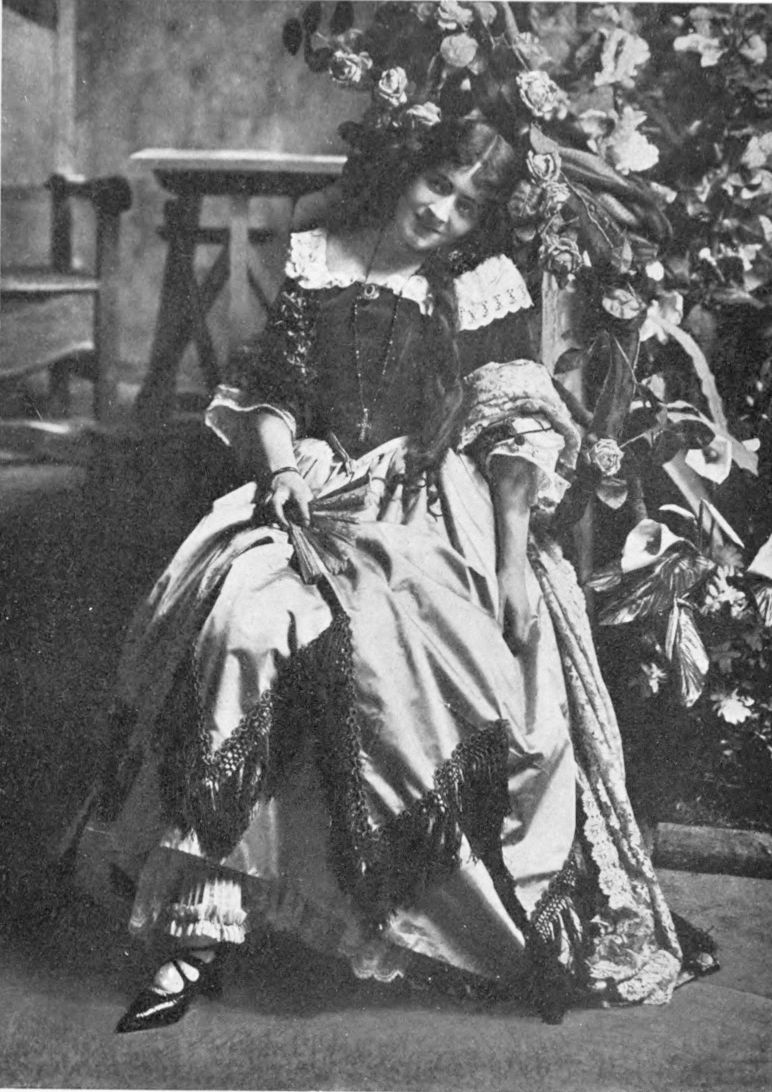
Photograph by Byron. Belasco’s Collection.
FRANCES STARR AS JAUNITA, IN “THE ROSE OF THE RANCHO”
and indolence in the fibre of contrasted races is conveyed in two casual remarks in this play: “Civilization,” says the “land-jumper,” Kinkaid, with blatant vulgarity of manner, when announcing his purpose of legalized robbery, “must progress”; and when it is found that certain muskets which have been collected for use in defending the Castro ranch are useless because of lack of powder, the Spanish cavalier is heard to murmur: “I meant to have got that powder to-morrow.” Charles Richman, as the intrepid Kearney, and John W. Cope, as the sinister Kinkaid, gave performances of sterling merit, because true to life and symmetrical and fluent in expression,—the one presenting, in a notably earnest spirit, a sonsy, healthful, interesting, thoroughly good fellow: the other assuming, in a painfully natural way, the obnoxious characteristics,—including a repulsive personal appearance,—commonly, and correctly, ascribed to the Western breed of ruffian.
Belasco has, in drama, made use of the element of natural accessories,—meaning peculiarities of climate, cloud, sunshine, rain, storm, calm, the sound of the sea, the ripple of leaves in the wind, the swirl of dust, the gentle falling of flower petals, the incessant variations of light according to place and time, whether morning or evening, noonday or midnight, and so following,—with an unerring skill akin to that of Wilkie Collins in the writing of fiction. In “The Rose of the Rancho” he took almost unparalleled pains to render his effects perfect. Writing of this work, he has recorded:
“To get the strong sunlight of my beloved California and the wonderful shades and tones of sunset, night, and dawn as they come out there I had my electrician, Louis Hartman, carry our experiments to the point of making our own colors for our lamps, as we could find none on the market that would give me the desired result. At the present time we mix all our own colors for the lights used in my productions, but in those days this had not been done. I took twenty-five electricians with me to Boston, for the opening of ‘The Rose’: usually, two or three are enough with any company....”