Volume 1 — A CHANGE OF NAMES.—THE FARCE OF “THE CONCERT.”
Reading edition
Belasco’s management of the theatre in West Forty-second Street which was the first to bear his name extended over a period of twelve years. In the spring of 1910 he began to feel dubious as to whether he would,—perhaps as to whether he could,—renew his lease at the end of its term, two years later. He therefore determined to restore to that house its former name of the Republic, and thereafter to designate the Stuyvesant as the Belasco Theatre. That change, accordingly, was made, in July, 1910; and on August 22 the Republic Theatre was reopened under that name with a performance of a play made by Mr. Winchell Smith, on the basis of a clever and amusing story by Mr. George Randolph Chester, called “Bobby Burnitt”: that play was produced by Cohan & Harris. On October 10 the second Belasco Theatre was opened with a performance of “The Concert,” adapted by Leo Ditrichstein from a German original by Herman Bahr: it had been acted, for the first time, at the Nixon Theatre, Pittsburgh, September 19.
The theme of “The Concert” is an old one,—Woman’s infatuation relative to the Musical Performer. The intention is to satirize that foolish state of the female mind, and also to expose and ridicule a despicable combination of febrile sensuousness, splenetic temper, and insensate egotism, often, and unjustly, designated “the artistic temperament.” That intention is accomplished in a manner certainly ludicrous, though heavy-handed and cynical: it is characteristic that the Stage of the Present, reflecting some aspects of life in the Present, while from time to time it exhibits much that is clever, brilliant, hard, satirical, exhibits little—whether of writing or of acting—that is amiable, playful, engaging, pleasant, and therefore potent to make the spirit gentle and happy. The chief postulate of “The Concert” and the manipulation of it are strongly reminiscent of “Delicate Ground” and “Divorçons.” The musician, Gabor Arany, having lied to his wife as to a purposed excursion from his home, which he says is undertaken for the purpose of “giving a concert,”—goes to a secluded retreat in the mountains of New York with one of his pupils, the wife of another man, intending an amorous intrigue with her. The other man, in
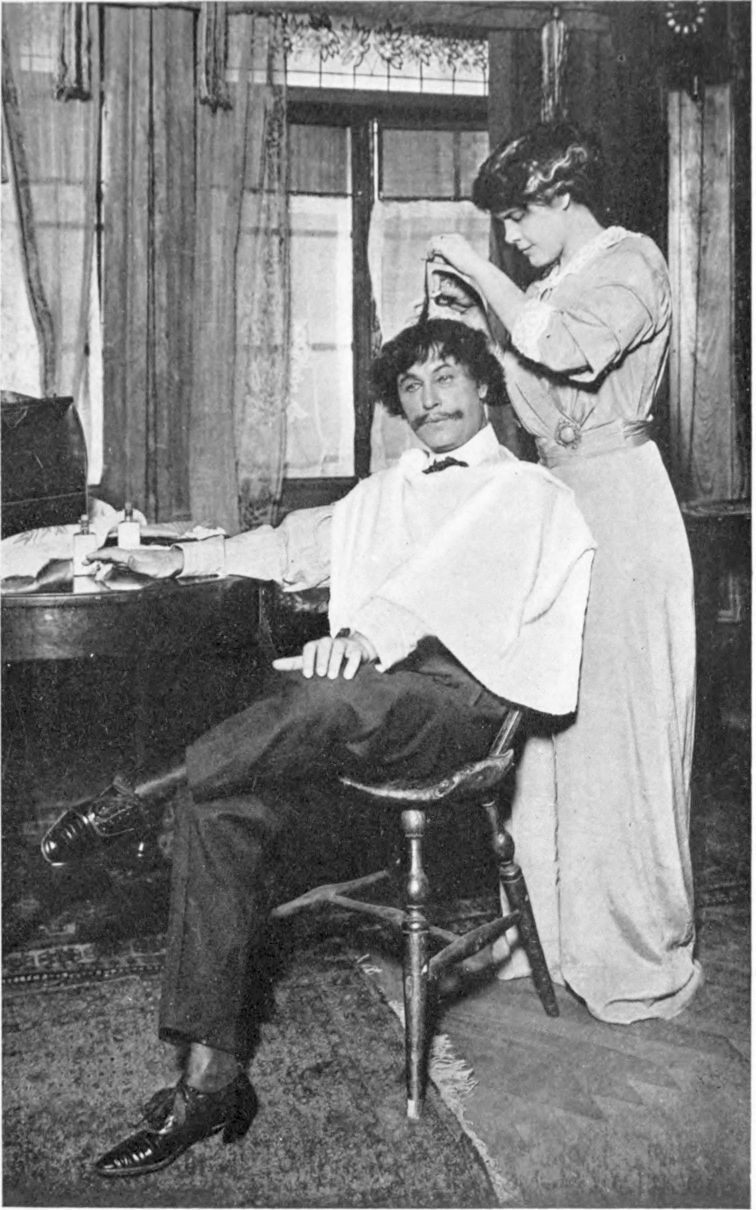
Photograph by White. Belasco’s Collection.
LEO DITRICHSTEIN AS GABOR ARANY AND JANET BEECHER AS HELEN, MRS. ARANY, IN “THE CONCERT”
company with the wife of the musician, pursues those fugitives, and, when the two couples are confronted, the insulted husband, after the manner of Citizen Sangfroid, blandly proposes that the complication of domestic affairs shall be solved and adjusted by an exchange of wives, sequent on the attainment of divorce. The silly woman who admires the musician is rescued by exposure of his selfishness and her folly, the musician is baffled and rebuked, and domestic peace is supposed to be restored.
Mr. Ditrichstein called his adaptation of Mr. Bahr’s play “a comedy.” The terms applied to plays, by way of classification, are somewhat indefinite at the best, but as to Comedy,—the general understanding is that it should be a dramatic composition which, in delineating character and manners, while piquant by virtue of delicate exaggeration and amusing by virtue of clever equivoke, moves within the limits of reason and probability. “The Concert” begins with farce and proceeds with violent absurdity. The persons implicated would not, in real life, act in a manner even approximate to that which is prescribed for them. The note that is struck, considered at its best, is that of burlesque. The play, in as far as it is a play,—the clash of character and the exposition of conduct,—begins in the Second Act. Sixteen persons are implicated in the action of the piece, but only seven of them are seen after the first curtain has fallen. The tone of the Second and Third acts, except at moments, is radically and extravagantly farcical. But toward the end an opportunity occurs, and it is duly improved,—perhaps in jest, perhaps in earnest,—of saying the magnanimous words that are usually attributed to philosophical lovers: “If you love a woman, and that woman happens to be your wife, you wish her to be happy, and if you discover that she thinks she can be happier with another man than she is with you your wish is that she should join him, if she can be sure of her feelings”; and so forth. At the close of this piece the wife of the genius affectionately assures him that she has all along understood his conduct, but is willing to pardon him if he will be faithful in future, and, by way of emphasizing her docile, charitable, and eminently tolerant spirit, she produces bottles of hair-dye and proceeds to rejuvenate his fading locks.—The scenic setting, the stage management, and the acting by which this farce were commended to public approbation were so appropriate, so resourceful and deft, so careful, zealous, spirited, and effective, that it gained immense popularity. This was the original cast of “The Concert”:
Gabor AranyLeo Ditrichstein.
Dr. DallasWilliam Morris.
McGinnisJohn W. Cope.
Helen AranyJanet Beecher.
Flora DallasJane Grey.
Eva WhartonAlice Leal Pollock.
Mrs. McGinnisBelle Theodore.
Miss MerkCatherine Proctor.
Fanny MartinEdith Cartwright.
Claire FlowerMargaret Bloodgood.
Natalie Moncrieff Adelaide Barrett.
Edith GordonCora Witherspoon.
Georgine RolandElsie Glynn.
Laura SageEdna Griffin.
Mrs. Lennon-RochKathryn Tyndall.
Mrs. ChatfieldMary Johnson.