Volume 1 — A GREAT NIGHT.—BELASCO AT THE METROPOLITAN.—A GENEROUS ACKNOWLEDGMENT.
Reading edition
During the season of 1906-’07 Belasco’s friend the Italian musical composer Puccini, who desired to write an opera on a characteristically American subject, made a visit to our country for the purpose of selecting one. While in New York, in January, 1907, he attended performances by Miss Frances Starr in “The Rose of the Rancho” and by Miss Bates in “The Girl,”—at the Academy of Music. After considerable cogitation his choice fell upon the latter, and while travelling to his home in Italy he wrote the following letter to Belasco:
(Giacomo Puccini to David Belasco.)
Hôtel de Londres, Paris [France], March 7, 1907.
“Dear Mr. Belasco:—
“I was exceedingly sorry to have left New York without seeing you once more. I have been thinking so much of your play, ‘The Girl of the Golden West,’ and I cannot help thinking that with certain modifications it might easily be adapted for the operatic stage. Would you be good enough to send me a copy of the play, to Torre del Lago, Pisa, Italia? I could then have it translated, study it more carefully, and write to you my further impressions.
“I cannot express to you all the admiration I feel for your great talent, and how much impressed I was at the drama I saw at your theatre.
“With kindest regards, and hoping to hear from you soon,
“Yours sincerely, “Giacomo Puccini.”
Puccini’s wish was immediately complied with, and upon the basis of Belasco’s melodrama he wrote his opera of “La Fanciulla del West,”—which was sung, in Italian, “for the first time on any stage,” December 10, 1910, at the Metropolitan Opera House, New York: the libretto was “arranged” by
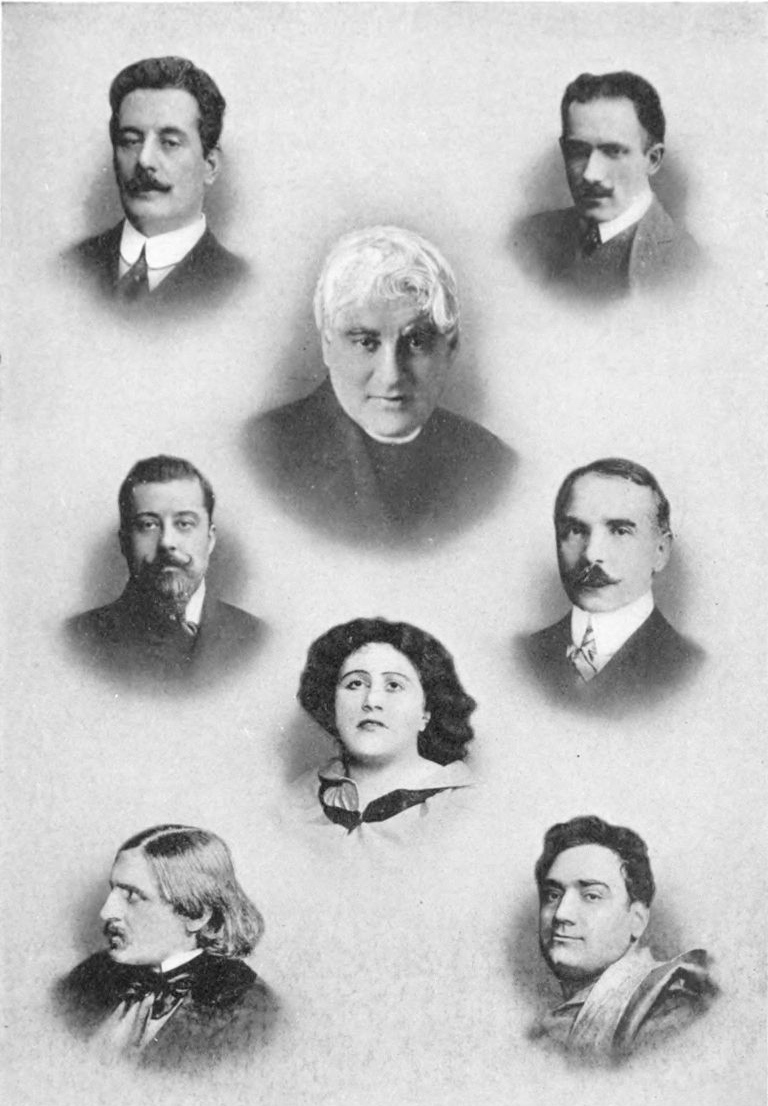
In Remembrance
PUCCINI’S OPERA “THE GIRL OF THE GOLDEN WEST”
Giacomo Puccini Arturo Toscanini
(P. by Dupont) (P. by Dupont)
Belasco (P. by Abbe)
G. Gatti-Casazza Otto H. Kahn
(P. by Dupont) (P. by Pach)
Emmy Destinn (P. by White)
Pasquale Amato Enrico Caruso
(P. by White) (P. by White)
Signori G. Zangarini and C. Civinni: it is, substantially, a translation, until the last act, when a scene is introduced showing the imminent lynching of Johnson by “the boys” in a convenient grove of redwood trees and his rescue by the Girl. This scene, as I understand, was originally planned by Belasco for use in his play but was by him discarded. “La Fanciulla del West” was sung for the first time by an extraordinary cast, which should be recorded. This is it:
Minnie Emmy Destinn.
Dick Johnson, (Ramirez, the road-agent) Enrico Caruso.
Jack Rance Pasquale Amato.
Nick, Bartender at the “Polka” Albert Reiss.
Ashby, Wells-Fargo Agent Adamo Didur.
Sonora Dinh Gilly.
Trin Angelo Bada.
Sid Giulio Rossi.
Bello Miners Vincenzo Reschiglian.
Harry Pietro Audisio.
Joe Glenn Hall.
Happy Antonio Pini-Corsi.
Larkens Bernard Bégué.
Billy, an Indian Georges Bourgeois.
Wowkle, his Squaw Marie Mattfeld.
Jake Wallace, a Minstrel Andrea de Segurola.
José Castro Edoardo Missiano.
The Pony Express Rider Lamberto Belleri.
Men of the Camp and Boys of the Ridge.
CONDUCTOR ARTURO TOSCANINI.
Belasco felt profound interest in the production of his friend’s opera and directed many of the rehearsals, intent, as he has declared, “to make the artists act as well as sing.” That, doubtless, was a laudable ambition,—but, practically, it is, in the very nature of things, impossible of fulfilment, whether by Belasco or another. Opera singers may be, indeed, frequently are, dramatic in temperament: they are not and can not simultaneously be excellent as actors and as singers. Sometimes a comparatively poor singer becomes, in opera, a tolerably good actor,—but that is the limit of achievement in this direction. True impersonation, as made known on the dramatic stage,—in, for example, Forrest’s Othello, Davenport’s Macbeth, Jefferson’s Rip Van Winkle, Barrett’s Cassius, Irving’s Mephistopheles,—never has been and never can be displayed on the operatic stage.
Talking with me about the first performance of this opera, Belasco said: “It was a great night for me, and I took unbounded pleasure in it and felt much honored when I found myself taking curtain calls with the author, Toscanini, Gatti-Casazza, Caruso, Miss Destinn, and the rest. Puccini, as always, was simple and frankly demonstrative in his delight. The singers were all wild with enthusiasm—I was never so much be-kissed in my life!—but I think I was, perhaps, most interested in that wonderful man Arturo Toscanini. He seemed to me one of those self-contained fellows—calm on the surface but burning white-hot inside. To me it was thrilling to watch him conduct, and he did so at that first performance without a score, as though the work were a classic long familiar to him and held in memory.”
Belasco’s labor on the production of “La Fanciulla” was wholly one of love, as he declined to accept any payment for all his arduous work at rehearsals. In the programme of the first performance appeared a notice saying: “The Metropolitan Opera Company desires to make public acknowledgment of its indebtedness, and to express its cordial thanks, to Mr. David Belasco for his most valuable and kind assistance in the stage production of ‘The Girl of the Golden West.’” And among his most cherished possessions is a sumptuous album containing signed portraits of all the principal singers who participated in the opera, as well as of Puccini, Toscanini, and Gatti-Casazza, together with an exquisitely illuminated copy of the programme on vellum and an appreciative inscription, also illuminated on vellum. This gracious token was taken to Belasco’s studio and delivered to him by a committee, representing the opera company, composed of Messrs. Otto Kahn, Henry Rogers Winthrop, Robert Goelet, and John Brown.