Volume 1 — CHRONOLOGY OF THE LIFE OF DAVID BELASCO
Reading edition
HUMPHREY ABRAHAM BELASCO, BORN, LONDON, ENGLAND, DECEMBER 26, 1830. REINA MARTIN BELASCO, BORN, LONDON, ENGLAND, APRIL 24. 1830.
1853. July. 25. David Belasco, eldest child of Humphrey Abraham, and Reina Martin, Belasco, was BORN, in a house in Howard Street, near Third Street, San Francisco, California. 1858. While David Belasco was a little child,—apparently about 1858,—his parents removed to Victoria, Island of Vancouver, B. C., taking him with them. In the latter part of 185(8?) he was “carried on,” at the Theatre Royal, Victoria, as Cora’s Child, in “Pizarro,”—Julia Dean (Hayne) being the Cora. Later he played the child in “Metamora,” when Edwin Forrest filled an engagement in Victoria. 186(2?). About 1862 he appeared with Julia Dean (Hayne), in “East Lynne,” as Little William. 1864. In the latter part of 1864 he played the little Duke of York, in “King Richard III.,” with Charles Kean, at the Theatre Royal, Victoria. 1865-1871. In 1865 (March-April?) the elder Belasco removed with his family to San Francisco, California, and there established his permanent residence. As a boy, in that city, Belasco attended several schools, chief among them the Lincoln Grammar School. During part of this period the Belasco home was in Louisa Street, then in Bryant Street, afterward it was in Clara Street. 1871. March. 17. At the Metropolitan Theatre, San Francisco, Belasco appeared as an Indian Chief in Professor Hager’s “Great Historical Allegory, ‘The Great Republic,’”—which was several times repeated, for the benefit of the schools whose pupils participated in the performance: in the Second Part thereof he personated War. April. 15. He appeared, in Hager’s “The Great Republic,” at Sacramento, California. June. 2. (Friday Evening.) He took part in a series of public “competitive declamations” (reciting “The Maniac”), by pupils of the Lincoln Grammar School, at Platt’s Hall, San Francisco. On same occasion he appeared as Highflyer Nightshade, in “The Freedom of the Press.” 7. At the Metropolitan Theatre, revival of Hager’s “The Great Republic,” in which he again appeared as an Indian Chief, and as War. 22. He appeared as Fornechet, Minister of Finance, in a presentment of Sutter’s “Life’s Revenge,” by the Fire-Fly Social and Dramatic Club, at Turnverein Hall, Bush Street, near Powell, San Francisco. July. 10. Belasco’s First Regular Appearance on the professional stage,—as a super, with Joseph Murphy, in “Help,” at the Metropolitan Theatre. Subsequently he was given a small part, a few words to speak, in this play. “Help” was played till July 16, Sunday night. 19. “Help” revived at Metropolitan Theatre. 22. End of Murphy’s engagement in “Help.” 1872. July. 22. He played Bloater, in “Maum Cre” (then first acted in San Francisco), with Joseph Murphy, at the Metropolitan Theatre. December. 16. He appeared at the Metropolitan Theatre, San Francisco, with Minnie Wells (not Mary Wells), in “The Lion of Nubia” (not Lioness), as Lieutenant Victor: on this occasion he was billed as Walter Kingsley. 1873. February. 23. He played Peter Bowbells in “The Illustrious Stranger,” in a Benefit Performance, for Marion Mordaunt, at the Metropolitan Theatre. March. 5. “Grand Reopening of the Metropolitan Theatre,” under direction of John R. Woodard: cheap prices: The Chapman Sisters, in H. J. Byron’s “Little Don Giovanni.” Belasco played the First Policeman. 18. He played Prince Saucilita (giving burlesque of a local character known as “Emperor” Norton), in “The Gold Demon,” with the Chapman Sisters, at the Metropolitan Theatre. 21. He played Strale, in “Checkmate,” with the Chapmans, at the Metropolitan. April. 2. (One night only.) He played Reuben, in “Schermerhorn’s Boy,” and Strale, in “Checkmate,” with the Chapmans, at the Academy of Music, Oakland, California. 3. At the Metropolitan, San Francisco, he appeared, with the Chapmans, as the Genius of the Ring, in “The Wonderful Scamp; or, Aladdin No. 2,” and as Peter True, in “The Statue Lover.” 9. He played the First Fury, in “Pluto,” with the Chapmans, at the Metropolitan. 18. Revival of “Little Don Giovanni” at the
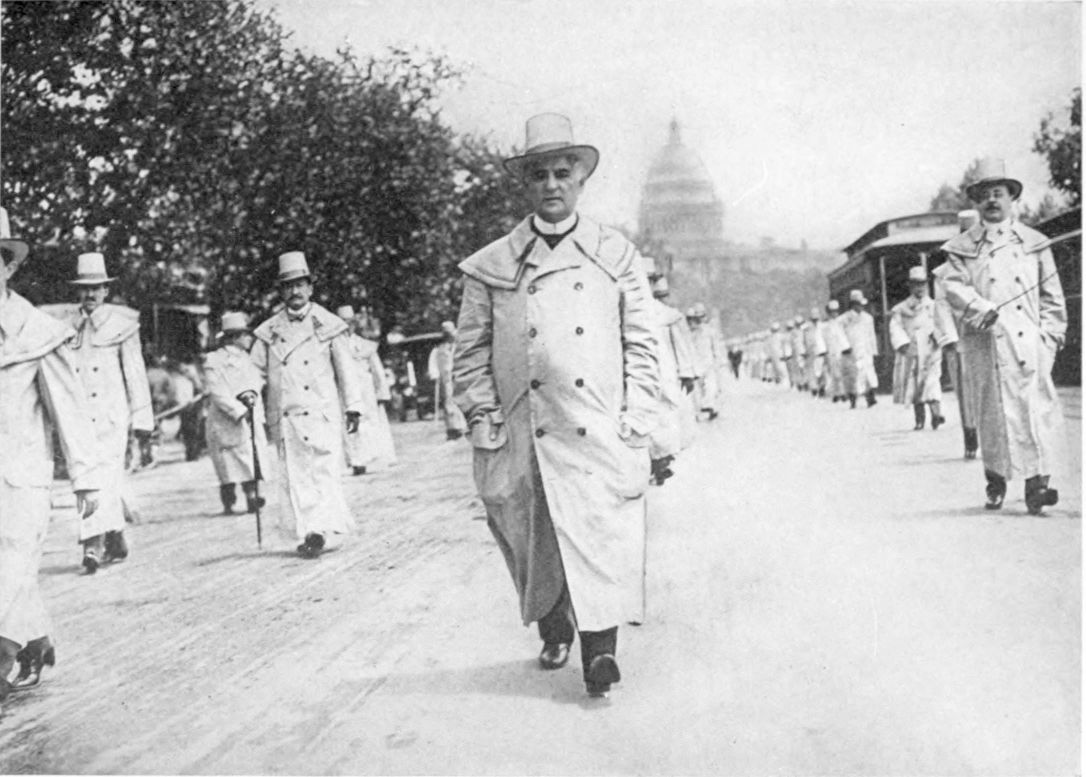
Photograph by Harris & Ewing. Belasco’s Collection.
BELASCO LEADING THE PARADE OF “THE LAMBS” UP PENNSYLVANIA AVENUE, WASHINGTON, D. C.
Inscription:
“The first time I ‘paraded’ into town since my old days in the West, when I used to bang the cymbals and pound the drum!”—D. B.
Metropolitan: Belasco as the First Policeman. 28. Last regular performance at the Metropolitan Theatre, San Francisco. The Chapman Sisters in “Cinderella,”—produced 23. May. 3. He played with the Chapman Sisters, in “Little Don Giovanni,” in Sacramento. Later he appeared, with the Chapman Sisters, in several California towns. August. 18. He played Bloater, in “Maum Cre,” with Joseph Murphy, at Shiels’ Opera House, San Francisco. 25. He played Bob Rackett, in “Help,” with Murphy, at Shiels’. 26. At the home of his parents, No. 174 Clara Street, San Francisco, California, David Belasco and Cecilia Loverich were married. September. 1. At Shiels’ Opera House he played Baldwin, with Murphy, in “Ireland and America”: Same bill, September 2, 6, and 7. “Maum Cre” 3, 4, and 5. 10. He played Harvey, in “Out at Sea,” with Laura Alberta, at Shiels’ Opera House. 20. He played Sambo, in “Uncle Tom’s Cabin,” to the Topsy of Laura Alberta, at Shiels’. 25. “Twice Saved; or, Bertha the Midget,” was acted at the Opera House (formerly Shiels’, subsequently Gray’s) and Belasco played Major Hershner. 29. He acted Spada, in Stirling Coyne’s “The Woman in Red,” with Fanny Cathcart, at the Opera House. (That house was first billed as Gray’s Opera House, on October 3, and “The Woman in Red” was played there till October 5.) October. 6. Belasco played at Gray’s Opera House, as Darley, with Fanny Cathcart and George Darrell, in “Dark Deeds.” 18. Benefit performance, at Gray’s Opera House, to James Dunbar: Belasco acted Mons. Voyage, in Third Act of “Ireland as It Was.” October-November, et seq. He went to Virginia City, Nevada, where he became a member of the stock company at Piper’s Opera House. 1874. March. 1-7? Belasco returned to San Francisco from Virginia City. 10. Engagement of Adelaide Neilson in San Francisco began at the California Theatre,—Miss Neilson making her first appearance there in “Romeo and Juliet.” Belasco participated in all the performances given during that engagement,—which ended on March 30,—as a super and helper about the stage. May. 4. Grand Opening of Maguire’s New Theatre, San Francisco, (the old Alhambra, rebuilt and altered),—“The Entire Lingard Combination,” Wiliam Horace Lingard, Dicky Dunning, Alice Lingard, etc., appearing in “Creatures of Impulse,” “Mr. and Mrs. Peter White,” and a miscellaneous entertainment. June-September. Belasco worked as a copyist, etc., for Barton Hill, at the California Theatre and played minor parts (not recorded) at Maguire’s New Theatre. Also, he made several brief excursions as a “barnstormer” to small towns of California and Nevada. September. (14?). Belasco became attached to Maguire’s New Theatre as assistant stage manager and prompter, actor of small parts, hack playwright, and secretary and messenger to Thomas Maguire. In this employment he came into association with James A. Herne, Thomas Whiffen, Annette Ince, Ella Kemble, Sydney Cowell, etc. He remained there for about four months. October. 12. He played the Dwarf in “Rip Van Winkle” at Maguire’s,—Herne being Rip. December. 24. Belasco played Pietro and Galeas, in the prologue and drama of “The Enchantress,” at Maguire’s New Theatre. 1875. January to (May?). Belasco was “barnstorming” with a Miss Rogers, originally a school teacher, who obtained financial support and starred in a repertory including “East Lynne,” “Camille,” “Frou Frou,” and “Robert Macaire.” Miss Rogers’ tour began in Portland, Oregon, and continued through small towns along the Big Bear and Little Bear rivers. It proved a failure and the company was disbanded,—Miss Rogers and Belasco, however, continued to appear together for several weeks, presenting one-act plays such as “A Happy Pair” and “A Conjugal Lesson.” June. —. He was in San Francisco. July. 4. He participated, as assistant to James H. Le Roy, in stage management of a benefit performance, for Frank Rea, at Maguire’s New Opera House. August. 4. He assisted, in various ways, in a presentation at the California Theatre of “The Bohemian,” in which George Ceprico (amateur) appeared as Edmund Kean. 7. Production at the California Theatre of [a variant, by Belasco?] Le Roy’s version of “The New Magdalen,”—Ellie Wilton playing Mercy Merrick. 8. “Lost in London” was presented at Maguire’s New Theatre, at Belasco’s suggestion [acted according to a prompt book or “version” prepared by him?]. November. 17. Benefit, to “Sam” Wetherill, at Maguire’s New Theatre,—stage management of Belasco. December. 6. Belasco played a subsidiary part in “The Jealous Wife,” in a performance (“last night of the season”) at Maguire’s, for the benefit of Katy Mayhew. 13. C. R. Thorne’s Palace Theatre (formerly Wilson’s Amphitheatre), corner Montgomery and Mission streets, San Francisco, was opened, with “Gaspardo; or, The Three Banished Men of Milan,” and Belasco appeared in it as Santo, a Monk. 21. He played Signor Mateo, in “The Miser’s Daughter.” 24. He played Selim, in “The Forty Thieves,” at Thorne’s Palace Theatre. 30. He played Gilbert Gates, in “The Dawn of Freedom,” at the same house. Thorne closed his theatre, suddenly, December 31. 1876. January. 7. The Palace Theatre was reopened, as the Palace Opera House, under management of Colonel J. H. Wood, presenting Frank Jones in “The Black Hand; or, The Lost Will,” in which Belasco played Bob, a Policeman. That engagement lasted for about three weeks, at the end of which time, apparently, he went back to Maguire’s New Theatre. March. 6. Opening of Baldwin’s Academy of Music, San Francisco. Thomas Maguire, proprietor. James A. Herne, stage manager. David Belasco, assistant stage manager and prompter. Bill: Barry Sullivan, in “King Richard III.,”—Belasco played Ratcliff. 11. Sullivan revived “The Wonder,” at Baldwin’s, and Belasco played in it as Vasquez. 13. Sullivan acted in “Hamlet,” at Baldwin’s: Belasco played Bernardo and the Second Actor. 16. Sullivan presented “Richelieu,” at Baldwin’s, and Belasco appeared as one of the Secretaries. 20. Played the First Officer, in “Macbeth,” with Sullivan, at Baldwin’s. 23. Played the Waiter, in “The Gamester,” with Sullivan as Beverley. 27. Played the Duke of Burgundy, in “King Lear,” with Sullivan, at Baldwin’s. 29. Played a Messenger, in “Othello,” with Sullivan, at Baldwin’s. 31. Played Salarino, in “The Merchant of Venice,” with Sullivan, at Baldwin’s. April. 5. Played the Lieutenant, in “Don Cæsar de Bazan,” with Sullivan, at Baldwin’s. 7. Played Furnace, in “A New Way to Pay Old Debts.” 10. Played Marco, in “The Wife.” 16. End of Barry Sullivan’s engagement at Baldwin’s Academy of Music, “King Richard III.” Belasco played Ratcliff. 18. Mrs. James A. Oates began an engagement in Opera at Baldwin’s, and Belasco, with other members of the dramatic stock company, returned to Maguire’s New Theatre (whence they had come to Baldwin’s), where they supported Baker and Farron, in “Heinrich and Hettie.” May-June—part of July. Belasco went “barnstorming.” July. 23. He played DeMilt, in “Under the Gas-Light,” in a benefit, by John McCullough and others, for E. J. Buckley, at the California Theatre. September. 4. Edwin Booth began an eight weeks’ engagement in San Francisco (the first in twenty years), at the California Theatre, in “Hamlet,” “Richelieu,” “Othello,” etc., and Belasco was employed as a supernumerary in his company. October. —. Belasco was employed by James M. Ward as stage manager and playwright, at the Grand Opera House. 16. He appeared with Ward and Winnetta Montague, at the Grand Opera House, in “The Willing Hand.” 22. He appeared at Baldwin’s, as Doctor of the Hospital, in “The Two Orphans,” for benefit of Katy Mayhew. 1877. February. 16. He appeared at Egyptian Hall (No. 22 Geary Street, near Kearny), in association with Frank Gardner and his wife (Carrie Swan), acting The Destroyer, in “The Haunted House,”—a play written by himself,—Valentine, in an abridgment of “Faust,” and Mr. Trimeo, in “The Mysterious Inn.” The presentments at Egyptian Hall were all built around a variant of the “Pepper’s Ghost” illusion. 17. At Egyptian Hall he appeared as Avica, Spirit of Avarice, in “A Storm of Thoughts”; Phil Bouncer, in “The Persecuted Traveller,” and as The Destroyer, in “The Haunted House.” 20. At Egyptian Hall “Our Mysterious Boarding House” was presented, in which he played Our Guest, replacing “The Persecuted Traveller,” in bill as on 17. April. 2. Same place, he played Mark, in “The Prodigal’s Return,” as well as Avica and Our Guest, as above. The engagement of the Gardners and Belasco at Egyptian Hall continued for eight weeks. Other plays which Belasco recalls having written for presentation there are “Wine, Women, and Cards” and “The Christmas Night; or, The Convict’s Return.” I have not, however, found record of the presentation of them. During that engagement at Egyptian Hall, Belasco also gave several recitations, including “The Maiden’s Prayer,” with musical accompaniment, and “Little Jim.” May-July. Belasco acted with Gardiner and his wife, in various cities and towns of California and the Pacific Slope, in the plays above mentioned. August. 18. Belasco played John O’Bibs, in Boucicault’s “The Long Strike” (billed as “The Great Strike”), and the Earl of Oxford, in the Fifth Act of “King Richard III.,” in a benefit for A. D. Billings, at the California Theatre, San Francisco. September. 24. A theatrical company, from the California Theatre, San Francisco, under the management of Thomas W. Keene, of which Belasco was stage manager, began a “Fair week” engagement at the Petaluma Theatre, Petaluma, California. Bill: “The Lady of Lyons,” in which Belasco played Monsieur Deschapelles; and “The Young Widow,” in which he played Mandeville. 25. Same engagement: “The Hidden Hand,” Belasco playing Craven Lenoir; and “Robert Macaire,” in which he played Pierre. 26. Same. “The Wife,” Belasco as Lorenzo; and “My Turn Next,” Belasco as Tom Bolus. 27. Same. “The Streets of New York,” Belasco as Dan; and “The Rough Diamond,” Belasco as Captain Blenham. 28. Same. “Deborah,” Belasco as Peter; and “Solon Shingle” (“The People’s Lawyer”), Belasco as Lawyer Tripper. Same. Benefit of Keene. “The Ticket-of-Leave Man,” Belasco acted one of the subsidiary parts. October. —. Belasco joined the Frayne Troupe, at Humboldt, Oregon, opening as Mrs. Willoughby, in “The Ticket-of-Leave Man.” This engagement lasted about three months. 1878. January. 4. He played at the Opera House, San José, as a member of the Frayne Troupe (Frank I. Frayne, manager), comprising also M. B. Curtis, H. M. Brown, E. N. Thayer, Mrs. Harry Courtaine, Gertrude Granville, and Miss Fletcher. He played in many Pacific Slope towns and cities with this company. January-March. He returned to San Francisco and performed miscellaneous theatrical drudgery. March. 4. Belasco played James Callin, and Pablo, an Italian Harpist, in the prologue and drama of “Across the Continent,” with Oliver Doud Byron, at the Bush Street Theatre, San Francisco. (Six nights: revival, March 18 to 23.) 26. The New York Union Square Company acted at the Baldwin Theatre, San Francisco, in “Agnes,” and Belasco appeared with it, as the valet, Rudolphe. April. 8. “One Hundred Years Old” was acted at the Baldwin Theatre, Belasco playing the servant, Louis. 15. “Saratoga” was acted at the Baldwin, Belasco playing Gyp. 25. “A Celebrated Case” was revived at the Baldwin, Belasco playing a subsidiary part. May, et seq. Belasco travelled with the Union Square Theatre Company, as stage manager, during a tour of towns and cities of California, Oregon, etc. At the end of that tour he received a memorable tribute from the members of the company: see page 106. July. 8. Boucicault’s “The Octoroon,” “retouched and rearranged” by Belasco, was revived at the Baldwin Theatre. September. 2. Belasco’s version of “The Vicar of Wakefield,” entitled (like Wills’ version) “Olivia,” was produced for the first time at the Baldwin Theatre, San Francisco, Rose Wood acting Olivia, A. D. Bradley Dr. Primrose, James O’Neill Mr. Barchell, and Lewis Morrison Squire Thornhill. October. 14. An alteration by Belasco of Wills’ “A Woman of the People” was acted at the Baldwin. 28. Belasco’s “Proof Positive” was acted at the Baldwin. November. 4. Clara Morris began her first San Francisco engagement at the Baldwin, Belasco being the stage manager. December. 23. “Not Guilty,” by Watts Phillips, revised by Belasco, and produced under his direction, was acted for the first time in San Francisco, at the Baldwin Theatre: notable success. 1879. January. —. Belasco resigned his position at the Baldwin Theatre and rewrote his play of “The Lone Pine” for Denman Thompson. He disagreed with Thompson and his manager, J. M. Hill, and his play was not produced. February. —. Belasco was re-employed as stage manager, etc., at the Baldwin. 6. He played Colonel Dent, in “The Governess,” with Clara Morris, at the Baldwin Theatre (one night only: farewell of Miss Morris). 17. Belasco’s dramatization of Gaboriau’s “Within an Inch of His Life” was acted for the first time at the Grand Opera House: notable success. March. 1. “Within an Inch of His Life” was withdrawn. 3. The first presentation of Salmi Morse’s “The Passion Play” was made at the Grand Opera House, San Francisco, under the stage management of Belasco and “Harry” Brown,—James O’Neill appearing in it as Jesus Christ. 11. “The Passion Play” was withdrawn at the Grand Opera House. April. 15. Revival of “The Passion Play” at the Grand Opera House. 20-21. An injunction prohibiting further presentation of “The Passion Play” was issued, and, that being disregarded, O’Neill and his associates were arrested (21st): O’Neill was imprisoned, and later he was fined $50 and his associates $5 each, for contempt of court. May. 5. An adaptation of Sardou’s “La Famille Benoiton!” entitled “A Fast Family,” made by Belasco, was played at the Baldwin. 19. At the Baldwin Belasco acted the old man, Timothy Tubbs, in his play of “The Millionaire’s Daughter,” which was then first presented,—five nights: revival May 26 to 31. June. 2. Rose Coghlan, engaged at Belasco’s request, began her first engagement in San Francisco, at the Baldwin, playing Lady Gay, in “London Assurance.” 30. First performance of “Marriage by Moonlight” (afterward renamed “The Moonlight Marriage”), by Belasco and James A. Herne, occurred at the Baldwin Theatre. July. 13. (Sunday night.) Special benefit for Belasco and James A. Herne, at the Baldwin: “The Moonlight Marriage” and “Rip Van Winkle.” 15. First performance of Belasco’s version of “L’Assommoir,” based on Zola’s novel, was made at the Baldwin, with an “all-star company,”—Rose Coghlan, Lillian Andrews, Jean Clara Walters, O’Neill, Morrison, Herne, etc., being in the cast. September. 9. At Baldwin’s Theatre, San Francisco, first production of “Chums” (“Hearts of Oak”), by David Belasco and James A. Herne. 21. (Sunday.) Last performance of “Chums” at Baldwin’s. Failure. October. 6. Herne-Belasco partnership presented “Chums” at Salt Lake City. Other places were visited. The business was bad. Failure. “Chums” was closed, and company disbanded. Belasco, Herne and his wife (Katharine Corcoran) went to Chicago and lodged at the old Sherman House. November. 17. First performance in Chicago, at Hamlin’s Theatre (formerly the Coliseum?), of “Hearts of Oak” (“Chums”). Notable success. 30. “Hearts of Oak” closed at Hamlin’s. December. 1. Belasco-Herne Company appeared in Cincinnati. 20. (About) Belasco-Herne Company was playing “Hearts of Oak” in Indianapolis. A version of “The Mariner’s Compass” (on which “Hearts of Oak” was built) was presented in cities of the Middle West, under the name of “Oaken Hearts,” to trade on the success of the Belasco-Herne title: unauthorized use of that title was stopped by legal action taken by Herne in courts of Michigan in May, 1880. 1880. March. 15. “Hearts of Oak” was acted at Hooley’s Theatre, return engagement, till March 27. 29. “Hearts of Oak” was performed for first time in New York, at the New Fifth Avenue Theatre—untruthfully announced as “by James A. Herne.” Failure. During this engagement Herne was several times incapacitated to perform and Belasco appeared in his place as Terry Dennison. April. 16. Last performance of first “Hearts of Oak” engagement in New York. Belasco and Herne took their play to the Arch Street Theatre, Philadelphia. There Herne quarrelled with Belasco and bought his half-interest in the play for $1500, which he did not pay till several years later. Belasco returned to New York, seeking employment, but could not obtain it. He then made his way, by various shifts, across the continent, to his home in San Francisco. June. 16. Belasco reached San Francisco, after his disastrous experience with Herne and “Hearts of Oak.” He obtained immediate employment at the Baldwin Theatre, where Adelaide Neilson was then playing her farewell engagement (it began on June 8). James H. Vinson and Robert M. Eberle were, officially, the stage managers: Belasco officiated as assistant stage manager and as prompter, and, on July 17, he “rang down” the curtain on the last performance ever given by Miss Neilson:—Juliet, in Balcony Scene from “Romeo and Juliet,” and Amy Robsart, in the play of that name. During this engagement at the Baldwin, though actually he performed much important labor, both as stage manager and as writer and adapter of plays, Belasco’s acknowledged position was wholly subsidiary: for reasons of business expediency he again assumed, for a time, use of the name Walter Kingsley. July. 19. His play of “Paul Arniff” was produced, for the first time, at the Baldwin Theatre: it is founded in part on “The Black Doctor.” August. 16. John T. Malone made his first appearance on the stage, acting Richelieu, at the Baldwin, under the direction of Belasco. 30. A new version, by Belasco, of T. P. Cooke’s “True to the Core” was acted at the Baldwin. November. 15. William E. Sheridan began his first San Francisco engagement, at the Baldwin, during which, under stage direction of Belasco, he appeared in “King Louis XI.,” “Wild Oats,” “The Lady of Lyons,” “The Merchant of Venice,” etc., etc. December. 28. First production in America of the once famous melodrama of “The World” was made, under Belasco’s direction, at the Baldwin Theatre, San Francisco. 1881. January. 17. Belasco’s “The Creole” (based on “Article 47”) was acted for the first time in New York, at the Union Square Theatre,—Eleanor Carey appearing in it as Diana. February. 6(?). Last performance of “The Creole” at the Union Square Theatre. March. 27. Belasco left San Francisco, with the Baldwin Theatre stock company, for Portland, Oregon. April. 15. He returned from Portland and resumed employment at the Baldwin Theatre. July. 18. Belasco’s play of “La Belle Russe” was anonymously produced, under his stage direction, at the Baldwin Theatre, San Francisco (first time anywhere), Miss Jeffreys-Lewis, Osmond Tearle, and Gerald Eyre acting the chief parts in it. Exceptional success. 26. Belasco’s authorship of “La Belle Russe” was announced, in advertisements of that play. 30. Final performance, original run, of “La Belle Russe,” at the Baldwin. August. 15. At the Baldwin occurred the first performance of Belasco’s dramatic epitome of Adolphe Belot’s story, “The Stranglers of Paris,” Osmond Tearle acting Jagon: Belasco’s name was not made known at this time as the stage-adapter of the story. September. 25. Belasco left San Francisco, with Maguire, for the East, to arrange for the sale of his play of “La Belle Russe.” During his stay in New York, October-December, this year, Belasco negotiated regarding presentment of “La Belle Russe” with Augustin Daly, John Stetson, A. M. Palmer, and Lester Wallack. He finally sold his interest in that play outright, to Frank L. Goodwin, for $1500, a return ticket to San Francisco, and $100 for travelling expenses. December. 25. Belasco reached San Francisco from New York. 1882. March. 7. First performance of Belasco’s spectacle melodrama of “The Curse of Cain” occurred at the Baldwin. April. 16. End of Thomas Maguire’s control of the Baldwin Theatre, San Francisco. May. 8. First production in New York of Belasco’s play of “La Belle Russe” was made at Wallack’s Theatre,—Osmond Tearle and Rose Coghlan playing the chief parts. June. 12. A “sensation revival” of Belasco’s “retouched and re-arranged” version of Boucicault’s “The Octoroon,” introducing Callender’s Colored Minstrels, was effected at the Baldwin, under the stage direction of Belasco and the management of Gustavo Frohman: notable success. July. 10. Belasco’s “American Born” was acted, for the first time, at the Baldwin Theatre, San Francisco,—Edward N. Marble being then the lessee of that house. —. First meeting of Belasco and Charles Frohman. 18(?). Belasco left San Francisco, travelling, as stage manager, with the [Gustave] Frohman Dramatic Company. 31. That company began an engagement in Denver, Colo.,—at the end of which, apparently, it was disbanded. August. 16. Belasco’s “American Born” was successfully produced, at the Grand Opera House, Chicago, under the joint management of Gustave and Charles Frohman. October. 9. First production of “Young Mrs. Winthrop,” by Bronson Howard, at the Madison Square Theatre. This was the first play produced at that theatre under the stage management of Belasco, and the incident marks his establishment in the Theatre of New York. The 100th performance of “Young Mrs. Winthrop” occurred January 12, 1883: the 150th, March 5. 1883. April. 7. Last performance (original “run”) of “Young Mrs. Winthrop” at the Madison Square Theatre. 9. First performance, by professional actors, Madison Square Theatre, of “A Russian Honeymoon,” by Mrs. Burton N. Harrison, produced under stage management of Belasco. June. 4. Last performance of “A Russian Honeymoon” and end of “the regular season” at the Madison Square. 5. Beginning of the “summer season” at the Madison Square, with first production of “The Rajah; or, Wyncot’s Ward,” by William N. Young, revised by Belasco, and produced under his stage direction. September. 1. 100th performance of “The Rajah” at the Madison Square. October. 31. 150th performance of “The Rajah.” November. 12. At the New Park Theatre occurred the first performance in New York of Belasco’s melodrama (revised for the occasion) of “The Stranglers of Paris,” which was produced under the stage direction of the author and the management of Charles Frohman: Henry Lee appeared as Jagon. December. 8. “The Rajah” was withdrawn at the Madison Square. 10. At the Madison Square first production of “Delmar’s Daughter; or, Duty”; by Henry C. De Mille, under Belasco’s direction. It was a failure and was withdrawn on the 15th. 17. “The Rajah” was revived at the Madison Square. 1884. January. 29. Last performance of “The Rajah.” 31. First New York performance, Madison Square Theatre, of “Alpine Roses,” by H. H. Boyesen; stage direction of Belasco. Georgia Cayvan, Marie Burroughs, Eben Plympton, and Richard Mansfield played the chief parts in this drama. April. 10. Last performance of “Alpine Roses.” 12. At the Madison Square Theatre, first production, on any stage, of Belasco’s drama of “May Blossom,” founded in part on his earlier play of “Sylvia’s Lovers”: produced under the stage direction of the author. July. 5. Belasco sailed for England, on board the SS. Alaska, to witness performances of “Called Back,” at the Haymarket Theatre, London,—that play having been purchased for production in America by the Mallory brothers. First meeting of Belasco and author occurred on this voyage. 19. He sailed for New York, on board the SS. Alaska. 27. He arrived in New York. August. 27. Public announcement by the Mallory brothers that Albert Marshall Palmer had become a partner in the management of the Madison Square Theatre. Friction between Belasco and Palmer, relative to management of the stage, had arisen some time earlier. September. 1. First production in America of “Called Back,” made by the Mallory brothers at the Fifth Avenue Theatre, under the stage direction of Belasco. 9. 150th performance of “May Blossom” at the Madison Square Theatre. 27. Last performance of “May Blossom” at the Madison Square Theatre. 29. A new policy was put into effect at the Madison Square Theatre, under the influence of Palmer, marked by the presentation, on this date, of “The Private Secretary.” This farce was placed on the stage almost entirely under the direction of Frank Thornton. After the successful production of “Called Back” at the Fifth Avenue Belasco resigned his position as stage-manager of the Madison Square Theatre company. 1885. —. Belasco contemplated abandoning stage direction and reverting to acting,—it being his plan to appear at the head of a company managed by himself as Hamlet and in the central part of a play he wished to write for his own use. He became acquainted with Steele Mackaye. 1886. February. 15. At Wallack’s Theatre, New York, occurred the first production on any stage of “Valerie,” a play in three acts altered by Belasco from Sardou’s “Fernande.” March. 13. “Valerie” was withdrawn at Wallack’s. May. —. Belasco returned to San Francisco as stage manager of Al. Hayman’s “all-star stock company.” 31. That company appeared, under his direction, at the Baldwin Theatre, in a dramatization of the novel of “Moths.” June. Hayman’s company acted at the Baldwin under Belasco’s direction as follows: 7. In Belasco’s “Valerie.” 14. “The Marble Heart.” 21. “Anselma.” 24. “The Lady of Lyons.” 28. “Alone in London.” July. 18. (Sunday night.) Belasco took a benefit at the Baldwin Theatre, San Francisco: extraordinary programme and great public enthusiasm. 26. He left San Francisco for New York, to take up work there in connection with the Lyceum Theatre. September. Belasco revised A. C. Gunter’s “A Wall Street Bandit,”—which was produced at the Standard Theatre, September 20. 18. Henry C. De Mille’s play of “The Main Line; or, Rawson’s Y” was produced at the Lyceum Theatre, under Belasco’s stage direction. October. 18. May Fortesque (Finney) began an engagement at the Lyceum, acting Gretchen, in Gilbert’s “Faust”: Belasco officiated as stage director throughout that engagement, during which Miss Fortesque also acted as Gilberte, in “Frou-Frou”; Iolanthe, in “King Rene’s Daughter,” and Jenny Northcott in “Sweethearts.” 1887. March. 23. Under Belasco’s direction, pupils of the Lyceum Theatre School of Acting gave a performance, at the Lyceum, of an English translation of Molière’s “Les Précieuses Ridicules.” May. 3. First production, at the Lyceum Theatre, of “The Highest Bidder,” made by Belasco on the basis of a play called “Trade,”—which was written by John Maddison Morton and Robert Reece, for the elder Sothern. Notable success. July. 16. End of the original “run” of “The Highest Bidder,” and close of the season at the Lyceum Theatre. August. 22. Revival of “The Highest Bidder” at the Lyceum. September. 12. “Pawn Ticket 210,” by Belasco and Clay M. Greene, was produced by Lotta, at McVicker’s Theatre, Chicago. 19. Cecil Raleigh’s farce, “The Great Pink Pearl,” and Augustus Thomas’ one-act drama, “Editha’s Burglar,” were produced, under Belasco’s stage direction, at the Lyceum. October. 24. At the Fourteenth Street Theatre “Baron Rudolph,”—originally entitled “Only a Tramp,”—by Bronson Howard, first rewritten as well as renamed by Howard; then, at Howard’s request, altered and improved by Belasco, was produced, for the first time in New York, by George S. Knight,—Charles Frohman representing Knight in the business management and Belasco stage directing the performance. Failure: the play was kept on the stage four weeks, to bad business. (In its original form Knight first presented “Baron Rudolph” in New York, at the Windsor Theatre, October 17, 1881.) November. 1. At the Lyceum occurred the first performance on any stage of “The Wife,” by Belasco and Henry C. DeMille. 19. “Baron Rudolph” was withdrawn at the Fourteenth Street Theatre. December. —. During this month Belasco revised and rectified William Gillette’s dramatization of Haggard’s “She,”—which had been produced at Niblo’s Garden on November 29. His work, for which he received $1,000, made a popular success of that spectacle. 1888. June. 16. 239th consecutive performance of “The Wife,” and close of the Lyceum Theatre. August. 21. The Lyceum was reopened for the season with first performance anywhere of Belasco and De Mille’s “Lord Chumley.” September. 11. Belasco’s revision of E. J. Schwartz’s “The Kaffir Diamond” was produced at the Broadway Theatre, New York, with Louis Aldrich in the chief part. (Belasco was paid $300 for his work on this play.) November. 11. —th and last performance at the Lyceum of “Lord Chumley.” 1889. March. 11. The fifth annual performance of the Academy of Dramatic Art (formerly the New York School of Acting) occurred at the Lyceum Theatre, under the direction of Belasco, Franklin H. Sargent, and Henry C. De Mille,—pupils of that school appearing in an English version of Sophocles’ “Electra.” 18. “The Marquis,” a version of Sardou’s “Ferréol,” prepared by Belasco, was produced under his stage direction at the Lyceum. Failure. 29. Revival of Belasco-De Mille drama of “The Wife,” at the Lyceum. April. 29. A play by William Gillette, based on Mrs. Humphry Ward’s novel of “Robert Elsmere” and bearing the same name, was produced at the Union Square Theatre under the stage direction of Belasco—by special arrangement with the directorate of the Lyceum Theatre: Belasco received $500 for his labor on this production. May. 6. James Albery’s play of “Featherbrain” (adapted from a French farce called “Tête de Linotte”) was produced, under stage management of Belasco, at the Madison Square Theatre—a special company organized by Daniel Frohman appearing in it. 18. Close of the season at the Lyceum. (Month, date?) Belasco and De Mille were commissioned to write a new play for the season of 1889-’90, at the Lyceum. —. First meeting of David Belasco and Mrs. Leslie Carter. September. —. Mrs. Leslie Carter sought Belasco at Echo Lake, New Jersey, and obtained his promise to undertake her training for the stage. November. 19. First performance anywhere of “The Charity Ball,” by Belasco and De Mille, stage direction of the former. This was the last play for the Lyceum with which Belasco was concerned. December. —. Belasco, being in need of the use of a stage for rehearsals of Mrs. Carter, agreed to revise a play by Mrs. Abby Sage Richardson, based on Mark Twain’s “The Prince and the Pauper,” and to rehearse a company in it, on the understanding that, as payment, he should be permitted to rehearse Mrs. Carter on the stage of the Lyceum Theatre. 1890. January. 20. Belasco’s revision of “The Prince and the Pauper” was acted at the Broadway Theatre, Elsie Leslie appearing in it as Tom Canty and as Prince Edward of Wales. January-February. Belasco was active in planning a play for Mrs. Carter, called “The Heart of Maryland,” in negotiation for its production under the management of A. M. Palmer, and in training of Mrs. Carter. February. 26. The bargain between Daniel Frohman and Belasco, for the latter to use the stage of the Lyceum Theatre, was wrongfully abrogated by the directors of that institution. Belasco soon afterward resigned his place at the Lyceum. March. 27. Belasco ended his association with the Lyceum Theatre. May. 24. 200th performance of “The Charity Ball,” and close of the Lyceum Theatre. October. 21. A melodrama entitled “Men and Women,” by Belasco and De Mille, was produced at Proctor’s Twenty-third Street Theatre, by Charles Frohman, under the stage direction of Belasco: and, to accommodate Miss Annie A. Adams, an old friend, Belasco wrote in this play a small part for Miss Maude Adams. November. 10. Belasco, with E. D. Price as business manager (the financial capital having been provided by Mr. N. K. Fairbank, of Chicago), presented Mrs. Leslie Carter, at the Broadway Theatre, as a star, in a play by Mr. Paul M. Potter, called “The Ugly Duckling”; that was Mrs. Carter’s first appearance on the stage. 1891. March. 14. End of tour of Mrs. Carter in “The Ugly Duckling,” and of career of that play, in Kansas City, Mo. 25. 200th consecutive performance of “Men and Women” at Proctor’s Twenty-third Street Theatre. 28. Last performance of “Men and Women,”—original production. April. 15. Belasco, Mrs. Carter, and Mrs. Dudley, her mother, sailed for England, on board SS. City of New York, and proceeded to Paris, to see the French play with music afterward presented in America as “Miss Helyett.” November. 3. “Miss Helyett,” a farce with music, adapted from the French by Belasco, was, by him, in association with Charles Frohman, produced at the Star Theatre, New York,—Mrs. Carter appearing in it as Miss Helyett. December. 17. 50th performance of “Miss Helyett” at the Star. 1892. January. 10. Last performance of “Miss Helyett” at the Star. 11. “Miss Helyett” was transferred from the Star to the Standard Theatre. 29. 100th performance of “Miss Helyett.” February. 13. Close of the New York engagement of Mrs. Carter in “Miss Helyett”: she then went on a tour in that play, under the management of Frohman and Belasco, which lasted until the end of the theatrical season of 1891-’92. During the greater part of the remainder of 1892 Belasco’s attention was bestowed principally on the writing of “The Girl I Left Behind Me.” 1893. January. 16. “The Girl I Left Behind Me,” by Belasco and Franklyn Fyles, was produced, by Charles Frohman, for the first time anywhere, at the New National Theatre, Washington, D. C.,—under the stage management of Belasco. 25. The Empire Theatre, New York, was opened, under the management of Charles Frohman, with a performance of “The Girl I Left Behind Me.” March. 29. “The Girl I Left Behind Me” was played at the Empire with an entirely new cast—the original company, with one or two exceptions, going to Chicago, where, during the World’s Columbian Exposition, it was presented in that drama, at the Schiller (now, 1917, the Garrick) Theatre, for many weeks. June. 24. 288th consecutive performance of “The Girl I Left Behind Me,” at the Empire, and close of the first season at that theatre. October. 24. First performance in New York, at the Empire Theatre, of “The Younger Son,” adapted by Belasco from a German play called “Schlimme Saat” (“Evil Seeds”). Failure: it was withdrawn after four performances. 1894. August. 22. Belasco left New York, taking his brother Frederick with him, for San Francisco,—called there by the illness of his mother, who was thought to be dying. 1895. October. 9. Belasco’s play of “The Heart of Maryland” was presented, by the author, in association with Mr. Max Bleiman, of New York, for the first time anywhere, at the Grand Opera House, Washington, D. C. 22. “The Heart of Maryland” was acted for the first time in New York, at the Herald Square Theatre: notable success. 1896. March. 3. 150th performance of “The Heart of Maryland.” 31. An extra performance of “The Heart of Maryland” was given at the Herald Square Theatre, for the benefit of the Hebrew Infant Asylum. April. 18. 200th performance of “The Heart of Maryland,” and distribution of souvenirs at the Herald Square. May. 16. End of the “run” of “The Heart of Maryland,” and close of the season at the Herald Square Theatre: 229 consecutive performances had been given of this fine melodrama. June. 3. Trial of Belasco’s suit against N. K. Fairbank, to recover $65,000, losses, expenses, etc., incidental to instruction of Mrs. Carter and her tour in “The Ugly Duckling,” was begun before Justice Leonard Giegerich and a jury, in Part V., Supreme Court, State of New York. This suit was fought with extreme acrimony at every point. 23. The jury in Belasco’s suit against Fairbank returned a verdict for the Plaintiff, awarding him $16,000 and interest, for five years, at 5 per cent. August. 20. “Under the Polar Star,” revision by Belasco of play by Clay M. Greene, was produced at the Academy of Music, New York. 1897. August. 16. Belasco presented “The Heart of Maryland” at the Baldwin Theatre, San Francisco. October. 5. At the Manhattan (previously the Standard) Theatre Belasco, in partnership with Charles Frohman, presented, for the first time in New York, a tragedy of Chinese character entitled “The First Born,” by Francis Powers. It was produced under the stage management of Belasco, and Powers appeared in its principal part, Chan Wang: notable success. The tragedy was acted in association with a farce called “A Night Session,” derived from a French original by Georges Feydeau. 23. The theatrical company that acted “The First Born” in New York sailed for England,—a new company taking its place at the Manhattan. November. 6. “The First Born” was acted at the Duke of York’s Theatre, London,—where it failed and was withdrawn after one week. Last performance of “The First Born” at the Manhattan Theatre. Nov. 29.—Transferred to Garden Theatre, where it was acted until December 11. 1898. —. Close of the third season of “The Heart of Maryland” at Springfield, Mass. March. 30. Belasco, Mrs. Carter, and the company which had been acting in “The Heart of Maryland” sailed for England on SS. St. Paul. April. 8. Belasco, in partnership with Charles Frohman, presented Mrs. Carter, at the Adelphi Theatre, London (her first appearance abroad), as Maryland Calvert, in “The Heart of Maryland.” June. 25. End of the season of “The Heart of Maryland” in London. September. 7. Belasco arrived in New York, from England, on board SS. Majestic. December. 25. Belasco’s adaptation of “Zaza,” from a French play of that name, by MM. Pierre Berton and Charles Simon, was acted for the first time, at the Lafayette Square Opera House (now, 1917, the Belasco Theatre), Washington, D. C., Mrs. Leslie Carter appearing in its central part. 1899. January. 9. “Zaza” was acted for the first time in New York, at the Garrick Theatre. 11. Death of Mrs. Humphrey Abraham Belasco, at 174 Clara Street, San Francisco, in her 69th year. Mrs. Belasco was buried at Hills of Eternity Cemetery, San Mateo, California. June. 5. 150th performance of “Zaza,” observed by distribution of souvenirs during the evening. 17. End of “run” of “Zaza,” and close of the season at the Garrick: 164 performances had been given. December. 25. Belasco’s “Naughty Anthony” was produced, first time, at the Columbia Theatre, Washington, D. C., with Blanche Bates and Frank Worthing in its principal parts. 1900. January. 8. Belasco presented his farce of “Naughty Anthony,” for the first time in New York, at the Herald Square Theatre. March. 5. At the Herald Square, first performance anywhere of the tragedy, in one act, by Belasco, entitled “Madame Butterfly,”—founded on a story of the same name by John Luther Long,—Blanche Bates acting in it as Cho-Cho-San and Frank Worthing as Lieutenant B. F. Pinkerton. 21. Close of the Belasco season (“Naughty Anthony” and “Madame Butterfly”) at the Herald Square Theatre. April. 5. Belasco, Mrs. Carter, and the theatrical company to act “Zaza” sailed for England on SS. St. Paul. 16. Belasco, in partnership with Charles Frohman, presented Mrs. Carter in his play of “Zaza,” at the Garrick Theatre, London. 28. In association with Charles Frohman, Belasco presented “Madame Butterfly” at the Duke of York’s Theatre, London: memorable triumph. May. —. Belasco fell on stairs of the Garrick Theatre, London, and was seriously injured. July. 28. End of the London engagement of Mrs. Carter, in Belasco’s “Zaza.” August. —. Belasco and Mrs. Carter sailed for New York on board SS. ——-. —. They landed in New York. 1901. February. 5. Belasco, in partnership with Charles Frohman, presented at the Garden Theatre, for the first time on any stage, a dramatization of Ouida’s novel, “Under Two Flags,” by Mr. Paul M. Potter,—revised by Belasco. Blanche Bates, making her first appearance in New York as a star, acted in it as Cigarette. Stage direction of Belasco. June. 1. 133rd performance of “Under Two Flags” at the Garden Theatre, and close of the season there. September. 9. At the Hyperion Theatre, New Haven, Conn., Belasco presented David Warfield as a star, in “The Auctioneer,”—then first acted on any stage,—a play built on suggestions by Belasco, by Charles Klein and Lee Arthur, and amended by Belasco. 23. Belasco presented Warfield in “The Auctioneer,” for the first time in New York, at the Bijou Theatre. December. 12. At the New National Theatre, Washington, D. C., Belasco, for the first time anywhere, presented his play of “Du Barry,” with Mrs. Carter in the central part. “Du Barry” was to have been given on Monday, the 9th inst., but difficulty in handling the elaborate and heavy stage settings and the need of additional rehearsals delayed it till the 12th. 25. First performance of “Du Barry” in New York occurred, at the Criterion Theatre. 1902. January. 1. A silver loving cup was presented to Belasco, on the stage of the Criterion Theatre, by Mrs. Carter and all the other members of the “Du Barry” company: Mr. Charles A. Stevenson made the presentation speech, and Mr. Belasco replied. 14. Belasco, by lease, secured control of the Republic Theatre, New York. 25. Belasco was sued by M. Jean Richepin, demanding an accounting for the receipts from representations of “Du Barry,”—on the ground, as alleged, that Belasco’s “Du Barry” is, in fact, Richepin’s play of the same name. March. 13. Judge John J. Freedman, in the Supreme Court, New York, denied a motion by attorneys of M. Jean Richepin to strike out essential clauses from Belasco’s answer in Richepin’s suit against him, alleging plagiarism in the play of “Du Barry.” The Plaintiff never proceeded in this case, and it was formally discontinued, in January, 1908. 17. Belasco was severely injured by the fall of a heavy piece of scenery, during representation of “Du Barry,” at the Criterion Theatre: he was struck on the head, badly cut, and rendered unconscious for a quarter of an hour. April. 19. Work of reconstruction of the Republic Theatre was begun: the whole interior of that theatre was torn out and rebuilt,—a sub-stage chamber, twenty-five feet deep, being excavated (which entailed much blasting of solid rock), a perpetual spring of water being incidentally tapped, which it was extremely difficult to dam. May. 31. 165th performance of “Du Barry” at the Criterion, and close of that theatre for the season. September. 29. Belasco opened the first Belasco Theatre, New York (previously the Republic), presenting Mrs. Carter, in a revival of “Du Barry.” November. 17. The first performance, anywhere, of “The Darling of the Gods,” a tragedy of Japanese life by Belasco and John Luther Long, occurred at the National Theatre, Washington, D. C., under the management and stage direction of Belasco: Blanche Bates, George Arliss, and Robert Haines acted the chief parts in it. December. 2. Suit for $20,000 damages for malicious libel was entered by Belasco against the writer known as Onoto Watanna (Mrs. Bertrand W. Babcock), in the Supreme Court, New York, before Judge James J. Fitzgerald. 3. First New York presentment of “The Darling of the Gods,” at the first Belasco Theatre. 1903. January. —. Belasco entered into a contract with Henrietta Crosman for her appearance as a star in a dramatization of the novel by Agnes and Egerton Castle, called “The Bath Comedy.” February. 6. Order for the arrest of Onoto Watanna (Mrs. Babcock), obtained by Belasco, in his suit against her claiming $20,000 damage for malicious libel, was vacated by Judge David Leventritt,—defendant, in effect, withdrawing the libel: appeal against vacation of the order of arrest entered by Belasco’s lawyers. May. 30. “The Darling of the Gods” was withdrawn at the Belasco Theatre and that house was closed for the season,—186 performances having been given. June. 6. End of tour, under Belasco’s direction, of Mrs. Carter and a company of 147 other players, presenting “Du Barry,” at Minneapolis, Minn.: it had lasted thirty-eight weeks. 10. Belasco gave a brilliant reception in honor of Mrs. Carter, on the stage of the Belasco Theatre, New York,—which was attended by several hundred persons of varied social and artistic distinction. September. 16. The Belasco Theatre was reopened with a revival of “The Darling of the Gods.” 28. Beginning of Warfield’s third tour in “The Auctioneer,” at the Harlem Opera House, New York. November. 14. Last performance of “The Darling of the Gods” at the Belasco Theatre. 16. A contemptible outrage was perpetrated at the Belasco Theatre, New York, when, during representation of the First Act of “Zaza,” a process server, employed and instructed by Mr. A. Hummel, leaped upon the stage and handed to Mrs. Leslie Carter notice of an action brought by Miss Eugenie Blair and Mr. Henry Gressit, against David Belasco, praying for an injunction to stop the latter presenting “Zaza”! The plaintiffs alleged rights of ownership of the play by Charles Frohman. Hummel (firm of Howe & Hummel) was attorney for C. Frohman as well as for Miss Blair and Gressit. 23. Belasco produced, for the first time anywhere, at the Lafayette Square Opera House (now, 1917, Belasco Theatre), Washington, D. C., his stage version of “The Bath Comedy,” entitled “Sweet Kitty Bellairs.” 24. Suit was brought by Joseph Brooks, in the Supreme Court, New York, against Belasco, in an endeavor to establish that he, Brooks, was a copartner with Belasco in management and presentation of David Warfield, in the play of “The Auctioneer.” December. 8. First performance of “Sweet Kitty Bellairs” in New York,—at the first Belasco Theatre. 11. Judge Scott denied application, by Miss Blair and Mr. Gressit, for an injunction to stop Belasco’s presentation of “Zaza.” 23. By arrangement with Belasco Herbert Beerbohm-Tree presented “The Darling of the Gods” at His Majesty’s Theatre, London, appearing in it as Zakkuri, with George Relph as Kara and Miss Marie Löhr as Yo-San. 1904. January. 8. Publication, in the newspaper press, of letter by David Warfield repudiating Joseph Brooks’ assertion of partnership with Belasco in the management and presentation of Warfield, in “The Auctioneer.” 10. Warfield’s tour in “The Auctioneer” was abruptly ended at New Orleans. 25. Judge David Leventritt, in the Supreme Court, New York (First District), refused to issue a mandatory order, prayed for by Joseph Brooks, directing David Warfield to continue to act in “The Auctioneer.” February. 3. Legal action was brought in the Circuit Court of the United States for the Southern District of New York by Grace B. Hughes (otherwise known as Mary Montagu) to restrain Belasco, Maurice Campbell, and Henrietta Crosman from further presenting Belasco’s play of “Sweet Kitty Bellairs,”—Plaintiff alleging that Belasco’s play was, in fact, an infringement of one by her, entitled “Sweet Jasmine.” February. 14. Hon. W. M. K. Olcott was appointed as Receiver for the play of “The Auctioneer” (as represented with Warfield in the central part), in the Brooks-Belasco “partnership” suit. March. 18. The application by Grace B. Hughes for an injunction against Belasco, et al., as above, was argued before Judge E. Henry Lacombe. 26. Judge Lacombe denied the motion for an injunction as prayed for by Grace B. Hughes, holding that there was no plagiarism by Belasco. This case was finally stricken from the Calendar, without trial, March 3, 1913. June. 4. End of the first New York run of “Sweet Kitty Bellairs,” at the Belasco Theatre. July. 31. Belasco presented “The Darling of the Gods,” with Blanche Bates and the original New York company, at the Imperial Theatre, St. Louis, thus incurring the bitter, active animosity of the Theatrical Syndicate,—the Imperial Theatre not being under the control of that organization. September. 12. Belasco produced, for the first time anywhere, at the Young’s Pier Theatre, Atlantic City, N. J., Charles Klein’s play of “The Music Master,” revised by Belasco—David Warfield acting in it, as Herr Anton von Barwig. September. 16. The Belasco Theatre was reopened with a revival of “The Darling of the Gods.” 28. At the Montauk Theatre, Brooklyn, Mrs. Carter’s “Farewell Tour” in “Du Barry” began, under Belasco’s direction. 26. First presentation of “The Music Master” in New York,—at the first Belasco Theatre. December. 26. In Convention Hall (which, having been shut out of all theatres by the iniquitous Theatrical Syndicate, he had hired and converted into a theatre, for one week’s engagement) Belasco produced, for the first time anywhere, the tragedy, written by him in collaboration with John Luther Long, entitled “Adrea,”—Mrs. Leslie Carter acting the principal part in it. 1905. January. 11. First performance of “Adrea” in New York, at the first Belasco Theatre. May. 4. End of the first run of “Adrea” and close of the Belasco Theatre for the season. June. —. Belasco went to London. September. 20. Belasco reopened the Belasco Theatre with a revival of “Adrea.” October. 3. At the new Belasco Theatre, Pittsburgh, Pa., Belasco produced, for the first time anywhere, his play of “The Girl of the Golden West,”—Blanche Bates acting the central character and Frank Keenan and Robert Hilliard playing the chief supporting parts. November. 14. First performance in New York of “The Girl of the Golden West,”—at the first Belasco Theatre. 1906. June. 23. End of Mrs. Carter’s tour at Williamsport, Pa.,—in “Zaza”; her last performance under Belasco’s management. November. 12. Belasco produced his play “The Rose of the Rancho,”—based, in part, on an earlier one by Richard Walton Tully, called “Juanita,”—at the Majestic Theatre, Boston, Mass, (first time in this form), Frances Starr appearing in it as Juanita, that being her first venture as a star. 27. First New York presentation of “The Rose of the Rancho” occurred at the first Belasco Theatre. December. 5. The corner-stone of Belasco’s Stuyvesant Theatre (1917, the Belasco) was laid by Blanche Bates. Bronson Howard made a brief address. 1907. September. 23. Belasco produced, at the Hyperion Theatre, New Haven, Conn., for the first time anywhere, a play written by himself in conjunction with Misses Pauline Phelps and Marion Short, entitled “A Grand Army Man,”—David Warfield appearing in it as Wes’ Bigelow. October. 16. Belasco opened his Stuyvesant Theatre, New York,—now, 1917, the second Belasco Theatre,—presenting Warfield in “A Grand Army Man.” November. 18. He presented Mr. William De Mille’s “The Warrens of Virginia,” first time, at the Lyric Theatre, Philadelphia. December. —. First New York performance of “The Warrens of Virginia,” Belasco Theatre. 1908. February. 24. Belasco revived “The Music Master” at the Stuyvesant Theatre. May. 2. Close of the season at the Stuyvesant,—performance of “A Grand Army Man.” September. 7. William J. Hurlbut’s play of “The Fighting Hope” was produced by Belasco and under his stage direction (first time anywhere) at the Belasco Theatre, Washington, D. C., Blanche Bates and Charles Richman acting the principal parts. 22. First New York presentation of “The Fighting Hope,”—at the Stuyvesant Theatre. December. 31. At the Parsons Theatre, Hartford, Conn., Belasco produced, for the first time anywhere, the repulsive play of “The Easiest Way,” by Mr. Eugene Walter—Miss Frances Starr playing the central part in it. 1909. January. 19. Belasco presented “The Easiest Way,” for the first time in New York, at the Stuyvesant Theatre,—“The Fighting Hope” being transferred to the Belasco. February. 7. Belasco left New York for San Francisco, to visit his father. 12. Arrived in San Francisco. 24. A dinner in honor of Belasco was given at Bismarck Café (now, 1917, the Hofbrau Café), San Francisco, by former schoolmates of his at the old Lincoln Grammar School of that city. 27. Festival at the Bohemian Club, San Francisco, in honor of Belasco. March. 2. He left San Francisco. 7. He arrived in New York. April. 29. Announcement made that H. G. Fiske and Belasco and the Theatrical Syndicate “will book in each others’ theatres when mutually agreeable.” June. 1. Marriage of Belasco’s elder daughter, Reina Victoria Belasco, and Morris Gest, theatrical manager, at Sherry’s, New York. August. 16. At the Savoy Theatre, Atlantic City, for the first time anywhere, Belasco produced “Is Matrimony a Failure?” (adapted by Leo Ditrichstein from “Die Thür Ins Frei” by Oscar Blumenthal and Gustav Kadelburg), Frank Worthing and Jane Cowl acting the chief parts. 23. First New York performance of “Is Matrimony a Failure?” at the first Belasco Theatre. December. 6. First presentation of “The Lily” (adapted by Belasco from a French original by MM. Pierre Wolff and Gaston Leroux) was effected at the Belasco Theatre, Washington, D. C., Nance O’Neil and Charles Cartwright playing the principal parts. 23. Belasco presented “The Lily,” for the first time in New York, at the Stuyvesant Theatre. 1910. January. 17. Belasco produced Mr. E. Walter’s play of “Just a Wife,” at the Colonial Theatre, Cleveland, Ohio. January. 31. First New York performance of “Just a Wife,”—at the first Belasco Theatre. July. —. It was decided to restore to the theatre known since 1902 as the Belasco its former name of the Republic Theatre, and to change the name of Belasco’s Stuyvesant Theatre to the Belasco Theatre. August. 22. The Republic Theatre was reopened, under that name, with the first performance of Winchell Smith’s dramatization of the story of “Bobby Burnitt.” September. 19. Under the management and stage direction of Belasco the first presentation in America was effected, at the Nixon Theatre, Pittsburgh, Pa., of “The Concert,” adapted by Leo Ditrichstein from a German original by Herman Bahr,—Mr. Ditrichstein appearing in it as a star. October. 10. First New York performance of “The Concert” occurred at the (second) Belasco Theatre. 24. Belasco produced Mr. Avery Hopwood’s farce of “Nobody’s Widow” (first time anywhere) at the Euclid Avenue Opera House, Cleveland, Ohio,—Blanche Bates acting the chief part in it. November. 14. First New York presentation of “Nobody’s Widow” at the Hudson Theatre. 1911. January. 2. First performance of Belasco’s play of “The Return of Peter Grimm,” at the Hollis Street Theatre, Boston. David Warfield appeared in its principal part. 27. Marriage of Belasco’s younger daughter, Augusta Belasco, to William Elliott, actor, at the Hotel Marie Antoinette, New York. February. 24. Mrs. Elliott, dangerously ill, taken by Belasco to Asheville, N. C. April. 11. Death of Humphrey Abraham Belasco, at 1704 Sutter Street, San Francisco, California, in the 81st year of his age. Buried at Hills of Eternity Cemetery, San Mateo, California. 17. Belasco produced William C. De Mille’s play of “The Woman” (first time anywhere) at the New National Theatre, Washington, D. C.,—Helen Ware and William Courtleigh acting the principal parts in it. May. 1. Belasco takes his daughter, Mrs. Elliott, to Colorado Springs, Col. June. 5. Death of Augusta Belasco, Mrs. William Elliott, at Broadmoor, Colorado Springs. 9. Funeral of Mrs. Elliott at Temple Ahawath Chesed, New York. Buried at Ahawath Chesed Cemetery, Linden Hills, Long Island. September. 19. First New York performance of “The Woman” occurred at the present (1917) Republic Theatre. October. 18. “The Return of Peter Grimm” was first presented in New York,—at the second Belasco Theatre. 30. Belasco presented Edward Locke’s play of “The Case of Becky,” for the first time anywhere, at the New National Theatre, Washington, D. C.,—Miss Frances Starr acting the central character. December. 10. First performance on any stage of Puccini’s “La Fanciulla del West,”—opera on Belasco’s play “The Girl of the Golden West,”—at the Metropolitan Opera House, New York,—stage direction of Belasco. 1912. February. 19. Legal action was begun in the United States District Court for the Southern District of New York, by Abraham Goldknopf, praying for an injunction to restrain Belasco and William C. De Mille from further presentment of their play of “The Woman,” alleging that play to be, in fact, an infringement of Plaintiff’s play of “Tainted Philanthropy.” (See November, et seq.) April. 20. 254th performance of “The Woman” at the Republic Theatre, and close of the season at that house. 29. Belasco produced (first time anywhere) “The Governor’s Lady,” written by himself in collaboration with Miss Alice Bradley, at the Broad Street Theatre, Philadelphia, Pa. May. 4. End of the run of “The Return of Peter Grimm” in New York, and close of the Belasco Theatre for the season. June. 25. Legal action was brought against Belasco by Amelia Bachman and George L. McKay, alleging plagiarism by him, in “The Case of Becky,” from their play of “Etelle.” (See May 13, 1913.) July. 31. Trial of Goldknopf suit against Belasco was begun before Commissioner Gilchrist: continued, August 5, before Judge George C. Holt, in United States Circuit Court. September. 9. First New York performance of “The Governor’s Lady” occurred at the present (1917) Republic Theatre. October. 1. Belasco presented “The Case of Becky,” for the first time in New York, at the second Belasco Theatre. November. 4. At the Empire, Syracuse, New York, Belasco produced (first time anywhere) the play by Frederick Hatton and Fanny Locke Hatton, entitled “Years of Discretion.” 26. By permission of the Court Belasco presented, at the Belasco Theatre, for one performance only, in the morning, De Mille’s play of “The Woman” (then filling an engagement at the Grand Opera House), and in the afternoon, Mr. Goldknopf’s play of “Tainted Philanthropy”: Judge Holt adjourned Court to the Belasco and witnessed both performances. 29. Judge Holt rendered decision in suit by Mr. Goldknopf against Belasco in favor of the Defendant,—holding that there is no plagiarism by Belasco of Goldknopf’s play. December. 10. At the Broad Street Theatre, Philadelphia, Pa., Belasco presented (first time anywhere in America) the fairy play of “A Good Little Devil,” adapted by Austin Strong from original by Rosemonde Gerard and Maurice Rostand,—Ernest Lawford and Mary Pickford acting the principal parts. 12. First New York production of “Years of Discretion” occurred at the Belasco Theatre. 1913. January. 8. The first New York performance of “A Good Little Devil” was given at the present (1917) Republic Theatre. March. 3. Grace B. Hughes’ suit against Belasco, alleging plagiarism in his “Sweet Kitty Bellairs” from her play of “Sweet Jasmine,” was stricken from the Calendar of the Circuit Court of the United States, Southern District of New York. (Same date.) In the suit of A. Goldknopf against Belasco, as above, final judgment was entered, dismissing Plaintiff’s complaint upon the merits. May. 13-14. Suit by Amelia Bachman and George L. McKay, against Belasco, alleging plagiarism by him, in his “The Case of Becky,” from their play of “Etelle,” was tried before Judge Julius M. Mayer, in the United States District Court. June. 18. Belasco sailed on board SS. Campania, for Paris, via Fishguard, Great Britain, re purchase of Henri Bernstein’s play of “The Secret.” July. 9. Judge Mayer rendered decision in the suit of Amelia Bachman and George L. McKay against Belasco, in favor of the Defendant, holding that there is no plagiarism in the play of “The Case of Becky,” and dismissing Plaintiffs’ complaint upon the merits. 15. Final judgment was entered against Amelia Bachman and George L. McKay, in their suit as above. This case was appealed: see April 6, 1914. August. 28. At the Lyceum Theatre, Rochester, N. Y., Belasco produced (first time anywhere) the adaptation made by Leo Ditrichstein of the comedy “Pour Vivre Heureux,” by MM. André Rivoire and Yves Mirande, and entitled “The Temperamental Journey,”—Mr. Ditrichstein appearing in it as a star. September. 4. First New York performance of “The Temperamental Journey” occurred at the present (1917) Belasco Theatre. October. 27. Belasco produced (first time anywhere), at the Euclid Avenue Opera House, Cleveland, Ohio, a play by Roland B. Molineux, called “The Man Inside.” November. 11. At the Criterion Theatre the first performance was given in New York of “The Man Inside.” December. 8. At the Detroit Opera House, Detroit, Mich., for the first time anywhere, Belasco produced his English adaptation of Henri Bernstein’s French play of “The Secret,” Miss Frances Starr appearing in the principal part. 28. First New York performance of “The Secret” at the second Belasco Theatre. 1914. April. 6. The appeal of Amelia Bachman and George L. McKay, in suit against Belasco, alleging plagiarism, was argued before the United States Circuit Court of Appeals for the Second Circuit. Decision on this appeal was in favor of Belasco,—affirming Judge Mayer’s decision, in dismissing Plaintiffs’ case that there is no plagiarism. Opinion by Lacombe, J., 224 Fed. Rep., page 817. N.B. This is the only case against Belasco which was ever carried to an appeal. May. 4. Belasco presented Frederick Ballard’s play of “What’s Wrong” (first time anywhere) at the New National Theatre, Washington, D. C. July. 27. He produced (first time anywhere) “The Vanishing Bride,” a farce adapted by Sydney Rosenfeld from a German original by Leo Kastner and Ralph Tesmar, entitled “Tantalus.” Mr. Thomas A. Wise and Miss Janet Beecher played the principal parts. September. 28. At Ford’s Opera House, Baltimore, Md., he presented (first time anywhere) the English version by Leo Ditrichstein of “The Phantom Rival,” by Ferenc Molnar, Mr. Ditrichstein appearing in it as a star. (This English version was, originally, called “Sascha Comes Back.”) October. 6. First New York presentment of “The Phantom Rival” was effected at the present (1917) Belasco Theatre. 1915. January. 18. For the first time in America, Belasco presented, at the Belasco Theatre, Washington, D. C., Edward Knoblauch’s play of “Marie-Odile,” Frances Starr acting the central part. 26. First New York performance of “Marie-Odile,” at the Belasco Theatre. March. 29. Belasco, in association with Charles Frohman, revived “A Celebrated Case” in Boston. April. 5. At the Playhouse Theatre, Wilmington, Del., Belasco presented (first time anywhere) the farce of “The Boomerang,” by Winchell Smith and Victor Mapes. 7. Belasco and Frohman presented “A Celebrated Case” at the Empire Theatre, New York. 26. At the Parsons Theatre, Hartford, Conn., he produced a play by Henry Irving Dodge, called “The Love Thought,”—Miss Janet Beecher and Hardee Kirkland playing the principal parts in it. June. 28. At the Apollo Theatre, Atlantic City, N. J., he presented (first time anywhere) a play called “The Girl,” by George Scarborough. (This was afterward renamed “Oklahoma,” and, again, “The Heart of Wetona”: see January 22 and February 29, 1916.) Lenore Ulric played Wetona, the chief part. August. 10. First New York performance of “The Boomerang” was given at the present Belasco Theatre. December. 12. At the Playhouse, Wilmington, Delaware, Belasco first produced his drama of “Van Der Decken,” with David Warfield in the character of that name. 1916. January. 14. Lila Longson began an action at law against Belasco, Winchell Smith, and Victor Mapes, in the District Court of the United States for the Southern District of New York, alleging that their play of “The Boomerang” is an infringement of her play of “The Choice.” 20. Belasco presented “Oklahoma” (first called “The Girl,” later renamed “The Heart of Wetona”) at the Stamford Theatre, Stamford, Conn. February. 29. In association with “Charles Frohman” (Company), he presented “The Heart of Wetona” at the Lyceum Theatre, for the first time in New York. April. 17. Belasco produced (first time anywhere) a farce by Roi Cooper Megrue called “The Lucky Fellow” (afterward renamed “Seven Chances”), at the Apollo Theatre, Atlantic City, N. J. May. At the Apollo Theatre, Atlantic City, he produced (first time anywhere) a play called “The Treadmill” (later renamed “Alias”), made by Willard Mack on the basis of a story by John A. Moroso entitled “Alias Santa Claus.” August. 7. “Seven Chances” was produced for the first time in New York, at the Cohan Theatre. September. 19-21. Suit of Lila Longson against Belasco et al. was tried before Judge William B. Sheppard, who held that there was no infringement and dismissed the complaint. 25. Entry of final judgment against Lila Longson and dismissal of her complaint, upon the merits. October. 16. Belasco produced, for the first time anywhere, “The Little Lady in Blue,” by Horace Hodges and T. Wigney Percyval, at the Belasco Theatre, Washington, D. C. 28. Belasco planted two juniper trees, in the Shakespeare Garden, Cleveland, Ohio, with public ceremonies. December. 22. First New York performance was given of “The Little Lady in Blue,” at the Belasco Theatre. 1917. February. 5. Belasco presented “Alias” (formerly “The Treadmill”) at the Belasco Theatre, Washington, D. C. March. 31. —th and last New York performance of “The Little Lady in Blue” occurred at the Belasco Theatre. April. 5. Belasco presented (first time anywhere) a play by John Meehan, called “The Very Minute,” at the Playhouse, Wilmington, Del., Mr. Arnold Daly then first appearing under his management as a star. 9. “The Very Minute” was acted for the first time in New York, at the Belasco Theatre. Failure. May. ADDED BY J. W. 7. Last performance of “The Very Minute,” and close of the Belasco Theatre, for the 1916-’17 season. July. 3. Belasco officiated as one of the pallbearers at the funeral of William Winter. August. 25. Belasco produced a play entitled “Polly With a Past,” written by George Middleton and Guy Bolton and revised by himself, at the Stamford Theatre, Stamford, Conn.,—presenting Miss Ina Claire in the central part.—A trial performance of this play was given at Atlantic City, N. J., June 11. September. 6. The first New York performance of “Polly With a Past” occurred at the Belasco Theatr October. 3. Belasco produced the melodrama called “Tiger Rose,” by Willard Mack, at the Lyceum Theatre, New York: trial performance of this play was given at the Shubert Theatre, Wilmington, Delaware, April 30, 1917. Preliminary tour began, September 21, at
[Illustration]