Volume 1 — WARFIELD IN “THE MUSIC MASTER.”—AN ANIMATED SPEECH.
Reading edition
Once committed to “open war” with the Trust and having got the St. Louis engagement of Miss Bates securely arranged, Belasco turned to completion of the plays for Warfield and Mrs. Carter. He had, at first, intended to write the Warfield piece unaided, but the demands on his time and strength had rendered that impossible and he had employed the late Charles Klein (1867-1915) to work with him. “I had,” he said, “given much thought to the subject of the play I needed for Warfield, but with all my other responsibilities and cares I found that I must get somebody else to do much of the actual writing. One night while having supper in a restaurant with Roeder, after the play, I told him that I was going to ask Klein to undertake it. ‘Well,’ Roeder said, ‘this is a good time to ask him—here he comes,’ and Klein, who had just come in, walked over to our table and told me he had been thinking for some time about writing a play for Warfield! I told him what I had in mind, and before we separated we had agreed to do the piece together.”
The outcome of that agreement was the play of “The Music Master,” which was produced for the
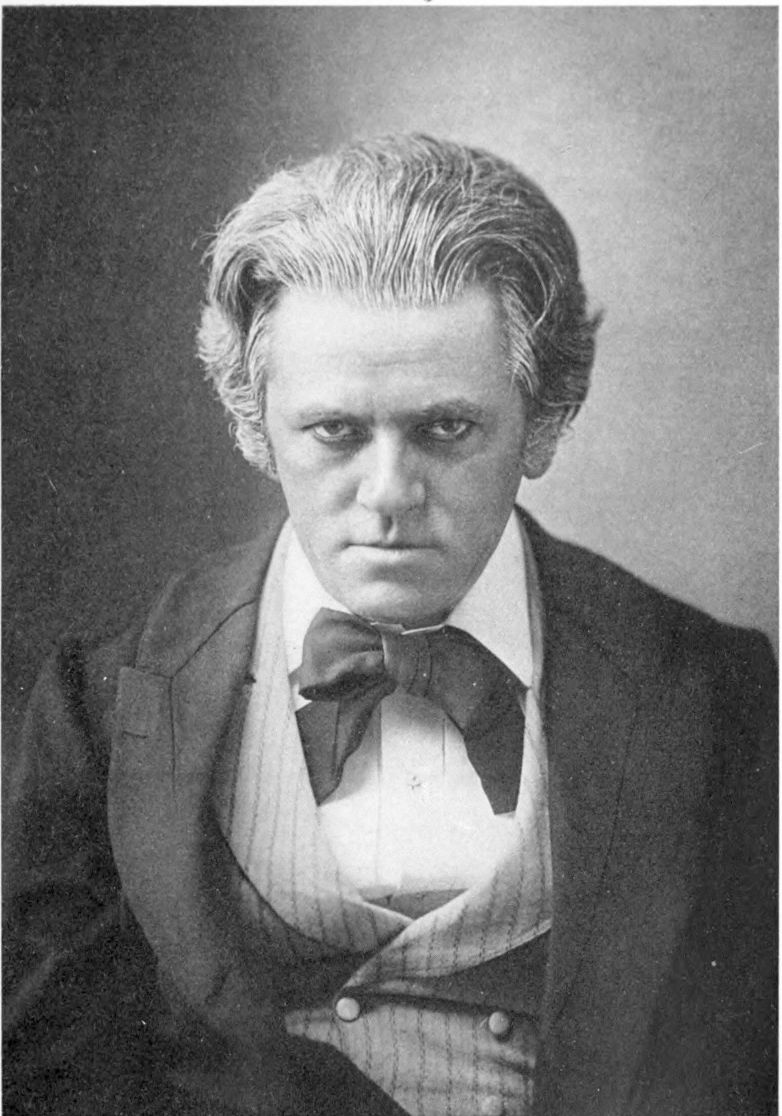
Photograph by Sarony. The Albert Davis Collection.
DAVID WARFIELD AS HERR ANTON VON BARWIG, IN “THE MUSIC MASTER”
first time at the Young’s Pier Theatre, Atlantic City, New Jersey, on September 12, 1904. “The Music Master” is not remarkable for either originality of design or felicity of construction, but it is pure in spirit, interesting in story, picturesque in setting, and healthful in influence, and it was apparent from the first that it would have a long and abundantly prosperous career. There has been on our Stage such excessive exposition of vice and degradation, of the possible depravity of human conduct and wickedness of human motive, that it was an active benefaction to place such a play before the public, a positive blessing to receive the privilege of mental contact with its pure and noble ideal of humanity. It was announced, without qualification, as having been written by Charles Klein: that was an injustice. It is, in fact, a patchwork,—in the form in which Klein first shaped it being based to some extent on a play by Felix Morris (1847-1900) called “The Old Musician,” and then made over by Belasco, with a distinctively perceptible interfusion of dramatic expedients from that fine old drama “Belphégor; or, The Mountebank.” The central person, Herr Anton von Barwig, the Music Master, is a German musician, of a familiar type,—peculiar but attractive; impassioned but gentle; droll but piteous; fervid but patient: an image of moral dignity and self-sacrifice,—and the posture of situations and incidents that have been utilized for his presentment shows him as a loving father, occupied, under conditions of almost sordid adversity, in a quest for his daughter, whom an unworthy wife and mother has taken from him, flying, with a paramour, from Germany to the United States, whither he has followed them. That daughter, at last, he finds and, in circumstances cruel to himself, practically befriends by keeping the secret of her paternity. The conspicuous attributes of this person,—attributes blended and interwoven beneath a serio-comic surface of foreign manner and broken English,—are, intrinsically (of course with variant investiture), those that have long endeared such characters as Michonnet, Triplet, Mr. Peggotty, Caleb Plummer, and Doctor Primrose: attributes, namely, of love, charity, fidelity, fortitude, patience, humor, simplicity, spontaneous goodness, and an unconscious grace equally of conduct, manner, and thought. The purpose, manifestly, was to place an eccentric, gentle, affectionate, humorous, and somewhat forlorn elderly man in a predicament of sad circumstance, and in that way to arouse pity and stimulate the promptings of charitable impulse. That purpose was accomplished; and therefore, aside from all consideration of its inspiration and while the play is neither novel with invention, potent with strong dramatic effect, nor brilliant with polished dialogue, it possesses the solid worth of fidelity to simple life, the charm of diversified character, and the beauty of deep, tender, human feeling.
It was a wise choice to combine those attributes into a stage figure, and David Warfield,—finding himself liberated, mind and heart, into a congenial character,—gained in embodying it the most substantial success of his professional career,—making of that figure a vital emblem of heroism that is never flamboyant and virtue that is never insipid; an image of paternal affection that typifies innate dignity of character and the sweet, gentle, lovely patience of pure self-abnegation. In earlier performances this comedian was almost exclusively photographic; but time, thought, and practice,—the forces that constitute experience,—gradually expanded and ripened his art, and in his performance of this part (when repetition had eliminated excessive nervous trepidation and made it “a property of easiness” to him) he showed intuitive insight and was deeply pathetic. That is true success; because the higher purpose of acting a play is not proclamation of the talents of an actor, but liberation and enforcement of the utmost of beneficial influence upon an audience that a play contains. Warfield in “The Music Master” conquered by the two great virtues of simplicity and sincerity. The principal artistic defects in the personation—defects conspicuous in all Warfield’s acting and to the elimination of which he seems to be curiously indifferent—were a hard, metallic voice and a poor method of elocution. The best dramatic expedient in the play is that by which the father’s dubious, inchoate recognition of the daughter is confirmed. At that point and in the sequent situation (“lifted” from “Belphégor”) the actor evinced sympathetic delicacy and tempestuous fervor. The closing scenes of the play are marred by episodes of irrelevant incident and by prolixity, obscurity and artifice, in the long-drawn passage of parental and filial recognition,—which, indeed, requires but a glance.
Belasco has written the following reminiscence of the production of “The Music Master,” in which he shows just appreciation of the destructive result of those excessive expedients of stage “realism” which, in some of his earlier productions, impaired precisely the effect they were designed to create:
“We always spoke of von Barwig as ‘the music teacher.’ Naturally that became the name of the play; but as the character grew our musician impressed us as a master, and our title was changed to ‘The Music Master.’
“I think there were at least fourteen versions of this comedy-drama. Even after the cast was engaged, we went over the manuscript again. The entire Supper Scene in the First Act was written while the company was assembled on the stage; so, too, was the ending of the play. Such radical alterations were made at the last rehearsal that one of the acts was almost entirely rewritten. We had a scene, wherein von Barwig dreamed of his past life in Leipzig. While the stage was dark, a double took Warfield’s place in the armchair and remained in view of the audience while Warfield himself moved through the following scenes. He was shown as a young man, writing the intermezzo which was to bring him fame and fortune. Then he was seen directing the orchestra, then in his home, where he came fresh from his triumph, to find a note from his wife, telling of her departure, and on the floor a broken toy,—the toy by which after many years he was to identify his daughter. These scenes were mounted on movable platforms, easily set in place without loss of time. They were shown with telling effect at rehearsals, but I felt that the beauty of the actor’s art was hampered by machinery. While Warfield was making quick changes, hurrying on and off the stage, the beautiful simplicity of his work was lost. The artist was of less importance than scenic changes and effects. ‘This is not a spectacular play,’ I thought, ‘all these external matters are carrying us too far from this man’s performance.’ To the surprise of everyone, I ordered the scenes cut out. Instead, I showed Warfield sitting in revery, and by means of his changing expression and a few phrases dropped now and then the story of his past was conveyed to the spectators. His simple acting made it all as clear as though I had really used the various scenes. At the same time attention was centred on the actor, not on canvas.... The Last Act represented an attic with a skylight with its cracked panes stuffed with cloths which fluttered violently in the wind until some of them fell out and snow drifted through the openings. I liked the snowstorm very much, as it accentuated the misery of the characters grouped about a little stove. Warfield did not like the storm, but he did not wish to say so; so he took a novel way to be rid of it. ‘Brrr!’ he said as he walked off the stage, ‘I’m cold! The snowstorm is so realistic it has given me a chill!’ I ordered the weather changed at once....”
“The Music Master,” when first acted in New York,—at the original Belasco Theatre, September 26, 1904,—was cast as follows:
Herr Anton von Earwig David Warfield.
Signor Tagliafico Musicians W.G. Ricciardi.
Mons. Louis Pinac of the Louis P. Verande.
Herr August Poons Liberty Café. Leon Kohlmar.
Henry A. Stanton Campbell Gollan.
Andrew Cruger William Boag.
Beverly Cruger J. Carrington Yates.
Mr. Schwarz Alfred Hudson.
Mr. Ryan Tony Bevan.
Al. Costello Louis Hendricks.
Joles Harold Mead.
Ditson H. G. Carlton.
Danny Master Richard Kessler.
A Collector Downing Clarke.
Mrs. Andrew Cruger Isabel Waldron.
Helen Stanton Minnie Dupree.
Miss Houston Marie Bates.
Jenny Antoinette Walker.
Charlotte Sybil Klein.
Octavie Jane Cowl.
After the Second Act Belasco was many times called before the curtain and finally, responding to insistent requests, addressed the audience in an exceptionally animated way, saying:
“I hope you will excuse me from making a formal speech; but I am most happy to take this occasion to say that I am glad you like our little play and glad that Mr. David Warfield has succeeded. And I am happy, too, to take this occasion to say publicly how proud I am of him and how very, very grateful I am for his loyalty to me—loyalty that no persecution could shake and no malice undermine! There have been lawsuits, plots, perjuries, and lies; there have been vexations enough to weary the patience of a saint (and I am not a saint, ladies and gentlemen!): but Mr. Warfield has remained through it all unshaken and true to me—and I honor and thank him: and, ladies and gentlemen, as long as I possess your confidence and friendship no theatrical syndicates, with all their money and outside influence, can crush me or dictate to me in what way I shall conduct my business. I rejoice in Mr. Warfield’s success, and since this play pleases you, I will only say that our prosperity is just so much more ammunition with which to continue the struggle for Justice and the triumph of Right in American theatrical management!”
The appended letter, written by Belasco during the toil and strain of preparing his “Music Master” and “Adrea” productions, indicates his strenuous labor to make the former a success and his almost diffident estimate of his practically invaluable contributions to it as a playwright:
(David Belasco to Charles Klein, at Merriewold Park, N. Y.)
“Shelter Island, Long Island, “New York, July 10, 1904.
“My dear Charles:—
“Act Second is now in the hands of Miss Edith. As you say you have shipped the Third Act to me I am expecting it any hour. I shall have Act One typed as soon as possible and fire it off to you. I hope you will like the things I have done to it. I am so anxious that your play shall be a sensational hit that I am giving fifteen hours a day to it. Whatever I do I think will help the cause,—and after all we are working for a big success. There is too much at stake for us all not to take off our coats and work for life. You have been bully, my dear Charles, from start to finish, and now with good health and with God on our side you shall reap the benefit of your patience and hard work.—I shall drop the acts along to you as they leave Miss Edith, and as I said before, I hope the work I have done on them will please you.
“Faithfully “David Belasco.”