Volume 1 — LENORE ULRIC.—AND “THE HEART OF WETONA.”
Reading edition
Many players of talent and present eminence have been fostered and developed under Belasco’s management—that being, indeed, one of his most important services to our Stage. He is an inveterate theatre-goer,—attending performances everywhere and, sooner or later, seeing practically everything and everybody visible on the American Stage. This customary vigilant observance of all activity within his profession he facetiously describes as “my fishing trips,” and, conversing with me on the subject, he has remarked: “It is often a long time between ‘bites,’ but one of the delights of the sport is that you never know, as the curtain goes up, how soon you may ‘hook a big one.’ Among the biggest I have ever landed is, I believe, little Miss Ulric: I think she will grow bigger every season she is before the public.”
Miss Lenore Ulric, to whom Belasco thus referred, was born at New Ulm, Minnesota, July 21, 189—. In childhood she knew the meaning of hardship, and she has studied and learned in the often harsh school of experience. Whether or not she will fulfil Belasco’s high expectation time alone can tell, but one thing about her is certain: she belongs to a class of which there is urgent need on our Stage,—she is “a born actress.” She resorted to the dramatic calling not through mere vanity, the impulse of personal exhibition, or the acquisitive hope of profit,—motives which actuate a majority of the young women who go upon the Stage,—but because her natural vocation is acting. As far as known, no precedent member of her family was ever associated with the Theatre, and for some time her choice of that calling met with severe paternal disapproval. Her novitiate was served in various stock companies in Milwaukee, Grand Rapids, Chicago, and Syracuse. In August, 1913, Miss Ulric appeared as Luana, in “The Bird of Paradise,” under the management of Mr. Oliver Morosco: she acted that part for two seasons. In 1914, while playing at the Standard Theatre, New York, she wrote to Belasco asking him to witness her performance of that part and expressing the hope that after having done so he might find a place for her in some one of his companies. “I have long made it a rule,” writes Belasco, “to comply with such requests from young players whenever it is possible for me to do so. I well remember how long I pleaded with dear John McCullough for a hearing before I got it and I know the discouragement of ‘hope deferred.’ Besides—nobody can make a fairer proposition than ‘watch my work and, if you think it is good, engage me.’ But I was extremely busy when I received Miss Ulric’s request and couldn’t give the time,—so I sent my secretary, Mr. Curry. His report was so favorable that I felt I must see her at work—so, since I could not go to her, I had Mr. Roeder bring her to me by making her a tentative offer of an engagement to act in George Scarborough’s play of ‘The Girl.’ She accepted, of course (she has told me, since, that she had set her heart on getting with me and would have accepted almost any offer to do so), and I had my stage manager call a rehearsal. I was not supposed to attend,—but I slipped into the gallery unknown to anybody (a little trick I have) and watched her carefully. After twenty minutes I knew I was watching a very talented and unusual young woman—one who with opportunity and proper training might do great things. Before the rehearsal was over I had told Roeder to close the arrangement with her to play the leading part in ‘The Girl,’ which, afterward, became ‘The Heart of Wetona.’”
In its original form the scene of that play was “A Middle Western Town” (Missouri), its five characters were Caucasian, and its story was one of erring love, deceit, shame, and rescue set in a commonplace rural environment,—a main purpose of its author being, presumably, to exhibit a group of conventional persons impelled by violent passion yet restrained by religious feeling. In that form it received a trial presentment, June 28, 1915, at Atlantic City, New Jersey, with this cast:
In the Prologue.
David GreerWilliam H. Thompson.
Elizabeth GreerLenore Ulric.
In the Play.
Jonathan Wells, D.DArthur Lewis.
Anthony WellsLowell Sherman.
The Rev. Frederick ForbesJohn Miltern.
Elizabeth GreerLenore Ulric.
David GreerWilliam H. Thompson.
“Although its material was undeniably good, I had felt strong doubts about the piece, from the first, but I gave it a ‘try-out,’ anyway,” said Belasco. “Then I saw that it would not do as it stood and took it off, and, at my suggestion and under my supervision, with such assistance as I could give, Mr. Scarborough rewrote ‘The Girl’ and eventually we had a real success with it.”
The rewritten play was first acted, January 20, 1916, at Stamford, Connecticut, under the title of “Oklahoma”; soon after it was called “The Heart of Wetona,” and under that name it was brought forth, February 29, at the Lyceum Theatre, New York, where it held the stage until May 20.
In its definitive form the scene of “The Heart of Wetona” is an Indian Reservation, in the torrid State of Oklahoma; several of its persons are aborigines of the Comanche tribe, and,—though its action and incidents are sometimes arbitrarily directed,—it is a remarkably good melodrama of a long-familiar kind. Belasco’s purpose in directing the revision was to provide an effective play for the exploitation of the young actress whose talents had so favorably impressed him, and that purpose was well accomplished,—the interest centring continuously in the principal female part, a girl named Wetona, the child of a Comanche chieftain and a white mother, deceased. This girl, who has been seduced under a lying promise of marriage by Anthony Wells, a visitor to the Indian Reservation, is chosen as a sort of vestal virgin in ceremonial rites of the Comanches, and thereupon, in the Tribal House, before her father and his assembled warriors, though concealing her lover’s identity, she confesses her transgression. The girl is then subjected to a harrowing inquisition by the Indians, who desire to find and slay her lover. At last, unable to endure longer, she agrees to reveal his name on condition that she first be permitted to warn him of his danger. She seeks him in the home of his friend John Hardin, the Indian Agent on the Reservation (who secretly loves the girl and desires to make her his wife), and is followed by her father, Chief Quannah, who, finding her in conference with Hardin, furiously accuses him of being the wronger of his daughter and demands that he instantly marry her—as an alternative to being instantly slain with her. To save the girl, himself, and her to him unknown lover, Hardin agrees to do so, privately assuring Wetona that the marriage shall be one in name but not in fact, and, a clergyman being conveniently accessible, the wedding is at once performed. Afterward Wetona, collapsing, calls upon the name of her Anthony—thus discovering to her husband her resolutely guarded secret. Later, Wells, ensconced in the home of Hardin and supposing himself unsuspected and secure, seeks to resume his relation with Wetona, but is repulsed by her until a divorce (to which Hardin will connive) shall have been obtained and he shall have fulfilled his promise of marriage. Then the perfidy of Wells is revealed to Wetona and she revolts from him; Quannah discovers the truth; Hardin, though righteously wrathful against Wells, tries to save him from the vengeance of the Indians (providing him with weapons and a steed) but fails,—that rascal being shot and killed as he attempts to ride away in the night,—and the injured, forlorn Indian girl humbly and thankfully confesses to Hardin her contrition, her gratitude for his protective generosity, the affection with which he has inspired her, and her glad willingness to remain with him as his wife.
The ethics of all this will hardly bear scrutiny—but the dramatic effect of it in representation was undeniable; and, perhaps, where virtue is, presumably, intended it is to consider too curiously to consider further. Miss Ulric presented with vigor, skill, simplicity, sustained continuity of identity, and remarkable force a true, pathetic, and alluring ideal of unsophisticated girlhood, confiding feminine ardor and passionate distress, and she gained an auspicious success.—The cast of “The Heart of Wetona,” as acted at the Lyceum under the management of Belasco and a corporation called “Charles Frohman, Inc.,” is appended:
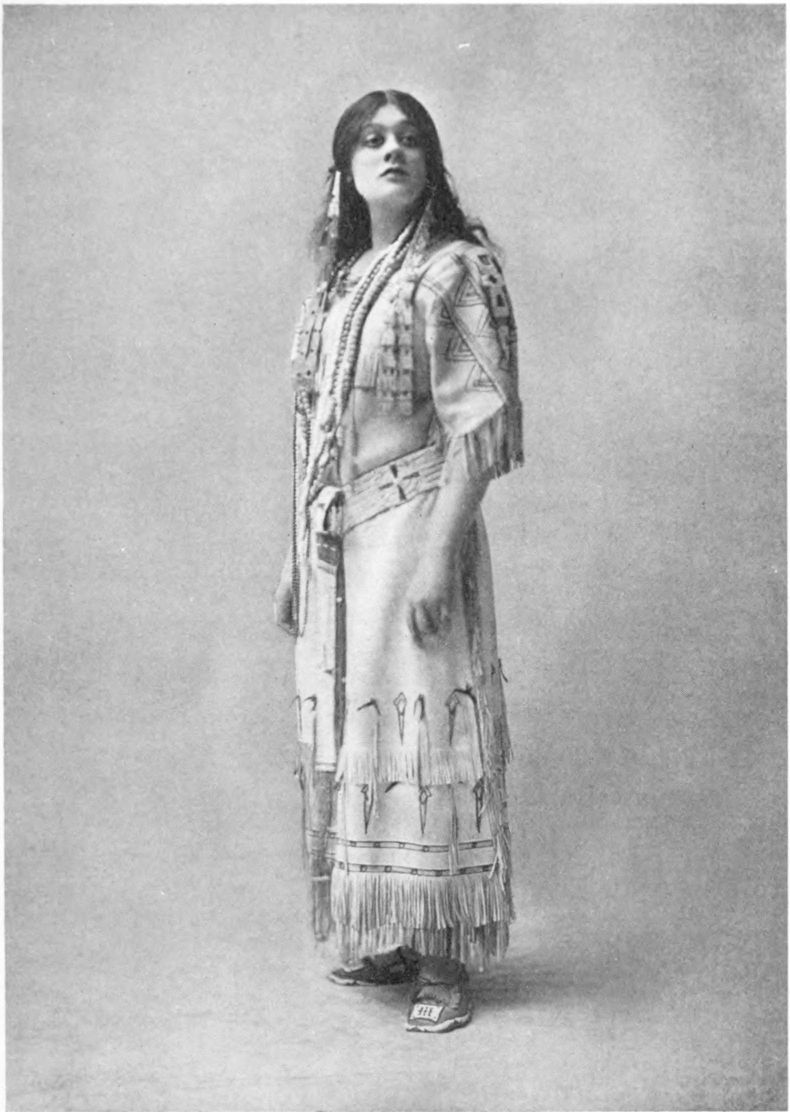
Photograph by Abbe. Belasco’s Collection.
LENORE ULRIC AS WETONNA, IN “THE HEART OF WETONNA”
Quannah, Chief of the Comanches William Courtleigh.
WetonaLenore Ulric.
John HardinJohn Miltern.
David WellsEdward L. Snader.
Anthony WellsLowell Sherman.
Mary GreerIsabel O’Madigan.
Comanche JackCurtis Cooksey.
NaumaEthel Benton.
NipoH. G. Carleton.
PasequaLangdon West.
EagleChief Deer.