Volume 1 — RICHEPIN AND THE “DU BARRY” LAWSUIT.
Reading edition
After Belasco had rejected Richepin’s play about du Barry, returned the manuscript of it to him, and announced that he would produce a play about that celebrated favorite of royalty, written by himself, there was much pother in theatrical circles and much newspaper parade of warnings and threats, by Richepin and various of his agents, of the dire consequences which would fall upon him for so doing. The once widely known firm of lawyers, Howe & Hummel, were the American representatives of the French Authors’ Society, which supported Richepin, and Mr. A. Hummel,—who, 1905, was convicted of subornation of perjury, imprisoned for one year on Blackwells Island, and debarred,—who was the active member of that firm, on January 25, 1902, brought suit against Belasco,
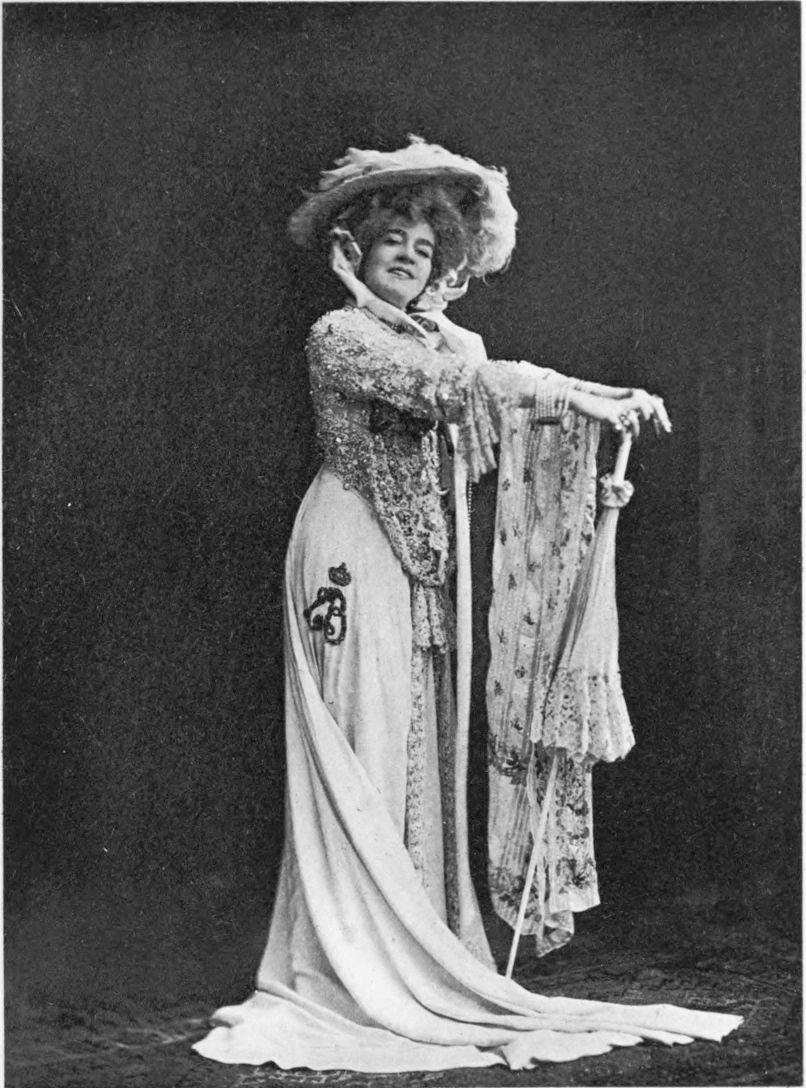
MRS. LESLIE CARTER AS DU BARRY
Photograph by Sarony.
on behalf of the French author, alleging, substantially, that Belasco’s “Du Barry” was, in fact, Richepin’s drama of similar name (“La du Barry”) and demanding an accounting for the receipts from representations of it. Belasco’s reply to the complaint in that suit was served on March 4, 1902, and it was explicit and conclusive. In that answer he specifies that on July 22, 1899, he entered into a contract with M. Richepin, which that author obtained “by false and fraudulent representations,” wherein he agreed to write for Belasco a “new and original” play about du Barry, which was to be “entirely satisfactory to this defendant [Belasco],”—failing which he was at liberty to reject the work and return it to Richepin. Belasco, “relying upon the said representations, statements, and promises, and not otherwise, and believing the same to be true, paid to the plaintiff, on the signing and execution of the agreement, the sum of $1,000”; and, on or about July 1, 1901, upon receiving from Richepin (in London, during the run of “Zaza”) the manuscript, in French, of “La du Barry,” he paid $1,500 more. Of his own play, “Du Barry,” Belasco swore that it is “wholly composed and originated by this defendant, without any aid or assistance whatever from the play alleged to have been written by” Richepin. The latter’s play, Belasco pointed out, was “not new and original,” as required by the contract between them, but was “taken, plagiarized, pirated, and copied, by the plaintiff, from public sources and publications, common and open to the public, and that the said play was wholly unsatisfactory to him [Belasco], of which fact he notified the plaintiff, and that the said manuscript was thereafter returned to, and accepted by, the plaintiff.” A motion on behalf of Richepin to strike out these damaging clauses from Belasco’s answer was made and argued before Justice Freeman, in the Supreme Court, March 13,—Mr. Hummel maintaining that the allegations of fraud and plagiarism by Richepin were “irrelevant and redundant.” The motion was peremptorily denied,—after which the legal ardor of the French poet and his agents cooled and his suit languished: Richepin never proceeded in the case (which appears to have been an effort to extort money from Belasco), and it was formally discontinued in January, 1908.
Richepin’s play (called “Du Barri”) was produced by Mrs. Cora Urquhart Potter, March 18, 1905, at the Savoy Theatre, London, and it was a complete failure. “I had planned to take Mrs. Carter to London, in ‘Du Barry,’” Belasco has told me, “but Mrs. Potter’s failure was so decisive that I gave up all thought of attempting to do so.” Writing about the “Du Barry” lawsuit, Belasco says: “Our quarrel was long and heated, but eventually all was ‘forgotten and forgiven,’ and I could once more read Richepin’s mellow poetry without tearing my hair, and Richepin said publicly, ‘The rest is silence,’ or something as nearly like it as the Frenchman can say,”—which, truly, was most generous on the part of “the Frenchman,” in view of the fact that, altogether, Belasco had paid him $8,500 in a venture toward making which he had, at most, contributed merely the suggestion of a subject.