Volume 1 — HENRIETTA CROSMAN AND “SWEET KITTY BELLAIRS.”
Reading edition
On June 15, 1900, Belasco entered into an agreement with the English fiction writer Egerton Castle by which he obtained optional rights of producing dramatizations of five novels by that author and his wife and collaborator, Agnes Castle. He relinquished his rights in four of those novels, “Young April,” “The Pride of Jennico,” “The Star Dreamer,” and “The Secret Orchard,” but he exercised them with regard to a fifth, “The Bath Comedy,” upon which he based a play. His purpose, originally, was to bring forth Blanche Bates in its central character, when “The Darling of the Gods” should have ceased to hold public interest. Many reasons, however,—chief among them desire to please Mr. Castle by an early production,—caused him to change his plan. He, accordingly, in January, 1903, engaged the accomplished actress Miss Henrietta Crosman to assume the principal part in the play which he had founded on Mr. Castle’s story, and, on November 23, of the same year, at the Lafayette Square Opera House, Washington, D. C., he produced it for the first time, under the title of “Sweet Kitty Bellairs.” Pursuant of what was, I am convinced, a deliberate plan to harass Belasco and hinder him in his managerial enterprises, the lawsuit instituted by Joseph Brooks (incidents of which have already been recounted) was brought almost in the moment of that first performance. Belasco, however, had grown accustomed to persecution and remained unperturbed by it. On being notified, November 24, of Brooks’s allegation in the matter and asked for a statement, he dismissed the subject in two sentences: “It is,” he said, “a pack of lies, and I am too busy with this production [“Bellairs”] to make any answer to these persons [meaning Brooks and his associates] now. When I am disengaged I will make a reply.”
Belasco’s presentment of his “Sweet Kitty Bellairs,”—made for the first time in New York, December 9, 1903, at the Belasco Theatre,—revealed a comedy as well as a spectacle, because, while it satiated the vision with luxuriance of ornament and color, it set a truthful and piquant picture of manners in the jewelled framework of a story generally credible and always romantic as well as at once humorous and tender, merry and grave. The central purpose of it is the display of a study in womanhood, an exceptional female character, a peculiar and fascinating type; and the predominant attribute of it, accordingly, is sexuality. The dashing coquette of old English fiction lives again in his Kitty Bellairs,—not precisely Lady Froth, Lady Bellaston, Mrs. Rackett or Mrs. Delmaine, but a purified, glorified ideal of those gay, tantalizing, roguish dames, a creature of sensuous beauty and reckless behavior, whose whole occupation in life is the bewitchment of man; and, in a silver fabric of gossamer comedy, this siren and all her associates are engaged in adjusting their amatory relations. In other words, this is a play of intrigue.
“The Bath Comedy” is an extravagant and flimsy novel, and the dramatist derived but little material from it,—that little, however, comprising the jealous, peppery, belligerent, irrational husband; the silly, pretty wife, with her saccharine endearments and ever-ready tears; the ingenuous young nobleman, Lord Verney, so readily dazzled; and the burly, genial, blundering ardent Irish soldier, O’Hara, so fond and faithful, so rich in desert, and, at the last, so completely forlorn. Expert use is made, likewise, of the diverted love-letter, inclosing the tress of red hair. No spectacle, indeed, could, intrinsically, be funnier than that presented by the enraged, suspicious, tumultuous husband, intent on fighting with every red-haired man in Bath, in order to be avenged on the unknown epistolary suitor of his absolutely innocent wife. Taking this bull-headed mistake as a pretext for action, and taking as a basis Kitty’s wicked scheme for the relief of Lady Standish,—who has temporarily wearied her husband by her dulness and who will be taught to win and hold him by gay indifference and the piquant allurement of coquetry,—Belasco built a structure of story and action practically original and certainly brilliant. Writing on this subject, he modestly says: “The dramatization was not easy: I was obliged to add to the plot, but I used the atmosphere and characters of the book,”—and, it may be added, contrived to fashion a charming and effective comedy where, perhaps, any other dramatist of the time would have failed.
After an insipid Prologue, in crude rhyme, the old English city of Bath is shown, in a beautiful picture, and therein is displayed a populous, animated scene, constructed to exhibit as a background the raiment, manners, morals, and pursuits of Bath society, in the butterfly days that Smollett and Sheridan have made immortal. Then the story,—slender and frail but amply adequate for its light purpose,—is rapidly disclosed. Kitty Bellairs will help Lady Standish to bewitch her indifferent husband by making him jealous; and when, through Kitty’s artful roguery, his dangerous wrath is directed against Lord Verney, whom she would like to have for her own sweetheart, she will intervene to prevent the impending duel and will implicate herself in a most disastrous and distressing tangle of comic trouble. Two situations ensue that are essentially dramatic and that also involve affecting and enjoyable elements of pathos and humor. Kitty and Lady Standish, having proceeded to Lord Verney’s lodging, in hope to avert a catastrophe that their mischief has invoked, are in peril of compromising discovery there, and at the climax Kitty takes upon herself the apparent disgrace and shame by coming forward to shield her friend. Later, in the thronged assembly-room,—in a pageant of almost unprecedented magnificence,—the brilliant Bellairs, ostracized by the ladies of Bath, appeals to Lady Standish for vindication and finds that spineless comrade too weak and too timid to speak the truth. The latter incident provides the supreme moment of the comedy, and, however much its probability may be questioned, no spectator of it, adequately acted, will for an instant doubt its theatrical effect. The preparations for it are made with extraordinary skill. The scenic adjuncts to it provided by Belasco were of royal opulence. It is fraught with emotional suspense; it is a sharp surprise, and it has the decisive potentiality of a dramatic act. Later the scene shifts to a Bristol tavern, where Lady Betty makes a tardy explanation, retrieving the wrong, while Verney and O’Hara and the rest of the soldiers march away,—in a storm, most deftly managed (as Belasco showed it), of wind and pouring rain,—and Sweet Kitty Bellairs is left in possession of the field, a little rueful, perhaps, but rehabilitated and triumphant. This close seemed somewhat tame, as a sequel to the ballroom effulgence, but it was inevitable: after the clock has struck twelve it must necessarily strike one. There is no thirteen.
The antique moralist, while gazing on that gorgeous spectacle,—“the teacup time of hood and hoop, or when the patch was worn,”—might, perhaps, be moved to inquire whether women, in their traffic with the impulses of love, the caprices of their own sex and the follies of the other, do really think and act as they are made to think and act in this play of Belasco’s: but, as the antique moralist knows nothing whatever about women, he would only bewilder himself by such interrogatory. Enough to know, in gazing on that spectacle, that it dazzles his vision and that the story pleases his fancy. He sees a woman to whom humdrum conventionality is intolerable; a woman who is fearless alike of vindictive feminine spite and insolent masculine tolerance; a woman who can be magnanimous; a woman who is nothing if not brilliant: and all this ought to content even a cynic. The dramatist has made Kitty Bellairs much more of a woman and Lord Verney much more of a man than they were in the Castle novel,—where, indeed, Bellairs is unprincipled and heartless and Verney foolish: a coarse flirt and a callow milksop. Evil influence may be incarnate, without evil deed. In the play this heroine is a thoroughly noble, gentle, and tender woman, underneath her panoply of mirth and mischief, and she acts from a good heart, and not from mere vanity and sensuous caprice. Miss Crosman entered into this character with absolute sympathy, and, as to the glittering side of it, so embodied it as to create a cogent effect of nature. There is an appeal made by Kitty to her Irish and other military friends, when they behold her in apparent disgrace, that strikes the true note of pathos, and, in the speaking of this, Miss Crosman eloquently and nobly expressed the dignity of conscious virtue, while in the denotement of tenderness she much exceeded expectation,—because tenderness is not characteristic of her acting in general, the drift of her temperament and style setting toward pert assurance, skittish
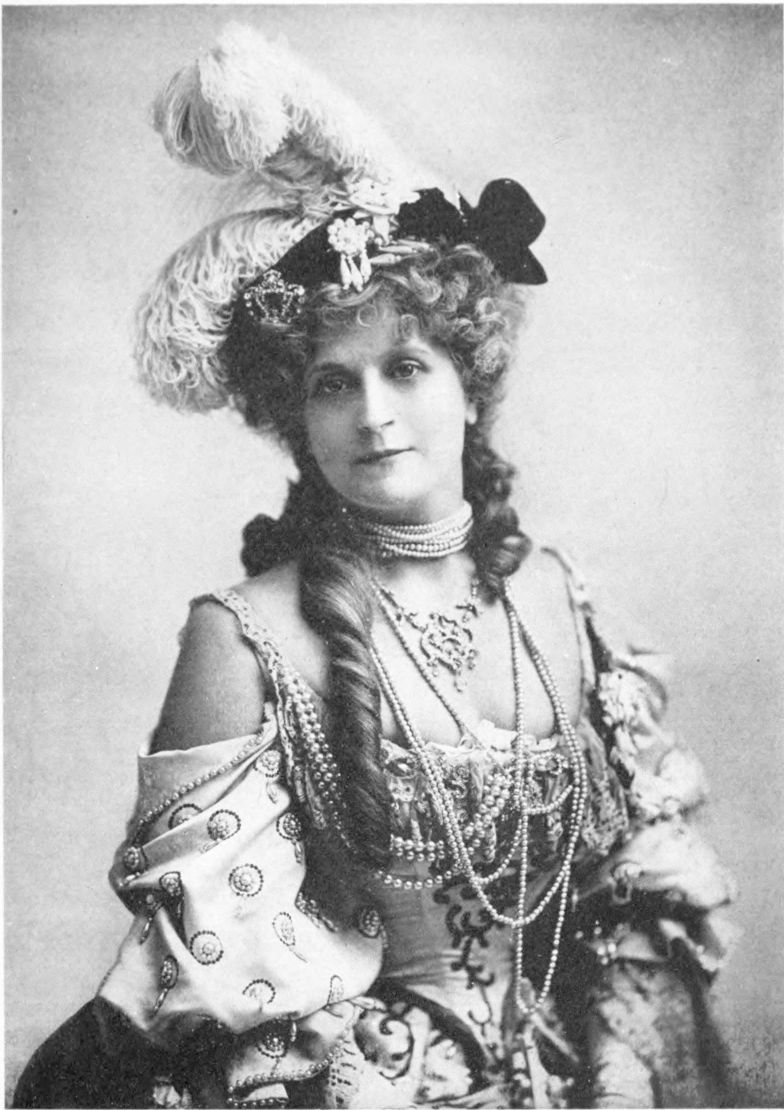
HENRIETTA CROSMAN AS MISTRESS KITTY BELLAIRS, IN “SWEET KITTY BELLAIRS”
Photograph by Sarony. Belasco’s Collection.
sport, sparkling raillery, and sprightly banter. Kitty’s attitude, during most of the comedy, is that of a maker of innocent mischief,—with a spice of wickedness in it,—and she complicates everything from pure love of drollery. This Miss Crosman made perfectly and delightfully clear. The dilemma in Act Second, when Kitty and Lady Betty are surprised in the bedroom at Verney’s, and the exaction of an hysterical outburst at the end of Act Third a little overtaxed the strength of the actress; but her impersonation of Kitty Bellairs lives in memory and is treasured for unity of purpose and consistency of method, blithe spirit and buoyant action, sentiment sweetly denoted beneath arch pleasantry and many winning graces of manner, inflection, and playful prettiness. Belasco gained a new and lasting laurel of success with this production, in which all points had been well considered and nothing left to chance. The first performance in New York was given in the presence of a brilliant and delighted multitude. The final curtain did not fall till after midnight,—but
“Noiseless falls the foot of Time That only falls on flowers.”
This is the original cast of “Sweet Kitty Bellairs”:
“They lived in that past Georgian day When men were less inclined to say That ‘Time is gold’ and overlay With toil their pleasures.”
IN THE PROLOGUE.
Master of CeremoniesMark Smith, Jr.
The Prologue will be spoken byAntoinette Walker.
IN THE PLAY.
Sir Jasper Standish John E. Kellerd.
Col. the Hon. Henry Villiers Edwin Stevens.
Captain Spicer Frank H. Westerton.
Lord Verney, Lieut.Of theCharles Hammond.
Mr. Tom Stafford, Lieut.51stJames Carew.
Mr. Bob Chichester, Lieut. Regiment.Clyde Fogel.
Gandy, Private Addison Pitt.
Fenwick, Private Shelley Hull.
The Bishop of Bath and Wells H. Rees Davies.
Col. Kimby McFiontan R. Peyton Carter.
Capt. Denis O’Hara J. Malcolm Dunn.
Major Owen MacTeagueOf theAlfred Cahill.
Mr. Lanty MacLusky, Lieut. “Inniskillings.” Douglas Wood.
Mr. Darby O’Donovan, Cornet. Emmet Lennon.
Mallow Stanley Drewitt.
The Innkeeper of the Bear Inn Harold Watts.
First Courier Howard Hull.
Second Courier S. K. Blair.
Post Boy William Whitney.
Mistress Kitty Bellairs Henrietta Crosman.
Lady Standish (Julia) Katharine Florence.
Lady Marie Prideaux Louise Moodie.
Lady Bab Flyte Edith Crane.
Mistress Bate-Coome Genevieve Reynolds.
Hon. Mrs. Beaufort Charlotte Nicoll Weston.
Miss Prue Bernice Golden.
Miss Doll Sybil Klein.
Miss Debby Jane Cowl.
Miss Sally Lydia Winters.
Selina Lillian Coffin.
Lydie Estelle Coffin.
Barmaid of the Bear Inn Mignon Hardt.
Clorinde Mrs. Irvin Chapman.
Dorothea Gertrude Dorrance.
Arabella Mrs. Bate-Coome’s Edith Rowland.
Angeladaughters. Helen Hale.
Marjorie Edna Griffen.
Mistress Tilney Sara Delaro.