Volume 1 — BLANCHE BATES AND “THE GIRL OF THE GOLDEN WEST.”
Reading edition
Belasco’s stirring play of “The Girl of the Golden West” was first produced at the new Belasco Theatre, Pittsburgh, Pennsylvania, on October 3, 1905. It is a fabric of situations contrived for the advantageous display of that old, familiar, everlasting, always effective theatrical personage, the Rough Diamond. The Girl was beautiful, intrepid, passionate, vivacious; the soul of innocence; the incarnation of virtue; the blooming rose of vigorous health; and she could swear fluently, play cards, and shoot to kill. She kept a drinking shop, she was adored by all “the boys”; and the fame of her probity and her many fascinations filled the countryside of California, in the halycon days of ’49. That fortunate State, according to the testimony of novelists and bards, was densely populated at that time by girls of this enchanting order; but this particular Girl seems to have transcended all rivals. She was beloved by a picturesque and expeditious outlaw, Dick Johnson, known as Ramirez, who had gained brilliant renown by means of highway robbery, and likewise she was beloved by the local Sheriff, Jack Rance, a grim, obnoxious officer, self-dedicated to the wicked business of causing that outlaw’s arrest and death. Both those lovers were ardent, and, between those two fires, her situation was difficult; but she always rose to the occasion, and when her outlaw was entrapped by his pursuer the ingenuity of her love and the dexterity of her stratagem delivered him from bondage, and, upon his promise of reformation and integrity, launched him upon a new and better career. The most conspicuous display of her passionate devotion and adroit skill occurred on a night when he was captured in her dwelling. The circumstances were essentially dramatic,—because the Girl and her favored swain were storm-bound in a mountain cabin, whither the Sheriff had tracked his prey; and the robber had been shot and wounded, so that there seemed to be no method of escape for him, till the Girl proposed a game of poker with his foe, staking herself against the liberty of her sweetheart, and won it by successful emulation of the Heathen Chinee,—substituting “an ace full” for an empty hand, at the decisive moment.
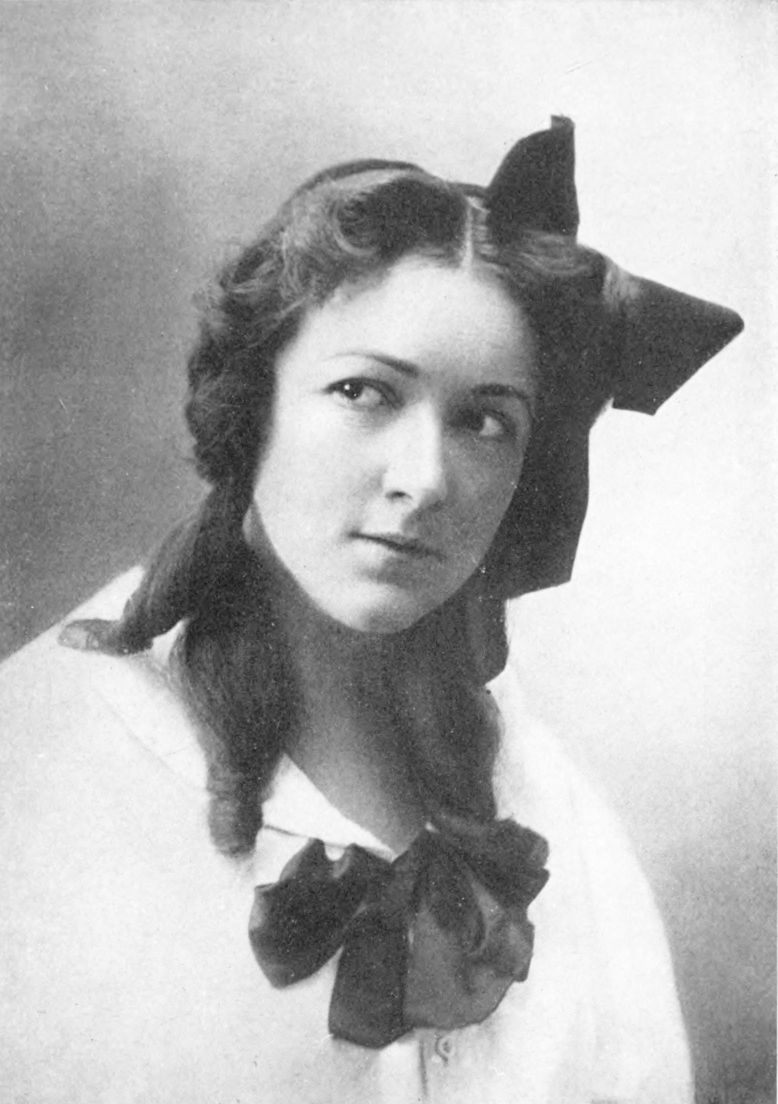
Photograph by Otto Sarony. Collection of Jefferson Winter.
BLANCHE BATES AS THE GIRL, IN “THE GIRL OF THE GOLDEN WEST”
There came a time, however, when even Love could do no more; but at that crisis Fate interposed, in the shape of Public Opinion,—that is to say, the friendship of “the boys,”—and the Girl and her lover were united.
The condition of California in 1849 was, to say the least of it, turbulent. Some parts of that State are in a turbulent condition now. Groups of “the boys” can still be discovered. They are not paragons, though, and they never were. The existence of good impulses in uncouth persons does not make them less uncouth. Fine qualities can, and do, exist in beings who are unfamiliar with soap and the toothbrush; but it would seem that the study of human nature can be pursued, more agreeably than elsewhere, among saponaceous branches of the race. It is more pleasant to read about “the boys” than it is to see them. But, broadly speaking, in Belasco’s drama the Girl is the play, and with Miss Bates as the Girl there was little more to be desired. Shorn of all extraneous fringes—variously impious, improper, vulgar, and offensive interjections of profanity and violent expletive—the play is the image of a lovely, impetuous woman’s devotion to her lover,—a devotion that is shown in a series of actions by her to save him from danger and ruin and to make him happy. Feminine heroism is the theme, and the Girl selected to exemplify it is meant to be “a child of nature,” simple, direct, and true—and Belasco was entirely accurate when he wrote that the part fitted the actress for whom he made it from her head to her feet. Given the specified ideal to interpret, Miss Bates placed her reliance on Acting, and there were moments in her performance,—as, for example, in the First Act, as the Girl speaks of the protective instinct in the heart of woman,—when the soul that showed itself in her face was beatific. She gave, throughout, a personation of extraordinary variety and strength. In the situations devised for the heroine,—situations, which, while not radically new, are ingeniously contrived and are fraught with the dominant spell of suspense,—the actress had to express the growth of love; the blissful sense of being loved; the bitter pangs of jealousy; the passionate resentment of a heart that thinks itself betrayed and wronged by the object of its love; the conflict of anger with affection; the apprehension of deadly peril, and the nobility of self-conquest. The exaction of the part is tremendous, equally upon physical resource and nervous vitality, but, at every point, it was met and satisfied. The play exemplifies its author’s remarkable faculty of continuation in the making of characteristic dialogue, together with ample felicity of invention, and it is overlaid with profusion of details. The midnight tryst of the Girl and the Road Agent is not altogether a credible device, but, once assumed and arranged, that situation,—comprehending the outlaw’s detection, as such, by the Girl, the awakening of furious jealousy, her turning him out into the storm, her subsequent harboring of him, and the game of cards with the outlaw’s life and liberty staked against the Girl’s whole future,—is handled with consummate skill and moulded to splendid results, and there the acting of Miss Bates rose to a magnificent climax of emotion, fully expressed and yet artistically controlled and directed,—a triumph of intellectual purpose.
This was the original cast of “The Girl of the Golden West”:
The GirlBlanche Bates.
Wowkle, an Indian squawHarriet Sterling.
Dick JohnsonRobert Hilliard.
Jack RanceFrank Keenan.
Sonora SlimJohn W. Cope.
Trinidad JoeJames Kirkwood.
NickThomas J. McGrane.
The Sidney DuckHorace James.
Jim LarkensFred. Maxwell.
“Happy” HalidayRichard Hoyer.
“Handsome” CharlieClifford Hipple.
Deputy SheriffT. Hayes Hunter.
Billy Jackrabbit, an IndianJ. H. Benrimo.
AshbyJ. Al. Sawtelle.
José CastroRoberto Deshon.
Rider of the Pony ExpressLowell Sherman.
Jake Wallace, a travelling camp minstrel Ed. A. Tester.
Bucking BillyA. M. Beattie.
The LookoutFred. Sidney.
A Faro DealerWilliam Wild.
The Ridge BoyIra M. Flick.
JoeH. L. Wilson.
Concertina PlayerIgnazio Biondi.
Citizens of the Camp and Boys of the Ridge.