Volume 1 — THE PLAY AND THE PERFORMANCE OF “THE DARLING OF THE GODS.”
Reading edition
The tragic drama of “The Darling of the Gods” is an excellent play, one of exceptional power and ethical significance. It is a unique fabric of fancy, wildly romantic, rich and strange with unusual characters, lively with incident, occasionally mystical with implication of Japanese customs and religious beliefs, opulent with an Oriental splendor of atmosphere and detail, like that of Beckford’s romance of “Vathek,”—fragrant with sweetness,—like Moore’s “Lalla Rookh,”—busy with movement, effective by reason of situation, and communicative of a love story of enchaining interest and melancholy beauty. That story is told in continuous, cumulative action,—each successive dramatic event being stronger than its predecessors in the element of suspense; and at the climax there is a weird picture of supernatural environment, a thrilling suggestion of the eternity of spiritual life and personal identity,—a poetic symbolism, at once pathetic and sublime, of the glory and ecstasy, the supreme triumph, of faithful love.
The story of Yo-San, the heroine of that play, who is designated “the darling of the gods,” separated from all adjuncts and accessories, is simple. She is a princess in Japan, betrothed to a Japanese courtier whom she does not wish to wed. She has stipulated, as a preliminary condition of their marriage, that the courtier must prove his valor by capturing a certain formidable outlaw, Prince Kara, who, on being captured, will be put to death. She has been saved from fatal dishonor through the expeditious courage and promptitude of that outlaw (unrecognized by her as such), and on seeing each other they become lovers. Kara pledges himself to appear at the palace of her father, at a “feast of a thousand welcomes” to be held in his honor, there to receive that parent’s thanks. Thither he comes, passing through the guards of Zakkuri, the dreaded War Minister of Japan, but sustaining a desperate hurt in doing so. Yo-San, when her lover, wounded and almost dying, has failed to make his escape from the precincts of the palace through a cordon of enemies, conceals him in her dwelling, and for many days she tends him, till his wounds are healed, and then, for a time, those lovers are happy in their secret love. The girl is, however, compromised by this indiscretion, and when presently her father, Prince Saigon, discovers her secret,—and, as he thinks, her dishonor,—she is declared an outcast; and her lover (taken prisoner while attempting to fight his way to freedom) is doomed to torture and death. She is compelled to gaze upon him as, stupefied with opium, he is led down into a chamber of infernal torment. Then she is apprised that she can secure his life and liberty by betraying the hiding place of her lover’s outlaw followers, and in desperate agony she does betray them: but she gains nothing by that action except an access of misery. Prince Kara, surprised with his band by soldiers of the War Minister, having, with a few of his followers, fought his way through the lines of his enemies and discovered that the secret of their hiding place, confided by him to Yo-San, has been by her revealed, commits suicide in the honorable Japanese manner, and she is left alone, with only his forgiveness as a comfort, and with the hope that,—after a thousand years of loneliness and grief, in the underworld of shadows,—she will be again united with him in the eternal happiness of heaven. The play shows Yo-San as an innocent, confiding, pathetic figure, a child-woman, passing amid stormy vicissitude, cruel temptation, and afflicting trials to a forlorn and agonized death by suicide, and leaves her at the last, redeemed and transfigured, on the verge of Paradise, where Kara stretches out his arms to embrace her, and where there is neither trouble nor parting nor sorrow any more.
The experience of this Japanese girl is the old ordeal over again, of woman’s sacrifice and anguish, when giving all for love. Something of Shakespeare’s Juliet is in that heroine, something of Goethe’s Margaret, something of the many passionate, wayward, mournfully beautiful ideals of woman’s sacrifice that are immortal in story and song. She is a loving and sorrowing woman, true, tender, faithful forever, and celestial alike in her
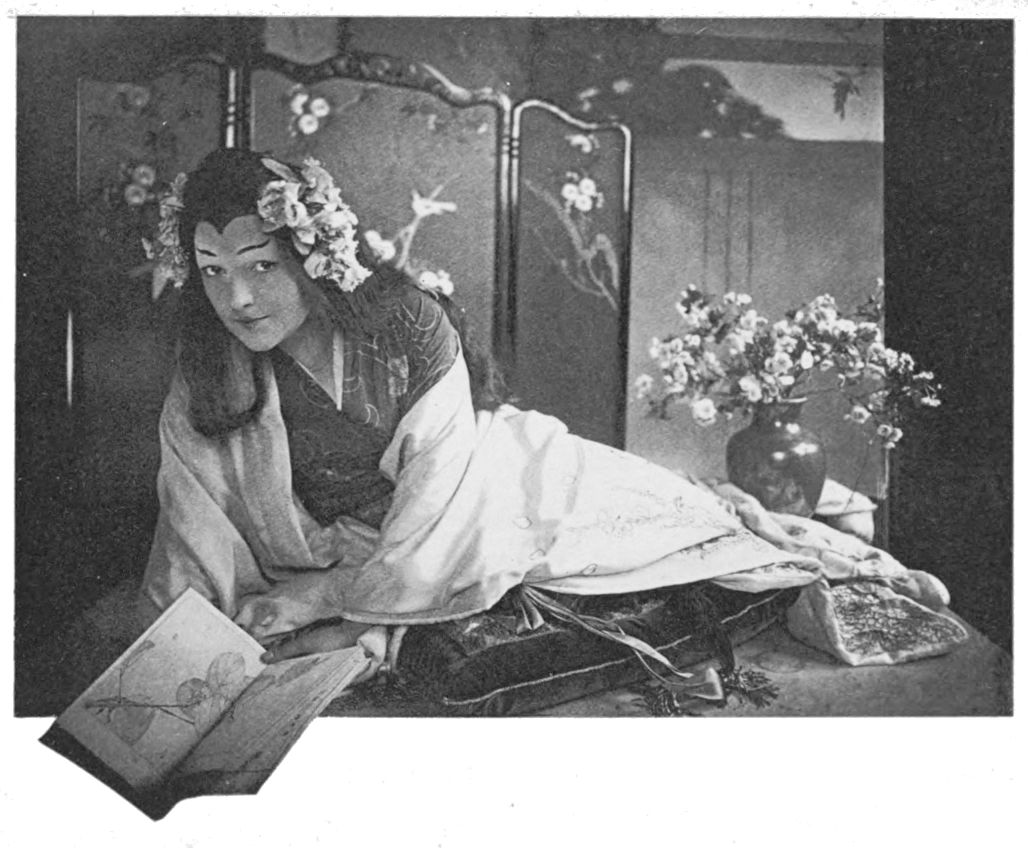
BLANCHE BATES AS THE PRINCESS YO-SAN, IN “THE DARLING OF THE GODS”
Photograph by Livingston Platt. Belasco’s Collection.
love, her temptation, and her grief. The character of Yo-San combines some of the finest components of womanhood and, indeed, exemplifies virtues such as redeem the frailty of human nature—purity of heart and life, true love, endurance, heroism of conduct, and devoted integrity of spiritual faith. Blanche Bates gained the greatest success of her professional career by her impersonation of Yo-San. She was an entirely lovely image of ardent, innocent, ingenuous, noble womanhood—such an image as irresistibly allured by piquant simplicity, thrilled the imagination by an impartment of passionate vitality, and by its exemplification of eternal constancy in love,—the immortal fidelity of the spirit,—captured the heart. Her facility of action and fluency of expression were continuously spontaneous, and she was delightful both to see and to hear. Indeed, the acting of Miss Bates, which, from the first of her performances on the New York Stage, had shown a charming wildness and freedom, was, in the character of Yo-San, more unconventional than ever. Her appearance was beautiful, her action graceful, alert, vigorous, and free from all restraint of self-consciousness and finical prudery. The clear, keen, healthful north wind was suggested by it, the reckless dash of a mid-ocean wave, the happy sea-bird’s flight. There was no ostentation about it, no parade, no assumption of the moral mentor. Her personation of Belasco’s Juliet of Japan came in a time of dreary “problems,” “sermons,” “lessons,” “arguments,” “symbols,” and the flatulent nonsense of siccorized novels and dirty farces, and it came as a relief and a blessing—the authentic representative of youth, health, strength, love, and hope.
There is one moment in “The Darling of the Gods” when suspense is wrought to a point of intense tension, and when the inherent, essential faculty of an actor, the power to reveal almost in a flash the feeling of the heart and the working of the mind, is imperatively required. It is when Kara, wounded, exhausted, desperate, has sought refuge in the dwelling of the Princess Yo-San and, by her, has been succored and concealed. Migaku, the Shadow, a spy of the terrible War Minister, Zakkuri, has traced him to that refuge, but a devoted guardian of Yo-San, Inu, a Corean giant, has detected the presence of the spy, has seized and slain him, and has hidden the body in a stream. Zakkuri and the father of Yo-San follow the spy, and come to the dwelling of Yo-San. Zakkuri wishes that it be searched, but he agrees to accept her oath, if she will give it, that she knows nothing of the whereabouts of Kara. The Princess is summoned and, denying the presence of Kara, is required by her father to swear that she has spoken the truth. Words can faintly indicate the beauty of the picture and action which follow, as the girl seeks to protect her lover. The time is night. The scene is a strange, fantastic, fairy-like garden of old Japan, a bower of flowers with twining wistaria wreathing the trees and houses, and, far, far off, visible in the silver moonlight, a great snow-capped volcano, the peak of which is touched with ruddy light. The father and the dreaded Minister of War stand before the door. Miss Bates, as Yo-San, stood a little above them, dressed in soft, flowing white garments, open at the throat, her black hair loose about her face and shoulders, her beautiful dark eyes suffused with a fascinating expression of innocence, tranquillity, and tenderness. Without a moment of hesitation, on being required to take the most solemn of oaths, she, with sweetly reverential dignity, raised a bowl of burning incense and, holding it before her, spoke, in a voice of perfect music: “Before Shaka, God of Life and Death,—to whom my word goes up on this incense,—I swear, hanging my life on the answer, I have not seen this Kara!” Then, as the discomfited searchers withdrew, she stood a moment, in the soft light streaming upon her from within the house, and, gazing after them, added, looking upward, “It is better to lie a little than to be unhappy much!” If she had done nothing else,—though the remainder of her professional life should be barren,—that single moment stamped her as a great actress.
It is, in any time, a noble achievement—one too much praised in words, too little sought in deeds—to bring home and make vital to the human heart the sanctity and beauty of love. The actor who does this can do no more. Pictorial art upon the stage attains to a marvellous height when it presents such a scene as that of the River of Souls and the reunion of long-sundered souls, in this romantic, imaginative, and beautiful play. Such an achievement in the dramatic art as the setting before the public of such a play and such a performance as Blanche Bates gave of its heroine vindicate the beneficent utility of the Theatre, because it cheers and ennobles, and thus practically helps society, through the ministration of beauty. This is a hard world. Almost everybody in it struggles beneath burdens of care and sorrow. Multitudes of human beings dwell in trouble and suffering. An imperative need of our race is the strength of patience and the light of hope. Dramatic art, or any art, which satisfies that need, or even remotely helps to satisfy it, is a blessing. The rest is little, if at all, better than a curse.
There was fine acting in “The Darling of the Gods” besides that of Miss Bates. The part of Zakkuri, the War Minister,—a callous, remorseless, cold villain, of the Duke of Alva type,—is the main source of action in the drama, and it is elaborately and vividly drawn. It was played by George Arliss, who gave in it a thrilling incarnation of dangerous force and inveterate wickedness, almost humorous in its icy depravity: he had an exceptional success, even for an actor who always acts well.
And there are many splendid imaginative and dramatic passages in this play besides those which have been particularly examined. As set upon the stage by Belasco it was a spectacle of superb opulence, surpassing all its predecessors in wealth of color and beauty of detail. In the Scene of the Night Watch at the gates; in that of the stealthy, nocturnal search for Kara, outside the lodge of the Princess, and in that of Yo-San’s supplication for her lover’s life there is the very poetry of terror. Some of the expedients employed had been used in earlier dramas,—such as “Patrie” and “Tosca,”—but they were so freshly handled that they were made newly terrible with an atmosphere of grisly dread. Belasco, in short, offered to his public in this production a true dramatic work of novelty, variety, and scenic splendor, extraordinarily rich in the element of histrionic art; an offering that was symmetrical and magnificent, prompting a memory of the old days of “Pizarro,” “The Ganges,” and “The Bronze Horse,” but proving that his day also was golden and that Aladdin’s Lamp had not been lost.