Volume 1 — IN THE GRIP OF THE OCTOPUS.—ANCIENT METHODS IN MODERN BUSINESS.
Reading edition
“The Auctioneer” played at the Bijou Theatre until December 21,—105 consecutive performances being given there. On December 23 Warfield began a “road tour” in that play which lasted for twenty weeks, ending at the Illinois Theatre, Chicago, May 10, 1902. The net profit from this tour was $80,000,—certainly an amazing sum to be gained by presentation in the regular Theatre of an unknown star, fresh from the music halls, who, all told, had appeared in perhaps a score of productions! But Belasco’s actual profit from the fruits of his perspicacious judgment and enterprise was far less than that great sum. The reason of this seemingly strange fact is that in his professional exploitation of Warfield he had fallen into the ruthless grip of an iniquitous “booking-monopoly” which, practically, dominated for many years what are known as “the first-class theatres” of America and which is still perniciously active. Belasco’s conflict with that monopoly was long and bitter; thousands of columns have been devoted to it in the newspaper press of the country, and it has, at various times, occupied a prominent place in public attention. That conflict grew directly out
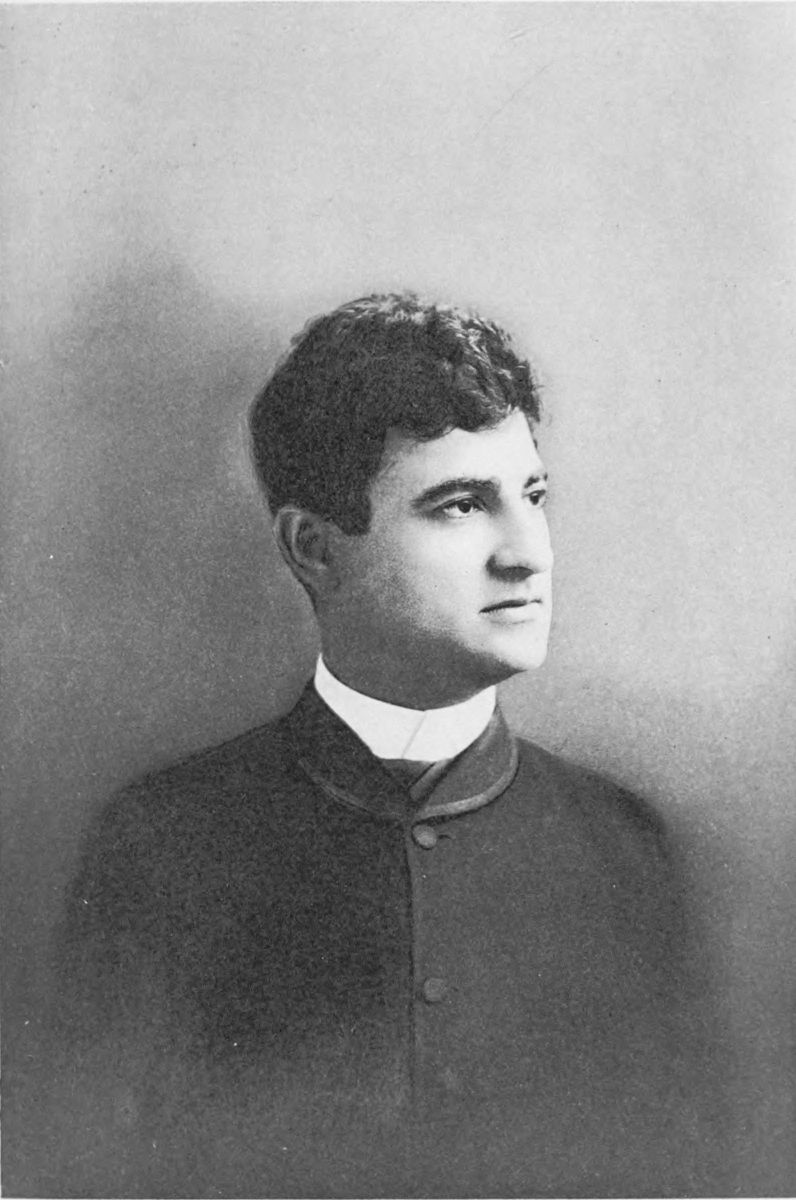
DAVID BELASCO
About 1885
Photograph by Falk. Belasco’s Collection.
of his undertaking the management of Warfield. Several actions at law have been incident to it. Testifying under oath in one of them, in 1905, Belasco gave an account of his experience in relation to “The Auctioneer” which I believe to be true in all essentials and of which I make the following abstract and brief chronicle:
After Belasco had undertaken to bring forward Warfield as a star he applied to Mr. Abraham Lincoln Erlanger, junior member of the firm of Klaw & Erlanger, theatrical managers and booking agents (i.e., “agents” who arbitrarily arranged tours by theatrical companies through American cities), for the purpose of making advantageous arrangements for Warfield to appear in New York and other cities. He applied to Mr. Erlanger because he was aware that it was, at the time, practically speaking, impossible for him to make such arrangements, except through the firm of Klaw & Erlanger, and that the junior member attended to such business for that firm. He called on Mr. Erlanger at his residence, No. 262 West Seventieth Street, New York, on Sunday, December 9, 1900, and stated his wish. Mr. Erlanger, in response, stated that “We [K. & E.] are not in this business for our health” and inquired “Where do we [K. & E.] come in?” Belasco replied that Klaw & Erlanger would receive their customary commission, $300 to $400, for “booking” the play. To this Mr. Erlanger rejoined “Hell, about that: we got to get something more.” Belasco, after protesting that he was not, in any way, soliciting a favor; that he assumed all risk and liability in the venture, and that he felt it to be “a sort of blackmail” (and a very obvious sort, I should say!) to exact from him a share in whatever gains might accrue to him from presentation of Warfield, offered to surrender to Klaw & Erlanger 20 per cent. of such gains, in return for “a route.” This offer, swore Belasco, Mr. Erlanger rejected, demanding that, instead he (his firm) should receive 50 per cent. of any profits from the exploitation of Warfield. To Belasco’s inquiry as to why he should receive this unearned remuneration Mr. Erlanger rejoined “None of your damn’ business; I want half, and if I don’t get half out of Warfield you can’t have a route for him. I will crush you out; sit upon you; jump upon you, and push you out; crush you out of this theatrical business!” He further admonished Belasco thus: “Understand me, Belasco; hereafter, I want 50 per cent. of every damn’ thing you do!” Belasco, after taking several days to consider this extortionate proposal, decided that he could not avoid accepting it, if he was successfully to present Warfield. He went, in company with his business manager, Benjamin F. Roeder, to Mr. Erlanger’s office and there communicated his decision to him, saying: “Mr. Erlanger, I can’t see any escape for me. I want it understood that you are compelling me to give up 50 per cent. I don’t think it is right, but, if you insist, there is nothing else for me to do.” The agreement was then made, the late Joseph Brooks, an associate of Klaw & Erlanger, being put forward, according to Belasco’s testimony, as a “dummy” in the written contract, in order that the partnership of Klaw & Erlanger might be concealed from their partners in the Theatrical Syndicate,—Messrs. Charles Frohman, Al. Hayman, Samuel F. Nirdlinger (known as S. F. Nixon) and J. Fred. Zimmermann,—this concealment being desired in order that Klaw & Erlanger, as booking agents, might be able to exact more profitable terms from their Syndicate partners than would be possible if that firm were generally known to possess “an interest” in the presentation of Warfield in “The Auctioneer.” Belasco, to substantiate his assertion that, actually, he was in partnership with Klaw & Erlanger, not with Brooks, in the said presentation, produced a number of paid cheques drawn to the order of that firm, to a total amount of more than $30,000,—which, he swore, represented its 50 per cent. of profits from “The Auctioneer” during the period while that play was “booked” by Klaw & Erlanger,—a period which, from the record, seems to have ended on January 31, 1902, at Duluth, Minnesota. Brooks, by way of explaining those cheques, testified that he had directed Belasco’s business agent, Roeder, to make them payable to the order of Klaw & Erlanger because he, Brooks, was frequently absent from New York! Brooks admitted that he “made them [Klaw & Erlanger] a present of” two-thirds of the half-interest in presentation of “The Auctioneer” which he asserted was his.