Volume 1 — “UNDER TWO FLAGS.”—BLANCHE BATES THE RISING STAR.
Reading edition
The London engagement of “Zaza” ended, Belasco, Mrs. Carter, and the members of the “Zaza” company returned to America, sailing from Southampton, on board the steamship New York, August 18, 1900. Mrs. Carter’s tour in that play began at the Criterion Theatre, New York, on October 1, and Belasco turned his attention to launching Blanche Bates as a star. The histrionic vehicle which he selected for this purpose was a revamped dramatization of Ouida’s “Under Two Flags.” He had hoped to obtain a drama on a fresh subject for her use and he had asked Charles Frohman to assist in finding such a one. But, after waiting a considerable time without any suitable play coming to light and it being essential to bring her forward in something, Belasco determined to turn to an old subject and revivify it. “I decided, in desperation,” he writes, “to revive ‘Under Two Flags,’ which I had long been familiar with, of which I had made at least two versions, and which, in the old days, I had directed for Lotta. Her version of it, however, seemed very old-fashioned, and I employed Mr. Paul M. Potter to make a new adaptation of the book. I introduced a novel effect in that production in the sand-storm in the Fourth Act; it was simple in its mechanism, but it required much work to perfect it: it has since come into general use.”
Ouida’s novel is so well known to the public of the Library and, in one form or another, histrionic adaptations of it are so well known to the public of the Theatre, that the subject is, in every point of view, familiar, and minutely detailed consideration of it in this place would, therefore, be superfluous. The new theatrical epitome of that novel was made known, for the first time, at the Garden Theatre, New York, February 5, 1901. It was, in every detail, supervised and made practical by Belasco, and it owed its success to his ingenious and expert manipulation and to the embodiment of Cigarette given in it under his direction by Miss Bates. The story of that ardent, picturesque, adventurous girl is a story of amatory infatuation, brave exploits, and pathetic self-sacrifice, under romantic circumstances. The representative of Cigarette must be handsome, passionate, expeditious, magnanimous, resolute, full of resource, sparkling with energy,
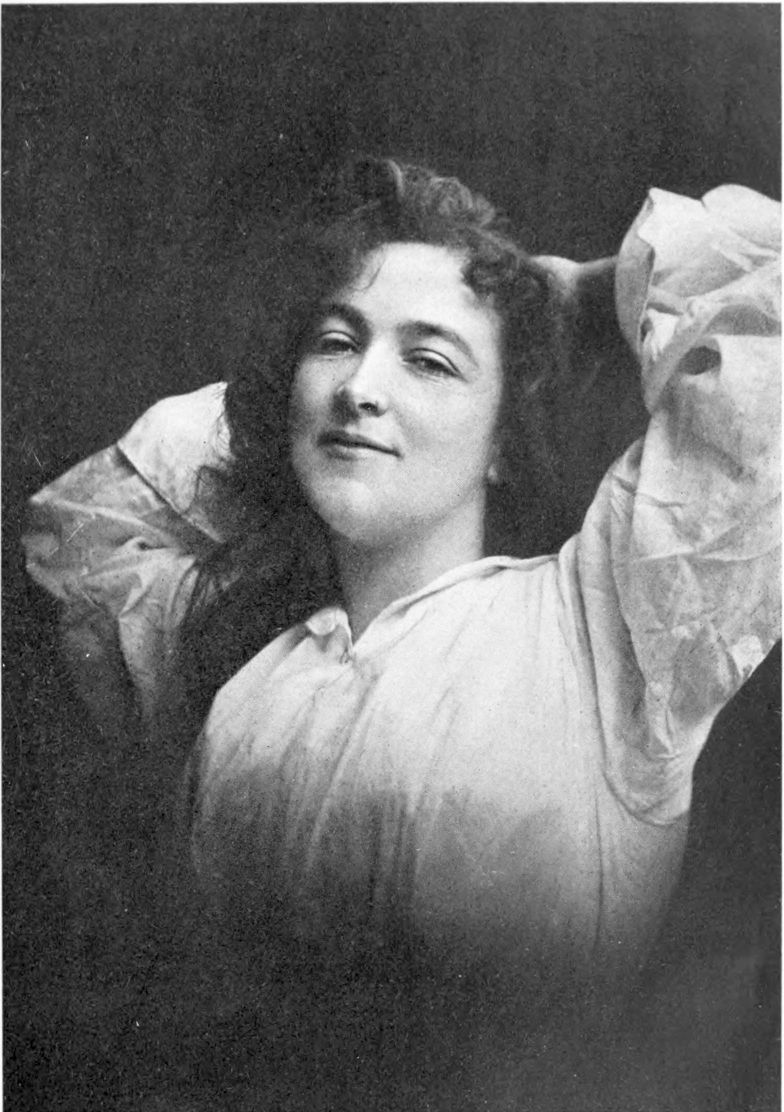
Photograph by Sarony. Collection of Jefferson Winter.
BLANCHE BATES AS CIGARETTE, IN “UNDER TWO FLAGS”
potent in fiery conflicts of feeling, and, above all, capable of covering grief with a smile. That is the essence of her character. Blanche Bates, possessing rare personal distinction and a temperament equally attuned to the extreme moods of mirth and grief, was easily proficient in the assumption of that personality and in the pictorial and effective exposition of it. Without the presence of that actress the play (if it had ever been produced at all) would have passed as a populous, tumultuous stage pageant,—a spectacle of Moorish scenery and military bustle. Animated by her power, sensibility, and spirited, various, incessant action, it was lifted to dramatic importance and Belasco’s “desperate” venture—as he calls it—proved brilliantly successful.
The employment of Cigarette is the salvation from various dangers of Bertie Cecil, a man whom she loves and whose love is bestowed on another woman, and her diligence in that employment is attended by risk and rewarded by ruin. Many persons appear to think that it is beatific to be loved by other persons and grievous not to be loved, and, accordingly, love-tales exemplary of the joy, on the one hand, and the sorrow, on the other, that are sequent from those antipodal conditions of experience are perennially popular. Pygmalion worships a stone; Titania caresses the ears of an ass, and the populace is thrilled. Cigarette’s passion for Bertie Cecil is of the old, familiar kind, and, the scene being Algeria, her adventures are, theatrically, shown across a background of singular beauty,—because that country is remarkable for flowers, cedar forests, Oriental palms, Roman remains, stony deserts contrasted with smiling villages, and luxuriant gardens not distant from mountains covered with snow.
Taste, thought, ingenuity, and sedulous care were expended on every feature of the pageant by Belasco, and the result was a magnificent spectacle,—one of the richest and most impressive ever seen on our Stage. Had it been brought here by Henry Irving or Herbert Beerbohm-Tree, it would have been hailed as a transcendent exploit in stagecraft. Every scene was a picture, every picture was harmonious with the phase of the story to be illustrated, and in the transitions from the luxurious villa, with its prospect of the tranquil ocean faintly rippling beneath the moon, to the desolate, rocky, weird, and ominous mountain gorge a climax of solemn grandeur seemed to take shape, color, and charm, slowly rising out of a dream of romantic beauty. The drift of whirling mist over the darkening waves of sand on the bleak seacoast would have seemed the most consummate of illusions had it not been excelled by the blinding terrors of a mountain tempest. Those effects were wrought by simple means, but they were not less splendid because of the simplicity of their management.
The dramatic victory was not won, however, by either the pageantry or the play. Mr. Potter’s variant version of “Under Two Flags” is hackneyed in expedients, abrupt in movement, drastic in method, coarse in character, shady in morals, florid in style, and it was made silly, in some of the colloquies, by the infusion of contemporary slang and reference. The listener heard of “rot” and also of “the Klondike,”—unknown in the period of the story. But the old novel had been made to yield telling situations, and the strong and splendid acting of Miss Bates vitalized them, brilliantly animated the whole structure, and vindicated Belasco’s faith in the ability of the actress. The revelation of jealousy working in an unsophisticated, half-savage nature, the elemental passion expressed in the fantastic dance, the prayer of the breaking heart for her lover’s fidelity, the supplication for his pardon, the agony when repulsed, the ecstasy when triumphant, the tremendous conflict of emotions in the wild ride for rescue,—they were all displayed with more of human nature and more of a competent artist’s power to control feelings and to shape the effect of situation than had been seen on our Stage for many a long day.—This was the original cast of “Under Two Flags” at the Garden Theatre:
Bertie CecilFrancis Carlyle.
JohnMaclyn Arbuckle.
RakeEdward S. Abeles.
Countess of WestminsterRose Snyder.
Venetia LyonnesseMargaret Robinson.
Marquis of ChateauroyCampbell Gollan.
Lord ConstantiaArthur Bruce.
Pierre BaroniAlbert Bruning.
Renée BaroniGrace Elliston.
General LamoricièreMatt. Snyder.
Paul LamoricièreMadge West.
Captain de ChanrellonBeresford Webb.
En-ta-MaboullFrank Leyden.
Beau BrunoTefft Johnson.
AminehMrs. F. M. Bates.
CigaretteBlanche Bates.