INTRODUCTION. (continued 9)
Reading edition
Euphorbium, s. A plant; a gum resin that exudes spontaneously from a large oriental tree.
Euphorbium is brought to us in small drops, of a pale yellow colour, which are generally mixed with woody and other extraneous matter. It is used as an external application, and generally employed in the form of tincture; sometimes it is mixed into an ointment with hog’s-lard, mercurial ointment, oil of origanum, oil of bay, &c., being previously reduced to a fine powder. It is also frequently an ingredient in strong blisters, to which it proves a powerful auxiliary. In whatever form euphorbium is employed, it proves extremely acrimonious and stimulating, and is useful in reducing callous swellings of the back sinews, curbs, windgalls, &c.
The tincture is made by steeping one ounce of the powder in four or six ounces of rectified or proof spirit, frequently shaking the bottle which contains the mixture, and keeping it in a warm place; after eight or ten days to be strained off, and kept well corked.—White.
Ewe, s. The she sheep.
Exfoliation, s. The process by which the corrupted part of the bone separates from the sound.
Expectoration, s. The act of discharging from the breast; the discharge which is made by coughing.
Expectorants, s. Medicines that increase the discharge of mucus, and thus relieve coughs and impeded breathing. In costive cases they should be assisted by clysters and bran mashes.
EXPECTORANT BALLS.
1. Gum ammoniacum 2 to 4 dr.
Powdered squill 1 to 2 dr.
Castile soap 3 dr.
Oil of aniseed 30 drops.
Ginger 1 dr.
Syrup enough to form a ball.
2. Gum ammoniacum 2 oz.
Powdered squills 1 oz.
Powdered ipecacuana ½ oz.
Powdered opium ½ oz.
Powdered ginger 1 oz.
Powdered allspice 1 oz.
Oil of aniseed ½ oz.
Balsam of sulphur 4 oz.
Castile soap, softened by being beaten up with a little syrup 2 oz.
To be beaten into a mass fit for making balls. The dose from one ounce to one ounce and a half daily, or twice a day.
3. Barbadoes aloes 1 dr.
Assafœtida 1 dr.
Liquorice powder and syrup enough to form the ball. One to be given daily until the bowels are a little opened, or the cough is cured.
4. Gum ammoniacum 2 dr.
Powdered squills 1 dr.
Ipecacuana ½ dr.
Castile soap 2 dr.
Syrup and liquorice powder enough to form the ball. One to be given daily, or twice a day.
Dr. Paris, in his Pharmacologia, remarks, that more is to be gained by the combination of these remedies, than can be obtained by any of them separately.
DRENCH.
Garlic bruised 4 oz.
Boiling vinegar 12 oz.
Macerate near the fire three or four hours, then press out the fluid part, and mix with it six ounces of honey. This is sufficient for two doses, and may be given morning and evening. It cannot, perhaps, be too often repeated, that, unless the horse’s diet is carefully attended to, medicine will avail but little, either in chronic cough or imperfect wind.—White.
Explode, v. To drive out with noise and violence.
Explosion, s. The act of driving out anything with noise and violence.
In January, 1809, Mr. Sayers, of Cuckfield, was reloading his fowling-piece; the powder ignited (supposed from a latent spark left by the paper wadding in the barrel), and drove the powder flask, which was copper, to a considerable height in the air, and shattered it to atoms. Mr. Sayers luckily escaped with no injury, except a slight scratch on his fingers. Accidents similar to the above may be effectually prevented by using pieces of pasteboard, felt, or leather, to charge, with instead of soft paper.—Daniel.
Extensor, s. The muscle by which any limb is extended.
Extirpation, s. The act of rooting out, excision.
Extract, v. To draw out of something; to draw by chemical operation.
Exuviæ, s. Cast skin, cast shells; whatever is shed or cast off by animals.
Eyas, s. A young hawk just taken from the nest. Vide Hawk.
Eyasmusket, s. obs. A young unfledged male musket hawk.
Eye, s. The organ of vision; any thing formed like an eye; any small perforation; a small catch into which a hook goes; bud of a plant.
Eye, v. To watch, to keep in view.
Eyeball, s. The apple of the eye.
Eyesore, s. Something offensive to the sight.
Eyespotted, a. Marked with spots like eyes.
Eyetooth, s. The tooth on the upper jaw next on each side to the grinders, the fang.
Eyewater, s.
No. 1. Super-acetate of lead (sugar of lead) 2 dr.
Vinegar 2 to 4 oz.
Soft water 14 oz.
Mix.
No. 2. Sulphate of zinc 1½ dr.
Diluted sulphuric acid ½ dr.
Water 1½ pint.
3. Super-acetate of lead 2 dr.
Sulphate of zinc 5 scrup.
Water 1 pint.
Mix and strain through blotting paper.
In severe attacks of inflammation of the eye, it is often in so irritable a state as to admit only of the application of warm water, or milk and water; then dilute either of the above eye waters with an equal quantity of warm water; but when the inflammation has abated, they may be made stronger, and applied cold. Should the above formulæ be found ineffectual, let one, two, or three ounces of tincture of opium be added, or a larger proportion of vinegar to No. 1 than is directed. The vinous tincture of opium (vinum opii), undiluted, has often done good, applied by means of a small camel hair pencil brush, or squeezed into the inner corner of the eye, by means of a small bit of clean sponge. A solution of the extract of belladonna, in white wine, or diluted spirit, may also be tried. Vide Blaine, Percivall, and White.
Eyre, s. obs. In Forestry, the court of justice itinerant.
Eyry, s. The place where birds of prey build their nests and hatch. Vide Aërie.
Falco, (Linn.), s. A genus thus characterised:—
Head covered with feathers, bill strong, short, generally bending from its base, which is covered with a naked and coloured cere. Nostrils round or oval, lateral, and placed in the cere. Tongue in most species fleshy and divided by a slit. Upper orbit of the eye projecting. Legs feathered to the toes, or naked. Toes three forwards and one behind, the middle toe connected with the outer one, as far as the first joint. Claws short and very hooked, strong and retractile. Female superior in size to the male.—Montagu.
Falcon, s. A hawk trained for sport; a bird of immense flight. Vide Hawk.
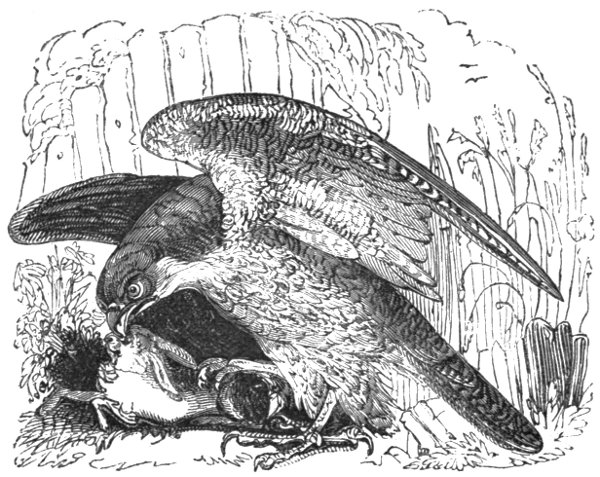
THE FALCON.
It is recorded, that a falcon belonging to a Duke of Cleves, flew out of Westphalia into Prussia in one day; and in the county of Norfolk, a hawk has made a flight at a woodcock near thirty miles in an hour.
But what are these compared to the actual velocity and continuance of the flight of a falcon, that is recorded to have belonged to Henry IV., King of France, which escaped from Fontainbleau, and in twenty-four hours after was found in Malta, a space computed to be not less than 1350 miles? a velocity equal to fifty-seven miles an hour, supposing the hawk to have been on wing the whole time. But as such birds never fly by night, and allowing the day to be at the longest, or to be eighteen hours light, this would make seventy-five miles an hour. It is probable, however, that he neither had so many hours of light in the twenty-four to perform the journey, nor that he was retaken the moment of his arrival, so that we may fairly conclude much less time was occupied in performing that distant flight.—Vide Flight of Birds.
Falconer, s. One who breeds and trains hawks.
The village of Falconswaerd, near Bois le Duc, in Holland, has for many years furnished falconers to the rest of Europe. I have known many falconers in England, and in the service of different princes on the Continent, but I never met with one of them who was not a native of Falconswaerd.
It has been the practice of these sober and industrious men to stay with their employers during the season for hawking, and to pass the remainder of the year with their families at home.
A falconer, whose province it was to tame, manage, and look after falcons and other hawks, was formerly as great and conspicuous a character as the most celebrated huntsman of the present day. The influence of fashion and the changes wrought by time have, however, so obscured both sport and sportsmen in this way, that neither hawk, falcon, or falconer, are to be seen or heard of, unless in the northern parts of the kingdom, where it is also nearly buried in oblivion.—Sebright—Daniel.
Falconry, s. Vide Hawking.
Fallow, a. Pale red, or pale yellow; unsowed, left to rest after the years of tillage; ploughed, but not sowed; unploughed, uncultivated.
Fallow Deer, s. The domestic or park deer.
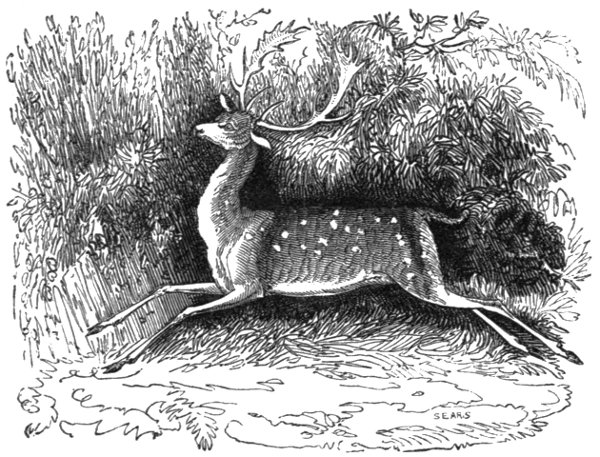
No two animals can make a more near approach to each other than the stag and the fallow deer, and yet no two animals keep more distinct, or avoid each other with more fixed animosity; they never herd or intermix together, and consequently never give rise to an intermediate race. It is even rare, unless they have been transported thither, to find fallow-deer in a country where stags are numerous.
The fallow-deer is easily tamed, and feeds upon many things which the stag refuses; he also preserves his venison better: nor does it appear that the rutting, followed by a long and severe winter, exhausts him, but he continues nearly in the same state throughout the year. He browses closer than the stag, for which reason he is more prejudicial to young trees, and often strips them too close for recovery. The young deer eat faster and with more avidity than the old. At the second year they seek the female, and, like the stag, are fond of variety. The doe goes with young eight months and some days; she commonly produces one fawn, sometimes two, but very rarely three. They are capable of engendering, from the age of two years to that of fifteen or sixteen; and in short they resemble the stag in all his natural habits, and the greatest difference between them is the duration of their lives. From the testimony of hunters it has been remarked, that stags live to the age of thirty-five or forty years, and from the same authority we understand that the fallow-deer does not live more than twenty. As they are smaller than the stag, it is probable that their growth is sooner completed.
If some curious gentleman would procure the head of a fallow-deer, and have it dissected, he would find it furnished with two spiracula, or breathing places, besides the nostrils; probably analogous to the puncta lachrymalia in the human head. When deer are thirsty they plunge their noses, like some horses, very deep under water while in the act of drinking, and continue them in that situation for a considerable time; but, to obviate any inconveniency, they can open two vents, one at the inner corner of each eye, having a communication with the nose. Here seems to be an extraordinary provision of nature worthy our attention; and which has not, that I know of, been noticed by any naturalist. For it looks as if these creatures would not be suffocated, though both their mouths and nostrils were stopped. This curious formation of the head may be of singular service to beasts of chase, by affording them free respiration: and no doubt these additional nostrils are thrown open when they are hard run.—Buffon—White’s Selborne.
False Quarter, s.
False Quarter is a defect in the hoof of a horse, originally occasioned by some injury producing a destruction of parts, as quitter, canker, wounds, treads, bruises, or such formation of matter by which a part of the hoof has been unavoidably destroyed, or necessarily taken away. In the regeneration of parts, the incarnation (from the rigid and horny nature of the hoof) is irregular and imperfect, forming a sort of cleft (or artificial union) with the sound part upon the surface, productive of a sensible weakness underneath. This imperfect and defective junction renders such quarter, as it is called, inadequate to the weight it is destined to bear; in which case much judgment is required, and may be exerted, in the palliation, as perfect cure is not to be expected. Care must be taken in forming the shoe to relieve the tender part from the pressure, by hollowing it at that particular spot, and letting the bearing be fixed entirely upon the sound parts. By constant attention in reducing the prominent edges of the irregular projection with the fine side of the rasp, and a few occasional impregnations with fine spermaceti oil, the hoof may be sometimes restored to its original formation.—Taplin.
Farcy, s. The leprosy of horses.
Farcy is intimately connected with glanders; they will run into each other, or their symptoms will mingle together, and before either arrives at its fatal termination its associate will almost invariably appear. An animal inoculated with the matter of farcy will often be afflicted with glanders, while the matter of glanders will frequently produce farcy. They are different types or stages of the same disease. There is, however, a very material difference in their symptoms and progress, and this most important of all, that while glanders are generally incurable, farcy, in its early stage and mild form, may be successfully treated.
Veterinary writers tell us that it is a disease of the absorbents in the skin, and therefore the first indication of this disease, even before any drooping, or loss of condition, or of appetite, is generally the appearance of little tumours—farcy buds—close to some of the veins, following the course of the veins, and connected together by a kind of cord, which farriers call corded veins. When they are few and small they may possibly exist for several weeks without being observed; but at length they increase in number and in size, and become painful and hot, and some of them begin to ulcerate. They appear usually about the face or neck, or inside of the thigh, and in the latter case there is some general enlargement of the limb, and lameness.
In some cases, however, the horse will droop for many a day before the appearance of the buttons or farcy buds; his appetite will be impaired;—his coat will stare;—he will lose flesh. The poison is evidently at work, but has not gained sufficient power to cause the absorbents to swell. In a few instances these buds do not ulcerate, but become hard and difficult to disperse. The progress of the disease is then suspended, and possibly for many months the horse will appear to be restored to health; but he bears the seeds of the malady about him, and, all at once, the farcy assumes a virulent form, and hurries him off. These buds have sometimes been confounded with the little tumours, or lumps of surfeit. They are generally higher than these tumours; not so broad; have a more knotty feel, and are principally found on the inside of the limbs, instead of the outside.
Few things are more unlike, or more perplexing, than the different forms which farcy assumes at different times. One of the legs, and particularly one of the hinder legs, will suddenly swell to an enormous size. At night the horse will appear to be perfectly well, and, in the morning, one leg will be three times the size of the other, with considerable fever, and scarcely the power of moving the limb.
At other times the head will be subject to this enlargement—the muzzle will particularly swell, and a stinking discharge will issue from the nose. Sometimes the horse will gradually lose flesh and strength; he will be hide-bound—mangy eruptions will appear in different parts; the legs will swell; cracks will appear at the heels, and the inexperienced person may conceive it to be a mere want of condition combined with grease.
Farcy, like glanders, springs from infection, or from bad stable management. It is produced by all the causes which give rise to glanders; but with this difference, that it is more frequently generated, and is sometimes strangely prevalent in particular districts.
The treatment of farcy varies with the form it assumes. In the button or bud farcy, a mild dose of physic should be first administered. The buds should be then carefully examined, and if any of them have broken, the budding iron, of a dull red heat, should be applied to them; or if matter should be felt in them, showing that they are disposed to break, they should be penetrated with the iron. These wounds should be daily inspected, and if, when the slough of the cautery comes off, they look pale, and foul, and spongy, and discharge a thin matter, they should be frequently washed with a lotion, composed of a drachm of corrosive sublimate dissolved in an ounce of rectified spirit; the other buds should likewise be examined, and opened with the iron as soon as they evidently contain matter. When the wounds begin to look red, and the bottom of them is even and firm, and they discharge a thick white or yellow matter, the friar’s balsam will speedily heal them. As, however, the constitution is now tainted, local applications will not be sufficient, and the disease must be attacked by internal medicines, as soon as the physic has ceased to operate. The corrosive sublimate will be the best alterative, and may be given in doses of ten grains, gradually increased to a scruple, with two drachms of gentian and one of ginger, and repeated morning and night until the ulcers disappear, unless the horse is violently purged, or the mouth becomes sore, when a drachm of blue vitriol may be substituted for the corrosive sublimate. During this, the animal should be placed in a large box, with a free circulation of air; and green meat, or carrots, the latter more particularly, should be given him, with a fair allowance of corn. If he could be turned out during the day, it would be advantageous; but at all events he should be daily exercised. It is related by Mr. Blaine, that a horse so reduced as not to be able to stand, was drawn into a field of tares, and suffered to take his chance: the consequence was, that when he had eaten all within his reach, he was able to rise and search for more, and eventually recovered. In an early stage of the disease, and if glanders have not appeared, this treatment will frequently succeed. If, after the wounds have healed, the absorbents should continue to be corded, a blister, or light firing, will probably be serviceable.—The Horse.
Fault, s. Offence; defect; puzzle, difficulty; a term in hunting.
Favourite, s. A person or thing beloved. In racing, the term is used to express supposed superiority, as “first favourite for the Leger.”
Fawn, s. A young deer.
Fawn, v. To bring forth a young deer; to court by frisking before one as a dog.
Feather, s. The plume of birds; upon a horse, a sort of natural frizzling hair.
At the root of the first quill in each wing of the woodcock, is a small pointed narrow feather, very elastic, and much sought after by painters, by whom it is used as a pencil. A feather of a similar kind is found in the whole of this tribe, and also in every one of the tringas and plovers which the author has examined.—Bewick.
Feather, v. To dress in feathers; to fit with feathers; to tread as a cock; to strike feathers from a bird fired at.
Febrifuge, s. Any medicine serviceable in fever. Vide Fever.
Feed, v. To supply with food; to graze; to consume by cattle; to take food; to prey.
Feed, s. Food, that which is eaten; a certain portion of corn given to a horse.
Feeder, s. One that gives food; one that eats; a kennel servant.
Feeler, s. One that feels; the horns or antennæ of insects.
Feet, s. The plural of foot.
Feet of Birds.—Technical terms:—
Pinnatus.—Finfooted or scalloped, a term applied to the feet of coots.
Pes lobatus.—Applied when the toes are furnished with broad plain membranes, as in the foot of the red-necked grebe.
Semi-palmatus—Semi-palmated: when the middle of the webs reach only about half the length of the toes.
When the middle toe claw is notched like a saw, it is called serrated; and pectinated when toothed like a comb.
The large crooked talons of birds of prey, and their hooked beaks, are well formed for securing and tearing their victims. The formation of the feet of the woodpeckers, the toes being placed two forward and two backward, is well calculated for climbing, and the cuneiform shape of the extremity of their bills is suited to the purpose of cutting holes in decayed trees; their tongue is also wonderfully contrived to search out insects beyond the reach of their bill, by its great length, which is double that of the tongue at least. The wryneck has this singularity, as well as the like formation of toes; which last is also found in the cuckoo: but neither of these birds is seen to climb up the bodies of trees, nor have either the stiff sharp-pointed feathers in the tail, as in the woodpecker, so admirably adapted to support them when in the act of hewing. This agrees with the observations of an ingenious living naturalist, the Rev. Revett Shepherd. “The cuckoo,” says he, “is furnished with two toes before and two behind, and yet is never known actually to climb, a convincing proof that such conformation does not necessarily bring with it the power of climbing, more especially when we consider that the nuthatch (Sitta Europæa), and the creeper (Certhia familiaris), have their toes placed in the usual manner, and yet run up and down trees with as much facility as the woodpeckers. The use of the pedes scansorii, as they evidently in this case conduce not to climbing, I judge to be this; it is well known that this bird will oftentimes sit by the half-hour together on the bough of a tree, vociferating its loud and pleasing note; in doing this, it sits remarkably forward, and appears in constant agitation, continually moving its body up and down with great elegance; now, as it sits so forward, while using this exertion, it would be liable to lose its balance and quit its hold, had it only one toe behind; whereas, by the contrivance of two, it is enabled strongly to adhere to the branch.”
The legs and feet of aquatic birds are wonderfully formed for accelerating their motion in that element, which is their greatest security. The bone of the leg is sharp, and vastly compressed sideways: the toes, when the foot is brought forward, close in behind each other in such a manner as to expose a very small surface in front, so that, in the action of swimming, very little velocity is lost in bringing the legs forward; this is very conspicuous in the diver. Some aquatic birds are web-footed before the whole length of the toes, as in the ducks; others only half the length of the toes, like the avoset. Some again have all four toes webbed, as in the cormorant; others whose feet are furnished with a fin-like membrane or each side of the toes; these are either plain, as in the grebe, or lobed, as in the coot and phalarope. There are also some who swim and dive well, whose toes are long and slender, and not furnished with webs or fins, such as the water-hen and rail; but these live as much on land as in water. The gulls and terns, although web-footed, seem incapable of diving; the latter, indeed, we never observed to settle on the water; the former is so buoyant that it floats elegantly on the surface. The avoset, whose feet bespeak it an inhabitant of the water, does not seem to have the power of swimming; the water-ouzel, on the other hand, has not the least appearance of an aquatic, nor can it swim; but it will dive, and remain a long time under water. The serrated claw in the heron and nightjar is a singular structure, which we have not discovered the use of. The bill as well as the feet of birds, makes one of the strong natural divisions; but these are described under the head of each genus.
Of Horses.—Contraction is the most general evil among the feet of our horses, and some breeds appear more liable to it than others: it is peculiarly the case with blood-horses. Colour also seems to have some influence in contracting the feet; hence I have observed dark chestnuts particularly prone to it. A good foot should exhibit a proper line of obliquity: when the horn is very upright, however wide and open the heels, such feet soon become defective. This is but seldom attended to, even among those who esteem themselves judges; but no rule admits of fewer exceptions, than that such a foot soon becomes faulty. There should also be a proper height of horn: when there is too much, it disposes to contraction: when too little, the heels, quarters, and soles must, of necessity, be weak, and tenderness in going must be the consequence.
The heels should be particularly attended to; they must be wide, and the frog healthy, firm, yet pliable and elastic. Contraction of their cleft is their most common defect, and is frequently accompanied with a general lessening of the circumference of the foot. Such a foot will probably feel hotter than natural; the frog also will be compressed and small, and very likely thrushy.
When a horse’s foot is held up, the sole should present a concave surface: if it be less concave than natural, that sole is weak, and will not bear much pressure; and it is more than probable it will continue lessening in concavity until it becomes a plane, when every subsequent shoeing will endanger the laming of the animal. White feet are very objectionable on this account, for they are particularly liable to become flat in the sole: their quarters, also, are commonly weak, and fall in; and when neither of these evils take place, they yet have seldom strength enough to resist contraction: and it may be determined on, that, when there are three dark and one white foot, in nineteen instances out of twenty, the white foot becomes defective sooner than the dark ones.
Another very serious complaint is a brittleness of hoof, which may be generally be detected by the marks of the fragile parts detaching themselves from every old nail-hole. This kind of foot, particularly in hot weather, breaks away, till there is no room for the nails to hold, when the horse, of course, becomes useless. In an examination of the foot, the eye should also be directed to the wearing of the shoe: if it be unequally worn, particularly if the toe be worn down, such a horse is probably a stumbler, and does not set his foot evenly on the ground, either from defective feet or natural gait.
The feet of horses being the very basis of support, upon which the safety and expedition of the frame entirely depends, they are entitled to every possible degree of care and attention; more particularly in the winter season, when, from neglect, so many ills and inconveniences are known to arise. The injuries, accidents, and diseases, to which the feet are constantly liable, consist of cracks in the heels, scratches or lacerations, stubs and bruises of the outer sole, or upon the verge of the coronet between hair and hoof, corns, sandcracks, thrushes, canker, quitter, ringbone, and footfounder; exclusive of the frequent injuries sustained in shoeing, by the ignorance, indolence, or obstinacy of those smiths who, having no professional reputation to support, are too innately confident in their own ability to bear instruction.
As the defects thus enumerated will be found individually enlarged upon under distinct and separate heads, it becomes only necessary here to lay down such general rules for the regular management of the feet, as may (properly attended to) prove the means of prudent prevention; not more in respect to the trouble and expense of disease, than of the most mortifying and repentant anxiety. These defects and disquietudes are seldom found but in the stables where the master rarely or ever condescends to obtrude his person and commands upon the tenacious dignity of a self-important groom; the preserving industry of whose careful endeavours, and the pliability and elasticity of whose joints, if properly exerted, would prove the truest and most infallible preventive of swelled legs and cracked heels, in preference to all the nostrums ever yet brought into private practice or public use. And those who unfortunately encounter these ills, may generally, and with justice, attribute them much more to the constitutional tardiness of the professed groom (or occasional strapper) than any defect in the constitution of the horse.
The feet of different horses vary exceedingly in what may be termed the texture or property of the hoof, and this is in general regulated by the colour of the legs and feet. There are few horses with white heels but what have white hoofs also; and these are always more liable to, and susceptible of, defects and weakness, than those of an opposite description. The sound, firm, dark-coloured hoof of the bay, brown, or black horse, is seldom found defective; but those of other coloured horses are most subject to weak, thin soles, displaying a prominence on each side the frog occasioned by a too feeble and inadequate resistance to the force of the membranous mass within; feet of which description are also frequently found to have the corresponding concomitant of a brittle hoof, the edges of which are incessantly splitting, and throwing out a constant threatening of sandcracks, with the additional mortification of being subject to inveterate thrushes, or an almost constantly diseased or putrefied state of the frog.
Feet so exceedingly different in the nature of their construction, must certainly require as different a mode of treatment, according to such circumstances as happen to exist. To preserve feet perfectly sound, and free from the ills to which they are subject, cleanliness is the leading step. After exercise or use, so soon as the body is drest, the dirt or gravel should be carefully taken from under the shoes with a picker, the feet well washed, the legs and heels rubbed dry, the bottom stopped with cow-dung, and the hoofs oiled with a brush impregnated with spermaceti oil. Horses left with wet legs and heels after a severe chase, or long journey, particularly in sharp easterly winds, or during frost and snow, constitute cracks or scratches to a certainty. So severe a rigidity is occasioned in the very texture of the integument, and it becomes partially ruptured or broken in various places, upon being brought into expeditious action; which, with the friction and irritation then occasioned by the sharp particles of gravel in dirty roads, soon produce lacerations of the most painful description.
The state of the shoes should be constantly attended to. Permitted to remain too long upon the feet, the growth of the hoof brings the shoe forward, rendering it too short at the heel, when it begins to indent, and sinking upon the foot, soon presses upon the outer sole, constituting pain or disquietude in some horses, laying the foundation of corns in others. Horses in moderate work require new shoes once a month upon an average, never varying more than two or three days from that time: indeed, it is not right that they should go longer. The penurious plan of removing shoes half worn, is truly ridiculous; they never render service adequate to the expense, and the practice only tends to a more frequent destruction of the hoof. Thrushes should be counteracted upon their first appearance, without being permitted to acquire a corroding virulence. Swelled legs are hardly ever seen in stables where a proper course of discipline and regular routine of business is observed; they proceed from a viscid, sizy state of the blood, a languor in the circulation, a want of exercise out of the stable, or a sufficiency of friction, leg-rubbing, care, and attention within.
Pointers’ and setters’ feet, particularly the former, are frequently chafed; their feet should always, after being hunted, be thoroughly washed with salt and water, and, half an hour afterwards, be well rubbed with hog’s-lard.—Montagu—Blaine—Taplin—Thornhill.
Feline, a. Like a cat, pertaining to a cat.
Fell, s. The skin, the hide.
Felloe, s. The circumference of a wheel.
Fellow, s. An associate, one united in the same affair; one of the same kind or litter.
Felt, s. Cloth made of wool united without weaving; a hide or skin.
Female, s. A she, one of the sex which brings young.
Femoral, a. Belonging to the thigh.
Fen, s. A marsh, flat and moist ground, a moor, a bog.
Fenberry, s. A kind of blackberry.
Fence, s. Guard, security; enclosure, mound, hedge.
Fencer, s. One who teaches or practises the use of weapons; a horse that leaps.
Ferine, a. Wild, savage.
Fermentation, s. A slow motion of the intestine particles of a mixed body, arising usually from the operation of some active acid matter.
Fern, s. A plant.
Ferny, a. Overgrown with fern.
Ferret, s. A quadruped of the weasel kind, used to catch rabbits.
Ferret, v. To drive out of lurking places; to hunt rabbits with a ferret.
Fetlock, s. A tuft of hair that grows behind the pastern joint.
Fetter, s. Chains for the feet.
Fever, s. A disease in which the body is violently heated, and the pulse quickened, or in which heat and cold prevail by turns. It is sometimes continual, sometimes intermittent.
In horses fever begins frequently with a cold or shivering fit, although this is not essential to fever. The horse is dull, unwilling to move, with a staring coat, and cold legs and feet. This is succeeded by warmth of the body; unequal distribution of warmth to the legs; one hot, and the other three cold, or some unnaturally warm, and others unusually cold, although not the deathy coldness of inflammation of the lungs; the pulse quick, soft, and often indistinct; breathing somewhat laborious; but no cough, or pawing, or looking at the flanks. The animal will scarcely eat, and is very costive. While the state of pure fever lasts, the shivering fit returns at nearly the same hour every day, and is succeeded by the warm one, and that often by a very slight sweating one; and this goes on for several days until local inflammation appears, or the fever gradually subsides. No horse ever died of pure fever; if he is not destroyed by inflammation of the lungs, or feet, or bowels succeeding to the fever, he gradually recovers.
What we have said of the treatment of local inflammation will sufficiently indicate that which we should recommend in fever. Fever is general increased action of the heart and arteries, and therefore evidently appears the necessity for bleeding, regulating the quantity of blood taken by the degree of fever, and usually continuing to take it (the finger being kept on the artery) until some impression is made upon the system. The bowels should be gently opened; but the danger of inflammation of the lungs, and the uniformly injurious consequence of purgation in that disease, will prevent the administration of an active purgative. One drachm and a half of aloes may be given morning and night with the proper fever medicine, until the bowels are slightly relaxed, after which nothing more of an aperient quality should be administered. Digitalis, emetic tartar, and nitre, should be given morning and night, in proportions regulated by the circumstances of the case, and these should give way to white hellebore in doses of half a drachm twice in the day, if symptoms of inflammation of the lungs should appear. The horse should be warmly clothed, but be placed in a cool and well-ventilated stable.
Symptomatic fever is generally increased arterial action, proceeding from some local cause. No organ of consequence can be long disordered or inflamed without the neighbouring parts being disturbed, and the whole system gradually participating in the disturbance. Inflammation of the feet or of the lungs never existed long to any material extent, without being accompanied by some degree of fever.
The treatment of symptomatic fever should resemble that of simple fever, except that particular attention should be paid to the state of the part originally diseased. If the inflammation which existed there can be subdued, the general disturbance will usually cease.—Blaine.
Fibula, s. The outer and lesser bone of the leg, smaller than the tibia.
Field, s. Ground not inhabited, not built on; cultivated tract of ground; the open country; horsemen collected at a hunt; horses collectively.
Fieldfare, (Turdus Pilarus, Linn.; La Litorne, ou Tourdelle, Buff.) s. A bird.
This is somewhat less than the missel-thrush; its length is ten inches. The bill is yellow; each corner of the mouth is furnished with a few black bristly hairs; the eye is light brown; the top of the head and back part of the neck are of a light ash-colour; the former spotted with black; the back and coverts of the wings are of a deep hoary brown; the ramp ash-coloured; the throat and breast are yellow, regularly spotted with black; the belly and thighs of a yellowish white; the tail brown, inclining to black; the legs dusky yellowish brown; in young birds yellow.
We have seen a variety of this bird, of which the head and neck were of a yellowish white; the rest of the body was nearly of the same colour, mixed with a few brown feathers; the spots on the breast were faint and indistinct: the quill feathers were perfectly white, except one or two on each side, which were brown; the tail was marked in a similar manner.
The field-fare is only a visitant in this island, making its appearance about the beginning of October, in order to avoid the rigorous winters of the north, whence it sometimes comes in great flocks, according to the severity of the season, and leaves us about the latter end of February or the beginning of March, and retires to Russia, Sweden, Norway, and as far as Siberia and Kamtschatka. Buffon observes that they do not arrive in France till the beginning of December, that they assemble in flocks of two or three thousand, and feed on ripe crevises, of which they are extremely fond; during the winter they feed on haws and other berries; they likewise eat worms, snails, and slugs.
Field-fares seem of a more sociable disposition than the throstles or the missels: they are sometimes seen singly, but in general form very numerous flocks, and fly in a body; and though they often spread themselves through the fields in search of food, they seldom lose sight of each other, but, when alarmed, fly off, and collect together upon the same tree.—Bewick.
Fieldmouse, s. A mouse that burrows in banks.
An extraordinary instance of the rapid increase of mice, and of the injury they sometimes do, occurred a few years ago in the new plantations made by order of the crown in Dean Forest, Gloucestershire, and in the New Forest, Hampshire. Soon after the formation of these plantations, a sudden and rapid increase of mice took place in them, which threatened destruction to the whole of the young plants. Vast numbers of these were killed,—the mice having eaten through the roots of five-year-old oaks and chestnuts, generally just below the surface of the ground. Hollies also, which were five and six feet high, were barked round the bottom; and in some instances the mice had crawled up the tree, and were seen feeding on the bark of the upper branches.
The following account will show the numbers of mice caught in the different inclosures in Dean Forest in three months, from September to January, with the number of acres, and the proportion between the long and the short-tailed mice.
Short- Long-
tailed tailed
Acres. Mice. Mice. Total.
Haywood Inclosure 418 12,850 8 12,858
Oiley Hill ditto 41 1,161 11 1,172
Crabtree Hill do. 372 7,851 7,851
Park Hill ditto 113 2,665 2,665
Shutcastle ditto 163 484 33 517
Sallow Vallets do. 386 1,361 1,361
Barnhill ditto 50 70 70
Birchwood ditto 50 3 3
Whitemead Park do. 100 1,559 15 1,574
—— ———
Total Acres, 1,693 Total Mice, 28,071
I should not forget to mention that, in New Forest, foxes were frequently seen hunting, after the mice, and eating them greedily.—Jesse.
Filly, s. A young mare; opposed to a colt or young horse.
Film, s. A pellicle or thin skin.
Filter, v. To clear by drawing off liquor by depending threads; to strain; to percolate.
Fin, s. The wing of a fish.
Fin-footed, a. Having feet with membranes between the toes.
Finch (Fringilla), s. A small bird; of which we have three kinds, the goldfinch, the chaffinch, and bullfinch.
The transition from the bunting to the finch is very easy, and the shade of difference between them, in some instances, almost imperceptible; on which account they have been frequently confounded with each other. The principal difference consists in the beak, which in the finch is conical, very thick at the base, and tapering to a sharp point: in this respect it more nearly resembles the grosbeak. Of this tribe many are distinguished as well for the liveliness of their song, as for the beauty and variety of their plumage, on which accounts they are much esteemed. They are very numerous, and assemble sometimes in immense flocks, feeding on seeds and grain of various kinds, as well as on insects and their eggs.—Bewick.
Finger, s. The flexible member of the hand by which men catch and hold; a small measure of extension.
Fir, s. The tree of which deal boards are made.
Fire, v. To set on fire; to kindle; to inflame the passions; to discharge any fire-arms.
Fire-arms, s. Arms which owe their efficacy to fire; guns.
Firing, p. The application of a red hot iron to the skin, so as to burn without penetrating through it; to cauterise a horse.
The violent inflammation firing occasions, rouses the absorbent vessels into action, by which callous or even bony swellings are sometimes dispersed. The diseases in which it is most efficacious are spavins, ring-bones, and callous swellings about the back sinews, the consequences of strains and windgalls. Firing draws blood to the affected part, thickens and strengthens it, and makes the skin act as a permanent bandage. A blister is often applied to the part immediately after firing, or on the following day, to render it more effectual. It is necessary to observe that the milder remedies should be tried before this severe operation is had recourse to. Firing has been recommended for the purposes of strengthening the back sinews and hocks of colts, to prevent strains, and what is termed breaking-down.
It has been erroneously asserted, that when firing is employed to a callus of the back sinews, the swelling should be previously reduced by blistering; that firing would then prevent a return; whereas if the firing were performed in the first place, it would fix the swelling, and render it incurable. In inflammation, certainly firing will do harm, therefore it must be first removed by the frequent application of a cooling lotion, such as diluted vinegar, in which a little sugar of lead has been dissolved.—Percival.
Firelock, s. A soldier’s gun; a gun discharged by striking steel with flint.
Fish, s. An animal that inhabits the water.
Fish, v. To be employed in catching fish.
Fishes in general are male and female; the former possessing the melt and the latter the roe, although some individuals of the cod and sturgeon are said to contain both. The spawn of the greater number of fishes is deposited in the sand or gravel; and in that state, it is probable that the roe and melt are mixed together. A fish whose weight, at twenty years old, shall be thirty pounds, generates the first or second year, when perhaps it does not weigh more than half a pound; and it is certain that the male seems more attached to the eggs than the female, for when she ceases to drop them, the male instantly abandons her, and with ardour follows the eggs which are carried down by the stream, or dispersed amongst the waves by the wind, passing and repassing many times over every spot where he finds the eggs.
Summer is the usual spawning time, because at that season the water is tepified by the beams of the sun, and is therefore better adapted for quickening the eggs into life. How the eggs of fishes are impregnated is wholly unknown. All that obviously offers is, that in ponds, the sexes are often seen together among the long grass at the edge of the water; that there they seem to struggle, and are in a state of suffering, as they grow thin, lose their appetite, whilst their flesh becomes flabby, and in some, the scales grow rough and lose their lustre; on the contrary, when the time of coupling is over, their appetite returns, their natural agility is resumed, and their scales become brilliant and beautiful. The spawn continues in the state of eggs a longer or shorter period, but this is for the most part proportioned to the size of the animal. The young animal remains in the form of an egg from December until April in the salmon kind; the carp not above three weeks, and the gold fish from China is produced in a still less time. With all the advantages of minuteness and agility when excluded from the egg, there is not one, perhaps, of a thousand, that survives the dangers of its youth. Among the spinous fishes there is no trace of parental affection; they abandon their eggs to be hatched by the warmth of the season, and if they ever return to the spot where their young first received life, the parents that gave them birth, become their most formidable enemies.
By the rapacity of one another although the fishes perish by millions, yet they have other destroyers. Many of the quadrupeds and a great proportion of the sea fowls, either feed on fish, are the merciless invaders of the small fry, or devour the spawn. In a savage state, numbers of the human race wander round the lakes and rivers, whence a considerable proportion of their sustenance is derived, and among those nations whom arts and agriculture have rendered less dependent on this precarious support, superstition has usurped the place of want, and given a new edge to their avidity for this species of food; but the munificent Author of nature, notwithstanding the annual consumption of fishes is constant and immense, has made a kind provision for his creatures, in which the glory of his providence is remarkable in a twofold manner. First, by giving fishes at certain fixed seasons of the year, a particular inclination to approach the land; and this always at a time when they are the fattest, and not emaciated by breeding; as the salmon in the spring, mackerel about midsummer, herrings in the autumn, cod in the winter, &c. Secondly, by the amazing fertility which he has conferred on this class of beings. The fecundity of fishes far surpasses that of any other animals; if we should be told of a being so prolific, that it would bring forth in one season as many of its kind as there are inhabitants in England, our surprise would be deeply excited, yet upwards of 9,000,000 of ova have been found in the spawn of a single cod. 1,357,400 have been taken from the belly of a flounder; the mackerel, carp, tench, and a variety of others, are endowed with a fertility but little inferior. Such an astonishing progeny, were it allowed to arrive at maturity, would soon overstock the element allotted them; but their numbers, by the means above-mentioned, are considerably lessened, and thus two important purposes are answered in the economy of nature; by the extraordinary fruitfulness of fishes, amongst a host of foes it preserves the species, and furnishes the rest with an aliment adapted to their nature.
Fishes are the most voracious animals in nature. Many species prey indiscriminately on everything digestible that comes in their way, and devour not only other species of fishes, but even their own. As a counter-balance to this voracity, they are amazingly prolific. Some bring forth their young alive; others produce eggs. The viviparous blenny brings forth 200 or 300 live fishes at a time. Those which produce eggs are all much more prolific, and seem to proportion their stock to the danger of consumption. Leuwenhoek affirms that the cod spawns above 9,000,000 in a season. The flounder produces above 1,000,000, and the mackerel above 500,000. Scarcely one in a hundred of these eggs, however, is supposed to come to maturity; but two wise purposes are answered by this amazing increase: it preserves the species in the midst of numberless enemies, and serves to furnish the rest with a sustenance adapted to their nature.
How long a fish, that seems to have scarce any bounds put to its growth, continues to live, is not ascertained; the date prescribed as the age of man, would not perhaps be sufficient to measure the life of the smallest. In the royal ponds at Marli, in France, there are some fishes that have been preserved tame since the time, it is said, of Francis the First, and which have been individually known to the persons who have succeeded to the charge of them, ever since that period. These have now attained a size much beyond the common bulk of fishes of the same kind; and although there are certain peculiarities distinguishing them from younger fishes, yet they evince no symptoms of that decrepitude and disease, which inevitably accompany a life protracted much beyond the usual space, among quadrupeds.
When any fish is hog-backed, with a small head, this is a sure sign of that fish being in season, of whatever sort it is.
Very little is known of the habits and economy of fish from the nature of the element in which they live. When I resided in Bushy Park, I caused the sides and bottom of a place to be bricked, through which a stream of very clear water ran, and stocked it with most of the varieties of our English fresh-water fish, supplying them abundantly with food; but though I constantly watched them, and could see all they did at any time of the day, the result of my observations was far from being satisfactory. The perch were the boldest and most familiar of any of the fish, as I found no difficulty in soon getting them to come with eagerness to take a worm out of my hand. The barbel were the shyest, and seemed most impatient of observation, although in the spring, when they could not perceive any one watching them, they would roll about and rub themselves against the brickwork, and show considerable playfulness. There were some large stones in my piscatorium, round which they would wind their spawn in considerable quantities. The trout appeared to bear their confinement with less philosophy than any of the others, making high leaps against the grating which admitted the water, and seeming at all times out of sorts and out of condition. The chub were also very restless, being continually on the move, but they never could resist a cockchafer when thrown to them. My flounders only moved at night, and the eels always made their escape, but in what way I never could conjecture, except, indeed, they had the power of crawling up the brickwork, which was about five feet from top to bottom, and generally two feet above the edge of the water. They certainly could not get through the grating, which was sufficiently close to confine bleak and gudgeons; and some of the eels were of a large size. The pike, of which I had eight of about five pounds’ weight each, kept up their character for voracity. Out of 800 gudgeons, which were brought to me by a Thames fisherman, and which I saw counted into the reservoir, some few of which however died, there were scarcely any to be seen at the end of three weeks, though I should mention that the three large barbel I had, and six good-sized perch, probably partook of them.
The author of the Wild Sports of the West, in speaking of the immense Loughs Masks and Corrib, says—“It would appear, that in these lakes the fish are commensurate to the waters they inhabit. It is no unusual event for pikes of thirty pounds weight to be sent to their landlords by the tenants; and fish of even fifty pounds have not unfrequently been caught with nets and night-lines. The trouts in those loughs are also immensely large. From fifteen to sixteen pounds is no unusual size, and some have been found that reached the enormous weight of thirty. The perch tribe appear the smallest in the scale of relative proportion. These seldom exceed a herring size; but they too have exceptions, and perch of three or four pounds weight have been sometimes seen. Within fifty years this latter fish has increased prodigiously, and in the lakes and rivers where they abound, trouts have been found to diminish in an equal ratio.”
Pike and perch were almost unknown in the rivers of Belcarra and Minola, and the chain of lakes with which they communicate, and these waters were then second to none for trout-fishing. Within ten years, my cousin tells me that he often angled in them, and that he frequently killed from three to six dozen of beautiful middle-sized red trouts. Now fly-fishing is seldom practised there. The trout is nearly extinct, and quantities of pike and perch infest every pool and stream. The simplest methods of taking fish will be here found successful, and the lakes of Westmeath will soon be rivalled by the loughs of Mayo.
It is a curious fact, that the loughs where the party angled, though situate in the same valley, and divided only by a strip of moorland not above fifty yards across, united by the same rivulet, and in depth and soil at bottom, to all appearance, precisely similar, should produce fish as different from each other as it is possible for those of the same species to be. In the centre lake, the trout are dull, ill-shaped, and dark-coloured; the head large, the body lank, and though of double size, compared to their neighbours, are killed with much less opposition. In the adjacent loughs, their hue is golden and pellucid, tinted with spots of a brilliant vermilion. The scales are bright, the head small, the shoulder thick, and from their compact shape, they prove themselves, when hooked, both active and vigorous. At table they are red and firm, and their flavour is particularly fine—while the dark trout are white and flaccid, and have the same insipidity of flavour which distinguishes a spent from a healthy salmon.
It is remarkable that only three kinds of fish have been transported from foreign parts into Great Britain—the carp, the tench, and the gold-fish.
Maxims on fishing.—The following hints are quaint and useful.
“Do not imagine that, because a fish does not instantly dart off on first seeing you, he is the less aware of your presence; he almost always on such occasion ceases to feed, and pays you the compliment of devoting his attention to you, whilst he is preparing for a start whenever the apprehended danger becomes sufficiently imminent.”
“If you pass your fly neatly and well three times over a trout, and he refuses it, do not wait any longer for him; you may be sure he has seen the line of invitation which you have sent over the water to him, and does not intend to come.”
“Remember that, in whipping with the artificial fly, it must have time, when you have drawn it out of the water, to make the whole circuit, and to be at one time straight behind you, before it can be driven out straight before you. If you give it the forward impulse too soon, you will hear a crack: take this as a hint that your fly is gone to grass.”
“It appears to me that, in whipping with an artificial fly, there are only two cases in which a fish taking the fly will infallibly hook himself without your assistance, viz.:—1st, when your fly first touches the water at the end of a straight line: 2d, when you are drawing out your fly for a new throw. In all other cases, it is necessary that, in order to hook him when he has taken the fly, you should do something with your wrist which is not easy to describe.”
“If your line should fall loose and wavy into the water, it will either frighten away the fish, or he will take the fly into his mouth, without fastening himself; and when he finds that it does not answer his purpose, he will spit it out again before it has answered yours.”
“Never mind what they of the old school say about ‘playing him till he is tired.’ Much valuable time, and many a good fish, may be lost by this antiquated proceeding. Put him into your basket as soon as you can. Every thing depends on the manner in which you commence your acquaintance with him. If you can at first prevail upon him to walk a little way down the stream with you, you will have no difficulty afterwards in persuading him to let you have the pleasure of seeing him at dinner.”
“Do not leave off fishing early in the evening, because your friends are tired. After a bright day, the largest fish are to be caught by whipping between sunset and dark. Even, however, in these precious moments, you will not have good sport, if you continue throwing after you have whipped your fly off. Pay attention to this; and, if you have any doubt after dusk, you may easily ascertain the point, by drawing the end of the line quickly through your hand, particularly if you do not wear gloves.”
“When you have got hold of a good fish which is not very tractable, if you are married, gentle reader, think of your wife, who, like the fish, is united to you by very tender ties, which can only end with her death, or her going into weeds. If you are single, the loss of the fish, when you thought the prize your own, may remind you of some more serious disappointment.”
“Never angle in glaring-coloured clothes; perhaps green is that which the fish discern least, as varying less from those objects, such as trees, and herbage on the sides, to which they are familiarised. The angler should shelter himself (unless the water is muddy from rain) far from the bank, or behind a bush or tree, where he can just see the float, and so that his shadow does not, at any time, lie upon the water, especially where it is shallow, and the gravelly bottom can be discerned.”
The angler should always have the wind at his back, the sun or moon before him, as much as possible; in cold, windy weather especially, he should be on the weather-shore, where the fish then resort for warmth, and the calmness of the water. The east wind, for angling, has been universally execrated, but probably this may not hold good in rivers running from east to west.
At the conflux of rivers that ebb and flow, it is best angling at the ebb; sometimes, when the tide is not strong, they will bite at flood, but very rarely at high water.
Deep waters are best to angle in, as the fish are not then disturbed by wind or weather.
The best periods are from April to October; from three until nine in the morning, and from three in the afternoon, so long as there is light; the later, the better sport. In winter, the weather and times are much alike; the warmest is most preferable.
During the summer, even when the water is quite low and clear, no wind stirring, and the sun shining in its utmost lustre, and in the hottest part of the day, it is insisted, trout may be taken (although very few anglers are disposed to credit it), with a small wren’s-tail, grouse, smoky dun, and black hackles, fishing straight down the water by the sides of streams and banks; keeping out of sight, and with as long a line as can conveniently be managed, with the foot-length very fine: they may be often seen with their fins above water, at which time they will eagerly snap at the abovementioned flies; and though upon hooking one the rest will fly off, they will soon be composed, and return for two or three times.
Right of Fishing.—It has been held that where the lord of the manor hath the soil on both sides of the river, it is a good evidence that he hath right of fishing; and it puts the proof upon him who claims liberam piscariam; but, where a river ebbs and flows, and is an arm of the sea, there it is common to all, and he who claims a privilege to himself, must prove it; for if the trespass is brought for fishing there, the defendant may justify that the place is brachium maris, in quo unusquique subditus domini regis habet et habere debet liberam piscariam. In the Severn the soil belongs to the owners of the land on each side; and the soil of the river Thames is in the king, but the fishing is common to all. He who is owner of the soil of a private river, hath separata piscaria; and he that hath libera piscaria, hath a property in the fish, and may bring a possessory action for them; but communis piscaria is like the case of all other commons. One that has a close pond, in which there are fish, may call them pisces suas, in an indictment, &c.; but he cannot call them bona et catalla, if they be not in tanks. There needs no privilege to make a fish-pond, as there doth in case of a warren.—Ency. Brit.—Daniel—Jesse—Wild Sports, &c.
Fish-hook, s. A hook for catching fish.
Fish-pond, s. A small pool for fish. Vide Pond.
Fisher, s. One who is employed in catching fish.
Fisherman, s. One whose employment and livelihood is to catch fish.
Fishery, s. The business of catching fish.
Fishing, s. Commodity of taking fish.
Fishing-rod, s. An implement for angling. Vide Rod.
Fishy, a. Consisting of fish; having the qualities of fish.
Fistula, s. A sinuous ulcer callous within.
Fistulous, a. Having the nature of a fistula.
Fit, s. A paroxysm of any intermittent distemper; any short return after intermission.
For a dog that has fits when hunting.—Strike him smartly with a whip or stick until he is roused; the stimulus from the blows will recover as well as letting blood, and prevent a too great effusion, which is often the case when bled in the field.
Fitchat or Fitchew, s. A stinking little beast, that robs the henroost and warren.
Fives, s. A kind of play with a ball; a disease of horses.
Fixture, s. The place where hounds meet.
Fizgig, s. A kind of dart or harpoon, with which seamen strike a fish.
Flagworm, s. A grub bred in watery places among flags or sedge.
Flame, s. Light emitted from fire; a stream of fire.
Flank, s. The part of the side of a quadruped near the hinder thigh; in men, the latter part of the lower belly.
Flap, s. Any thing that hangs broad and loose.
Flask, s. A bottle, a vessel, a powder-horn.
Flaw, s. A crack or breach in any thing; a fault, a defect; a sudden gust; a violent blast.
Flax, s. The fibrous plant of which the finest thread is made; the fibres of flax cleansed and combed for the spinner.
Flay, v. To strip off the skin; to take off the skin or surface of anything.
Flea, s. A small insect. Vide Vermin.
Hares are very subject to fleas. Linnæus tells us, that cloth made of their fur will attract these insects, and preserve the wearer from their troublesome attacks.
Fleam, s. An instrument to bleed cattle.
Fledge, v. To furnish with wings, to supply with feathers.
Fledged, a. Full feathered, able to fly.
Flew, s. The large chaps of a deep-mouthed hound; a kind of net.
Flews may be described as of two kinds, the one for drawing, the other to be placed either as a stop to a drag-net, or to be set and left quietly standing in a pond or river, to intercept the fish. Those for drawing should be made of stouter materials, and the lint of all should be of silk. The expense is greater at the first; but the compiler has had silk flews of both sorts, where the lint has outlasted three sets of walling, and still remained perfectly good. It must, however, be understood, that great care was observed in the washing and drying his nets; for silk has no peculiar power, any more than hemp, to defend itself against the heat, which a few hours will generate when thrown together full of mud and weeds; and both, by such slovenly inattention, are as quickly spoiled: yet carefully managed, a silk net will endure to the utmost wishes of the proprietor; and such is the quality of the silk, when wet, that the fish which touches it is sure to be entangled; the texture is so pliant, that a fish is enveloped before being sensible of it, and the more he struggles the faster he is confined.
For a dragging-flew, the lint two inches and a quarter mesh, seventy meshes deep, and fifty-two yards in length (to be hung twenty yards long and eight feet deep), it will take four pounds and a half of silk.
For a setting flew, of a similar mesh, and ninety deep, with the same length of lint and depth of hanging, five pounds and a quarter of silk; from these may be calculated any larger or smaller size. Never tan or colour flews, it renders them easier to be discerned by the fish.
The walls or trammels of flews should be at least eighteen inches square (but two feet is preferable), those of nine or twelve inches, hung diamond fashion, are only calculated to receive a fish that strikes point blank; it is impossible for a good sized fish to get in sideways, (whereby they are more entangled than by touching the flew in any other direction), besides, these small wallings render a net more cumbersome, and are, for the most part, useless. Flews should be very lightly leaded, the floats or corks nicely adjusted, and where the fish run very large, the mesh of the lint may be extended; always recollecting that in thread nets, the materials for the lint must be three twisted, and cannot be too strong or too fine.
In carp-fishing, drawing with flews is the most killing mode yet devised, they slide so lightly over the mud, and hamper the fish in their progress through the water, which the drag-net does not.
Flewed, a. Chapped, mouthed.
Flexor, s. The general name of the muscles which act in contracting the joints.
Flight, s. The act of using wings; removal from place to place by means of wings; a flock of birds flying together; the birds produced in the same season, as the harvest flight of pigeons; the space passed by flying.
Flint, s. A kind of stone used in firelocks; any thing eminently or proverbially hard.
None are better than the most transparent of the common black flints. Great quantities (considered as good as any) come to London from Lord Cadogan’s estate at Brandon. They should be put in with the flat side upwards, and stand well clear of the hammer, and yet be long enough to throw it. Screw them in with leather, as lead strains the cock, and cloth is dangerous from being liable to catch fire. If very particular about the neat appearance of your gun, get a punch for stamping the leathers, and change them as often as you put new flints.
To make a flint strike lower you have only to reverse the usual way of putting it in; but, if you want to strike higher, you must either put a very thick leather, or screw the flint in with a bit of something under it. This temporary way of regulating a lock, so as to make the hammer fall, is worth knowing, as it often saves vexation and loss of time.—Hawker.
Flix, s. Down, fur, soft hair.
Float, v. To swim on the surface of the water; to pass with a light irregular course.
Float, s. The act of flowing; any body so contrived or formed as to swim on the water; the cork or quill by which the angler discovers the bite.
Floats are of many kinds; of swan, goose, muscovy duck, and porcupine quills. The first is preferable, when light baits are used in rivers or deep waters, and the others for slow streams and ponds, where the water is not very deep, and where the baits are pastes, &c. The quills of the bustard some anglers use, believing that the small black spots with which they are (erroneously) said to be mottled, appear to the fish as so many little flies, and attract them by this deception. For heavy fishing with worm or minnow, and in rapid eddies, the cork float is best, and is made by taking a cork free from flaws, and with a small red hot iron bore a hole lengthways through the centre; it is then to be cut across the grain with a sharp knife, about two-thirds of the length, and the remaining third (which is the top of the float) rounded with it, and then neatly finished with pumice stone, the whole resembling in shape a child’s peg top. For pike, barbel, and large chub, the cork should be the size of a small bergamot pear; for trout, perch, eels, not bigger than a walnut when the green rind is removed. A quill is fitted to the hole, and used formerly to be cut off close to the cork at each end of it. Some direct cork floats to be proportioned to the number of hairs the line is made of, and no larger than a horsebean for a single hair; but so diminutive a cork is of no use, and the quill floats will answer better.
Some recommend the shape of a cork like a pear, and not to exceed the size of a nutmeg, and the quill that passes through it not to be more than half an inch above and below the cork; they are now made with a cap at the top, and wire for the line to pass through at the bottom. The advantage the cork float has over the bare quill is that it allows the line to be loaded so heavily, that the hook sinks almost as soon as put into the water; whereas, when lightly loaded, it does not reach the bottom until near the end of the swim.
Quill floats are thus made: the barrel part is cut off from that where the feathers grow, the inside cleared from the film, and a small piece of pitch fixed close to the end; a piece of cotton is then introduced, and upon that another piece of pitch, which not only confines the cotton, but assists in making the float discernible in water. A piece of soft wood, the size of the quill, about two inches long, of which nearly one inch is to be introduced into the quill, after being dipped into a melted cement of bees-wax, resin, and chalk, in equal quantities; the lower end of this plug is to be tapered, with a fine awl, a piece of brass twisted wire, with a round eye at the end, is to be passed as a screw into the plug, with a pair of pliers, turning round in the float; the line passes through this eye of the wire, and the upper part of the quill is fastened to the line by a hoop made of a larger sized quill, so as to admit the thickness of the line, and which ought to fasten nearly an inch from the top of the quill. (These caps should be secured by fine waxed silk, varnished over, which prevents their splitting; as also should the end of the quill round the plug, which will greatly preserve the float.) These hoops upon the top of the float may be dyed red (which will render them more conspicuous), by putting as much powdered Brazil wood into stale chamber-ley as will make it a deep red, which may be seen by applying it upon a piece of white paper; then take some spring-water, and put a handful of salt and a small quantity of argal into it; stir them until they are dissolved, and boil them well in a saucepan; when the water is cold, scrape the quills, and steep them a little time in the mixture; afterwards let them remain in the chamber-ley for a fortnight, and, after drying, rub them with a woollen cloth, and they will be transparent.
If two quills are wanted to be joined together, it may be done by a plug a little thicker in the middle than at the ends, which is to go into the mouth of the quills; dip the two ends into the above cement warmed, and fix the quills upon it, or by dipping the two ends of both quills, without the plug, into the cement, and inserting one into the other while thoroughly warm, the cement, when cold, will strongly fix them; rub the float all over with wet coal-dust and a woollen cloth, dry it with one of linen, and, after that, dry coal-dust will polish it effectually. Quill floats should be so leaded as to just suffer their tops to appear above the surface, that the slightest nibble may be perceived; if either a cork or a quill float fall on one side, the lead is either on the ground, or insufficient to keep them in a proper position.
In fishing with a float, the line should be a foot shorter than the rod; if longer, it is inconvenient when a fish is wanted to be disengaged; and the rod should be fourteen or fifteen feet long, light, stiff, and so smart in the spring as to strike at the extremity of the whalebone.—Daniel—Fisher’s Guide, &c.
Flock, s. A company of birds or beasts; a company of sheep, distinguished from herds, which are of oxen; a lock of wool.
Flock, v. To gather in crowds or large numbers.
Flog, v. To lash, to whip.
Flood, s. A body of water; a deluge, an inundation; flow, flux, not ebb.
Flop, v. To clap the wings with noise.
Flounder, s. The name of a small flat fish.
The flounder inhabits every part of the British sea, and is found, although at a great distance, in all the rivers that communicate with it; numbers of them that are not taken, lose themselves, continuing and breeding with vast fecundity in the rivers, and those grow to be the largest and best flavoured. They will likewise live in ponds, and are a profitable fish to stock them with, as they soon get fat, will live many hours out of their element, and consequently may be carried to a great distance; but they will not breed when confined. The colour of the upper part of the body is a pale brown, sometimes marked with a few spots of dirty yellow; the belly is white. It may easily be distinguished from the plaice, or any other fish of this genus, by a row of sharp small spines that surround its upper sides, and are placed just at the juncture of the fins with the body; another row marks the side line, and runs half way down the back. Mr. Pennant mentions hearing of one that weighed six pounds; but a flounder of half that weight is not common. Flounders spawn in May and June, and are in season the rest of the year. They swim in shoals, and bite freely at all hours of the day, but particularly on the rise of the water by flood or tide, and in warm weather, with a little wind, and are to be fished for with a strong line and good gut at the bottom, as some of them are large, and struggle much. The best places to angle for them, are by the sides and at the tails of deep streams, where the bottom consists of fine gravel, sand, or loam, or in still places of the same quality near the banks; two or three rods may be used, with a bullet on the lines, to lie on the ground in streams; and when in still water, a shot or two on the line, and the hook small. Brandlings that are taken from rotten tan, well scoured, are the best baits. They will take the lobworm, and even the minnow; a flounder weighing twenty-three ounces being caught in 1799 with the latter.
Flounder, v. To struggle with violent and irregular motions.
Flour, s. The edible part of the corn, or any grain reducible to powder.
Flue, s. A small pipe or chimney to convey air; soft down or fur.
Fluid, s. In physic, an animal juice; any thing that flows.
Flush, v. To colour, to redden; to elate; to spring birds.
Flush, s. Afflux, sudden impulse, violent flow; cards all of a sort.
Flutter, v. To take short flights with great agitation of the wings; to move irregularly.
Fly, v. To move through the air with wings; to pass through the air; to pass swiftly; to fly at; to burst asunder with a sudden explosion; to shiver; to run away; to attempt to escape.
Fly, s. A small winged insect; that part of a machine which, being put into a quick motion, regulates the rest.
From my own experience I should suppose that in all the habitable parts of the globe, certain water-flies exist wherever there is running water. Even in the most ardent temperature, gnats and musquitoes are found, which lay their congeries of eggs on the water, which, when hatched, become, first worms, afterwards small shrimp-like aurelia, and, lastly, flies. There are a great number of the largest species of these flies on stagnant waters and lakes, which form a part of the food of various fishes, principally of the carp kind; but the true fisherman’s fly—those which are imitated in our art—principally belong to the northern, or at least temperate parts of Europe, and I believe are nowhere more abundant than in England. It appears to me, that since I have been a fisherman, which is now the best part of half a century, I have observed in some rivers where I have been accustomed to fish habitually, a diminution of the numbers of flies. There were always some seasons in which the temperature was favourable to a quantity of fly; for instance, fine warm days in spring for the grannam, or brown-fly; and like days in May and June for the alder-fly, May-fly, and stone-fly: but I should say, that within the last twenty years I have observed a general diminution of the spring and autumnal flies, except in those rivers which are fed from sources that run from chalk, and which are perennial—such as the Wandle, and the Hampshire and Buckinghamshire rivers; in these streams the temperature is more uniform, and the quantity of water does not vary much. I attribute the change of the quantity of flies in the rivers to the cultivation of the country. Most of the bogs or marshes which fed many considerable streams are drained; and the consequence is, that they are more likely to be affected by severe droughts and great floods—the first killing, and the second washing away the larvæ and aurelias. May-flies, thirty years ago, were abundant in the upper part of the Teme river, in Herefordshire, where it receives the Clun: they are now rarely seen.
In December and January there are a few small gnats or waterflies on the water in the middle of the day, in bright days, or when there is sunshine. These are generally black, and they escape the influence of the frost by the effects of light on their black bodies, and probably by the extreme rapidity of the motions of their fluids, and generally of their organs. They are found only at the surface of the water, where the temperature must be above the freezing point. In February a few double-winged water-flies which swim down the stream are usually found in the middle of the day—such as the willow-fly; and the cow-dung fly is sometimes carried on the water by winds. In March there are several flies found on most rivers. The grannam or green-tail fly, with a wing like a moth, comes on generally morning and evening, from five till eight o’clock, A. M. in mild weather in the end of March and through April. Then there are the blue and brown, both ephemeral, which come on, the first in dark days, the second in bright days; these flies, when well imitated, are very destructive to fish. The first is a small fly with a palish yellow body, and slender, beautiful wings, which rest on the back as it floats down the water. The second, called the cob in Wales, is three or four times as large, and has brown wings, which likewise protrude from the back, and its wings are shaded like those of a partridge, brown and yellow-brown. These three kinds of flies lay their eggs in the water, which produce larvæ that remain in the state of worms, feeding and breathing in the water till they are prepared for their metamorphosis and quit the bottoms of the rivers, and the mud and stones, for the surface, and the light and air. The brown fly usually disappears before the end of April, likewise the grannam; but of the blue dun, there is a succession of different tints, or species, or varieties, which appear in the middle of the day, all the summer and autumn long. These are the principal flies on the Wandle—the best and clearest stream near London. In early spring these flies have dark olive bodies; in the end of April and beginning of May they are found yellow; and in the summer they become cinnamon-coloured; and again, as the winter approaches, gain a darker hue. I do not, however, mean to say that they are the same flies, but more probably successive generation of ephemera of the same species. The excess of heat seems equally unfavourable as the excess of cold, to the existence of the smaller species of water insects, which, during the intensity of sunshine, seldom appear in summer, but rise morning and evening only. The blue dun has, in June and July, a yellow body; and there is a water-fly which in the evening is generally found before the moths appear, called the red spinner. Towards the end of August, the ephemera appear again in the middle of the day—a very pale, small ephemera, which is of the same colour as that which is seen in some rivers in the beginning of July. In September and October, this kind of fly is found with an olive body, and it becomes darker in October, and paler in November. There are two other flies which appear in the end of September, and continue during October, if the weather be mild; a large yellow fly with a fleshy body and wings like a moth, and a small fly with four wings, with a dark or claret-coloured body, that when it falls on the water has its wings like the great yellow fly, flat on its back. This, or a claret-bodied fly, very similar in character, may be likewise found in March or April, on some waters. In this river I have often caught many large trout in April and the beginning of May, with the blue dun, having the yellow body; and in the upper part of the stream below St. Alban’s, and between that and Watford, I have sometimes, even as early as April, caught fish in good condition; but the true season for the Colne is the season of May-fly. The same may be said of most of the large English rivers containing large trouts, and abounding in May-fly: such as the Test and the Kennet; the one running by Stockbridge, the other by Hungerford. But in the Wandle at Carshalton and Beddington, the May-fly is not found: and the little blues are the constant, and, when well imitated, killing flies on this water; to which may be joined a dark alder fly, and a red evening fly. In the Avon, at Ringwood and Fordingbridge, the May-fly is likewise a killing fly; but as this is a grayling river, the other flies, particularly the grannam and blue and brown, are good in spring, and the alder-fly or pale blue later, and the blue dun in September and October, and even November. In the streams in the mountainous parts of Britain, the spring and autumnal flies are by far the most killing. The Usk was formerly a very productive trout stream, and the fish being well fed by the worms washed down by the winter floods, were often in good season, cutting red in March and the beginning of April: and at this season the blues and browns, particularly when the water was a little stained after a small flood, afforded the angler good sport.
As we are on the subject of tying, I must observe, that the advantage one derives from being able to construct his own flies is wonderful; in fact, without attaining this accomplishment in the ‘gentle art,’ no one can fish comfortably or successfully. No stock, however extensive, will afford a supply adapted for every change of weather and water, and a man may lose a day overlooking an interminable variety of kinds and colours, in a vain search after one killing fly. Not so the artist: the favourite insect being once ascertained, he speedily produces an imitation and fills his basket, while his less fortunate neighbour is idly turning the pages of his over-stocked fishing-book.
I had two sporting friends, who were excellent instances of this. Colonel S—— was an ardent, and, I may add, a very tolerable angler. No one went to more trouble and expense in procuring the most approved flies; he never tied, or attempted to tie one, and he assured me he had many hundred dozens in his possession. To find a new fly, was with him sometimes the labour of a day: and when about to try another water, he would spend hours toiling through his immense variety, before he could succeed in discovering the necessary colour and description. I have seen him with Job-like patience, labouring through endless papers and parcels in search of a paltry insect, that I could fabricate in five minutes.
His companion, Captain B——, ran into an opposite extreme. He rarely had a second casting line, and seldom a second set of flies. Did the day change, or the river fill or lower, he sat down on the bank, ripped wings and dubbings from his hooks, and prepared a new outfit in a twinkling. I never met an angler who was so certain of filling a basket as my friend B——. His system, however, I would totally disapprove of. Without burthening oneself with enough to furnish out a tackle-shop, a small and effective collection is desirable, and it is absurd to lose a fortunate half-hour tying on the river bank, what could be more conveniently fabricated during the tedium of a wet day within doors. An accident may rob the most discreet angler of his flies, and surely it is necessary to have a fresh relay to put up? But though I take a sufficiency along with me, I never leave home without being provided with the materials for constructing new ones. An hour may bring ephemeræ on the waters, which you must imitate, or you will cast in vain; before evening they will have vanished, and given place to some new variety of the insect world. Thus far, at least, the tier possesses an advantage over him who cannot produce a fly, that no collection which human ingenuity can form will compensate.
FLIES IN GENERAL USE.
February.—Dark fox, hare’s ear and claret, dark grey hackle, plain black hackle, grey sooty.
March.—Plain black hackle, plain wren, dark brownrail, dark olive camel, fox half a shade lighter than last month, dark brown camel, latter end of the month brown coughlin, dark red hackles’ bodies with brown coughlin, dirty tawny bodied with hare’s ear, green cowdung, grey sooty.
April.—Grey coughlin, light olive camel, light brown rail, ash fox-blow for latter end of the month, orange cow dung, blue blow, tipped wing black, plain black midge, hare’s ear and yellow, hare’s ear and green, plain red hackle orange bodied, do. tipped black hackle, plain black hackle, blue bodied black hackle, buff fox, grey sooty, all kind of wren hackles, grey hackles. This list will bring you into May, and some of them into June.
May.—Hawthorn fly, yellow may fly, golden sooty, light fox, cream camel, brown rail, fancy hackle flies, caterpillars, green beetles, black do., golden palmers, yellow and orange palmers, stone fly, plain and brown beetles.
June.—All the may flies, and green fox come in now, and with light fox continues all the summer; light rail, blue bodied black hackle, orange bodied red, fancy wrens, gold palmer, green beetle, scaldcrow midge, and night moth.
July and August.—The above flies, and the cinnamon called the cadbait fly.
September.—Muddy green fox, green rail with plain red hackle, orange body do., light rail, plain and fancy wrens; small cadbait breasted with woodcock hackle and double wings, last during the fishing season.
In fly-fishing, the angler should recollect to take with him some portion of all the different materials for fly-making: so whimsical sometimes are trouts, that they may be seen to take insignificant flies greedily, which at other times they would not look at. When this happens, catch one of such flies, and try how nearly art can imitate nature, by framing one as similar as can be.—Davy—Wild Sports—Daniel.
Flycatcher, s. One that hunts flies; a bird.
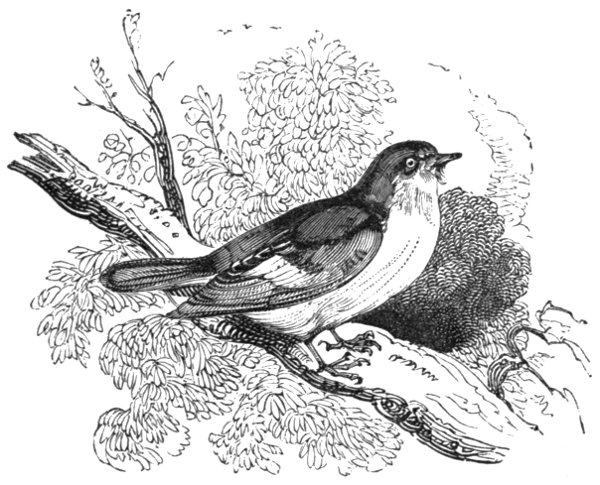
Of the birds which constitute this class, we find only two kinds that inhabit this island, and these are not the most numerous of the various tribes with which this country abounds.
The characters of this genus with us are somewhat equivocal, and not well ascertained; neither do we know of any common name in our language by which it is distinguished. Mr. Pennant describes it thus:—“Bill flatted at the base, almost triangular, notched at the end of the upper mandible, and beset with bristles at its base.”—Bewick.
Flyfish, v. To angle with a hook baited with a fly.
Foal, s. The offspring of a mare, or other beast of burden.
Foal, v. To bring forth a foal.
Foam, s. The white substance which agitation or fermentation gathers on the top of liquors; froth, spume.
Foam, v. To froth, to gather foam; to be in rage; to be violently agitated.
Fodder, s. Dry food stored for cattle against winter.
Fold, s. The ground in which sheep are confined; the place where sheep are housed; the flock of sheep; a double, a complication.
Fomentation, s. Partial bathing, called steeping; the lotion prepared to foment the parts.
Fomentations are divided into emollient and anodyne.
EMOLLIENT FOMENTATION.
Boil marshmallows in water for some time, strain off the liquor, and bathe the affected parts with it while warm.
ANODYNE FOMENTATION.
1. White poppy heads broken, two dozen.
Hemlock, two handfuls.
Boil for two hours gently in six quarts of water.
2. Wormwood dried, and camomile flowers of each 4 oz.
Rue 3 oz.
Bay leaves 2 oz.
Boil them for one hour in a gallon of water.
The efficacy of a fomentation depends on its being properly applied: therefore, the liquid should be only as hot as the part can bear without pain. Large flannel cloths should be dipped into the fomentation, lightly wrung out, and spread over the affected part, and be renewed before they become cold; this ought to be continued for half an hour at least, and repeated three or four times a day.
Emollient fomentation is adapted to inflamed swellings, from whatever cause they may arise; and, in the absence of others, warm water alone will be found an useful substitute.
Warm water, if used assiduously, and at a proper temperature, is an excellent fomentation. In inflammation of the eye, it should not be above 98°; in inflamed and painful swellings it should seldom exceed 100°. In strains of the back sinews, vinegar is preferable; and as the injury is deeply seated, the fomentation may be applied hotter.
When employed for inflammation of the bowels, it should be still hotter, so hot, indeed, that the hand cannot feel it without pain. The best mode of application is by a long piece of woollen cloth, with the ends joined, that it may be wrung out of the boiling liquor by placing a stick through each end. When thus applied, it may be called a steam fomentation. A man on either side the horse is required to apply this fomentation effectually. Where the injury is not extensive, the fomentation may be applied with a large sponge, or a thick woollen cloth, or old rug or blanket.—White.
Foot, s. The part upon which we stand; that by which any thing is supported; the base; a measure containing twelve inches.
Forage, s. Search of provisions; provisions sought abroad; provisions in general; food for horses.
Forceps, s. Properly signifies a pair of tongs, but is used for an instrument in chirurgery to extract any thing out of wounds.
Ford, s. A shallow part of a river.
Ford, v. To pass without swimming.
Forehand, s. That part of a horse which is before the rider.
Forehand implies that part of a horse extending from the ears to the withers; which to be handsome should be long, and rise gradually from the upper point of the shoulder blade to the very extremity of the ear. A forehand of this description adds greatly to the majestic appearance and value of a horse. But a horse low before, with a short forehand, and indented crest, can never become an object of attraction.—Taplin.