INTRODUCTION. (continued 17)
Reading edition
Olive oil 1 oz.
Melt the ointment by a very gentle heat, and add the oil, then let it be removed from the fire, and stir it in the Goulard’s extract; continue stirring until cold.
SULPHURIC OINTMENT.
Oil of turpentine 6 oz.
Sulphuric acid 2 oz.
Mix cautiously in the open air, or in a chimney, in a vessel large enough to hold one pound and a half; stir the mixture, and, when they are perfectly combined, add one pound and half of hogs’ lard: continue stirring until cold. By the addition of cantharides, this ointment forms a strong blister, and with sulphur vivum, finely powdered, or flower of sulphur and train oil, it becomes a good mange ointment.
DIGESTIVE OINTMENT.
Hogs’ lard 1 lb.
Common turpentine 1 lb.—Melt, and add
Verdigris 2 oz.
Continue stirring until cold.
HOOF OINTMENT.
Tallow 1 lb.
Tar 1 lb.
Melt; continue stirring until cold.
Ointments are not so generally applied to wounds or inflamed parts, as they were formerly; as powders, washes, and fomentations are often found more efficacious. Vide Astringents, Digestives, Detergents, Caustics, Emollients, Blisters, &c.—White.
Old, a. Past the middle of life; not young.
Olive, s. A plant producing oil; the emblem of peace; a colour.
To dye a fine Golden Olive.—Take as much of fine sappy green heath tops as will half fill a pot which holds eight gallons, put one pound and a half of strawall (wild French weed, dyer’s weed) in the bottom while dry; spread over that a little of the heath to cover it; put in half a pound of fur, or more if you like; cover that with the remainder of the heath, and put on your frame and lid; press it down and fill it with water, and boil it twelve or eighteen hours. Divide the time to make different shades in your drawings, and do not let your liquor boil away too much without adding fresh water to keep it up. If you have your shades to your wish, you will have the finest golden olives that ever were dyed, and in the simplest way. Wash them, and they are finished.
To dye fine Green Olives.—Take a pound of strawall, put it down with eight quarts of water, and half a pound of fur. Cut your strawall short, and put it down. (You ought to have a frame or wooden crop, and a broad piece of lead, to keep down the stuff, as it takes so very long to give out the dye.) When it has boiled about half an hour, see if it is anything of a fine greenish yellow. Draw then for the first shade. Boil half an hour longer; look at it, and if you like it draw it, as it is not right to have your shades too near. For the next shade give double the time, and so on to about four shades. The last ought to get six hours’ boiling, and you ought, by rights, to divide the time amongst them all. When you have made out four shades, lift out the dye stuff, and put in the size of a small horse-bean of copperas with the liquor; and, when dissolved, put in each shade, and whip it out, and so on with the whole. If not enough of the olive, add a little more copperas with each, and dip each of them over again. Thus you have four very fine green olives. Wash out the copperas immediately.—Old Recipe.
Ombre, s. A game at cards played by three.
Omentum, s. The caul, the double membrane spread over the entrails, called also reticulum, from its structure, resembling that of a net.
Ooze, s. Soft mud, mire at the bottom of water, slime.
Opacity, s. Cloudiness, want of transparency.
Operation, s. Agency; action, effect; in chirurgery, that part of the art of healing which depends on the use of instruments.
Ophthalmy, s. A disease of the eyes.
Opiate, s. A medicine that causes sleep.
Opiate confection is composed of opium, long pepper, and other stimulants. One ounce of the confection does not contain more than fourteen or fifteen grains of opium; it may therefore be given in doses from one to two ounces, though in this quantity it would be a powerful stimulant.
In veterinary medicine, an electuary may be advantageously substituted for the opiate confection of the London dispensatory.
OPIATE CONFECTION, OR ELECTUARY OF OPIUM.
Opium 1½ oz.
Macerate in hot water until it forms a thin paste, or, by stirring, is uniformly mixed, and free from lumps.
Powdered ginger 3 oz.
Powdered caraway seeds 6 oz.
Powdered allspice 6 oz.
Treacle 1½ oz.
Let these ingredients be well mixed, and kept in a closed jar or pot. The dose is about one-twentieth part of the mass. It is a warm cordial and diaphoretic, and may be given in flatulent colic mixed with a little warm beer, or infusion of peppermint, or other aromatic herbs. This electuary is a good cordial for cattle.—White.
Opium, s. A medicine used to promote sleep.
The anodyne quality which renders opium so valuable in human medicine, is not so manifest when given to the horse.
If injudiciously given, opium frequently aggravates the disease, and does injury: and I have several times seen it increase pain, when it has been improperly given as an anodyne. In flatulency or spasm of the bowels it is an excellent remedy, particularly if joined with aromatic powder, ginger, or some other stimulant. In diarrhœa it is an effectual remedy, but must be given cautiously. In diabetes I have found it very beneficial, when joined with bark and ginger. Sometimes it is given with emetic tartar, and some cordial composition, with good effect, and in this way it proves a good diaphoretic.
I have given opium and squill, in obstinate coughs, with success; but the effect is not permanent.
Opium is very apt to produce costiveness in horses; but this may be in a great measure counteracted by exercise: when it does take place, it may be removed by clysters, bran mashes, or a laxative ball.
The medium dose of opium is half a drachm, or two scruples; but if given in the form of clysters, which it sometimes is with the best effect, two drachms will not be too much.
Opium is brought to this country in chests from Turkey and India. The Turkey opium is in flat pieces, covered with leaves and the reddish capsules of some species of dock, which is considered an indication of its goodness, as the inferior kinds of opium have none of these capsules adhering to them. Turkey opium generally contains about one fourth part of impurities. India opium is less pure, is in round masses, covered with leaves to the thickness nearly of one fourth of an inch. Mr. Kerr relates that, at Bahar, it is frequently adulterated with cow dung, the extract of the poppy procured by boiling, and various other substances. It is made also from lettuces, in India.
A celebrated preparation of opium, named the black drop, is thus prepared:—
Opium sliced ½ pound.
Good verjuice 3 pints.
Nutmegs 1½ oz.
Saffron ½ oz.
Boil them to a proper thickness, then add a quarter of a pound of sugar and two spoonfuls of yeast. Set the whole in a warm place near the fire for six or eight weeks, then place it in the open air until it becomes a syrup; lastly decant, filter, and bottle it up, adding a little sugar to each bottle. One drop of this is said to be equal to three drops of the tincture of opium.
The diseases of the horse in which opium is the most beneficial, are locked jaw and flatulent colic; in the former it has been given in large doses, with the best effect, generally joined with camphor, and sometimes with assafœtida and other antispasmodics. In flatulent colic, smaller doses have been found sufficient, which have generally been joined with sweet spirit of nitre, and other carminatives.—White.
Opodeldoc, s. Soap and camphor dissolved in spirit of rosemary.
It is either liquid or solid. The former is made with soft, and the latter with hard soap. In the solid state it seems to be the same as the celebrated Steers’s opodeldoc.
It is employed for strains and bruises, after the inflammation which accompanies those complaints at first has subsided.
LIQUID OPODELDOC, OR SOAP LINIMENT.
Soft soap 4 oz.
Water 8 oz.
Mix, and add one pint of rectified spirit of wine, in which there has been previously dissolved—
Camphor 2 oz.
Oil of rosemary 1 oz.
STEERS’S OPODELDOC.
Hard soap ½ oz.
Rectified spirit of wine 8 oz.
Camphor ½ oz.
Oil of rosemary 2 dr.
Oil of lavender, or oil of origanum 2 dr.
Compound spirit of ammonia 4 oz.
Digest in a moderate heat, so as to dissolve the soap, which should be cut up in thin shavings. For these expensive preparations, the following may be substituted:—
VETERINARY OPODELDOC.
Soft soap 4 oz.
Water 8 oz.
Mix over the fire; when cold, add—
Rectified spirit 1 pint.
Oil of rosemary 2 oz.
Strong liquid ammonia 4 oz.—Mix.
Orange, s. The orange tree; the fruit of the tree.
Orange, a. Belonging to an orange, of the colour of an orange.
To dye a fine Orange.—If you have half a pound of stuff to dye, you must get an ounce and a half of black grain (cochineal), and pound it fine; put down the stuff in six or eight quarts of water, with turmeric, to bring it to the finest highest yellow that is possible; take it out, and put in the black grain; stir it about well, boil it half an hour. Then put in the stuff for ten minutes, and draw half for the first shade; keep the remainder of the stuff for thirty minutes, then take it out, put two teaspoonfuls of Brazil dust into the pot, and let it boil up. Throw in the light shade, and be watchful lest it get too dark; lift out the stuff, and put in two more spoonfuls of dust, and watch as before, and boil on for a blood orange. This is certainly the best way for oranges in the world.
Should you make your shades too dark, infuse six drops of spirit into the liquor while hot, and any shade you want to brighten throw it in, press it well, and lift out in an instant; and if not to your wish, put in three drops more, and throw the other shades into it, and it will enliven the colour exceedingly. The same may be done with gold colours, and it will brighten them also.
To dye Orange Hackles.—Get white hackles; prepare them as already directed. Ground them richly in turmeric, then put in some cochineal, boil it well, and if you do not soon get a fine rich orange, put in some more cochineal with a pinch of Brazil dust. Let it boil for a time, and then draw for bright orange; put in more cochineal, and a teaspoonful of Brazil dust; boil it well, and you will have a full or deep orange. Draw the hackles, and put in a spoonful or two of Brazil dust, and boil on till you see a fine blood red. These three shades may be distinguished as a bright orange, a blood orange, and a blood red. Archil will give a fourth shade.
Take care not to dry your hackles too quickly, neither put them too near the fire. Finish one bunch at a time, and draw them constantly through your fingers till dry, as that keeps the hackles in proper form. You should keep the wet hackles rolled up in paper, as, if they dry too fast, they will get ragged and staring, which is a great fault, and can seldom be cured. To stain fine bright golden yellows, follow the same process, with this difference,—that the quantity of turmeric and madder used must be very small, and only two drops of spirits should be infused, if any be necessary.—Old Recipe.
Orbits (Orbita, Linn.), s. In ornithology, the skin which surrounds the eye. It is generally bare, but particularly in the parrot and the heron.
Orc, s. A sort of sea-fish.
Ornithology, s. Natural history of birds.
A good ornithologist should be able to distinguish birds by their air as well as by their colours and shape; on the ground as well as on the wing, and in the bush as well as in the hand. For, though it must not be said that every species of birds has a manner peculiar to itself, yet there is somewhat in most genera at least, that at first sight discriminates them, and enables a judicious observer to pronounce upon them with some certainty. Put a bird in motion
“——et vera incessu patuit.”
Thus kites and buzzards sail round in circles with wings expanded and motionless: and it is from their gliding manner that the former are still called in the north of England gleads, from the Saxon verb glidan, to glide. The kestrel or wind-hover has a peculiar mode of hanging in the air in one place, his wings all the while being briskly agitated. Hen-harriers fly low over heaths or fields of corn, and beat the ground regularly like a pointer or setting-dog. Owls move in a buoyant manner, as if lighter than the air; they seem to want ballast. There is a peculiarity belonging to ravens that must draw the attention even of the most incurious—they spend all their leisure time in striking and cuffing each other on the wing in a kind of playful skirmish; and when they move from one place to another, frequently turn on their backs with a loud croak, and seem to be falling to the ground. When this odd gesture betides them, they are scratching themselves with one foot, and thus lose the centre of gravity. Rooks sometimes dive and tumble in a frolicsome manner; crows and daws swagger in their walk; woodpeckers fly volatu undoso, opening and closing their wings at every stroke, and so are always rising or falling in curves. All of this genus use their tails, which incline downward, as a support while they run up trees. Parrots, like all other hook-clawed birds, walk awkwardly, and make use of their bill as a third foot, climbing and descending with ridiculous caution. All the Gallinæ parade and walk gracefully, and run nimbly; but fly with difficulty, with an impetuous whirring, and in a straight line. Magpies and jays flutter with powerless wings, and make no despatch; herons seem encumbered with too much sail for their light bodies, but their vast hollow wings are necessary in carrying burthens, such as large fishes, and the like; pigeons, and particularly the sort called smiters, have a way of clashing their wings the one against the other over their backs with a loud snap; another variety called tumblers turn themselves over in the air. Some birds have movements peculiar to the season of pairing; thus ringdoves, though strong and rapid at other times, yet in the spring hang about on the wing in a toying and playful manner: thus the cock-snipe, while breeding, forgetting his former flight, fans the air like the wind-hover; and the greenfinch in particular exhibits such languishing and faltering gestures as to appear like a wounded and dying bird; the kingfisher darts along like an arrow; fern-owls, or goat-suckers, glance in the dusk over the tops of trees like a meteor; starlings, as it were, swim along, while missel-thrushes use a wild and desultory flight; swallows sweep over the surface of the ground and water, and distinguish themselves by rapid turns and quick evolutions; swifts dash round in circles; and the bank martin moves with frequent vacillations like a butterfly. Most of the small birds fly by jerks, rising and falling as they advance. Most small birds hop, but wagtails and larks walk, moving their legs alternately. Skylarks rise and fall perpendicularly as they sing; woodlarks hang poised in the air; and titlarks rise and fall in large curves, singing in their descent. The whitethroat uses odd jerks and gesticulations over the tops of hedges and bushes. All the duck kind waddle; divers and auks walk as if fettered, and stand erect on their tails; these are the compedes of Linnæus. Geese and cranes, and most wild fowls, move in figured flights, often changing their position. The secondary remiges of Tringæ, wild ducks, and some others, are very long, and give their wings, when in motion, a hooked appearance. Dabchicks, moorhens, and coots, fly erect, with their legs hanging down, and hardly make any despatch; the reason is plain, their wings are placed too forward out of the true centre of gravity, as the legs of auks and divers are situated too backward.—White’s Selborne.
Ortolan, s. A small bird accounted very delicious.
Osier, s. A tree of the willow kind, growing by the water.
Osprey, s. The sea eagle. Vide Eagle.
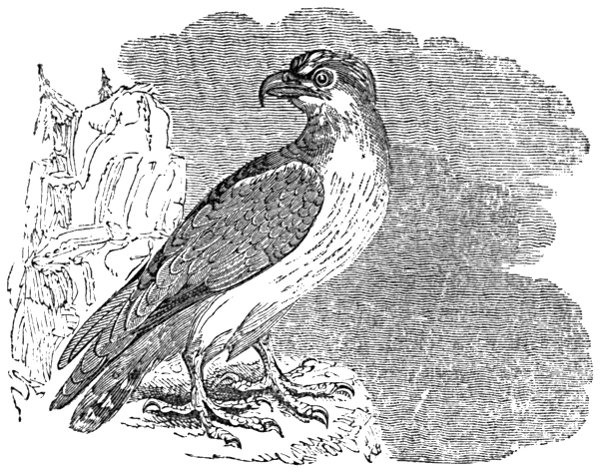
THE OSPREY.
Buffon observes that the osprey is the most numerous of the large birds of prey, and is scattered over the extent of Europe, from Sweden to Greece, and that it is found even in Egypt and Nigritia. Its haunts are on the sea shore, and on the borders of rivers and lakes. Its principal food is fish; it darts upon its prey with great rapidity, and with undeviating aim.
Ossification, s. Change of carneous, membranous, or cartilaginous, into bony substance.
Ossification of the cartilages frequently accompanies ringbone, but it may exist without any affection of the pastern joint. It is oftenest found in horses of heavy draught. It arises not so much from concussion, as from a species of sprain, for the pace of the horse is slow. The cause, indeed, is not well understood, but of the effect we have too numerous instances. Very few heavy draught horses arrive at old age without this change of structure.
In the healthy state of the foot, these cartilages will readily yield to the pressure of the fingers on the coronet over the quarters, but, by degrees, the resistance becomes greater, and at length bone is formed, and the parts yield no more. No evident inflammation of the foot, or great, or perhaps even perceptible lameness accompanies this change; a mere slight degree of stiffness may have been observed, which, in a horse of more rapid pace, would have been lameness. Even when the change is completed, there is not in many cases any thing more than a slight increase of stiffness, little or not at all interfering with the usefulness of the horse. When this altered structure appears in the lighter horse, the lameness is more decided, and means should be taken to arrest the progress of the change: these are blisters or firing; but, after those parts have become bony, no operation will restore the cartilage.—The Horse.
Ossifrage, s. A kind of eagle.
Osteology, s. A description of the bones.
Ostler, s. The man who takes care of horses at an inn.
Otter, s. An amphibious animal that preys upon fish.
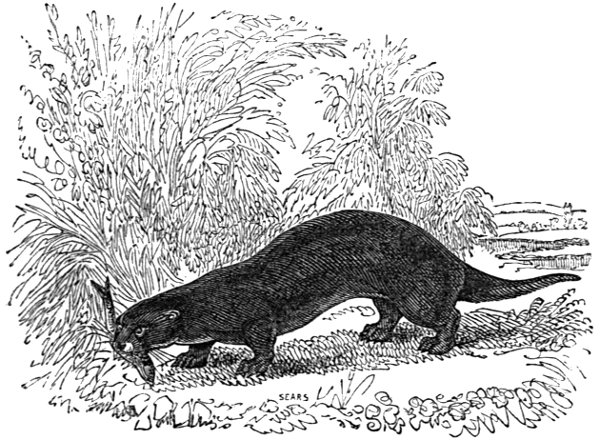
The description of this animal and the mode of destroying it are mentioned on account of its being so inveterate a foe to the fisherman’s amusement, for the otter is as destructive in a pond as a polecat in a hen-house. This animal seems to link the chain of gradation between terrestrial and aquatic creatures, resembling the former in its shape, and the latter in being able to remain for a considerable space of time under water, and being furnished with membranes like fins between the toes, which enable it to swim with such rapidity as to overtake fish in their own element. The otter, however, properly speaking, is not amphibious; he is not formed for continuing in the water, since, like other terrestrial creatures, he requires the aid of respiration; for if, in pursuit of his prey, he accidentally gets entangled in a net, and has not time to cut with his teeth the sufficient number of meshes to effectuate his escape, he is drowned. The usual length of the otter, from the tip of the nose to the base of the tail, is twenty-three inches; of the tail itself, which is broad at the insertion and tapers to a point, sixteen; the weight of the male is from eighteen to twenty-six, of the female from thirteen to twenty pounds. One, in October, 1794, was snared in the river Lea between Ware and Hertford, which weighed upwards of forty pounds. The head and nose are broad and flat; the eyes are brilliant, although small; are nearer the nose than is usual in quadrupeds, and placed in such a manner as to discern every object that is above, which gives the otter a singular aspect, not unlike the eel; but this property of seeing what is above gives it a particular advantage when lurking at the bottom for its prey, as the fish cannot discern any object under them, and the otter seizing them from beneath by the belly readily takes any number with little exertion; the ears are extremely short, and their orifice narrow; the opening of the mouth is small, the lips are capable of being brought very close, somewhat resembling the mouth of a fish; are very muscular, and designed to close the mouth firmly while in the action of diving, and the nose and corners of the mouth are furnished with very long whiskers; it has thirty-six teeth, six cutting and two canine above and below; of the former the middlemost are the least; it has besides five grinders on each side in both jaws. The legs are very short, but remarkably broad and muscular; the joints articulated so loosely, that the otter can turn them quite back, and bring them on a line with its body and use them as fins; each foot has five toes, connected by strong webs like those of a water-fowl; thus nature in every particular has attended to the way of life allotted to an animal whose food is fish, and whose haunts must necessarily be about waters. The otter has no heel, but a round ball under the sole of the foot, by which its track in the mud is easily distinguished, and is termed the seal. The general shape of the otter is somewhat similar to that of an overgrown weasel, being long and slender; its colour is entirely a deep brown, except two small spots of white on each side the nose, and one under the chin; the skin is valuable, if killed in the winter, and makes gloves more durable, and which at the same time will retain their pliancy and softness after being repeatedly wetted, beyond any other leather.
The otter destroys large quantities of fish, for he will eat none unless it be perfectly fresh, and what he takes himself; by his mode of eating them he causes a still greater consumption. So soon as the otter catches a fish, he drags it on shore, devours it to the vent, but, unless pressed by extreme hunger, always leaves the remainder, and takes to the water in quest of more. In rivers it is always observed to swim against the stream, to meet its prey; it has been asserted, that two otters will hunt in concert that active fish the salmon; one stations itself above, the other below where the fish lies, and being thus chased incessantly the wearied salmon becomes their victim. To suppose the otter never uses the sea is a mistake, for they often have been seen in it, both swimming and seeking for their booty, which, in the Orkneys, has been observed to be cod and conger.
In very hard weather, when its natural sort of food fails, the otter will kill lambs, sucking pigs, and poultry, and one was caught in a warren, where he had come to prey on rabbits.
The hunting of the otter was formerly considered as excellent sport, and hounds were kept solely for that purpose. The chase of the otter has still, however, its staunch admirers, who are apparently as zealous in this pursuit as in any other we read of. In 1796, near Bridgnorth, on the river Worse, four otters were killed: one stood three, another four hours, before the dogs, and was scarcely a minute out of sight. The hearts, &c., were eaten by many respectable people who attended the hunt, and allowed to be very delicious; the carcasses were also eaten by the men employed, and found to be excellent; what is a little extraordinary, the account does not state that the partakers of this hard-earned fare were Carthusians.
As he spoke, I remarked the occurrence which the commander noticed. The fish, which upon our first arrival had risen merrily at the natural flies, ceased on a sudden altogether—now they rushed confusedly through the water, or threw themselves for yards along the surface. It was not the sullen plunge at an insect, or the vertical spring, when sport, not food, brings the salmon over water; but it was evident that there was some hidden cause of alarm, and we were not long left in doubt. Near the neck of the pool, an otter of the largest size showed himself for a moment, then darting under water, the same commotion ensued again. Before a minute elapsed, Andy Bawn pointed silently to a shoal beneath an overhanging bush, and there was the spoiler, apparently resting himself after his successful exertions, and holding a four-pound white-trout in his mouth. Either he noticed us, or had some more favourite haunt to feed in, for he glided into the deep water, and we saw no more of him.
Although we found out that the otter and ourselves could not manage to fish in company, we ascertained that the pool was abundantly stocked with salmon:—during the period of the greatest alarm, at least half a dozen fish were breaking the surface at the same time.
A curious incident, however, supplied us with an excellent white fish. The servant who brought the post bag, when in the act of crossing the river, which in his route from the lodge he was obliged to do repeatedly, most unexpectedly encountered a large otter carrying off a salmon he had just seized. The postman attacked the poacher vigorously, who, dropping his prey, glided off into the deep water at the tail of the ford. The spoil proved to be a fresh salmon not twenty hours from the sea, and consequently in prime condition. The otter showed himself the best artist of the day, for while the Colonel and his companion returned with empty baskets, the little animal managed to secure the finest and freshest salmon in the river.—Wild Sports.
Otterhound (Canis Latrans), s.
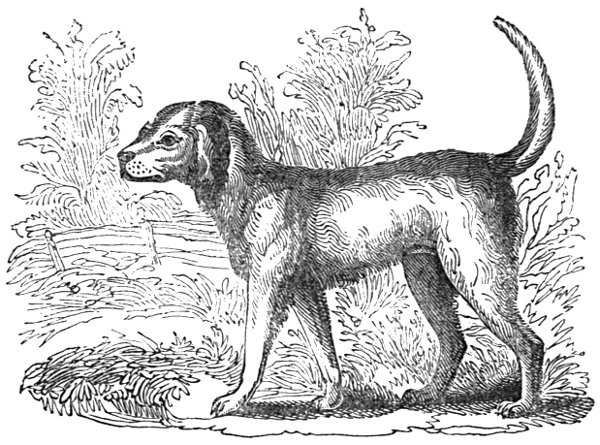
The otter hound is a mixed breed between the hardy southern hound and the large rough terrier. His head is large and broad, his ears long and pendulous; he is in size betwixt the harrier and the fox hound; is thick quartered and shouldered; his hair strong and wiry, and somewhat shaggy. He is a bold and fierce dog, and has a full and harmonious voice. He is usually sandy-coloured on the back, the sides, and the neck, with the lower parts white; he carries his tail, which is rough, in the manner of a fox-hound.
Otter hunting, during the reign of Queen Elizabeth, was a favourite amusement amongst the young gentry of Great Britain, at which period that animal was much more numerous than at the present time, being greatly reduced since population became more dense, and gamekeepers more generally used, who employ all kinds of traps and gins to destroy them. Cultivation has also contributed to lessen this destructive creature.
Otter hounds were kept in small packs of from six to sixteen, seldom exceeding that number. The sport of otter hunting is now little understood, and is quite on the decline in this country.
Oval, a. Oblong, resembling the longitudinal section of an egg.
Overreach, v. A horse is said to over-reach, when he brings his hinder feet too far forwards, so as to strike against his fore-feet.
Under this term are comprised bruises and wounds of the coronet, produced usually in the hind-feet, by the awkward habit of setting one foot upon another, and in the fore-feet, by the hinder one over-reaching it, and wounding the other near the heel. When properly treated, a tread is seldom productive of much injury. If the dirt be well washed out of it, and a pledget of tow dipped in Friar’s balsam be bound over the wound, it will, in the majority of cases, speedily heal. Should the bruise be extensive, or the wound deep, a poultice may be applied for one or two days, and then the Friar’s balsam, or digestive ointment. Sometimes a soft tumour will form on the part, which will be quickly brought to suppuration by a poultice, and when the matter has run out the ulcer will heal by the application of the Friar’s balsam, or a weak solution of blue vitriol.
Overset, v. To turn the bottom upwards, to throw off the basis; to throw out of regularity; to upset a carriage.
Oviparous, a. Bringing forth eggs, not viviparous.
Ounce, s. The sixteenth part of a pound in Avoirdupoise weight, the twelfth part of a pound in Troy weight.
Outstrip, v. To outgo, to leave behind.
Owl or Owlet, s. A bird that flies in the night and catches mice.
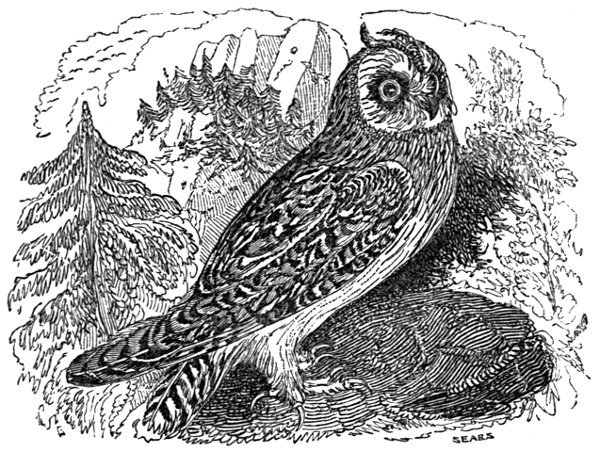
The owl is distinguished, among birds of the rapacious kind, by peculiar and striking characters; its outward appearance is not more singular than its habits and dispositions. Unable to bear the brighter light of the sun, the owl retires to some lonely retreat, where it passes the day in silence and obscurity; but on the approach of evening, when all nature is desirous of repose, and the smaller animals, which are its principal food, are seeking their nestling places, the owl comes forth from its lurking holes in quest of its prey. Its eyes are admirably adapted for this purpose, being so formed as to distinguish objects with greater facility in the dusk than in broad day-light. Its flight is low and silent during its nocturnal excursions, and when it rests, it is then only known by its frightful and reiterated cries, with which it interrupts the silence of the night. During the day, the owl is seldom seen, but, if forced from his retreat, his flight is broken and interrupted, and he is sometimes attended by numbers of small birds of various kinds, who, seeing his embarrassment, pursue him with incessant cries, and torment him with their movements: the jay, the thrush, the blackbird, the red-breast, and the titmouse, all assemble to hurry and perplex him. During all this, the owl remains perched upon the branch of a tree, and answers them only with awkward and insignificant gestures, turning his head, eyes, and body, with all the appearance of mockery and affectation. All the species of owls, however, are not alike dazzled and confused with the light of the sun; some of them being able to fly, and see distinctly in open day.
Nocturnal birds of prey are generally divided into two kinds—that which hath horns or ears, and that which is earless or without horns. These horns consist of small tufts of feathers, standing up like ears on each side of the head, which are erected or depressed at the pleasure of the animal; and in all probability are of use in directing the organs of hearing, which are very large, to their proper object. Both kinds agree in having their eyes so formed as to be able to pursue their prey with much less light than other birds. The general character of the owl is as follows:—The eyes are large, and are surrounded with a radiated circle of feathers, of which the eye itself is the centre; the beak and talons are strong and crooked; the body very short, but thick, and well covered with a coat of the softest and most delicate plumage; the external edges of the outer quill feathers in general are finely fringed, which adds greatly to the smoothness and silence of its flight.
The Great-eared Owl. (Strix Bubo, Linn.; Le Grand Duc, Buff.)—This bird is not much inferior in size to an eagle. Its head is very large, and is adorned with two tufts, more than two inches long, which stand just above each eye, its bill is strong and much hooked; the eyes large, and of a bright yellow; the whole plumage is of a rusty brown, finely variegated with black and yellow lines, spots, and specks; its belly is ribbed with bars of brown colour, confusedly intermixed; its tail is short, marked with dusky bars; its legs are strong, and covered to the claws with a thick close down, of a rust colour; its claws are large, much hooked, and of a dusky colour. Its nest is large, being nearly three feet in diameter; it is composed of sticks bound together by fibrous roots, and lined with leaves. It generally lays two eggs, somewhat larger than those of a hen, and variegated like the bird itself. The young ones are very voracious, and are well supplied with various kinds of food by the parents. This bird has been found, though rarely, in Great Britain; it builds its nest in the caverns of rocks, in mountains, and almost inaccessible places, and is seldom seen on the plains, or perched on trees; it feeds on young hares, rabbits, rats, mice, and reptiles of various kinds.
The Long-eared Owl. (Horn Owl, Strix Otus, Linn.; Le Hibou, Buff.)—Its length is fourteen inches; breadth, somewhat more than three feet. Its bill is black; irides of a bright yellow; the radiated circle round each eye is of a light cream colour, in some parts tinged with red; between the bill and the eye there is a circular streak, of a dark brown colour; another circle of a dark rusty brown entirely surrounds the face; its horns or ears consist of six feathers, closely laid together, of a dark brown colour, tipped and edged with yellow; the upper part of the body is beautifully pencilled with fine streaks of white, rusty, and brown; the breast and neck are yellow, finely marked with dusky streaks, pointing downwards; the belly, thighs, and vent feathers are of a light cream colour; upon each wing there are four or five large white spots; the quill and tail feathers are marked with dusky and reddish bars: the legs are feathered down to the claws, which are very sharp; the outer claw is movable, and may be turned backwards.
This bird is common in various parts of Europe, as well as in this country; its usual haunts are in old ruined buildings, in rocks, and in hollow trees. M. Buffon observes, that it seldom constructs a nest of its own, but not unfrequently occupies that of the magpie: it lays four or five eggs; the young are at first white, but acquire their natural colour in about fifteen days.
The Short-eared Owl. (Strix Brachyotus, Phil. Trans. vol. 62, p. 384.)—Length fourteen inches; breadth three feet. The head is small, and hawklike; bill dusky; the irides are of a bright yellow, and when the pupil is contracted, shine like gold; the circle round each eye is of a dirty white, with dark streaks pointing outwards; immediately round the eye there is a circle of black; the two horns or ears consist of not more than three feathers, of a pale brown or tawny colour, with a dark streak in the middle of each; the whole upper part of the body is variously marked with dark brown and tawny, the feathers are mostly edged with the latter; the breast and belly are of a pale yellow, marked with dark longitudinal streaks, which are most numerous on the breast: the legs and feet are covered with feathers of a pale yellow colour; the claws are much hooked and black: the wings are long, and extend beyond the tail; the quills are marked with alternate bars of a dusky and pale brown; the tail is likewise marked with bars of the same colours, and the middle feathers are distinguished by a dark spot in the centre of the yellow space; the tip is white. Of several of these birds, both male and female, with which this work has been favoured, both sexes had the upright tufts or ears: in one which was alive, they were very conspicuous, and appeared more erect while the bird remained undisturbed; but, when frightened, were scarcely to be seen: in the dead birds they were hardly descernible.
Mr. Pennant seems to be the first describer of this rare and beautiful species, which he supposes to be a bird of passage, as it only visits us in the latter part of the year, and disappears in the spring. It flies by day, and sometimes is seen in companies: twenty eight were once counted in a turnip-field in November. It is found chiefly in wooded or mountainous countries: its food is principally field-mice.
The Female Horned Owl.—This bird is somewhat larger than the former; the colours and marks were the same, but much darker, and the spots on the breast larger and more numerous; the ears were not discernible. Being a dead bird, and having not seen any other at the time, the editors suppose it to be a distinct kind; but having since seen several both males and females, they are convinced of the mistake.
The White Owl, Barn Owl, Church Owl, Gillihowt, Screech Owl, (Strix Flammea, Linn.; L’Effraie, ou, La Fresaie, Buff.)—Length fourteen inches. Bill pale horn colour; eyes dark; the radiated circle round the eye is composed of feathers of the most delicate softness, and perfectly white; the head, back, and wings, are of a pale chestnut, beautifully powdered with very fine grey and brown spots, intermixed with white; the breast, belly, and thighs, are white; on the former are a few dark spots: the legs are feathered down to the toes, which are covered with short hairs; the wings extend beyond the tail, which is short, and marked with alternate bars of dusky and white; the claws are white. Birds of this kind vary considerably: of several which were in the hands of the editors, the differences were very conspicuous, the colours being more or less faint according to the age of the bird; the breast in some was white, without spots, in others pale yellow.
The white owl is well known, and is often seen in the most populous towns, frequenting churches, old houses, maltings, and other uninhabited buildings, where it continues during the day, and leaves its haunts in the twilight in quest of its prey. It has obtained the name of screech owl from its cries, repeated at intervals, and rendered loud and frightful from the stillness of the night. During its repose it makes a blowing noise, resembling the snoring of a man. It makes no nest, but deposits its eggs in the holes of walls, and lays five or six, of a whitish colour. It feeds on mice and small birds, which it swallows whole, and afterwards emits the bones, feathers, and other indigestible parts, at its mouth, in the form of small round cakes, which are often found in the empty buildings it frequents.
The Tawny Owl, Common Brown Ivy Owl, or Howlet. (Strix stridula, Linn.; Le Chat-huant, Buff.)—This bird is about the size of the last. Its bill is white; eyes dark blue; the radiated feathers round the eyes are white, finely streaked with brown; the head, neck, back, wing coverts, and scapulars, are of a tawny brown colour, finely powdered and spotted with dark brown and black; on the wing coverts and scapulars are several large white spots, regularly placed so as to form three rows; the quill feathers are marked with alternate bars of light and dark brown; the breast and belly are of a pale yellow, marked with narrow dark streaks pointing downwards, and crossed with others of the same colour; the legs are feathered down to the toes; the claws are large, much hooked, and white. This species is found in various parts of Europe; it frequents woods, and builds its nest in the hollows of trees.
The Little Owl. (Strix passerina, Linn.; La Chevêche, ou Petite Chouette, Buff.)—This is the smallest of the owl kind, not being larger than a blackbird. Its bill is brown at the base, and of a yellow colour at the tip; eyes pale yellow; the circular feathers on the face are white, tipped with black; the upper part of the body is of an olive brown colour; the top of the head and wing coverts are spotted with white; the breast and belly white, spotted with brown; the feathers of the tail are barred with rust colour and brown, and tipped with white; the legs are covered with down of a rusty colour mixed with white; the toes and claws are of a brownish colour. It frequents rocks and caverns and ruined buildings, and builds its nest, which is constructed in the rudest manner, in the most retired places; it lays five eggs, spotted with white and yellow. It sees better in the day time than other nocturnal birds, and gives chase to swallows and other small birds on the wing; it likewise feeds on mice, which it tears in pieces with its bill and claws, and swallows them by morsels; it is said to pluck the birds which it kills before it eats them, in which it differs from the other owls. It is rarely met with in England; it is sometimes found in Yorkshire, Flintshire, and in the neighbourhood of London.
Having some acquaintance with a tame brown owl, I find that it casts up the fur of mice, and the feathers of birds in pellets, after the manner of hawks; when full, like a dog, it hides what it cannot eat.
The young of the barn-owl are not easily raised, as they want a constant supply of fresh mice: whereas the young of the brown owl will eat indiscriminately all that is brought; snails, rats, kittens, puppies, magpies, and any kind of carrion or offal.—Bewick—White’s Selborne.
Owler, s. One who catches owls. Owling, Owl catching.
Owlery, s. A place where owls are kept.
The Owlery at Arundel Castle.—We were unwilling to leave this venerable castle without the sight of the owls, which are said to be the finest in Great Britain. We were introduced to an utterly ruined part of the ancient castle, where, upon entering the inclosure, we saw a number of these strange looking creatures, hopping about with an ungraceful gait, and staring at us with looks of wonderful sagacity. One stood at the mouth of a subterraneous excavation, and upon the keeper pronouncing “bow, wow,” the owl instantly returned the expression, retiring at the same time back again into his hole, till it actually got out of sight. The other owls were driven by the keeper into one corner of the yard; they ranged themselves along a piece of old timber, altogether presenting a spectacle which raised in my mind some singular emotions. The countenance of the largest of them was marked by an unusual degree of solemnity.
These owls are the finest of the horned kind, and the keeper showed no small pride in the exhibition of them. “Beauty, Beauty,” was the name by which he called them together, and they seemed to recognise the propriety of the appellation with a becoming consciousness. Upon the justness of this term, however, the keeper and myself were by no means agreed.
With respect to the sight of the owls, they are so overpowered by the brightness of the day, that they are obliged to remain in the same spot without stirring; and when they are forced to leave their retreat, their flight is tardy and interrupted, being afraid of striking against the intervening obstacles. The other birds, perceiving their constrained situation, delight to insult them: the titmouse, the finch, the redbreast, the jay, the thrush, &c. assemble to enjoy the sport. The bird of night remains perched upon a branch, motionless and confounded; hears their cries, which are incessantly repeated, but it answers them only with insignificant gestures, turning round its head and its body with a foolish air. It even suffers itself to be assaulted without making resistance; the smallest, the weakest of its enemies, are the most eager to torment and turn it into ridicule. The keep in which the owls are shown is an undoubted remnant of the original Saxon building, and well worth the attention of the antiquary.
This owlery is thus spoken of by another visiter: “The owls, which are still to be seen, are uncommonly elegant birds, and extremely large, some of them measuring across the wings, when extended, from eight to ten feet. Their plumage is particularly beautiful, and their eyes brilliant. The late duke procured them from North America.”—Evans.
Ox, s. The general name for black cattle; a castrated bull.
Oxalic Acid, s. Is extracted from wood sorrel, or from sugar combined with potash. It is commonly sold under the name of salt of lemon, and is useful in removing stains from linen, cleaning boot-tops, &c. It is a deadly poison, and in appearance like Epsom salts. As oxalic acid is a necessary article in a hunting establishment, too great care cannot be taken to prevent those unhappy results which have arisen from mistaking it for Epsom salts, which it so strikingly resembles.
Oxfly, s. A kind of fly.
Oyster, s. A bivalve testaceous fish. Oysters are taken by a small bag-net extended on an iron frame, which, like the trawl, is swept along the ground by a sailing or row boat.
Pace, s. Step, single movement in walking; gait, manner of walking; degree of celerity; a particular movement which horses are taught, though some have it naturally, made by lifting the legs on the same side together; amble.
Pace, v. To move on slowly.
Pack, s. A large bundle of anything tied up for carriage; a burden; a due number of cards; a number of hounds hunting together; a covey or brood of grouse.
Pack, v. To bind up for carriage; to sort the cards so that the game shall be iniquitously secured. Birds are said to pack where several broods collect together. This is particularly the case with grouse and black game.
Packhorse, s. A horse of burden, a horse employed in carrying goods.
Pad, s. A footpath; an easy-paced horse; a low soft saddle.
Paddle, v. To row; to beat water as with oars; to play in the water.
Paddle, s. An oar, particularly that which is used by a single rower in a boat; anything broad like the end of an oar.
Paddock, s. A great frog or toad; a small enclosure for pasture.
Pancreas, s. The sweetbread.
Par, s. A fish.
The natural history of the samlet, or par, is very doubtful. Some assert it to be a mule produced by the salmon and trout, and as a corroboration of this theory, it is stated that the rivers where the par is found are always resorted to by salmon. Others conjecture it to be a hybrid of the sea and river trout; and Sir Humphry Davy mentions, that fishing in October, in a small stream communicating with the Moy, near Ballina, he caught a number of sea trout, who all proved males, and accordingly infers that “these fish, in which the spermatic system was fully developed, could only have impregnated the ova of the common river trout.”
The par differs from the small mountain trout in colour, and in having additional spines in the pectoral fin. It has also certain olive-bluish marks upon the side, similar to impressions made by the pressure of a man’s fingers.
Great numbers of samlet are found in the upper streams of the Ballycroy river. They will rise voraciously at a fly, provided it be gay and small enough. I remember my friend Sir Charles Cuyler and I amused ourselves on a blank shooting day, when there was neither a sufficiency of wind nor water to warrant salmon fishing, in angling for this hybridous diminutive. We nearly filled our basket; we reckoned them, and they amounted to above two hundred.—Wild Sports.
Partridge, (Tetrao Perdix, Linn.; Le Perdrix Grise, Buff.) s. A bird of game.
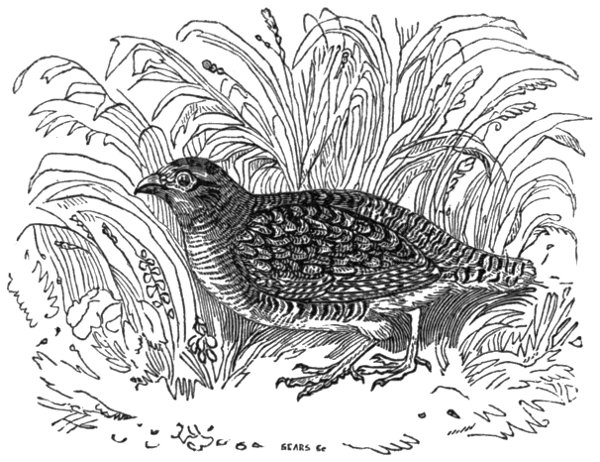
THE PARTRIDGE.
The length of this bird is about thirteen inches. The bill is light brown; eyes hazel; the general colour of its plumage is brown and ash, elegantly mixed with black; each feather is streaked down the middle with buff colour; the sides of the head are tawny; under each eye there is a small saffron-coloured spot, which has a granulated appearance, and between the eye and the ear a naked skin of a bright scarlet, which is not very conspicuous but in old birds; on the breast there is a crescent of a deep chestnut colour; the tail is short; the legs are of a greenish white; and are furnished with a small knob behind. The female has no crescent on the breast, and her colours in general are not so distinct and bright as those of the male. Partridges are found chiefly in temperate climates; the extremes of heat and cold are equally unfavourable to them, they are nowhere in greater plenty than in this island, where, in their season, they contribute to our most elegant entertainments. It is much to be lamented, however, that the means taken to preserve this valuable bird should, in a variety of instances, prove its destruction: the proper guardians of the eggs and young ones, tied down by ungenerous restrictions, are led to consider them as a growing evil, and not only connive at their destruction, but too freely assist in it.
Partridges pair early in the spring; the female lays from fourteen to eighteen, or twenty eggs, making her nest of dry leaves and grass upon the ground. The young birds learn to run as soon as hatched, frequently encumbered with part of the shell sticking to them. It is no uncommon thing to introduce partridges’ eggs under the common hen, who hatches and rears them as her own, in this case the young birds require to be fed with ants’ eggs, which are their favourite food, and without which it is almost impossible to bring them up; they likewise eat insects, and when full grown, feed on all kinds of grain and young plants. The affection of the partridge for her young is peculiarly strong and lively; she is greatly assisted in the care of rearing them by her mate; they lead them out in common, call them together, point out to them their proper food, and assist them in finding it by scratching the ground with their feet; they frequently sit close to each other, covering the chickens with their wings like the hen. In this situation they are not easily flushed; the sportsman, who is attentive to the preservation of his game, will carefully avoid giving any disturbance to a scene so truly interesting, but should the pointer come too near, or unfortunately run in upon them, there are few who are ignorant of the confusion that follows; the male first gives the signal of alarm by a peculiar cry of distress, throwing himself at the same moment more immediately into the way of danger. In order to deceive or mislead the enemy he flies, or rather runs, along the ground, hanging his wings, and exhibiting every symptom of debility, whereby the dog is decoyed, in the too eager expectation of an easy prey, to a distance from the covey; the female flies off in a contrary direction and to a greater distance, but returning soon after by secret ways, she finds her scattered brood closely squatted among the grass, and collecting them with haste she leads them from the danger, before the dog has had time to return from his pursuit. Vide Shooting.
A hen partridge came out of a ditch, and ran along shivering with her wings, and crying out as if wounded and unable to get from us. While the dam acted this distress, the boy who attended me saw her brood, which was small and unable to fly, run for shelter into an old fox-earth under the bank. So wonderful a power is instinct.
It is not uncommon to see an old partridge feign itself wounded, and run along on the ground fluttering and crying before either dog or man, to draw them away from its helpless unfledged young ones. I have seen it often, and once in particular I saw a remarkable instance of the old bird’s solicitude to save its brood. As I was hunting with a young pointer, the dog ran on a brood of very small partridges; the old bird cried, fluttered, and ran tumbling along just before the dog’s nose till she had drawn him to a considerable distance, when she took wing and flew still farther off, but not out of the field: on this the dog returned to me, near the place the young ones lay concealed in the grass, which the old bird no sooner perceived than she flew back again to us, settled just before the dog’s nose again, and by rolling and tumbling about drew off his attention from her young, and thus preserved her brood a second time. I have also seen, when a kite has been hovering over a covey of young partridges, the old birds fly up at the bird of prey, screaming and fighting with all their might to preserve their brood.
Partridges manifest great caution in choosing the place where they intend having their nest. I have observed them to remain near the same spot for some weeks before the female lays her eggs; and if in the mean time they should discover the retreat of any animal in the neighbourhood, who is likely to be injurious to them, they shift their quarters. I have generally noticed that partridges lodge themselves at night near the middle of a field, probably being aware that they are safer in this situation from the attacks of stoats or weasels, than if they got nearer hedges, under the roots or banks of which these animals conceal themselves.—Bewick—White of Selborne—Markwick.
Passerine Order, s. Birds of the sparrow tribe.
This numerous class constitutes the fifth order in Mr. Pennant’s arrangement of British birds, and includes a great variety of different kinds: of these we have detached the stare, the thrush, and the chatterer, and have joined them to the pies, to which they seem to have a greater affinity. Those which follow are distinguished by their lively and active disposition, their beautiful plumage, and delightful melody. Of this order consist those amazing flocks of small birds of almost every description—those numerous families, which universally diffused throughout every part of the known world, people the woods, the fields, and even the largest and most populous cities, in countless multitudes, and every where enliven, diversify, and adorn the face of nature.
The characters of the Passerine order, which are as various as their habits and dispositions, will be best seen in the description of each particular species. It may be necessary, however, to observe, that they naturally divide themselves into two distinct kinds, namely, the hard-billed or seed birds, and the slender or soft-billed birds; the former are furnished with stout bills of a conical shape, and very sharp at the point, admirably fitted for the purpose of breaking the hard external coverings of the seeds of plants from their kernels, which constitute the principal part of their food; the latter are remarkable for the softness and delicacy of their bills; their food consists altogether of small worms, insects, the larvæ of insects, and their eggs, which they find deposited in immense profusion on the leaves and bark of trees, in chinks and crevices of stones, and even in small masses on the bare ground, so that there is hardly a portion of matter that does not contain a plentiful supply of food for this diligent race of beings.—Bewick.
Pastern, s. The distance between the joint next the foot and the coronet of a horse.
Pasturage, s. The business of feeding cattle; lands grazed by cattle; the use of pasture.
Peacock, s. A fowl eminent for the beauty of his feathers, and particularly of his tail.
The peacock and peahen are always kept by the London dealers, whence any person in the country, desirous of breeding them, may be supplied with breeding stock. Exclusive of the consideration of ornament to a poultry-yard, the peacock is very useful for the destruction of all kinds of reptiles, but at the same time some peacocks are said to be vicious, and apt to tear to pieces and devour young chicks and ducklings, suffered to be within their reach. They are also destructive in a garden.
It is asserted by the ancient writers, that the first peacock was honoured with a public exhibition at Athens; that many people travelled thither from Macedonia, to be spectators of that beautiful phenomenon, the paragon of the feathered race. It is probable the ancients, as well as the moderns, introduced the peacock upon the table, rather as an ornament than a viand. There are varieties of this bird, some white: they perch on trees, like the turkey. Their age extends to twenty years, and at three, the tail of the cock is full and complete. The cock requires from two to four hens, and, where the country agrees with them, they are very prolific. They are granivorous like other domestic fowls, preferring barley.—Moubray.
Peck, s. The fourth part of a bushel; the stroke of a bird’s bill.
Peck, v. To strike with the beak as a bird; to pick up food with the beak.
Pelican (Pelicanus, Linn.), s. There are two sorts of pelicans, one lives upon fish, the other keeps in deserts, and feeds upon serpents; the pelican is supposed to admit its young to suck blood from its breast.
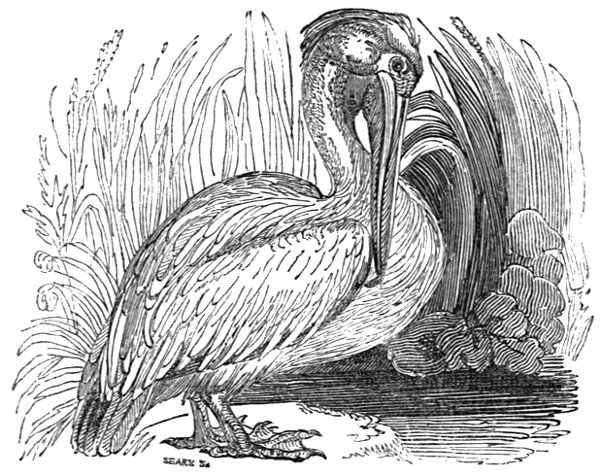
The bill of this genus is long and straight; the end either hooked or sloping; the nostrils placed in a furrow that runs along the sides of the bill, and in most of the species not distinguishable. The face generally destitute of feathers, being covered only with a bare skin: gullet naked, and capable of great distension: body long, heavy, flat: legs placed far backward; toes four in number, and all webbed together.
Latham, following the example of Linnæus, includes the pelican, man-of-war bird, cormorant, shag, gannet, and booby, in this genus, of which he enumerates thirty distinct species, and two varieties; four only of this number, and one variety, are British birds. In confining the present account to these, it is proper to remark that they are not the inhabitants of this country only, but are widely dispersed over the globe, being met with in almost every climate which navigators have visited, whether temperate, hot, or cold. The gannet only is migratory, large flocks of this species arrive in the spring of the year, and disperse themselves in colonies over the rocky promontories of Scotland, and its isles, in various parts of which they breed and rear their young, and as soon as that office is performed, they retire in the autumn to their unknown abodes. Their return each season points out also that of the shoals of the herrings, which they hover over, pursue, and chiefly feed upon. These shoals, at that season of increasing warmth, are poured forth on their southern route, gliding forward in wide glittering columns of myriads upon myriads, from the unknown but prolific regions of the northern pole. These prodigious shoals with their divisions and subdivisions, in their branched course around the British isles, are attended by the gannet. On our southern coasts the pilchard affords these birds another supply of food, in pursuit of which they are enticed as far southward as the Mediterranean sea.
The cormorant and the shag remain with us throughout the year, but particularly on our more northern shores, upon whose rocky shelving precipices they station themselves, and perform the offices of incubation, while stragglers occasionally taking a wider range, with outstretched neck and vigorous wing sweep along the coast, and entering the mouths of the rivers, follow their course in quest of food, to the lakes inland.—Bewick.
Pellet, s. A little ball; a bullet, a ball.
Perch, s. A measure of five yards and a half; a pole; something on which birds roost or sit; a kind of fish peculiar to ponds and rivers.
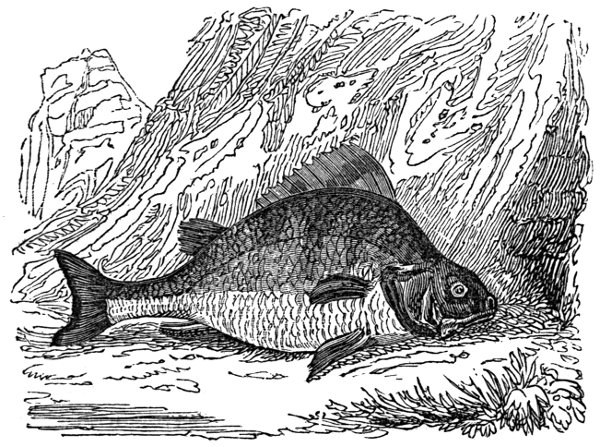
Perch have one particularity, which is contrary to the nature of all fish of prey in fresh water (and they are so voracious as to attack their own kind), that they are gregarious, swimming in shoals. The body of the perch is deep, the scales very rough, the back much arched, and the side-line approaches near it: the irides are golden, the teeth small, disposed in the jaws and on the roof of the mouth, which is large; the edges of the cover of the gills serrated, on the lower end of the largest in a sharp spine, and the head is said to consist of no fewer than eighty bones; the colours of the perch are beautiful, the back and part of the sides being of a deep green, marked with broad black bars pointing downwards; the belly is white, tinged red; the ventral fins of a rich scarlet; the anal fins and tail (which is a little forked,) of the same colour but rather paler.
The perch affords the angler great diversion, and not only the baits are various, but the modes of using them. Of worms, the best kinds are small lob-worms which have no knot, brandlings, red dunghills, or those found in rotten tan, all well scoured; the hook may be varied from No. 2 to 6, being well whipt to a strong silk-worm gut, with a shot or two a foot from it: put the point of the hook in at the head of the worm, out again a little lower than the middle, pushing it above the shank of the hook upon the gut; take a smaller one, beginning the same way, and bring its head up to the middle of the shank only; then draw the first worm down to the head of the latter, so that the tails may hang one above the other, keeping the point of the hook well covered. This is the most enticing method that can be adopted in worm-fishing; use a small cork float, to keep the bait at six or twelve inches from the bottom, or sometimes about midwater: in angling near the bottom, raise the bait very frequently from thence almost to the surface, letting it gradually fall again. Should a good shoal be met with, they are so greedy, that they may be all caught, unless one escapes that has felt the hook: then all is over, the fish that has been hooked becomes restless, and soon occasions the whole shoal to leave the place. Two or three rods may be employed, as they require time to gorge sufficient to allow the angler to be prepared to strike them.
Baits for the perch are loaches, sticklebacks, with the spines cut off, miller’s-thumbs, horse-beans boiled (after the place has been well-baited with them, put one at a time on the hook), cad-bait, bobs, and gentles.
Although generally termed a bold biter, the perch is extremely abstemious in winter, and scarcely ever bites in that season, but in the middle of a warm sunshiny day; he bites best in the latter part of the spring, from seven to eleven in the forenoon, and from two to six in the afternoon, except in hot and bright weather, and then from sunrise to six in the morning, and in the eve from six to sunset. If a day be cool and cloudy, with a ruffling south wind, perch will bite during the whole of it. In clear water, sometimes a dozen or more of perch have been observed in a deep hole, sheltered by trees or bushes; by using fine tackle and a well-scoured worm, the angler may see them strive which shall first seize it, until the whole shoal have been caught.
The perch may be angled for and taken until the end of September, and indeed at particular times all the year round; but the preferable season is from the beginning of May, to the middle of July.
Mr. Young mentions that, at Pakenham, Lord Longford informed him respecting the quantities of fish in the lakes in his neighbourhood, that the perch were so numerous, that a child with a packthread and a crooked pin would catch enough in an hour for the daily use of a whole family, and that his lordship had seen five hundred children fishing at the same time; that, besides perch, the lakes produced pike five feet long, and trout of ten pounds each.
Great numbers of perch are bred in the Hampton Court and Bushy Park ponds, all of which are well supplied with running water, and with plenty of food, yet they seldom arrive at a large size. In a neighbouring pond, which is only fed with drainage water, I have caught very large perch. The perch in the water in the Regent’s Park are very numerous. Those I have taken, however, are almost invariably of one size, from half to three-quarters of a pound. Why they should have arrived at this weight and not go on increasing in size, is a circumstance which it is not easy to account for. I have, however, remarked it to be the case in other ponds.—Daniel—Wild Sports—Jesse.
Percussion, s. The impression a body makes in falling or sticking upon another. It is direct or oblique. Direct when the impulse is made in the direction of a perpendicular line to the point of impact. Such is the action of a cock upon the copper cap. Vide Gun, Rifle, Appendix.
Pewet, s. A waterfowl; the lapwing.
Pewter, s. A composition of lead and tin.
Pheasant, (Phasianus Colchicus, Linn.; Le Faisan, Buff.) s. A kind of wild cock; a beautiful large bird of game.
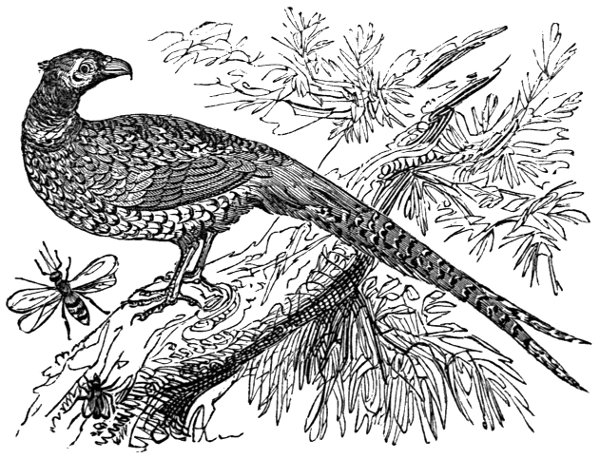
The pheasant is rather less than the common cock. The bill is of a pale horn colour; the nostrils are hid under an arched covering; the eyes are yellow, and surrounded by a space, in appearance like beautiful scarlet cloth, finely spotted with black; immediately under each eye there is a small patch of short feathers of a dark glossy purple; the upper parts of the head and neck are of a deep purple, varying to glossy green and blue; the lower parts of the neck and breast are of a reddish chestnut, with black indented edges; the sides and lower parts of the breast are of the same colour, with pretty large tips of black to each feather, which in different lights vary to a glossy purple; the belly and vent are dusky; the back and scapulars are beautifully variegated with black and white or cream-colour speckled with black, and mixed with deep orange, all the feathers are edged with black; on the lower part of the back there is a mixture of green; the quills are dusky, freckled with white, wing coverts brown, glossed with green and edged with white; rump plain reddish brown; the two middle feathers of the tail are about twenty inches long, the shortest on each side less than five, of a reddish brown colour, marked with transverse bars of black; the legs are dusky, with a short blunt spur on each, but in some old birds the spurs are as sharp as needles; between the toes there is a strong membrane.
The female is less, and does not exhibit that variety and brilliancy of colours which distinguish the male; the general colours are light and dark brown, mixed with black, the breast and belly finely freckled with small black spots on a light ground; the tail is short, and barred somewhat like that of the male; the space round the eye is covered with feathers.
The ring pheasant is a fine variety of this species; its principal difference consists in a white ring, which encircles the lower part of the neck; the colours of the plumage in general are likewise more distinct and vivid. A fine specimen of this bird was sent us by the Rev. William Turner, of Newcastle, from which the figure was engraven. They are sometimes met with in the neighbourhood of Alnwick, whither they were brought by his grace the Duke of Northumberland. That they intermix with the common breed is very obvious, as in some we have seen the ring was hardly visible, and in others a few feathers only, marked with white, appeared on each side of the neck, forming a white spot. It is much to be regretted that this beautiful breed is likely soon to be destroyed, by those who pursue every species of game with an avaricious and indiscriminating rapacity.
There are many varieties of pheasants of extraordinary beauty and brilliancy of colours; in many gentlemen’s woods there is a kind as white as snow, which will intermix with the common ones. Many of the gold and silver kinds, brought from China, are also kept in aviaries in this kingdom; the common pheasant is likewise a native of the East, and is the only one of its kind that has multiplied in our island. Pheasants are generally found in low woody places, on the borders of plains, where they delight to sport; during the night they perch on the branches of trees. They are very shy birds, and do not associate together, except during the months of March and April, when the male seeks the female; they are then easily discoverable by the noise which they make in crowing and clapping their wings, which may be heard at some distance. The hen breeds on the ground like the partridge, and lays from twelve to fifteen eggs, which are smaller than those of the common hen; the young follow the mother as soon as they are freed from the shell. During the breeding season the cocks will sometimes intermix with the common hen, and produce a hybrid breed, of which we have known several instances.
For shooting pheasants it often becomes necessary to start very early in the morning, as they are apt to lie during the day in high covert, where it is almost impossible to shoot them till the leaf has fallen from the trees. We can never be at a loss in knowing where to go for pheasants, as we have only to send some one the previous evening, for the last hour before sun-set, to watch the different barley or oat stubbles of a woodland country, and on these will be regularly displayed the whole contents of the neighbouring coverts. It then remains to be chosen, which woods are the best calculated to shoot in; and, when we begin beating them, it must be remembered to draw the springs, so as to intercept the birds from the old wood. If the coverts are wet, the hedge-rows will be an excellent beginning, provided we here also attend well to getting between the birds and their places of security. If pheasants, when feeding, are approached by a man, they generally run into covert; but if they see a dog, they are apt to fly up.
There are very few old sportsmen but what are aware that this is by far the most sure method of killing pheasants, or any other game, where they are tolerably plentiful in covert; and although to explore and beat several hundred acres of coppice, it becomes necessary to have a party with spaniels, yet, on such expeditions, we rarely hear of any one getting much game to his own share, except some sly old fellow, who has shirked from his companions to the end of the wood, where the pheasants, and particularly the cock birds, on hearing the approach of a rabble, are all running like a retreating army, and perhaps flying in his face faster than he can load and fire.
For one alone to get shots in a thick underwood, a brace or two of very well broke spaniels would, of course, be the best. But were I obliged to stake a considerable bet (taking one beat with another, where game was plentiful), I should back against the sportsman using them, one who took out a very high couraged old pointer, that would keep near him, and would, on being told, break his point to dash in, and put the pheasants to flight before they could run out of shot. This office may be also performed by a Newfoundland dog; but, as first getting a point would direct the shooter where to place himself for a fair shot, the Newfoundland dog would always be best kept close to his heels, and only made use of to assist in this; and particularly for bringing the game; as we rarely see a pointer, however expert in fetching his birds, that can follow and find the wounded ones half so well as the real St. John’s Newfoundland dog.
Lord Stawell sent me from the great lodge in the Holt a curious bird for my inspection. It was found by the spaniels of one of his keepers in a coppice, and shot on the wing. The shape, air, and habit of the bird, and the scarlet ring round the eyes, agreed well with the appearance of a cock pheasant; but then the head and neck, and breast and belly, were of a glossy black: and though it weighed three pounds three ounces and a half, the weight of a large full-grown cock pheasant, yet there were no signs of any spurs on the legs, as is usual with all grown cock pheasants, who have long ones. The legs and feet were naked of feathers, and therefore it could be nothing of the grouse kind. In the tail were no long bending feathers, such as cock pheasants usually have, and are characteristic of the sex. The tail was much shorter than the tail of a hen pheasant, and blunt and square at the end. The back, wing-feathers and tail, were all of a pale russet, curiously streaked, somewhat like the upper parts of a hen partridge. I returned it with my verdict, that it was probably a spurious or hybrid hen bird, bred between a cock pheasant and some domestic fowl. When I came to talk with the keeper who brought it, he told me that some pea-hens had been known last summer to haunt the coppices and coverts where this mule was found.
The pheasant is not a long-lived bird; but it is probable the period of existence assigned to it by some writers, namely, six or seven years, is too short. The wholesomeness of its flesh was proverbial among the old physicians; it is of a high flavour and alkalescent quality, and in perfection during autumn. A young pheasant very fat is reckoned an exquisite dainty. In a wild state, the hen lays from eighteen to twenty eggs in a season, but seldom more than ten in a state of confinement. Pheasants are not to be tamed by domestication, like other fowls; nor is the flesh of those brought up in the house, in any degree comparable to that of the wild pheasant: thence they are bred at home, either merely for show, or for the purpose of replenishing the proprietor’s grounds, both with regard to number or particular varieties. However good nursing mothers in a wild state, pheasant hens are far otherwise in the house, whence their eggs are always hatched at home by the common hen,—generally, at present, by the smooth-legged bantam.
The natural nest of the pheasant is composed of dry grass and leaves, which being provided for her in confinement she will sometimes properly dispose. The cock is bold, voracious, and cruel; and one which I had many years ago, caught a canary bird which had accidentally escaped, and was observed with it beneath his talons, in the proper attitude of the hawk, tearing it to pieces and devouring it. Pheasants have been seen preying upon a dead carcase, in company with carrion crows; and it has been said that they will fall upon a diseased and weak companion of their own species, and devour it. They feed upon all kinds of insects and vermin, like the peacock, and are said to be particularly greedy of toads, provided they be not too large to swallow; whereas, according to report, they will not touch the frog, of which ducks are so fond. A pheasant was shot by T. Day, Esq. of Herts, the crop of which contained more than half a pint of that destructive insect the wire-worm. And the number of 1606 grains of barley were taken from the crop of a pheasant, at Bury, in Suffolk, in 1727.
The best known varieties of the pheasant, are the golden, the silver, the peacock or spotted, and the common European or English, generally brown, with a less brilliancy of colour. Mr. Castang, however, enumerates six distinct varieties, exclusive of the common, as follow: the gold and silver, natives of China, and very hardy in this country, and good breeders. The ring-necks, natives of Tartary, bred in China, very scarce; their plumage very beautiful. The white and pied; both sorts will intermix readily with our common breed, as will the Bohemian, one of the most beautiful of its kind, and equally scarce. The golden variety is generally of the highest price, the common most hardy and of the largest size.
Breeding Pheasants.—Eggs being provided, put them under a hen that has kept the nest three or four days; and if you set two or three nests on the same day, you will have the advantage of shifting the good eggs. At the end of ten or twelve days, throw away those that are bad, and set the same hen or hens again, if sitting hens should not be plenty.
The hens having sat their full time, such of the young pheasants as are already hatched put into a basket, with a piece of flannel, till the hen has done hatching.
The brood, now come, put under a frame with a net over it, and a place for the hen, that she cannot get to the young pheasants, but that they may go to her: and feed them with boiled egg cut small, boiled milk and bread, alum curd, ants’ eggs, a little of each sort, and often.
After two or three days, they will be acquainted with the call of the hen that hatched them, may have their liberty of running on the grass-plot, or elsewhere, observing to shift them with the sun, and out of the cold winds. They should not have their liberty in the morning till the sun is up; and they must be shut in with the hen in good time in the evening.
Every thing now going on properly, you must be very careful (in order to guard against the distemper to which they are liable) in your choice of a situation for breeding the birds up; and be less afraid of foxes, dogs, pole-cats, and all sorts of vermin, than the distemper. I had rather encounter all the former than the latter; for those, with care, may be prevented, but the distemper, once got in, is like the plague, and destroys all your hopes. What I mean by a good situation, is nothing more than a place where no poultry, pheasants, or turkeys, &c. have ever been kept; such as the warm side of a field, orchard, pleasure-ground, or garden, or even on a common, or a good green lane, under circumstances of this kind; or by a wood-side; but then it is proper for a man to keep with them under a temporary hovel, and to have two or three dogs chained at a proper distance, with a lamp or two at night. I have known a great number of pheasants bred up in this manner, in the most exposed situations. It is proper for the man always to have a gun, that he may keep off the hawks, owls, jays, magpies, &c. The dogs and lamps intimidate the foxes beyond any other means; and the dogs will give tongue for the man to be on his guard if smaller vermin are near, or when strollers make their appearance.
The birds going on as before mentioned, should so continue till December, or, if very early bred, the middle of August. Before they begin to shift the long feathers in the tail, they are to be shut up in the basket with the hen, regularly every night; and when they begin to shift their tail the birds are large, and begin to lie out, that is, they are not willing to come to be shut up in the basket. Those that are intended to be turned out wild should be taught to perch (a situation they have never been used to); this is done by tying a string to the hen’s leg, and obliging her to sit in a tree all night: be sure you put her in the tree before sun-set; and if she falls down, you must persevere in putting her up again, till she is contented with her situation; then the young birds will follow the hen, and perch with her. This being done, and the country now covered with corn, fruits, and shrubs, &c. &c. they will shift for themselves.
For such young pheasants as you make choice of for your breeding stock at home, and likewise to turn out in the spring following, provide a new piece of ground, large and roomy, for two pens, where no pheasants, &c. have been kept, and there put your young birds in as they begin to shift their tails. Such of them as you intend to turn out at a future time, or in another place, put into one pen netted over, and leave their wings as they are; and those you wish to keep for breeding put into the other pen, cutting one wing of each bird. The gold and silver pheasants you must pen earlier, or they will be off. Cut the wing often; and, when first penned, feed all your young birds with barley-meal, dough, corn, and plenty of green turnips.
A Receipt to make Alum Curd.—Take new milk, as much as your young birds require, and boil it with a lump of alum, so as not to make the curd hard and tough, but custard like.
N.B.—A little of this curd twice a day, and ants’ eggs after every time they have had a sufficient quantity of the other food. If they do not eat heartily, give them some ants’ eggs to create an appetite, but by no means in such abundance as to be considered their food.
The distemper alluded to above, is not improbably of the same nature as the roup in chickens; contagious, and dependent on the state of the weather; and, for prevention, requiring similar precaution.
General Directions.—Not more than four hens to be allowed in the pens to one cock; and in the out covers, three hens to one cock may be sufficient, with the view of allowing for accidents, such as the loss of a cock or hen. Never put more eggs under a hen than she can well and closely cover, the eggs fresh and carefully preserved. Short broods to be joined and shifted to one hen. Common hen pheasants in close pens, and with plenty of cover, will sometimes make their nests and hatch their own eggs, but they seldom succeed in rearing their brood, being so naturally shy; whence, should this method be desired, they must be left entirely to themselves, as they feel alarm even in being looked at. Eggs for setting are generally ready in April. Period of incubation the same in the pheasant as in the common hen. Pheasants, like the pea-owl, will clear grounds of insects and reptiles, but will spoil all wall-trees within their reach, by pecking off every bud and leaf.
Feeding.—Strict cleanliness to be observed, the meat not to be tainted with dung, and the water to be pure and often renewed. Ants’ eggs being scarce, hog-lice, earwigs, or any insects, may be given; or artificial ants’ eggs substituted, composed of flour beaten up with an egg and shell together, the pellets rubbed between the fingers to the proper size. After the first three weeks, in a scarcity of ants’ eggs, Castang gives a few gentles, procured from a good liver tied up, the gentles, when ready, dropping into a pan or box of bran; to be given sparingly, and not considered as common food.
Food for grown pheasants, barley or wheat; generally the same as for other poultry. In a cold spring, hemp-seed, or other warming seeds, are comfortable, and will forward the breeding stock.
A New Species of Pheasant.—Amongst the numerous interesting natural productions recently brought from China by Mr. Reeves, it was with pleasure we observed a magnificent new species of pheasant, which will be a most interesting addition to the aviaries of Europe; and as it comes from the same part of the world as the gold and silver kind, there is scarcely a doubt but that, with a little care, it may be induced to breed in this country. It is about three times the size of the common pheasant, and has a tail from five to six feet long; it is of a pale bay colour, ornamented with black moons, and the head, wing, and under part of the body, black varied with white; the tail feathers are black and brown banded. Mr. Reeves brought with him from Canton two living specimens; but one of them unfortunately died in the Channel; the other is now in the gardens of the Zoological Society, where it will most probably recover its fine tail. A beautiful specimen, in nearly perfect plumage, brought by Mr. Reeves for General Hardwicke, has been presented by that gentleman to the collection of the British Museum. The tail feathers of this bird have been long known, two having been exhibited in the Museum for many years; but the bird which bore them was first described in General Hardwick’s Illustrations of Indian Zoology, from a drawing sent by Mr. Reeves, where it is called Reeves’s pheasant (Phasianus Reevesii).—Daniel—Hawker—Moubray.
Phraseology, s. Style, diction; a phrase-book; technical terms.
There was a peculiar kind of language invented by sportsmen of the middle ages, which it was necessary for them to be acquainted with, and some of the terms are still continued.
A sege of herons and of bitterns; an herd of swans, of cranes, and of curlews; a dopping of sheldrakes; a spring of teals; a covert of coots; a gaggle of geese; a badelynge of ducks; a sord or sute of mallards; a muster of peacocks; a nye of pheasants; a bevy of quails; a covey of partridges; a congregation of plovers; a flight of doves; a dule of turkeys, a walk of snipes; a fall of woodcocks; a brood of hens; a building of rooks; a murmuration of starlings; an exaltation of larks; a flight of swallows; a host of sparrows; a watch of nightingales; and a charm of goldfinches.
When beasts went together in companies, there was said to be a pride of lions; a lepe of leopards; an herd of harts, of bucks, and of all sorts of deer; a bevy of roes; a sloth of bears; a singular of boars; a sownder of wild swine; a dryft of tame swine; a route of wolves; a harass of horses; a rag of colts; a stud of mares; a pace of asses; a baren of mules; a team of oxen; a drove of kine; a flock of sheep; a tribe of goats; a skulk of foxes; a cete of badgers; a richness of martins; a fesynes of ferrets; a huske or a down of hares; a nest of rabbits; a clowder of cats, and a kendel of young cats; a shrewdness of apes; and a labour of moles; and, when animals were retired to rest, a hart was said to be harboured, a buck lodged, a roebuck bedded, a hare formed, a rabbit set, a fox kennelled, a martin tree’d, an otter watched, a badger earthed, a boar couched: hence, to express their dislodging they say, unharbour the hart, rouse the buck, start the hare, bolt the rabbit, unkennel the fox, untree the martin, vent the otter, dig the badger, and rear the boar. Two greyhounds were called a brace; three a leash; but two spaniels or harriers were called a couple, and three, a couple and a half; there was also a mute of hounds for a number; a litter of whelps, and a cowardice of curs.—Strutt—Ascham—Daniel—Book of St. Alban’s.
Pianet, s. A bird, the lesser woodpecker; the magpie.
Pie, s. A magpie, a particoloured bird.
Birds of this kind are found in every part of the known world, from Greenland to the Cape of Good Hope; the general character of this kind is chiefly as follows:—The bill is strong, and has a slight curvature along the top of the upper mandible; the edges are thin, and sharp or cultrated; in many of the species there is a small notch near the tip; the nostrils are covered with bristles; tongue divided at the end; three toes forward, one behind, the middle toe connected to the outer as far as the first joint.—Bewick.
Piebald, a. Of various colours, diversified in colour.
Pied, a. Variegated, particoloured.
Pig, s. A young sow or boar; an oblong mass of lead or unforged iron.
This instinctive sagacity, which guides animals who have been taken from their old haunts, in making their way back to them, appears in some to whom we should have been least disposed to attribute it. I have an anecdote from a gentleman, who resided some years on an estate high up the Susquehanna, of some pigs, which, having been brought in a sack fifteen miles through an American wood, by the next morning had found their way back, from their new to their old home.—Jesse.
Pigeon (Columba, Linn.), s. A domestic bird.
Pigeons (Columbidæ, Leach; Rasores, Illiger), s. A family of snatching birds.
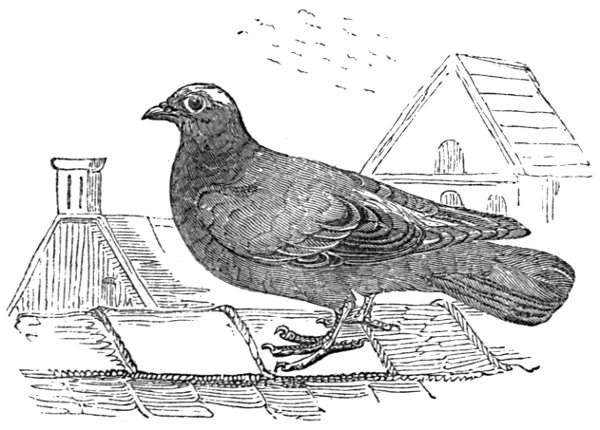
Of these the varieties and intermixtures are innumerable, and partake of all those varied hues which are the constant result of domestication. The manners of pigeons are well known, few species being more universally diffused, and having a very powerful wing, they are enabled to perform very distant journeys; accordingly wild and tame pigeons occur in every climate, and although they thrive best in warm countries, yet with care they succeed also in very northern latitudes. Every where their manners are gentle and lively; they are fond of society, and the very emblem of connubial attachment; they are faithful to their mates, whom they solicit with the softest cooings, the tenderest caresses, and the most graceful movements. The exterior form of the pigeon is beautiful and elegant: the bill is weak straight and slender, and has a soft protuberance at the base, in which the nostrils are placed: the legs are short and red, and the toes divided to the origin.
Buffon enumerates upwards of thirty varieties of the pigeon, which, according to his usual systematic plan—its convenience, perhaps, being rather more obvious than its accuracy—he derives from one root, namely, the stock-dove, or common wild pigeon. All the varieties of colour and form which we witness, he attributes to human contrivance and fancy. There exist, nevertheless, essential specific differences in these birds, which seem rather attributable to the nature of the region, soil, or climate, to which they are indigenous, than to the art of man.
The pigeon is monogamous, that is, the male attaches and confines himself to one female, and the attachment is reciprocal: the fidelity of the dove to its mate being proverbial. Young pigeons are termed squeakers, and begin to breed at about the age of six months, when properly managed: their courtship, and the well known tone of voice in the cock, just then acquired and commencing, are indications of their approaching union. Nestlings, whilst fed by the cock and hen, are termed squabs, and are at that age sold and used for the table. The dove-house pigeon is said to breed monthly, being well supplied with food, more particularly when the ground is bound by frost, or covered with snow. At any rate, it may be depended on, that pigeons of almost any healthy and well established variety, will breed eight or ten times in the year; whence it may be conceived how immense are the quantities which may be raised.
The first step towards pigeon keeping, is, undoubtedly, to provide a commodious place for their reception, of which I shall afterwards speak; the next, to provide the pigeons themselves. These will be had in pairs, but if not actually matched, pains must be afterwards taken, to that end, that no time be lost; indeed, they may be matched according to the fancy of the keepers, for the purpose of varying the colours, or with any other view. But it is necessary to give a caution on the subject of old pigeons, of which a bargain may offer, since the difficulty of retaining them is so great, indeed insuperable, without the strictest vigilance. Nothing short of cutting their wings, and confining them closely until they have young to attach them to the place, will be a security; and even afterwards, they have been known to take flight with the first use of their wings, and leave their nests. I have had several examples of this. Thence it is always preferable to purchase squeakers, or such as have not yet flown: these, being confined, in a short time, well fed, and accustomed gradually to the surrounding scenery, before they have acquired sufficient strength of wing wherewith to lose themselves, will become perfectly domesticated.
The dove-cote, or pigeon-loft, as to its situation or extent, will necessarily depend on convenience, one general rule, however, must be invariably observed,—that every pair of pigeons have two holes, or rooms, to nest in. Without this indispensable convenience there will be no security, but the prospect of constant confusion, breaking of eggs, and destruction of the young. Pigeons do well near dwellings, stables, bake-houses, brew-houses, or such offices; or their proper place is in the poultry-court. A dove-cote is a good object, situate upon an island, in the centre of a piece of water: indeed, such is a proper situation for aquatic poultry, and rabbits also; and may be rendered extremely beautiful and picturesque by planting, and a little simple ornamental and useful building. Where pigeons are kept in a room, some persons prefer making their nests upon the floor, to escape the danger of the young falling out; but in all probability this is to guard against one risk, and incur a great number, particularly that of rats and other vermin.