INTRODUCTION. (continued 21)
Reading edition
Rooks are not easily induced to forsake the trees on which they have been bred, and which they frequently revisit after the breeding season is over. This is shown in Hampton Court Park, where there is an extensive rookery among the fine lime-trees, and where a barbarous and unnecessary custom prevails of shooting the young rooks. As many as a hundred dozen of them have been killed in one season, and yet the rooks build in the avenue, though there is a corresponding avenue close by in Bushy Park, which they never frequent, notwithstanding the trees are equally high and equally secure. I never hear the guns go off during this annual slaughter without execrating the practice, and pitying the poor rooks, whose melancholy cries may be heard to a great distance, and some of whom may be seen, exhausted by their fruitless exertions, sitting melancholy on a solitary tree waiting till the sport is over, that they may return and see whether any of the offspring which they have reared with so much care and anxiety are left to them; or, what is more probable, the call for assistance of their young having ceased, they are aware of their fate, and are sitting in mournful contemplation of their loss. This may appear romantic, but it is nevertheless true; and whoever, like myself, has observed the habits and manners of the rook, and witnessed their attachment to each other and to their young,—and is convinced, as I am, that they have the power of communication by means of a language known to themselves, and are endowed with a knowledge and foresight most extraordinary, will take as much interest in them as I have confessed that I do.
A gentleman in this neighbourhood had two milk-white rooks in one nest. A booby of a carter, finding them before they were able to fly, threw them down, and destroyed them, to the regret of the owner, who would have been glad to have preserved such a curiosity in his rookery. I saw the birds myself nailed against the end of a barn, and was surprised to find that their bills, legs, feet, and claws were milk-white.
Passage hawks are also used for rooks. These birds sometimes mount like herons, but their flight is in general much lower. They must be found in an open country; and the wood, which is their place of retreat, must be so situated as to oblige them to fly against the wind to gain in.—Bewick—Daniel—Jesse—White’s Selborne—Sebright.
Rookery, s. A nursery of rooks.
Roost, s. That on which a bird sits to sleep; the act of sleeping.
Roost, v. To sleep as a bird.
Rope, s. A cord, a string, a halter.
Ropy, a. Viscous, tenacious, glutinous.
Rosin, s. Inspissated turpentine.
Rosin, v. To rub with rosin.
Rostrum, s. The beak of a bird; the beak of a ship. Rostrum cultratum (Linn.), in ornithology, is a term used when the edges of the bill are very sharp, as in that of the crow. When the bill is notched near the tip, as in shrikes, thrushes, &c., it is called by Linnæus rostrum emarginatum.
Rot, v. To make putrid, to bring to corruption.
Rot, s. A distemper among sheep in which their lungs are wasted; putrefaction; putrid decay.
Rotary, a. Whirling as a wheel. A motion peculiar to the flight of the hawk tribe.
Rouge et Noir, s. A game.
Rouge et noir, or red and black, is a modern game, so styled, not from the cards, but from the colours marked on the tapis or green cloth with which the table is covered.
The first parcel of cards played is usually for noir, the second for rouge, though sometimes the cards are cut to determine which shall begin. All the terms of this game are French, and that language is used in playing. Any number of persons may play, and the punters may risk their money on which colour they please, placing the stakes in the outer semicircle; but after the first card is turned up, no other stakes can be laid for that coup.
The tailleur and croupier seat themselves opposite each other, with a basket for receiving the cards of every coup after dealing, which is placed on the middle of the table. The tailleur then passing round six packs of cards to be shuffled and mixed confusedly all together by the company, afterwards finally shuffles them, and inserts all the end cards into various parts of the 312, till he meets with an honour, which being placed upright at the end, is offered to a punter, who, putting the same into any part of the pack, the tailleur there separates it, and lays that part which was below the said honour uppermost, and taking therefrom a handful of cards, and placing a weight upon the remainder, proceeds to deal, taking afterwards other parcels from the heap as they may be wanted, till all are dealt out. He looks at the first card, and puts its face downwards; two others, one red, the other black, are then laid back to back, and that placed conspicuously uppermost which is of a similar colour with the first card; these two cards are turned according to the colour of the card which afterwards may be first dealt in each succeeding coup. When the stakes are deposited, the tailleur cries noir, turns the top card, and places each succeeding one in a row, till the points of those so turned shall exceed thirty; he then declares the numbers at trente and une, one and thirty; or, if above that, up to forty he only says, deux, trois, quatre, cinq, six, sept, huit, neuf, two, three, four, five, six, seven, eight, nine, and when forty, quarante.
Another parcel is then dealt in a similar mode for rouge, and the punters win who had staked on that colour, the points for which were thirty-one or nearest to it, which the tailleur declares, by saying rouge gagne, red wins; or rouge perd, red loses. These two parcels, one for each colour, make a coup. When the same number is dealt for each, the tailleur says, apres, after, which forms un refait, or doublet, by which neither party loses, except it is un refait trente et un, one-and-thirty, when the tailleur wins half the stakes punted on each colour, which half the punters may either pay, or have their stakes moved into the middle semicircles of the colour they then choose, called la première prison, the first prison, to be determined by the next event, whether they lose all or are set at liberty; but if un refait second trente and un, a second doublet of one and thirty, should occur in the next succeeding deal, the punters lose only one half of their remaining moiety, making three-fourths of their original stakes, and are removed into the smallest semicircle, styled la seconde prison, the second prison, and the next coup determines whether the punter loses all, or is to be removed again into la première prison.
Punters after winning may paroli, &c., and pursue their luck up to a soixante, as at faro; but as no livrets are used at rouge et noir, they cannot make either paix or pont.
At this game a banker cannot refuse any stake not exceeding his fund; which the punter declares, by saying je va la banque, va la banque, or va banque, I aim at the bank. Bankers generally furnish punters with slips of card paper, ruled in columns, each marked N. or R. at the top on which accounts are kept by pricking with a pin, and when un refait happens, the same is denoted by running the pin through the middle line. Some bankers give up the profit of le refait during the first deal.
The odds against le refait being deals, are reckoned sixty-three to one, but bankers expect it twice in three deals, and there are generally from twenty-nine to thirty-two coups in each deal.—Hoyle.
Roughrider, s. One that breaks horses for riding.
Rousing, s. The action of a hawk when she shakes herself.
Row, v. To impel by oars. To use the oar.
Rowel, s. The points of a spur turning on an axis; a seton, a roll of hair or silk put into a wound to hinder it from healing, and provoke a discharge.
Rowels are seldom so convenient or so useful as setons. They are formed by making an incision in the skin, where it is rather loose, as in the chest, about an inch in length. This being done, the finger is to be introduced, or an instrument called a cornet, that is, the crooked end of a small horn made for the purpose, and the skin separated from the parts underneath all around for the space of about an inch. Into the cavity thus made a round piece of leather, with a hole in the middle, wrapped in tow and smeared with digestive ointment, is to be introduced. The orifice in the skin is then to be plugged up with tow, and kept there until suppuration takes place, that is, four or five days. The tow is then to be taken out, when a great deal of matter will flow from the orifice. The rowel is afterwards to be moved daily and kept clean.—White.
Rowel, v. To pierce through the skin, and keep the wound open by a rowel.
Rower, s. One that manages an oar.
Rub, v. To clean or smooth anything by passing something over it; to scour, to wipe; to move one body upon another; to remove by friction; to touch hard; to rub down, to clean or curry a horse.
Rubber, s. One that rubs; the instrument with which one rubs; a coarse file; a game, a contest; two games out of three.
Ruby, a. Of a red colour.
Rud, s. A fish.
The body of the rud is broader than the carp, more like that of the bream, but much thicker; the head is small, the palate and teeth like the carp, on the covers of the gills are spots of a blood colour; the irides are yellow, varying in some almost to redness; the nostrils large, and by some said to be double on each side; the back is arched, sloping off suddenly at the two extremities; the scales are very large, like the carp; the side line is slightly incurvated: the back is of an olive; the sides and belly are of a gold colour, with certain red marks; the ventral, anal fins, and the tail (which is forked), are generally of a deep red, and the dorsal fin is darker than the rest; the usual length of this fish is from ten to sixteen inches. It lives on insects and grass, and is preyed on by the voracious fish and the anseres. In rivers the rud’s haunts are in deepish gentle streams and deep still water, where the bottom is a kind of slimy mud sand, or fine gravel, and also among weeds.
They are always in season, except at the time of spawning, which is in April, when the male fish have small white spots about their heads, and the scales of both sexes feel more rough; they swim in shoals, casting their spawn upon and among the aquatic plants, to the number according to the Elements of Natural History, of 91,000 ova.
Their flesh is exceedingly wholesome, and holds a distinguished rank for its fine flavour; but they are very scarce.
Mr. Pennant believes the shallow of the Cam, which grows to the length of thirteen inches, and spawns in April, to be no other fish than the rud.
The angler will find the rud worth his attention; the tackle must be strong, but fine, with a quill float, and a hook proportioned to the bait; the same ground-bait is to be used as for carp and chub, fishing about the same depths as for the latter, except on the ground, for they feed naturally near the surface; they will in this way take red-worms, gentles, wasp-maggots, caddis, and red-paste. Some use a ground-bait of boiled malt, and prefer a small red worm to any other bait. In fishing among weeds, have neither float nor shot, and let the worm, or other bait sink a little under water: at top they are taken either with natural or artificial flies, by whipping with a long, and dibbing or bobbing with a short line. In warm, bright weather, the rud will bite early and late; when coolish, the fore and afternoons; and in winter, the middle of the day; when hooked this fish struggles hard, and requires time in landing, and is so tenacious of life, as to retain it after being taken out of the water a considerable time.—Daniel.
Ruddock, s. A kind of bird.
Ruddy, a. Approaching to redness, pale red; yellow.
Ruff, s. A puckered linen ornament formerly worn about the neck; a bird.
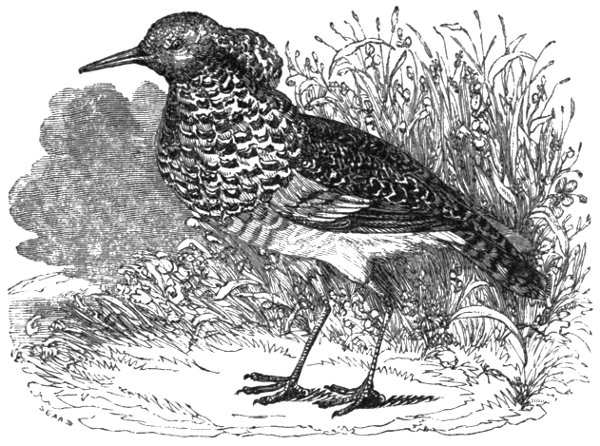
The male of this curious species is called the ruff, and the female the reeve: they differ materially in their exterior appearance; and also, what is remarkable in wild birds, it very rarely happens that two ruffs are alike in the colours of their plumage. The singular, wide-spreading, variegated tuft of feathers which, in the breeding season, grows out of their necks, is different in all. The tuft, or ruff, a portion of which stands up like ears behind each eye, is in some black, in others black and yellow, and in others again white, rust colour, or barred with glossy violet, black and white. They are, however, more nearly alike in other respects: they measure about a foot in length, and two in breadth, and when first taken weigh about seven ounces and a half; the female seldom exceeds four. The bill is more than an inch long, black at the tip, and reddish yellow towards the base; the irides are hazel: the whole face is covered with reddish tubercles, or pimples; the wing coverts are brownish ash colour; the upper parts and the breast are generally marked with transverse bars, and the scapulars with roundish-shaped glossy black spots, on a rusty coloured ground; quills dusky; belly, vent, and tail coverts white; the tail is brown; the four middle feathers of it are barred with black; the legs are yellow. The male does not acquire the ornament of his neck till the second season, and, before that time, is not easily distinguished from the female, except by being larger. After moulting, at the end of June, he loses his ruff and the red tubercles on his face, and from that time until the spring of the year, he again, in the plumage, looks like his mate.
These birds leave Great Britain in the winter, and are then supposed to associate with others of the tringa genus, among which they are no longer recognised as the ruff and reeve. In the spring, as soon as they arrive again in England, and take up their abode in the fens where they were bred, each of the males (of which there appears to be a much greater number than of the females) immediately fixes upon a particular dry and grassy spot in the marsh, about which he runs round and round, until it is trodden bare; to this spot, it appears, he wishes to invite the female, and waits in expectation of her taking a joint possession, and becoming an inmate. As soon as a single female arrives, and is heard or observed by the males, her feeble cry seems as if it roused them all to war, for they instantly begin to fight, and their combats are described as being both desperate and of long continuance: at the end of the battle she becomes the prize of the victor. It is at the time of these battles that they are caught in the greatest numbers in the nets of the fowlers, who watch for that opportunity: they are also, at other times, caught by clap, or day-nets, and are drawn together by means of a stuffed reeve, or what is called a stale bird, which is placed in some suitable spot for that purpose.
The ruff is highly esteemed as a most delicious dish, and is sought after with great eagerness by the fowlers, who live by catching them and other fen birds for the markets of the metropolis, &c. Before they are offered for sale, they are commonly put up to feed for about a fortnight, and during that time fed with boiled wheat, and bread and milk mixed with hempseed, to which sugar is sometimes added: by this mode of treatment they become very fat, and are often sold as high as two shillings and sixpence each. They are cooked in the same manner as the woodcock.
The female, in the beginning of May, makes her nest in a dry tuft of grass in the fens, and lays four white eggs, marked with rusty spots.
These birds are common in the summer season in the fens of Denmark, Sweden, and Russia, and are also found in other more northern regions, even as far as Iceland.
The trade of catching ruffs is confined to a very few persons. They live in obscure places on the verge of the fens, and are found out with difficulty; for few, if any birds, are ever bought, but by those who make a trade of fatting them for the table; and they sedulously conceal the abode of the fowlers; so much so, that by no art could we obtain from any of them where they resided; and in order to deceive us, after evading our entreaties, they gave us instructions that led us quite a contrary direction. The reason of all this was obvious; for after much labour and search in the most obscure places, (for neither the innkeepers, nor other inhabitants of the towns, could give any information, and many did not know such a bird was peculiar to their fens,) we found out a very civil and intelligent fowler, who resided close to Spalding, at Fengate, by name William Burton (we feel a pleasure in recording his name, not only from his obliging nature, but for the use of others in similar pursuits); and, strange to say, that although this man had constantly sold ruffs to Mr. Towns, a noted feeder, hereafter more particularly noticed, as also to another feeder at Cowbit, by the name of Weeks, neither of those persons could be induced to inform us even of the name of this fowler. The reason, however, was evident, and justly remarked by Burton, for he obtained no more than ten shillings per dozen, whereas Weeks demanded thirty shillings for the like number he had the same day bought of Burton. The season was far advanced, and we were obliged to buy some at that price of Weeks, for Burton could not then catch us as many as were required.
At this time we were shown into a room where there were about seven dozen males and a dozen females, and of the former there were not two alike. This intrusion to choose our birds, drove them from their stands, and compelling some to trespass upon the premises of others, produced many battles.
By this feeder we learned, that two guineas a dozen was now the price for fattened ruffs; and he never remembered the price under thirty shillings, when fit for table.
Mr. Towns, the noted feeder at Spalding, assured us his family had been a hundred years in the trade, and boasted they had served George the Second, and many noble families in the kingdom. He undertook, at the desire of the late Marquess of Townsend, when that nobleman was Lord Lieutenant of Ireland, to take some ruffs to that country, and actually set off with twenty-seven dozen from Lincolnshire; left seven dozen at the Duke of Devonshire’s, at Chatsworth; continued his route across the kingdom, to Holyhead; and delivered seventeen dozen alive in Ireland; having lost only three dozen in so long a journey, confined and greatly crowded as they were in baskets, which were carried upon two horses.
The manner of taking these birds is somewhat different in the two seasons; in the spring, the ruffs hill, as it is termed; that is, they assemble upon a rising spot of ground, contiguous to where the reeves propose to deposit their eggs; there they take their stand, at a small distance from each other, and contend for the females; the nature of polygamous birds. This hill, or place of resort for love and battle, is sought for by the fowler, who, from habit, discovers it by the birds having trodden the turf somewhat bare, though not in a circle as usually described.
When a hill has been discovered, the fowler repairs to the spot before the break of day, spreads his net, places his decoy birds, and takes his stand at the distance of about one hundred and forty yards, or more, according to the shyness of the birds.
The net is what is termed a single clap-net, about seventeen feet in length, and six wide, with a pole at each end; this, by means of uprights fixed in the ground, and each furnished with a pulley, is easily pulled over the birds within reach, and rarely fails taking all within its grasp; but in order to give the pull the greatest velocity, the net is, (if circumstances will permit) placed so as to fold over with the wind: however there are some fowlers, who prefer pulling it against the wind for plovers. As the ruffs feed chiefly by night, they repair to their frequented hill at the dawn of day, nearly all at the same time, and the fowler makes his first pull according to circumstances, takes out his birds, and prepares for the stragglers who traverse the fens, and who have no adopted hill; these are caught singly, being enticed by the stuffed birds.
Burton, who was before mentioned, never used anything but stuffed skins, executed in a very rude manner; but some fowlers keep the first ruffs they catch for decoy birds; these have a string of about two feet long tied above the knee, and fastened down to the ground. The stuffed skins are sometimes so managed as to be moveable by means of a long string, so that a jerk represents a jump, (a motion very common amongst ruffs, who at the sight of a wanderer flying by, will leap or flirt a yard off the ground,) by that means inducing those on the wing to come and alight by him.
The stuffed birds are prepared by filling the skin with a wisp of straw tied together, the legs having been first cut off, and the skin afterwards sewed along the breast and belly, but with no great attention to cover the straw beneath: into this straw a stick is thrust, to fix it into the ground, and a peg is also thrust through the top of the head, and down the neck into the stuffing or straw body, and the wings are closed by the same process. Rough as this preparation is, and as unlike a living bird as skin and feathers can be made, it answers all the purpose.
When the reeves begin to lay, both those and the ruffs are least shy, and so easily caught, that a fowler assured us he could with certainty take every bird on the fen in the season. The females continue this boldness, and their temerity increases as they become broody; on the contrary, we found the males at that time could not be approached within the distance of musket shot, and consequently were far beyond the reach of small shot.
We were astonished to observe the property that these fowlers have acquired, of distinguishing so small an object as a ruff at such an immense distance, which, amongst a number of tufts or tumps, could not by us be distinguished from one of those inequalities; but their eyes had been in long practice of looking for the one object.
The autumnal catching is usually about Michaelmas, at which time few old males are taken, from which an opinion has been formed that they migrate before the females and young. It is, however, more probable, that the few which are left after the spring fowling, like other polygamous birds, keep in parties separate from the female and her brood till the return of spring. That some old ruffs are occasionally taken in the autumnal fowling we have the assertion of experienced fowlers, but we must admit that others declare none are taken at this season. It must, however, be recollected, that in the autumn the characteristic long feathers have been discharged, and consequently young and old males have equally their plain dress; but the person who assured us that old birds were sometimes taken at that season, declared it was easy to distinguish them from the young of that summer.
It does not appear to be the opinion of fowlers, that the males are more than one season arriving at maturity, because the ruffs taken in the spring, destitute of the characteristic long feathers, which constitute their principal distinction, are comparatively few to those possessing the ruff: the opinion, therefore, that those ruffless males are birds of a very late brood of the preceding season, is a reasonable conjecture.
The long feathers on the neck and sides of the head, in the male, that constitute the ruff and auricles, are of short duration, for they are scarcely completed in the month of May, and begin to fall the latter end of June. The change of these singular parts is accompanied by a complete change of plumage; the stronger colours, such as purple, chestnut, and some others, vanish at the same time, so that in their winter dress they become more generally alike from being less varied in plumage; but we observed that those which had the ruff more or less white, retained that colour about the neck after the summer or autumnal moulting was effected.
The females, or reeves, begin laying their eggs the first or second week in May; and we have found their nests with young as early as the third of June. By this time the males cease to hill.
The nest is usually formed upon a tump in the most swampy places, surrounded by coarse grass, of which it is also formed.
The eggs are (as usual with its congeners) four in number; these are so nearly similar in colour to those of the snipe and redshank, both of which breed in the same wet places, and make similar nests, that some experience is required to discriminate them; they are, however, superior in size to the former, and are known from the latter by the ground being of a greenish hue instead of rufous white; but individuals assimilate so nearly to each other as not to be distinguished, especially as the dusky and brown spots and blotches are similar. The weight of the eggs is from five drachms twenty-five grains, to five drachms fifty grains.—Montagu.
Ruffe, s. A fish.
The ruffe somewhat resembles a perch, though the form is more slender, and the length rarely exceeds six inches; the teeth are very small, and disposed in rows; it is marked on the jaws with a double course of half circles; the upper part of the eye is of a dark-brown; the lower part somewhat yellow, and the globe of it black: the first rays of the dorsal fin (which is spotted with black) are like those of the perch, strong, sharp, and spiny; the others soft; the body is covered with rough compact scales; the back and sides are of a dirty green; the last, as well as the belly, inclining to yellow, but both spotted, with the tail marked with transverse bars of black. Their principal spawning-time is the beginning of April, but some are said to spawn again in October; and, in the Elements of Natural History, are said to deposit 75,000 ova. To the young angler the ruffe yields good sport; they associate in great numbers; their haunts are in recluse places, where the water is deep, and runs quietly, with a loamy or muddy bottom, and also in still water; the tackle should be fine, the hook No. 7, and a quill float; the bait (a small, well scoured red-worm) must just run on the ground, and either throw in some clay-balls, with worms, as directed in perch fishing, or if the water be clear, use common mud-balls to colour it; three rods may be easily managed, the baits touching the bottom; when there is a bite, strike directly, for they gorge so hastily, that the disgorger, or a knife, must frequently be used to get out the hook; by thus angling for them, six or eight dozen are often caught at a standing. Either in the spring or summer, with a brisk, warm wind, they will bite all day; and will sometimes in cold weather take the bait very freely. The ruffe, for the delicacy and richness of its flavour, as well as for its being considered very nourishing, is more admired than the perch. They are to be dressed in the same manner.—Daniel.
Ruffing, s. When the hawk strikes without trussing its prey.
Rum, s. A kind of spirit distilled from molasses.
Ruminate, v. To chew over again; to muse on, to meditate over and over again.
Runner, s. One that runs, a racer; a messenger; a shooting sprig; one of the stones of a mill; a bird.
Runt, s. Any small animal below the natural growth of the kind; a pigeon.
Rupture, s. The act of breaking, state of being broken; preternatural eruption of the gut.
Russet, a. Reddishly brown; Newton seems to use it for grey; rustic.
Russian Dog (Canis Russianus), s.
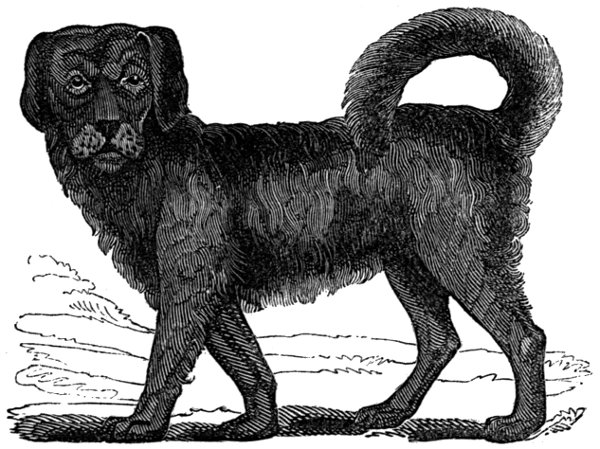
This dog is of a large size, being considerably superior, in point of strength, to the Newfoundland dog. He was originally produced by a cross between the Newfoundland and the Siberian, and has now assumed the characteristics of a distinct race: his head is large, with moderately long ears, and his tail bent over his back, like that of most of the boreal varieties; his hair is very long and curled, being from seven to nine inches in length; and in colour he varies from white with black patches, to pure white, and sometimes is entirely black. He has an expressive and intelligent countenance, and possesses all those qualities for which the Newfoundland dog is famous. In Russia this animal is employed for watching property, which he defends with all the assiduity of a mastiff or Newfoundland dog. He is sometimes also used in hunting the wolf and wild boar, for which he is admirably adapted, from his great strength, and from possessing considerable swiftness. His feet are semi-webbed, and he swims with great ease, and is accordingly often used in shooting aquatic birds, which he fetches out of the water when killed.
The dogs of Russia are not so quarrelsome amongst themselves as the British, probably owing to their never being encouraged to fight: and I am informed by a gentleman who resided twelve years in that country, that he never even heard of a dogfight there.—Brown.
Rust, s. The red incrustation of iron; the tarnished or corroded surface of any metal.
Rust, v. To gather rust; to have the surface tarnished or corroded.
Three ounces of black lead, half a pound of hog’s lard, one quarter of an ounce of camphor, boiled upon a slow fire; the gun-barrels to be rubbed with this, and, after three days, wiped off with a linen cloth: twice in a winter will keep off the rust, which the salt-water is otherwise sure to be continually bringing out from the iron.
To protect guns from rust in the humid climate I have been latterly accustomed to, I found nothing answer well but strong mercurial ointment. On the Western coast, oil, no matter how good in quality, is useless, but for cleaning. Those who are acquainted with the localities of that country know that turf is of trifling value. No limit is consequently placed upon its consumption; it is calculated only by the stack or the boat-full, and hence more fuel was wasted in my lodge, than would supply three moderate houses. Yet so penetrating is the damp from the ocean breeze, that the house-arms rusted above the fire-places, and the pistols I kept upon my table would spot if not frequently examined, and dry-rubbed with a flannel cloth.—Hawker—Wild Sports.
Rut, s. Copulation of deer; the track of a cart-wheel.
Rye, s. A coarse kind of bread corn.
Ryegrass, s. A kind of strong grass.
Saccade, s. obs. A violent check the rider gives his horse by drawing both the reins suddenly.
Sack, s. A bag, a pouch, commonly a large bag; the measure of three bushels; a kind of sweet wine now brought chiefly from the Canaries.
Saddle, s. The seat which is put upon the horse for the accommodation of the rider.
Saddle, v. To cover with a saddle; to fix the saddle on.
Saddlebacked, a. Horses saddlebacked have their backs low, and a raised head and neck.
Saddlegall, s. An injury on the horse’s back, arising from a defective or ill-fitted saddle.
Saddle or harness galls may be considered as bruises, and when it can be done should be poulticed, until the swelling has been dispersed or has suppurated. If the matter has not sufficient vent, the opening may be enlarged or the sinus laid open, if there is any. It must then be dressed with digestive ointment, and when it has been reduced to the state of a clear open sore, the cure may be finished by the astringent paste.—White.
Saddler, s. One whose trade is to make saddles.
Saffron, a. Yellow, having the colour of saffron.
Sagacious, a. Quick of scent; quick of thought; acute.
Sagittal, a. Belonging to an arrow.
Sakeret, s. The male of a sakerhawk.
Saline, a. Consisting of salt.
Saliva, s. Every thing that is spit up; but it more strictly signifies that juice which is separated by the glands called salival.
Salivate, v. To purge by the salival glands.
Dogs, when fully salivated, lose their teeth very early, and their breath continues offensive through life. The whole of the feline tribe are also easily affected by mercury. I was requested to inspect the very large lion that so long graced Pidcock’s menagerie. It may be remembered by many, that this noble animal’s tongue constantly hung without his mouth; which arose from his having been injudiciously salivated, many years before, by a mercurial preparation applied by the keeper for the cure of mange. The submuriate of mercury (calomel) is, likewise, very irregular in its action on dogs; I have seen eight grains fail to open the bowels of a small one, while, on the contrary, I have been called to a pointer fatally poisoned by ten grains. It forms however, a useful auxiliary to purgatives, in doses of three or four grains; and as it not unfrequently acts on the stomach, so it may be used with advantage as an emetic in some cases, particularly in conjunction with tartarised antimony (tartar emetic). When, therefore, a purgative is brought up again, in which calomel was a component part, it may be suspected to arise from this source, and, if it is necessary to repeat the purge, the mercurial should be omitted.—Blaine.
Salmon, s. The king of freshwater fish.
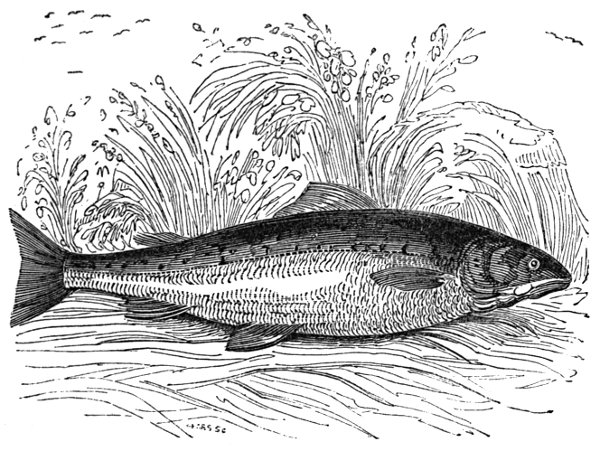
THE SALMON.
At the latter end of the year, and some in November, salmon begin to press up the rivers as far as they can reach, in order to spawn; when that period approaches, and they have accommodated themselves with a fit place, nature supplies the male with a bony excrescence, growing out of the end of the lower jaw, to the length of half an inch or more: this, it is said, aids him in the removal of the gravel, but both male and female assist in forming a proper receptacle for the spawn, in the sand or gravel, about eighteen inches deep. In this the ova and milt are deposited, and carefully covered by the parent fish, who afterwards hasten to cleanse and recover themselves (the male loses the gristle at the jaw); for, after spawning, they become very poor and lean, and then are called kipper. At their first entrance into the fresh water, salmon are observed to have abundance of insects adhering to them, especially above the gills: these animals denote the fish to be in high season, and die and drop off soon after the salmon’s leaving the sea.
The spawn lies buried until spring, and, without any other care, is nourished and brought to perfection, if not disturbed by violent floods, or by depredations from other fish, of which the eel, roach, dace, and grayling, are dangerous neighbours. About the latter end of March, the spawn begins to exclude the young, which gradually increase to four or five inches in length, and are then termed smelts, or smouts; about the beginning of May the river seems to be alive, and there is no framing an idea of the numbers without seeing them. A seasonable flood, however, hurries them to the sea, very few being left in the river. About the middle of June the earliest fry commence their return from the sea into the river (at that period from twelve to sixteen inches long), and progressively augment in number and size, until about the end of July, which is, at Berwick, the height of the grilse time (the name there given to the fish of that age). Early in August they lessen in number, but advance in bigness, some being from six to as high as nine pounds’ weight. This increase appears surprisingly quick; yet a gentleman of Warrington has given an instance of still more rapid growth: a kipper salmon, weighing seven pounds three quarters, taken on the 7th of February, was marked with scissors on the back fin and tail, and turned into the river; he was again taken on the 17th of the following March, and then weighed seventeen pounds and a half. In this case the remark of Walton seems to have been more than verified, “that the samlet becomes a salmon in as short a time as a gosling becomes a goose.”
The salmon in Lough Erne increase in size wonderfully, and young ones, which were caught and marked when going into the lake, have been caught on their return, and found so large, that they must have increased at the rate of one pound per week.
The migratory habits of the salmon, and the instinct with which it periodically revisits its native river, are curious circumstances in the natural history of this fish. As the swallow returns annually to its nest, as certainly the salmon repairs to the same spot in which to deposit its ova. Many interesting experiments have established this fact. M. De Lande fastened a copper ring round a salmon’s tail, and found that for three successive seasons it returned to the same place. Dr. Bloch states, that gold and silver rings have been attached by eastern princes to salmon, to prove that a communication existed between the Persian Gulf and the Caspian and Northern Seas, and that the experiment succeeded. Shaw, in his Zoology, mentions that a salmon of seven pounds and three quarters was marked with scissors on the back fin and tail, and turned out on the 7th of February, and that it was retaken in March of the succeeding year, and found to have increased to the amazing size of seventeen pounds and a half. This statement, by the by, is at variance with the theory of Dr. Bloch, who estimates the weight of a five or six year old salmon at but ten or twelve pounds.
That the salmon should lose condition rapidly on quitting the sea for the fresh water, may be inferred from a fact agreed upon by naturalists, that during the period of spawning the fish neglects feeding. In this peculiar habit the salmon is not, however, singular; animals of the Phocæ tribe, in breeding-time, exercise a similar abstinence. On opening a salmon, at any season, no food will be discovered, and the contents of the stomach will be confined to a small quantity of yellowish fluid and tape-worms, which are generated there. Sir Humphry Davy believes that occasionally food may be found. I have seen thousands opened preparatory to being salted, and I never observed anything but this fluid and tape-worms. Another circumstance may be stated as a curious proof of health, as well as of the period of time the salmon has been resident in a river. When the fish leaves the sea, and of course is in its best condition, insects (the Lernæ Salmoneæ of Linnæus) will be perceived firmly adhering to the skin. Immediately on entering the fresh water, these insects begin to detach themselves from the salmon, and after a short time they gradually drop off and disappear.
Ireland (particularly the north) abounds with salmon; the most considerable fishery is at Crarma, on the river Ban, near Coleraine. (Some account of this fishery is mentioned in the list of the rivers, &c. of this country.) The nets used are eighteen score, or three hundred and sixty yards long, and are continually drawing, night and day, the whole season (nearly four months), two sets of sixteen men each alternately relieving one another. The best drawing is when the tide is coming in.
The salmon are cured by being first split, and rubbed with fine salt; and, after laying in pickle, in great tubs or reservoirs, are packed up with layers of coarse brown Spanish salt, in casks, six of which make a ton. These are exported to Leghorn and Venice.
Immediately near to Katrineberg, at a hamlet called Deje Forsa, there is a valuable fishery for salmon, ten or twelve thousand of these fish being taken there annually. They are, however, of a small size, the largest of them rarely exceeding twenty pounds in weight; one with another, indeed, they probably do not average more than six or seven pounds a-piece.
These salmon are bred in the Wenern lake, but, in consequence of the considerable cataracts at Deje, they never have access to the sea; from this cause, they are said to be inferior, in point of flavour, to those found in most other rivers.
I subjoin a statement of the numbers taken in eight successive years:—
1820 21,817
1821 11,751
1822 10,103
1823 9,823
1824 14,313
1825 8,884
1826 5,800
1827 10,500
———
92,991
———
11,624 average.
In the river Beaulie, below the falls, is a valuable salmon fishery, and in the months of July and August many of these come to the foot of the falls. When a flood occurs, they endeavour to get up the stream, but as the water in which they swim is constantly agitated and frothy, on account of the height from which it descends, they cannot see before them, often mistake their direction, and leap upon the dry rock. It is a constant practice with the people in the neighbourhood to lay branches of trees along the side of the water, to prevent the fish tumbling back into the river. Twenty salmon have by these means been frequently taken in a morning. The last Lord Lovat is said to have performed a curious experiment here. He made a fire upon the rock, and placed on it a large pot of water; speedily a salmon, making a leap, tumbled into the pot where it was soon boiled, and no doubt eaten. This was done that his lordship might be enabled to boast in the south of the wonders that existed in the Highlands, which were then little known, and to say that in his country provisions abounded so much, that if a fire was made, and a pot set to boil on the banks of the river, the salmon would of themselves leap into the pot to be boiled, without requiring to be caught by a fisherman.
The fifteenth of February, 1809, Harry Fenn, a fish-salesman at Billingsgate, sold an uncrimped Severn salmon, weighing nineteen pounds, for the immense sum of one guinea per pound to Phillips, the fishmonger in Bond Street. N.B. It was the only salmon at market.
La Fontaine gives an anecdote of a gourmand, who having despatched an entire salmon with the exception of the jowl, was taken so ill that the physician pronounced his recovery to be impossible. “Is it so?” said the dying fish-fancier—the doctor gave a desponding nod—“Bring me then the remainder of my salmon.”
Salmon Colour.—Take two ounces of annotto, tie it up in a bag, then throw it into clean cold water, and squeeze it in the rag often, till you melt a quantity of it down; pour off some of this liquor into your dye-pot, put in your stuff and boil it, and if it is pretty red, put in some madder, a little at a time, and if you see it is come to the colour, draw, squeeze out the remainder, put it into your pot, and sparingly add more madder. By using Brazil instead of madder, you will get flesh colour.
Salmon fishing.—In salmon fishing you must alter your manner of moving the fly. It must not float quietly down the water; you must allow it to sink a little, and then pull it back by a gentle jerk, not raising it out of the water, and then let it sink again till it has been shown in motion, a little below the surface, in every part of your cast.
Salmon often in this season haunt the streams in pairs; but so far from rising again after being pricked, they appear to me to learn when they have been some time in the river, that the artificial fly is not food, even without having been touched by the hook. In the river at Galway, in Ireland, I have seen above the bridge some hundreds of salmon lying in rapid streams, and from five to ten fishermen tempting them with every variety of fly, but in vain. After a fish had been thrown over a few times, and risen once or twice and refused the fly, he rarely ever took any notice of it again in that place. It was generally nearest the tide that fish were taken, and the place next the sea was the most successful stand, and the most coveted; and when the water is low and clear in this river, the Galway fishermen resort to the practice of fishing with a naked hook, endeavouring to entangle it in the bodies of the fish; a most unartist-like practice. In spring-fishing, I have known a hungry, half-starved salmon rise at the artificial fly a second time, after having been very slightly touched with it; but even this rarely happens, and when I have seen it the water has been coloured.
I made several unsuccessful casts—“A bad look out, friend Julius; Heaven forefend that the cook has placed any dependence on the angle!” Again I tried the pool, and, like all disappointed fishermen, began to prognosticate a change of weather. “I had remarked mares’ tails in the sky yesterday evening, and there was rain over head, for a hundred.” My cousin smiled; when suddenly my nebulous speculations were interrupted by a deep sluggish roll at the dropper. “Monamondiaoul!” exclaimed Mortien Beg, as he caught a momentary glance of the broad and fan-like tail, “he is fifteen pound weight!” Obedient to the directions of my Mentor, I left the spot the salmon leaped in, and commenced casting a dozen yards below it. Gradually I came over him again. “A light cast, Frank, and you have him.” I tried, and succeeded gallantly. I sent the fly across the water with the lightness of the thistle’s down—at the same moment the breeze eddied up the stream, and curled the surface deliciously. A long, dull ruffle succeeded. Whish, span the wheel: wish-h-h-h-h, whish-h-h, whish—I have him!
Nothing, my dear George, can be more beautiful than the play of a vigorous salmon. The lubberly struggles of a pond fish are execrable to him who has felt the exquisite pleasure that attends the conquest of “the monarch of the stream.” His bold rushes—his sudden and rapid attempts to liberate himself from the fisher’s thrall—the energy with which he throws his silver body three or four feet above the surface of the water, and the unwearied and incessant opposition he makes until his strength is exhausted by the angler’s science. All this must be experienced, to be adequately conceived. In ten minutes I mastered my beautiful victim; and Mortien Beg gaffed and landed a splendid summer fish, which, if the cook’s scales be correct, weighed thirteen pounds and seven ounces.
Salmon laws.—The Scotch in early times had most severe prohibitions against the killing of the salmon. In the Regiam Majestatem are preserved several laws relating to their fisheries, couched in terms expressive of the simplicity of the times. From Saturday night until Monday morning they were obliged to leave a free passage for the fish, which is called the “Saterdaye’s sloppe.”
Alexander I. enacted “that the streame of the water sal be in all parts swa free, that ane swine of the age of three years, well feed, may turn himself within the stream round about, swa that his snowt nor taile sal not tuch the bank of the water.” By a law of James IV. the third offence was made capital (before that, the offender had power to redeem his life). “Slayers of reide fish, or smoltes of salmond, the third time are punished with death; and sic like he quha commands the samine to be done.” Salmon were in the reign of Henry VI. thought a present worthy of a crowned head, for in that reign, the Queen of Scotland sent to the Duchess of Clarence ten casks of salted salmon, which Henry directed to pass duty free.
Salmon Rod.—The salmon rod is, all but the top, made of ash, as being the lightest wood. The structure of the trout or fly rod has been variously recommended; the most ancient is, the butt to be made of yellow deal, seven feet long; next, a straight hazel, of about six feet; and then a delicate piece of fine-grained yew, exactly tapered, and ending in a point of whalebone, both making about two feet: to colour the stock, a feather dipped in aquafortis, and rubbed into the deal, gives it a cinnamon colour; for a nut-brown colour, a quartern of spirit lacquer, half an ounce of gamboge, the like quantities of gum sandarach and dragon’s-blood (the three last to be powdered very fine), and as much of each of them as will lie upon a sixpence, put into the spirit lacquer, which must be kept stirring, until properly mixed: the phial must be warmed as well as the wood, and the mixture gradually laid on with a camel’s-hair brush; after it is dried, a second and third coat is to be applied. To make the colour redder put double the quantity of dragon’s-blood; to make the rod mottled, get green copperas and dissolve in spring water; dip linen tape in the liquid, and while wet twist it round about, and let it remain on the rod eight or ten hours in the cool; unbind the tape, which will be dry, and use the above-mentioned varnish, which will give the desired effect. The varnish also preserves the rings and the bindings that fix them to the rod. To fasten a fly rod of the above make properly, a piece of shoemaker’s wax was rubbed upon each splice; a handle of a knife, or any hard thing, was rubbed over them, until they were smooth; they were then tied neatly together, and were as firm as any part of the rod.
The following comparison is made by Sir Humphry Davy, between trout and salmon:—The salmon is broader, has a tail rather more forked, and teeth in proportion are rather smaller. The trout, likewise, has larger and more black-brown spots on the body; and the head of the trout is a little larger in proportion. The salmon has fourteen spines in the pectoral fins, ten in each of the ventral, thirteen in the anal, twenty-one in the caudal, and fifteen in the dorsal. The salmon measures thirty-eight inches and a half in length, and twenty-one inches in girth; and his weight, as you see, is twenty-two pounds and a quarter. The trout has one spine less in the pectoral, and two less in the anal fin, and measures thirty inches and a quarter in length, and sixteen inches in girth, and his weight is eleven pounds. When opened, the stomach of the salmon contains nothing but a little yellow fluid, and, though the salmon is twice as large, does not exceed much in size that of the trout. The stomach of the trout, unlike that of the salmon, will be found full of food.—Daniel—Wild Sports—Lloyd—Davy, &c.
Salmon-trout, s. A trout that has some resemblance to a salmon.
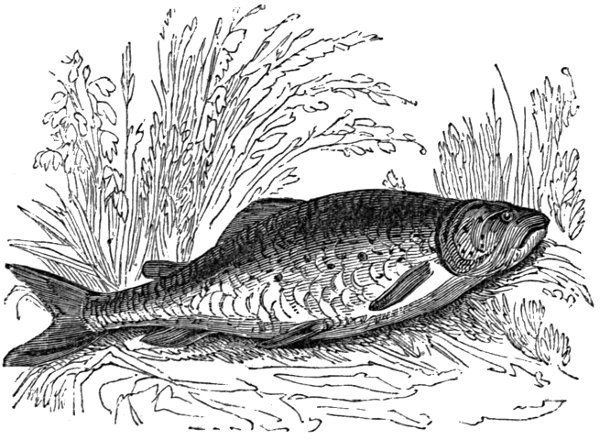
The salmon trout is handsome in its form, is more richly adorned, and is longer, thicker, rounder in proportion than a salmon; the scales are small, beautifully intermixed on both sides of the lateral line, and also the covers of the gills, with spots; the fins are strong, and the tail shorter, but not so much forked as the salmon’s; the flesh is exceedingly rich, and in some countries better esteemed than any fish of the salmon kind; they are generally from two to six pounds weight, some run larger; they are often taken when angling for salmon or large trout, their haunts being the same. Early in the spring they enter the rivers, are in prime season from the end of April until July, and spawn chiefly in September; but that period varies in different waters; the rod should be as for salmon, the reel line strong, and foot length about three yards of fine twisted silkworm gut, or the strongest single, with the knots well whipped.—Daniel.
Salt, s. Salt is a body whose two essential properties seem to be solubility in water and a pungent sapor.
Salt, a. Having the taste of salt, as salt fish; impregnated with salt; abounding with salt.
Salt, v. To season with salt.
Saltcat, s. A contrivance to attach pigeons to their dovecot.
The last dietetic, or rather, perhaps, medicinal article necessary to be described, is the saltcat, so called from an old fancy of baking a real cat with spices for the use of pigeons, which, however, I never observed to eat animal food. In compliance with this custom, I caused to be placed in the middle of the pigeon loft a dish of the following composition:—Loam, sand, old mortar, fresh lime, bay-salt, cummin, coriander, caraway seed, and allspice, moistened into a consistence with urine. The pigeons were constantly pecking at this, and were in a constant state of good health; how much of which may be attributed to the use of the cat I cannot determine; but certainly they are extremely fond of it, and if it have no other merit, it prevents them from pecking the mortar from the roof of the house, to which otherwise they are much inclined. The cat was mixed and heaped up in the dish, a piece of board being placed upon the summit to prevent the birds from dunging upon it; when become too hard it was occasionally broken for them.
The regular old formula for this cat is as follows: gravel or drift-sand, unctuous loam, the rubbish of an old wall, or lime, a gallon of each—should lime be substituted for rubbish, a less quantity of the former will suffice—one pound of cummin-seed, one handful of bay-salt; mix with stale urine. Inclose this in jars, corked or stopped, holes being punched in the sides, to admit the beaks of the pigeons. These may be placed abroad—Moubray.
Saltpetre, s. Nitrate of potash. The chief ingredient in the composition of gunpowder.
Saltwater, s. The water of the sea.
When on the sea, always use linseed oil for every part of your gun, except the works of the locks; because sweet oil has not body enough to repel the effect of the salt water.
If the salt water should have stained your barrels, you will, I think, find yellow soap and warm water the best recipe to restore their colour.—Hawker.
Salve, s. A glutinous matter applied to wounds and hurts, a plaster.
Samlet, s. A little salmon; a par. Vide Par.
Sanable, a. Curable, susceptive of remedy.
Sandblind, a. Having a defect in the eyes, by which small particles appear before them.
Sandcrack, s. A disease in the horse’s hoof.
This is an accident that happens to dry brittle hoofs, and is in fact a breaking or fracture of the horn in the weakest part, that is, at the upper part of the inner quarter. A sandcrack almost always extends to the sensible parts, and can seldom be cured if the horse is kept in work. The first thing to be done is to open the crack with a drawing knife, for it generally runs obliquely under the horn, and cut out every hollow part completely, however far it may extend under the crust. Every particle of horn that is hollow or detached from the sensible parts must be completely cut away; some tar ointment should then be applied, or at first a solution of blue vitriol. If there is much lameness or inflammation in the foot, it should be poulticed for several days or a week, and then the horse should be turned to grass without shoes, or with a bar shoe, for three weeks at least, or until an inch of new hoof appears above the crack. A little blister ointment just above the crack often does good, and tar ointment on the crack and adjacent horn. Observe, too, that the quarter where the crack is must be rasped away as thin as possible. In this way sandcracks may be always cured without difficulty. The brittle state of the hoof, however, must be corrected when the horse returns from grass, by paring the soles rather thin, applying a wide hollow shoe, and keeping the foot stopped, not with cow-dung or clay, as has been advised, but with the tar ointment; this will be absorbed through the horn, stimulate the secreting vessels, and cause a plentiful effusion of that odorous vapour which is constantly escaping from the bottom of the foot. The vessels being thus unloaded, the temperature of the foot will be reduced, and the secretion of horn will be at the same time so increased, that the horse will soon be able to go with a narrower shoe.—White.
Sanderling, Torvillee, or Curwillet (Charadrius Calidris, Linn.; Maubeche, Buff.) s. A bird.
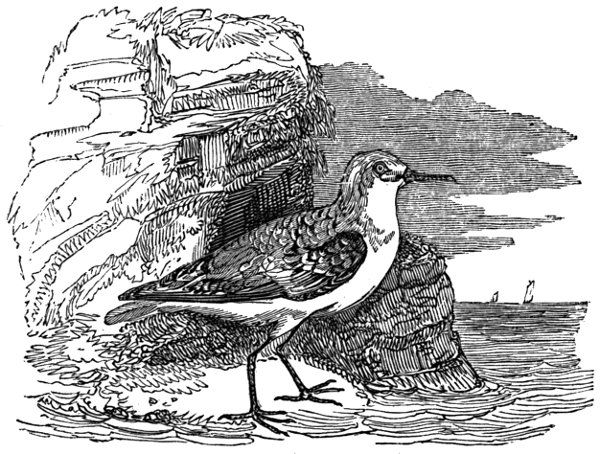
This bird weighs almost two ounces, is about eight inches in length, and fifteen in breadth from tip to tip. The bill is an inch long, slender, black, and grooved on the sides nearly from the tip to the nostril; the brow, to the eyes, white; the rest of the head, pale ash-colour, mottled in brown streaks from the forehead to the hinder part of the neck, and on each side of the upper part of the breast; back scapulars and greater coverts brownish ash, edged with dull white, and irregularly marked with dark brown spots. The pinions, lesser coverts, and bastard wings, dark brown; the quills, which extend beyond the tail, are of the same colour on the exterior webs and points, except four of the middle ones, which are white on the outer webs, forming, when the wing is closed, a sharp wedge-shaped spot; the inner webs brownish ash; the secondary quills brown, tipped with white; the rump and tail coverts are also brown, edged with dirty white; the tail feathers brownish ash edged with a lighter colour—the two middle ones much darker than the rest; the throat, fore part of the neck, breast, belly, thighs, and vent, are white; the toes and legs black, and bare a little above the knees. This bird is of a slender form, and the plumage has a hoary appearance among the stints, with which it associates on the sea shore in various parts of Great Britain. It wants the hinder toe, and has, in other respects, the look of the plover and dotterell, to which family it belongs.
Latham says, this bird, like the purre, and some others, varies considerably, either from age or the season; for those he received in August had the upper parts dark ash-coloured, and the feathers deeply edged with ferruginous colour; but others sent to him in January were of a plain dove-coloured grey. They differ also in some other trifling particulars.
Sandpiper, s. A bird.
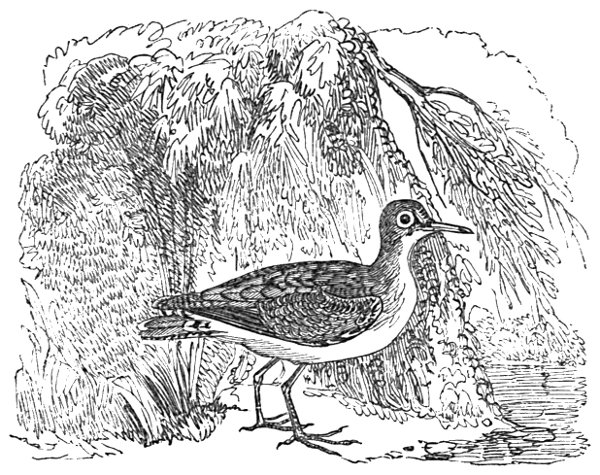
The tongue of the sandpiper is slender; toes divided, or very slightly connected at the base by a membrane; hinder toe weak; their bills are nearly of the same form as those of the preceding species, but shorter: their haunts and manner of life are also very similar. Latham has enumerated thirty-seven species and nine varieties of this genus, seventeen of which are British, exclusive of those which, in this work, are placed among the plovers; but the history and classifications of this genus are involved in much uncertainty.
Common Sandpiper. (Tringa hypoleucus, Linn.; La Guignette, Buff.)—This bird weighs about two ounces, and measures seven inches and a half in length. The bill is about an inch long, black at the tip, fading into pale-brown towards the base. The head, and hinder part of the neck, are brownish-ash, streaked downwards with dark narrow lines: the throat is white, and a streak of the same colour surrounds and is extended over each eye; the cheeks and auriculars are streaked with brown; the forepart of the neck, to the breast, is white, mottled and streaked with spots and lines of a brown colour, pointing downwards; in some the breast is plain white; belly and vent white. The ground-colour of all the upper parts of the plumage is ash, blended with glossy olive bronze; the coverts, scapulars, lower part of the back, and tail-coverts, are edged with dull white, and most elegantly marked with transverse dark-coloured narrow, waved lines; the first two quills are plain brown; the next nine are marked on the middle of their inner webs, with white spots; the secondaries are also marked in the same manner, on both webs, and tipped with white. The tail consists of twelve feathers; the four middle ones are of an olive brown, dark at the tips; those next to them, on each side, are much lighter coloured, mottled with dark-brown and tipped with white; the two outside ones are edged and tipped in the same manner, but are barred on their webs with dark-brown; legs pale dull-green, faintly blushed with red.
This elegant little bird breeds in this country, but the species is not numerous; yet they are frequently seen in pairs during the summer months; and are well known by their clear piping note, by their flight, by jerking up their tails, and by their manner of running after their insect prey on the pebbly margins of brooks and rivers. The female makes her nest in a hole on the ground near their haunts; her eggs, commonly five in number, are much mottled and marked with dark spots, on a yellowish ground. They leave England in the autumn; but whither they go is not particularly noticed by ornithologists. Buffon says they retire far north; and Pennant and Latham, that they are met with in Siberia and Kamtschatka, and are also not uncommon in North America.
Brown Sandpiper. (Fusca.)—Pennant describes this bird, which, he says, was bought in a London market, and preserved in the collection of the late M. Tunstall, Esq., of Wycliffe:—Size of a jacksnipe; the bill is black; the head, upper part of the neck, and back, are of a pale-brown, spotted with black; coverts of the wings dusky, edged with dirty white; under side of the neck white, streaked with black; the belly white; tail cinereous: legs black.
Greenwich Sandpiper. (Greenovicensis.)—Size of the redshank; weight nearly eight ounces; length twelve inches and a half; bill an inch and a half long, black; crown of the head reddish-brown, streaked with black; nape, cheeks, and neck, ash-colour; the middle of the feathers dusky, down the shaft; lower part of the neck and back, black; the feathers margined on the sides with pale ferruginous, and some of those of the back at the tips also; chin nearly white; forepart of the neck very pale ash-colour, as far as the breast, which is a dusky white; belly, sides, vent, and upper tail-coverts on each side, and the whole of the under ones, white; lesser wing-coverts ash-colour; the greater, the same, obscurely margined with pale ferruginous; greatest tipped with white; under wing coverts pure white; prime quills dusky, the shafts more or less white; secondaries and scapulars nearly the colour of the back; the secondaries and primaries very little differing in length; the lower part of the back, rump, and middle of the tail-coverts, ash-colour; tail a little rounded at the end, brownish ash-colour, somewhat mottled with brownish near the tips, and fringed near to the end with pale ferruginous; legs dusky olive-green, bare an inch above the knee; the outer and middle toe connected at the base.
Black Sandpiper. (Tringa cinerea.)—Size of a thrush; the beak short, blunt at the point, and dusky; nostrils black; the irides yellow: the head small, and flattened at the top; the colour white, most elegantly spotted with grey; the neck, shoulders, and back, mottled in the same manner, but darker, being tinged with brown; in some lights these parts appeared of a perfect black, and glossy; the wings were long; the quill feathers black, crossed near the base with a white line; the throat, breast, and belly white, with faint brown and black spots of a longish form, irregularly disposed, but on the belly become larger and more round; the tail short, entirely white, except the two middle feathers, which are black; legs long and slender, and of a reddish brown colour.
Spotted Sandpiper. (Tringa macularia, Linn.; La Grive d’Eau, Buff.)—This bird measures about eight inches in length; the bill is black at the tip, and fades into a reddish colour towards the base; a white streak is extended over each eye, and a brownish patch between them and the bill; the whole upper part of the plumage is of a glossy lightish brown, with green reflections; the head and neck are marked with longish small dark spots; on the back, scapulars, and wing coverts, the spots are larger, and of a triangular shape; the rump is plain; the greater quills are dusky; secondaries tipped with white, as are also the greater and lesser coverts, which form two white oblique lines across the extended wings; the two middle feathers of the tail are greenish brown; the sides ones white, crossed with dusky lines; the breast, belly, and vent, are white, but in the female spotted with brown; legs of a dirty flesh colour. This species is not common in England.
Red-legged, Sandpiper. (Tringa erythropus.)—This bird measures from the tip of the beak to the end of the tail ten inches; the bill is an inch and three-eighths long, black at the tip, and reddish towards the base; the crown of the head is spotted with dark brown, disposed in streaks, and edged with pale brown and grey; a darkish patch covers the space between the corners of the mouth and eyes; the chin is white; the brow and cheeks pale brown, prettily freckled with small dark spots; the hinder part of the neck is composed of a mixture of pale brown, grey, and ash, with a few distinct dusky spots; the forepart and breast are white, clouded with a dull cinnamon colour, and sparingly and irregularly marked with black spots, reflecting a purple gloss; the shoulder and scapular feathers are black, edged with pale rust colour, and have the same glossy reflections as those on the breast; the tertials are nearly the same length as the quills; the ridges of the wings are a brownish ash colour; the coverts, back, and rump, are nearly the same, but inclining to olive, and the middle of each feather is of a deeper dusky brown; the primary quills are deep olive brown; the exterior webs of the secondaries are also of that colour, but lighter, edged and tipped with white, and the inner webs are mostly white towards the base; the tail coverts are glossy black, edged with pale rust colour, and tipped with white, but in some of them a streak of white passes from the middle upwards nearly the whole length. The tail feathers are lightish brown, except the two middle ones, which are barred with spots of a darker hue; the belly and vent are white; legs bare above the knees, and red as sealing-wax; claws black. The female is less than the male, and her plumage more dingy and indistinct; an egg taken out of her previous to stuffing was surprisingly large considering her bulk, being about the size of that of a magpie, of a greenish white colour, spotted and blotched with brown, of a long shape, and pointed at the smaller end. This bird is a constant inhabitant of the fens, and is known to sportsmen by its singular notes, which are very loud and melodious, and are heard even when the bird is beyond the reach of sight.
The description of this bird, which, it seems, is common in the fen countries, has been more particularly attended to, because it has not been described in any of the popular works on ornithology; at least not so accurately as to enable a naturalist to distinguish it by the proper name.
Red Sandpiper, Aberdeen Sandpiper. (Tringa Icelandica, Linn.)—Latham describes this bird in the following manner:—Length from eight to ten inches; bill brown, one inch and a half long, and a little bent downwards; head, hinder part of the neck, and beginning of the back, dusky, marked with red; forepart of the neck and breast cinereous, and mixed with rust colour, and obscurely spotted with black; lesser wing coverts cinereous; quills dusky; secondaries tipped with white; the two middle tail feathers dusky; the other cinereous; legs long and black.
Ash-coloured Sandpiper. (Tringa Cinerea, Linn.)—This bird weighs between four and five ounces, and measures ten inches in length, and about nineteen in breadth. The whole upper parts of the plumage are of a brownish ash-colour: the head is spotted, and the neck streaked with dusky lines: the feathers of the back, scapulars, and wing coverts, are elegantly marked or bordered on their ridges and tips, with two narrow lines of dull white, and dark brown. Some specimens have black spots on the breast, but most commonly the whole under parts are pure white; the tail is cinereous, edged with white, and its coverts are barred with black; legs dirty green; toes edged with a fine narrow scalloped membrane.
The ash-coloured sandpiper, it is said, breeds in the northern parts of both Europe and America. Pennant says they appear in vast flocks on the shores of Flintshire in the winter season; and Latham, that they are seen in vast numbers on the Seal Islands, near Chateau Bay; and also that they breed and remain the whole summer at Hudson’s Bay, where they are called by the natives sasqua pisqua nishish.
Shore Sandpiper. (Tringa Littorea, Linn.; Le Chevalier Variée, Buff.)—Under this name Latham describes this bird, which it is said migrates from Sweden into England at the approach of winter. He makes it a variety of the last species, and says it does not differ materially from it. “The spots on the back are ferruginous instead of white: the shaft of the first quill is white, as in the green sandpiper; and the secondaries have white tips: the legs are brown.” Brunnich mentions a further variety, wherein the first quill has a black shaft, and the spots on the back and wings are less; and observes, that they differ in age and sex.
Green Sandpiper. (Tringa Ochropus, Linn.; Le Becasseau, ou Cul-blanc, Buff.)—This bird measures about ten inches in length, to the end of the toes nearly twelve, and weighs about three ounces and a half: the bill is black, and an inch and a half long: a pale streak extends from it over each eye; between which and the corners of the mouth; there is a dusky patch. The crown of the head and hinder part of the neck are of a dingy brownish ash-colour, in some specimens narrowly streaked with white; the throat white; fore part of the neck mottled or streaked with brown spots, on a white or pale ash-coloured ground. The whole upper parts of the plumage are of a glossy bronze, or olive brown, elegantly marked on the edge of each feather with small roundish white spots; the quills are without spots, and are of a darker brown; the secondaries and tertials are very long; the inside of the wings are dusky, edged with white grey; and the inside coverts next the body are curiously barred, from the shaft of each feather to their edges, with narrow white lines, formed nearly of the shape of two sides of a triangle. The belly, vent, tail coverts, and tail, are white; the last broadly barred with black, the middle feathers having four bars, and those next to them decreasing in the number of bars towards the outside feathers, which are quite plain: the legs are green.
This bird is not any where numerous, and is of a solitary disposition, seldom more than a pair being seen together, and that chiefly in the breeding season. It is a scarce bird in England, but is said to be more common in the northern parts of the globe as far as Iceland. It is reported that they never frequent the sea shores, but their places of abode are commonly on the margins of the lakes in the interior and mountainous parts of the country.—Bewick—Latham.
Sanguine, a. Red, having the colour of blood; abounding with blood more than any other humour.
Sap, s. The vital juice of plants, the juice that circulates in trees and herbs.
Sarcelle, (Clangula Glacialis, Flem.) s. A bird of the duck tribe.
This species is about the size of a widgeon, length twenty-two inches, including the long feathers of the tail; the bill is black; down the middle and across the tip, orange; irides red; the fore part and sides of the head are reddish grey; on each side of the neck, just below the head, is an oval black spot; the hind part of the head, the throat, and remaining part of the neck and breast, white; back and rump black; sides of the upper tail coverts white, the middle black; the lower belly and vent white; the scapulars white long, and pointed; the wings chiefly black, with a mixture of chestnut; the four middle tail feathers are black, the others white; the two middle ones are narrow, and exceed the others three inches and a half; legs of a dull red; claws black.
Such is the description of the male; but in some the black spots are more or less of a chocolate colour, and the spot on the neck occupies half of it. The length of the tail also varies.
The female has been described by some authors for a different species. The bill, however, which is the same in this sex, seems to be an unerring guide. The sides of the head are white, behind cinereous; the rest of the head, the neck, breast, and back, dusky black; the lower part of the breast and scapulars chestnut; belly white; upper tail coverts and wings like the male; legs dusky reddish brown. This sex is also subject to some variation; most commonly, the middle tail-feathers are not much longer than the rest. It is seldom met with in England, but is frequent in the north of Scotland and the Orkneys in winter, where they assemble in large flocks; it is common in Sweden, Lapland, and Russia, and is said to breed in Greenland and at Hudson’s Bay, where it makes a nest of grass near the sea, and lays ten or more bluish-white eggs. The down of this bird is said to be as valuable as that of the eider duck.—Montagu.
Savage, a. Wild, uncultivated; uncivilised, barbarous.
Savin, s. A plant formerly used in veterinary and canine diseases.
Scab, s. An incrustation formed over a sore by dried matter; the itch or mange of horses.
Scabbed, a. Covered or diseased with scabs; paltry, sorry.
Scad, s. A kind of fish, probably the same as shad.
Scale, s. A balance, a vessel suspended by a beam against another; the small shells or crusts which, lying one over another, make the coats of fishes; anything exfoliated; a thin lamina; regular gradation; anything marked at equal distances.
Scale, v. To climb as by ladders; to measure or compare; to take off a thin lamina; to pare off a surface; to clean fishes.
Scaled, a. Squamous, having scales like fishes.
Scallop, s. A fish with a hollow pectinated shell.
Scalp, v. To deprive the skull of its integuments.
Scaly, a. Covered with scales.
Scapula, s. The shoulder blade.
Scapulars, s. In ornithology, are feathers which take their rise from the shoulders, and cover the sides of the back.
Scar, s. A mark made by hurt or fire, a cicatrix.
Scar, v. To mark as with a sore or wound.
Scarfskin, s. The cuticle; the epidermis.
Scarification, s. Incision of the skin with a lancet, or such like instrument.
Scarlet, a. Of the colour of scarlet.
Scate, s. A kind of wooden shoe on which people slide; a fish of the species of thornback. Scates are exceedingly abundant on the Irish coasts: they are a coarse fish, and little valued.
Scate, v. To slide on scates.
Scating, a. The art of sliding.
Scaup Duck, or Spoonbill Duck (Nyroca marila, Flem.), s.
The length of this species is about twenty-one inches; weight sometimes as much as thirty-five ounces; the bill is broad, and not so much compressed as usual in this genus; colour bluish-lead; nail black; irides light gold-colour; the head and upper part of the neck black, glossed with green, and, from being well clothed with feathers, appears large; the lower part of the neck and breast black; back and scapulars pale grey, undulated with innumerable small transverse lines of black; the wing coverts the same, but minutely small; lower part of the back, rump, and vent, black; the primores are dusky, lightest on their inner webs, and black at the ends; the secondary quills, except a few next the body, are white tipped with black, forming a broad bar of white across the wing; the under part of the body is white, sprinkled between the thighs with dusky; the tail is composed of dusky-black feathers; legs lead-colour. In some we have seen, the white in the wing is edged with rust-colour: it is also subject to other varieties.
The scaup duck is not uncommon in most parts of this kingdom in winter, and is frequently found in fresh waters. It is supposed to take its name from feeding on broken shells called scaup. This, like most of the genus, breeds in the more northern parts; is common in Russia, Sweden, Norway, and Lapland; and is found at Hudson’s Bay, in the warmer months.—Montagu.
Scent, s. The power of smelling; the smell; the object of smell; chace followed by the smell.
Scent cannot be ascertained by the air only, it depends also on the soil. Doubtless, the scent most favourable to the hound, is when the effluvia constantly perspiring from the game as it runs, is kept by the gravity of the air to the height of his breast; for then it is neither above his reach, nor need he stoop for it: this is what is meant when scent is said to be breast high. Experience tells us that difference of soil alters the scent. When the leaves begin to fall, and before they are rotted, scent lies ill in cover—a sufficient proof that it does not depend on the air only. Scent also varies by difference of motion; the faster the animal goes the less scent it leaves. When game has been ridden after, and hurried on by imprudent sportsmen, hounds will with difficulty pick out the scent; and one reason may be, that the particles of scent are then more dissipated: but if the game should have been run by a dog not belonging to the pack, very seldom will any scent remain.
Scent frequently alters in the same day; and without asserting what scent exactly is, it may be said to depend chiefly on two things—the condition of the ground, and the temperature of the air, which should be moist without being wet. When both are in this state, the scent is then perfect; and vice versa, when the ground is hard and the air dry, there seldom will be any scent. It scarce ever lies with a north or an east wind; a southerly wind without rain, and a westerly one that is not rough, are the best. Storms in the air seldom fail to destroy scent. A fine sunshiny day is not good for hunting; but a day warm without sun, is generally a perfect one: there are not many such in a whole season. In some fogs scent lies high, in others not at all, depending, probably, on the quarter the wind is then in. It sometimes lies very high in a mist, when not too wet; but if the wet continues to hang upon the boughs and bushes, it will fall upon the scent and deaden it. When the dogs roll, and also when cobwebs hang on the bushes, there is seldom much scent. During a white frost, the scent lies high, as it also does when the frost is quite gone; at the time of its going off (which is a critical minute for hounds, in which their game is frequently lost), scent never lies. In a hard rain, with the air mild, scent will sometimes be very good. A wet night often produces the best chases, game not then liking to run the cover or the roads. In heathy countries, where the game brushes as it goes along, scent seldom fails; yet, from the inclosures of poor land surrounding them, the scent is, at times, very difficult for hounds; the sudden change from a good to a bad scent confuses their noses; a scent therefore which is less good, but less unequal, is more favourable to hounds. When the ground carries the scent is bad for an obvious reason, which hare-hunters who pursue their game over greasy fallows and dirty roads have great cause to complain of. A remark has been generally made, that scent lies best in the richest soils, and those countries which are favourable to horses are not so to hounds; and it has likewise been observed in some particular spots in almost every country, let the temperature of the air be as it may, that hounds can never carry a scent across them.
The morning is the part of the day which usually affords the best scent, and the animal itself, which you are at this time more than ever desirous of killing, is then least able to escape; the want of rest, added perhaps to a full belly, give hounds a decided superiority over an early found fox.—Daniel.
Scent, v. To smell, to perceive by the nose; to perfume, or to imbue with odour good or bad.
Schooner, s. A vessel with two masts.
Schooners, within the last twenty years, have gradually come into general use, and have, in a great degree, superseded the smaller sized brigs and large sloops which were formerly employed as coasters. They are found more manageable and weatherly, and in sailing qualities infinitely superior to either.
The Americans are celebrated for the size of their schooners, and the beauty of their mould. In the late war, numbers of these vessels were fitted out as privateers; and from their extraordinary sailing properties, their success was unexampled.
In the Royal Yacht Club there are a good number of vessels of this class; but the cutter rig appears to be the favourite.
The common tonnage of schooners ranges from 80 to 150; but some of the Baltimore privateers admeasured 300 tons.
Scirrhus, s. An indurated gland.
Scirrhous, a. Having a gland indurated.
Scissors, s. A small pair of shears, or blades moveable on a pivot, and intercepting the thing to be cut. Scissors with very fine points are indispensable to fly-tiers.
Scollop, s. A pectinated shell fish.
Scolopax, (Illiger,) s. The snipe, a genus thus characterised:—
Bill long, straight, compressed, slender, soft, bulged at the point; the two mandibles furrowed about the half of their length; the point of the upper mandible longer than the under, the bulged part forming a hook; ridge elevated at its base and salient; nostril, at the sides of the base, slit lengthwise, near the edges of the mandible, covered by a membrane; legs of mean length, slender, the naked space above the knee very small; three toes before entirely divided, the middle and the outer ones rarely united; one toe behind; wings of mean length, the first quill of equal length, or a little shorter than the second, which is the longest in the wing.
This division of the numerous scolopax genus of Linnæus amounts, according to Latham, to about twenty species, besides varieties, of which only the woodcock, common snipe, and judcock, and their varieties, are accounted British birds.
Pennant has placed the woodcock after the curlews, as the head of the godwits and snipes; and others are of opinion that the knot, from the similarity of its figure to that of the woodcock, ought to be classed in this tribe. In the subdivisions, ornithologists may vary their classification without end. As in a chain doubly suspended, the rings of which gradually diminish towards the middle, the leading features of some particular bird may point it out as a head to a tribe; others, from similarity of shape, plumage, or habits, will form, by almost imperceptible variations, the connecting links; and those which may be said to compose the curvature of the bottom, by gradations equally minute, will rise to the last ring of the other end, which, as the head of another tribe, will be marked with characters very different from the first.—Montagu.
Scoter, Black Duck, or Black Diver, (Anas Nigra, Linn.; La Macreuse, Buff.) s. A kind of duck.
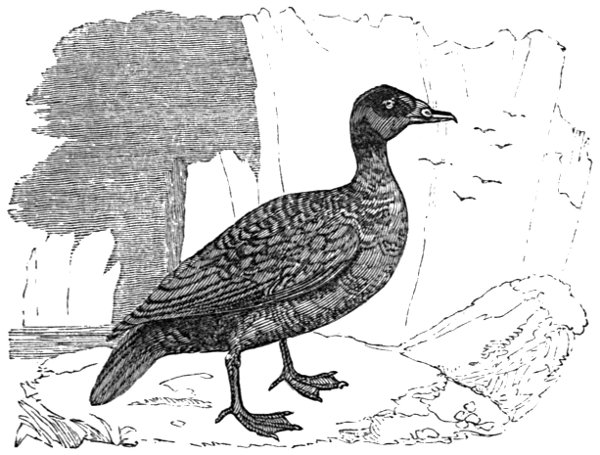
The scoter is less than the velvet duck, weighing generally about two pounds nine ounces, and measuring twenty-two inches in length, and thirty-four in breadth.
In severe winter the scoters leave the northern extremities of the world in immense flocks, dispersing themselves southward along the shores of more temperate climates. They are only sparingly scattered on the coasts of England.
The scoters seldom quit the sea, upon which they are very nimble, and are indefatigable expert divers; but they fly heavily, near the surface of the water, and to no great distance, and are said to walk awkwardly erect on the land.—Bewick.
Scray, s. A bird called the sea-swallow.
Screech, v. To cry out as in terror or anguish; to cry as a night owl.
Screechowl, s. An owl that hoots in the night.
Screen, s. Anything that affords shelter or concealment; a riddle to sift sand. An artificial erection to cover the shooter’s approach when stealing upon wildfowl.
Screw, s. One of the mechanical powers; a kind of twisted pin or nail which enters by turning; bolts which secure a gun-lock.
Screw, v. To turn by a screw; to fasten with a screw; to deform by contortions.
Screwdriver, s. An implement to turn screws.
Scruple, s. Doubt; perplexity; twenty grains, the third part of a drachm.
Sculk, v. To lurk in hiding-places, to lie close.
Scull, s. The bone which incases and defends the brain; the arched bone of the head; a small boat; one who singly rows a boat; a shoal of fish.
Sculler, s. A boat in which there is but one rower; one that rows a boat, singly.
Scurf, s. A kind of dry miliary scab; soil or stain adherent; anything sticking on the surface.
Scut, s. The tail of those animals whose tails are very short, as the hare, rabbit, &c.
Sea, s. The ocean, the water opposed to the land; a collection of water.
Sea-fishing, s. The pursuit of sea-fish.
This water-sport is unknown ‘to the many,’ and yet to him whose hands are not unacquainted with rope and oar, it affords, at times, an admirable amusement.
The coal-fishing requires a stiff breeze, and if there be a dark sky it is all the better. In its detail it is perfectly similar to mackerel-fishing, only that the superior size of the coal-fish makes stronger tackle and a heavier lead indispensable.
An eel of seven or eight inches long is the bait. The head being removed, the hook is introduced as in a minnow, and the skin brought three or four inches up the snoud. This latter is a fine line of two or three fathoms length, affixed to the trap-stick and lead, the weight of which latter is regulated by the rate of sailing.
The coal-fish, in weight, varies from two to fourteen pounds; it is finely shaped, immensely rapid, uniting the action of the salmon with the voracity of the pike. If he miss his first dash, he will follow the bait to the stern of the boat, and I have often hooked them within a fathom of the rudder.
Four or five knots an hour, is the best rate of sailing for killing coal-fish, and upon a coast where they are abundant, the sport, at times, is excellent.
Like the pike the coal-fish is very indifferent to the tackle used, which is generally very coarse. Not so the mackerel; he requires much delicacy of line and bait to induce him to take.
In light winds, or when the fish are out of humour, I have killed mackerel by substituting a salmon casting line of single gut, for the hempen snoud commonly employed by fishermen, which with a newly-cut bait of phosphoric brilliancy, commonly overcame his resolve against temptation. But there are times when a change of weather, or some inexplicable phenomena of sea or sky, render these fish dull and cautious—for usually it requires but trifling art to kill them.
A little experience is necessary. The bait must be cut from the freshest mackerel, and assimilated in size and shape to the herring-fry, which they generally follow—and the way of the boat must be so regulated, as to preserve the deception by a sufficient velocity, without breaking by its rapidity the mackerel’s hold. The mouth of this fish is particularly tender—and if care be not taken many will drop from the hook before they can be secured on board.—Wild Sports.
Seafowl, s. A bird that lives at sea.
Shooting Seafowl.—To venture after fowl at sea you must have a large boat with good bearings, that will carry plenty of canvass. Rowing after them scarcely ever answers; but when it blows fresh a fast sailing boat may often run in upon geese, and sometimes other birds, before they can take wing; and after a coast has been for some time harassed by the gunning punts, I have seen more birds killed under sail from a common boat, than by any other manner of day shooting. But, to do the business well, a stanchion gun must be fixed in the boat, and this, by all means, contrived so as to go back with the recoil, or you run the risk of staving your boat, and therefore of being really in danger. Recollect when you get on the outside of the harbour an accident is no joke; and you have, as Dr. Johnson observes, but one plank between you and eternity.
A boat for this work should have plenty of bearings, and have as little keel as she can well go to windward with, in order to get, at times, within shot of the mud and sands, and also to run through a harbour at spring tides without getting aground. You should therefore, for this sport, always make choice of a day when the wind is off the land, and a time when the tide is flowing; as you have then no danger of filling your boat with the hollow sea of a lee shore, or running her so fast aground as not to be able to get her off immediately. In following wild fowl under sail, command, as much as you can, a windward berth, in order to bear down on them at pleasure; and if they rise out of shot against wind, as they usually do, luff up directly, and try to head them for a cross shot. As the gun, when on one tack, is in the way of the jib, you must have the man who attends the jib-sheets always in readiness to haul the weather one to windward; but this must be done only just before you want to fire, or you deaden the boat’s way. Take care also to let the sheet be under the barrel of the gun, in order that your line of aim may be clear of every thing. In this pursuit, when the more wind sometimes the more sport, never go with less than three good hands; and be careful in squally weather not to make too fast the mainsheet, as nine-tenths of the misfortunes that we hear of, have occurred from this very circumstance.—Hawker.
Seagreen, a. Resembling the colour of the distant sea, cerulean.
Seagull, s. A sea bird. Vide Gull.
Seahog, s. The porpoise.
Seal, s. A stamp engraved with a particular impression, which is fixed upon wax; the seacalf, or phoca.
Seals are very numerous on the coast, and at this season a number may be seen any warm day you make an excursion up the Sound of Achil. We shoot them occasionally; the skin makes a waterproof covering, and the fat affords an excellent oil for many domestic purposes. It is difficult, however, to secure the animal, for numbers are shot and few gotten. The head is the only place to strike them, for even when mortally wounded in the body, they generally manage to escape. This fact we have ascertained, from finding them dead on shore many days after they were wounded, and at a considerable distance from the place where they had received the bullet. I shot one last autumn at the mouth of the river, and a fortnight afterwards he was taken up in the neighbourhood of Dhuhill. There could be no doubt as to the identity of the creature, for on opening him to extract the oil, a rifle-ball, such as I use, of the unusually small size of fifty-four to the pound, was found lodged in his lungs. Unless when killed outright, they sink instantly; and I have seen the sea dyed with blood to an extent that proved how severely the seal had been wounded, but never could trace him farther.