INTRODUCTION. (continued 25)
Reading edition
Thrushes may happen in the fore-feet merely from filthiness, and may then be cured as they are in the hind-feet; but this is not a common occurrence.
The third kind of thrush I have to describe is not so common as the two former, and is no other than an incipient canker. It may always be cured by removing from the frog every bit of horn that is detached from the sensible frog, and by which a diseased part may be concealed, and then applying to the affected part a saturated solution of blue vitriol, or egyptiacum, with a few drops of sulphuric acid. Cleanliness must be carefully attended to; and when the disease of the frog has been cured, tar, or hoof-ointment, may be employed to promote the regeneration of horn.—White.
Tick, s. Score, trust; the case which holds the feathers of a bed; the louse of dogs or sheep.
To destroy ticks, rub the dogs over with oil. The oil operates by stopping up their spiracula, or breathing pores; a few drops of oil poured on a wasp so as to cover it, destroys it in a few seconds.—Blaine.
Tike, s. A species of dog.
Tilt, s. A tent, any covering over head; the cover of a boat; a military game at which the combatants run against each other with lances on horseback; a thrust. Vide Strutt.
Tin, s. One of the primitive metals, called by the chemists Jupiter.
This metal is a good anthelmintic in dogs; and though not employed in veterinary practice, appears to be worth a trial. I have known great numbers of worms discharged from dogs, by giving filings or scrapings of pewter, which is composed principally of tin and lead. The dose about a drachm. Vide Anthelmintics.—White.
Tincture, s. Colour or taste superadded by something; medical preparations made by infusing or digesting vegetables, &c. either in rectified or proof spirit.
Compound tincture of benzoin, commonly named Friar’s, or traumatic balsam, is made by digesting gum benzoin, aloes, &c. in rectified spirit. Tincture of opium is made by digesting opium in proof spirit. There are also tinctures made with vinegar, such as squill and meadow saffron. Compound spirit of ammonia likewise is sometimes employed, as in the volatile tincture of guaiacum, and fœtid spirit of ammonia.—White.
Tinder, s. Anything eminently inflammable placed to catch fire.
Tinge, v. To impregnate or imbue with a colour or taste.
Tinsel, s. A kind of shining cloth; anything shining with false lustre, anything showy and of little value.
Tip, s. Top, point, end, extremity.
Tit, s. A small horse, generally in contempt; a woman, in contempt; a titmouse or tomtit, a bird.
Titlark, s. A small bird; a name for the meadow pipit.
Titmouse, s. A small species of bird.
This diminutive tribe is distinguished by a peculiar degree of sprightliness and vivacity, to which may be added a degree of strength and courage which by no means agrees with its appearance. Birds of this class are perpetually in motion; they run with great celerity along the branches of trees, searching for their food in every little cranny, where the eggs of insects are deposited, which are their favourite food. During spring they are frequently observed to be very busy among the opening buds, searching for caterpillars, and are thus actively employed in preventing the mischiefs that would arise from a too great increase of those destructive insects, whilst at the same time they are intent on the means of their own preservation; they likewise eat small pieces of raw meat, particularly fat, of which they are very fond. None of this kind have been observed to migrate; they sometimes make short flittings from place to place in quest of food, but never entirely leave us. They are very bold and daring, and will attack birds much larger than themselves with great intrepidity.
These birds are very widely spread over every part of the old continent, from the northern parts of Europe to the Cape of Good Hope, as well as to the farthest parts of India, China, and Japan; they are likewise found throughout the vast continent of America, and in several of the West India islands. They are every where prolific, even to a proverb, laying a great number of eggs, which they attend with great solicitude, and provide for their numerous progeny with indefatigable activity.
All the titmice are distinguished by short bills, which are conical, a little flattened at the sides, and very sharp-pointed; the nostrils are small and round, and are generally covered by short bristly feathers, reflected from the forehead; the tongue seems as if cut off at the end, and terminated by short filaments; the toes are divided to their origin; the back toe is very large and strong.—Bewick.
Tivy, a. A word expressing speed, from tantivy, the note of a hunting-horn.
Toad, s. An animal resembling a frog; but the frog leaps, the toad crawls; the toad is accounted venomous.
I remember some years ago getting up into a mulberry-tree, and finding in the fork of the two main branches a large toad almost embedded in the bark of the tree, which had grown over it so much, that he was quite unable to extricate himself, and would probably in time be completely covered over with the bark. Indeed, as the tree increased in size, there seems to be no reason why the toad should not in process of time become embedded in the tree itself, as was the case with the end of an oak rail that had been inserted into an elm-tree, which stood close to a public footpath. This, being broken off and grown over, was, on the tree being felled and sawn in two, found nearly in the centre of it. The two circumstances together may explain the curious fact of toads having been found alive in the middle of trees, by showing that the bark having once covered them, the process of growth in the tree would annually convey the toad more nearly to the centre of it, as happened with the piece of oak-rail; and by showing that toads, and probably other amphibia, can exist on the absorption of fluids by the skin alone. This is confirmed by the following fact. A gentleman informed me that he put a toad into a small flower pot, and secured it so that no insect could penetrate into it, and then buried it in the ground at a sufficient depth to protect it from the influence of frost. At the end of twenty years he took it up, and found the toad increased in size, and apparently healthy. Dr. Townson, in his tracts on the respiration of the amphibia, proves, I think satisfactorily, from actual experiment, that, while those animals with whose economy we are best acquainted receive their principal supply of liquids by the mouth, the frog and salamander tribes take in theirs through the skin alone; all the aqueous fluid which they take in being absorbed by the skin, and all they reject being transpired through it. He found that a frog absorbed nearly its own weight of water in the short space of an hour and a half, and that by being merely placed on blotting-paper well soaked with water; and it is believed that they never discharge it, except when they are disturbed or pursued, and then they only eject it to lighten their bodies, and facilitate their escape. That the moisture thus imbibed is sufficient to enable some of the amphibia to exist without any other food, there cannot I think be a reasonable doubt; and if this is admitted, the circumstance of toads being found alive in the centre of trees is accounted for by this and the preceding facts related.
In additional proof however of what has been advanced, I may mention that the respectable proprietor of some extensive coal-mines in Staffordshire, informed me that his men, in working into a stratum of thick coal at a very considerable depth, found three live eels in a small deposit of water in the centre of a block of coal, which died as soon as they were taken out of it. Another case was mentioned to me by an eminent physician. A wet spot had always been observed on a freestone mantel-piece, which afterwards cracked at that place, and upon its being taken down, a toad was found in it, dead; but its death was probably owing to the want of that moisture which it had been enabled to imbibe when the stone was in the quarry, and which gradually lessened by the action of the fire, as from the moisture which appeared on that part of the mantel-piece, some time after it was put up, there seems but little reason to doubt that the toad was alive at that time.
It is a curious fact that toads are so numerous in the island of Jersey, that they have become a term of reproach for its inhabitants, the word ‘Crepaud’ being frequently applied to them; while in the neighbouring island of Guernsey not a toad is to be found, though they have frequently been imported. Indeed, certain other islands have always been privileged in this respect. Ireland is free from venomous animals, of course by the aid of St. Patrick. The same was affirmed of Crete in olden times, being the birth place of Jupiter. The Isle of Man is said also to be free from venomous creatures. The Mauritius, and I believe one of the Balearic islands, enjoys the same immunity.—Jesse.
Toast, v. To dry or heat at the fire; to name when a health is drunk.
Tod, s. A bush, a thick shrub; a certain weight of wool, twenty-eight pounds.
Toe, s. The divided extremities of the feet, the fingers of the feet.
Ton, s. A measure of weight of twenty cwts.
Tonic, a. Being extended, being elastic; relating to tones or sounds; a medicine to strengthen the system.
Tonics, according to Murray, are those substances whose primary operation is to give strength to the system. Their operation is not mechanical, as was once conceived; they act not on the simple solids, increasing their tension or tone, but on the living fibre, and are merely powerful stimulants permanent in their operation. By producing a gradual excitement, they give vigour to the actions of the system, and as that excitement is gradually produced, it is in like manner gradually diminished, and the habitual stimuli continuing to operate, diminished action does not succeed. Where tonics however are given in excess, are used unnecessarily, or for too long a time, they weaken the powers of life.
Tonics may be divided into minerals and vegetables; the former are generally considered the most powerful, and I believe are at this time generally preferred, not only on account of their supposed superior efficacy, but likewise, probably, from their being less expensive, and the dose less bulky and inconvenient.
The following is the list of tonics given by Murray, as employed in veterinary medicine:
Tonics from the mineral kingdom.—Preparations of quicksilver or mercury; of iron; of zinc; of copper; of arsenic; of oxymuriate of potash.
From the vegetable kingdom.—Peruvian bark, pale, yellow, and red; Angostura bark; snake-root; contrayerva; canella alba; cascarilla; calumba; quassia; simarouba; gentian; camomile; wormwood; centaury; Seville orange peel; horehound. Minerals may be employed either separately, or in combination.
The following are examples:—
No. 1. Powdered arsenic from 5 to 10 gr.
Powdered aniseed ½ oz.
Opium ½ dr.
Treacle enough to form the ball.
No. 2. Arsenic from 5 to 10 gr.
Sulphate of copper ½ dr.
Opium ½ dr.
Powdered caraways ½ oz.
Treacle enough to form the ball.
No. 3. Arsenic from 5 to 10 gr.
Opium ½ dr.
Sulphate of zinc 2 dr.
Caraway seeds ½ oz.
Treacle enough for the ball.
For the numerous formulæ of vegetable tonics vide White, vol. ii.—White.
Tooth, s. One of the bones of the mouth with which the act of mastication is performed; a tine, prong, a blade; the prominent part of wheels.
Decayed and tartared Teeth.—Sportsmen and persons living in the country, who are habituated only to healthy dogs, will smile at such a head line; but were they in London, or other large cities and towns, where dogs are petted and immured in hot apartments night and day; where also they are gorged with the richest food, and are not exercised but in a carriage; and withal are probably descended from a long lineage of parents equally unnaturally treated; they would see sufficient of these effects of an imperfect digestion, to make them aware that this article is perfectly in place; and the remarks which follow are in unison with the general intention of these pages, to let nothing pass unnoticed, which a long and critical attention to the habits and diseases of these animals renders necessary to be guarded against and remedied. In the dogs I have described, nothing is more common to find than carious teeth, insufferably fœtid; others displaced, preventing mastication; or an immense accumulation of tartar, which covers them, erodes the gums, and makes the animal insufferably offensive. The veterinarian will often be called on to remedy these evils: the decayed teeth he must remove, and the displaced ones also; the tartaric deposit he must likewise completely scale off with proper dental instruments; for the accumulation is not only most unpleasant to the owners, but injurious to the dogs, by its septic tendency, and its invariably ending in the destruction of the teeth. The ulcerations are best removed by touching them with a mixture of a proper strength made from the solution of the chloride of soda with water: by the use of this, these ulcers will quickly heal; and the continuance of it will do much to remove the remaining fœtor, and stop the further deposit of tartar, particularly if coupled with a corresponding improvement in the general treatment of the animal.—Blaine.
Toothach, s. Pain in the teeth.
I have been lately told by a friend, who rarely errs in his prescriptions, that the best cure for a toothach is,
One tablespoonful of rum,
Another of vinegar,
A teaspoonful of salt.
Mixed together and then held in the mouth.—Hawker.
Nothing is more annoying in the mountains than an attack of this afflicting disease. Grouse shooters are particularly obnoxious to it, from unavoidable exposure to wet and sudden alterations of atmospheric temperature. I have known a sporting expedition embittered by this visitation, and as professional assistance was not procurable, the sufferer had no remedy but the old and slow one—patience. I recommend the worthy colonel’s nostrum for two reasons; the first, that I believe it to be efficacious; and the second, that it is easily compounded.—Ed.
Top, s. The highest part of anything; the surface, the superficies; the extreme joint of a fishing-rod.
Topheavy, a. Having the upper part too weighty for the lower—a great defect in a fishing-rod.
Torch, s. A wax-light bigger than a candle; any large or portable light.
Touchhole, s. The hole through which the fire is conveyed to the powder in a gun.
Touchwood, s. Rotten wood used to catch the fire struck from the flint.
Tow, s. Flax or hemp beaten and combed into a filamentous substance.
Train, v. To draw along; to entice; to draw by artifice or stratagem; to educate, to bring up.
Train, s. Artifice, stratagem of enticement, the tail of a bird; a line of powder reaching to the mine.
Training, p. The act of putting into condition for racing, pugilism, or other violent exercises.
Training Racehorses.—A month is the least time that can be allowed to draw the horse’s body clear, and to refine his wind to that degree of perfection that is attainable by art.
It is first necessary to take an exact view of his body, whether he be high or low in flesh, and it is also necessary to consider whether he be dull or heavy, or brisk and lively when abroad. If he appear dull and heavy and there is reason to suppose it is owing to too hard riding, or, as the jockeys express it, to some grease that has been dissolved in exercise, and has not been removed by scouring, then the proper remedy is half an ounce of diapente, given in a pint of good sack; this will at once remove the cause, and revive the creature’s spirits. After this, for the first week of the month, he is to be fed with oats, bread, and split beans, sometimes the one and sometimes the other, as he likes best, and always leaving some in the locker, that he may feed at leisure whilst left alone. At feeding time, whatever is left of this must be removed and fresh given, by these means the creature will soon become high-spirited, wanton, and full of play. Every day he must be rode out on airing, and every other day it will be proper to increase his exercise, but not so as to make him perspire too much. The beans and oats should be put in a bag, and beaten till the hulls are all off, and then winnowed clean, and the bread, instead of being chipped in the common way, should have the crust cut clean off. If the horse be in good health and in spirits, when taken up for its month’s preparation the diapente must be omitted, and the chief business will be to give him good food, and so much exercise as will keep him in wind, without over-sweating or tiring him; when he takes larger exercise afterwards, towards the end of the month, it will be proper to have some horses to run against him. This will put him on his mettle, and the beating them will give him spirits: this, however, is to be cautiously observed, that he has not a blood heat (at full speed) given him for ten days or a fortnight before the race, and that the last heat that is given him the day before the race must be in his clothes, this will make him run with much more vigour, when stripped for the race, and feeling the cold wind on every part.
In the second week, the horse should have the same food, and more exercise. In the last fortnight, he must have dried oats, that have been hulled by beating. After this, they are to be wetted in a quantity of whites of eggs beaten up, and then laid out in the sun to dry, and when as dry as before the horse is to have them. This sort of food is very light of digestion, and very good for the creature’s wind. The beans in this case should be given more sparingly, and the bread should be made of three parts wheat, and one part beans; if he should become costive, under this course, he must then have some ale and whites of eggs beaten together, this will cool him and keep his body moist. In the last week, the mash is to be omitted, and barley-water given him in its place every day until the day before the race; he should have his fill of hay at first, and then given more sparingly, that he may have time to digest it, and on the morning of the race-day he must have a toast or two soaked in sack, and the same just before he is let out to the field. This is an excellent method, because the two extremes of fullness and fasting are at this time to be equally avoided, the one hurting his wind, and the other occasioning faintness that may make him lose. After he has had his food, the litter is to be shook up, and the stable kept quiet that he may be disturbed by nothing till he is taken out to run.
The training of Jockeys.—John Arnall, when rider to his Royal Highness the Prince of Wales, was desired to reduce himself as much as he possibly could, to enable him to ride some favourite horse, without his carrying more weight than was agreed upon; in consequence of which, he abstained from animal and even farinaceous food for eight succeeding days, and the only substitute was now and then a piece of apple; he was not injured by it at the time, and is now in good health: added to which, Dennis Fitzpatrick, a person at this time continually employed as a rider, declares that he is less fatigued by riding, and has more strength to contend with a determined horse, in a severe race, when moderately reduced, than when allowed to live as he pleased, although he never weighs more than nine stone, and frequently has reduced himself to seven stone seven pounds.
REPLY TO SIR JOHN SINCLAIR’S QUERIES BY
MR. SANDEVIR OF NEWMARKET.
How long does the training of jockeys continue?
With those in high repute as riders, in a greater or lesser degree, from about three weeks before Easter to the end of October, but a week or ten days are quite sufficient for a rider to reduce himself from the weight he is naturally of, to sometimes a stone and a half below it.
What food do they live on, both solid and liquid, and what quantities are allowed them of each?
For breakfast, a small piece of bread and butter, with tea, in moderation. Dinner is taken in a very sparing way, a very small piece of pudding, and less meat, and when fish is to be obtained, neither one nor the other are to be allowed; wine and water is their usual beverage, in the proportion of one part wine to two of water. Tea in the afternoon, with little or no bread and butter, and no supper.
What exercise do they get, and what hours of rest?
After breakfast, having sufficiently loaded themselves with clothes, that is, five or six waistcoats, two coats, and as many pair of breeches, a severe walk is taken, from ten to fifteen or sixteen miles; after their return home, dry clothes are substituted for those that are made very wet and uncomfortable by sweat, and, if much fatigued, some of them will lie down for an hour before dinner; after which, no severe exercise is taken, but the remaining part of the day is spent in that way that may be most agreeable to themselves; they generally go to bed by nine o’clock, and continue there till six or seven the next morning.
Are they purged, and what purges and other medicines are given them?
Some of them that do not like excessive walking, have recourse to purgative medicines, two ounces of Glauber’s salts is the usual dose, and it is very seldom that any other medicine is had recourse to.
Mr. Sandevir would recommend a similar process to reduce corpulency in either sex, as, from experience, he perceives, that the constitution does not appear to be injured by it, but he is apprehensive that hardly any person could be prevailed upon to submit to such severe discipline, that had not been inured to it from his infancy.
The art of training for athletic exercises consists in purifying the body and strengthening its powers by certain processes, which thus qualify a person for the accomplishment of laborious exertions. It was known to the ancients, who paid much attention to the means of augmenting corporeal vigour and activity; and accordingly among the Greeks and Romans certain rules of regimen and exercise were prescribed to the candidates for gymnastic celebrity.
The great object of training for running or boxing matches, is to increase the muscular strength and to improve the free action of the lungs or wind of the person subjected to the process, which is done by medicines, regimen, and exercise. That these objects can be accomplished is evident from the nature of the human system. It is well known (for it has been demonstrated by experiments) that every part of the firmest bones is successively absorbed and deposited. The bones and their ligaments, the muscles and their tendons—all the finer and all the more flexible parts of the body, are as continually renewed, and as properly a secretion, as the saliva that flows from the mouth, or the moisture that bedews the surface. The health of all the parts and their soundness of structure, depends upon this perpetual absorption and perpetual renovation; and exercise, by promoting at once absorption and secretion, promotes life without hurrying it, renovates all the parts, and preserves them apt and fit for every office. When the human frame is thus capable of being altered and renovated, it is not surprising that the art of training should be carried to a degree of perfection almost incredible; and that by certain processes the breath, strength, and courage of man should be so greatly improved as to enable him to perform the most laborious undertakings. That such effects have been produced is unquestionable, being fully exemplified in the astonishing exploits of our most celebrated pedestrians, which are the infallible results of preparatory discipline.
The skilful trainer attends to the state of the bowels, the lungs, and the skin; and he uses such means as will reduce the fat, and at the same time invigorate the muscular fibres. The patient is purged by drastic medicines; he is sweated by walking under a weight of clothes, and by lying between feather beds; his limbs are roughly rubbed; his diet is beef or mutton; his drink strong ale; and he is gradually inured to exercise by repeated trials in walking and running. By attenuating the fat, emptying the cellular substance, hardening the muscular fibre, and improving the breath, a man of the ordinary frame may be made to fight for one hour with the utmost exertion of strength and courage, or to go over one hundred miles in twenty-four hours.
The most effectual process for training is that practised by Captain Barclay, and the particular mode which he has adopted has not only been sanctioned by professional men, but has met with the unqualified approbation of amateurs. The following statement, therefore, contains the most approved rules, and it is presented to the reader as the result of much experience, founded on the theoretic principles of the art.
The pedestrian, who may be supposed in tolerable condition, enters upon his training with a regular course of physic, which consists of three doses. Glauber’s salts are generally preferred, and from one ounce and a half to two ounces are taken each time, with an interval of four days between each dose. After having gone through the course of physic, he commences regular exercise, which is gradually increased as he proceeds in the training. When the object in view is to accomplish a pedestrian match, his regular exercise may be from twenty-four miles a-day. He must rise at five in the morning, run half a mile at the top of his speed up hill, and then walk six miles at a moderate pace, coming in about seven to breakfast, which should consist of beefsteaks or mutton chops under done, with stale bread and old beer. After breakfast he must again walk six miles at a moderate pace, and at twelve lie down in bed without his clothes for half an hour. On getting up he must walk four miles, and return by four to dinner, which should also be beefsteaks or mutton chops, with bread and beer as at breakfast. Immediately after dinner he must resume his exercise by running half a mile at the top of his speed, and walking six miles at a moderate pace. He takes no more exercise for that day, but retires to bed about eight, and next morning proceeds in the same manner. After having gone in this regular course for three or four weeks, the pedestrian must take a four mile sweat, which is produced by running four miles in flannel at the top of his speed. Immediately on returning a hot liquor is prescribed in order to promote the perspiration, of which he must drink one English pint. It is termed the sweating liquor, and it is composed of the following ingredients, viz. one ounce of carraway seed, half an ounce of coriander seed, an ounce of root liquorice, and half an ounce of sugar-candy, mixed with two bottles of cider, and boiled down to one half. He is then put to bed in his flannels, and being covered with six or eight pairs of blankets and a feather bed, must remain in this state from twenty-five to thirty minutes, when he is to be taken out and rubbed perfectly dry. Being then well wrapped in a great coat, he walks out gently for two miles to breakfast, which on such occasions should consist of a roasted fowl. He afterwards proceeds with his usual exercise. These sweats are continued weekly, till within a few days of the performance of the match, or in other words he must undergo three or four of these operations. If the stomach of the pedestrian be foul, an emetic or two must be given about a week before the conclusion of the training, and he is now supposed to be in the highest condition. Besides his usual or regular exercise, a person under training ought to employ himself in the intervals in every kind of exertion which tends to activity, such as cricket, bowls, throwing quoits, &c., that during the whole day both body and mind may be constantly occupied.
The diet or regimen is the next point of consideration, and it is very simple. As the intention of the trainer is to preserve the strength of the pedestrian, he must take care to keep him in good condition by nourishing food. Animal diet is alone prescribed, and beef and mutton are preferred. The lean of fat beef cooked in steaks, with very little salt, is the best, and it should be rather underdone than otherwise. Mutton being reckoned easy of digestion, may be occasionally given, to vary the diet and gratify the taste. The legs of fowl are highly esteemed. It is preferable to have the meat broiled, as much of its nutritive quality is lost by roasting or boiling. Biscuit and stale bread are the only preparations of vegetable matter which are permitted to be given; and every thing inducing flatulency must be carefully avoided. Veal and lamb are never allowed, nor pork, which operates as a laxative on some people; and all fat or greasy substances are prohibited, as they induce bile and consequently injure the stomach. But it has been proved by experience that the lean of meat contains more nourishment than the fat, and in every case the most substantial food is preferable to any other kind.
Vegetables, such as turnips, carrots, or potatoes, are never given, as they are watery and of difficult digestion. On the same principle fish must be avoided, and, besides, they are not sufficiently nutritious. Neither butter nor cheese is allowed; the one being very indigestible, and the other apt to turn rancid on the stomach. Eggs are also forbidden, excepting the yolk taken raw in the morning. And it must be remarked, that salt, spices and all kinds of seasonings, with the exception of vinegar, are prohibited.
With respect to liquors, they must always be taken cold; and home-brewed beer, old but not bottled, is the best. A little red wine, however, may be given to those who are not fond of malt liquor, but never more than half a pint after dinner. Too much liquor swells the abdomen, and of course injures the breath. The quantity of beer, therefore, should not exceed three pints during the whole day, and it must be taken with breakfast and dinner, no supper being allowed.
Water is never given alone, and ardent spirits are strictly prohibited, however diluted. It is an established rule to avoid liquids as much as possible, and no more liquor of any kind is allowed to be taken than what is merely requisite to quench the thirst. Milk is never allowed, as it curdles on the stomach. Soups are not used; nor is any thing liquid taken warm but gruel or broth, to promote the operation of the physic, and the sweating liquor mentioned above. The broth must be cooled, in order to take off the fat, when it may be again warmed, or beef tea may be used in the same manner, with little or no salt. In the days between the purges, the pedestrian must be fed as usual, strictly adhering to the nourishing diet, by which he is invigorated.
Profuse sweating is resorted to as an expedient for removing the superfluities of flesh and fat. Three or four sweats are generally requisite, and they may be considered the severest part of the process.
Emetics are only prescribed if the stomach be disordered, which may sometimes happen, when due care is not taken to proportion the quantity of food to the digestive powers; but, in general, the quantity of aliment is not limited by the trainer, but left entirely to the discretion of the pedestrian, whose appetite should regulate him in this respect. Although the chief parts of the training system depend upon sweating, exercise, and feeding, yet the object to be obtained by the pedestrian would be defeated, if they were not adjusted to each other, and to his constitution. The skilful trainer will, therefore, constantly study the progress of his art, by observing the effects of the processes separately, and in combination.
It is impossible to fix a precise period from the completion of the training process, as it depends upon the condition of the pedestrian; but from two to three months, in most cases, will be sufficient, especially if he be in tolerable condition at the commencement, and possessed of sufficient perseverance and courage to submit cheerfully to the privations and hardships to which he must unavoidably be subjected.
The criterion by which it may be known whether a man be in good condition, or, what is the same thing, has been properly trained, is the state of the skin, which becomes smooth, elastic, and well coloured, or transparent. The flesh is also firm, and the person trained feels himself light and full of spirits. But in the progress of the training, his condition may be as well ascertained by the effect of the sweats, which cease to reduce his weight, and by the manner in which he performs one mile at the top of his speed, as to walk a hundred; and therefore, if he performs this short distance well, it may be concluded that his condition is perfect, or that he has derived all the advantages which can possibly result from the training process.
The manner of training jockeys is different from that which is applicable to pedestrians and pugilists. In regard to jockeys, it is generally wasting with the view to reduce their weight. This is produced by purgatives, emetics, sweats, and starvation. Their bodily strength is of no importance, as they have only to manage the reins of the courser, whose fleetness depends upon the weight he carries; and the muscular power of the rider is of no consequence to the race, provided it be equal to the fatigue of a three or four mile heat.
Training for pugilism is nearly the same as for pedestrianism, the object in both being principally to obtain additional wind and strength. But it will be best illustrated by a detail of the process observed by Cribb, the Champion of England, preparatory to his grand battle with Molineaux, which took place on the 29th of September, 1811.
The champion arrived at Ury on the 7th of July of that year. He weighed sixteen stone; and from his mode of living in London, and the confinement of a crowded city, he had become corpulent, big-bellied, full of gross humours, and short-breathed, and it was with difficulty he could walk ten miles. He first went through a course of physic, which consisted of three doses; but for two weeks he walked about as he pleased, and generally traversed the woods and plantations with a fowling-piece in his hand. The reports of his musket resounded everywhere through the groves and the hollows of that delightful place, to the great terror of the magpies and wood-pigeons.
After amusing himself in this way for about a fortnight, he then commenced his regular walking exercise, which at first was about ten or twelve miles a day. It was soon after increased to eighteen or twenty; and he ran regularly, morning and evening, a quarter of a mile at the top of his speed. In consequence of his physic and exercise, his weight was reduced in the course of five weeks, from sixteen stone to fourteen and nine pounds. At this period he commenced his sweats, and took three during the month he remained at Ury afterwards; and his weight was gradually reduced to thirteen stone and five pounds, which was ascertained to be his pitch of condition, as he could not reduce farther without weakening.
During the course of his training, the champion went twice to the Highlands, and took strong exercise. He walked to Mar Lodge, which is about sixty miles distant from Ury, where he arrived to dinner on the second day, being now able to go thirty miles a day with ease, and probably he could have walked twice as far if it had been necessary. He remained in the Highlands about a week each time, and amused himself with shooting. The principal advantage which he derived from these expeditions, was the severe exercise he was obliged to undergo in following Captain Barclay. He improved more in strength and wind by his journeys to the Highlands, than by any other part of the training process.
His diet and drink were the same as used in the pedestrian regimen, and in other respects the rules previously laid down were generally applied to him. That he was brought to his ultimate pitch of condition, was evident from the high state of health and strength in which he appeared when he mounted the stage to contend with Molineaux, who has since confessed, that when he saw his fine condition he totally despaired of gaining the battle.
Cribb was altogether about eleven weeks under training, but he remained only nine weeks at Ury. Besides his regular exercise, he was occasionally employed in sparring at Stonehaven, where he gave lessons in the pugilistic art. He was not allowed much rest, but was constantly occupied in some active employment. He enjoyed good spirits, being at the time fully convinced that he would beat his antagonist. He was managed, however, with great address, and the result corresponded with the wishes of his friends.—Sporting Repository.
Trap, s. A snare set for thieves or vermin; an ambush, a stratagem to betray or catch unawares; a play at which a ball is driven with a stick.
I place my trap a few yards to the right or the left of the partridge’s nest (so that it may not catch the parent bird) but plainly in view, so that when the magpie approaches it cannot fail to see the bait. As magpies are fond of eggs, nothing can form a better bait (particularly in the breeding season) than a hen’s egg, which should be perforated at each end, the contents blown out, and a small twig run through it into the ground, in order to give the magpie some trouble to get it off; and while it is endeavouring to pull it away, its feet should be on the bridge of the trap, the bait being placed at the requisite distance for that purpose. The plunderer is sure to be caught. The mere shell of the egg answers better for the purpose of a bait than if it contained its original contents, and it is thus more easily fastened to the requisite spot. I repeat, that the square is much preferable to the semicircular trap, as the latter is more apt to miss the thief, owing to its form.
If an egg be not at hand, or easily obtained, a piece of raw meat will answer the purpose, and will form a good bait:—a magpie is not very particular in its food.
If the kite or the buzzard be the object of consideration, the trap should be placed precisely in the same manner, but the bait should be a pigeon, a small rabbit, (or a piece of either) or any of the smaller kind of birds, or a piece of raw meat or liver will answer the purpose. The bait should be fastened, and if a few feathers are scattered about, it will be more easily perceived by these birds—they will discern it indeed at a great distance.—Kites and buzzards, though very mischievous, are few in number, and do not approach the human habitation with the same familiarity as the magpie or the crow. They are fond of being able to see a great distance around them, as if to prevent surprise; and for this reason they may be often seen, when they alight on the ground, to take their station on some hillock or eminence, on downs or other open places, whence they can survey the surrounding country. Wherever it is perceived that these birds frequent or haunt, the traps should of course be placed. Let it be further understood, that the application of these remarks is not intended to be confined to the breeding season. Whenever vermin, of any kind, are discovered, they should be trapped or destroyed—there is no mode so certain as the steel trap, when properly prepared and set.
The sparrow hawk, the hobby, &c., require a smaller trap than the kite or the buzzard, which is, however, to be prepared and placed in the same manner, and baited with a sparrow, lark, or other small bird (excepting the swallow tribe, which birds of prey refuse) and a few of its feathers scattered about for the purpose of attracting the object to be caught.
In regard to the quadrupedal vermin, and first of all for the polecat, it may be remarked, that when this animal is suspected of making free with the eggs of the pheasant or the partridge, the trap may be prepared for him precisely in the same manner as already described for the magpie, and he is sure to be caught; or should the track to his hole be discovered, he may be taken by placing the trap in it, close to the hole, (covered in all cases, as the most certain means of success,) with or without the bait, but the latter mode is preferable; or the deception may be placed a little out of his track; and perhaps half a yard out of his track is the better method. This animal is attracted by the smell of musk, and therefore the bait may be anointed with a little of the essence of this strong perfume: but it will answer the purpose without it; and the only effect, in fact, that it has, is merely enabling the polecat to smell or scent the bait at a greater distance. A trap placed at the entrance of the hole of the polecat, without a bait, will take him, if covered in the manner described in the preceding pages; but if not concealed, its effective operation will be very uncertain; with a rat it would fail: if the trap were so placed that the rat could not miss it in coming out, he would form another hole to avoid it, when the calls of hunger compelled him to leave his hiding place. The bait for a polecat should be a rat, a mouse, a bird, entrails, or indeed almost any animal substance will answer the purpose.—And what I have stated respecting the polecat is equally applicable to the stoat, and to all the weasel tribe.
The cat, as I have previously stated in a separate article, is very destructive to game; for which nothing is a more tempting bait than a sparrow, lark, &c., and, as these animals are attracted by valerian, the bait may be rubbed with it if convenient; but it is not absolutely necessary, as a cat is easily caught without that addition. Valerian may, as well as musk, be obtained at any druggist’s shop. It will be requisite, of course, to set a larger trap for a cat than that which is used for a weasel or a magpie.
The caution of rats in approaching a trap is very well known, and, in fact, those who attempt to take them in the common way uniformly fail; an odd one may perhaps be caught (and that not often) and the business ends. But when the trap is concealed in a proper manner, the rats are sure to be caught.—Gamekeeper’s Directory.
Trap, v. To ensnare, to catch by a snare or ambush; to decorate.
Trappings, s. Ornaments appendant to the saddle; ornaments, dress, embellishments.
Travel, s. Journey, act of passing from place to place; the rate of a setter.
Traverse, v. To cross, to lay athwart.
Traumatic Balsam, s. Compound tincture of benzoin, friar’s balsam, &c.
Benzoin 3 oz.
Strained storax 2 oz.
Balsam of tolu 1 oz.
Aloes ½ oz.
Rectified spirit 1 quart.
Digest for fourteen days, and filter or strain.—White.
Tread, v. To walk on, to feel under the foot; to press under the foot; to track; to crush under foot; to put in action by the feet; to love as the male bird the female.
Trespass, v. To transgress, to offend; to enter unlawfully on another’s ground.
Trespass, s. Transgression, offence; unlawful entrance on another’s ground.
Trespasser, s. An offender, a transgressor; one who enters unlawfully on another’s grounds.
Military Trespassers.—Killing or taking game, without leave from the lord of the manor, under his hand and seal, subject to penalties as follow:—
Officer 5l. Officer within whose command the offence is committed by a soldier, 1l. to the poor of the place, and (being convicted by a justice of peace, and the penalty demanded by the constable or overseer) the officer must pay it within two days, or forfeit his commission.
By this act, an officer, although invited by his friends to shoot on their land, may be sued for the above penalty by the lord of a manor, who has, perhaps, no right to sport there himself.
Notices of Trespass.—May be personally served, or left at the place of abode of the party trespassing.
Verbal notices are quite sufficient, if accurately proved.
All notices to come from the tenant and not from the landlord, who cannot support an action of trespass upon the land, of which he is not the occupier.
Gamekeepers, or other persons, may be deputed to serve either verbal or written notices, by lords of manors, occupiers of land, &c.
Instructions how to warn off a Trespasser.—The following is the proper form of a notice to be sent to, or served on, any person in particular.
To (name the person’s christian and surname) of (name his residence).
I hereby give you notice, not to enter or come into or upon any of the lands, woods, underwoods, shaws, or coverts (or into or upon, any of the rivers, ponds, pools, waters, or water-courses) in my occupation in the parish of (name the parish, or if the lands lie in more than one, the several parishes) in the county of (name the county or counties) as, in case of your doing so, I shall proceed against you as a wilful trespasser. Witness my hand this (name the day of the month) day of — 18—.
(Sign your name.)
Trevis, s. An instrument of restraint for horses.
The trevis is the very utmost limit of restraint, and is seldom used but by smiths to shoe very violent and powerful horses: whenever recourse is had to it, the greatest caution is necessary to bed and bolster all the parts that are likely to come in contact with the body. On the continent I have seen horses very dexterously shod in this machine, and apparently put in under no other necessity than either to avoid labour, or, ridiculous as it may seem, to prevent the clothes of the smith from being injured or dirtied by the common method. Horses have been destroyed by the trevis, as well as by casting; or, at least, their aversion to the restraint has been such, that they have died under their own resistance; it, however, has a very decided advantage over casting, as it is seldom the vertebræ are fractured by it; and it might be so framed, I am convinced, as to render it a most efficient restraint for the performance of many operations, and might be further used as a slinging machine in many cases requiring suspension, which might here, by the adjustment of machinery, be made to act in many ways favourable to the horse and the practitioner. The side-line is now very generally used, not only in minor operations but also in those more important.—Blaine.
Trey, s. A three at cards.
Tribe, s. A distinct species as divided by family—or any other characteristic.
Trigger, s. A catch to hold the wheel on steep ground; the catch that, being pulled, looses the cock of the gun. Hair triggers are generally used in duelling pistols and rifles.
Let the triggers of all your guns be made to go nearly alike; for, if one requires too hard a pull, it is a sad check to shooting; and, if it goes too easy, you are liable to the accident of firing the gun before it is fairly brought to the shoulder. Any tolerable mechanic may rectify these extremes, by filing, more or less, the part where the scear catches the tumbler. The most accurate way to regulate the pull of a trigger, as well as that of a cock, is by a small stilliard, which will draw out and regulate those of twenty guns to the same focus.
The triggers are now kept well in their places, by the constant pressure of little springs, and you must therefore push them back before you can let in your locks.—Hawker.—Vide Safety Trigger, Appendix.
Trim, v. To fit out; to dress, to decorate, to shave, to clip.
It is necessary here to make some remarks on the absurd and mischievous practice of trimming horses’ legs; that is, cutting off parts which were designed by the Almighty for a useful purpose, that of defending the pastern; whereby they expose an important part to injuries. The fetlock, as it is termed, is found in all horses, especially in those of the northern breed, and from its position is an admirable guard against thorns, furze, flints, or other bodies, to which the pastern, without it, is so much exposed. The only excuse for this foolish practice is, that it is customary, and makes a horse look clean about the legs; and this notion is carefully preserved, and impressed upon the minds of those inexperienced in horses, by the men employed to operate on the occasion. To such an extent is this absurd practice carried, that in Exeter it has become a distinct profession, for there is one man I know who appears to make it his sole employment. The hairs covering the back part of the legs, and fetlock joint, are always indicative of the horse’s breed. In those of northern climates it is strong, abundant, and an excellent protection against accidents. In the Arabian and barb it is thin, silky, and highly ornamental. The English race-horse being a mixture of the Arab and the barb, with a very small proportion of the northern blood, has this ornament in nearly as great a degree as the Arab or barb. The English hunter has it in a less degree, but in sufficient quantity and strength for the defence of the pastern against furze, thorns, and flints; but there are many who thin or trim out the fetlock and pastern in such a manner, in order to make the horse appear well-bred, that it is made inadequate to the purpose for which it was intended. Hence it is that punctures and wounds in the back part of the pastern are so common as we find them. Wounds of the pastern, from the imprudent practice I have just described, often occasion severe lameness, and sometimes of considerable duration. They are generally occasioned by small thorns, which having entered the sheath of the tendon, are, from the hardness of the perforans tendon, turned on their side, and rendered less injurious than they would otherwise be; but even then the irritation they occasion is such as to produce a dreadful degree of lameness, and even locked jaw. This severe injury, however, is not common; more frequently the entrance of the thorn is effectually resisted by the sheath, so that the point is turned upward or downward, and the thorn laid flat on its surface. But most commonly the thorn is turned in an oblique direction, by entering the skin, and both the tendon and its sheath escape injury. Whenever these accidents occur, it is of the utmost importance to remove the thorn as speedily as possible, and this can be done most readily with the instrument named dissecting forceps. The thorn will always be found in an oblique direction, and must be sought for accordingly. The search will always be successful, if careful, and in time. After the thorn has been extracted, an emollient poultice should be applied as long as it is necessary.—White.
Troll, v. To troll, to run round; to fish with a rod which has a pulley towards the bottom.
Trolling, in the limited sense of the word, means taking jack and pike with the gorge hook; live-bait fishing, when a floated line is used; and snap-fishing, when the angler so places his baited hooks, that, immediately he feels a bite, he strikes with much force, and generally throws over his head, or drags the jack or pike on shore, instead of playing his victim till he is exhausted.
Trolling is a valuable branch of fishing, affording the angler several months’ amusement during the year, and it may be practised without danger to the health, when every other mode of angling ceases to be either profitable or prudent to follow; for as the winter approaches, fish seldom rise to the surface of the water, but leave the sharps, shallows, and scouers, for the more deep and still parts of rivers or other waters; the fly-fisherman may then lay by his tackle till the ensuing spring is well advanced.—Salter.
Trot, v. To move with a high jolting pace.
Trot, s. The jolting high pace of a horse.
Trout, s. A delicate spotted fish inhabiting brooks and quick streams.
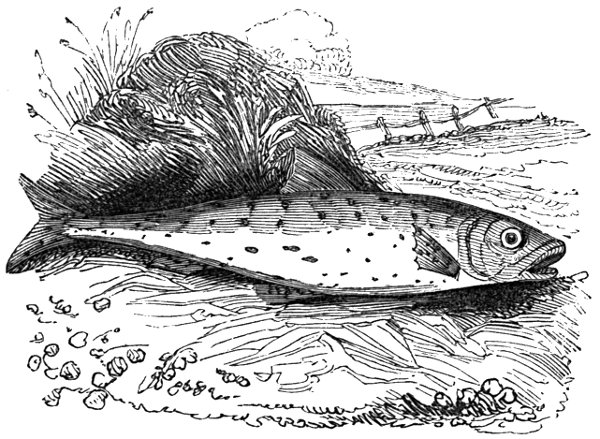
This very elegant species is plentifully distributed through the British waters, and varies in weight from a few ounces to fifteen or even thirty pounds.
The general shape of trouts is rather long than broad; in several of the Scotch and Irish lakes and rivers, they grow so much thicker than in those of England, that a fish from eighteen to twenty-two inches will often weigh from three to five pounds. The trout is a fish of prey, has a short roundish head, blunt nose, mouth wide, and filled with teeth, not only in the jaws, but on the palate and tongue: the scales are small, their back is ash colour, the sides yellow, and when in season, is sprinkled all over the body and covers of the gills with small beautiful red and black spots; the tail is broad.
There are several sorts of trout, differing in their size, (for in many of the smaller streams there are trouts that always continue small, but are very great breeders,) shape, and hue; but the flesh of the best is either red or yellow when dressed; the female fish has a smaller head and deeper body than the male, and is of superior flavour. In fact the colours of the trout and the spots vary greatly in different waters and at distinct seasons, yet each may be reduced to one species. In Lyndive, a lake in South Wales, are trout called coch-y-dail, with red and black spots as big as sixpences; others unmarked, and of a reddish hue, that sometimes weigh nearly ten pounds, but are ill-tasted. In Lough Neagh, in Ireland, are trout called buddaghs, which rise to thirty pounds; and some (probably of the same species) are taken in Ulleswater, in Cumberland, of still greater weight; and both those are supposed to be similar with the large trout of the lake of Geneva, a fish says Mr. Pennant which I have eaten of more than once, and think very indifferent.
A trout taken in Llynallet, in Denbighshire, which is famous for its excellent kind, was singularly marked and shaped; it measured seventeen inches in length, depth three and three quarters, and weighed one pound ten ounces; the head thick, nose sharp, both jaws as well as the head, of a pale brown, blotched with black; the teeth sharp and strong, dispersed in the jaws, roof of the mouth, and tongue (as is the case with the whole genus, except the gwinniad, which is toothless, and the grayling, which has none on the tongue), the back was dusky, and sides tinged with a purplish bloom, both above and below the side line, which was straight, and marked with deep purple spots, mixed with black. The belly was white; the first dorsal fin was spotted; the spurious fin brown, tipped with red; the pectoral, ventral, and anal fins of a pale brown; the edges of the latter white; the tail very little forked when extended.
Some peculiar remarks upon the various sorts of trout in the northern counties of England, and of their growth and age, have been given by a very experienced angler, to the following effect:—That he does not undertake to determine whether the river or burn trout are of one species: in many points the trout taken out of the same river and same pools will agree, and in some shall vary; so that, if the difference were owing to the water or food, he could say nothing against their being of one species: he believes they spawn promiscuously together, are all similar in shape, in the number of their fins, and their fins being disposed in the same places. Whether the colour of the spots make any specific variety, he leaves to the decision of naturalists; but, in his opinion, the so much esteemed char, both red and white, is only a meer or marsh trout, and the colour perhaps owing to the sex. In several of the northern rivers he has taken trouts as red and as well tasted as any char, and whose bones, when potted, have dissolved, like those of the char. That about Michaelmas he had caught trouts of a coppered hue, without spots; the flesh when dressed, was like bees-wax, and well tasted: that likewise in April he took one of these trout twenty-eight inches and thick in proportion, which boiled yellow, but was equally good; and this he thinks was the bull trout mentioned by Walton, and several authors, as extraordinary both for its size and goodness, and to be found no where but in Northumberland. He records a still larger fish caught in the same river (the Cocquet) by him in September, near Brenkburn Abbey; the length, which was nearly a yard, did not strike this gentleman so much, as the bright spots upon the lateral line; by which it appeared to him to be an overgrown burn trout, and neither a salmon, salmon-trout, nor the same with those two he thought were the bull trout.
Walton mentions the Fordwich trout taken in the river Stour, of which only one instance was ever known of their being caught by the angle, and are said to be delicious eating; one weighing twenty-six pounds, and of a most beautiful colour, was taken with a net in December 1797; they grow to a larger size.
The burn or river trout, with plenty of food and good water, grows rapidly; several experiments were made in ponds fed by river water, and some by clear springs, into which the young fry have been put at five or six months old (that is, in September or October, reckoning from April, when they first come from the spawning-beds) at which time they will be six or seven inches long; in eighteen months the change has been surprising; he has seen a pond drained ten months after being thus stocked, which was in July, when the fish were fifteen months old; some were fifteen or sixteen inches, others not more than eleven or twelve; the fish were returned into the pond, and it was again drained the March following, when some were twenty-two inches, and weighed three pounds; others were sixteen inches, and some not more than twelve.
In March, or, if mild open weather, in February, trouts begin to leave their winter quarters, and approach the shallows and tails of streams, where they cleanse and restore themselves to health; as they acquire strength they advance still higher up the rivers, until they fix upon their summer residence, for which they generally choose an eddy, behind a stone, a log, or bank that projects forward into the water, and against which the current drives; whirlpools and holes into which sharps and shallows fall, under roots of trees, and in places shaded by boughs and bushes; in small rivers they frequently lie under sedges and weeds, especially in the beginning of the year, before their perfect strength is recovered; but when in their prime, they feed in the swiftest streams, and are often found at the upper end of mill-pools, at locks, flood-gates, and weirs, also under bridges, or between two streams running from under their arches, and likewise in the returns of streams, where the water seems to boil; in the decline of summer, they lie at mill-tails, or the end of other streams, and in the deep water.
Trout spawn, or deposit their ova and seminal fluid in the end of the autumn or beginning of winter, from the middle of November till the beginning of January; their maturity depending upon the temperature of the season, their quantity of food, &c. From some time (a month or six weeks) before they are prepared for the sexual function, or that of reproduction, they become less fat, particularly the females; the large quantity of eggs and their size, probably affecting the health of the animal, and compressing generally the vital organs in the abdomen. They are at least six weeks or two months after they have spawned before they recover their flesh; and the time when these fish are at the worst is likewise the worst time for fly-fishing, both on account of the cold weather, and because there are fewer flies on the water than at any other season.
It has been remarked by many other people, as well as myself, that, of all fish in existence, there is not one that you can partake of so many days in succession, without ceasing to enjoy it, as a trout, provided it be fresh caught, and well in season. Almost every sportsman, and every fishmonger, has his own way of fancying that he can tell when a trout is in season. As to the red spots on the skin having any thing to do with it, the very idea is absurd and fallacious. But the more general criterions are a small head and high crest, a full tail, and the roof of the mouth, or, what is still better, the flesh under the tongue being rather of a pink colour. Another excellent criterion, which was explained to me by Mr. Joseph Miller, the fishmonger in Piccadilly, is the smallness and tightness of the vent; for the better the trout is in season, the smaller will be that vent-hole, which is formed just before the under or belly-fin. And, after all, I prefer this, and one other way of deciding; which is by the bright and silver-like appearance of the scales. Take twenty trout, and, I think, if you dress them all, and previously mark that one on which the scales shone the brightest, it will prove to be the best fish. This may be frequently ascertained, even before you land a trout, as a bright one, on being first hooked, generally gives two or three leaps out of the water.
Before you send trout on a journey, always have them cleaned and gutted, and let them be laid on their backs, and closely packed in willow (not flag) baskets, and with either flags or dry wheat-straw. Packing in damp grass or rushes is apt to ferment, and therefore liable to spoil your fish.
Salmon and trout were here to be found among the rest. Indeed the people asserted there were nine kinds of the former, for all of which they had names, each kind making its appearance in the river at different periods of the year. This must of course be a mistake, as so many varieties of that fish do not, I imagine, exist.
Altogether I caught thirty-seven trout and salmon, their aggregate weight being two hundred and twenty-six pounds, or on an average something better than six pounds a-piece. The greatest number I killed in any one day were seven, and the largest I took was eighteen pounds; this weight was however comparatively nothing, for in the river below the falls salmon were occasionally taken in nets weighing forty, fifty, sixty, and even seventy pounds.
The trout are very fine at Trolhattan; I have killed them upwards of twelve pounds’ weight. They are about the best grown fish I ever saw in my life.
The high flavour and red colour for which the fish taken in Lochleven are so famed, are understood to arise from the ford by which they are supported in the loch; it being a general rule that while the flesh of trout is white in clear and limpid waters, the same sort, when found where the rivers pass slowly through a tract of foul or meadow ground, have less or more redness in their colour. A considerable part of the bottom of Lochleven is spongy, from which aquatic plants rise in great abundance; and in many parts, towards the beginning of autumn, cover the surface of the water with their flowers. But the circumstance to which the high colour of the Lochleven trout is chiefly ascribed, is the vast quantity of a small red shell fish which abounds in the bottom of the loch, and especially among the aquatic plants; its form is globular, and the trouts when caught have often their stomachs full of these shell-fish. They generally lie in deep water, and will not rise to any kind of fly or hook however baited: it has been remarked also, that in Lochleven are discovered all the different species of river trout, and after they have remained some time in the loch, and approached towards one pound in weight, they become red in flesh. (Vide Fishing, Rod, Worm, &c., &c.)—Daniel—Davy—Lloyd—Wild Sports, &c.
Trump, s. A trumpet, an instrument of warlike music; a winning card; a card that has particular privileges in a game.
Trump, v. To win with a trump card.
Truss, s. A bandage by which ruptures are restrained from lapsing.
Trussing, s. Term applied to a hawk when she raises a fowl into the air, and descends rapidly again.
Tumbler, s. One who shows postures or feats of activity; a pigeon.
Tumid, a. Swelling, puffed up; protuberant, raised above the level; pompous, boasting, puffy, falsely sublime.
Tun, s. A large cask; two pipes, the measure of four hogsheads; any large quantity proverbially; a drunkard, in burlesque; the weight of two thousand pounds; a ton.
Turbith Mineral, s. Subsulphate of mercury, yellow mercurial emetic, or vitriolated quicksilver.
This mercurial preparation is seldom used in veterinary practice, being apt to irritate the stomach and bowels, and bring on violent purging; but it has been recommended as a remedy for farcy.
The dose is from half a drachm to a drachm.
It is given as an emetic to dogs, when they have swallowed any poisonous substance, or at the commencement of the distemper.—White.
Turf, s. A clod covered with grass; a part of the surface of the ground; a kind of fuel; a racecourse. To be on the turf, to be engaged in horse-racing.
Turnip, s. A white esculent root.
Turnpike, s. A cross of two bars armed with pikes at the end, and turning on a pin, fixed to hinder horses from entering: a gate erected on the road to collect tolls to defray the expense of repairing roads.
Turnspit, s. He who anciently turned a spit; a dog used for this purpose.
Turpentine, s. The gum exuded by the pine, the juniper, and other trees of that kind.
Of turpentines there are four kinds, viz. Chio, Strasburg, Venice, and common turpentine; the two last only are employed in veterinary medicine. They are effectual diuretics, and possess a considerable carminative power. Common turpentine is a principal ingredient in digestive and detergent ointments. By distillation we obtain from it the oil, or, as it is sometimes termed, the spirit of turpentine, a medicine of great utility. In doses from two to three or four ounces, it frequently cures the flatulent colic or gripes; and, when combined with camphor and other stimulants, makes a good embrocation for indurated swellings, strains, and bruises. When properly mixed with mustard, it forms an embrocation that has been found serviceable in counteracting internal inflammation. I have seen it applied to obstinate ulcers with good effect. It is a useful ingredient in blistering-ointment and liniments.
In speaking of the turpentines, Dr. Paris says they all possess the same chemical as well as medicinal properties, viz. Canada turpentine, or Canada balsam, as it is sometimes improperly called, is obtained from the Pinus Balsamea. 2dly, Chian or Cyprus turpentine, from the Pistachia Terebinthinus. 3dly, Common, or horse turpentine, from the Pinus Sylvestris, or Scotch fir. 4thly, Venice turpentine from the Pinus Larix; from the twigs of this species of fir the essence of spruce is made. True Riga balsam is made from the shoots of the Pinus Cembra, previously bruised and macerated for a month in water. The same fir also yields Briançon turpentine.
Venice turpentine is generally made by mixing oil with the common turpentine, which is easily done when the latter is melted.
Venice turpentine is sometimes employed as an ingredient in cough medicines. The dose is about half an ounce. But if given as a remedy for flatulent colic, or as a diuretic, a larger quantity is necessary. It makes a good detergent ointment, if mixed with about a fourth or a third part of red precipitate, finely powdered.
Dr. Latham considers it a valuable medicine in epilepsy. As a veterinary medicine it is certainly of great value; and though in a few cases, when given internally, it has produced violent effects, merely, I believe, from bad management, yet, when judiciously administered, it may be employed in a dose of four ounces, with advantage and safety.
I have long discontinued the use of oil of turpentine in my practice as a remedy for flatulent colic, gripes, or fret; finding the preparations of opium far more effectual.—White.
Turtle, s. The sea tortoise.
Turtle Dove (Columba turtur, Linn.; La Tourtourelle, Buff.), s.
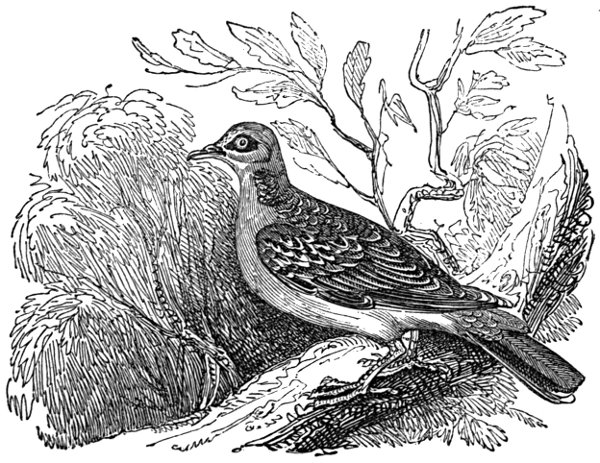
Length somewhat more than twelve inches; the bill is brown; eyes yellow, encompassed with a crimson circle; the top of the head is ash-colour, mixed with olive; each side of the neck is marked with a spot of black feathers, tipped with white: the back is ash-colour, each feather margined with reddish brown; wing coverts and scapulars reddish brown, spotted with black; quill feathers dusky, with pale edges; the fore part of the neck and the breast are of a light purplish red; the belly, thighs, and vent, white; the two middle feathers of the tail are brown, the others dusky tipped with white; the two outermost also edged with the same; the legs are red.
The note of the turtle dove is singularly tender and plaintive; in addressing his mate the male makes use of a variety of winning attitudes, cooing at the same time in the most gentle and soothing accents; on which account the turtle dove has been represented in all ages as the most perfect emblem of connubial attachment and constancy. The turtle arrives late in the spring, and departs about the latter end of August; it frequents the thickest and most sheltered parts of the woods, where it builds its nest on the highest trees; the female lays two eggs, and has only one brood in this country, but in warmer climates it is supposed to breed several times in the year. Turtles are pretty common in Kent, where they are sometimes seen in flocks of twenty or more, frequenting the pea fields, and are said to do much damage. Their stay with us seldom exceeds more than four or five months, during which time they pair, build their nests, and rear their young, which are strong enough to join them in their retreat.—Bewick.
Tush or Tusk, s. The long tooth of a fighting animal, the fang, the holding tooth.
Tusked or Tusky, a. Furnished with tusks.
Twine, s. A twisted thread; twist, convolution; embrace; act of convolving itself round.
Twinling, s. A twin lamb, a lamb of two brought at a birth.
Twitch, v. To pluck with a quick motion, to snatch.
The twitch is a very necessary instrument in a stable, though, when frequently and unnecessarily used, it may have the ill effect of rendering some horses violent and vicious to resist its future application. In many instances blindfolding will do more than the twitch; and some horses may be quieted, when the pain is not excessive, by holding the ear in one hand, and rubbing the point of it with the other. A firm but soothing manner will often engage the attention and prevent violence; but it is seldom that either threats or punishment render an unruly horse better. Inexperienced persons guard themselves against the hind feet only, but they should be aware that some horses strike as truly and as terribly with their fore feet: it is prudent therefore, in all operations, to blindfold the animal, and the more so, as by this he becomes particularly intimidated, nor will he often strike without an aim. Barnacles are a sort of clams used by smiths, into which they introduce the nose in the manner of a twitch. They are only admissible when a person is so situated as to be wholly without assistance.—Blaine.
Twitter, v. To make a sharp tremulous intermitted noise; to be suddenly moved with any inclination.
Tympanum, s. A drum, a part of the ear.
Tyro, s. One yet not master of his art.
Valerian, s. A plant, of which cats are immoderately fond.
Vapour, s. Anything exhalable, anything that mingles with the air; wind; fume, steam; diseases caused by diseased nerves; melancholy, spleen.
Varnish, s. A matter laid upon wood, metal, or other bodies, to make them shine.
As moisture is at all times destructive to wood, it is essential for the angler to guard all in his power against its influence on his rod; for, admitting that a shower of rain will not spoil it, yet if not protected by varnish, it may soon be deprived of its elasticity, which is the chief requisite of any, and more particularly of a fly-rod. Variety of methods are used in preparing varnish; the one here mentioned is said to be excellent.
Varnish Recipe.—Half a pint of linseed oil, and a little India rubber scraped fine; put them over a slow fire, and stir them well together, until the rubber is dissolved, then boil and skim it, apply it warm, and do not use the rod until quite dry. The appearance upon the rod will be like a fine thin bark; it will preserve the rod from being worm-eaten, and from other injuries, and is very durable.
Another.—Half an ounce of shell, and the same quantity of seedlac powdered fine in a mortar; put into separate phials, with half a pint of good spirits of wine in each, and placed in a sand heat to dissolve; during the process, shake the phials often; when each is dissolved, mix them together in a larger bottle, with half an ounce of gum benzoin; increase the heat, and the dregs will subside; then warm the wood, and with a camel’s hair brush apply that part of the varnish which is become fine; the third coat will remain on the surface, and securely protect the rod from injury.—Old Receipts.
Varnish, v. To cover with something shining.
Vascular, a. Consisting of vessels, full of vessels.
Vault, v. To leap, to jump.
Udder, s. The breast or dugs of a cow, or other large animals.
Veal, s. The flesh of a calf killed for the table.
Vegetable, s. Anything that has growth without sensation, as plants.
Vegetable, a. Belonging to a plant; having the nature of plants.
Vehicle, s. That in which any thing is carried; that part of a medicine which serves to make the principal ingredient potable; that by means of which anything is conveyed.
Vein, s. The veins are only a continuation of the extreme capillary arteries reflected back again towards the heart, and uniting their channels as they approach it.
Veiny, a. Full of veins; streaked, variegated.
Velocity, s. Speed, swiftness, quick motion.
Velvet, s. Silk, with a short fur or pile upon it.
Velvet Duck, Double Scoter, or Great Black Duck, (Anas Fusca, Linn.; Le Grand Macreuse, Buff.) s.
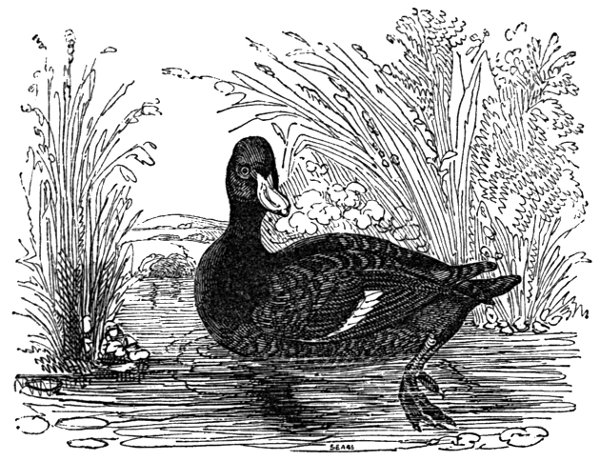
THE VELVET DUCK.
The velvet duck is larger than a mallard, weighing about three pounds two ounces, and measuring above twenty inches in length.
They spread themselves in small numbers along the shores of Western Europe, as far as France, where they sometimes appear in company with the large flocks of scoters, and are often caught in the fishermen’s nets with those birds; but they are seldom met with on the British shores.
The bill broad, with a black knob at the base; the rest of the bill is yellow; the nail red; the edges all round black; the plumage is black, inclining to brown on the belly; under each eye is a white mark passing backwards in a streak; across the middle of the wing is a band of white; legs red; claws black. The female is more inclining to brown, and the protuberance on the bill is wanting; forehead and cheeks under the eye, dull brownish; behind that a large oval spot of white; whole upper parts and neck dark brownish drab; tips of the plumage lighter; second ones white; wing quills deep brown; belly brownish-white; tail hoary-brown; the throat white, marked with dusky specks; legs and feet yellow.
This species much resembles the scoter, only that bird has no white feathers about it, and the colour of the bill is somewhat different. In the windpipe of this bird is a singular bony swelling, the size of a small walnut, situated about two-thirds of the length from the larynx; immediately under the larynx is another oblong bony cavity, of nearly an inch in length; at the divarication the parts become bony, but not greatly enlarged. This is peculiar to the male sex.—Montagu.
Venatic, a. Used in hunting. obs.
Venation, s. The act or practice of hunting, obs.
Veneer, v. To make a kind of marquetry, or inlaid work.
Venery, s. The sport of hunting; the commerce of the sexes.
Venesection, s. Bloodletting, the act of opening a vein, phlebotomy.
Venison, s. Game, beast of chace, the flesh of deer.
Venomous, a. Poisonous.
Vent, s. A small aperture; a hole; a spiracle; the aperture of a bird or fish; act of opening; emission; discharge.
Venter, s. Any cavity of the body; the abdomen.
Vent Feathers (Crissum, Linn.), s. In ornithology, are those that lie from the vent, or anus, to the tail underneath.
Ventilator, s. An apparatus to supply close places with fresh air.
Ventricle, s. The stomach; any small cavity in an animal body, particularly those of the heart.
Verderer, s. An officer of the forest.
In every forest there are usually four verderers, so named from viridis or vert. The verderer is a judicial officer of the forest, chosen by force of the king’s writ in full county, and sworn to maintain the laws of the forest, and to view, receive, and enrol the attachments and presentments of all trespasses within the forest of vert and venison.
Verdigris, s. The rust of brass.
Verjuice, s. Acid liquor expressed from crab apples.
Vermicular, a. Acting like a worm, continued from one part to another.
Vermifuge, s. Any medicine that destroys or expels worms.
Vermilion, s. The cochineal, a grub of a particular plant; factitious or native cinnabar, sulphur mixed with mercury; any beautiful red colour.
Vermin, s. Any noxious animal.
To destroy vermin.—When dogs are afflicted with lice, the most effectual remedy is to rub the whole animal over with train-oil; allow it to remain on half an hour, and then wash it off with salt of tartar, or potashes and water. Soft soap made into a thick paste, and rubbed over the body, and allowed to remain on an hour before washing the dog, will effectually destroy them.
N.B.—The method of giving any bolus, pill, or other medicine to a dog, is to pull out his tongue, then put it down his throat as far as possible, and when the dog draws in his tongue, the medicine will descend into his stomach.
Sopping the skin with tobacco water has been recommended; but it has only a momentary effect, and it not unfrequently poisons the dog. Innumerable other means I have tried to drive away fleas, but the only tolerably certain one I have discovered, is to make dogs sleep on fresh yellow deal shavings. These shavings may be made so fine as to be as soft as a feather bed; and, if changed every week or fortnight, they make the most cleanly and wholesome one that a dog can rest on; and the turpentine in them is very obnoxious to the fleas. But, where it is absolutely impracticable to employ deal shavings, it will be found useful to rub or dredge the dog’s hide, once or twice a week, with very finely powdered resin: if simply rubbed in, add some bran.—Brown—Blaine.
Vernal, a. Belonging to the spring.
Vernal Birds of Passage.—The earlier or later appearance of our spring birds may be found to arise from accidental vicissitudes of the season in those countries from whence they come; and, viewed in this light, the time of their arrival becomes an interesting phenomena to note down. Generally speaking, they arrive at the following times, on an average of many years:—
Wryneck Middle of March.
Smallest Willow Wren March 25.
House Swallow April 15.
Martin April 20.
Sand Martin April 20.
Blackcap April 17.
Nightingale April 10.
Cuckoo April 21.
Yellow Willow Wren April 20.
Whitethroat April 16.
Redstart April 16.
Night Plover or Stone Curlew March 27.
Grasshopper Lark April 15.
Swift May 9.
Lesser Red Sparrow April 30.
Corn Crake or Land Rail April 25.
Largest Willow Wren End of April.
Fern Owl May 20.
Flycatcher May 3.
Other birds, water wagtails for instance, who only make partial migrations, are more uncertain in their times of appearance.—Foster.
Vert, s. Everything that grows and bears a green leaf within the forest.
Vertebral, a. Relating to the joints of the spine.
Vertebræ, s. Joints of the back.
Vertigo, s. A giddiness, a sense of turning in the head. According to White fast trotters are particularly subject to this disease.
When a horse has been worked hard and fed high, and especially horses that excel in trotting, we often find, in the course of a few years, that they appear giddy at times, or when trotting suddenly stand still; ramble or reel a little, and shake their heads; but after a short time recover. Sometimes they reel and drop down, and lie motionless for some time; when they get up again, and recover in a short time. Sometimes after falling down, they are convulsed, and the eyes are distorted; from this state also they recover after a short time.—White.
Vesicate, v. To blister.
Vesicatory, s. A blistering medicine.
Veterinary, a. Belonging to cattle, particularly horses.
Vibrissæ (Linn.), s. In ornithology, are hairs that stand forward like feelers: in some birds they are slender, as in flycatchers, &c. and point both upwards and downwards, from both the upper and under sides of the mouth. Vibrissæ pectinatæ (Linn.), in ornithology; these hairs are very stiff, and spread out on each side like a comb from the upper sides of the mouth of the nightjar.—Montagu.
Vice, s. The course of action opposite to virtue; a fault, an offence; a kind of small iron press with screws. Vice, in horses, ill temper, savageness.
Vinegar, s. Wine grown sour.
Vingt-un, s. A game.
Vingt-un, or twenty-one, very much resembles quinze; but may be played by two or more persons, and as the deal is advantageous, and often continues long with the same person, it is usual to determine it at the commencement by the first ace turned up.
The cards must all be dealt out in succession, unless a natural vingt-un occurs, and in the mean time the pone, or youngest-hand, should collect those that have been played, and shuffle them ready for the dealer against the period when he shall have distributed the whole pack. The dealer is first to give two cards, by one at a time to each player, including himself, then to ask every person in rotation, beginning with the eldest hand on the left, whether he stands or chooses another card, which, if required, must be given from off the top of the pack, and afterwards another, or more, if desired, till the points of the additional card or cards, added to those dealt, exceed or make twenty-one exactly, or such a number less than twenty-one, as may be judged proper to stand upon; but when the points exceed twenty-one, then the cards of that individual player are to be thrown up directly, and the stake to be paid to the dealer, who is also in turn entitled to draw additional cards, and on taking a vingt-un is to receive double stakes from all who stand the game, such other players excepted who may likewise have twenty-one, between whom it is thereby a drawn game: when any person has vingt-un, and the dealer not, he who has it wins double stakes of the dealer; in other cases, except a natural vingt-un happens, the dealer pays single stakes to all whose numbers under twenty-one are higher than his own, and receives from those who have lower numbers; but nothing is paid or received by such players as have similar numbers to the dealer: and when the dealer draws more than twenty-one, he is to pay to all who have not thrown up.
Twenty-one, made by an ace and a ten, or court card, whenever dealt in the first instance, is styled a natural vingt-un, should be declared immediately, and entitles the possessor to the deal, besides double stakes, from all the players, unless there shall be more than one natural vingt-un, in which case the younger hand or hands so having the same, are excused from paying to the eldest, who takes the deal of course.
N.B. An ace may be reckoned either as eleven or one; every court-card is counted as ten, and the rest of the pack according to their pips.—Hoyle.
Vintage, s. The produce of the vine for the year; the time in which grapes are gathered.
Viper, s. A serpent of that species which brings its young alive; any thing mischievous.
When I wrote to you last year on reptiles, I wish I had not forgot to mention the faculty that snakes have of stinking se defendendo. I knew a gentleman who kept a tame snake, which was in its person as sweet as any animal while in good humour and unalarmed; but as soon as a stranger, or a dog or cat, came in, it fell to hissing, and filled the room with such nauseous effluvia as rendered it hardly supportable. Thus the squnck, or stonck, of Ray’s Synop. Quadr. is an innocuous and sweet animal; but, when pressed hard by dogs and men, it can eject such a most pestilent and fetid smell and excrement, that nothing can be more horrible.
On August the 4th, 1775, we surprised a large viper, which seemed very heavy and bloated, as it lay in the grass basking in the sun. When we came to cut it up, we found that the abdomen was crowded with young, fifteen in number; the shortest of which measured full seven inches, and were about the size of full grown earthworms. This little fry issued into the world with the true viper spirit about them, showing great alertness as soon as disengaged from the belly of the dam: they twisted and wriggled about, and set themselves up, and gaped very wide when touched with a stick, showing manifest tokens of menace and defiance, though as yet they had no manner of fangs that we could find, even with the help of our glasses.
To a thinking mind nothing is more wonderful than that early instinct which impresses young animals with the notion of the situation of their natural weapons, and of using them properly in their own defence, even before those weapons subsist or are formed. Thus a young cock will spar at his adversary before his spurs are grown: and a calf or lamb will push with its head before its horns are sprouted. In the same manner did these young adders attempt to bite before their fangs were in being. The dam, however, was furnished with very formidable ones, which we lifted up (for they fold down when not used) and cut them off with the point of our scissors.
There was little room to suppose that this brood had ever been in the open air before; and that they were taken in for refuge, at the mouth of the dam, when she perceived that danger was approaching; because then probably we should have found them somewhere in the neck, and not in the abdomen.—White’s Selborne.
Viperous, a. Having the qualities of a viper.
Viscera, s. The bowels or entrails.
Viscera of the horse.—The alimentary canal is continued from the expellent orifice of the stomach to the anus, or end of the passage; forming a long canal, whose varying dimensions have occasioned it to be divided into the small and large intestines. The length of the tract ranges between twenty-seven and thirty yards; of which proportions the small intestines occupy from twenty to twenty-two yards, and the large from seven to eight. It is not easy to give a determinate place to the intestines, either individually or generally; the large, however, may be said to occupy all the inferior portion of the abdomen throughout, and the small to range between and upon them; both occasionally shifting their position by the peristaltic motion. They are, however, prevented from an unnatural displacement, by membranous productions of the peritoneum, under the name of mesentery, mesocolon, and mesorectum. The first intestinal coat is derived from the peritoneum, which separates to receive the tube between its lamen; at once protecting it, and affording a medium for the transmission of its vessels and a lubricating surface. The second, or muscular coat, presents a longitudinal and a circular plan of fibres; by the contraction of which, the vermicular motion, called peristaltic, is performed, the longitudinal slightly shortening them, and the circular diminishing their diameter; the inner surface of this fabric being garnished with a quantity of dense cellular tissue, was formerly erroneously considered as another and a nervous coat. The inner tunic of the intestinal canal is villous, or mucous, and is very vascular and sensible, its villi presenting an increased surface for the mucous secretion, as well as more numerous chyliferous orifices, with which it is thickly studded; but it presents no valvulæ conniventes, as in the human, their place being supplied by the increased length of the tract.—Blaine.
Viscous, a. Glutinous, sticky, tenacious.
Vision, s. Sight, the faculty of seeing; the act of seeing.
Vision of Birds.—Ross, in his voyage to Baffin’s Bay, proved that a man under favourable circumstances could see over the surface of the ocean to the extent of one hundred and fifty English miles. It is not probable that any animal exceeds this power of vision, though birds, perhaps, excel men and most quadrupeds in sharpness of sight. Schmidt threw at a considerable distance from a thrush (Turdus musicus) a few small beetles, of a pale grey-colour, which the unassisted human eye could not discover, yet the thrush observed them immediately and devoured them. The bottle tit (Parus caudatus,) flits with great quickness among the branches of trees, and finds on the very smooth bark its particular food, where nothing is perceptible to the naked eye, though insects can be detected there by the microscope. A very tame red-breast (Sylva rubecula, Latham,) discovered crumbs from the height of the branch where it usually sat, at the distance of eighteen feet from the ground the instant they were thrown down, and this by bending its head to one side, and using of course only one eye. At the same distance a quail discovered, with one eye, some poppy-seeds, which are very small and inconspicuous.—Montagu.
Vitriol, s. Vitriol is produced by addition of a metallic matter with the fossil acid salt.
Vitriolic, a. Resembling vitriol, containing vitriol.
Vitriolated Zinc, s. White vitriol.
Vives, s. A disease in horses.
This disorder consists of a swelling of the parotid gland, situated immediately beneath the ear, and is commonly named the vives or ives. Fomentations of hot water should be first applied, that is, a large piece of thick woollen cloth should be wrung out of hot water, and kept in contact with the swelling. After continuing this operation for some time, the woollen cloth may be confined close to the part, by suitable bandages, until it is convenient to repeat the fomentation. Sometimes these swellings go on to suppuration, and burst; when this happens, the opening should be enlarged sufficiently to introduce the fore-finger, and when the extent of the cavity has been thus ascertained, any further opening, should it appear necessary, may be made. A tent of digestive ointment is then to be applied, and repeated daily until the disease is cured. Sometimes these swellings continue hard, and I have known them prevent a horse from feeding. In a case of this kind, which I met with last spring, I completely relieved the horse in a short time, by rubbing in the following ointment:—
Crystallised tartarised antimony, very finely powdered. 2 drachms.
Olive oil. 1 drachm.
Hog’s lard. 1 ounce.
Mix.
The hair must be closely cut off from the swelling, and the ointment well rubbed in with the hand for about ten minutes. When horses have sore necks, and lose the jugular vein, which sometimes happens after bleeding, a hard swelling of the parotid gland takes place, which generally continues a considerable time. In such cases, the above ointment, after the disease in the neck has been cured, may be tried.—White.