INTRODUCTION. (continued 16)
Reading edition
After so much labour is bestowed in erecting a mansion, as Nature seldom works in vain, martins will breed on for several years together in the same nest, where it happens to be well sheltered, and secure from the injuries of weather. The shell or crust of the nest is a sort of rustic-work full of knobs and protuberances on the outside; nor is the inside of those that I have examined smoothed with any exactness at all; but is rendered soft and warm, and fit for incubation, by a lining of small straws, grasses, and feathers; and sometimes by a bed of moss interwoven with wool. In this nest they tread, or engender, frequently during the time of building; and the hen lays from three to five white eggs.—White’s Selborne.
Martingal, s. A broad strap made fast to the girths under the belly of a horse, which runs between the two legs to fasten the other end under the noseband of the bridle.
The martingal is generally attached to a horse who throws his head up. It is unsafe in the field, and only efficient when used by a light handed and practised rider.
Mash, s. Anything mingled or beaten together into an undistinguished or confused body; a mixture for a horse.
Bran mashes are made by pouring boiling water on fresh sweet bran in a pail, so that the mixture, when stirred, may be about the consistency of a soft poultice; it is then to be covered over, and not given to the horse until sufficiently cold. When it is thought necessary to steam the head, as it is termed, the mash is put into the manger while hot. Steaming the head is recommended in strangles, colds, and sore throats.
Bran mashes are proper in fever and all inflammatory complaints. They are useful also as a preparative to physic, serving to remove indurated fæces, and to facilitate the operation of the medicine. Mashes are a necessary diet while physic is operating. In making malt mashes, the water should be below the boiling point, otherwise the malt would be spoiled. Mashes are given for recruiting strength, when a horse is debilitated from fever or any other cause. When a horse has been fed high for some time with oats and beans, a change to bran mashes for two or three days will often do a great deal of good. The bran should be fresh, and perfectly free from any musty smell. There is a finer kind of bran, named gurgings or pollard, which, though more nutritious, is not so fit for medicinal purposes.—White.
Mash, v. To beat into a confused mass; to mix malt and water together in brewing.
Master-sinew, s. A large sinew that surrounds the hough, and divides it from the bone by a hollow place, where windgalls are usually seated.
Mastic, s. A kind of gum gathered from trees of the same name; a kind of mortar or cement.
Mastication, s. The act of chewing.
Hay, as often given, is too dry for mastication or digestion. If it has been suffered to stand until the seed becomes ripe, it is very deficient in nutriment, and difficult of digestion; and, however perfectly it may be masticated, will only serve to oppress the stomach without affording any thing that is capable of being formed into good chyle. Hay that has been kept more than one year becomes dry and deficient in nutriment, especially when kept in small mows and exposed to the wind. When such hay therefore is given to horses, it requires to be moistened with water, and given in moderate quantity. From eight to twelve pounds of hay and one peck of oats is a sufficient allowance, both as to proportion and quantity, for any saddle horse of whatever size he may be, provided he has only moderate work; but when his exertions exceed that degree which may be termed moderate, then an additional allowance is necessary, and that addition should be in oats or beans.
The teeth may be imperfect, and often are so; the grinders wear in a different manner from that in which they would, were the animals in a state of nature: consequently sharp edges are sometimes formed on the outside of the higher grinders, and on the inside of the lower grinders; and the inside of the cheeks and the tongue, with the skin or membrane connected with it, are thereby wounded, which prevents the horse from masticating, without considerable pain, and induces him to swallow his food imperfectly chewed; this is more especially the case with hay; and when hay is swallowed in this state it does harm, being difficult of digestion, as then its nutritive matter is not easily extracted by the gastric power; hence arise indigestion, flatulency, and numerous disorders. Mastication may be impeded or prevented by that state of the mouth which generally attends teething: it may also be affected by an injudicious use of the bit (as is well known in regiments of cavalry where it is too common), and has been attributed to the spiculæ of the squirrel-tail grass. The consequence of this imperfection is worms, in addition to indigestion and all its consequences.—White.
Mastiff (Canis Anglicus, Linn.), s. A dog of the largest size.
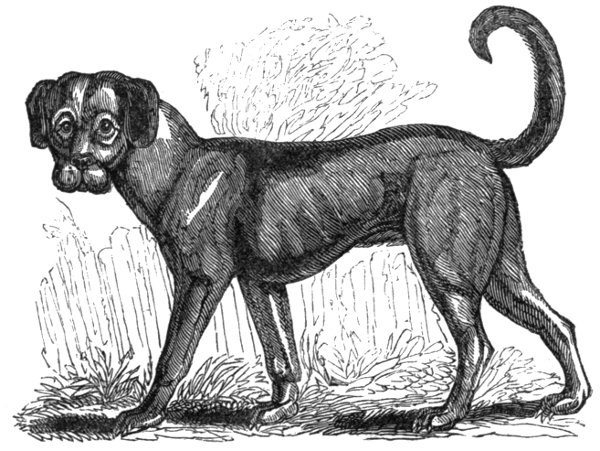
This is a large and powerful animal, much stronger than the bull dog; his ears are longer and more pendulous; his lips are full and loose, the upper one hanging considerably over the lower at the two extremities; his aspect is grave and somewhat sullen; and his bark loud, deep-toned, and terrific, particularly during the night.
The mastiff differs in form from the bull-dog in being much longer in the legs, and not so deep in the chest; and while his head is large in proportion to his body, he wants the projecting under jaw of the latter.
Buffon was of opinion that the mastiff is not an original race, but a mongrel generated betwixt the Irish greyhound and the bull-dog. This, however, must be mere conjecture; for the mastiff, in his pure and uncontaminated state, has a much more dignified aspect than either of these dogs; and we are rather inclined to believe him to be an original breed peculiar to Britain. We are borne out in this opinion, as we find it on record that so early as the time of the Roman emperors, this country was celebrated on account of its dogs of this kind. At the period Great Britain was under the Roman yoke, an officer was appointed to live here, whose sole business it was to breed, select, and send to Rome such as promised, by their size and strength, to become fit for the combats of the amphitheatre. Dr. Caius, in his Treatise on British Dogs, tells us that three mastiffs were reckoned a match for a bear, and four for a lion.
This dog, from his large size and commanding aspect, is naturally calculated to intimidate strangers, and he is admirably suited for and principally used in protecting large and extensive premises containing property of value, which he watches with most scrupulous care and assiduity. He is so instinctively impressed with the importance of his charge, that he will only quit it with the loss of his life, which he will rather forfeit than betray the confidence reposed in him. With his naturally commanding and imposing appearance, calculated to keep at a distance the ill-intentioned, he is nevertheless possessed of the greatest mildness of manners, and is as solicitous to gain attention and as faithfully grateful for favours bestowed, as the most diminutive of the canine tribe. The mastiff displays one peculiarity which seems inherent,—his ferocity is always increased by the degree of restraint in which he is kept. If constantly on the chain he is much more dangerous to approach than when in a state of liberty; from whence it evidently appears that what may be considered as a friendly kindness on one side, is always productive of confidence on the other.
The mastiff usually shows a remarkable and peculiar warmth in his attachments, and, on the other hand, he is equally distinguished for inveteracy in his dislike. If he is once severely corrected or insulted, it is almost impossible to eradicate the feeling from his memory, and it is no less difficult to obtain a reconciliation with him. He seems conscious of his own strength, power, and authority, and will seldom condescend to lower his dignity by servile fawning, while he appears to consider his services as only befitting a trust of the highest importance. This dog is naturally possessed of strong instinctive sensibility, speedily obtains a knowledge of all the duties required of him, and discharges them too with the most punctual assiduity. In the protection of gardens, houses, woodyards, and widely extended manufactories, his vigilance is very striking; he makes regular rounds of the whole premises like a watchman, examines every part of them with a careful eye; his penetration reaches even the remotest corner, and not a spot is passed by until he is satisfied that all is in a state of perfect security. During the night he gives a signal of his presence by repeated and vociferous barkings, which are increased upon the least cause of alarm; and, contrary to the spirit of the bull-dog, whose invariable practice is to bite before he barks, the mastiff always warns before he attacks. This breed is very difficult to be obtained in purity, from the various admixtures and experimental crosses which have taken place. The genuine old English mastiff is now rarely to be seen, although we have dogs of various sizes and colours which go under that name.
This animal, conscious of his superior strength, has been known to chastise, with great propriety, the impertinence of an inferior:—a large dog of this kind, belonging to the late M. Ridley, Esq., of Heaton, near Newcastle, being frequently molested by a mongrel, and teased by its continual barking, at last took it up in his mouth by the back, and with great composure dropped it over the quay into the river, without doing any further injury to an enemy so much beneath his notice.—Sporting Anecdotes.
Mastlin, s. Mixed corn, as wheat and rye.
Mat, s. A texture of sedge, flags, or rushes.
Mat, v. To cover with mats; to twist together, to join like a mat.
Matadore, s. A term used in the games of quadrille and ombre. The matadores are the two black aces when joined with the two black deuces, or red sevens in trumps.
Match, s. Anything that catches fire; a contest, a game; one equal to another. Vide Racing.
Match, v. To be equal to; to equal; to suit, to proportion; to marry.
Mate, s. A husband or wife; a companion, male or female; the male or female of animals; one that sails in the same ship; one that eats at the same table; a kind of toothed instrument to pull up wood; a pickaxe.
Maw, s. The stomach of animals; the craw of birds.
Maw-worm, s. Gut-worms frequently creep into the stomach, whence they are called stomach or maw-worms.
May-fly, s. An insect; a very killing artificial fly.
Mead, s. A kind of drink made of water and honey.
Meadow, s. Rich pasture ground from which hay is made.
Meal, s. The act of eating at a certain time; a repast; the flour or edible part of corn.
Mealy, a. Having the taste or soft insipidity of meal; besprinkled as with meal.
Mease, s. A mease of herrings is five hundred.
Measles, s. A kind of eruptive and infectious fever; a disease of swine.
Measly, a. Scabbed with the measles.
Meathe, s. A kind of drink.
Medicate, v. To tincture or impregnate with anything medicinal.
Medicinal, a. Having the power of healing, having physical virtue; belonging to physic.
Medicine, s. Any remedy administered by a physician.
Medullar or Medullary, a. Pertaining to the marrow.
Meer, s. A lake, a boundary.
Meershaum, s. A fine sort of Turkish clay, of which pipes are made in Germany of various forms. It assumes a beautiful brown colour after it has been used for smoking some time.—Crabbe.
Meloe, s. Insects, of which the two principal species are the oil beetle, so called because, on being handled, it exudes from its legs drops of a clear deep-yellow oil or fluid, of a very peculiar or penetrating smell; and the meloë vesicatorius, or Spanish fly, which is used for blistering.—Ibid.
Melwel, s. A kind of fish.
Membrane, s. A membrane is a web of several sorts of fibres interwoven together for the covering and wrapping up of some parts.
Membranous, a. Consisting of fibres.
Menage, s. A collection of animals.
Menagerie, s. A place for keeping foreign birds, and other curious animals.
Menstruum, s. All liquors are called menstruums which are used as dissolvents, or to extract the virtues of ingredients by infusion or decoction.
Mercurial, a. Under the influence of Mercury; active, sprightly; consisting of quicksilver.
Mercurial ointment is made by rubbing together in a mortar quicksilver and hogs’ lard, in various proportions, according to the strength required, until the former disappears, and the mixture assumes a dark blue or lead colour.
In the strongest mercurial ointment there are equal parts of quicksilver and lard; these are the best proportions in which it can be made, as it is easily weakened by the addition of lard.
Mercurial ointment is employed in veterinary practice as an application to callous swellings or enlarged joints. It is mixed with camphor in those cases, and is certainly much more efficacious when converted into a blister by the addition of cantharides or euphorbium. In this state it is a good remedy for bog spavin or other swellings of the hock joint.
Mercurial ointment is said to be an effectual remedy for the scab in sheep, and is often an ingredient in ointments for the mange.—White.
Mercury, s. A mineral or metallic fluid vulgarly called quicksilver, and distinguished from all other metals by its extreme fusibility, which is such that it does not assume the solid state until cooled to the thirtieth degree below 0 on Fahrenheit’s thermometer; and of course is always fluid in temperate climates. It is volatile, and rises in small portions at the common temperature of the air. It readily combines with gold, silver, lead, tin, bismuth, and zinc, and on that account is usefully employed in silvering looking-glasses, making barometers and thermometers, and for various other purposes.—Crabbe.
Mere, s. A pool, commonly a large pool or lake; a boundary.
Merganser, s. (Mergus serrator, Linn.)
This species is about twenty-one inches in length; weight two pounds. The bill is three inches long; the upper mandible dusky, the lower red; irides purplish red. The head and part of the neck black, glossed with green; on the back of the head the feathers are long, forming a sort of pendant crest; the rest of the neck and under part of the body white; breast ferruginous, mixed with black and white; upper part of the back glossy black; rump marked with brown and cinereous transverse streaks; the scapulars and wing coverts are some black and some white; quills dusky; tail brown; legs orange; claws black.
Mr. Pennant says this species breeds in the Isle of Ely, on the shores amongst the loose stones. They sometimes appear in the south of England in winter, but more frequently in the north, and are said to breed in Scotland in some of the lochs. They are found in the Russian dominions, about the great rivers of Siberia.
They are also said to breed on the shores of Greenland, and are observed at Hudson’s Bay in large flocks, breeding there as well as at Newfoundland, chiefly on the islands. The nest, which is built on the margin of lakes and rivers, is said to be made with dry grass, lined with down; the eggs are generally eight in number, of a bluish white; sometimes as many as thirteen in a nest, about the size of those of a duck. The young may be distinguished from the adult, by the black band on the wing spot.—Montagu.
Mergus, s. A genus in ornithology.
Birds of this genus have roundish slender bills, furnished at the end with a hard, horny, crooked nail; edges of the mandibles very sharply toothed, or serrated; the nostrils small, subovated, and placed near the middle of the bill: tongue rough, with hard indented papillæ turned backward; legs short; feet webbed; toes long, and the outer ones about the same length as the middle; the head is small, but the quantity of soft silky feathers with which it is furnished, and which they can bristle up from the nape of the neck to the brow, give it a large appearance. They are a broad, long-bodied, and flat-backed kind of birds, and swim very squatly on the water, the body seeming nearly submerged, with only the head and neck clearly seen. They are excellent divers, remaining a long while under water, and getting to a great distance before they appear again. They fly near the surface of the water, and, notwithstanding the shortness of their wings, with great swiftness, though seldom to any great distance. They devour a large quantity of fish; and their pointed sharp-toothed, and hooked bills, are well calculated for holding fast their slippery prey, none of which, when once within their gripe, can escape. Latham enumerated six species and three varieties of this genus, five of which are accounted British birds. George Strickland, Esq., of Ropin, enumerates six species of this genus, which are all met with in Great Britain and its adjacent isles: the author agrees with him likewise in opinion, that much remains to be done in order to clear up the doubts in which their history is involved, and by which the classification of different species is confused: he says, “The genus mergus, though only a very small tribe of birds, still remain in the greatest obscurity, and I have not yet met with any ornithologist, who has not, in my opinion, multiplied the number of the species, by considering birds of this genus as of different kinds, when they differ only in sex.” His arrangement is as follows:—
GENUS MERGUS.
Species 1 Merganser Goosander
2 Castor Dun Diver
3 Serrator Less Dun Diver
4 Albellus Smew
5 ———— Lough Diver
6 Minutus Red-headed Smew.
For a particular description of each species, vide Bewick, Montagu, &c. &c.
Merlin, s. A kind of hawk.
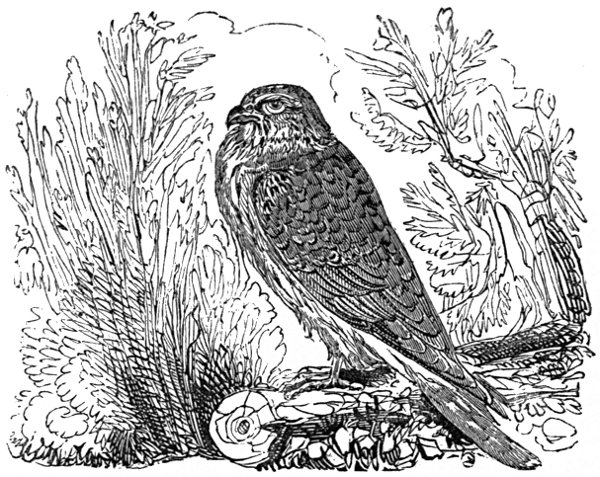
The Merlin—(Falco Æsalon, Linn.; L’Emerillon, Buff.)—The smallest of all the hawk kind, scarcely exceeding the size of a black bird. Its bill is blue; cere and irides yellow; the head is of a rust colour, streaked with black; back and wings of a deepish brown, tinged with ash, streaked down the shafts with black, and edged with rust colour: quill feathers dark tipped and margined on the inner webs with reddish white: the breast and belly are of a yellowish white, with streaks of rusty brown pointing downwards; the tail is long, and marked with alternate dusky and pale bars; the wings, when closed, do not reach quite to the end of the tail; the legs are yellow; claws black.
The merlin, though small, is not inferior in courage to any of the falcon tribe. It was used for taking larks, partridges, and quails, which it would frequently kill by one blow, striking them on the breast, head, or neck. Buffon observes, that this bird differs from the falcons, and all the rapacious kind, in the male and female being of the same size. The merlin does not breed here, but visits us in October; it flies low, and with great celerity and ease. It preys on small birds, and breeds in woods, laying five or six eggs.
Merrythought, s. A forked bone in the body of fowls.
Mesentery, s. That round which the guts are convolved.
Mesh, s. The space between the threads of a net.
Mesh, v. To catch in a net; to insnare.
Metal, s. A hard compact body, malleable and capable of fusion. The metals are six in number; first, gold; second, silver; third, copper; fourth, tin; fifth, iron; and sixth, lead.
Metallic, a. Partaking of metal, containing metal, consisting of metal.
Metalline, a. Impregnated with metal; consisting of metal.
Mettle, s. Spirit, sprightliness, courage.
Mettlesome, a. Sprightly, lively, brisk.
Mew, s. A cage, an enclosure, a place where a thing is confined; cry of a cat; a sea fowl; the place where a hawk changes her feathers.
The mew is the place where hawks are put to moult. They are sometimes kept loose in a room; but it is, in my opinion, much better to mew them on perches or on blocks.
Hawks must be fed very high, and kept very quiet when they mew; they are also kept unhooded, and frequently bathed.—Sebright.
Midge, s. A small fly, a gnat. The artificial midge is very serviceable in evening fishing.
Midriff, s. The diaphragm.
Midstream, s. Middle of the stream.
Migration, s. Act of changing place.
What has so often been said of herrings, mackerel, and other gregarious fish moving in vast shoals from Shetland to the Orkneys, and of their then dividing and surrounding the Islands of Great Britain and Ireland, is, I think, liable to some objections.
During the last month (April) large shoals of mackerel came on the shallows, a few miles from Brighton, one day, and disappeared the next. This is constantly observed to be the case, not only there but in other places, and may perhaps be accounted for in this way. We must consider that there are probably as many mountains, and valleys, and plains in the sea as we know there are on land. We are to recollect that those mountains and valleys are covered with weeds of various kinds, which afford food and shelter to an infinite number of fish and marine animals and insects; and we know that all fish come into shallow water for the purpose of depositing their ova, which the influence of the air, not, as has been commonly supposed, of the sun, is required for bringing to maturity. Is it not probable, then, that the shoals of fish which are found on our fishing banks, have left some neighbouring deep, where they had retired for the winter, till they are rendered buoyant by the quantity of roe within them, and are directed by instinct to go and deposit it in the adjacent shallows? If, as is generally supposed, all fish, both great and small, from the whale to the herring, have each their respective haunts and localities, why should we suppose that they quit those haunts to go many hundred miles in search of spawning ground, when that ground is to be found near their winter retreats? It appears more probable that the large shoals of fish which are found are quite unconnected with each other, and that they have all just quitted some neighbouring deep for the nearest shallow, only moving on as the ground is occupied, or till they have paired and the roe is ready to be deposited.—Jesse.
Mile, s. The usual measure of roads in England, one thousand seven hundred and sixty yards; eight furlongs, or five thousand two hundred and eighty feet.
Milk, s. The liquor with which animals feed their young; emulsion made by contusion of seeds.
To dry up a Bitch’s Milk.—Take goose grease and rum, equal portions, rub the teats once or twice a day; if the case is bad, for three or four days.
Brandy and salad oil, used in the same way, will have a similar effect.
Milktooth, s. Milkteeth are those small teeth which come forth before when a foal is about three months old.
Milkwhite, a. White as milk.
Milldam, s. The mound by which the water is kept up to raise it for the mill.
Millepedes, s. Wood-lice, so called from their numerous feet.
Miller’s-thumb, s. A small fish found in brooks, called likewise a bull’s head.
Millet, s. A plant; a kind of fish.
Mineral, s. Fossil body, matter dug out of mines.
Minnow, s. A very small fish, a pink.
This beautiful little fish abounds in many of our small gravelly streams, where they keep in shoals; it is sometimes called the pink, and when in right season and not sick, which only happens just after spawning, is dappled, its sides inclining to a greenish watery sky colour, its belly white, and its back almost black, but these colours are not universal; the body is slender and smooth, the scales being extremely small; it seldom exceeds three inches in length; the lateral line is of a golden colour, the back flat and of a deep olive; the sides and belly vary greatly in different fish, as a few are of a rich crimson, others are bluish, and others white. The tail is forked, and marked near the base with a dusky spot. The minnow appears first in March, continues until Michaelmas, and then betakes himself to the mud, weed-roots, or wood in rivers, to secure himself from floods and fishes of prey. They are usually full of spawn all the summer (for they breed often), and quickly arrive at their growth and perfection.
Although so diminutive in size, the minnow may be compared for the excellency of its taste to many of the most famed fish; they are in some places made into minnow tansies; after being gutted and well washed in salt and water, their heads and tails cut off, they are then to be put with yolks of eggs well beat with cowslips and primrose flowers, and a little tansy shred very small, and fried in good butter; the sauce to them is butter, vinegar, or verjuice, and sugar. To the young sportsman, who has not possessed himself of the patience requisite to form the angler, the minnow yields plenty of amusement. They will in hot weather bite eagerly all day, and are frequently drawn out of the water from their adhering to the end of the worm, without being touched by the hook; the best way to catch them, is, to have three or four very small hooks, baited with the least red worm, or a piece of one, and a crow quill float; fish deeper than midwater, or near the ground in shallow places, in eddies, and at the sides of small streams.
Minnows are very excellent baits for many fish, as will hereafter be specified, and when wanted in haste for that purpose, a small meshed casting-net will save much time and trouble, as enough for a day’s diversion may be caught at a throw or two in shallow streams.
Minnow Fishing.—The tackle for minnow fishing for trouts, should be of the same sort as that for salmon, with this difference, that it must be finer, with a stout single silk worm gut at bottom, and the hook No. 2, 3, or 4, according to the bigness of the trout in the water where angled for: the middle-sized and whitest minnows are the best (of which those caught in streams are far brighter than those procured from ditches or stagnated waters), and the way of baiting recommended by Walton, is,
“To put the hook in at the mouth and draw it out through the gill about three inches; then again put the hook in at the mouth, and let the point and beard come out at the tail; then tie the hook and the tail about with a fine white thread, which will make it spin quicker; pull back that part of the line which was slack when the hook was thrust in the second time, which will fasten the head of the minnow, so as to make it be almost straight on the hook; try if it turns well, which it cannot do too fast. Angle with the point of the rod down the stream, drawing the minnow against the current gradually, and near the surface: when descried, the trout will freely come at it; be careful not to snatch it away, nor strike until he has turned with the bait. For this angling the winch and ringed rod is to be always used; and there should be two or three swivels on the line, which will assist the spinning of the minnow.”
Walton’s method may be altered and improved, by first thrusting the hook in at the lower side of the minnow’s under, and also quite through the upper chap, drawing it two or three inches on the line, and putting the hook in at the mouth as before directed; this will keep the minnow’s mouth closed, which otherwise should be stitched up.
Various hooks are recommended in minnow fishing; one much used consists of a large hook, with two very small ones fastened back to back to a piece of gut about two inches long, with a small hook to another gut something shorter, to fasten the head of the minnow: these pieces of gut are so attached to the link, that the two small hooks may be about the middle of the minnow when baited, and the other reach the head; a small lead cap (which renders other weight unnecessary) slides upon the link, keeps the short pieces of gut close, and falls upon the head of the minnow. The advocates for this plan boast of the certainty of hooking the trout with the two small hooks; this may be true, says an angler of no inconsiderable skill, but he asks if these small hooks (which seldom exceed No. 12) are sufficient to kill a trout of any bigness; and when a fish is hooked by these, the other hooks are entirely useless, from the situation in which they are placed. Another objection started by the same gentleman, is, that when the gut to which they are tied has been a short time in the water, it will not sustain the weight of the hooks, but they will sink below the minnow, and are continually foul of weeds and rubbish at the bottom; besides, the lead cap, falling upon the minnow’s head, totally conceals the eyes, parts which add life and attraction to the bait, and are, on that account, so essential to be seen.
Some use about three feet of stout silkworm gut for the bottom links, with two or three small swivels, which prevents the line from being entangled, and assists the twirling of the minnow. If these hooks are used as directed for pike, it will be successful; the bottom swivel must be open at one end, that the link on which the hooks are may be taken off occasionally to be baited; the proper size of these hooks is No. 7; if the old method of a large hook and a smaller above it, be preferred, the proper sizes are Nos. 2 and 6, with a running line; the angler can permit the minnow to be carried by the current under bushes, banks, &c.; this will be effected by his suffering the stream to gain upon it when he pulls it back, which also prevents its sinking to the bottom, and entangling the hooks; as he draws it gently against the stream, favouring the direction to which he would have the bait driven, it will of course spin round very quick, and this is the moment the trout usually takes it; by holding the rod firm, he will infallibly hook himself; will then spring out of the water several times, and, by an astonishing strength and agility, endeavour to get quit of the hook. The angler must not be too hasty, but lower his right hand, which will raise the top of his rod and keep it bent; by this means the trout may be tired, but he will not readily suffer himself to be got into the landing-net; the best way therefore, instead of bringing the fish to the surface (where he will so violently plunge, as to endanger breaking the rod, line, or hook), is to keep him as deep in the water as possible.
Artificial minnows made of mother of pearl, &c., fitted to single, two, or more hooks, and bent in various attitudes, are to be purchased at all the tackle makers.—Daniel.
Mint, s. A valuable herb that grows very abundantly. There are two kinds used in horse medicine, spearmint and peppermint. The former is an excellent carminative, generally affording relief in flatulency of the stomach and bowels, and the complaints which arise from it, termed gripes and flatulent colic.
Minute, s. The sixtieth part of an hour; any small space of time.
Minute-glass, s. A glass of which the sand measures a minute.
Minute-watch, s. A watch in which minutes are more distinctly marked than in common watches which reckon by the hour. Such are generally used by judges of a course, &c.
Miss, v. Not to hit; to mistake.
Missel Thrush (Turdus viscivorus, Linn.; La Drainé, Buff.) s. A bird.
The length of this bird is about eleven inches. The bill is dusky, the base of the lower bill yellow; the eyes hazel; the head, back, and lesser coverts of the wings, are of a deep olive brown, the latter tipped with white: the lower part of the back and rump tinged with yellow; the cheeks are of a yellowish white, spotted with brown, as are also the breast and belly, which are marked with larger spots of a dark brown colour; the quills are brown, with pale edges; tail feathers the same, the three outermost tipped with white; the legs are yellow, claws black. The female builds her nest in bushes or low trees, and lays four or five eggs, of a greenish blue colour, marked with red spots. Its nest is made of moss, leaves, &c., lined with dry grass, strengthened on the outside with small twigs. It begins to sing very early, often on the turn of the year in blowing showery weather, whence in some places it is called the storm-cock. Its note of anger is very loud and harsh, between a chatter and a shriek, which accounts for some of its names. It feeds on various kinds of berries, particularly those of the misletoe, of which birdlime is made. It was formerly believed that the plant of that name was only propagated by the seed which passed the digestive organs of this bird, whence arose the proverb—“Turdus malum sibi cacat;” likewise feeds on caterpillars and various kinds of insects, with which it also feeds its young.
This bird is found in various parts of Europe, and is said to be migratory in some places, but continues in England the whole year, and frequently has two broods.—Bewick.
Missile, a. Thrown by the hand, striking at a distance.
Mist, s. A low thin cloud, a small thin rain, the drops of which are hardly perceptible.
Misletoe, s. The name of one of those plants which draw their nourishment from some other plant. It generally grows on the apple tree, sometimes on the oak, and was held in great veneration by the ancient Druids.
Mite, s. A small insect found in cheese or corn; a weevil; vermin found about the head and nares of hawks.
Mithridate, s. Mithridate was formerly, before medicine was simplified, one of the capital medicines of the shops, consisting of a great number of ingredients, and has its name from its inventor, Mithridates, king of Pontus.
The following is the recipe for Mithridate, or Confection of Democrites.
Cinnamon twenty-four drachms; Indian spikenard, ginger, saffron, shepherd’s-purse seed, frankincense, Chian turpentine, of each ten drachms; Zedoary mace, long pepper, juice of hypocistus, storax, opoponax, galbanum, opobalsam and castor, of each one ounce; scordium, cubebs, white pepper, carrot seed, bdellium, of each seven drachms; celtic nard, gentian, dittany of Crete, red roses, wild parsley seed, cardamoms, sweet fennel seeds, gum arabic, strained opium, dissolved in wine, of each five drachms; aromatic reed, valerian root, sagapenum, aniseed, of each three drachms; catechu, St. John’s wort, skinks, of each two ounces and a half, &c. &c.
Another of these absurd preparations is composed of seventy-two articles.
Mittens, s. Coarse gloves for the winter; gloves that cover the arm without covering the fingers.
Mob, v. To harass or overbear by tumult; a term in hunting.
Mohair, s. Thread or stuff made of camel’s or other hair; an excellent article for sporting dresses.
Mole, s. A mole is a formless concretion of extravasated blood, which grows into a kind of flesh in the uterus; a natural spot or discolouration of the body; a mound, a dyke; a little beast that works whilst under ground.
Molecatcher, s. One whose employment is to catch moles.
Molehill, s. Hillock thrown up by the mole working underground.
Mollusca, s. An order of the class Vermes of Linnæus. It comprehends naked simple animals not included in a shell, but furnished with limbs, as snails, star fish, sea urchins, cuttle fish, &c.
Moon-eyed, a. Having eyes affected by the revolutions of the moon; dim-eyed, purblind.
Moonfish, s. Moonfish is so called, because the tail fin is shaped like a half moon.
Moor, s. A marsh, a fen, a bog, a tract of low and watery ground; a negro.
Moorcock, s. The male of the moorhen.
Moorhen, s. A fowl that feeds in the fens, without web feet.
Moose, s. A large American deer. They were formerly found in Ireland, and their gigantic remains are frequently discovered in the bogs and morasses.
Mop, s. Pieces of cloth, or locks of wool, fixed to a long handle, to clean floors, carriages, &c. &c.
Morass, s. Fen, bog, moor.
Morbid, a. Diseased, in a state contrary to health.
Morbidness, s. State of being diseased.
Mordant, a. Biting, pungent, acrid.
Moreland, s. A mountainous or hilly country.
Morillon, (Anas Glaucion, Linn.; Le Morillon, Buff.) s. An aquatic bird.
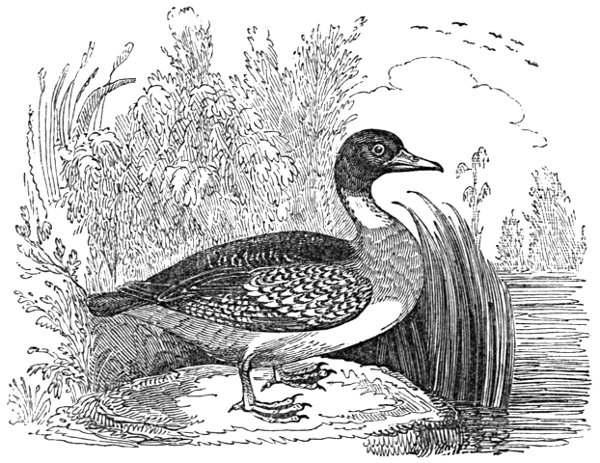
Bill brown, orange from the nostrils to the point, the knob of which is black; it is an inch and a half long, rather narrow towards the apex; the nostrils are placed very forward; head brown, cheeks tinged with black; irides straw colour; a broad white circle round the neck, the back part of which is mottled with brown; breast, sides of the body, and scapular feathers, white, barred with black; belly white; thighs and vent feathers brown and white; inner coverts of the wings brown; back and coverts of the wings black, mottled with white; quill feathers and tertials black; secondaries white; tail rounded and grey; legs and toes yellow brown, with a greenish tinge; webs and claws black. Length, one foot four inches; breadth, two feet four inches; weight, one pound seven ounces.
They are generally seen in small flocks, diving for their food, near the shore.—Bewick.
Mortar, s. A strong vessel in which materials are broken by being pounded with a pestle; a short wide cannon, out of which bombs are thrown; cement made of lime and sand with water, and used to join stones or bricks.
Mortification, s. The state of corrupting or losing the vital qualities, gangrene; humiliation, vexation, trouble; to humble, to depress, to vex.
Mortise, s. A hole cut into wood that another piece may be put into it.
Moss, s. A plant.
Moth, s. A small winged insect that eats cloths and hangings; an evening fishing fly.
Moult, v. To shed or change the feathers, to lose the feathers.
Mountain, s. A large hill, a vast protuberance of the earth.
Mountain, a. Found on the mountains, as mountain hares, mountain partridges.
Mountainous, a. Hilly, full of mountains; large as mountains, huge; inhabiting mountains.
Mouse, s. The smallest of all beasts, a little animal haunting houses and corn-fields. Vide Field Mouse.
Mouth, s. The aperture in the head of any animal at which the food is received; the opening, the entrance; the instrument of speaking.
Mouth, v. To chew, to eat; to seize in the mouth; to injure with the teeth.
Mow, s. A loft or chamber where any hay or corn is laid up.
Mow, v. To cut with a scythe; to put in a mow.
Mucilage, s. A slimy or viscous body, a body with moisture sufficient to hold it together.
Mucilage is made by dissolving gum arabic in water. There are other cheaper gums, however, that will answer the same purpose: mucilage may be made also from quince seeds and starch. For internal use it is most cheaply and abundantly obtained from flax-seed, or linseed. Eight ounces infused in two or three quarts of boiling water, forms a good mucilage.—White.
Mucilaginous, a. Slimy, viscous, soft with some degree of tenacity.
Mucous, a. Slimy, viscous.
Mucus, s. The viscous substance discharged at the nose; any viscous matter.
Mud, s. The slime at the bottom of still water; earth well moistened with water.
Mue, v. To moult, to change feathers.
Muffle, v. To cover from the weather; to blindfold; to conceal; to involve, to hood a hawk.
Mule, s. An animal generally between a he-ass and a mare, or between a horse and a she-ass.
These useful and hardy animals are the offspring of the horse and ass, or ass and mare; those produced between the two last are esteemed the best, as the mule is observed to partake less of the male than of the female parent; yet it is a general remark, that they almost always inherit, in some degree, the obstinacy of the parent ass, though it must be confessed that this vice is heightened by their being injudiciously broke in.
Savoy produces very large mules, but the finest are bred in Spain. They are chiefly used in countries where there are rocky and stony roads, as about the Alps and Pyrenees, &c. Great numbers of them are kept in these places, they are usually black, and are strong, well-made, and large, being mostly bred out of fine Spanish mares. They are sometimes fifteen or sixteen hands high, and a good one of this kind is worth fifty or sixty pounds. No creature is so proper for carrying large burdens, or more surefooted. They are much stronger for draught than our horses; often as thick-set as our dray-horses, and will travel for several months together with six or eight hundred weight on their backs.
The mule far excels the horse for travelling in a mountainous country, the former being able to tread securely where the latter can hardly stand. Their manner of going down the precipices of the Alps, the Andes, &c., is very extraordinary. In these passages, on one side are steep eminences, and on the other frightful abysses, and as they generally follow the direction of the mountain, the road, instead of lying on a level, forms at every little distance, deep declivities of several hundred yards downward. These can be descended only by mules, and these animals seem sensible of the danger, and the caution that is to be used in such descents. When they come to the edge of one of these precipices, they stop, without being checked by the rider, and if he inadvertently attempts to spur them on, they continue immovable, apparently ruminating on the danger that lies before them, and preparing themselves for the encounter. They not only attentively view the road, but tremble and snort at the danger. Having prepared for the descent, they place their fore-feet in a posture as if they were stopping themselves, they then put their hind-feet together, but a little forward, as if they were going to lie down. In this attitude, having taken, as it were, a survey of the road, they slide down with the swiftness of a meteor. In the mean time, all that the rider has to do, is to keep himself fast on the saddle without checking the rein, for the least motion is sufficient to disorder the equilibrium of the mule, in which case they both unavoidably perish. But their address in this rapid descent is truly wonderful, for in their swiftest motion, when they seem to have lost all government of themselves, they follow exactly the different windings of the road, as if they had previously settled in their mind the route they were to follow, and had taken every precaution for their safety.
In these journeys the natives place themselves along the sides of the mountains, and holding by the roots of the trees, animate the beasts with shouts, and encourage them to persevere. Some mules, after being long used to such travelling, acquire a kind of reputation for their safety and skill, and their value rises in proportion to their fame.
The Roman ladies had equipages drawn by mules, as appears from the medals of Julia and Agrippina, and at this day, in Spain, the carriages of the nobility, and even of princes, are usually drawn by them. We are assured that M. de Thou, first president of the parliament, had the fourth coach in France, in 1505, till which time every body rode to court and parliament on mules.
The progeny between the pheasant and the common fowl, are necessarily mules, as proceeding from different species, although of the same genus. They may be obtained with some little difficulty, which they scarcely repay, as being neither an improvement in form nor goodness of the flesh. It is recommended, as the best method, to confine a cock-pheasant half grown with two pullets of the same age, either game, bantam, or common, as may be desired; or to make a house for common hens in a pheasant preserve near home, where they will soon associate with the pheasants, and be trodden by the cocks. Hybrids, or mules, between the pheasant and black grouse, have been occasionally found on the moors.—Le Keux—Moubray.
Mullet, s. A sea fish.
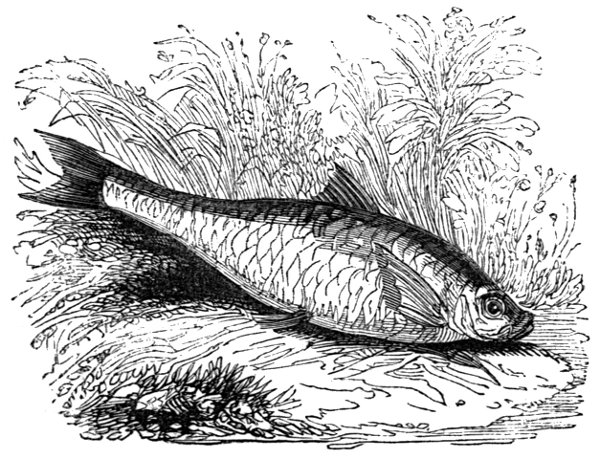
The mullet is found in great plenty on several of our sandy coasts, and, in particular, haunts those small bays that have influxes of fresh water; they are very cunning, and when surrounded with a net, the whole shoal frequently escapes by leaping over it; for when one takes the lead, the others are sure to follow.
They come in great shoals into the rivers with the tide during the summer, and keep rooting, like hogs, in the sand or mud, leaving their traces in the form of large round holes; but return back when the water ebbs, never stopping in the rivers. They are something like the dace in shape, yet much thicker; the head is almost square and flat on the top; the nose blunt; lips thick; they have no teeth, only the upper-lip is a little rough, as is also the tongue; between the eyes and mouth is a hard callus; the pupil of the eye is black, encircled with a small silvery line; the colour of the back is dusky, varied with blue and green; the sides silvery, marked with broad, dusky, parallel lines, reaching from head to tail, which is much forked; the scales are large and deciduous, and are also upon the covers of the gills and head, and extend as far as the nostrils. The largest are nearly half a yard long, and the flesh is excellent.
Although the mullet are generally first seen here in the month of June, from the wetness of this summer the shoals are later in their appearance than usual. Mullet are taken in draught-nets like salmon, but on this coast a different mode of fishing is pursued. The shoals in hot weather run in with the tide, and after remaining on the shores and estuaries during flood they return with the ebbing water. The following method we employed in our fishing to-day: being provided with a sufficient quantity of herring-nets and a number of spars and poles, we selected, at low water, a sandy creek for our operations, and commenced erecting a line of poles across the entrance of the cove. The nets were then extended along these uprights, and also secured firmly to the bottom of the spars; the lower part of the net is kept upon the bottom by a row of stones, and the remainder laid flat upon the sands. With the flowing tide the fish pass over the prostrate net, and run along the estuary; at high water the buoy-ropes are raised and secured to the upright poles; with the assistance of a boat the whole is effected in a few minutes, and a net-work barrier effectually cuts off the retreat of all within. When the ebb of tide commences, the mullet begin to retire, and when they discover that their egress is obstructed, their attempts to effect a passage are both constant and curious—now running down the nets, trying for a broken mesh by which to force an aperture—now with a bold spring endeavouring to clear the buoy-ropes, and, even after repeated failures, leaping at it again and again. The last effort is directed to the bottom, but there the heavy stones resist every attempt to dislodge them, and deserted by the treacherous water, the mullet are left upon the bare sands.
The general length of the common mullet (mugil) is from twelve to eighteen inches. When used immediately after being taken, the fish is excellent; carriage, even for a short distance, injures it. Dr. Blotch recommends oil and lemon-juice to be used with it at table. Vinegar, with parsley and melted butter, is better—“probatum est.”
This fish is sometimes preserved by salting; and from its spawn an inferior kind of caviar, called botargo, is prepared, by using the common process of curing and drying.—Wild Sports.
Multiparous, a. Bringing many at a birth.
Mum, s. Ale brewed with wheat.
Mungrel, s. Anything generated between different kinds; anything partaking of the qualities of different causes or parents.
Mungrel, a. Generated between different natures, baseborn, degenerate.
Munition, s. Ammunition; materials for war.
Muriates, s. Combinations of muriatic acid, with alkalies, earths, or metals.
Muriate of Ammonia, commonly named crude sal ammoniac.—When dissolved in vinegar, it has been found a useful application for splents when in a state of inflammation.
Muriate of ammonia, powdered 2 dr.
Vinegar 1 oz.
Alcohol 1 oz.
Water 2 oz.—Mix.
Muriate of Antimony, or Butter of Antimony.—A strong and useful caustic, employed by smiths, in canker, punctured wounds from picking up a nail, bruises of the foot, &c.
Muriate of Copper.—A solution of verdigris in muriatic acid or spirit of salt. A mild caustic, and diluted occasionally with water.
Muriate of Soda.—Common salt, or the salt employed with food. This is an excellent laxative for cattle, and, in small doses, promotes digestion. Mow-burnt hay, or bad hay of any kind, is made more palatable to horses and cattle by being moistened with water in which a small quantity of salt has been dissolved, and it is, perhaps, rendered more easy of digestion also.—White.
Murky, a. Dark, cloudy, wanting light.
Murrey, a. Darkly red.
Mus, s. A tribe of order Glires, and class Mammalia. In it are included the common rat and mouse, Norway rat, musk rat, &c. &c.
Muscadine, s. A kind of sweet grape, sweet wine.
Muscle, s. A bivalve shell-fish.
Muscovy, Cairo, Guinea, or Indian Duck (Anas moschatus, Linn.; Le Canard Musque, Buff.), s.
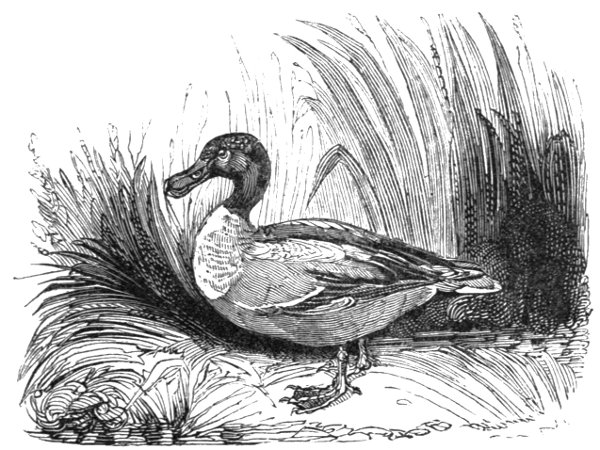
This species is much larger than the common duck, measuring about two feet in length. The bill is two inches long; the tip and nostrils brown; the other parts of it red, as is also the red warty skin which joins its base, and surrounds the eyes. The crown of the head is rather tufted or crested, and black; the cheeks, throat, and fore part of the neck, white, irregularly marked with black; the belly, from the breast to the thighs, white. The general colour of the rest of the plumage is deep brown, darkest, and glossed with green on the back, rump, quills, and tail; the two outside feathers of the latter, and the first three of the former, are white: the legs and feet are red, short, and thick. This is the general appearance of the musk duck; but, as it is domesticated in almost every country, it varies very much, like all other birds in that state. In the female, the bare warty or carunculated skin which is spread from the bill over the eyes, is of a much duller red, and does not cover so large a portion of the head as it does in the male: she is also of a less size.
These birds have obtained the name of Musk Duck, from their musky smell, which arises from the liquor secreted in the glands on the rump. They are a thriving and prolific species, and their flesh, which is highly flavoured, is by many very much esteemed. They will associate with the common ducks; and instances are not wanting of their producing a mixed breed.—Bewick.
Muscular, a. Performed by muscles.
Musk, s. A very powerful perfume; it is procured from a kind of Indian goat.
Musket, s. A soldier’s gun; a male hawk of a small kind.
Musketeer, s. A soldier whose weapon is his musket.
Musketoon, s. obs. A blunderbuss, a short gun of a large bore.
Muslin, s. A fine stuff made of cotton.
Mustard, s. A plant.
Musty, a. Mouldy, spoiled with damp, moist and fetid; stale.
Mute, a. Silent, not vocal, not having the use of voice.
Mute, s. The excrement of hawks.
Mute, v. To dung as birds.
Mutton, s. The flesh of sheep dressed for food; a sheep.
Muzzle, s. The mouth of any thing; a fastening for the mouth which hinders to bite; a contrivance to prevent a horse from eating hay or litter.
Muzzle, v. To secure the mouth.
Myopy, s. Shortness of sight.
Myrrh, s. A precious kind of gum. Myrrh is sometimes used in veterinary practice. The tincture is a favourite remedy with grooms and farriers, for recent wounds. The dose of myrrh is from one or two to three drachms.
Nag, s. A small horse; a horse in familiar language.
Nail, s. The horny substance at the ends of the fingers and toes; the talons of birds and beasts; a spike of metal by which things are fastened together; a stud, a boss; a kind of measure, two inches and a quarter.
Nape, s. The joint of the neck behind.
Narcotic, a. Producing torpor, or stupefaction.
Nares, s. The hawk’s nostrils.
Narrow, a. Not broad or wide.
Narrow-heels, s. A disease in horses.
Chronic lameness may exist in various degrees, and, in the early stages of the disorder, a horse may do considerable work, by paring his feet properly, and keeping them cool and moist; by paring the soles, putting on a wide hollow shoe, and keeping them stopped with tar ointment. By such management the progress of the disease may be retarded, and the horse much relieved; but it can never be cured. Most commonly the disease gradually gets worse, and at length the horse becomes unfit for every kind of work. At this period the horse is generally blistered or fired, and turned to grass. But this never does any good; shoes with claws, or hinges and screws, have been proposed, and employed with a view to open the heels; but of course they have never done any good, either in the way of prevention or cure. The hoof has been all rasped away, and the horse turned to grass until a new hoof has grown down of a proper form, but it has never done any good. That cruel operation of tearing off the sole, technically termed drawing the sole, was formerly practised for it, but is now, I trust, completely discontinued. In short, every thing that human ingenuity can devise has been tried, but nothing has ever been found to cure this disorder. I believe at this time all veterinarians agree in the opinion of its being absolutely incurable.—Blaine.
Native, a. Produced by nature, not artificial; natural, such as is according to nature; conferred by birth; pertaining to the time or place of birth, original.
Natural, a. Produced or effected by nature.
The natural fly delights in hovering over the stream, and performs it with that ease and beauty, which cannot be attained with the artificial, but the former often drowns when tired of making its airy evolutions, and it is then the latter best resembles it, and as a drowned fly is the artificial one taken by the fish, no art being able to make that play upon the water like the living one.
This way of angling is chiefly adapted to warm weather, when the water is low and clear; and is best in small rivers and brooks, where the angler can keep more out of sight than near large waters, that are more exposed. He must have a long rod, as before described for artificial fly fishing; the line fine for nearly the whole length of it (which is not to exceed three fourths of that of the rod), with a fine short shanked hook, in size proportioned to the baits.
Nave, s. The middle part of the wheel in which the axle moves; the middle part of the church, distinct from the aisles or wings.
Navelgall, s. Navelgall is a bruise on the top of the chine of the back, behind the saddle, right against the navel.
Neap, a. Low, decrescent.
Neat, s. Black cattle, oxen; a cow or ox.
Neat’s-foot Oil, s. Is extracted from the feet of oxen, &c.; it is used in lubricating stiff joints, old sprains, &c., and is an excellent preservative of harness and leather.
Neb, s. Nose, beak, mouth. In Scotland, the bill of a bird.
Nebula, s. It is applied to appearances like a cloud in the human body, as to films upon the eye.
Neck, s. The part between the neck and the body; a long narrow part.
The neck should form from the head to the withers, an elegant but moderate curve, with which it should unite with a very moderate depression only; while its under surface ought to be but very slightly incurvated, and should enter the chest rather above the point of his shoulders. A large prominent windpipe adds to the perfection of the lower surface of the neck. In point of length, it is of consequence that the neck be duly proportioned. The long neck, when thin withal, seldom presents a firm or proper resistance against the pressure of the bit. When, on the contrary, the neck is too short, the head is frequently ill placed, and the lever in the hand of the rider will be also too short. Such necks are often likewise weighty, and overloaded with flesh. It is evident, also, that such cannot be reined up without danger of suffocation; and it is seldom that a short-necked horse is speedy. When the upper surface of the neck is thick and heavy, it is a very strong presumption of a sluggish disposition, particularly in geldings and mares. In stallions, it is a distinctive sexual mark, and hence less to be depended on. Now and then, the neck is arched downwards, which is called ewe-necked. When the deformity is considerable, it prevents the head from being carried in its true angle; instead of which, the nose, from being projected upwards and forwards, has occasioned such horses to be called stargazers; to remedy which, it is usual to draw the head down by a martingal. In the horse, as well as in all the grazing tribes, the length of the well proportioned neck is such, that, adding to it the angle resulting from the head, the length of both is equal to the height of the shoulders from the ground. It may not, also, be amiss to mention, that, in the purchase of a horse, it is prudent to observe whether the upper part of the neck bears any marks of a tight collar having been worn: when such an appearance does exist, it commonly arises either from a strap worn to prevent the action of crib-biting, or such a horse is apt to unloose himself, which is almost an equal defect.—Blaine.
Needle, s. A small instrument pointed at one end to pierce cloth, and perforated at the other to receive the thread; the small steel bar which, in the mariner’s compass, stands regularly north and south.
Neigh, v. To utter the voice of a horse.
Neigh, s. The voice of a horse.
Nerve, s. The nerves are the organs of sensation passing from the brain to all parts of the body; it is used by the poets for sinew or tendon.
Neurotomy.—A question has arisen how far a horse that has undergone the operation of the division of the nerve of the leg, and has recovered from the lameness with which he was before affected, and stands his work well, may be considered to be sound. In our opinion there cannot be a doubt about the matter. Does the operation of neurotomy render a horse as capable of work as he was before he became affected with the disease on account of which, and to relieve him from the torture of which, the nerve was divided? Is the operation of neurotomy so invariably followed by capability, and continued capability of ordinary and even extraordinary work, that they may regularly be considered as cause and effect? The most strenuous defenders of the nerve operation cannot affirm this. They can only say that they partially succeed in almost every fair case,—that they perfectly succeed in the majority of cases; but they cannot deny that the horse will batter and bruise that foot, when he has lost sensation in it, which should have been tenderly used; that even the hoof will sometimes be lost, after operations performed with the greatest judgment; that the lameness will sometimes return, after the animal has gone sound, one, two, or three years; and that, after all, there is a little unpleasantness, and even unsafeness in the action of the horse, from the peculiar manner in which the foot meets the ground when its feeling is destroyed; and that the horse is more liable to accidents, for he will travel on without warning his rider of the evil, after a piece of glass has penetrated his foot, or a stone has insinuated itself between the sole and the shoe; and thus irreparable mischief will be done, before the cause of it can possibly be detected. A horse on whom this operation has been performed may be improved—may cease to be lame, may go well for many years; but there is no certainty of his continuing to do so, and he is unsound.
Poiet.—These, as well as the omens of death watches, dreams, &c., are for the most part founded upon some accidental coincidences; but spilling of salt on an uncommon occasion may, as I have known it, arise from a disposition to apoplexy, shown by an incipient numbness of the hand, and may be a fatal symptom; and persons dispirited by bad omens sometimes prepare the way for evil fortune, for confidence in success is a great means of ensuring it.
I knew a man of very high dignity, who was exceedingly moved by these omens, and who never went out shooting without a bittern’s claw fastened to his button-hole by a riband.
Under these circumstances a man must either pick his shots or occasionally miss, though his gun be every time held straight. I venture to say there is no sportsman living who has not been known to miss the fairest shots, and there are very few but now and then in a season will shoot badly for a whole day. It stands to reason when the most skilful may become for a time unnerved for shooting by ill health, oppression of mind, one night’s debauch, or anything that will operate on the temper or nerves.—The Horse—Sir Humphry Davy—Hawker.
Nest, s. The bed formed by the bird for incubation; any place where insects are produced; an abode; boxes of drawers, little conveniences.
Nest, v. To build nests. Vide Nidification.
Nestegg, s. An egg left in the nest to keep the hen from forsaking it.
Nestle, v. To house, as in a nest; to cherish, as a bird her young.
Nestling, s. A bird taken out of the nest.
Net, s. A texture woven with large interstices or meshes, used for taking fish and birds. Game is frequently thus poached, and to the smaller kinds, particularly snipes, the net is very destructive.
The snipe net seems to be the most destructive, and is used with great success in Ireland, as follows: it must be about half as long again as the partridge-net, with the meshes much smaller and not quite so deep; two strong men hold each end of the net, and run down the wind with it, as fast as possible, having not time even to look where they are going, as they must constantly mind the net, to see when a bird strikes it, that they may let it fall, by which means they secure these birds; they get, of course, very severe falls, from the attention they are obliged to pay to the net, but are amply repaid, it being no uncommon circumstance for them to take one or two hundred brace, in a very few hours (especially if the day is dark and windy, which is the most favourable time both for gun and net). The top part of the net gets so forward, that by the time the snipe perceives it, and rises, on striking the lower part of it, he is secured. One netted snipe is worth twenty that are shot.
Anecdote of Netting Snipes.—Visionary in the extreme were many of the devices which entered into his head in regard to compassing the wild fowl, that resorted hither in astonishing abundance; in two only of those which he put into execution was he successful; namely with the talking hare, and the snipe net. Of his numberless expeditions with the latter, one is worthy of recital. It was at the close of a cold winter’s day, when John and an attendant sallied forth from Grenton for the moor, anticipating much sport, as the wind and the complexion of the evening seemed particularly favourable; moreover they soon encountered a hail-storm, which made the birds lie to their perfect satisfaction.
They had at length taken a quantity of snipes, and were thinking about returning, when something struck the net with unusual force, and struggled so, that the poles were with difficulty kept to the ground. What have we here, said the attendant, calf, sheep, hog, dog, or goat? It is the d——l, I believe, replied John, and if we can but hold him fast, we shall have made a tolerable night’s work of it. The net had enclosed a goose of a coarse dun-coloured plumage, no one knew what sort of a goose it was, but it was allowed to be the largest aquatic bird, the hooper excepted, ever taken on King’s Sedgmoor.—Thornhill—Sporting Anecdotes.
Network, s. Anything resembling the work of a net.
Neurology, s. A description of the nerves.
Neurotomy, s. Vide Nerve.
Newfoundland Dog (Canis Sensilis), s.
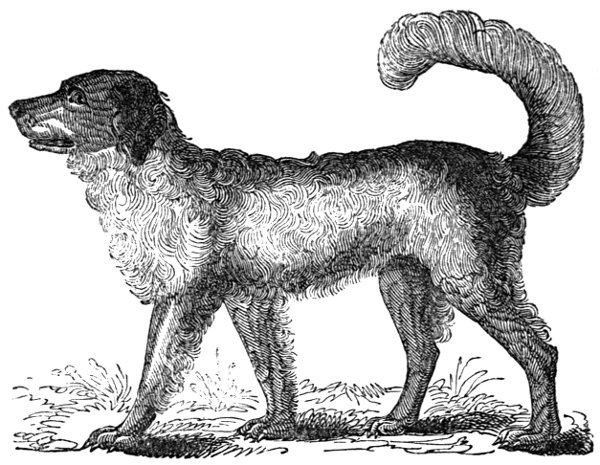
NEWFOUNDLAND DOG.
In a state of purity, and uncontaminated by a mixture of any inferior race, this is certainly the noblest of the canine tribe. His great size and strength, and majestic look, convey to the mind a sort of awe, if not fear, but which is quickly dispelled when we examine the placid serenity and the mild expressive intelligence of his countenance, showing at once that ferocity is no part of his disposition.
The full-sized Newfoundland dog from the nose to the end of the tail measures about six feet and a half, the length of the tail being two feet; from the one fore foot to the other, over the shoulders, five feet eight inches; girth behind the shoulders three feet four inches; round the head, across the ears, two feet; round the upper part of the fore leg, ten inches; length of the head, fourteen inches; and his feet are webbed, by which means he can swim with great ease. He is covered with long shaggy hair, has feathered legs, and an extremely villous tail, which is curvilinear.
This dog is but of recent introduction into this country from the island whose name he bears, and may be considered as a distinct race. I cannot agree with some naturalists who hold the opinion that the Siberian, Lapland, and Iceland dogs are from the same stock as the Newfoundland, because the formation of the head in this last is very different, and his muzzle, though long, is not nearly so acute as in the others; he also differs materially in his shape, but more especially in the length of his body.
This dog is not remarkable for symmetry of form, or in the setting on of his legs, whence his motion is somewhat awkward and loose, and consequently he is not distinguished for speed,—a defect which might be remedied by breeding, were an improvement in that particular thought desirable.
The Newfoundland dog is docile to a very great degree, and nothing can exceed his affection. Naturally athletic and active, he is ever eager to be employed, and seems delighted to perform any little office required of him. Nature has given him a great share of emulation, and hence to be surpassed or overcome is to him the occasion of great pain. Active on every emergency, he is the friend of all, and is naturally without the least disposition to quarrel with other animals. He seldom or never offers offence, but will not receive an insult or injury with impunity. Such is the capacity of his understanding, that he can be taught almost everything which man can inculcate, and of which his own strength and frame are capable. His sagacity can only be exceeded by his energies, and he perseveres with unabated ardour in whatever shape he is employed, and while he has a hope of success he will never slacken in his efforts to attain it. The amazing pliability of his temper peculiarly fits him for the use of man, and he never shrinks from any service which may be required of him, but undertakes it with an ardour proportionate to the difficulty of its execution. Taking a singular pride in being employed, he will carry a stick, a basket, or a bundle, for miles in his mouth, and to deprive him of any of these is more than a stranger could accomplish with safety.
Sagacity and a peculiar faithful attachment to the human species are characteristics inseparable from this dog, and hence he is ever on the alert to ward off from his master every impending danger, and to free him from every peril to which he may be exposed. He is endowed with an astonishing degree of courage, whether to resent an insult or to defend his friends, even at the risk of his own life.
Habitually inclined to industrious employment, such dogs are as useful to the settlers of the coast from which they are brought, as our ponies and galloways are to us. It is easy to accustom them to daily labour. From three to five of them are harnessed to a sledge or other vehicle, containing a load of wood or lumber, amounting to twenty or thirty stone, which they steadily draw for miles with ease. This they do without the aid of a driver, when they are acquainted with the road, and having delivered their burden, they return home to their master, and receive as a reward for their labour their accustomed food, which generally consists of dried fish, of which they are said to be extremely fond. The qualifications of this dog are extensive indeed; as a keeper or defender of the house, he is far more intelligent, more powerful, and more to be depended upon than the mastiff, and has of late years been much substituted for him in England; indeed he may with great propriety entirely supersede that breed. As a watch dog, and for his services upon navigable rivers, none can compete with him; and various sportsmen have introduced him into the field as a pointer with great success, his kind disposition and sagacity rendering his training an easy task.
The usual fate of other fine dogs attends this generous race among us; they are too often degraded and degenerated by inferior crosses, which with so noble an animal should be avoided by every possible means.
At the commencement of the action which took place between the Nymph and Cleopatra, during the late war, there was a large Newfoundland dog on board the former vessel, which the moment the firing began ran from below deck, in spite of the endeavours of the men to keep him down, and climbing up into the main-chains he there kept up a continual barking, and exhibited the most violent rage during the whole of the engagement.
When the Cleopatra struck, he was among the foremost to board her, and there walked up and down the decks, seemingly conscious of the victory he had gained.
Newt, s. Eft, small lizard.
Nibble, v. To bite by little at a time, to eat slowly; to bite as a fish does the bait; not to bite sportingly.
Nick, s. A notch cut in anything; in hazard, a winning throw.
Nick, v. To hit, to touch luckily; to cut in nicks or notches; to suit, as tallies cut in nicks; a term at hazard; to shorten a horse’s tail.
The operation of nicking is thus performed. The side line is put on the horse, or some deem it more prudent to cast him, and that precaution we should be disposed to recommend. The hair at the end of the tail is securely tied together for the purpose of afterwards attaching a weight to it. The operator then grasps the tail in his hand, and lifting it up, feels for the centre of one of the bones (the prominences at the extremities will guide him to this), from two to four inches from the root of the tail, according to the size of the horse. He then with a sharp knife divides the muscles deep from the edge of the tail on one side to the centre, and continuing the incision across the bone of the tail, he makes it as deep on the other side. One continued incision, steadily, yet rapidly, made, will accomplish this. If it be a blood horse this will be sufficient. For a hunter, two incisions are usually made, the second being about two inches below the first, and likewise as nearly as possible in the centre of one of the bones; the reason of which is, that the incision, in order perfectly to divide the muscles that bring down the tail, must not be so deep, as, in the neighbourhood of a joint, to endanger the wounding of the ligament which ties the bones together, or the substance which is interposed between the joints, and thus by destroying the joint to render the tail deformed.
On a hackney, or cocktail, a third incision is made; for fashion has decided that his tail shall be still more elevated and curved. Two incisions only are made in the tail of a mare, and the second not very deep.
When the second incision is made, some fibres of the muscles between the first and second incisions will project into the wounds, and which must be removed with a pair of curved scissors. The same must be done with the projecting portions from between the second and third incisions; and the wounds should be carefully examined to ascertain that the muscles have been equally divided on each side, otherwise the tail will be carried awry. This being done, pledgets of tow must be introduced deeply into each gap, and confined, but not too tightly, by a bandage. A very profuse bleeding will alone justify any tightness of bandage; and the ill consequences which have resulted from re-nicking are mainly attributable to the unnecessary force which is used in confining these pledgets. Even if the bleeding, immediately after the operation, should have been very great, the roller must be loosened in two or three hours, otherwise swelling and inflammation, or death, may possibly ensue. Twenty-four hours after the operation, the bandage must be quite removed; and then, all that is necessary, so far as the healing of the wounds is concerned, is to keep them clean.
Nide, s. A brood, as a nide of pheasants.
Nidification, s. The act of building nests.
It is curious to observe with what different degrees of architectonic skill Providence has endowed birds of the same genus, and so nearly correspondent in their general mode of life; for while the swallow and the house martin discover the greatest address in raising and securely fixing crusts or shells of loam as cunabula for their young, the bank martin terebrates a round and regular hole in the sand or earth, which is serpentine, horizontal, and about two feet deep. At the inner end of this burrow does this bird deposit, in a good degree of safety, her rude nest, consisting of fine grasses and feathers, usually goose feathers, very inartificially laid together.
Perseverance will accomplish any thing: though at first one would be disinclined to believe that this weak bird, with her soft and tender bill and claws, should ever be able to bore the stubborn sandbank without entirely disabling herself; yet with these feeble instruments have I seen a pair of them make great despatch: and could remark how much they had scooped that day by the fresh sand which ran down the bank, and was of a different colour from that which lay loose and bleached in the sun.
In what space of time these little artists are able to mine and finish these cavities I have never been able to discover, for reasons given above; but it would be a matter worthy of observation, where it falls in the way of any naturalist to make his remarks. This I have often taken notice of, that several holes of different depths are left unfinished at the end of summer. To imagine that these beginnings were intentionally made in order to be in the greater forwardness for next spring, is allowing perhaps too much foresight and rerum prudentia to a simple bird. May not the cause of these latebræ being left unfinished, arise from their meeting in those places with strata too harsh, hard, and solid, for their purpose, which they relinquish, and go to a fresh spot that works more freely? Or may they not in other places fall in with a soil as much too loose and mouldering, liable to founder, and threatening to overwhelm them and their labours?
One thing is remarkable—that, after some years, the old holes are forsaken and new ones bored; perhaps because the old habitations grow foul and fetid from long use, or because they may so abound with fleas, as to become untenantable. This species of swallow, moreover, is strangely annoyed with fleas; and we have seen fleas, bed fleas, (Pulex irritans,) swarming at the mouths of these holes, like bees on the stools of their hives.—White’s Selborne.
Nightcrow, s. A bird that cries in the night.
Night-fishing, s.
Night-fishing is carried on when the river is low, and the night moonless. The poacher, with a gaff and torch, selects some gravelly ford—for there, by a law of nature, the salmon resort, to form beds in the stream, wherein to deposit their ova; and they continue working on the sand, until they are discovered by torch-light, and gaffed by the plunderer. Hundreds of the breeding fish are annually thus destroyed; and although the greater fisheries may be tolerably protected, it is impossible to secure the mountain streams from depredation.—Wild Sports.
Nightingale, s. A bird that sings in the night with remarkable melody.
One of the finest songsters of the feathered race, generally visiting us, about London, the beginning of April; in Somersetshire it seldom arrives till the middle or latter end of that month, and sometimes not till the beginning of May; Devonshire, and Cornwall, and some other counties, it does not visit at all: it generally leaves us again the beginning of September. Its song, when wild, is very fine, but lasts but a few weeks; to have it in the greatest perfection is to have a good bird in a cage, where, if it be a very kindly one, it will begin singing the beginning of December, and continue till June. I had a very fine one that only left off singing the latter end of June last; it began again a little in September, and the 1st of December it was in full song, and continued to sing through the whole of the month, and nearly all day long, as fine as if at Midsummer, and would have continued on had not the frost set in so severe; when singing in a cage none of the soft notes are lost, they are all heard quite clear, which is not the case when heard in the woods or hedges.
The best way to be certain of a good nightingale is to get one that is just caught in spring; for there is no dependence on a young one bred up from the nest, or a young brancher, except it be kept with a good old bird, to learn its proper notes from; a young one being apt to catch all it hears, good or bad, and to be deficient of many of its natural ones. I had one three years, and it never sang worth any thing; the year before last I turned it out, and it continued in the gardens round the house until it left the country in autumn; it returned back to the same place last spring, where I recognised it by its bad song, and it continued about the same place all the summer, and bred up a nest of young ones. A female that I had also been keeping for six years, to see if she would breed, I also turned out with him, but whether she came back and was partner in the nest I cannot say, as I had no mark to know her by: this female I kept four years, and it never attempted to sing; the fifth year it sang frequently, a pretty soft nightingale’s note. I have found that the case with several female birds; they do not sing till they become aged; but it is not a general rule, as I have had a female willow wren that sang when quite young.
I treat my nightingales in exactly the same manner as the before-mentioned birds, which is at variance with the bird-fanciers’ method, who feed them on grated beef and egg, and German paste; but I have never heard of any thing being kept many years on that food: the German paste I do not approve of at all, as the maw-seeds, honey, sugar, and such out of the way ingredients, I am convinced must be very injurious to their health. The best thing to keep them in good health and spirits, is to give them as much insect food as possible, and there are scarcely any insects they will refuse, except the common earth-worm and the hairy caterpillars; they are particularly fond of ants and their eggs, for which they will leave any other food; they are also very partial to all sorts of smooth caterpillars, earwigs, crickets, grasshoppers, cockroaches, common maggots, and meal-worms; but there is nothing that all the birds of this tribe are so fond of, as the young larvæ in the combs of wasps and hornets—they will even eat them after they become winged. I have, when a boy, kept nightingales, blackcaps, the greater pettychaps, and whitethroats, for two months at a time, on nothing else.—White of Selborne.
Nimble, a. Quick, active, ready, speedy, lively, expeditious.
Ninepins, s. A play where nine pieces of wood are set up on the ground to be thrown down by a bowl.
The kayle-pins were afterwards called kettle or kittle-pins; and hence, by an easy corruption, skittle-pins, an appellation well known in the present day. The game of skittles as it is now played, differs materially from that of nine-pins, though the same number of pins are required in both. In performing the latter, the player stands at a distance settled by mutual consent of the parties concerned, and casts the bowl at the pins: the contest is, to beat them all down in the fewest throws. In playing at skittles there is a double exertion; one by bowling, and the other by tipping: the first is performed at a given distance, and the second standing close to the frame upon which the pins are placed, and throwing the bowl through in the midst of them; in both cases, the number of pins beaten down before the return of the bowl, for it usually passes beyond the frame, are called fair, and reckoned to the account of the player; but those that fall by the coming back of the bowl are said to be foul, and of course not counted. One chalk or score is reckoned for every fair pin; and the game of skittles consists in obtaining thirty-one chalks precisely: less loses, or at least gives his antagonist a chance of winning the game; and more requires the player to go again for nine, which must also be brought exactly, to secure himself.
Hanmer intimates that the kittle-pins were sometimes made with bones; and his assertion is strengthened by the language of a dramatic writer, the author of the Merry Milk-maid of Islington, in 1680, who makes one of his characters speak thus to another: “I’ll cleave you from the skull to the twist, and make nine skittles of thy bones.”—Strutt.
Nitrate of Potash, Nitre, or Saltpetre, s. A neutral salt, formed by the combination of nitrous acid and potash.
This is a medicine of great utility in veterinary practice. It possesses a cooling and diuretic property, which renders it extremely useful in fevers, and complaints of an inflammatory nature.
In fevers, it is often joined with emetic tartar, or antimonial powder. In catarrh or cold, nitre is the best remedy; and in troublesome coughs it gives relief, if mixed with some emollient drink and a little honey.
The medium dose of nitre is about one ounce, though farriers often give double that quantity, but large doses are apt to irritate the stomach and do mischief. In urgent cases half an ounce may be given every fourth hour, in a mucilaginous drink, or in water-gruel.—White.
Nitrous, a. Impregnated with nitre.
Noble, a. Of ancient and splendid family; exalted to a rank above commonalty; great, illustrious; exalted.
Node, s. A knot, a knob; a swelling on the bone.
Nombles, s. The entrails of a deer.
Nope, s. A kind of bird called a bull-finch or red-tail.
Nose, s. The prominence on the face, which is the organ of scent and the emunctory of the brain; scent; sagacity.
Nose, v. To scent, to smell.
Nostril, s. The cavity in the nose. Nostrils linear, in ornithology,—when they are extended lengthwise in a line with the bill, as in divers; Nostrils pervious,—when they are open, and may be seen through from side to side, as in gulls, &c.
Nostrum, s. A medicine not yet made public, but remaining in some single hand.
Notch, s. A nick, a hollow cut in anything.
Nozzle, s. The nose, the snout, the end.
Nut, s. The fruit of certain trees: it consists of a kernel covered by a hard shell; a small body with teeth, which correspond with the teeth of wheels.
Nutbrown, a. Brown like a nut kept long.
Nuthatch, Nutjobber, or Nutpecker, s. A bird.
Nutritious, a. Having the quality of nourishing.
Nux Vomica, s. A flat compressed round fruit, about the breadth of a shilling, brought from the East Indies. It is a certain poison for dogs, &c. Vide Poison.
Oak, s. A tree; the wood of the tree.
A decoction of oak-bark is a good vehicle for tonic and astringent medicines. When finely powdered and given as a drench with ginger, it may be of service in those complaints, the continuance of which depends upon debility. It is said, however, to be much less efficacious than Peruvian-bark; yet, when that cannot be procured, it may be found a useful substitute. The dose is about two ounces.—White.
Oakapple, s. A kind of spongy excrescence in the oak.
Oaken, a. Made of oak, gathered from oak.
Oakum, s. Cords untwisted and reduced to hemp.
It is somewhat extraordinary that I and other sportsmen, as well as the gun-makers, should never have discovered that a punched wadding on the powder is not the best means of loading a gun. We were all content, because it was ten times better than paper, and therefore it is, and has long been, the universal method of loading. But I was induced to try an experiment at quires of paper, having, as I always do, a clerk, the same as at a cricket match, to take down the advantages of strength and closeness, and then to sum up the evidence and pronounce, like a judge, the grand aggregate of the gun’s performance; which, on such occasions, is seldom so undecided as to be merely a matter of opinion. I first tried a pasteboard wadding of Mr. Joseph Manton’s, and no one, I presume, will dispute, that both the punch and the wadding, as well as every thing else from Mr. Joseph Manton, must be of the best quality; the one as to fitting well, and the other as to being of good pasteboard. I then tried this duck-gun system of loading, viz.: a piece of coarse tarred oakum (precisely what ships’ ropes are made of,) first wound round the finger, so as to be quite hard, and then rolled up in as large a ball as will fit tight into the muzzle, and go with moderate force down the calibre of the gun. (The balls thus rolled up may be readily made and carried in the pocket; and, if of the proper size, will force down the calibre rather quicker than punched wadding. Let the calibre be as large as it may, you of course, with this wadding, require nothing more on the powder.) I then put a common pasteboard wadding (with air vent) on the shot, and I found, that even in small guns, where pasteboard is far less apt to swerve, this mode of loading threw the shot closer, stronger, and, above all, with less variation in its performance.
In the experiment, I anticipated an increase of recoil, particularly when I came to try it with a detonater; but, on the contrary, the recoil was less from the oakum than from the wadding. The case, I conceive, must be this: the punched wadding gives a severe check at first, but before the powder is half burned, it slips a little on one side, and allows it to mix with the shot; while the oakum has an elastic rotundity, that springs to every gradation, of the calibre; and therefore will never suffer any powder to escape, till it has left the muzzle of the gun.
Moreover, on the other hand, the pasteboard being once a little contracted by the friction, or rendered soft on its edges by the elastic fluid in the barrel, allows the powder to escape where the calibre becomes relieved, and therefore makes the gun, in comparison, shoot thin, weak, and irregular.—Hawker.
Oar, s. A long pole with a broad end by which boats are propelled.
Oatcake, s. Cake made of the meal of oats.
Oaten, a. Made of oats, bearing oats.
Oatmalt, s. Malt made of oats.
Oatmeal, s. Flour made by grinding oats.
Oats, s. A grain with which horses are fed.
In the choice of oats for horses, such as are heavy and clean, and sweet, are preferable. New oats are injurious, being difficult of digestion, and apt to scour; but this quality may be, in a great measure, corrected by drying them gradually on a kiln.
Kiln-dried oats are seldom used in Ireland, it being supposed that they are injurious to a horse’s wind.
Ocular, a. Depending on the eye, known by the eye.
Odd, a. Not even, not divisible into equal numbers; particular, uncouth, extraordinary.
Odds, s. Inequality; more than an even wager; advantage, superiority.
Offal, s. Waste meat, that which is not eaten at the table; carrion; coarse flesh, refuse, that which is thrown away; the food of hounds.
Oil, s. Any fat, greasy, unctuous, thin matter.
Oils are fixed or volatile. The former are procured from animal and vegetable substances by heat and pressure, and hence they have been named expressed oils; and are termed fixed, because they do not evaporate, except at a very high temperature. Volatile oils, on the contrary, evaporate readily, and are obtained from vegetables by distillation; and as they commonly contain all the essential qualities of the substance they are procured from, they have been named also essential oils. The numerous officinal oils prescribed in old dispensations are now totally disused.
Oil of Bay.—Is liker an ointment than an oil, of a light green colour. It is used as an external application in cutaneous complaints, as mange. Sometimes it is substituted for hog’s lard in making mercurial ointment, and is supposed to render it more active. When to this mixture is added cantharides and oil of origanum, a strong blister is formed, which is recommended for the removal of splents and spavins.
Oil of Castor.—An useful laxative. The dose is about a pint.
Oil of Olive.—This also is a very pure and sweet oil; and in the dose of a pint generally operates as a laxative. When castor oil cannot be easily procured, this may with great propriety be substituted for it. It is used also in making emulsions, liniments, and ointments.
Oil of Linseed.—This also has a laxative quality, but is not so certain in its effect as the castor or olive oil. It is employed as a remedy for coughs; and on such occasions the cold-drawn oil is preferred, i. e. that which is expressed from the seed without the assistance of heat.
Oil of Palm or Palm Oil.—This, though termed an oil, is of the consistence of hogs’ lard, and very similar to it in its medical qualities.—White.
Oil, v. To smear or lubricate with oil.
Oily, a. Consisting of oil, containing oil, having the qualities of oil; fat, greasy.
Ointment, s. Unguent, unctuous matter; a sort of cataplasm.
Ointments are composed generally of lard, suet, tallow, bees’ wax, oils, resins, and turpentines. The following are those principally used.
SIMPLE OINTMENT.
Olive oil 1 lb.
Bees’ wax 3 oz.
Palm oil 2 oz.
Melt over a slow fire, and continue stirring until cold.
For common purposes hogs’ lard makes a good simple ointment, but becomes rancid by keeping. The simple ointment may be readily converted into a detergent, a digestive, or an astringent, by the addition of red precipitate, verdigris, or blue vitriol finely powdered, finely powdered alum, superacetate of lead (sugar of lead), or a solution of subacetate of lead.
The following is a very useful ointment for chapped heels, harness galls, &c.
GOULARD OINTMENT.
Simple ointment 1 lb.
Solution of subacetate of lead, commonly called Goulard’s extract 3 oz.