INTRODUCTION. (continued 14)
Reading edition
Hydrophobia in medicine is a disease generally communicated to man by the bite of a rabid dog, and is so called because one of its principal symptoms is the inability of the patient to swallow water or any other liquid. It is called by some writers canine madness, and seldom makes its appearance till a considerable time after the bite of the rabid animal. In some few instances it has commenced in seven or eight days from the accident, but generally the patient continues in health for twenty, thirty, or forty days, or even much longer. The bite will in general be healed long before that time, frequently with the greatest ease, though sometimes it resists all kinds of healing applications, and forms a running ulcer, which discharges a quantity of matter for many days. The approach of the disease is known by the cicatrix of the wound becoming high, hard, and elevated, and by a peculiar sense of prickling at the part; pains shoot from it towards the throat; sometimes it is surrounded with livid or red streaks, and seems to be in a state of inflammation; though often there is nothing remarkable to be observed. The patient becomes melancholy, loves solitude, and feels sickness at the stomach. Sometimes the peculiar symptoms, the dread of water, comes on all at once; sometimes the disease begins like a common sore throat, and the soreness daily increasing, the hydrophobic symptoms appear like a convulsive spasm of the muscles of the fauces. In others the mind is first affected, and a real dread of water arises before the patient tries whether he can swallow it. But in whatever manner this symptom comes on, the most painful sensations accompany every attempt to swallow liquids. Nay, the bare sight of water, or any thing clear, will give the utmost uneasiness, or even throw the patient into convulsions. The patient, however, is not as yet deprived of reason; some have, merely by the dint of resolution, conquered the dread of water, though they never could overcome the convulsive motions which the contact of liquids occasioned: and yet this has been of no avail; for the convulsions and other symptoms increasing have always overpowered the individual at last, and a great flow of viscid saliva into the mouth now takes place, and it has the same effect upon the fauces that other liquids have. This therefore is blown off with violence, which in a patient of Doctor Fothergill’s occasioned a noise like the barking of a dog. Patients then have an insatiable thirst, but are unable to get down any drink without the utmost difficulty, though sometimes they can swallow bread soaked in liquids, slices of oranges, or other fruits. There is a pain under the scrobiculus cordis, as in the tetanus. But the symptoms are so various, that they cannot be enumerated, for we seldom read two cases of hydrophobia which do not differ very remarkably. Sometimes every member is convulsed by fits, but most violently from the navel up to the breast and œsophagus. The fit comes on perhaps every quarter of an hour; the fauces are not red, nor the tongue dry; the pulse is not at all feverish; and, when the fit is over, nearly like a sound pulse. The face grows pale, then brown, and during the fits almost black, the lips livid; the head is drowsy, and the ears tingling; the urine limpid. At last the patient is weary, the fits are less violent, the pulse becomes weak, intermittent, and not very quick; and at last the whole body becomes cold. If the patient can get sleep, so he will expire. The blood drawn before death appears good in every respect. The hydrophobia seems to be a symptom peculiar to the human race; for the mad animals which communicate the infection do not seem to have any dread of water. If the disease once exhibits its symptoms in a human patient, the chances for recovery are small indeed; there having never been one well authenticated case of the recovery of a really hydrophobous person. Prevention is the only chance, and removal of the contagious matter the only fair hope of preserving life. Of all the means of removal, the cutting out the part to which the tooth had been applied is unquestionably the most effectual. This therefore should not be delayed; one quarter of an hour’s hesitation will sometimes prove fatal. But besides cutting away the part, careful washing may be used. Cold water should be poured upon the wound from a considerable height, that the matter may be washed away with some force. Even after removal by the knife, careful washing is still proper. And after both these, to prevent, as far as can be, the possibility of any contagious matter lurking about the wounded part, it should not be allowed to heal, but a discharge of matter should be supported for several weeks by ointment with cantharides, or similar applications; by these means there is the best chance of removing the matter at a sufficiently early period. Prevention may also be obtained by the destruction of the contagious matter at the part; and where there is the least reason to think that a complete removal has not been obtained, these should always be had recourse to. With this intention the actual cautery, and burning with gunpowder, have been employed; and fire is doubtless one of the most powerful agents that can be used for this purpose. Recourse has also been had to washing, both with acids and alkalies. Of the former vinegar has been chiefly used, but more may be expected from the latter, particularly from the caustic alkali, so far diluted that it can be applied with safety; for from its influence as a solvent of animal mucus, it gives a better chance of a complete removal of the poison.
The injured part must be destroyed, or be cut out. Destroying it is the most safe and certain, and the best applications for that purpose are the lapis infernalis and the butter of antimony. These are preferable to a hot iron, which the ancients used, because a hot iron forms a crust that acts as a defence to the under parts instead of destroying them. The lapis infernalis is much better than any other caustic, as it melts and penetrates during its application. The bitten part must be destroyed to the bottom, and where there is any doubt that the bottom of the wound is not sufficiently reached, butter of antimony should be introduced occasionally as deep as possible, and incisions should be made, if necessary, to lay open every part to the influence of the caustic. In desperate cases incisions should be made round the wound to prevent the virus from spreading. The wound is to be dressed for some time with poultices, to assuage the inflammation caused by the caustics, and afterwards with acrid dressings and hot digestives, to create a discharge and drain the injured parts.
It is my practice, and I recommend it to others when called to patients bitten by a mad dog, to try them immediately, and from time to time, with water, slopping it first into a pewter pot, and from thence back to the basin a few times, in order to detect as early as possible the hydrophobia, or first decided symptom produced by the poison of a mad dog.
An Italian surgeon of the hospital at Moscow, being in the Ukraine in 1813, was requested to give assistance to fifteen persons, who had received the bite of a mad dog. A deputation of elders waited upon him, and entreated him to administer help to the unfortunate persons through a peasant, who, during several years, had acquired great reputation for curing hydrophobia. M. Marochetti consented upon certain conditions. The country doctor then administered to fourteen of the persons confided to him in a peculiar way. The fifteenth, a young girl of fifteen, was treated in the ordinary manner, for the purpose of proving the effect of both modes of treatment. To each of the fourteen he gave daily one pound and a half of the decoction of the buds of yellow broom flowers, and he examined twice a day under the tongue the place where, according to his statement, little swellings were formed containing the virus of madness. These swellings rose on the third or ninth day, and were seen by M. Marochetti. Very soon after they appeared, they were touched with a red hot needle, after which the patient gargled the part with the decoction of broom. The result of this treatment was that the fourteen patients were cured in six weeks, whilst the young girl, treated differently, died on the seventh day in the convulsions of madness. Three years after M. Marochetti paid a visit to the fourteen persons, and they were all doing well. The same physician being at Padolia, in 1818, had a new opportunity of confirming this interesting discovery. The happy result of this mode of treatment was the same with twenty-six persons, who had all been bit by a mad dog.—Gazette de Santé—Gilman—Darwin—Marochetti.
Jack, s. The diminutive of John; an instrument to pull off boots; an engine which turns the spit; a young pike; a cup of waxed leather; a small bowl thrown out for a mark to the bowlers; the male of some animals; a support to saw wood on; the colours or ensign of a ship.
Jackdaw, (Corvus monedula, Linn.; Le Choucas, Buff.) s. A small species of crow.
This bird is considerably less than the rook, only thirteen inches in length, and about twenty-eight in breadth. Its bill is black, eyes white; the hinder part of the head and neck are of a hoary grey colour; the rest of the plumage is of a fine glossy black above; beneath it has a dusky hue; the legs are black.
The daw is very common in England, and remains with us the whole year: in other countries, as in France and various parts of Germany, it is migratory. They frequent churches, old towers, and ruins, in great flocks, where they build their nests: the female lays five or six eggs, paler than those of the crow, and smaller; they rarely build in trees; in Hampshire they sometimes breed in the rabbit burrows. They are easily tamed, and may be taught to pronounce several words; they will conceal part of their food, and with it small pieces of money, or toys. They feed on insects, grain, fruit, and small pieces of flesh; and are said to be fond of partridges’ eggs.
There is a variety of the daw found in Switzerland, having a white collar round its neck. In Norway, and other cold countries, they have been seen perfectly white.—Bewick.
Jacket, s. A short coat; a close waistcoat.
Jacksnipe. Vide Judcock.
Jacobine, s. A pigeon with a high tuft.
Jacobus, s. A gold coin of James I., current at 20s., 23s., and 25s.—Crabbe.
Jaculation, s. The act of throwing missile weapons.
Jade, v. To tire, to harass, to dispirit, to weary.
Jalap, s. A purgative root. It is the root of a West Indian plant of the convolvulus kind, is black on the outside, and reddish within, with resinous veins. It takes its name from Xalapa, a town in New Spain. Its constituent parts are chiefly resin and starch.
Jamaica Pepper or Allspice, s. A good carminative and cordial, given in doses from half an ounce to an ounce, in flatulency of the stomach and bowels, and used as an ingredient in cordial medicines.
The following tincture is strongly recommended by Mr. Bracey Clark, as a remedy for flatulent colic, gripes, &c.:—
Jamaica pepper 1 lb.
Proof spirit 6 pints.—Mix.
Let the allspice be powdered, and mixed with the spirit; the bottle to be well corked and frequently shaken. In two or three weeks the tincture will be fit for use. The dose about four ounces diluted with water, and repeated every hour until the horse is relieved.—White.
James’s Powder, s. A powder composed chiefly of antimony.
James’s Powder is composed chiefly of antimony, and similar to that which is sold in the shops by the name of Antimonial Powder. As a horse medicine, the latter is as useful and efficacious as James’s Powder. It is an excellent medicine in fevers of every kind; and, though usually given in the small dose of a scruple, or half-a-drachm, may be exhibited with perfect safety, and better effect in a much larger quantity. White says, he never gave less than two drachms, and sometimes three; and has seen even one ounce given at a dose without the least inconvenience. It appears to act on the skin like tartar emetic, promoting insensible perspiration; its effect is not so certain. It is sometimes joined with opium, camphor, nitre, or ginger, according to the nature of the disease: with ginger it is prescribed for horses that are hide-bound; but this compound is not proper in fevers, or any complaint arising from inflammation. It is most commonly given with nitre and camphor; and some practitioners prefer it, as a fever medicine, to tartar (emetic).—White.
Japan, v. To varnish, to embellish with gold and raised figures; to black shoes.
Jar, v. To strike together with a kind of short rattle; to strike or sound untuneably.
Jaundice, s. A distemper from obstructions of the glands of the liver.
A peculiar yellowness of the membranes of the eyes and mouth sometimes attends certain disorders, which have on that account been named yellows, or jaundice. Those disorders consist in great heaviness of the head, a peculiar languor and disinclination to motion, yellowness, or a yellowish redness of the inner surface of the eyelids, while little or no dung is voided, and that little has mucus or slime on its surface; the urine is scanty, and high-coloured; in short there is great torpor in all the organs of the body. This disorder generally happens towards autumn, or the latter part of summer, and may be caused, in some measure, by the heat of the weather, as well as by feeding immoderately, especially upon hay, when it happens to be remarkably good and sweet, such hay always tempting a horse to eat immoderately: but it is produced by immoderate feeding upon any kind of hay, or even of corn. By this excess of food, assisted by the heat of the weather, the stomach is weakened, and the bowels become torpid; the large bowels are in consequence loaded with excrement, and the mesenteric veins with blood. Hence the liver also becomes loaded with blood, and performs its office imperfectly; the bile therefore seems to be forced back upon the circulation, or re-absorbed, and thus the blood and all the secretions are tinged of a yellow colour. The high colour of the membrane of the eye is caused by the determination of blood to the head, when the blood is forced into vessels which in health convey only a colourless and transparent fluid; and as the whole mass of blood is loaded with bile, it appears in those minute vessels of a yellow colour: and generally that yellowness in the membranes under the eyelids approaches towards redness, or the colour of an orange. Bleeding is the first remedy in this disorder; nor should blood be taken off in small quantities at a time, from a fear of increasing the animal’s apparent weakness, which depends more upon the brain being oppressed with blood than any thing else, but in a full quantity, that is, to the extent of from one to two gallons, or until the horse becomes faint. The bowels should then be unloaded by means of clysters and a purgative ball.
Jaw, s. The bone of the mouth in which the teeth are fixed; the mouth.
Jay, (Corvus glandarius, Linn.; Le Geai, Buff.) s. A bird.
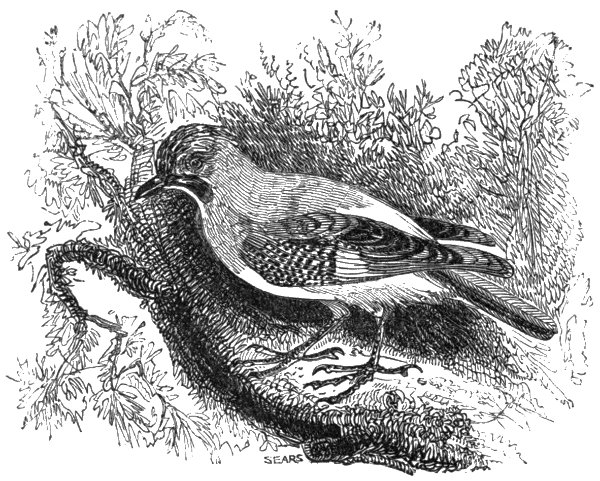
THE JAY.
This beautiful bird is not more than thirteen inches in length. Its bill is black, eyes white; the feathers on the forehead are white, streaked with black, and form a tuft which it can erect and depress at pleasure; the chin is white, and from the corners of the bill on each side proceeds a broad streak of black, which passes under the eye; the hinder part of the head, the neck, and the back, are of a light cinnamon colour; the breast is of the same colour, but lighter; lesser wing coverts bay; the belly and vent almost white; the greater wing coverts are elegantly barred with black, fine pale blue and white alternately; the greater quills are black, with pale edges, the bases of some of them white; lesser quills black; those next the body, chestnut; the rump is white; tail black, with pale brown edges; legs dirty pale brown.
The jay is a very common bird in Great Britain, and is found in various parts of Europe. It is distinguished as well for the beautiful arrangement of its colours, as for its harsh grating voice, and restless disposition. Upon seeing the sportsman, it gives by its cries the alarm of danger, and thereby defeats his aim and disappoints him. The jay builds in woods, and makes an artless nest, composed of sticks, fibres, and tender twigs; the female lays five or six eggs, of a greyish ash colour, mixed with green, and faintly spotted with brown. Mr. Pennant observes, that the young ones continue with their parents till the following spring, when they separate to form new pairs. Birds of this species live on acorns, nuts, seeds, and various kinds of fruits; they will eat eggs, and sometimes destroy young birds in the absence of the old ones. When kept in a domestic state they may be rendered very familiar, and will imitate a variety of words and sounds. We have heard one imitate the sound made by the action of a saw so exactly, that though it was on a Sunday, we could hardly be persuaded that the person who kept it, had not a carpenter at work in the house. Another, at the approach of cattle, had learned to hound a cur dog upon them, by whistling and calling upon him by his name: at last, during a severe frost, the dog was, by that means, excited to attack a cow big with calf, when the poor animal fell on the ice, and was much hurt: the jay was complained of as a nuisance, and its owner was obliged to destroy it.—Bewick.
Ichthyology, s. The doctrine of the nature of fish.
Jennet, s. A Spanish horse.
Jerk, s. A smart quick lash; a sudden spring; a quick jolt that shocks or starts.
Jesses, s. Slips of light leather, seven or eight inches long, and a quarter of an inch wide, made fast to each of the hawk’s legs. These are to be secured to a small swivel, fixed to the end of a thong of leather, three or four feet long, called a leash, so as easily to be detached from the swivel when the hawk is required to fly. The jesses are seldom removed from the bird’s legs when once they have been put on.
Jet, s. A very beautiful fossil of a fine deep black colour; a spout or shoot of water.
Jetty, a. Made of jet; black as jet.
Ignite, v. To kindle, to set on fire.
Ignitible, a. Inflammable, capable of being set on fire.
Ignition, s. The act of kindling, or of setting on fire.
Jigot, s. A leg; as, a jigot of mutton.
Jill, s. A measure of liquids.
Iliac, a. Relating to the lower bowels.
Imbrown, v. To make brown, to darken.
Imping, s.
This curious process consists in attaching to the part that remains an exact substitute for the piece lost. For this purpose the falconer is always provided with pinions, (right and left,) and with tail-feathers of hawks, or with the feathers separated from the pinion, carefully preserved and numbered, so as to prevent mistake in taking a true match for the injured feather. He then with a sharp knife gently parts the web of the feather to be repaired, at its thickest part, and cuts the shaft obliquely forward, so as not to damage the web on the opposite edge. He next cuts the substitute feather as exactly as possible at the corresponding point, and with the same slope.
For the purpose of uniting them, he is provided with an iron needle, with broad triangular points at both ends; and after wetting the needle with salt and water, he thrusts it into the centre of the pith of each part, as truly straight, and as nearly to the same length in each as may be. When this operation has been skilfully performed, the junction is so neat that an inexperienced eye would hardly discern the point of union; and as the iron rusts, from having been wetted with brine, there is little or no danger of separation.—Sebright.
Imposthume, s. A collection of purulent matter in a bag or cyst.
Inbred, a. Produced within; hatched or generated within.
Incage, v. To coop up, to shut up; to confine in a cage, or any narrow space.
Inch, s. The twelfth part of a foot.
Incision, s. A cut, a wound made with a sharp instrument.
Incisor, s. Cutter, tooth in the forepart of the mouth.
Incorporate, v. To mingle different ingredients so as they shall make one mass; to unite, to associate, to embody.
Incubation, s. The act of sitting upon eggs to hatch them.
Incubation.—It is probable birds are endowed with an instinctive power of regulating the necessary heat for this purpose; of course, should the heat of the air, together with the natural warmth of the body, on the close contact of the bird to the eggs, be too great, her feelings would dictate the necessity of leaving them for a time to cool. At the early period of incubation birds quit their eggs more frequently than at the time the fetus is more perfect. Yet, in the advanced state, the embryo young is not in more danger of being destroyed, if so much; for we have frequently found a living fetus in an egg that has been taken from the nest two days. If, however, the young is within a few hours of being excluded, and the egg is suffered to be some time cold, it either dies, or becomes so weak as not to be able to extricate itself from the shell. Various degrees of heat will enlarge the embryo young, but regular heat seems necessary to its production; and yet artificial heat, regulated by the brooding of a bird, will not produce young with such certainty. In Egypt, a vast quantity of eggs are hatched by artificial heat in stoves. It is probable, however, one third or one fourth miscarry. The necessary heat for this purpose is about ninety-six degrees of Fahrenheit’s thermometer, or thirty-two of Reaumur’s scale. Birds frequently turn and change the situation of their eggs in the nest; besides this, it is possible that the moisture of the bird’s body may assist the natural growth of the fœtus and the production of the young.
The male birds of some species supply the place of the female on the nest; but then it is of short duration, and rarely, if ever, when the eggs are near hatching; at that time the female is frequently fed by the male. This is not common to all species, but very conspicuous in the rook, the pigeon, and many others. Many species of birds possess a reservoir for food, called a craw, or crop; this seems to answer the same purpose as the first stomach in ruminating animals. Here it is the food is softened and prepared for the stomach; from this reservoir it is by some ejected for the purpose of feeding their young; conspicuous in the pigeon.
The rook has a small pouch under the tongue, in which it carries food to its young. It is probable the use of the craw may be extended further than is generally imagined; for besides the common preparation of the food to assist its digestion in the stomach, there are some species that actually secrete a lacteal substance in the breeding season, which, mixing with the half-digested food, is ejected to feed and nourish the young. The mammæ, from which this milky liquor is produced, are situated on each side the upper part of the breast, immediately under the craw. In the female turtle dove we have met with these glands tumid with milky secretion, and we believe it common to both sexes of the dove genus. The cormorant or pelican genus possess no craw; but, to supply its place, they have a loose skin at the base of the under mandibles, capable of great distension, in which they carry fish to their young. The bustard is said to possess a bag of an astonishing size, for the purpose of retaining water; but the most unaccountable and extraordinary formation in the trachea of many of the males of the duck genus, called a labyrinth, is beyond our reach to discover the use of, as well as the singular flexure in the windpipe of the hooping swan and crane.
Attention during Incubation.—There is this distinction in the hen: in some, the desire of sitting or incubation is predominant, which they will repeat to the fifth or sixth time in the year, to their emaciation or almost destruction: in others the desire is so slight, that they will probably sit but twice, or even once in the season, and then not steadily. It is for the skilful breeder to take advantage of this variation of quality, the one kind furnishing plenty of eggs for the other to sit upon.
It is proper to place corn and water beside the sitting hen, whenever it may appear necessary, withdrawing them as soon as she is satisfied, not only to encourage steadiness of incubation, but to support the constitutions of those in which the natural excitement is so powerful, that they will remain several successive days upon the nest, at the risk of famishing. I have had instances of hens of this description fainting outright, and appearing as dead, on their finally leaving the nest with the chickens, in a state of total emaciation, having, probably, not eaten or drank more than once in three or four days, during the term of their incubation, twenty-one days. The plan of feeding on the nest should be invariably pursued with all frequent sitters.—Montagu—Moubray.
Incurable, a. Not admitting remedy, not to be removed by medicine; irremediable, hopeless.
Indian Rubber, or Caoutchouc, s. An elastic gum procured from a South American tree, called the Syphonia Uastica. It is mostly brought into Europe in the shape of bottles, which are formed by spreading the gum over moulds of clay.
Indigo, s. A plant, by the Americans called anil, used in dyeing for a blue colour.
Infect, v. To act upon by contagion; to fill with something hurtfully contagious.
Infection, s. Contagion, mischief by communication.
Inflame, v. To kindle, to set on fire; to heat the body morbidly with obstructed matter; to fire with passion.
Inflammation, s. The act of setting on flame; the heat of any morbid part occasioned by obstruction.
Inflammation is a disorder of the blood-vessels, depending upon their having too much blood in them, or upon that blood being impure and acrimonious, or upon the blood vessels themselves being in a diseased state.
Cool air is always of service in inflammatory diseases, and cold air is sometimes still better; even turning the horse out, if the weather is dry, is perhaps the best situation of any. Inflammation may be general or local. General inflammation is fever, of which there is but one kind in the horse, and that may almost always be cured by early and copious bleeding.—White.
Inflammatory, a. Having the power of inflaming.
Infusion, s. The act of pouring in, instillation; the act of steeping any thing in moisture without boiling; the liquor made by infusion.
Injection, s. The act of casting in; any medicine made to be injected by a syringe, or other instrument, into any part of the body.
Innings, s. Lands recovered from the sea; term in cricket.
Inoculation, s. The practice of transplanting the small-pox, by infusion of the matter from ripened pustules into the veins of the uninfected.
Insect, s. Insects are so called from a separation in the middle of their bodies, whereby they are cut into two parts, which are joined together by a small ligature, as we see in wasps and common flies.
Insnare, v. To entrap, to catch in a trap, gin, or snare.
Instinct, s. The power which determines the will of brutes; a desire or aversion in the mind, not determined by reason or deliberation.
They who write on natural history cannot too frequently advert to instinct, that wonderful limited faculty, which, in some instances, raises the brute creation as it were above reason, and in others leaves them so far below it.
It has been remarked that every species of bird has a mode of nidification peculiar to itself; so that a schoolboy would at once pronounce on the sort of nest before him. This is the case among fields and woods and wilds; but, in the villages round London, where mosses and gossamer, and cotton from vegetables, are hardly to be found, the nest of the chaffinch has not that elegant, finished appearance, nor is it so beautifully studded with lichens, as in a more rural district; and the wren is obliged to construct its house with straws and dry grasses, which do not give it that rotundity and compactness so remarkable in the edifices of that little architect. Again, the regular nest of the house martin is hemispheric; but where a rafter, or a joist, or a cornice, may happen to stand in the way, the nest is so contrived as to conform to the obstruction, and becomes flat, or oval, or compressed.
In the following instances instinct is perfectly uniform and consistent. There are three creatures, the squirrel, the field-mouse, and the bird called the nuthatch (Sitta Europæa) which live much on hazel-nuts; and yet they open them each in a different way. The first, after rasping off the small end, splits the shell in two with his long fore-teeth, as a man does with his knife; the second nibbles a hole with his teeth, as regular as if drilled with a wimble, and yet so small that one would wonder how the kernel can be extracted through it: while the last picks an irregular ragged hole with its bill: but as this artist has no paws to hold the nut firm while he pierces it, like an adroit workman, he fixes it, as it were, in a vice, in some cleft of a tree, or in some crevice; when, standing over it, he perforates the stubborn shell. We have often placed nuts in the chink of a gate-post where nuthatches have been known to haunt, and have always found that those birds have readily penetrated them. While at work they make a rapping noise that may be heard at a considerable distance.
It is no doubt exceedingly difficult, and perhaps impossible, to define where instinct ends, and reason begins, in animals. But that some of them are endowed with a faculty which does not come under the usual notion of instinct, by whatever other name we may choose to call it, will, I think, hardly allow of a dispute. This, as it strikes me, appears in the different degrees of intelligence which we are accustomed to recognize as elevating one species of animal above another,—as the half-reasoning elephant for instance, and the friend of man, the dog, above numberless others. Now, instinct of one tribe, one would think, as much as in another, must be full and perfect, and would not admit of our considering the degree of intelligence manifested in one species as higher or lower than that possessed by another. Again: much more must we conceive that the proper instinct of any species will be fully, and therefore equally, possessed by all individuals of that species. How, then, upon the notion of mere instinct, shall we account for that superiority of intelligence, which is found in one individual, to others of the same species, and which is familiar to those who are employed about, or in any way in the habit of conversing with, animals? But the observation which appears to me most decidedly to carry the faculties of animals to something exceeding the measure and character of instinct, is that of the new and ingenious contrivances to which they will often have recourse in situations, and upon occasions, much too accidental and peculiar to admit of our imagining that they could have been contemplated and provided against in the regular instinct of the whole species. This we should naturally be disposed to conceive must have been given to regulate the ordinary habits of the animals, and adapted to those exigencies of their mode of life which are continually occurring, not to such as do rarely, and might, one would be tempted to say, never occur. A few instances will, perhaps, better explain what I mean, and carry more persuasion than my argument.
I was one day feeding the poor elephant (who was so barbarously put to death at Exeter ’Change) with potatoes, which he took out of my hand. One of them, a round one, fell on the floor, just out of the reach of his proboscis. He leaned against his wooden bar, put out his trunk, and could just touch the potato, but could not pick it up. After several ineffectual efforts, he at last blew the potato against the opposite wall with sufficient force to make it rebound, and he then, without difficulty, secured it. Now it is quite clear, I think, that instinct never taught the elephant to procure his food in this manner; and it must, therefore, have been reason, or some intellectual faculty, which enabled him to be so good a judge of cause and effect. Indeed, the reflecting power of some animals is quite extraordinary. I had a dog who was much attached to me, and who, in consequence of his having been tied up on a Sunday morning, to prevent his accompanying me to church, would conceal himself in good time on that day, and I was sure to find him either at the entrance of the church, or, if he could get in, under the place where I usually sat.
A gentleman, a good shot, lent a favourite old pointer to a friend who had not much to accuse himself of in the slaughter of partridges, however much he might have frightened them. After ineffectually firing at some birds which the old pointer had found for him, the dog turned away in apparent disgust, went home, and never could be persuaded to accompany the same person afterwards.
I have been often much delighted with watching the manner in which some of the old bucks in Bushy Park contrive to get the berries from the fine thorn-trees there. They will raise themselves on their hind legs, give a spring, entangle their horns in the lower branches of the tree, give them one or two shakes, which make some of the berries fall, and they will then quietly pick them up.—White’s Selborne—Jesse.
Insular, a. Belonging to an island.
Intermew, s. The change of a hawk’s colour from red to white the second year.
Intestina, s. An order in the Linnæan system of the class Vermes, including earthworms and leeches.—Crabbe.
Intestines, s. The guts, the bowels.
Jockey, s. A person that rides horses in the race; a man that deals in horses.
Jockey, v. To jostle by riding against one; to cheat, to trick; to ride; to ride unfairly.
Joint, s. Articulation of limbs, juncture of moveable bones in animal bodies; hinge; a knot in a plant. Out of joint, luxated, slipped from the socket, or corresponding part where it naturally moves.
Journey, s. The travel of a day; travel by land.
Ipecacuanha, s. An Indian plant.
Ipecacuanha is sometimes employed as an expectorant in chronic cough and asthmatic affections, and I believe with good effect when joined with squills, ammoniacum, &c.—White.
Iris, s. The rainbow; the circle round the pupil of the eye, which is striped and variegated.
Hanging from the upper edge of the pupil of the horse, are found two or three round black bodies, as large as millet seeds. When the horse is suddenly brought into an intense light, and the pupil is closed, these bodies present a singular appearance, being squeezed out from between the edges of the iris. An equal number, but much smaller, are attached to the edge of the lower portion of the iris. Their general use is probably to intercept portions of light which would be troublesome or injurious; but their principal function is accomplished during the act of grazing. They are larger on the upper edge of the iris, and are placed on the outer side of the pupil, evidently to obstruct the light in those directions in which it would come with greatest force, both from above and even from below, while at the same time, the field of view is perfectly open, so far as it regards the pasture on which the horse is grazing.
The colour of the iris is, in some unknown way, connected with this black point behind. Wall-eyed horses, whose iris is white, have no uvea.—The Horse.
Irish Horse, s.
In some of the rich grazing counties, as Meath and Roscommon, a large long blood horse is reared of considerable value, but he seldom has the elegance of the English horse; he is larger headed, more leggy, ragged-hipped, angular, yet with great power in the quarters, much depth beneath the knee, stout and hardy, full of fire and courage, and the best leaper in the world.
The Irish horse is generally smaller than the English. He is stinted in his growth, for the poverty and custom of the country have imposed upon him much hard work, at a time when he is unfit for labour of any kind. For this reason, too, the Irish horse is deficient in speed. There is, however, another explanation of this. The Irish thorough-bred horse is not equal to the English. He is comparatively a weedy, leggy, worthless animal, and very little of him enters into the composition of the hunter or the hackney.
For leaping, the Irish horse is unrivalled. It is not, however, the leaping of the English horse, striding as it were over a low fence, and stretched at his full length over a higher one; it is the proper jump of the deer, beautiful to look at, difficult to sit, and, both in height and extent, unequalled by the English horse.
Iron, s. A hard, fusile, malleable metal.
Iron is found in every part of the globe, in the soil, in the water, and as a constituent of vegetable and animal bodies. The preparations of iron, used in medicine, are, 1st, sulphate of iron, or salt of steel; 2d, muriate of iron; 3d, subcarbonate of iron; 4th, tartarised iron; 5th, red oxide of iron, or colcothar of vitriol; 6th, rust of iron; and, 7th, scales of iron. They are all powerful tonics in the human body, but not often given to horses. The dose of No. 1, is from 1 drachm to 3. No. 2, 1 drachm to 2 or 3. No. 3, 2 drachms to 4. No. 4, 3 drachms to 5. No. 5, 4 drachms to 6. No. 6, 2 drachms to 4. No. 7, 2 drachms to 4, finely powdered. Preparations of iron are generally mixed with aromatics, and sometimes with soda. Metallic preparations should be used with great caution. Iron is the most innocent, and possessed of considerable tonic power; but, before it is employed, wholesome food, moderate exercise, and good grooming, should have a fair trial.
Iron, a. Made of iron; resembling iron in colour; hard, impenetrable.
Ironwood, s. A kind of wood extremely hard, and so ponderous as to sink in water.
Isinglass, s. A fine kind of glue made from the intestines of a large fish resembling a sturgeon. It is chiefly made from dried sounds of codfish.
Island, s. A tract of land surrounded by water.
Issue, s. The act of passing out; termination; a vent made in a muscle for the discharge of humours; evacuation; progeny, offspring.
Itch, s. A cutaneous disease extremely contagious; the sensation of uneasiness in the skin which is eased by rubbing; a constant teasing desire. Itch is supposed to be caused by a small insect of the acarus tribe. On microscopic examination it appears to be white with red legs, and will be found in the small pellucid vesicles which are observable on the parts infected.
Itch, v. To feel that uneasiness in the skin which is removed by rubbing; to long.
Itchy, a. Infected with the itch.
Judcock, Jacksnipe, Gid or Jetcock, (Scolopax gallinula, Linn.; La Petite Becassine, Buff.) s. A bird.
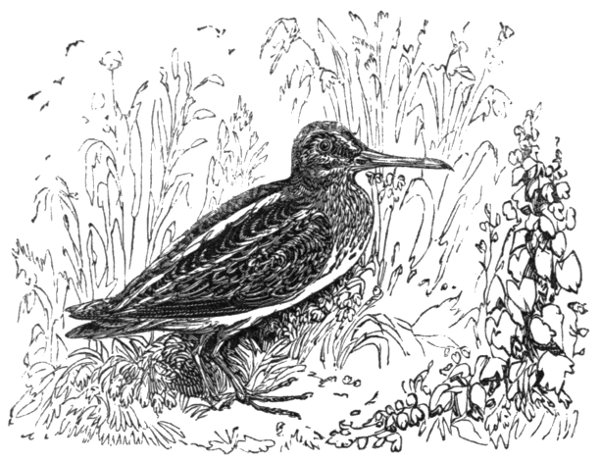
The judcock, in its figure and plumage, nearly resembles the common snipe; but it is only about half its weight, seldom exceeding two ounces, or measuring more, from the tip of its beak to the end of its tail, than eight inches and a half: the bill is black at the tip, and light towards the base, and rather more than an inch and a half in length. A black streak divides the head lengthwise from the base of the bill to the nape of the neck, and another, of a yellowish colour, passes over each eye to the hinder part of the head: in the midst of this, above the eye, is a narrow black stripe running parallel with the top of the head from the crown to the nape. The neck is white, spotted with brown and pale red. The scapulars and tertials are very long and beautiful; on their exterior edges they are bordered with a stripe of yellow, and the inner webs are streaked and marked with bright rust colour on a deep brown, or rather bronze ground, reflecting in different lights a shining purple or green. The quills are dusky. The rump is of a glossy violet or bluish purple; the belly and vent white. The tail consists of twelve pointed feathers of a dark brown, edged with rust colour; the legs are of a dirty or dull green.
The judcock is of nearly the same character as the snipe, it feeds upon the same kinds of food, lives and breeds in the same swamps and marshes, and conceals itself from the sportsman with as great circumspection, among the rushes or tufts of coarse grass. It, however, differs in this particular, that it seldom rises from its lurking place until it is almost trampled upon, and, when flushed, does not fly to so great a distance. It is as much esteemed as the snipe, and is cooked in the same manner.
The eggs are not bigger than those of a lark; in other respects they are very like those of the snipe.—Bewick.
Jugular, a. Belonging to the throat.
Jugulares, s. That order of fishes, according to Linnæus, which have the ventral fins placed before the pectoral, as cod, haddock, and whiting.
Kalendar, s. An account of time.
Kaw, v. To cry as a raven, crow, or rook.
Kayle, s. Ninepins; nine holes.
Keen, a. Sharp, well edged: severe, piercing; eager, vehement; acrimonious; bitter of mind.
Keg, s. A small barrel, commonly used for a fish barrel.
Kell, s. The omentum, that which inwraps the guts.
Kennel, s. A cot for dogs; a number of dogs kept in a kennel; the hole of a fox, or other beast; the water-course of a stream.
Kennel.—Is the place where hounds are kept; upon the judicious construction of which, their health, safety, and preservation, are known greatly to depend. Those who take to, or become possessed of, kennels ready built, frequently continue them in the form they fall into their hands; but such as encounter the expense of new erections, cannot do better than take a previous survey of the most approved plans; amongst which the Duke of Bedford’s at Woburn Abbey; the Duke of Richmond’s at Goodwood, in Sussex; and Sir William Rawley’s at Tendring Hall, Suffolk, are supposed, for extent and convenience, to take the lead of most others in the kingdom. Taste and fashion may go a great way in the external glare of such establishments; but health and convenience should always prove the most predominant considerations. It is universally admitted, by all who have a practical knowledge of this subject, that in large and regularly hunted packs, two kennels are indispensably necessary to the success and well doing of the whole. When there is but one, it can in the winter season be but seldom cleaned; and even then the hounds are in a comfortless state, from the dampness of the situation so long as it remains. Cleanliness is so essentially necessary in every apartment and department of a kennel, that no continuance of health in the hounds, or excellence in the field, can be expected without it. They are individually innately clean; and will never, if they can avoid it, dung near where they lie. Air, fresh straw, and ample room for the occasional expansion of their weary limbs, are requisite for the invigoration of the frame, and the preservation of health. Hounds confined in a body are more liable to disease than the same animal single, and in a state of unrestrained liberty; hence the necessity for counteraction, by every means the most prudent precaution can adopt. Hounds thus subject to, and constantly attacked with disease, and even madness, under the best and most judicious management, must be evidently much more so if surrounded with filth and nastiness.
That some idea may be formed of the grandeur of the buildings, and the liberal scale, of the most celebrated hunting establishments, it is only necessary to introduce a few explanatory remarks upon the kennels of eminence already mentioned. The superb edifice of the Duke of Richmond is said (and probably with great truth) to have cost £10,000, in its erection; to which his Grace contributed no small proportion of personal assistance. He is reported to have been his own architect and builder; to have dug his own flints, burnt his own lime, made his own bricks, and framed the woodwork in his own shops. The dog kennel, abstracted from all other buildings, stands alone, in such part of the park as to form a grand and striking object from the principal rooms of the mansion; the materials are flints, finished at all the angles by a light grey-brick, like the Lymington white stock.
The distribution of the building is into five compartments: two of them thirty-six feet by fifteen, and three more thirty by fifteen; these are called kennels, to which are annexed two feeding rooms, twenty-eight by fifteen. In each of these are openings at top, for the admission of external air when necessary, and stoves to qualify the air when too cold. There are supplies of water, and drains into a tank a considerable depth below, full of rain water, from the surface of which to the rise of the arch is eleven feet, so that no inconvenience arises from smell, and the whole can be occasionally cleared off by drains to more dependent depths and dung pits, where it becomes contributory to the purposes of agriculture. Round the whole building is a pavement five feet wide; airing yards, places for breeding, and other conveniences, making a part of each wing. To constitute a uniformity of elegance, neatness, and perfection, the huntsman and whipper-in have each a parlour, kitchen, and sleeping-room, appropriated to their own particular purpose.
The Duke of Bedford’s is an immense establishment, upon a scale of too much extent for particular description, as it includes tennis court, riding-house, &c., &c., in one stone-fronted building, of 266 feet in length, with two wings of stables, containing stalls for thirty-six hunters; and eleven loose houses for horses sick and lame. As the dog kennel, however, is the only part entitled to notice under this head, it will create no surprise that the richest subject should possess the most complete in England.
It is in length 405 feet, having the boiling house in the centre, with feeding rooms adjoining, and a granary behind. On the right of the centre are apartments for two kennel-keepers, two long lodging rooms for the hunting hounds, with flues running along the wall to preserve an equal temperature in the severity of the winter season; spacious yards to each, furnished with a fountain in the middle, for the dogs to drink at; and water-cocks fixed at proper distances to cleanse the pavement when it may be required; adjoining to these are seven hospitals for sick and lame hounds, with yards to each. On the left are divisions for litter, straw, &c.; eleven apartments for bitches and puppies, with yards to each; eleven ditto for bitches in pup, with yards also; and a large division for bitches at heat. In the front is a large reservoir of water, which supplies the fountains and different cocks in the several yards within. Behind the whole is a large airing-ground, flesh-house, and all requisite conveniences. The huntsman’s dwelling-house is a handsome building adjoining. The number of hunting hounds kept in the kennel are usually from sixty to seventy couple.
The kennel of Sir William Rawley is by no means equal to the external grandeur of the two already described, but replete with every internal convenience that an establishment upon a somewhat smaller scale can possibly require. It is situate about half a mile from the family mansion, from the garden of which it constitutes a picturesque appearance. It is erected in a valley of the park, a spot well adapted to the purpose, being equally defended from the cutting easterly winds, and the heat of the sun in its meridian, by a thick skirting of the park and forest trees. Not having the advantage of a rivulet to the water courts, that want is amply supplied by a pump which, by means of different cocks, turns the water to every part of the premises, consisting of the hunting kennel, or principal lodging-room, which is twenty feet by eighteen in the clear, eighteen feet high, and paved with flag-stones. The beds or benches which cover almost the whole area, are of original and most admirable contrivance, being lathed like some bedsteads, and are made to fold up with joints, for the convenience of washing the floor beneath them. This room, by means of a flue of a peculiar construction, is heated to any required temperature; and the hounds after severe chases and in wet weather are rendered dry and comfortable in a much less time than they could be by any other means.
There is also a kennel or lodging room for the young hounds, of the same dimensions as the former, and possessing the same conveniences except the flue, which here would have been superfluous. Several small kennels for bitches in a state of gestation, as well as a proportional number for those with puppies; a paved court to the hunting kennel; a feeding house, one-half of which is open, the other under cover; a paved court to the kennel for the young hounds; a pump and a stone water cistern; a large grass yard for airing the hounds belonging to the hunting kennel, containing about an acre and three-quarters, in which are a variety of lime, chestnut, and other trees, forming an excellent shade for the hounds during the summer season; the young hounds have a similar convenience. To these are annexed twelve small kennels for puppies, well constructed for the purpose. The hunting hounds generally consist of about thirty-six couple, and the establishment is conducted in such a style of punctuality, order, and excellence, that it is universally acknowledged equal to any and inferior to none upon a similar scale, from one extremity of the kingdom to the other.
Next to the choice of a proper spot for, and a judicious as well as a convenient structure of the kennel, the management of the hounds, when there, becomes a matter of serious consideration, and requires a feeder of strict sobriety, indefatigable industry, invariable punctuality, great humanity, personal fidelity to his employer, and a constant attention to the business in which he is engaged, as upon him in a great degree depends the health and preservation of the hounds. Mr. Beckford observes (in great proof of his practical knowledge and personal experience) that no part of the hunting establishment goes on so well as when the master becomes an occasional superintendent of his own concerns. He says, as the sport in the field depends on the exquisite sense of smelling so peculiar to the hound, so care should be taken to preserve it, and cleanliness is the surest means. The keeping of the kennel sweet and clean, cannot therefore be too strongly inculcated and impressed upon the mind of the feeder; if he seems habitually disposed to deviate from which, he is not at all calculated for the office he has undertaken.
The preparation for feeding, as boiling the meat, mixing the meal, and getting it ready at the hours agreed on, is a matter that the huntsman will of course take care (on his part) never to have neglected; but there are other considerations equally important, which become entitled to attention. Hounds cannot be properly fed by a single person; two are (for a variety of reasons) unavoidably necessary, and those two should be the feeder and the huntsman, as hounds should be drafted and fed according to their state of flesh and condition. Some are much more voracious than others, and will require a greater portion of food; others look and work well with half the quantity. The eye of the huntsman should discriminate between the opposite descriptions; in want of which attention the pack will never be of equal appearance. When any of the hounds are observed to be low in flesh, off their appetites, bad feeders, or kept under by the old and master hounds, it will be a matter of advantage to draft them, and let them feed under less restraint. Young and impatient feeders fall into the very common fault of feeding hounds with their meat too hot; it is both a prevalent and injurious error that should be totally abolished.
Mr. Beckford is of opinion, that hounds poorer than the rest should be fed again, and that they cannot be fed too often; as well as that those hounds which become too fat, if any, should be drafted off, and not permitted to fill themselves. All hounds (particularly young ones) should be often called over in kennel; their names become more familiar to them, and it teaches them obedience; this lesson is practised, or should be, at the time of feeding. Hounds should all be let out into the airing ground to empty themselves after feeding, to prevent an unnecessary accumulation of filth and consequent effluvia in the kennel. It may be a custom with some to shut up the hounds for two or three hours after they return from hunting, before they are fed; if so, it is more entitled to contempt than imitation. No plea can justify the practice; they should have their meat ready for feeding immediately on their return; once gratified they enjoy their rest undisturbed, the best and most natural foundation for renovation of strength. Plenty of vegetables, boiled in the meat copper once a week, is a custom in most kennels, as it is also to throw in a pound or two of sulphur (in proportion to the number), particularly in the summer season, when there is a greater tendency in the blood to morbidity, particularly to cutaneous diseases.
During the hot months, when hounds do not work, they require but a small proportion of substantial food, compared to what is necessary in the severity of the hunting season; flesh may then be given very sparingly; the less it is used in the summer, the less likelihood there will be of seeing that malignant and unwelcome visiter, the mange, amongst them. Various opinions has been promulgated upon the best, cheapest, and most nutritious food for the support of the hounds in general; but experience seems to have justified the consistency of occasional changes, according to the different seasons, and the different degrees of work; without adhering too closely to one particular mode, unassisted by such deviations as circumstances may render not only prudent and proper, but sometimes unavoidable. Horseflesh, sheep’s trotters, raspings, greaves, bullocks’ paunches, (in a scarcity of flesh,) oatmeal, and barley meal, constitute the principal articles upon which hounds are known to subsist; although they are differently prepared, and differently administered, according to the judgment, experience, whim, or caprice, of the parties concerned. It is, however, universally admitted, after a number of fair and impartial trials, that, in respect to the two meals, they act much more profitably and advantageously, when used in a mixed state of nearly equal proportions, than when either is given alone.
Mr. Beckford says, his feeder, who was a good one, and of much experience, mixed the meal in equal quantities; that the oatmeal he boiled for half an hour; and then put out the fire, adding the barley meal, and mixing both together; his reason for boiling one, and not the other, was, that boiling made the oatmeal thick, and the barley meal thin; and that when he fed with the barley meal only, it should not be put into the copper, but mixed up with the scalding liquor in a proper tub, or hogshead, kept for the purpose. There are many little things within the department of the feeder, which, if neglected, become of serious consequence. Nice observation should be made upon the state of the bitches at all times; upon the least indication of their going to heat, they should be instantly removed; a few hours’ delay may be the destruction of some of the best hounds in the kennel. After their return on a hunting day, he should ascertain whether there are any hounds who have sustained injuries in the feet by thorns, flints, &c., in which case a fomentation of warm pot liquor (or bran water), followed by a washing of cold vinegar, or salt and water, will generally effect a speedy cure. Hounds, seriously lame, or palpably sick, should be separated from the rest, and placed where they can be more at ease, and have better attention.
Kennel, is a sporting term for the den in which a fox deposits himself after his nocturnal depredations, and to which he retires about the dawn of day: being found by the hounds in drawing covert, he is then said to be unkennelled, and the chase begins. When safe in some burrow, or hole, below the surface, he is then said to lie at earth.—Taplin.
Kennel, v. To lie, to put or keep in kennel.
Kestrel, Stonegall, Stannel Hawk, or Windhover, (Falco Tinnunculus, Linn.; La Cresserelle, Buff.), s. A kind of bastard hawk.
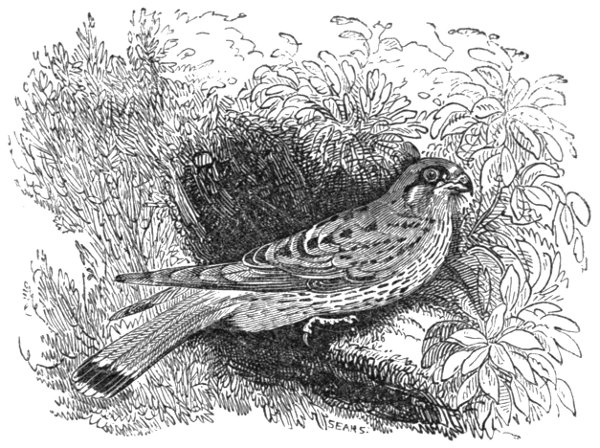
THE KESTREL.
The male of this species differs so much from the female, that we have given a figure of it from one we had in our possession, probably an old one. Its length is fourteen inches; breadth two feet three inches: its bill is blue; cere and eyelids yellow; eyes black, the forehead dull yellow; the top of the head, back part of the neck, and sides as far as the points of the wings, are of a lead colour, faintly streaked with black; the cheeks are paler; from the corner of the mouth on each side there is a dark streak pointing downwards; the back and coverts of the wings are of a bright vinous colour, spotted with black; quill feathers dusky, with light edges; all the under part of the body is of a pale rust colour, streaked and spotted with black; thighs plain; the tail feathers are of a fine blue grey, with black shafts; towards the end there is a broad black bar both on the upper part and under sides; the tips are white: the legs are yellow, and the claws black.
The kestrel is widely diffused throughout Europe, and is found in the most temperate parts of North America: it is a handsome bird; its sight is acute, and its flight easy and graceful: it breeds in the hollows of trees, and in the holes of rocks, towers, and ruined buildings it lays four or five eggs, of a pale reddish colour: its food consists of small birds, field-mice, and reptiles; after it has secured its prey, it plucks the feathers very dexterously from the birds, but swallows the mice entire and discharges the hair, in the form of round balls from its bill. This bird is frequently seen hovering in the air, and fanning with its wings by a gentle motion, or wheeling slowly round, at the same time watching for its prey, on which it shoots like an arrow. It was formerly used in Great Britain for catching small birds and young partridges.
The Female Kestrel.—This beautiful bird is distinguished from every other hawk by its variegated plumage: its bill is blue; cere and feet yellow; eyes dark coloured, surrounded with a yellow skin; its head is rust coloured, streaked with black: behind each eye there is a light spot; the back and wing coverts are elegantly marked with numerous undulated bars of black; the breast, belly, and thighs are of a pale reddish colour, with dusky streaks pointing downwards, vent plain; the tail is marked by a pretty broad black bar near the end; a number of smaller ones, of the same colour, occupy the remaining part; the tip is pale.
This is one of our most common species, being very generally spread throughout the kingdom, especially in the more rocky situations and high cliffs on our coast, where they breed. The nest is made of a few sticks, loosely put together, and lined with wool and other soft materials, built in trees, in some crevice, or projecting rocky shelf, and sometimes they content themselves with the deserted nest of a crow or magpie. It lays four or five eggs of a dirty white, blotched over with rust-colour of various shades; sometimes wholly covered with a deep rusty red; these are rather inferior in size to those of the sparrow hawk.—Bewick—Montagu.
Kibe, s. An ulcerated chilblain, a chap in the heel.
Kid, s. The young of a goat; a bundle of heath or furze.
Kid, v. To bring forth kids.
Kidney, s. One of the two glands that separate the urine from the blood.
Kilderkin, s. A small barrel of eighteen gallons’ capacity.
King Charles’s Dog (Canis Brevipilis, Linn.), s.
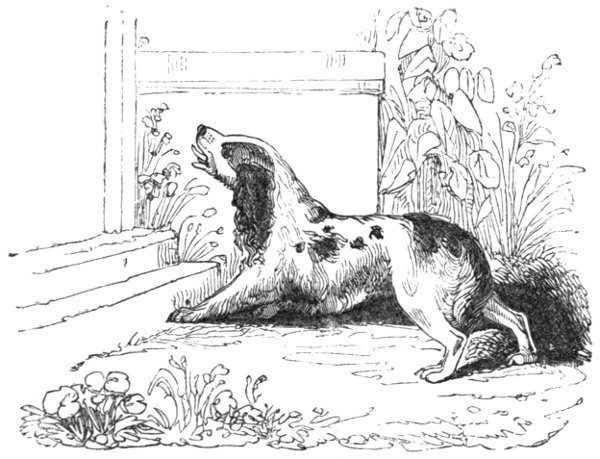
This beautiful little animal is much smaller than the cocker, to which he is similar in shape and other characteristics; he has, however, longer ears, and the tail is also longer in proportion to the size of his body. Like the cocker and springer, he is extremely fond of pursuing birds of all kinds, and, like them, too, always gives tongue in pursuit. He is seldom used for field sports, from his diminutive size, being easily tired, and is too short in the legs to get through swampy ground.
This dog is found of all colours; but those which are black, with tanned cheeks and legs, are considered the purest breed. He gets the name of King Charles’s dog from the extreme liking the second monarch of that name had for this animal, as he never went out without being followed by eight or a dozen of them. They were also introduced into most of the portraits of himself and family, and particularly in that by Vandyke. They were also his constant companions in the palace.
The use of this variety at present is as a lap-dog, and they are consequently prized in proportion to the diminutiveness of their size.
The sense of smelling in this little spaniel is very remarkable. The following anecdote is related by Brown to instance it:—
In 1792, a gentleman who lived in Vere Street, Clare Market, went, with his family, to the pit of Drury Lane theatre, at about half-past five in the evening, leaving a small spaniel of King Charles’s breed locked up in the dining room, to prevent it from being lost in his absence. At eight o’clock his son opened the door, and the dog immediately went to the playhouse, and found out his master, though the pit was unusually crowded, and its master seated near the centre.—Brown.
Kingfisher, s. A species of bird.
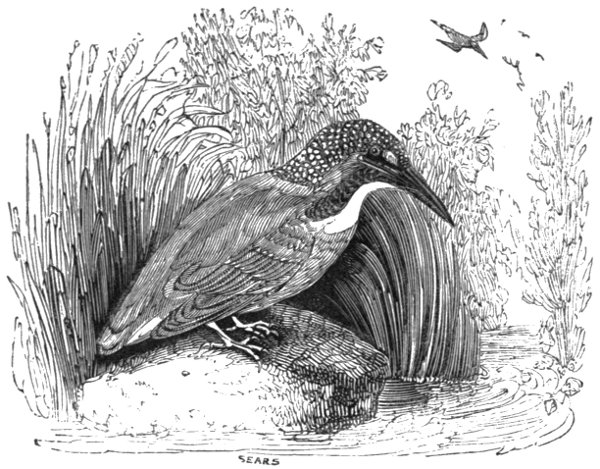
King-fisher. (Alcedo ispida, Linn.; Le Martin-pécheur, Buff.)—This splendid little bird is rather of a clumsy shape, the head being large in proportion to the size of the body, and the legs and feet very small. In length it is only seven inches, in breadth eleven; and its weight is about two ounces and a quarter. The bill, measured from the corners of the mouth, is two inches long, vertically compressed on the sides, strong, straight, and tapering to a sharp point: the upper mandible is black, fading into a red-colour towards the base; the under one, as well as the inside of the mouth, is of a reddish orange: the irides are hazel, inclining to red. A broad stripe passes from the bill over the eye to the hinder part of the neck, a bright orange colour, but margined on the side of the mouth, and crossed, below the eye, by a narrow black stroke, and it is terminated behind the auriculars with a slanting wedge-shaped white spot. The throat is white; the rest of the head and wing coverts are of a deep shining green, spotted with bright light blue: the scapulars and exterior webs of the quills are of the same colour, but without spots. The middle of the back, the rump, and the coverts of the tail are of a most resplendent azure: the tail, which consists of twelve short feathers, is of a rich deep blue, and the whole under part of the body of a bright orange. The legs and toes are of a red-colour, and are peculiar in their shape and conformation, the three forward toes being unconnected from the claws to the first joints, from whence they appear as if grown into each other; and the inner and hinder ones are placed in a line on the inside of the foot, whereby the heel is widened and seems pressed out.
The suspension of this bird by a thread, under the notion that its breast will always turn to the north, is as fabulous as that it will preserve woollen cloth from the moth.
“I have once or twice,” says Mrs. Charlotte Smith, “seen a stuffed bird of this species hung up to the beam of a cottage ceiling, and imagined that the beauty of the feathers had recommended it to this sad pre-eminence, till, on inquiry, I was assured that it served the purpose of a weather-vane; and, though sheltered from the immediate influence of the wind, never failed to show every change, by turning its beak to the quarter whence the wind blew.” The learned, but somewhat credulous author of the “Physicæ Curiosæ,” says the same, upon the testimony of his own observation. “Father Athanasius Kircher,” he says, “had one of these birds sent him as a present by a friend, and being disembowelled and dried, it was suspended from the ceiling of his celebrated museum, from 1640 to 1655, when I left Rome; and though all the doors and windows were shut, it constantly turned its bill towards the wind, and this I myself observed with admiration and pleasure almost every day for the space of three years!!”
It is difficult to conceive why ornithologists have classed the kingfisher with land birds, as its habits and manner of living are wholly confined to the waters, on the margins of which it will sit for hours together on a projecting twig or a stone, at one while fluttering its wings and exposing its brilliant plumage to the sun; at another, hovering in the air, like the kestrel, it waits the moment when it may seize its prey, on which it darts with almost unerring certainty: often it remains for several seconds under the water, before it has gained the object of its pursuit, then brings up the little fish, which it carries to the land, beats to death, and swallows.
The female commonly makes her nest by the sides of rivers or brooks, in a hole made by the mole, or the water-rat: this she enlarges or contracts to suit her purpose; and it is conjectured, from the difficulty of finding the nest, that frequently the hole which leads to it is under water.
Kingfishers are not so numerous as might be expected from the number of eggs found in their nests; owing, probably, to the young being destroyed by the floods, which must often rise above the level of the holes where they are bred.
Except in the breeding-season, the bird is usually seen alone, flying near the surface of the water with the rapidity of an arrow, like a little brilliant meteor, by which appearance the eye is enabled to follow its long-continued course. Considering the shortness of its wings, the velocity with which it flies is surprising.
Ornithologists inform us that kingfishers are found in almost every part of the globe; but it does not appear that more than this one species has ever been seen in Europe.
King Duck, (Somateria spectabilis, Fleming,) s.
This species is not much inferior in size to the eider duck. The bill is almost two inches long, of an orange-colour; at the base of the upper mandible is a ridged protuberance, flat on the top, and compressed on the sides, but divided into two, the elevated parts velvety black, passing on each side to the eyes; the crown of the head and nape are pale ash-colour; at the base of the upper mandible the feathers are pea-green, passing backwards on each side the neck, and taking in half the eye; beneath which, and round to the chin, the feathers are of a dirty white; but here the two colours are blended, and the white is lost by degrees in the green; under the chin is a black mark, diverging like the letter V inverted: the rest of the neck and breast are whitish; the middle of the back, the belly, and vent, black; wings dusky; on the middle of the coverts is a patch of white; quills black; the secondaries curve downwards over the quills; the shafts deep ferruginous, on each side the outer ones a patch of white; the tail is cuneiform, short, and black; legs dusky; the windpipe, according to Captain Sabine, is precisely like that of the eider duck.
The female is less; the protuberance on the bill not so large, nor so high-coloured, but the feathery ridge on the top is broader; the whole plumage brown, the middle of each feather dusky; six of the lesser quills are tipped with white, which forms a line of white on the wing; the rest of the quills and tail brown.—Montagu.
King’s Hounds, s.
His majesty’s stag-hounds pass under this denomination, as a part of the royal establishment continued in every successive reign without variation. The kennel in which they are kept is situate near the race course upon Ascot Heath; at the distance of two short miles from which is Swinley-lodge, the official residence of the master of the stag-hounds, an appointment seldom conferred but upon one of the peerage, and is considered an office of honour, with a salary of 2,000l. per annum. The presence of the master of the stag-hounds in the field is not a matter of necessity, but choice, except when his majesty hunts, and then his personal attendance is indispensable; his badge of office is a pair of gold dog couples, which hang suspended from a belt on his left side. The huntsman has a handsome residence at the kennel, with a salary of 125l. a year; to whom there are six assistants, (called yeomen prickers) each having a salary of 104l. with the royal livery richly ornamented, and an annual supply of saddles, bridles, horse-clothes, and the necessary stable appendages; but they find their own horses.
The hunting season commences on Holyrood day, the 25th of September, and continues every Tuesday and Saturday till the first week in May; with the exception of Christmas and Easter weeks, when they hunt three times in each. Holyrood day and Easter Monday, are two grand days of the year for company, when the field is extremely numerous. His majesty has also a pack of harriers, which are kept at the Little Park Lodge, near Windsor, and these he hunts constantly in Windsor Great Park, and the surrounding neighbourhood; they are, however, a private concern of his majesty’s, and not included in the regular Crown establishment.
King’s Plate, s.
Those called king’s-plates are a free gift from his majesty, of 100 guineas each; and, it is believed, were originally granted as a means of exciting such a degree of emulation, as would probably tend to national advantage (by an additional influx of company) to such cities and towns as enjoy the royal favour. Newmarket, as the superior spot of sporting celebrity, is particularly honoured, having two in the first Spring, and one in the first October meetings.
King’s-plates are also given at Newcastle-upon-Tyne, Guildford, Winchester, Ipswich, Burford, Chelmsford, Nottingham, Lewes, Edinburgh, York, Canterbury, Warwick, Lichfield, Richmond (Yorkshire), Lincoln, Salisbury, Ayr, Carlisle, and Ascot Heath; the whole of which, except the last, are run for by horses or mares of different ages, carrying such weights as shall be appointed by the master of the horse, or whoever he may delegate for that purpose.
The king’s-plate, of 100 guineas, given at Ascot, and always run for on the first day, (invariably Whit Tuesday fortnight) is only for horses which have regularly hunted with his majesty’s stag-hounds the preceding season, and must have been well up with the hounds, at their running up to, taking, or killing, ten deer, as an indispensable qualification, without having which they cannot be permitted to start. At the conclusion of the chase, when the deer is secured, those who intend to qualify for the plate, apply to the huntsman, and a ticket is delivered to the rider, bearing the arms of the master of the stag-hounds, and the seal of the royal hunt; when which ten tickets are obtained the horse has secured his qualification, may then be withdrawn from the field, and is not obliged to appear again till the day of entrance at Sunning Hill Wells, where the tickets must be produced, in confirmation of his being duly qualified to start. For the accommodation of the sporting world at large, horses of all ages are permitted to run, carrying the following weights:—four years’ old, 11st. 2lb.; five years’ old, 11st. 9lb.; six years’ old, 11st. 12lb.; and aged, 12st. Mares allowed 4lb. The best of three four-mile heats.—Vide Racing.
The following rules are, by his majesty’s command, to be strictly observed by the owners and riders of all such horses, mares, or geldings, as shall run for his majesty’s plates at Newmarket:—
KING’S-PLATE ARTICLES.
Every person that putteth in a horse, mare, or gelding, for the said plate, is to show such horse, mare, or gelding, with the marks, name, and name of the owner, to be entered at the king’s stables in Newmarket, the day before they run, and shall then produce a certificate under the hand of the breeder, specifying his exact age the grass before.
Every horse, mare, or gelding, that runneth, is to start between the hours of one and four in the afternoon; and to be allowed half an hour between each heat to rub.
Every horse, mare, or gelding, that runneth on the wrong side the posts or flags, or is distanced in any of the heats, shall have no share of the said plate, nor be suffered to start again.
The horse, mare, or gelding, that winneth any two heats, winneth the plate; but if three several horses, mares, or geldings, win each of them a heat, then those three, and only they, to run a fourth; and the horse, mare, or gelding, that winneth the fourth heat, shall have the plate.
And each horse, mare, or gelding’s place, as he or they come in by the ending post each heat, as first, second, or third, &c., shall be determined by such judges as shall be appointed for that purpose by the Master of the Horse. And in case any horse, mare, or gelding, shall be then, or after prove to be, above the age certified the grass before, the owner or owners of such horse, mare, or gelding, shall be rendered incapable of ever running for any of the king’s plates hereafter.
As many of the riders as shall cross, jostle, or strike, or use any other foul play, as shall be judged by such person or persons as shall be appointed by the Master of the Horse, such rider shall be made incapable of ever riding any horse, mare, or gelding, for any of his majesty’s plates hereafter; and such owners shall have no benefit of that plate; but such owners may be permitted to run any horse, mare, or gelding, for any other of his majesty’s free plates in future.
Every rider shall, immediately after each heat is run, be obliged to come to the ending post with his horse, mare, or gelding, then and there to alight, and not before, and there to weigh to the satisfaction of the judges appointed for that purpose.
And in case of neglect or refusal thereof, such winners and riders shall be immediately declared incapable of running or riding any more for this or any of his majesty’s plates in future.
And should any difference arise relating to their ages, or in their running, or to these his majesty’s orders, the same to be determined by such person or persons as shall be appointed by the Master of the Horse. And these articles are to continue in force, unless altered by command of his majesty.
For the better and more certain prevention of any fraud or misapplication, the winner of a king’s plate is to receive from the clerk of the course, a certificate signed by the steward of the race where such plate is won, counter-signed by himself also, which being presented to the lord lieutenant of the county, it obtains his signature likewise: when thus sanctioned, it becomes payable at sight to bearer (if properly endorsed by the winner,) at the office of the clerk of his majesty’s stables, in the King’s Mews, London. The lord lieutenant of a county being out of the kingdom, the signature of any person regularly deputed by him is sufficient. The certificate of winning the plate at Ascot requires only the signature of the master of his majesty’s stag hounds, instead of the lord lieutenant of the county.
Kite, s. A bird of prey that infests the farms, and steals the chickens; a fictitious bird made of paper.
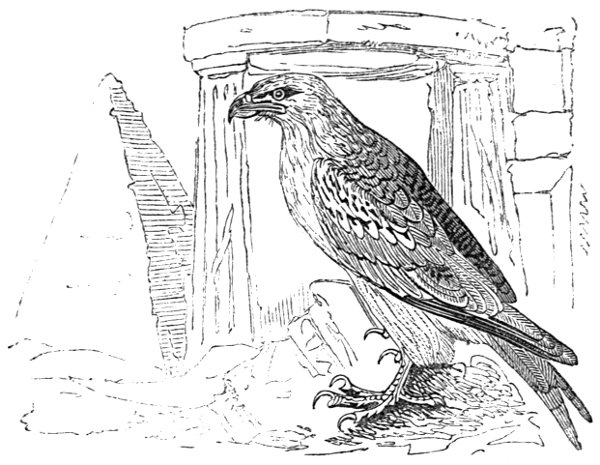
This bird is easily distinguished from the buzzard by its forked tail, which is its peculiar and distinguishing feature. Its length is about two feet; its bill is of a horn colour, furnished with bristles at the base; its eyes and cere are yellow; the feathers on the head and neck are long and narrow, of a hoary colour, streaked with brown down the middle of each; those on the body are of a reddish brown colour, the margin of each feather pale; the quills are dark brown, the legs yellow, and the claws black. It is common in England, where it continues the whole year. It is found in various parts of Europe, in very northern latitudes, whence it retires towards Egypt before winter, in great numbers; it is said to breed there, and return in April to Europe, where it breeds a second time, contrary to the nature of rapacious birds in general. The female lays two or three eggs of a whitish colour, spotted with pale yellow, and of a roundish form. Though the kite weighs somewhat less than three pounds, the extent of its wings is more than five feet; its flight is rapid, and it soars very high in the air, frequently beyond the reach of our sight; yet, at this distance, it perceives its food distinctly, and descends upon its prey with irresistible force: its attacks are confined to small animals and birds; it is particularly fond of young chickens, but the fury of their mother is generally sufficient to drive away the robber.—Bewick.
Kitten, s. a young cat.
Kitten, v. To bring forth young cats.
Knee, s. The joint of the leg where the leg is joined to the thigh; a knee is a piece of timber growing crooked, and so cut that the trunk and branch make an angle.
Knee of a Horse is the central joint of the leg, where the fore thigh is united to the shank bone. Its formation is of such strength, that a lameness, by twist, distortion, or any other injury, is hardly ever sustained in this part, but by the accident of falling, which frequently happens, and, if attended with a blemish, very much reduces the previous value of the horse. Prominences in a pavement, or rolling stones upon a road, are sometimes the occasion of such misfortunes, even to those who are in general exceedingly sure-footed, and of the most valuable description. Custom has, however, introduced of late years such an unprecedented degree of precaution in an examination of the knees, that the slightest touch cannot be expected to pass unnoticed amidst so much scrutinising inspection; and if once appearances are sufficient to justify a doubt, the object immediately sinks in estimation, however superior he may be in other respects and qualifications. This being so great a disadvantage when a horse is to be sold, it evidently points out the absolute necessity of a minute examination before he is bought, as a want of it may produce considerable loss and serious reflection. Loss of hair upon the knees, when not too seriously affected, may sometimes be restored by a daily application of very strong camphorated liniment.
The knee of the horse corresponds with the human wrist. Like the joints generally, it should be large, by which the surface of muscular and ligamentous contact becomes increased, and the stability of the limb in proportion augmented; by this form also the tendinous insertions are further removed from the centre of motion, and thereby their power is increased. The knee should be carefully examined, to see whether the skin has been broken by falls; and great caution is necessary in this, for the hair sometimes grows so well over the scar as to leave it hardly discernible. Horse dealers likewise hide the blemish by blackening the part. It does not, however, follow that a mark or scar always indicates a stumbler; and persons are too apt to forget that the safest horse may by an unavoidable accident fall; but which circumstance will never influence his future manner of going, unless the cicatrix should be of such extent as to interfere with the motion of the joint; if, therefore, the arm and fore-arm be strong, the fore-hand high, and the horse show good action, he should not be rejected wholly for an accidental blemish.—Blaine.
Knot, s. A complication of a cord or string not easily to be disentangled; a hard part in a piece of wood; a confederacy, an association, a small band; intricacy; a cluster, a collection; a fen bird. Knot is the division of the log-line answering to half a minute as a mile does to an hour.
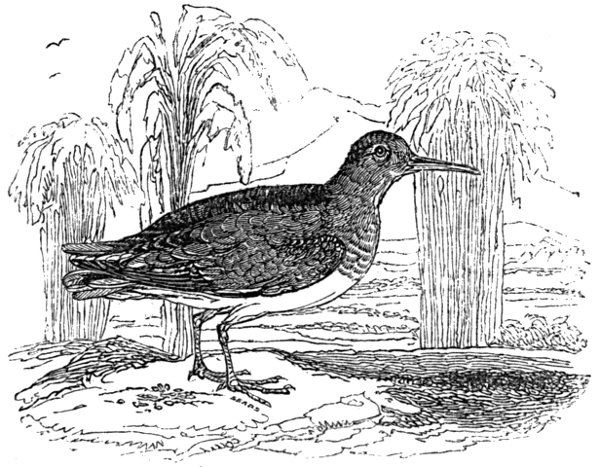
These birds, like others of the same genus, differ considerably from each other in their appearance in different seasons of the year, as well as from age and sex. The specimen from which the above drawing was taken measured from the point of the bill to the tip of the tail eight inches and a half; the extended wings about fifteen; and it weighed two ounces eight drachms. The bill is one inch and three-eighths long, black at the tip, and dusky, fading into orange towards the base; tongue of nearly the same length, sharp, and horny at the point: sides of the head, neck, and breast, cinereous, edged with ash-coloured grey; the chin white, and a stroke of the same colour passed over each eye. All the upper parts of the plumage were darkish-brown, but more deep and glossy on the crown of the head, back, and scapulars, and each feather was edged with ash or grey; the under parts were a cream-coloured white, streaked or spotted with brown on the sides and vent; the greater coverts of the wings tipped with white, which formed a bar across them when extended; the legs reddish yellow and short, not measuring more than two inches and one-eighth from the middle toe nail to the knee; the thighs feathered very nearly to the knee; toes divided without any connecting membrane.
This bird is caught in Lincolnshire and the other fenny counties in great numbers by nets, into which it is decoyed by carved wooden figures painted to represent itself, and placed within them, much in the same way as the ruff. It is also fattened for sale, and esteemed by many equal to the ruff in the delicacy of the flavour. The season for taking it is from August to November, after which the frost compels it to disappear.
This bird is said to have been a favourite dish with Canute, King of England; and Camden observes that its name is derived from his—Knute or Knoute, as he was called, which in process of time has been changed to Knot.—Bewick.
Knot, v. To complicate in knots; to entangle, to perplex; to unite.
Knotty, a. Full of knots; hard, rugged; intricate, perplexed.
Knuckle, s. The joints of the fingers, protuberant when the fingers close; the joint of a calf; the articulation or joint of a plant.
Lace, s. A string, a cord; a snare, a gin.
Laceration, s. The act of tearing or rending; the breach made by tearing.
Lair, s. The couch of a boar, or wild beast; the place where deer harbour by day.
Lake, s. A large diffusion of inland water; a small plash of water; a middle colour betwixt ultramarine and vermilion.
Lame, a. Crippled, disabled in the limbs.
Lameness, s. The state of a cripple, loss or inability of limbs; imperfection, weakness.
Lameness in Horses.—Proceeds from a variety of causes, and requires much patient investigation to ascertain, to a certainty, the exact seat of injury; for want of which judicious precaution, mischief frequently follows. Horses are sometimes persecuted, blistered, and fired for a lameness in one part, which ultimately proves to be in another, and this alone sufficiently points out the absolute necessity of a deliberate discrimination. As lameness proceeds from different causes, so it is of different kinds, and requires various modes of treatment, equally opposite to each other. This cannot be more forcibly elucidated, than by adverting to the difference between a lameness originating in a relaxation of the sinews, and a ligamentary injury sustained by a sudden turn, twist, or distortion, of some particular joint. These require a very different mode of treatment; and yet it is too much, and too unthinkingly the custom to treat every kind of lameness in the same way. From either a want of patience in the owner, or a want of prudence in the practitioner, the favourite operation of blistering is thought applicable to every case without exception; and being often resorted to before the inflammation of the part has sufficiently subsided, occasions a permanent enlargement, with a thickening of the integument, and consequent stiffness, rendering the remedy equally injurious with the original defect.
In all lamenesses occasioned by a relaxation of the tendons, blistering, and even firing, are admitted to have a forcible effect, provided they are brought into use at a proper time; but not before the inflammation (which is generally attendant upon such case) has previously subsided. In all ligamentary injuries blistering is seldom, if ever, known to be productive of permanent advantage; and is, perhaps, upon most occasions, so immediately adopted, because a single application is of so much less personal trouble, than a daily persevering hour bestowed in a hot fomentation, and stimulative embrocations.
Upon the subject of lameness in general, it is necessary to remark, that injuries sustained in tendons (commonly called the back sinews) are more frequently relieved, and a lasting cure obtained, than in a lameness of the joints; where, after patient and persevering medical applications, and a corresponding portion of rest, a renewal of work has almost immediately produced a relapse.
Lameness, from whatever cause arising, is unsoundness. However temporary it may be, or however obscure, it lessens the utility of the horse, and renders him unsound for the time. How far his soundness may be afterwards affected, must depend on the circumstances of the case. A lame horse is for a time an unsound one.
Lameness in Dogs.—During the hunting or shooting season, dogs are very liable to sore feet: they should be frequently washed with strong brine, pot liquor, or salt and vinegar,—a handful of the former to a pint of the latter. But as it will be found easier to prevent than cure the affection, this is best done by washing their feet every day, when returning from the field, with pot-liquor or brine.—The Horse—Brown.
Lampass, s. A lump of flesh, about the bigness of a nut, in the roof of a horse’s mouth.
Lampass.—Called also lampers, and lampards, is a spongy, elastic enlargement of the roof of a young horse’s mouth, just behind the nippers of his upper jaw, which frequently acquires such a luxuriance in growth, as to be equal with, or to exceed, the surface of the teeth, and is supposed to occasion pain to such horses in the mastication of their corn. Whenever the lampass are found so protuberant as to justify an opinion, or produce a proof that they occasion pain in mastication, it is then time enough to pass the point or edge of a sharp penknife, or lancet, transversely and longitudinally over the puffy and prominent part, so as to let it bleed in that state for a few minutes; then let it be washed with a solution of alum in water, and no further inconvenience need be apprehended.—White.
Lampblack, s. Is made by holding a torch under the bottom of a basin, and as it is furred striking it with a feather into some shell, and grinding it with gum water.
Lamprey, s. A kind of eel.
The sight of a large square slab of white marble at a trifling distance from the main road on this mountain, excited my curiosity some days ago. It contained a modern Latin inscription of great length, which for its singularity I would send you, but I wish to save postage. The traveller is desired to pause, in order to behold an ocular demonstration of the cruelty and impiety of the ancient pagans, exhibited in the fish-ponds of A. Pollio, Esq. who, says the marble, was particularly fond of lampreys fed with human blood; and who to gratify this inhuman sort of gluttony, had these ponds built at an immense expense, and caused the wretched victims of his corrupt palate to be thrown into them. Accepting the pious invitation, I entered the farm pointed out by the inscription, and actually found the farm-house to consist of some modern masonry engrafted upon a solid stock of ancient reticulated architecture. At the back of the building a small door opened into the ponds, which even now appeared to be abundantly supplied with water, rising to the height of about eight or ten feet, from the door downwards, and covered by an arched vault nearly as high from the top of the door: the sides were lined with a stucco, as hard, if not harder than stone. The whole fabric was in perfect preservation, and well worth the attention of an antiquary; but my conductor was unable to add anything to the information given by the inscription, which, I confess, appeared to me very problematical. The neat and impenetrable covering of stucco, would rather induce me to take it for a reservoir, or large cistern for water, than a pond for lampreys: and supposing it to have been the latter, where is the evidence of human bodies having supplied their food; and supposing the Roman laws to have been lax enough to allow such a diabolical practice, what stomach could relish such a dainty?—Letters from the Campagna Felice.
Lampron, s. A kind of sea-fish, a long eel.
Lance, v. To pierce, to cut; to open chirurgically, to cut in order to a cure.
Lancet, s. A small pointed chirurgical instrument.
Land, v. To set on shore; to secure a fish.
Landmark, s. Anything set up to preserve boundaries.
Landrail, or Daker Hen, Corncrake, (Rallus crex, Linn.; Le Rale de Genet, Buff.) s. A bird.
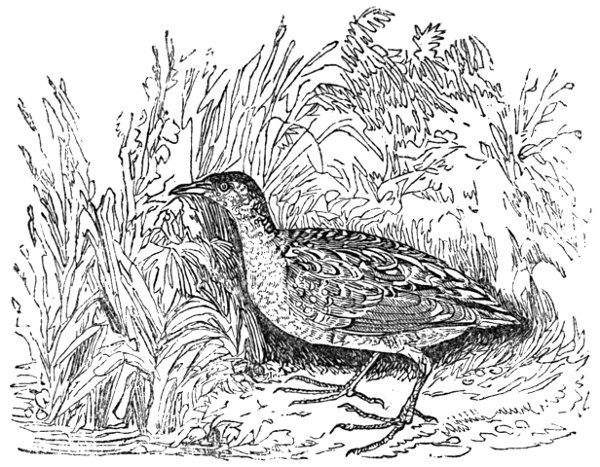
THE LAND-RAIL.
Length rather more than nine inches; the bill is light brown; the eyes hazel; all the feathers on the upper parts of the plumage are of a dark brown, edged with pale rust colour; both wing coverts and quills are of a deep chestnut; the fore part of the neck and the breast are of a pale ash colour; a streak of the same colour extends over each eye from the bill to the side of the neck; the belly is of a yellowish white; the sides, thighs, and vent, are marked with faint rusty coloured bars; the legs are of a pale flesh colour.
We have ventured to remove this bird from the usual place assigned to it among those to whom it seems to have little or no analogy, and have placed it among others to which in most respects it bears a strong affinity.
It makes its appearance about the same time as the quail, and frequents the same places, whence it is called in some counties the king of the quails. Its well known cry is first heard as soon as the grass becomes long enough to shelter it, and continues till the grass is cut; but the bird is seldom seen, for it constantly skulks among the thickest part of the herbage, and runs so nimbly through it, winding and doubling in every direction, that it is difficult to come near it; when hard pushed by the dog, it sometimes stops short and squats down, by which means its too eager pursuer overshoots the spot, and loses the trace. It seldom springs but when driven to extremity, and generally flies with its legs hanging down, but never to a great distance; as soon as it alights it runs off, and before the fowler has reached the spot, the bird is at a considerable distance.