INTRODUCTION. (continued 13)
Reading edition
Hit, v. To strike, to touch with a blow; to touch the mark, not to miss; to reach the point; a lucky chance; a game at backgammon.
Hitch, s. A knot or noose taken on a rope.
Hive, s. The habitation or cell of bees; the bees inhabiting a hive.
Hoar, a. White; grey with age; white with frost.
Hobby, s. A species of hawk; an Irish or Scottish horse.
The Hobby. (Falco subbuteo, Linn.; Le Hobereau, Buff.)—The length of the male is twelve inches; breadth about two feet. The bill is blue; cere and orbits of the eyes yellow; the irides orange; over each eye there is a light-coloured streak; the top of the head and back are of a bluish black; the wing coverts the same, but in some edged with rust colour; the hinder part of the neck is marked with two pale yellow spots; a black mark from behind each eye, forming almost a crescent, is extended downwards on the neck; the breast and belly are pale, marked with dusky streaks; the thighs rusty, with long dusky streaks; the wings brown; the two middle feathers of the tail are of a deep dove colour, the others are barred with rusty and tipped with white. The female is much larger, and the spots on her breast more conspicuous than those of the male; the legs and feet are yellow.
The hobby breeds with us, but is said to emigrate in October. It was formerly used in falconry, chiefly for larks and other small birds, which were caught in a singular manner: when the hawk was cast off, the larks, fixed to the ground through fear, became an easy prey to the fowler, who drew a net over them. Buffon says that it was used in taking partridges and quails.
A male hobby perceiving a goldfinch in a cage, within a window which happened to be open, dashed at the imprisoned bird, notwithstanding several persons were in the room; but being alarmed at the natural vociferations of some young ladies for the safety of their darling, the intruder mistook the passage by which he entered, and flew against the glass, when his retreat was cut off, and he was secured.
This species was formerly trained for hawking, but more commonly used for taking partridges and larks with a net, which was termed daring, that is, the hobby was cast off, which so frightened the birds, that they readily suffered a net to be drawn over them.—Montagu.
Hock, s. The joint between the knee and fetlock; old strong Rhenish.
Hoe, s. An instrument to cut up the earth.
Hog, s. The general name of swine; a castrated boar.
To prepare Hog’s Fur.—Take according to the quantity of fur you have: if a pound, four quarts of water; cut down into it two ounces of soap with a noggin of stale urine; throw in your fur, and let it come to a high scald, and while it is coming to that, keep it constantly under the liquor. Lay it by to cool, and when cool enough gently squeeze and press with your hands, and throw it into cold water. Then in some clean water, about two quarts, dissolve about the size of two walnuts of alum, and when it boils throw in your fur, press it well, and throw it into clean water; press it, and throw off the water, pour in more, and do the same at least three times. You must open your fur before you can dye it, as this process will cement it together. As to mohair it needs nothing more than washing with soap and water, to be boiled as above in alum, and washed.—Old Recipe.
Hoggerel, s. A two-years-old ewe.
Hogshead, s. A measure of liquids containing sixty gallons; any large barrel.
Hog’s Lard, s. An article of some importance in veterinary surgery, being the basis of almost every ointment.
Hog’s lard possesses a laxative quality, and may be given to the extent of half a pound, melted or mixed with warm water or peppermint water, as a substitute for castor oil, olive oil, or linseed oil, when neither of those can be procured. Fresh hog’s lard melted, and mixed with a little salad oil, forms a good softening ointment for horses’ heels that are subject to cracks.—White.
Hold, s. The act of seizing; gripe, grasp, seizure; something to be held; hold of a ship, all that part which lies between the keelson and the lower deck; a lurking-place.
Hole, s. A cavity narrow and long; a cave, hollow place; cell of an animal.
Hollow, v. To shout, to hoot. View hollow! The hunter’s halloo! given when the game is viewed by the hounds.
Holly, s. A tree.
Honey, s. A thick, viscous, luscious substance, which is collected and prepared by bees. Honey is divided into three kinds; virgin honey, the first produce of the swarm, obtained by drawing, without pressing the comb; a second, or thicker kind, produced by pressure; and a third and worst description extracted by heating, and then pressing the comb.
Honeycomb, s. The cells of wax in which the bee stores her honey.
Honeycombed, a. Flawed with little cavities; a term used to describe the injuries produced by rust on cannon and gun barrels.
Hood, s. Anything drawn upon the head, and wrapping round it; a cap of leather put on the hawk’s head immediately after he is taken. It is so constructed as to prevent him from seeing, but to allow him to feed; and may be put on or taken off at pleasure. To hood a hawk requires a degree of manual dexterity that is not easily acquired.
Hood, v. To blind as with a hood.
Hooded or Royston Crow (Corvus cornix, Linn.; La Corneille mantelée, Buff.) s.
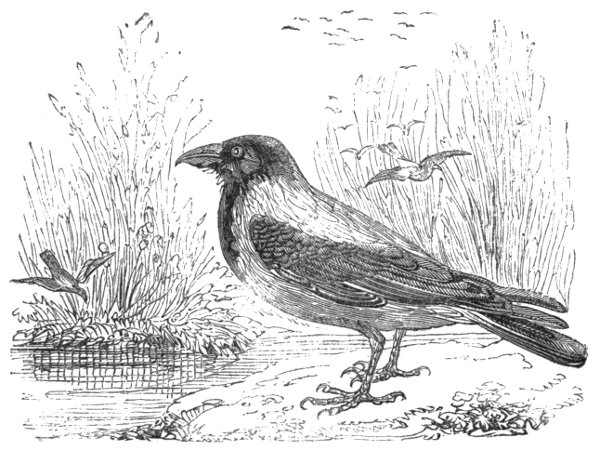
This bird is somewhat larger and more bulky than the rook, measuring twenty-two inches in length. Its bill is black, and two inches long; the head, fore part of the neck, wings, and tail, are black; the back and all the under parts are of a pale ash-colour; legs black.
These birds arrive with the woodcock, and on their first coming frequent the shores of rivers. They depart in the spring to breed in other countries, but it is said that they do not all leave us, as they have been seen during the summer months in the northern quarters of our island, where they frequent the mountainous parts of the country, and breed in the pines. In more northern parts of the world they continue the whole year, and subsist on sea-worms, shell-fish, and other marine productions. With us they are seen to mix with and to feed in the same manner as the crow. During the breeding season they live in pairs, lay six eggs, and are said to be much attached to their offspring.—Bewick.
Hooded Gull, (Larus atricilla, Linn.) s.
The bill and feet are deep lake red; hood of dark bluish ash-colour; quill feathers all black, and two inches longer than the tail; length of the shank one inch and three-fourths. In the month of August, 1774, we saw five of them together feeding in a pool upon the shingley flats near Winchelsea; two only were black on the head; the others were mottled all over with brown. We also saw two others near Hastings, in Sussex. It is found in Russia and America, and, according to Natterer, on the coasts of the Mediterranean and the Adriatic.—Montagu—Temminck.
Hoodwink, v. To blind with something bound over the eyes.
Hoof, s. The hard horny substance which composes the feet of several sorts of animals.
Hoof Ointment.—Tar and tallow in equal parts: when melted let the mixture be removed from the fire, and stirred until it is cold. This ointment is applied to the coronet and heels, when dry and cracking.—White.
Hook, s. Any thing bent so as to catch hold; the bended wire on which the bait is hung for fishes, and with which the fish is pierced; a snare, a trap; a sickle to reap corn; an iron to seize the meat in the caldron; an instrument to cut or lop with; the part of the hinge fixed to the post.
In the choice of hooks, those should be preferred that are longish in the shanks, strong, and rather deep in the bend, the point fine and straight, and as true as it can be set to the level of the shank (which, for fly making, should be tapered off to the end, that the fly may be the neater finished), the point should be sharp and the barb of a proper length; many experienced anglers, who have impartially tried both kinds, consider these to be more sure than the crooked hooks, that they cause a smaller orifice, and are less liable to break their hold. At Limerick, in Ireland, the best of these hooks are manufactured. A hook, whose point stands outwards, ought never to be chosen, as it frequently scratches the fish without laying hold; if the points were somewhat shorter, and the barbs a trifle wider, the hooks of every maker would be improved. When hooks are blunt, a small whetstone will restore their sharpness much better than a file, which always leaves them rough and jagged.
I find, by sad experience, that in hook-making the Irish are far before us; our workmen either do not understand the method of forming and tempering hooks, or they do not take sufficient pains in their manufacture. It is strange, that when so much of the angler’s pleasure and success depends upon the quality of his hooks, that more attention is not bestowed upon their fabrication. The art of forming, and the process of tempering them, appears simple enough; and that little difficulty is required to attain it, is evident from the fact that many fishermen make their own hooks. For my own part, however, I consider hook-making to be an unnecessary accomplishment for the angler, as the best hooks in the world can be procured without trouble, and at a trifling expense, from O’Shaughnessy of Limerick.
I have even made a hook, which, though a little inferior in form, in other respects, I think I could boast as equal to the Limerick ones.
I never used any hooks for salmon-fishing except those which I am sure have been made by O’Shaughnessy of Limerick; for even those made in Dublin, though they seldom break, yet they now and then bend; and the English hooks, made of cast-steel, in imitation of Irish ones, are the worst of all.
Hooks, to whip on.—When hooks are armed, especially to hair, it should be done with small but strong silk, well rubbed with shoemaker’s wax, after having smoothed the shank with a whetstone, to hinder its fretting; from a straw’s breadth below the top of the hook, wrap the silk about the bare shank until it comes to the top, which will prevent its slipping, or cutting the line from frequently using; then lay the hair or gut on the inside and whip the silk downwards almost to the bend of the hook; the colour of the arming silk should be as near that of the baits used as may be, and its size be regulated by the thickness of the wire, hair, or gut, to which it is joined. In whipping on a hook, it is to be held in the left hand, and the silk whipped down to within four turns of its bend; the shank is then to be taken between the fore finger and thumb of the left hand, and the end of the silk close to it, holding them both tight, and leaving the ends of the silk to hang down; the other part of the silk is then to be drawn into a large loop, and with the right hand, turning backwards, continue the whipping for four turns, and draw the end of the silk, which has hung down under the left thumb, close, and cut it off.—Salmonia—Wild Sports—Daniel.
Hook, v. To catch with a hook; to entrap; to draw as with a hook.
Hooked, a. Bent, curvated.
Hooknosed, a. Having the aquiline nose rising in the middle.
Hoop, s. Anything circular by which something else is bound, particularly casks or barrels.
The hoop net is a very destructive engine. For large and deep waters the mesh should be an inch and three quarters, the length full nine feet, and the hoops (of which that in the centre should be iron, rounded like a curtain rod, and painted red to prevent its rusting) should be strong and three feet high. In laying hoop nets, place them where the water gets tolerably deep from a gravelly scour. All the infallible attraction of brass candlesticks, yellow ribands, flowers, and looking-glasses, are superseded by the arcanum of encircling a live fish brought from other waters in each hoop net; whether the old inhabitants approach the stranger out of vengeance or curiosity remains a mystery, but that they will run into the hoop net to get at him, Mr. Daniel positively insists. It was a secret which an old gamekeeper would not impart, until after being in his service for many years.—Daniel.
Hoop, v. To bind or enclose with hoops; to encircle; to clasp.
Hoot, v. To shout in contempt; to cry as an owl.
Hop, s. A plant, the flowers of which are used in brewing. Hops were introduced into England in the sixteenth century, from the Netherlands.
Horn, s. The hard pointed bodies which grow on the heads of some quadrupeds, and serve them for weapons; an instrument of wind music, made of horn; the extremity of the waxing or waning moon; the feelers of a snail; a drinking cup made of horn.
Hornet, s. A very large, strong, stinging fly.
Hornowl, s. A kind of horned owl. Vide Owl.
Horse, s. A quadruped used in war, draught, and carriage.
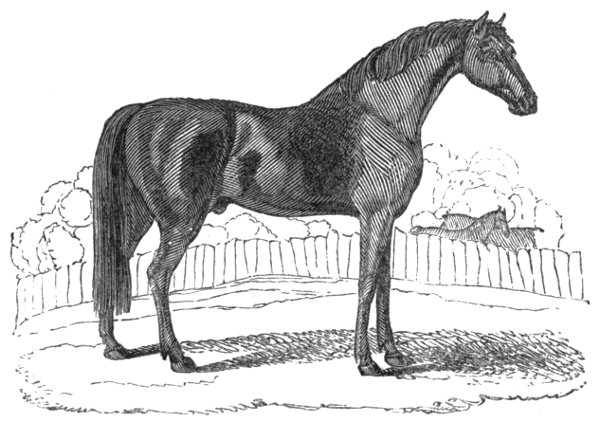
The generic character of horses, according to Linnaeus, is, that the fore-teeth are twelve in number, the upper six erect and parallel, the lower six more prominent; the tusks are solitary, included, remote; teats two, inguinal: they fight by biting, and kicking with the hind feet; and they have the singular property of breathing only through the nostrils, and not through the mouth.
Cuvier places the horse in the class Mammalia, which contains those animals that suckle their young, and forms the ninth genus of his sixth order, called Pachydermata, of which order the following are characters:—Skin very thick; some of the genera are partially without teeth, others with three sorts of teeth; quadrupedal, generally with hoofs, and the toes varying in number; stomach simple, and they do not ruminate; without clavicles, or collar-bones. They are either herbivorous or omnivorous, and their habits are various. They generally inhabit the temperate and torrid zone.
The genus Equus is subdivided by Cuvier into six species, and thus defined:—Incisory teeth, six in the upper jaw, and six in the under; two canines, one above and one below, on each side of the cutting or incisory teeth, (the females of some of the species with no canine teeth,) and six cheek teeth, or grinders, on each side, on both jaws; they are furrowed on both sides with flat crowns and several ridges of enamel. Between the canines and cheek teeth is a void space; the upper lip is susceptible of considerable motion; the eyes are large; the pupil oblong-ovate, placed laterally; their sight excellent, and, although not formed for seeing in the night, they can distinguish objects very clearly in the dark; ears rather small, pointed, and erect, having great mobility in the external conch, so that their hearing is very acute, and is the sense which, in all probability, they possess in the greatest perfection; feet, with a single apparent toe, covered with a thick hoof; the tail is furnished with long hair, or with a tuft at the extremity; mammæ two, inguinal; the stomach is simple and membranaceous, and the intestines and cæcum very large.
The six species of this genus are the horse, ass, common zebra, zebra of the plains, quagga, dzhiggtai, with the mule, which may be regarded as a sub-species.
Of all quadrupeds, the horse possesses, along with grandeur of stature, the greatest elegance and proportion of parts. By comparing him with the animals above or below him, we find that the ass is ill made, and that the head of the lion is too large; that the limbs of the ox are too slender, and too short in proportion to the size of his body; that the camel is deformed; and the grosser animals, as the rhinoceros, hippopotamus, and elephant, may be considered as rude and shapeless masses. The great difference between the head of man and that of the quadruped, consists in the length of his jaws, which is the most ignoble of all characters. But, although the jaws of the horse be very long, he has not, like the ass, an air of imbecility, nor, like the ox, of stupidity. The regularity and proportion of the parts of his head, give him a light and sprightly aspect, being gracefully attached to his finely arched neck, which is well supported by the beauty of his chest. He elevates his head, as if anxious to exalt himself above the condition of other quadrupeds. In this noble attitude he regards man, face to face. His eyes are open, lively, and intelligent; his ears handsome, and of a proper height, being neither too long, like those of the ass, nor too short, like those of the bull. His mane adorns his graceful neck, and gives him the appearance of strength and courage. His long bushy tail covers, and terminates with advantage, the extremity of his body. His tail, very different from the short tails of the deer, elephant, and hippopotamus, and from the naked tails of the ass, camel, and rhinoceros, is formed of long, thick hairs, which seem to rise from his crupper, because the trunk from which they proceed is very short. He cannot, like the lion, elevate his tail; but, though pendulous, it becomes him better; and as he can move it from side to side, it serves him to drive off the flies, which incommode him; for though his skin is very firm, and well garnished with close hair, it is, nevertheless, very sensible.
Brown says, the head of the horse should not be too long, and it ought to be rather thin than otherwise. The front should be narrow, and a little convex; the eye-pits well filled, and the eye-lids thin; the eyes large and prominent, clear, lively, and sparkling with fiery glances; the pupil should be large; the under jaw should be a little thick, but not fleshy; the nose slightly arched; the nostrils open and deep, and divided by a thin septum or partition; the ears should be small, erect, and narrow, but not too stiff, and placed on the upper part of the head, at a proper distance from each other, but not too wide, as this always gives a horse a disagreeable aspect; the mouth should be delicate, and moderately split; the withers sharp and elevated; the shoulders flat and not confined; the back equal, a little arched lengthwise, and raised on each side of the spine, which should have the appearance of being slightly sunk; the flanks short and full; the crupper round and plump; the haunches well furnished with muscular flesh; the dock, or fleshy part of the tail, firm and thick; the thighs large and muscular; the hough round before, broad on the sides, and tendinous behind; the shank thin before, and broad on the sides; the tendon Achillis prominent, strong, and well detached from the leg-bone; and the fetlock somewhat prominent, and furnished with a small tuft of long hair behind; the pasterns should be of a middling length, and pretty large; the coronet a little elevated; the hoof black, solid, and shining; the instep high; the quarters round; the heels broad, and a little prominent; the frog thin and small, and the sole thick and concave.—Vide Arabian—Hunter—Roadster, Race Horse, &c.
The horse is considered to have been originally a native of what is called the old world, and by the industry of man to have been planted in the new. It appears from the sacred records, that his subjugation did not take place until many years after that of the camel and the ass.
At what precise time foreign horses were brought into Britain is uncertain; but it is not improbable that it was a very early one, since history informs us they were sufficiently numerous, and their uses well known, when Julius Cæsar invaded the island. Whether these early horses were the entire produce of Britain, or whether they had already been mixed, it is likely that their intercourse with the Roman cavalry would introduce new races, as diversified as the countries from whence the Romans themselves drew their own immense supplies. Freed from their conquerors, the English cultivated the arts of peace, and were consequently not unmindful of the horse, which was become, as early as A.D. 930, so valuable that Athelstan prohibited their exportation.
William the Conqueror brought with him the means of greatly improving the island horse; and the barons who accompanied him, being spread over the kingdom, in their newly acquired estates, rapidly diffused a valuable mixture among the native breeds. One of these nobles (Roger de Belesme, Earl of Shrewsbury) is particularly celebrated for introducing Spanish stallions into his Welsh possessions.
In 1121, the first Arabian horse on record was imported into England, and the crusades, which soon succeeded, were the means of introducing a large accession of eastern horses from the Levant. The traffic in horses now began to assume much of its future character: Smithfield was established as a horse-market; and the dealing in this animal was already become a regular profession, as well as already garnished with much of its trickery.
To Edward the Second the breed of English horses owes much of its early improvement: he procured cavalry horses from Lombardy, Italy, and Spain, and heavy draught horses from Flanders. From this time the public attention appears to have been particularly directed to the necessity of improving the breed of horses; and many public ordinances were promulgated to that effect. In the reigns of Henry VII. and VIII. it became common to import foreign stallions for this purpose from Barbary and Spain; and, in the two following reigns, others were imported from Belgium, Flanders, and Denmark; and as the former were intended to improve the speed, spirit, and beauty, these latter added greatly to the size of the future breeds. As early as the twelfth and thirteenth centuries, there were horse-races in England; but these appear to have been principally confined to trials of speed and continuance over uncertain grounds between native horses. In the reign of Henry VIII., horses either procured from Barbary, or bred from such, were expressly used for this purpose; and we may date the systematic improvement in the breed, by the admixture of what we call blood, to have its origin about this time.
James the First pursued the system, and imported from Barbary a set of the finest mares, for purity of breed and excellence of form, which could be procured: these, known significantly as the Royal Mares, greatly assisted the general purpose. James also imported an Arabian, whose own qualities, as well as those of his produce, not answering to the expectations raised, the breed for many years became in disrepute. Regular race-courses were now established, and racing was conducted on fixed principles, and confined within rules. Charles the First encouraged these sports, and to him we owe the establishment of the Newmarket course; and in such estimation were they, as connected with the national good, that even the fanaticism of Cromwell gave way to it, for he also had his stud of race-horses. The Restoration gave a new impulse to racing, and a new impetus to the improvements meditated. The Arabian was again resorted to, and, on the renewed trials, his proceeds justified the former expectations. From that time to the present, by a judicious mixture of crossings of the native and the eastern horses, in different degrees of consanguinity, according to the different purposes for which they are required, we now stand unrivalled among nations; and we now send our breeds back to eastern countries, to meliorate that blood which we originally borrowed from them.
It would appear that the ancient Irish horses were held in high estimation:—
“Horses they have of pace easie, in running wonderful swift. Therefore they make of them great store, as wherein at times of need they repose a great piece of safetie.
“I heard it verrified by honourable to honourable, that a nobleman offered (and was refused) for one such horse, an hundred kyne, five pound lands, and an aery of hawks yearly during seven years.”—Brown—Blaine—Strutt—Campion.
Horse, v. To mount upon a horse; to cover a mare.
Horseback, s. The seat of the rider, the state of being on a horse.
Horsebean, s. A small bean usually given to horses.
Horsebreaker, s. One whose employment is to tame horses to the saddle.
Horsechestnut, s. A tree, the fruit of a tree.
Horsecourser, s. obs. One that runs horses, or keeps horses for the race; a dealer in horses.
Horsehair, s. The hair of horses. Vide Hair.
Horseleech, s. A leech that bites horses; a farrier.
Horseman, s. One skilled in riding; one that serves in wars on horseback; a rider, a man on horseback.
Horsemanship, s. The art of riding, the art of managing a horse.
Horsepond, s. A pond for watering horses.
Pond water, from a clay bottom, is by some preferred to running water; but in summer stagnant water often becomes putrid and nauseous, and is consequently highly injurious.
Horserace, s. A match of horses in running. Vide Racing.
Horseshoe, s. A plate of iron nailed to the feet of horses; an herb. Vide Shoe.
Hostler, s. One who has the care of horses at an inn.
Hot, a. Having the power to excite the sense of heat; fiery; ardent, vehement, eager.
Hough, s. The lower part of the thigh.
Hough, v. To hamstring, to disable by cutting the sinews of the ham.
Hound, s. A dog used in the chase.
The old English hound or Talbot. (Canis Sagax, Linn.)—This is undoubtedly the origin of those famous hounds for which Great Britain is celebrated above all other countries. In former times this dog was of a pure white, but is now generally of a white and black colour, and tanned over the eyes.
This majestic animal is distinguished by his great size and strength; his body is long, his chest deep, and his ears long and sweeping, with great gravity of expression. From the particular formation of his organs, or from the extraordinary moisture which always flows from his nose, or from some other unknown cause, he is endowed with the most exquisite sense of smelling, and can discover scent hours after other dogs have given up.
Although the talbot hunts with great certainty, yet he becomes tedious from the slowness of his motions; this, however, enables him to receive more distinctly the directions of the huntsman. And he can trace with a cold scent, which he is too apt to make so by his want of speed.
The talbot, in the “History of Manchester,” is stated to be the original breed of this island, used by the ancient Britons in the chase of larger kinds of game, with which the country at one time abounded. They were common in all parts of the kingdom, and were much larger than they are at present; and have been gradually declining in consequence of mixing them with lighter dogs for the purpose of increasing their speed. We have no doubt that, from this cause, the breed will eventually become extinct.
It is said, that the tone of his voice is peculiarly deep, sonorous, powerful, and mellow.
Among sportsmen it is generally understood that hounds of the middle size are the most proper, all animals of that description being stronger than such as are either very small or very large. The shape ought to be particularly attended to; for, if the hound be not well proportioned, he can neither run fast nor do much work. His legs ought to be straight, his feet round and not very large, his shoulders back, his breast rather wide than narrow, his chest deep, his back broad, his head small, his neck thin, his tail thick and bushy and well carried. None of those young hounds which are out at the elbows, or such as are weak from the knee to the foot, should ever be taken into the pack. That the pack may look well, the hounds should be as much as possible of a size; and if they be also handsome, the pack will then be perfect. This, however, contributes nothing to the goodness of a pack, for very unhandsome packs, consisting of hounds entirely different in size and colour, often afford very good sport.
It is only necessary that they should run well together; to which indeed a uniformity in size and shape seems to contribute. The pack that can run ten miles, or any other considerable space, in the shortest time, may be said to go fastest, though the hounds taken separately might be considerably inferior to others in point of swiftness. A pack of hounds considered in a collective body, go fast in proportion to the excellence of their noses and the head they carry. Packs composed of hounds of various kinds seldom run well. When the packs are very large, the hounds are seldom sufficiently hunted to be good; twenty or thirty couple, therefore, or at most forty, will be sufficient for the keenest sportsman in this country, as thus he may be enabled to hunt three and even four times a week. The number of hounds to be kept must however, in a considerable degree, depend on the strength of the pack, and the country in which they hunt. They should be left at home as seldom as possible; and too many old hounds should not be kept. None ought to be kept above five or six seasons, though this also is somewhat uncertain, as we have no rule for judging how long a hound will last. In breeding hounds, considerable attention ought to be paid to the dog from which you breed. All such are to be rejected as have a tender nose, or are babblers or skirters. An old dog should never be put to an old bitch. January, February, and March, are the best months for breeding; late puppies seldom thrive. After the females begin to grow big with young, it will not be proper to let them hunt any more, or indeed to remain for a much longer time in the kennel. Sometimes these animals will have an extraordinary number of whelps. Mr. Beckford informs us, that he has known a bitch have fifteen puppies at a litter; and he assures us, that a friend of his informed him, that a hound in his pack brought forth sixteen, all alive. In these cases it is proper to put some of the puppies to another bitch, if you want to keep them all; but, if any are destroyed, the best coloured ought to be kept. The bitches should not only have plenty of flesh, but milk also; and the puppies should not be taken from them till they are able to take care of themselves; their mothers will be relieved when they learn to lap milk, which they will do in a short time. After the puppies are taken away from their mother, the litter should have three purging balls given them, one every other morning, and plenty of whey the intermediate day. If a bitch bring only one or two puppies, and you have another that will take them, by putting the puppies to her, the former will soon be fit to hunt again. She should, however, be first physicked, and it will also be of service to anoint her dugs with brandy and water. Whelps are liable to the distemper, to which dogs in general are subject, and which frequently makes great havoc among them at their walks. Young hounds should be fed twice a day, as they seldom take kindly to the kennel-meat at first, and the distemper is most apt to seize them at this time. It is impossible to determine how many young hounds ought to be bred in order to keep up the pack, as this depends entirely on contingencies. The deficiencies of one year must be supplied by the next; but it is probable, that from thirty to thirty-five couple of old hounds, and from eight to thirty-five couple of young ones will answer the purpose, where no more than forty couple are to be kept. A considerable number, however, ought always to be bred; for it is undoubtedly and evidently true, that those who breed the greatest number of hounds must expect the best pack. After the hounds have become acquainted with the huntsman, and answer to their names, they ought to be coupled, and walked out among sheep; and two dogs should not be coupled together, when you can avoid it. As young hounds are awkward at first, a few ought only to be sent out at a time, with people on foot, and they will soon afterwards follow a horse. With regard to the first entering of hounds to a scent, our author gives the following directions:—“You had better enter them at their own game; it will save you much trouble afterwards. Many dogs, I believe, like that scent best which they were first blooded to: but, be this as it may, it is most certainly reasonable to use them to that which it is intended they should hunt. Hounds ought to be entered as soon as possible, though the time must depend on the nature of the country in which they are. In corn countries hunting may not be practicable till the corn is cut down; but you may begin sooner in grass countries, and at any time in woodlands. Hounds at their first entrance cannot be encouraged too much. When they are become handy, love a scent, and begin to know what is right, it will then be soon enough to chastise them for what is wrong; in which case one severe beating will save a great deal of trouble. When a hound is flogged, the whipper in should make use of his voice as well as his whip. They should be low in flesh when you begin to hunt, the ground being generally hard at that time, so that they are very liable to be shaken. Sometimes the huntsman turns down a cat before them, which they kill; and, when the time of hunting approaches, he turns out young foxes or badgers; taking out some of the most steady of his old hounds to lead on the young ones. Small covers and furze brakes are drawn with them to use them to a halloo, and to teach them obedience. If they find improper game, and hunt it, they are stopped and brought back; and as long as they will stop at a rate, they are not chastised. To render fox-hunting complete, no young hounds should be taken into the pack the first season; a requisite too expensive for most sportsmen. The pack should consist of about forty couple of hounds, that have hunted one, two, three, four, or five seasons. The young pack should consist of about twenty couple of young hounds, and an equal number of old ones. They should have a separate establishment, and the two kennels should not be too near one another. When the season is over, the best of the young hounds should be taken into the pack, and the draft of old ones exchanged for them. Many must be bred to enable a sportsman to take in twenty couple of young hounds every season. It will always be easy to keep up the number of old hounds, for, when your own draft is not sufficient, drafts from other packs may be obtained, and at a small expense. When young hounds are hunted together for the first season, and have not a sufficient number of old ones along with them, it does more harm than good.”—Vide Beagle, Harrier, Fox and Stag-hound.
NAMES OF HOUNDS.
A. dogs.
Antic
Ardent
A. bitches.
Active
Airy
B. dogs.
Bachelor
Bellman
Blaster
Bluecap
Bouncer
Bowler
Bravo
Brazen
Brilliant
Brusher
Bustler
B. bitches.
Bashful
Beauty
Beldam
Blowsy
Bluebell
Brimstone
Busy
Buxom
C. dogs.
Captain
Carver
Charon
Chaser
Chanter
Chieftain
Chimer
Clinker
Comrade
Comus
Constant
Coxcomb
Crasher
Crowner
Cruiser
Crusty
Cryer
C. bitches.
Careless
Charmer
Chantress
Clio
Comely
Crafty
Crazy
Crony
D. dogs.
Damper
Danger
Dasher
Dashwood
Driver
Duster
D. bitches.
Dainty
Darling
Dashaway
Dauntless
Dian
Dulcet
E. dogs.
Eager
Earnest
E. bitches.
Easy
Endless
F. dogs.
Factor
Fervent
Finder
Flasher
Fleecer
Flippant
Foamer
Forward
F. bitches.
Faithful
Fairmaid
Fearless
Fickle
Fidget
Firetail
Flighty
Flourish
Fretful
Frisky
Frolic
Fury
G. dogs.
Gainer
Gallant
Gimcrack
Glancer
Glider
Growler
Grumbler
G. bitches.
Gayless
Giddy
Gladsome
Graceful
H. dogs.
Hardy
Havoc
Hazard
Headstrong
Hearty
Hector
Hero
Hopeful
Hotspur
H. bitches.
Hasty
Handsome
Harlot
Helen
J. dogs.
Jingler
Jockey
Jolly
Judgment
J. bitches.
Joyful.
L. dogs.
Lasher
Leader
Lictor
Lifter
Lightfoot
Lounger
Lusty
L. bitches.
Lawless
Lively
Lofty
Lovely
M. dogs.
Marksman
Marplot
Match’em
Meddler
Mendall
Merlin
Messmate
Monarch
Motley
Mounter
Mungo
M. bitches.
Madcap
Magic
Minion
Mischief
Music
N. dogs.
Nestor
Nettler
Newsman
Nimrod
Noble
Nonsuch
N. bitches.
Nimble
Noisy
Novice
P. dogs.
Pealer
Perfect
Phœbus
Pilgrim
Pilot
Piper
Playful
Prattler
Presto
Primate
Prowler
Prosper
P. bitches.
Patience
Placid
Pliant
Precious
Priestess
Prudence
R. dogs.
Racer
Rambler
Random
Ranger
Ransack
Ranter
Rattler
Rector
Render
Rifler
Ringwood
Risker
Rockwood
Rouser
Rover
Rumbler
Rusher
R. bitches.
Racket
Rapid
Rattle
Ruin
Rummage
S. dogs.
Samson
Saunter
Scalper
Scamper
Scourer
Scramble
Scuffler
Sharper
Shifter
Singer
Skirmish
Smoker
Songster
Soundwell
Spanker
Spinner
Spoiler
Sportsman
Squabbler
Squeaker
Steady
Stickler
Stringer
Stripling
Striver
Stroker
Struggler
Sturdy
Sylvan
S. bitches.
Sappho
Skilful
Speedy
Spitfire
Sportful
Sprightly
Stately
Strumpet
Sybil
T. dogs.
Tackler
Tamer
Tangent
Tartar
Tattler
Taunter
Teaser
Terror
Thrasher
Thumper
Thwacker
Tickler
Tomboy
Topper
Torrent
Touchstone
Trampler
Trimbush
Trimmer
Trojan
Trouncer
Truant
Trueboy
Trueman
Trusty
Tryall
Tuner
Twig’em
T. bitches.
Tattle
Telltale
Tempest
Termagant
Testy
Trifle
Trollop
Truelass
Tuneful
V. dogs.
Vagrant
Valid
Vaulter
Venture
Vexer
Victor
Vigorous
Viper
Volant
Voucher
V. bitches.
Vanquish
Venomous
Vicious
Vivid
Vixen
Vocal
W. dogs.
Warbler
Warrior
Wayward
Wellbred
Whynot
Wildair
Wildman
Wilful
Woodman
Workman
Wrangler
Wrestler
W. bitches.
Waggery
Waggish
Wagtail
Wanton
Warfare
Warlike
Waspish
Watchful
Welcome
Whimsey
Wildfire
Wishful
Worry
Wrathful.
Brown—Whitaker—Beckford, &c.
Hound, v. To set on the chase; to hunt, to pursue.
Hour, s. The twenty-fourth part of a natural day; the space of sixty minutes.
Hourglass, s. A glass filled with sand, which, running through a narrow hole, marks the time.
House, v. To harbour, to admit to residence; to shelter, to keep under a roof; to take shelter, to keep the abode.
Housedog, s. A mastiff kept to guard the house.
Housing, s. Cloth originally used to keep off dirt, now added to saddles as ornamental.
Howl, v. To cry as a wolf or dog; to utter cries in distress.
Howl, s. The cry of a wolf or dog; the cry of a human being in horror.
Hoy, s. A large boat, sometimes with one deck.
Hucho, s. A fish of the genus Salmo.
The hucho is the most predatory fish of the salmo genus, and is made like an ill-fed trout, but longer and thicker. He has larger teeth, more spines in the pectoral fin, a thicker skin, a silvery belly, and dark spots only on the back and sides. I have never seen any on the fins. The ratio of his length to the girth is as eight to eighteen, or, in well-fed fish, as nine to twenty; and a fish, eighteen inches long by eight in girth, weighed 16,215 grains. Another, two feet long, eleven inches in girth, and three inches thick, weighed 4lbs. 2¼ oz. Another, twenty-six inches long, weighed 5lbs. 5oz. Of the spines in the fins, the anal has nine, the caudal twenty, the ventral nine, the dorsal twelve, the pectoral seventeen: having numbered the spines in many, I give this as correct. The fleshy fin belonging to the genus is, I think, larger in this species than in any I have seen. Bloch, in his work on fishes, states, that there are black spots on all the fins, with the exception of the anal, as a character of this fish: and professor Wagner informs me, he has seen huchoes with this peculiarity; but, as I said before, I never saw any fish with spotted fins; yet, I have examined those of the Danube, Save, Drave, Mur, and Izar: perhaps, this is peculiar to some stream in Bavaria; yet the huchoes in the collection at Munich have it not. The hucho is found in most rivers tributary to the Danube—in the Save and Laybach rivers always; yet the general opinion is, that they run from the Danube twice a year, in spring and autumn. I can answer for their migration in spring, having caught several in April, in streams connected with the Save and Laybach rivers, which had evidently come from the still dead water into the clear running streams, for they had the winter leech, or louse, of the trout upon them; and I have seen them of all sizes in April in the market at Laybach, from six inches to two feet long; but they are found much larger, and reach thirty, or even forty pounds. It is the opinion of some naturalists that it is only a fresh-water fish; yet this I doubt, because it is never found beyond certain falls—as in the Traun, the Drave, and the Save; and, there can be no doubt, comes into these rivers from the Danube; and probably in its largest state, is a fish of the Black Sea. Yet it can winter in fresh water; and does not seem, like the salmon, obliged to haunt the sea, but falls back into the warmer waters of the great rivers; from which it migrates in spring, to seek a cooler temperature, and to breed. The fishermen at Gratz say they spawn in the Mur, between March and May. In those I have caught at Laybach, which, however, were small ones, the ova were not sufficiently developed to admit of their spawning that spring. Marsigli says that they spawn in the Danube in June. You have seen how violently they pursue their prey; I have never taken one without fish in his stomach; yet, when small, they will take a fly. In the Kleingraben, which is a feeder to the Laybach river, and where they are found of all sizes—from twenty pounds downwards—the little ones take a fly, but the large ones are too ravenous to care about so insignificant a morsel, and prey like the largest trout, often hunting in company, and chasing the small fish into the narrow and shallow streams, and then devouring them.
The hucho, as you have seen, preys with great violence, and pursues his object as a foxhound or a greyhound does. I have seen him in repose; they lie like pikes, perfectly still, and I have watched one for many minutes, that never moved at all. In this respect their habits resemble those of most carnivorous and predatory animals. It is probably in consequence of these habits, that they are so much infested by lice, or leeches, which I have seen so numerous in spring as almost to fill their gills, and interfere with their respiration, in which case they seek the most rapid and turbulent streams to free themselves from these enemies. They are very shy, and, after being hooked, avoid the baited line. I once saw the hucho, for which I was fishing, follow the small fish, and then the lead of the tackle; it seemed as if this had fixed his attention, and he never offered at the bait afterwards. I think a hucho that has been pricked by the hook becomes particularly cautious, and possesses, in this respect, the same character as the salmon. In summer, when they are found in the roughest and most violent currents, their fins (particularly the caudal fin) often appear worn and broken; at this season they are usually in constant motion against the stream, and are stopped by no cataract or dam, unless it be many feet in height, and quite inaccessible. In the middle of September, I have caught huchoes perfectly clean in rapid cool streams, tributary to the Laybach and the Save rivers; and, from the small development of their generative system at this time, I have no doubt that they spawn in spring. On the 13th of September, 1828, I caught, by spinning the small dead fish, three huchoes that had not a single leech upon their bodies, and they were the first fish of the kind I ever saw free from these parasites.
They migrate generally when the water is foul, and, except in the spring and autumn, do not so readily run at the bait. I was once nearly a month seeking for one in rivers in which they are found, between the end of June and that of July, without being able to succeed in even seeing one alive; and, as far as my information goes, the two places where there is most probability of taking them, are at Laybach and Ratisbon, in the tributary streams to the Save, and in the Danube; and the best time, in the first of these situations, is in March and April, and, in the second, in May. I am told, likewise, that the Izar, which runs by Munich, is a stream where they may be caught, when the water is clear: and I have seen in the fish market at Munich very large huchoes.
I am inclined to believe that the hucho is to be found in some of the mountain loughs in Connaught. Certainly I have seen fish of the salmo genus, taken in rivers communicating with deep lakes in the hills, which strikingly resemble the fish described by Sir Humphry.—Salmonia—Editor.
Hue, s. Colour, dye; a clamour, a legal pursuit.
Hulk, s. The body of a ship; anything bulky and unwieldy.
Humblebee, s. A buzzing wild bee; an herb.
Humour, s. Moisture; the different kinds of moisture in man’s body. Humours of the eye are these—the aqueous or watery, which lies in the forepart of the globe; the crystalline, next to the aqueous; and the vitreous or glassy humour, which is larger than the rest, and fills the backward cavity of the eye.—Crabbe.
Hunt, v. To chase wild animals; to pursue, to follow close; to search for; to direct or manage hounds in the chase.
Hunting among the Britons is of great antiquity. Dio Nicæus, speaking of the inhabitants of the northern parts of this island, tells us, they were a fierce and barbarous people, who tilled no ground, but lived upon the depredations they committed in the southern districts, or upon the food they procured by hunting. Strabo also says, that the dogs bred in Britain were highly esteemed upon the continent, on account of their excellent qualities or hunting; and these qualities, he seems to hint, were natural to them, and not the effect of tutorage by their foreign masters.
After the expulsion of the Danes, and during the short restoration of the Saxon monarchy, the sports of the field still maintained their ground. Edward the Confessor, whose disposition seems rather to have been suited to the cloister than to the throne, would join in no other secular amusements; but he took the greatest delight, says William of Malmsbury, “to follow a pack of swift hounds in pursuit of game, and to cheer them with his voice.”
During the tyrannical government of William the Norman, and his two sons who succeeded him, the restrictions concerning the killing of game were increased. The privilege of hunting in the royal forests was confined to the king and his favourites; and, to render these receptacles for the beasts of the chase more capacious, or to make new ones, whole villages were depopulated, and places of divine worship overthrown.
King John was particularly attached to the sports of the field; and his partiality for fine horses, hounds, and hawks, is evident, from his frequently receiving such animals, by way of payment, instead of money, for the renewal of grants, fines, and forfeitures, belonging to the crown.
Edward III. took so much delight in hunting, that even at the time he was engaged in war with France, and resident in that country, he had with him in his army sixty couple of stag hounds, and as many hare hounds, and every day he amused himself with hunting or hawking.
James I. preferred the amusement of hunting to hawking or shooting. It is said of this monarch, that he divided his time betwixt his standish, his bottle, and his hunting; the last had his fair weather, the two former his dull and cloudy.
It would be a needless task, to quote the passages in the poetical and prose writings of the last three centuries, which prove that this favourite pastime has lost nothing of its relish in modern times, but, on the contrary, seems to be more generally practised.
If you have the whole country to yourself, and can hunt on either side of your house, as you please, never (when you can help it) fix your place of hunting till you see what the weather is.
Before a huntsman goes into the kennel to draft his hounds, let him determine within himself the number of hounds he intends to take out; as likewise the number of young hounds that he can venture in the country where he is going to hunt. Different countries may require different hounds: some may require more hounds than others. It is not an easy matter to draft hounds properly; nor can any expedition be made in it without some method.
When the place of meeting and time are fixed, every huntsman ought to be as exact to them as it is possible for him to be. On no account is he to be before the time; yet, on some occasions, it might be better, perhaps, for the diversion, were he permitted to be after it. The course your huntsman intends to take in drawing ought always to be well understood before he leaves the kennel.
If your huntsman, without inconvenience, can begin drawing at the farthest cover down the wind, and so draw from cover to cover up the wind till you find, let him do it.—Vide Cover.
While hounds are drawing for a fox, let your people place themselves in such a manner that he cannot go off unseen. I have known them lie in sheep’s scrapes on the side of hills, and in small bushes, where huntsmen never think of looking for them; yet, when they hear a hound, they generally shift their quarters, and make for closer covers. Gentlemen should take this necessary part of fox-hunting on themselves, for the whipper-in has other business to attend to.
Huntsmen, whilst their hounds are drawing, or are at fault, frequently make so much noise themselves, that they can hear nothing else: they should always have an ear to a halloo. I once saw an extraordinary instance of the want of it in my own huntsman, who was making so much noise with his hounds, which were then at fault, that a man hallooed a long while before he heard him; and when he did hear him, so little did he know whence the halloo came, that he rode a couple of miles the wrong way, and lost the fox.
Though a huntsman ought to be as silent as possible at going into a cover, he cannot be too noisy at coming out of it again; and if at any time he should turn back suddenly, let him give as much notice of it as he can to his hounds, or he will leave many of them behind him; and should he turn down the wind, he may see no more of them.
There are times when hounds should be helped, and at all times they must be kept forward: hounds will naturally tire on a cold scent, when stopped by sheep, or other impediments; and when they are no longer able to get forward, will oftentimes hunt the old scent back again, if they find that they can hunt no other. It is the judicious encouraging of hounds to hunt when they cannot run, and the preventing them from losing time by hunting too much when they might run, that distinguishes a good sportsman from a bad one. Hounds that have been well taught will cast forward to a hedge of their own accord: but you may assure yourself this excellence is never acquired by such as are left entirely to themselves.
Though I like to see fox-hounds cast wide and forward, and dislike to see them pick a cold scent through flocks of sheep to no purpose, yet I must beg leave to observe, that I dislike still more to see that unaccountable hurry which huntsmen will sometimes put themselves into the moment their hounds are at fault. Time ought always to be allowed them to make their own cast; and if a huntsman is judicious, he will take that opportunity to consider what part he himself has next to act; but instead of this, I have seen hounds hurried away the very instant they came to a fault, a wide cast made, and the hounds at last brought back again to the very place from whence they were so abruptly taken, and where, if the huntsman had had a minute’s patience, they would have hit off the scent themselves.
When your huntsman makes a cast, I hope he makes it perfect one way before he tries another, as much time is lost by going backwards and forwards. You will see huntsmen, when a forward cast does not succeed, come slowly back again: they should return as fast as they can.
In large covers, if there are many roads, in bad scenting days, when these roads are dry, or after a thaw, when they carry, it is necessary your huntsman should be near to his hounds to help them, and hold them forward. Foxes will run the roads at these times, and hounds cannot always own the scent. When they are at fault on a dry road, let not your huntsman turn back too soon; let him not stop till he can be certain that the fox is not gone on. The hounds should try on both sides the road at once: if he perceives that they try on one side only, on his return let him try the other.
If a fox runs up the wind when first found, and afterwards turns, he seldom, if ever, turns again. This observation may not only be of use to your huntsman in his cast, but may be of use to you, if you should lose the hounds.
When you are pursuing a fox over a country, the scent being bad, and the fox a long way before, without ever having been pressed, if his point should be for strong earths that are open, or for large covers, where game is in plenty, it may be acting wisely to take off the hounds at the first fault they come to; for the fox will go many miles to your one, and probably will run you out of all scent; but if he should not, you will be likely to change at the first cover you come into: when a fox has been hard pressed, it is my opinion, that he never should be given up.
A perfect knowledge of his country certainly is a great help to a huntsman: if yours, as yet, has it not, great allowance ought to be made.
In a country where there are large earths, a fox that knows the country, and tries any of them, seldom fails to try the rest. A huntsman may take advantage of this; they are certain casts, and may help him to get nearer to his fox.
Great caution is necessary when a fox runs into a village: if he is hallooed there, get forward as fast as you can. Foxes, when tired, will lie down anywhere, and are often lost by it. A wide cast is not the best to recover a tired fox with tired hounds: they should hunt him out, inch by inch, though they are ever so long about it.
A huntsman must take care, where foxes are in plenty, that he does not run the heel; for it frequently happens that hounds can run the wrong way of the scent better than they can the right, when one is up the wind, and the other down.
When a huntsman hears a halloo, and has five or six couple of hounds along with him, the pack not running, let him get forward with those which he has: when they are on the scent, the others will soon join them.
Let him lift his tail hounds, and get them forward after the rest: it can do no hurt. But let him be cautious how he lifts any hounds to get them forward before the rest: it always is dangerous, and foxes are sometimes lost by it.
When hounds are hunting a cold scent, and point towards a cover, let a whipper-in get forward to the opposite side of it. Should the fox break before the hounds reach the cover, stop them, and get them nearer to him.
When a fox persists in running in a strong cover, lies down often behind the hounds, and they are slack in hunting him, let the huntsman get into the cover to them: it may make the fox break; it may keep him off his toil; or may prevent the hounds from giving him up.
It is not often that slow huntsmen kill many foxes: they are a check upon their hounds, which seldom kill a fox but with a high scent, when it is out of their power to prevent it. Activity is the first requisite in a huntsman to a pack of fox-hounds: a want of it no judgment can make amends for; but the most difficult of all his undertakings is the distinguishing betwixt different scents, and knowing with any certainty the scent of his hunted fox. Much speculation is here required; the length of time hounds remain at fault; difference of ground; change of weather; all these contribute to increase the difficulty, and require a nicety of judgment, and a precision, much above the comprehension of most huntsmen.
When hounds are at fault, and cannot make it out of themselves, let the first cast be quick; the scent is then good, nor are the hounds likely to go over it: as the scent gets worse, the cast should be slower, and be more cautiously made. This is an essential part of hunting, and which, I am sorry to say, few huntsmen attend to. 1 wish they would remember the following rules, viz.: that, with a good scent, their cast should be quick; with a bad scent, slow; and that, when the hounds are picking along a cold scent, they are not to cast them at all.
When hounds are making a good and regular cast, trying for the scent as they go, suffer not your huntsman to say a word to them: it cannot do any good, and probably may make them go over the scent.
When hounds come to a check, a huntsman should observe the tail hounds: they are least likely to over-run the scent, and he may see by them how far they brought it. In most packs there are some hounds that will show the point of the fox, and, if attended to, will direct his cast. When such hounds follow unwillingly, he may be certain the rest of the pack are running without a scent.
Different countries require different casts: such huntsmen as have been used to a woodland and inclosed country, I have seen lose time in an open country, where wide casts are always necessary.
When you want to cast round a flock of sheep, the whipper-in ought to drive them the other way, lest they should keep running on before you.
Most huntsmen like to have all their hounds turned after them, when they make a cast: I wonder not at them for it, but I am always sorry when I see it done; for till I find a huntsman that is infallible, I shall continue to think the more my hounds spread the better: as long as they are within sight or hearing, it is sufficient. Many a time have I seen an obstinate hound hit off the scent, when an obstinate huntsman, by casting the wrong way, has done all in his power to prevent it. Two foxes I remember to have seen killed in one day by skirting hounds, whilst the huntsman was making his cast the contrary way.
When your hounds are divided into many parts, you had better go off with the first fox that breaks. The ground will soon get tainted, nor will hounds like a cover where they are often changing.
The heading a fox back at first, if the cover be not a large one, is oftentimes of service to hounds, as he will not stop, and cannot go off unseen. When a fox has been hard run, I have known it turn out otherwise; and hounds that would easily have killed him out of the cover, have left him in it.
When a fox has been often headed back on one side of a cover, and a huntsman knows there is not any body on the other side to halloo him, the first fault his hounds come to, let him cast that way, lest the fox should be gone off; and if he is in the cover, he may still recover him.
Suffer not your huntsman to take out a lame hound. If any are tender-footed, he will tell you, perhaps, that they will not mind it when they are out: probably they may not; but how will they be on the next day? A hound, not in condition to run, cannot be of much service to the pack; and taking him out at that time may occasion him a long confinement afterwards. Put it not to the trial.
All hounds go fast enough with a good scent; but it is the particular excellence of a fox-hound, when rightly managed, to get on faster with an indifferent scent than any other hound, and it is the business of a huntsman to encourage this. Every minute you lose is precious, and increases your difficulties; and while you are standing still the fox is running miles.
When hounds flag from frequent changes and a long day, it is necessary for a huntsman to animate them as much as he can: he must keep them forward, and press them on; for it is not likely, in this case, that they should over-run the scent: at these times the whole work is generally done by a few hounds, and he should keep close to them.
The many chances that are against you in fox-hunting; the changing frequently; the heading of the foxes; their being coursed by sheep-dogs; long faults; cold hunting, and the dying away of the scent; make it necessary to keep always as near to the fox as you can; which should be the first and invariable principle of fox-hunting. Long days do great hurt to a pack of fox-hounds. I set out one day last winter from the kennel at half-past seven, and returned home a quarter before eight at night, the hounds running hard the greatest part of the time. The huntsman killed one horse and tired another, and the hounds did not recover it for more than a week.
The whole system of hunting is so revolutionised that the preparation which a horse now requires is very different to what it was in former times. The hour of meeting is seldom before eleven: the find generally quick and certain; and horses are often not more than five or six hours from their stables after the best day’s sport; and the ground they go over is frequently not so much as a plating race horse performs in contending three or four-mile heats. Having said this, I see no reason to doubt the propriety of feeding, sweating, and muzzling the hunter much in the same manner as the race horse, only making due and proper allowance for the relative nature of their work; particularly as to not stripping the hunter too much of his flesh; or losing sight of the natural difference between the thorough-bred horse and the cock-tail.
There is certainly no country in the world where the sport of hunting on horseback is carried to such a height as in Great Britain at the present day, and where the pleasures of a fox-chase are so well understood, and conducted on such purely scientific principles. It is considered the beau ideal of hunting by those who pursue it. There can be no doubt that it is infinitely superior to stag-hunting, for the real sportsman can only enjoy that chase when the deer is sought for, and found like other game which are pursued with hounds. In the case of finding an outlying fallow-deer, which is unharboured in this manner, great sport is frequently afforded; but this is rarely to be met with in Britain. So that fox-hunting is now the chief amusement of the true British sportsman; and a noble one it is: the artifices and dexterity employed by this lively, crafty animal, to avoid the dogs, are worthy of our admiration, as he exhibits more devices for self-preservation than any other beast of the chase.
In many parts of this and the sister island, hare-hunting is much followed, but fox-hunters consider it as a sport only fit for women and old men. But although it is less arduous than that of the fox-chase, there are charms attached to it which compensate for the hard riding of the other.
The hunting match given by the Prince Esterhazy, Regent of Hungary, upon the signing the treaty of peace with France, was a day’s sport, that bids fair to vie in point of blood (if the King of Naples’ slaughter be excepted) with any of those recorded in modern history, as there were killed, 160 deer, 100 wild boars, 300 hares, and 80 foxes. The king had a larger extent and a longer period for the exercise of his talents, and it is proved that during his journey to Vienna, in Austria, Bohemia, and Moravia, he killed five bears, 1820 boars, 1950 deer, 1145 does, 1625 roebucks, 1121 rabbits, 13 wolves, 17 badgers, 16,354 hares, and 354 foxes; the monarch had likewise the pleasure of doing a little in the bird way, by killing upon the same expedition, 15,350 pheasants, and 12,335 partridges.
Anecdotes of Hunting.—The late Duke of Grafton, when hunting, was thrown into a ditch; at the same time a young curate, calling out “Lie still, my lord,” leaped over him, and pursued his sport. Such an apparent want of feeling, we may presume, was properly resented. No such thing: on being helped out by his attendant, his grace said, “That man shall have the first good living that falls to my disposal; had he stopped to have taken care of me, I never would have given him any thing;” being delighted with an ardour similar to his own, or with a spirit that would not stoop to flatter.
“In this pursuit I (Colonel Thornton) sunk more than once, into a quagmire, where the prince’s whipper-in some years since, was hesitating whether he should go to the assistance of some hounds which had got an old stag at bay, but on his master’s asking if he were afraid, he immediately dashed in and sunk to rise no more.” It is indeed reported, that neither himself nor his horse were ever found.
One of the sons of Gosden, whose father was celebrated as the bold rider of Datchett, was out upon his favourite poney with the king’s stag hounds; he came to a part where the present D—— of C—r—d, was refusing a leap, when the bolder son of Nimrod, without thinking of the importance and rank of the person he was addressing, exclaimed, “Stand away, and let me take it, a pretty sort of a duke you are.”
He (the huntsman) died, some time since, at Duffry-hall, the seat of Cæsar Colclough, Esq. at the advanced age of ninety-six, near sixty years of which he passed in the Colclough family. He acted in the triple capacity of huntsman, steward, and master of the family. During the rebellion in 1798, he and his family acted with uncommon fidelity to their employers, as one of his sons, when Mr. C. was obliged to fly, came down to protect the house and property, and he never quitted his post. Another of his sons brought off horses and clothes to his master, at the risk of his life, when he was informed where to find him, and during that period the old man buried a large quantity of the family plate, which he afterwards conveyed to a place of safety.
Until the last year of his life he regularly went out with the hounds, and his voice retained its clearness and sweetness. He was well known to all sportsmen in that part of Ireland.
The celebrated Saunderson, professor of mathematics, at Cambridge, who was entirely destitute of sight, continued to hunt until a very advanced stage of life; his horse was accustomed to follow that of his servant, and the satisfaction of Saunderson was extreme when he heard the cry of hounds and the huntsmen, and which he used to express with all the eagerness of those who, possessing their eye-sight, could consequently be more gratified by the incidents of the chase.—Strutt—Beckford—Brown—Thornton—&c. &c.
Hunt, s. A pack of hounds; a chase; pursuit.
Hunter, s. One who chases animals for pastime; a dog that scents game or beasts of prey; a horse employed in hunting.
To obtain a useful hunter, let the person purchase a well-bred mare, not so much regarding her size as her points of action—particularly requiring that she have a sound constitution and good legs. Let him send her to a horse of good form, with freedom of action and a sound constitution; also being particular as to the state of his legs and feet. Never let him breed from a naturally infirm horse, whose legs have shown more than ordinary weakness; and, above all, let him fix upon one which has what the veterinary profession call a short canon; that is, the bone extending from the knee to the fetlock, commonly called the shank bone. Let him begin to breed from his mare before she is much injured by work; as in that case, if she does not breed to please him with her first and second foal, he can dispose of her and purchase another.
A very celebrated fox-hunter has observed, that “the goodness of the horse generally goes in at the mouth.” Let the breeder, then, bear this in mind, and take care that the foal be dropped early, and the dam well fed for the first two months with bran mashes, carrots, &c., till the spring grass arrives. If the mare should prove a good nurse, the colt will not require corn till he is weaned, which on no account should be delayed beyond the first or second week in September. Here the grand mistake has arisen, to which we are indebted for such numbers of mis-shapen horses as this country abounds in. Farmers, in general, never think of weaning their colts till after Michaelmas, long before which period there is little or no virtue in grass, but, on the contrary, it is sour and unwholesome.
From weaning time to the following May, the colt should be well kept on a full allowance of sweet hay, with at least two good feeds of oats per day, and he should be kept warm. He should have a head collar on, with a small strap hanging down to his knees, which will admit of his being handled every day; and every two months his toes should be rasped, and his heels opened a little with the drawing knife. In March or April he should have two mild doses of physic, which will cause him to grow; and when the weather is warm he should be turned out into a good upland pasture for the summer, with plenty of shade and water, but taken up every month to have his legs examined and his toes rasped. The second week in September he should be housed again for the winter, when his belly should be the measure for his corn. When docked, his tail should be left eight inches in length, which will preclude the disagreeable necessity of having the operation repeated.
Early in the following spring, when turned two years old, he should be broken, but not backed; and physicked as before directed. In the first or second week in June he should be cut; and when recovered he should be turned out for the summer. When taken up again for the winter, he should have two mild doses of physic, and be very well kept, giving him a few carrots, or a large bran mash once a week. Very early in the spring he should have a little more very mild physic; and in a fortnight afterwards he should be backed, and taught his paces by a person who understands his business. Idleness, from this time forth, will be an enemy to him; and as soon as he is perfect in his paces, he should do what in the training stables is called “a little work.” Exercise will strengthen his legs, enlarge his muscles, improve his form, and make him grow. From this time forth he should be treated as a horse in every respect but in his work, which should be moderate till the fifth year; but previously to that time a customer will always be ready for him, and if his owner is disposed to part with him, his average price will be from one to two hundred sovereigns.
When I say a colt should be treated as a horse after the third year, I mean, of course, that he should be treated after the system I have laid down for hunters, and not allowed his summer’s run at grass. Hard meat will make him powerful and handsome: grass will render him, comparatively speaking, heavy, pot-bellied, and shapeless.
I omitted to mention one very essential part of the education of a colt designed for a hunter. His action—particularly that of his shoulders—will be greatly benefited by riding him up and down hill, and trotting him gently in deep ground. He should also be taught to leap at three years old. If there should be the least appearance of a curb, the iron should at once be applied.
The hunter should be taken up certainly not later than the twentieth of July. Soon after this period the nights begin to get chilly, and his coat would receive a check if exposed to them. It would lose that soft, silky feel, which it generally has if the horse is in perfect health previously to that time. When first taken to house he should be kept as cool as possible, and, if it can be avoided, there should not be more than one horse in every other stall, be the stable ever so large. As his bowels will be relaxed by the grass he has been eating, his physic should be milder than usual; but that must depend upon previous knowledge of the constitution of the horse. Generally speaking, five drachms and a half would be sufficient, if well prepared by bran mashes beforehand. I do not approve of strong physic; because it is useless to give it, when mild, with proper preparation, will do what is required of it; but it is not in the power of a drachm or two of good aloes to destroy a horse.
By the time he is ready for his second dose, he will be in some measure reconciled to the change of temperature—from the open air to that of a confined stable—and a little more caution is necessary during the operation of it. Unless the weather happens to be very warm, he should have a hood on him if he goes out early in the morning, and, at all events, one warm body cloth, or his coat may receive a check which it will not recover for some time. If he has had his first dose, a day or two after he was taken up—say the 20th of July—allowing seven clear days between the setting of each dose, he will be through it all by about the 17th of August, up to which time, and for a week afterwards, he should have nothing but gentle walking and trotting exercise, of about an hour and a half at a time, before heat of the day; and by no means should a brush be laid upon him, as it opens the pores of his skin, and renders him more susceptible of cold. Indeed, all the grooming he requires at this time is to have his legs well rubbed—particularly with the hand—three or four times a day, and oftener if the circulation be languid, and his body well wisped with a good solid hay wisp, a little damped. Should a horse have had some physic at grass in the summer, or late in the spring, before he was turned out, and not appear foul, it may be better to stop a fortnight or three weeks between his second and third dose: and, if a bit of soft ground can be found, to give him a little work in the time. If his two other doses did not work him hard, it will be advisable to add half a drachm of aloes to the third dose, as it will take more to move his bowels now than it did before he got the hard meat into him, and had a little work.
The condition of a horse must proceed by slow degrees: it is the work of time; and it is in vain to expect it on any other terms than as the result of a long course of preparation, followed by severe work. In a clear fortnight after he has had his last dose of physic, he should begin to do some work; for without it no progress can be made. This, however, should be gradual; and for the first month should consist of long protracted exercise, rather than what is called “good work.” He should be kept out of his stable for three or four hours in the course of the day; and if ridden gently across a country, and now and then with a pack of harriers (weather permitting), it will greatly promote his condition, by hardening his flesh, increasing his strength, and improving his wind. At this time the use of alteratives is indispensable. By their mild and gradual impression a healthy action of the bowels is obtained, and thereby what in stable language is called “fog,” (but which might more properly be termed debility, or depression of strength,) is got rid of, and the general appearance and condition of the animal much improved. Indeed, without the use of alterative medicines—exclusively of physic—no hunter can be got into blooming condition; that is to say, to look well in his skin, to dry immediately after a sweat, and to be in full vigour of body. Of these medicines there are several sorts in use; but the diuretic and diaphoretic are in my opinion the best. It is almost needless to observe, that the latter act upon the skin: but as sensible perspiration in the horse is not to be obtained by medicine without difficulty, and having recourse to larger doses than may be safe or convenient for him to take when at work, and it is insensible perspiration that we wish to obtain, these alteratives should be combined; for it is from their gradual and almost imperceptible operation that we are to look for the effect we wish to produce. Antimony forms the principal diaphoretic; and from its weight a sufficient quantity—one ounce divided into four parts—may be given him every day in his corn for eight days together; but this should be given when the weather is warm, or danger from catching cold may arise, from the pores of the skin being relaxed. With proper precautions, however, none is to be apprehended, and the effect on the general health and appearance of the horse is striking. If the diaphoretic alterative, in the quantity above stated, be not given before the horse begins to work, and the weather becomes cold and wet, it is better to combine it with the diuretic, by giving him a very mild urine ball twice a week, for three weeks in succession, with half an ounce of antimony, finely levigated, in each ball. These medicines combined will check that excitement of the general habit which always accompanies a transition from rest to work, purify the blood, and give tone and vigour to the system. Nitre has been much used by grooms as a cooling diuretic, and a preventive of disease from such causes; but it must be borne in mind that nitre is a strong repellant, and of a debilitating nature.
All this, however, without a good stable, and good stable management, is of no avail.
Speaking next of feeding, Nimrod says:—Formerly wheat was given to race horses, as more nourishing than oats; but now the latter form the chief food for all descriptions of horses. Beans, however, have for some time been allowed to hunters, and when given with discretion are most beneficial. Two single handfuls in each feed of corn is the allowance for a hunter who is fed (as he ought to be) five times a day.
About eight pounds a-day of hay, or one truss a-week, is considered sufficient for a hunter that will eat five feeds of corn per day. A larger quantity is found to increase the size, consequently the weight of the carcase, to injure the wind, and destroy the digestive powers. If one handful of good hay be found in his rack, he should have no more till next stable time, when his appetite will be sharp. If given to eat his straw, the setting muzzle, in this case, must be made use of.
Hunters are not always to be fed alike: allowance should be made for the distance to covert; for when a horse has to go twelve or fourteen miles in a morning to meet hounds, he may be allowed a little more hay overnight, than if he had but four or five, as he will empty his stomach on the road, and there is reason to expect a long day. As to whether a hunter should have any water on the morning of hunting, that is a point not so much considered as it ought to be, for we should be guided by his constitution. If he is apt to scour, and throw off his meat on the road, I should recommend his having none; but if, on the other hand, he holds his meat well in him, has some distance to go, and is not called on till ten or eleven o’clock in the day, he should have six or eight swallows, or godowns, as the grooms call them, between five and six in the morning. This quantity of water, or more, is always given to the race horse on the day he runs his race, as it makes him enjoy his food, and digest it afterwards, and it is all absorbed by the time he is called upon to run. Nothing is so apt to make horses scour as change of food and water; for which reason it is advisable that a hunter should go from his own stable to meet hounds, if the distance does not exceed fifteen or sixteen miles, rather than sleep out, and be subject to the effects alluded to. If, however, he does sleep out, and is affected by the change, he should be watered before he leaves home, and have very little where he sleeps, which will in some measure counteract the evil.
Speaking of stable management, Nimrod says:—As no man can make good work without good tools, so no servant can do his duty by a stud of hunters without proper materials to go to work with. He must have a good stable, some loose boxes, and a good saddle-room with fire-place: he must have lots of horse-clothes of all descriptions, bandages, hot water, gruel, lancets, tweezers, and a few drugs—the very best old hay and corn, good exercising ground, and, above all, plenty of strength in his stable; for there are two ways of dressing a horse—one to warm him, and the other to starve him. Dressing a horse vigorously removes obstructions in the smaller vessels, promotes the circulation of the blood, and in bad weather is a substitute for exercise.
With regard to a horse coming round after a hard day, even supposing him to be in the hands of the best of grooms, that must, in some measure, depend on the stuff he is made of; but, generally speaking, he should come out about the sixth day after the severest run. If his legs have received no injury, he should come out three times in a fortnight, at least during the open weather; and he will be the better for being out twice a week if there have been no tiring days. Some horses require much more work than others; but none of them can go the pace, and continue it over a country, unless they are in strong work.
General rules cannot be individually applied; but there is one respecting a hunter which I have held inviolable; and that is, that, under all circumstances, whether the intervals between his hunting have been long or short, he should have a sweat, and go for a mile nearly at the top of his speed on the day before hunting. I have generally adopted the following plan:—
Let some heavy clothes be put on him, and, with a light weight on his back, let him go at a gentle rate six or eight times around a large field that rides a little deep, till he sweats kindly. Let him be followed to the place by a man with some dry clothes and a scraper, and, taking him into some building, or under a warm hedge, let him be well scraped, and have on his dry clothes. Then, if short of work, let him have a good gallop for a mile, and walk home. This treatment, with proper care, is unattended with any danger of catching cold, and, if followed by a proper allowance of hay and water, will give him a wonderful advantage over those horses which have not been doing what he has done, provided he drop into a quick thing with the hounds the next day. I have seen hunters led to be sweated by a boy riding a hack; but however great an advocate I may be for preserving horses’ legs by keeping weight off them as much as possible, yet a horse cannot, in my opinion, be worthy the name of a hunter if he cannot carry a boy in his exercise.
Having laid some stress upon the words, proper allowance of hay and water on the day before hunting, I will proceed to state what I consider that allowance to be. In the first place, if a horse will eat his corn in the morning without water, he should have none till he comes in from exercise, and is done up, which should be by ten o’clock at farthest. He should then have half a pail of water, and a proportion of his hay, which should not exceed, for a moderately-sized horse, ten pounds a day. He should then be shut up till four, when, before he is dressed over, he should have another half pail of water, and no more until he returns from hunting the next day, unless it be a few swallows on the morning he hunts, when his groom first comes to him. If this quantity of hay is not sufficient to satisfy his appetite, and there is an appearance in the morning of straw in the manger, as if he had been eating it, the setting-muzzle should be put on him at ten o’clock, and should remain on him for the night, but his groom should be with him by five in the morning, to relieve him. He should then have his two feeds, at an interval of an hour, and proceed to the covert at a gentle pace. If, when there, provided he have been treated in the way I have prescribed, he cannot carry his rider as he ought to do, we must conclude nature forbids it, as he will have had every assistance from art.
When I first began to keep hunters, we knew nothing of those great restoratives in the stable—flannel bandages, hot water for the legs, and gruel. Except in case of illness they were never thought of. An old writer on farriery, the Sieur la Fosse, speaks of “the great advantage of keeping horses’ legs warm, as preventing glanders and other accidents;” but it is only within these few years that bandages have been applied as part of the clothing of a hunter; the benefit of which is, in my opinion, incalculable. By their use circulation is kept up in those parts where it is apt to be most languid; and the practice of washing legs in very warm water, and swathing them in large folds of flannel, takes off soreness and inflammation from blows and other injuries, which all hunters are liable to in a run over a strong country. Another advantage attending them is, that they admit of a horse being shut up in half the time it formerly required to clean him, which enables him to lie down, or roll, which he will always do if in a loose house, before he gets stiff from his work.
There is a cleanliness in not letting a hunter be taken into his stable until the rough dirt which hangs about him is removed; for which purpose he should be taken under a shed or into another stable; and the quickest method of removing it is by the means of a birch-broom. Three minutes will accomplish this. He should then be taken into his own stable, have two or three quarts of tepid gruel, and his feet and legs above his knees and houghs should be well washed in water nearly hot. When sponged well with strained sponges, one set of bandages should be swathed around them. His head and body should be well dried, which, if he is full of hard meat, will not occupy more than an hour, when he should be shut up in a loose house, well littered down, and a small feed of corn allowed him. In about two hours his groom should come to him again; his bandages should be taken off, his legs well wisped and hand-rubbed, his head and body lightly brushed over, and a dry set of bandages put on. A lukewarm mash, with a feed of oats in it, and three parts of a pail of tepid water, with a very small quantity of hay, will make him comfortable for the night; and on the following morning he should go to exercise as soon as it is light, and be walked for an hour with an extra cloth and a hood. He should have tepid water all that day, and a liberal allowance of it, with his usual oats if he will eat them, but no beans. If his appetite fails him, and does not return before shutting-up time that evening, he should have half a cordial and half a diuretic-ball mixed together; which, with a liberal allowance of tepid water, and an hour and a half walking exercise on the third day, will so far recover him as to enable him to return to his former high feed on the fourth; on the fifth or sixth have a sweat; and on the seventh be fit for business again (as far, at least, as his constitution is concerned) after the hardest day, and will carry his rider with more ease to himself than if he had not gone through it.—Nimrod.
Huntinghorn, s. A bugle, a horn used to cheer the hounds.
Huntress, s. A woman that follows the chase; a mare used in hunting.
Huntsman, s. One who delights in the chase; the servant whose office it is to manage the chase.
It is the opinion of a great sportsman, that it is as difficult to find a perfect huntsman as a good prime minister. Without taking upon me to determine what requisites may be necessary to form a good prime minister, I will describe some of those which are essentially necessary towards making a perfect huntsman; qualities which, I will venture to say, would not disgrace more brilliant situations:—such as a clear head, nice observation, quick apprehension, undaunted courage, strength of constitution, activity of body, a good ear, and a good voice.—Beckford.
Huntsmanship, s. The qualifications of a hunter.
Hurl, v. To throw with violence; to play at a kind of game.
Hurl, s. Tumult, riot; a kind of game; the bat used in hurling.
Hurler, s. One that plays at hurling.
Hurling is the national game of Ireland, and much practised in the southern and western counties. It differs from cricket in its being a mere contest between the opposing parties, as to which shall force the ball between barriers placed at some distance from each other. The ball is thrice the size of a cricket-ball, the hurl differently shaped, and the game of a wilder and less methodical character, as it affords a liberty for each individual to exert himself as he pleases. Hence the “melée” of a hurling-match has rather the appearance of hostile encounter than rustic sport, and is therefore better adapted to the rude and martial people who practise it, than the more scientific but less exciting game of cricket.
Husk, s. The outmost integument of some sorts of fruit.
Hybrid, s. Any animal whose sire is of one kind and dam of another.
Hybridous, a. Begotten between animals of different species; produced from plants of different kinds.
Hydrophobia, s. Dread of water; a malady destructive to the human and canine races.