INTRODUCTION. (continued 4)
Reading edition
One of the principal uses in which the blood-hound was employed by our ancestors, was in recovering game that had escaped wounded from the hunter. And he was taught also to pursue felons, which he would do through thickets, and the most secret coverts; and, if they had lately escaped, they were almost certain of being retaken. For this reason there was a law in Scotland, enacting, that whoever denied entrance to one of these dogs, in pursuit of stolen goods, should be deemed an accessory. And they were also much used on the borders, between England and Scotland, which were greatly infested by robbers and murderers; and a tax was laid on the inhabitants for keeping and maintaining a certain number of these animals. The arm of justice is now, however, so effectually extended over Great Britain, and cultivation so general, that there are no secret haunts where villany can be concealed; which renders this part of the services of the blood-hound no longer necessary. In Scotland this dog was called the sleuth-hound. A few of this race are still kept in the royal forests for the purpose of finding deer that have been previously wounded; and even lately they have been employed in tracing deer-stealers, which they do from the blood which issues from the wounds of the animal.
The blood-hound is tall and most beautifully formed, and is usually of a reddish or brown colour, and exceeds in size, weight, strength, and courage, every other variety of hound. He possesses a kind of sagacious, or serious solemn dignity, admirably calculated to impress the marauder with dread and awe; and at one period, when he was destined to a single pursuit, he was kept a stranger to every other. Much care was taken to prevent those dogs from following the sports of the field, and they were scrupulously taught to trace the footsteps of man alone. At the time they were so much in use, deer-stealing was extremely prevalent in Great Britain, which rendered a constant vigilance on the part of park-keepers, necessary; and when necessity required, in their nocturnal watching, to trace a depredator, when once laid upon the scent, they so closely and keenly pursued, that they infallibly traced and discovered the offending party. Somerville finely describes the manner in which these animals pursue the nightly poacher.
To try whether a young blood-hound was well instructed, a nobleman caused one of his servants to walk to a town four miles from thence. The dog, without seeing the man he was to pursue, followed him by the scent to the above-mentioned places, notwithstanding the multitude of people going the same road, and of travellers that had occasion to cross it. When the hound came to the chief market-town, he passed through the streets, without noticing any of the people there, till he got to the house where the man he sought was, and there found him in an upper room.
Blood-hounds were formerly employed by the Spanish chasseurs in the island of Cuba, for hunting down maroons and fugitive slaves. Mr. Dallas thus describes them:—
“The dogs carried out by the Chasseurs del Ré are perfectly broken in, that is to say, they will not kill the object they pursue, unless resisted. On coming up with a fugitive, they bark at him till he stops; they then crouch near him, terrifying him with a ferocious growling, if he stirs. In this position they continue barking, to give notice to the chasseurs, who come up and secure their prisoner; each chasseur, though he can hunt only with two dogs, properly is obliged to have three, which he maintains at his own cost, and that at no small expense. These people live with their dogs, from which they are inseparable. At home the dogs are kept chained, and, when walking with their masters, are never unmuzzled, or let out of ropes, but for attack. They are constantly accompanied with one or two small dogs, called finders, whose scent is very keen, and always sure of hitting off a track. Dogs and bitches hunt equally well, and the Chasseurs rear no more than will supply the number required. This breed of dogs, indeed, is not so prolific as the common kind, though infinitely stronger and hardier. The animal is the size of a very large hound, with ears erect, which are usually cropped at the points; the nose more pointed, but widening very much towards the upper part of the jaw. His coat, or skin, is much harder than that of most dogs, and so must be the whole structure of the body, as the severe beatings he undergoes in training would kill any other species of dog. There are some, but not many, of a more obtuse nose, and which are rather squarer set. These, it may be presumed, have been crossed by the mastiff; but if by this the bulk has been a little increased, it has added nothing to the strength, height, beauty, or agility, of the native breed.”—Brown—Boyle—Dallas.
Blotch, s. A spot or pustule upon the skin.
Blue, a. One of the seven original colours.
To dye Blues and Greens.—You must have two pickling crocks that well hold eight quarts each; fill them with clean urine, let them stand for eight days. Pound two ounces of Spanish indigo, separate. Put it into a small flannel bag, each ounce; put a bag into each crock, and carefully squeeze out the indigo; let it stand two or three days; stir it each day, and when you see a shining scum on it, it is in order to work. It will dye feathers, mohair, or hog’s fur; any hackles, or fur dyed with this must be brightened with a solution of liquid blue made with boiling water, with a little of the liquid poured into it for each shade.
To make liquid blue.—A pound of the oil of vitriol and an ounce of the best Spanish indigo pounded very fine and sifted; pour the vitriol into a three-pint delft bowl, put the indigo in, and stir it with a clean stick for half-an-hour; add of soft water by little and little one pint, stirring it all the time till the fermentation is over; then bottle it for use. This gives the finest blues and greens, but they fade; you are not to touch your blueing vat with any thing that is yellow.
For blues.—You ought to get the finest of whites, and prepare them well; have the urine vat in good order. Stir up the vat, throw in the feathers in as many bunches as you intend to have shades; lift them out now and then to strike the air. When a middling bright blue, take out a bunch; let the second lie in for double the time and more, and air them as directed. When you see a fine full blue, take out another bunch. You may let the third bunch lay in for two or three days; but as soon as you take out each bunch, you should have about six drops of solution blue in a bowl with a pint of boiling water; rinse them well in that, and it will clean them. If you see it wants it, add in a few drops more, and it will still add to the brightness. Put them instantly into cold water, and wash them well. Do the same three or four times; thus you will have fine deep blues, bright and fast.
Powder blues.—Follow the same process, but do not leave them till done; draw and air them every half-hour; and when of a proper colour, have some boiling water, and from four to six drops of solution to rise and brighten them; and if you see it requires it, add a few drops more. Wash, &c., as before.
A very bright blue.—Ground richly with an archill. Wash in stale urine; put your feathers into the urine vat for half-an-hour; take out and air them, and do as with all the rest. Boiling water, solution water, &c.—Old Recipes.
Blue-bottle, s. A fly with a large blue belly.
Blueness, s. The quality of being blue.
Blue-stone, Blue Vitriol, or Sulphate of Copper, s. A mild caustic, and, when dissolved, a mild detergent and astringent lotion. By the addition of any of the mineral acids it becomes a strong caustic. When in solution with vinegar and water, it makes a good wash for the foot-rot in sheep. When very weak it may be applied to the eye. It is a tonic used in diabetes and farcy.
Blunt, a. Dull on the edge or point; not sharp.
Boar, s. The male swine.
Body, s. The material substance of an animal; matter; strength—as, wine of a good body.—The coating or wool of an artificial fly.
Bog, s. A marsh, a fen, a morass.
Bole, s. The body or trunk of a tree.
Bole Armenia, s. Little used but as an application to ulcers, where the discharge is thin and acrimonious.
Bolt, s. An arrow; a dart; a thunderbolt. Bolt upright, that is, upright as an arrow; the bar of a door; an iron to fasten the legs.
Bolt, v. To spring out with speed and suddenness. To gib, or diverge from the course.
Bolus, s. A medicine made up into a soft mass larger than pills.
Bone, s. The solid parts of the body of an animal.
The bones of birds are nearly all hollow, and communicating with the lungs, are thence filled with air, so as to render them more buoyant for flight. The breast bone (sternum) extends much lower than in quadrupeds, and is distinguished by a ridge like the keel of a ship, except in the ostrich, &c., which do not fly. The bones of the wings are similar to the fore-legs of quadrupeds.—Rennie.
Boom, v. To rush with violence. To make a noise like a bittern.
Boonk (Ardea minuta, Linn.), s.
This is a very rare bird, and few instances only are recorded of its being killed in England. A male was shot near Bath, in the autumn of 1789, perched on the stump of a tree on the bank of the Avon. In the month of May, 1808, a female was shot contiguous to the river Creed, and Dr. Fleming tells us that one was shot at Sunda, Orkney, in 1805. It is more frequent in some parts of the European continent, particularly in Switzerland, and, as Temminck informs us, in Holland.—Montagu.
Boot, s. A covering for the leg.
All boots for going in the wet, answer much better if kept at least half a year before they are worn; and they should afterwards never be suffered to get too hard. Water boots should be invariably worn over an extra pair of coarse yarn stockings, without which you do not give them a fair trial.
So far from being hard to the feet, they are the softest possible wear, and may be made very light. They should always be made to draw, when required, very far above the knees, in order to protect them from cold or wet.
Various dressings are recommended, though, perhaps, almost any grease may answer; but the first and most effectual application might be tar, tallow, and bees’ wax, melted, (not too warm) and then poured into the boots; which, after having this shaken into every part of them, should be hung up to let it run out. By this dressing, and the sacrifice of the first pair of stockings that follows it, we may walk in the river with more comfort than a Bond-street lounger would cross the street after a shower.
This recipe, however, though a double defence, I do not mean to say is absolutely necessary.
As another good recipe, I should prefer the following one:—
RECIPE.
Drying oil 1 pint
Yellow wax 2 ounces.
Turpentine 2 ounces.
Burgundy pitch 1 ounce.
Melt those over a slow fire, and then add a few drachms of essential oil of lavender (or thyme). With this your boots are to be rubbed with a brush, either in the sun, or at some distance from the fire. The application must be repeated as often as the boots become dry again, until they are fully saturated.
Melt three ounces of spermaceti in an earthen vessel, over a slow fire, to which add six drachms of India rubber cut into thin slices, and when dissolved, add eight ounces of tallow, two ounces of hog’s lard, and four ounces of amber varnish, which, when well mixed, is fit for immediate use. Two or three coats applied with a common shoe-brush makes the leather water-proof, and produces a polish equal to the best puffed-off blacking in the kingdom.
Fishermen use a preparation for their boots, of bees-wax, burgundy pitch, and clean turpentine, each two ounces, clear rendered tallow, four ounces, all melted together, and applied over a weak flame until the leather fills; the boots should be perfectly dry before being liquored, and apply the liquor by degrees so that one portion may be dried in, before another is laid on.
The following is an approved recipe:—If the boots are new, half a pound of bees wax, a quarter of a pound of rosin, and the like quantity of mutton suet or tallow; boil them up together, and anoint the boots well with the preparation luke-warm. Should the boots have been used, beef suet is to be substituted for the mutton.—Hawker—Sport. Mag.
Boot of a Coach, s. The place under the coach-box.
Boot-hose, s. Stockings to serve for boots.
Borax, s. An artificial salt, prepared from sal ammoniac, nitre, calcined tartar, sea-salt, and alum, dissolved in wine.
Borax is sometimes applied in a solution of water to the mouths of young horses when cutting teeth, but alum is cheaper and more effectual.
Bott, s. Small worms in the entrails of horses.
Bottle, s. A small vessel of glass, or other matter; a quantity of wine usually put into a bottle—a quart; a quantity of hay or grass bundled up.
Bottom, s. The lowest part of any thing; the ground under the water; a ball of thread wound up together. The constancy or durability of a man, horse, or dog.
Bound, s. A limit, a boundary; a leap, a jump, a spring.
Bound, v. To jump, to spring.
Bourgeon, v. obs. To sprout, to shoot into branches.
Bow, s. To bend, or incline, in condescension.
Bow, v. An instrument of war, or of the chase; a rainbow; the instrument with which stringed instruments are played upon.
The cross-bow is an instrument of great antiquity, formerly used in projecting bolts or short arrows, for which, in modern times, bullets have been substituted.
Rooks, although pertaining to no species of game, yet the custom of shooting them being adopted by many gentlemen who use the cross-bow for that purpose, and since upon the proper regulation of this instrument, the whole of its execution depends, directions are therefore here given to render it useful.
Cross-bows employed formerly as weapons in war, and also to kill animals in the field, (where great nicety of vision was required, to find those sorts of game that kept upon the ground, for the cross-bow was always used at motionless objects), were of somewhat the shape as those of the present day, at least those that now throw what is termed a bolt. The bullet-bows are of modern and much neater construction, and their accuracy, when once set, is astonishing; the splitting a ball upon the edge of a knife, however extraordinary it may sound, is to be performed by a novice, at a distance of from fifteen to twenty yards, and the bow, once regulated, will throw the ball with the same unerring certainty for fifty times successively.
Directions.—When shooting where the trees are lofty, try the bow at fourteen yards upon a level, stopping all the holes in the sight but one; if it shoots too high, raise the bead higher on the fork; if too low, the contrary: should it carry to the right, turn the bead round to the right; if to the left, the contrary.
When the ball does not come within the notches of the fork, open another hole in the sight; if it shoots too high, open one lower; if too low, the reverse.
Should the spring within the lock happen to fail, take care to place the open part of the new one toward the butt end of the bow; if it be put in the wrong end forward, the bow will be useless.
Never keep the bow long in full tension, rather shoot the ball waste.
If the string frets or unravels, close up the defective places with bees-wax.
Care is necessary to hold the bow steady in charging; if let slip whilst drawing up the string, it will assuredly break the stock, and probably the lath and string at the same time.—Daniel.
Bowels, s. Intestines, the vessels and organs within the body; the inner parts of anything.
The bowels of the dog are very frequently disordered. Dysentery, as an idiopathic affection in dogs, is very rare; but an irritation productive of morbid and inordinate mucous discharge is produced by various causes. A principal one is the consequence of long-continued diarrhæa, which is so common to distemper. Another is the result of bilious inflammation. A third cause is the introduction of poisons. Super-purgation will bring it on, as noticed with enteritis and diarrhæa: the presence of worms will likewise occasion it.—See Worms.
Bowl, s. A vessel to hold liquids; the hollow part of anything; a basin; a fountain. A round mass rolled along the ground.
Bowl, v. To play at bowls; to throw bowls at anything.
Bowler, s. He that plays at bowls.
Bowling-green, s. A level piece of ground, kept smooth for bowlers.
Bowman, s. An archer.
Bowstring, s. The string by which the bow is kept bent.
Bowyer, s. An archer; one whose trade is to make bows.
Box, s. A tree; the wood of it. A case made of wood, or other matter, to hold any thing.
“A tin box is sometimes preferred for carrying fly tackle, as the flies are not pressed in it, as they are in the book.”—Daniel.
Brace, v. To bind, to tie close with bandages; to strain up.
Brace, s. Cincture, bandage; that which holds anything tight. Braces of a coach, thick straps of leather on which it hangs.
Brach, s. A bitch hound.
Brachial, a. Belonging to the arm.
Brag, s. A game at cards.
Brag is not so much in vogue as formerly; it is played with a whole pack of cards, and rather variously conducted by different parties, but the following is given as one of the most scientific methods:—As many persons as the cards, leaving a few for stock, will supply, may play at a time, all of whom are to lay down three stakes a piece, one for the best whist card turned up in the deal; the second for the best brag-hand, and the third for the eldest hand obtaining thirty-one, or the next number under that. The dealer is to give three cards at once to every player turning up, all round, the last card belonging to each player, and the best card reckoning from ace downwards amongst those so turned up, wins the first stake; if two or more superior cards of a sort be turned up, the eldest hand, of course, has the preference, except in case of the ace of diamonds, which at this part of the game takes place of every other.
The second stake is won by the person possessing the best brag-hand, or often rather by the boldest bragger, who sometimes only pretends to hold good cards, such as pairs, flushes, sequences of flushes, and so on, similar to cribbage, excepting fifteens. In this state of the game there are usually two favourite cards; viz. the knave of clubs and the nine of diamonds, which are reckoned with any others to form pairs-royal or pairs; that is, the two favourites combined together with one, or either of them with two aces, kings, &c., are styled a pair royal of such cards, or singly, either of the favourites with another card ranks as a pair; only natural pairs-royal are to precede artificial ones, as three aces, kings, &c., take place before a pair-royal, formed by assistance of the two favourites, though a natural pair does not supersede an artificial one made by the help of a favourite, into which situation only the knave of clubs is admitted by some companies. The principal sport of the game is occasioned by any player bragging that he holds a better hand than the rest of the party, which is declared by saying, I brag, and staking a sum of money; if no one answer by a similar or larger deposit, then the bragger wins the second stake; but should any one reply, either by putting down the same or a greater sum, and the first bragger decline the contest, the answerer then takes both the money put down and the second stake: should the first bragger go on, and he says Again, and ventures another sum, whether similar to that laid down by the opponent or not, is of no consequence, provided it is not smaller; and if the other should reply in like manner again, the parties continue betting, each putting down a sum not less than that last ventured by his adversary, till one or other of them, frightened, gives up the contest, by which the player holding out longest gains all the money wagered, including the second stake; or either party may lay down a stake, saying, Let me see you, or I’ll see it, in which case both the hands are to be shown, and the strongest wins. When more than one person wishes to answer the first bragger, the eldest has the preference.
The third stake is obtained by the eldest player, who may hold, either from the cards dealt, or obtain by drawing in addition from the stock, thirty-one, or the highest number under that; each ace, king, queen, and knave being calculated as ten, and the rest according to their pips; any one drawing above thirty-one loses of course.
The player who is so fortunate as to gain all the three stakes in one deal, is, strictly speaking, entitled to three more from each of his antagonists, though in some companies this is declined, as savouring too much of gambling.—Hoyle.
Brake, s. Fern, brambles. A carriage for training horses.
Braky, a. Thorny, prickly, rough.
Bramble, s. Blackberry-bush, dewberry-bush, raspberry-bush; any rough prickly shrub.
Brambling, s. A bird, called also the mountain chaffinch. A small worm.
Bran, s. The husks of corn ground.
Branch, s. The shoot of a tree from one of the main boughs; any distinct article; any part that shoots out from the rest; a smaller river running into a larger. The offspring, the descendant; the antlers or shoots of a stag’s horn.
Branch, v. To spread in branches, to spread into separate parts; to have horns shooting out.
Brancher, s. One that shoots out into branches. In Falconry, a young hawk. A young rook.
Brand, s. A stick lighted, or fit to be lighted; a mark made by burning with a hot iron.
Brandling, s. A particular worm.
Brandy, s. A strong liquor distilled from wine.
Brank, s. Buckwheat.
Brasil, or Brazil, s. An American dye-wood, commonly supposed to have been thus denominated, because first brought from Brasil.
Brass, s. A yellow metal made by mixing copper with lapis calaminaris; impudence.
Brawn, s. The fleshy or muscular part of the body; the arm, so called from its being muscular; bulk; muscular strength; the flesh of the boar; a boar.
Brawner, s. obs. A boar killed for the table.
Bray, v. To pound, or grind small. To make a noise as an ass.
Braze, v. To solder with brass.
Bread, s. Food made of ground corn; corn in general.
Break, v. To part in two; to bruise by dashing, as waves upon a rock; to open and discharge matter.
Breaker, s. He that breaks dogs.
Breaking Dogs.—There are three kinds commonly used in shooting; the setter, the pointer, and the spaniel. It is not designed in this work to enter into minute directions for breaking them; that is a province few gentlemen choose to undertake, and very properly have their dogs made to understand their business, before they will take them into the field; however, a method will be here concisely mentioned, and which the experience of one, who has broke as many, and as capital dogs as any man of his age, in this or any other country, always led him to adopt.
For breaking a pointer or setter, get a check collar, with a line nearly twenty yards long. Peg the dog down, and give him the word (“Take heed!”) or any other, make him drop, and let him lay a quarter of an hour, walking round, and using the word; afterwards walk up and give him a small piece of cheese. Take the dog upon a slack line, drop him, and act as above every morning for a fortnight, until he perfectly knows the word; then hunt him at first single; when on a strong haunt of birds, use the word, and stop him; reward him as above with a piece of cheese, and so encourage him until he knows his game: serve each dog in the same way for fourteen days; then take two or three dogs upon check collars, peg down one before the other, give the word, and make them back each other four mornings successively; afterwards hunt them together.
To teach pointers or setters to bring their game, get a rabbit’s skin stuffed; begin by throwing it in a room, and let the dog have a small line on his collar; when he takes up the skin, bring him to you with a gentle pull, with the skin in his mouth; encourage him three or four times, and then take the line off; when the dog begins to enjoy it, take a small line and run it through a pulley fixed at the top of a room; tie the rabbit’s skin to one end of the line, keep the other in hand, fire a pistol, and let the skin drop; the dog will soon be fond of the sport, and readily bring every head of game that is shot. Break all the dogs in this way, and then take two or three together into a room, fire the pistol, and order first one, and then another dog, to bring the skin, and they will soon be perfect.
To break a wild spaniel, fasten a wide leather strap, about four feet long, to his collar, with a swivel; this he will tread on, and throw himself over, and will, by that means, soon be checked, and rendered handy and obedient. Spaniels may be taught to bring the game by the same mode of instruction as the pointers or setters; there should, however, be but one spaniel in a team that does this; if more, they will break the game in struggling which shall carry it.
The keepers in the west of Ireland commonly break their dogs by using a pole of about five feet long perforated with a small bicket, about a foot from the end—to this bicket they affix the check-collar, and by pegging the dog down, secure him at his point as long as they please. By reversing the pole when it is necessary to chastise the animal for misconduct, the dog is effectually secured from escape or resistance; and, with this simple apparatus, an Irish breaker will stop the wildest setter, and subdue the most refractory.
Some sportsmen, however, object to the use of the pole on the score of severity, and allege that timid dogs are frequently blinked by using it. But for a violent setter, nothing will conquer his obstinacy so soon or so effectually as this implement.—Thornhill, &c.
Bream, s. The name of a fish.
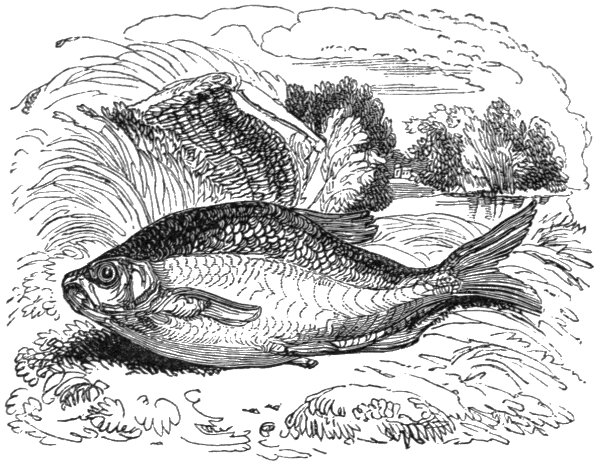
The bream is a well-known fish, and yields good diversion to the angler; it is found in slow running, deep rivers, but is chiefly met with in extensive ponds, where, although it grows tardily, it will attain the weight of three or four pounds (they have been known to weigh eight), and if the water and air suit him, will get very fat: they are great breeders, for it is observed the melter has two melts, and the spawner two large bags of spawn, from which is deposited upwards of 130,000 ova. Very few wish to stock their waters with them, as they increase so rapidly, as to consume all the sweet feed, and starve other fish, and are only fit to be put into ponds as food for pike, perch, &c.
The bream is broad, with a small head, smooth at the top, big eyes, a small leather mouth, no teeth, but a lozenge-like bone to help its grinding; the palate is soft and fleshy, resembling that of the carp; it is covered with curious net-work scales, on which it sometimes has abundance of minute whitish tubercles; has a hog back, of a colour between blue and black; the sides of the largest are yellowish, and the belly, inclining to red, is extremely deep, and thin in proportion to its length; the tail is very large, and something in the form of a crescent.
The flesh is soft and clammy, yet by some reckoned of easy digestion, and of better nourishment than that of a carp; the choice parts are the belly and head; what renders it unpleasant for the table is the multitude of bones, and the best way of preparing him is by pickling it like salmon. The French, however, esteem this fish highly, and proverbially say, “he that hath breams in his pond is able to bid his friend welcome.”
The baits used are the red paste; also paste made of brown bread and honey, gentles, waspings, flag-worms; and they are great lovers of red-worms, especially such as are found at the root of a great dock, and lie wrapt up in a round clue: the common red-worms should be used two small ones at a time. Green flies under water, the grasshopper with the legs cut off in June and July; but the best bait for the full-grown bream is a large red worm without a knot, which is to be found in garden walks or chalky commons after rain; put the worms with moss well washed and picked, and the water squeezed from it, into an earthen pot set dry; change the moss every four days for three weeks; they will then be clear, lively, and at the best.
The following directions have been generally given for taking the bream, and as being also equally certain of tempting that shy fish the carp. The bait to be a large red worm, the rods long; the lines silk, or silk and hair, and the floats, goose or swan quills; a piece of lead of the form of an upright brass weight, with a hole at the top, is to be fastened to the low end of the lines; then fasten the hook-link also to the lead, allowing ten inches or a foot between lead and hook, which should be No. 4: the lead must be sufficiently heavy to sink the float quite level with the surface, and not for the float to bear up the lead, which must lie on the ground; by which means the worm will crawl up and down so far as the lead will allow, which to the fish is a great enticement. The line for two yards at bottom should be of strong round gut, and the link next the hook as small as you dare use, for fear of pike or perch (who will assuredly visit the hooks), and till they are taken, neither carp or bream will come near to bite: this fineness will admit the worm to draw the hook to and fro with less difficulty.
For the ground-bait, get a peck, or peck and a half, according to the greatness of stream and depth of water, of sweet gross ground malt, or unground wheat, which is thought preferable; boil it very little, and strain it through a bag: when cold, at night, cast in two parts of it squeezed hard between the hands, so that it may rest in the precise spot where you mean to angle; and if this be repeated for two or three times, it will more certainly attract the fish. Recollect in a stream, to throw it at least a yard above the place where you mean your hook to be, or the stream will carry it too far down; some sew worms for the fish to feed on, upon a turf of short grass, nearly to cover the turf, which is then fastened to a round board, with a hole through that and the turf, where a cord runs, and is tied to a pole to let down to the bottom. Bream generally choose the broadest and deepest part of a river, and in hot weather are easily seen swimming in shoals; there, or thereabouts, with a clear bottom, take the exact depth, making some mark that shall explain if any rise or fall has taken place in consequence of watermills, &c.
The ground thus baited, the worms and tackling prepared, by three or four in the morning, with great caution approach the place, so as not to be seen by the fish; some of them are frequently at the top of the water, whilst the rest are feeding beneath. Having baited the hook that the worm can move at bottom, cast it, and by drawing it gently to you, let the lead rest about the middle of the ground bait; a second rod should be a yard or two above, and a third a yard or two below it; retire from the water so far as just to perceive the top of the floats; when there is a bite the top of the float will sink suddenly; remain quiet until the line goes clear away, then creep to the water-side, and give as much line as possible; if it be a good carp or bream it will go to the farther side of the river, strike gently, and hold the rod at the proper bend, that it may tire him; for if both pull together, either line, hook, or hold, will break, and the fish will be lost. The bream is strong, and runs hard when first struck; but after two or three turns, he will fall on his side, which enables you easily to land him: the carp is far stronger and more mettlesome than the bream; it is advisable to use a reel upon the rods for carp, barbel, or bream; the length of line kills the fish with ease, and increases the angler’s amusement.
This sport may be continued from four till eight in the morning, and from four until the same hour in the evening. The following morning, for the same hours, your diversion will be perhaps the best; if it is gloomy and windy, they will bite all day long, especially if the water is a little thick after rains; during the time of fishing, and at that of quitting the water, throw in more of the ground-bait. After two or three days, the place should be baited and left quiet; the fish will otherwise get too cunning to touch the hook-bait.
Another mode of catching the bream, is, after plumbing the depth, put one or more shot a foot below the float, to balance it, which is a way to take the shyest fish; the bait a large red-worm, which must be laid in, and let sink very gradually to the ground-bait. When the fish bites, strike gently that very instant.
A third is the running line, with a bullet and hole through it, and a small shot to hinder the bullet falling on the hook; let this run on the bottom with the current into holes, and equally as for the bream, it will be found to answer for all other fish that bite at the bottom.—Daniel.
Breast, s. The middle part of the human body, between the neck and the belly; the part of a beast that is under the neck, between the fore-legs.
Breath, s. The air drawn in and ejected out of the body; life; respiration.
Breathe, v. To draw in and throw out the air by the lungs; to live; to rest; to take breath.
Breech, v. To fit any thing with a breech, as to breech a gun.
Breed, v. To procreate, to generate; to bring up, to take care of. To bring young; to raise a breed.
Breed, s. A cast, a kind, a subdivision of species; progeny, offspring; a number produced at once, a hatch.
Breeder, s. One that produces any thing; a female that is prolific; one that takes care to raise a breed.
Breeding Dogs.—Never breed from an old dog and old bitch; if one party must be aged, it had better be the latter; but age on either side should be avoided if possible.
Winter whelps of all sorts of dogs are best, although the difficulty in rearing the produce and the loss of the use of the bitch for some weeks, are strong reasons against it, in the opinion of many; but the few that survive and are reared, amply recompense these obstacles. At three or four days old, part of the sterns should be twisted off, and the dew claws be cut off with a sharp pair of scissors. Puppies will soon learn to lap milk, which will relieve the mother; at six weeks old they may be separated, and should then be wormed.
The dog, to be complete in his form, should have round small feet, legs strong, straight, and muscular; the shoulders fall properly into the back, not upright; chest let down; loins good; back not too long; elbows play finely in their action, and come well in; thighs and gaskings broad and strong.
In our selection of parents for multiplying a breed a variety of circumstances should necessarily engage our attention; as, whether we are continuing a race already established, improving a defective one, or altogether forming a new variety. In either case, but particularly in the two latter, one or two propagations are not sufficient to enable us to judge of the merits or demerits of the products: anomalies may occur, monstrosities appear, or dogs may breed back. It should likewise be always present to us, that, in despite of all our care, and in face of the most favourable opportunities for selection, still perfect specimens to propagate from are unattainable; and as, therefore, we are necessarily to expect defects, it should be our care to well examine that we do not select our male and female parents with each the same faulty form or property; for, however perfect they may be in other respects, they are, in such a case, totally unfit to breed from together. We may, for instance, suppose an otherwise eligible pair of pointers, of the purest blood, but that each, from early and constant confinement, had contracted long, weak, spreading phalanges or toes, instead of a round, cat-like form of foot. By choosing a mate for each of these whose feet were unusually small, round, and firm, we might remedy this defect, and preserve their excellencies; but it would be only propagating deformity to breed from them together. We can only expect to prove successful in rearing a superior race of any domestic animal, when we make our selection of parents with a careful reference to the merits and defects in each, by balancing the one against the other, and by thus combining their different properties. It is by inattention to these circumstances that so many persons, after giving immense prices for animals of particular stocks, have found themselves foiled in their attempts at rearing any thing beyond mediocrity, which animals, under the judicious management of a Russell, a Coke, or an Ellman, among cattle, or an Orford, a Meynell, a Rivers, or a Topham, among dogs, would have produced unrivalled forms.
Breeding In-and-In.—Among the practical and systematic breeders of all domestic animals, and among none more than those sportsmen who devote themselves to the improvement of the dog, a great diversity of opinion has always existed on the subject of consanguineous breeding, or of that between near relations, characterised by the term In-and-In. The conflicting authorities on the subject are numerous, and the testimonies contradictory; and it is more than probable that they will remain so, until a long course of experiment is undertaken by a body or society of scientific and observant breeders on various domestic animals, for the express purpose of arriving at the truth in this particular.
Sir John Sebright says, “a breed cannot be improved, or even continued in the degree of perfection at which it has already arrived, but by breeding from individuals, so selected as to correct each other’s defects, and by a judicious combination of their different properties (a position that I believe will not be denied); it follows that animals must degenerate by being long bred from the same family, without the intermixture of any other blood, or from being what is technically called bred in-and-in.”
To Mr. Meynell’s opinion to the contrary, he replies—“Mr. Meynell’s fox-hounds are quoted as an instance of the success of this practice (i. e. the in-and-in); but, on speaking to that gentleman upon the subject, I found that he did not attach the meaning that I do to the term in-and-in. He said, that he frequently bred from the father and the daughter, and the mother and the son. This is not what I consider as breeding in-and-in; for the daughter is only half of the same blood as the father, and will probably partake, in a great degree, of the properties of the mother.” Again: “I have tried many experiments by breeding in-and-in upon dogs, fowls, and pigeons; the dogs became, from strong spaniels, weak and diminutive lap-dogs; the fowls became long in the legs, small in the body, and bad breeders.”
Sir W. C——n, in his Treatise on Greyhounds, is unfavourable to breeding a kin. He says, “If continued for some litters, a manifest inferiority of size, and a deficiency of bone, will soon be visible, as well as a want of courage and bottom; though the beauty of the form, with the exception of the size, may not be diminished.”—Blaine.—Sir John Sebright.
Brent Goose (Anas Bernicla, Linn.; Le Cravant, Buff.), s.
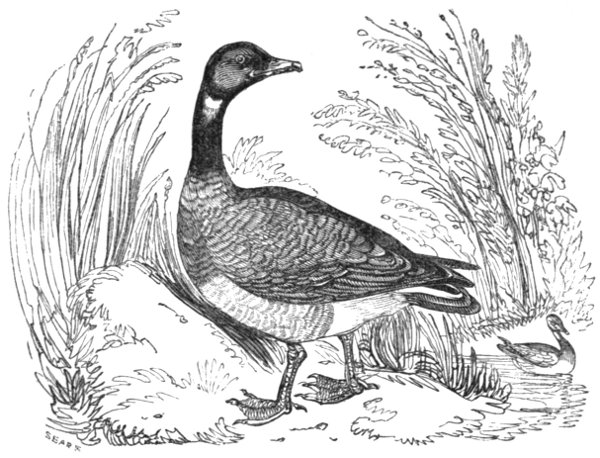
This is of nearly the same shape, but somewhat less than the Bean Goose, from which it differs in the colour of its plumage, being mostly of a uniform brown, the feathers edged with ash; the upper parts, breast and neck, are darker than the belly, which is more mixed and dappled with paler cinereous and gray: the head and upper half of the neck are black, excepting a white patch on each side of the latter, near the throat: the lower part of the back and rump are also black: the tail, quills, and legs dusky: the bill is dark, rather of a narrow shape, and only about an inch and a half long: the irides are light hazel. In the female and the younger birds, the plumage is not so distinctly marked, and the white spots on the sides of the neck are often mixed with dusky; but such varyings are discernible in many other birds, for it seldom happens that two are found exactly alike.
The brent geese, like other species of the same genus, quit the rigours of the north in winter, and spread themselves southward in greater or less numbers, impelled forward, according to the severity of the season, in search of milder climates. They are then met with on the British shores, and spend the winter months in the rivers, lakes, and marshes in the interior parts, feeding mostly upon the roots, and also on the blades of the long course grasses and plants which grow in the water; but, indeed, their varied modes of living, as well as their other habits and propensities, and their migrations, haltings, breeding-places, &c., do not differ materially from those of the other numerous families of the wild geese. Buffon gives a detail of the devastations which they made, in the hard winters of 1740 and 1765, upon the corn-fields on the coasts of Picardy in France, where they appeared in such immense swarms, that the people were literally raised (en masse we suppose) in order to attempt their extirpation, which, however, it seems they could not effect, and a change in the weather only caused these unwelcome visitants to depart.
The brent and the bernacle were formerly, by some ornithologists, looked upon as being of the same species; later observers, however, have decided differently, and they are now classed as distinct kinds.—Bewick.
Bret, s. A fish of the turbot kind.
Brew, v. To make liquors by mixing several ingredients; to prepare by mixing things together.
Bridle, s. The headstall and reins by which a horse is restrained and governed; a restraint, a curb, a check.
Bridle, v. To guide by a bridle; to restrain, to govern.
Bridle-hand, s. The hand which holds the bridle in riding.
Briery, a. Rough, full of briers.
Brig, s. A square-rigged vessel with two masts.
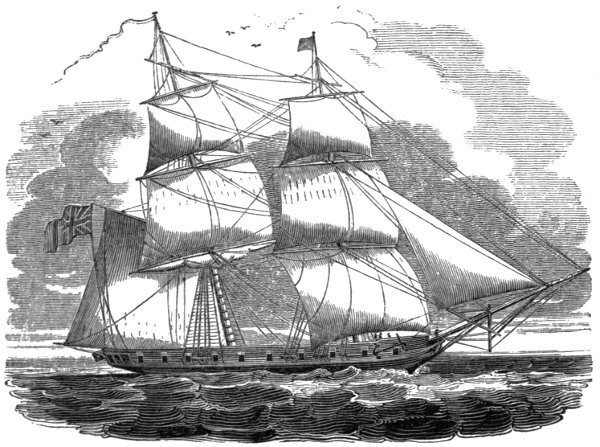
This class of vessels are generally employed as merchantmen and cruisers; and from their sea-worthy qualities and handy rig, are at once safe and easily worked. Latterly they have been introduced into the Royal Yacht Club; and the proud boast of having built one of the fastest and finest vessels in the world, has been recently achieved by the Earl of Belfast.
The Water Witch is 331 tons measurement, and has more than realised all that a builder could expect. She has, in every trial, proved her superiority; and in all weathers maintained a decided advantage over every antagonist. A letter from the noble owner, elicited by some trifling misstatement, concerning her model, &c., appeared in a late number of the Sporting Magazine, and as it is briefly descriptive of this beautiful brig, we have transferred it from the periodical.
“Her stern is upright, and, consequently, not so handsome as if it had more over-hung; but being built for a man-of-war, the intention (which has completely succeeded) was to enable her to run two guns out astern without a platform, which most vessels are obliged to have, and which is exceedingly inconvenient, inasmuch as it takes up a considerable portion of the quarter-deck.
“As regards the quantity of canvas, her sails are the same size as a ten-gun brig; nor has she any advantage in being without fittings below, having all the bulk-heads up (with the exception of the one that ought to divide the captain’s cabin from the gun-room), which was omitted, to make a larger and more airy cabin for my friends.
“Add to this, that she had her full weight of stores, &c., on board, as if provisioned for five months, with eight eighteen-pound carronades, and two long six-pounders, three boats, all spare spars, &c., on deck.
“I have only to add, that to this day she has beaten everything that has ever attempted to sail with her, both large and small; and although His Majesty’s ship Vernon (two thousand two hundred tons) had the advantage in light breezes of her one day, by crossing to windward of her, (after a trial of eight hours) about a cable’s length, she having started half a cable’s length to leeward of the Vernon, I understand she retaliated next day by beating the Vernon (under double-reefed topsails and top-gallant sails and considerable head-sea) two or three miles. I can also state, she never took advantage of any of her opponents in starting; and that I should not have the least objection to change her eighteen-pounders for four and twenty-pounders, and sail any square-rigged vessel (now built) in England for whatever sum they please.”
Brigandine, or Brigantine, s. A light vessel, such as has been formerly used by corsairs or pirates. They are still used in the Mediterranean.
Bright, a. Shining, glittering, full of light; clear.
Brilliant, a. Shining, sparkling.
Brimstone, s. Sulphur.
Brinded, a. Streaked, tabby.
Brindle, s. The state of being brinded.
Brindled, a. Brinded, streaked.
Brine, s. Water impregnated with salt, the sea.
Brisket, s. The breast of an animal.
Bristle, s. The stiff hair of swine. Hogs’ bristles for fly tying are dyed in the same manner as feathers and wool. They require, however, to be kept longer in the dye-pot.
Bristle, v. To stand erect as bristles.
Brit, s. The name of a fish.
Broach, v. To spit, to pierce as with a spit; to pierce a vessel in order to draw the liquor.
Brock, s. A badger.
Brocket, s. A red deer, two years old.
Brogue, s. A kind of shoe; a corrupt dialect.
Broil, v. To dress or cook by laying on the coals.
Broke. Preterimperfect tense of the verb To break. Applied to a dog when perfect in field discipline.
Broken Knees, Paste for.
Take pipe-clay and alum in equal parts; powder them, and reduce them in water to the consistency of cream; should the composition become dry, dilute it with water; stronger applications, as red precipitate and burnt alum, are occasionally necessary.
When the wound heals use any ointment coloured with lamp-black.
Bronchial, a. Belonging to the throat.
Bronchotomy, s. The operation which opens the windpipe by incision, to prevent suffocation.
Bronze, s. Brass; a medal.
Brood, v. To sit on eggs to hatch them; to cover chickens under the wing.
Brood, s. Offspring, progeny; a hatch, the number hatched at once; the act of covering the eggs.
Brood Mares.
No part of a racing establishment requires stricter attention than the brood mares. They should be kept, during the winter, in a paddock well supplied with water; also with a roomy hovel, with two wide entrances, to prevent accidents. There should also be rollers up each side of the door-way, as foals are apt to have their hips knocked down in striking them, or by getting squeezed against them by the mares in passing in or out. Not more than two mares should be kept in one paddock.
In winter, brood mares should be fed with the best hay; and, if in low condition, should have cold bran mashes twice a day. When in foal, the greatest care should be taken that their food be of the sweetest nature; the olfactory organs of a mare, during the period of her gestation, being extremely sensitive, and mouldy hay or straw has frequently caused premature birth. Indeed, extraordinary as it may appear, abortion has been caused by a groom merely striking a mare on the nose with his hand, which proves that, during the time they are in foal, they cannot be kept too quiet, or free from danger or excitement of any sort. The smell of carrion, or of animals fresh slaughtered, should be carefully avoided; for it is very provoking to lose a fine foal, after the heavy expense incurred, by these apparently trifling circumstances, so easily guarded against.
Attention should be paid to the state of the bowels of a newly dropped foal. If a passage be not observed, the gut should be carefully emptied by the hand. About a month previous to foaling, mares should be fed, at least twice a day, with cold bran mashes, as also plentifully supplied with any forward succulent food—such as lucerne, tares, clover, &c., but the two first are best. It is desirable to have the mares foal as early as possible, and when the mare is barren, she may be covered as early in February as she will take the horse, and if stinted she will foal early in January—thereby gaining a considerable advantage over those foaled later in the year. For instance, a colt dropped in January is fifteen months old, when in racing chronology he only reckons for twelve. It must, however, be observed, that it is impossible to have mares to foal every year in the month of January, unless the mare were to take the horse every year in February, as her time of gestation is eleven months and some days. Consequently, if she were to be covered in January, she would foal (out of the year) in December, as was the case with the December filly.
When mares are near their time of foaling, they should be carefully watched, for they will always approach water at this time; and as they generally (though not invariably) foal standing up, the produce may thus be lost. Some mares should be watched from another cause, as they will kill their foals as soon as they are dropped. When a mare has foaled, she should have a pail full of warm gruel, and should live generously until there is grass for her. The colt should also be fed with oats (bruised) twice or three times a day, which it will begin to eat at three days old.
The covering season commences on the first of February. Mares should be tried by the teazer every ninth day until the end of the season, which terminates in July.
Those mares which have foaled will be in season on the third day after; but it is not advisable to put them to the horse until the ninth, when they will probably be stinted. A mare, with a foal at her foot, is quite as likely to stand to the horse, if not more so, than one which has never bred, or proved barren the previous season; as it is called “missed the horse,” though she might have bred the year before.
Various have been the measures resorted to, to stint mares to the horse, which have proved barren for several years, or perhaps never bred at all—such as bleeding, immersing in cold water, and putting them in motion after the horse has retired; but no great faith is to be placed in any of them. It said that opium has been administered with effect; but in the cases of Victoria and Echo, every possible means tried, proved abortive.
Perhaps it would be better that stallions which cover at a high price, should only be suffered to serve a certain number of mares, as in that case it would not be necessary to pamper them to that degree generally practised, to enable them to exceed their natural powers. I have no hesitation in saying, that, in the long run, their produce would be greater, and I reason thus:—A mare which has missed three or four seasons together, is put to an ass, and generally stands to him. Now whatever may be the supposed increased physical powers of this animal, the effect, in this instance, is principally to be attributed to the cool state of his blood.
It is usually the practice to keep stallions very full of flesh, perpetually crammed with corn, by which their blood must be in a constant state of fever, and many of them have died in consequence of this treatment. Eggs are also frequently given them in the covering season. Some years since, a person in Shropshire, who purchased a horse out of the north, called “Young Roscius,” at a considerable price, not taking the precaution of cracking the egg before he gave it to him, it got across his gullet and killed him. If, instead of having recourse to a common farrier, who attempted to force it down with the butt-end of a whip, he had sent for a veterinary surgeon, it might have been dissected out with the greatest ease and safety, and his horse’s life preserved. Stallions, at the end of the season, should be physicked and turned out into a paddock, with very little corn; but the first day they are turned out, great precaution is necessary. They should be walked out on that day from five o’clock in the morning until evening; for if turned into the paddock fresh from their stable, they would gallop about for hours; and some have been known to do so until they have dropped down dead. Early in November, they should be brought into the stable again, physicked, moderately fed at first; well cleaned, and exercised every day for two or three hours; and this plan should be continued until the commencement of the next covering season. The air and exercise, say an hour or two a day, at this time, would invigorate their bodies, and conduce to their general health. Grooms may object to this system; but it has reason on its side, which they have not always on theirs.—Sporting Repository.
Brook, s. A running water; a rivulet.
Broom, s. A shrub; a besom, so called from the matter of which it is made.
Broth, s. Liquor in which flesh is boiled.
Brown, a. The name of a colour.
For a rich fiery Brown.—Put down some young fustic, about six chips, boil your stuff in three or four quarts of water; this takes a long time to give out the dye. If your fur be very white, and free from black hairs, you may draw two shades of fine bright yellows from it; you should put the more fur on that account. Then put down five or six more chips and boil it on till you bring it to a very deep orange; lift out your fur, and if you have half a pound of it you must put down an ounce of black grain, or half an ounce to a quarter of a pound; boil it and put in your stuff, and boil on till you have a blood orange.—Lift out your stuff, put in three teaspoonfuls of brasil wood in powder, stir it up and put down your stuff, boil till it comes to a light fiery brown. If you see what brasil you have added does not bring it to that shade, add more, and when you are near it take out your stuff, and have prepared in another vessel half a tablespoonful of archill, by boiling it in water, put half a noggin of this liquor into your pot and boil your stuff in it, and then try your shade, as I think you must be near it. Put in a little stale urine, and if not dark enough put in a little salt of tartar, throw in your stuff and I think you have it. If you want it darker, repeat the same quantity of salt of tartar. If you wish you may have two shades from this very process, or by drawing the fur may get many fine shades of claret by using double the quantity of black grain and more archill. Be nice with the archill, as if you darken too much with it, you can never discharge it.
Brown Varnish.—Rectified spirits of wine one quart, seed lac six ounces, dissolve the lac in the spirits two days and it is done, you must keep it the chief of the first day near the fire. This is the best of all varnishes, it must not be laid on any thing that is oiled.—Ancient Recipes.
Browse, v. To eat branches or shrubs.
Bruise, v. To crush or mangle with a heavy blow.
Bruise, s. A hurt with something blunt and heavy.
Brush, s. An instrument for rubbing. The tail of a fox. “To get the brush,” in sporting parlance, means to be foremost rider at the death.
Brush, v. To sweep or rub with a brush; to strike with quickness; to fly over; to skim lightly.
Brusher, s. He that uses a brush. A horse liable to speedy cut, &c.
Brushwood, v. Rough, shrubby thickets.
Bubo, s. The groin, from the bending of the thigh to the scrotum; all tumours in that part are called buboes.
Buck, s. The male of the fallow deer; the male of rabbits, and other animals.
Buck, v. To copulate as bucks and does.
Buckbean, s. A plant, a sort of trefoil, intensely bitter; its properties are tonic, diuretic, and purgative.
Buckle, s. A link of metal, with a tongue or catch, made to fasten one thing to another. Buckle, v. To fasten with a buckle.
Buckram, s. A sort of strong linen cloth, stiffened with gum.
Bud, s. The first shoot of a flower; a germ.
Bud, v. To put forth young shoots or germs.
Buff, s. Leather prepared from the skin of the buffalo, used for waist-belts, pouches, &c.; a colour.
To dye light shades of Buff, and other colours.—To assist in mixing, the drakes are said to be dyed by ivy and laurel alone; I do not vouch for their being fast and yet they may.
For Buffs.—Get some rich common fustic chips, put down three or four of them in three or four quarts of water with your stuff, and when it comes to a pale yellow, put in some pale madder, by a teaspoonful at a time, and you have, by boiling a sufficient length of time, a light buff. Boil on and put in more madder, and you will have a deeper; if your yellow is too faint put in more fustic, half an hour before your next addition of madder. By using young fustic chips and madder in the same way, you will get nice rich colours, something between a rich cinnamon and a light brick red.—Old Recipe.
Bull, s. The male of black cattle; a blunder.
Bullbaiting, s. The sport of baiting bulls with dogs.
Bull-dog (Canis Molossus), s. A dog of particular form, remarkable for his courage.
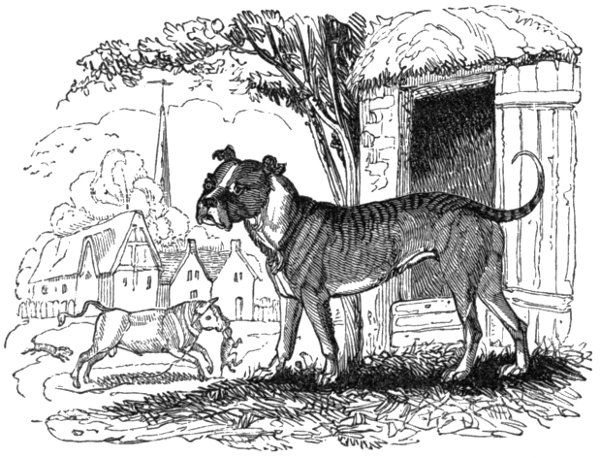
The bull-dog is low in stature, deep-chested, and strongly made about the shoulders and thighs, the muscles of both of which are extremely developed. His head is broad, his nose short, and the under jaw projects beyond the upper, which gives him a fierce and disagreeable aspect. His eyes are distant and prominent, and have a peculiar suspicious-like leer, which, with the distension of his nostrils, gives him also a contemptuous look; and from his teeth being always seen, he has the constant appearance of grinning, while he is perfectly placid. He is the most ferocious and unrelenting of the canine tribe, and may be considered courageous beyond every other creature in the world, for he will attack any animal, whatever be his magnitude.
The internal changes which determine the external characters of this dog, consist in a great development of the frontal sinuses, a development which elevates the bones of the forehead above the nose, and draws the cerebral cavity in the same direction.
But the most important quality, and that, perhaps, which causes all the others, although we cannot perceive the connexion, is the diminution of the brain. The cerebral capacity of the bull-dog is sensibly smaller than in any other race; and it is doubtless to the decrease of the encephalon that we must attribute its inferiority to all others in every thing relating to intelligence. The bull-dog is scarcely capable of any education, and is fitted for nothing but combat and ferocity.
This animal takes his name from his having been employed, in former times, in assaulting the bull, and he is used for the same purpose at the present day, in those districts where this brutal amusement is still practised.
Nothing can exceed the fury with which the bull-dog falls upon all other animals, and the invincible obstinacy with which he maintains his hold. In attacking the bull, he always assails him in front, and generally fastens upon his lip, tongue, or eye, where he holds and hangs on, in spite of the most desperate efforts of the other to free himself from his antagonist, which affords ample proof of the amazing strength and power of this animal.
Whenever a bull-dog attacks any of the extremities of the body, it is invariably considered a mark of his degeneracy from the original purity of blood. Puppies will assail a bull, and thereby give a decided proof of their breed, when only six months old; and, if permitted, will rather suffer themselves to be destroyed than relinquish the contest.
Although this trial is sometimes made with the whelps of a particular litter, to demonstrate the purity of their descent, and to prove that there has been no improper cross by which the future fame of their posterity may be affected, yet they are seldom entered in a regular ring until from fifteen to eighteen months old. But their ligaments cannot be considered as at their full strength until they are at least two years old. Indeed, amateurs say, that they are not at their prime until they have attained four or five years of age.
The bull-dog is admitted by naturalists to be one of the original and peculiar races of Britain, and may be ranked, in point of originality, with the shepherd’s dog and Irish greyhound. In various districts of England this breed is still preserved in its native purity, by that class of people who delight in bullbaiting and fighting of dogs; both of which amusements, alike inhuman, are now happily on the decline.—Brown.
Bull-head, s. The name of a fish.
The bull-head seldom exceeds the length of three inches and a half; the head is large, broad, flat, and thin at its circumference, being well adapted for insinuating itself under stones; on the middle part of the covers of the gills is a small crooked spine turning inwards; the eyes are very small, the irides yellow; the body grows slender towards the tail, and is very smooth; the colour is as disagreeable as its form, being dusky, mixed with a dirty yellow; the belly whitish. They are found all the summer in holes, among mud and gravel, and among weeds and flat stones in clear water, where they may be seen sunning themselves in a hot day; put the hook, with a small red worm, before them, and they will instantly take it. Notwithstanding the disgust which the form of the bull-head creates, the largest, when the heads are cut off, are very delicious eating; they are also good baits for other fish. Some anglers think them, when their gill-fins are cut away, preferable to the minnow.—Daniel.
Bull Terrier (Canis Pugilis), s.
This variety, which has now assumed a fixed character, as its name implies, was produced by a cross between the bull-dog and terrier, and this variety proves to be a handsomer dog than either of its progenitors. It is a sprightly and showy animal, and even better adapted for mischievous sport than either of the above dogs. He is airy and pleasant tempered, but possesses great fierceness when his energies are called into action.
The full-sized bull terrier is larger than either of his original parents, from which we are inclined to think he has a dash of the mastiff in him. He has rather a large square head, short neck, deep chest, and very strong legs. He possesses great strength of jaw, and draws a badger with much ease. He is all colours, and often white, with large black or brown patches on different parts of his body. His hair is short and stiff.
This variety has risen into great reputation with gentlemen of the fancy, and consequently good ones sell for a high price. Bull terriers are to be had of every colour in the metropolis—and of late years, dealing in these and other dogs has become a regular trade.—Brown, &c.
Bull Trout, Bulger, or Scarf, s.
This species migrates, like the salmon, into several of our rivers; they begin to run up the rivers in May, and are most plentiful in September and October, although the flesh is not then so good (on account of their spawning) as in July and August; when boiled, it is of a pale red, and well flavoured, but drier than that of the salmon. Mr. Pennant has described one taken in June, 1769, in the Tweed below Berwick.
The shape was thicker than the common trout; the irides silver, and the head thick, smooth, and dusky, with a gloss of blue and green; the back of the same colour, growing fainter towards the lateral line, which is straight; and the sides, as far as this line, are marked with large irregular-shaped spots of black; the sides beneath the line and the belly are white; the tail is broad and even at the end; the weight was three pounds two ounces.
The bull have the same haunts as the salmon trout, and are sometimes met with in gentle shallow streams, running between and over rocks and stones, and are also found about weirs, made across rivers. The baits and tackle should be the same as for the salmon trout.—Daniel.
Bump, s. A swelling, a protuberance.
Bumper, s. A cup filled.
Bunting, (Emberiza miliaria, Linn.; Le Proyer, Buff.) s. The name of a bird.
The principal difference between this kind and that of the passerine order, consists in the formation of the bill, which in the bunting is of a very singular construction.
The two mandibles are movable, and the edges of each bend inwards; the opening of the mouth is not in a straight line as in other birds, but at the base, the junction is formed by an obtuse angle in the lower mandible, nearly one-third of its length, which is received by a corresponding angle in the upper one; in the latter there is a strong knob, of great use in breaking the harder kinds of seeds and kernels, on which it feeds. The tongue is narrow, and tapers to a point like a toothpick; the first joint of the outer toe is joined to that of the middle one.—Bewick.
Buoy, s. A piece of cork or wood tied to a weight. Dog or sheep skins prepared with a coating of tar and tallow, are used for suspending spellits and herring nets—on the western and southern coasts of Ireland they are called puckawns.
Buoy, v. To keep afloat.
Buoyancy, s. The quality of floating.
Bur, s. A rough head of a plant.
Burbot, s. A fish full of prickles.
Burn, v. To consume with fire; to wound with fire.
Burnish, v. To polish.
Burnisher, s. The person that burnishes or polishes; the tool used—it is commonly a dog’s tooth set in a stick.
Burrow, s. Holes made in the ground by rabbits.
Burrow, v. To mine as conies or rabbits.
Burst, v. To break suddenly.
Burst, s. A cry of hounds.
Burt, s. A flat fish of the turbot kind.
Bush, s. A thick shrub.
Bushel, s. A measure containing eight gallons; a strike.
Bushy, a. Thick; full of small branches; full of bushes.
Buss, s. A vessel for fishing—a herring boat.
Bustard, (Otis Tarda, Linn.; L’Outarde, Buff.)
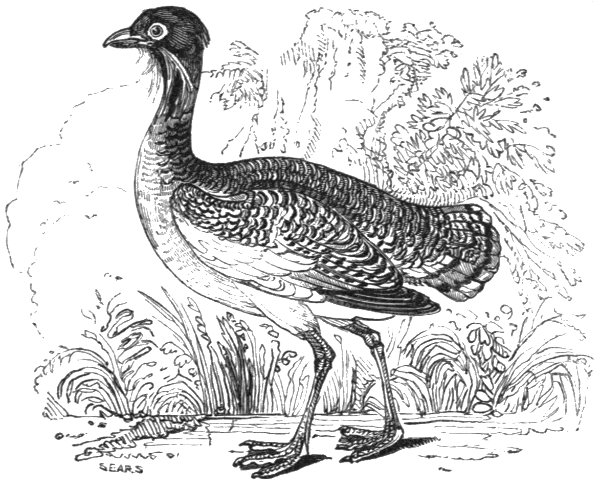
Great Bustard.—This very singular bird, which is the largest of our land birds, is about four feet long, and weighs from twenty-five to thirty pounds; its characters are peculiar, and with such as connect it with birds of the gallinaceous kind, it has others which seem to belong to the ostrich and the cassowary. Its bill is strong, and rather convex: its eyes red; on each side of the lower bill there is a tuft of feathers about nine inches long; its head and neck are ash-coloured. In the one described by Edwards there are on each side of the neck two naked spots, of a violet colour, but which appeared to be covered with feathers when the neck was much extended. The back is barred transversely with black and bright rust-colour on a pale reddish ground; the quills are black, the belly white; the tail consists of twenty feathers; the middle ones are rust-colour, barred with black; those on each side are white, with a bar or two of black near the ends; the legs are long, naked above the knees, and dusky; it has no hind toe, its nails are short, strong, and convex both above and below; the bottom of the foot is furnished with a callous prominence, which serves instead a heel. The female is not much more than half the size of the male: the top of her head is of a deep orange, the rest of the head brown; her colours are not so bright as those of the male, and she has no tuft on each side of the head. There is likewise another very essential difference between the male and the female: the former is furnished with a sack or pouch, situated in the forepart of the neck, and capable of containing about two quarts; the entrance to it is immediately under the tongue. This singular reservoir was first discovered by Dr. Douglas, who supposes that the bird fills it with water as a supply in the midst of those dreary plains where it is accustomed to wander. It likewise makes a farther use of it in defending itself against the attacks of birds of prey. On such occasions, it throws out the water with such violence, as not unfrequently to baffle the pursuit of its enemy.
Bustards were formerly more common in this island than at present; they are now found only in the open counties of the south and east, in the plains of Wiltshire, Dorsetshire, and in some parts of Yorkshire; they were formerly met with in Scotland, but are now supposed to be extinct there. They are slow in taking wing, but run with great rapidity, and when young are sometimes taken with grey-hounds, which pursue them with great avidity: their chase is said to afford excellent diversion. The great bustard is granivorous, but feeds chiefly on herbs of various kinds, it is also fond of those worms which are seen to come out of the ground in great numbers before sun-rise in the summer; in winter, it frequently feeds on the bark of trees; like the ostrich, it swallows small stones, bits of metal, and the like. The female builds no nest, but making a hole in the ground drops two eggs, about the size of those of a goose, of a pale olive brown, with dark spots. She sometimes leaves her eggs in quest of food; and if during her absence, any one should handle, or even breathe upon them, she immediately abandons them.
Bustards are found in various parts of Europe, Asia, and Africa; but have not hitherto been discovered on the new continent.
The Little Bustard, (Otis Tetrax, Linn. La Petite Outarde, Buff.) is in length only seventeen inches. The bill is pale brown; irides red; the top of the head is black, spotted with pale rust colour; the sides of the head, the chin, and throat, are of a reddish white, marked with a few dark spots; the whole neck is black, encircled with an irregular band of white near the top and bottom; the back and wings are rust colour, mottled with brown, and crossed with fine irregular black lines, the under parts of the body, and outer edges of the wings, are white: the tail consists of eighteen feathers; the middle ones are tawny, barred with black, the others are white marked with a few irregular bands of black, the legs are grey. The female is smaller, and has not the black collar on the neck; in other respects she nearly resembles the male.
This bird is very uncommon in this country: and we have seen only two of them, both females. The figure was drawn from one sent by W. Trevelyan, Esq. which was taken on the edge of Newmarket heath, and kept alive about three weeks in a kitchen, where it was fed with bread and other things, such as poultry eat. It is very common in France, where it is also a very shy and cunning bird; if disturbed it flies two or three hundred paces, not far from the ground, and then runs away much faster than any one can follow on foot. The female lays her eggs in June, to the number of three or four, of a glossy green colour: as soon as the young are hatched, she leads them about as the hen does her chickens: they begin to fly about the middle of August.
Both this and the great bustard are excellent eating, and, we should imagine, would well repay the trouble of domestication: indeed, it seems surprising that we should suffer these fine birds to run wild, and be in danger of total extinction, which, if properly cultivated, might afford as excellent a repast as our own domestic poultry, or even as the turkey, (vide Turkey) for which we are indebted to distant countries.—Bewick.
Butt, s. The place on which the mark to be shot at is placed; a vessel; a barrel containing one hundred and twenty-six gallons of wine; the thick or lower joint of a fishing rod; the handle of a cue.
The marks usually shot at by archers, for pastime, were “butts, prickes, and roavers.” The butt, we are told, was a level mark, and required a strong arrow, with a very broad feather; the pricke was a “mark of compass,” but certain in its distance; and to this mark strong swift arrows, of one flight, with a middling sized feather, were best suited; the roaver was a mark of uncertain lengths. It was, therefore, proper for the archer to have various kinds of arrows, of different weights, to be used according to the different changements made in the distance of the ground.
The Cornish men are spoken of as good archers, who shoot their arrows to a great length; they are also, says Carew, “well skilled in near shooting, and in well aimed shooting: the butts made them perfect in the one, and the roaving in the other, for the prickes, the first corrupters of archery, through too much preciseness, were formerly scarcely known, and little practised.” Other marks are occasionally mentioned; as the standard, the target, hazel wands, rose garlands, and the popinjay, which, we are told, was an artificial parrot.—Strutt.
Butt, v. To strike with the head.
Butter, s. An unctuous substance, made by agitating the cream of milk till the oil separates from the whey.
Butterfly, s. A beautiful insect.
Buttock, s. The rump, the part near the tail.
Button, s. Any knob or ball; the bud of a plant.
Buzzard, s. A degenerate or mean species of hawk.
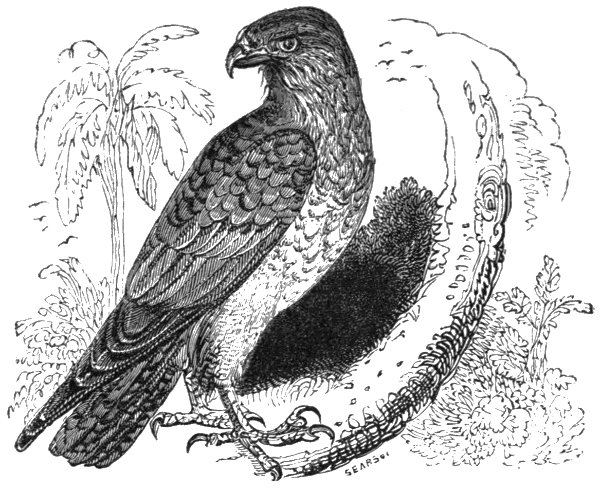
The Common Buzzard, or Puttock.—(Falco Buteo, Linn.; La Buse, Buff.) M. Buffon distinguishes the kites and the buzzards from the eagles and hawks, by their habits and dispositions, which he compares to those of the vultures, and places them after those birds. Though possessed of strength, agility, and weapons to defend themselves, they are cowardly, inactive, and slothful, they will fly before a sparrow-hawk, and when overtaken, will suffer themselves to be beaten, and even brought to the ground, without resistance. The buzzard is about twenty inches in length, and in breadth four feet and a half. Its bill is of a lead colour, eyes pale yellow: the upper parts of the body are of a dusky brown colour; the wings and tail are marked with bars of a darker hue; the under parts pale, variegated with a light reddish brown; the legs are yellow; claws black. But birds of this species are subject to greater variations than most other birds, as scarcely two are alike: some are entirely white, of others the head only is white, and others again are mottled with brown and white.
This well-known bird is of a sedentary and indolent disposition; it continues for many hours perched upon a tree or eminence, whence it darts upon the game that comes within its reach: it feeds on birds, small quadrupeds, reptiles and insects. Its nest is constructed with small branches, lined in the inside with wool and other soft materials; it lays two or three eggs, of a whitish colour, spotted with yellow. It feeds and tends its young with great assiduity. Ray affirms, that if the female be killed during the time of incubation, the male buzzard takes charge of them, and patiently rears the young till they are able to provide for themselves.
The Honey Buzzard (Falco Apivorus, Linn.; La Bondrée, Buff.), is as large as the buzzard, measuring twenty-two inches in length; the wings extend above four feet. Its bill is black, and rather longer than that of the buzzard; the eyes are yellow; the head large and flat, and of an ash-colour; the upper parts of the body dark brown; the under parts white, spotted or barred with rusty brown on the breast and belly; tail brown, marked with three broad dusky bars, between each of which are two or three of the same colour, but narrower; the legs are stout and short, of a dull yellow colour; claws black.
This bird builds a nest similar to that of the buzzard, and of the same kind of materials: its eggs are of an ash-colour, with small brown spots. It sometimes takes possession of the nests of other birds, and feeds its young with wasps and other insects. It is fond of field-mice, frogs, lizards and insects. It does not soar like the kite, but flies low, from tree to tree, or from bush to bush. It is found in all the northern parts of Europe, and in the open parts of Russia and Siberia, but is not so common in England as the buzzard.
Buffon observes that it is frequently caught in the winter, when it is fat and delicious eating.
The Moor Buzzard, Duck Hawk or White-headed Harpy (Falco Æruginosus, Linn.; Le Busard, Buff.) is in length above twenty-one inches. The bill is black; cere and eyes yellow; the whole crown of the head is of a yellowish white, lightly tinged with brown; the throat is of a light rust colour: the rest of the plumage is of a reddish brown, with pale edges; the greater wing coverts tipped with white. The legs are yellow; claws black.
Birds of this kind vary much; in some, the crown and back part of the head are yellow; and in one described by Mr. Latham, the whole bird was uniformly of a chocolate brown, with a tinge of rust colour.
The moor buzzard preys on rabbits, young wild ducks, and other water-fowl; and likewise feeds on fish, frogs, reptiles, and even insects. Its haunts are in hedges and bushes near pools, marshes, and rivers that abound with fish. It builds its nest a little above the surface of the ground, or in hillocks covered with thick herbage: the female lays three or four eggs of a whitish colour, irregularly sprinkled with dusky spots. Though smaller, it is more active and bolder than the common buzzard, and, when pursued, it faces its antagonist, and makes a vigorous defence.—Bewick.—Latham.
By-Law, s. By-laws are orders made for the good of those that make them, farther than the public law binds.
By-Way, s. A private obscure way.
By-Word, s. A saying, a proverb; a term of reproach.
Cab, s. A contraction of cabriolet; a two-wheeled carriage.
Cackle, v. To make a noise, as a goose or hen.
Cackler, s. A fowl that cackles.
Caddis or Cad-bait, s. A kind of worm or grub.
The several kinds of cadews in their nympha, or maggot state, thus house themselves; one sort in straw, called from thence straw-worms; others in two or more parallel sticks, creeping at the bottom of brooks; a third, in a small bundle of pieces of rushes, duckweed, &c. glued together, therewith they float on the surface, and can row themselves about the water with the help of their feet; both these are called cad-bait. It is a curious faculty that these creatures possess, of gathering such bodies as are fittest for their purpose, and then so gluing them together, some to be heavier than water, that the animal may remain at bottom where its food is, and others to be so buoyant as to float, and there collect its sustenance; these houses are coarse, and show no outward art, but are within well tunnelled and have a tough hard paste, into which the hinder part of the maggot is so fixed, that its cell can be drawn after it without danger of leaving it behind, and it can also thrust out its body to reach the needful supplies, or withdraw into its covering for protection and safety.
These insects inhabit pits, ponds, low running rivers, or ditches, in cases of different forms, and composed of various materials; some of them inclosed in a very rough shell, found among weeds in standing waters, are generally tinged green; others are bigger than a gentle, and of a yellowish hue, with a black head; they are an excellent bait, and are found in most plenty in gravelly and stony rivulets, and by the sides of streams, in large rivers among stones.
To collect them, turn up the stones, and the best will adhere to them; when the quantity wanted is obtained, put them into a linen bag for five or six days, dip them, together with the bag, into water once a day, and hang them up; they will then turn yellow, become tough, and fitter for angling than when first got from the brook. If meant to be kept long, they must be put into a thick woollen bag, with some of the moist gravel or sand from the same rivulet whence they are taken; they must be wetted twice a day, but oftener in very hot weather; when you carry them abroad, fill the bag with water and holding the mouth of it close, let the water run from them; thus they have been kept three weeks. Another way of preserving them is, by placing them in an earthen pot full of river water, with some of the gravel they were bred in at the bottom; but the preceding method is preferable: some use bait pans of different sizes for insects, the tops punched full of holes, not so large as to admit of their escaping when placed in the river, which not only keeps them cool, but supplies them with aliment in the fresh water; some keep them in moss in a woollen bag on a damp floor, taking care that the bag retains a proper moisture. Another mode of preserving caddis, and also grasshoppers, caterpillars, oak-worms, or natural flies, is to take the green withy bark from a bough six or seven inches round, and about a foot in length, turn both ends into the form of a hoop, and fasten them with a large needle and thread; stop up the bottom with cork, and bore the bark full of holes with a red hot wire, tie over it a colewort leaf, and lay it in the grass every night: in this manner caddis may be preserved until they turn to flies. When grasshoppers are to be preserved in the case, some grass must be put into it.
In angling with caddis, the line, when all out, should be as long as the rod, for three lengths next the hook, of single hairs, with the smallest float, and the least weight of lead, that the swiftness of the stream will allow to sink, and that may be aided by avoiding the violence of the current, and angling in the returns of a stream, or in the eddies betwixt two; which are also the most likely places wherein to kill fish, either at the top or bottom. The caddis may be at times, with very good effect, joined to a worm, and sometimes to an artificial fly, to cover the point of the hook, and also two or three together may be put upon the hook; but it is always to be angled with at the bottom, especially when by itself, with the finest tackle, and at all seasons is a most holding bait for trout and grayling.—Daniel.
Cag, s. A barrel or wooden vessel, made to contain four or five gallons.
Cage, s. An enclosure of twigs or wire, in which birds are kept; a place for wild beasts; a prison for petty malefactors.
In Falconry, the cage is an oblong frame, four feet six inches long and two feet wide, made of light wood, the sides and ends are of a proper size for hawks to perch upon, and a little wadded, that it may not injure their feet. It is supported, when placed on the ground, by four legs, about a foot long. Slight rods of hazel are fixed across each end, to prevent the hawks from falling on the inside when they bait. A space of about twenty inches in length is left in the middle of the cage, in which the falconer places himself, carrying it by two straps that pass over his shoulders. The hawks are tied upon the cage as upon a perch, and by this contrivance many may be carried by one man.
Cages and other instruments used in falconry, are well described in the plates of the French Encyclopædia, printed in 1751.—Sebright.
Cage, v. To enclose in a cage.
Cajeput Oil, s. Is highly stimulating; it is given internally as an antispasmodic, and applied as an external remedy for strains and rheumatism: it may be diluted with olive oil.
Calamine, (Lapis calaminaris,) s. A kind of fossil bituminous earth, which, being mixed with copper, changes it into brass.
Calcination, s. Such a management of bodies by fire as renders them reducible to powder: chemical pulverization.
Calcine, v. To burn in the fire to a calx or substance easily reduced to powder.
Calculus, s. The stone in the bladder.
Calf, s. The young of a cow or deer; the thick, plump, bulbous part of the leg.
Calibre, s. The bore, or diameter of the barrel of a gun.
Calidris, (Illiger,) s. Sanderling, a genus thus characterised:—
Bill of middle length, slender, straight, soft, flexible throughout; compressed from the base; at the point depressed, flattened, and broader than in the middle, the nasal groove being prolonged towards the point; nostrils at the sides slit lengthwise; legs slender, three toes directed forwards, and almost entirely divided; wings of middle size, the first quill the longest.—Montagu.
Caliver, s. obs. A hand-gun, or harquebuse; an old musket.
Call, v. To name; to make a noise like quails and partridges.
Call, s. An instrument to call birds.
The Call of Birds is, in most instances, effected by the lungs and larynx; but some species of woodpecker, in the breeding season, have a very extraordinary and peculiar call to each other, by strong reiterated strokes of their bill against the dead sonorous branch of a tree. These calls seem to be a species of song.—Montagu.
Callosity, s. A kind of swelling without pain.
Callous, a. Hardened, insensible.
Callow, a. Unfledged, naked, wanting feathers.
Calomel, s. Mercury six times sublimed.
Calomel, or submuriate of mercury, is the most useful of the mercurial preparations, and composed of oxide of quicksilver and muriatic acid. When prepared it is a fine white powder, rather inclining to yellow, and very ponderous. It is the most efficacious anthelminthic we are acquainted with (see Anthelminthic), and an excellent alterative. When a brisk purgative is wanted, calomel may be added to the common physic, which is composed chiefly of aloes.
Though calomel possesses these useful qualities, it must be given with caution, and its effects carefully watched; as it sometimes acts very violently and unexpectedly on the stomach and bowels, and induces a dangerous degree of weakness. Salivation is sometimes the effect of calomel, when given daily as an alterative, or as a remedy for farcy or mange; the mouth becoming so sore, and the tongue so swollen, as to prevent the horse’s feeding. When these accidents occur, the medicine should be discontinued a short time, and the horse allowed to drink plentifully of water-gruel, linseed infusion, or any other mucilaginous drink. When the bowels are affected by it, opium is the best remedy, should arrow-root gruel or wheat-flour gruel prove ineffectual. In some cases, where it has produced great irritation about the anus or bladder, opium should be given in the form of clyster. (See Clysters.) If the mouth becomes very sore, let it be washed with a solution of alum, by means of a syringe.
Whenever calomel is given, the horse must be kept warm, drink warm water, and have regular exercise. When calomel is given as an anthelminthic, or as a purgative, the dose is from one to two drachms; as an alterative, from fifteen grains to half a drachm. Calomel generally acts upon the kidneys, increasing the discharge of urine. (See Alteratives and Anthelminthics.)—White.
Calve, v. To bring forth a calf, spoken of a cow. To drop a fawn.
Calumba, s. A plant. The root is a good tonic and stomachic.
Calx, s. Any thing rendered reducible to powder by burning.
Camber, s. A piece of timber cut archwise. The bending of a gun-stock.
Camlet, or Camblet, s. A kind of stuff, originally made by a mixture of silk and camel’s hair; it is now made with wool and silk. It is much used for shooting jackets, as it resists water well, and is light and strong.
Camphor, s. A kind of resin produced by a chemical process from the camphor tree. The tree from which camphor is extracted.
The following description of the properties of camphor was given me by an old M. D. Camphor is at once an emollient, an antispasmodic, an anodyne, a febrifuge, and a sedative.—Condition of Hunters.
Canary, s. Wine brought from the Canaries; sack.
Canary Bird, (Fringilla canaria, Linn.) s. A much admired singing bird.
In length this beautiful species is about five inches and a half; the bill pale flesh-colour, passing into reddish white; eyes chestnut brown; the whole plumage of a rich, deep primrose colour, inclining to yellow; edge of the quills sometimes yellowish white; legs and feet the same colour as the bill. The female is distinguished from the male by the plumage being of a paler colour; the yellow round the bill, eye, and on the breast and edge of the wing, being also of a paler yellow; she is likewise rather larger and less slender in form towards the tail.
There are said to be upwards of thirty varieties of the breeds of canaries, which can be easily distinguished; and the number is increasing every year. In London, we have societies for promoting the breeds, and a premium is awarded to the competitor who comes nearest to the model of perfection given out by the society the season prior to the competition.
There are two distinct species of canaries, the plain and the variegated, or, as they are technically called, the gay spangles, or mealy; and jonks, or jonquils. These two varieties are more esteemed by amateurs than any of the numerous varieties which have sprung from them; and although birds of different feathers have their admirers, some preferring beauty of plumage, others excellence of song, certainly that bird is most desirable where both are combined. The first property of these birds consists in the cap, which ought to be of fine orange colour, pervading every part of the body except the tail and wings, and possessing the utmost regularity without any black feathers, as, by the smallest speck, it loses the property of a show-bird, and is considered a broken-capped bird. The second property consists in the feathers of the wing and tail being of a deep black up to the quill, as a single white feather in the wing or tail causes it to be termed a foul bird; the requisite number of these feathers in each wing is eighteen, and in the tail twelve. It is, however, frequently observed that the best coloured birds are foul in one or two feathers, which reduces their value, although they may still be matched to breed with.