INTRODUCTION. (continued 6)
Reading edition
Chronic, a. Relating to time. A chronic distemper is of long duration. Vide Lameness.
Chub, s. A river fish. The cheven.
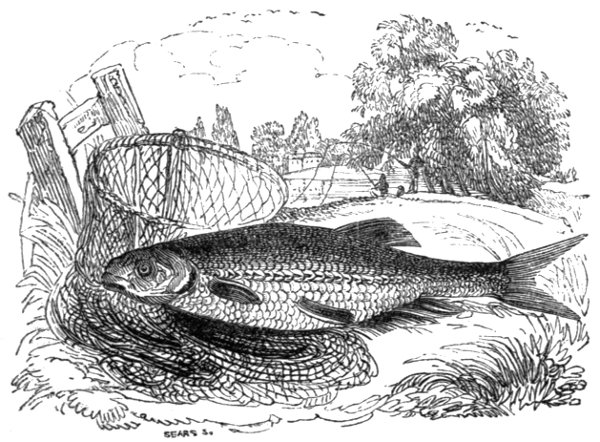
This fish takes its name from the head, not only in our own but other languages; we call it chub, according to Skinner, and from the old English cop, a head; the French, testard; the Italians, capitome: in different parts of England this fish is called cheven, nob, or botling; he much resembles the carp, but is of a longer form; the body is oblong, rather round, and of a pretty equal thickness in the greater part of the slope; the scales are large; the irides silvery; the cheeks of the same colour; the head and back of a deep dusky green; the sides silvery, but in the summer, yellow; the belly white; the pectoral fins of a pale yellow; the ventral and anal fins, red; the tail forked, of a brownish hue, but tinged with blue at the end; it is altogether a handsome fish, will sometimes weigh upwards of five pounds; but Salvianus speaks of them as increasing to eight or nine. The flesh of the chub is not in much esteem, being coarse, and when out of season, full of small hairy bones; the head and throat are the best parts, taking care to have the latter well washed and cleansed from the grass and weeds usually in it. The roe is exceedingly good, and this fish stewed as carp, will, it is said, deceive a connoisseur.
The haunts of the chub are in rivers whose bottoms are of sand or clay, or which are bounded by clayey banks; particularly in deep holes, shaded by trees, weeds, &c. They frequently float on the surface, and are sometimes in streams and deep waters where the currents are strong; in ponds fed by a rivulet they grow to a large size. They spawn in April, and are most in perfection in December and January, having then very few of the hairy bones aforementioned.
The chub does not afford the angler so much diversion as the trout, from being so dull a fish on the hook, and when once struck becoming soon tired; but he bites so eagerly, that, when he takes the bait, his jaws are heard to chop like those of the dog, and having a very wide leather mouth, and his teeth in his throat, there is little danger of his breaking hold; to fish for him, the angler should have a stout long rod, a strong line (if he uses a reel he will be enabled the better to fish under bushes) with a yard or more of the best silk-worm-gut at bottom, a hook proportioned to the bait used, a swan-quill float, and the line so shotted, eight or ten inches from the hook, as to sink the float to a quarter of an inch above the surface; the same ground-bait to be used as for the carp, and the hook baited with a sufficient quantity of salmon’s roe (boiled a little) to fill up the bend properly; this rightly done is a tempting bait. The large ones are to be caught by dibbing, very early in the morning, with the brown beetle or cockchafer: by day-break the angler should be at the river, and after baiting his hook, let him move it two or three times near the surface, as in the act of flying; then let it softly drop on the water, shaking the rod gently, which will cause the appearance of its struggling to escape: this attracts the chub, who are so fond of this bait that they will rise two or three at a time to seize it; the landing-net in this fishing should never be forgotten, as the places most likely for success in taking chub, are those where the angler cannot get to the water-side to land them with his hands.
Another way of dibbing is in a hot summer day with a grasshopper. In any hole where they haunt, many of them will be seen basking themselves near the surface; the rod must be both long and of considerable strength; the line strong, and in length about a yard. Bait the hook with a grasshopper, and the angler must conceal himself behind some bush or tree, and remain as motionless as possible, for the chub is so fearful, that the smallest shadow of a bird flying over, or of the rod, makes him sink to the bottom, but he will soon rise again. Having selected the largest chub, let him move the rod with great slowness and caution, and drop the bait gently upon the water, three or four inches before it, and he will infallibly take it: there is no danger of securing the chub, if allowed play enough before it is attempted to be taken out, being one of the leather-mouthed fishes, wherein a hook seldom loses its hold.
The chub will take gentles, wasps, maggots (which must be baked in an oven before used). Paste of fine new white bread (without being made wet), worked up in the hand, and tinged with vermilion as near as possible to the colour of salmon’s roe; from the hook this paste will not easily wash off, and is a most killing bait; but the best baits for bottom or float-fishing for this fish, are old Cheshire cheese, (such as, without crumbling, will mould in the hand), and the pith from the back bone of an ox, with the outward so carefully taken off as not to bruise the inward skin.
At every season of the year, the former of these is good; but the latter end of summer, and all the winter, are the preferable times for both. In baiting with the cheese, put a round lump, the size of a cherry, on a large hook, so as to cover the bend, and some way up the shank; fish six inches from the bottom, or in cold raw weather the bait may lie on the ground; but if the hole has not been ground-baited, the depth is immaterial; when there is a bite, the float will very swiftly be drawn under water, strike immediately and give him play, holding a tolerable tight line, to keep the fish clear of weeds and stumps, which at sight of the angler he will endeavour to get at for shelter, and if not properly managed, he will break the tackle. In the spring of the year the chub will take a marsh, or small red-worm; in May, June, and July, flies, beetles, snails (the black ones with the belly slit to shew the white;) in August, pastes: the large chub will also take minnows, small dace, and gudgeons, angled with in the same manner as for perch; and the latter bait used likewise in trolling for pike, the hook not so heavily loaded upon the shank. They gorge immediately upon taking the bait. Their biting times are chiefly from before sunrise until nine in the morning, and from four until after sunset in the summer, (some will, by chance, take at any time of the day when mild and cloudy); and in the winter the middle of the day is best; remembering that in hot weather, they are to be fished for at or near the top, and not deeper than mid-water, and in cold, close to or upon the bottom; and that the main point in taking this fish is, the angler’s keeping himself out of sight.—Daniel.
Chubbed, a. Big-headed, like a chub.
Chuck, v. To make a noise like a hen.
Chyle, s. The white juice formed in the stomach by digestion of the aliment.
Cicatrice, or Cicatrix, s. The scar remaining after a wound; a mark, an impressure.
Cicatrize, v. To apply such medicines to wounds, or ulcers, as skin them.
Cider, s. The juice of apples expressed and fermented.
Ciliary, a. Belonging to the eyelids.
Ciliated (Lingua Ciliata, Linn.), a. In ornithology, a term used when the tongue is edged with fine bristles, as in ducks.
Cingle, s. A girth for a horse.
Cinnabar, s. Vermilion, a mineral consisting of mercury and sulphur.
Cinnamon, s. The fragrant bark of a low tree in the island of Ceylon.
To dye cinnamon colour.—Take about three pints of right stone crottle, (common lichen) about four or six chips of young fustic, and a good flake of walnut-bark; put them down in eight quarts of water; when your time of boiling is half done, add a pint of crottle and eight or ten fustic chips; make four very thick canvass bags, ten inches broad and fourteen or fifteen inches long—wash them when made, lest they should hurt your colour. Divide one pound of fur into four parts, and put a part into each bag; tie a leaden weight to each bag, at both ends, allowing two inches of string, to admit the bags to rise that height from the bottom, lest they should burn; place them in the pot so that they may not entangle with each other, put in your frame without the lid, and fill the pot with water. It will take from twelve to eighteen hours boiling; divide that time as to the drawing each shade; look at them every hour by lifting out a bag, and if you see a shade to your eye, draw a part and put down your bag again: in this case you should put half a pound of fur in your bags. There are many shades of cinnamon wanting in fishing. Thus you have your colour nice and clean. The reason of using the bags is the difficulty of carding the crottle out of the fur; and the reason of boiling so long, is, that the bag in some degree prevents the dye.
You may get a more flaming cinnamon by using the following dye-stuff:—A quarter of a pound of turmeric, half a table-spoonful of brasil, and a flake of walnut-bark; follow the process of the other, as to the addition of more dye-stuff, the bags, leads, &c.—Old Receipt.
Cinque, s. A five.
Circle, v. To move round any thing; to enclose, to surround; to confine.
Circumvolation, s. The act of flying round.
Cirrus, s. A description of cloud.
Cirrus or Curlcloud.—When, after much fine weather, this cloud appears like a white line pencilled along on the azure sky, we may generally reckon on a change; and if the cloud increases, and others are added to it latterly, or if it change to the wane-cloud, rain will probably follow before long.
The tufts of cirrus, called mares’ tails, are known to be a sign of wind, which has frequently been found to blow from the quarter to which these curlclouds have previously pointed.—Foster.
Cist, s. A case, a tegument, commonly the enclosure of a tumour.
Cistern, s. A receptacle of water for domestic uses; a reservoir; an enclosed fountain; any watery receptacle.
Citron, s. A large kind of lemon.
Citron-Water, s. Aqua vitæ, distilled with the rind of citrons.
Claret, s. A species of French wine.
To dye claret colour.—Take any quantity of stuff, put it down with some young fustic chips, bring it up to as bright a shade as it will give, and then put in some black grain; bring it up high with this, add some brasil dust, and you will have a deep red. Have a small quantity of boiling water and a little stale urine in another vessel, dip a small bit of wool in, and if you like the change dip more; have some archil liquor boiled and strained, add this to the rest of your liquor sparingly, as, if you darken too much at first, you ruin all: thus you may draw two shades between the different additions of the archil and liquor; and if you wish it to be still darker, take out your fur, and throw into the pot a quarter of a tea-spoonful of salt of tartar, and that will darken it sufficiently.
To dye good dark clarets, blood, and fiery reds.—Get some bunches of the clearest red hackles, ground them well in cochineal, then add some brasil dust, and when they have boiled a few minutes draw a bunch or two; add more brasil dust, boil and draw again. If they are changed enough, then add in some archil and boil them again. Never attempt to ground in yellow for this process, as at best the hackles will appear but a dull mahogany colour when placed between you and the light. Never use young fustic in hackle-dyeing, as it spoils the feathers.—Old Receipt.
Class, s. A rank or order of persons or animals.
Class, v. To range according to some stated method of distribution.
Claw, s. The foot of a beast or bird armed with sharp nails.
Puppies are frequently born with dew claws; sometimes they are double. Whether there is any bony attachment or not, it is always prudent to cut them off in a few days after birth, otherwise they become very troublesome as the dog grows up; for the claw or nail attached to the end of each, frequently turns in and wounds the flesh; or, by its hook-like shape, it catches into every thing the dog treads on.
The horny claws or nails of the true toes are also subject, when dogs have not sufficient exercise, to become preternaturally long, and, by turning in, to wound these toes likewise, and lame the dog. It is better to saw them off with a very fine and hard cockspur saw, and then to file them smooth; avoiding to cut them too close, or the vascular part may be entered on, and much unnecessary pain given to the animal. Some dogs require their nails to be cut every two or three months, or even oftener; otherwise they become very lame.—Blaine.
Cleanliness, s. Freedom from dirt, being clean.
The following curious fact is mentioned in a communication on the cleanliness of animals.—(Jour. Roy. Institution, No. II.) “Walking one day along the shore of Holy Island, off the coast of Northumberland, I disturbed an ash-coloured sanderling (Calidris islandica, Steph.), which flew heedlessly, and as if injured. On shooting the bird, I found that it was covered with vermin, more especially about the head; so much so, that the poor thing must have fallen a victim to their tormenting ravages. On further examination, I found that it had lost one of its legs, so that it was from its incapability to rid itself of these insects that their extraordinary increase was to be attributed. Poultry (the same naturalist remarks) which run about in stony or paved yards, wear away the points of their claws by friction and digging, which renders them unfit to penetrate their coating of feathers; they are, therefore, more covered with vermin, and, in consequence, more sickly than fowls from the country.”—Ainsworth.
Clergy, s. A man in holy orders, not a laic.
The propensity of the clergy to follow the secular pastimes, and especially those of hunting and hawking, is frequently reprobated by the poets and moralists of the former times. Chaucer, in his Canterbury Tales, makes the monk much better skilled in riding and hunting, than in divinity. The same poet, afterwards, in the Ploughman’s Tale, takes occasion to accuse the monks of pride, because they rode on coursers like knights, having their hawks and hounds with them. In the same tale he severely reproaches the priests for their dissolute manners, saying, that many of them thought more upon hunting with their dogs, and blowing the horn, than of the service they owed to God.
The bishops and abbots of the middle ages hunted with great state, having a large train of retainers and servants; and some of them are recorded for their skill in this fashionable pursuit. Walter, bishop of Rochester, who lived in the thirteenth century, was an excellent hunter, and so fond of the sport, that at the age of fourscore he made hunting his sole employment, to the total neglect of the duties of his office. In the succeeding century an abbot of Leicester surpassed all the sportsmen of the time in the art of hare-hunting; and even when these dignitaries were travelling from place to place, upon affairs of business, they usually had both hounds and hawks in their train. Fitzstephen assures us, that Thomas à Becket, being sent as ambassador from Henry II. to the court of France, assumed the state of a secular potentate; and took with him dogs and hawks of various sorts, such as were used by kings and princes.
At the time of the Reformation, the see of Norwich, only, was in the possession of no less than thirteen parks, well stocked with deer and other animals for the chase. At the end of a book of Homilies in MS., in the Cotton Library, written about the reign of Henry VI., is a poem containing instructions to priests in general, and requiring them, among other things, not to engage in “hawkynge, huntynge, and dawnsynge.”—Strutt.
Clew, s. Thread wound upon a button; a guide.
Click, v. To make a sharp, successive noise.
Cliff, or Clift, s. A steep rock, a rock.
Clip, v. To cut with shears; to curtail, to cut short.
Clipping, s. The part cut or clipped off; an operation performed on rough or long-coated horses. Of its benefits and disadvantages very contrary opinions have been given.
I should certainly prefer seeing a horse of mine with a fine short coat without the aid of clipping; but if that were not to be accomplished, I would certainly have him clipped.
“A very dangerous effect of debility, or being out of condition,” says Mr. Smith, p. 18, “is, that the subject has a long rough coat, which retains the perspiration excited by exercise; and even in cold weather, when the exercise is not such as to excite sweat, the insensible perspiration which is constantly issuing from the extremities of the cutaneous vessels is condensed among the hair, and appears on the surface like dew; whereby cold is produced on the surface of the body, occasioning too great a determination of blood to the lungs, and other important viscus, which is always in proportion to the diminution of the cutaneous perspiration.”
“I must own myself a very decided advocate for the clipping of hunters, having observed such horses to have had a most decided advantage, during the last season, with the Cheshire, Sir Richard Puleston’s and Sir Thomas Stanley’s fox-hounds, as well as with the Chester harriers, now under the very superior management of Captain Puleston. Experience and observation are, in this matter, worth a bushel of à priori reasoning; but scientific argument and rational explanation are not wanting to aid and enforce the practice of clipping. In the first place and to begin with the most trifling reason—the horse is a pound lighter; and the coat affording little resistance to the brush, your groom is not half so soon fatigued in dressing, and lays double strength upon the surface. This causes a greater determination to the extreme vessels, and the insensible perspiration is proportionably increased. We invariably find a connexion between the action of the skin and that of the intestines; and this is sufficiently evident in a well-groomed horse; the lacteals of the bowels seem to have a corresponding action communicated to them—they absorb and select the pabulum of the blood with increased vigour—the secreting vessels of the stomach furnish the gastric solvent more abundantly—the liver more readily acts, and separates those vitiated parts which have fulfilled their duties in the circulation, and require to be thrown out of the system, but in their transit, in the form of bile, perform other important uses, in stimulating the intestines to that regular peristaltic motion which secures a change of particles to the vessels which absorb the nourishment for the blood. But the abdominal viscera do not alone benefit by the more intimate friction which is admitted to the skin of a clipped horse. The lungs are wonderfully assisted the more the insensible perspiration is increased: the less work for them to accomplish, the less will be the determination to the internal vessels; and consequently the less risk of congestion in the minute bronchial ramifications of the lungs.”
Were I to give a good price for a promising young horse for the purpose of making him a hunter, and keeping him for my own use, and a man were to come into my stable and tell me he would give me one-third of his value if I would have him clipped, I would refuse his offer. I look upon clipping as nothing but a bad substitute for good grooming, and an operation attended with several disadvantages. In the first place, when once performed it must always be repeated; and in the second, it is a constant eye-sore to a person who is fond of seeing his horses looking well, as it effectually destroys that bloom on the skin which is not only so beautiful, but also so confirmatory of the sound health of the animal; and lastly, by depriving him of the protection which a short thick coat, lying close to the body, affords him against the scratching of thorns and briars, it very frequently causes a horse to refuse rough places in a fence which he would not have refused before. It is a remedy to be sure, or at least a palliative; but I had rather a horse of mine should endure the disease it is intended to relieve, until I could bring a better medicine to his aid; and were I to become possessed of a hunter which required clipping, I would put up with his long coat and evening sweats, until, by strengthening his general system, I got rid of the latter, to which the former is by no means a certain contributor. It is quite possible—and I have an instance at this moment in my own stable—for a horse to have a long coat (and some horses at certain periods will not wear a short coat), but still to look very blooming to the eye, and dry immediately after a sweat, as is the case with the horse I speak of. I am not weak enough to suppose that clipping will not continue to be practised because one individual disapproves of it; but I may be allowed to say, I will never after this year practise it again. The horse I had clipped last winter must now, I fear, be clipped again, for I abhor the sight of him in his present state—his coat somewhat resembling a poodle dog; but his evening sweats are got rid of by the method I pursued with him in the summer. Clipping may be all very well for those who cannot, or will not, get their horses into condition by other means; and to such only do I recommend it.—Nimrod—Smith—Equestris.
Close, s. A small field enclosed; the period when it is illegal to shoot or fish; the time of shutting up; a grapple in wrestling.
Clothe, v. To invest with garments, to cover with dress.
Clove, s. A valuable spice brought from Ternate; the fruit or seed of a very large tree; some of the parts into which garlick separates.
Cloven-footed, or Cloven-hoofed, a. Having the foot divided into two parts.
Clover, s. A species of trefoil.
Clout, s. Anciently the mark of white cloth at which archers shot; an iron plate to an axletree.
Cloy, v. To satiate, to sate, to surfeit.
Club, s. A heavy stick; the name of one of the suits of cards; the shot or dividend of a reckoning; an assembly of good fellows.
Cluster, s. A bunch, a number of things of the same kind growing or joined together; a number of animals gathered together.
Clutch, s. The gripe, grasp, seizure; the paws, the talons.
Clyster, s. An injection into the anus.
Clysters of broth, gravy, or gruel, will afford a very considerable quantity of nourishment: a small proportion of opium, as twenty drops of laudanum, may be given in each, to assist in retaining it within the bowels. Astringent clysters, as starch, rice-water, alumine whey, infusion of red roses, or of oak-bark, are useful in violent loosenesses. Purging clysters may be made of veal or mutton broth, with a portion of salt or moist sugar added: the effect may be still further quickened by adding castor oil or Epsom salts.
Clysters are very easily administered to dogs, and no apparatus is so convenient for the purpose as the patent syringe of Reid: a good domestic apparatus is found in the common pipe and bladder also. The liquid used should be warm, but not hot; the quantity from three ounces, to six or eight, according to the size of the dog, &c.: the pipe should be greased previously to its introduction, and the tail held down a minute or two after its removal.
In flatulent colic it is essentially useful, and it is from this circumstance being too little known, or not attended to, that flatulent colic sometimes terminates in inflammation, and death. (See Carminatives.) In suppression or retention of urine, or in difficulty of staling, a clyster is the best remedy that can be employed. In short there is scarcely a disease to which horses are liable, in which clysters may not be advantageously employed, either as a principal remedy, or as an auxiliary to others. The clyster syringes commonly employed are worse than useless, because they sometimes prevent a clyster being given when it is absolutely necessary, especially in flatulent colic. The clyster-pipe and bladder is the only effectual apparatus I have seen. The pipe should be one inch in bore, and fifteen inches in length. The quantity of liquid employed should be five or six quarts, and consist only of warm water, with half a pound of salt dissolved in it. There is sometimes difficulty found in introducing the pipe, generally from hard excrement in the straight gut; sometimes, however, from the bladder being distended with urine. In such cases patience and care are necessary to exhibit the clyster effectually, and it may almost always be accomplished without raking or drawing out the hard excrement with the hand; there is no objection, however, to this operation, and when a clyster-pipe is not at hand, it must be employed as a substitute for a clyster. (See Raking.) The simple emollient clyster should be thin gruel, or warm water only. The anodyne or opiate clyster should be composed of three or four ounces of tincture of opium in two quarts of gruel, or warm water. Gibson gave half an ounce of solid opium dissolved in water, as a clyster to a horse in locked jaw, with success. Nourishing clysters are composed of arrow-root, or wheat-flour gruel with sugar, or broth thickened with flour. Tincture of opium is an useful addition to such clysters, especially in locked jaw.—Blaine.—White.
Coal, s. The common fossil fuel; the cinder of burnt wood, charcoal.
Coal-black, a. Black in the highest degree.
Coat, s. The upper garment; the covering of any animal; any tegument.
Coat, v. To cover; to change the hair.
Coat-card, s. A card having a coat on it; as the king, queen, or knave; now corrupted into Court-card.
Cob, s. A sort of sea-fowl; a low but powerful horse; a hack.
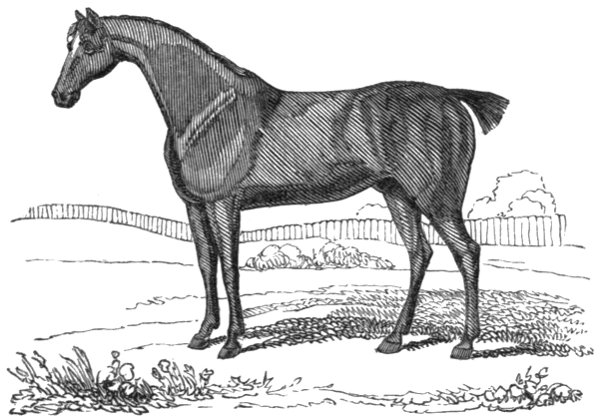
Perfection is seldom found in any living being; but certain it is, that of all animals in which perfection, or as near to it as their nature will admit, is required, it is in a horse to carry a man or a woman on the road: and were I requested by a friend to purchase a good hack for him, I should consider him to have given me a commission ten times more difficult than if he had requested me to purchase half a dozen hunters. The qualifications of a good hack are so numerous as to be almost disheartening to look for them: he must have good fore legs as well as good hinder ones: he must have perfect feet, a good mouth, not given to start, safe on his legs, gentle in his temper, and quiet to ride on all occasions. A fidgetty hack, however good in his nature, is very unpleasant, and in hot weather insupportable. He is fit for nothing but to ride to covert at the rate of twenty miles in the hour.—Nimrod.
Cobble, v. To mend any thing coarsely; to do or make any thing clumsily.
Cobble, s. A punt used for wild-fowl shooting, fishing, &c.
Cochineal, s. An insect, from which a red colour is extracted.
Cock, s. The male to the hen; the male of any small bird; the weather-cock that shows the direction of the wind; a spout to let out water or any other liquor at will; the notch of an arrow; the part of a lock of a gun that strikes with the flint; cock-boat, a small boat; a small heap of hay; the form of a hat.
Cock-fighting is a sport of great antiquity. It is supposed to have first originated with the Greeks; and that at one period it became so prevalent amongst them, that families of extensive property were reduced thereby to the lowest ebb of fortune.
As the Romans were so fond of imitating the Greeks, in their bad as well as good customs, it came to them as a mere gambling sport. According to Herodian, the first cause of contention between the two brothers, Bassianus and Geta, sons of the Emperor Septimus Severus, happened in their youth, about cock-fighting, which they had probably seen in Greece, whither they had often accompanied their father.
It is not known when this custom was first introduced into England, but undoubtedly by the Romans. The bird was here before the landing of Julius Cæsar; but no notice of cock-fighting occurs earlier than the time of William Fitz Stephen, who wrote the life of the Archbishop Becket in the reign of Henry II., and describes it as a sport of school-boys on Shrove Tuesday. From this time it continued in a fluctuating state; sometimes in vogue, at others, disapproved; and prohibited, 39 Edward III.; also in the reign of Henry VIII., and in 1569. It has been termed a royal diversion; and the cock-pit at Whitehall was erected by a crowned head for the more magnificent celebration of it. There were other pits in Drury Lane and Jewin Street. It was prohibited by Oliver Cromwell, March 31, 1654.
With respect to the breed of game fowls, the criterion of blood in these animals, before trial, is “fineness of feathers,” richness of plumage, “cleanness of feet,” and keenness of aspect. But there have been introduced of late years some varieties quite distinctly marked from the game fowls of old times; viz., “top knots” and “muffy heads,” which were quite unknown to our ancestors.
The cock is in his prime at two years old, and retains his vigour to his fifth year: the hen somewhat longer. Cockers breed in-and-in without scruple. The following is Mr. Sketchley’s description of a brood cock, in full health and vigour:—“A ruddy complexion, feathers close and short, not cold or dry: flesh firm and compact, full breasted, yet taper and thin behind; full in the girth, well coupled, lofty and spiring, with a good thigh; the beam of his leg very strong, a quick large eye, strong beak, crooked, and big at setting on.” Such a one, not more than two years old, to be put to early pullets, or a blooming stag with two-year old hens; and when a cock, with pullets of his own getting. Uniformity of colours is generally sought for, and the hens selected of similar plumage to that of the cock; the same of shape, which is a greater object in the hen, than size; only she should be lofty crested, short and close feathered, with clean, sinewy, blood-like legs. Shropshire and Cheshire have long been famous for their breed of game cocks; and the Shropshire reds are in particular high estimation. There was formerly in Staffordshire a famous breed of cocks, of a perfect jet black, gipsey faced, black legs, and rather elegant than muscular; lofty in fighting, close in feather, and well shaped. This breed soon degenerated; and, I presume, is now extinct. The following procreative comparison of Mr. Sketchley speaks volumes:—
YEARS. YEARS. YEARS. YEARS.
Stags 1 with hens 2 man 18 woman 22
Cock 2 with pullets 0 man 25 woman 22
Cock 2 with hens 2 man 25 woman 22
Cock 3 with hens 3 man 40 to 50 woman 45
Cock 4 with hens 3 man 50 to 60 woman 45
It is said that a game cock that happened to be on board Rodney’s ship on the memorable 12th of April, during that glorious action, exhibited the most undaunted courage, by crowing and clapping his wings.—Vide Hoyle, article Game Cock.
Cocks, when they crow at unwonted hours, often foretel a change of weather. We have often noticed this before rain. During the calm, still, dry, dark, and warm weather, sometimes occurring in the winter months, and which may be called the halcyon days of our climate, cocks keep a constant crowing all night and day. There appear to be three principal cock-crowings in ordinary weather, namely, about midnight or soon after, about three in the morning, and at daybreak; the latter is never omitted. We have noticed, however, that when cocks crow all day, in summer particularly, a change to rain has frequently followed.
Cocks and hammers.—If the sportsman has no objection to its clumsy appearance, I should be inclined to recommend the solid cock which falls on its end, instead of being stopped in the middle by the lock plate. It will therefore admit of main springs as strong as you please: and, by this means, add considerably to quickness in firing. But if you have very strong main springs, with the common cock, the resistance from the hammer spring, to prevent its breaking, must be so great, that you would soon wear out hammers, by being obliged to use an immoderate quantity of flints. With this another part of the lock also is safer, because the solid cock is received on a firm support annexed to the pan; while the one on the other construction suddenly catches the lock-plate, and is therefore liable to jar, and break either the tumbler itself, or the pin of the tumbler. A solid cock has many other advantages, from its durability and strength: it is proof against all awkward hands, and particularly desirable on guns which are liable to meet with rough usage in a boat.—Sporting Repository—Hawker—Foster.
Cock, v. To set erect, to hold upright; to fix the cock of a gun for a discharge; to raise hay in small heaps.
Cocker, s. One who follows the sport of cock-fighting: a small spaniel.
The Cocker—(Canis extrarius, Var. B. Linn.)—This dog is much smaller than the springing spaniel, and is generally used for woodcock and snipe shooting. His diminutive size peculiarly fits him for ranging in low and thick coverts, for which purpose nature seems peculiarly to have adapted him.
The cocker differs from the springer in having a shorter and more compact form, a rounder head, and a shorter muzzle; the ears are very long, the limbs are short and strong; the tail is generally truncated and more bushy; and the hair of the cocker, over his whole body, is more curled than that of the springer. He varies in colour from liver and white, red, red and white, black and white, all liver-coloured, and not unfrequently black, with tanned legs and muzzle.
This beautiful and lively dog seems to have been produced, originally, by a cross between the small water spaniel and the springer, for he not only resembles the figure of the latter, but also has many of his habits, combined with the lively and active disposition of both. From the beauty and temper of the cocker, the breed has become very generally diffused throughout the kingdom, and he is more frequently a companion in the parlour than used in the sports of the field. He is extremely common in many parts of Sussex, from which, in the south, he has obtained the name of the Sussex Spaniel. There has long been a beautiful breed of this dog in the possession of the Duke of Marlborough and his friends, which is preserved in great purity; these are invariably red and white, with very long ears, short noses, and black and sparkling eyes; they are active and indefatigable in the chase, and are consequently held in great estimation among sportsmen.
General Maxwell, of Edinburgh, has long had an extremely beautiful breed of cockers; most of them have been black, with tanned cheeks and legs, and ears nearly seven inches in length; they are of a small size, but they are lively and handsome little creatures.
In his general qualifications the cocker differs but little from the springer, except that he is decidedly more active: he appears also to have a more acute sense of smelling, and pursues game with an enthusiasm amounting to ecstacy. From his lively temperament, he does not tire so soon as the springer, however long the labour of the day may be.
From an innate principle of this industrious little animal, he gives the loudest proofs of his ecstatic delight upon finding, or even coming upon the scent, foot, or haunt of game; it is also his determined resolution to persevere until he has fairly driven them from covert. Consequently all sportsmen who take the field with cockers, are compelled to be on the alert, and to keep pace with the progress which the dogs make in the wood, otherwise they are sure to lose the greater part of the game. They may even travel many a weary mile without obtaining a successful shot, as it is the unalterable nature of these dogs to spring, flush, or start all the game before them; and they pursue, without distinction, hare, pheasant, partridge, woodcock, snipe, quail, and plover. It thus becomes necessary to hunt them within gun-shot of covert, and bells or gingles should be placed inside the collars, if the wood is extensive, to prevent them from beating too wide, and to keep them within call of the whistle.
The springer and cocker are more particularly appropriated to pheasant and woodcock shooting. The former may be considered the most laborious, and the least entertaining of all field sports, if we except the mode in which it is practised in the extensive preserves of Norfolk and Suffolk, and some few districts in other counties, where the large tracts of lofty wood-lands with thick and low underwood, contribute so materially to the safety and increase of the game.
Spaniels of both descriptions are brought into general use and domestic estimation, from their handsome shape, their beautiful sleek coats, their cleanly habits, insinuating manner, incessant attendance, and faithful obedience to their masters, qualities in which they surpass all the other members of the canine race.
Cockers are said to be more subject to certain diseases than other dogs, as loss of smell, and swelling of the glands in the neck, which sometimes prevents their taking any assistance till they die; a disease of the ears, like the mange, called formicæ; and lastly to the mange itself, which is most destructive of all to their beauty, health, and quiet.—Thornhill.
Cockerel, s. A young cock.
Cockfight, s. A match of cocks.
Cockpit, s. The area where cocks fight.
Cod, or Codfish, s. A sea-fish.
The fishermen take the cod from the depth of fifteen to sixty fathoms, according to the inequality of the bank, which is represented as a mountain under water, above five hundred miles long, and near three hundred broad, and that the approach to it is known by the great swell of the sea, and the thick mists that impend over it.
The largest cod ever taken on our coasts was at Scarborough, in 1755, and weighed seventy-eight pounds; the length was five feet eight inches; and the girth, round the shoulders, five feet. It was sold for one shilling. The general weight of these fish in the Yorkshire seas, is from fourteen to forty pounds.
A cod will not only live, but thrive well, in fresh water, if properly fed. A respectable fishmonger assured me that he had tried the experiment and succeeded, and offered to send me some live cod in a well-boat, for my piscatorium in Bushy Park.—Daniel—Jesse.
Codling, s. An apple; a small codfish.
Coffee, s. The berries of the coffee-tree; a drink made by the infusion of those berries in hot water.
Coffin, s. Coffin of a horse, is the whole hoof of the foot above the coronet, including the coffin-bone.
A sprain of the coffin joint is not an unusual occurrence; and, like the former, consists of violence applied to the tendinous and ligamentous connexion of this joint. When a horse becomes suddenly lame, and attentive examination can discover no injury above, the feet should be closely examined, when it is very probable there will be found in one of them some tenderness, and perhaps swelling, particularly at the back part, towards the upper portions of the heels, and in the neighbourhood of the navicular bone, where the part will be more hot than the others, and the horse will express pain when the foot is bent or extended, and he will generally also, though not always, point the foot when in the stable, or, as it is expressed, will stand favouring. The treatment, if the heat be considerable, would be to put the whole foot into a Goulard poultice for three or four days: in very bad cases I have thinned the whole crust of the hoof, and have drawn blood from the toe with advantage. After the heat has in some degree subsided, blister, as a milder treatment will seldom avail here: frequently it must be repeated also.—Blaine.
Cog, v. To flatter; to cog a die, to secure it, so as to direct its fall.
Cohesion, s. The act of sticking together; the state of union.
Coil, v. To gather into a narrow compass; to collect a rope.
Coin, s. Money stamped with a legal impression; payment of any kind.
Coistrel, s. obs. A coward hawk.
Colic, s. Is strictly a disorder of the colon; but loosely, any disorder of the stomach or bowels that is attended with pain.
The causes are various: the sudden application of cold either to the surface of the skin when hot, or to the intestines under similar circumstances, in the shape of cold water drunk hastily, and when the horse has been warm; in which latter case, the attack often soon follows. Costiveness will bring it on. Tumours in the mesentery, and strictures in the bowels are also the sources of occasional colic; and when a horse is found to be subject to repeated attacks, something of this kind, or otherwise calculous concretions, may be suspected: and I have known many instances where habitual colic was present, dependent on these causes. Horses long confined to dry food will sometime get it by suddenly gorging themselves with green meat; and with others, a constitutional tendency from some occult cause, gives them a predisposition to it.
The symptoms of spasmodic colic are usually sudden in their appearance, and not marked, as in inflammation of the bowels, by previous indisposition; but the horse is observed to be at once attacked with considerable uneasiness, shifting his position from side to side, pawing his litter, and stamping with his feet impatiently. After a few minutes thus passed, the pain remits, and leaves the horse tolerably easy; while in enteritis no perfect remission occurs, but all is one scene of nearly equable pain and distress. As the colic advances, the remissions are less perfect, and less frequent: the horse now lies down frequently, and on rising shakes himself, looking round to his sides, which occasionally, in desperate cases, he snaps at with his teeth; but more frequently he is seen to strike with his hind feet at his belly, as though determined to remove by force the cause of his pain. In enteritis this acuteness of sensation or violence of temper is seldom seen. When on the ground, it is not uncommon for the horse to roll on his back; sometimes he will remain in this situation a few seconds, or he will roll over; neither of which are usually done in simple inflammation. In colic the pulse is seldom much altered from its natural state, unless the colic have existed some time, when it occasionally presents marks of general irritation, and is not only quickened, but also somewhat hardened. If felt also during the intensity of the paroxysms, it will likewise be often found to be disturbed even in the early stage, but this is momentary only, and ceases on the remission of the pain. The extremities, as the legs and ears, in colic are not often much affected, and they never remain intensely cold for a considerable period, as in enteritis; but the coat stares, and the horse breaks out frequently into cold sweats. In colic, also, relief is obtained by friction and motion, but both aggravate the distress in enteritis. Sometimes he is seen to attempt to stale without effect, at others he stales frequently, with momentary relief.
Treatment.—Having reason to believe that the patient is labouring under simple spasm of the intestines, unmixed with inflammatory tendency, derived from idiopathic enteritis; or symptomatic irritation from inversion, involution, invagination, or intussusception of the intestinal track; proceed at once to administer such one or more of the numberless antispasmodic remedies as custom and experience have warranted the use of. Numerous as these are, there is not one that has not its advocate, and perhaps not one that does not deserve it, so simple are the means sometimes required; and so much is the constitution prone, in some cases, to assist itself or our efforts. While, at the same time, other cases occur, sufficiently obstinate, and sufficiently fatal, to require all our energies, and all our discrimination in the choice of our remedies, I can confidently speak to the antispasmodic qualities of the following, which should one or either of them be given as soon as possible, and repeated in one, two, three, or four hours, according to the violence of the symptoms, if no benefit be apparent from the first dose: for it must be remembered, that what we do we must do quickly, to prevent inflammation, for, of the fatal cases, four-fifths show evident marks of enteritic attack on a post-mortem examination.
1. Ground pepper ½ oz.
Spirit of turpentine 2 oz.
Tincture of opium 1 oz.
Sound ale 4 oz. Mix.
2. Spirit of vitriolic æther 1 oz.
Tincture of opium (laudanum) 2 oz.
Oil of peppermint 1 drachm.
Common gin, and sound ale, of each ¼ of a pint.
3. Spirit of turpentine 2 oz.
Oil of peppermint 1 drachm.
Castor oil, and watery tincture of aloes (Mat. Med.) each 6 oz.
As a domestic remedy, and one which has relieved at the moment, when other medicines were not at hand, I would recommend the following:—
Ground pepper 1 tea-spoonful.
The juice of two or three large onions
Common gin, and sound ale, of each ¼ of a pint.
The antispasmodic having been given, the necessity of bleeding should be next taken into consideration: if the case be one of very acute features, I would recommend that it be proceeded with without delay, and, according to the degree of intensity, or duration of the complaint, do it more or less liberally. Extensive bleeding, it should be remembered, is one of the most powerful relaxers of spasmodic constriction with which we are acquainted, and instead of its being an antagonist to the antispasmodic treatment usually adopted, by internal remedies, its relaxant qualities are found to be infinitely increased in efficacy when conjoined with large doses of opium. I have had so many opportunities of witnessing the effect of this combination, that I cannot too strongly recommend it: and although most of the ordinary cases of spasmodic colic will yield to the common stimulant treatment, and many would even go off without any treatment at all, yet bleeding, in mild cases even, is always safe and precautionary against inflammation; and in the more aggravated, it is essentially necessary, both to combat the inflammatory tendency, and to promote the relaxation of the spasmodic irritation on the muscular fibre. It is likewise particularly indicated in these violent or protracted cases, to counteract the irritative qualities of the antispasmodics used, which, though in other instances of simple spasm are innocuous, however large, yet may not prove so when reaction is at hand, or already begun. It should, however, be remembered, that though I advocate bleeding, it is not that useless and non-medical practice of bleeding by the palate or sublingual vessels; and though, with Mr. Peal, I would most strongly condemn violent, and particularly long-continued exercise, yet I have so often experienced the good effects of a brisk trot for ten minutes, that I cannot but recommend its adoption. Friction to the belly is also to be employed, by means of a brush, or if with a heated coarse woollen cloth it will be better; but the practice of rubbing with a stick is, I apprehend, worse than useless, and often hurtful. Fomentations of very hot water are also sometimes singularly efficacious; and in every case we should, by means of the patent syringe, throw up considerable quantities of relaxant clysters; and where costiveness is present, until the bowels are relieved of their fæcal matter, the clysters should be of a mild watery solution of aloes, or, by preference, of a solution of sulphate of magnesia (Epsom salts) in broth, gruel, &c. Afterwards the clysters may be made media of applying antispasmodics to the bowels, as decoction of poppy heads, or even tinct. opii, largely diluted with warm water, &c.—Vide Outlines of Vet. Art.
Dogs are subject to two kinds of colic; one arising from constipation of the bowels; the other is of a kind peculiar to dogs, apparently partaking of the nature of rheumatism, and also of spasm. From a sudden or violent exposure to cold, dogs become sometimes suddenly paralytic, particularly in the hinder parts, having great tenderness and pain, and every appearance of lumbago. In every instance of this kind, there is considerable affection of the bowels, generally costiveness, always great pain. A warm bath, external stimulants, but more particularly active aperients, remove the colic. Colic, arising from costiveness, is not in general violently acute from the pain it produces; sometimes it appears accompanied with more spasm than is immediately dependent on the confinement of the bowels. In the former give active aperients, as calomel with pil. cochiæ, i. e. aloetic pill, and clysters; in the latter, castor-oil, with laudanum and ether.—Blaine.
Collar, s. A ring of metal put round the neck; the harness fastened about the horse’s neck. A collar of brawn is the quantity bound up in one parcel.
Collar-bone, s. The clavicle; the bones on each side of the neck.
Colour, s. The appearance of bodies to the eye; hue, dye; the appearance of blood in the face; in the plural, a standard, an ensign of war.
A general name given to the dyed wools and mohairs, which are used in forming the bodies of artificial flies. Mixing the wools, or producing, by a union of different colours, the exact shade of the body of the insect to be imitated, is justly reckoned the greatest difficulty of the art; and I have known many persons tie a fly with neatness and elegance, who never could turn out a killing one. Hence practical acquaintance with the ephemeræ, which are imitated, is absolutely requisite for tying, as without it, the handsomest fly is inefficient.
To this may be ascribed the inferiority of the flies usually purchased in extensive fishing shops. Though, possibly, an elegant similitude of the intended insect in size and shape, they are, in tint and colouring, untrue to nature; and, as such, are easily discovered by the keen eye of the invited victim, and as certainly rejected. Without the precise colour of the fly is obtained, the handsomest production will be unsuccessful; and the neophyte will marvel that the basket of the rustic fisherman is filled, while his own showy imitations fail to rise a fish.
In choosing colours the brightness of the tint is to be less regarded than the permanency of the dye. To produce, at the same time, a brilliant and lasting colour, requires time, trouble, and experience. But for all the disciple of Walton will be well repaid; for nothing can be more mortifying to an angler, than to see the tints of his fly fade after a few immersions in the water, and a short exposure to the sunshine.
The receipts for dying wools and feathers, recommended in the Field Book, were given the compiler by Major Patrickson, an angler, who, in scientific and practical knowledge is, probably, second to none in Britain. They may, perhaps, be undervalued by modern philosophers; but from these simple and antiquated recipes, my accomplished friend produced the most beautiful and permanent colours; and I have, at this moment, in my possession, flies bodied with his wools, which have stood the test of water and weather, and are still as brilliant in their hue, as when they were first attached to the hook. Vide Fly Fishing.
Colour, v. To mark with some hue or dye; to palliate.
Colt, s. A young horse.
Colt’s-tooth, s. An imperfect tooth in young horses.
Columba, (Linn.) s. A dove or pigeon. Vide Wood-pigeon.
Bill (save at the point, which is bent down) compressed and straight, the base of the upper mandible being covered with a soft gristly substance, in which the nostrils are placed towards the middle of the bill, forming a cleft lengthwise. The feet having three toes before entirely separated, with one hind toe articulated on the heel. Wings of middle size, the first quill rather shorter than the second, which is the longest in the wing.
Columbary, s. obs. A dove-cote.
Colymbus (Latham.) s. A diver; a genus thus characterised:—
Bill of middle size, strong, straight, much pointed, compressed. Nostrils at the sides of the base, concave, oblong, half shut by a membrane, pierced from part to part. Legs of middle length, drawn towards the belly beyond the equilibrium of the body; shanks compressed; three toes before, very long, entirely webbed; the hind toe short, articulated upon the shank, carrying a small loose membrane. Claws flat. Wings short; the first quill the longest. Tail very short and rounded.—Montagu.
Comb, s. An instrument to separate and adjust the hair; the top or crest of a cock; the cavities in which the bees lodge their honey.
Comforter (Canis consolator), s. A species of dog.
This beautiful little dog seems to be a cross betwixt the Maltese and the smaller spaniel described in the last section. His colour is generally white, with black or brown patches; his ears are long, and his head broad on the upper part, with an acute muzzle; the hair is long over the whole body, with the fore-legs feathered. His tail is curled, and feathered with very long hairs. This is the smallest of any of the distinct races of dogs, frequently not above a foot from the tip of the nose to the point of the tail.
This elegant little animal is used as a lap-dog, or as an attendant on the toilet or in the drawing-room. He is most affectionate to all the members of the family in which he resides; but is very snappish to strangers, whose familiarity he will seldom permit.—Brown.
Commerce, s. A game at cards.
Of this game there are two distinct methods of playing, the new and the old mode. The new way is played by any number of persons, from three to twelve, with a complete pack of 52 cards, bearing the same import as at whist, only the ace is reckoned as eleven. Every player has a certain quantity of counters, on which a fixed value is put, and each, at every fresh deal, puts down one for the stake. Sometimes the game is continued, or not finished, till one of the players has lost all the counters given at the commencement; but in order to prevent it from being spun out to an unpleasant length, or concluded too soon, it is often customary to fix the duration to a determinate number of tours, or times, so that the whole party shall deal once each completely round.
After determining the deal, the dealer, styled also the banker, shuffles the pack, which is to be cut by the left-hand player; then three cards, either altogether or one by one, at the dealer’s pleasure, are given to each person, beginning on the right hand, but none are to be turned up. If the pack prove false, or the deal wrong, or should there be a faced card, there must be a fresh deal. There are three degrees or ranks in this game. The first, which takes place of all others, is what is called the tricon, or three cards of the same denomination, similar to pair royal at cribbage; the next in rank is the sequence, or three following cards of the same suit, like tierce at piquet; and the last, the point, being the greatest number of pips on two or three cards of a suit in any one hand. As to all these parts, the higher disannuls the lower. For the old method &c. vide Hoyle.
Common, s. An open ground equally used by many persons.
Commonage, s. The right of feeding on a common.
Concave, a. Hollow, opposed to convex.
Condition, s. Quality, that by which any thing is denominated good or bad; natural quality of the mind, temper, temperament.
Condition, as regards horses, is a term conventionally well understood; but beyond the precincts of the stable, it is neither precise nor technical. The term, in common parlance, might be supposed to imply nothing more than the symptoms and appearances which usually betoken health. Thus, when a horse is in perfect health, he ought, under this view of it, to be considered as in perfect condition; and, on the contrary, when a horse is in any respect out of health, he should be considered as out of condition; that is, in a condition that neither fits him for perfect service to his owner, nor for perfect comfort to himself.
The accidental causes of this latter (morbid condition) are various; a very common one is found in injudicious feeding, both as to quality and quantity. Any sudden alteration in the articles of a horse’s diet will frequently, according to the term of horse amateurs, “throw him out of condition,” such as removing him from the grass field or the straw yard to a full allowance of dry hay and corn, with a scanty supply of water “to draw up his belly;” all which are perhaps done at once, without the smallest preparation. In these cases the alimentary canal, being hardly yet in a state of digesting capacity, suffers from the increased powers necessary to draw nutriment from substances which, although in themselves more nutritious, yet are, in this instance, less digestible than those before in use. Thence follow costiveness, heat, and thirst; as well as an unhealthy state of the coat, which stares, and feels harsh and dry, being a necessary consequence of the ordinary sympathy between the stomach and the skin. A sudden remove from a generous to a poor diet is unfavourable to condition likewise; for in such case the chyle or nutritious pabulum, from whence all the vital organs are recruited, and all the vital energies derive their vigour, cannot be separated in sufficient quantities: the blood thereby becomes deteriorated; universal absorption takes place of the softer parts, which produces lessened bulk; while a laxity of fibre in the remaining portions is productive of langour and debility. The quality of the food is also of considerable consequence to the condition. Mow-burnt hay, by exciting a partial diabetes, is very apt to “throw a horse out of condition.” Musty hay, also, and oats highly kiln-dried, have an unfavourable effect on it also. The liquid aliments should likewise be attended to in a consideration of the condition. Mineral waters are unfavourable to it in most cases; although there is reason to believe that in some morbid affections they are salutary. Sea-water may be considered in the same light, but a continued use of the brackish water found near sea-bathing places, is unfavourable to the condition of such horses as have not been accustomed to it: to which, in union with the bad care taken of them in most of the livery stables of the sea-coast bathing, I attribute the universal complaint of the ill-condition in which they so frequently return from thence. Badly ventilated stables, excess of clothing, and deprivation of water, are also frequent causes of morbid condition, as I have often witnessed: for, in some of these cases, after a course of purgatives, followed by alteratives and tonics, has failed, the more simple means of succulent food, a proper quantity of water, a well regulated but perfectly cool stable, with a free access of air, and very moderate clothing, have created an immediate change. An inordinate quantity of exertion, particularly if continued unremittingly for several days, will often produce morbid condition; and this in cases where the feeding has been, as supposed, equal to the tasks required. It is particularly likely to happen to young horses, and to such as have not been sufficiently prepared: in which cases, it is clear that the stomach, participating with the general debility, has a double task to perform in digesting a larger quantity of nutriment than usual, to make up the increased wants of the constitution; and thus the evil is increased by adding the further deterioration of this organ to the others. I know of no state of morbid condition which often proves so obstinate as this; and which is often found at last only to give way to a good salt-marsh run. Drastic purgatives, or violent remedies, as the mineral acids, when injudiciously continued, reduce the condition very quickly, and sometimes irrecoverably. Another principal cause of want of condition is the alternation of heat with cold. A sudden check to the natural or acquired heat of the body, particularly if aggravated by the evaporation of a perspiring state, and great previous exertion, as a sudden check after a severe burst with the hounds.
After a general enumeration of the causes of morbid condition, Mr. Blaine continues:—But to proceed with this important subject with some regularity, I would direct that in young plethoric horses, with much flesh on them, and which are, of all others, the most subject to take on this state of morbid condition, that one or two moderate bleedings may be premised, particularly in such as have been full fed for some time previous. If the inner surface of the eyelids, or of the nasal membranes, show any tinges of red, it is still more necessary to bleed; and in such cases I would repeat the same with moderation once or twice more, or until this inflammatory appearance should be removed. I have found this, united with mashing, in many instances sufficient to relax the hide and reduce the rugous tumefaction of the lampas. In most cases, however, some more active internal remedies will be found necessary with a young and plethoric patient: thus one or two very mild doses of physic, preceded by a nightly mash, into which ten grains of submuriate of mercury (calomel) has been mixed, are proper. If there be joined to the affected hide, and the swollen or clammy mouth of lampas, any eruptions on the skin, or any cracks of the heels, stable soiling, or even daily turning out to grass, are advisable; but as these cases usually happen when the animal is either at present wanted, or is intended soon to be used, so I have not mentioned turning out altogether; yet, if these appearances prove obstinate, such a course will be advisable, provided the season and other circumstances are favourable to the proceeding. But when neither the partial nor total turning out to grass is convenient, and when soiling is likewise not practicable, still the use of carrots as manger food can be resorted to. To this treatment may be added, after the administration of the physic, a nightly alterative.
Crude antimony
Supertartrate of potash (cream of tartar) of each 2 or 3 drs.
Nitrate of potash (nitre)
Or,
Supertartrate of potash 2 or 3 drs.
Nitrate of potash do.
Powdered sulphur ¼ oz.
Both of these will gently stimulate both the stomach and kidneys, and produce, by consent of parts, a favourable effect on the skin, and hair also. Violent diuretics are never advisable; nor have I seen their mildest form, unaccompanied by other remedies, produce much good, unless there have been, in addition to the other symptoms, swelled legs, either with or without discharge.
When morbid condition arises in such horses as, from age, previous deprivations, severe work, long confinement in bad stables, or feeding on unwholesome provender, are not to be supposed plethoric; even then, if no actual debility is present, I have often derived great benefit by commencing the treatment with a very mild dose of physic, the horse being previously fully mashed, to make a small quantity of aloes sufficient; for I have generally found that the stomach tonics to be afterwards administered have had double effect from this previous preparation of the alimentary canal. But where the debility has been extreme, or where there has been already sufficient laxity of bowels, or perhaps even superpurgation from drastic physic, begin at once with either of the following tonics, or of any of those detailed under that head in the Materia Medica:—
Socotrine aloes, in powder 1 dr.
Winter’s bark, ditto 2 drs.
Ærugo (verdigris) 1 dr.
Treacle or honey to form a ball.
Or,
Oxide of arsenic (arsenic) 8 grs.
Pimento (allspice) in powder 1 dr.
Extract of gentian ½ oz.
Make into a ball with liquorice powder. Or,
Sulphate of copper 1½ gr.
Sulphate of iron ditto
Powdered ginger 1 dr.
Horse turpentine to form a ball.
Either of these formulæ may be given some time in each day, at the convenience of the practitioner or owner. It would, however, where practicable, be more prudent to let it be given in the morning, fasting, allowing the horse but a handful or two of hay for an hour after its exhibition. If a liquid form only can be got down, either of the above mixtures may be dissolved and horned down as a drink, with ale; but active mineral agents seem to produce their effect best in mass. In all cases of morbid condition, marked with emaciation and debility, a full allowance of carrots is advisable; and in default of them, or alternating with them, malt mashes or speared corn may be usefully brought in aid of the other tonics.
When a horse returns from grass, or straw-yard, both his external appearance, and the internal state of his body, in general, require considerable alteration before he can be said to be fit for the uses to which he is applied by man.
To promote ‘condition’ in a horse from grass, his dieting and watering, the temperature to which he is removed, his clothing, grooming, and exercise, are the circumstances particularly to be attended to. Physicking is also a usual and necessary appendage to the other parts of the treatment.
It would be most imprudent to take a horse from so moist a food as grass, and at once to place before him hay and corn without caution or limitation. Coming from a straw-yard, this restraint is not so imperative; yet even in this case, little corn should be given at first: but following the removal from grass, both corn and hay should be allowed but sparingly, particularly the former. The hay given for the first two or three days should likewise be moistened, by sprinkling it with water; the corn allowed should also be mixed with bran, by which the dangers of constipation and repletion may be avoided. The constipating effects of the removal from a moist to a dry course of feeding, may be further obviated by a nightly bran mash. The bran mashing may likewise be extended to twice a day, or until the bowels be somewhat relaxed, if the horse be very full in flesh, or have his skin at all tight, or eruptive; or if the legs be inclined to swell. In all which cases it likewise tends to shorten the process, and prevent that almost irrecoverable hide-binding, which often follows these appearances, if succulent food, particularly carrots, be mixed with, or even wholly substituted for, hay. The privation of grass renders it prudent that water should at first be given in sufficient quantity: it is often withheld, with a view to harden the flesh and get up the belly: but this treatment at first is erroneous, and by exciting heat, thirst, and indigestion, frustrates its own intention. The temperature into which the newly-stabled horse is removed, should not at first be much increased beyond that to which he has been so long accustomed, or the sudden change may operate unfavourably on his lungs; and if it does not produce inflammation, it may at least occasion roaring, or broken wind. The most prudent plan is, first to place the horse in an airy box, which will not only prevent too great heat, but also obviate the danger of swelled legs, and heated feet. By degrees so much increase of temperature may be kept up, as will promote the fall of long hair, or the retention or renewal of the short: and in the degree to which the artificial coating is wished to be carried, to that degree should a temperate or an ardent climate be imitated. The clothing and grooming should, like the other parts of the conditioning treatment, be at first very moderate: the one produces extra heat, the other extra irritation; but by degrees both may be increased according to the views of the owner, or the purposes of the horse. Physicking is found to assist the condition of horses; for by emptying the bowels thoroughly, absorption of the extraneous fluids is promoted. One, two, or three doses, according to the extent to which the condition is intended to be carried, are usually given to every horse, where this process is conducted on the usual principles; and are certainly necessary, wherever continued and accelerated exertions are required. Exercising a conditioning horse, like the other aids, must be done with a due regard to circumstances. At first, walking alone best answers the purpose, and twice a-day is better than once: the duration of each walk must be regulated by the age, the fulness of habit, &c. &c. As the condition improves, trotting and galloping may be employed, to benefit the wind, draw up the carcass, and accustom the horse to full work. It may be here remarked, that I have seen all attempts to promote condition fail in a horse removed from an old companion, or when stabled alone. Horses are gregarious, and often bear segregation badly: such a case can only be treated by association.—Blaine—Outlines of the Vet. Art—Nimrod on Condition—White, &c.
Coney, s. A rabbit, an animal that burrows in the ground.
Conger, s. The sea-eel.
Conirostres, (Cuvier,) s. Birds having concave bills.
Contagion, s. The emission from body to body by which diseases are communicated; infection; pestilence.
Contagious, a. Infectious, caught by approach.
Convulse, v. To give an involuntary motion to the parts of any body.
Convulsion, s. A convulsion is an involuntary contraction of the fibres and muscles; an irregular and violent motion, commotion.
Coo, v. To cry as a dove or pigeon.
Cookery, s. The art of dressing victuals.
Cookery on the Moors.—No one merits or relishes a good dinner better than a grouse-shooter. It delights me to see my companion eat like a traveller; and, to please me, he should possess sufficient acumen to enable him to appreciate the fare. I despise the man who is cursed with a Spartan palate, and who hardly knows the difference between beef and mutton; and yet, in equal ratio, the gourmand is my abomination. There is a limit in culinary lore beyond which, as I opine, the sportsman should never travel. Like a soldier, he will sometimes find it serviceable to be able to direct the broiling of a steak, and the combination of a stew. To fabricate a curry, or even regulate a hash, may be tolerated; and in wild countries, like Ballycroy or the Scottish highlands, this knowledge will frequently be “worth a Jew’s eye;” but every thing beyond this in kitchen accomplishments, is detestable. With one who composed omelets, and talked scholarly of the materiel of a plum-pudding—and I once had the misfortune to fall into a shooting party afflicted with such a personage—I would consort no more upon the heath, than I would shoot with a cook, or draw a cover with a confectioner. And yet, with these antipathies, I recommend the neophyte to make himself in every thing as independent as he can. A few practical lessons are worth a world of precept: one week’s cooking in the moors will render him for life an adept; and if gun and angle fail him not, he will be able to command a dinner, without owing to the devil the compliment of a bad cook.—Wild Sports.
Coolness, s. Gentle cold, a soft degree of cold; freedom from passion.
Coomb, s. A measure of corn containing four bushels.
Coop, s. A cage, a pen for animals, as poultry or sheep.
Coot (Fulica, Linn.), s. A small black water-fowl.
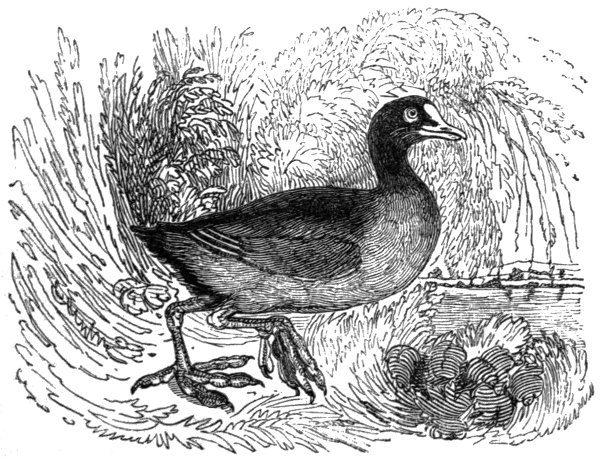
Its characteristics are, bill strong, thick, sloping to a point; the base of the upper mandible rising far up into the forehead; both mandibles of equal length; nostrils inclining to oval, narrow, short; body compressed; wings and tail short; toes long, furnished with broad scalloped membranes between each joint, on each side; the inner toe has two, the middle three, and the outer four scallops; and the hinder toe, one plain membrane adhering to its whole length.
Bald Coot.—(Fulica atra, Linn.—Le Foulque au Morelle, Buff.)—This bird generally weighs, when in full condition, about twenty-eight ounces, and measures fifteen inches in length. The bill is of a greenish white colour, more than an inch and a quarter long: a callous white membrane, like that of the water hen, but larger, is spread over the forehead, which also, as in that bird, changes its colour to a pale red in the breeding season: irides red; the upper part of the plumage is black, except the outer edges of the wings, and a spot under each eye, which are white; the under parts are of a hoary dark ash or lead colour. The skin is clothed with a thick down, and covered with close fine feathers; the thighs are placed far behind, are fleshy and strong, bare, and yellow above the knees; the legs and toes are commonly of a yellowish green, but sometimes of lead colour.
The common coot has so many traits in its character, and so many features in its general appearance like the rails and water hens, that to place it after them, seems a natural and easy gradation. Linnæus and other ornithologists, however, describe it as a genus distinct from those birds, and from the waders in general, on account of its being fin footed, and its constant attachment to the waters, which, indeed, it seldom quits. With it naturalists begin the numerous tribe of swimmers, and rank it among those that are the most completely dependent upon the watery element for their support: it swims and dives with as much ease as almost any of them; and also, like those which seldom venture upon land, it is a bad traveller, and may be said not to walk, but to splash and waddle between one pool and another, with a laboured, ill balanced, and awkward gait.
These birds skulk and hide themselves during the day among rushes, sedges, and weeds, which grow abundantly in the loughs and ponds, where they take up their constant abode: they rarely venture abroad, except in the dusk, and in the night, in quest of their food, which consists of the herbage, seeds, insects, and the slippery inhabitants of stagnant waters. It is seldom that the sportsman and his dog can force the coot to spring from its retreat; for it will, in a manner, bury itself in the mud rather than take wing: and when it is very closely pursued, and compelled to rise, it does so with much fluttering and apparent difficulty.
This species is met with in Great Britain at all seasons of the year; and it is generally believed that it does not migrate to other countries, but changes its stations, and removes in the autumn from the lesser pools or loughs, where the young have been reared, to the larger lakes, where flocks assemble in the winter. The female commonly builds her nest in a bush of rushes surrounded by the water; it is composed of a great quantity of coarse dried weeds, well matted together, and lined within with softer and finer grasses: she lays from twelve to fifteen eggs at a time, and commonly hatches twice in a season: her eggs are about the size of those of a pullet, and are of a pale brownish white colour, sprinkled with numerous small dark spots, which, at the thicker end, seem as if they had run into each other, and formed bigger blotches.
As soon as the young quit the shell, they plunge into the water, dive, and swim about with the greatest ease; but they still gather together about the mother, and take shelter under her wings, and do not entirely leave her for some time. They are at first covered with sooty coloured down, and are of a shapeless appearance: while they are in this state, and before they have learned, by experience, to shun their foes, the kite, moor buzzard, and others of the hawk tribe, make dreadful havoc among them; and this, notwithstanding the numerous brood, may account for the scarcity of the species.
Greater Coot.—(Fulica aterrima, Linn.; Le Grand Foulque au Morelle, Buff.)—This is of a larger size than the last, but differs not in the colour of the plumage, except that it is blacker. Brisson distinguishes the two by the colour of the bare forehead, which is in this white; and the garters, which are of deep red. This bird is said to be found in Lancashire and in Scotland. It should seem to be a mere variety of the former, did not authors join in advancing the contrary. They are more plentiful on the continent, being found in Russia and the western part of Siberia very commonly, and are also in plenty at Sologne and the neighbouring parts, where they call it judelle. The people eat them on maigre days, and the flesh is much esteemed.—Latham.
A curious anecdote is related of a bald coot that built her nest in Sir William Middleton’s lake, at Belsay, Northumberland. The rushes which contained it being afterwards loosened by the wind, the nest was driven about, and floated upon the surface of the water, in every direction; notwithstanding which, the female continued to sit as usual, and brought out her young upon her moveable habitation.
Cleaning Coots.—The recipe for this, is, after picking them, to take off all the black down, by means of powdered white rosin and boiling water, and then to let them soak all night in cold spring water; by which they are made to look as delicate as a chicken, and to eat tolerably well; but, without this process, the skin, in roasting, produces a sort of oil, with a fishy taste and smell; and, if taken off, the bird becomes dry, and good for nothing. After all, however, these birds are in no way delicate, except when skinned; and after being soaked twenty-four hours in cold spring water, repeatedly changed, made into a pudding, by which, as with all such birds, when in puddings, pies, or soup, you can get rid of their strong skins without losing the juice of their flesh; and their fishy taste is, in a great measure, drawn off by steam.
Moor-hens may be cleaned in like manner, and, if in good condition, they will then be nearly equal to any wild fowl.—Hawker.
Copper, s. One of the six primitive metals.
Copper-cap, s. A metallic covering fixed upon the nipple of a percussion gun, containing a fulminating composition, which explodes by the action of the cock and ignites the powder in the barrel. Vide Percussion.
Copperas, s. A kind of vitriol.
Coppice, s. Low woods cut at stated times for fuel.
Copse, s. Short wood.
Copse, v. To preserve underwood.
Copulate, v. To come together as different sexes.
Copulation, s. The congress or embrace of the two sexes.
Coracle, s. A boat used in Wales by fishers.
Cordial, s. A medicine that increases the force of the heart, or quickens the circulation; any medicine that increases strength; any thing that comforts, gladdens, and exhilarates. Cordials are useful to give a temporary energy to the stomach and bowels, and stimulate the nervous system.
White says, “There is not a better cordial than about half a pint of good strong beer, with a little ginger grated into it. A wineglassful of brandy in half a pint of water is stronger, and may, on some occasions, be more useful; but I wish to impress on the reader, that, whenever a cordial appears necessary, we should give one of no greater strength than is sufficient to produce the desired effect; and it will be found, I think, that a much better effect may be produced by three or four small doses, or weak cordials, than by giving only one large dose.”
CORDIALS.
1. From half a pint to a pint of the best old mild beer, with a little grated ginger.
2. Best Cognac brandy, from 2 to 4 oz.
Warm water 6 to 12 oz.
3. Anodyne carminative tincture 2 oz.
Water 6 or 8 oz.
4. Allspice, powdered 2 to 4 drs.
Caraway seeds (fresh), powdered 4 dr. to 1 oz.
Treacle enough to form a ball.
5. Ginger, powdered 1 dr.
Allspice, powdered 2 drs.
Caraway seeds, powdered 4 drs.
Treacle enough to form a ball.
The cordials No. 4 and 5 may be given as a drench with a little water; and if the cordials 1, 2, and 3, were sweetened with treacle or sugar, they would be more palatable to the horse, and probably have a better effect. The above cordials are as well suited to cattle as to horses; and, though much stronger drenches are often given, those will be found, I think, of sufficient strength.—White.
Cordial, a. Reviving, invigorating, sincere.
Core, s. The heart; the inner part of any thing; the inner part of a fruit, which contains the kernel; the matter contained in a bile or sore.
Coriander, s. A plant.
Cork, s. A glandiferous tree, in all respects like the ilex, excepting the bark; the bark of the cork-tree used for stopples; the stopple of a bottle.
Cormorant, Cole Goose, or Great Black Cormorant, (Pelicanus Corbo, Linn.; Le Cormoran, Buff.) s. A bird that preys upon fish.
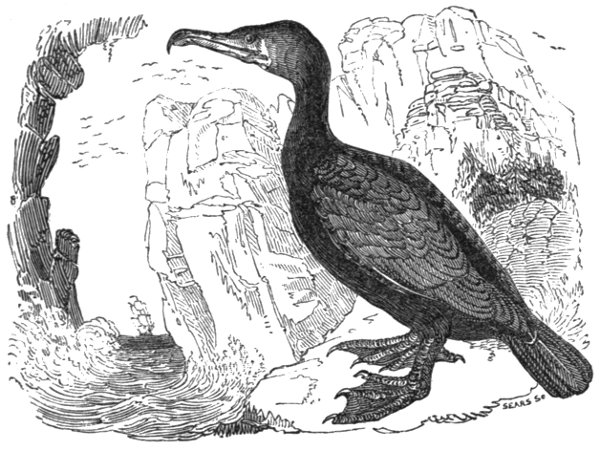
The weight of this species varies from four to seven pounds, and the size from thirty-two inches to three feet four or five in length, and from four feet to four feet six inches in breadth. The bill, to the corners of the mouth, measures four inches, and on its ridge two and three quarters; it is of a dark horn colour, and the tip or nail of the upper bill is much hooked and sharp; from the base of this it is furrowed on each side nearly to the tip, without any visible appearance of nostrils; the lower bill is compressed, and covered, about the gape of the mouth, with a naked yellowish skin, extended under the chin and throat, where it hangs loose, and forms a kind of pouch, which, together with the springing blade on each side, forming its rim, is capable of distension to a great width, and enables the bird to swallow prey apparently too large to be admitted into its throat; the skin about the eyes is also naked, and of the same colour as the pouch; the eyes, which have a remarkable wild stare, and are placed near the bill, look like two little greenish glass globes. The crown of the head, and the neck, are black; on the hinder part of the former the feathers appear elongated, and form a sort of loose short crest. In some specimens the throat is white, with a kind of stripe passing from it, upwards, behind each eye; in others the cheeks and throat are mixed with brown and white; and again, in others the head and neck are streaked with scratches of the latter colour. The middle of the belly is white, with a patch of the same colour over each thigh; all the under parts, however, together with the back and rump, are commonly of a glossy blue black, with green reflections: the shoulders, scapulars, and wing-coverts, are of a bronze brown, tinged and glossed with green, and each feather is bordered with shining blueish black; the secondary quills are nearly of the same colour; the coverts and the primaries are dusky. The tail consists of fourteen stiff husky feathers, which look as if they were discoloured by being dipped in mud or dirty kennel-water: the legs are thick, strong, black, and coarse, about two inches and a half long, and the outer toe is more than four in length.
The cormorant is found in every climate. In Greenland, where it is said they remain throughout the year, the jugular pouch is made use of by the natives, as a bladder to float their fishing-darts, after they are thrown; their skins, which are tough, are used for garments, and their flesh for food; “but the eggs are too fetid to be eaten even by the Greenlanders.”
These birds usually assemble in flocks on the summits and inaccessible parts of the rocks which overhang or are surrounded by the sea, upon which the female makes her nest of the withered sea-tang, weeds, sticks, and grasses, which are cast on shore by the waves: she lays four or more greenish-white eggs, of the size of those of a goose, but of a longer shape. There are writers who assert that, in some parts of the world, they build their nests on trees, like the rook and the heron; other authors, stricken with the singular conformation of the feet and serrated claws, have ascribed properties to them which they do not possess, and believe that they hold their prey in one foot, while with the other they push forward to the shore, or carry it thither, in the same manner, on the wing; but this seems mere conjecture, for the feet of this tribe are not fitted for any such purpose; they are, like those of all the expert divers, placed far behind; and while, by the position of these, and the powerful strokes from their broad webs, the bird is enabled to pursue and overtake its slippery prey, the hooked, sharp-edged beak is the only fit instrument both to catch and to secure it; and there is no need to use the awkward expedient of removing it afterwards to the foot.
At sea, or on the inland lakes, they make terrible havoc. From the greatest height they drop down upon the object of pursuit, dive after it with the rapidity of a dart, and, with an almost unerring certainty, seize the victim; then emerging with the fish across the bill, with a kind of twirl, throw it up into the air, and, dexterously catching it head foremost, swallow it whole.
While at rest on the shore, commonly on the ledge of a projecting rock, these birds sit, more or less, in an erect posture, and are propped up by the stiff feathers of the tail; and in places where they have not experienced the fatal effects of the gun, they have been known, however wary at other times, to sit and receive repeated shots, without offering to move out of the danger. At other times and places, while they sit in a dosing and stupified state, from the effects of one of their customary surfeits, they may easily be taken, by throwing nets over them, or by putting a noose around their necks, which they avoid no further than by slipping the head from side to side as long as they can.
Notwithstanding the natural wildness of their disposition, it seems, according to some accounts, that certain species of these birds have formerly been tamed and rendered subservient to the purposes of man, both in this and other countries. Among the Chinese it is said they have frequently been trained to fish, and that some fishermen keep many of them for that purpose, by which they gain a livelihood. “A ring placed round the neck hinders the bird from swallowing; its natural appetite joins with the will of its master, and it instantly dives at the word of command; when, unable to gorge down the fish it has taken, it returns to the keeper, who secures it to himself. Sometimes, if the fish be too big for one to manage, two will act in concert, one taking it by the head and the other by the tail.” In England, according to Willoughby, “when they came to the rivers, they take off their hoods, and having tied a leather thong round the lower part of their necks, that they may not swallow down the fish they catch, they throw them into the river. They presently dive under water, and there for a time, with wonderful swiftness, they pursue the fish; and when they have caught them, they arise presently to the top of the water, and pressing the fish lightly with their bills, they swallow them, till each bird hath in this manner swallowed five or six fishes; then their keepers call them to the fist, to which they readily fly, and, little by little, one after another, vomit up all their fish, a little bruised with the nip they gave them with their bills. When they have done fishing, setting the birds on some high place, they loose the string from their necks, leaving the passage to the stomach free and open, and for their reward they throw them part of the prey they have caught, to each, perchance, one or two fishes, which they by the way, as they are falling in the air, will catch most dexterously in their mouths.”
Whitelock tells us “That he had a cast of them manned like hawks, which would come to hand.” He took much pleasure in them, and relates, that the best he had was one presented to him by Mr. Wood, Master of the Cormorants to Charles the First.
Dr. Heysham relates that, about the year 1759, one of these birds “perched upon the castle at Carlisle, and soon afterwards removed to the cathedral, where it was shot at upwards of twenty times without effect; at length a person got upon the cathedral, fired at, and killed it.” “In another instance, a flock of fifteen or twenty perched, at the dusk of evening, in a tree on the banks of the river Esk, near Netherby, the seat of Sir James Graham. A person who saw them settle, fired at random at them in the dark six or seven times, without either killing any or frightening them away: surprised at this, he came again, at day-light, and killed one, whereupon the rest took flight.”—Bewick—Latham—Willoughby, &c.
Corn, s. The seeds which grow in ears, not in pods; grain unreaped; grain in the ear, yet unthrashed; an excrescence on the foot, hard and painful.
Corns are a very common and a very troublesome disorder, and may truly be said to be often occasioned by the smith, being generally in consequence of bad shoeing. Corns most commonly happen in white feet with weak low heels; but they are too common in feet of all colours. They are occasioned by the pressure of the heel of the shoe, either by its bearing directly on the sole when it is too thin to bear the pressure, or by its forcing the heel of the crust inwards. In this way the sensible sole and laminæ are bruised, their blood-vessels ruptured, and the blood penetrates into the pores of the horn, causing the dark red appearance observable on removing the shoe, and scraping off the surface of the sole. This bruised part is exceedingly tender, and incapable of bearing the pressure of the shoe, and so are the crust and bar on each side of it. In the treatment of this complaint all this must be cut away, that is, all the parts must be so cut down, crust, bar, and sole, that when a bar shoe is applied it may be full half an inch distant from its surface. In this way a horse will be able to do his work, provided the shoe is removed, and the heel pared down as often as is necessary. As in this case the frog will be constantly receiving considerable pressure from the bar shoe, it is necessary to take care that the heels are not too thick and inflexible, in which case it is necessary to rasp them; and whenever there is a morbid degree of heat in the feet, or dryness, they should be kept constantly moist and cool in the stable, either by poultice or by several folds of old woollen wrapped round the coronet, and kept constantly wet. The common practice of pairing out the corn and leaving the bar and crust to be in contact with the heel of the shoe, is doing no good, nor would it afford even temporary relief, if the shoe were not bent up or made to bear off that quarter a little, as they term it; yet after riding a few miles the shoe is sure to yield to the horse’s weight, and bear upon the tender heel. It is thus that corns are made so troublesome as we find them, and many horses are rendered nearly unserviceable, or absolutely ruined by this improper treatment. Matter is often formed within the heel from this sort of management, and breaks out at the coronet, frequently doing great mischief, and even rendering the horse useless. When corns have been suffered to go this length the foot must be poulticed, and all the hollow horn cut away. After the inflammation has been thus completely subdued, the sensible parts which have been laid bare may be dressed with Friars’ balsam and the tar ointment. The radical cure of corns is always practicable if taken early, but in old cases the sensible parts will always remain in a tender state, however carefully they may be treated, and will always require the defence of the bar shoe, applied as I have described. A run at grass without shoes is a great relief to a horse with corns, provided the tender heel is cut down as I have described, and the heel and quarter rasped very thin. When a radical cure is attempted, this is the most likely means of effecting it.—White.