INTRODUCTION. (continued 27)
Reading edition
Windgall, s. Windgalls are soft, yielding, flatulent tumours or bladders, full of corrupt jelly, which grow upon each side of the fetlock joints, and are so painful in hot weather and hard ways, that they make a horse to halt.
Windgalls consist of distended bursæ mucosæ, which have been described as small bags or sacs filled with synovia; and interposed between tendons and the parts upon which they move; but this is not the case. Windgalls seldom occasion lameness, and rarely disappear even after blistering and rest. Firing and long rest are the most likely means of strengthening the parts. In cases where no inconvenience is felt from them this severe operation is not advisable, but the legs may be kept bandaged.—White.
Windgun, s. A gun which discharges a bullet by means of wind compressed; the air gun.
Wing, s. The limb of a bird by which it flies; a fan to winnow; flight, passage by the wing; the side bodies of an army; any side piece.
The bastard wings (alula spuria, Linn.) are three or five quill-like feathers, placed at a small joint rising at the middle part of the wing.
The lesser coverts of the wings, (tetrices primæ, Linn.) are small feathers that lie in several rows on the bones of the wings. The under coverts are those that line the inside of the wings.
The greater coverts, (tetrices secundæ, Linn.) are the feathers that lie immediately over the quill feathers and the secondaries.
The primores or primary quills, (primores, Linn.) are the largest feathers of the wings; they rise from the first bone.
The secondaries, or secondary quills (secondariæ, Linn.) are those that rise from the second bone.
The tertials take their rise from the second bone, at the elbow joint, forming a continuation of the secondaries, and seem to do the same with the scapulars, which lie over them. These feathers are so long in some of the scolopax and tringa genera, that when the bird is flying they give it the appearance of having four wings.—Montagu.
Wing, v. To furnish with wings; to enable to fly; to maim a bird by hitting the wing; to supply with side bodies.
Winged, a. Furnished with wings; flying; swift, rapid; hurt in the wing.
Wipe, v. To cleanse by rubbing with something soft; to take away by tersion.
Wire, s. Metal drawn into slender threads.
Wisp, s. A small bundle, as of hay or straw.
Withers, s. Is the joining of the shoulder-bones at the bottom of the neck and mane.
Fistula of the Withers.—This disease comes by very severe bruises from the fore part of the saddle, which being neglected and repeated from time to time, produces at length an inflammation of the spinous processes of the dorsal vertebræ. A deep-seated abscess is the consequence, and the matter penetrates in different directions before it arrives at the surface, where at length it causes a tumour, which is very different from a common abscess, and requires always a considerable time to be cured. To give vent to the matter is the first object, and when that has been done, the extent of the injury must be ascertained. When this cannot be done, and this is sometimes the case, the caustic tents must be introduced, as I have described in the chapter on wounds and bruises; and when the slough or core which this causes, has separated, which will generally be in three or four days, the finger should be introduced as well as a probe, and the direction of the sinuses ascertained. A depending opening for the matter to run off freely must always be obtained, by cutting open the part freely. If a clean sore has been thus produced, or if it can be ascertained that there are no more sinuses or pipes, the cure may be effected by mild dressings, or tents of digestive ointment, tincture of myrrh, &c.; but this is seldom the case, and repeated dressings with caustic tents are generally necessary. As soon as the bottom of the sore is arrived at, it will often be found that the tops of the spinous processes or the ligament covering them have been injured, and the bare bone may be distinctly felt with the probe. When this is the case the bare bone must be scraped with a suitable instrument, and then dressed with tincture of myrrh; after this the wound will readily heal by continuing to dress it with tincture of myrrh or digestive ointment, according to the directions given on wounds.—White.
Witherwrung, s. An injury caused by the bite of a horse, or by a saddle being unfit, especially when the bows are too wide.
Woad, s. A plant cultivated in England for the use of dyers, who use it for laying the foundation of many colours.
Wolfdog, s. A dog of a very large breed, kept to guard sheep; a dog bred between a dog and a wolf.
Woodcock, (Scolopax rusticola, Linn.; La Becasse, Buff.) s. A bird of passage with a long bill.
The woodcock measures fourteen inches in length, and twenty-six in breadth, and generally weighs about twelve ounces. The shape of the head is remarkable, being rather triangular than round, with the eyes placed near the top, and the ears very forward, nearly on a line with the corners of the mouth. The upper mandible, which measures about three inches, is furrowed nearly its whole length, and at the tip it projects beyond, and hangs over the under one, ending in a kind of knob, which, like those of others of the same genus, is susceptible of the finest feeling, and calculated by that means, aided, perhaps by acute smell, to find the small worms in the soft moist grounds from whence it extracts them with its sharp-pointed tongue. With the bill it also turns over and tosses the fallen leaves in search of the insects which shelter underneath. The crown of the head is of an ash colour, the nape and the back part of its neck black, marked with three bars of rusty red: a black line extends from the corners of the mouth to the eyes, the orbits of which are pale buff; the whole under parts are yellowish white, numerously barred with dark waved lines. The tail consists of twelve feathers, which, like the quills, are black, and indented across with reddish spots on the edges; the tip is ash-coloured above, and of a glossy white below. The legs are short, feathered to the knees, and, in some, are of a bluish cast, in others, of a sallow flesh colour. The upper parts of the plumage are so marbled, spotted, barred, streaked and variegated, that to describe them with accuracy would be difficult and tedious. The colours consisting of black, white, grey, ash, red, brown, rufous, and yellow, are so disposed in rows, crossed, and broken at intervals by lines and marks of different shapes, that the whole seems to the eye, at a little distance, blended together and confused, which makes the bird appear exactly like the withered stalks and leaves of ferns, sticks, moss and grasses, which form the back ground of the scenery by which it is sheltered in its moist and solitary retreats. The sportsman only being accustomed to it, is enabled to discover it, and his leading marks are his full dark eye, and glossy silver white-tipped tail. In plumage the female differs very little from the male, and, like most other birds, only by being less brilliant in her colours.
The flesh of the woodcock is held in very high estimation, and hence it is eagerly sought after by the sportsman. It is hardly necessary to notice, that in cooking it, the entrails are not drawn, but roasted within the bird, from whence they drop out with the gravy, upon slices of toasted bread, and are relished as a delicious kind of sauce.
The woodcock is migratory, and in different seasons is said to inhabit every climate: it leaves the countries bordering upon the Baltic, in the autumn and setting in of winter, on its route to this country. They do not come in large flocks, but keep dropping in upon our shores singly, or sometimes in pairs, from the beginning of October till December. They must have the instinctive precaution of landing only in the night, or in dark misty weather, for they are never seen to arrive, but are frequently discovered the next morning in any ditch which affords shelter, and particularly after the extraordinary fatigue occasioned by the adverse gales which they often have to encounter in their aërial voyage. They do not remain on the shores to take their rest longer than a day, but commonly find themselves sufficiently recruited in that time to proceed inland to the very same haunts which they left the preceding season. In temperate weather they retire to the mossy moors and high bleak mountainous parts of the country; but as soon as the frost sets in, and the snow begins to fall, they return to lower and warmer situations, where they meet with boggy grounds and springs, and little oozing mossy rills which are rarely frozen, and seek the shelter of the close bushes of holly, furze, and brakes, in the woody glens, or hollow dells which are covered with underwood: there they remain concealed during the day, and remove to different haunts and feed only in the night. From the beginning of March to the end of that month, or sometimes to the middle of April, they keep drawing towards the coasts, and avail themselves of the first fair wind to return to their native woods: should it happen to continue long to blow adversely, they are thereby detained; and as their numbers increase, they are more easily found and destroyed by the merciless sportsman.
The female makes her nest on the ground, generally at the root or stump of a decayed tree; it is carelessly formed of a few dried fibres and leaves, upon which she lays four or five eggs, larger than those of a pigeon, of a rusty grey colour, blotched and marked with dusky spots. The young leave the nest as soon as they are freed from the shell, but the parent birds continue to attend and assist them until they can provide for themselves. Buffon says they sometimes take a weak one under their throat, and convey it more than a thousand paces.
Latham mentions three varieties of British woodcocks: in the first the head is of a pale red, body white, and the wings brown; the second is of a dun, or rather cream colour; and the third of a pure white. Dr. Heysham, in his catalogue of Cumberland animals, mentions his having met with one, the general colour of which was a fine pale ash, with frequent bars of a very delicate rufous; tail brown, tipped with white; and the bill and legs flesh colour. In addition to these, some other varieties are taken notice of by the late Marmaduke Tunstall, Esq. of Wycliff, in his interleaved books on ornithology.
Latham and Pennant assert that some woodcocks deviate from the course which nature seems to have taught their species, by remaining throughout the year and breeding in this country; and this assertion Mr. Tunstall corroborates by such a number of well authenticated instances, that the fact is unquestionable.
When the woodcock is pursued by the sportsman, its flight is very rapid but short, as it drops behind the first suitable sheltering coppice with great suddenness, and in order to elude discovery runs swiftly off, in quest of some place where it may hide itself in greater security.
To describe the various methods which are practised by fowlers to catch this bird would be tedious; but it may not be improper to notice those most commonly in use, and against which it does not seem to be equally on its guard as against the gun. It is easily caught in the nets, traps, and springes, which are placed in its accustomed runs or paths, as its suspicions are all lulled into security by the silence of the night; and it will not fly or leap over any obstacles which are placed in its way, while it is in quest of its food; therefore in those places barriers and avenues formed of sticks, stones, &c., are constructed, so as to lure it into the fatal openings where it is entrapped; in like manner, a low fence made of the tops of broom stuck into the ground across the wet furrow of a field, or a runner from a spring which is not frozen, is sufficient to stay its progress, and to make it seek from side to side for an opening through which it may pass, and there it seldom escapes the noose that is set to secure it.
They leave the north with the first frost, and travel slowly south till they come to their accustomed winter quarters, they do not usually make a quick voyage, but fly from wood to wood, reposing and feeding on their journey, they prefer for their haunts woods near marshes or morasses; they hide themselves under thick bushes in the day, and fly abroad to feed in the dusk of the evening. A laurel or a holly bush is a favourite place for their repose, the thick and varnished leaves of these trees prevent the radiation of heat from the soil, and they are less affected by the refrigerating influence of a clear sky, so that they afford a warm seat for the woodcock. Woodcocks usually begin to fly north on the first approach of spring, and their flights are generally longer and their rests fewer at this season than in autumn. In the autumn they are driven from the north to the south by the want of food, and they stop wherever they can find it. In the spring there is the influence of another powerful instinct added to this, the sexual feeling. They migrate in pairs, and pass as speedily as possible to the place where they are likely to find food, and raise their young, and of which the old birds have already had the experience of former years. Scarcely any woodcocks winter in any part of Germany. In France there are few found, particularly in the southern provinces, and in Normandy and Britany. The woods of England, especially of the west and south, contain always a certain quantity of woodcocks; but there are far more in the moist soil and warmer climate of Ireland, but in the woods of southern Italy and Greece, near marshes, they are far more abundant, and they extend in quantities over the Greek islands, Asia Minor, and northern Africa.
Woodcocks have been known to settle upon a vessel at sea. Mr. Travers, of Cornwall, records an instance, when at a distance from land unusual for birds to be seen, a bird was discovered hovering over the ship, when first discerned it was high in the air, but gradually descended, and after taking several circuits round, at length alighted on the deck; it was so wearied as to be taken up by the hand. Probably this bird had lost its companions, or, by the force of winds, was driven from the true aërial track. In 1799 a couple of woodcocks, seeking shelter from a gale of wind, alighted upon the Glory man of war, at that time cruising in the Channel.
In their flight the woodcock, like other birds, is attracted by a glare of light, and many instances have occurred, at the Cromer and Eddystone light-houses, of their falling victims to it; but in 1796, at the light-house upon the Hill of Howth, the man who attends whilst trimming his lamps was surprised by a violent stroke against the windows, which broke a pane of plate-glass cast for the place, more than three-eighths of an inch thick; on examining the balcony that surrounds the light he found a woodcock, which had flown with such violence as to break his bill, head, breast-bone, and both wings. The man had often found birds which had killed themselves by flying against the windows, but never before knew the glass to be injured.
Upon the Sussex coast woodcocks have been seen at their first dropping, in considerable numbers in the church-yard, and even in the streets of Rye, but during the night, the usual time of their flying, they removed further inland, and dispersed. At their first coming on that coast, they are commonly poor, as if wasted by their long journey; and are sometimes scurfy, though not so much as before their return in the spring; and it is remarkable, that when the woodcock first arrives, the taste of its flesh is quite different from what it is afterwards. It is very white, short, and tender, and seems to have little or no blood in it; but after it has been in this country a considerable time, the flesh becomes more tough, stringy, and fibrous, like that of domestic fowls. If a woodcock is shot just before his departure, it bleeds plentifully, whereas, at the beginning of winter, scarcely any blood flows from the wounds, by this it seems that in those countries, where they have their summer residence, they have a different nourishment to that they here find. Probably the luxuriant and succulent food which they meet with among us, prepares them for breeding in those countries where they retire with the companions of their choice.
The woodcock feeds indiscriminately upon earth-worms, small beetles, and various kinds of larvæ, and its stomach sometimes contains seeds, which I suspect have been taken up in boring amongst the excrements of cattle; yet the stomach of this bird has something of the gizzard character, though not so much as that of the landrail, which I have found half filled with the seeds of grasses, and even containing corn, mixed with May-bugs, earth-worms, grasshoppers, and caterpillars.
The time of their appearance and disappearance in Sweden coincides exactly with that of their arrival in, and return from, Great Britain. Their autumnal and vernal appearances on the coast of Suffolk have been accurately noticed, they come over sparingly in the first week in October, the greater numbers not arriving until November and December, and always after sun-set. It is the wind and not the moon, that determines the time of their arrival, and it is probable that this should be the case, as they come hither in quest of food, which fails them in the places they leave; if the wind has favoured their flight, their stay on the coast where they drop is very short, if any, but if they had been forced to struggle with an adverse gale, such as a ship can hardly make any way with, they rest a day or two to recover their fatigue. So greatly has their strength been exhausted, that they have been taken by hand in Southwold streets; they do not come gregariously, but separate and dispersed.
In the same manner as woodcocks quit us, they retire from France, Germany, and Italy, making the northern and cold situations their universal summer rendezvous. They visit Burgundy the latter end of October, but continue there only four or five weeks; it being a dry country, they are forced away, for want of sustenance, by the first frost. In the winter they are found in vast plenty as far south as Smyrna and Aleppo; during the same season, in Barbary, where the Africans call them the ass of the partridge. It has been asserted that some have appeared as far south as Egypt, which is the remotest migration to which they can be traced on that side the Eastern world; on the other side they are very common in Japan. The woodcocks that resort into the countries of the Levant, probably come from the deserts of Siberia or Tartary, or the old mountains of Armenia.
In the neighbourhood of Athens, hares and other game are purchased for little more than the value of powder and shot. In winter woodcocks abound, descending, after snow on the mountains, into the plains; and suddenly retiring if the weather continues severe, they enter the gardens of the town in great distress, rather than cross the sea, and are sometimes caught with the hand.
It has been the belief that the woodcock has two broods in the year, because young ones have been found, just hatched, in the month of August; but I think the cause of the supposition is this,—that as woodcock shooting, at flight time, continues till late in the summer, some of the males may have been shot, and a new pair may have been formed later than usual. If in shooting you meet with a brood of woodcocks, and the young ones cannot fly, the old bird takes the young ones separately between her feet, and flies from the dogs with a moaning cry.
The woodcock, as it is well known, is a bird of passage. It usually took its departure from Sweden towards the end of October or beginning of November, and did not return until the approach of spring. Mr. Grieff says, he never knew the woodcock to make his appearance in the vicinity of Stockholm until the 6th of April, which about tallies with the time of their leaving our shores.
Woodcocks were exceedingly scarce in the vicinity of Stfirn, which was also the case in all other parts of Scandinavia that I ever visited. This may be supposed when I mention that I never killed more than three in any one day during my stay in the north of Europe. Indeed I never saw more than seven or eight of those birds in the course of a day’s shooting, and very generally not one-fourth part so many. During the woodcock’s periodical migrations, however, for during the winter not one of them remains in Scandinavia, they are occasionally, as it is said, to be met with in considerable numbers on the western coasts of Sweden and Norway.
As it is from the countries of which I am now speaking our covers are supposed to be supplied with woodcocks, it may seem extraordinary that those birds should there be so scarce as I have just described, and so plentiful in places with us. This, however, is easily explained, when we consider, that on their breeding grounds, extending over the whole of the north of Europe, there is probably a thousand times as much wood as in the United Kingdom; and, consequently, when they come to us, and are concentrated, if I may use the term, into our small covers, they naturally make a very great show.
It is generally said that woodcocks are less plentiful in Great Britain than formerly. This I have heard attributed to the Scandinavians eating the eggs of those birds. If, however, persons who entertain this opinion were to see the almost boundless northern forests, they would probably think with me, that if the whole of the scanty population of that part of the world were to go out for the purpose, they would not be able to explore the hundredth part of the woods in the course of a year, and consequently they could not take or destroy any considerable number of eggs.
In 1796, Mr. Yea, of Swansea, killed one hundred couple of woodcocks in one season. In Ireland, the Earl of Claremont shot half as many in a day, but then it should be premised, that such was the abundance of these birds, as to be sold in some parts (for instance, near Ballyshannon, in the County of Donegal) for one penny each, and the expense of powder and shot.
In the winter of 1797, the gamekeeper of E. M. Pleydell, Esq., of Whatcomb, Dorsetshire, brought him a woodcock which he had caught in a net set for rabbits, alive and unhurt. Mr. P. scratched the date upon a bit of thin brass, bent it round the woodcock’s leg, and let it fly. In December next year, Mr. Pleydell shot this bird with the brass about its leg, in the very same wood where it had been first caught by the keeper.
Comical Direction.—Hawker says in a country where woodcocks are scarce, be sure to put a marker in a tree.
Woodcock Fancier.—Mr. Jeremiah Tupman, who died about thirteen years since at Berkeley, caught upon his estate at Lyston, a young male woodcock, which he carefully reared, and having procured a mate for it, they bred in considerable abundance. He was so pleased with his success, that he actually altered his will, which was originally made in favour of a young lady, and left his fortune to the minister at Berkeley, to be principally laid out in the breed of woodcocks, upon the neglect of which the estate was to revert to the family relations; a reversion for which probably the family were not long in expectancy.—Bewick—Davy—Grieff—Daniel—Wild Sports—Lloyd, &c.
Woodland, s. Woods, grounds covered with wood.
Woodlark, s. A melodious sort of wild lark.
Woodman, s. A sportsman, a hunter.
Woodpecker, s. A bird.
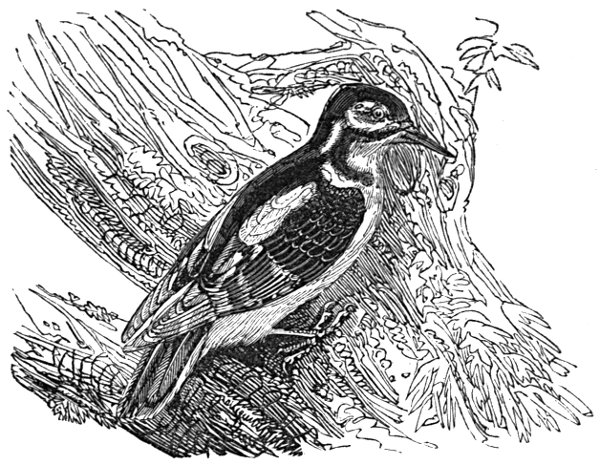
Of these only three or four kinds are found in Great Britain. Their characters are striking, and their manners singular. The bill is large, strong, and fitted for its employment: the end of it is formed like a wedge, with which it pierces the bark of trees, and bores into the wood in which its food is lodged. Its neck is short and thick, and furnished with powerful muscles, which enables it to strike with such force as to be heard at a considerable distance: its tongue is long and taper; at the end of it there is a hard horny substance, which penetrates into the crevices of trees, and extracts the insects and their eggs which are lodged there: the tail consists of ten stiff, sharp-pointed feathers, bent inwards, by which it supports itself on the trunks of trees while in search of food; for this purpose its feet are short and thick, and its toes, which are placed two forward and two backward, are armed with strong hooked claws, by which it clings firmly, and creeps up and down in all directions.—Bewick.
Woodpigeon, s. A wild pigeon; one that builds in trees.
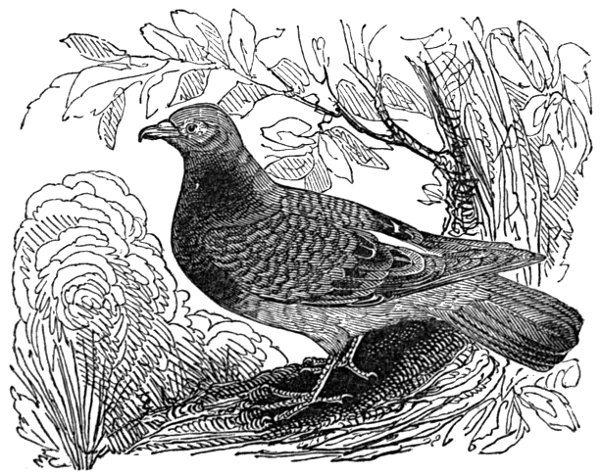
This species weighs about twenty ounces; length eighteen inches. The bill yellowish; irides light yellow; the head, coverts of the wings, and scapulars are of a deep bluish ash colour; the neck and breast vinaceous, beautifully glossed with green and copper colour, changeable in different lights; on each side the neck is a large patch of glossy white, which almost joins behind; the back and tail ash colour, the latter black at the end; vent and thighs white, tinged with ash colour; the bastard wing almost black, behind which a few of the coverts are white, forming a line down to the greater quills, which are dusky, edged with white; the legs are feathered much below the knee, which, with the feet, are of a purplish red. There is little or no distinction in the plumage of the sexes; but the female is not quite so large.
Woodward, s. obs. A forester.
A subject who has lived within a forest, according to usage, ought to have a woodward; and if he does not appear at the justice seat, the wood shall be seized into the king’s hands, till he makes fine and replevy it; and if he do not replevy it within a year, it shall remain in the king’s hands for ever.
Wool, s. The fleece of sheep, that which is woven into cloth; any short thick hair.
Woolly, a. Consisting of wool; clothed with wool; resembling wool.
Worm, s. A small harmless serpent that lives in the earth; a poisonous serpent; animal bred in the body; the animal that spins silk; grubs that gnaw wood and furniture; anything vermiculated or turned round; anything spiral; a favourite bait in angling.
When the day is dark or lowering, and a gentle whistling wind plays on the water, or a fine mizzling rain falls without violence; likewise when trout leap out of the water, and pike shoot after other fishes; and also when a sudden shower has mudded and raised the water, if the angler tries on the sides of the stream at the ground, with brandling, gilt tail, or red worm, well scoured, he will have diversion.
The ash grub or bank-worm is plump, milk white, and bent round from head to tail, with a red head, resembling a young humble bee, and is exceedingly tender; it is found under the bark of oak, ash, birch, or alder, especially if they lie a year after they are felled; it is also met with in the body of a rotten alder, when broken in pieces, but care must be observed in breaking the tree, that the worm is not crushed; it is sometimes found under the bark of an old decayed stump of a tree. It is best kept in bran, and will by that means be made tougher; but at the best they are so tender, that great caution must be observed in their use; the hook, which must be armed with a bristle to prevent its slipping down, should be introduced under its head, and guided down the middle of the belly, without suffering it to break the skin in its passage (for if it does, water and milk will issue from the wound, until nothing but the skin remains, when the bent of the hook will appear black through it), until the point of the hook comes so low that the head of the grub may rest on the bristle that projects to hold it; it will be thus defended from slipping off by its own exertions, nor will the force of the stream or quick pulling it out of the water, strip it off.
The brandling worm is streaked from head to tail in alternate red and yellow circles; is dark at the head; becomes gradually paler towards the tail. Brandlings are found in old dunghills which consist of hogs’ and horses’ dung and rotten earth; also in old thatch and dung; in grass mown from garden walks after it has lain some time: but those which are found in tanners’ bark, after being used and laid by until quite rotten, are the best, and may generally be used without any scouring. When brandlings are kept in mosses like the lob-worm, they should be fed by dropping a little cream, about a spoonful a day, upon the moss; it will prevent their swelling at the knot near their middle, which, when it takes place, usually kills them. With some anglers it is a rule not to use these worms and the gilt tail until they have been in moss two days, nor after they have continued in it more than ten.
The short white worms or bobs are of two sorts: the one found in mellow, heathy, sandy soils, and is easily gathered by following the plough in autumn, when such ground is first broken up from grazing; also by digging one spot deep in the above described lands sufficient may be got. Those of this class are called the earth bob, white grub, or white bait, and are as big again as a gentle; have a pale red head, very soft all over, are yellowish at the tail, and their bodies when taken in some degree resemble the colour of the earth where found in, but when scoured are of a pale white. They are an excellent winter bait, and to preserve them they should be put into a large earthen pot with some of its own earth, with dryish moss at the top, and set in a warm place.
Dunghill red worms are small and knotted, of a bright red, and are to be found almost in every heap of horsedung that has much straw rotted in it. Cowdung red worms are found in the fields, and in nearly dry flakes of dung; their heads are shining dark brown, with flat tails, are good baits, and may occasionally be used when taken, but are best scoured and preserved, like other worms.
The dock or flag-worm is of the colour of a gentle, when scoured, but is longer and slenderer in his make, with rows of feet down his belly, and a red head. They are found by pulling up the flags growing round an old pond or pit, shaking the roots in the water, and when free from dirt, amongst the fibres that spread from the roots, will be seen little husks of a reddish or yellowish colour; these must be opened very cautiously with a pin, and the worm either used immediately, or dropt into some bran to carry them, where they may be preserved in the same manner as the cad-bait; they sometimes insinuate themselves into the body of the round stalk of the flag.
The long dock-worms are of a fine pale red, without knots; are chiefly found in moist places, near dock-roots, and are best taken by shaking the earth with a dung-fork. They are excellent baits, especially for carp and tench. In the hollow parts near the roots of the largest sort of sedges, may be found a large black-headed grub, about an inch long, and which is not to be found in any other place; it is a famous bait for pond-fishing, though extremely tender; but by putting them into boiling milk for about two minutes, the morning you mean to use them, they will be rendered tougher.
Gilt-tails are paler and larger than the last-mentioned worms; are knotted like them, are of a pale yellow, especially towards the tail.
The marsh-worms are middle-sized and knotted; are of a bluish cast and tender; are to be found in the rich banks of rivers, and in marshy ground, wherein they are usually got by treading the ground when it is moist, much backwards and forwards, or in circles, with both feet close together; they require more scouring in moss than most other worms, at least fifteen days, but are very lively good baits.
White or marl worms are found chiefly in marl or clay land by following the plough, and also in turnip fields, where the soil is of a stiffish quality; the head is very small, and of a pale red; they are larger than the brandling, and naturally tough, are a good bait, especially in muddy water; may be preserved in some of their own earth, keeping it properly damp; with some moss at top, and when scoured are of a pale white.
The red worm is found in all loamy soils; may be collected by following a plough, turning up garden soil, and under boards, bricks, slates, tiles, stones, &c. that have lain undisturbed for any time: these four worms may be preserved together in one pot, and when the brandling or others are meant to be used, let the angler, the evening before, pick them out by themselves, and put them into a bag, with moss moistened with sweet thinnish cream, and they will appear more bright and tempting to the fish.
The tag-tail is a worm of a pale flesh-colour, with a yellow tag, almost half an inch long: it is found in marled land or meadows, after a shower, or in the morning, in calm and not cold weather in March and April. In discoloured water by rain, it is considered a fatal bait for trout. They will not endure long scouring.
A three-prong dung-fork thrust into the ground, and continually moving it, will force all the worms within a certain distance to come instantly out of their holes; supposing, from the shaking of the earth, it is the mole’s heaving to come at them.
Get a parcel of cow or horse-hair, and cut it five or six inches long, into a pan; throw the worms upon it, and in a couple of hours they will have cleared themselves from the chief of their dirt; take them from amongst the hair, observing that none of it sticks to them, and selecting out the dead or wounded worms; clean the pan from the hair and filth, and put the worms into it, covering them with garden mould, about an inch thick: they will keep a very long time in this manner, moistening it once a day with new milk, and changing it every month, to prevent the growth of young worms, which would occasion the death and decay of the old.
Amongst the old recipes for scouring worms, the putting them into a powder got from a dead man’s skull, by beating it to atoms, was deemed super-excellent.
When worms are wanted for immediate use, and no provision has been made, the way to scour them quickly, is, if lob-worms, to put them all night in water; brandlings must not remain above one hour in it, and both sorts must be then put with fennel into the angler’s worm-bag.
Worms of different kinds inhabit the intestines; but except when they exist in very great numbers, they are not so hurtful as is generally supposed, although the groom or carter may trace to them hidebound, and cough, and loss of appetite, and gripes, and megrims, and a variety of other ailments. Of the origin or mode of propagation of these parasitical animals we will say nothing; neither writers on medicine, nor even on natural history, have given us any satisfactory account of the matter.
The long white worm (lumbricus teres) much resembling the common earth-worm, and, being from six to ten inches long, inhabits the small intestines. It is a formidable looking animal, and if there are many of them, they may consume more than can be spared of the nutritive part of the food, or the mucus of the bowels; and we think that we have seen a tight skin, and rough coat, and tucked up belly, connected with their presence. They have then, however, been voided in large quantities, and when they are not thus voided, we should be disposed to trace these appearances to other causes. A dose of physic will sometimes bring away almost incredible quantities of them. Calomel is frequently given as a vermifuge. The seldomer this drug is administered to the horse the better. It is the principal ingredient in some quack medicines for the expulsion of worms in the human subject, and thence, perhaps, it came to be used for the horse; but in him we believe it to be inert as a vermifuge, or only useful as quickening the operation of the aloes. When the horse can be spared, a strong dose of physic is an excellent vermifuge, so far as the long round worm is concerned; but perhaps a better medicine, and not interfering with either the feeding or work of the horse, is two drachms of emetic tartar, with a scruple of ginger, made into a ball, with linseed meal and treacle, and given every morning half an hour before the horse is fed.
A smaller, darker coloured worm, called the needle worm, or ascaris, inhabits the large intestines. Hundreds of them sometimes descend into the rectum, and immense quantities have been found in the cœcum. These are a more serious nuisance than the former, for they cause a very troublesome irritation about the fundament, which sometimes sadly annoys the horse. Their existence can generally be discovered by a small portion of mucus, which hardening, is converted into a powder, and is found about the anus. Physic will sometimes bring away great numbers of these worms; but when there is much irritation about the tail, and much of this mucus, indicating that they have descended into the rectum, an injection of a quart of linseed oil, or of an ounce of aloes dissolved in warm water, will be a more effectual remedy.
The tape worm is seldom found in the horse.
Worms are most commonly found in the bowels and stomach; but they are sometimes met with also in almost every part of the body. The worms commonly found in the stomach are named botts. They are generally attached to the cuticular or insensible coat of the stomach; but sometimes clusters of them are found at the pylorus, and even in the beginning of the first intestine, named duodenum. In one case they were so numerous in this last situation as to obstruct the passage completely, and cause the animal’s death. Botts are short thick reddish worms, surrounded with short prickles, which are arranged in circular bands all over the body. They attach themselves firmly by two hooks, which they appear to have the power of straightening and retracting, of projecting and curvating. They are extremely tenacious of life, and difficult to be expelled from the stomach, except about the month of September, or when a horse is taken up from grass. At this period they may generally be got rid of by brine, or a solution of common salt in water, in a dose of from four to five ounces of salt to a quart of water. The horse should be kept fasting the night before it is given; and about five minutes before the drench with salt is given, let the horse be drenched with about a pint of warm milk, sweetened with honey or treacle.
Mercurial physic seems to be generally considered the most effectual, especially when a little calomel is given for two or three successive nights, and followed up by a dose of physic. I have seen small doses of aloes given daily, about two drachms, with good effect. Oil of turpentine is a powerful vermifuge, if given after some hours’ fasting, and when the bowels have been brought into a lax state by giving bran mashes for two or three days, or a small dose (about three drachms) of aloes the day before.
This previous fasting, as well as keeping the horse without food two hours after, is necessary to the success of this remedy. In a few instances, oil of turpentine has produced alarming symptoms; and in one case, where a horse had taken a mild dose of physic the day before, it brought on almost immediately a fatal inflammation of the stomach and bowels. On the other hand, a great number of cases have been reported to me in which it has been given with the best effect. I should be inclined, however, to try the mercurial purgative first; but even this, in the horse, is attended with some danger, unless he is managed judiciously before, and during its operation. The third remedy is of a milder nature, but often, I believe, inert; that is, bitter vegetables, such as rue, box, savine, &c., which are chopped up and given with the horse’s corn. Ethiop’s mineral, levigated antimony, emetic tartar, very small doses of arsenic and calomel, have each of them sometimes succeeded. But, whatever worm medicine is given, the horse should be kept without food for several hours, or the whole night before, and two hours after. Chopped horse-hair has been given with success, and brine, or a solution of common salt. In one case, a great number of worms were discharged by fasting the horse during the night, and giving him a malt mash in the morning. Another method is to keep the horse without food during the night, and give him in the morning a quart of new milk sweetened with honey, and about ten minutes after, four, five, or six ounces of salt in a quart of water. A run at grass in the spring is, perhaps, the best remedy of all, for it is the most effectual means of invigorating the digestive organs, and purifying the blood. When it is not convenient to turn the horse out, he should be soiled in the stable with vetches. The most certain indication of worms, except that of their being discharged with the horse’s dung, is a yellowish or brimstone-coloured stain under the fundament. Sometimes worms produce symptoms of an unusual kind, as in the following case:—A horse was observed for some time to fall off in flesh and become weak, and, upon attempting to mount him, he shrunk and gave way in the back, as if he had received some severe injury in that part; they gave him, however, a dose of mercurial physic, which brought off a lump of worms and viscid mucus as large as a man’s fist. After this the horse was perfectly free from pain in the back, and quickly recovered his flesh and strength. I have heard of a horse being cured of worms, when reduced by them to such a degree of weakness that he was thought incurable, by being turned into a field of young vetches. Powdered tin has been recommended for worms, and may be given without danger in a dose of three or four drachms made into a ball with flour and honey. With regard to the short red worms, named botts, so often found in the horse’s stomach, adhering in large clusters, most commonly to the insensible coat, but sometimes to the pylorus, the most likely means of expelling them is to give a drench of salt and water in the manner before prescribed; that is, to keep the horse without food during the night, and in the morning to give him a quart of new milk sweetened with honey; about ten minutes after this drench is down, the drench of salt and water is to be given. This remedy should be employed in September, or soon after a horse is taken from grass. Botts are so often found in the horse’s stomach, that they have been supposed to do no harm; it is certain, however, that they sometimes produce the most serious diseases. They sometimes cause ulceration and sloughing of the stomach, inflammation of the lungs and heart, and frenzy or mad staggers. According to Gibson they sometimes cause locked-jaw. Botts appear to be the larvæ of a fly, and are probably eaten with grass or hay. According to Mr. Bracy Clark, the fly deposits its eggs on the horse’s coat; and, when they are about to be hatched, the horse licks them off, so that they are hatched by the warmth of the mouth and the moisture of the saliva, and then swallowed. Mr. Feron says he has paid particular attention to this subject, and has found that, when in large quantities, they are very destructive to horses; that he has seen several horses whose stomachs had been pierced quite through by them, the botts making their way into the abdomen. He thinks they are taken in with the horse’s forage, whether dry or green, as they are found in horses that have not been at grass for several years, but that they may also be licked in from the horse’s coat. He is of opinion that botts, when once attached to the stomach, may remain there during the horse’s life, and it is only when they become too numerous that they are forced off and discharged by the bowels. Mr. James Clarke relates a case of a horse’s stomach being perforated by botts. I have seen several horses destroyed by botts. In some of them, they caused inflammation of the lungs; in one frenzy, or mad staggers. In one horse the pylorus was completely plugged up with them. There is a remarkable sympathy or consent between the stomach and the lungs, and it is owing to this that they sometimes cause inflammation of the lungs. In the cases which have occurred in my practice, the most remarkable circumstance was the great depression they occasioned, and the inefficacy of copious bleeding. Castor oil seemed to do more good than anything, and Mr. Feron remarks that common oil, given in large quantities, has sometimes succeeded in detaching botts from the stomach; and he adds, it is the only medicine that seems to have any effect in making them lose their hold from the stomach. There is a kind of worm I have often met with since I have practised in Somersetshire, especially at Oakhill, which appears to do a great deal of mischief. When drawn out, they are from one to three or four inches in length, from one to two eighths of an inch in breadth, and scarcely of any thickness; they have numerous transverse lines close to each other, like those of the leach, and adhere firmly to the bowels by one of their extremities. When viewed through a microscope, the transverse lines appear as upright scales applied very near to each other, and inclining, I think, a little forwards; the extremity, by which they adhere to the gut, appears as a bulb with holes in it; the other extremity is square, as if it had been cut off transversely. These worms are generally of a white colour, and sometimes drawn up or contracted so as to appear as a flake of mucus, or fat, of about half an inch in length. I have seen them of a darker colour in horses that were in a state of great poverty, and sometimes reddish, as if containing blood. In many dogs and cats that have been opened at Oakhill, they have been almost invariably found; and they have been discharged, in this village, from the bowels of men and children. They are found both in the small and large bowels, most commonly in the former, and near the part where the ilium terminates in the cœcum. At Easton, near Wells, this worm has been seen swimming in a small stream that runs through the village, from which it is probable that their natural habitation is water, and that they are swallowed while the animal is drinking, and are capable of living in the bowels.
Method of worming dogs.—Secure a large dog on his back on a table, bench, or form; one of a middling size may be held in the lap of an assistant; a small one may be conveniently taken into that of the operator. The mouth being held open by means of two pieces of tape—one embracing the part immediately behind the upper, and the other that posterior to the lower canine teeth—draw the tongue from the mouth, when, exposing its under surface, a cuticular fold or eminence will present itself, occupying its median line from the point to the base: open this with a lancet through its whole extent, which will expose a minute fibrous cord. Pass a blunt-pointed probe under it, and, carrying the instrument from one end to the other, detach the cord from its adhesions; which done, divide it at one extremity, and carefully drawing it forwards with a tenaculum, divide the other also. The uninitiated in sporting mysteries may smile at all this minuteness of detail, and recommendation of caution, in the division of a line of skin, and the extraction of a thread of ligament; but all this is actually necessary to satisfy the prejudices of those who put faith in the operation. For with them it is essential to the prospective benefits of it, not only that the whole of the worm (for which read frænum) should be extracted, but that, if possible, it should be done in one continuous mass.
In the removal of this cord by huntsmen, game-keepers, &c., the violence used in stripping it off, puts its fibrous substance so much on the stretch, that when extracted, its elasticity making it recoil, gives it somewhat the character of the contraction of a dying worm; and we may yet read of this appearance, and its general form, being adduced as proofs of its vermicular identity. And although now no informed person gives credence to its being other than a portion of the canine tongue; yet there are many sporting characters of education and ability, who still lend themselves to an opinion that there is some enigmatical property inherent in this part, which renders its retention dangerous, by making the unwormed dog the subject of acute rabies, but the wormed one the subject of the dumb variety. Of a piece with this palpable error was that of Marochetti’s vesicles in the same vicinage; which being also with him the hiding-place of the rabid virus, it became as necessary, according to his doctrine, to destroy them as it was with the ancients (and yet remains with some of the moderns) to remove the worm.
Of these worms which appear indigenous to the intestines of the dog, the tænia, or tape worm, from its flat figure, is the most prejudicial, and the most difficult to remove. I have known four or five hundred joints (each a distinct animal) passed by a dog, whose united length would encircle his body many times. Sometimes they become coiled up into a ball, which thus forms an impenetrable obstruction within the intestines, and destroys the dog.
The teres, or long cylindrical worms, resembling earthworms in figure, but of a whitish colour, are the most common to dogs; and, when existing in great numbers, particularly in puppies and young ones, sometimes prove fatal by the convulsions they occasion. In distemper they greatly aggravate the symptoms; so much so, that to destroy them frequently cures the dog. The natural situation of these worms is within the intestines, but they sometimes crawl from them into the stomach, and are then brought up by the sickness they occasion.
The ascarides, or small thread-worms, likewise occasionally infest dogs, residing principally within the rectum. They produce an intolerable itching behind, to relieve which those troubled with them are seen continually drawing the fundament along the ground. Except by the irritation occasioned, which may weaken when it is excessive, they do not appear to do much internal injury. The constitution of some dogs appears particularly favourable to the generation of worms; for, destroy them as often as you will, they soon return again. Puppies, during every stage of their growth, are very liable to them; in many, the increase of the body appears checked by their ravages.
The presence of worms, when they exist in considerable numbers, is easily detected; for such a dog has usually a slight cough, his coat stares, he eats voraciously, yet seldom fattens: his evacuations prove also a most unequivocal symptom, for they are, in such cases, peculiarly irregular, being at one time loose and slimy, and at another more hard and dry than natural. The belly likewise is often tense and enlarged. When very young dogs have worms, the first that pass are seldom noticed, for they seem to affect the health but little; but gradually, as they increase, purging becomes more frequent; and the animal, though lively, becomes emaciated; his appetite is often irregular, his nose hot and dry, and his breath fœtid. The growth likewise appears stationary, and in this way it is very common for him to continue till a fit or two carries him off, or he dies tabid. In adult dogs worms are less fatal, though, from the obstructions they form, they sometimes kill them likewise; and they always occasion a rough unhealthy coat, with a hot nose and fœtid breath; and in both the young and the full grown, they occasionally produce epileptic fits. It does not follow, because no worms are seen to pass away, that one who exhibits the other symptoms of them has none; neither, when they are not seen, does it follow even that none pass; for, if they remain long in the intestines after they are dead, they become digested like other animal matter.
The treatment of worm cases in dogs has been like that of the human, and the remedies employed have been intended either to destroy the worms within the body, or otherwise to drive them mechanically, as it were, out of the bowels by active purgatives; but, as these latter means were violent (for, without the very mucus of the bowels, as well as the fæces, were expelled, no benefit was derived from them), so the remedy, in many instances, became worse than the disease. Many substances have, therefore, been tried in hopes of destroying these animals within the body; and it is evident that any thing that could certainly do this would be most important, as it would obviate the necessity of having recourse to the violent purgative means heretofore employed.
For this purpose, substances which present small spiculi, or points, have been found the best adapted for the destruction of worms, by abrading their external or internal surfaces, and that without in the slightest degree injuring the patient. Among huntsmen and gamekeepers glass, very finely powdered, is a very favourite remedy. An old man of this description, in Buckinghamshire, was famed for worm-killing in dogs, and his only means used was glass finely powdered, and given as a ball. Mr. Youatt also recommends the same. If this should be objected to, from what I believe to be a groundless fear, that it is dangerous, try the following:—
Cowhage (dolichos pruriens, Linn.) half a drachm.
Tin filings or iron, made with a very fine file 4 drachms.
Form into four, six, or eight balls, and give one every morning; after which, a mercurial purgative will be proper. I have occasionally succeeded, in very obstinate worm cases, by moderate daily doses of Epsom salts. Ascarides are best destroyed by soap or aloetic clysters. The tape-worm is not unfrequently removed by mercurial purges; but a still more certain remedy for this noxious guest is such doses of the oil of turpentine as a dog could safely take, remembering that dogs bear very little of it: to some, however, it proves much less hurtful than to others. A small dog might be tried with half a drachm, given night and morning, mixed with the yolk of an egg, for a few days: a larger two scruples, and the largest a drachm, beginning always with a very small dose, and increasing it, if it produce no disturbance.—Daniel—The Horse—White—Blaine.
Wormeaten, a. Gnawed by worms, worthless.
Wormwood, s. A plant.
Wormy, a. Full of worms.
Wound, s. A hurt given by violence.
Wounds, bruises, and other injuries, may happen in various ways, by kicks, by bites, in leaping over hedges or gates, by kicking against stalls, and many other ways. Various names have been applied to such injuries, according to the manner in which they are inflicted; but there is no occasion for such distinctions: they are all bruises or contused wounds, and all require to be poulticed or fomented. It is to be observed, that, in all injuries of this kind, whether wounds or bruises, or both, the horse should be immediately bled freely, and have his bowels opened by a dose of physic. The diet also should be attended to, allowing only a very moderate quantity at first of grass, or bran mashes. In all those cases poultices are by far the best remedy, until the inflammation is completely subdued; and when the situation of the part will not admit of a poultice, which is seldom the case, then fomentations of warm water only, almost constantly applied, are the best substitute. When inflammation has quite ceased, which may be known by an abatement of the pain and swelling, and by the appearance of white matter, the poultice may be discontinued, and then the wound should be carefully dressed to the bottom with a tent of tow, dipped in melted digestive ointment. The cavity is not to be filled with the tent, but it must be introduced to the bottom, and then the wound will heal as it ought; whereas, if it is dressed superficially, or only syringed, it will often close over at the surface, and the wound appear healed, while the matter is spreading and doing mischief at the bottom. There are four obstacles to the complete healing of wounds which sometimes occur, and these are, when the wound has been complicated with an injury of a bone, a ligament, a cartilage, or a tendon. In either of these cases the fleshy parts and skin will generally heal readily, and the wound will appear nearly or quite healed, except a small or minute orifice, from which a little matter oozes; and this orifice is not perceptible, being covered with spongy flesh, until a probe is introduced; it will then be found that there is a sinus running down to the bottom of the original wound, and there the probe will be resisted by the diseased bone, ligament, cartilage, or tendon. The bone may be easily distinguished by the sensation conveyed to the hand through the probe; and when this is felt a free opening should be made, if the situation of the wound will admit of it, and the diseased surface scraped off. A tent of friar’s balsam should then be introduced, and continued until it is cured. If the first scraping has not been freely performed, a second may be necessary. Sometimes sinuses, or pipes, as they are termed, remain after the inflammation of wounds has subsided. If these are superficial, running under the surface, or nearly horizontally, they require to be laid open, and then they heal readily. Sometimes they run obliquely inward, or perpendicularly, and then require to be dressed at first with stimulating or even caustic tents, of solution of blue vitriol; and these must be repeated until the sides of the sinus have sloughed off, and the very bottom of the wound can be distinctly felt. In all complicated ulcers of this kind, where the sinus runs in a winding or crooked direction, or where there are two or more sinuses, the caustic tents must be repeated until they are brought to the state of one simple sore, the bottom of which can be distinctly felt; and if the bottom happen to be bone, it must be scraped freely and dressed with friar’s balsam. A good method of destroying such sinuses is to take some corrosive sublimate, or finely pulverised blue vitriol, and fold it up in a long narrow slip of thin whity-brown paper; this being neatly folded may be twisted at each end, and may thus be conveniently introduced into the sinuses, and forced to the very bottom with a long probe. Several small particles of this kind may be made and forced in one after another, until all the sinuses are completely filled. By these means a large core or slough will be brought out in four or five days; and if the sinuses are not then so destroyed that the bottom can be ascertained, the same dressing must be repeated.
There is a class of punctured wounds that will not admit of the treatment I have described; these are punctured wounds of the sheath of tendons, and the capsular ligament of joints. Such wounds often happen about the fetlock and hock joint, or in the sheath of the flexor tendon, or back sinew; and these are often attended with considerable inflammation and swelling. It will not be proper to introduce tents into such wounds, or to irritate them by probing: emollient poultices are considered the remedies for such wounds; but they do not always succeed; I have in several cases found it necessary to touch the wound with lunar caustic, before I could procure any abatement of the inflammation and swelling, and I am inclined to believe that this had better be done on the first occurrence of such wounds. The caustic should be scraped off to a point, and introduced within the wound about the eighth of an inch or a little more; it should then be moved round a little, and withdrawn. I have seen a punctured wound in the fore leg, near the fetlock joint, get well rapidly after this had been done; though emollient poultices and fomentations had been carefully employed for several days before without doing the least good; on the contrary they were doing harm, for the inflammation, pain, and swelling, certainly increased while they were employed. But the caustic seemed to operate almost as a charm; for the leg got well in two or three days after it was applied. I have seen a similar good effect from it in a punctured wound of the hock joint.
In lacerated wounds, as they are termed, the skin is often much torn, and so are the muscles or flesh. Now the muscles must never be stitched up, on any account whatever; the skin only is to be stitched or sewed up, and that will rarely be of any use in the horse, as union by the first intension, I believe I may venture to say, can never be accomplished in the horse, except in one situation, and that is in the forehead, when the skin has been torn neatly down or up and not bruised. When the skin of a lacerated wound has been stitched up, the stitches always give way, and the wound is completely open again by the fifth day, and then the flap of skin may as well be removed, for it never will unite. The scar will then be much less than a person would imagine, for the skin and hair will be in a great measure regenerated, and scarcely any blemish will be left.
Bruises always require to be poulticed, and there is scarcely any situation where this cannot be done, if a person will but take a little trouble about it. If, however, it cannot be done, a fomentation is the best substitute. For bruises on the back the old farriers employed a greasy dish-clout, and this, next to a poultice, is perhaps the best remedy; for the cloth has been so softened by almost constant maceration in water, and is so completely imbued with grease, that it really becomes a good emollient application, and only requires to be kept wet. By this treatment bruises will be generally brought to suppuration, and if they are capable of being dispersed, poultices are the best means of effecting it. When a bruise has been brought to suppuration, or has thrown off a slough, it may then be considered as a wound or rather ulcer, for such wounds do become when they have suppurated, and must be treated according to the directions I have given under that head. These are all the instructions necessary to be given for the treatment of wounds and bruises. I think there is no occasion here for the classification and distinctions that are employed in human surgery; and it will be found, I trust, that what has been said on the subject, will be sufficient for every accident that may happen.
When a horse becomes suddenly lame, after the legs have been carefully examined and no cause of lameness appears in them, the shoe should be taken off. In many cases the offending substance will be immediately detected, or the additional heat felt in some part of the foot will point out the seat of injury; or, if the crust be rapped with the hammer all round, the flinching of the horse will discover it; or pressure with the pincers will render it evident.
When the shoe is removed for this examination the smith should never be permitted to wrench it off, but each nail should be drawn separately, and examined as it is drawn, when some moisture appearing upon it will not unfrequently reveal the spot at which matter has been thrown out. In the fore-foot the injury will generally be found on the inner quarter, and on the hind foot near the toe, these being the thinnest parts of the fore and hind-feet.
Sudden lameness occurring within two or three days after the horse has been shod will lead us to suspect that the smith has been in fault; yet no one who considers the thinness of the crust, and the difficulty of shoeing many feet, will blame him for sometimes pricking the horse. His fault will consist in concealing or denying that of which he will almost always be aware at the time of shoeing, from the flinching of the horse, or the dead sound, or the peculiar resistance that may be noticed in the driving of the nail.
When the seat of mischief is ascertained, the sole should be thinned round it, and, especially at the nail-hole or the puncture, it should be pared to the quick. The escape of some matter will now probably tell the nature of the injury, and remove its consequences. If it be puncture of the sole by some nail, or any similar body, picked up on the road, all that will be necessary is a little to enlarge the opening, and then to place on it a pledget of tow dipped in friar’s balsam, and over that a little common stopping; or, if there be much heat and lameness, a poultice should be applied.
The part of the sole wounded and the depth of the wound will be taken into consideration. It will be seen that a deep puncture towards the back part of the sole, and penetrating even into the sensible frog, may not be productive of serious consequence. There is no great motion in the part, and there are no tendons or bones in danger. A puncture near the toe may not be followed by much injury. There is little motion in that part of the foot, and the internal sole covering the coffin-bone will soon heal; but a puncture about the centre of the sole may wound the flexor tendon where it is inserted into the coffin-bone, or may even penetrate the joint which unites the navicular bone with the coffin-bone, or pierce through the tendon into the joint which it forms with the navicular-bone, and a degree of inflammation may ensue, which, if neglected, may be fatal. Many horses have been lost by the smallest puncture of the sole in these dangerous points. All the anatomical skill of the veterinarian should be called into requisition, when he is examining the most trifling wound of the foot.
If the foot has been wounded by the wrong direction of a nail in shoeing, and the sole be well pared out over the part on the first appearance of lameness, little more will be necessary to be done. The opening must be somewhat enlarged, the friar’s balsam applied, and the shoe tacked on, with or without a poultice, according to the degree of lameness or heat, and on the following day all will often be well. It may, however, be prudent to keep the foot stopped for a few days. If the accident has been neglected, and matter begins to be formed, and to be pent up and to press on the neighbouring parts, and the horse evidently suffers extreme pain, and is sometimes scarcely able to put his foot to the ground, and much matter is poured out when the opening is enlarged, further precautions must be adopted. The fact must be recollected that the living and dead horn will never unite, and every portion of the horny sole that has separated from the fleshy sole above must be removed. The separation must be followed as far as it reaches. Much of the success of the treatment depends on this. No small strip or edge of separated horn must be suffered to press upon any part of the wound. The exposed fleshy sole must then be touched, but not too severely, with the butyr (chloride) of antimony, some soft and dry tow placed over the part, and the foot stopped, and a poultice placed over all, if the inflammation seems to require it. On the following day a thin pellicle of horn will frequently be found over a part or the whole of the wound. This should be, yet very lightly, touched again with the caustic; but if there be an appearance of fungus sprouting from the exposed surface, the application of the butyr must be more severe, and the tow again placed over it, so as to afford considerable yet uniform pressure. Many days do not often elapse before the new horn covers the whole of the wound. In these extensive openings the friar’s balsam will not often be successful, but the cure must be effected by the judicious and never too severe use of the caustic. Bleeding at the toe and physic will be resorted to as useful auxiliaries when much inflammation arises.
In searching the foot to ascertain the existence of prick, there is often something very censurable in the carelessness with which the horn is cut away between the bottom of the crust and the sole, so as to leave little or no hold for the nails, while some months must elapse before the horn will grow down sufficiently far for the shoe to be securely fastened.
When a free opening has been made below, and matter has not broken out at the coronet, it will rarely be necessary to remove any portion of the horn at the quarters, although we may be able to ascertain by the use of the probe that the separation of the crust extends for a considerable space above the sole.
Dogs are liable to become wounded in various ways, and their wounds, however bad, are not, generally much attended to, from an opinion that the animal’s tongue is the best dressing. This is very questionable: in some instances, I am certain, no application can be worse to a wounded dog than his own tongue. Whenever dogs are at all inclined to foulness, as a tendency to cuticular complaints is called, a sore, so licked, is sure to become mangy, and to be aggravated by the licking.
Wounds in the chest or belly should be closed up as soon as possible, to prevent the external air from penetrating: a stitch or two made in the integuments is proper; over which some adhesive plaster, and a bandage over that, may be applied. If the intestines protrude in a wounded belly, and the bowels are themselves wounded; first, neatly stitch up the intestinal opening, and return the gut; then close the wound in the integuments, leaving the thread which united the gut, if long enough, hanging without the external wound.
In wounds of arteries or veins, the hæmorrhage should be stopped by pressure: should that not succeed, take up the vessel with needle and thread. Wounds into joints occur from cuts, and often from stabs: great inflammation is apt to follow, and the dog is often lamed for life. If the synovia escapes by a very minute puncture, and the inflammation is not yet very extensive, treat exactly as in horse practice, by firing with the budding iron. If the wound be a lacerated one, and not already much inflamed, place over it a pledget of lint, and over that a thick paste of linseed meal; after which bandage the whole up moderately tight. Should the inflammation be great, reduce that by a common poultice, and then endeavour to close the joint as above.
In all extensive and lacerated wounds, a stitch or two should be made with a large needle and thread, as it will reduce both the sore and the scar; but as such stitches soon ulcerate out in the dog, so the edges should be still further secured by slips of sticking-plaster. A recent wound should be cleansed from the dirt, and then covered up; when it begins to suppurate, dress with any mild ointment. In thorn wounds, or others made with splinters, carefully examine that nothing is left within them; otherwise no attempts to produce healing will prove successful. The most common wounds in dogs arise from the bites of others; and, under any such circumstance, should any suspicion arise that the dog was mad by which the wounded one was bitten, proceed as directed under Rabies. The wounds arising from common bites, in general soon heal of themselves. If, however, they are very extensive, wash them with friar’s balsam, to prevent their becoming gangrenous.
For a wound from shot.—Oil of turpentine, oil of camomile, and aqua vitæ, of each two ounces, and half a pint of linseed oil, well mixed together. A second is goose grease, melted and strained through a sieve, and an equal quantity of best spirits of wine and spirits of turpentine: of the three articles put rather most of the goose grease, which must be fresh, and strained quite clear and fine.—White—The Horse—Blaine—Daniel.
Wren, s. A small bird.
Wrench, s. A violent pull or twist; a sprain.
Wrestle, v. To contend who shall throw the other down; to struggle; to contend.
Yacht, s. A small ship anciently used for carrying passengers; a private vessel of pleasure.
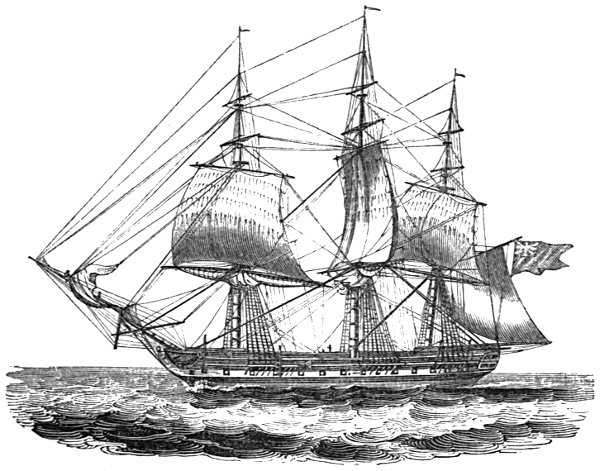
LORD YARBOROUGH’S YACHT.
The Royal Yacht Club, at the present time, has about five hundred and eighty-eight persons on its lists, of which one hundred and thirty-six are members, and four hundred and fifty-two are honorary members. Of the former number about one fifth are peers, twelve baronets, four knights, three generals, three colonels, eight captains, two clergymen, and seventy-nine private gentlemen. Among the latter (honorary members) we find nineteen admirals, twenty-nine vice-admirals, thirty-one rear-admirals, and three hundred and sixty-two captains, independently of eleven eminent civilians, who head the list. The number of yachts is one hundred and nine—of which eighty-seven are cutters, ten schooners, three brigs, four yawls, two ships, two ketches, and one lugger. The greater part of these vessels belong to Cowes and to Southampton, the rest being distributed among the different ports of the three kingdoms. The shipping belonging to the club amounts to 7250 tons. Now, at a moderate computation, each vessel carries ten men on an average; this gives us the total number employed by the club, one thousand and sixty. During the summer months, then, while regattas are celebrated, we may say that the Royal Yacht Club alone supports more than eleven hundred men. These, with some few exceptions, are discharged on the approach of winter, and the yachts are laid up for the season, retaining the master and one man in pay. The crews thus discharged obtain employment in merchant vessels or otherwise during the winter, and in the middle of spring are generally re-shipped in the yachts in which they have previously served. Active and industrious men of good character are always sure of constant employment in the club on these conditions; and many members justly pride themselves on the high discipline, manly bearing, and crack appearance of their crew. The situation of master is one of much responsibility, and is on all accounts respectably filled. In some of the largest craft, junior officers of the navy are found to accept this office. The Flower of Yarrow, the property of the Duke of Buccleuch, is commanded by one of the oldest lieutenants in the service, to say nothing of others, respecting which we cannot enter into particulars.
It has been already remarked, that the shipping of the club amounts to 7250 tons. Now, a vessel of one hundred tons seldom, we believe, stands the owner in less than from five to six thousand pounds, varying, of course, from that to ten, according to the ornamental parts, the internal fittings, and other contingencies. At this rate, the shipping of the club would have cost more than three millions and a half of money: but it is impossible to speak decisively on this point; for the first cost of the yachts vary so much, and the numerous styles of rig are attended with expenses so widely different, that it is idle to attempt a conclusive opinion on the subject.
Among the most active members of this club we may mention the following—but we make the selection from past remembrances, and not from any invidious distinction. Lord Yarborough is well known to the world as the commodore, and his beautiful ship, the Falcon, is admired no less for her model than the fine seamanship of her “companie.” Mr. Weld, of Lulworth, and his brother James, have been indefatigable in their exertions; and who has not heard of the Arrow, the Lulworth, and the Alarm, of the former, and the Paul Pry of the latter? Lord Belfast too, Lord Anglesea, Lord Darnley, Lord Vernon, the Rev. Denis George, Lord Clonbrook, Mr. Symonds, Lord Errol, Mr. Corbett, Lord Donegal, Lord Chesterfield, Mr. Brett, Lord Ilchester, Mr. Gibson, the Duke of Buccleuch, and many others whom we have not room to mention, are known to take a high personal interest in aquatics. Mr. Assheton Smith, a name so familiar at Melton Mowbray, seemed to love his yacht as much as he did the chace; and who is ignorant of the nautical achievements of Sir Godfrey Webster? Nor can I omit to mention the arduous attention, the unremitting exertions (to say nothing of his generous disposition), of a gentleman to whom the Yacht Club is deeply indebted for his assistance—Richard Stephens, Esq. the secretary. His indefatigable zeal and valuable aid on all occasions, and at all seasons, is beyond any praise.
The Northern Yacht Club is a highly interesting society, although its plan is not so extensive as that of the Royal Club. It contains about three hundred and fifty members. The documents for 1830, with which the commodore, J. E. Matthews, Esq. has favoured us, comprise ninety-two in the Scottish and ninety in the Irish division, with fifty-two honorary members, in addition to ninety-three members of the Cork Yacht Club, who are also entered on the honorary lists. It had, in 1830, sixty yachts, not equal in proportion to the tonnage of the Cowes club, as smaller vessels are admitted. Many R. Y. C. men are found in the Northern Club; among others, the Marquis of Donegal, Earl Belfast, the Duke of Portland, the Rev. Denis George, and Captain Kean. The commodore of the Irish division is John E. Matthews, Esq. who hoists his flag in the Water Witch, a three-masted schooner of seventy-three tons; and the Duke of Portland, in his Clown, ketch, one hundred and fifty-six, still, we believe, presides over the Scottish division. There are many fine vessels in this club. Cutters, as usual, excel in number, but there are many clippers in the shape of schooners; and what is more in a “ladye’s eye,” their names are equally pretty and well chosen.
We have now to notice the Cork Harbour Club, one of highest descent, independently of its regatta being considered the oldest in the United Kingdom. We are deficient in particulars respecting this association; but we know that it is supported by some of the first men in Ireland, and has many handsome yachts in its fleet. The Emerald Isle is highly favoured by having two powerful clubs, equally respected and respectable; and it is pleasing to see the honourable men of the north blending the names of Scotland and Ireland under the bright emblem of friendship.
We must not omit to mention the share Dublin takes in these festivals, nor pass by in silence Plymouth, with her excellent Regatta Club and Yacht Society.
At the lowest computation, the number of vessels at present employed for pleasure in this kingdom cannot be less than from three to four hundred, ranging in bulk from ten to three hundred and fifty tons. These craft are variously distributed along our shores, carrying their opulence into every port and harbour in the sister islands. But there is another advantage arising from yacht clubs, which as yet has been slightly touched upon; I mean, that national principle which to a maritime people is above all choice. The bulwarks of England are her wooden walls; and if our ships are hearts of oak, let it not be forgotten that “hearts of oak are our men” also; and we must never allow the proud feeling of naval supremacy to wither or decay. The yacht clubs, by keeping alive this feeling, feed the flame of patriotism, and uphold, with just ambition, our hopes, our honour, and our fame.
Sailing regulations of the Royal Yacht Club.—First—Members entering their yachts must send the names of them to the Secretary one week previous to the day of sailing, and pay two guineas entrance at the same time.
Second—All vessels starting or entering must be the bonâ fide property of Members, as well as spars, sails, boats, &c. &c.
Third—Each Member to be allowed to enter one vessel only for all prizes given by the Club.
Fourth—Cutters to carry four sails only, viz. mainsail, foresail, jib, and gaff-topsail:—yawls, luggers, schooners, and all other vessels in like proportion. No booming out allowed.
Fifth—No trimming with ballast, or shifting of ballast allowed; and all vessels to keep their platform down, and bulk-heads standing.
Sixth—That vessels on the larboard tack must invariably give way for those on the starboard tack; and in all cases where a doubt of the possibility of the vessel’s on the larboard tack weathering the one on the starboard tack shall exist, the vessel on the larboard tack shall give way; or if the other vessel keep her course and run in to her, the owner of the vessel on the larboard tack shall be compelled to pay all damages, and forfeit his claim to the prize.
Seventh—Vessels running on shore shall be allowed to use their own anchors and boats actually on board to get them off, afterwards weighing anchor and hoisting the boat in; but upon receiving assistance from any other vessel or vessels, boats, or anchors, shall forfeit all claim to the prize.
Eighth—That nothing but the hand-line be used for sounding.
Ninth—That any deviation from these rules shall subject the aggressor to forfeit all claim to the prize.
Tenth—That if any objection be made with regard to the sailing of any other vessel in the race, such objection must be made to the stewards within one hour after the vessel making the objection shall arrive at the starting post.
Eleventh—That no vessel be allowed to take in ballast, or take out, for twenty-four hours previous to starting, and that no ballast be thrown overboard.
Twelfth—Vessels to start from moorings laid down at a cable-length distance, with their sails set; and that every vessel not exceeding one hundred tons shall carry a boat not less than ten feet long; and vessels exceeding one hundred tons, to carry a boat not less than fourteen feet long.
Thirteenth—That there shall be a member, or honorary member, on board each vessel.
Fourteenth—The time of starting may be altered by the stewards, and all disputes that may arise are to be decided by them, or such persons as they shall appoint.—Sporting Magazine.
Yard, s. Enclosed ground adjoining to a house; a measure of three feet; the supports of the sails of a ship.
Yarwhip, s.
This species is generally rather larger than the common godwit; weight about twelve ounces; length eighteen inches; the bill is full three inches and a half long, a trifle reflected; slender; dusky towards the point; the base yellowish flesh-colour; irides hazel; the head, neck, breast, back, and the top of the head, are streaked with dusky; the back and scapulars marked with large black spots or bars; from the bill to the eye a light coloured streak; the belly and under tail-coverts white; the sides under the wings barred with dusky; the smaller coverts of the wings, on the ridge, dusky; the next inclining to ferruginous; the larger ones cinereous-brown, light at the tips; greater quill-feathers black; shafts white; the outer webs slightly edged with white half way down; inner webs white at the base; the secondary quills dusky from their points half way; base white; those next the body ferruginous, like the scapulars, barred with black; the rump and upper tail-coverts white; the two middle feathers of the tail dusky black; the rest white half way from the base; ends black; legs near four inches long, and black; the thighs bare of feathers full an inch above the knee. In some, the breast is streaked with black; others mottled rufous and white; and the upper tail-coverts barred with rufous and brown.—Montagu.
Yawl, s. A little vessel belonging to a ship for convenience of passing to and from it; a small yacht.
Year, s. Twelve months; it is often used plurally, without a plural termination; in the plural, old age.
Yearling, s. Being a year old.
Yelk, s. The yellow part of the egg.
Yell, v. To cry out with horror and agony; to cry like a beaten dog.
Yellow, a. Being of a bright glaring colour, as gold.
To dye fine rich bright Yellows.—These are the best yellows for salmon colours, as they are very strong. The gold colours, as before directed, are better for some flies. You are to get two pounds of strawall, and six ounces of turmeric: boil these in eight quarts of water; put down one pound of fur along with your dye stuff; give it an hour’s boiling, and you have a fine shade: boil on an hour longer and draw again: boil for an hour and a half, and draw again. Finish your last with two hours’ boiling, and you have four as fine high yellows as can be dyed, and fast colours.
Mr. Peter Woulfe’s Recipe for the Yellow Dye.—Take half an ounce of powdered indigo, and mix it in a high glass vessel, with two ounces of strong spirit of nitre, which should be previously diluted with eight ounces of water, for preventing the indigo being set on fire by the spirit; because two ounces and a half of strong spirit of nitre will set fire to half an ounce of indigo. Let the mixture stand for a week, and then digest it in a sand heat for an hour or more, and add four ounces more of water to it; filter the solution, which will be of a fine yellow colour. If the indigo be digested twenty-four hours after the spirit of nitre is poured upon it, it will froth and boil over, but after standing about a week it has not that property. One part of the solution of indigo in the acid of nitre, mixed with four or five parts of the water, will dye silk cloth of the palest yellow colour, or of any shade to the deepest, and that by letting them boil more or less in the colour. The addition of alum is useful, as it makes the colour more lasting; according as the solution boils away, more water must be added—cochineal, Dutch litmus, orchil, cudbear, and many other colouring substances, treated in this manner, will dye silk and wool a yellow colour. The indigo which remains undissolved in making Saxon blue, and collected by filtration, if digested with spirit of nitre, dyes silk and wool of all shades of brown inclining to yellow.
Mr. Boyle tells us a most beautiful yellow may be procured, by taking good quicksilver, and three or four times its weight of oil of vitriol. Drawing off in a glass retort the saline menstruum from the metalline liquor, till there remains a dry snow-white calx at the bottom. On pouring a large quantity of fair water on this, the colour changes to an excellent light yellow.
Lighter Yellows.—Take three or four sprigs of eld, and two chips of young fustic, about the size of half a crown; boil them in six quarts of water for two hours; put down all your stuff together. You may then put in half a thimbleful of the best madder, and the same of turmeric; let them boil smartly for five minutes, and then draw a part for the first shade. It must be divided into four parts; let it boil ten minutes; lift out and draw; follow on by adding a whole thimbleful of each for the second, and one and a half thimbleful for the third, and two of each for the last. This is the only bright yellow I could get to stand, and is the best for foxes. You may dye hog’s fur in this if it be very white.
Another Recipe.—Take two large handfuls of laurel leaves, nice and green, the same with ivy tops, and half a pound of weld. Put your weld in the bottom, and some of laurel branches to cover the weld, and lay your mohair nice and thin over the laurel; then cover with the ivy, and put the remainder of the laurel on the top; put on your wooden frame and your lid, and fill the pot with water, and boil it as long as you please, and you will get fine rich soft yellows. Do not boil too long at first, or omit to draw soon, as you will lose your nice golden colours, and others, for the drake’s. This will not dye hog’s fur, but is a fast colour.—Ancient Recipes.
Yellowhammer, s. A bird.
The weight of this species is about seven drachms; length six inches; bill dusky bluish; irides hazel; the crown of the head, throat, and belly, are of a beautiful bright yellow; the back part and sides of the head tinged with green; the breast, in some, is marked with reddish-brown; quill-feathers dusky, the primores edged on their exterior webs with greenish-yellow, the secondaries with rusty-brown, those next the body, the greater coverts, and back, dusky, deeply margined with the same, the latter dashed with green; the rump and upper tail-coverts tawny-red; the tail a little forked, dusky, edged with greenish-yellow; the two outer feathers marked with white on the exterior webs; legs yellow-brown.
The female has much less yellow about the head, and the colours in general less vivid. The yellow hammer is subject to some variety in plumage. We have a specimen in which the whole head and neck is of a light yellow; some of the quill-feathers and scapulars white; and the under parts and rump pale yellow. The young birds have no yellow about them when first they leave the nest.
This is one of the most common indigenous birds of this country; if it were more rare, its beauty would be less disregarded. Its song, however, is as little attractive as that of the common bunting, possessing only a repetition of the same note five or six times successively, terminating in one more lengthened and shrill. In winter they assemble in flocks, with other granivorous birds, and pick up the scattered grain dispersed by the bountiful flail, and not by the master of the hoarded sheaves, who knows too well the value of his auriferous store. It does not breed till late in the spring. The nest is generally placed near the ground, in some low bush or hedge. It is composed of straw and various dried stalks, and lined with fine dried grass, finished with long hair.—Montagu.
Yellows, s. A disease in horses.
This disorder takes its name from the yellowness of the eyes and mouth; the urine is high-coloured; dung small and slimy: pulse quick and sometimes very weak. The horse appears exceedingly weak and languid; sometimes in such a degree that he reels when led out of the stable; he eats but little, yet is generally rather thirsty. This disease generally requires in the first place copious bleeding, being evidently of an inflammatory nature; this is denoted by the membranes of the eye appearing red instead of yellow, and by the pulse being rather strong as well as quick, and sometimes by the breathing being a little quickened. I have seen, however, the membranes of the eye exceedingly red, while the pulse was so feeble as to forbid bleeding; most commonly, however, it is otherwise; and, as a general practice, it is safer to bleed freely at first. Sometimes it is necessary to repeat the bleeding; this is generally the case when we are prevented, by the apparent debility of the animal, from bleeding copiously at first. When the heart and the brain are oppressed with blood there is always great stupor and debility, and generally a pulse that may lead the inexperienced to avoid bleeding; but, upon taking off a gallon of blood, the pulse, in such circumstances, will often feel stronger; and, if the blood be examined after it has become cool, it will be found rather firm, and with a thick coat of buff or size on its surface. Immediately after the bleeding throw up a clyster, and give the following ball, and six hours after the ball the following drench, and another clyster:—