INTRODUCTION. (continued 7)
Reading edition
Corncrake. (Vide Landrail.)
Corneous, a. Horny, of a substance resembling horn.
Cornet, s. Cornet of a horse, is the lowest part of his pastern that runs round the coffin.
Corpulent, a. Fleshy, bulky.
Corroborant, a. Having the power to give strength.
Corrode, v. To eat away by degrees.
Corrosion, s. The power of eating or wearing away by degrees.
Costive, a. Bound in the body; close, unpermeable.
Costiveness, s. The state of the body in which excretion is obstructed.
Cot, s. A small house, a hut, a bed.
Cotton, s. The down of the cotton tree; a plant; cloth or stuff made of cotton.
Couch, v. To lie down in a place of repose; to lie down on the knees, as a beast, to rest; to lie down in ambush.
Couchant, a. Lying down, squatting.
Cove, s. A small creek or bay; a shelter, a cover.
Cover, v. To overspread any thing with something else; to hide by artificial appearances; to brood on; to copulate with a female.
Cover, s. Any thing that is laid over another; a concealment, a screen; shelter; a wood, a thicket or place planted with furze or brushwood; a breeding place for foxes. To draw a cover—to search it for foxes, by sending the hounds through.
Judicious huntsmen will observe where foxes like best to lie; this must, of course, vary in different countries, and a knowledge of the country will best direct them in this respect. Where there are large tracts of cover, such observation will save time in finding; generally speaking, foxes prefer covers that lie high, are dry and thick at the bottom, that are out of the wind, and are on the sunny side of hills. The cover where a fox is found, when it has remained still any time, will probably produce a second. In nutting time, furze-brakes and two or three years’ coppices are the only quiet places for a fox to kennel in; when pheasant-shooting begins, older covers are more likely. The season when foxes are most wild and strong, is near Christmas; a huntsman must, at that season, lose no time in drawing, and be as silent as possible; three or four years’ coppices, with heath or furze at the bottom, are then most likely. The male foxes, about Christmas, travel miles after the females, and, when hunted, generally run directly for the country from whence they came; the compiler has at that season, in the course of three weeks, killed two brace of dog-foxes from one cover, where the least distance was twelve, and in one of the four chases was extended to double the number of miles, from the place of unkennelling, to the spot where the fox was killed.
When a string of small covers have plenty of foxes in them, some caution is necessary to prevent their being all disturbed in one day. Foxes are said to go down wind to their kennel, but, however that may be, the huntsman should begin drawing at the farthest cover down the wind, and proceed from cover to cover up the wind, till he finds; these advantages will attend it; he will draw the covers more speedily, there will be less difficulty in getting hounds away, and as the fox most likely will run to the covers already drawn, there is the less probability of changing, and the covers which are up the wind, beyond where the fox is found, remain perfectly undisturbed.
Never hunt the small, until the large covers have been well rattled; for it would be bad policy to drive from the former to the latter to increase the number. If foxes are meant to be thinned and dispersed, hounds must throw off at the same cover, as long as a fox can be found. Hounds that come away with the first fox that breaks, do not disturb the cover, and may expect to find there again the next day; but where foxes are scarce, the same cover should never be drawn two days following.
Furze covers cannot be drawn too close, and if a fox is there found, he should never be hallooed until quite clear of them; from such places, hounds are sure to go off well with him; and it would be the height of cruelty to head him back into the hounds’ mouths.
Much depends on the first finding a fox, who, if well found, may be said to be half killed. The huntsman should draw quietly, and up the wind; this is material; the fox, by drawing up the wind, does not hear the approach of the hounds, who by this means are also within hearing; besides, should the fox turn down the wind, as most probably he will, it lets the hounds all in. If covers are small, and from which a fox cannot break unseen, noise can then do no hurt, but late in the season foxes are wild, particularly in covers that are often hunted; and should there be any noise, they will slink their kennels and get too much advantage; the whipper-in, where this is suspected to happen, should get the opposite side of the cover, before the hounds are thrown into it.
When foxes are numerous, there is no occasion for an early hour, and when they are weak, by hunting late, they give better chases; when foxes are strong, hounds ought then to have the advantage which hunting early affords them. When hounds go out late, they should immediately proceed where it is likely to find, which, for the most part, is that cover where hounds have been least in; if a fox is not soon found, a long and tiresome day is generally the consequence; when the cover is thick, particularly if it be furzy, it should be drawn slowly; a fox at a late hour will keep his kennel until hounds come close upon him.—Beckford.—Daniel.
Covert, s. A shelter, a defence. Coverts of the Tail, (Uropygium, Linn.), in Ornithology, are feathers which cover the tail on the upper side, at the base.
Covey, s. A hatch, an old bird with her young ones; a number of birds together.
Cough, s. A convulsion of the lungs.
Cough, v. To have the lungs convulsed; to make a noise in endeavouring to evacuate the peccant matter from the lungs.
Chronic Cough.—It may appear strange to a person unacquainted with the animal economy, that what is taken into the stomach should affect the mucous membrane of the lungs, and that of the larynx, which is the seat of chronic cough. It is in the following manner: when the stomach is distended by hay, and especially if that hay is bad, it is gradually weakened, and rendered incapable of performing its office properly; hence the chyle is crude, and unfit for the purpose it was intended for, that is, forming pure blood. By this imprudent method of feeding them, the blood is rendered impure, and of course all the secretions become so likewise. Thus it is that the bland mucous fluid, formed upon the internal membrane of the wind-pipe and its branches, for the purpose of defending and lubricating it, becomes saline and acrimonious, and a source of constant irritation: hence arises the cough. It is commonly observed, that horses with chronic cough have immoderate appetites both for hay and water; and though people have suspected some connexion between this circumstance and the cough, they have not perceived the entire dependence of the cough upon it, which they might easily have done by a very simple experiment. Let a horse affected with chronic cough be fed moderately upon green food only, and it will generally be found that the chronic cough will gradually go off. But let the horse return to his former method of feeding, and the disease will quickly reappear.
There is no occasion to say much on the treatment and prevention of this disorder, when arising from improper feeding. It may be useful, however, to observe, that when the appetite has been depraved, and the digestive power weakened by long continued improper feeding, they cannot be suddenly restored: and it will often require a steady perseverance in a careful system of feeding, and the use of diuretic medicine, in such a way, however, as to keep up only a moderate degree of increased action in the kidneys, without injuring those organs, or affecting the stomach: and this may be accomplished by giving half an ounce of nitre in a little corn twice or three times a day, or the powder described afterwards. If a horse is inclined to eat his litter, he should be muzzled during the night, and in the day time it should be taken from him.
Chronic cough is sometimes a consequence of a violent attack of catarrh or strangles, especially when there has been considerable soreness and inflammation of the throat, extending, in some degree, perhaps, to the larynx. Roaring often originates in the same cause. I have known an obstinate chronic cough cured by drenches composed of oxymel, or a syrup made with treacle and vinegar; also by a decoction of garlic with linseed oil. Barbadoes tar and oil, with balsam of sulphur, have also been employed as remedies for cough. It is not improbable that these drenches, by stimulating the throat, may improve the secretion of the mucous membrane of the larynx, or render it less irritable.
Blistering the throat externally may also be of use. In the human subject, gargles, made of infusion of Cayenne pepper, have been employed in hoarseness, and a syrup made from a decoction of horse-radish; with a view, probably, of improving the mucous secretion of the larynx. Opium will frequently put a stop to chronic cough for a day or two; but its effect, I believe, is never permanent. This seems to prove, however, that the cough depends, in some measure, on a morbid sensibility of the larynx.
REMEDIES.
COUGH BALL.
No. 1. Gum ammoniac 2 or 3 drs.
Powdered squills 1 dr.
Camphor 1 dr.
Ginger 1 dr.
Castile soap 2 drs.
Oil of aniseed 20 drops.
Syrup and flour enough to form the ball.
No. 2. Strained turpentine 8 oz.
Yellow resin 4 oz.
Olive oil 2 oz.
Hard soap 8 oz.
Put these in a pan over a slow fire, and, when perfectly melted, stir in of powdered ginger six ounces; allspice, powdered, six ounces; liquorice powder, or linseed powder, enough to form a mass fit for making balls. The dose, from one and a half to two ounces, to be given for two or three successive mornings, or until it acts as a diuretic. When a horse, affected with cough, becomes costive, a clyster may be thrown up; or he may be kept chiefly on green food, or bran mashes, for a few days. I have observed, in some cases, that the cough-ball has been more efficacious when preceded by a mild purgative with a drachm of calomel. The following powder has sometimes been found a good remedy for coughs, especially when the horse’s diet and exercise have been carefully attended to; and in cases where the cough has appeared to be confined to the larynx the following drench has done good. Vide Blaine.
Take of nitre, levigated antimony, and powdered resin, of each two or three drachms; mix for one dose, and give it every morning in a mash until it acts as a diuretic. When cough happens to young horses, and the membranes of the eye appear red, the loss of a little blood, and a clyster, are likely to do good.
DRENCH FOR COUGH.
Bruise three ounces of fresh squills in a mortar, or four or five ounces of garlic; and macerate in twelve ounces of vinegar in a slow oven, or on a hot plate, for an hour; strain off the liquid part, and add to it treacle or honey one pound. The dose should be three or four ounces in bad coughs; where there appears great irritation in the larynx, two teaspoonfuls or one tablespoonful of tincture of opium may be added to two or three doses. A dose may be given every morning.—White.
Coulterneb, (Fratercula arctica, Briss.) s.
The weight of this species is between twelve and thirteen ounces; length exceeds twelve inches. The bill is of a very singular form; it is about an inch and a half deep at the base, much compressed sideways, and arched, but ends in a point, where the upper mandible is a little hooked: at the base of this mandible is an elevated rim, full of small punctures of a light colour; next to which is a space of blueish grey, at the bottom of which the nostrils are lodged at the edge, which is a long narrow slit; from thence it is orange-coloured with four oblique furrows; the under mandible corresponds in colour, but has only three furrows; irides hazel, in some greyish; orbits, red; above the eye is a triangular callous protuberance, beneath an oblong one; the top of the head and whole upper parts are black, passing round the neck in a collar; the sides of the head and all the under parts are pure white; the chin in some is grey, in others white, and the cheeks are grey; quills dusky; tail short, and consists of sixteen feathers; legs and feet orange; claws black, the inner one much hooked.
It is remarked that the bill of this bird varies much according to age; at first it has no furrows, and is of a dusky-colour, the yellow colour and furrows increasing with age.
These birds appear on many parts of our rocky coasts about the middle of April, and begin to breed about the middle of May. On the stupendous cliffs of Dover, and such places, they deposit their single eggs, in the holes and crevices; in other places they burrow like rabbits, if the soil is light; but more frequently take possession of rabbit-burrows, and lay their egg many feet under ground. This is the case on Priestholm Isle off the coast of Anglesea, and other small islands off St. David’s-head, where the soil is sandy.
If the coulterneb is, however, a robber of rabbit-burrows, it is too formidably armed to allow of retaliation with impunity, and few birds or beasts dare venture to attack it in its retreat. Sometimes, however, as Jacobson tells us, “the raven makes bold to offer battle; but as soon as he approaches, the coulterneb catches him under the throat with her beak, and sticks her claws into his breast till he screams out with pain and tries to get away; but the coulterneb keeps fast hold of him and tumbles him about till both frequently fall into the sea, where the raven is drowned, and the coulterneb returns in triumph to her nest. But should the raven, at the first onset, get hold of the coulterneb’s neck, he generally comes off victorious, kills the mother, and feasts on her eggs or her young.” On St. Margaret’s Island, near St. David’s, we have seen the fishermen draw them out of their holes in a singular manner; by introducing the hand into the hole, which is seized by the bird, who suffers himself to be drawn out rather than loose his hold. In other places they are caught by ferrets, and the young are pickled.
About the latter end of August they retire from our coast, and have all completely migrated by the beginning of September, together with the razor-bills and guillemots.
The egg is white, but is occasionally found obscurely speckled with cinereous, about the size of a hen’s; their principal food is small fish, particularly sprats, with which they feed their young. It is not known to what parts they retire when they leave our coast, but they have been found in abundance in various parts of the southern and northern hemisphere.—Montagu.
Counter, s. A false piece of money used as a means of reckoning.
Counter, ad. Contrary to, in opposition to; the wrong way; contrary ways.
Couple, s. A chain or tie that holds dogs together; two, a brace; a male and his female.
Couple, v. To chain together; to join to one another; to join embraces.
Course, s. Race, career; track or line in which a ship sails; a tract of ground set apart for horse-racing.
The following are the abbreviations used in designating the different courses at Newmarket, with their respective measurements; as also, other abbreviations used, in describing races, throughout the united kingdom.
M. F. Y.
B. C. The Beacon course 4 1 138
L. T. M. Last three miles of do. 3 0 45
D. I. From the ditch in 2 0 97
T. L. I. From the turn of the lands in 0 5 184
C. C. Clermont Course 1 5 217
A. F. Across the flat 1 1 44
T. Y. C. Two-year-old course 0 5 136
Y. C. Yearling course 0 2 147
R. C. Round course 3 6 93
D. M. Ditch mile 0 7 184
A. M. Abingdon mile 0 7 211
R. M. Rowley mile 1 0 1
T. M. M. Two middle miles of B. C. 1 7 115
D. C. Duke’s course.
F. C. Fox’s course.
An. M. Ancaster mile.
B. M. Bunbury’s mile.
C. S. C. Craven stakes course.
M. D. Mile and distance B. C.
Course, v. To hunt, to pursue; to pursue with dogs that hunt in view; to put to speed, to force to run.
Courser, s. A swift horse.
Coursing, s. The pursuit of hares with greyhounds.
The ancient Laws of Coursing established by the Duke of Norfolk in queen Elizabeth’s reign, and agreed to by the nobility and gentry who then followed the diversion, have been always held authentic.
The Feuterer, or person who lets loose the greyhounds, was to receive those that were matched to run together into his leash, as soon as he came into the field, and to follow next to the hare finder, or him that was to start the hare, until he came to the form, and no horse or footmen were to go before, or on either side, but directly behind for the space of about forty yards.
A hare was not to be coursed with more than a brace of greyhounds.
The hare finder was to give the hare three soho’s before he put her from her form, to give notice to the dogs that they may attend her starting.
The hare was to have twelve score yards law before the dogs were loosed, unless the small distance from the cover would not admit it without danger of immediately losing her.
The dog that gave the first turn, and during the course, if there was neither cote, slip, nor wrench, won.
A cote is when the greyhound goes endways by his fellow, and gives the hare a turn.
A cote served for two terms, and two trippings or jerkins for a cote; if the hare did not turn quite about, she only wrenched, and two wrenches stand for a turn.
If there were no cotes given between a brace of greyhounds, but that one of them served the other at turning, then he that gave the hare most turns won; and if one gave as many turns as the other, then he that bore the hare, won.
A go-by or bearing the hare was equivalent to two turns.
If neither dog turns the hare, he that led last to the cover won.
If one dog turned the hare, served himself and turned her again, it was as much as a cote, for a cote was esteemed two turns.
If all the course were equal, the dog that bore the hare, won; if the hare was not borne, the cause was adjudged dead.
If a dog fell in a course, and yet performed his part, he might challenge the advantage of a turn more than he gave.
If a dog turned the hare, served himself, and gave divers cotes, and yet in the end stood still in the field, the other dog, if he ran home to the cover, although he gave no turn, was adjudged the winner.
If by accident a dog was rode over in his course, the course was void, and he that did the mischief was to make reparation for the damage.
If a dog gave the first and last turn, and there was no other advantage betwixt them, he that gave the odd turn won.
He that came first at the death, took up the hare, saved her from being torn, cherished the dogs, and cleansed their mouths from the wool, was adjudged to have the hare for his trouble.
Those that were judges of the course, were to give their decision before they departed out of the field.
Cow, s. The female of the bull.
Crab, s. A shell-fish; a wild apple, the tree that bears a wild apple.
Craber, s. The water-rat.
Crack, s. A sudden disruption; chink, fissure, narrow breach; the sound of any body bursting or falling; any sudden and quick sound; any breach, injury, or diminution; a flaw.
Cracks or Ulcers in the Heels are very painful, often cause lameness, and, from improper treatment, often prove very obstinate. An emollient poultice should be first applied, and continued for a few days, or until the inflammation has completely subsided. The crack, or ulcer, as well as all the hollow part of the pastern or heel, should be covered with the following paste, which is to remain two or three days, and then washed off and repeated. When the crack is perfectly healed or dried up by this astringent paste, a little salad oil or fresh hog’s lard is often necessary to supple the part. In obstinate cases it is necessary to keep the horse perfectly at rest until the crack is healed, and sometimes to apply the following ointment, spread on a pledget of tow, and confined by a bandage:—
Take of litharge plaster 2 oz.
Best salad oil 1 oz.
Melt slowly, and when removed from the fire, continue stirring until it is cold.
Three of these dressings will generally cure the disorder. During this treatment the horse must not be taken out for exercise, but be turned loose into a cool box or out-house, where he may move himself about gently. As he takes no exercise during this time, he should be fed with bran mashes, and have only very little hay, as his bowels would otherwise be loaded with excrement, and much mischief might thereby be done. Though the disease is entirely local, it may not be amiss to give half an ounce of nitre once or twice a day in his mash.
Horses that are constantly kept trimmed out in the heels, often lose the hair from the part by the constant friction of the dirt in the roads; and, besides the deformity this occasions, they are still more liable to those painful cracks. I have lately found the following treatment successful. If the cracks are very painful, poultice for one day and night, then wash them three times a day with the following lotion, for one or two days; after this apply the astringent ointment, which generally heals them in a short time:—
LOTION.
Super-acetate of lead and sulphate of zinc, of each 2 dr.
Water 8 oz.
Mix.
ASTRINGENT OINTMENT.
Super-acetate of lead, sulphate of zinc, vinegar, of each two drachms, rub well together in a large mortar; then add melted hog’s lard, four ounces, and continue stirring briskly until perfectly incorporated and nearly cold.—White.
Craft, s. Manual art; cunning; small sailing vessels.
Crag, s. A rough steep rock; the rugged protuberances of rocks; the neck.
Cram, v. To stuff, to fill with more than can conveniently be held; to fill with food beyond satiety; to fatten fowls.
Barley and wheat meal are generally the basis or chief ingredient, in all fattening mixtures for chickens and fowls; but in Sussex, ground oats are used, and in that county, I think, oats are in higher repute for fattening than elsewhere, many large hogs being there fattened with them. The food given them is ground oats made into gruel, mixed with hogs’ grease, sugar, pot-liquor, and milk: or ground oats, treacle, and suet, sheep’s plucks, &c. The fowls are kept very warm, and crammed morning and night. The pot liquor is mixed with a few handfuls of oatmeal and boiled, with which the meal is kneaded into crams or rolls of a proper size. The fowls are put into the coop, two or three days before they are crammed, which is continued for a fortnight, and they are then sold to the higglers. Those fowls, full grown, weigh seven pounds each, the average weight five pounds, but there are instances of individuals double the weight.
The Workingham method of feeding is to confine the fowls in a dark place, and cram them with a paste made of barley-meal, mutton suet, treacle, or coarse sugar, and milk, and they are found completely ripe in a fortnight. If kept longer, the fever that is induced by this continued state of repletion renders them red and unsaleable, and frequently kills them.—Moubray.
Cramp, s. A spasm or contraction of the limbs; a piece of iron bent at each end, by which two bodies are held together; an implement for removing or replacing the main-spring of a gun lock.
Cramp, v. To pain with cramps or twitches; to restrain; to bind with cramp-irons.
Crane, s. A bird with a long beak; an instrument made with ropes, pulleys, and hooks, by which great weights are raised.
Craw, s. The crop or first stomach of birds.
Craw-fish, s. A small shell-fish found in brooks.
Creance, s. In Falconry, a long and light string, which must always be tied to the leash when lessons are given to a young hawk.
Crest, s. Any tuft or ornament of the head.
Crested, a. Adorned with a plume or crest; wearing a comb.
Cretaceous, a. Abounding with chalk, chalky.
Crew, s. A company of people associated for any purpose; the company of a ship.
Crib, a. The rack or manger of a stable; the stall or cabin of an ox.
Crib-biting, though only a trick or habit which a horse gets, and which he may teach another that stands next him, especially a young horse, may be considered as a disorder, because it renders him very liable to indigestion and flatulent colic. There is no doubt that in crib-biting a horse swallows air, and I have seen a horse distend his stomach and bowels with it in an enormous degree, and he would thereby often get the flatulent colic, and sometimes swell himself that he could scarcely move. The only convenient method of preventing crib-biting is to put a leather strap round the neck, close to the jaws, which prevents him from laying hold of the manger; it may impede his feeding, however, and this must be attended to. A muzzle sometimes answers the purpose.
The compiler has known horses effectually cured of crib-biting by merely leaving them loose in the stable.—White.
Cribbage, s. A game at cards.
Cribbage, a game differing from all others by its immense variety of chances, and generally reckoned useful to instruct young people in the science of calculation, is played several ways, either by two, three, or four persons, with five, six, or sometimes eight cards: the rules also vary a little in different companies; but the following are those most generally allowed.
The dealer may discover his own cards, though if he show any of the adversary’s, the adversary is entitled to mark two points, and is also at liberty to call a fresh deal.
Should too many cards be dealt to either party, the non-dealer may score two points, and likewise demand another deal, upon the error being detected previous to taking up the cards; but if he should not choose a new deal, the extra cards must be drawn: and when any player is observed to have in hand more than the proper number of cards, the opponent may set up four points, and also call a new deal.
If any player meddle with the cards after dealing, till the period of cutting them for the turn-up card, his opponent may score two points.
When any player scores more than he is entitled to, the other party may not only put him back as many points as are overmarked, but likewise score the same extra number for his own game.
Should either party meddle even with his own pegs unnecessarily, the opponent may take two points, and if any one take out his front peg, he must place the same back behind the other; though when any are misplaced by accident, a by-stander is to replace the same according to the best of his judgment, but never otherwise interfere.
When any player miscalculates, or neglects to set up what he is entitled to, the adversary is, in some companies, allowed to take the points so omitted; but in other companies this rule is not observed, the inattentive player being only prohibited from afterwards scoring them.
Each player may place his own cards, when done with, on the pack.
In five-card cribbage, the cards are to be dealt one by one alternately; but when played with six cards, it is customary to give three, and if with eight cards, four at a time.
The non-dealer, at the commencement of the game, in five-card cribbage, scores three points, called taking three for last; but in six and eight-card cribbage this is not done.
Some parties permit flushes in play to be reckoned, when three or more cards of a suit are laid down successively; that is, the person playing the third card reckons three, and the player laying down a fourth of the same suit scores four, and so on if five, six, or more can be played.
Cricket, s. An insect that chirps about ovens or fire-places; a sport.
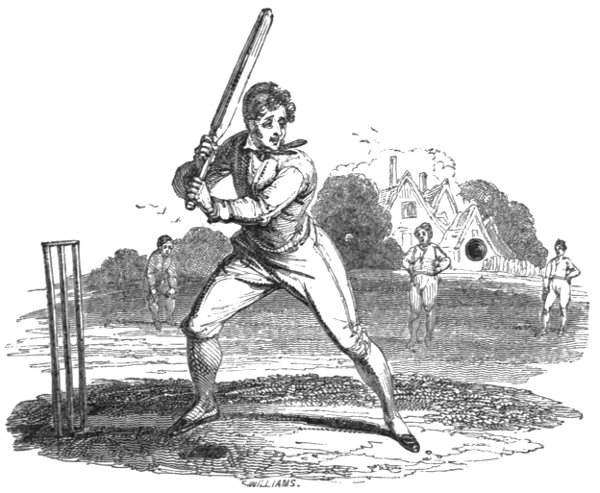
Of all the English athletic games, none perhaps presents so fine a scope for bringing into full and constant play the qualities both of the mind and body as that of cricket. A man who is essentially stupid will not make a fine cricketer; neither will he who is not essentially active. He must be active in all his faculties—he must be active in mind to prepare for every advantage; and active in eye and limb, to avail himself of those advantages. He must be cool-tempered, and, in the best sense of the term—Manly, for he must be able to endure fatigue, and to make light of pain; since, like all athletic sports, cricket is not unattended with danger, resulting from inattention and inexperience. The accidents, however, attendant upon the players at cricket commonly arise from unwatchfulness, or slowness of eye. A short-sighted person is as unfit to become a cricketer, as one deaf would be to discriminate the most delicate gradations and varieties in tones; added to which, he must be in constant jeopardy of serious injury.
This noble game is thoroughly British. Its derivation is probably from the Saxon “cɲẏce a stick.” Strutt, however, in his “Sports and Pastimes,” states that he can find no record of the game under its present appellation “beyond the commencement of the last century, where it occurs in one of the songs published by d’Urfey.” The first four lines of “Of a noble race was Shenkin,” run thus:—
“Her was the prettiest fellow
At foot-ball or at cricket,
At hunting chase, or nimble race,
How featly her could prick it.”
The same historian of our games doubts not that cricket derived its origin from the ancient game of club-ball, the patronymics of which being compounded of Welsh and Danish (clwppa and bol) do not warrant his conclusion, the Saxon being an elder occupant of our island. The circumstance, however, of there being no illustration extant—no missal illuminated with a group engaged in this king of athletic games, as is the case with its plebeian brother, the club-ball; also from its constitution being of a more civil and complicated character, we may rationally infer that it is the offspring of a more polite, at all events of a maturer age, than its fellow. The game of club-ball appears to have been no other than the present well-known bat-and-ball, which, with similar laws and customs prescribed in the playing at it, was doubtless anterior to trap-ball. The trap, indeed, carries with it an air of refinement in the “march of mechanism.”
They who are acquainted with some of the remote and unfrequented villages of England, where the primitive manners, customs, and games of our ancestors survive in the perfection of rude and unadulterated simplicity, must have remarked the lads playing at a game which is the same in its outline and principal features as the consummate piece of perfection that at this day is the glory of “Lord’s,” and the pride of English athletæ;—I mean the one in which a single stick is appointed for a wicket, ditto for a bat, and the same repeated, of about three inches in length, for a ball. If this be not the original of the game of cricket, it is a plebeian imitation of it.
The constitution of this pastime has undergone considerable alterations and improvements since it has become a favourite and fashionable recreation. Even till as late as the year 1770, for instance, the wicket had consisted of two stumps, when a third, the centre one, was added:—a decided improvement; seeing that it multiplied the chances to the batter of being bowled out, consequently increased the difficulty of his position, and thereby exalted his maintaining it for any length of time into the greater merit: for, under the old system, if the ball passed between the stumps, the batter was not considered out; under the improved system, such an event cannot happen; for the three stumps are not pitched at so great a distance from each other as to allow of the transit of the ball without knocking off the bale, which decides the fate and existence of the bats-man. The bale too, which crowns the stumps, formerly consisted of a single piece of wood, and therefore required a considerable concussion of the ball to remove it, without which the batter cannot be declared out; it is now divided in the centre, and consequently a very slight agitation of either of the outside stumps will displace the one half resting upon it; and this is equally fatal to the batsman as if the two were knocked off.
The formation of the bat has also undergone considerable change and improvement. In an old code of “the Laws of Cricket, revised at the Star and Garter, Pall-mall, on February 25, 1774, by a committee of noblemen and gentlemen,” the rules and directions are prefaced by a wood-cut of the bat then in use, by which it appears that it was curved, and the face flat.
The modern bat is not only perfectly upright, but its face is convex, which again increases the difficulty to the player; for, in striking the ball, unless he meet it directly in the centre of his bat, the chances are many, that, from the convexity in the face of the bat, the ball will fly off in a diagonal line, and the player may be caught out. The mode of holding the bat has changed with its alteration of form; the chief injunction now being to a young player to keep his bat as upright as possible.
The regular and full game of cricket is composed of twenty-two players, eleven in each party. Each party also selects an umpire, to whom all disputes are referred; who decide whether a player be out or not; and from whose judgment there is no appeal.
The wickets are pitched opposite to each other, upon the most level and advantageous ground, and twenty-two yards asunder. They must stand twenty-seven inches out of the ground, and the bales must be eight inches in length. In a line with the wickets, a mark is cut in the turf, three feet in length, which is termed the bowling crease; and at right angles with this is a short line, called the return crease. The bowler, in delivering his ball, is compelled to have one foot before, and the other behind this crease; and if he fail, it is the duty of the umpire at his wicket to call out—“No ball!” in which case, the batter may strike it, and obtain what advantage he can, and if he be bowled out, it is not reckoned. A good bowler is a most valuable member of the game, and one on whom success mainly depends. The ball must not weigh more than five ounces and three quarters, nor less than five ounces and a half.
The bat must not be wider than four inches and a half; its height, exclusive of the handle, should be twenty-one inches. There is no absolute law respecting the height of the bat; this, however, is found to be the most convenient.
The striker, or bats-man, is confined by a line, cut parallel with his wicket, and four feet distant from it. This line is termed the popping crease. If he transgress this boundary while the ball is in play, the wicket-keeper, or any other player holding the ball, is at liberty to put him out, by striking down his wicket with the ball. This, however, must always be done by means of the ball itself; either by throwing it, or, if near enough, by keeping the ball in hand at the time of putting down the wicket.
The wicket-keeper holds likewise an important station in the game. He stands opposite to the bowler, and behind the wicket at which the striker is playing. The duties of the wicket-keeper are too various to be detailed in this work, which, of course, affects no more than to give an outline of the principle of the game.
Besides the bowler and wicket-keeper, who are the two most serviceable men in the field; there are the first short slip, who stands near to the wicket-keeper, consequently behind the wicket, yet diagonally in front of the batter.
The point directly faces the striker. His station is about seven yards from the popping-crease.
The middle-wicket stands on the off side, and about twenty-three yards from the striker’s wicket.
The leg or hip has his appointment about sixteen yards from the popping-crease, behind the batter.
The long-stop is placed behind the wicket-keeper, to save the balls he may miss as they come from the bowler; for the batters may take the advantage of running when a ball has been over-thrown, or has not been stopped after the bowler has delivered it, although it may not have been struck.
The long slip stands in a line with the striker, and between the point and short slip, but farther out in the field.
A man to cover the middle-wicket and the point, stands on the off-side of the striker. It is his duty to save those balls that either of the above may have missed.
The long field on the off-side, stands between the middle-wicket and the bowler, but at a considerable distance, to save the hard hits.
The long field on the on-side, is stationed at a great distance from the striker, and on the other side of the bowler from the man last mentioned.
After every four halls have been bowled, the umpire calls “Over!” when the whole party, who are seeking out, (with the exception, of course, of the bowler and wicket-keeper) change their positions to the opposite quarters of the field.
[Note.—The reader who may desire farther information respecting the laws of this game, with instructions to the young player, is referred to a little work entitled “The Young Cricketer’s Tutor, by John Nyren, who was for many years a player in the celebrated old Hambledon Club.”]
Crimp, v. To make several cuts across the spine of a fish when just taken out of the water, by which it is rendered firmer when produced at table.
Crimson, s. Red, somewhat darkened with blue; red in general.
Crinose, a. Hairy, full of hair.
Cripple, v. To lame, to make lame.
Croak, v. To make a hoarse low noise like a frog; to caw or cry as a raven or crow.
Crook, s. Any crooked or bent instrument; a sheep-hook; any thing bent.
Crop, s. The craw of a bird.
Crop, v. To cut off the ends of any thing; to mow; to cut off the ears.
Young dogs should not be cropped before the fourth and fifth week of their age: when the ears are cut earlier, they sprout again, and the form of the crop cannot be so well directed as when the ear is more developed.
In cropping terriers, begin at the hinder root of the ear, close to the head, and when this cut is carried through, one other cross cut from the root at the front of the head, if managed with dexterity, will be sufficient, and will make an excellent fox crop, without torturing the animal with numerous trimmings. The less oblique the second cut is carried, the more sharp and foxy will the crop prove: the portion cut off, if laid on the remaining ear, will serve to direct the operation in that also. A rounded crop may be made at one cut. The cropping of pug puppies is the most painful of any; the cuts must, in general, be repeated, and carried close to the root of the ear; as upon the total absence of external ears (which gives an appearance of roundness to the head) is the beauty of the animal supposed to consist.
Cropful, a. Satiated, with a full belly.
Cropper, s. A kind of pigeon with a large crop.
Cropsick, a. Sick with excess and debauchery.
Crossbill (Loxia curvirostra, Linn.), s.
This species weighs about an ounce and a half; length near six inches and a half; bill strong, both mandibles convex, and crossing each other at the points, which are hooked; colour brown; eyes small; irides dusky.
The plumage of the male varies from a beautiful red to orange-colour on the head, neck, breast, back, and rump; the wing coverts rufous brown; quills and tail dusky; vent almost white; under tail coverts spotted dusky; tail forked; legs short; claws strong.
The females also vary somewhat in colour. In general, they are of a dull olive-green on those parts where the male is red; but the feathers on the back are mottled with dusky; the wings and tail similar to that of the male, but not so dark. We have observed that the crossing of the mandibles is not constantly on the same side.
That rare bird, the crossbill, occasionally visits the orchards in our neighbourhood, coming in little parties to feed on the seeds of the apple, and, seldom as it appears, it is always noticed by the mischief it does to the fruit, cutting it asunder with its well constructed mandibles, in order to obtain the kernels. A native of those extensive pine forests in the neighbourhood of the Rhine, it makes excursions into various parts of Europe in search of change of food; and though several instances are recorded of its visits to our islands, I know but one mentioned of its having bred in England. A pair was brought to me very early in August, and the breast of the female being nearly bare of feathers, as is observed in sitting birds, it is very probable that she had a nest in the neighbourhood.—Knapp—Montagu.
Cross-bow, s. A missive weapon formed by placing a bow athwart a stock.
Cross-grained, a. Having the fibres transverse or irregular; perverse, vexatious.
Crottle, s. A lichen which grows principally on sand stone, used in dyeing hackles and wools.
The power of crottle can never be known but by length of boiling; for which reason, get the largest copper pot you can. It ought to hold thirty or forty quarts; then put three quarts of crottle in, and fill it with water. Separate the wool according to the number of shades you wish for, put it into as many bags, and let them boil eight whole days, or as long as you can stay out of bed. You may draw a bag every six hours, and if you wish lighter shades, sooner. You are to get a round thin deal board, (see there is no turpentine in it,) bore it with holes that will receive your fingers, put your lid over that, and be careful of keeping your pot full of water. After three days’ boiling, you must put in two quarts more crottle, to bring up your dark shades. I followed this plan for a whole six days, and I got the finest colours my eyes ever saw. I got so high a shade as a rich claret brown under; and it was a very rich cinnamon over head. The reason I have mentioned eight days is on account of the bags, which prevent the dye. I also mention a copper pot, and you must use no other in any dye. I never could clean the crottle properly out of the fur for want of being in bags. Strong muslin bags will answer much better; particularly as by using them the operator may enjoy his bed four nights out of the eight specified.—Ancient Recipe.
Croup, s. The rump of a fowl; the buttocks of a horse.
Croupades, s. obs. Are higher leaps than those of curvets.
Crow, s. A large black bird that feeds upon the carcases of beasts; a piece of iron used as a lever; the voice of a cock, or the noise which he makes in his gaiety.
This species weighs about nineteen ounces; length eighteen inches; bill black; irides dusky. The whole plumage black, glossed above with a purplish blue; legs black.
Distinguished from the rook by the bill, which is rather more convex towards the end, and the nares, or reflected bristles, at the base being always perfect; but these are only obvious in adults. In young birds the note is the only criterion of distinction, which in this is much more hoarse than that of the rook.
The crow feeds on flesh, insects, and grain; but is particularly fond of carrion. It frequently attacks the eyes of dying animals, and destroys weakly lambs; it will also pursue birds on wing, when pressed by hunger. We once saw this bird in pursuit of a pigeon, at which it made several pounces, like a hawk; but the pigeon escaped, by flying in at the door of a house. We have also seen it strike a pigeon dead from the top of a barn. It is a great destroyer of young game and poultry.
It is a bold bird, always at war with the lesser species of hawks; nor does the kite, the buzzard, or the raven, approach its nest without being attacked and driven away. At that season, even the peregrine falcon is insulted, who frequently at one pounce brings it to the ground.
The eggs are four or five in number, of a greenish colour, spotted with dusky and ash-colour, their weight about five drachms. Colonel Montagu observed two crows by the sea-shore, busy in removing small fish beyond the flux of the flowing tide, and depositing them just above high-water mark, under the broken rocks, after having satisfied the calls of hunger. This species, like the magpie, is extremely garrulous at the sight of a fox or other small quadrupeds, and attacks and makes prey of a half-grown hare. In a summer evening ramble, Colonel Montagu saw one of these birds make repeated pounces at some animal in a field where the grass was nearly a foot high, which appeared to raise itself on its hind legs, and defend itself stoutly; upon a nearer approach he discovered it to be a young hare.—Rennie.
Crownscab, s. A stinking filthy scab round a horse’s hoof.
Crown Scab and Rat Tails are of the same nature as mallenders, and may be cured by the same means. They generally, however, leave a blemish, consisting in a loss of hair and thickening of the cuticle. Crown scab occurs on the coronet, and rat tails in lines on the back part of the leg, extending from the fetlock upwards.—Vide Mallenders.
Crude, a. Raw, not subdued by fire; not brought to perfection, immature.
Crupper, s. That part of the horse’s furniture that reaches from the saddle to the tail.
Crural, a. Belonging to the leg.
Crust, s. Any shell, or external coat; an incrustation, collection of matter into a hard body; the outer hard part of bread.
Crustaceous, a. Shelly, with joints; not testaceous.
Cry, v. To utter an inarticulate voice, as an animal; to yelp, as a hound on a scent.
Cry, s. Yelping of dogs; yell, inarticulate noise; a pack of dogs.
Crystal, s. A clear transparent substance, like glass.
Crystal, a. Consisting of crystal; bright, clear, transparent, lucid.
Crystalline Humour, s. The second humour of the eye, that lies immediately next to the aqueous, behind the uvea.
Cub, s. The young of a beast, generally of a bear or fox.
Cub, v. obs. To bring forth.
Cub-hunting. The pursuit or chace of young foxes—dangerous for horses, and destructive to game.
Previous to the month of November no man who has any thing else to amuse himself with, or who has a regard for his neck, or his horse, should be seen by a covert’s side, unless it be on a hack cub-hunting, which after all is but a melancholy recreation.
Cube, s. A regular small body, consisting of six square and equal faces or sides, and the angles all right, and therefore equal.
Cubebs, s. A very efficient pepper. It has been lately much used in medicine.
Cuckoo, s. A bird which appears in the spring, and is said to suck the eggs of other birds, and lay her own to be hatched in their place; a name of contempt.
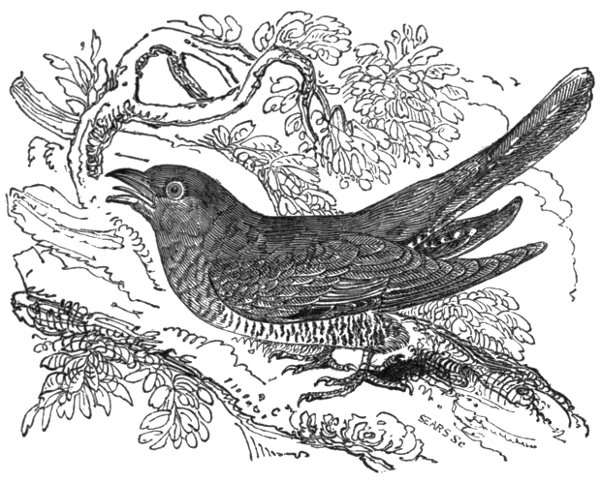
Cuckoo, or Gowk.—(Cuculus Canorus, Linn.; Le Coucou, Buff.)—Length fourteen inches, breadth twenty-five; its bill is black and somewhat bent; eyes yellow; inside of the mouth red; its head, neck, back, and wing coverts are of a pale blue, or dove colour, which is darkest on the head and back, and palest on the fore part of the neck and rump; its breast and belly are white, elegantly crossed with wavy bars of black; the quill feathers are dusky, their inner webs marked with large oval white spots; the tail is long; the two middle feathers are black, with white tips; the others dusky, marked with alternate spots of white on each side the shaft: the legs are short and of a yellow colour; toes two forward, and two backward; claws white.
The cuckoo visits us early in the spring; its well-known cry is generally heard about the middle of April, and ceases the latter end of June; its stay is short, the old cuckoos being said to quit this country early in July. Cuckoos build no nest; and, what is more extraordinary, the female deposits her solitary egg in the nest of another bird, by which it is hatched. The nest she chooses for this purpose is generally selected from the following, viz., the hedge sparrows, water wagtails, titlarks, yellow hammers, green linnets, or the winchats. Of these it has been observed that she shows a much greater partiality to that of the hedge sparrow than to any of the rest.—Bewick.
Cup, v. To draw blood by applying cupping glasses.
Cur, s. A worthless degenerate dog.
Curb, s. An iron chain, made fast to the upper part of the branches of the bridle, running over the beard of the horse; restraint.
Curb is an enlargement at the back of the hock, about three or four inches below the point of the hock. It is either a strain in the ring-like ligament which binds the tendons down in their place, or in the sheath of the tendons; oftener, we are inclined to think, of the ligament than of the sheath. Any sudden action of the limb of more than usual violence may produce it, and therefore horses are found to ‘throw out curbs’ after a hardly contested race, an extraordinary leap, a severe gallop over heavy ground, or a sudden check in the gallop. Young horses are particularly liable to it, and horses that are cow-hocked or whose hocks and legs resemble those of the cow, the hocks being turned inward, and the legs forming a considerable angle outwards. This is intelligible enough; for in hocks so formed, the annular ligament must be continually on the stretch to confine the tendon.
Curbs are generally accompanied by considerable lameness at their first appearance, but the swelling is not always great; indeed, it sometimes presents so gradual a curve, that it is scarcely perceivable when we stand behind the horse, and both the horseman and the veterinary surgeon have overlooked it. It is best detected by observing the leg sideway.
The first object in attempting the cure is to abate inflammation, and this will be most readily accomplished by cold evaporating lotions, frequently applied to the part. Equal portions of spirit of wine, water, and vinegar, will afford an excellent application. It will be almost impossible to keep a bandage on. If the heat and lameness are considerable, it will be prudent to physic the horse, and to bleed from the subcutaneous vein. Whether the injury be of the annular ligament, or the sheath of the tendon, more active means will be necessary to perfect the cure. Either a liquid blister should be rubbed on the part, consisting of a vinous or turpentine tincture of cantharides, and this daily applied until some considerable swelling takes place, which should be allowed to subside, and then the liniment again resorted to; or, what is the preferable plan, the hair should be cut off, and the part blistered as soon as the heat has been subdued. The blister should be repeated until the horse goes sound, and the swelling has disappeared. In severe cases it may be necessary to fire, but we cannot recommend the indiscriminate recourse to the hot iron in every case of curb, and we would uniformly give a fair trial to milder measures. If the iron be used, the strokes should be in straight lines.
There are few complaints in which absolute and long continued rest is more requisite, than in curb. An injury so serious leaves the parts very materially weakened, and, if the horse be soon put to work again, the lameness will frequently return. No horse that has had curbs should be put even to ordinary work in less than a month after the apparent cure, and even then he should very gradually resume his former habits. A horse with a curb is manifestly unsound.
Curb, v. To guide a horse with a curb; to restrain; to check.
Curd, s. The coagulation of milk.
Cure, s. Remedy, restorative; act of healing.
Cure, v. To heal, to restore to health, to remedy.
Curlew, (Scolopax arquata, Linn.; Le Courlis, Buff.), s. A kind of waterfowl.
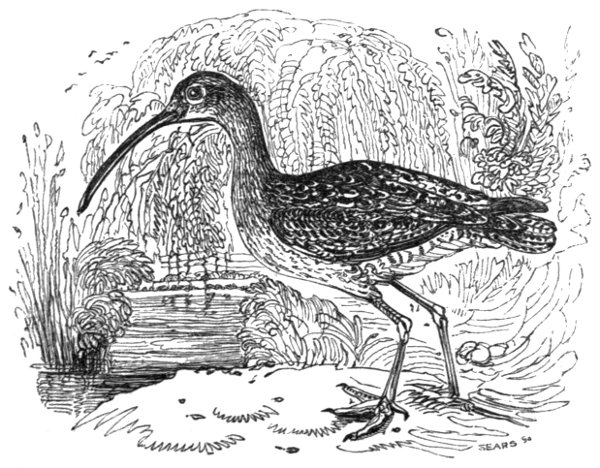
The bill is long, equally incurvated, and terminated in a blunt point; nostrils linear, and longitudinal near the base; tongue short and sharp-pointed; and the toes are connected as far as the first joint, by a membrane.
With the curlew, Linnæus begins a numerous tribe of birds under the generic name of scolopax, which, in his arrangement, includes all the snipes and godwits, amounting, according to Latham, to forty-two species and eight varieties, spread over various parts of the world, but nowhere very numerous.
Buffon describes fifteen species and varieties of the curlew, and Latham ten, only two or three of which are British birds. They feed upon worms, which they pick up on the surface, or with their bills dig from the soft earth: on these they depend for their principal support; but they also devour the various kinds of insects which swarm in the mud, and in the wet boggy grounds, where these birds chiefly take up their abode.
The curlew generally measures about two feet in length, and from tip to tip above three feet. The bill is about seven inches long, of a regular curve, and tender substance at the point, which is blunt. The upper mandible is black, gradually softening into brown toward the base; the under one flesh-coloured. The head, neck, upper part of the back, and wing-coverts, are of a pale brown, the middle of each feather black, edged and deeply indented with pale rust colour, or light grey. The breast, belly, and lower part of the beak, are dull white, the latter thinly spotted with black, and the two former with oblong strokes more thickly set, of the same colour. The quill-feathers are black, the inner webs crossed or spotted with white; the tail is barred with black, on a white ground tinged with red; the legs are bare a little above the knees, of a blueish colour, and the toes are thick, and flat on the under side.
These birds differ much in size, as well as in the different shades of their plumage; some of them weighing not more than twenty-two ounces, and others as much as thirty-seven. In the plumage of some the white parts are much more distinct and clear than in others, which are more uniformly grey, and tinged with pale brown.
The female is so nearly like the male, that any particular description of her is unnecessary: she makes her nest upon the ground, in a dry tuft of rushes or grass, of such withered materials as are found near, and lays four eggs, of a greenish cast, spotted with brown.
The curlew is met with by travellers in most parts of Europe, from Iceland to the Mediterranean islands. In Britain their summer residence is upon the large heathy, boggy moors, where they breed. Their food consists of worms, flies, and insects, which they pick out of the soft mossy ground by the marshy pools, which are common in such places. In winter they depart to the sea-side, where they are seen in great numbers, and then live upon the worms, marine insects, and other fishy substances which they pick up on the beach and among the loose rocks and pools left by the retiring tide. The flesh of the curlew has been characterised by some as very good, and of a fine flavour—by others as directly the reverse; the truth is, that, while they are in health and season, and live on the moors, scarcely any bird can excel them in goodness; but when they have lived some time on the sea shore, they acquire a rank and fishy taste.—Bewick.
Curricle, s. An open two-wheeled chaise, made to be drawn by two horses abreast.
Curry, v. To dress leather; to rub a horse with scratching instruments, so as to clean his coat.
Currycomb, s. An iron instrument used for currying horses.
Curve, s. Anything bent, a flexure or crookedness.
Curve, v. To bend, to crook, to inflect.
Curvet, v. To leap, to bound.
Cut, v. To penetrate with an edged instrument; to make its way by dividing obstructions; to perform the operation of cutting for the stone.
Cut, s. The action of a sharp or edged instrument; the impression or separation of continuity made by an edge; a wound made by cutting; a channel made by art; the act or practice of dividing a pack of cards; form, shape.
Cutaneous, a. Relating to the skin.
Cuticle, s. The first and outermost covering of the body, commonly called the scarf-skin.
Cutter, s. An agent or instrument that cuts any thing; the teeth that cut the meat; a fore and aft-rigged vessel with one mast and a running boltsprit.
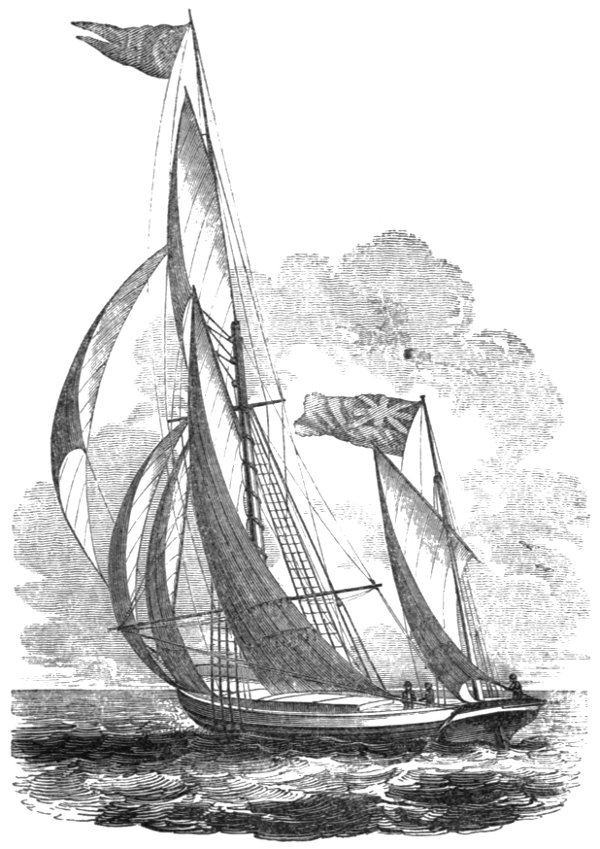
Cutters have been always favourite vessels, from their excellent sailing qualities, and, consequently, are much employed as revenue cruisers, smugglers, privateers, and packets, and in any trade requiring much despatch. A cutter under one hundred tons is sufficiently handy and manageable, but when the size increases to that of the larger yachts and cruisers, a very strong crew is necessary, as the spars are immensely heavy, and a number of men requisite to set or shorten sail.
A single-masted vessel is objectionable, because in the event of springing a spar, she becomes perfectly helpless; hence large cutters are only used in short voyages, or as coasting cruisers. Their peculiar qualities of beating well to windward, and working on short tacks, adapt them for channel cruising; and in case of accident, they can always manage to reach some harbour or anchorage where they can repair the damage they may have sustained.
Some years back, large cutters were confined principally to the navy and revenue, but the Royal Yacht Club have not only exceeded them in size, but also in beauty and sailing. Some of the finest and fastest cutters in the world are the property of this celebrated and truly national club; and two of them, the Alarm (Mr. Wild’s), and the Arundel (the Duke of Norfolk’s), measure 193 and 188 tons.
The inconvenient size of a cutter’s boom and mainsail has caused the introduction very generally of a ketch rig; which, by the addition of a mizen, enables the boom to be dispensed with, and reduces the mainsail considerably. This rig, when the mizen stands well, is very elegant, and, if a vessel is short-handed, exceedingly handy.—Vide Yacht.
Cygnet, s. A young swan.
Living on the banks of the Thames, I have often been pleased with seeing the care taken of the young swans by the parent birds. Where the stream is strong, the old one will sink herself sufficiently low to bring her back on a level with the water, when the cygnets will get upon it, and in this manner are conveyed to the other side of the river, or into stiller water. Each family of swans on the river has its own district; and if the limits of that district are encroached upon by other swans, a pursuit immediately takes place, and the intruders are driven away. Except in this instance, they appear to live in a state of the most perfect harmony. The male is very attentive to the female, assists in making the nest, and when a sudden rise of the river takes place, joins her with great assiduity in raising the nest sufficiently high to prevent the eggs being chilled by the action of the water, though sometimes its rise is so rapid, that the whole nest is washed away and destroyed.—Jesse.
Cygnetics, s. obs. The art of hunting.
Cyst, s. A bag containing some morbid matter.
Dab, s. A kind of small flat fish.
Dab-chick, s. A water-fowl.
Dace, s. A small river-fish, resembling a roach.
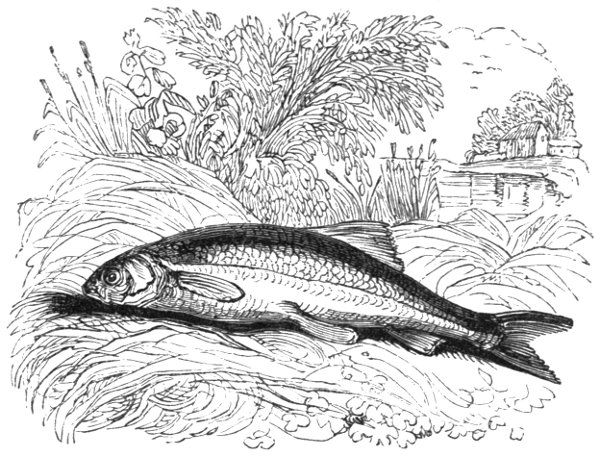
DACE.
Dace or Dare, is gregarious, is a great breeder, very lively, and during summer is fond of frolicking near the surface. Its head is small, the irides of a pale yellow; the body long and slender; its scales are smaller than those of the roach, and is upon the whole a handsomer fish; the back is varied with dusky, and a cast of yellowish green; the sides and belly silvery, the ventral, anal, and caudal fins are sometimes of a pale red hue; the tail is very much forked. The dace is seldom above ten inches long, although in a list of fish sold in the London markets, with the greatest weight of each, communicated to Mr. Pennant, there is an account of one that weighed a pound and half, and according to Linnæus, it grows to a foot and half in length.
The haunts of Dace are deep water, near piles of bridges, where the stream is gentle, over gravelly, sandy, and clayey bottoms; deep holes that are shaded, water-lily leaves, and under the foam caused by an eddy; in the warm months they are to be found in shoals on the shallows near to streams; the dace spawn in March, are in season about three weeks after; they improve, and are very good, about Michaelmas, but are best in February, and are said in that month, when just taken, scotched, and broiled, to be more palatable than a fresh herring.
This is a fish affording great sport to the angler, indeed more pleasure than profit, for the flesh is insipid, and full of bones. The baits for dace are the red worm, brandling, gilt-tail, cow-dung, and earth-bob, and indeed any worm bred on trees or bushes, that is not too big for his mouth, and almost every kind of fly and caterpillar. Flesh flies upon the surface with the hook put into the back, between the wings, the line from the middle downwards of single hairs, and a trifle longer than the rod, which ought to be eighteen feet at least, and as light as possible; the flies can be kept in a phial; fix three very small hooks upon single hair links, not above four inches along the line, and in a summer’s evening, at the smoothest part of the end of a mill-stream, from seven or eight, so long as light continues, the dace will yield diversion. In the same manner, they will rise in the morning at the ant-fly, if used at the foot of a current or mill-stream, or on a scour before the sun comes on the water.
After rains, when the river is nearly level with its banks, use a caterpillar-fly, or a small red palmer and yellow-gentle (the yellower the better), run the hook through its skin, and draw it up to the tail of the fly, then whip on the surface, the dace will rise freely.
Another way to take this fish, from the middle of April until the beginning of October, is by artificial fly-fishing, with a long line.—Daniel.
Dalmatian, (Canis Dalmatianus), s. The coach-dog.
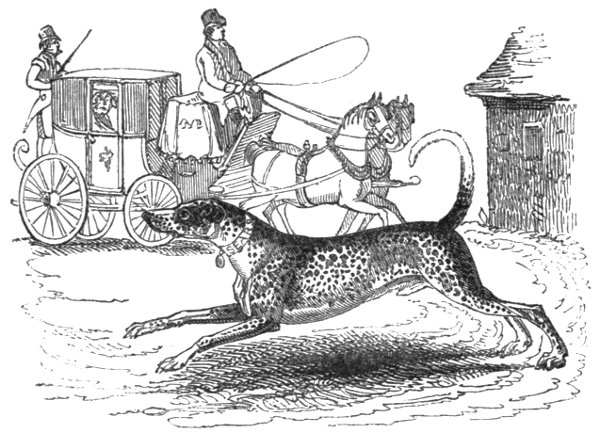
This dog has been erroneously called the Danish dog by some authors, and Buffon, and some other naturalists, imagine him to be the harrier of Bengal; but his native country is Dalmatia, a mountainous district of European Turkey. He has been domesticated in Italy for upwards of two centuries, and is the common harrier of that country.
The Dalmatian is also used as a pointer, to which his natural propensity more inclines him than to be a dog of the chase; he is said to be easily broken, and to be very staunch. He is handsome in shape, something betwixt the British foxhound and English pointer; his head is more acute than that of the latter, and his ears fully longer: his general colour is white, and his whole body and legs are covered with small irregular sized black or reddish brown spots. He is much smaller than the large Danish dog. A singular opinion prevailed at one time in this country, that this beautiful dog was rendered more handsome by having his ears cropped: this barbarous fancy is now quickly dying away.
I have never heard of the Dalmatian being trained to the sports of the field in Great Britain. His only use seems to be an elegant attendant upon a carriage, for which the symmetry of his form and beauty of his skin peculiarly fit him. A most erroneous notion has prevailed among some breeders, that neither this nor the great Danish dog has the sense of smell. They have been indiscriminately called the coach-dog.—Brown.
Dam, s. The mother; a mole or bank to confine water.
Damascene, s. Vide Barrel.
Dapple, a. Marked with various colours; variegated.
Dapple, v. To streak, to vary.
Dar, or Dart, s. A fish found in the Severn.
Dare, s. Vide Dace.
Dare, v. To Dare Larks, to catch them by means of a looking-glass.
Daw, s. A bird.
Deal, s. The art or practice of dealing cards; fir-wood; the wood of pines.
Dealer, s. A person who deals the cards; one who buys and sells horses and dogs.
A gownsman of Cambridge, anxious to purchase a particular horse in the possession of Mr. Fordham, horse-dealer of that place, called upon him to make proposals, but disagreeing as to price, the collegian waited upon him several times to see if he could possibly bring him over to his terms.—In the interim, however, Mr. Fordham was taken dangerously ill and died. Next day, the gownsman, unacquainted with the circumstance of his death, called and asked a groom for his master.—“My master is dead, sir, (said one of the stable-boys) but he left word you should have the horse.”—Sporting Anecdotes.
Decoction, s. The act of boiling any thing; a preparation made by boiling in water.
The vessel in which decoctions are made should be covered, and when the substance contains any aromatic or volatile principle, the boiling should be continued only a short time. Decoctions should be strained while hot, as some of them, Peruvian bark for example, deposit some active and useful matter in cooling. Decoctions soon ferment, and are spoiled by keeping; they should be used therefore soon after they are made.
A decoction of marsh-mallows, it is useful in fevers as a vehicle for nitre or other medicine; also as an emollient clyster and fomentation.
CAMOMILE.
Camomile flowers, dried 1 oz.
Caraway seeds, bruised 1½ oz.
Ginger, bruised 1½ oz.
Water 1 qt.
Boil for ten or fifteen minutes: a good stomachic drench.
OAK BARK.
Oak Bark, bruised 2 oz.
Water 1 qt.
Boil gently for ten minutes; a good vehicle for tonic medicine.
DECOCTION FOR FOMENTATION
Is made by boiling bay leaves, camomile flowers, wormwood, and southernwood in a sufficient quantity of water.
BARLEY.
Barley water is made by boiling pearl barley in water. This may be used in fevers, either alone, or as a vehicle for nitre or other medicine. Various other decoctions are occasionally employed, and sometimes preferred on account of their cheapness, to more efficacious, but more expensive medicines; yet it must be recollected that some vegetables, such as peppermint, pennyroyal, &c. have their useful properties dissipated by much boiling, and should therefore be only simmered for a few minutes, or only infused.—White.
Decoy, v. To lure into a cage, to entrap.
The decoys now in use are formed by cutting pipes, or tapering ditches, widened and deepened as they approach the water; in various semicircular directions, through the swampy ground, into particular large pools, which are sheltered by surrounding trees or bushes, and situated commonly in the midst of the solitary marsh. At the narrow points of these ditches farthest from the pool, by which they are filled with water, the fowlers place their funnel nets: from these the ditch is covered by a continued arch of netting, supported by hoops, to the desired distance; and all along both sides, screens formed of reeds are set up so as to prevent the possibility of the birds seeing the decoyman; and as these birds feed during the night, all is ready prepared for this sport in the evening. The fowler, then placed on the leeward side, sometimes with the help of his well-trained dog, but always by that of his better trained tame decoy ducks, begins the business of destruction. The latter, directed by his well known whistle, or excited forward by the floating hempseed, which he strews occasionally upon the water, entice all the wild ducks after them under the netting; and as soon as this is observed, the man or his dog, as the fitness of opportunity may direct, is from the rear exposed to the view of the birds, by which they are so alarmed that they dare not offer to return, and are prevented by the nets from escaping upwards: they therefore press forward in the utmost confusion to the end of the pipe, into the purse nets there prepared to receive them, while their treacherous guides remain behind in conscious security. The season allowed by act of parliament for catching these birds in this way, continues only from the latter end of October till February.
Particular spots or decoys, in the fen countries, are let to the fowlers at a rent of from five to thirty pounds per annum; and Pennant instances a season in which thirty-one thousand two hundred ducks, including teals and widgeons, were sold in London only, from ten of these decoys near Wainfleet, in Lincolnshire. Formerly, according to Willoughby, the ducks, while in moult and unable to fly, were driven by men in boats, furnished with long poles, with which they splashed the water, between long nets, stretched vertically across the pools, in the shape of two sides of a triangle, into lesser nets placed at the point, and in this way, he says four thousand were taken at one driving in Deeping-fen; and Latham has quoted an instance of two thousand six hundred and forty-six being taken in two days, near Spalding in Lincolnshire; but this manner of catching them while in moult is now prohibited.
Decoy, s. Allurement to mischief.
Decoy-duck, s. A duck that lures others.
Deer, s. That class of animals which is hunted for venison. Vide Fallow, Red, and Roe Deer.
Degenerate, v. To fall from its kind, to grow wild or base.
Demulcent, a. Softening, mollifying.
Demulcents, s. Medicines of an oily and mucilaginous nature, as lint and quince seed, gum, &c.
Den, s. A cavern or hollow running horizontally; the cave of a wild beast.
Deobstruent, s. A medicine that has the power to resolve viscidities.
Destroy, v. To kill; to put an end to.
It is not unfrequently a subject of inquiry, how it may be possible to destroy a dog with least pain to himself, and least shock to the feelings of his owner. Although shooting and hanging are not, in themselves, painful deaths, yet the violence necessarily committed is revolting to one’s feelings. Whenever, therefore, cases arise (and many such do occur) where it would be infinitely more humane to destroy an animal than to prolong a miserable existence, and when the more usual modes are objected to on account of the violence and force necessary, either of these essential oils, cherry laurel, and bitter almond, dropped on the tongue, or a very small ball made from the extract, will extinguish life almost instantaneously, and without pain.—Blaine.
Deterge, v. To cleanse a sore. Vide Caustics.
Detonation, s. A noise somewhat more forcible than the ordinary crackling of salts in calcination, as in the going off of the pulvis or aurum fulminans. Vide Percussion.
Detonating Powder, s. A chemical composition by which percussion-guns are discharged.
One of the recipes for making detonating powder is:—
One ounce of oxymuriate of potash.
One eighth of an ounce of superfine charcoal.
One sixteenth of an ounce of sulphur.
Mixed with gum-arabic water, and then dried. It should be mixed up in wood, for fear of accident.
Another, and, I am told, a far better proportion, is:—
Five of oxymuriate, Two of sulphur; and
One of charcoal.
I merely give the recipe, in case a sportsman should be in a place where he cannot buy the composition, as I presume, that no one in his senses would run the risk of being blown up, in order to make, perhaps indifferently, what he could so cheaply purchase in perfection.—Hawker.
We entirely agree with the colonel—and caution insurance companies against gentlemen who would attempt a home manufacture.
Diabetes, s. A morbid copiousness of urine.
Diabetes consists in an excessive discharge of urine, attended with great thirst, and sometimes with a gradual loss of flesh and great debility. The urine is sometimes limpid and transparent like water; at others high coloured, and of a very offensive smell. In slight or recent cases of diabetes a cure may generally be accomplished by the following ball, provided the cause is removed, which is generally new hay, new oats, musty hay or oats, or some other unwholesome provender. But in the confirmed diabetes, when the urine has become stinking and high coloured, the cure is more difficult. Rest, or voluntary exercise only, and a light nutritious diet, are necessary.
BALL FOR DIABETES.
No. 1. Opium from ½ to 1 dr.
Ginger 2 dr.
Gentian-root powder 3 or 4 dr.
Oil of caraways 20 or 30 drops.
Syrup enough to form the ball.
To be given morning and evening for two or three days, and should the disease then continue, give the following:—
No. 2. Sulphate of copper 1 dr.
Ginger 1 dr.
Linseed powder and syrup enough to form the ball.
To be given every morning and evening until the disease is cured.
Sulphate of copper has been found an excellent tonic in horses. I have also found the following a good tonic ball:—
No. 3. Sulphate of iron 2 to 3 or 4 dr.
Powdered ginger 1 dr.
Powdered Gentian 3 to 4 dr.
Treacle enough to form the ball.
I have seen an increased discharge of urine brought on in draught horses by working them beyond their strength; this has been attended with great weakness, especially of the hind parts, and loss of appetite. I have found great benefit in such cases from turning the horse to grass, and letting him remain there for some time, giving him a little good hay, or some oats, when it appears necessary.—White.
Diachylon, s. An ingredient in sticking plaster.
Diachylon (litharge or lead plaster) is made by boiling olive oil nine parts, litharge five parts, water two parts, over a slow fire, and constantly stirring, until the oil and the litharge unite, and acquire the consistence of plaster. The water must be replaced as it evaporates. Diachylon is an ingredient in sticking plaster and charges, and is useful when spread on leather, for defending a tender part from pressure.
Diapente, s. A compound powder, tonic and stomachic.
Diaphoretic, a. Sudorific, promoting perspiration. The most useful sudorifics in veterinary practice, are hot stimulants, combined with antimony and opium.
Dice, s. The plural of die.
Dice-box, s. The box from which the dice are thrown.
Dicer, s. A player at dice, a gamester.
Didapper, s. A small bird of the diver kind.
Die, v. To tinge, to colour.
Die, s. Colour, tincture, stain, hue acquired; a small cube, marked on its faces with numbers from one to six, which gamesters throw in play; hazard, chance; any cubic body.
Recipes for Dyeing Hair.—(Dark water colour.)—Take a pint of strong ale, half a pound of soot, a small quantity of the juice of walnut leaves, and an equal quantity of alum powdered fine; mix them well, and boil them in a pipkin half an hour; when the mixture is cold, put in the hair, and let it remain ten or twelve hours.
Some boil a quarter of a pound of soot in a pint of strong alum water, with a little juice of walnut leaves, for half an hour, and steep the hair in it when nearly cold.
For a brown, take some powdered alum, boil it well until dissolved; then add a pound of walnut-tree bark, from the branches when the sap is up, or the buds or green nuts; boil it in an hour, and let it stand. When after skimming it for ten minutes, put in the gut or hair for about a minute (stirring it round), or until you like the colour. If it continues too long, it will become quite dark and injure the hair. The lighter it is tinged with this colour, the better. Salt and ale will also give hair a brownish cast that is steeped in it.
For a blueish water colour, proceed as above; only add logwood instead of the walnut, and be careful not to colour it too much.
Yellow.—The inner bark of a crab-tree boiled in water with some alum, makes a fine yellow, which is excellent when the weeds rot, the line appearing of the same hue. Another dye may be obtained from two quarts of small ale, and three handfuls of walnut leaves bruised therein; the hair to remain in it until tinged to your wish.
Tawny is prepared from lime and water mixed together, by steeping hair in it for four or five hours, and then soaking it a whole day in a tan pit.
Russet.—Take a pint of strong lye, half a pound of soot, some juice of walnut leaves, and a quart of alum water; put them together into a pan, boil them well, and when the liquor is cold, steep the hair until it acquires the colour you desire.
General Remark.—The hair to be dyed, should always be the best white: the seasons for using dyed hair, are, September and two following months; the yellow, russet all the winter, and until the end of April, as well in rivers as in lakes; for the same periods, the brown and tawny should be used in blackish, heathy, and moorish waters.
Dyeing or Staining Fishing-rods.—Red is done by boiling the wood in water and alum; then taking it out, adding Brazil to the liquor, and giving the wood another boil in it. Black, by brushing it over with logwood, boiled in vinegar, then washing it over with a decoction of galls and copperas, till it be of the hue required. Any other colour may be given by squeezing out the moisture of horse-dung through a sieve, mixing it with dissolved roch alum and gum arabic, and to the whole adding green, blue, or any other colour designed. After standing two or three days, pear-tree or other wood cut to the thickness of half-a-crown is put into the liquor boiling hot, and suffered to remain till it be sufficiently coloured.
In Dyeing Bone, Horn, or Ivory.—Black is performed by steeping brass in aqua fortis till it be turned green; with this, the bone, &c., &c., is to be washed once or twice, and then put in a warm decoction of logwood and water. Green, is verdigris, sal ammoniac, and white wine vinegar; keeping the material therein till sufficiently green. Red is began by boiling it in alum water, and finished by a decoction in a liquor compounded of quicklime steeped in rain-water strained. To every pint an ounce of Brazil wood is added: the bone to be boiled therein till sufficiently red.—Ancient Recipes.
Diet, s. Food, victuals; food regulated by the rules of medicine.
Dig, v. To work with a spade.
Digging Foxes.—With respect to the digging of foxes which hounds run to ground, if the hole be straight and earth slight, follow it, and in following the hole, by keeping below its level, it cannot be lost.—Beckford.
Digest, v. To generate matter as a wound.
Digestion, s. The act of concocting food; the preparation of matter by a chemical heat; the act of disposing a wound to generate matter.
Digestives, s. Medicines which promote suppuration in ulcers, and cause them to discharge a white healthy matter.
DIGESTIVE OINTMENT.
1. Hog’s lard and strained turpentine, of each 4 oz.
Verdigris 1 oz.—Mix.
2. Hog’s lard and Venice turpentine, of each 4 oz.
Sulphate of copper (blue vitriol), finely powdered 1 oz.—Mix.
3. Ointment of yellow rosin 4 oz.
Oil of turpentine 1 oz.
Nitric oxide of mercury (red precipitate), finely powdered 1 oz.—Mix.
4. Ointment of nitrated quicksilver 4 oz.
Oil of turpentine 1 oz.—Mix.
—White.
Disease, s. Distemper, malady, sickness.
Dislocate, v. To put out of the proper place; to put out of joint; to displace a bone.
Dismount, v. To throw any one from on horseback; to alight from a horse.
Dispensatory, s. A book in which the composition of medicines is described and directed; a pharmacopœia.
Distemper, s. A disease, a malady.
The Distemper.—No disorder is more general or so destructive as that known by the name of the distemper; it is the most fatal (the plague only excepted) that any animal is subject to.
The symptoms of the distemper are not invariably similar, although there are predominant ones which always occur. It generally comes on with a dry husky cough, dullness and want of appetite, a running from the nose and eyes, and loss of flesh. As the disease advances, the dog appears much emaciated, and grows excessively weak, particularly in the loins and hinder extremities; usually there is convulsive twitchings of different parts, most commonly of the head, attended with dimness of sight; when the disease proceeds, and takes on its more virulent form, then the twitches degenerate into continued convulsive fits, the dog foams at the mouth, runs round, and expresses great pain, has a constant disposition to dung, with obstinate costiveness or incessant purging. There is likewise great irritability of the stomach, every thing being thrown up immediately it is taken in, and the animal dies, generally, in one of the spasmodic fits. From this state of the disease hardly any dog recovers, unless from the powerful effect of this gentleman’s medicine, and even then he admits its success doubtful, although he insists, with the medicine early given, the disease will never arrive to this height; but, with every deference to the efficacy of the above medicine, the compiler has known Dr. James’s powder cure the most inveterate stages of the disorder: the method of administering it will be hereafter directed. In every part of this disease a want of nervous energy, and a particular paralytic affection of the nerves, is apparent, and, in some instances, remains long after every other symptom has ceased, and in many respects is not unlike the palsy of the human frame.
The distemper, when existing in its worst form, is very often mistaken for canine madness; but a close attention to the following points will with certainty show the difference. Puppies are not so liable to madness as full-grown dogs; it is but seldom the animal will drink freely in the distemper, never in madness—yet they will now and then try to drink; the hydrophobia arrives likewise at its height, in general, sooner than the distemper, although the latter is sometimes equally sudden in its attack, and rapid in its progress. In madness, all recollection of places or persons is lost by the affected animal; his home will be left, and he will bite the hand that feeds him, indiscriminately with any other. In the distemper, there is no loss of reason but in the attack and actual continuance of the convulsion fits; the animal does not attempt to bite or rove abroad, and, on recovery from the fit, resumes his faculties. If, therefore, a young dog will drink when the immediate effect of the spasmodic restriction is removed, or, without evident fear, will bear the sight of water, but more particularly when his weakness is excessive, and strongly apparent between the intervals of the fits, it may be safely concluded that it is the distemper, and not madness. These circumstances, continues Mr. Blaine, should be carefully remarked, as they are unerring, and may save many a valuable animal from destruction, and many a timid mind from the most dreadful apprehension.
For the distemper, so soon as the symptoms appear, give an ounce of castor oil, and after its operation has ceased, give the following powder, mixed up with butter, into a bolus, every two hours, keeping the dog warm, and supplying him frequently with warm milk or water-gruel. Should the medicine occasion sickness or purging, the quantity and frequency of the doses are to be abated.
Crocus metallorum finely levigated, and white antimonial powder, each six grains, and diaphoretic calx of antimony, ten grains for one dose.
It is necessary to remark, that the above dose is sufficient for a pointer or fox-hound, of six or eight months old, and that the quantity is to be varied according to the size and age of the dog.
Rhubarb and jalap mixed, as much as will lie on a shilling, is an excellent common physic. For dogs, foul within, five grains of tartar emetic, given in a piece of hog’s lard. For a surfeit, one ounce of sulphur, half an ounce of antimony, mixed together; a small ball in butter, to be given to the dog, and the sore place well rubbed with a mixture of white hellebore-root powdered, and hog’s lard; the dog to be kept from water if he licks the ointment.
Doctor Darwin has given the following opinion upon the disorder, and how to counteract its malignity.
“In dogs, the catarrh is generally joined with symptoms of debility early in the disease; the animals should be permitted to go about in the open air, the use of being as much as may be in the air, is evident, because all the air which they breathe, passes twice over the putrid sloughs of the mortified parts of the membrane, which lines the nostrils, and the maxillary and frontal cavities; that is, during inspiration and expiration, and must, therefore, be loaded with contagious particles.
“Fresh new milk, and fresh broth, should be given them very frequently, and they should be suffered to go amongst the grass, which they sometimes eat for the purpose of an emetic; and, if possible, they should have access to a running stream of water, as the contagious mucus of the nostrils generally drops into the water they attempt to drink.
“Bits of raw flesh, if the dog will eat them, are preferred to cooked meat, and from five to ten drops of tincture of opium (according to the size of the dog), may be given with advantage when symptoms of debility are evident, every six hours. If sloughs can be seen in the nostrils, they should be moistened twice a day with a solution of sugar of lead, or of alum, by means of a sponge fixed on a bit of whalebone, or by a syringe. The lotion may be made by dissolving half an ounce of sugar of lead, or of alum, in a pint of water.”
The following remedies have their advocates, and, consequently, in some cases of the disorder have been proved essential in its cure.
One grain and a half of calomel, and five grains of rhubarb, to be repeated every other day.
Four grains of Turbith’s mineral, and one grain of emetic tartar; first bleeding the dog.
A tea-spoonful of jalap, half the quantity of grated ginger, a table-spoonful of syrup of buckthorn, made into a ball, or given liquid in warm water. No milk, but water-gruel to drink, and the dog must be kept very warm.
Gamboge, dragon’s-blood, jesuit’s-bark, of each half an ounce, made into pills the size of a hazel nut. To a full grown dog, one pill to be given every morning until cured; to a whelp, three times a week, the dogs to have liberty to run out.
Some rely entirely on purgatives: others bleeding and physicking; others on emetics; some put tar upon the nose, others a pitch plaster, and some cauterize the nasals; some inject vinegar into the dose, others hellebore, and others a solution of camphor; some cut off the tail, others the ears; some give tobacco and olive oil, others the golden sulphuret of antimony; the keeper gives the curpeth’s mineral: the more scientific of these gentry will knock down the disease, and the dog too with arsenic. The gentleman will give compound tincture of benzoin, the farmer common salt; the medical man sulphuric ether, or emetics and sulphur, or emetics and jalap, or emetics and scammony.—Youatt—Daniel—Darwin.
Ditch, s. A trench cut in the ground usually between two fields; any long narrow receptacle of water.
Diver, s. A bird; one that sinks voluntarily under water; one that goes under water to search for any thing.
Diuretics, s. Medicines that excite and increase urinal discharge.
DIURETIC POWDER.
Powdered rosin and nitre, of each, 4 drs.
Mix for one dose, and let it be repeated daily, or twice a day, if necessary, until a sufficient effect is produced.
DIURETIC BALL.
Hard soap and common turpentine, of each, 4 drachms.
Powdered caraway seeds enough to form the ball. Mix for one dose.
CORDIAL DIURETIC BALL.
Hard soap and common turpentine, of each 4 dr.
Ginger 1 dr.
Opium ½ dr.
Powdered caraways enough to form the ball. Diuretics should not be kept to become hard, as they often are, but be given in rather a soft state, and recently made. Diuretics should never be so given as to operate while a horse is in work, as he may thereby be prevented from staling when he has occasion; from neglecting this precaution, and from their frequent and immoderate use, arise those mischievous effects before alluded to. The kidneys are often materially injured by them as well as the bladder.—White.
Diuretic, a. Having the power to provoke urine.
Dock, s. The stump of the tail which remains after docking; a place where water is let in or out at pleasure, where ships are built or laid up.
Dock, v. To cut off a tail; to cut any thing short.
Dog, s. A domestic animal remarkably various in its species.
In ancient manuscripts we find the following names for the dogs employed in the sports of the field; that is to say, raches, or hounds; running hounds or harriers, to chase hares; and greyhounds, which were favourite dogs with the sportsmen; alauntes, or bull-dogs, these were chiefly used for hunting the boar; the mastiff is also said to be “a good hounde” for hunting the wild boar; the spaniel was of use in hawking; “hys crafte,” says the author, “is for the perdrich or partridge, and the quaile; and, when taught to couch, he is very serviceable to the fowlers, who take those birds with nets.” There must, I presume, have been a vast number of other kinds of dogs known in England at this period; these, however, are all that the early writers, upon the subject of hunting, have thought proper to enumerate. In the sixteenth century the list is enlarged; besides those already named, we find bastards and mongrels, lemors, kenets, terrours, butcher’s hounds, dunghill dogs, trindel-tail’d dogs, “pryckeared” curs, and ladies’ small puppies.
There formerly existed a very cruel law, which subjected all the dogs that were found in the royal chases and forests, excepting such as belonged to privileged persons, to be maimed by having the left claw cut from their feet, unless they were redeemed by a fine; this law probably originated with the Normans, and certainly was in force in the reign of Henry I.
Linnæus, in his System of Nature, has placed the dog as the second genus of the third order of mammiferous animals, or those which suckle their young by means of lactiferous teats.
The characters of the third order, Feræ, are as follows:—The fore teeth are conic, usually six in each jaw; the tusks are longer, the grinders have conic projections; the feet have claws, which are usually subulate, or awl-shaped; they feed on carcasses, and prey on other animals.
The characters of the genus Canis, or Dog, are, six cutting teeth in the upper jaw; those at the sides longer than the intermediate ones, which are lobated. In the under jaw there are also six cutting teeth, the lateral ones lobated; there are four canine teeth, one on each side, both above and below, and from six to seven grinders. The specific characters of the Canis Familiaris, or common dog, are, the head is carinated, or keel-shaped on the crown, the lower lip is hid by the upper, indentated and naked at the sides; the tongue is smooth; on the upper lip are five or six rows of whiskers; the nostrils are turned outwards into a crescent-shaped furrow; the upper margin of the ears is reflected and posteriorly doubled; the anterior margin is three-lobed, and there are seven or eight hairy warts on the face. There are ten teats, four of them pectoral, and six abdominal; the feet are subpalmated, with claws on the toes, which are long, a little curved, and not retractile within the toes, as is the case with those of the cat.