INTRODUCTION. (continued 26)
Reading edition
Ulcer, s. A sore of continuance, not a new wound.
Ulceration is a process directly the reverse of granulation; for as that builds up, so ulceration directly breaks down parts, which become absorbed through the medium of the lymphatics; the surfaces thus acted on producing at the same time a purulent or other discharge. An abraded surface thus circumstanced is called an ulcer, for the cure of which we must endeavour to remedy the morbid action, by exciting a new and more healthy one; by which the part being then brought to the condition of a simple wound, will heal. When ulcers have continued for a long time, it is often necessary to employ constitutional remedies to establish a cure. In full habits we increase the other secretions, as those of the bowels, the kidneys, the skin, &c., by purgatives, diuretics, and such remedies as act on the skin. We also lessen the excess of morbid secretion of pus, by establishing a new and artificial drain in the neighbourhood, which is done by setons or by rowels. In some cases, instead of existing plethora the ulcer has occasioned, or is accompanied by great irritability of system, which must be combatted by opium, and other sedatives; or if debility become very apparent, tonics must be given, together with liberal diet. In general cases, stable soiling, a course of carrots, or other total change of food, assists the healing and restorative process greatly. Ulcers are often found of a greater extent internally than externally; and when such cavities extend in different directions, they form the sinuses of the surgeon and the pipes of the farrier: when the edges of the external opening are hardened, it is said to be fistulous. In general cases, the longer an ulcer has lasted, the more obstinately will the vessels have gained a diseased habit, and the more difficulty there will be to bring them back to a healthy state. The external means employed for this purpose are usually three; stimulating injections, seton, or incision; which operations it will not be necessary to enter upon here, as we shall proceed to describe the more common and important ulcers, with their treatment, separately. It remains, however, to state, that ulcers in general are apt to be treated by farriers erroneously, by plugging up the sinuses, by which the matter formed penetrates farther, bringing into its own action all the neighbouring parts. They likewise dress them so seldom, that the pus frequently takes on a process of decomposition, and becomes acrid; and, lastly, they neglect to gain a depending orifice for these collections.—Blaine.
Ulcerate, v. To disease with sores.
Ulceration, s. The act of breaking into ulcers; ulcer, sore.
Umbla, or Ombre Chevalier, s. A fish.
The umbla or ombre chevalier, is very like a char in form, but is without spots, and has a white and silvery belly. On the table, its flesh cuts white or cream-colour, and it is exceedingly like char in flavour. On February 11th, 1827, one was brought me from the lake of Bourget, in Savoy; it was said to be small for this fish, it was fifteen inches long, and seven and a half in circumference. In the dorsal fin there were twelve spines, in the pectoral nine, in the ventral eight, in the anal eleven, and in the caudal twenty-four.
Bloch says, that it is peculiar to the lakes of Geneva and Neufchatel; but what I have just said must convince you of the inaccuracy of this statement, as I dare say the fish exists in other deep waters of a like character amongst the Alps. It is a fish closely allied to the char, and congenerous both in form and habits.—Sir H. Davy.
Umbles, s. A deer’s entrails.
Under Tail Coverts, s. Those feathers immediately covering the base of the tail beneath.
Under Wing Coverts, s. Those feathers covering the wing underneath.
Unearthed, a. Driven from the ground. To unearth a fox, is to force him from his den.
Unfledged, a. That has not yet the full furniture of feathers, young.
Unfleshed, a. Not fleshed, not seasoned to blood.
Upper Tail Coverts, s. Those feathers immediately covering the base of the tail feathers.
Volant, a. Flying, passing through the air; active.
Vole, s. A deal at cards that draws the whole tricks.
Volery, s. A flight of birds.
Volley, s. A flight of shot; an emission of many at once.
Volt, s. A round or a circular tread; a gait of two treads made by a horse going sideways round a centre.
Vomica, s. An encysted humour in the lungs.
Vomit, v. To cast up the contents of the stomach.
Vomit, s. The matter thrown up from the stomach; an emetic medicine.
Vomitory, a. Procuring vomits, emetic.
Voracious, a. Greedy to eat, ravenous.
Voracity, s. Greediness, ravenousness.
Urethra, s. The passage of the urine.
Urinary, a. Relating to the urine.
Urine, s. Animal water.
Inflammation of the kidneys is generally caused by riding or driving a horse immoderately, by straining the loins, in making him draw heavy loads or carry heavy burthens; or they may become inflamed in consequence of peritonæal inflammation of the bowels. In either case breed freely, or to faintness; cover the loins with a fresh sheep skin, the flesh side under, having first rubbed on them some warm embrocation, such as hartshorn and oil, with a little oil of turpentine, or the following embrocation. Open the bowels with a dose of castor oil and clysters of warm water, with a small quantity of salt and oil, or hog’s lard. I should first have noticed, however, the symptoms of the disorder, which are, a constant desire to make water, without being able to void any, or scarcely any: and the little that is discharged is dark coloured or bloody. There is great stiffness of the hind parts, generally more observable in one leg than the other. The horse often stands straddling or wide, as if in want to make water, and every now and then straining, or making painful and ineffectual efforts to stale. This appearance often leads the groom to think that it is a stoppage of water, and that a diuretic is necessary; but the fact is, that the dark-coloured or bloody urine is so stimulating or acrimonious that the bladder contracts violently in order to force out the smallest quantity that gets into it.
The disorder I have now been describing may happen in various degrees, but still the treatment is the same. It sometimes happens, however, that the urine becomes foul and stimulating from high feeding, or foul and unwholesome feeding. In this case the bladder will contract upon a small quantity of urine, and the urine may be rather high coloured, like beer, or turbid, like whey, and the horse may appear to strain a little in voiding it; but this is very different from those distressing symptoms which attend inflammation of the kidneys, nor is it accompanied with loss of appetite, or any degree of fever, which is always present in inflammation of the kidneys. When the urine becomes thus stimulating, some cold mashes, with a little nitre, may be given, or what is still better, perhaps, some grass, vetches, or lucern. If the horse is at all costive, a clyster should be thrown up. An infusion of linseed is a good drink for a horse when the urine is in this state.
The improper manner in which horses are generally fed, the early age at which they are worked, and the immoderate degree in which they are often worked, are circumstances which either separately or conjointly tend to weaken the stomach, and disturb the digestive functions; in consequence of this the blood becomes foul, or loaded with excrementitious matter, the greatest part of which, in the horse, is carried off by the kidneys. This renders the urine more acrimonious than it would otherwise be, and causes the bladder to contract upon a smaller quantity. We may often observe, also, how the urinary passages are stimulated by such urine, making mares appear as if they were horsing, and causing an erection in geldings. As the horse is often staling in this case, and voiding but a small quantity, and appearing as if he was endeavouring to void more, it is often mistaken for a stoppage in the water, as it is termed, and diuretics are generally given, which, if not too strong, may be of service. But the best plan is to keep the horse on bran mashes chiefly for a few days, and give twice a day, for two or three days, the following powder:—
Nitre 3 or 4 dr.
Carbonate of soda 1 dr. or chalk 2 dr.
Mix for one dose.
Or, No. 2, Nitre, powdered resin, chalk, and levigated antimony, of each two drachms.—Mix for one dose.
If these powders appear to disagree with the stomach they should be discontinued: in such cases the cordial diuretic is more likely to do good, such as has been prescribed for asthmatic affection or broken wind.
Retention of urine, strangury, or stoppage of water, may be caused by inflammation and swelling of the neck of the bladder; and this may be brought on by a peculiar acrimony in the urine, such as that produced by cantharides when taken as medicine. The different species of pepper, or grains of paradise, may produce some effect of this kind. The neck of the bladder may be pressed down upon the pubis by an accumulation of dung in the rectum, so as to stop the passage completely. A clyster is always proper on these occasions, for if an accumulation of dung be the cause, it will be speedily removed. But there will be some difficulty in giving the clyster, unless some of the hard dung is first taken out with the hand. The neck of the bladder may be so affected with spasm as to confine the urine. This may be the cause of the stoppage of water that happens in flatulent colic, but I rather think it depends entirely upon an accumulation of dung in the bowels, therefore I always prescribe a clyster in colic, of whatever kind it may be.—Blaine.
Wadding, s. That substance which secures the powder and shot in loading a gun.
Wadding.—Paper not being stiff enough, hat dirty, card too thin, and leather apt to soften with the heat of the barrel, the common, and perhaps the best punched wadding is pasteboard. The larger the bore, the thicker should be the wadding, which may be got to any size, among the discarded cuttings of a book-binder.
Nothing is better to punch your wadding on than a round block, sawed out of some close grained kind of wood; such as beech, chestnut, lime, sycamore, &c. Lead is improper, as it wears out the punch.
Be careful not to let your wadding get damp, or in drying it may shrink so much as to become too small for the calibre of your gun.
In countries where orchards abound, a very fine moss, of greenish grey colour, is found adhering to the apple-trees, which is extremely proper for wadding, and which even possesses the extraordinary quality of making the barrel less greasy and foul than paper, which always contains a certain quantity of oil.—Hawker—Essay on Shooting.
Wade, v. To walk through the waters, to pass waters without swimming.
Waders, s. A class of waterfowls.
Wager, s. A bet, anything pledged upon a chance or performance.
Wager, v. To lay, to pledge as a bet.
Wagtail, s. A bird.
The species of this kind are few, and these are chiefly confined to the continent of Europe, where the individuals are numerous.
They are easily distinguished by their brisk and lively motions, as well as by the great length of their tails, which they jerk up and down incessantly, from which circumstance they derive their name. They do not hop but run along the ground very nimbly after flies and other insects, on which they feed: they likewise feed on small worms, in search of which they are frequently seen to flutter round the husbandman whilst at his plough, and follow the flocks in search of the flies which generally surround them. They frequent the sides of pools, and pick up the insects which swarm on the surface. They seldom perch; their flight is weak and undulating, during which they make a twittering noise.
In almost all languages the name of this bird is descriptive of its peculiar habits. In Latin, motacilla; in French, motteux, la lavandière, or washer; in England, they are sometimes called washers, from their peculiar motion; in German, brook-stilts; in Italian, shake-tail, &c. &c.—Bewick.
Wain, s. A carriage.
Walk, s. Act of walking for air or exercise; gait, step, manner of moving; a length of space, or circuit through which one walks; a fish: Walk is the slowest or least raised pace, or going of a horse.
Wall-eyed, a. Having white eyes.
Walnut, s. The name of a tree; the fruit and wood of the tree.
Wander, v. To rove, to ramble here and there, to go without any certain course; to deviate, to go astray.
Wanderer, s. Rover, rambler.
Warble, v. To quaver any sound; to cause to quaver; to utter musically.
Warbler, s. A singer, a songster.
This very numerous class is composed of a great variety of kinds, differing in size from the nightingale to the wren, and not a little in their habits and manners.
They are widely dispersed over most parts of the known world; some of them remain with us during the whole year; others are migratory, and visit us annually in great numbers, forming a very considerable portion of those numerous tribes of singing birds, with which this island so plentifully abounds. Some of them are distinguished by their flying, which they perform by jerks, and in an undulating manner; others by the whirring motion of their wings. The head in general is small; the bill is weak and slender, and beset with bristles at the base; the nostrils are small and somewhat depressed; and the outer toe is joined to the middle one by a small membrane.—Bewick.
Warden, s. A forest officer. The chief warden of the forest is a great officer, next to the justices of the forest, to bail and discharge offenders, but he is no judicial officer.
Warn, v. To caution against any fault or danger; to give previous notice; to admonish to any duty to be performed; to warn off trespassers from a manor.
Warp, v. To contract, to shrivel; to turn aside from the true direction.
Warren, s. A kind of park for rabbits.
Warrener, s. The keeper of a warren.
Wart, s. A corneous excrescence, a small protuberance on the flesh.
Warty, a. Grown over with warts.
Wash, s. Alluvion, anything collected by water; a bog, a marsh, a fen, a quagmire; a medical or cosmetic lotion; a superficial stain or colour.
Wasp, s. A brisk stinging insect, in form resembling a bee. Vide Adder.
Abundance of wasps are said to denote a good fruit year. We have remarked also the converse of this, for in the present season, 1824, perhaps the worst for apples and stone fruit that we remember, there is scarcely a wasp to be seen. In general towards the close of summer they are very numerous, particularly in the month of September. In 1821 they were prodigiously plentiful, and in 1822 there were a great many of them, while 1824 scarcely presented a solitary wasp, even where they usually abound.—Foster.
Water, s. One of the four elements; the sea; urine; to hold water, to be sound, to be tight; it is used for the lustre of a diamond.
Water varies considerably in its qualities and temperature. In deep wells it rarely changes from 40° of Fahrenheit, while in exposed streams and lakes, there may be a variation of from 12 to 16 degrees. Much, consequently, depends upon the watering of horses, in quality, quantity, and temperature. Horses, if they be not violently exercised, cannot be too frequently watered.
Water Birdlime.—Procure the strongest and best of birdlime possible, and wash it in clear spring water till you perceive the hardness is completely removed, and the lime has become very pliable: then squeeze or beat out the water remarkably well, till you cannot observe a single drop; dry it well: after this, put it into an earthen pot, and mix with it the fat of fowls, unsalted, as much as will make it run; then add two table spoonfuls of strong vinegar, a table spoonful of the best salad oil, and a small quantity of Venice turpentine. This is the quantity of ingredients which must be added to every pound of strong birdlime. Having thus mixed them, boil them all gently together over a small fire, stirring the whole continually till the mixture is complete, when it may be taken from the fire and suffered to cool. When at any time you have occasion to use it, warm it and then anoint your twigs or straws, or any other small things, and water will not take away the strength of it. This sort of birdlime is well calculated for snipes, &c.—Gamekeeper’s Directory.
Water, v. To irrigate, to supply with moisture; to supply with water for drink.
Water Crake, Spotted Rail, Lesser Spotted Water Rail, Skitty, or Spotted Gallinule, (Rallus porcana, Linn.; La Marouette, Buff.) s.
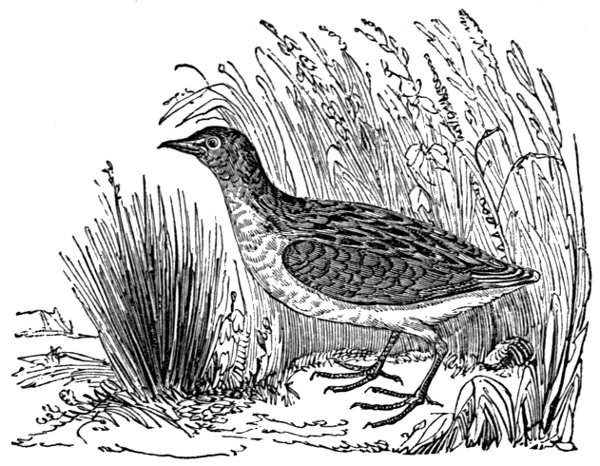
WATER CRAKE.
This bird weighs about four ounces, and measures nearly nine inches in length, and about fifteen in breadth. The bill is of a greenish-yellow, and not more than three quarters of an inch long. The top of the head, to the nape, is dusky, and slightly streaked with rusty-brown; a brown and white mottled stripe passes from the bill over and behind the eyes; the cheeks and throat are of a freckled dull grey. The neck and breast are olive, marked with small white spots; the sides dusky and olive, crossed with bars of white, and the under parts are a mixture of cinereous, dirty and white yellow. The colour of the plumage of all the upper parts is dusky and olive-brown, spotted, edged, barred or streaked with white; the spots on the wing-coverts are surrounded with black, which gives them a studded or pearly appearance; and the white bars and streaks on the scapulars and tertials form a beautiful contrast to the black ground of the feathers on these parts. The legs are of a yellowish-green. The water-crake in its figure and general appearance, though much less, is extremely like the corn-crake or land-rail; but its manners and habits are very different. Its common abode is in low, swampy grounds, in which are pools or streamlets, overgrown with willows, reeds, and rushes, where it lurks and hides itself with great circumspection; it is wild, solitary, and shy, and will swim, dive, or skulk under any cover; and sometimes it is said, will suffer itself to be knocked on the head, rather than rise before the sportsman and his dog. This species is very scarce in Great Britain, and from its extreme vigilance it is rarely to be seen. It is supposed to be migratory here, as well as in France and Italy, where it is found early in the spring; it is also met with in other parts of Europe, but no where in great numbers. The conformation of its nest is curious; it is made of rushes and other light, buoyant materials, woven and matted together, so as to float on, and to rise or fall with the ebbing or flowing of the water, like a boat; and to prevent its being swept away by floods, it is moored or fastened to the pendent stalk of one of the reeds, by which it is screened from the sight, and sheltered from the weather. The female lays from six to eight eggs. The young brood do not long require the fostering care of the mother, but as soon as they are hatched, the whole of the little black shapeless family scramble away from her, take to the water, separate from each other, and shift for themselves. The flesh is said to have a fine and delicate flavour, and is esteemed by epicures a delicious morsel.—Bewick.
Watercresses, s. A plant. There are five species.
Water Cricket or Creeper, s. A cricket used as bait for fish.
It is an error to suppose this the same as the cad bait, for though generally found by the water side, the latter is always in some kind of husk, the creeper never, nor has ever wings, and cannot therefore be the stone-fly; it may be kept in the same way as the cadis.
They may be kept in a large horn, like that for powder, with gravel at the bottom, and some holes at the sides to admit air: the mouth of the horn should be wide enough to receive a quart bottle cork, and should be placed in water with the creepers, when not using them.—Daniel.
Water Dog, s. A rough and web-footed spaniel.
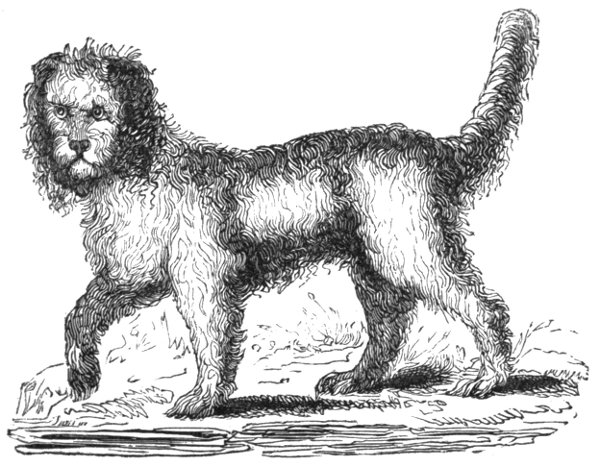
The Great Rough Water Dog. (Canis Aquaticus, Linn.)—The great rough water dog has long curly hair, is web-footed, swims with great ease, and is extremely useful in the sport of shooting aquatic birds. He has many of the qualities of the land spaniel.
This dog has a great liking to fetching and carrying, and such is his exquisite sense of smell, that he will find a particular stone thrown by his master to the bottom of a river: he dives with astonishing dexterity. He is particularly valuable on board of ships, as he leaps from the side of a vessel after any article which has fallen overboard, and is very useful for recovering birds that have been shot from the deck of the ship. Above all, he is lively, playful, good-tempered, and much attached to his master.
Large Water Spaniel. (Canis Inquisitor.)—The large water spaniel is about the size of an ordinary setter, but much stronger in the bone and shorter in the legs. His head is long, his muzzle moderately acute, and his face is quite smooth, as well as the front of all his legs; his ears are long, which, together with his whole body, is covered with deep hair, consisting of firm, small, and distinctly crisped curls, not unlike those of a wig, his tail is rather short, and clothed with curled hair. His hair is very differently curled from the great water dog and poodle, as that of the two latter consists of long and pendulous curls. His general colour is a dark liver-brown, with white legs, neck, and belly; and is sometimes, though rarely to be met with, all black, or with a black body and white neck and legs.
His smell is extremely acute, and he has in some instances been taught to set, but this is rather a difficult task, from his naturally lively disposition. He takes the water with great eagerness, on which account he is a valuable dog in shooting wild fowl; he watches with much keenness and anxiety the motions of his master, and as soon as the bird is killed he instantly plunges into the water, fetches it out, and lays it at the feet of his master. He is very quick at finding the haunts of wild fowl; he is also easily taught to fetch and carry articles, and will seek things which have been lost, on which account he has received in England the appellation of the finder.
The great water spaniel has sometimes been employed in otter hunting, but it is seldom he has the pluck to combat with so keen an adversary. He is an animal naturally distinguished for mildness and docility, qualities which are pourtrayed in his countenance, and is remarkable for his attachment to his master.
The native country of this dog is Spain; but we conceive that the variety we possess, which is a very distinct one, is not the pure breed as originally imported into this country, but that it is the produce of the large water dog and the English setter, as it appears to be intermediate between these, not only in figure, but also in their united qualities.
The Small Water Spaniel, or Poodle. (Canis Aquaticus minor.)—This variety is presumed to be the offspring of the large water dog and the small cocker; it has all the appearance of the former, not only in shape, but also in the thick curled silky hairs. It is a most lively active dog, with an acute sense of smell, and is very susceptible of instruction of almost every kind. Its general colour is white, although individuals are sometimes found with black patches over various parts of their bodies. The poodle is very fond of diving, and can find at the bottom of a river or pond any particular stone thrown in by his master.
In France this dog is a great favourite, and is taught many curious tricks. He is an excellent companion in shooting of wild fowl, which, when killed in the water, he very soon recovers.
Some dogs are more easily instructed than others, though all are sufficiently docile. The poodle breed is the most extraordinary for aptitude in this particular; many have been made so useful as to perform the common offices of a servant, such as to go on ordinary errands, shut and open doors, ring bells, &c. and their knack at mimicry is extreme.
I have tried poodles, but always found them inferior in strength, scent, and courage. They are also very apt to be sea-sick. The Portland dogs are superior to them.
A water-dog should not be allowed to jump out of a boat, unless ordered so to do, as it is not always required, and therefore needless that he should wet himself and every thing about him without necessity.
For a punt or canoe, always make choice of the smallest Newfoundland dog that you can procure; as the smaller he is the less water he brings into your boat after being sent out; the less cumbersome he is when afloat; and the quicker he can pursue crippled birds upon the mud. A bitch is always to be preferred to a dog in frosty weather, from being, by nature, less obstructed in landing on the ice.
If, on the other hand, you want a Newfoundland dog only as a retriever for covert shooting, then the case becomes different; as here you require a strong animal, that will easily trot through the young wood and high grass with a large hare or pheasant in his mouth.—Brown—Hawker.
Water Fowl, s. Fowl that live or get their food in water.
Water Hen, Common Gallinule, or Moorhen, (Fulica chloropus, Linn.; La Poule d’Eau, Buff.) s.
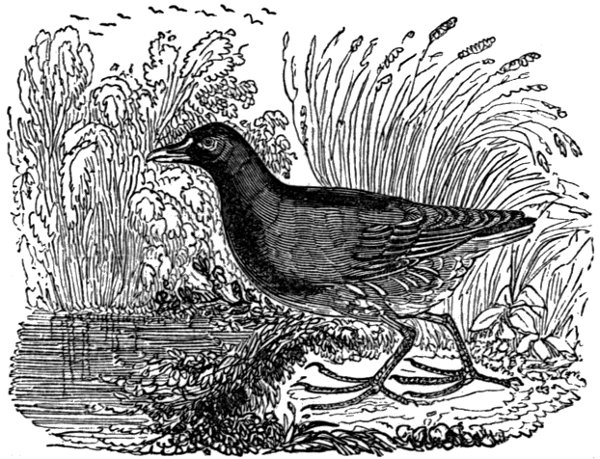
The weight of this bird varies from ten and a half to fifteen ounces; the length from the tip of the beak to the end of the tail is about fourteen inches, the breadth twenty-two; the bill is rather more than an inch long, of a greenish yellow at the tip, and reddish towards the base, whence a singular kind of horny or membranous substance shields the forehead as far as the eyes; this appendage to the bill is as red as sealing-wax in the breeding season; at other times it varies or fades into a white colour. The head is small and black, except a white spot under each eye, the irides which are red; all the upper part of the plumage is of a dark shining olive green, inclining to brown; the under parts are of a dark hoary lead colour; vent feathers black; those on the belly and thighs tipped with dirty white; long loose feathers on the sides, which hang over the upper part of the thighs, are black, streaked with white; the ridge of the wing, outside feathers of the tail, and those underneath, are white; the upper bare part of the thighs is red; from the knees to the toes, the colours are different shades, from pale yellow to deep green; the toes are very long, the middle one measuring to the end of the nail, nearly three inches; their undersides are broad, being furnished with membranous edgings their whole length on each side, which enable the bird to swim, and easily run over the surface of the slimy mud by the sides of the waters where it frequents.
The female makes her nest of a large quantity of withered reeds and rushes, closely interwoven, and is particularly careful to have it placed in a most retired spot, close by the brink of the waters, and it is said, she never quits it without covering her eggs with the leaves of the surrounding herbage. Pennant and Latham say, she builds her nest upon some low stump of a tree, or shrub, by the water side; no doubt she may sometimes vary the place of her nest, according as particular circumstances may command, but she generally prefers the other mode of building it. She lays six or seven eggs at a time, and commonly has two hatchings in a season. The eggs are nearly two inches in length, and are irregularly and thinly marked with rust-coloured spots on a yellowish white ground. The young brood remain but a short time in the nest, under the nurturing care of the mother, but as soon as they are able to crawl out they take to the water, and shift for themselves.
Although the water-hen is nowhere very numerous, yet one species or other of them is met with in almost every country in the known world. It is not yet ascertained whether they ever migrate from this to other countries, but it is well known that they make partial flittings from one district to another, and are found in the cold mountainous tracts in summer, and in lower and warmer situations in winter.
On examination of several specimens of this bird, in full feather, they were found, like most birds of plain plumage, very little different from each other.—Bewick.
Water Ousel, Water Crow, Dipper, or Water Piot, (Sturnus Cinclus, Linn.; Le Merle d’Eau, Buff.) s.
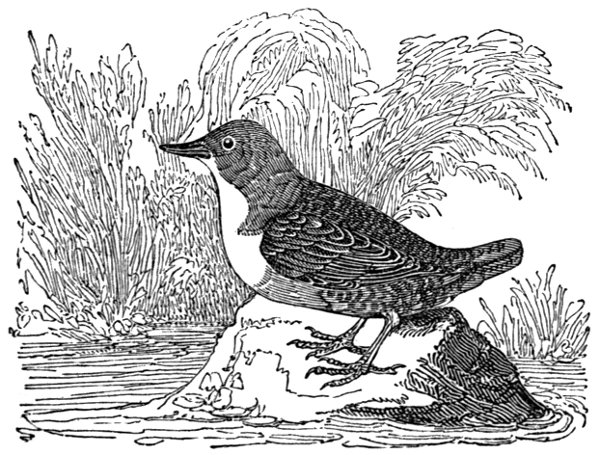
The length of the water ousel is about seven inches and a half from the point of the beak to the end of its tail, which is very short, and gives the bird a thick and stumpy appearance. The mouth is wide; the bill black, about three quarters of an inch long; the upper mandible rather hollow in the middle and bent a little downwards at the point; the eyelids are white, and irides hazel. The upper parts of the head and of the neck are of a deepish rusty-brown; the back, rump, scapulars, wing coverts, belly, vent, and tail are black; but each feather on these parts is distinctly edged with a hoary grey colour. The breast, forepart of the neck, and throat, are of a snowy white; and the black and white on the belly and breast are separated by a rusty brown. The legs and toes are short and strong, the scales pale blue, the hinder part and joints brown; the claws are curved, and the toes are distinctly parted without any membranous substance between to join them.
This solitary species is removed from the place it has hitherto holden in all systems among the land birds: it ought not to be classed any longer with the ousels and thrushes, to which it bears no affinity. Its manners and habits are also different from those birds, and are peculiar to itself. It is chiefly found in the high and mountainous parts of the country, and always by the sides of brooks and rocky rivers, but particularly where they fall in cascades, or run with great rapidity among stones and fragments of broken rocks; there it may be seen perched on the top of a stone in the midst of the torrent, in a continual dipping motion, or short courtesy often repeated, whilst it is watching for its food, which consists of small fishes and insects. The feathers of this bird, like those of the duck tribe, are impervious to water, whereby it is enabled to continue a long time in that fluid without sustaining the least injury. But the most singular trait in its character, (and it is well authenticated) is that of its possessing the power of walking, in quest of its prey, on the pebbly bottom of a river, in the same way, and with the same ease, as if it were on dry land. The female makes her nest in the banks of the rivulet, of the same kind of material, and nearly of the same form as that of the common wren; and lays four or five eggs, which are white, lightly blushed with red.—Bewick.
Water Rail, Bilcock, Velvet-Runner, or Brook Ousel (Rallus Aquaticus, Linn.; Le Rale d’Eau, Buff.) s.
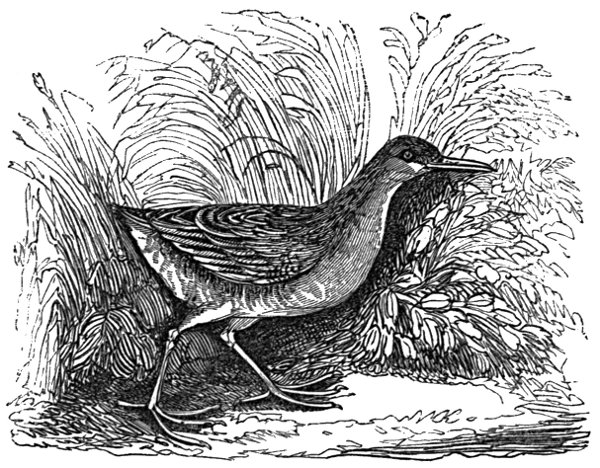
This bird, though a distinct genus of itself, has many traits in its character very similar to both the corn crake and the water crake; it is migratory, like the former, to which it also bears some resemblance in its size, its long shape, and in the flatness of its body: its haunts and manner of living are nearly the same as those of the latter; but it differs from both in the length of its bill, and its plumage. It weighs about four ounces and a half, and measures twelve inches in length and sixteen in breadth. The bill is slightly curved, and one inch and three quarters long: the upper mandible is dusky, edged with red; the under reddish orange; the irides red. The top of the head, hinder part of the neck, back, scapulars, coverts of the wings and tail are black; edged with dingy brown. The ridge of the wings is white, the bastard wing barred with white, the inside barred with brown and white, and the quills and secondaries dusky. The side feathers are beautifully crossed with black and white, and slightly tipped with pale reddish brown. The inner side of the thighs, the belly, and the vent are pale brown, and in some specimens specked with bluish ash. The sides of the head, chin, forepart of the neck, and breast, are of a dark hoary lead colour, slightly tinged with pale rufous. The tail consists of twelve short black feathers, edged and tipped with dirty red; some of those on the under side barred with black and white. The legs which are placed far behind, are a dull dirty red; the toes long and without any connecting membrane. Latham says, “the eggs are more than an inch and a half long, of a pale yellowish colour, marked all over with dusky brown spots, nearly equal in size, but irregular.”
The water rail is a shy and solitary bird. Its constant abode is in low wet places, much overgrown with sedges, reeds, and other coarse herbage, among which it finds shelter, and feeds in hidden security. It runs, occasionally flirting up its tail, through its tracks, with the same swiftness as the corn crake runs through the meadows and cornfields, shows as great an aversion to take flight as that bird, and has more of the means in its power of disappointing the sportsman. It generally exhausts his patience, and distracts and misleads his dog, by the length of time to which it can protract its taking wing: and it seldom rises until it has crossed every pool, and ran through every avenue within the circuit of its retreats. It is, however, easily shot when once flushed, for it flies but indifferently, with its legs dangling down while on the wing. This bird is not very common in Great Britain, but is said to be numerous in the marshes of the northern countries of Europe, whence, partially and irregularly, it migrates southward, even into Africa, during the severity of the winter season. Buffon says, “they pass Malta in the spring and autumn,” and to confirm this, adds, “that the Viscount de Querhoent saw a flight of them at the distance of fifty leagues from the coasts of Portugal, on the 17th of April, some of which were so fatigued that they suffered themselves to be caught by the hand.” The flesh of the water rail is not so generally esteemed as that of the land rail, and yet by many it is thought rich and delicious eating.—Bewick.
Water Rat, s. A rat that makes holes in banks.
I suspect much there may be two species of water-rats. Ray says, and Linnæus after him, that the water-rat is web-footed behind. Now I have discovered a rat on the banks of our little stream that is not web-footed, and yet is an excellent swimmer and diver.
Habits of the Water Shrew and Water Rat.—The brown rat (Mus decumanus) frequents water and is fond of swimming, though it does not willingly dive. The water rat (Arvicola aquatica, Fleming,) again, which is the one alluded to by White, swims as readily below as above water, and feeds chiefly on the roots of water plants. White was near the truth in supposing two species of water rats, inasmuch as he was not acquainted with the water shrew (Sorex ciliatus, Sowerby), so well described by Mr. Dovaston of Shrewsbury in the Magazine of Natural History. “I repeatedly,” he says, “marked it glide from the bank under water, and bury itself under the mass of leaves at the bottom. It very shortly returned and entered the bank, occasionally putting its long sharp nose out of the water and paddling close to the edge. This it repeated at very frequent intervals, from place to place, seldom going more than two yards from the side, and always returning in about half a minute. I presume it sought and obtained some insect or food among the rubbish and leaves, and retired to consume it. Sometimes it would run a little on the surface, and sometimes timidly and hastily come on shore, but with the greatest caution, and instantly plunge in again. When under water he looks gray, on account of the pearly cluster of minute air bubbles that adhere to his fur and bespangle him all over. He only appears at evening, and such is his general habit. Once, however, at broad and bright noon, while leaning on a tree gazing on the sun sparkles, like fairy lights, in numberless and eternal succession under the gentlest breath of air, I was aware of my little friend running nimbly on the surface among them. My rapture caused me to start with delight, on which he vanished to security within his rush-fringed bank.”
During summer they reside principally in holes on the banks of rivers, ditches, and ponds; but, as winter comes on, they approach the human habitations, and very often take up their abode in barns, corn-stacks, &c. They have haunts or runs in the walls and under the floors of old houses, where they frequently injure the furniture; and they have been known to gnaw the extremities of infants while asleep. They swim with ease, and will dive after fish.
Rats increase very fast; they will bring forth three times a year, and produce from ten to fifteen at a birth. They are numerous in most large towns; and though they seek the fields on the approach of summer, it generally arises from a diminution of food about farm-houses, &c., as well as from the insecurity which they feel from the removal of the corn-stacks, the clearing of the barns, &c., at the same time that plenty of food is presented abroad in the fields. When a colony of these animals happens to take possession of a field of standing corn, they make dreadful havoc.
These animals will attack young poultry, and even the old, if pressed by hunger; and their voracity is such that they have been known to fasten on the fatter parts of living swine; nor are infants in their cradle always free from their attacks. They will destroy young game, and indeed the rat may be regarded as a general marauder.
Rats become uncommonly bold from impunity, but they are easily destroyed or driven away when proper means for that purpose are adopted. There are various methods of taking or destroying these creatures, the most effective of which will be detailed.
The weasel tribe pursue the rat as fiercely as the hare; but the rat, unlike “the poor timid hare,” does not resign itself to its fate; it is interesting to see the small weasel attack a large rat. The latter will get away, if possible; but finding escape out of the question, it turns upon its invincible assailant and fights while it is able, crying out all the time. From the active motions of the rat in this contest, as well as from its evident superiority in strength, a spectator might suppose that the business must end in the defeat or destruction of the weasel; but, after a time, the efforts of the rat evidently grow languid, while the weasel may be perceived sticking like a leech, its teeth fast hold of the rat about the head or neck. The battle lasts no great length of time; for when once the weasel has got hold, all the efforts of the rat are not sufficient to dislodge it.
The ferret, it is well known, is in general use for the destruction of rats, assisted by the terrier; and this was a kind of business or employment followed by numbers throughout the country.—White’s Selborne—Gamekeeper’s Directory.
Wattle, s. The barbs, or loose red flesh that hangs below the cock’s bill; a hurdle.
Wax, s. The thick tenacious matter gathered by the bees; any tenacious mass, such as is used to fasten letters; the substance that exudes from the ear.
In this country, one hundred pounds of honey-comb will yield from three to five or six pounds of wax; in some of the southern countries nearly double that quantity. Transparent white honey is to be preferred to the higher coloured; new to old, and that of the spring to the summer or autumnal honey.
The wax being crumbled or pressed, must be boiled in water, and then strained from bags into a tub of water. The water being strained when the wax is cold, it may be collected, boiled, and when cool, will be found in a cake on the surface. It is refined by repeated boilings in fair water.—Moubray.
Wax, v. To smear, to join with wax.
Weald, s. A wood, a grove. Old Saxon.
Wean, v. To put from the breast; to withdraw from any habit or desire.
Weanling, s. An animal newly weaned.
Weasand, s. The windpipe, the passage through which the breath is drawn and emitted.
Weasel, s. A small animal that eats corn and kills rats and mice.
The hare has no enemy more fatal than the weasel, which will follow and terrify it into a state of absolute imbecility, when it gives itself up without resistance, at the same time making piteous outcries. The weasel seizes its prey near the head: the bite is mortal, although the wound is so small that the entrance of the teeth is scarcely perceptible; a hare or rabbit bit in this manner is never known to recover, but lingers for some time and dies.
The common weasel is the least animal of this species; the disproportionate length and height of the little animals which compose this class are their chief characteristics, and are alone sufficient to distinguish them from all other carnivorous quadrupeds; the length of the wolf, in proportion to its height, is as one and a half to one; that of the weasel is nearly as four to one. The weasel never exceeds seven inches in length from the nose to the tail, which is only two inches and a half long, ends in a point, and adds considerably to the apparent length of the body; the height of the weasel is not above two inches and a half, so that it is almost four times as long as it is high; the most prevailing colour is a pale tawny brown, resembling cinnamon, on the back, sides, and legs; the throat and belly white; beneath the corners of the mouth on each jaw is a spot of brown; the eyes are small, round, and black; the ears broad and large, and from a fold at the lower part have the appearance of being doubled; it has likewise whiskers like a cat, but has two more teeth than any of the cat kind, having thirty-two in number, and these well adapted for tearing and chewing its food. The motion of the weasel consists of unequal bounds or leaps, and in climbing a tree it gains a height of some feet from the ground by a single spring; in the same precipitate manner it jumps upon its prey, and possessing great flexibility of body, easily evades the attempts of much stronger animals to seize it. We are told that an eagle, having pounced upon a weasel, mounted into the air with it, and was soon after observed to be in great distress; the little animal had extricated itself so much from the eagle’s hold as to be able to fasten upon the throat, which presently brought the eagle to the ground, and gave the weasel an opportunity of escaping. Its activity is remarkable, and it will run up the sides of a wall with such facility that no place is secure from it. The weasel also preys in silence, and never utters any cry except when it is struck, when it expresses resentment or pain by a rough kind of squeaking. It is useful to the farmer in winter by clearing his barns and granaries of rats and mice.
The weasel sleeps in its hole during the greater part of the day, and evening is the chief time when it begins its depredations; it may then be seen stealing from its retreat, and creeping about in search of prey, which extends to all the eggs it can meet with, and it not unfrequently destroys the bird that tries to defend them. If it enter the henroost the chickens are sure to fall victims; it does not there often attack the cocks or old hens, nor does it devour what it kills on the spot, but drags it off to eat at leisure.
Ferocity of Weasels.—In the month of December, 1817, in the parish of Glencairn, a labourer was suddenly attacked by six weasels, which rushed upon him from an old dyke, in the field where he was at work. The man alarmed at such a furious onset from an unprovoked enemy, instantly betook himself to flight, in which, however, he was closely pursued, and although he had about him a large horsewhip, with which he endeavoured by several back hand strokes to stop them, yet so eager was their pursuit, that he was on the point of being seized by the throat, when he luckily noticed at some distance, the fallen branch of a tree which he made for, and hastily snatching it up, commenced in turn the attack with so much success, that he killed three of them, and put the remaining three to flight. The man’s life was in great danger, when it is ascertained that two weasels are a match for a dog.
Weather, s. State of the air, respecting either cold or heat, wet or dryness; the change of the state of the air; tempest, storm.
Effect of Weather in water shooting.—Fog, snow, or any other hazy weather, is very bad, as it makes every thing on the water appear large and black, and then it is that these birds (and indeed all others) soon take alarm. The novice fancies just the reverse. Fog in the fens and marshes, however, is sometimes the best weather, although quite the reverse on the sea.
Bright starlight is the very best of all times for getting at birds, as the tide flows over the mud; particularly if there is a little breeze, without wind enough to blacken the shallow water. If a cold black frost, so much the better.
Even in moonlight wigeons are easier approached than in hazy weather. In white frosts wigeons are often restless. In rain they are constantly flying and pitching. In very dark weather they are suspicious, and more on the watch than in starlight; but, if the wind blows fresh enough to drown the noise of a launching punt, some “heavy shots” may now and then be made by sweeping the surface of the mud to the sound where the flock is walking and feeding. This may sometimes be within thirty yards of the “launcher.” In mild weather, wigeons are generally scattered about like rooks, till after midnight, unless they become concentrated by the flow of the surrounding tide. But in cold weather they sit thick together.
The first night or two of thaw, after a sharp frost, is the best opportunity for this sport.—Hawker.
Web, s. Texture, anything woven; a kind of dusky film that hinders the sight; the film or skin that connects the toes of water fowls and dogs.
Webbed, a. Joined by a film.
Webfooted, a. Having films between the toes.
Weight, s. Quantity measured by the balance; a mass by which, as the standard, other bodies are examined; ponderous mass; gravity, heaviness, tendency to the centre.
Weight for Inches.—It may prove a matter of intelligence to those persons unconnected with the movements and terms of the sporting world, to understand that the graduated scale for a match, when made for two or more horses to run and carry weight for inches, is thus: that horses measuring fourteen hands high are to carry nine stone, above or below which height they are to carry seven pounds more or less, for every inch they are higher or lower than the fourteen hands fixed as the criterion.
Example.—A horse measuring fourteen hands, one inch and a half, (four inches making one hand) will carry nine stone, ten pounds, eight ounces; a horse measuring thirteen hands, two inches and a half, will carry only eight stone, three pounds, eight ounces; the former being one inch and a half above the fourteen hands, the other one inch and a half below it; the weight is therefore added or diminished by the height of every inch higher or lower.
Whatever might have been the original intention of cocktail racing (and I have no doubt it was very laudable) it has become a regular and well-organised system of swindling and fraud. It behoves every gentleman and man of honour connected with the turf to discountenance it; and if stakes “for horses not thorough-bred” cannot be immediately expunged from every race list, a salutary check may easily be put upon it by weighting the winners in such a manner as could not fail to bring them to the proper level. Weight must and will always tell; and by this means an effectual bridle would be placed upon these nefarious cocktails at the commencement of their career. Even in regard to the age of these suspicious cocktails, that is often rendered a doubtful circumstance, as all the trickery and cunning of the men who own them are put in practice to accomplish their purpose in this respect. From information which I have no reason to doubt, a cocktail from the north, which has repeatedly won during the present season (1829) has been running as a year younger than the correct age; add to this also, little doubt can exist of the animal being as thorough-bred as any racer in the kingdom. Moreover, to say nothing of the immediate and obvious turpitude of the system of cocktail racing, it is productive of continual and never-ending disputes.—Turf Expositor.
Welsh Pony, s.
The ponies of Wales seem to be original and unmixed. They are much esteemed for the neatness and beauty of their forms, for the nimbleness of their motions, and, above all, for being remarkably surefooted on the most difficult roads, which renders them extremely valuable in the mountainous tracts to which they originally belong. In point of size and hardiness, they bear a near resemblance to the best of the native breed of the Highlands of Scotland, and other hilly countries in the north of Europe. These animals are too small for the two horse ploughs now in use, but few horses are equal to them for enduring fatigue on the road.
“I well remember,” says Cully, “one that I rode for many years, which, to the last, would have gone on a pavement in preference to a softer road.”—Le Keux.
Wheal, s. A pustule, a small swelling filled with water.
Wheat, s. The grain of which bread is chiefly made.
Wheaten, a. Made of wheat.
Wheatear, s. A small bird very delicate.
Wheel, s. A circular body that turns round upon an axis; a circular body, a carriage that runs upon wheels; rotation; a compass about, a track approaching to circularity.
Whelp, s. The young of a dog, a puppy; the young of any beast of prey.
Whelp, v. To bring young.
Whimbrel (Scolopax Pharopus, Linn.; Le Petit Courlis, Buff.) s.
The whimbrel is only about half the size of the curlew, which it very nearly resembles in shape, the colours of its plumage, and manner of living. It is about seventeen inches in length, and twenty-nine in breadth, and weighs about fourteen ounces. The bill is about three inches long, the upper mandible black, the under one pale red. The upper part of the head is black, divided in the middle of the crown by a white line from the brow to the hinder part; between the bill and the eyes there is a darkish oblong spot; the sides of the head, neck, and breast, are of a pale brown, marked with narrow dark streaks pointing downwards; the belly is of the same colour, but the dark streaks upon it are larger: about the vent it is quite white; the lower part of the back is also white. The rump and tail feathers are barred with black and white; the shafts of the quills are white, the outer webs totally black, but the inner ones marked with large white spots; the secondary quills are spotted in the same manner on both the inner and outer webs. The legs and feet are of the same shape and colour as those of the curlew.
The whimbrel is not so commonly seen on the sea shores of this country as the curlew; it is also more retired and wild, ascending to the highest mountain heaths in spring and summer to feed and rear its young.—Bewick.
Whimper, v. To cry without any loud noise.
Whinny, v. To make a noise like a horse or colt.
Whip, s. An instrument of correction tough and pliant.
Whipcord, s. Cord of which lashes are made.
Whiphand, s. Advantage over; right hand.
Whiplash, s. The lash or small end of a whip.
Whipper-in, s. The field assistant to the huntsman.
You that know so well how necessary it is for a pack of fox-hounds to be steady, and to be kept together, ought not to wonder that I should prefer an excellent whipper-in to an excellent huntsman. No one knows better than you do how essential a good adjutant is to a regiment; believe me, a good whipper-in is not less so to a pack of fox-hounds. But I must beg you to observe that I only mean, that I could do better with mediocrity in the one than in the other.
You say you agree with me, that a huntsman should stick close to his hounds. If then his place is fixed, and that of the first whipper-in (where you have two) is not, I cannot but think genius may be at least as useful in one as in the other: for instance, while the huntsman is riding to his head hounds, the whipper-in, if he has genius, may show it in various ways; he may clap forward to any great earth, that may by chance be open; he may sink the wind to halloo, or mob the fox, when the scent fails; he may keep him off his foil; he may stop the tail hounds, and get them forward; and has it frequently in his power to assist the hounds without doing them any hurt, provided he has sense to distinguish where he is wanted most. Besides, the most essential part of fox-hunting, the making and keeping the pack steady, depends entirely upon him; as a huntsman should seldom rate, and never flog a hound. In short, I consider the first whipper-in as a second huntsman; and to be perfect, he should be as capable of hunting the hounds as the huntsman himself.
You cannot too much recommend to your whipper-in to get to the head of his hounds before he attempts to stop them. The rating behind is to little purpose, and if they are in cover, may prevent him from knowing who the culprits are. When your hounds are running a fox, he then should content himself with stopping such as are riotous, and getting them forward. They may be condemned upon the spot, but the punishment should be deferred till the next day, when they may be taken out on purpose to commit the fault and suffer the punishment. I agree with you that young hounds cannot be awed too much; yet suffer not your punishment of them to exceed their offence. I could wish to draw a line betwixt justice and barbarity.
A whipper-in, while breaking in young hounds, sometimes will rate them before they commit the fault: this prevents them for that time, but they will be just as ready to begin the next opportunity. Had he not better let them quite alone, till he sees what they would be at? The discipline then may be proportioned to the degree of the offence. Whether a riotous young hound runs little or much is of small consequence, if he be not encouraged; it is the blood only that signifies, which in every kind of riot should carefully be prevented.
My general orders to my whipper-in are, if when he rates a hound, the hound does not mind him, to take him up immediately, and give him a severe flogging. Whippers-in are too apt to continue rating, even when they find that rating does not avail. There is but one way to stop such hounds, which is to get to the heads of them. I also tell him never on any account to strike a hound, unless the hound is at the same time sensible what it is for; never to strike a hound that does not deserve it, and to strike those hard that do.
Such of my hounds as are very riotous are taken out by themselves on the days when they do not hunt, and properly punished; and this is continued while my patience lasts, which of course depends on the value of the dog. It is a trial betwixt the whipper-in and the dog, which will tire first; and the whipper-in, I think, generally prevails. If this method will not make them steady, no other can: they are then looked upon as incorrigible, and are put away.
Such hounds as are notorious offenders should also feel the lash, and hear a rate, as they go to the cover; it may be a useful hint to them, and may prevent a severer flogging afterwards. A sensible whipper-in will wait his opportunity to single out his hound; he will then hit him hard, and rate him well; whilst a foolish one will often hit a dog he did not intend to hit; will ride full gallop into the midst of the hounds; will perhaps ride over some of the best of them, and put the whole pack into confusion. This is a manœuvre I cannot bear to see.
Have a care! are words which seldom do any harm; since hounds, when they are on a right scent, will not mind them. Let your whipper-in be careful how he encourages the hounds: that, improperly done, may spoil your pack.
A whipper-in will rate a hound, and then endeavour to flog him. A dog, after having been rated, will naturally avoid the whip. Tell your whipper-in, whenever a hound deserves the lash, to hit him first, and rate him afterwards.
When there are two whippers-in, one ought always to be forward. When there is only one, he, to be very perfect, should be a very Mungo, here, there, and everywhere.
You will find it difficult to keep your people in their proper places. I have been obliged to stop back myself to bring on hounds which my servant had left behind. I cannot give you a greater proof how necessary it is that a whipper-in should bring home all his hounds, than by telling you that I have lost an old hound for ten days, and sent all the country over to inquire after him; and at last, when I thought no more about him, in drawing a large cover in the country where he had been lost, he joined the pack: he was exceedingly emaciated, and it was a long time before he recovered. How he subsisted all that time I cannot imagine. When any of your hounds are missing, you should send the whipper-in back immediately to look for them: it will teach him to keep them more together.
The getting forward the tail hounds is a necessary part of fox-hunting, in which you will find a good whipper-in of the greatest use. He must also get forward himself at times, when the huntsman is not with the hounds; but the second whipper-in (who frequently is a young lad, ignorant of his business) on no account ought to encourage or rate a hound, but when he is quite certain it is right to do it; nor is he ever to get forward, as long as a single hound remains behind.
Halloo forward is certainly a necessary and a good halloo; but is it not used too indiscriminately?—it is for ever in the mouth of a whipper-in. If your hounds are never used to that halloo till after a fox is found, you will see them fly to it. At other times other halloos will answer the purpose of getting them on as well.
Most huntsmen, I believe, are jealous of the whipper-in: they frequently look on him as a successor, and therefore do not very readily admit him into the kennel; yet, in my opinion, it is necessary he should go there; for he ought to be well acquainted with the hounds, who should know him and follow him as well as the huntsman.—Beckford.
Whirlbat, s. Anything moved rapidly round to give a blow.
Whirlpool, s. A place where the water moves circularly, and draws whatever comes within its circle towards its centre, a vortex.
Whirring, a. A word formed in imitation of the sound expressed by it, as the “whirring pheasant.”
Whisperer, s. One who speaks low; a private talker.
Whist, s. A game at cards, requiring close attention and silence.
This game, which requires great care and attention, is played by four persons, who cut for partners; those who cut the two highest cards are partners against the two lowest, and the person who cuts the lowest card is entitled to the deal. In cutting, the ace is accounted the lowest.
Though it is customary for only the elder hand, and afterwards the dealer, to shuffle the cards, yet each player has a right so to do before the deal, but the elder hand ought to shuffle last, except the dealer.
The pack is afterwards cut by the right-hand adversary, and the dealer is to distribute the cards, alternately, one at a time, to each of the players, beginning with the left-hand adversary, till the last card, which must be turned up, being the trump, and left on the table till the first trick is played.
No one, before his partner plays, should intimate, that he has or has not won the trick; even the attempt to take up a trick, though won before the last partner has played, is deemed very improper. No intimations of any kind during the play of the cards between partners are to be admitted. The mistake of one party is the game of the adversary. However, there is one exception to this rule, in case of a revoke: if a person happen not to follow suit, or to trump a suit, the partner is permitted to inquire, whether he is sure he has none of that suit in his hand. This indulgence must have arisen from the severe penalties annexed to revoking, which affect the parties equally.
The person on the dealer’s left-hand is called the elder hand, and plays first; and whoever wins the trick becomes the elder hand, and plays again; and so on till all the cards are played out. The tricks belonging to each party should be turned and collected by the respective partners of whoever wins the first trick in that hand. Each trick above six is reckoned one point towards the game. The ace, king, queen, and knave of trumps, are called honours; and when either of the parties has in his own hand, or between himself and his partner, three honours, they count two points towards the game; and if they should have the four honours, they count four points. Ten points make the game.
TWENTY-FOUR SHORT RULES FOR LEARNERS.
1. Always lead from your strong suit, and be cautious of changing suits.
2. Lead through an honour when you have a good hand.
3. Lead through the strong suit, and up to the weak, except in trumps, unless strong in them.
4. Lead a trump, if you have four or five, and a good hand besides.
5. Sequences are eligible leads, of which play the highest card.
6. Follow your partner’s lead, not your adversary’s.
7. Do not lead from ace queen, or ace knave.
8. Avoid leading an ace unless you have the king to it.
9. Never lead a thirteenth card, unless trumps are out.
10. Nor trump a thirteenth card, except last player.
11. Play your best card third hand.
12. When in doubt win the trick.
13. When you lead small trumps, begin with the highest.
14. Do not trump out, when your partner is likely to trump a suit.
15. If you hold only small trumps, make them when you can.
16. Make your tricks early, and be careful of finessing.
17. Be sure to make the odd trick when in your power.
18. Never force your adversary with your best card, unless you have the next best.
19. If you have only one card of any suit, and but two or three small trumps, lead the single card.
20. Always try to keep a commanding card to bring in your strong suit.
21. In your partner’s lead, endeavour to keep the command in his hand.
22. Keep the card you turn up as long as you conveniently can.
23. Should your antagonists be 8, and you have no honour, play your best trump.
24. Always consider your score, and play your hand accordingly.
METHODS OF SCORING AT WHIST.
One. Two. Three. Four. Five. Six. Seven. Eight. Nine.
0 00 000 0000 0 0 00 000 0
00 000 0 0 0
0
0 0 0 00 0 0 0 0 00
0 0 0 00 0 0 00 0
0 0 0 00 00 0 0 —Hoyle.
Whistle, v. To form a kind of musical sound by an inarticulate modulation of the breath; to make a sound with a small wind instrument; to sound shrill.
Whistle, s. Sound made by the modulation of the breath in the mouth; a sound made by a small wind instrument; a small wind instrument; the noise of birds; a call, such as sportsmen use to their dogs.
Whistler, s. One who whistles.
White, s. Whiteness, anything white; white colour; the mark at which an arrow is shot; the albuminous part of eggs; the white part of the eye.
White Trout, s. The sea trout.
The whole body is of an elegant form; the lateral line is straight; the colour between that and the top of the back, dusky and silvery intermixed; beneath the line, of an exquisite silvery whiteness; the first dorsal fin is spotted with black, and much forked; they seldom exceed a foot in length; when dressed, their flesh is red, and of most delicious flavour.
Their haunts are in rough stony streams, and at the sides and tails of them, where it is gravelly, and are sometimes to be met with in smooth gliding currents; they are to be taken with the black and green hackles (described among the standard flies) and afford great sport when hooked; they are so strong that some of them will spring with the line a yard out of the water, and that several times before they can be landed.—Daniel.
Whiting, s. A small sea fish; a soft chalk.
Whitlow, s. A swelling between the cuticle and cutis, called the mild whitlow: or between the periosteum and the bone, called the malignant whitlow.
Whoop, s. A shout of pursuit; a bird.
Whoop, v. To shout insultingly; to shout in the chace.
Wigeon, Whewn, Whirn, or Pandled Whew (Anas Penelope, Linn.; Le Canard Siffleur, Buff.) s. A waterfowl not unlike a wild duck, but not so large.
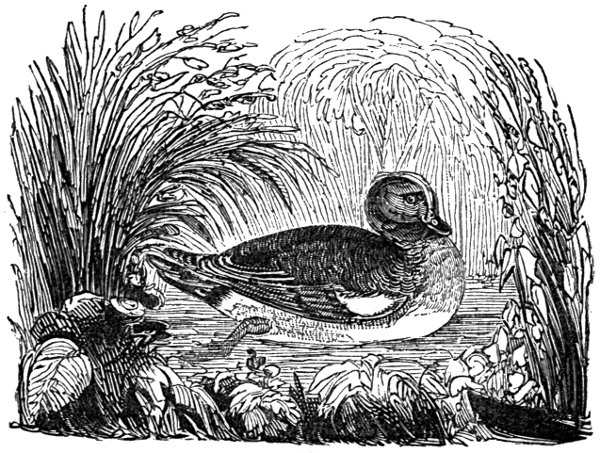
This is nearly of the same size as the gadwall, weighing generally about twenty-three ounces, and measuring nearly twenty inches in length, and two feet three in breadth.
The bill is an inch and a half long, narrow, and serrated on the inner edges; the upper mandible is of a dark lead-colour, tipped with black. The crown of the head, which is very high and narrow, is of a cream-colour, with a small spot of the same under each eye; the rest of the head, the neck, and the breast, are bright rufous chestnut, obscurely freckled on the head with black spots, and darkest on the chin and throat, which are tinged with a vinous colour; a band, composed of beautifully waved, or indented narrow ash-brown and white lines, separates the breast and neck; the back and scapulars are marked with similar feathers, as are also the sides of the body under the wings, even as low as the thighs, but there they are paler; the belly to the vent is white; the ridge of the wing, and adjoining coverts, are dusky ash-brown; the greater coverts brown, edged with white, (in some specimens wholly white,) and tipped with black, which forms an upper border to the changeable green beauty-spots of the wings, which is also bordered on the under side by another stripe formed by the deep velvet black tips of the secondary quills; the exterior webs of the adjoining quills are white, and those next the back, which are very long, are of a deep brown, (in some specimens a deep black) edged with yellowish white; the greater quills are brown; the vent and upper tail-coverts black.
Wigeons commonly fly in small flocks during the night, and may be known from others by their whistling note while they are on the wing. They are easily domesticated in places where there is plenty of water, and are much admired for their beauty, sprightly look, and busy frolicsome manners.
The tail, which consists of fourteen feathers, is of a hoary brownish ash, edged with yellowish white; the two middle ones are sharp-pointed, darker and longer than the rest. The legs and toes are of a dirty lead colour, faintly tinged with green; the middle of the webs and nails black. The female is brown, the middle of the feathers deepest; the fore part of the neck and breast paler; scapulars dark brown, with paler edges; wings and belly as in the male. The young of both sexes are grey, and continue in that plain garb till the month of February, after which a change takes place, and the plumage of the male begins to assume its rich colourings, in which it is said he continues till the end of July, and then again the feathers become dark and grey, so that he is hardly to be distinguished from the female.
These birds quit the desert morasses of the north on the approach of winter, and as they advance towards the end of their destined southern journey, they spread themselves along the shores and over the marshes and lakes in various parts of the continent, as well as those of the British isles, and it is said that some of the flocks advance as far south as Egypt. They remain in these parts during the winter, at the end of which the old birds pair, and the whole tribe in full plumage take their departure northward about the end of March. While they remain with us, they frequent the same places, and feed in the same mode as the mallard, and are often taken in the decoys along with them and other kinds of ducks.—Bewick.
Wild, a. Not tame, not domestic; propagated by nature, not cultivated; desert, uninhabited; tempestuous; inconstant, fickle; uncouth, strange; done or made without any consistent order or plan; merely imaginary.
Wild, s. A desert, a tract uncultivated and uninhabited.
Wild Dog, s. An untrained dog; a dog run wild.
In December, 1784, a dog was left by a smuggling vessel near Boomer, on the coast of Northumberland. Finding himself deserted, he began to worry sheep, and did so much damage that he was the terror of the country, within the circuit of above twenty miles. It is asserted that when he caught a sheep, he bit a hole in the right side, and after eating the fat about the kidneys, left it. Several of them thus lacerated were found alive by the shepherds, and being properly taken care of some of them recovered and afterwards had lambs. From this delicacy of his feeding, the destruction may in some measure be conceived, as the fat of one sheep in a day would scarcely satisfy his hunger. Various were the means used to destroy him; frequently was he pursued with hounds, greyhounds, &c., but when the dogs came up to him he laid down on his back, as if supplicating for mercy, and in that position they never hurt him; he therefore laid quietly, taking his rest till the hunters approached, when he made off without being followed by the hounds, till they were again excited to the pursuit, which always terminated unsuccessfully. He was one day pursued from Howick to upwards of thirty miles’ distance, but returned thither and killed sheep the same evening. His constant residence was upon a rock on the Heugh Hill, near Howick, where he had a view of four roads that approached it, and there, in March 1785, after many fruitless attempts, he was at last shot.
Another wild dog, which had committed devastation among the sheep, near Wooler, in the same county (Northumberland) was on the 6th of June, 1799, advertised to be hunted on the Wednesday following by three packs of hounds, which were to meet at different places; the aid of men and firearms was also requested, with a reward promised of twenty guineas to the person killing him. This dog was described by those who had seen him at a distance, as a large greyhound, with some white in his face, neck, and one foreleg white, rather grey on the back, and the rest a jet black; an immense concourse of people assembled at the time appointed, but the chase was unprosperous; for he eluded his pursuers among the Cheviot Hills, and what is singular returned that same night to the place from whence he had been hunted in the morning, and worried an ewe and her lamb. During the whole summer he continued to destroy sheep, but changed his quarters, for he infested the fells, sixteen miles south of Carlisle, where upwards of sixty sheep fell victims to his ferocity. In September, hounds and fire-arms were again employed against him, and after a run from Carrock Fell, which was computed to be thirty miles, he was shot whilst the hounds were in pursuit, by Mr. Lewel of Wedlock, who laid in ambush at Moss Dale. During the chase, which occupied six hours, he frequently turned upon the headmost hounds, and wounded several so badly as to disable them. Upon examination he appeared of Newfoundland breed, of a common size, wire-haired, and extremely lean. This description does not tally with the dogs so injurious to the farmers in Northumberland, although from circumstances there is little doubt but it was the same animal.—Daniel.
Wildfire, s. A composition of inflammable materials, easy to take fire, and hard to be extinguished.
Wild Fowl Shooting, s. To shoot water fowl.
During the time of long frosts, if going on the water or into the marshes, after the wild fowl, does not suit the shooter’s convenience or choice, by attending the brooks and small rivers that are only partially frozen early of a morning, and following their course, he may frequently find diversion, and be almost certain of meeting with wild ducks searching both for food and fresh water; he will be also equally sure to get shots, for they will not rise until he is close upon them. In extreme severity of frost, with hard and permanent snow, the warm springs which do not freeze are spots that then seldom fail, as the wild ducks are confined to these places in order to procure the aquatic herbs growing there, and which are almost the sole food that remains for them at this inclement period.
In following wild fowl, it is easier to get within twenty yards of them by going to leeward, than a hundred and fifty if directly to windward; so very acute is their sense of smelling.
The coast between Hampshire and the Isle of Wight is peculiar, consisting, at ebb tide, of vast muddy flats, covered with green sea-weed: it affords the fowler an opportunity of practising arts perhaps not elsewhere resorted to. Fowling and fishing are indeed on this coast commonly the employment of the same person. He who in summer with his line or net, plies the shores, when they are overflowed by the tide; in winter, with his gun, as evening draws on, runs up in his boat among the little creeks, which the tide leaves in the mudlands, and lies in patient expectation of his prey. Sea-fowl usually feed by night, when, in all their multitudes, they come down to graze on the savannahs of the shore. As the sonorous cloud advances, the attentive fowler listens which way they bend their course:—perhaps he has the mortification to hear them alight at too great a distance for his gun to reach them; and if he cannot edge his boat round some winding creek, which it is not always in his power to do, he despairs of success that night: perhaps, however, he is more fortunate, and has the satisfaction to hear the airy noise approach nearer, till at length the host settles in some place upon the edge of which his boat is moored. He now, as silently as possible, primes both his pieces anew, (for he is generally doubly armed) and listens with all his attention: it is so dark that he can take no aim; for if he could discern the birds, they would also see him; and being exceedingly timorous, would seek some other pasture. Though they march with noise, they feed in silence; some indistinct noises, however, if the night be still, issue from so vast a concourse; he directs his piece, therefore, towards the sound, fires at a venture, and instantly catching up his other gun, discharges it where he supposes the flock to rise on the wing. His gains for the night are now decided, and he has only to gather his harvest. He immediately puts on his mud pattens (flat square pieces of board, which the fowler ties to his feet, that he may not sink in the ooze) ignorant yet of his success, and goes groping about in the dark in quest of his booty, picking up sometimes many, and perhaps none. And, after all, others frequently enjoy more from his labours than himself: for the tide often throws, next day, on different parts of the shore, many of the birds which he killed, but could not find in the night.
This hazardous occupation once led a fowler into singular distress:—it happened too in the day-time, which shows still more forcibly the risk of such nocturnal expeditions. Mounted on his mud pattens, he was traversing one of these oozy plains in search of ducks, and, being intent only on his game, suddenly found the water, which had been accelerated by some peculiar circumstance affecting the tide, had made an alarming progress around him, and he found himself completely encircled: in this desperate situation, an idea struck him, as the only hope of safety. He retired to that part which seemed the highest, from its being yet uncovered by water, and striking the barrel of his long gun deep in the ooze, he resolved to hold fast by it, as well for a support as a security against the waves, and to wait the ebbing of the tide.—He had reason to believe that a common tide would not have flowed above his middle; but, in the midst of his reasoning upon the subject, the water had reached him:—it rippled over his feet—it gained his knees, his waist:—button after button was swallowed up, until at length it flowed over his shoulders! With a palpitating heart, he gave himself up for lost! Still, however, he held fast by his anchor:—his eye was eagerly in search for some boat, which might accidentally be passing, but none appeared. A head upon the surface of the water, and that sometimes covered by a wave, was no object to be descried from the land, at the distance of half a league; nor could he exert any sounds of distress that could be heard so far! While, as the exigence would allow, he was thus making up his mind to the terrors of certain destruction, his attention was called to a new object:—he thought he saw the uppermost button of his coat begin to appear! No mariner floating on a wreck could behold approaching succour with greater transport than he felt at the transient view of his button; but the fluctuation of the water was such, and the turn of the tide so slow, that it was yet some time before he durst venture to assure himself that the button was fairly above the level of the flood; at length, a second button appearing at intervals, his sensations may rather be conceived than described; and his joy gave him spirits and resolution to support his situation four or five hours longer, until the water had fully retired.—Daniel—Gilpin.
Wild Turkeys, s. Turkeys not domesticated.
One of the keepers in Richmond Park informs me that he has often heard his father, who was also a keeper, mention that, in the reign of George the Second, a large flock of wild turkeys, consisting of not less than two thousand, was regularly kept up as part of the stock of the park. In the autumn and winter they fed on acorns, of which they must have had an abundant supply, since the park was then almost wooded with oak, with a thick cover of furze; and although at present eleven miles in circumference, it was formerly much larger, and connected with extensive possessions of the Crown, some of which are now alienated. Stacks of barley were also put in different places in the park for their support; and some of the old turkey cocks are said to have weighed from twenty-five to thirty pounds. They were hunted with dogs, and made to take refuge in a tree, where they were frequently shot by George the Second. I have not been able to learn how long they had been preserved in the park before his reign, but they were totally destroyed towards the latter end of it, in consequence of the dangers to which the keepers were exposed in protecting them from poachers, with whom they had many bloody fights, being frequently overpowered by them.
Though I have not been able, in any of the accounts which have been given of Richmond Park, to find a notice of the stock of turkeys; there can, I think, be no doubt of the fact, since the ancestors of the present head and second keepers of the park had, for many generations, been keepers in it, and have handed down to their present successors many curious accounts of the fights which took place between them and the poachers, in the preservation of the turkeys.
That turkeys would increase rapidly in the park if left to themselves, there can be no doubt, as a stray hen turkey brought up a large brood, which I saw, and which were quite wild. They kept in a part of the park little frequented, and if disturbed would take a flight and settle in trees: they were subsequently shot, and were in good condition. Had these birds been suffered to remain, they would probably have increased rapidly.
The only wild turkeys which I can at present hear of, are to be found in the park of Sir Watkin Williams Wynne, at Wynnstay, where there is a flock consisting of about five hundred. They were tried in Windsor Great Park, but did not succeed there. A few bustards are still to be found near Newmarket; but I believe they have quite deserted Salisbury Plain.—Jesse.
Willow, s. A tree.
Wind, s. A strong motion of the air; breath, power of respiration; flatulence; windiness; down the wind, to decoy.
Thick wind is a common consequence of either acute or chronic inflammations. In some instances, it is the immediate consequence of violent or long-continued exercise, particularly on a distended stomach and bowels, or after full drinking; or it may be brought on by the application of cold. It is often connected with a plethoric state, and is therefore very common among gross feeders, and where the exercise is not proportioned to the work; and more particularly in low-bred and thickset horses. The remote causes are usually increased vascular action; the proximate, the deposit occasioned by it, which blocks up the air-cells, and thus interferes with the freedom of respiration. The post-mortem examinations of such cases, exhibit, in some instances, a slight hepatisation of lung, the consequence of repeated congestions in plethoric habits; in others, the minute bronchial cells are filled with adhesive matter, or the general parenchymatous substance may be pervaded with minute granulations of a bluish colour.
The symptoms of thick wind are sufficiently known to any one at all conversant with horses, and the rationale by which they are produced is not difficult to explain. The capacity of the air cells being diminished, renders it necessary for the air to be more frequently taken in, because, being acted on by a less surface, the blood is not sufficiently oxygenated; and a sufficient number of air cells not being expanded, a sense of fulness in the right side of the heart induces the animal to make hasty inspirations to remedy the defect, and consequently hasty expirations: the force with which these are operated, occasions the sound so well known as the distinguishing mark of thick wind. In this affection, the obstruction to both being equal, the inspirations and expirations are equal, which serves to distinguish it from broken wind, in which there is no obstruction to the entrance; and therefore the breath is drawn in with its usual facility, but is expelled with difficulty. Thick wind is, however, very apt to degenerate into that state termed broken wind; and the post-mortem appearances of such horses as have been examined under thick wind would readily, by an increase of the disorganisation, account for the symptoms of broken wind; but it cannot be the hepatised lung that is changed into the emphysematous state.
The treatment of thick wind can seldom be more than palliative, as, once established, it remains permanent. In very recent cases, bleeding, blistering the chest, or mildly stimulating the course of the trachea and bronchia, by mercurial frictions, to promote the absorption of any deposit, may be tried. These having failed, a preventive treatment should be adopted, calculated to avoid any increase of the evil, as in the treatment of broken wind. I have, now and then, witnessed benefit from repeated doses of mild mercurial physic.
Broken Wind.—The remote causes of broken wind are hereditary or constitutional liability, as well as the remaining sufficiently long under the action of causes capable of exciting morbid changes in the respiratory organs themselves. A certain form of body is unquestionably favourable to its production, and it is from this circumstance that it proves hereditary. The narrow confined chest, and the pendent belly, which mark low bred horses and gross feeders, all of whom are observed to be peculiarly liable to it, are predisponents, by confining the ordinate action of the lungs, and affording no reserve for the inordinate. It must be this defect in form which makes it more common in mares than horses; subjecting horses to a long-continued unhealthy course of feeding on dry food, as chaff, bran, barley meal, &c., &c., brings it on; or working in mills, where much dust is necessarily inhaled. It is seldom the immediate consequence of pneumonia, but frequently it results from those states of disordered respiration which succeed to it, as thick wind, chronic cough, &c. The proximate causes we are as much in the dark about; we see that it gradually steals on a horse, occupying months, and even years, in a slight occasional cough, which ripening into a state of slightly impeded respiration on exertion, at last ends in broken wind. We see it also follow one hard gallop, and we can leave a horse well one day, and find him broken-winded the next.
The symptoms of this complaint are well marked; the cough and the mode in which respiration is performed may be considered as pathognomonic. The sound emitted by the cough is peculiar to this asthmatic state, and is often forced out with a kind of grunt through the upper part of the trachea, in a short but vibrating feeble tone compared with the usual cough of sound winded horses. The respiration is conducted with a remarkable difference between the inspirations and expirations. Inspiration is effected quickly and with the ordinary ease, because, as would be argued by those who favour the opinion that an emphysematous state of lungs is the sole cause of this equine asthma, the air is supposed readily to find its way into the cellular tissue of the ruptured air-cells, where, becoming entangled, it occasions that remarkable difference in the ease with which inspiration is effected and the lengthened laborious effort of expiration, which, it may be observed, is performed by two distinct efforts, in one of which the usual muscles operate, and in the other the auxiliary muscles, particularly the abdominal, which are put on the stretch to complete the expulsion more perfectly; after which the flank falls with peculiar force, when these muscles resume their relaxations. An auxiliary symptom is the peculiar flatulence of every broken-winded horse, which is strikingly characteristic of that disordered state of digestion so common in these cases, and of that constant thirst also which is invariably present.
The treatment of broken wind can seldom be more than palliative. Whatever increases the distension of the vessels generally, as a state of plethora, or of the stomach and bowels particularly, aggravates the complaint by increasing the difficulty of expanding the lungs. Therefore, avoid stimulants, and promote regular evacuations by the bowels; abstain from over-distension of the lungs by too violent and too sudden exertions, particularly after eating; for the food, although it may be supposed to pass the stomach quickly, yet is retained longer in the large intestines, which equally press on the diaphragm. By carefully attending to these principal indications, a broken-winded horse may be rendered comfortable to himself, and useful to his owner. The food should be regularly given in moderate quantities only; but most particularly it should be of such a nature as will contain much nutriment in a small space: hence corn is more proper than hay, and, above all, I have found a manger food composed of one part bran, one part bruised beans, and two parts braised oats, agree particularly well, given somewhat moistened, as indeed all the food given to a broken-winded horse should be. On a sufficient quantity of this food a horse will need but very little hay, and what he does have should be of the oldest and best kind, and principally given at night as a condiment to the corn. When they can be got, give also carrots, mangel wurzel, Swedish turnips, parsneps, or cooked potatoes, which feeding will be found to combine both medicine and nutriment, and render little water necessary. Turning out to grass commonly aggravates the symptoms of broken wind; but a daily run on a very short pasture is generally found advantageous, and a neglect of moderate exercise aggravates the complaint greatly; water should be sparingly given, particularly in the working hours: at night, a moderate quantity may and should be allowed, but on no account let the broken-winded horse drink his fill at a pond or trough. Medicinally, it may not be improper to bleed when the occasional symptoms run high; and benefit has been received from daily doses of foxglove under these circumstances. I have also administered antimony and nitre with advantage.
Modes of distinguishing soundness and unsoundness of the Wind.—These various affections of the wind are very important to the veterinarian, nor can he be too well informed of the appearances that characterise each distinctly; because, as their existence affects the legal soundness of horses, so he will be very often forced to decide peremptorily on very slight appearances. To detect thick wind it is generally necessary that some time be spent with the horse; and it is often requisite that he should be examined under various circumstances. Does he bear moderate exercise, immediately after eating or drinking, without blowing high? Does he cough in so doing, or is he observed to do it on every change of position, or temperature; particularly after drinking? And does he when in the stable, field, or when completely at rest, occasionally cough short, hollow, and not followed by that firm effort we call clearing afterwards? In such a case the horse has chronic cough; and as his breathing is more or less accelerated beyond the ordinary standard, he is more or less thick-winded also. Roaring may be immediately detected by a brisk gallop; but the person who is to judge of its existence should be on the ground, and the horse should pass him several times, but without restraint; for I have seen horses whipped into a momentary cessation of the roaring.
Broken wind can hardly be mistaken; the cough accompanying it conveys a peculiar sound; it is short, vibrates within, and is combined with a grunting effort, more particularly observable on any sudden motion or surprise; to produce which, dealers hold up the horse’s head, and then either strike, or pretend to strike, him suddenly, or kick him, which usually elicits this peculiar grunting sound. The breathing is hurried in the extreme by exertion, and is remarkable by being made up of three efforts instead of two. In the first, the air is drawn in naturally, and the flanks fill up as usual; but in the next, the falling of the flanks, again to expel the air, is most unusual; for it is not done with a gradual contraction of the muscles, but takes place at once by a momentary effort; and then a third action takes place, which is a slow but strong drawing up of the muscles of the belly, as though to press out remaining air. Broken-winded horses are also observed to be peculiarly greedy after water; and a little hurried motion distends the nostrils, and produces evident distress.—Blaine.