INTRODUCTION. (continued 12)
Reading edition
That our times should be as far distinguished for increased effect and superior elegance in the formation of fire-arms, as for any other mechanical improvement, will be admitted by all but the most prejudiced of the old school. Antique gunners may still be found, who are obstinate in preferring the flint to the percussion plan. But any person who has suffered the disappointments that the best guns on the former principle will entail upon those who carry them, and particularly in wet and stormy weather, will freely admit the wonderful advantages that simple and effective invention, the copper-cap, confers upon the modern sportsman. The misery entailed upon the man who in rain and storm attempts to load and discharge a flint gun, may be reckoned among the worst upon the human catalogue; and if he who has suffered repeated disappointments of eternal misses and dilatory explosions from a thick flint and a damp pan, tried the simple and elegant improvement now in general use, he would abandon the stone gun for ever.
It has been said that gun-making is only brought to perfection in London, and that the Irish are not able to compete with their English rivals. I am, I confess, decidedly partial to a London gun; and while I admit that I have occasionally met with excellent fire-arms produced by Dublin makers, yet they are, in finish and elegance, generally behind those which one gets from any of the leading artists in the great metropolis. To point to any particular name among the host of London makers, would be absurd. From more than a dozen a person will be certain of obtaining a first-rate implement; and from the Mantons, Purdy, Egg, and many others, guns of the most efficient qualities and beautiful finish will be procured.
Trial between French and English Guns.—We then made trial of some guns of the manufactory, and it may be reasonably supposed the best were selected. I had only brought two of my own, one of which was my coach gun, not more than two feet long, but even this far surpassed those produced by the manufactory. They made some shots at the distance of ninety-eight yards, but did not succeed.
It was afterwards agreed to have a full and fair trial of my guns against the manufactory, and each party was naturally anxious for success. The Poker, or Bonaparte, as the gun is termed, opened the ball, and she threw her shot so exactly, that the French admitted, “une mouche ne pouvoit pas l’echapper.”
Theirs in return failed, after which they assayed about four others. The next was my air gun, at ninety-three yards, against their rifle. I shot within an inch of their mark though it was not fully pumped; the day was extremely sultry, and yet my next shot was still more exact.
The next trial was my double rifle, which was, apparently, greatly in their favour, as the sight to a single rifle is far more accurate. On preparing to reload, I found that, owing to some mistake, the loader and the bullet moulds were either lost or mislaid. However, some bullets were found to fit, and, after loading with powder merely by guess, I made eight shots, each sufficient to pierce through a deer’s head, and one even touched the edge of the white.
We had several other trials both with rifles and air guns, but the result afforded a convincing proof of the superiority of the English manufactures: several bets were made on this occasion, and general Beaumont, the appointed judge, decided impartially in favour of my guns, but, out of respect for the civilities I had received, I ordered a single and double barrelled gun of the best make.
The mounting of their guns at Versailles is certainly excellent, and the carving of their stocks is most beautifully conceived and is capitally executed, but their barrels are not fitted in that workman-like manner which constitutes a striking excellence in the English manufactories. They are also very inferior to my countrymen in the art of browning, and in the construction of their locks.
The manufactory at Versailles was under the patronage of the First Consul, and he frequently ordered the most costly pieces, as presents for foreign princes, or general officers; one gun was produced which was then completing for the Consul, at the price of eight hundred guineas. The sum was certainly very great, but I remember receiving a fowling piece as a present from Lord Rockingham, which cost his lordship four hundred guineas, in consequence of my having killed a sparrow, which had perched on the top of Wentworth house.
Anno 1712, a brass gun was advertised to be shot for, at Hoxton, which was in the shape of a walking cane, might be used either as a gun or pistol, and which contained a telescope, a dial on the head, and a perpetual almanac.
Directions for cleaning guns.—Let your barrels be first washed perfectly clean with cold, and then fill each of them with hot water; which, by the time it has nearly run out at the touch-holes, will accelerate their being wiped dry, as much as though boiling water had been used; and before they have completely discharged the water, stop the muzzles and touch-holes; and after shaking it up and down in the barrels, turn it out at the muzzles, by which means you will effectually stir up and expel any extraneous matter that may have lodged in the bottom of the chambers. To ascertain this, hold them with the touch-holes towards the window, and (with the breechings which I have recommended) you will, by looking into each muzzle, plainly perceive the light in the chamber appearing like one dot surrounded by two (and sometimes three) rings. I have recommended washing guns with cold water, from having found that it always more readily removes the foulness occasioned by the powder, which, from sudden heat, is apt, at first, to dry and adhere more closely to the calibre: whereas, with cold water, it remains in a moist state, and immediately mixes.
In cleansing barrels, a little fine sand may not be amiss, and will generally answer in removing the lead. If hot water should be required for this purpose, the gun may be scoured with it, after having been washed with cold.
Gun-makers generally apply hot water to clean the barrels if much leaded, and afterwards finish with cold; but cold water is best, and the tow being strewed over with steel-filings, will better remove the lead, and at the same time do no injury to the inside polish of the barrel.
Every shooter should have the breeches of his guns taken out at least twice a year. To undo them without springing the barrels, let him use tallow and wax mixed, and anoint the threads; steeping the barrels in warm water before trying to unscrew them; any fault may be easily discovered by thus inspecting the barrels.
If a stupid fellow wedges dry tow into your gun, with the cleaning rod, pour boiling water on it, and the rod may then be turned round and drawn out. I remember this occurred with a large punt-gun, at which I caught four men hauling away most unmercifully, but to no effect; I luckily came by and saved the destruction of the cleaning-rod, if not the injury of the barrel, by suggesting this simple contrivance.
TECHNICAL TERMS USED BY GUN-MAKERS.
Bolts—Pieces of iron, which fasten the barrel to the stock.
Bridle—The polished piece of steel, which caps the tumbler; it is secured by two screws, and also the scear-screw.
Cap—The covering for the worm of the ramrod.
Chain or Swivel—A little catch attached to the neek of the tumbler, which receives the end of the mainspring.
Chamber—Centre tube in breeching. Antechamber is the smaller tube, leading from this to the touch-hole.
Cock-screw—That which fastens the flint.
Cup—The concave at the top of the improved breechings.
Escutcheons, ornamental—Pieces of silver, to prevent bolts from wearing the stock; and also the shield on which the crest and cipher are engraved.
Face of the Hammer—The part which, by coming in contact with the flint, strikes fire.
False Breeching—The part where the nose of the breechings hook in, before the barrels can be laid in the stock.
False Breech-screw—Passes through the stock into the trigger-plate, and screws them together.
Fence—The part between cock and pan, on which is received the solid cock.
Guard—Curved plate to defend the triggers.
Hammer-spring—That on which the hammer is moved.
Hammer-bridle—A part which the tail of the hammer works in.
Heel-plate—The plate with which the butt is tipped.
Jaw—Lips of the cock, to hold the flint.
Lock-plate—Plate to which all the lock is screwed.
Loops—Eyes to receive the bolts that fasten the barrel to the stock.
Mainspring—That spring by which the tumbler is worked with the cock.
Nipple—The iron pillar on which the copper cap of a detonating-gun is placed.
Pipes—Tubes to receive the ramrod.
Rib—Piece of iron which strengthens the barrel, and on which the ramrod rests.
Scroll-guard—An extension from the guard to steady the hand.
Scear—That which catches the tumbler for half or whole cock, and which, being pushed up by the trigger, lets the cock fall.
Scear-spring—The spring which holds the scear in the notches of the tumbler, at half or whole cock.
Side-nail—A screw which fastens on the locks.
Sight—The piece of metal, attached to the end of a gun-barrel, to assist the eye in taking aim at an object.
Spring-cramp—A small instrument for dissecting locks.
Tail—The shoulder of a hammer.
Top-piece—Elevated rib, along which is directed the line of aim.
Trigger-plate—Plate in which the triggers work.
Trigger-springs—Small springs to keep the triggers constantly pressing close to scear.
Tumbler—The moveable centre piece of a lock, which falls with the cock.
Tumbler-screw—The screw which fastens on the cock.
Vent-hole—A small hole at the side of the breeching in detonating-guns, to let out the gas, and lessen the recoil.
Worm—Screw at the end of ramrod.—Hints to Sportsmen—Thornton—Daniel—Hawker—Wild Sports.
Gunpowder, s. The powder put into guns to be fired.
Gunpowder is composed of very light charcoal, sulphur, and well refined saltpetre. The powder used by sportsmen in shooting game is generally composed of six parts of saltpetre, one of charcoal, and one of sulphur; but these proportions, as well as the introduction of other ingredients, and the sizes of the grains, are undoubtedly varied by the different manufacturers in the composition of the powders of the same denominations, and are always kept profoundly secret.
The materials are put into a wooden trough, where they are ground together, to render the contact of the nitrous and combustible particles intimate and equal throughout the whole mass. The mixture is occasionally sprinkled with water to form an amalgam, which is afterwards granulated, and to prevent the finer particles of the sulphur and the charcoal from flying off, which would necessarily alter the proportion of the composition. The powder-makers employ more or less time in the operation of grinding, in proportion to the quantity and quality of the saltpetre. When they conceive that the ingredients are properly mixed together, they from the paste form these little grains, which, being dried, obtain the name of gunpowder.
There are two general methods of examining gunpowder, one with regard to its purity, the other with regard to its strength.
Its purity is known by laying two or three little heaps near each other upon white paper, and firing one of them. For if this takes fire readily and the smoke rises upright, without leaving any dross or feculent matter behind, and without burning the paper, or firing the other heaps, it is esteemed a sign that the sulphur and nitre were well purified, that the coal was good, and that the ingredients were thoroughly incorporated together; but if the other heaps also take fire at the same time, it is presumed, that either common salt was mixed with the nitre, or that the coal was not well ground, or the whole mass not well beat or mixed together; and if either the nitre or sulphur be not well purified the paper will be black or spotted.
To determine the strength of powder, dry it perfectly and ascertain how many sheets of paper it will drive the shot through at the distance of ten or twelve yards. In this trial we should be careful to employ the same sized shot in each experiment—the quantity both of the shot and the powder being regulated by exact weight, otherwise we cannot, even in this experiment, arrive to any certainty in comparing the strength of different powders, or of the same powder at different times.
Mr. Daniel, in speaking of gunpowder, gives the following recipe for increasing its strength. We entirely coincide in his opinion that it is quite unnecessary to augment the force of modern gunpowder, and insert the directions rather for the experimentalist than the sportsman.
“The following method of increasing the force of gunpowder one-third in proportion to its original goodness, was discovered by a physician of Fogano, in Tuscany, whose name was Francesco. To every pound of powder add four ounces of quick lime, fresh and well pulverised; let the whole be shaken until the mixture is perfect, and afterwards kept for use in a close stopped vessel. To the chemists is left to decide upon what principle the lime acts in strengthening the powder. The experiment is said to be certain. It is necessary to add, that the powder used in priming must be unmixed with lime. Without artificially augmenting the strength of gunpowder, that made by Messrs. Pigou and Andrews will be found excellent; and it is to be feared, if a gentleman cannot kill with the above, no chemical preparation will much assist his endeavours.”
The concluding observations are taken from a very clever and ingenious work, published many years ago, and entitled “An Essay on Shooting.”
Powder ought to be kept very dry; every degree of moisture injures it. Good powder, however, does not readily imbibe moisture; and, perhaps, there is no greater proof of the bad quality of powder, than its growing damp quickly when exposed to the air. This readiness to become moist, depends upon the saltpetre employed in the composition not having been freed from the common salt it contains in its crude state, and which, in consequence, has a very strong attraction for watery particles.
Powder may acquire a small degree of dampness, and be freed from it again by drying, without much injury to its quality. But if the moisture is considerable, the saltpetre is dissolved, and the intimate mixture of the several ingredients thereby entirely destroyed. Drying powder with too great a heat also injures it; for there is a degree of heat, which, although not sufficient to fire the powder, will yet dissipate the sulphur, and impair the composition by destroying the texture of the grains. The heat of the sun is, perhaps, the greatest it can with safety be exposed to, and, if properly managed, is sufficient for the purpose; when this cannot be had, the heat of a fire, regulated to the same degree, may be employed; and for this end, a heated pewter plate is perhaps as good as anything, because pewter retains so moderate a heat, that there can be little danger of spoiling the powder by producing the consequences before-mentioned.
It is observable that damp powder produces a remarkable foulness in the fowling-piece after firing, much beyond what arises from an equal quantity of dry powder; and this seems to arise from the diminution of the activity of the fire in the explosion.
Unless the sportsman is very particular indeed in the mode of keeping his powder, we would recommend him always to air it and his flask before he takes the field.
Flasks made of copper or tin are much better for keeping powder in than those made of leather, or than small casks; the necks of these should be small, and well stopped with cork.—Wild Sports.
Gunshot, s. The reach or range of a gun.
Gunshot, a. Made by the shot of a gun.
Gunsmith, s. A man whose trade is to make guns.
Gunstick, s. obs. The rammer.
Gunstock, s. The wood to which the barrel of a gun is fixed. Vide Stock.
To repair a broken stock.—See then, I first put a little glue between the fractured parts, and then tie them strongly round. Hand me that gimlet. Now we have a hole right through, at right angles with the grasp;—dip that peg in glue, and hand it over to me—so now we have it driven tight in. I let loose the string at one end, and begin to bind the stock with this waxed thread, leaving the glue that has oozed from the sides of the wood to lay hold of the thread—so now it is finished off like a cricket-bat. Let us borrow a small strip of ribband of the hostess, to bind over and prevent our friend’s hand from being stuck to the stock. Enough; I will venture to say that the bandage would remain firm much longer than it will be left there; and though the grasp of the gun is a little thicker, it will not much matter, and it is but a make-shift after all.—Hints to Grown Sportsman.
Gurgitting, s. In falconry, act of suffocation in hawks.
Gust, s. A sudden violent burst of wind.
Gut, s. The long pipe reaching with many convolutions from the stomach to the vent; the stomach, the receptacle of food.
Gut, v. To eviscerate, to draw; to take out the inside.
Gwinniad, s. The name of a fish.
The gwinniad, although a fish, is not immediately within the list of those that are objects of the angler’s attention, yet it is noticed as being a native of peculiar parts of this country. It is found, according to Pennant, in one of the lakes of Ireland—Lough Neagh, where it is called the pollen; in Lough Maben, in Scotland, where it is termed the vangis; and the Scotch have a tradition, that it was there first introduced by their beauteous queen, the unhappy Mary Stuart.
They are taken in nets, but never by any bait, keeping on the bottom of the lake, and feeding on small shells, and the leaves of the water gladiole, a plant peculiar to these mountain lakes.—Daniel.
Gymnastic, a. Relating to athletic exercises.
Gyration, s. The act of turning any thing round; the ascent of a hawk.
Gyre, s. A circle described by anything going in an orbit.
Haak, s. A fish.
Hack, v. To turn hackney; to abuse.
Hackle, s. Raw silk, any filmy substance unspun.
To Prepare Hackles.—First, pick and bunch them, and be careful they are the feathers of old cocks, otherwise they will not be worth a farthing when dyed, as they will all curl in on each edge, and shrivel up in the points. Bunch each colour by themselves, and throw them into a basin of hot water. Take them out one by one, and rub soap on them downwards, dipping them occasionally in the water till you see they are clean; dip them in a weak solution of alum water, and then wash them very well in clean water, and they are done.
Every shade of red will come out of the dye, differing in colour, whether olive or cinnamon. For olives, ground richly in turmeric, and throw into the same liquor the size of a hazel nut of best madder. Boil in that a quarter of an hour, and throw in a small bit of copperas, first lifting out your hackles till the copperas is dissolved, and when the liquor boils, throw in your feathers for an instant, and you have fine olives. Black hackles dyed in this way, become a rich green olive, or dooghadoo. For cinnamons ground richly in turmeric, all red hackles; then put in two teaspoonfuls of cochineal, ground or powdered, boil them in that for a quarter of an hour, then put in one teaspoonful of best brazil dust, and boil for a quarter of an hour, and you have fine cinnamons. Any dirty tawneys, or grizzle hackles may be dyed in this, and it will improve them much. There is a sort of reddish cuckoo hackle that may be dyed in turmeric and madder, as in the olive hackle process, but not to have any copperas. There is also a yellowish white with a black vein in the middle, and edged with black. All whites, natural yellows, or yellowish whites for the drakes. There is a scald whitish cuckoo hackle with very little black in it—have nothing to do with them. All those marked as above should be dyed in the following way:—
Take one chip of young fustic, and two or three seedy sprigs of French weed; boil in this till they come to a faint yellow: draw them, if you wish a bunch of that colour, and if not, put in one pinch of turmeric, and one of madder; boil in this for a quarter of an hour, and I think you will have fine hackles for the drakes. You have no richness from the weed, but when you add the turmeric and madder you have. In every instance except this, I condemn and forbid the dyeing with turmeric and young fustic, as it will ruin every thing that is dyed in it—it gives so bad a colour.
To stain hackles of a fine rich Gold Colour.—Ground strongly in turmeric, then add a tea-spoonful of best madder, boil well for fifteen minutes, and draw them. Add then two spoonfuls more of madder, and boil for the same time, and draw again. Then add three more, and boil as before; and, lastly, add six spoonfuls of madder, and boil for half an hour, and you have four fine shades of gold colours.—Ancient Recipes.
Hackney, s. A hired horse; a hireling; any thing let out for hire; a horse of small value used to ride to cover.
Hackney, v. To practise in one thing; to accustom to the road.
Haddock, s. A sea fish of the cod kind.
The haddock, one of the commonest fishes in the London markets, begins to be in roe in the middle of November, and so continues until the end of January; from that time until May they are thin tailed, and much out of season. The grand shoal of haddocks comes periodically on the Yorkshire coasts.
Fishermen assert, that when the sea is rough, haddocks sink down into the ooze and sand at the bottom, and there shelter themselves until the storm subsides; their reason for this assertion is, that in boisterous weather they take none, and those that are caught immediately after a storm, have their backs covered with mud. The bulk of the haddock is seldom known to exceed fourteen pounds; these are uncommon, and extremely coarse, the best for the table weighing from two to three pounds. The black spot beyond the gills, is the mark which superstition interprets to be the impression left by the finger and thumb of St. Peter, when he took the tribute money out of the mouth of a fish of this species, and which has been ever since that miracle continued to the whole race of haddocks.
The haddock taken on the Irish coasts are much superior to what is found in the English markets. Those of seven or eight pounds weight are preferred to smaller fish, being considered finer and firmer.—Daniel, &c.
Haft, s. A handle, that part of an instrument that is taken into the hand.
Haggard, a. Wild, untamed, irreclaimable; lean; rugged, deformed.
Haggard, s. Any thing wild or irreclaimable; a species of hawk.
Hail, s. Drops of rain frozen in their falling; a provincial name for shot.
Hair, s. One of the common teguments of the body; a single hair; any thing proverbially small; small filaments issuing out of the pores of the skins of animals, and serving for the most part as a covering. The constituent parts of hair are animal matter, oil, silex, sulphur, carbonate of lime, &c.—Crabbe.
Hair that is most proper, is that taken from a young, healthy, grey, or white stallion, and which is of a pale transparent water-colour; that from the middle of the tail is the best. The hairs should be sorted singly, and the biggest, roundest, and freest from blemishes, made up into small bundles; the next sized hairs, and all that are sound and good, are to be alike sorted and parcelled out; they are then to be laid in clean spring water for twelve hours; after that, washed well, and dried either with bran, or by hanging them in a room where the heat of a fire or sun comes (they must not be placed too near a fire); when dry, they should be again sorted, and the best done up five or six score together, with their root-ends quite equal, and tied round with thread at both ends and in the middle, and should be kept in a dry place. Hair must not touch oil, which will make it hollow and soon decay; it ought to be kept in parchment. Dipping it in water every two or three months, and afterwards slowly drying it, will preserve it for years.
Sorrel, chestnut, or brown-coloured hairs are best for ground angling, especially in muddy waters, as they nearly resemble the colour of the water; white, grey, or darkish white hair, is for clear streams. Some use a pale watery green for weedy rivers in summer. Black will only do for rivers immediately flowing from mosses.
To make the hair grow in horses.—When the surfeit or sharp humour prevents the wound healing, take a piece of fresh butter and boil it in a spoon, to which, add a common charge of gunpowder; mix well, and anoint the part at night; wash off the ointment with vinegar in the morning; repeat this for two or three times.
Haircloth, s. Stuff made of hair; it is useful in cleansing a horse’s skin of impurities.
It is also assistant to health, that confined dogs should have their hides rubbed every day with a hair cloth, or a wisp of straw; this dislodges the furfuraceous matter of the skin, and prevents its adhesion, which forms the first step to mange: it also assists general circulation, and stands in the stead of exercise. This practice of rubbing would prove an excellent substitute for washing in many cases, particularly where water proves injurious, which it sometimes does to delicate dogs.—Blaine.
Hale, a. Healthy, sound, hearty.
Half-bred, s. Any horse not thorough bred; half-bred, imperfect.
Halibut, s. A sort of fish.
Halloo, interj. A word of encouragement when dogs are let loose on their game.
Halloo, v. To cry as after dogs; to encourage with shouts; to chase with shouts; to call or shout to.
Halm, s. Straw.
Halt, v. To limp, to be lame; to stop in a march.
Halter, s. A rope to hang malefactors; a cord; a manger rope.
Halter, v. To bind with a cord; to catch in a noose.
Hammer, s. The instrument, consisting of a long handle and heavy head, with which any thing is forced or driven; a part of a gun cock.
If a hammer is too hard, the flint will make scarcely any impression on it; and if too soft, it soon becomes dented, like lead; but when of good temper, the impression is moderate, and the sparks, before they are extinguished, pause in the pan, and occasion a whizzing noise.—Hawker.
Hammer, v. To beat with a hammer; to forge or form with a hammer.
Hammock, s. A swinging bed, generally used in vessels; a hempen cloth bag to sleep on, six feet long and three feet wide.
Hamstring, s. The tendon of the ham.
Hamstring, v. To lame by cutting the tendon of the ham.
Hand, s. That member of the body which reaches from the wrist to the fingers’ end; measure of four inches; cards held at a game; pressure of the bridle.
Hander, s. Conveyer in succession; the person who manages the cock when fighting.
Handful, s. As much as the hand can gripe or contain; a small quantity.
Handgallop, s. A slow easy gallop.
Handgun, s. obs. A gun wielded by the hand.
Handle, s. That part of any thing by which it is held in the hand.
Handy, a. Ready, dexterous, skilful, convenient.
Hank, s. A skein of thread; a skein of gut containing 100 threads.
Harbour, s. A port or haven for shipping; an asylum; a shelter; the lair or haunt of a dog.
Harbour, v. To entertain, to shelter, to secure; to trace a deer to cover.
Hardy, a. Brave, stout, daring; strong, hard, firm.
Hare, s. A small quadruped, remarkable for timidity, vigilance, and fecundity.
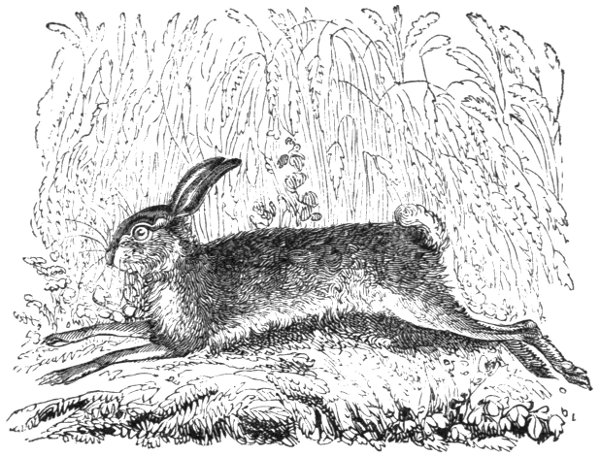
THE HARE.
The generic character of the hare consists in its having two front teeth, both above and below; and the upper pair duplicate, two small interior ones standing behind the others: the forefeet with five, and the hinder with four toes.
These animals live entirely on vegetable food, and are all remarkably timid. They run by a kind of a leaping-pace, and in walking they use their hind feet as far as the heel. Their tails are either very short (called in England scuts), or else they are entirely without.
The Common Hare.—This little animal is found throughout Europe, and indeed in most of the northern parts of the world. Being destitute of weapons of defence, it is endowed by Providence with the passion of fear. Its timidity is known to every one: it is attentive to every alarm, and is, therefore, furnished with ears very long and tubular, which catch the most remote sounds. The eyes are so prominent, as to enable the animal to see both before and behind.
The hare feeds in the evenings, and sleeps in his form during the day; and as he generally lies on the ground, he has the feet protected both above and below, with a thick covering of hair. In a moonlight evening, many of them may frequently be seen sporting together, leaping about and pursuing each other: but the least noise alarms them, and they then scamper off, each in a different direction. Their pace is a kind of gallop, or quick succession of leaps; and they are extremely swift, particularly in ascending higher grounds, to which, when pursued, they generally have recourse, here their large and strong hind legs are of singular use to them. In northern regions, where, on descent of the winter’s snow, they would, were their summer fur to remain, be rendered particularly conspicuous to animals of prey, they change in the autumn their yellow grey dress, for one perfectly white; and are thus enabled, in a great measure, to elude their enemies.
In more temperate regions, they choose in winter a form exposed to the south, to obtain all the possible warmth of that season: and in summer, when they are desirous of shunning the hot rays of the sun, they change this for one with a northerly aspect: but in both cases they have the instinct of generally fixing upon a place where the immediately surrounding objects are nearly the colour of their own bodies.
In one hare that a gentleman watched, as soon as the dogs were heard, though at the distance of nearly a mile, she rose from her form, swam across a rivulet, then lay down among the bushes on the other side, and by this means evaded the scent of the hounds. When a hare has been chased for a considerable length of time, she will sometimes push another from its seat, and lie down there herself. When hard pressed, she will mingle with a flock of sheep, run up an old wall, and conceal herself among the grass on the top of it, or cross a river several times at small distances. She never runs in a line directly forward, but constantly doubles about, which frequently throws the dogs out of the scent; and she generally goes against the wind. It is extremely remarkable that hares, however frequently pursued by the dogs, seldom leave the place where they were brought forth, or that in which they usually sit; and it is a very common thing to find them after a long and severe chase, in the same place the following day.
The females have not so much strength and agility as the males; they are, consequently, more timid, and never suffer the dogs to approach them so near, before they rise as the males. They are likewise said to practise more arts, and double more frequently.
This animal is gentle, and susceptible even of education. He does not often, however, though he exhibits some degree of attachment to his master, become altogether domestic: for although taken very young, brought up in the house, and accustomed to kindness and attention, no sooner is he arrived at a certain age, than he generally seizes the first opportunity of recovering his liberty, and flying to the fields.
Whilst Dr. Townson was at Gottingen, he had a young hare brought to him, which he took so much pains with, as to render it more familiar than these animals commonly are. In the evenings it soon became so frolicsome, as to run and jump about his sofa and bed; sometimes in its play it would leap upon, and pat him with his forefeet, or whilst he was reading, even knock the book out of his hand. But whenever a stranger entered the room, the little animal always exhibited considerable alarm.
Mr. Borlase saw a hare that was so familiar as to feed from the hand, lie under a chair in a common sitting room, and appear, in every other respect, as easy and comfortable in its situation as a lap-dog. It now and then went out into the garden, but after regaling itself always returned to the house as its proper habitation. Its usual companions were a greyhound and a spaniel, both so fond of hare-hunting, that they often went out together, without any person accompanying them. With these two dogs this tame hare spent its evenings: they always slept on the same hearth, and very frequently would rest itself upon them.
Hares are very subject to fleas. Linnæus tells us, that cloth made of their fur will attract these insects, and preserve the wearer from their troublesome attacks. In India the hare is hunted for sport, not only with dogs, but with hawks, and some species of the cat genus. The flesh, though in esteem among the Romans, was forbidden by the Druids, and by the Britons of the early centuries. It is now, though very black, and dry, and devoid of fat, much esteemed by the Europeans, on account of its peculiar flavour.
The female goes with young about a month; she generally produces three or four at a litter, and this about four times in a year. The eyes of the young ones are open at birth: the dam suckles them about twenty days, after which they leave her, and procure their own food. They make forms at a little distance from each other, and never go far from the place where they were brought forth. The hare lives about eight years.
Some believe that hares propagate but once a year, but, in the author’s opinion, they breed from February to the end of harvest. The doe chooses some thick dry brake, high grass, clover, or standing corn, to kindle in; her paps come forwarder under her belly, than those of almost any quadruped; she does not long suckle her young; if she did, and had many, the udder would be drawn too big, and be inconvenient whilst the hare was running; she brings forth differently from the rabbit, her offspring being completely formed and quick-sighted the instant they are dropped. Among naturalists it is a received notion that the hare, especially the buck, seldom lives beyond seven years, and that when either is killed, another succeeds to occupy its place; whence is derived the proverb—“The more hares you kill, the more you will have to hunt;” for when the buck and doe live undisturbed together a little time, they suffer no stranger to reside within their limits. It is also a well experienced truth, that some places are remarkable for being seldom without hares, and others (although as likely, in all appearance, to harbour them) rarely with any. Whether it is any particular excellence in the feed, in the situation for forming advantageously, for warmth, hearing, or seeing, that induces them to prefer certain spots to others, or that on the death of a buck or doe, another succeeds, and they possess their usual circle, cannot be ascertained, but the fact is perfectly established.
The first ring a hare takes is generally the foundation of the ensuing pastime, all the doubles she afterwards makes are in a great measure like the first; a hare will go over great part of trailed land, and visit her works of the preceding night and morning; sometimes a buck will take endways over fresh ground, without offering to return; the doe usually runs in a circle, unless with young, or having recently kindled; at such times she often runs forward, and scarcely ever escapes with life, being naturally unfit for fatigue: however, both sexes greatly regulate their conduct according to the season and weather. After a rainy night, in a woody country, neither buck nor doe will keep the cover, owing to the drops of wet hanging on the spray; they therefore run the highways or stony lanes, for as the scent naturally lies strong, they hold the roads which take the least; not that a hare judges upon what soil the scent lies weakest; it is her ears that chiefly direct her, for the hounds being oftener at fault on the hard paths than the turf, she finds herself not so closely pressed, and is not so much alarmed with the continual cry of the dogs at her heels. The louder the cry, the more she is terrified, and flies the swifter; the certain effect of which is, a heart broken sooner than with a pack equal in number and goodness, but who spend their tongues less free. The same principle directs the hare to run to the covers in autumn; when the ground is dry, and the wind cold at north or east; she then keeps the paths that are covered with leaves, which are so continually falling and blowing about, that the best hounds can carry no scent; her alarms are consequently short, and she rests contented where she is least disturbed.
When a hare rises out of form, if she erects her ears, and at first runs slowly, with her scut cast over her back, it is surely old and crafty. When a hare is hunted to her form, along the hard highways, and feeds far away from cover, and that her doublings and crossings are wide and large, it is a buck; for the does generally keep close to the side of some cover, and, when going to feed in the corn-fields, seldom cross over the furrows, but follow the track of them: when hunted they turn frequently, use many stratagems, and rarely leave the country round their seat, whilst the buck, after two or three turns about his form, runs straight forward four or five miles, and then probably squats in some place where he has before preserved himself. A buck or jack hare may also be known by his head being shorter, his ears more grey, his shoulders redder, and the body being smaller than the doe, and, at his first starting, by the whiteness of his hinder parts.
They who make a business of hare-finding (and a very advantageous one it is, in some counties), are enabled to find them in any weather, by observing the direction of the wind. People frequently do not find hares, from not knowing them in their forms. A gentleman coursing with his friends, was shown a hare that was found sitting: “Is that a hare?” he cried; “then, by Jove, I found two this morning as we rode along.”
According to the season of the year, the hare is to be looked for: if it be spring, upon fallows or green corn; during the autumn, in stubbles or turnips; in winter they will seat themselves near houses, in brambles and tufts of thorns.
Hares will certainly, when hard pressed, go to vault; that is, take the ground like a rabbit.
Fecundity of Hares.—A male and female hare were put together by Lord Ribblesdale, for a year, when the offspring amounted to sixty-eight. A couple of rabbits, inclosed for the same period, produced about three hundred.
Feet of Hares.—Tender feet in dogs are owing to the softness of that fleshy substance called the ball of the foot; but nature has to the hare been singularly liberal in this part by supplying her with such feet as are not subject to, and indeed scarcely susceptible of hurt, so as to incommode her in running. The balls of her feet, instead of hard flesh, are covered with strong coarse fur, suited so well for the purpose, that she never treads easier or to more advantage than on the hardest beaten track, or rugged, stony road; the very surface which cripples a dog she glides over with pleasure. In a frost she has an evident superiority to most creatures; the horse does not at that season take his gallops for fear of foundering; the greyhound or hound would in running start all their claws, and tear their soles to pieces, whilst the hare treads as soft as if she went on wool.
Hare Warren.—The warren should be paled, and the meuses made of brick; but to any person making a warren, Mr. Beckford recommends examining the traps, boxes, and stoppers, all of which have peculiarities not easy to be described. His town warren is in a wood of near thirty acres, and is cut into many walks; a smaller warren, which would perhaps answer as well, should have only one walk, and that round the outside of it. No dog must ever be allowed to enter it, and traps for stoats and polecats should be constantly set. Parsley sown in it will induce the hares to keep at home. When hares at the end of a season become shy of the traps from having been often caught, it will be necessary to drive them in with spaniels. The warren hares will be found very thick round the warren, for they will be unwilling to leave it, and when disturbed by dogs will immediately go in. The number of hares which a warren will supply is hardly to be conceived; but Mr. B. prefers a warren in the midst of an open country (which might be stopped close on hunting days), to the catching hares in traps, and then turning them down. A warren so situated would supply the whole country with hares, which, after one turn round it, would most probably run straight on end.
The Varying Hare.—This species has a very soft fur, which in summer is grey, with a slight mixture of tawny; the tail is always white. The ears are shorter, and the legs more slender than those of the common hare, and the feet more closely and warmly furred. In size this animal is somewhat smaller.
Besides other cold parts of Europe, the varying hare is found on the tops of the highest Scotch hills, never descending to the plains. It never mixes with the last species, though common in the same neighbourhood. It does not run fast, and when alarmed takes shelter in clefts of the rocks.
In September it begins to change its grey coat and resume its white winter dress, in which only the tips and edges of the ears and the soles of the feet are black. In the month of April it again becomes grey. It is somewhat singular that although this animal be brought into a house, and even kept in stoved apartments, yet it still changes its colour at the same period that it does among its native mountains.
Hounds for hunting box hares should not be too fleet, and they are to be hunted like a pack of fox hounds, as a trap hare runs very much in the same manner, and will even top the hedges; Mr. B. concludes his remarks upon the running of trap hares, with the method recommended by a gentleman to insure them to run straight, which was tying a piece of riband to their ears.
The hounds mostly used for hare hunting, are the deep-tongued, thick-lipped, broad and long hung southern hounds.
The fleet, sharp-nosed dog, ears narrow, deep-chested, with thin shoulders, showing a quarter cross of the fox hound.
The rough wire-haired hound, thick quartered, well hung, and not too much flesh on his shoulders.
The rough or smooth beagle.—Daniel—Buffon, &c. &c.
Harelip, s. A fissure in the upper lip, with want of substance.
Harness, s. The leather gear, &c., used to attach horses to carriages.
Harness, v. To fix horses in their traces.
Harpoon, s. A bearded dart with a line fastened to the handle, with which whales are struck and caught.
Harquebuss, s. obs. Fr. Arquebuse. A handgun; a musquet.
Harrier, Hen Harrier, (Circus Pygargus, Fleming), s. A small sized hawk. It is generally believed by ornithologists to be the same species as the Ringtail.
Harrier, s. A dog for hunting hares.
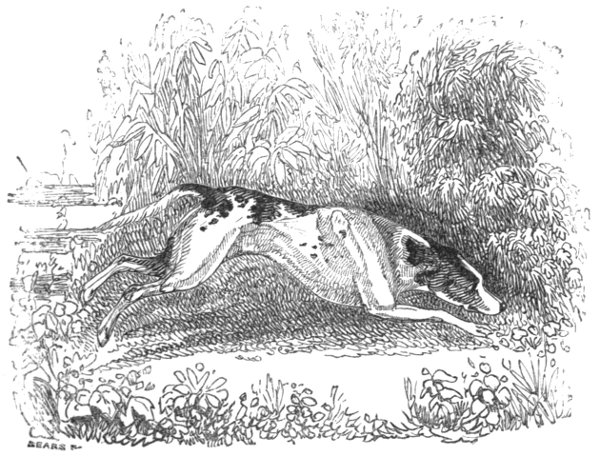
This dog is now almost universally used in Great Britain for hare hunting. He was originally generated in a double cross, between the small beagle, the southern hound, and the dwarf fox.
There are, however, various harriers produced by crosses introduced in breeding, dictated by knowledge and experience, and depending on the kind of country they hunt in, and the wish or fancy of the owner of the pack; all of which are a great alteration in the blood.
The harrier pursues the hare with great eagerness and speed, allowing her but little time to breathe or double. The keenest sportsmen often find it difficult to keep up with this dog, and with a strong hare it is rather fatiguing work. There is a great deal of melody and cheerful harmony in the voices of harriers during the chase.
Mr. Beckford, who was justly esteemed one of the best judges of dogs in Britain, endeavoured, as far as possible, to breed his harriers with much bone and strength within a small compass, and, at the same time, of a handsome make. These respective qualities he obtained; and his hounds ran remarkably well together, went fast, had all the alacrity that could be desired, and would hunt the coldest scent.
Although the harrier is the best adapted for hare hunting, yet there are situations where he is too weak, being ill-suited for swampy and marshy lands, such as those of Lancashire and Lincolnshire, and many other places. The large low southern hound seems best calculated for such localities. Harriers which are of a larger description, and crossed for the purpose of speed, are only superior in open countries, where, for want of covert, the hare will run five or six miles right out without a single turn. In such cases the pleasure of the chase may be compared to those of fox-hunting.
Harriers, in Mr. Beckford’s judgment, to be good, must be kept to their proper game. Hounds cannot be perfect unless used to one scent, and one style of hunting; to run fox with them teaches them to skirt, and is of great disservice to them. The high scent which a fox leaves, the straightness of his course, the eagerness of the pursuit, and the hallooing that usually accompanies it, all contribute to spoil a harrier.—Brown—Daniel.
Harry, v. In Scotland, signifies to rob, plunder, or oppress; destruction of game by birds of prey.
Hart, s. A he-deer of the large kind; the male of the roe.
Hartshorn, s. A volatile alkali, originally drawn from the horn of a stag, called by modern chemists subcarbonate of ammonia.
Haslet, or Harslet, s. The heart, liver, and lights of a hog, with the windpipe and part of the throat to it.
Hatch, v. To produce young from eggs; to quicken the eggs by incubation.
Hatch, s. A brood excluded from the egg; the act of exclusion from the egg; the half-door; in the plural, the doors or openings by which they descend from one deck or floor of a ship to another.
Hattock, s. A shock of corn. Provincial.
Haul, v. To pull, to draw, to drag by violence, to draw a net.
Haul, s. Pull, violence in dragging; a draught of fishes.
Haum, s. Straw.
Haunch, s. The thigh, the hind hip; the hind part of a deer.
Haunt, v. To frequent, to be much about any place.
Haunt, s. Place in which game feed and are found.
Haw, s. The berry and seed of the hawthorn; a hedge; an excrescence in the eye; a small piece of ground adjoining to a house.
Hawthorn, s. The thorn that bears haws; the white thorn.
Hawthorn, a. Belonging to the white thorn; consisting of white thorn.
Hawk, s. A bird of prey, used much anciently in sport to catch other birds.
Hawks (Accipitrina, Vigors) are birds of prey, belonging to the falcon family (Falconidæ, Leach), and characterised by the wings being short, and, when closed, scarcely reaching to the end of the tail; the first quill feather very short, the third nearly equal to the fourth, which is the longest in the wing; shanks plaited, long, and slender; middle toe greatly exceeding the two lateral ones in length; claws much hooked, and very sharp; flight rapid and direct. They pounce upon their prey on the wing, and are so bold as to attack much larger birds than themselves.
Breaking of Hawks.—When the hawk is placed upon the fist with his hood on, he will at first bait, (flutter off,) when he is to be replaced gently by the hand; but he will very soon learn to sit still. He must be carried on the fist during the greater part of the day frequently, and stroked with a feather on his back and legs.
When he is to be fed, the hood must be taken off. At first, this is best done at night, with a candle so placed as to give no more light than is absolutely necessary; but in two or three days this precaution will not be required, and he may be unhooded, and fed by daylight.
He must now be brought, by degrees, to stand quiet when the hood is to be put on.
The brail is used for this purpose. This is a thong of soft leather, with a slit running longitudinally along the middle, of such a length as to admit the pinion joint.
When the pinion joint has been introduced into the slit, the lower end of the thong is brought backwards under the wing, and tied to the other end above it.
The wing is thus confined, and in such a way as to remove it but little from its natural position, and so that it can receive no injury.
Another very effectual way to make a hawk stand quiet is, by causing water to stream upon him, from a wisp of hay or straw, until he is thoroughly drenched. This should always be done in the morning, and he should be carried on the fist until he is dry, with his wing brailed, be stroked with a feather, and hooded and unhooded very frequently.
When he has become a little accustomed to the hood, neither the brail nor the drenching will be necessary, but he must be carried almost all day upon the fist. The hood is to be occasionally taken off, and he may then be allowed for a short time to pull upon a stump or pinion from which he can get but little meat.
A few mouthfuls should always be given to him the moment the hood is put on.
Hawks, when hooded, are always quiet. In the field the hood prevents them from baiting when birds rise, and, at other times, from being alarmed at any thing that may approach them.
It may, perhaps, appear paradoxical to assert, that hawks, by being kept hooded, are brought nearer to their natural habits, but this is undoubtedly the case, for by this treatment they are induced to remain at rest when they are not either feeding, or in pursuit of game; and such are their habits in a wild state, when left undisturbed.
When the hawk is become tolerably tame, he may be unhooded, and, after having eaten a few mouthfuls, be placed on the block, and enticed to come from thence to the fist when held near him. He will soon learn to fly to it when it is presented to him at the distance of several feet, the fist being, of course, always well garnished with meat.
When he has been practised in this manner for a few days, if he be unhooded on the fist, and a small piece of meat be thrown on the ground, to the distance of two or three feet, he will fly down to it, and having eaten it, fly back to the fist, enticed, as usual, by the offer of food.
The sport of hawking is generally placed at the head of those amusements that can only be practised in the country, and probably it obtained this precedency from its being a pastime so generally followed by the nobility, not in this country only, but also upon the continent. Persons of high rank rarely appeared without their dogs and their hawks; the latter they carried with them when they journeyed from one country to another, and sometimes even when they went to battle, and would not part with them to procure their own liberty when taken prisoners. Sometimes they formed part of the train of an ecclesiastic.
These birds were considered as ensigns of nobility: and no action could be reckoned more dishonourable to a man of rank than to give up his hawk.
I cannot trace the origin of hawking to an earlier period than the middle of the fourth century. Julius Firmicus, who lived about that time, is the first Latin author that speaks of falconers, and the art of teaching one species of birds to fly after and catch others.
The grand fauconnier of France was an officer of great eminence; his annual salary was four thousand florins; he was attended by fifty gentlemen, and fifty assistant falconers; he was allowed to keep three hundred hawks; he licensed every vender of hawks in France, and received a tax upon every bird sold in that kingdom, and even within the verge of the court; and the king never rode out upon any occasion of consequence without this officer attending him.
Edward III., according to Froissart, had with him in his army when he invaded France, thirty falconers on horseback, who had charge of his hawks; and every day he either hunted, or went to the river for the purpose of hawking, as his fancy inclined him.
We may also here notice, that the ladies not only accompanied the gentlemen in pursuit of this diversion, but often practised it by themselves; and, if we may believe a contemporary writer, in the thirteenth century, they even excelled the men in knowledge and exercise of the art of falconry, which reason, he very ungallantly produces, in proof that the pastime was frivolous and effeminate. Hawking was forbidden to the clergy by the canons of the church; but the prohibition was by no means sufficient to restrain them from the pursuit of this favourite and fashionable amusement. On which account, as well as for hunting, they were severely lashed by the poets and moralists; and, indeed, the one was rarely spoken of without the other being included; for those who delighted in hawking were generally proficients in hunting also.
When the hawk was not flying at her game, she was usually hood-winked, with a cap or hood provided for that purpose, and fitted to her head; and this hood was worn abroad as well as at home. All hawks taken upon “the fist,” the term used for carrying them upon the hand, had straps of leather, called jesses, put upon their legs. The jesses were made sufficiently long for the knots to appear between the middle and the little fingers of the hand that held them, so that the lunes, or small thongs of leather, might be fastened to them with two tyrrits, or rings; and the lunes were loosely wound round the little finger. It appears that sometimes the jesses were of silk. Lastly, their legs were adorned with bells, fastened with rings of leather, each leg having one; and the leathers, to which the bells were attached, were denominated bewits; and to the bewits was added the creance, or long thread, by which the bird in tutoring, was drawn back, after she had been permitted to fly; and this was called the reclaiming of the hawk. The bewits, we are informed, were useful to keep the hawk from “winding when she bated,” that is, when she fluttered her wings to fly after her game.
Respecting the bells, it is particularly recommended that they should not be too heavy, to impede the flight of the bird; and that they should be of equal weight, sonorous, shrill, and musical; not both of one sound, but the one a semitone below the other; they ought not to be broken, especially in the sounding part, because, in that case, the sound emitted would be dull and unpleasing. “There is, says the book of Saint Alban’s, great choice of sparrow-hawk bells, and they are cheap enough; but for goshawk bells, those made at Milan, are called the best; and, indeed, they are excellent; for they are commonly sounded with silver, and charged for accordingly. But we have good bells brought from Dordreght (Dort), which are well paired, and produce a very shrill, but pleasant sound.”
The person who carried the hawk was provided with gloves for that purpose, to prevent their talons from hurting his hand. In the inventories of apparel belonging to King Henry VIII. such articles frequently occur; at Hampton Court, in the jewel house, were seven hawkes’ gloves embroidered.—Montagu—Sebright—Strutt.
Hay, s. Grass dried to fodder cattle in winter.
Much in a horse’s condition depends on the quality of his hay; good hay is easily chosen, and the smell and colour afford a test of its quality not to be mistaken.
Hazard, s. Chance, accident; chance of danger; a game at dice.
Any number of persons may play hazard. The person who takes the box and dice, throws a main, that is to say, a chance for the company, which must be above four, and not exceed nine, otherwise it is no main, consequently he must keep throwing till he brings five, six, seven, eight, or nine; this done, he must throw his own chance, which may be any above three, and not exceeding ten: if he throw two aces or trois-ace (commonly called crabs), he loses his stakes, let the company’s chance, called the main, be what it will. If the main should be seven, and seven or eleven be thrown immediately after, it is what is called a nick, and the caster (the present player) wins out his stakes: also, if eight be the main, and eight or twelve thrown immediately after, it is also called a nick, and the caster wins his stakes. The caster throwing any other number for the main, such as is admitted, and bringing the same number directly afterwards, that is likewise termed a nick, and he then also wins whatever stakes he has made.
Every three successive mains the caster wins, he is to pay half a guinea to the box or furnisher of the dice.
The meaning of a stake or bet at this game differs somewhat from the other. If a person choose to lay a sum of money with the thrower or caster, he must put his cash upon the table, within a circle which is described for that purpose; when he has done this, if the caster agree to it, he knocks the box upon the table at the person’s money with whom he intends to bet, or particularly mentions at whose money he throws, which is sufficient, and he is obliged to answer whatever sum is down, unless the staker calls to cover; in that case the caster is obliged to stake also, otherwise the bets would be void. It is optional in the person who bets with the thrower, to bar any throw which the caster may be going to cast, provided neither of the dice be seen; if one die should be discovered, the caster must throw the other to it, unless the throw is barred in proper time.
The common odds, which are absolutely necessary to be understood, before any person attempts to play or bet at this game, are as follow: if seven be thrown for the main, and four the chance, it is 2 to 1 against the person who throws; if six to four be thrown, 5 to 3; if five to four, 4 to 3; seven to nine, 3 to 2; seven to six, 3 to 2, barring the two trois; with the two trois, only six to five; seven to five, 3 to 2; six to five, an even bet, barring the doublets or the two trois; with the trois, 5 to 4; eight to five, an even bet, barring the two fours; five to four with the two fours; nine to five, even; nine to four, is 4 to 3; the nick of seven is 7 to 2, but often laid but 10 to 3; and five to one you do not nick six or eight.
To illustrate these calculations still more clearly, the following table will be serviceable:—
TABLE OF THE ODDS.
7 to 4 is 2 to 1. ⎫
6 .. 4 .. 5 .. 3. ⎪
5 .. 4 .. 4 .. 3. ⎪
7 .. 9 .. 3 .. 2. ⎪
7 .. 6 ⎧ 3 .. 2, barring the two trois. ⎪
⎩ 6 .. 5, with the two trois. ⎪ against
7 .. 5 .. 3 .. 2. ⎬ the
6 .. 5 ⎧ even, barring the two trois. ⎪ caster.
⎩ 5 .. 4 with the two trois. ⎪
8 .. 5 ⎧ even, barring the two fours ⎪
⎩ 5 .. 4 with the two fours. ⎪
9 .. 5 .. even. ⎪
9 .. 4 .. 4 .. 3. ⎭
The nick of seven is 7 to 2, often laid 10 to 3.
The nick of six and eight is 5 to 1.
It is necessary to be perfectly master of these odds, in order to play the prudent game, and to make use of them by way of insuring bets in what is called hedging, in case the chance happens to be unlikely; for, by taking the odds a ready calculator secures himself, and often stands part of his bet to a certainty. For example, if seven be the main, and four the chance, and he should have 5l. depending on the main, by taking 6l. to 3l. he must either win 2l. or 1l.; and on the contrary, if he should not like his chance, by laying the odds against himself, he must save in proportion to the bet he has made.—Hoyle.
Hazard, v. To expose to chance.
Haze, s. Fog, mist.
Hazel, s. A nut-tree.
Hazel, a. Light brown, of the colour of hazel.
Head, s. The part of the animal that contains the brain or the organ of sensation and thought; chief, principal person, one to whom the rest are subordinate; state of a deer’s horns, by which his age is known; the top of anything bigger than the rest; the forepart of anything, as of a ship; that which rises on the top of liquors; upper part of a bed; source of a stream.
The head of the horse is a very important part, considered with a view to the beauty of the animal; and in no part is an improvement in the breed so soon detected as in this. Can any thing be conceived more dissimilar than the small inexpressive features attached to the enormous head of a cart-horse, compared with the bold striking lines which grace that of the blood-horse? The head, in the improved breeds, is small and angular, the eyes prominent, the ears spirited, small, and pointed; the forehead wide, straight, and sometimes slightly curved inwards at the lower part: in them the facial angle is about 25°, whereas, in the heavy breed, it is more generally 23°: its junction with the neck, also, is less easy and elegant than in the improved kind.—Blaine.
Head, v. To lead; to direct; to behead; to kill by taking away the head; to lop trees at the top; to get before a deer or fox, to make him take another course.
Headland, s. Promontory, cape; ground under hedges.
Headstall, s. Part of the bridle that covers the head.
Headstrong, a. Unrestrained; violent, ungovernable.
Heal, v. To cure; to restore from sickness or wounds.
Healing, a. Mild, mollifying; assuasive.
Health, s. Freedom from bodily pain or sickness; strength.
Healthy, a. In health, free from sickness; in good condition.
Hearing, s. The sense by which sounds are perceived; reach of the ear.
Heart, s. The muscle which by its contraction and dilatation propels the blood through the course of circulation, and is therefore considered as the source of vital motion. It is situated in the thorax, and divided externally into the base, the superior and inferior surface, and the anterior and posterior margin. Internally it comprises two ventricles called the right and left.
Heartless, a. Without courage, spiritless, out of condition.
Hearty, a. Sincere, warm; in full health; vigorous, strong.
Heat, s. The sensation caused by the approach or touch of fire; hot weather; state of any body under the action of fire; a term in racing. In gun-making three degrees of heat are employed; blood-red heat, the lowest flame; white heat, the second; and sparkling or welding heat, the most intense.
Heath, s. A plant; a place overgrown with heath.
Heathcock, s. A large fowl that frequents heaths. Vide Grouse.
Heathpeas, s. A species of bitter vetch.
Hedge, s. A fence made round grounds with prickly bushes.
Hedge, v. To enclose with a hedge; to encircle; to shut up within an enclosure. In betting, hedging means to bet upon and against the same event.
Hedgehog, s. An animal set with prickles like thorns in a hedge.
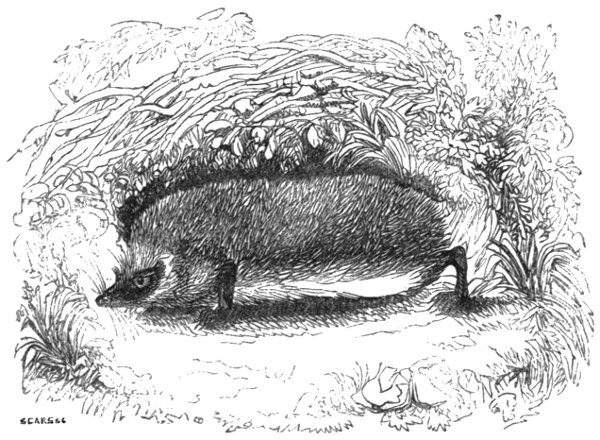
Hedgehogs abound in my gardens and fields. The manner in which they eat the roots of the plantain in my grass walk is very curious: with their upper mandible, which is much longer than their lower, they bore under the plant, and so eat the root off upwards, leaving the tuft of leaves untouched. In this respect they are serviceable, as they destroy a very troublesome weed; but they deface the walks in some measure by digging little round holes. It appears, by the dung that they drop upon the turf, that beetles are no inconsiderable part of their food. In June last I procured a litter of four or five young hedgehogs, which appeared to be about five or six days old; they, I find, like puppies, are born blind, and could not see when they came to my hands. No doubt their spines are soft and flexible at the time of their birth, or else the poor dam would have but a bad time of it in the critical moment of parturition: but it is plain that they soon harden; for these little pigs had such stiff prickles on their backs and sides as would easily have fetched blood, had they not been handled with caution. Their spines are quite white at this age; and they have little hanging ears, which I do not remember to be discernible in the old ones. They can, in part, at this age draw their skin down over their faces; but are not able to contract themselves into a ball, as they do, for the sake of defence, when full grown. The reason, I suppose, is, because the curious muscle that enables the creature to roll itself up into a ball has not then arrived at its full tone and firmness. Hedgehogs make a deep and warm hybernaculum with leaves and moss, in which they conceal themselves for the winter: but I never could find that they stored in any winter provision, as some quadrupeds certainly do.
Jesse says, “I had also a tame hedge-hog, which nestled before the fire, on the stomach of an old lazy terrier dog, who was much attached to it, and the best understanding existed between them.”
Sagacity of the Hedgehog.—During the summer of 1818, as Mr. Lane, gamekeeper to the Earl of Galloway, was passing by the wood of Glascaden, near Garlieston, in Scotland, he fell in with a hedgehog, crossing the road at a small distance before him, carrying on its back six pheasant’s eggs, which upon examination he found it had pilfered from a pheasant’s nest hard by. The ingenuity of the creature was very conspicuous, as several of the remaining eggs were holed, which must have been done by it, when in the act of rolling itself over the nest, in order to make as many adhere to its prickles as possible. After watching the motions of the urchin for a short time longer, Mr. Lane saw it deliberately crawl into a furze bush, where its nest was, and where the shells of several eggs were strewed around, which had at some former period been conveyed thither in the same manner.—White’s Selborne—Jesse.
Hedgerow, s. The series of trees or bushes planted for enclosures.
Hedgesparrow, or Chanter, (Accentor Modularis, Cuvier), s. A sparrow that lives in bushes.
This well known species, commonly called hedge sparrow, needs little description. The length is five inches and three quarters; weight near six drams. Bill dusky; irides light hazel; head and neck brown, mixed with ash-colour; back and wing coverts darker brown, edged with rufous brown; throat and breast dull ash-colour; belly dirty white; sides and vent tawny brown. The female has less ash-colour about the head and breast.
The hedge sparrow is found in all parts of England; has a pleasing song, which it begins with the new year, if the weather is mild; breeds early, making a nest in March, composed of green moss and wool, and lined with hair, which is placed in some low evergreen shrub, thick brush, or cut hedge; frequently builds in faggot piles. The eggs are four or five in number, blue; their weight about twenty-eight grains.
This bird is one of the few of the warbler tribe that remains with us the whole year. The food is insects and worms; but like the redbreast, it will, in defect of these, pick up crumbs of bread; and seems to prefer situations near the habitation of man.—Montagu.
Heel, s. The part of the foot that protuberates behind.
Heeler, s. A cock that strikes well with his heels.
Heifer, s. A young cow.
Hemorrhage, s. A violent flux of blood.
Hen, s. The female of a house cock; the female of any bird.
Henroost, s. The place where the poultry rest.
Herb, s. Herbs are those plants whose stalks are soft, and have nothing woody in them, as grass and hemlock.
Herbaceous, a. Belonging to herbs; feeding on vegetables.
Herbage, s. Herbs collectively; grass, pasture.
Herd, s. A number of beasts together; it anciently signified a keeper of cattle, as goat-herd.
Herd, v. To run in herds or companies; to associate.
Herdsman, s. One employed in tending herds.
Hermaphrodite, s. An animal uniting two sexes.
Hernia, s. Any kind of rupture.
Heron, Common Heron, Heronsewgh, or Heronshaw, (Ardea Major, Linn.; Le Heron huppé, Buff.) s. A bird that feeds on fish.
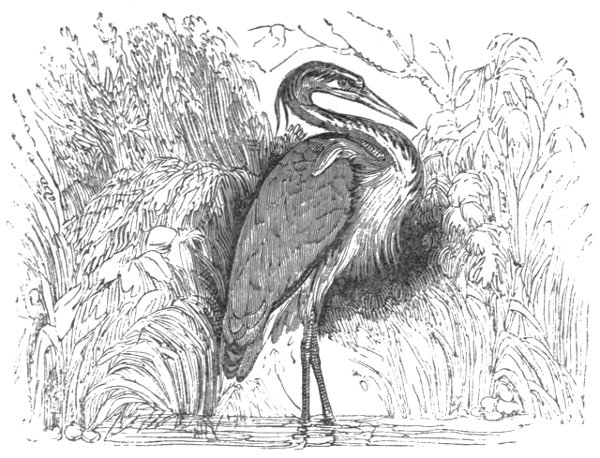
Although the heron is of a long, lank, awkward shape, yet its plumage gives it, on the whole, an agreeable appearance; but when stripped of its feathers, it looks as if it had been starved to death. It seldom weighs more than between three and four pounds, notwithstanding it measures about three feet in length, and in the breadth of its wings, from tip to tip, above five. The bill is six inches long, straight, pointed, and strong, and its edges are thin and slightly serrated; the upper mandible is of a yellowish horn colour, darkest on the ridge, the under one yellow; a bare skin, of a greenish colour, is extended from the beak beyond the eyes; the irides of which are yellow, and give them a fierce and piercing aspect.—The brow and crown of the head are white, bordered above the eyes by black lines, which reach the nape of the neck, where they join a long flowing pendent crest of the same colour. The upper part of the neck, in some, is white, in others pale ash, the forepart lower down is spotted with a double row of black feathers, and those which fall over the breast are long, loose, and unwebbed; the shoulders and scapular feathers are also of the same kind of texture, of a grey colour generally streaked with white, and spread over its down-clothed back. The ridge of the wing is white; coverts and secondaries lead colour; bastard wings and quills of a bluish black, as are also the long, soft feathers, which take their rise on the sides under the wings; and, falling down, meet at their tips, and hide all the under parts: the latter, next the skin, are covered with a thick, matted, dirty-white down, except about the belly and vent, which are almost bare. The tail is short, and consists of twelve feathers of a cinereous or brownish lead-colour; the legs are dirty-green, long, bare above the knees, and the middle claw is jagged on the inner edge.
The female has not the long flowing crest, or the long feathers which hang over the breast of the male, and her whole plumage is more uniformally dull and obscure. In the breeding-season they congregate in large societies; and, like the rooks, build their nests on trees, with sticks, lined with dried grass, wool, and other warm materials. The female lays from four to six eggs, of a pale, greenish-blue colour.
The heron is described by Buffon as exhibiting the picture of wretchedness, anxiety, and indigence, condemned to struggle perpetually with misery and want, and sickened by the restless cravings of a famished appetite, &c. However faithful this ingenious naturalist may have been in pourtraying the appearance of the heron, yet others are not inclined to adopt his sentiments in describing its habits and manners, or to agree with him in opinion that it is one of the most wretched of animated beings. It is probable that it suffers no more than other birds, many species of which employ equal attention in looking for their prey, and it is not unlikely that the heron derives pleasure from it instead of pain. This bird, however, is of a melancholy deportment, a silent and patient creature; and will, in most severe weather, stand motionless a long time in the water, fixed to a spot, in appearance like the stump or root of a tree, waiting for its prey, which consists of frogs, waternewts, eels, and other kinds of fish; and it is also said that it will devour field-mice.
The heron traverses the country to a great distance in quest of some convenient or favourite fishing spot, and in its aerial journeys soars to a great height, to which the eye is directed by its harsh cry, uttered from time to time while on the wing. In flying it draws the head between the shoulders, and the legs stretched out, seem, like the longer tails of some birds, to serve the office of a rudder. The motion of their wings is heavy and flagging, and yet they get forward at a greater rate than would be imagined.
In England herons were formerly ranked among the royal game, and protected as such by the laws; and whoever destroyed their eggs was liable to a penalty of twenty shillings for each offence. Heron hawking was at that time a favourite diversion among the nobility and gentry of the kingdom, at whose tables this bird was a favourite dish, and was as much esteemed as pheasants and peacocks.
Great White Heron. (Ardea alba, Linn.; Le Heron blanc, Buff.)—The great white heron is of nearly the same hulk as the common heron, but its legs are longer. It has no crest, and its plumage is wholly white; its bill yellow, and its legs black.
Its character and manner of living are the same as those of the common heron, and it is found in the same countries, though this species is not nearly so numerous. It has rarely been seen in Great Britain. Pennant, in his Arctic Zoology, says it is found in the Russian dominions, about the Caspian and Black Seas, the lakes of Great Tartary, and the river Irtisch, and sometimes as far north as latitude 53°. Latham says it is met with in New York, in America, from June to October; at different seasons of the year it is found in Jamaica, and in the Brazils: and our circumnavigators have met with it at New Zealand.
The Night Heron, Lesser Ash-coloured Heron or Night Raven. (Ardea Nycticorax, Linn.; Le Bihoreau, Buff.)—The length of this bird is about twenty inches; the bill is three inches and three quarters long, slightly arched, strong, and black, inclining to yellow at the base; the skin from the beak round the eye is bare, and of a greenish colour; irides yellow. A white line is extended from the beak, over each eye a black patch, glossed with green, covers the crown of the head and nape of the neck, from which three long narrow white feathers tipped with brown, hang loose and waving: the hinder part of the neck, coverts of the wing, sides and tail, are ash-coloured; throat white, forepart of the neck, breast, and belly, yellowish white or buff; the back black, the legs a greenish yellow. The female is nearly of the same size as the male, but she differs considerably in her plumage, which is less bright and distinct, being more blended with clay or dirty white, brown, grey, and rusty ash-colour, and she has not the delicate plumes which flow from the head of the male.
The night heron frequents the sea shores, rivers, and inland marshes, and lives upon crickets, slugs, frogs, reptiles, and fish. It remains concealed during the day, and does not roam abroad until the approach of night, when it is heard and known by its rough, harsh, and disagreeable cry, which is by some compared to the noise made by a person straining to vomit. Some ornithologists affirm that the female builds her nest on trees, others that she builds it on rocky cliffs: probably both accounts are right. She lays three or four white eggs.
This species is not numerous, although widely dispersed over Europe, Asia, and America.
The bird is indeed very uncommon in this country. Latham mentions one in the Leverian Museum, which was shot, not many miles from London, in May 1782.
Voracity of the Heron.—In the month of April 1818, as a person was walking a short distance from the river Mole, in the neighbourhood of Cobham Park, Surrey, where H. C. Combe, Esq. has a heronry, he was surprised by a pike in weight full 2lbs. dropping from the air immediately before him: on looking up, he perceived a large heron hovering over him, which had no doubt dropped the fish from its beak. And also, during the same month, another individual near the above spot, saw a heron take a fish from the water, and after carrying it to a bank insert its bill into the vent of the fish, beginning to suck its entrails; he drove away the bird, and on taking up the fish, found it to be a pike weighing a pound and upwards.
Some hawks will not attack a heron, when it is first shown to them; but they may generally be brought to it by flying them at a cock, of a light colour, and by tying meat upon a heron’s back, and allowing them to feed there. Small pieces of elder are put upon the heron’s beak, to prevent him from wounding the hawk in training. The herons are caught by a slip-knot at the end of a long string, so arranged round their nests as to be drawn about their legs when they come upon their eggs. This is best done about sun-set; and the man who is to draw the string, must place himself to leeward of the nest. Herons will not feed when they are first taken; it is therefore necessary to cram them with food, and to tie a piece of mat round their necks, to prevent them from throwing it up again.
A well-stocked heronry in an open country is necessary for this sport. The herons go out in the morning to rivers and ponds at a very considerable distance, in search of food, and return to the heronry towards the evening.
It is at this time that the falconers place themselves in the open country, down wind of the heronry; so that when the herons are intercepted on their return home, they are obliged to fly against the wind to gain their place of retreat. When a heron passes, a cast (a couple) of hawks is let go. The heron disgorges his food when he finds that he is pursued, and endeavours to keep above the hawks by rising in the air; the hawks fly in a spiral direction to get above the heron, and thus the three birds frequently appear to be flying in different directions. The first hawk makes his stoop as soon as he gets above the heron, who evades it by a shift, and thus gives the second hawk time to get up and to stoop in his turn. In what is deemed a good flight, this is frequently repeated, and the three birds often mount to a great height in the air. When one of the hawks seizes his prey, the other soon binds to him, as it is termed, and buoyant from the motion of their wings, the three descend together to the ground with but little velocity. The falconer must lose no time in getting hold of the heron’s neck when he is on the ground, to prevent him from injuring the hawks. It is then, and not when he is in the air, that he will use his beak in his defence. Hawks have, indeed, sometimes, but very rarely, been hurt by striking against the heron’s beak when stooping, but this has been purely by accident, and not (as has been said) by the heron’s presenting his beak to his pursuer as a means of defence.
When the heron flies down wind, he is seldom taken, the hawks are in great danger of being lost, and as the flight is in a straight line, it affords but little sport.—Bewick—Pennant—Sebright.
Heronry, or Heronshaw, s. A place where herons breed.
Belon mentions it as one of the extraordinary feats performed by the divine king Francis I., that he formed two artificial heronries at Fontainebleau,—“the very elements themselves,” he adds, “obeying the commands of this divine king (whom God absolve!!!), for to force nature is a work partaking of divinity.” In order to enhance the merits of these French heronries, he undertakes to assert, that they were unknown to the ancients, because they are not mentioned in any of their writings; and for the same reason he concludes that there are none in Britain. Before Belon’s time, on the contrary, and before the “Divine” constructor of heronries in France was born, there were express laws enacted in England for the protection of herons, it being a fine of ten shillings to take the young out of the nest, and six shillings and eight-pence for a person, without his own grounds, killing a heron, except by hawking, or by the long-bow; while in subsequent enactments, the latter penalty was increased to twenty shillings, or three months’ imprisonment. At present, however, in consequence of the discontinuance of hawking, little attention is paid to the protection of heronries, though, I believe, none of the old statutes respecting them have been repealed. Not to know a hawk from a heron-shaw (the former name for a heron) was an old adage, which arose when the diversion of heron-hawking was in high fashion: it has since been corrupted into the absurd vulgar proverb, “not to know a hawk from a hand-saw.”
In the breeding season they congregate, and make their nests very near each other. Mr. Pennant mentions having seen eighty nests on one tree. We once saw a heronry on a small island in a lake in the north of Scotland, whereon there was only one scrubby oak tree, which not being sufficient to contain all the nests many were placed on the ground.—Sebright—Montagu.
Herring, s. A small sea-fish.
Of all migrating fish, the herring and the pilchard take the most adventurous voyages.
This mighty army begins to put itself in motion from the Icy Sea early in the spring: this body is distinguished by that name, for the word herring is derived from the German heer, an army, to express their number, which is so vast, that were all the men in the world loaded with herrings, they could not carry the thousandth part away. No sooner, however, is their asylum quitted, but millions of enemies collect to thin their squadrons. The fin fish and cacholot swallow barrels at a yawn; the porpoise, the grampus, the shark, and the whole numerous tribe of dog-fish, desist from making war upon each other, and make the herring their easy prey. The unnumbered flocks of sea fowl, that chiefly inhabit near the pole, watch the outset of their migration and spread extensive ruin. In this exigence the defenceless emigrants find no other safety but by crowding closer together, and leaving to the outermost the danger of being first devoured. Thus, like frighted sheep (which ever run together in a body), each finding some protection in being but one of many that are equally liable to invasion, they separate into shoals: those to the west visit the American shores, while those holding to the east pour down towards Europe, endeavouring to evade their merciless pursuers by approaching the first shore that presents itself, which is that of Iceland, in the beginning of March. Upon their arrival on that coast, this phalanx, notwithstanding its diminutions, is still of amazing extent, depth, and closeness, covering an extent of shore as large as the island itself; the whole water seems alive, and by their foes the herrings are cooped up so closely, that any hollow vessel put into it takes them out of the water without further trouble. The power of increasing in these animals exceeds our idea, as it would in a very short time outstrip all calculation. A single herring, it is affirmed, if suffered to multiply unmolested and undiminished for twenty years, would show a progeny greater in bulk than ten such globes as that we live upon; but happily the balance of nature is exactly preserved, and their consumption is equal to their fecundity. Upon this account, we must consider the fish and fowl that so incessantly attack them, not as plunderers, but as the benefactors of mankind: without their aid the sea would soon be overcharged with the burden of its own productions, and that element, which at present distributes health and plenty to the shore, would but load it with putrefaction.
These collective masses that come upon our coasts, begin to appear off the Shetland Isles in April and May; these are only the fore-runners of the grand shoal which comes in June, and their arrival is marked by the numbers of birds, such as gannets and others, which follow them as their prey. But when the main body approaches, its breadth and depth alters the very appearance of the ocean. They divide into distinct columns of five or six miles long, and three or four broad, while the water before them ripples as if forced out of its bed; sometimes they sink for ten or fifteen minutes, then rise again to the surface, on which in bright weather they reflect a variety of splendid colours, like a field bespangled with the most precious gems, in which, or rather in a much more valuable light, should this stupendous gift of Providence be considered by the inhabitants of the British Isles. The fishermen are ready prepared for their reception, and by nets made for the occasion they sometimes take above two thousand barrels at a single draught.
After this check from the Shetland Isles, which divide the army into two parts, one wing takes to the eastern shores of Great Britain, and fills every bay and creek with its numbers; the other pushes on towards Yarmouth, the great and ancient mart of herrings; they then pass through the British Channel, and after that in a manner disappear. Those which take to the west, after offering themselves to the Hebrides, where the great stationary fishery is, proceed towards the north of Ireland, where being interrupted they make a second division; that to the western side is scarcely perceived, being soon lost in the immensity of the Atlantic, whilst the other, which passes into the Irish Sea, rejoices and feeds the inhabitants of most of the coasts that border upon it.
The herring is always found in shoals, and on some occasions are crowded so close together, as to fill the sea, at least so far as our implements can reach, from top to bottom. Ships are said to have been retarded in their course in passing through these shoals, and instances are recorded where these little fishes have been left by the ebbing of the tide in heaps three feet deep upon the shores for many miles in extent. It is universally credited among those conversant in the herring fishery, that no other fish will go into the middle of a shoal. The whale, to whom they are a favourite repast, and who swallows a thousand at once, never ventures into the shoal, but hovers about the skirts of it, and regularly follows their course. The dog-fish, which in vast troops assiduously attend the herrings wherever they go, carefully keep aloof from the great mass of them; so it is with other fishes, who delight in the herring as a prey, but as a body seem to dread their multitudes.
Herring Fishing.—To approach the fleet was a task of some difficulty. The nets, extended in interminable lines, were so frequent, that much skill was necessary to penetrate this hempen labyrinth, without fouling the back ropes. Warning cries directed our course, and with some delay we treaded the crowded surface, and, guided by buoys and puckawns, found ourselves in the very centre of the flotilla.
It was an interesting scene; momently the boats glided along the back ropes, which were supported at short intervals by corks, and at greater by inflated dog-skins, and raising the curtain network, which these suspended, the herrings were removed from the meshes, and deposited in the boats. Some of the nets were particularly fortunate, obliging their proprietors to frequently relieve them of the fish; while others, though apparently stretched within a few yards, and consequently in the immediate run of the herrings, were favoured with but a few stragglers; and the indolent fisherman had to occupy himself with a sorrowful ditty, or in moody silence watched the dark sea “like a strange soul upon the Stygian banks staying for waftage.”
The darkness of the night increased the scaly brilliancy which the phosphoric properties of these beautiful fish produce. The bottom of the boat, now covered with some thousand herrings, glowed with a living light, which the imagination could not create, and the pencil never imitate. The shades of gold and silvery gems were rich beyond description: and much as I had heard of phosphoric splendour before, every idea I had formed fell infinitely short of its reality.—Buffon—Wild Sports.
Herring Gull (Larus fuscus, Linn.) s. A genus thus characterised:—
This species weighs about thirty-three ounces; length twenty-three inches; bill yellow; on the lower mandible a reddish-orange spot; irides light yellow; orbits red. Head, neck, tail, and under parts, white; back, scapulars, and wing coverts, ash-colour; quill-feathers, dusky, the five first black towards their ends, with a white spot near the tip; legs pale flesh-colour.
Whether these immatured birds breed we cannot be certain, but are inclined to think they do, as we saw a great many of them intermixed with the perfect ones in the gullery on an island off St. David’s, where the nests were innumerable: they seemed equally clamorous with the others when disturbed. The nests were on the top of the island, amongst the grass and loose stones, composed of a small quantity of long dry grass, the eggs, which were two in number, of a dark olive-brown, with dusky blotches. Like others of the genus, this bird feeds indiscriminately on fish, and various other productions of the sea, particularly the star-fish. It is sometimes observed to trample the soft sand, by moving its feet alternately in the same place: for what purpose this singular action is intended, we cannot say, unless it is to force up the sand eels or other hidden prey, as the one mentioned above did the worms.—Montagu.
Hide, s. The skin of any animal, either raw or dressed; the human skin.
Hidebound, v. A horse is said to be hide-bound, when his skin sticks so hard to his ribs and back, that you cannot with your hand pull up or loosen the one from the other; in trees, being in the state in which the bark will not give way to the growth.
Highland, s. Mountainous region.
Highway, s. Great road, public path.
Hill, s. An elevation of ground less than a mountain.
Hillock, s. A little hill.
Hilly, a. Full of hills, unequal in the surface.
Hind, s. The she to a stag; a servant; a peasant, a boor.
Hip, s. The joint of the thigh; the fleshy part of the thigh; the fruit of the briar.
Hip, v. To sprain or shoot the hips.
Hipshot, a. Sprained or dislocated in the hip.
Hirundo, s. Swallow, a genus thus characterised:—
Bill short, much depressed, and wide at the base; the upper mandible being keeled and bent at the tip; gape extending as far backwards as the eyes; nostrils at the base of the bill, oblong, and partly covered by a membrane; legs with the shank short; the toes slender, three before and one behind; the outer toe united to the middle one as far as the first joint; tail of twelve feathers, generally forked; wings long and acuminated, the first quill being the longest.—Montagu.