INTRODUCTION. (continued 11)
Reading edition
These birds will in general take the materials for building, which they can most easily procure. On the tenth of May I observed a pair of goldfinches beginning to make their nest in my garden; they had formed the ground-work with moss, grass, &c., as usual, but on my scattering small parcels of wool in different parts of the garden, they, in a great measure, left off the use of their own stuff, and employed the wool. Afterwards, I gave them cotton, on which they rejected the wool and proceeded with the cotton; the third day I supplied them with fine down, on which they forsook both the other and finished their work with this last article. The nest, when completed, was somewhat larger than is usually made by this bird, but retained the pretty roundness of figure and neatness of workmanship, which is proper to the goldfinch. The nest was completed in the space of three days, and remained unoccupied for the space of four days; the first egg not being laid till the seventh day from beginning the work. The eggs are four or five in number, of a bluish white, with a few spots, chiefly at the larger end.
The goldfinch is easily tamed and easily taught, and its capability of learning the notes of other birds is well known; but the tricks it may be taught to perform are truly astonishing. A few years ago the Sieur Roman exhibited his birds, which were goldfinches, linnets, and canaries. One appeared dead, and was held up by the tail or claw without exhibiting any signs of life; a second stood on its head with its claws in the air; a third imitated a Dutch milkmaid going to market, with pails on its shoulders; a fourth mimicked a Venetian girl looking out at a window; a fifth appeared as a soldier, and mounted guard as a sentinel; and the sixth acted as a cannoneer with a cap on its head, a firelock on its shoulder, and a match in its claw, and discharged a small cannon. The same bird also acted as if it had been wounded. It was wheeled in a barrow, to convey it, as it were, to the hospital; after which, it flew away before the company: the seventh turned a kind of windmill: and the last bird stood in the midst of some fireworks which were discharged all round it, and this without exhibiting the least symptom of fear.
They may also be taught to draw up little buckets or cups with food and water. To teach them this, there must be put round them a narrow soft leather belt, in which there must be four holes—two for the wings, and two for the feet. The belt is joined a little below the breast, where there is a ring, to which the chain is attached, that supports the little bucket or cup. We have seen both the goldfinch and lesser redpole perform this action, but in a different manner. Their cage had no wires,—only a back-board, a bottom-board, and one perch. To one foot of the bird was attached a light slender chain, which allowed it more exercise than it could have had in the common wire cage; at the outer edge of the bottom-board was a ring, through which ran the chain, to each end of which were fastened the little buckets that held the food and water, which the bird drew up with its foot and bill; and as one bucket was drawn up, the other sunk, thus lessening the difficulty, and lightening the task.—Montagu—Bolton—Syme.
Goosander (Mergus merganser, Linn.), s. a species of diver.
This is the largest species of merganser; weight about four pounds; length two feet four inches. The bill three inches long, narrow, serrated, or toothed, on the edges of both mandibles; the tip of the upper hooked; colour red: irides the same; the head and upper part of the neck glossy greenish black; the feathers on the crown and back of the head are long and loose; the rest of the neck, breast, and under parts, white; the sides, above the thighs, undulated with dusky lines; the upper part of the back black; lower part of the back, rump, and tail coverts, brownish ash-colour; the lesser wing coverts white; the rest ash-colour, with some white; the greater quill feathers are black, with ash-colour on the interior webs of some of the inner ones; the secondaries white, margined with greenish black on the outer webs; the scapulars nearest the body black, the others white; the tail consists of eighteen ash-coloured feathers, with dusky shafts; legs orange; in some specimens the breast is of a rosy buff-colour.
The goosander sometimes visits our rivers and lakes in severe winters, but retires to the more northern latitudes of Greenland and Iceland, where it breeds. In the Orkneys and Hebrides it is found the whole year round, while in the other districts it is only a winter visitant. It is not uncommon on the continent of Europe and Asia, but most plentiful towards the north. It is a winter inhabitant of the sea shore, and fresh water lakes of America, where they usually associate in small parties of six and eight. They disappear from that country in the month of April, and return in November. Its food consists entirely of fish, for which it dives with great celerity, and holds its slippery prey with great security, by means of its toothed bill, which is admirably adapted to the purpose.—Montagu.
Goose, s. A large waterfowl. Vide Anser.
Canada Goose, (Anas Canadensis Linn.; L’Oie à cravate, Buff.)—This is less than the swan goose, but taller and longer than the common goose, and may be considered as the connecting link between that species and the swan. Their average weight is about nine pounds, and the length about three feet six inches. The bill is black and two inches and a half long: irides hazel: the head and neck are also black, with a crescent shaped white band on the throat, which tapers off to a point on each side below the cheeks, to the hinder part of the head: the whiteness of this cravat is heightened by its contrast with the dark surrounding plumage, and it looks very pretty: this mark also distinguishes it from others of the goose tribe. All the upper parts of the plumage, the breast, and a portion of the belly, are of a dull brown, sometimes mixed with grey: the lower part of the neck, the belly, vent, and upper tail coverts, white; quills and tail black; legs dingy blue.
The English of Hudson’s Bay depend greatly on geese, of these and other kinds, for their support; and, in favourable years, kill three or four thousand, which they salt and barrel. Their arrival is impatiently attended; it is the harbinger of the spring, and the month named by the Indians the goose-moon. They appear usually at our settlements in numbers, about St. George’s day, O. S. and fly northward to nestle in security. They prefer islands to the continent, as further from the haunts of men. Thus Marble Island was found, in August, to swarm with swans, geese, and ducks; the old ones moulting, and the young at that time incapable of flying.
The English send out their servants, as well as Indians, to shoot these birds on their passage. It is in vain to pursue them; they therefore form a row of huts made of boughs, at musket shot distance from each other, and place them in a line across the vast marshes of the country. Each hovel, or, as it is called, stand, is occupied by only a single person. These attend the flight of the birds, and, on their approach, mimic their cackle so well that the geese will answer, and wheel and come nearer the stand. The sportsman keeps motionless, and on his knees, with his gun cocked, the whole time; and never fires till he has seen the eyes of the geese. He fires as they are going from him, then picks up another gun that lies by him, and discharges that. The geese which he has killed he sets upon sticks as if alive, to decoy others; he also makes artificial birds for the same purpose. In a good day (for they fly in very uncertain and unequal numbers) a single Indian will kill two hundred. Notwithstanding every species of goose has a different call, yet the Indians are admirable in their imitation of every one.
The vernal flight of the geese lasts from the middle of April until the middle of May. Their first appearance coincides with the thawing of the swamps, when they are very lean. The autumnal, or the season of their return with their young, is from the middle of August to the middle of October. Those which are taken in this latter season, when the frosts usually begin, are preserved in their feathers and left to be frozen for the fresh provisions of the winter stock. The feathers constitute an article of commerce, and are sent into England.
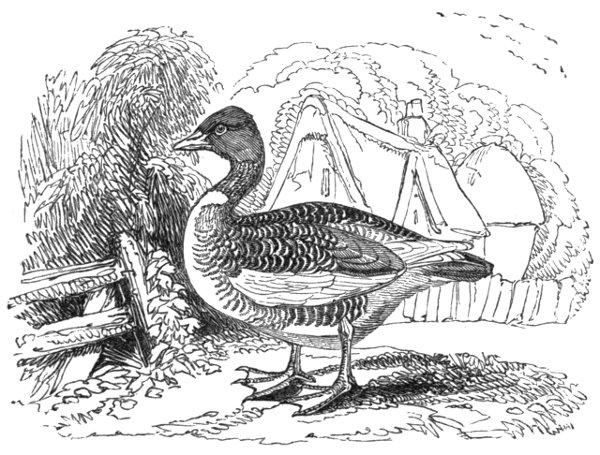
Common Wild Goose—Grey Lag Goose, (Anas anser, Linn.; L’Oie Sauvage, Buff.) This wild goose generally weighs about ten pounds, and measures two feet nine inches in length, and five in breadth. The bill is thick at the base, tapers towards the tip, and is of a yellowish red colour, with the nail white: the head and neck are of a cinereous brown, tinged with dull yellow, and from the separations of the feathers, the latter appears striped downwards: the upper part of the plumage is of a deep brown, mixed with ash-grey; each feather is lighter on the edges, and the lesser coverts are tipped with white: the shafts of the primary quills are white, the webs grey, and the tips black: the secondaries black, edged with white: the breast and belly are crossed and clouded with dusky and ash on a whitish ground; and the tail coverts and vent are of a snowy whiteness: the middle feathers of the tail are dusky, tipped with white: those adjoining more deeply tipped, and the exterior ones nearly all white: legs pale red.
This species is common in this country, and although large flocks of them, well known to the curious, in all the various shapes which they assume in their flight, are seen regularly migrating southward in the autumn, and northward in the spring, yet several of them are known to remain and breed in the fens of Lincolnshire and Cambridgeshire, and, it is said, in various other parts of Great Britain. Pennant says they reside in the fens the whole year, breed there, and hatch about eight or nine young ones, which are often taken, easily made tame, and much more esteemed for the excellent flavour of their flesh than the domestic goose.
Egyptian Goose.—(Anas Ægyptiaca, Linn.; L’Oie d’ Egypte, Buff.)—This beautifully variegated species is nearly the size of the grey lag, or the common wild goose. The bill red, about two inches in length, tip black, and nostrils dusky; eyelids red, and the irides pale yellow; the throat, cheeks, and upper part of the head, are white; a rusty chestnut-coloured patch, on each side of the head, surrounds the eyes. About two-thirds of the neck, from the head downwards, is of a pale reddish bay colour, darker at the lower end; a broad deep chestnut-coloured spot covers the middle of the breast; the shoulders and scapulars are of a reddish brown, prettily crossed with numerous dark waved lines; the wing coverts are white; the greater ones barred near the tips with black; the secondary quills are tinged with reddish bay, and bordered with chestnut; those of the primaries, which join them, are edged with glossy green, and the rest of the first quills are black; the lower part of the back, the rump, and tail, are black; the belly is white, but all the other fore-parts and sides of the body, from the neck near the vent, are delicately pencilled with narrow rust-coloured zigzag lines on a pale ash-grey ground; each wing is furnished on the bend with a short blunt spur. The colours of the female are pretty much the same as those of the male, but not by any means so bright or distinctly marked. This kind is common in a wild state in Egypt, at the Cape of Good Hope, and in various parts of the intermediate territories of Africa, whence they have been brought into, and domesticated in this and other civilised countries, and are now an admired ornament on many pieces of water contiguous to gentlemen’s seats.
Red-breasted Goose.—(Siberian Goose; Anser ruficollis.)—The red-breasted goose measures above twenty inches in length, and its extended wings three feet ten in breadth. The bill is short, of a brown colour, with the nail black; irides yellowish hazel; the cheeks and brow are dusky, speckled with white; an oval white spot occupies the space between the bill and the eyes, and is bounded above, on each side of the head, by a black line which falls down the hinder part of the neck; the chin, throat, crown of the head, and hinder part of the neck to the back, are black; two stripes of white fall down from behind each eye on the sides of the neck, and meet in the middle; the other parts of the neck, and the upper part of the breast, are of a deep rusty red, and the latter is terminated by two narrow bands of white and black; the back and wings are dusky; the greater coverts edged with grey; sides and lower part of the breast black; belly, upper and under tail coverts, white; legs dusky.
This beautiful species is a native of Russia and Siberia, whence they migrate southward in the autumn, and return in the spring; they are said to frequent the Caspian Sea, and are supposed to winter in Persia. They are very rare in this country.
White-fronted Wild Goose.—(Laughing Goose; Anas albifrons; L’ Oie rieuse, Buff.)—This species measures two feet four inches in length, and four feet six in the extended wings, and weighs about five pounds. The bill is thick at the base, of a yellowish red colour; the nail white; from the base of the bill and corners of the mouth a white patch is extended over the forehead; the rest of the head, neck, and upper parts of the plumage, are dark brown; the primary and secondary quills are of the same colour, but much darker, and the wing coverts are tinged with ash; the breast and belly are dirty white, spotted with dusky; the tail is of a hoary ash-coloured brown, and surrounded, like the lag goose’s, with a white ring at the base; the legs yellow.
These birds form a part of those vast tribes which swarm about Hudson’s Bay, and the north of Europe and Asia, during the summer months, and are but thinly scattered over the other quarters of the world. They visit the fens and marshy places in England in small flocks in the winter months, and disappear about the beginning of March. It is said that they never feed in the corn fields, but confine themselves wholly to such wilds and swamps as are constantly covered with water.
Wild geese are very destructive to the growing corn in the fields where they happen to halt in their migratory excursion. In some countries they are caught at those seasons in long nets, resembling those used for catching larks: to these nets the wild geese are decoyed by tame ones, placed there for that purpose. Many other schemes are contrived to take these wary birds; but, as they feed only in the day time, and betake themselves to the water at night, the fowler must exert his utmost care and ingenuity in order to accomplish his ends: all must be planned in the dark, and every trace of suspicion removed, for nothing can exceed the vigilant circumspection and acute ear of the sentinel, who, placed on some eminence, with outstretched-neck, surveys every thing that moves within the circle of the centre on which he takes his stand; and the instant he sounds the alarm, the whole flock betake themselves to flight.
The time that wild geese feed in this country is by night, and particularly during moonlight. I have never known them either netted or decoyed; and all the shooter has to rely upon is patience and a long barrel.
M. Cuvier has published a brief description of a bird produced between a swan and a goose, which in fact amounts to its being a perfect goose, in every thing but size like its mother, which it greatly exceeds.—Bewick—Wild Sports.
Gorge, s. The throat, the swallow; that which is gorged or swallowed; the craw or crop.
Gorge, v. To fill up to the throat, to glut, to satiate; to swallow, as the fish has gorged the hook.
Gorse, s. Furze, a thick prickly shrub.
Furze-covers cannot be too much encouraged, for there cubs are safe. They have also other advantages attending them: they are certain places to find in; foxes cannot break from them unseen, nor are you so liable to change as in other covers.
A fox, when pressed by hounds, will seldom go into a furze-brake. Rabbits, which are the fox’s favourite food, may also be encouraged there, and yet do little damage. Were they suffered to establish themselves in your woods, it would be difficult to destroy them afterwards. Thus far I object to them as a farmer: I object to them also as a fox-hunter; since nothing is more prejudicial to the breeding of foxes than disturbing your woods late in the season, to destroy the rabbits.—Beckford.
Goshawk, s. A hawk of a large kind.
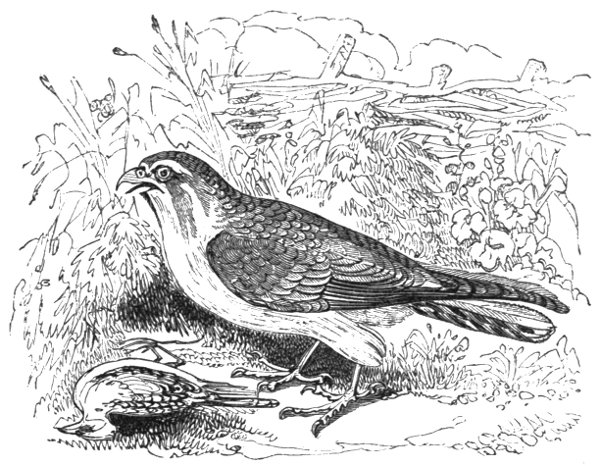
This is a large species, superior in size to the buzzard; length twenty-two inches or more; the bill is blue, tip black; cere yellowish green; irides yellow.
The head, hind part of the neck, back, and wings, deep brown; over the eye is a white line, and a broken patch of the same colour on the side of the neck; the breast and belly marked with numerous transverse bars of black and white; the tail is long, and ash-coloured, with four or five dusky bars; legs yellow; claws black.
The goshawk is rarely found in England, but is not uncommon in the wild and mountainous parts of Scotland, where it is known to breed in the forest of Rothemurchus, and on the woody banks of the Dee. They are said to be numerous in the Orkney Islands, where they breed in the rocks and sea cliffs. They more generally build however in lofty fir trees, and lay from two to four eggs, of a bluish white, marked with streaks and spots of reddish brown. Its flight is described to be very rapid, generally low, and it strikes its prey on the wing, near the ground, being incapable of mounting. If its prey take refuge, it will wait patiently on a tree, or a stone, until the game, pressed by hunger, is induced to move; and as this hawk is capable of great abstinence, it generally succeeds in taking it. Colonel Thornton informs us, that he flew one at a pheasant, which got into cover, and the hawk was lost; at ten o’clock next morning the falconer found her, and just as he caught her the pheasant ran and rose. According to Meyer, it will prey on its own young, but its principal food is wild ducks, hares, and rabbits. In the young, the head, neck, and belly, are of a rufous colour, with long brown spots, and tips of the tail white. In this plumage they have been termed gentil falcons. In the days of falconry, they were held in high repute for hunting cranes, geese, and the larger sorts of game, and were considered by falconers, the best and most courageous of the short-winged hawks.
The goshawk is common in France, Germany, and Russia; it is also found in America, but is rare in Holland.
The goshawk is taken by a net about eight feet deep, and of sufficient length to inclose a square of nine or ten feet. It is suspended to upright stakes, by notches cut upwards, so that it may be disengaged from them, when the hawk strikes against it. This inclosure is left open at the top, and in the middle a pigeon is to be tied to the ground for a bait. The meshes of this net should not be too small, and the colour should be as much as possible like that of the surrounding objects.
The goshawk is termed a hawk of the fist, because it is from thence, and not from the air, that he flies at his game. He is never to be hooded unless for a short time when first taken, or to keep him quiet in travelling. The resting-place of short-winged hawks is called a perch. It is a pole of about an inch and a half in diameter, fixed horizontally about four feet from the ground. It is to be placed under a tree in fine weather, and in some sheltered place when it rains. To the perch is suspended a piece of cloth, or of matting, hanging like a curtain, which assists the hawk in regaining the perch when he has baited off, and prevents him from twisting the leash round it by passing under. The swivel that is fixed to the leash is to be tied close to the top of the perch, and is attached to the jesses by a short leash, six or eight inches long, in such a manner as to be easily taken off when the hawk is to be prepared for flying. He is then to be held on the fist by the jesses, in the same way as the slight falcon.
As the goshawk is carried without a hood, and as he is not to be brought down by the lure, but must come to the fist at the falconer’s call, it is essential that he should be made as tame as possible, and this can only be done by almost constant carriage, and by allowing him frequently to pull upon a stump or pinion, from which he can get but little meat. He will soon learn to come from the perch to the fist, if held close to him when allured by meat. By persevering in this practice, and by cautiously increasing the distance, he will at length be brought to come to the fist, when he is thirty or forty yards off. It is hardly necessary to say, that a creance must always be attached to the leash when these lessons are given, until the hawk is sufficiently reclaimed to be trusted at large, and with this precaution too much must not be required of him at a time. In breaking hawks, and all other animals, much additional trouble is occasioned, and much time is lost in endeavouring to get them on too fast. When the goshawk will come freely to the fist, not only from the perch, but from the ground, and from low trees (on which he should frequently be placed), it will only be necessary to give him a few live partridges in the way that I have described, and he will be ready for the field.—Montagu—Sebright.
Gosling, s. A young goose, a goose not yet full-grown.
Gourdiness, s. A swelling in a horse’s leg.
Gournet, s. A sea-fish, commonly pronounced Gurnet. Of this fish the red is excellent, while the grey sort is coarse and insipid.
Grain, s. A single seed of corn; corn; the seed of any fruit; any minute particle; the smallest weight; anything proverbially small; the direction of the fibres of wood, or other fibrous matter.
Grained, a. Rough, made less smooth.
Grains, s. The husks of malt exhausted in brewing; the prongs of a fish-spear.
Gralla, s. That order of birds which Linnæus classifies as having obtuse bills, and long legs, as the crane, stork, &c.
Graminivorous, a. Grass-eating.
Granivorous, a. Eating grain.
Granivorous birds.—Birds may be distinguished, like quadrupeds, into two kinds or classes—granivorous and carnivorous; like quadrupeds, too, there are some that hold a middle nature, and partake of both. Granivorous birds are furnished with larger intestines, and proportionally longer, than those of the carnivorous kind. Their food, which consists of grain of various sorts, is conveyed whole and entire into the first stomach or craw, where it undergoes a partial dilution by a liquor, secreted from the glands, and spread over its surface; it is then received into another species of stomach, where it is further diluted; after which it is transmitted into the gizzard, or true stomach, consisting of two very strong muscles, covered externally with a tendinous substance, and lined with a thick membrane of prodigious power and strength; in this place the food is completely triturated, and rendered fit for the operation of the gastric juices. The extraordinary powers of the gizzard in comminuting the food, so as to prepare it for digestion, would exceed all credibility, were they not supported by incontrovertible facts, founded upon experiments.
In order to ascertain the strength of these stomachs, the ingenious Spallanzani made the following curious and very interesting experiments:—
Tin tubes, full of grain, were forced into the stomachs of turkeys, and after remaining twenty hours, were found to be broken, compressed, and distorted in the most irregular manner.
In proceeding further, the same author relates, that the stomach of a cock, in the space of twenty-four hours, broke off the angles of a piece of rough jagged glass, and upon examining the gizzard, no wound or laceration appeared.
Twelve strong needles were firmly fixed in a ball of lead, the points of which projected about a quarter of an inch from the surface; thus armed, it was covered with a case of paper, and forced down the throat of a turkey; the bird retained it a day and a half, without showing the least symptom of uneasiness; the points of all the needles were broken off close to the surface of the ball, except two or three, of which the stumps projected a little. The same author relates another experiment, seemingly still more cruel; he fixed twelve small lancets, very sharp, in a similar ball of lead, which was given in the same manner to a turkey cock, and left eight hours in the stomach; at the expiration of which the organ was opened but nothing appeared except the naked ball, the twelve lancets having been broken to pieces, the stomach remaining perfectly sound and entire. From these curious and well-attested facts we may conclude, that the stones so often found in the stomachs of many of the feathered tribes, are highly useful in comminuting grain and other hard substances which constitute their food.
Granivorous birds partake much of the nature and disposition of herbivorous quadrupeds. In both the number of their stomachs, the length and capacity of their intestines, and the quality of their food, they are very similar; they are likewise both distinguished by the gentleness of their tempers and manners. Contented with the seeds of plants, with fruits, insects, and worms, their chief attention is directed to procuring food, hatching and rearing their offspring, and avoiding the snares of men, and the attacks of birds of prey, and other rapacious animals. They are a mild and gentle race, and are in general so tractable as easily to be domesticated.—Bewick.
Granulate, v. To grain; to break into small masses.
Grape, s. The fruit of the vine, growing in clusters.
Grasp, v. To hold in the hand, to gripe; to seize, to catch at.
Grasp, s. The gripe or seizure of the hand; hold; power of seizing.
Grass, s. The common herbage of fields on which cattle feed.
Grassy, a. Covered with grass.
Grate, s. A partition made with bars placed near to one another, to prevent fish escaping from a pond; the range of bars within which fires are made.
Grave, v. To carve on any hard substance; to impress deeply.
Gravitating Stops, s.
Gravitating Stops.—An insurance from accidents, with a double gun, is completely effected by Mr. Joseph Manton’s gravitating stops, which act of themselves, to remedy the serious danger of loading with a barrel cocked; and, with these stops, you may, by holding the gun downwards, carry both barrels cocked, through a hedge-row, with little or no danger, if any circumstance could justify such determined preparation.
The gravitating stops, I should not omit to mention, require to be kept very clean, as, with rust or dirt under them, they will not fall so readily, and thereby prevent the gun from going off. This I name as a caution to a slovenly shooter, and not as an imperfection in the plan.—Hawker.
Gray, s. White, with a mixture of black; white or hoary with old age; dark, like the opening or close of day.
Grey horses are of different shades, from the lightest silver to a dark iron grey. The silver grey reminds the observer of the palfrey, improved by an admixture of Arab blood. He does not often exceed fourteen hands and a half high, and is round carcassed—light legged—with oblique pasterns, calculated for a light carriage, or for a lady’s riding—seldom subject to disease—but not very fleet, or capable of hard work.
The iron grey is usually a larger horse; higher in the withers, deeper and thinner in the carcass, more angular in all his proportions, and in many cases a little too long in the legs. Some of these greys make good hackneys and hunters, and especially the Irish horses; but they are principally used for the carriage. They have more endurance than the flatness of the chest would promise; but their principal defect is their feet, which are liable to contraction, and yet that contraction is not so often accompanied by lameness as in many other horses.
The dappled grey is generally a handsomer and a better horse: all the angular points of the iron grey are filled up, and with that which not only adds to symmetry, but to use. Whether as a hackney, or, the larger variety, a carriage-horse, there are few better, especially since his form has been so materially improved, and so much of his heaviness got rid of by the free use of foreign blood. There are not, however, so many dappled greys as there used to be, since the bays have been bred with so much care. The dappled grey, if dark at first, generally retains his colour to old age.
Some of the greys approach to a nutmeg, or even bay colour. Many of these are handsome, and most of them are hardy.
Grayling, s. The umber, a fish.
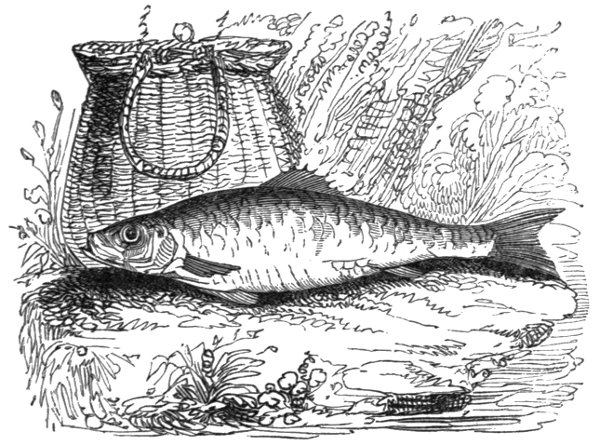
Grayling are never found in streams that run from glaciers—at least near their source; and they are killed by cold or heat. I once put some grayling from the Teme, in September, with some trout, into a confined water, rising from a spring in the yard at Dawnton; the grayling all died, but the trout lived. And in the hot summer of 1825, great numbers of large grayling died in the Avon, below Ringwood, without doubt killed by the heat in July.
The grayling lies deeper and is not so shy a fish as the trout; and, provided your link is fine, is not apt to be scared by the cast of flies on the water. The fineness of the link, and of the gut to which your flies are attached, is a most essential point, and the clearer the stream the finer should be the tackle. I have known good fishermen foiled by using a gut of ordinary thickness, though their flies were of the right size and colour. Very slender transparent gut of the colour of the water, is one of the most important causes of success in grayling fishing.
He is to be fished for at all times, for he is rarely so much out of season as to be a bad fish; and when there are flies on the water, he will generally take them: but as the trout may be considered as a spring and summer fish, so the grayling may be considered as a winter and autumnal fish.
Grayling do not refuse large flies; and in the Avon and Test May flies, and even moths, are greedily taken in the summer by large grayling. Flies, likewise, that do not inhabit the water, but are blown from the land, are good baits for grayling. There is no method more killing for large grayling, than applying a grasshopper to the point of a leaded hook, the lead and shank of which are covered with green and yellow silk, to imitate the body of the animal. This mode of fishing is called sinking and drawing. I have seen it practised in this river with as much success as maggot fishing, and the fish taken were all of the largest size; the method being most successful in deep holes, where the bottom was not visible, which are the natural haunts of such fish. In the winter, grayling rise for an hour or two in bright and tolerably warm weather, and at this time the smallest imitations of black or pale gnats that can be made, on the smallest sized hook, succeed best in taking them. In March, the dark-bodied willow fly may be regarded as the earliest fly; the imitation of which is made by a dark claret dubbing and a dun hackle, or four small starlings’ wing feathers. The blue dun comes on in the middle of the day in this month, and is imitated by dun hackles for wings and legs, and an olive dubbing for body. In mild weather, in morning and evening in this month, and through April, the green tail, or grannon, comes on in great quantities, and is well imitated by a hen pheasant’s wing feather, a grey or red hackle for legs, and a dark peacock’s harle, or dark hare’s ear fur, for the body. The same kind of fly, of a larger size, with paler wings, kills well in the evening, through May or June. The imitation of a water insect called the spider-fly, with a lead-coloured body and woodcock’s wings, is said to be a killing bait on this and other rivers, in the end of April and beginning of May, but I never happened to see it on the water. The darker alder fly, in May and June, is taken greedily by the fish; it is imitated by a dark shaded pheasant’s wing, black hackle for legs, and a peacock’s harle, ribbed with red silk, for the body. At this season, and in July, imitations of the black and red palmer worms, which I believe are taken for black or brown, or red beetles or cockchafers, kill well; and in dark weather there are usually very light duns on the water. In August, imitations of the house fly and blue bottle, and the red and black ant fly, are taken, and are particularly killing after floods in autumn, when great quantities of the fly are destroyed and washed down the river. In this month, in cloudy days, pale blue duns often appear, and they are still more common in September. Throughout the summer and autumn, in fine calm evenings, a large dun fly, with a pale yellow body, is greedily taken by grayling after sunset, and the imitation of it is very killing. In the end of October, and through November, there is no fly fishing but in the middle of the day, when imitations of the smaller duns may be used with great success; and I have often seen the fish sport most, and fly fishing pursued with great success in bright sunshine, from twelve till half past two o’clock, after severe frosts in the morning; and I once caught under these circumstances a very fine dish of fish on the 7th of November. It was in the year 1816; the summer and autumn had been peculiarly cold and wet, and, probably in consequence of this, the flies were in smaller quantity at their usual season, and there were a greater proportion later in the year.
Grayling, if you take your station by the side of a river, will rise nearer to you than trout, for they lie deeper, and therefore are not so much scared by an object on the bank; but they are more delicate in the choice of their flies than trout, and will much oftener rise and refuse the fly. Trout, from lying nearer the surface, are generally taken before grayling where the water is slightly coloured, or after a flood; and in rain trout usually rise better than grayling, though it sometimes happens, when great quantities of flies come out in rain, grayling, as well as trout, are taken with more certainty than at any other time. The artificial fly, in such cases, looks like a wet fly, and allures even the grayling, which generally is more difficult to deceive than trout in the same river.—Sir Humphry Davy.
Grease, s. The soft part of the fat; a swelling and gourdiness of the legs, which generally happens to a horse after his journey.
Swelled legs, although distinct from grease, are apt to degenerate into it. This disease, therefore, comes next under our consideration. It is an inflammation of the skin of the heel, sometimes of the fore, but oftener of the hind foot. It is not a contagious disease, although when it once appears in a stable it frequently goes through it, for it is usually to be traced to bad stable management. The skin of the heel of the horse somewhat differs from that of any other part. There is a great deal of motion in the fetlock, and to prevent the skin from excoriation or chapping, it is necessary that it should be kept soft and pliable; therefore, in the healthy state of the part, the skin of the heel has a peculiar greasy feel. Under inflammation, the secretion of this greasy matter is stopped—the heels become red, dry, and scurfy; and being almost constantly in motion, cracks soon succeed: these sometimes extend, and the whole surface of the heel becomes a mass of soreness, ulceration, and fungus.
The first appearance of grease is usually a dry and scurfy state of the skin of the heel, with redness, heat and itchiness. The heel should be well washed with soap and water; as much of the scurf should be detached as is easily removable: white ointment composed of one drachm of sugar of lead, rubbed down with an ounce of lard, will usually supple and cool, and heal the part.
When cracks appear, the mode of treatment will depend on their extent and depth. If they are but slight, a lotion composed of a solution of two drachms of blue vitriol, or four of alum, in a pint of water, will often speedily dry them up and close them. But if the cracks are deep, with an ichorous discharge, and the lameness considerable, it will be necessary to poultice the heel. A poultice of linseed meal will be the most effectual, unless the discharge is thin and offensive, when an ounce of finely powdered charcoal should be mixed with the linseed meal, or a poultice may be made with carrots boiled soft, and mashed. The efficacy of a carrot poultice is seldom sufficiently appreciated in cases like these.
When the inflammation and pain have evidently subsided, and the cracks discharge good matter, they may be dressed with an ointment composed of one part of resin, and three of lard, melted together, and one part of calamine powder added, when these begin to get cool. The healing will be quickened if the cracks are occasionally washed with either the vitriol or alum solution. A mild diuretic may here be given every third day, but a mild dose of physic will form the best medicine that can be administered.
After the chaps or cracks have healed, the legs will sometimes continue gorged and swelled. A flannel bandage evenly applied over the whole of the swelled part will be very serviceable; or, should the season admit of it, a run at grass, particularly spring grass, should be allowed. A blister is inadmissible, from the danger of bringing back the inflammation of the skin, and discharge from it; but the actual cautery, taking especial care not to penetrate the skin, must occasionally be resorted to.
There will be great danger in suddenly stopping this discharge. Inflammation of a more important part has rapidly succeeded to the injudicious attempt. The local application should be directed to the abatement of the inflammation. The poultices just referred to should be diligently used night and day, and especially the carrot poultice; and, when the heat and tenderness and stiffness of motion have diminished, astringent lotions may be applied; either the alum lotion, or a strong decoction of oak bark, changed, or used alternately, but not mixed. The cracks should likewise be dressed with the ointment above mentioned; and the moment the horse can bear it, a flannel bandage should be put on, reaching from the coronet, to three or four inches above the swelling.
Walking exercise should be resorted to as soon as the horse is able to bear it, and this by degrees may be increased to a gentle trot.—The Horse.
Greasy, a. Oily, fat, unctuous; smeared with grease.
Greaves, s. The offal of chandlers; the animal matter which remains after the tallow has been extracted. Greaves mixed with oatmeal make excellent feeding for dogs.
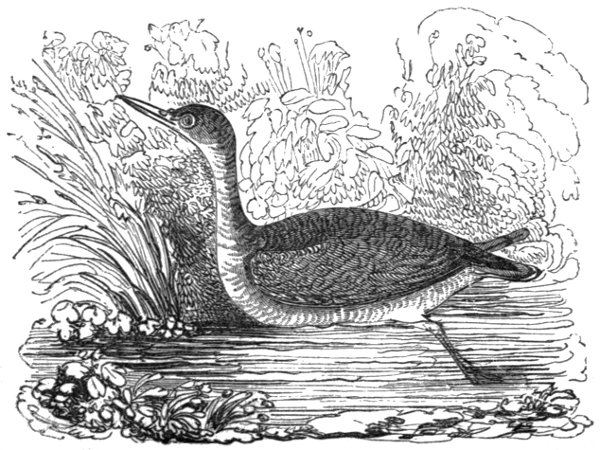
Grebe, s. A water-fowl.
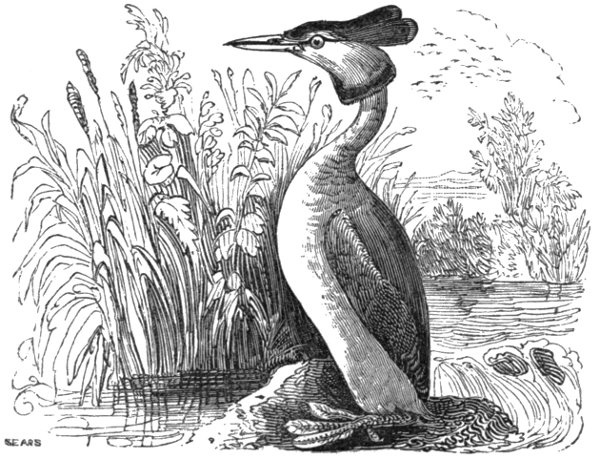
The bills of this genus are compressed on the sides, and though not large, are firm and strong, straight and sharp pointed: nostrils linear; a bare space between the bill and the eyes; tongue slightly cloven at the end; body depressed; feathers thickly set, compact, very smooth, and glossy; wings short, scapulars long; no tail; legs placed far behind, much compressed, or flattened on the sides, and serrated behind with a double row of notches; toes furnished on each side with membranes; the inner toes broader than the outer; the nails broad and flat.
This genus is ranked by Ray and Linnæus with the diver and guillemot; but as the grebes differ materially from those birds, Brisson, Pennant, and Latham, have separated them. The grebes are almost continually upon the water, where they are remarkable for their agility: at sea they seem to sport with the waves, through which they seem to dart with the greatest ease, and, in swimming, slide along, as it were without any apparent effort upon the surface, with wonderful velocity; they also dive to a great depth in pursuit of their prey. They frequent fresh-water lakes and inlets of rivers as well as the ocean, to which they are obliged to resort in severe seasons, when the former are bound up by the ice. No cold or damp can penetrate their thick, close plumage, which looks as it were glazed on the surface, and by which they are enabled, while they have open water, to brave the rigours of the coldest winter. They can take wing from the water, or drop from an eminence, and fly with great swiftness to a considerable distance; but when they happen to alight on the land, are helpless, for they cannot either rise from the flat surface of the ground, or make much progress in walking upon it. On shore they sit with the body erect, commonly upon the whole length of their legs, and, in attempting to regain the water, they awkwardly waddle forward in the same position; and, if by any interruption they happen to fall on their belly, they sprawl with their feet, and flap their short wings as if they were wounded, and may easily be taken by the hand, for they can make no other defence than by striking violently with their sharp-pointed beak. They live upon fish, and it is said, also upon fresh water and sea-weeds. They are generally very fat and heavy in proportion to their size.
The females generally build their nests in the holes of the rocky precipices which overhang the sea-shores; and those which breed on lakes, make theirs of withered reeds and rushes, &c., and fix it among the growing stalks of a tuft, or bush, of such like herbage, close by the water’s edge. They lay from two to four eggs at one hatching.
The skins of these birds are dressed with the feathers on, and made into warm beautiful tippets and muffs; the under part only is used for this purpose, and a skin of one of the species sells as high as fourteen shillings.
Great Crested Grebe.—(Greater crested Douker, Car Goose, Ash-coloured Loon, or Gaunt, Colymbus cristatus, Linn.; Le Grêbe huppé, Buff.)—This bird is the largest of the grebes, weighing about two pounds and a half, and measuring twenty-one inches in length, and thirty in breadth. The bill is about two inches and a quarter long, dark at the tip, and red at the base; the bare stripe, or core, between the bill and eyes, is in the breeding season red, afterwards change to dusky; irides fine pale crimson. The head, in adult males, is furnished with a great quantity of feathers, which form a kind of ruff, surrounding the upper part of the neck; those on each side of the head, behind, are longer than the rest, and stand out like ears: this ruff is of a bright ferruginous colour, edged on the under side with black. The upper parts of the plumage are of a sooty or mouse-coloured brown; the under parts of a glossy or silvery white; the inner ridge of the wing is white; the secondaries of the same colour, forming an oblique bar across the wing when closed: the outsides of the legs are dusky, the inside and toes of a pale green.
This species is common in the fens and lakes in various parts of England, where they breed and rear their young. The female conceals her nest among the flags and reeds which grow in the water, upon which it is said to float, and that she hatches her eggs amidst the moisture which oozes through it. It is made of various kinds of dried fibres, stalks, and leaves of water plants, and (Pennant says) the roots of bugbane, stalks of water-lily, pond-weed, and water-violet; and he asserts, that when it happens to be blown from among the reeds, it floats about upon the surface of the open water.
These birds are met with in almost every lake in the northern parts of Europe, as far as Iceland, and southward to the Mediterranean; they are also found in various parts of America.
Tippet Grebe, Greater Dabchick, or Greater Loon.—(Colymbus urinator, Linn. Le Grêbe, Buff.)—This bird differs from the last only in being somewhat less, in having its neck, in most specimens, striped downward on the sides with narrow lines of dusky and white, and in having no crest.
Modern ornithologists begin to suspect, that the tippet grebe is the female of the great crested grebe, or a young bird of that species, Latham says, “It is with some reluctance, that we pen our doubts concerning the identity of this, as a species, at least as being distinct from the great crested grebe, in contradiction to what former authors have recorded on the subject. It is certain that the last-named bird varies exceedingly at different periods of life; and we are likewise as certain, that the birds which have been pointed out to us as the Geneva grebes, have been no other than young ones of the great crested, not having yet attained the crest; and whoever will compare Brisson’s three figures of the birds in question, will find (the crest excepted) that they all exactly coincide, allowing for their different periods of ages.”
Eared Grebe.—This bird measures about twelve inches in length, and twenty two from tip to tip of the wings. The bill is black, inclining to red towards the base, rather slender, nearly an inch long, and slightly bent upwards at the point, lore and irides red; the head is thickly set and enlarged with feathers of a sooty black colour, except two large loose and spreading orange-coloured tufts, which take their rise behind each eye, flow backwards, and nearly meet at their tips, the neck and upper parts of the plumage are black, the under parts of a glossy white; the sides a rusty chestnut colour; legs greenish black. The male and female are nearly alike, only the latter is not furnished or puffed up about the head with such a quantity of feathers.
This species is not numerous in the British isles. Pennant says they inhabit and breed in the fens near Spalding in Lincolnshire, and that the female makes a nest not unlike that of the crested grebe, and lays four or five small white eggs. The eared grebe is found in the northern regions of Europe, as far as Iceland, and also met with in southern climates. The circumnavigator Bougainville says, it is called the “Diver with spectacles,” in the Falkland Islands.
Dusky Grebe, Black and White Dabchick, (Colymbus nigricans, Linn. La petite Grêbe Buff.)—This species measures about an inch less in length, and two in breadth, than the last. The bill is more than an inch long, and of a pale blue colour, with reddish edges; lore and orbits red; irides bright yellow: the upper part of the head, hinder part of the neck, scapulars, and rump, are of a dark sooty or a mouse-coloured brown; the feathers on the back are nearly of the same colour, but glossy, and with greyish edges; the ridge of the wings and secondary quills are white, the rest of the wing dusky. There is a pale spot before each eye; the cheeks and throat are white; the fore part of the neck is light brown; and the breast and belly are white and glossy like satin; the thighs and vent are covered with dirty white downy feathers; the legs are white behind, dusky on the outer side, and pale blue on the inner sides and shins; the toes and webbed membranes are also blue on the upper sides, and dark underneath.
Red-necked Grebe (Colymbus subscristatus, Le Jougris, Buff.)—This bird measures, from the bill to the rump, seventeen inches; to the end of the toes twenty-one; and weighs eighteen ounces and three quarters. The bill is about two inches long, dusky or horn-coloured on the ridge and tip, and on the sides of it, towards the corners of the mouth, of a reddish yellow; the underside of the lower mandible is also of the latter colour: lore dusky; irides dark hazel; the cheeks and throat are of a dirty or greyish white; the upper part of the head is black, with a greyish cast, and the feathers are lengthened on each side, on a line with the eyes backward, so as to look like a pair of rounded ears—these it can raise or depress at pleasure: the fore part and sides of the neck are of a dingy brown, mixed with feathers of a bright rusty red; the upper parts of the plumage are of a darkish mouse-coloured brown, lightest on the wing-coverts, deepest on the scapulars and rump, and edged with grey on the shoulders; the under parts are of a glossy white, like satin, mottled with indistinct brownish spots: primary quills brownish tawny, with dark-coloured tips; secondaries white: outer sides of the legs dusky, inner sides sallow green; webs of the outer toes flesh colour, middle ones redder, and the inner ones orange.
Pennant supposes the red-necked grebe to be only a variety of the great crested grebe; but Latham, who has been furnished with several specimens, is of opinion that it is a distinct species. He describes the adult males in full feather, as having their necks of an uniform reddish chestnut; and the younger birds, when they have not obtained their full plumage, to be only partially spotted on their necks with that colour.
Little Grebe, Dab-chick, Small Doucher, Dipper, or Didapper (Colymbus minutus, Linn.; Le Castagneaux, Buff.)—This is the least of the grebe tribe, weighing only between six and seven ounces, and measuring, to the rump, ten inches, to the end of the toes thirteen, and about sixteen from tip to tip of the wings. The bill is scarcely an inch long, of a dusky reddish colour; irides hazel; the head is thickly clothed with a downy kind of soft feathers, which it can puff up to a great size, or lay down flat at pleasure; the cheeks are mostly of a bay colour, fading towards the chin and throat into a yellowish white. The neck, breast, and all the upper parts of the plumage, are of a brown or chestnut colour, tinged with red, lightest on the rump: the belly is white, clouded with ash-colour, mixed with red: thighs and vent grey: greater quills dark brown; the lesser white on their inner webs: legs dirty olive green.
The little grebe is a true aquatic, for it seldom quits the water, nor ventures beyond the sedgy margins of the lake where it has taken up its abode. It is a most excellent diver, and can remain a long while under water, in pursuit of its prey, or to shun danger. It is found in almost every lake, and sometimes upon rivers, but seldom goes out to sea. Its food is of the same kind, and its habits much the same as those of the other grebes.
This species of the grebe is an inhabitant of both Europe and America.
Black-chin grebe.—This bird is described as being larger than the last. Chin black; forepart of the neck ferruginous; hinder part mixed with dusky; belly cinereous and silver intermixed. Inhabits Tiree, one of the Hebrides.—Latham.
Greedy, a. Ravenous, voracious, hungry; eager.
Green, a. Having a colour formed by compounding blue and yellow; flourishing, fresh; new, fresh, as a green wound; unripe, immature, young.
Green, s. One of the seven original colours; a grassy plain.
To dye green.—Boil your stuff to a very rich yellow, in turmeric, lift it, and add near a teaspoonful of best madder; boil it for five minutes, and draw what you want for the first shade; add a teaspoonful and a half of madder, and boil for the same length of time, and for as many shades as you want; follow the same plan to four or five shades; wash them well in water, then in urine, as in the other recipes. Wring them and green them, one by one, in the greening-vat; beginning with the lightest, which will green in a very few minutes. You will destroy the greens if they take too much of the blue: you must attend them closely till you finish. These are the richest of all greens, and fast colours. The lightest of them, or the next, are used for the green rail and September-green fox. If you want your greens finer, put less madder, and do not boil so long; you must here be guided by your eye.—Old Recipe.
Green, v. To make green.
Greenfinch, s. A small bird.
Greenshanked Godwit, or Greenlegged Horseman, (Scolopax glottis, Linn.; La Barge variée, Buff.), s.
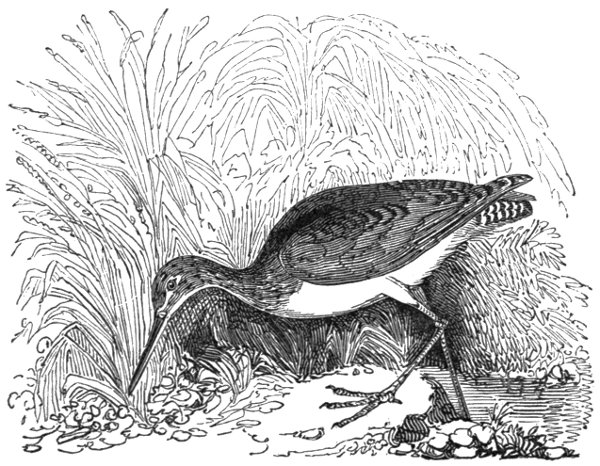
The greenshank is of a slender and elegant shape, and its weight small in proportion to its length and dimensions, being only about six ounces; although it measures from the tip of its beak to the end of its tail fourteen inches, and to the toes twenty, and from tip to tip of the wings twenty-five. The bill is about two inches and a half long, straight and slender: the upper mandible black; the under reddish at its base. The upper parts of its plumage are pale brownish ash colour; but each feather is marked down the shaft with glossy bronze brown; the under parts, and rump, are of a pure white: a whitish streak passes over each eye; the quill-feathers are dusky, plain on the outer webs; but the inner ones are speckled with white spots: the tail is white, crossed with dark waved bars: the legs are long; bare about two inches above the knees, and of a dark-green colour: the outer-toe is connected by a membrane to the middle one, as far as the first joint.
This species is not numerous in England, but they appear in small flocks in the winter season, on the sea-shores and the adjacent marshes; their summer residence is in the northern regions of Russia, Siberia, &c., where they are said to be in great plenty; they are also met with in various parts of both Asia and America. Their flesh, like all the rest of this genus, is well flavoured, and esteemed good eating.—Bewick.
Gregarious, a. Going in flocks or herds.
Greyhound, s. A tall fleet dog that chases by sight. Of this species the varieties are numerous, and are generally named after the countries to which they originally belong.
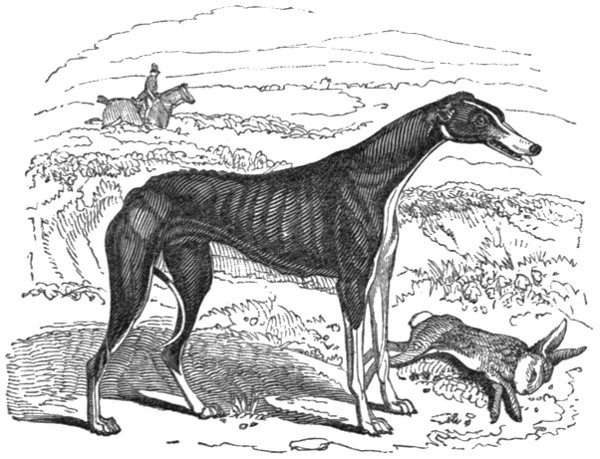
The Irish greyhound.—(Canis Graius Hibernicus, Ray.)—This is one of the largest of the canine race, with an air at once beautiful, striking, and majestic. He has been known to grow to the extraordinary height of four feet, although the general standard is about three feet.
In shape, the Irish greyhound somewhat resembles the common greyhound, only that he is much larger, and more muscular in his formation; clumsy in all his different parts, and is quite unserviceable for hunting either the stag, fox, or hare. His chief use, in former times, was in clearing the country of wolves and wild boars, for which his great size and strength peculiarly adapted him.
The colour of the Irish greyhound is a pale cinnamon or fawn. His aspect is mild, and his disposition gentle and peaceable. It is said he is greatly an overmatch for either the mastiff or bull dog; and when he fights, he generally seizes his antagonist by the back, and shakes him to death, which his great strength enables him to do with ease.
M. Buffon supposes the great Danish dog to be only a variety of the Irish greyhound: and Mr. Pennant was of opinion that the French matin and the Albian dog were also varieties of the same.
The Irish greyhound is now rarely to be met with even in his native country.
Aylmer Bourke Lambert, Esq., one of the vice-presidents of the Linnæan Society, took the measurement of one of the Marquis of Sligo’s dogs, which was as follows:—“From the point of the nose to the tip of the tail, sixty-one inches; tail, seventeen and a half inches long; from the tip of the nose to the back part of the skull, ten inches; from the back part of the skull to the beginning of the tail, thirty-three inches; from the toe to the top of the foreshoulder, twenty-eight inches and a half; length of the leg sixteen inches; from the top of the hind toes to the hind shoulders, thirteen inches; from the point of the nose to the eye, four inches and a half; the ears, six inches long; round the widest part of the belly, (about three inches from the forelegs,) thirty-five inches; twenty-six inches round the hinder part, close to the hind legs; the hair short and smooth; the colour of some brown and white, of others black and white.”
They seemed good-tempered animals, but, from the accounts Mr. Lambert received, it is obvious that they must have degenerated, particularly in point of size.
Dr. Goldsmith says he has seen a dozen of these dogs, and assures us the largest was about four feet high, and as tall as a calf of a year old.
Scottish Highland Greyhound or Wolf Dog, (Canis Caledonius.)—This is a large and powerful dog, nearly equal in size to the Irish greyhound. His general aspect is commanding and fierce; his head is long, and muzzle rather sharp; his ears pendulous, but not long; his eyes large, keen, and penetrating, half concealed among the long, stiff, bristly hair with which his face is covered; his body is very strong and muscular, deep-chested, tapering towards the loins, and his back slightly arched; his hind-quarters are furnished with large prominent muscles; and his legs are long, strongboned, and straight,—a combination of qualities which gives him that speed and long duration in the chase for which he is so eminently distinguished. His hair is shaggy and wiry, of a reddish colour, mixed with white: his tail is rough, which he carries somewhat in the manner of a stag-hound, but not quite so erect.
This is the dog formerly used by the highland chieftains of Scotland in their grand hunting parties, and is in all probability the same noble dog used in the time of Ossian.
The Scotch Highland greyhound will either hunt in packs or singly.
The Russian Greyhound, (Canis Graius Borealis.)—This is a large and powerful dog, nearly equal in strength to the Irish greyhound, which he also resembles in shape; his hair is long and bushy, and his tail forms a spiral curl, but which in the chase stands nearly straight behind him. The colour of the Russian greyhound is generally of a dark umber brown, but sometimes black: his coat is rough and shaggy.
When the Russian greyhound loses sight of the hare, he runs by the scent. Indeed, when parties go out a coursing, this dog even endeavours to find game. He is a very powerful animal, and is frequently used either in small packs, or with other dogs, to hunt the wild boar, deer, or wolf, the latter of which a good hound will kill singlehanded. But it is the deer principally that he hunts. When used in coursing, he is slipped in the same manner as is practised in this country.
The Scotch Greyhound, (Canis Graius Scotius.)—This dog, in point of form, is similar in all respects to the common grey-hound, differing only in its being of a larger size, and the hair being wiry, in place of that beautiful sleekness which distinguishes the coat of the other. Their colour for the most part is of a reddish brown or sandy hue, although they are sometimes to be met with quite black. I saw some powerful animals of this description in the north of Ireland, in possession of the small farmers and peasants of the mountainous districts. They are said to be the only dogs which are capable of catching the hares which inhabit those mountain ranges,—the common greyhound wanting strength for such a laborious chace. These dogs in Ireland are almost universally dark iron grey, with very strong grizzly hair, and are much superior in many respects to any I have seen in Scotland. I remark a peculiarity in those Irish hounds, which was that of having very small but extremely brilliant and penetrating hazel-coloured eyes; their teeth were also very strong and long.
We are informed by Topsel, that the dog was used for tracing thieves in Scotland, and also on the borders of England, and that he had an excellent sense of smelling. Even at the present day he has the sense in a more acute state than the common greyhound; and it is probable that in early times he was still more distinguished by an active power of scent.
The Italian Greyhound, (Canis Graius Italianus.)—Is about half the size of the common greyhound, and is perfectly similar in form. His shape is exquisitely beautiful, and he has a most delicate appearance. The general colour of this handsome dog is a pale mouse brown, sable, or white. The skin is very sleek, and the hair extremely fine and short. He does not thrive well in Great Britain, the climate being too cold for his delicate constitution.
The Italian greyhound is too small to have sufficient speed for taking a hare, and is in consequence never employed in the chace, his principal use being an attendant on the great. In Italy, men of rank are frequently seen either walking or riding followed by several of these dogs.
Turkish Greyhound, (Canis Egyptius, Linn.)—This is a diminutive variety of the greyhound, probably reduced to its smallest size from the influence of climate. It is little more than half the bulk of the Italian greyhound, and like the same animal, both in this country and in Italy, is an attendant on people of rank, and usually kept as a pet.
The Turkish greyhound is quite naked, with only a few scattered hairs on its tail. The colour of the skin is leaden or black, and has all the appearance of leather. His ears are long and erect. This dog is said to possess great attachment to his master. We have heard of one which belonged to a pacha who was beheaded, that laid itself down on the body of his murdered master and expired.
It is said that the greyhound of Great Britain when taken to Turkey, quickly degenerates, and becomes a poor spiritless animal, without the least desire for sporting. This is not peculiar to the greyhound, but extends to all dogs brought from temperate climates.
Sonnini, who travelled through the Ottoman empire, mentions that he endeavoured by every means in his power to ascertain whether this singular dog was really a native of Turkey, but that he had sought in vain for it in that country. He further remarks, that it is not in the temperate climate of Turkey that dogs lose their hair, nor even under the burning sun of Egypt.
The breeding of the greyhound is recommended to be from the well tried and best bitches, as an indifferent dog was supposed from such a cross, to get better whelps than if the excellence was inverted, and the bitch but tolerable; the surest way to have the whelps excellent, is to have both sire and dam good, and not to exceed four years old; if any inequality in their age, it is recommended to be on the bitch’s side, provided the dog be young.—Brown.
Grig, s. A small eel.
Grimalkin, s. A cat.
Grin, v. To set the teeth together, and withdraw the lips; to fix the teeth as in anguish.
Gripe, v. To hold with the fingers closed; to catch eagerly; to seize; to clutch.
Gristle, s. A cartilage.
Gristly, a. Cartilaginous.
Grit, s. The coarse part of meal; oats husked, or coarsely ground; sand; rough hard particles; a kind of fish.
Grizzle, s. A mixture of white and black; grey.
Grizzled, a. Interspersed with grey.
Groat, s. A piece valued at fourpence; groats, oats that have the hulls taken off.
Grogginess, s. A disease incident to horses.
The peculiar knuckling over of the fetlock joint, and tottering of the whole of the foreleg, known by the name of grogginess, and which is so often seen in old and over-worked horses, is seldom an affection of either the fetlock or the pastern-joints simply, although these have their full share in the mischief that has been produced by tasking the poor animal beyond his strength. Sometimes it is difficult to fix on any particular joint; at others, it seems to be traced to a joint deep in the foot, where the flexor tendon runs over the navicular bone. It seems oftenest to be a want of power in the ligaments of the joints generally, produced by frequent and severe sprains, or by ill-judged and cruel exertion; and, in the majority of cases, admits of no remedy; especially as dissection often discovers ulceration within the joints, and of the membrane which lines the cartilage, and even of the cartilage itself, which it was impossible to reach or to remove.
Groom, s. A servant that takes care of the stable.
Groove, s. A deep cavern or hollow; a channel or hollow cut with a tool.
Gross, a. Thick, corpulent; inelegant; coarse, rough, opposite to delicate.
Ground-bait, s. A bait made of barley or malt boiled, thrown into the place where fish are to be collected.
Groundling, s. A fish which keeps at the bottom of the water.
Grouse, s. A kind of fowl, a heathcock.
The Wood Grouse, Cock of the Wood, or Capercalzie.—(Tetrao urogallus, Linn. Legrand Coq de Bruyère, Buff.)—This bird is as large as the turkey, is about two feet nine inches in length, and weighs from twelve to fifteen pounds. The bill is very strong, convex, and of a horn colour; over each eye there is a naked skin, of a bright red colour; the eyes are hazel; the nostrils are small, and almost hid under a covering of short feathers, which extend under the throat, and are there much longer than the rest, and of a black colour; the head and neck are elegantly marked with small transverse lines of black and grey, as are also the back and wings, but more irregularly; the breast is black, richly glossed with green on the upper part, and mixed with a few white feathers on the belly and thighs; the sides are marked like the neck, the tail consists of eighteen feathers, which are black, those on the sides are marked with a few white spots; the legs are very stout, and covered with brown feathers; the toes are furnished on each side with a strong pectinated membrane. The female is considerably less than the male, and differs from him greatly in her colours; her throat is red; the transverse bars on the head, neck, and back, are red and black; the breast is of a pale orange colour; belly barred with orange and black, the top of each feather white; the back and wings are mottled with reddish brown and black; the scapulars tipped with white; the tail is of a deep rust colour, barred with black, and tipped with white.
This beautiful kind is found chiefly in high mountainous regions, and is very rare in Great Britain. Mr. Pennant mentions one, as an uncommon instance, which was shot near Inverness. It was formerly met with in Ireland, but is now supposed to be extinct there. In Russia, Sweden, and other northern countries, it is very common: it lives in the forests of pine with which those countries abound, and feeds on the cones of fir trees, which, at some seasons, give an unpleasant flavour to its flesh, so as to render it unfit for the table; it likewise eats various kinds of plants and berries, particularly the juniper. Early in the spring the season for pairing commences; during this period the cock places himself on an eminence, where he displays a variety of pleasing attitudes; the feathers on his head stand erect, his neck swells, his tail is displayed, and his wings trail almost on the ground; his eyes sparkle, and the scarlet patch on each side of his head assumes a deeper dye; at the same time he utters his well-known cry, which has been compared to the sound produced by the whetting of a scythe; it may be heard at a considerable distance, and never fails to draw round him his faithful mates. The female lays from eight to sixteen eggs, which are white, spotted with yellow, and larger than those of the common hen: for this purpose she chooses some secret spot, where she can sit in security: she covers her eggs carefully over with leaves, when she is under the necessity of leaving them in search of food. The young follow the hen as soon as they are hatched, sometimes with part of the shell attached to them.
The Black Grouse, Black Game, or Black Cock.—(Tetrao Tetrix, Linn.; Le Coq de Bruyère à queue fourchue, Buff.)—This bird, though not larger than the common hen, weighs nearly four pounds: its length is about one foot ten inches, breadth two feet nine. The bill is black, the eyes dark blue; below each eye there is a spot of dirty white colour, and above a larger one, of a bright scarlet, which extends almost to the top of the head; the general colour of the plumage is a deep black, richly glossed with blue on the neck and rump; the lesser wing coverts are dusky brown; the greater are white, which extends to the ridge of the wing, forming a spot of that colour on the shoulder when the wing is closed; the quills are brown, the lower parts and tips of the secondaries are white, forming a bar of white across the wing; there is likewise a spot of white on the bastard wing; the feathers of the tail are almost square at the ends, and, when spread out, form a curve on each side; the under tail coverts are of a pure white; the legs and thighs are of a dark brown colour, mottled with white; the toes are toothed on the edges like those of former species. In some of our specimens the nostrils were thickly covered with feathers, whilst in others they were quite bare, probably owing to the different ages of the birds.
These birds, like the former, are found chiefly in the high situations in the northern parts of our island; they are common in Russia, Siberia, and other northern countries: they feed on various kinds of berries and other fruits, the produce of wild and mountainous places: in summer they frequently come down from their lofty situations for the sake of feeding on corn. They do not pair, but, on the return of spring, the males assemble in great numbers at their accustomed resorts, on the tops of the high and heathy mountains, when the contest for superiority commences, and continues with great bitterness till the vanquished are put to flight: the victors, being left in possession of the field, place themselves on an eminence, clap their wings, and with loud cries give notice to their females, who immediately resort to the spot. It is said that each cock has two or three hens, which seem particularly attached to him. The female is about one-third less than the male, and differs from him considerably in colour, her tail is likewise much less forked. She makes an artless nest on the ground, where she lays six or eight eggs of a yellowish colour, with freckles and spots of a rusty brown. The young cocks, at first, resemble the mother, and do not acquire their male garb till towards the end of autumn, when the plumage gradually changes to a deeper colour, and assumes that of a bluish black, which it afterwards retains.
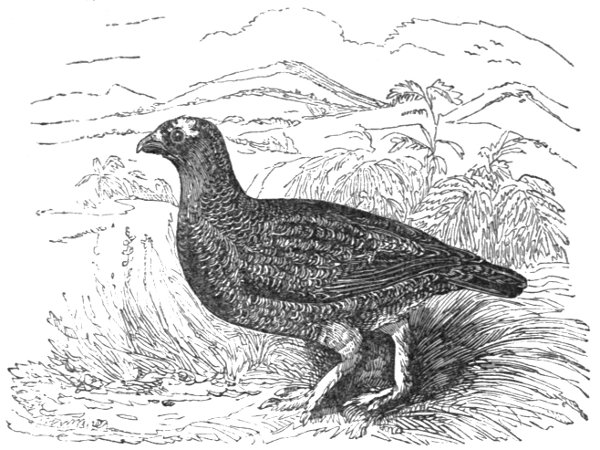
Red Grouse, Red Game, Gorcock or Moorcock.—(Tetrao Scoticus, Linn.; L’Altagas, Buff.)—The length of this bird is fifteen inches; the weight about nineteen ounces. The bill is black; the eyes hazel; the nostrils shaded with small red and black feathers; at the base of the lower bill there is a white spot on each side; the throat is red: each eye is arched with a large naked spot, of a bright scarlet colour; the whole upper part of the body is beautifully mottled with deep red and black, which gives it the appearance of tortoise-shell; the breast and belly are of a purplish hue, crossed with small dusky lines; the tail consists of sixteen feathers of equal length, the four middlemost barred with red, the others black; the quills are dusky; the legs are clothed with soft white feathers down to the claws, which are strong, and of a light colour. The female is somewhat less; the naked skin above each eye is not so conspicuous, and the colours of her plumage in general are much lighter than those of the male.
This bird is found in great plenty in the wild, heathy, and mountainous tracts in the northern counties of England: it is likewise common in Wales and the Highlands of Scotland. Mr. Pennant supposes it to be peculiar to Britain; those found in the mountainous parts of France, Spain, Italy, and elsewhere, as mentioned by M. Buffon, are very probably varieties of this kind, and no doubt would breed with it. It is to be wished that attempts were more frequently made to introduce a greater variety of these useful birds into this country, to stock our waste and barren moors with a rich fund of delicate and wholesome food; but till the legislature shall alter or abrogate our very unequal and injudicious game laws, there hardly remains a single hope for the preservation of such birds of this species as we now have.
Red grouse pair in spring; the female lays eight or ten eggs on the ground. The young ones follow the hen the whole summer; as soon as they have attained their full size, they unite in flocks of forty or fifty, and are then exceedingly shy and wild.
White Grouse, White Game or Ptarmigan.—(Tetrao Lagopus, Linn.; La Lagopéde, Buff.)—This bird is nearly the same size as the red grouse. Its bill is black; the upper parts of its body are of a pale brown or ash colour, mottled with small dusky spots and bars; the bars on the head and neck are somewhat broader, and are mixed with white; the under parts are white, as are also the wings, excepting the shafts of the quills, which are black. This is its summer dress, which in winter is changed to a pure white, excepting that in the male there is a black line between the cill and the eye. The tail consists of sixteen feathers; the two middle ones are ash-coloured in summer and white in winter; the next two are slightly marked with white near the ends; the rest are wholly black; the upper tail coverts are long, and almost cover the tail. The white grouse is fond of lofty situations, where it braves the severest cold; it is found in most of the northern parts of Europe, even as far as Greenland. In this country it is to be met with on the summits of some of our highest hills, chiefly in the Highlands of Scotland, in the Hebrides and Orkneys, and sometimes, but rarely, on the lofty hills of Cumberland and Wales. Buffon, speaking of this bird, says that it avoids the solar heat, and prefers the biting frosts on the tops of mountains; for as the snow melts on the sides of the mountains, it constantly ascends till it gains the summit, where it forms holes and burrows in the snow. They pair at the same time as the red grouse; the female lays eight or ten eggs, which are white spotted with brown. She makes no nest, but deposits them on the ground. In winter they fly in flocks, and are so little accustomed to the sight of man, that they are easily shot or taken in a snare. They feed on the wild productions of the hills, which sometimes give the flesh a bitter but not unpalatable taste; it is dark-coloured, and, according to M. Buffon, has somewhat the flavour of the hare.
Hunting for grouse during the basking hour of the day, is rigidly prohibited by all gentlemen who compile sporting directories; and yet every shooter knows, that at these proscribed hours himself is commonly on the moors. Morning and evening, when the birds are on foot in search of food, is undoubtedly preferable to the duller portion of the day, when they are accustomed to indulge in a siesta. But, generally, some considerable distance must be travelled before the sportsman can reach his beat from his quarters. The morning is consumed on horseback or in the shooting-cart; the same road must be again accomplished before night; and hence the middle of the day is, of necessity, the portion devoted to pursuit of game.
To find the birds when, satisfied with food, they leave the moor to bask in some favourite haunt, requires both patience and experience; and here the mountain-bred sportsman proves his superiority over the less-practised shooter. The packs then lie closely, and occupy a small surface on some sunny brow or sheltered hollow. The best nosed dogs will pass within a few yards, and not acknowledge them; and patient hunting, with every advantage of the wind, must be employed to enable the sportsman to find grouse at this dull hour.
But if close and judicious hunting be necessary, the places to be beaten are comparatively few, and the sportsman’s eye readily detects the spot where the pack is sure to be discovered. He leaves the open feeding-grounds for heathery knowes and sheltered valleys; and while the uninitiated wearies his dogs in vain over the hill-side, where the birds, hours before, might have been expected, the older sportsman profits by his experience, and seldom fails in discovering the dell or hillock, where, in fancied security, the indolent pack is reposing.—Bewick—Wild Sports.
Grub, s. A small worm that eats holes in bodies; a thick short man.
Gruel, s. Food made by boiling oatmeal in water.
Gruel is a useful drink for horses on many occasions, and, when made carefully, sweetened with treacle or sugar, and sometimes seasoned with salt, they will often drink it, and save the trouble of drenching. It is a good vehicle for such medicines as are of a stimulating or acrimonious nature, such as oil of turpentine. Gruel is made either with oatmeal or grits, barley meal or pearl barley, fine wheat flour or arrow root; it may be made also with sago, salep or tapioca; either of these to be boiled in water, and, for some purposes, in milk and broth.
Gruel is often made merely by stirring some oatmeal into warm water, but it is better when boiled: and when grits or pearl barley are employed, it should be boiled a short time, and the first water thrown away; the gruel will then be free from an unpleasant taste which these substances contract by keeping: when they are first crushed or bruised, the gruel is richer, and more expeditiously made. Gruel is a useful restorative for weak or convalescent horses, being very nutritious and easy of digestion; perhaps nothing is more nutritious than wheat flour gruel made with milk and sweetened with sugar. In India it is a common practice to give horses strong broths, thickened with grain or flour, and seasoned with pepper or other spices, when they work hard, or as a restorative cordial. Infusion of malt makes a good nutritive drink for horses; but good sweet grits make an excellent gruel. Oatmeal is sometimes musty, and gruel made with it has often some degree of bitterness. When gruel is given as a cordial restorative after hard work, a little beer and ginger may, on some occasions, be added. Horses are very nice in their drinking, therefore the gruel should be made in a clean saucepan, free from the smell of meat, smoke, or fat. For some purposes, or where it is inconvenient to boil the gruel, a little oat, barley, or wheat meal, may be stirred into warm or cold water. This in Ireland is termed a white drink.—White.
Grunt, v. To murmur like a hog.
Grunter, s. A kind of fish.
Guaiacum, s. A physical wood; lignum vitæ.
A resinous looking substance, extracted from a very dense wood of a tree growing in the West Indies, called Guaiacum officinale. It is little used in veterinary prescriptions.—Ure.
Gudgeon, s. A small fish of the carp kind, found in brooks and rivers.
Guernsey Partridge (Perdrix rufa, Ray), s.
This bird is rather larger than the common species. Bill, irides, and legs red; the upper part of the head is red-brown; greyish on the forehead; chin and throat white, encircled with black; over each eye a band of white; fore part and sides of the neck cinereous, spotted with black; back, wings, and rump, grey-brown; breast pale ash-colour; belly rufous; sides marked with linear streaks of black, white, and orange; the tail composed of sixteen feathers of a rufous-colour, except the six middle ones, which are more or less grey-brown.
The habits of this species differ somewhat from the common partridge. This frequently perches on a tree, and will breed in confinement, which the other is never known to do.
Mr. Daniel says that they are now plentiful near Oxford, the Marquis of Hertford having imported many thousand eggs, which were hatched under hens, and liberated; and so early as 1777, he says he saw a covey, consisting of fourteen of these birds, several of which he shot; many coveys may be found in the neighbourhood of Ipswich, on preserved manors, where they seem to prefer the waste heathy ground to corn-fields, the favourite haunts of the common species.
It is a curious fact, that the Guernsey partridge should be so much changed in its nature by passing the British Channel from Picardy to Kent, not above the third of a degree in difference of latitude, and yet, prolific as they are on the south side of the Channel, they become less inclined to propagation, even in the same sort of soil, in the north, which has rendered every exertion to naturalise them to any extent ineffectual.
This species is very plentiful in Spain and Portugal, frequenting the vineyards, especially in winter. Bechstein informs us that they have been found in Austria and Bohemia, where, however, they are, as with us, very rare in a wild state. Woody and mountainous countries, he adds, seem to please them more than the plains. Wheat and corn of all sorts, with the leaves of several plants, and insects in turn, furnish them with their food; they never become so familiar as the quail, but sufficiently so to breed in the aviary.
Why this should be called Guernsey partridge we cannot imagine, since we are credibly informed it is very rare in that island. The common species breed there, but are scarce; whether this ever bred there is uncertain, though they are known to breed in the island of Jersey. It is also found in various parts of Asia and Africa, and is called by the name of the Red-legged Partridge.—Montagu.
Guinea-hen, s. A small Indian hen.
The Pintada, or Guinea Hen, has been said to unite the character and properties of the pheasant and the turkey. It is about the size of the common hen, but standing high upon its legs gives it the appearance of a larger size. The back is round, with the tail turned downwards, like the partridge. It is an active, restless, and courageous bird, and will even attack the turkey, although so much above its size. The Guinea fowls assimilate perfectly with the common species, in habits and in kinds of food; but have this peculiarity, that the cocks and hens are so nearly alike, it is difficult to distinguish them. They have also a peculiar gait and cry, or chuckling. The head is covered with a kind of casque, with wattles under the bill, and the whole plumage is either black or dark grey, speckled with regular and uniform white spots. The pintada is generally supposed to be a native of Guinea, whence its additional name; but it is in equal plenty in America. In those countries it perches on trees, and, in a wild state, makes its nest in the holes of the palm tree. It is gregarious, and often found in large flocks. Like the peacock, it may be said to be universally domesticated.
There is sometimes, but not invariably, a distinction of colour in certain parts, between the cock and hen pintada; the manner and gait of the cock, however, soon distinguish him. However long domesticated, these birds retain some part of their original wild habits, and will stray in search of a place in which to drop their eggs, without any apparent solicitude as to their security. They lay an abundance of eggs, smaller than those of the common hen, speckled, resembling wild, rather than common, eggs. It sometimes happens that they are everlasting layers, in which case, and indeed generally, it is most profitable to hatch pintadas under a common hen, which will cover an additional number of those small eggs. The chicks are extremely tender, and should not be hatched too early in the spring; a sudden change of the wind in March, to the north-east, has destroyed many a brood of them.—Moubray.
Guinea-pig, s. A small animal with a pig’s snout.
Gulf, s. A bay, an opening into land; an abyss, an immeasurable depth; a whirlpool; a sucking eddy.
Gull (Larus canus, Linn.), s. A sea bird.
This species weighs fifteen or sixteen ounces; length about seventeen inches; bill yellow; irides hazel. The head, neck, tail, and under parts of the body, white; the back, scapulars, and wing coverts, ash-colour—the former tipped with white; the primary quills black; the two or three first have a spot of white across the ends, but the tips are black—the rest are tipped with white; the secondaries, like the back, tipped with white; legs dull white, or tinged with green.
This is one of the most plentiful species found on our coast. They breed upon the ledges of the rocks close to the sea-shore, sometimes not far above the water.
The eggs are two or three in number, of a dull olive-brown, blotched with dusky, the size of a small hen’s. When disturbed they are exceedingly clamorous, and not much alarmed by being shot at. They are frequently seen in winter, at a considerable distance from the coast, and in severe weather they flock with the rooks. They follow the plough for the sake of the larvæ of the chaffer (Scarabæus melolontha), and of worms. The young are brown, mottled with white, the tail having a brown bar near the end; the white commences in the second year, and the spots on the wing and the bar on the tail gradually disappear.—Montagu.
Gullet, s. The throat, the meat-pipe.
Gum, s. A vegetable substance, differing from a resin in being more viscid, and dissolving in aqueous menstruums; the fleshy covering which contains the teeth.
Gummy, a. Consisting of gum, of the nature of gum; overgrown with gum; soft, flaccid.
Gun, s. The general name of fire-arms; the instrument by which shot is discharged by fire.
Agilis. You seem very decided as to your opinion of the relative value between London-made guns, and those at a much less price manufactured in the country. In what qualities do you suppose the advantages to consist, and how do you prove these qualities may not exist as well in a country as a London-made gun? Pray state your opinion at length. I have never heard the matter fully discussed, though I have certainly seen much confidence shown by the advocates of each.
Peritus. The value is derived from four causes: goodness of raw material, temper, close fitting, and adaptation of the several parts to each other, in shape, position, and substance, as fittest to fulfil the duties for which they are separately and collectively intended, in the production or convenience, permanence, and effect.
Let us consider this in the same light in which we should view any other branch of merchandise; first, it must be conceded, that wherever the best maker may be, there the highest quality of produce will be found; it is likely, therefore, that the material offered to the London maker will be superior to that brought for sale to the comparatively small consumer (in price if not in quantity) in the country; the well-known competition existing between all London makers, renders it probable that he will use his utmost exertions to secure this advantage in the highest degree. Secondly: with regard to temper there are two things to be considered, namely, the degree of hardness required to prevent a movement from wearing itself away; and next, with reference to its action upon other parts in contact with it, as in some machines we have wheels bushed with brass to diminish friction. Great tact is requisite in this matter; first, to know the temper required; secondly, to give it. The workman who can effect this, is valuable in proportion to his knowledge; is he likely to remain in the country at low wages, or to become the servant of the highest bidder? Close-fitting: an accurate eye and practised hand are absolutely necessary to effect this, which is a main cause of permanence in a gun-lock, as thereby all parts bear their even proportion of stress, and (the temper and position of all parts being correct) an even wear is the result. But the most practised workman requires an extension of time, in some degree proportionate to the goodness of his work, comparing it with that of others less skilful, and this adds to the price; the London maker can best afford to pay that price.
Lastly, the fitness of the parts for the duties they have to fulfil. It may be said here, that the greater the quantity of material manufactured, the greater degree of knowledge must be attained by the manufacturer. Assuming then that the superiority of material is shown, we have to prove that the cheap manufacturer either cannot, by quantity, obtain such a knowledge of the requisite shape of the parts of a gun, as, when put together, shall make it equal to that of a London maker; or, if in possession of that knowledge, cannot, in the same degree, avail himself of it. Supposing, then, that he does take the pattern of the most approved shape for his guide (a circumstance we find not to be commonly the case), or even in the absence of equal opportunities of comparison, that great spur to improvement, can invent a better shape than others, this can only refer to the handling of the gun; its working, as before shown, depending so much upon material, temper, and putting together, that it possesses the form of goodness only, without the reality; and as well might you expect to procure an article of dress equally convenient, lasting, and fitting, of a country tailor, as that which may be had of a first-rate workman in London, as procure an article of the nature of a gun of the same degree of excellence in the country as in town.
Agilis. Have you not omitted the consideration, that all workmen can work cheaper in the country, from the diminished price of food and house-rent, than in large towns; as also the enormous profits made by London gun-makers?
Peritus. The advantage you here mention, does not come into play—it is a matter of consideration for the workman alone. I would admit it, did I consider that the workman himself was ill-paid, but the contrary is the fact. It has already been conceded, that, although a gun progresses in value as it progresses in price, yet not in an equal ratio, and part of the difference consists in the greater (I might most say undue) pay, in proportion to his labour, which a first-rate workman can procure; and secondly, in the great credit which any one maker may obtain over others from the known excellence of his work: these latter are two little monopolies, and must be paid for while they exist; but it is your business to fix a limit upon this by selecting from the best makers, and procuring the most for your money; and you may be certain, that although large manufactories can be carried on with greater advantage in the country, in circumstances where moderate ability is required, and many hands used, and machinery can also be called into play upon the same terms, yet superior manual dexterity will always overcome the difference of dearness of living and present itself where there is and ever must be the greatest mart, and most continued as well as highest bidders for it; to wit, in that place where the manufacture to be produced is in the highest credit and perfection. And as these two will, therefore, continue to operate upon each other, the demand for guns and the perfection of their manufacture, will draw the best workmen, and they will again produce the most perfect guns: and London will thus continue the best mart for the buyer as well as the seller, until some other city spring up, where the purchasers of the article become more numerous, and the talents of the workmen more appreciated.