INTRODUCTION. (continued 5)
Reading edition
A small breeding cage is all that is required for rearing these birds; but where a room can be allotted to the purpose, it ought to have shrubs for them to roost and build, with plenty of water to drink and bathe in, that being indispensable for all birds. The light should be admitted into the room from the east, for the benefit of the morning sun, and the windows should have wire cloth, that they may enjoy the fresh air. The floor of the apartment ought to be strewed with sand or white gravel, and on that should be thrown groundsel, chickweed, or scalded rapeseed; but when breeding, they should have nothing except hard chopped eggs, dry bread, cake without salt, and, once in two or three days, a few poppy-seeds. Some bird-fanciers give their breeding-birds plantains and lettuce-seeds; but this should be done sparingly, and only for two days, lest it should weaken them.
About the 15th of April they ought to be furnished with flax, soft hay, wool, hair, moss, and other dry materials, for building the nest, which usually occupies about three days: the time of incubation is thirteen days; but when the hen has sat eight or nine days, it is necessary to examine the eggs, holding them carefully by the ends, against the sun or a lighted candle, and to throw away the clear ones. Some bird-fanciers substitute an ivory egg until the last is laid, when the real ones are replaced, that they may be hatched at the same time.
When the young are to be reared by the stick, they must be taken from the mother on the eighth day, taking nest and all. Prior to this, the food should consist of a paste composed of boiled rapeseed, the yolk of an egg, and crumbs of cake unsalted, mixed with a little water; this must be given every two hours. This paste ought not to be too wet, and must be renewed daily, until the nestlings can feed themselves. The hen has generally three broods in the year, but will hatch five times in the season, each time laying six eggs.
The process of moulting, which takes place five or six weeks after they are hatched, is frequently fatal to them. The best remedy yet known is to put a small piece of iron into the water they drink, keeping them warm during the six weeks or two months which generally elapse before they regain their strength. This malady, to which they are all subject, is often fatal to the hen after the sixth or seventh year; and even the cock, though from superior strength he may recover, and continue occasionally to sing, and survive his mate four or five years, appears dull and melancholy from this period, till he gradually droops, and falls a victim to this evil.
If it is proposed to rear gay birds, the cock and hen should be of the same deep colour; if mottled birds are required, both parents should be mottled. When a gay bird and a fancy bird are matched, they are termed mule-birds, because they are irregularly mottled in their plumage, and therefore of no value, although they be equally good singers. The spangled or French canary cock, with a mealy hen, often produces beautiful varieties.
The most common cause of disease in birds proceeds from a superabundance of food, which brings on repletion. In this case the intestines descend to the extremities of the body, and appear through the skin, while the feathers on the part affected fall off, and the poor bird, after a few days, pines and dies. If the disease is not too far gone, putting them in separate cages, and confining them to the cooling diet of water and lettuce-seed, may save the lives of many: they are also subject to epilepsy, asthma, ulcers in the throat, and to extinction of the voice. The cure for the first is doubtful; it is said that if a drop of blood fall from the bill, the bird will recover life and sense; but if touched prior to falling of itself, it will occasion death. If they recover from the first attack, they frequently live for many years without any alteration in their note. Another cure is to inflict a slight wound in the foot. Asthma is cured by plantain, and hard biscuit soaked in white wine; while ulcers, like repletion, must be cured by cooling food. For extinction of voice, the cure ought to be hard yolk of eggs, chopped up with crumbs of bread, and for drink a little liquorice-root, or a blade of saffron in water. In addition to these evils, the canary is infested by a small insect, if they are kept dirty. To avoid this, they should have plenty of water to bathe in, in a new cage, covered with new cloth, and their seeds well sifted and washed. These attentions, if troublesome, are nevertheless necessary to possess a thriving bird. When wild, it has already been remarked, that all birds require water, and to a canary this is so necessary, that if a saucer or cup of snow be put into the cage they will flutter against it with the utmost delight, even during the most severe winters. They are bred in immense numbers, both for amusement and commerce, in France, Tyrol, Germany, and in this country: those from Germany are in the least esteem, from their living only one or two years in this country, although the cock of this variety is an approved songster.—Montagu.
Cancer, s. A crabfish; a virulent swelling; a sore.
The virulent, dreadful ulcer, that is so fatal in the human subject, and is called cancer, is unknown in dogs; yet there is very commonly a large scirrhous swelling of the teats in bitches, and of the testicles (though less frequent) in dogs, that as it sometimes becomes ulcerated, so it may be characterised by this name. In the early state of this disease, discutients prove useful; as vinegar with salt, and camphor and Spanish flies with mercurial ointment, have sometimes succeeded, taking care to avoid irritating the part so much as to cause blister. But when the swelling is detached from the belly, and hangs pendulous in the skin, it had better be removed; and, as a future preventative, suffer the bitch to breed. Scirrhous testicles are likewise sometimes met with; for these no treatment yet discovered succeeds, but the removal of the part, and that before the spermatic chord becomes much affected, or it will be useless.—White.
Cancerous, a. Having the virulence of a cancer.
Candle, s. A light made of wax or tallow, surrounding a wick of flax or cotton.
Candles, as well as lamps, often afford good prognostics of weather. When the flames of candles flare and snap, or burn with an unsteady or dim light, rain, and frequently wind also, are found to follow. The excrescences from the wicks called funguses also denote rain and wind.—Foster.
Cane, s. A kind of strong reed; the plant which yields the sugar; a lance. Canes are sometimes used for fishing-rods.
Canella-alba, s. An aromatic stimulant.
Canine, a. Having the properties of a dog.
Canker, s. A worm that preys upon, and destroys fruits; a fly that preys upon fruits; any thing that corrupts or consumes; an eating or corroding humour; corrosion, virulence; a disease in trees.
Canker in the ear.—A common and troublesome disease, to which dogs are liable. To cure it, boil two ounces of best shag tobacco in a quart of water, until one pint is consumed; dip the dog’s ears, as it is boiling hot, into the tobacco water, until two inches above the cankered part; repeat it three successive days. To bring the hair again, burn some old shoe, and mix with a quarter of a pound of hog’s-lard, and frequently anoint the ears; but the readiest and best way to rid dogs of cankers, is to apply the rounding-iron.
In the early stages, a wash composed of half a drachm of superacetate (sugar) of lead, dissolved in four ounces of rose or rain water, is often all that is necessary. A small teaspoonful may be introduced (previously warmed to a blood heat, to prevent surprise) night and morning, rubbing the root of the ear at the same time, to promote the entrance of the wash into the cavities. In more obstinate cases, it is prudent to add fifteen or twenty grains of vitriolated zinc (white vitriol) to the wash; and if, instead of water, a decoction of oak bark is made use of to form the wash, it will greatly promote the end desired. In some cases, acetate of copper (verdigris), mixed with oil, has proved beneficial when introduced in the same manner. In others, submuriate of quicksilver (calomel) and oil have produced amendment in the same way. A very weak injection of the oxymuriate of quicksilver (corrosive sublimate) has succeeded when every other application has failed. A very mild injection of nitrate of silver, as one grain to two ounces of water, has done much good also.
Canker on the outside of the ear consists of an ill-disposed ulcer, which is usually situated on the lower edge of the flap or pendulous part of one or both ears, dividing it into a kind of slit. It seems to itch intolerably, and is therefore kept in a continual state of aggravation by the shaking of the dog’s head. An unguent, made with equal parts of ointment of nitrated quicksilver and calamine cerate, may be applied once a day, carefully securing the ear from the injury occasioned by the shaking of the head, by a sort of head dress, during its use. Or the following may be tried:—
Oxymuriate of quicksilver (corrosive sublimate) very finely powdered 3 grains
Cerate of calamine (Turner’s cerate) 1 drachm
Sublimated sulphur (milk of) 1 scruple.
In some cases, the oxymuriate of silver has become more efficacious in a wash, six grains being dissolved in four ounces of water. Strong astringent lotions are sometimes useful; as alum dissolved in a decoction of oak bark. When the disease proves very obstinate, excision must be resorted to, taking care that the whole, not only of the immediate cracked part, but also of its tumefied edges, are included in the operation.
In tumefied flap of the ear, the tumour ought either to be opened its full length, and a pledget of lint introduced, to prevent too hasty a union of the outer edges of the sac; or a seton should be introduced, embracing the whole of the tumour, which should be suffered to remain for a week or ten days. By this means, instead of a discharge of serum, healthy matter will form in a little time; the sides will granulate and unite, and on the removal of the seton, the external lips of the wound will close firmly and healthily.—Blaine.
Canker, v. To corrupt, to corrode; to infect, to pollute.
Canoa, or Canoe, s. A boat made by cutting the trunk of a tree into a hollow vessel; a very light boat.
The Poole canoe is built sharp at both ends, on the plan of the Greenland whale-boat, except being so flat at the bottom as to draw only two or three inches of water, and so light as to weigh only from sixty to two hundred pounds. In making all canoes for gunning, the builder should be careful to have the bottoms of them a little rounded (say about half an inch of convex “a-midships,” for a bottom three feet broad); and, what is of still more consequence, a little “kammelled,” or sprung; that is, gradually rising “fore and aft,” in order to “give them life.” They will, otherwise, row miserably heavy, and, when they get aground, suck the mud or sand so much, that, in order to get them off again, you might be forced to stand up, and this would frighten away the fowl. If, however, the bottom of a canoe is too much kammelled, she will never keep steady in going to birds. Some people, for this reason, leave hollow grooves between the bottom planks. I should say, that to every five feet of plank I would give about one inch of “kammel;” so that the bottom of the canoe being ten feet, would, by holding a string along the centre of the bottom, outside, prove convex about two inches. If a little more, she would be none the worse; perhaps the better, provided that she drew water enough to give a bearing to every part; otherwise the ends that were sprung, would, by being out of the water, “cluck” so much as to make birds swim away in the night. In short, let your draught of water be the chief guide to regulate the kammelling, or springing, of your punts and canoes. If not required for rough work, or a fixed swivel-gun, I should recommend all the planks to be not more than three quarters of the thickness specified in the plate; as nothing, provided it be perfectly safe, can be too light for getting to wild birds. It is the large size of a boat, not the substance of the wood, that makes her safe in a sea. If the builder puts some oakum and tar round the heads of the principal nails, before he drives them in, so much the better.—Hawker.
Canter, s. A short gallop.
The chief paces for a hack to carry a gentleman are the walk and the canter. A very quick trot is a most ungentlemanlike pace, and only fit for a butcher; besides which, it wears out a horse much sooner than a canter, from the weight being all thrown upon one fore leg at the same time; whereas, in the canter, it is equally divided between both. Added to this a canter is much more easy, as well as safer to the rider, the horse having his haunches more under him than when he trots, thereby more likely to recover himself in case of making a mistake, which the best is sometimes subject to. Fast trotting also distresses a horse more than cantering, because in the one he is going up to the top of his speed, and in the other much below it.—Nimrod.
Cantharides, s. Spanish flies, used to raise blisters.
These insects are found adhering to trees of different kinds in France, Germany, and Spain: those from the latter country are considered the best.
Cantharides are so very acrimonious, that they inflame and excoriate the skin; and hence raise a more perfect blister than any other substance: this property renders them extremely useful in veterinary practice, in which a good blister is the most important of all external remedies. Cantharides should be finely powdered; but previously to this operation they should be sifted, that they may be free from a great deal of dust and useless matter, which we generally observe with them. When powdered, they may be either formed into an ointment, a liniment, or a spirituous tincture; but the former is the best form, and most commonly used. (See Blisters.)
Cantharides are imported from Sicily and Astracan, in sacks and small chests. The best are of a lively fresh colour, a small size, and not mouldy, nor mixed with the Melolontha vitis; an insect resembling them in some degree, but possessing no vesicating property. It may be distinguished by its form, which is more square than that of the Spanish fly, and by its black feet. If Spanish flies have been properly dried and kept in a well-stopped glass bottle, they retain their acrimony, and remain unchanged a great length of time; but sometimes they are attacked by a small worm, which, however, feeds on the inactive part only of the fly, reducing it to a powder that still possesses the active quality of the entire insect. They soon putrify when kept in a damp place, and therefore should be occasionally spread out to the air.—Thomson’s London Dispensatory.
Cantle, s. A piece with corners. The hinder part of the saddle.
Cap, s. A strong covering for the head, formerly worn by huntsmen—hats are now preferred by gentlemen riders. Vide Copper.
Caparison, s. A sort of cover for a horse; generally horse furniture.
Capelot, s. A swelling on the hock; it is harmless, but incurable.
Capercalzie, (Urogallus vulgaris, Flem.), s.
The male of this species is polygamous, and lives separate from the females, except in the breeding season. Their manner and habits are very like those of the black grous, except that this seems to be confined wholly to forests of pine, on the tender shoots of which it feeds. It was formerly to be met with in Scotland and Ireland, but is now extinct.
The female is said to lay from eight to sixteen eggs, of a white colour, spotted with yellow, larger than those of our domestic fowl. Dr. Latham says, he is well informed the nest of one found in Scotland was placed on a Scotch pine; if so, it differs from all the genus, who are known to lay their eggs on the bare ground.
It is not uncommon in the pine forests of Norway, whence we have received it. It is also found plentiful in Russia and Siberia, in Italy, and several parts of the Alps. It formerly frequented the fir woods of Ireland and Scotland, and was last seen in 1760, in the woods of Strathglass. It continued in Strathspey till 1745. Recent attempts have been made to re-introduce the species from Norway without success.—Montagu.
Capistrum, s. In ornithology, is a word used by Linnæus to express the short feathers on the forehead just above the bill. In some birds these feathers fall forward over the nostrils: they quite cover those of the crow.
Capivi, s. A balsam. It has been lately introduced into veterinary practice.
Capon, s. A castrated cock.
The Chinese are said to be particularly skilful in this operation, the outline of which, according to their mode, I give as a matter of curiosity. The wings of the fowl are folded back till they meet, and the left foot of the operator is placed upon them, the great toe of his right foot pressing upon the legs to keep them fast. After pulling the feathers, an incision is made, one inch long, and one inch from the spine, obliquely downward and forward.
After the operation, instead of being melancholy, abashed, and humiliated, the capon assumes a bold, lofty, and triumphant air; and such is the influence of audacity over all animals, that his borrowed courage completely imposes on the cocks and hens, and prevents them from disturbing him in the fulfilment of his charge. At first, he is a little awkward in the exercise of his office. His ambition, in imitating in his gait, the majesty and dignity of the cocks, makes him carry his head too stiff, and prevents him from seeing the chickens, which he sometimes thus inadvertently tramples under foot. But experience soon teaches him to avoid such mishaps, and accidents of the same kind do not occur again.—Moubray.
Capriole, s. Caprioles, in the old menage, are leaps such as horses make in one and the same place, without advancing forwards.
Capsicum, s. The pod from which cayenne pepper is produced; a powerful stimulant.
Car, s. A small carriage of burden.
Carabine, or Carbine, s. A small sort of musket. It is shorter in the barrel and smaller in the bore.
Caraway, s. A plant.
The seeds are cordial and carminative, and from them an essential oil is obtained for veterinary purposes. The dose is from half a drachm to a drachm, and may be mixed either with ale, milk, or water, into a drench; or formed into a ball with powdered liquorice, powdered ginger, and honey.
Caraway is a useful cordial and carminative. The dose of the seed is about an ounce; to which may be added a drachm or two of powdered ginger.
From twenty to thirty drops of oil of caraway are a useful addition to aloes, making a purgative ball; or, as it is commonly termed, a dose of physic.
Though the essential oil is the most convenient form for giving caraways, it is not perhaps so grateful to the stomach, or likely to produce so gradual or durable a stimulus as the recently powdered seeds. Caraways lose their power by long keeping, especially in damp places. When the essential oil is employed, the best manner of mixing it is to rub it in a mortar with sugar and treacle, and to add the ale or water gradually. Or it may be mixed in the proportion of one part of the oil to two of spirit of wine, and kept as an essence of caraway: this, when mixed with ale or water, will be more uniformly diffused through the liquor than the oil alone, which will immediately float on the surface.—White.
Cardamom-seeds, s.
There are two sorts of cardamoms, the greater and lesser: the latter are commonly sold in their shells or pods, from which they are easily freed. These are preferred in medical practice, probably on account of their more grateful smell and taste, but the larger sort, which are generally termed grains of paradise (see Grains of Paradise), are better for veterinary purposes, being a stronger stimulant, and much cheaper.—White.
Cards, s.
The general opinion respecting the origin of playing-cards is, that they were first made for the amusement of Charles VI. of France, at the time he was afflicted with a mental derangement, which commenced in 1392, and continued for several years. In proof of this supposition, an article in the treasury registers belonging to that monarch is quoted, which states that a payment of fifty-six sols was made to Jacquemin Gringonneur, painter, for three packs of cards gilded and painted with divers colours and different devices, to be carried to the king for his diversion.
In Spain, as early as A.D. 1387, John I., king of Castile, in an edict, forbade playing of cards and dice in his dominions. The provost of Paris, January 22, A.D. 1397, published an ordinance, prohibiting the manufacturing part of the people from playing at tennis, dice, cards, &c. which has inclined several modern writers upon this subject to refer the invention of cards from France to Spain; and the names of some of the cards, as well as of many of the most ancient games, being evidently derived from the Spanish language, are justly considered as strong corroborating arguments in favour of such an opinion.
A very intelligent writer upon the origin of engraving, Baron Heineken, asserts, that playing-cards were invented in Germany, where they were used towards the latter end of the fourteenth century; but his reasons are by no means conclusive. He says they were known there as early as the year 1376.
At the time that cards were first introduced, they were drawn and painted by the hand without the assistance of a stamp or plate; it follows of course that much time was required to complete a set or pack of cards; and the price they bore, no doubt, was adequate to the labour bestowed upon them, which necessarily must have enhanced their value beyond the purchase of the under classes of the people. For this reason it is, I presume, that card-playing, though it might have been known in England, was not much practised until such time as inferior sets of cards, proportionably cheap, were produced for the use of the commonalty, which seems to have been the case when Edward IV. ascended the throne, for in 1463, early in his reign, an act was established, on a petition from the card-makers of the city of London, prohibiting the importation of playing-cards; and soon after that period card-playing became a very general pastime.
The increasing demand for these objects of amusement, it is said, suggested the idea of cutting the outlines appropriated to the different suits upon separate blocks of wood, and stamping them upon the cards; the intermediate spaces between the outlines were filled up with various colours laid on by the hand. This expeditious method of producing cards reduced the price of them, so that they might readily be purchased by almost every class of persons. The common usage of cards was soon productive of serious evils, which all the exertions of the legislative power have not been able to eradicate.
Carminative, s. Carminatives are such things as dispel wind, and promote insensible perspiration.
The disorders for which carminatives are employed are flatulent or spasmodic colic, gripes, fret, and botts.
CARMINATIVE MIXTURES.
1. Best Cognac brandy 4 to 6 oz.
Hot water 10 or 12 oz.
Mix for one dose.
2. Anodyne carminative tincture 2 to 4 oz.
(The receipt for this tincture will be found under the article Anodyne.)
Hot water 8 or 10 oz.
Mix.
3. Tincture of opium ½ to 1 oz.
Essence of peppermint (see Peppermint) 1 dr.
Water 10 or 12 oz.
4. Oil of turpentine 4 oz.
Gruel 10 or 12 oz.
Mr. Bracey Clark recommends, above all other remedies, a tincture of allspice, made by digesting one pound of bruised allspice in three quarts of proof spirit. Of this he gives four ounces in a little water every hour until the horse is relieved.
Carminative, a. Belonging to carminatives.
Carnivorous, a. Flesh-eating; a term applied to birds and animals.
Carnivorous birds are distinguished by those endowments and powers with which they are furnished by nature for the purpose of procuring their food. They are provided with wings of great length, the muscles which move them being proportionally large and strong; whereby they are enabled to keep long upon the wing, in search of their prey. They are armed with strong hooked bills, and sharp and formidable claws. They have also large heads, short necks, strong and brawny thighs, and a sight so accurate and piercing, as to enable them to view their prey from the greatest heights in the air, upon which they dart with inconceivable swiftness and undeviating aim. Their stomachs are smaller than those of the granivorous kind, and their intestines are much shorter.—Bewick.
Carotid, s. Two arteries which arise out of the ascending trunk of the aorta.
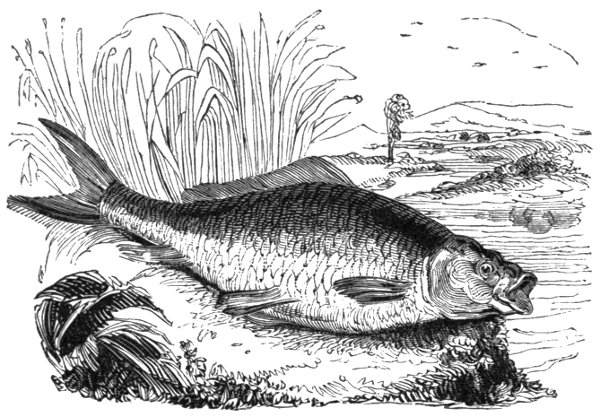
Carp, s. A pond and river fish, very abundant in Great Britain.
The carp is the queen of rivers; a stately, a good and a very subtle fish; that was not at first bred, nor hath been long in England, but is now naturalised. It is said, they were brought hither by one Mr. Mascal, a gentleman that then lived at Plumsted in Sussex, a county that abounds more with fish than any in this nation.
Carps and loaches are observed to breed several months in one year, which pikes and most other fish do not. And this is partly proved by tame and wild rabbits: and also by some ducks which will lay eggs nine of the twelve months; and yet there be other ducks that lay not longer than about one month. And it is the rather to be believed, because you shall scarce or never take a male carp without a melt, or a female without a roe or spawn, and for the most part very much, and especially all the summer season. And it is observed, that they breed more naturally in ponds than in running waters, if they breed there at all; and that those that live in rivers are taken by men of the best palates to be much the better meat.
I told you that Sir Francis Bacon thinks that the carp lives but ten years: but Janus Dubravius has writ a book Of Fish and Fish Ponds, in which he says, that carps begin to spawn at the age of three years, and continue to do so till thirty: he says also, that in the time of their breeding, which is in summer, when the sun hath warmed both the earth and water, and so apted them also for generation, that then three or four male carps will follow a female; and that then, she putting on a seeming coyness, they force her through weeds and flags, where she lets fall her eggs or spawn, which sticks fast to the weeds; and then they let fall their melt upon it, and so it becomes in a short time to be a living fish: and, as I told you, it is thought that the carp does this several months in the year.—Walton.
Carrier, s. One who carries something; a species of pigeons.
Carrion, s. The carcass of something not proper for food; flesh corrupted. Relating to carcasses.
Carrion Crow, (Corvus corone, Linn.; Le Corneille, Buff.) s.
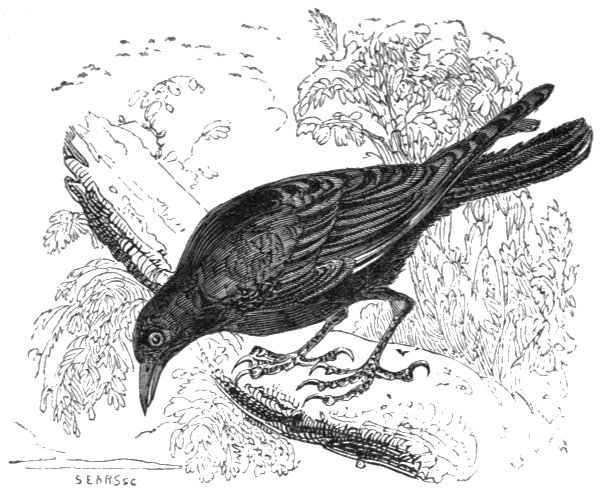
THE CARRION CROW.
The carrion crow is less than the raven, but similar to it in its habits, colour, and external appearance. It is about eighteen inches in length; its breadth about three feet. Birds of this kind are more numerous and as widely spread as the raven. They live mostly in woods, and build their nests on trees. The female lays five or six eggs, much like those of a raven. They feed on putrid flesh of all sorts; likewise on eggs, worms, insects, and various sorts of grain. They live together in pairs, and remain in England during the whole year.—Bewick.
Carrot, s. A garden root.
The varieties of food, as I have termed them, are such articles as, by their saccharine matter, prove highly nutritious, although their gluten is in small proportion. Carrots stand foremost on this list, and hardly too much can be said on their excellent qualities. They appear particularly favourable to condition, as the skin and hair always look well under their use: they are highly nutritious, as we know from the fat accumulated when they are used; and so favourable are they to the free exercise of the lungs, that horses have been found even to hunt on them: and, in conjunction with a certain portion of corn, perhaps they would form as good a food as could be devised for our coach and machine horses, our hackneys, and, in fact, for all horses not used on “fast work.” In the Museum Rusticum is an account of two hunters fed with carrots and small loaves made of barley and oatmeal mixed; and these horses were said to be the pride of the field. Agricultural horses may be supported on them wholly, when sliced and mixed with chaff.
Cart, s. A wheel-carriage, used commonly for luggage.
Cart-horse, s. A coarse unwieldy horse.
Cartilage, s. A smooth and solid body, softer than a bone, but harder than a ligament.
Cartouch, s. A case of wood, three inches thick at the bottom, holding balls. It is fired out of a small mortar.
Cartridge, s. A case of paper or parchment filled with gunpowder, used for the greater expedition in charging guns.
Cascarilla, s. A tonic bark. Dose from one to three drachms.
Case, s. Condition with regard to outward circumstances; in physic, state of the body; condition with regard to leanness or health.
Case, v. To put in a case or cover; to cover as a case; to strip off the covering; to unskin.
Caseworm, s. A grub that makes itself a case.
Cassia, s. A sweet spice.
Cassino, s. A game at cards.
Cassino is generally played by four persons, but occasionally by three or two; the points consist of eleven, and the lurch is six.
The points are thus calculated:—
That party which obtains the great cassino, or ten of diamonds, reckons 2 points.
Ditto little cassino (the deuce of spades) 1
The four aces one point each 4
The majority in spades 1
The majority in cards 3
A sweep before the end of the game, when any player can match all on the board, reckons 1
In some deals at this game, it may so happen that neither party wins any thing, as the points are not set up according to the tricks, &c., obtained, but the smaller number is constantly subtracted from the larger, both in cards and points, and if they both prove equal, the game commences again, and the deal goes on in rotation; when three persons play at this game, the two lowest add their points together and subtract from the highest; but when their two numbers together amount to or exceed the highest, then neither party scores.
LAWS.
The deal and partners are determined by cutting, as at whist. The dealer gives four cards, by one at a time, to every player, and either regularly, as he deals, or by one, two, three, or four at a time, lays four, face upwards, on the board, and after the first cards are played, four others are to be dealt to each person till the pack is out; but it is only in the first deal that any cards are to be turned up.
The deal is not lost when a card is faced by the dealer, unless in the first round, before any of the four cards are turned up on the table: but should a card be faced in the pack before any of the said four are turned up, then the deal must be begun again.
Any person playing with less than four cards must abide by the loss, and should a card be found under the table, the player whose number is deficient is to take the same.
Each person plays one card at a time, with which he may not only take, at once, every card of the same denomination on the table, but likewise all that will combine therewith; as, for instance, a ten takes not only every ten, but also nine and ace, eight and deuce, seven and three, six and four, or two fives; and if he clear the board before the conclusion of the game, he scores a point. When a player cannot pair or combine, he is to put down a card.
The number of tricks are not to be examined or counted before all the cards are played, nor may any trick but that last won be looked at, as every mistake must be challenged immediately.
After the pack is dealt out, the player who obtains the last trick sweeps all the cards remaining unmatched on the table.
RULES.
The principal objects are to remember what has been played; and when no pairs or combinations can be made, to clear the hand of court cards, which cannot be combined, and are only of service in pairing or in gaining the final sweep: but should no court cards be left, it is best to play any small ones, except aces, as thereby combinations are often prevented.
In making pairs and combinations a preference should generally be given to spades, as obtaining a majority of them may save the game.
When three aces are out, take the first opportunity to play the fourth, as it then cannot pair; but when there is another ace remaining, it is better even to play the little cassino, that can only make one point, than to risk the ace, which may be paired by the opponent, and make a difference of two points; and if great cassino and an ace be on the board, prefer the ace, as it may be paired or combined, but great cassino can only be paired.
Do not neglect sweeping the board when an opportunity offers; always prefer taking up the card laid down by the opponent, and as many as possible with one card; endeavour likewise to win the last cards or final sweep.
While great or little cassino is in, avoid playing either a ten or a deuce.
When you hold a pair, lay down one of them, unless when there is a similar card on the table, and the fourth not yet out.
Attend to the adversaries’ score, and, if possible, prevent them from saving their lurch, even though you otherwise seemingly get less yourself, particularly if you can hinder them from clearing the board.
At the commencement of a game, combine all the cards possible, for that is more difficult than pairing; but when combination cannot be made, do not omit to pair, and also carefully avoid losing opportunities of making tricks.—Hoyle.
Cast, v. To admit of a form by casting or melting; to warp, to grow out of form; to direct the hunting of a dog.
When hounds are at fault, staring about and trusting to their eyes and ears, a forward cast is the least likely to regain the scent; the place where they left is the most probable spot for them to hit the scent, and hounds knowing where they left the scent, will there try to recover it, nor is a wide cast often to be made without good reason; the scent should be tried to be retrieved by crossing the line of it, and a huntsman, by attending to this, will not fail to make a good cast, if he observes the point of the fox. When hounds cannot hit off a fault by themselves, the first cast should be speedy; the scent is then good, and hounds not likely to go over it. Every huntsman should adopt these rules; with a good scent his cast should be quick, with a bad scent, slow, and when hounds are picking along a cold scent, he is not to cast them at all.
Hounds that are all well taught will cast forward to a hedge of their own accord. Time ought always to be allowed them to make their own cast; it is impertinence in a huntsman to prevent them, and prudence should induce him to humour his hounds in the cast they seem inclined to make, and either to stand still, or trot round with them, as circumstances may point out. Different countries require different casts; in an open country, wide casts are always necessary; in casting round a flock of sheep, the whipper-in ought to drive them the other way, lest they keep running on before the hounds; in every cast a huntsman should make it perfect one way, before he tries another.—Daniel.
Cast, s. The act of casting or throwing; a throw; state of any thing cast or thrown; the throw of dice; chance from the cast of dice; a mould, a form; a shade, or tendency to any colour; manner, air, mien; a flight of hawks.
Caster, s. A thrower, he that casts.
Castile Soap, s. A kind of soap.
Casting-net, s. A net to be thrown into the water by hand.
The casting-net may be successfully employed in a certain depth of water, viz. gudgeon net at four, and large meshed casting net from six to eight feet: in the making great attention must be paid to putting in the widenings, or the net will never open freely, however skilful the person that throws it. In preparing it for casting, it must not be taken upon the shoulder so short as to prevent the leads having their proper swing, which is to be aided by the corresponding turn of the caster’s body, at the exact moment of delivering it from his arm; and the first object is, to let the leads all break the surface at once. Many persons jerk one part of the net high in the air (which assists the spreading), whilst the other part of the lead line drops close to the caster’s foot, making a variation of some seconds in the fall of the different leads into the water: fish must be very crowded, or extremely sleepy, if they remain within the curtailed range and slow sinking of a net so cast. The nicety of the art is, to be able to cover any particular spot, and to shape the net accordingly; and no one can be deemed a proficient, unless he is an ambidexter, and throws from either shoulder, as the turning and holes in a river may require.
For carp or large fish, the mesh should be an inch and three quarters, and the circumference of the lead line not less than twenty-four yards, and from that to twenty-eight; if made of silk, it will sink more speedily, and of course will admit to be thrown with success in deeper water and more weeds. By baiting a place in ponds with grains, worms, or graves, the fish may be collected, and the casting-net thrown over them: should there be much mud, let the net remain quiet some minutes, and the fish will rise from the mud, into which they may have sunk themselves at the noise of the net.
N.B.—A piece of crumb of bread put into the stomach of either carp or tench suspected to be tainted with the mud, will absorb all the disagreeable taste, and should be taken out before they are sent to table.
Castle, s. Vide Chess.
Castor Oil, s. Oil made from the beaver.
A useful laxative in cases where it is necessary to open the bowels, and at the same time avoid irritation: it is therefore extremely proper in fevers accompanied with costiveness, particularly when there appears to be pain and irritation in the bowels, and may be given with four or six ounces of Epsom salts.
The dose is from half a pint to a pint, or a pint and half.—White.
Castrate, v. To geld.
Castration is performed in various ways, but in all it expresses the removal of the testicles: there are methods of rendering the animal impotent without the actual ablation of these organs; for if by any other method the secretion of the spermatic glands is prevented, from which the uncontrollable sexual excitements arise, the end is answered.
Castration by cauterization is the method which has been principally practised among us; and as it is that taught at our alma mater, we may naturally suppose it has proved worthy of the patronage it has received. It is that I always practised, and was successful with it. But this by no means proves it the best; although good it must be, since I never had an untoward case in it; and the more, as, when I was called on to perform it, it was usually on adult horses, mostly on aged ones. Other plans may be still better: it is my duty, assuming as I do, to be a teacher, to bring them forward to view, that they may be compared together. A preliminary observation should be made previously to castrating, to see that the horse has no hernia or rupture: such cases have happened; and as in our method we open a direct communication with the abdomen, when the horse rises it is not improbable that his bowels protrude until they trail on the floor.
If a colt cannot be enticed with oats, &c., he must be driven into a corner between two steady horses, where, if a halter cannot be put on, at least a running hempen noose can be got round his neck; but, whichever is used, it should be flat, or the struggles, which are often long and violent, may bruise the neck, and produce abscess or poll evil. When his exertions have tired him, he may be then led to the operating spot: here his attention should be engaged while the hobbles are put on, if possible; if not, a long and strong cart-rope, having its middle portion formed into a noose sufficiently large to take in the head and neck, is to be slipped on, with the knotted part applied to the counter or breast, and the long pendent ends passed backwards between the fore legs, and, as expressed by Mr. Percivall, ‘extended obliquely backward, carried round the hind fetlocks within the hollows of the heels, brought forward again on the outside, passed under the collar rope, and a second time carried backwards over the outside of all, and extended to its full length in a direct line behind the animal.’ Thus fettered, Mr. Percivall says his hind feet may be drawn under him towards the elbows; I have, however, often found that, at the moment the rope touches the heels, the colt either kicks and displaces the rope, or altogether displaces himself; but his attention can generally be engaged by one fore leg being held up, or by having his ear or muzzle rubbed, or even by the twitch: if not, the rope may be carried actually around each fetlock, which then becomes a hobble; and this rope may be gradually tightened: in this way I have succeeded with very refractory colts; but it requires very able assistants, and, if possible, the man who has been used to the individual colt should be present. In either way, as soon as the rope is fixed, with a man to each end of it, behind the colt, let them, by a sudden and forcible effort in concert, approximate his hind legs to his fore, and thus throw him. Before the colt is cast, however, it should be endeavoured to ascertain that he is free from hernia: with an adult horse this is even more necessary.
Being satisfied that no hernia exists on either side, proceed to cast the horse, turning him, not directly on the left side, but principally inclining that way; and if possible let the croup be very slightly elevated: it is usual to place him directly flat on the left side, but I have found the above rather more convenient. Every requisite being at hand, and as Hurtrel d’Arboval, with his usual minuteness, observes, the operator, having his scalpel between his teeth, should place himself behind the horse, as the most convenient way to perform his manipulations, and firmly grasping the left testicle with his left hand, and drawing it out so as to render the scrotum tense, he should make an incision lengthways of the bag, from its anterior to its posterior part, or, as expressed by Hurtrel d’Arboval, in the direction of the grand axis of the organ. The incision may be carried at once through the integuments, the thin dartos expansion, and the vaginal coat of the testicles, by the dexterous operator, with a sweep of the scalpel: but with one less au fait at the operation, it will be more prudent to make the first incision through the scrotum and dartos only, to the required extent, and then to do the same by the vaginal coat, thus avoiding to wound the testicle, which would produce violent resistance, and give unnecessary pain. The testicle, if the opening be sufficiently large, will now slip out; but the operator must be prepared, at the moment of so doing, to expect some violent strugglings, more particularly if he attempts to restrain the contractions of the cremaster, and by main force to draw out the testicle. Preparatory to this, therefore, the twitch should be tightened; the attendants, especially the man at the head, must be on the alert, and the testicle itself, at the time of this violent retraction of the cremaster, should be merely held, but not dragged in opposition to the contraction, otherwise peritonitis itself might be the result from any such violence. If the clams have been put on over the whole, according to Mr. Percivall’s method, they will assist in retaining the retracting parts; but I must again offer a caution, that they be not used with too much pressure. The resistance having subsided, provided the clams have been thus employed, they must now be removed; or, if they have not been previously in use, they must now be taken in hand, and, being wadded with tow, should be placed loosely on the cord, while time is given to free the vas deferens, or spermatic tube, which is seen continued from the epididymis, from the grip of the pincers. The Russians, Mr. Goodwin informs us, cut it through when they operate. Hurtrel d’Arboval does not note it in the French practice; but humanity is much concerned in its removal from pressure, from the excess of pain felt when it is included. It is also necessary, before the final fixing of the clams, to determine on the part where the division of the cord is to take place. To use Mr. Percivall’s words, “If it be left too long, it is apt to hang out of the wound afterwards, and retard the process of union;” indeed, I have known the end of it swell into a fungous excrescence, which greatly embarrassed the practitioner to destroy: on the other hand, if it be cut very short, and the arteries happen to bleed afresh after it has been relieved from the clams, the operator will find it no easy task to recover it from the retraction of the cremaster. The natural length of the cord, which will mainly depend on the degree of the descent of the gland, will be our best guide in this particular. The place of section determined on and marked, close the clams sufficiently tight to retain firm hold of the cord, and to effectually stop the circulation within it. There are now two modes of making the division; the one is to sever it with a scalpel, and then to sufficiently sear the end of it so as to prevent a flow of blood, avoiding, however, to burn it to a cinder, as is sometimes done. The other, and in some respects the preferable method, is to employ an edged firing-iron, which is to divide it by little crucial sawings, so that, when the cord is separated, it shall not present a uniform divided surface, but ragged edges, which will more perfectly destroy the mouths of the vessels, and tend to lessen the chances of hæmorrhage. This done, loosen the clams sufficiently to observe whether there be any flow of blood; gently wipe the end of the cord also with the finger, as sometimes an accidental small plug gets within the vessel, which afterwards is forced out, and therefore had better be removed by this means and at this time. Retain a hold on the clams a few minutes longer; and while loosening them gradually, observing to have an iron in readiness again to touch the end of the cord, if any blood makes its appearance. Satisfied on this point, sponge the part with cold water, but by no means dash it over them, as has been done; neither is any external application necessary, still less any resin seared on the end of the cord, which can only irritate, and will never adhere. On the after-treatment much difference of opinion has existed, and even yet exists. The powerful evidence of accumulated facts has now convinced veterinarians of both the necessity and propriety of some motion for the newly-castrated horse as a preventive of local congestion; such practice is common in most countries but our own, and seems salutary in all. Hurtrel d’Arboval, thus impressed, recommends the horse, immediately after the operation, to be led out to walk for an hour, and it is a general plan in France to walk such horses in hand an hour night and morning. Mr. Goodwin, in proof of its not being hurtful, informs us, that whole studs of horses brought to St. Petersburgh to be operated on, are immediately travelled back a certain portion of the distance, night and morning, until they arrive at home. I have, therefore, no hesitation in recommending a moderate degree of motion in preference to absolute rest, as practised among us: it is a plan which has long been followed with success among our own cutters; and perhaps our not adopting it before has arisen from prejudice against whatever was practised by illiterate persons, without reflecting that, illiterate as they are, their employers are not all so; and that, unless success attended their practices, they would cease to be employed.
For the French mode, twitching, &c., vide Goodwin, Blaine, &c.
When a colt is to be gelded.—In the first or second week in June he should be cut; and when recovered he should be turned out for the summer.
“I would not operate,” says Mr. Percivall, “during the season of changing the coat, nor even just prior to that period, from fear of interrupting the process, or checking it altogether; neither would I choose frosty or sultry weather: but, above all, it is advisable to suspend the operation when the flies abound. If the subject have passed the colt period of age, I would recommend a dose of aperient medicine before the operation be undertaken, unless he should be already living on green food.”
Each testicle should be taken out of the scrotum separately, by an opening sufficiently large, when a ligature should be applied, moderately tight only, around the spermatic chord, about an inch and a half beyond its insertion into the testicle; the separation should then be effected by the scalpel or knife, between the ligature and testis. It is sometimes performed without the ligature, by making the division of the chord with a red-hot knife, but the other is the neatest and safest mode.
The castration of cats is sometimes practised to keep them from roving, or to increase their size. For this purpose nothing more is requisite than to make a slight opening on each side the scrotum, to slip out the two testicles, and draw them away with the fingers. The rupture alone of the spermatic chord prevents hæmorrhage in them, and no future inconvenience is felt. It is often found difficult to secure a cat for this operation; but it may be easily managed in two ways:—one by putting the head and fore-quarters of the animal into a boot; the other by rolling his whole body lengthways in several yards of towelling; but the former is the most secure and simple, for no animal is more intractable, as a surgical patient, than grimalkin: though to administer medicines to a pig beats the cat hollow, as an obstreperous operation.—Blaine—Nimrod—Percivall.
Castration, s. The act of gelding.
Casteril, or Castrel, s. A mean or degenerate kind of hawk.
Cat, s. A domestic animal that catches mice.
The cat is a faithless domestic; though gentle and frolicsome when young, they even then possess an innate cunning, and perverse disposition, which age increases, and education only serves to conceal.
The form and temperament of the cat’s body perfectly correspond with his disposition; he is handsome, light, adroit, cleanly, and voluptuous; he loves ease, and searches out the softest places for rest and repose. The cat is very amorous. The passion of the female continues nine or ten days, and commonly happens only twice a year, in the spring and autumn, but sometimes three and even four times. They go with young 55 or 56 days, and they usually have from four to six at a litter. As the males are apt to devour their progeny, the females commonly conceal themselves when they litter, and if suspicious of a discovery, they carry their young ones away in their mouths and hide them in holes or inaccessible places. After suckling them a few weeks, the old one takes them mice or small birds, to accustom them to eat flesh; but by an unaccountable caprice, these very mothers so tender and careful, become sometimes so cruel and unnatural, as to devour their offspring themselves.
Cats are without docility, and their scent, which, in the dog is so eminent a quality, is very indifferent, and therefore they hunt by the eye only; neither do they properly pursue, but rather lie in wait and attack the animals by surprise; and after having played with, and tormented them a long time, they kill them without any necessity, even when well fed, and in no want of prey to satisfy their appetites.
The most immediate physical cause of their inclination to seize other animals by surprise, comes from the advantage they receive from the particular formation of their eyes. The pupil in man, and many other animals, is capable of a certain degree of contraction and dilation; it enlarges a little when the light is faint, and contracts when it becomes too strong; in cats and nocturnal birds, as owls, &c., this contraction and dilation is so considerable that the pupil, which in the dark is large and round, becomes in the day long and narrow like a line; and therefore these animals see better in the night than in the day. There is a perpetual contraction in the eye of the cat during the day, and it is only by a great effort that he can see in a strong light, whereas, in the twilight, the pupil resumes its natural form; he sees perfectly, and profits from this superiority to know, attack, and surprise his prey.
Cats have less attachment to persons than to houses. When taken to the distance of a league or two they will return to their former abode of their own accord. They fear water, cold, and bad smells; they love to be in the sun, and to lie in warm places; they are very fond of perfumes, and willingly allow themselves to be taken and caressed by those who make use of them. They do not come to their full growth in less than fifteen or eighteen months, but they are capable of engendering before the end of the first year, and they can procreate all their lives, which seldom exceeds eight or nine years; they are notwithstanding, very lively and hardy, and more nervous than most other animals which live longer.
The wild cat couples with the domestic one, and they consequently form but one species. It is not uncommon for both males and females to quit their houses, when they are proud to go into the woods to seek wild cats, and afterwards return to their former habitations; it is for this reason that some of our domestic cats so entirely resemble the wild ones. The greatest difference between them is internally, the intestines of the domestic cat being longer than those of the wild cat, although the latter is much the largest and strongest; his lips are also always black, his ears more stiff, his tail larger, and his colour more uniform.
In general cats are not, like dogs, subject to degenerate when transported into warm climates. Their nature is indeed more constant, and as their domestic state is neither so entire, universal, nor perhaps so ancient as that of the dog, it is not surprising that they should have undergone less variation.
Besides this large and ferocious species, the warrens upon the coast suffer much injury from the common cat becoming wild and burrowing in the rabbit-holes. They are sometimes surprised and shot in the sand-banks, or taken in traps; but they are generally too wary to be approached—and hunting only by night, during the day they sleep in their dens, and are rarely met abroad.
Some estimate of their numbers may be formed, from the circumstance of five males having been killed in a herdsman’s outhouse which joined the warren. They had been attracted there by one of their own species, and the noise having alarmed the peasant, he guessed the cause, and cautiously managed to stop the hole by which they gained entrance, with a turf-cleave. Knowing the value of the capture, he kept guard upon the prisoners till morning, and then despatched information to the Lodge. My cousin, with his followers, promptly repaired to the place, and surrounding the barn with guns and greyhounds, bolted the wild cats successively, until the whole number were despatched. This chassé was not only novel, but profitable. After the death of their persecutors, the rabbits increased prodigiously; but fears are entertained that these destructive animals are become once more abundant in the sand-banks.
Cats are said, when they wash their faces, or when they seem sleepy and dull, to foretel rain. The same is said of them when they appear irritable and restless, and play with their tails.—Buffon—Wild Sports—Foster.
Cataplasm, s. A poultice.
Cataract, s. An inspissation of the crystalline humours of the eye; sometimes a pellicle that hinders the sight.
Catarrh, s. A deduction of a sharp serum from the glands about the head and throat.
Caterpillar, s. A worm sustained by leaves and fruits.
Cathartic, s. A medicine to purge downwards.
Cathartics are a most important class of medicines, and of all cathartics Barbadoes aloes is the best. Cathartics improve digestion and chylification, by cleansing the intestines and unloading the liver, and if the animal is afterwards properly fed, will improve his strength and condition in a remarkable degree. Cathartics are always useful when the appetite and digestion are bad, and this is known by a voracious or depraved appetite, both for food and for water; rumbling of the bowels, and a frequent discharge of wind from the anus. This is the case in a remarkable degree with broken-winded horses, and generally in such as have chronic cough, or are crib-biters. They should not be given too strong or too frequently, as they might thereby weaken instead of strengthening the digestive organs, and produce the effect they were intended to remove. Cathartics should always be made with soap, in the following manner, and then, if given upon an empty stomach, they will be carried off, and will not be dissolved until they get into the large bowels, where their effect is intended to be produced: that is carrying off all the excrementitious matter that may be lodged in them. When given in this way they never produce sickness or pain in the stomach, but always operate without pain or danger.
CATHARTIC BALL.
Barbadoes aloes powdered, from 5 dr. to 1 oz.
Hard soap 3 to 4 dr.
Ginger 1 dr.
Water 1 dr.
Oil of cloves 10 drops.
Beat the soap, oil of cloves, and water together in a mortar, so as to form a paste; if necessary use more water. Add the powdered aloes and ginger, and beat the whole into a ball.—White.
Cattle, s. Beasts of pasture, not wild or domestic.
Cauf, s. A chest with holes, to keep fish alive in the water.
Cavisson, s. A head-stall provided with a nose-band and ring, to which a long cord is attached. The cavisson is used in the earlier stages of horse-breaking.
Caustics, s. Medicaments which, by their violent activity, and heat, destroy the texture of the part to which they are applied.
The most powerful is the actual, or hot iron; but there are many other caustics possessed of great strength, which speedily destroy the parts to which they are applied. If a solid caustic is wanted, nothing is more convenient than the lunar caustic (nitrate of silver). Milder caustics are more frequently used; such as sulphate of copper, red precipitate, (nitric oxide of mercury,) burnt alum, &c.
Strong caustics are employed to destroy unhealthy or diseased parts; and for cleansing foul ulcers, so as to produce a healthy state, and render them curable by more simple applications. Caustics, divided into liquid and solid, are strong and mild. The mild are often called escharotics.
SOLID CAUSTICS, STRONG.
No. 1. The red-hot iron. (See Firing.)
2. Pure potash with lime.
3. Nitrate of silver, or lunar caustic.
4. Nitrate of copper.
MILD CAUSTICS, SOLID.
No. 1. Acetate of copper, or distilled verdigris.
2. Sulphate of copper, or blue vitriol.
3. Red nitrated quicksilver, red precipitate, or nitric oxide of mercury.
4. Burnt alum.
5. Common verdigris.
The mild require to be finely powdered and sprinkled on the ulcer; and are sometimes mixed with digestive ointments to increase their power.
STRONG CAUSTICS, LIQUID.
No. 1. The sulphuric and nitrous acids, which must be used cautiously: they may be diluted with a sufficiency of water, to be applicable to the purpose required.
2. Nitrous acid 1 oz.
Quicksilver ½ oz.
Place them in a large gallipot, or open phial, and avoid the noxious fumes which arise. When the quicksilver is perfectly dissolved, and the mixture cold, it may be put into a phial and corked.
This is a strong and efficacious caustic; a certain remedy for the foot-rot in sheep, and effectual in canker of the horse’s foot, provided these complaints are properly managed in other respects. It is formed with melted hog’s lard into a strong detergent ointment, or diluted with water.
No. 3. Nitrous acid 1 oz.
Verdigris ½ oz.—Mix.
This caustic is similar to the former, and applicable to the same purposes.
No. 4. Muriate of antimony, or butter of antimony.
5. Muriate of quicksilver, or sublimate 1 dr.
Muriatic acid 2 dr.
This is a very powerful caustic, and always requires dilution. Yellow arsenic mixed with lime and grease, or hog’s lard, is sometimes used as a caustic to destroy warts, or cure fistula or poll-evil.
MILD CAUSTICS, LIQUID.
No. 1. Solution of blue vitriol.
2. Any of the stronger caustics, except butter of antimony, diluted with an equal quantity, or more, of water.
3. Muriatic acid.
4. Muriate of iron.—White.
Cauterize, v. To burn with the cautery.
Cautery, s. Cautery is either actual or potential; the first is burning by a hot iron, and the latter with caustic medicines.
Caw, v. To cry as the rook or crow.
Cellular, a. Consisting of little cells or cavities.
Cement, s. The matter with which two bodies are made to cohere.
Cerate, s. A plaster made of wax.
Cere, s. (Cera, Linn.) A term in ornithology for the naked skin which covers the base of the bill, as in the hawk kind.
Cerecloth, s. Cloth smeared over with glutinous matter.
Certificate for killing Game, s. The legal authority prescribed by act of parliament.
Penalty for shooting without, 20l.
To be taken out annually, in the parish or place where your assessed taxes are paid—costs, 3l. 13s. 6d., and one shilling fee to the collector.
Does not authorise unqualified persons to kill game, but exempts them from the penalty of 20l., and leaves them subject to that of 5l. for non-qualification, and also to that of 5l. a piece for every head of game found in their possession.
For menial servants, hired as gamekeepers, costs, 1l. 5s., and a shilling fee to the collector.
Persons, not menial servants, must have a three and a half guinea certificate, and should have, also, the common gamekeeper’s certificate, to hold a deputation.
When demanded by any assessor, collector, land owner, commissioner, inspector, surveyor, occupier of land, also gamekeeper, or other person, provided the two latter produce their certificates, previously to requiring yours, penalty for refusing, 20l. If you have not your certificate to produce, your name, and place of abode, may be asked. All certificates expire on the 5th of April in each year.
If you have not a certificate to produce at the time it is called for, your Christian and surnames, and place of abode, may be demanded by any assessor, &c. &c., (as before mentioned) and the penalty for refusing them, or giving a false name, is 20l.
Cerulean, a. Blue, sky-coloured.
Chad, s. A sort of fish.
Chaffinch, s. A bird so called, because it delights in chaff.
This bird is rather less than the sparrow. The bill is bluish; irides hazel; the forehead black; crown of the head, back part, and sides of the neck, bluish ash-colour; the cheeks, under side of the neck, and breast, dull pink; back, chestnut-brown; rump greenish; belly, white, tinged with pink; the bastard wing and coverts of the primary quills are black; those of the secondary tipped with white; the smaller coverts black and greyish, on which is a spot of white; the quill-feathers dusky, slightly edged with greenish yellow on the outer webs, marked with white on both webs at the base; tail dusky; the exterior feather is obliquely marked with white, taking in the whole of the outer web, the next is tipped with white; legs dusky.
The female is of a dull green above; the breast and belly of a brown or dirty white; the wings have the same markings as the male, but less brilliant.
This bird makes a most elegant nest of green moss, curiously studded with lichen, interwoven with wool, and lined with feathers and hair. It builds against the side of a tree, particularly in ivy, or in some forked branch of a bush; but particularly in apple trees overgrown with moss and lichen, and, like many other birds, adapts the materials of its nest to the surrounding colour; an instinct of no small importance.—Bewick.
Chain, s. A series of links fastened one within another; a bond, a manacle; a fetter.
Chaise, s. A carriage either of pleasure or expedition.
Chaldron, or Chaudron, s. A dry English measure of coals, consisting of thirty-six bushels heaped up. The chaldron should weigh two thousand pounds.
Chalk, s. A white fossil, usually reckoned a stone, but by some ranked among the boles.
Chalybeate, a. Impregnated with iron or steel.
Chambel of a Horse, s. The joint or bending of the upper part of the hind leg.
Chamois, s. An animal of the goat kind, the skin of which made into leather is called Shammy.
The chamois is a little larger than a goat, but much superior in power and agility; the strongest man could not hold one of a month old; they bound from precipice to precipice to a prodigious distance, gaining the loftiest summits, and precipitating themselves from the steepest rocks without fear. The chase of this animal occupies a great part of the mountainous population, and many perish annually in the hazardous pursuit.
Often the hunter, overtaken by a dark mist, loses himself amongst the ice, and dies of cold and hunger; or the rain renders the rocks so slippery, that he is not able to reascend them. In the midst of eternal snows, braving all dangers, they follow the chamois frequently by the marks of their feet; when one is perceived at a distance, the hunter creeps along till within reach of his gun, which he rests on a rock, and is almost always sure of his prey: thus the innocent beast, which tranquilly feeds, perhaps enjoys the last moments of its happy existence. But if his watchful eye perceives the enemy, as is often the case, he flies from rock to rock, “timor addidit alas,” and the fatigues of the pursuer begin, who traverses the snows, and climbs the precipices, heedless of how he is to return. Night arrives, yet the hopes of the morrow reassure him, and he passes it under a rock. There, without fire, without light, he draws from his wallet a little cheese and oaten bread, which he is obliged to break with a stone, or with the hatchet he carries to cut his path in the ice. This repast finished, he falls asleep on his bed of snow, considering what route the chamois has probably taken. At break of day he awakens, insensible to the charms of a beautiful morning, to the glittering rays which silver the snowy summits of the mountains around him, and, thinking only of his prey, seeks fresh dangers. Thus they frequently remain many days in these horrible deserts, while their wives and families scarcely dare to sleep, lest they should behold the spirits of their dead husbands; for it is believed that a chasseur, after his death, always appears to the person who is most dear to him, to make known where lie his mangled remains, to beg the rites of burial.
Champ, v. To bite with a frequent action of the teeth; to devour.
Chance, s. Fortune, the cause of fortuitous events; the act of fortune; accident; possibility of any occurrence.
Chap, s. The upper or under part of a beast’s mouth.
Char, s. A fish found chiefly in Winandermeer in Lancashire.
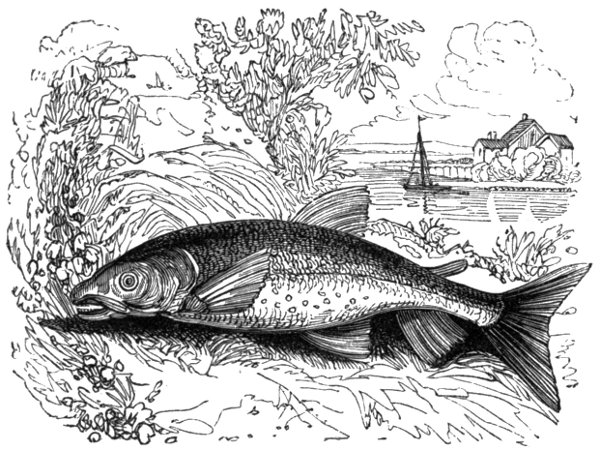
The char is a most beautiful and excellent fish, and is a fish of prey. They generally haunt deep cool lakes, and are seldom found at the surface till late in autumn. When they are at the surface, however, they will take either fly or minnow. I have known some caught in both these ways, and have myself taken a char, even in summer, in one of those beautiful, small, deep lakes in the Upper Tyrol, near Nazereet; but it was where a cool stream entered from the mountains, and the fish did not rise, but swallowed the artificial fly under water. The char is always, in its colour, a very brilliant fish, but in different countries there are many varieties in the tint. I do not remember ever to have seen more beautiful fish than those of Aussee, which, when in perfect season, have the lower fins and the belly of the brightest vermilion, with a white line on the outside of the pectoral, ventral, anal, and lower part of the caudal fin, and with vermilion spots, surrounded by the bright olive shade of the sides and back. The dorsal fin in the char has eleven spines, the pectoral fourteen, the ventral nine, the anal ten, and the caudal twenty. I have fished for them in many lakes, without success, both in England and Scotland, and also amongst the Alps; and I am told the only sure way of taking them is by sinking a line with a bullet and a hook having a live minnow attached to it, in the deep water which they usually haunt.—Davy.
Char, v. To burn wood to a black cinder.
Charadrius (Linn.) s. Plover, a genus thus characterised:
Bill shorter than the head, slender, straight, compressed, nasal furrow prolonged more than two-thirds; mandibles bulged towards the tip. Nostrils at the base, jagged, slit lengthwise in the middle of a large membrane, which covers the fosse. Legs long or of middle length, slender, three toes directed forwards; the outer toe joined to the middle one by a short membrane; the inner toe separate. Tail slightly rounded or square. Wings of middle size, the first quill a little shorter than the second, which is the longest in the wing.—Montagu.
Charcoal, s. Coal made by burning wood. Charcoal poultices are sometimes used to remove the fetid smell arising from greased heels.
Charge, v. To accuse; to command; to fall upon, to attack; to load a gun.
Charge, s. Care, trust, custody; command, commission; imputation; expense; onset; the quantity of powder and ball put into a gun; a preparation, or a sort of ointment applied to the shoulder-splaits and sprains of horses.
Charges are plasters applied to the legs to remove windgalls and lameness, previous to turning the horse out. Those in common use, are—
1. Yellow rosin 2 oz.
Burgundy pitch 4 oz.
Barbadoes tar 2 oz.
Bees-wax 3 oz.
Red lead 4 oz.
2. Yellow rosin 1 lb.
Bees-wax 8 oz.
Common turpentine 2 oz.
Armenian bole, powdered 4 oz.—Mix.
The first three are to be melted together, and then the latter is to be added. The mixture is to be constantly stirred until sufficiently cold to be applied; and if it prove too thick when cold, it may be softened with a little oil or lard.
Charger, s. an officer’s horse.
Chariot, s. A carriage of pleasure, or state.
Charmer, s. One that has the power of charms, or enchantments.
The Charmer.—That individuals have exercised a powerful and unaccountable influence on the most unmanageable animals, by means which still remain a mystery, is certain. The most remarkable case on record, is that of an Irish blacksmith, who, by an undiscovered agency, could subdue the most vicious horses. He asserted, that this was effected by merely whispering in the animal’s ear some potent spell, and hence he gained the title of the charmer. This power over the most desperate horses was so often put to the test, that all doubt is idle. He never refused to enter the stable of horses that to all besides were unapproachable, and after a short tête-à-tête, the animal would be found trembling and subdued, and while every limb appeared convulsed with terror the charmer would pass under his belly, lift his feet, or do any thing he was required. In his repeated experiments upon the most savage horses, the charmer never received any injury, or failed in subduing the animal.
Many attempts have been made to account for the means by which this influence was obtained. The general belief was, that some powerful drug was passed by the exorciser into the horse’s ear; but by what means was he enabled to approach sufficiently close to a furious brute to administer it?
It is singular that though the charmer was a miserable and poverty-stricken wretch, no bribe could induce him to communicate the charm—if it was one—and though immense sums of money were offered, he carried the secret with him to the grave!
Chase, v. To hunt, to pursue; to drive.
Chase, s. Hunting, pursuit of anything as game; fitness to be hunted; pursuit of something as desirable; hunting match; the game hunted; open ground stored with such beasts as are hunted; the chase of a gun, is the whole bore or length of a piece.
Chaser, s. Hunter, pursuer, driver.
Check, s. Restraint, curb; in falconry, when a hawk forsakes the proper game to follow other birds; the cause of restraint; a stop.
When hounds divide and are in two parts, the whipper-in must wait for the huntsman’s halloo before he stops either. If there are many scents, and it is quite uncertain which is the hunted fox, he should stop those hounds that are the farthest down the wind, as they can hear the others, and will reach them soonest.
When hounds are at a check, every one should be silent, and stand still, the huntsman had better let the hounds alone, or content himself with holding them forward, without taking them off their noses.
If hounds come to a check on a high road, by the fox being headed, in trying back they have the best chance of hitting off the scent again, as they may try on both sides at once.—Beckford.—Daniel.
Checkmate, s. The movement on the chess-board, that puts an end to the game.
Cheek, s. The side of the face below the eye; a general name among mechanics for almost all those pieces of their machines that are double.
Cherup, v. To chirp, to use a cheerful voice.
Chess, s. A nice and intricate game, in imitation of a battle between two armies.
RULES FOR CHESS.
1. Move your pawns before your pieces, and afterwards bring out the pieces to support them; therefore the king’s, queen’s and bishops’ pawns should be the first played, in order to open the game well.
2. Do not, therefore, play out any of your pieces early in the game, because you thereby lose moves, in case your adversary can, by playing a pawn, make them retire, and he also opens his game at the same time: especially avoid playing your queen out, till your game is tolerably well opened.
3. Avoid giving useless checks, and never give any unless to gain some advantage, because you may lose the move, if the adversary can either take or drive your piece away.
4. Never crowd your game by having too many pieces together, so as to prevent your men advancing or retreating as occasion may require.
5. If your game should be crowded, endeavour to free it by exchanges of pieces or pawns, and castle your king as soon as convenient; afterwards bring out your pieces, and attack the adversary where weakest.
6. When the adversary plays out his pieces before his pawns, attack them as soon as you can with your pawns, by which you may crowd his game and make him lose moves.
7. Never attack the adversary’s king without a sufficient force; and if he attack yours, and you cannot retaliate, offer exchanges; and should he retire, when you present a piece to exchange, he may lose a move. It also may sometimes be expedient to act in this manner in case of other attacks.
8. Play your men in guard of one another, so that if any be taken, the enemy may also be captured by that which guarded yours, and endeavour to have as many guards to your piece, as your adversary advances others upon it; and, if possible, let them be of less value than those he assails with. When you cannot well support your piece, see if by attacking one of his that is better, or as good, you may not thereby save yours.
9. Never attack but when well prepared, for thereby you open your adversary’s game, and prepare him to pour in a strong attack upon you, as soon as your weaker one is over.
10. Never play till you have examined whether you are free from danger by your adversary’s last move; nor offer to attack till you have considered what harm he would be able to do you by his next moves, in consequence of yours.
11. When your attack is in a prosperous way, never be diverted from it by taking any piece, or other seeming advantage, your adversary may purposely throw in your way, with the intent that, by your taking the bait, he might gain a move which would make your design miscarry.
12. When, in pursuing a well-laid attack, you find it necessary to force your adversary’s defence, with the loss of some pieces; if, upon counting as many moves forward as you can, you find a prospect of success, sacrifice a piece or two to gain your end: these bold attempts make the finest games.
13. Never let your queen stand so before the king, as that your adversary, by bringing forwards a rook or a bishop, might check your king if she were not there, for you could hardly save her, or perhaps at best must sacrifice her for an inferior piece; as for example: place the white king on 61, the queen on 53; the black king on 4, and the rook, on 16: which last, if moved to 13, must be taken by the white queen, who in return would be taken by the black king, because the white queen could not otherwise be moved without putting the king on check to the black rook.
14. Let not your adversary’s knight fork your king and queen, or king and rook, or queen and rook, or your two rooks, at the same time; for in the two first cases, the king being forced to go out of check, the queen or the rook must be lost; and in the two last a rook must be lost, at best, for a worse piece. Place the white queen on 5, the rook on 7, and a black knight on 37. The latter piece, if moved to 22, will fork both the queen and rook, and consequently one of them must be lost for the knight.
15. Take care that no guarded pawn of your adversary’s fork two of your pieces: knights and rooks are particularly liable to this mode of attack; also guard against either a check by discovery, or a stale-mate.
16. When the kings have castled on different sides of the board, attack with the pawn you have on that side where the adversary has castled, advancing the pieces, especially the queen and rooks to support them; and if the adversary’s king have three pawns on a line in front, he should not stir them till forced to it.
17. Endeavour to have a move in ambuscade; that is, place the queen, bishop, or rook behind a pawn, or a piece, in such a manner, as that, upon playing that pawn, or piece, you discover a check upon your adversary’s king, and consequently may often get a piece, or some other advantage by it. Suppose the black king on 6, a white bishop on 41, and a pawn on 34; by moving the pawn to 26, a check by the white bishop is discovered upon the black king.
18. Never guard an inferior piece or pawn with a better, if you can do it with a pawn, because that better piece may in such a case be, as it were, out of play.
19. A pawn pushed on, and well supported, often costs the adversary a piece; but one separated from the others is seldom of any value. And whenever you have gained a pawn, or other advantage, and are not in danger of losing the move thereby, make as frequent exchanges as you can.
20. If each player have three pawns upon the board, and no piece, and you have a pawn on one side of the board, and the other two on the other side, and your adversary’s 3 are opposite to your 2, march with your king to take his pawns; and if he move to support them, go on to queen with your single pawn; and if he attempt to hinder it, take his pawns, and push yours to queen; that is, to move a pawn into the adversary’s back row, in order to make a queen, when the original is lost.
21. At the latter end of the game, each party having only three or four pawns on different sides of the board, the kings are to endeavour to gain the move, in order to win the game: for example—the white king placed on 54, and the black king on 37, white would gain the move by playing to 53, or black to 38, and in both cases the adverse king would be prevented from advancing.
22. When the adversary has no more than his king and one pawn on the board, and you a king only, you can never lose that game if you bring and keep your king opposite to your adversary’s, when he is immediately either before or on one side of his pawn, and only one house between the kings. This must then either be a drawn game, or if the opponent persist in his endeavours to win, he will lose by a stale-mate, by drawing you upon the last square.
23. When your adversary has one pawn on the rook’s line, with a king and bishop against a king only, and his bishop is not of the colour that commands the corner-house his pawn is going to, if you can get your king into that corner, you cannot lose that game, but may win by a stale-mate.
24. When you have only your queen left in play, and your king happens to be in that position of stale-mate, keep giving check to your adversary’s king, always taking care not to check him where he can interpose any of his pieces that make the stale: by so doing, you will at last force him to take your queen, and then you win the game by being in stale-mate.
25. Never cover a check with a piece that a pawn pushed upon it may take, for fear of only getting that pawn for it: put a black rook on 7, and a pawn on 40; the white king on 63, and a knight on 61: the white king being on a check to the rook, if the check be covered by moving the white knight to 56, the black pawn could then be moved to 48, and take the knight.
26. Do not crowd your adversary’s king with your pieces, lest you inadvertently give a stale-mate.
27. Do not be too much afraid of losing a rook for an inferior piece; though a rook is better than any other, except the queen, yet it seldom comes into play, so as to operate, until the end of the game; and it is generally better to have a worse piece in play than a superior out.
28. When you have moved a piece, which your adversary drives away with a pawn, that is a bad move, your enemy gaining a double advantage. At this nice game no move can be indifferent. Though the first move may not be much, between equally good players, yet the loss of one or two more, after the first, makes the game almost irretrievable: but if you can recover the move, or the attack (for they both go together), you are in a fair way of winning.
29. If ever your game be such, that you have scarce any thing to play, you have either brought out your pieces wrong, or, which is worse, not at all; for if you have brought them out right, you must have variety enough.
30. Do not be much afraid of doubling a pawn: two in a direct line are not disadvantageous when surrounded by three or four others; three together are strong, (as three white pawns on 28, 35 and 37;) but four, (as 44 in addition) that make a square, with the help of other pieces, well managed, form an invincible strength, and probably may produce you a queen: on the contrary, two pawns, with an interval between (as on 35 and 37) are no better than one; and if you should have three over each other in a line (as 26, 34, and 42) your game cannot be in a worse situation.
31. When a piece is so attacked that it is difficult to save it, give it up, and endeavour to annoy your enemy in another place; for it often happens, that whilst your adversary is pursuing a piece, you either get a pawn or two, or such a situation as ends in his destruction.
32. Supposing your queen and another piece are attacked at the same time, and by removing your queen, you must lose the piece, if you can get two pieces in exchange for her, rather do that than retire; for the difference is more than the worth of a queen; besides, you preserve your situation, which is often better than a piece; when the attack and defence are thoroughly formed, if he who plays first be obliged to retire by the person who defends, that generally ends in the loss of the game on the side of him who attacks.
33. Do not aim at exchanges without reason; a good player will take advantage of it, to spoil your situation, and mend his own: but when you are strongest, especially by a piece, and have not an immediate check-mate in view, then every time you exchange, your advantage increases. Again, when you have played a piece, and your adversary opposes one to you, exchange directly, for he wants to remove you: prevent him, and do not lose the move.
34. Every now and then examine your game, and then take your measures accordingly.
35. At the latter end of the game, especially when both queens are off the board, the kings are capital pieces; do not let your king be idle; it is by his means, generally, you must get the move and the victory.
36. As the queen, rooks, and bishops operate at a distance, it is not always necessary in your attack to have them near your adversary’s king; they do better at a distance, cannot be driven away, and prevent a stale-mate.
37. When there is a piece you can take, and that cannot escape, do not hurry; see where you can make a good move elsewhere, and take the piece at leisure.
38. It is not always right to take your adversary’s pawn with your king, for very often it happens to be a safeguard and protection to him. Place a black rook on 5, with a pawn on 45, and the white king on 53, and he will be sheltered by the black pawn from the attack of the rook.
39. When you can take a man with different pieces, consider thoroughly with which you had best take it.
APPLICATION TO SOME OF THE FOREGOING RULES.
1. Whether you play the open or close game, bring out all your pieces into play before you begin the attack; for if you do not and your adversary should, you will always attack, or be attacked, at a great disadvantage; this is so essential, that you had better forego an advantage than deviate from it; and no person can ever play well who does not strictly practise this. In order to bring out your pieces properly, push on your pawns first, and support them with your pieces, by which your game will not be crowded, and all your pieces will be at liberty to play and assist each other, and so co-operate towards obtaining your end; and either in your attack or defence, bring them out so as not to be driven back again.
2. When you have brought out all your pieces, which you will have done well, if you have your choice on which side to castle; then consider thoroughly your own and adversary’s game, and not only resolve where to castle, but likewise to attack where you appear strongest, and your enemy weakest. By this it is probable you will be able to break through your adversary’s game, in which some pieces must be exchanged. Now pause again, and survey both games attentively, and do not let your impetuosity hurry you on too far; at this critical juncture (especially if you still find your adversary very strong) rally your men, and put them in good order for a second or third attack, still keeping them close and connected, so as to be of use to each other. For want of this method, and a little coolness, an almost sure victory is often snatched out of a player’s hands, and a total overthrow ensues.
3. At the last period of the game, observe where your pawns are strongest, best connected, and nearest to queen; likewise mind how your adversary’s pawns are disposed, and compare these things together; and if you can get to queen before him, proceed without hesitation; if not, hurry on with your king to prevent him: I speak now, as supposing all the noblemen are gone; if not, they are to attend your pawns, and likewise to prevent your adversary from going to queen.—Vide Hoyle—Jones, &c.
Chess-board, s. The board or table on which the game of chess is played.
Chess-man, s. A puppet for chess.
Chevaux-de-frise, s. A piece of timber traversed with wooden spikes, pointed with iron, five or six feet long.
Chew, v. To grind with the teeth, to masticate; to meditate, or ruminate in the thoughts; to taste without swallowing.
Chick, Chicken, s. The young of a bird, particularly of a hen, or small bird.
Chine, s. The part of the back in which the back-bone is found; a piece of the back of an animal.
Chirp, s. The voice of birds or insects.
Chop, v. To do any thing with a quick motion; to light or happen upon any thing. To fall upon a scent.
Chough, s. A bird which frequents the rocks by the sea.
This species weighs about fourteen ounces; length near seventeen inches. The bill is longer and more slender than in any of the genus, a little curved, of a deep orange red, much resembling red coral, and is remarkably brittle; irides hazel.
The plumage is wholly black, glossed with purple; legs and feet red; claws black, strong, and much hooked. The female differs in not being so large, and in the bill being shorter; the plumage in both sexes is alike.
This bird with us seems to be chiefly confined to Devonshire, Cornwall, and Wales, where it is found on most of the bold rocky shores. It has been seen on the cliffs of Dover, supposed to have escaped from confinement, and stocked those rocks. But we believe the breed in those parts is again lost.—Montagu.