INTRODUCTION. (continued 23)
Reading edition
Although there appears considerable force in these arguments of Montagu, I am disposed to be of opinion, that birds sing most frequently from joy and buoyancy of spirits, and not unfrequently in triumphant defiance of rivalry or attack. I have a red-breast at present, who will sing out whenever I snap my fingers at him; and the sedge-bird sings when a stone is thrown into the bush where he may be.
Syme’s remarks upon the songs of birds, are worth quoting. The notes, he says, of soft-billed birds, are finely-toned, mellow, and plaintive; those of the hard-billed species are sprightly, cheerful, and rapid. This difference proceeds from the construction of the larynx; as a large pipe of an organ produces a deeper and more mellow-toned note than a small pipe, so the trachea of the nightingale, which is wider than that of the canary, sends forth a deeper and more mellow-toned note. Soft-billed birds, also, sing more from the lower part of the throat than the hard-billed species. This, together with the greater width of the larynx of the nightingale and other soft-billed warblers, fully accounts for their soft, round, mellow notes, compared with the shrill, sharp, and clear notes of the canary and other hard-billed songsters. In a comprehensive sense, the complete song of birds includes all the notes they are capable of uttering; and, taken in this sense, it is analogous to the speech of man. It is the vehicle through which these little creatures communicate and convey to each other their mutual wishes and their wants. It may be divided into six distinct separate sounds or parts, each of which is very expressive, even to us, of the feelings which agitate the bird at the moment. To describe their song more fully, we shall divide it in the following manner:—
First—The call-note of the male in spring.
Second—The loud, clear, ardent, fierce notes of defiance.
Third—The soft, tender, full, melodious, love warble.
Fourth—The notes of fear or alarm, when danger approaches the nest.
Fifth—The note of alarm, or war-cry, when a bird of prey appears.
Sixth—The note the parent-birds utter to their brood, and the chirp or note of the young.
The note of the young may be again divided into two; that which they utter while in the nest, and the chirp after they have left it; for they are very distinct sounds or notes; to which may be added, a soft, murmuring kind of note, emitted by the male, while he is feeding the female in the nest; and also by her while she is receiving the food. The call-note; the warble of love; and the notes of defiance, or prelude to battle, seem only to be understood by birds of the same species, at least in a wild state. Perhaps, in a state of domestication, birds of different genera, if nearly allied, may partially comprehend these notes, as the canary bird does the notes of the siskin, the goldfinch, and the linnet.
All the notes comprised in the song of birds convey delight to the mind of a lover of nature; but the bird-fanciers only prize their love warble, and notes of defiance; these notes, and these only, he considers to be their song. The musical notes of birds, whether of love or war, are sweet, and really charming in themselves; but they perhaps pour on the mind a greater degree of pleasure than mere sound is capable of conveying—we mean the recollections of youthful days, of endearing incidents, or of scenes connected with country pleasure. We ourselves prefer the mellow, plaintive melody of the soft-billed species; but others give the palm to the cheerful warble of the hard-billed tribe; which of these two styles is the sweetest melody we cannot determine. Both warbles may be equally fine; and the preference, perhaps, may depend on taste and feeling. But it is allowed, by all who have an ear for music, or rather, we should say, who have an ear and love for simple natural melody, that the song or warble of birds is truly delightful; but all their musical notes cease as soon as the brood is hatched.—Montagu—Syme—Rennie.
Soporific, a. Causing sleep, opiate.
Sorel, s. A buck of the third year.
Soup, s. Strong decoction of flesh for the table.
Hawker’s recipe for a mountain soup is simple and excellent—Probatum est.—Ed.
Three pounds of meat, a large carrot, two onions, and two turnips. (The Frenchman adds also a cabbage; here John Bull may please himself.) Put them into two quarts of water, to simmer away till reduced to three pints. Let him season the soup to the taste, with pepper, salt, herbs, &c. He must then cut off square, a pound of the fattest part of the meat, and put it aside, letting the rest boil completely to pieces. After he has well skimmed off the fat, and strained the soup, let him put it by till wanted.
On your return, while seeing your dogs fed, which every sportsman ought to do, let the soup be put on the fire for twenty minutes, with some fresh vegetables, (if you like to have them,) and, for the last ten minutes, boil again the square piece of meat which was reserved. Another necessary part of the recipe also should be prescribed, lest the dish should fall into disrepute. To prevent the deputy cook from helping himself, and filling it up with water, let him have a partnership in the concern, and when he has occasion to quit the room, he should either lock the door, or leave one of your relay dogs for a sentry.
You will then have a good wholesome gravy-soup to begin with, and afterwards some tender meat, which, if eaten with mustard, a little raw parsley chopped fine, and a few anchovies, you will, it is presumed, find an excellent dish. A pot of anchovies might easily be carried in a portmanteau, being, of all the luxuries from an oil-shop, one of the most portable and most useful.—Hawker.
Sow, s. A female pig, the female of a boar; an oblong mass of lead; an insect, a millepede.
Spade, s. The instrument of digging; a suit of cards.
Spadille, s. The ace of spades at ombre and quadrille.
Spancounter, or Spanfarthing, s. obs. A play at which money is thrown within a span or mark.
Spaniel, s. A dog used for sport in the field, remarkable for sagacity and obedience.
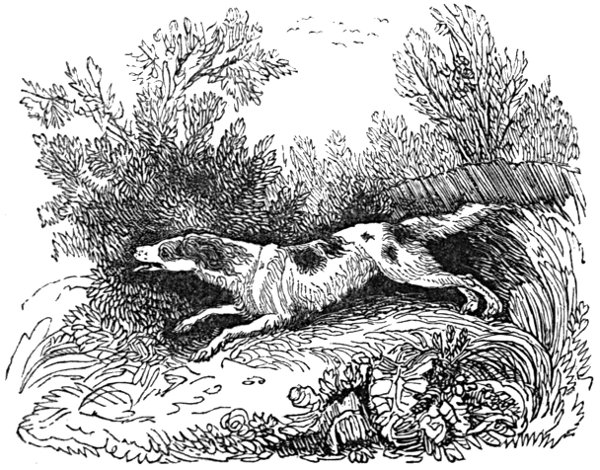
Anatomical Character of Spaniels.—The head very moderately elongated; the parietal bones do not approach each other above the temples, but diverge and swell out so as to enlarge the forehead and the cerebral cavity. This group includes the most useful and intelligent dogs.
Var. E—Spaniel, Can. fam. extrarius, Linn. The name of the spaniel race is derived from its supposed original country, Spain.
The sub-varieties are—a, The smaller spaniel, with a small round head, the ears and tail covered with long hair; b, King Charles’s spaniel, Can. brevipilis, Linn.; c, La Pyrame, Buff.; d, The Maltese, Bichon, Buff.; e, The lion dog, Can. leoninus, Linn.; f, the Calabrian dog; g, The hunting spaniel or cocker, which yields the setter, Can. index, Linn. Addenda—The Newfoundland dog; The Alpine spaniel.
Var. F—The water spaniel, Canis aquaticus, Linn.; chien barbat, Buff.
Sub-varieties—a, small water spaniel, petit barbet, Buff.; chien griffon, a dog between the water spaniel and the shepherd’s dog.—Blaine.
Spar, v. To fight like cocks with prelusive strokes; to box with gloves.
Spark, s. A small particle of fire, or kindled matter; anything shining; anything vivid or active.
Sparrow (Passer domesticus, Aldrovand), s. A small bird.
This well-known species weighs near seven drachms; length about six inches; the bill is dusky; irides hazel; the crown of the head ash-colour; round the eye, and between that and the bill, is black; behind the eyes, surrounding the back part of the head, bay; cheeks, white; chin and under part of the neck, black, mixed with grey; belly, dirty white; the coverts of the wings are chestnut and black mixed, with a whitish bar across them; the back a mixture of black and rufous; quills dusky, with rufous edges; tail dusky, edged with grey; legs brown. The bill of the female is lighter; behind the eye a line of white; the head and whole upper parts are brown, the under dirty white, dashed with ash-colour; no black on the chin or neck. In the country the sparrow exhibits a gloss and intermixture of colours rarely to be seen in those inhabiting large towns, which soon become of a dingy and almost uniform hue, from the accumulation of dust and smoke upon their plumage.
The sparrow is well known in every part of England; it inhabits the dwellings of the rich and the poor, taking possession of the humble thatched cottage in preference to the sumptuous palace. It is rarely seen far from the habitation of man, as it delights in the fruits of his labour; the highest cultivated parts producing the greatest quantity. It might be said of this bird, as of some species of water fowl, which remaining always within soundings, warn the mariner of his approach to land; so on the extensive and dreary mountains, not a sparrow is ever to be seen, and the sight of one bespeaks some habitation near. It makes a nest conformable to the place it chooses for incubation, whether in a hole of a wall, in thatch, or under the tiles of a house, or in a window swallow’s nest, it must conform to the size of the place; but when the nest is made in a tree, it is of large size, and covered at top, composed of hay and straw, lined warmly with feathers and fragments of thread or worsted, bits of cloth, or any refuse material of that sort, found about houses.
This accommodation of the structure of the nest to the locality where it is built, is in no instance, with which we are acquainted, more conspicuous than in the proceedings of the house-sparrow. Dr. Darwin mentions, seemingly as an extraordinary circumstance, that “in the trees before Mr. Levet’s house, at Litchfield, there are annually nests built by sparrows, a bird which usually builds under the tiles of houses or the thatch of barns;” but if he had been acquainted with the works of Bonnet, he would have learned that in Switzerland, at least, the sparrow “most usually (pour l’ordinaire) builds near the tops of trees,” while its nestling under tiles is an accidental exception. In the vicinity of London also, we venture to say that three pair of sparrows build on trees to one pair that nestle in holes; and so commonly is this noticed, that the tree-sparrow is popularly supposed to be a different species from the house-sparrow. The tree-sparrow (Passer montanus) of Yorkshire is indeed a different species, which lays pale brown eggs without spots; but the London ones, which build either on trees or in holes, have not a shade of difference.
It is worthy of notice, that they always proportion the quantity of materials to the size of the nest hole, which is generally packed close, leaving only a sufficient cavity for hatching the eggs and rearing the young. I have one of these nests, for example, which could almost be hid in the hollow of the hand, and another, built about a yard from it, which would fill a hat. When the nest is built on a tree, however, it is always nearly of the same dimensions, about a foot in diameter each way. From the bird nestling occasionally in holes, it might be imagined that when it made choice of a tree, it would be on account of thus obtaining a canopy of thick boughs to form a roof; but, on the contrary, sparrows, for the most part, select a high, exposed branch, as if they were more anxious to be out of the reach of cats, than of cold winds. When sparrows build in the ivied wall of a house, as they often do, they do not consider the thick clustering of the leaves above the nest as a sufficiently warm coping; and in such cases usually, if not always, construct a dome of straw, though much more slight than in nests built on the exposed branches of trees.
From its anxiety to procure shelter, the sparrow indeed seizes upon any convenience it can find best adapted to its purpose, whether that be accidental or have been prepared by some other bird. One very cogent reason for this appears to be its looking forward prospectively to the winter, for sparrows occupy their nests at night throughout the year, and though they are hardy birds, they require a warm shelter during severe frosts.
I am not aware that any contrivance is resorted to in Britain, to entice birds to build in particular places, except in the case of the house-sparrow. In the vicinity of London more particularly, pots of unglazed delft ware of a sub-oval shape, with a narrow hole for an entrance, are fixed upon the walls of houses, several feet below the eave, and the sparrows finding a domicile so suited to their habits, very soon took possession of every pot thus provided for them. But those who are so careful to accommodate the sparrows, do it not because they are fond of their neighbourhood or their yelping concerts, but to prevent their nestling under the eaves, where they dig out the mortar with their strong bills, when they do not find holes large enough for their accommodation. It probably never struck those wise persons, that by thus encouraging the sparrows to breed, they are promoting the increase of the race, and unless they multiply their sparrow pots yearly, they may be almost certain that the supernumeraries will resort to eaves nearest their birth-place. In Holland, square boxes are placed on the house-tops, to entice the stork (Ardea ciconia) to build; and for the same purpose it was customary in France, in Belon’s time, to place wheels there, a practice said to be still followed in some parts of Germany.
The sparrow lays six eggs of a whitish colour, spotted with dusky brown or ash-grey, and varying much in the shades as well as the thickness of the spots; each weighs from forty-three to forty-eight grains. Accidental varieties occur, such as white, black, and yellowish.
Sparrow Shooting.—If, however, there are persons who still think the practice of shooting swallows to be of assistance in acquiring the art, we will venture to recommend another mode which is nearly similar, but, in our opinion, much better. This is, by putting small pieces of white paper round the necks of sparrows, or other small birds, by the means of a hole cut in the middle of the paper, then throwing a single bird into the air, the young shooter may deliberately take his aim, for by this device the flight of the bird is rendered less rapid and more regular, and at the same time presents a much better mark for practice, besides it affords an excellent diversion in seasons when game cannot be pursued, or in wet weather from underneath the shelter of a shed or a barn-door. Some of the first shots in the kingdom have been perfected by this mode.—Montagu—Art of Shooting.
Sparrowhawk (Accipiter fringillarius, Ray), s. The female of the musket-hawk.
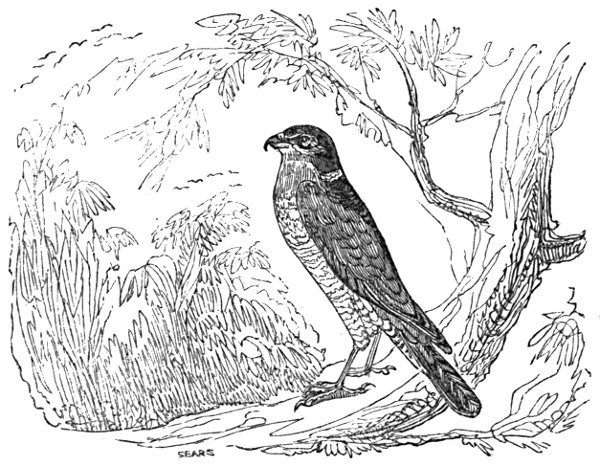
The Sparrowhawk. (Falconisus, Linn.; L’Epuvier, Buff.)—The length of the male is twelve inches; that of the female fifteen. Its bill is blue, furnished with bristles at the base, which overhang the nostrils; the colour of the eye is bright orange; the head is flat at the top, and above each eye is a strong bony projection, which seems as if intended to secure it from external injury: from this projection a few scattered spots of white form a faint line running backward towards the neck: the top of the head and all the upper parts of the body are of a dusky brown colour; on the back part of the head there is a faint line of white; the scapulars are marked with two spots of white on each feather; the greater quill feathers and the tail are dusky, with four bars of a darker hue on each; the inner edges of all the quills are marked with two or more large white spots; the tips of the tail feathers are white; the breast, belly, and under coverts of the wings and thighs are white, beautifully barred with brown; the throat is faintly streaked with brown; the legs and feet are yellow; claws black.
The above is the description of a female; the male differs both in size and colour; the upper part of his body is of a dark lead colour; and the bars on his breast are more numerous.
The female builds her nest in hollow trees, high rocks, or lofty ruins, sometimes in the old nest of a crow, and generally lays four or five eggs, spotted with reddish spots at the longer end.
The sparrow-hawk is very numerous in various parts of the world, from Russia to the Cape of Good Hope. It is a bold and spirited bird; but is obedient and docile, and can be easily trained to hunt partridges and quails; it makes great destruction among pigeons, young poultry, and small birds of all kinds, which it will attack and carry off in the most daring manner.—Bewick.
Sparrow-owl, s. (Noctua passerina, Savigny.)
The sparrow owl is a very rare species in England. In France it is said to frequent ruined edifices. It makes a nest in the holes of rocks and walls, and lays five or six eggs, spotted with yellowish and white. It is said to fly by day, and to give chace to small birds; but its principal food is mice. It is said to build in chimneys in Carniola; and Mr. Edwards mentions two having been taken in England by coming down chimneys. In 1808, one was shot by Mr. Comyns, in North Devon.—Montagu.
Spavin, s. This disease in horses is a bony excrescence, or crust as hard as a bone, that grows on the inside of the hough.
Bony spavin consists of a small bony enlargement on the inside of the hock, which often is not very observable. It occasions, however, a peculiar kind of lameness, which cannot well be mistaken, that is, a quick catching up of the leg, especially in trotting. This lameness is of course in various degrees, and sometimes scarcely observable except on first starting, and sometimes in confirmed and bad spavins; the lameness diminishes, and sometimes appears to go off by exercise, but after resting for some time the horse becomes very stiff and lame. The only remedy for this complaint is firing, and blistering immediately after. The horse should then be turned into a box for a short time, and afterwards to grass; in about a month he may be put to work. I have been informed that introducing a seton over the diseased part of the hock is now practised at the Veterinary College, in preference to firing. I have never tried this remedy, being satisfied that firing is the best, and indeed the only remedy where the disease is curable. The hot iron should be carried through the skin immediately over, and a little way into, the bony excrescence.
Bog spavin and thorough pin is a swelling on the inside of the hock, rather towards the fore part; the large vein which is so conspicuous on the inside of the leg passing over it. It depends either upon a distension, or rupture of the membranes which form the synovial cavity, or bursa mucosa, through which the great flexor tendon passes. The swelling is soft and yielding to the pressure of the finger, but rises again as soon as the pressure is removed. Sometimes, however, there is a swelling on the outside of the hock also, and in that case the fluid or synovia which the swelling contains, may be forced from one to the other. It is generally produced by hard work, or violent exertion for a short period, generally in breaking in a colt and putting him upon his haunches, as it is termed, at too early an age. It seldom occasions lameness, unless considerable, and then makes a horse go very stiff, especially after working much. The only remedy is firing, and sufficient rest; and when it is so considerable as to cause any degree of stiffness, it is advisable to have recourse to this operation. It often exists however in a slight degree, and without occasioning any inconvenience, and then it is better to leave it alone.—White.
Spawn, s. The eggs of fish or of frogs; any product or offspring.
Spawn, v. To produce as fishes do eggs; to generate, to bring forth.
Spawner, s. The female fish.
Spay, v. To castrate female animals.
Spaying is performed by making an opening in the flank on one side, when the ovaria, being enlarged by pregnancy, are readily distinguishable, and may be drawn out and cut off, first one and then the other; securing the ends by a ligature lightly applied to each surface, but leaving the threads without the wound, which is to be closed by stitches and bandaging. Farriers often apply no ligature, but content themselves with simply sewing up the wound, and no ill consequence seems to ensue. Bitches, after they have been spayed, become fat, bloated, and spiritless, and commonly prove short-lived.—Blaine.
Spear, s. A long weapon with a sharp point, used in thrusting or throwing; a lance; a lance generally with prongs to kill fish.
Spear, v. To kill or pierce with a spear.
Species, s. A sort, a subdivision of a general term; class of nature, single order of beings.
Specific, s. A specific medicine.
Speed, s. Quickness, celerity, haste, hurry, despatch; the course or pace of a horse.
Speed of the Horse.—Common report says that Flying Childers could run a mile in a minute, but there is no authentic record of this. He ran over the Round Course of Newmarket (three miles, six furlongs, and ninety-three yards) in six minutes and forty seconds; and the Beacon Course (four miles, one furlong, and one hundred and thirty-eight yards), in seven minutes and thirty seconds. In 1772, a mile was run by Firetail, in one minute and four seconds. In October 1741, at the Curragh meeting in Ireland, Mr. Wilde engaged to ride 127 miles in nine hours. He performed it in six hours and twenty-one minutes. He employed ten horses, and allowing for mounting and dismounting, and a moment for refreshment, he rode for six hours at the rate of twenty miles an hour. Mr. Thornhill, in 1745, exceeded this, for he rode from Stilton to London and back, and again to Stilton, being 213 miles, in eleven hours and thirty-four minutes, which is, after allowing the least possible time for changing horses, twenty miles an hour for eleven hours, and on the turnpike road and uneven ground. Mr. Shaftoe, in 1762, with ten horses, and five of them ridden twice, accomplished fifty miles and a quarter in one hour and forty-nine minutes. In 1763, Mr. Shaftoe won a more extraordinary match. He was to procure a person to ride one hundred miles a day, on any one horse each day, for twenty-nine days together, and to have any number of horses not exceeding twenty-nine: he accomplished it on fourteen horses, and one day he rode 160 miles, on account of the tiring of his first horse. Mr. Hull’s Quibbler, however, afforded the most extraordinary instance on record of the stoutness as well as speed of the race-horse. In December, 1786, he ran twenty-three miles round the flat at Newmarket, in fifty-seven minutes and ten seconds.
Speed is sportingly applicable to horse, hound, or greyhound. There are two modes of trial for speed, according to the present reformed mode of English racing; the one is to run a mile, which is termed running for speed; the other, of going off at score, and absolutely racing the whole four miles, which is called running for speed and bottom. Flying Childers, whose speed was almost proverbial, went one third of a mile in twenty seconds. Firetail and Pumpkin ran a mile in a few seconds more than a minute and a half. Childers ran the distance of four miles in six minutes and forty-eight seconds, carrying nine stone, two pounds; he made a leap of thirty feet upon level ground; and he covered a space of twenty-five feet at every stroke when racing. It was formerly known that any horse who could run four miles in eight minutes, would prove a winner of plates: this is, however, very materially refined, by judicious crosses in blood, or improvements in training; as Bay Malton ran four miles over York in seven minutes, forty-three seconds and a half. Eclipse ran the same distance over York in eight minutes, with twelve stone, though going only at his rate, without any inducement to speed.—Sporting Directory.
Speediness, s. The quality of being speedy.
Speedy, a. Quick, swift, fast.
Spelter, s. A kind of semi-metal.
Sperm, s. Seed, that by which the species is continued.
Spermaceti, s. A species of whale; an oily substance found in the head of the Physeter Macrocephalus.
Spice, s. A vegetable production, fragrant to the smell and pungent to the palate; an aromatic substance used in sauces.
Spike, s. An ear of corn; a long nail of iron or wood, a long rod of iron sharpened; a smaller species of lavender.
Spillet, s. A long line used for sea-fishing.
Did a man wish to moralise upon the unrealities of human expectations, let him hang over a spillet, and be interested in its success. Conceive an eternity of line, with a thousand hooks at given distances; as every snoud is placed a fathom apart, a person less conversant with figures than Joe Hume, may guess the total. This endless continuity of hemp must be carefully taken up. Do it slowly, and the thing is worse than a penance to Lough Dergh; and if you attempt rapidity, the odds are, that the back-line breaks, and a full hour will scarcely remedy the mischief.
It would puzzle a philosopher to determine the state of affairs in ten fathom of water; and if you shoot in foul ground, you will probably lose the spillet, or, with a world of labour, disentangle a moiety from rocks and sea-weed. Should it, however, have escaped those casualties, after a two hours’ probation, while you listen to a drimindhu from the skipper, and the exact state of the herring-market from the crew, you proceed to raise it. Up it comes—that vibratory motion announces that a fish is fast upon the snoud; conjecture is busily at work, and there is a difference of opinion, whether ‘the deceived one’ be a codling or red gurnet. It appears—a worthless, rascally, dog-fish! A succession of line comes in—star-fish, and, “few and far between,” some solitary plaices and flounders—at last a victim—heavy and unresisting. An indistinct glance of a dark object, broad as a tea-tray, brings the assistant spilleteer, gaff in hand, to the quarter. Alas! the turbot in expectation, turns out to be a ray! Often have I shot a spillet under favourable circumstances, and in approved ground, and lost time, hooks, and snouds, and my whole reward was a boat-load of skates and dog-fish.—Wild Sports.
Spinal, a. Belonging to the back bone.
Spine, s. The back bone.
Spine of Birds.—The back-bone of birds, unlike that of some other animals, is immoveable, though they have the power of bending the neck.—Montagu.
Spinous, a. Thorny, full of thorns.
Spiracle, s. A breathing hole, a vent, a small aperture, a pore.
Spirit, s. Breath, wind in motion; ardour; courage; that which gives vigour or cheerfulness to the mind; an inflammable liquor raised by distillation.
Spirited, a. Lively, full of fire.
Spiritless, a. Low, deprived of vigour, depressed.
Spitter, s. obs. A young deer.
Splayfooted, a. Having the foot turned inward.
Spleen, s. The milt, one of the viscera; anger, spite, ill-humour.
Splent, s. Splent is a callous hard substance, or an insensible swelling, which breeds on or adheres to the shank-bone, and when it grows big spoils the shape of the leg.
A horse often becomes lame when throwing out a splent; but that state of the bone which causes the lameness seldom continues long; nor does it ever produce permanent lameness. If any remedy is applied, a blister is always sufficiently strong. A new method of treating splents has been lately introduced; that is, passing a seton under the skin and immediately over the splent. It is said to be an improvement. I once tried it in a case of old bone spavin, but it did no good; nor did firing, which was tried soon after, though the hot iron was passed through the skin, and into the bony excrescence. The old method of rubbing or bruising a splent, puncturing it, and rubbing in some blistering preparation, will often produce a considerable swelling of the whole limb, and do a great deal of mischief. Lameness from a splent may sometimes be removed by placing a pledget of old linen, wet with goulard or saturnine lotion on it, and confining it with a bandage kept constantly wet. I have seen a good effect from diluted vinegar also.
SATURNINE LOTION.
Superacetate of lead 1 oz.
Vinegar 4 oz.
Water 1 pint. Mix.—White.
Splice, v. To join the two ends of a rope or line without a knot.
Splint, s. A thin piece of wood used by surgeons to hold the bone newly set.
Sponge, s. A soft porous substance remarkable for sucking up water.
Spoonbill (Platalea leucorodia, Linn.), s.
Weight about three pounds and a half; length two feet eight inches; the bill is near seven inches long, and three quarters of an inch broad in the narrowest part; two inches towards the points in the largest part of the spoon; colour black, sometimes brown, with an orange-coloured spot near the tip of the upper mandible; it is also crossed with several indentations and dotted protuberances; the irides in some grey, others reddish; the lore, and round the eyes and throat, the skin is bare and black. The whole plumage is white; sometimes the quills are tipped with black; the legs are black, six inches long; thighs bare about half way; toes connected by a small web, extending as far as the second joint of the outer, and first joint of the inner toe.
The spoonbill is rarely met with in England. Mr. Pennant mentions that a flock of these birds migrated into the marshes near Yarmouth, in Norfolk, in April, 1774. We have also been assured it is sometimes seen on the coast of Devonshire in the winter.—Montagu.
Sport, s. Play, diversion; diversion of the field, as of fowling, hunting, fishing.
Sport, v. To play, to game; to trifle, to enjoy field amusements.
Sportsman, s. One who pursues the recreation of the field.
Spot, s. A blot, a mark made by discoloration; a taint; a disgrace.
Sprain, v. To stretch the ligaments of a joint without dislocating the bone.
Sprain, s. Extension of ligaments without dislocation of the joint.
Sprat, s. A small sea fish.
Spring, v. To arise out of the ground; to grow, to thrive; to bound, to leap; to fly with elastic power; to rise from a covert; to issue from a fountain; to shoot; to start; to rouse game; to discharge a mine.
Spring, s. The season in which plants spring and vegetate; an elastic body, which, when distorted, has the power of restoring itself; elastic force; any active power; a leap, a violent effort; a fountain. Mainspring, the principal spring in a gun-lock.
If the mainspring be too strong, in proportion to that of the hammer, the cock is often broken for want of resistance, and if the hammer or feather spring be too stiff, or should shut down with too much force, it becomes difficult to throw it, even with a strong mainspring. Here, till very lately, most of the gunmakers were in the dark; as nothing was more admired in a lock, than the hammer shutting down with great velocity. This, not only for the reason already mentioned, is a sad fault, but the hammer by thus coming down escapes, in a certain degree, from the influence of the spring, and, consequently, loses its pressure on the pan; by which the priming is not so closely covered, and the hammer is apt to re-act instead of obeying the mainspring. In a word let your hammer shut down dull and fly back smart. The mainspring, to be well regulated, should at first pull up hard, and then draw progressively easier: because it requires an accession of force after it has recovered the first sudden escape from the scear-spring, otherwise it will go slow with a flint, and be liable either to cause a snap, or allow the cock to be blown back with a detonater.—Hawker.
Springe, s. A gin, a noose which catches by a spring or jerk.
Springer, s. One who springs or rouses game.
Springer or Springing Spaniel (Canis extrarius, Linn.), s.
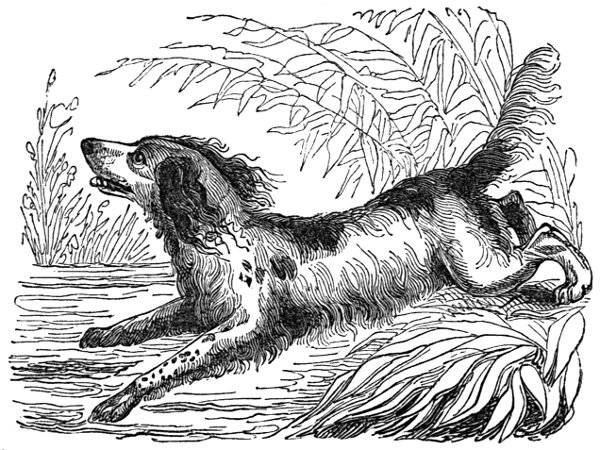
There are two different dogs which usually pass under this denomination; one being considerably larger than the other, and known by the name of the springing spaniel; it is applicable to every kind of game in any country.
The springer is supposed to have originated in Great Britain, although it is now widely diffused over every quarter of the globe. He is much and eagerly sought after in the wild sports of the East.
The true English-bred springing spaniel differs but little in figure from the setter, except in size; their chief difference consists in the former having a larger head than the latter in proportion to the bulk of his body; they vary also in a small degree in point of colour, from red, yellow, or liver colour and white, which seems to be the invariable standard of the breed. They are nearly two-fifths less in height and strength than the setter, their form being more delicate, their ears longer, very soft and pliable, covered with a coat of long waving and silky hair; the nose is red or black, the latter being the surest mark of high breeding; the tail is bushy and pendulous, and is always in motion when employed in pursuit of game.
Differently from other dogs used in shooting, both the springer and the cocker give tongue the moment they either smell or see game; and this gives intimation to the sportsmen, who generally station themselves on the skirts of the wood or covert to which woodcocks, snipes, and pheasants are known to fly when started.
Both this dog and the cocker are frequently used as finders in greyhound-coursing, and are no less eager to start a hare, which they pursue with as much ardour as they do winged game.
From the time the springer is thrown off in the field, he gives evident proofs of the pleasure he experiences in being thus employed, by the perpetual motion of his tail, which is termed feathering amongst sportsmen; and upon the increasing vibration of which the experienced fowler well knows that he is getting nearer to the object of attraction.
The nearer he approaches the game, the more energetic the dog becomes in his endeavours to succeed; tremulous whispers escape him, as a symptom of doubt; but the moment this doubt is dispelled, and the game is found, his clamorous raptures break forth in full force. He expresses his gratification by loud and quick barking, which may be relied on as a proof that he has not sought in vain; leaving the happy owner exultingly to boast, that “he is in possession of at least one faithful domestic, who never tells a lie.”—Brown.
Springhalt, s. A lameness by which the horse twitches up his legs.
Spring Wagtail (Budytes flava, Cuvier), s.
There appears no doubt but many authors have confounded this species with the grey wagtail, which we have remarked more fully in the history of that bird.
The male of this species, it is said, possesses a few black spots on the throat, but such a mark we have never observed in more than a hundred specimens. It must therefore be rare, if not a mistake, in describing the grey wagtail for this. If no other mark of distinction were to be found but the length and straitness of the hind claw in this, it would be sufficient to know it from the grey wagtail, which is very short and crooked. The tail of this bird is also an inch shorter, and has only two feathers on each side, partly white. The under parts of the male are of a much fuller yellow, and the upper parts never possess any of the cinereous colour.
The spring wagtail visits us about the time the other departs, and migrates again in September. It frequents arable land, especially in the more champaign parts; sometimes uncultivated ground interspersed with furze; it is also partial to bean fields; in all such places it breeds, and does not seem to regard water so much as either of the other species. It is said to be found in Russia and Siberia in summer, and to continue in France the whole year.—Montagu.
Sprout, s. A shoot of a vegetable; a branch of a deer’s horn.
Spur, s. A sharp point fixed on the rider’s heel; incitement, a stimulus; the sharp points on the legs of a cock; anything standing out.
Spur, v. To prick with the spur; to incite; to urge forward.
Spurgalled, a. Hurt with the spur.
Spurious, a. Not genuine, counterfeit; adulterine; not legitimate, bastard.
Spurling, s. A small sea fish.
Spurrier, s. One who makes spurs.
Spurry, s. A plant.
Squab, a. Unfeathered, newly hatched; fat, thick and stout; awkwardly bulky. obs.
Squamous, a. Scaly, covered with scales.
Square, a. Cornered, having right angles; forming a right angle.
Square, s. A figure with right angles and equal sides.
Squat, v. To sit cowering, to sit close to the ground.
Squeak, v. To cry with a shrill acute tone.
Squeak, s. A shrill quick cry.
Squib, s. A small pipe of paper filled with wildfire.
Squill, s. A plant; a fish; an insect.
Squirrel, s. A small animal that lives in woods, leaping from tree to tree.
Within the memory of some of the old persons residing in Richmond Park, squirrels were in such vast numbers, that parties of fifty or sixty persons have come from the metropolis and its neighbourhood, for the purpose of killing them. They were furnished with short sticks, with lead at one end, with which they knocked the animals down. These squirrel hunts occasioned many fights with the keepers, in one of which a keeper, of the name of Bishop, was nearly killed. The squirrels were in consequence destroyed, and it is now but seldom that one is seen.
Cat and Squirrels.—A boy has taken three little young squirrels in their nest, or drey as it is called in these parts. These small creatures he put under the care of a cat who had lately lost her kittens, and finds that she nurses and suckles them with the same assiduity and affection as if they were her own offspring. This circumstance corroborates my suspicion, that the mention of exposed and deserted children being nurtured by female breasts of prey who had lost their young, may not be so improbable an incident as many have supposed; and therefore may be a justification of those authors who have gravely mentioned what some have deemed to be a wild and improbable story.
So many persons went to see the little squirrels suckled by a cat, that the foster mother became jealous of her charge, and in pain for their safety; and therefore hid them over the ceiling, where one died. This circumstance shows her affection for these fondlings, and that she supposes the squirrels to be her own young. Thus hens, when they have hatched ducklings, are equally attached to them as if they were their own chickens.
The squirrel’s nest is not only called a drey in Hampshire, but also in other counties; in Suffolk it is called a bay. The word “drey,” though now provincial, I have met with in some of our old writers.
In the north of Hampshire a great portion of the squirrels have white tails. None of this variety, as far as I can learn, reach the London Market. I was much surprised at hearing from a man who kept a bird and cage shop in London, that not less than twenty thousand squirrels are annually sold there for the menus plaisirs of cockneys, part of which come from France, but the greater number are brought in by labourers to Newgate and Leadenhall markets, where any morning during the season four or five hundred might be bought. He said that he himself sold annually about seven hundred: and, he added, that about once in seven years the breed of squirrels entirely fails, but that in other seasons they are equally prolific. The subject was introduced by his answering to a woman who came in to buy a squirrel, that he had not had one that season, but before that time in the last season he had sold five hundred. It appears that the mere manufacture of squirrel cages for Londoners is no small concern.—Mitford—White.
Stable, a. Fixed, steady.
Stable, s. A house for beasts. Vide Appendix.
Stack, s. A large quantity of hay, corn, or wood.
Stag, s. The male red deer; the male of the hind.
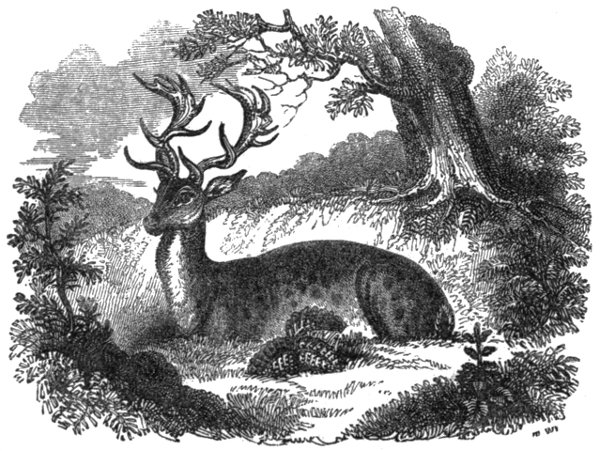
The stag or hart, whose female is called the hind, and the young a calf, differs in size and in horns from a fallow deer. He is much larger, and his horns round, whereas, in the fallow species, they are broad and palmated. By these the animal’s age is ascertained. During the first year the stag has no horns, but a horny excrescence, which is short and rough, and covered with a thin hairy skin, the next year the horns are single and straight, in the third they have two antlers, three the fourth, four the fifth, and five the sixth year, but this number is not always certain, for sometimes there are more, and often, less. After the sixth year the antlers do not always increase, and although in number they may amount six or seven on each side, yet the animal’s age is then estimated rather from the size of the antlers, and the thickness of the branch which sustains them, than from their variety. These horns, large as they seem, are, notwithstanding, shed every year, and new ones assume their place. The old horns are of a firm solid texture, and are extensively employed in making handles for knives and other instruments. But, while young, nothing can be more soft or tender, and the animal, as if conscious of his own imbecility, at those times, instantly upon shedding his former horns, retires from the rest of his species, and hides himself in solitudes and thickets, never venturing out to pasture except by night. During this time, which most usually happens in the spring, the new horns are very tender, and have a quick sensibility of any external impression. When the old horn has fallen off, the new one does not begin to appear immediately, but the bones of the skull are seen covered only with a transparent periosteum or skin, which covers the bones of all animals. After a short time, however, the skin begins to swell, and to form a sort of tumour, which contains a great deal of blood, and then it is covered with a downy substance, that to the touch resembles velvet, and which appears of nearly the same colour with the rest of the animal’s hair. This tumour daily increases from the point, like the graft of a tree, and, rising by degrees from the head, shoots out the antlers from either side, so that in a short time, in proportion as the animal is in condition, the entire horns are completed, but it should be observed, that the substance of which the horns are composed, begins to harden at the bottom, while the upper part remains soft and still continues growing; whence it appears that the horns of deer grow differently from those of sheep or cows, which latter always are seen to increase from the bottom. When, however, the horns have completed their full growth, the extremities then acquire solidity. The velvet-like covering, with its blood-vessels, dries up, and the former then begins to fall, and this the animal hastens by rubbing its antlers against the trees of the forest. In this manner the whole external surface being stripped off by degrees, the horns acquire their complete hardness, expansion, and beauty. It is also said that some hinds have horns.
It would be a vain task to inquire into the cause of the annual production of these horns; it is sufficient to observe, that if a stag be emasculated when the horns are fallen off, they will never grow again; and, on the contrary, if the same operation is performed when they are on, they will never fall off. If only one side is emasculated, he will want the horn on that side.
The old stags usually shed their horns first, which generally happens towards the latter end of February or the beginning of March.
Such as are between five and six years old shed their horns about the middle or latter end of March; those still younger in the month of April; and the youngest of all not till the middle or latter end of May.
They generally shed them in pools of water, whither they retire from the heat, and this has given rise to the opinion of their always hiding their horns. These rules, though true in general, are yet subject to many variations, and it is well known that a severe winter retards the shedding of the horns. A short time after they have gained their horns, they begin to feel the impression of the rut.
The old ones are the most forward, and about the end of August or beginning of September, they quit their thickets and return to the mountain or plain in order to seek the hind, to whom they call with a loud tremulous note. At this time their neck is swollen—they appear bold and ferocious—fly from country to country—strike with their horns against the trees and other obstacles—and continue restless and fierce until they have found the female, who at first flies from them, but is at last overtaken.
When two stags contend for the same female, however timorous they may appear at other times, they then seem agitated with an uncommon degree of ardour; they paw up the earth, and menace their opponent with their horns, bellowing with all their force, and striking in a desperate manner against each other, seeming determined upon death or victory. This combat continues till one of them is defeated or flies, and it oftentimes happens that the victor is obliged to fight several of these battles before he becomes the undisturbed master of the field. The old ones are generally the conquerors upon these occasions, as they have more strength and greater courage, and they are preferred by the hind to the younger, the latter being more feeble and less ardent.
In this manner the stag continues to range from one to the other for three weeks, the time the rut continues, during which he scarcely eats, sleeps, or rests, but continues to pursue, to combat, and enjoy. At the end of this period of madness, for such in this animal it seems to be, the creature that was before fat, sleek, and glossy, becomes lean, feeble, and timid. He then retires from the herd to seek replenishment and repose.
The stag or red deer is common in Europe, Barbary, the north of Asia, and North America; it abounds in the southern parts of Siberia, where it grows to an immense size, but is now extirpated in Russia. It lives in herds, and there is generally one male which is supreme in each herd. The colour of the stag is generally a reddish brown, with some black and white about the face, and a black line down the hinder part of the neck between the shoulders, and the belly white. Sometimes their colour is a pale yellow brown, sometimes a blackish brown, and lastly, instances occasionally occur of stags being found entirely white.
The stag possesses a fine eye, an acute smell, and excellent ear, like that of the cat and the owl; the eye of the stag contracts in the light, and dilates in the dark, but with this difference, that the contraction and dilatation are horizontal, while in the first mentioned animals they are vertical.
When deer are thirsty, they plunge their noses, like some horses, very deep under water while in the act of drinking, and continue them in that situation for a considerable time.
The number of teeth of the various species of deer and the antelope tribe, is generally thirty-two, namely, eight cutting teeth in the lower jaw, six molar teeth on each side of these, and six molar teeth on each side in the upper jaw; but there are frequent exceptions to this rule.
The cry of the hind or female is not so loud as that of the male, and is never excited but by apprehension for herself or her young. It need scarcely be mentioned that she has no horns, or that she is more feeble or unfit for hunting than the male. When once she has conceived she separates from the males, and then they both herd apart. The time of gestation continues eight months and a few days, and they seldom produce more than one at a birth. Their usual season for bringing forth is about the month of May, or the beginning of June. They take the greatest care to secrete their young in the most obscure thickets, nor is the caution without reason, as many creatures are their formidable enemies. The eagle, the falcon, the wolf, the dog, and all the rapacious family of the cat kind, are continually seeking to discover her retreat. But what is more unnatural still, the stag himself is a professed enemy, and she is obliged to use all her arts to conceal her young from him, as from the most dangerous of her pursuers. At this season, therefore, the courage of the male seems transferred to the female; she defends her young against her less formidable opponents by force, and, when pursued by the hunter, she offers herself to mislead him from the principal object of his concern. She flies before the hounds for half the day, and then returns to her offspring, whose life she has thus preserved at the hazard of her own.
Those persons who are fond of the pastime of hunting have their peculiar terms for the different objects of their pursuit. Thus the stag is called, the first year, a calf or hind calf, the second a knobber, the third a brock, the fourth a staggard, the fifth a stag, the sixth a hart. The female is called, the first year, a calf, the second a hearse, the third a hind.
In Britain the stag is become less common than formerly, its excessive viciousness during the rutting season inducing most people to dispense with this species, and rear the fallow deer, which is of a more placid nature, in its stead. Some attempts have, indeed, been made to render stags domestic, by treating them with the same gentleness as the Laplanders do their rein-deer; and it appears, in the Isle of France, where the Portuguese had introduced the European breed, they had so far succeeded, by degrees, as to render them quite domestic, many of the inhabitants keeping large flocks of them; but when the French took possession of that island, they destroyed most of these domesticated stags. Valmont de Bromere asserts that he saw in Germany, a set, or attelage, consisting of six stags, that were perfectly obedient to the curb and to the whip; and in the magnificent stables of Chantilly, in the year 1770, there were two stags that were occasionally harnessed to a small chariot, in which they drew two persons.
Stags are still found wild in the Highlands of Scotland, in herds of four or five hundred together, ranging at full liberty over the vast hills of the north, and some of them grow to a great size: Pennant says, upon the authority of Mr. Farquharson, that one of these wild stags weighed three hundred and fourteen pounds, exclusive of the entrails, head, and skin. Formerly the great Highland chieftains used to hunt with all the magnificence of eastern monarchs, assembling four or five thousand of their clan, who drove the deer into the toils, or to the station their lairds had placed themselves in. But as the chace was frequently used as a pretence for collecting their vassals for rebellious purposes, an act was passed prohibiting any assembly of this kind.
Stags are likewise met with on the moors that border on Cornwall and Devonshire, and Ireland, on the mountains of Kerry, where they add greatly to the magnificence of the romantic scenery of the lakes of Killarney.
Stags are mostly kept in parks, with fallow deer. Dr. Johnson describes them as not exceeding the common deer in size, and that their flesh is of equal flavour. From a stag that had been committing depredations on the farmers’ corn during a whole summer, and which was accidentally hunted and killed, after a long run, a haunch weighing forty-six pounds, was allowed by very competent judges to be the highest flavoured and fattest venison they had ever tasted. The stag’s age is partly known by the horns, which he begins to shed about the end of February, and the new horns are complete and polished in July or August: at six years, the antlers amount to six or seven on each side; their number is uncertain, nor can the years be precisely ascertained beyond that period, as the new horns come like those last shed. The eye of the stag is peculiarly beautiful, soft, and sparkling, and is, for these attributes, frequently alluded to in Eastern poetry; he hears quickly, and his sense of smelling is highly perfect; his powers of leaping are often astonishingly exerted during the chase, and in the New Forest is a celebrated spot called the Deer Leap, where a stag was once shot, and in the agony of death, collecting his strength, gave a bound which so surprised those that saw it, that it is commemorated by two posts, fixed at the extremity of the leap: the space between them is something more than eighteen yards. The stag’s rutting season is in August, and continues about three weeks, when he becomes a dangerous animal: he then frequents rivers or pools of water, to cool his ardour; he swims with great power and facility, and to this element he always retreats, when hard pressed by the hounds. The hind, at the expiration of eight months and a few days, produces seldom more than one young, which she resolutely protects from every enemy, and carefully conceals from the stag, one of the worst. During the whole summer the fawn never quits the dam; and in winter the stags and hinds of all ages keep together in herds, which are more or less numerous, according to the mildness or rigour of the season. They separate in the spring; the hinds retire to bring forth, while none but the young ones remain together. Stags are gregarious, delight to graze in company, and are separated but by danger or necessity.
While traversing a low range of moors, an incident occurred which, at this season, was unaccountable. A red-and-white setter pointed at the top of a little glen. The heathy banks on both sides of a mountain rivulet undulated gently from the stream, and caused a dipping of the surface; the ground seemed a favourable haunt for grouse, and our dogs were beating it with care. Observing the setter drop, his companions backed, and remained steady, when suddenly Hero rose from his couchant attitude, and next moment a wild deer of enormous size and splendid beauty crossed before the dog and sprang the birds he had been pointing. The apparition of the animal, so little expected, and so singularly and closely introduced to our view, occasioned a sensation I had never hitherto experienced. I rushed up the bank; unembarrassed by our presence, the noble deer swept past us in a light and graceful canter, at the short distance of some seventy or eighty yards. I might have fired at and annoyed him—but on a creature so powerful small shot could have produced little effect, and none but a cockney, under such circumstances, would waste a charge. To teaze without a chance of bringing down the gallant beast, would have been a species of useless mischief, meriting a full month upon the tread-mill. I gazed after him as he gradually increased his distance; his antlers were expanded as fully as my arms would extend; his height was magnificent, and compared with fallow-deer he seemed a giant to a dwarf. The sun beamed upon his deep bay side, as he continued describing a circular course over the flat surface of the moor, till reaching a rocky opening leading to the upper hills, he plunged into the ravine, and we lost sight of him.
What could have driven the red deer so low upon the heath was marvellous. Excepting when disturbed by a solitary hunter, or a herdsman in pursuit of errant cattle, or driven from the summit of the hills by snow and storm, those deer are rarely seen below the Alpine heights they inhabit. But the leisure pace of the beautiful animal we saw to-day, proved that he had not been alarmed in his lair, and led one almost to fancy, that in freakish mood, he had abandoned his mountain home to take a passing glance at men and things beneath him.
I will not pretend to describe the anxious, nay agonising hour that I passed in this highland ambuscade. The deep stillness of the waste was not broken even by the twittering of a bird. From the place where I lay concealed, I commanded a view of the defile for the distance of some eighty yards, and my eye turned to the path by which I expected the deer to approach, until to gaze longer pained me. My ear was equally engaged; the smallest noise was instantly detected, and the ticking of my watch appeared sharper and louder than usual. As time wore on my nervousness increased. Suddenly a few pebbles fell—my heart beat faster—but it was a false alarm. Again, I heard a faint sound, as if a light foot pressed upon loose shingle—it was repeated—by Saint Hubert, it is the deer! they have entered the gorge of the pass, and approach the rock that covers me, in a gentle canter!
To sink upon one knee and cock both barrels was a moment’s work. Reckless of danger, the noble animals, in single file, galloped down the narrow pathway. The hart led the way, followed by the doe, and the old stag brought up the rear. As they passed me at the short distance of twenty paces, I fired at the leader, and, as I thought, with deadly aim; but the ball passed over his back, and splintered the rock beyond him. The report rang over the waste, and the deer’s surprise was evinced by the tremendous rush they made to clear the defile before them. I selected the stag for my second essay; eye and finger kept excellent time, as I imagined—I drew the trigger—a miss by every thing unfortunate! The bullet merely struck a tyne from his antler, and, excepting this trifling graze, he went off at a thundering pace, uninjured.
The deer had separated—the hart and doe turned suddenly to the right, and were fired at by my cousin, without effect. The stag went right a-head; and while I still gazed after him, a flash issued from a hollow in the hill, the sharp report of Hennessey’s piece succeeded, and the stag sprang full six feet from the ground, and tumbling over and over repeatedly, dropped upon the bent-grass with a rifle-bullet in his heart.
In addition to a herd of fallow deer, amounting to about one thousand six hundred, which are kept in Richmond Park, there is generally a stock of from forty to fifty red deer. Some stags from the latter are selected every year, and sent to Swinley, in order to be hunted by the king’s stag-hounds. When a stag, which has been hunted for three or four seasons, is returned to the park, to end his days there, he is generally more fierce and dangerous than any of the others at a particular season of the year. At that time it is sometimes not safe to approach him: and the keepers inform me that they have been obliged to fire at them with buck shot, when they have been attacked by them. They account for this ferocity, by the circumstance of the deer having been much handled, and consequently rendered more familiar with, and less afraid of, those whom they would naturally shun. It is sometimes very difficult to take stags for hunting. One fine stag was so powerful, and offered so much resistance, that two of his legs were broken in endeavouring to secure him, and he was obliged to be killed. One who had shown good sport in the royal hunt, was named ‘Sir Edmund,’ by his late Majesty, in consequence of Sir Edmund Nagle having been in at the ‘take’ after a long chase. This stag lived some years afterwards in the park; and it is a curious fact that he died the very same day on which Sir Edmund Nagle died. This deer herded with the cows, probably from having been so long separated from his usual companions.
Does are longer lived than bucks. One doe in Richmond Park lived to be twenty years old; and there are other instances of their having attained the same age.
A curious circumstance lately occurred, respecting the red deer in the park in question. In the year 1825, not a single calf was dropped by any of the hinds, though they had bred freely the preceding, and did the same in the subsequent year. I find an event recorded in the ‘Journal of a Naturalist,’ as having happened in the same year in regard to cows. It is there stated that, for many miles round the residence of the author, scarcely any female calves were born. This diminution of the usual breed of deer, and the increase of sex in another animal, is not a little remarkable.
Of the stag’s longevity much has been asserted, which latter observations have refuted, and upon the received maxim, that animals live seven times the number of years that bring them to perfection, and this requiring six to arrive at its maturity, the stag’s age may be fixed at nearly forty years.
Of the stag’s courage, when his personal safety requires it, the combat promoted by William, Duke of Cumberland, many years since, in an area where a stag was inclosed with a hunting tiger, and which made so resolute a defence that the tiger was at length obliged to give up, is a faithful record. It was in Ascot race week, and this novelty attracted an additional concourse of people. On a lawn by the road-side, a space was fenced in with very strong toiling, fifteen feet high, into which an old stag was turned, and shortly after the tiger was led in, hoodwinked, by two blacks who had the care of him, and his eyes and himself at once set at liberty. The instant he saw the deer, he crouched down on his belly, and creeping like a house-cat at a mouse, watched an opportunity of safely seizing his prey. The stag, however, warily turned as he turned, and this strange antagonist still found himself opposed by his formidable brow antlers. In vain the tiger attempted to turn his flanks, the stag had too much generalship, and this cautious warfare lasted until it became tedious, when his royal highness enquired, if, by irritating the tiger, the catastrophe of the combat might not be hastened; he was told it might be dangerous, but it was ordered to be done; the keepers went to the tiger, and did as they were ordered, when immediately, instead of attacking the deer, with a furious and elastic bounce, he sprang at, and cleared the toiling that enclosed him; great indeed was the confusion amongst the affrighted multitude, every one imagining him or herself the destined victim to the tiger’s rage, who, regardless of their fears, or their persons, crossed the road, and rushed into the opposite wood.
It happened a herd of fallow deer were feeding not far from the scene of action, on the haunch of one of them he instantly fastened, and brought it to the ground. His keepers, to whom he was perfectly familiarised, for some time hesitated to go near him; at length they ventured, cut the deer’s throat, and separating the haunch he had seized, which he never left from his hold for a moment, hoodwinked, and led him away with it in his mouth.
Stag Hunting.—I hunted two winters at Turin: but their hunting, you know, is no more like ours, than is the hot meal you there stand up to eat to the English breakfast you sit down to here. Were I to describe their manner of hunting, their infinity of dogs, their number of huntsmen, their relays of horses, their great saddles, great bits, and jack-boots, it would be no more to our present purpose than the description of a wild boar chase in Germany, or the hunting of jackalls in Bengal. C’est une chasse magnifique, et voilà tout. However, to give you an idea of their huntsmen, I must tell you that one day the stag (which is very unusual) broke cover, and left the forest; a circumstance which gave as much pleasure to me as displeasure to all the rest—it put every thing into confusion. I followed one of the huntsmen, thinking he knew the country best; but it was not long before we were separated: the first ditch we came to stopped him. I, eager to go on, hallooed out to him, “Allons piqueur, sautez done.” “Non pardi,” replied he, very coolly, “c’est un double fossé—je ne saute pas des double fossés.” There was also an odd accident the same day, even to the king himself, you may think interesting; besides it was the occasion of a bon mot worth your hearing.—The king, eager in the pursuit, rode into a bog, and was dismounted: he was not hurt,—he was soon on his legs, and we were all standing round him. One of his old generals, who was at some distance behind, no sooner saw the king off his horse, but he rode up full gallop to know the cause, “Qu’est ce que c’est? qu’est ce que c’est?” cries the old general, and in he tumbles into the same bog. Count Kevenhuller, with great humour, replied, pointing to the place, “Voilà ce que c’est! voilà ce que c’est!”—Le Keux—Jesse—Wild Sports—White of Selborne—Beckford.
Stagecoach, s. A coach that keeps its stages; a coach that passes and repasses on certain days for the accommodation of passengers.
Stager, s. A player; an old cock grouse.
Staghound (Canis Strenuus), s. A hound kept for hunting stags.
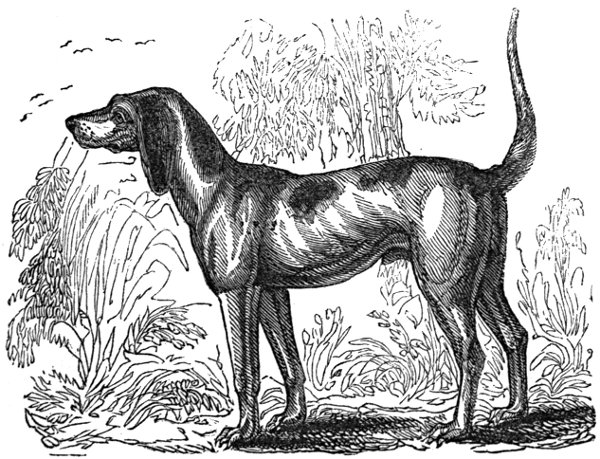
The stag-hound is now the largest and most powerful of all the dogs which go under the general term of hound. He is held higher in estimation than any other dog of chase, and has a most commanding and dignified aspect, blended with every mark of intellectual mildness.
It has been asserted by the most celebrated naturalists, that the hound, harrier, turnspit, water-dog, and spaniel, are originally of the same race; and there seem to be strong reasons for believing this to be the case, as their figures and instinctive properties are nearly allied in all of these kinds; the principal difference consisting in the length of their legs and the size of their ears, which are in all of them soft in their texture and pendulous. The hound and harrier are supposed to be the natives of Britain, France, and Germany, an opinion which is attended with some degree of reason, for when transported to warmer climates they quickly degenerate.
It seems extremely probable that this large, strong, and bony hound was the primeval stock from which all the collateral branches of this race have descended, and that all deviations from the original stem have been the result of crosses and improvements, during many centuries, by those skilled in rearing and breeding dogs of the chase, and varied in size and strength, according to the particular sport for which they are intended. At the present day there cannot be a doubt but that the practical breeder, by judicious crosses, can either enlarge or diminish the stature and strength of his pack in the course of three or four generations.
The stag-hounds exclusively devoted to that sport, in the royal establishment of this country, it is well known, have been an improved cross between the old English southern hound and the fleeter foxhound, grafted upon the bloodhound.
Things gradually continue thus to improve in proportion as the face of the country becomes more cultivated, till animals of the chace are greatly reduced in number, so much so, that even the stag is now but seldom seen in a state of nature in this country, decreasing as the sequestered places of its abode become fewer. They are now only to be met with in a state of unrestrained freedom in those extensive moors upon the borders of Cornwall and Devonshire, and in some places of the Highlands of Scotland, and the mountains of Kerry in Ireland, in which last place they add greatly to the beauty and magnificence of the justly celebrated Lake of Killarney, where they are pursued with hound and horn.
There is a fine breed of buck-hounds in Richmond Park, and their sagacity is very extraordinary. In taking the deer, according to annual custom, either for the royal hunt or for the fattening paddocks, a stag or a buck, which has been previously fixed upon, is ridden out of the herd by two or three of the keepers in succession, each of whom is closely followed by a hound, the young dogs only being kept in slips. As soon as the deer has been separated from his companions, the dogs have the requisite signal given to them, and they immediately follow in pursuit. The scene is then highly interesting. A strong deer will afford a very long chase, but when he comes to bay the dogs generally seize him by the throat or ears; the keepers come up, take him by the horns, and after having strapped his hind and fore legs together, put him into a cart which follows for the purpose, and he is then disposed of as he may be wanted. I have seen an active young keeper throw himself from his horse upon a deer at bay, which he had come up to at full gallop, and hold his horns till assistance arrived. Some danger, however, attends this sport; as, when a deer has been hard pressed, I have seen him, in more than one instance, suddenly turn upon the horsemen and injure the horses, and in one case wound the leg of the horseman. The dogs are so well trained, and are so soon made aware which buck is intended to be caught, that they seldom make a mistake, even if the deer regains the herd after having been driven from it, but press him through it, till they have again separated him from it. It is well known that when a hard pressed deer tries to rejoin his companions, they endeavour to avoid and get away from him as much as possible, or try to drive him away with their horns. So severe is the chase in Richmond Park in taking deer, especially when the ground is wet, that three or four good horses may be tired by a single horseman in one day’s deer taking, if each deer is ridden out of the herd, and followed till he is taken. When dogs are in slips, the man who holds them merely rides as near as he can to the person who is endeavouring to single out the deer, and awaits his signal for slipping the dog. These dogs who are a large, rough sort of greyhound, and very powerful and sagacious, are soon taught not to injure the deer when they come to them. The cry of ‘hold them,’ made use of by the keepers in urging them forward, seems to be perfectly understood by the dogs.—Brown—Jesse.
Staggard, s. A four-year-old stag.
Staggers, s. A kind of horse apoplexy; madness.
Stagnate, v. To lie motionless, to have no course or stream.
Stain, v. To blot, to spot, to dye.
Stake, s. A post or strong stick fixed in the ground; a piece of wood; anything placed as a palisade or fence; the post to which a beast is tied to be baited; anything pledged or wagered; the state of being hazarded, pledged, or wagered.
Stalk, v. To walk with high steps; to walk behind a stalking horse or cover; to follow deer.
Stalkinghorse, s. A horse, either real or fictitious, by which a fowler shelters himself from the sight of the game.
Stall, s. A crib in which an ox is fed, or where any horse is kept in the stable.
Stallfed, a. Fed not with grass but dry feeding.
Stallion, s. A horse kept for mares; a horse not castrated.
Stanch, v. To stop blood, to hinder from running.
Stand, s. A station; a place where one waits standing; station; a stop; a halt; stop, interruption; the act of opposing; highest mark; stationary point.
Standhouse, s. A building erected on a racecourse, to accommodate the subscribers or company generally.
Star, s. One of the luminous bodies that appear in the sky; the pole star; mark on the forehead of a horse.
Stare, v. To be rough in the coat, as a horse.
Starfish, s. A fish branching out into several points.
Starhawk, s. A kind of hawk.
Starling or Stare, (Sturnus vulgaris, Linn.; L’Etourneau, Buff.) s. A bird that may be taught to whistle, and articulate words.
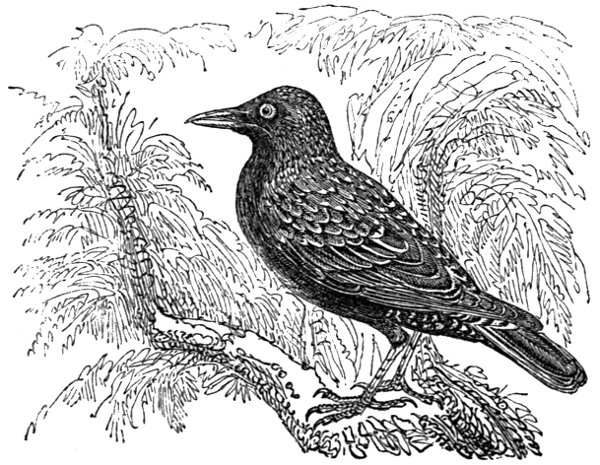
The length of this bird is somewhat less than nine inches. The bill is straight, sharp-pointed, and of a yellowish brown; in old birds deep yellow; the nostrils are surrounded by a prominent rim; the eyes are brown; the whole plumage is dark, glossed with green, blue, purple, and copper, but each feather is marked at the end with a pale yellow spot; the wing-coverts are edged with yellowish-brown; the quill and tail-feathers dusky, with light edges; the legs are of a reddish-brown. From the striking similarity, both in form and manners, observable between this bird and its congeners, we have no scruple in removing it from its usual place, as it evidently forms a connecting link between them, and in a variety of points seems equally allied to both. Few birds are more generally known than the stare, it being an inhabitant of almost every climate; and as it is a familiar bird, and easily trained in a state of captivity, its habits have been more frequently observed than those of most other birds. The female makes an artless nest in the hollows of trees, rocks, or old walls, and sometimes in cliffs overhanging the sea; she lays four or five eggs, of a pale greenish-ash colour; the young birds are of a dusky-brown colour, till the first moult. In the winter season these birds fly in vast flocks, and may be known at a great distance by their whirling mode of flight, which Buffon compares to a sort of vortex, in which the collective body performs a uniform circular revolution, and at the same time continues to make a progressive advance. The evening is the time when the stares assemble in the greatest numbers, and betake themselves to the fens and marshes, where they roost among the reeds; they chatter much in the evening and morning, both when they assemble and disperse. So attached are they to society, that they not only join those of their own species, but also birds of a different kind, and are frequently seen in company with red-wings, fieldfares, and even with crows, jackdaws, and pigeons. Their principal food consists of worms, snails, and caterpillars; they likewise eat various kinds of grain, seeds, and berries, and are said to be particularly fond of cherries. In a confined state they eat small pieces of raw flesh, bread soaked in water, &c.; are very docile, and may easily be taught to repeat short phrases, or whistle tunes with great exactness, and in this state acquire a warbling superior to their native song.
The time to shoot starlings by wholesale is just before the dusk of the evening, when they come down to roost among the reeds. Here they assemble in swarms, that darken the air; and for some time keep up a chatter, which even surpasses that of Frenchmen in their warmest political debates.
Having swept down some dozens with your duck-gun, let their heads be immediately pulled off; as this will, in a great degree, prevent their having a bitter taste.
Starlings are very good when stewed with rice, or made into a curry.
Before I conclude under the head of starlings, I must ask leave to become my own trumpeter, in order to name a shot that I made at these birds, which will give some idea as to the manner in which they swarm together. Happening, in the early part of last winter, to have put my punt afloat on Lord Rodney’s pond, at Alresford, I loaded my new double swivel-gun with a pound of small shot in each barrel, and a little before day-light paddled across to a retired part of the pond, where the reeds were literally swarming with these birds. Having placed the punt “stern on,” so as to command the eastern light, and shoot well clear of the reeds, I gave a little signal, as previously agreed on, to Mr. Macilwain (who, with Captain Hill, was in another punt behind) to discharge both barrels of my little double gun. On hearing this report up sprung the whole army, consisting I should say of every starling in Hampshire, and making the valley echo like a peal of thunder. No sooner had they cleared the reeds than I opened my battery, and cut such a lane through them, as I could scarcely have thought possible, and the quantity of feathers which came flying back to leeward, I could compare to nothing but a fall of black snow. What number were killed and wounded we never could ascertain, from the extreme difficulty of getting the birds that fell among the reeds and quagmires, but we fairly bagged two hundred and forty-three, as fast as they could be picked up, and the workmen, when the reeds were cut down, declared that they found between two and three hundred more; for this, however, I have only their word, though there is no reason to doubt it, as we all felt confident that at least five hundred fell in this one volley.—Bewick—Hawker.
Starred, a. Marked with stars.
Starshoot, s. A supposed emission from a star.
Start, v. To feel a sudden and involuntary twitch or motion of the animal frame; to wince; to deviate; to set out from the barrier at a race; to set out upon any pursuit; to alarm.
Start, s. A motion of terror; a sudden twitch or contraction of the frame; a sudden rousing of an animal; a quick spring or motion; first emission from the barrier; act of setting off.
Start in Racing.—The person appointed to start the horses shall mark in his list the time when the horses in each race actually started; and if there have been any false starts, the first of them shall be considered as the time of starting for that race. And he shall make a report thereof to the keeper of the match-book in the afternoon of the day the races are run. And if any delay beyond the allowed time shall have taken place, he shall state by whom, or by what cause, the delay was occasioned. He shall regulate his watch by the coffee-room clock, which shall be considered as the true time for this purpose.—Turf Expositor.
Startle, v. To fright, to impress with sudden terror.
Starveling, s. An animal thin and weak for want of nourishment.
Steel, s. Steel is a kind of iron, refined and hardened, of great use in the making of tools and instruments of all kinds; chalybeate medicines.
Steel, v. To point or edge with steel; to make hard or firm.
Steelyard, s. A kind of balance, in which the weight is moved along an iron rod, and grows heavier as it is removed farther from the fulcrum.
Steeple Chace, s. A race over the country by hunters.
Steer, s. A young bullock.
Stem, v. To oppose a current, to pass across or forward notwithstanding the stream.
Stern, s. The hinder part of anything; the tail of a dog.
Stern (Sterna nigra, Linn.), s.
This species is less than the common tern; weight about two ounces and three-quarters; length ten inches; bill black; irides dusky; forehead, sides of the head, beneath the eyes, throat, and fore part of the neck white; the rest of the head, back of the neck, and under part of the body, black; back, wings, and tail, deep ash-colour; vent and under tail-coverts white; the tail is less forked than in either of the other species; the outer feathers edged with white; legs dull red, the webs much indented or semipalmated. In some the forehead and fore part of the neck are mottled with black; and as most authors have omitted, or at least have not made mention of any white on the forehead, such is probably another variety. The female has no white about the head.—Montagu.
Sterna (Linn.), s. Tern, a genus thus characterised:—
Bill as long, or longer than the head, almost straight, compressed, fringed, cutting and pointed; the mandibles of equal length, the upper slightly inclined towards the point; nostrils towards the middle of the bill, slit lengthwise, and pierced from part to part; legs small, naked to above the knee; shank very short; four toes, the three fore ones reunited by a cut membrane, the hind toe free; claws small and arched; tail more or less forked; wings very long and pointed, the first quill the longest.
Stew, v. To seeth anything in a slow moist heat.
Stew, s. A storepond, a small pond where fish are kept for the table.
Stickleback, s. The smallest of fresh water fish; applied to a horse means heavy, lazy, not flippant.
The stickleback is the smallest fish in this country, and is called by several names in different parts of it; they are not worthy the angler’s notice, except as baits with the prickles cut off (which kills the fish), for which purpose they are equal to the minnow, or superior in pond fishing for perch; they may be taken with the least sized hook, and a bit of small red worm, and are found in little inlets of streams, and also in stagnated waters. Walton considers the stickleback preferable to the minnow, as being capable of whirling round quicker, which is the perfection of this sort of fishing: to acquire this velocity, the hook is to be put in at the mouth and out at the tail, and having first tied him with white thread a little above the tail, and placed him in such a manner on the hook as he is likely to turn quick, his mouth is then sewed up to the line; should he not whirl so speedily as is wished, the tail should be more or less turned towards the inner part, or side of the hook, or put somewhat more crooked or straight on the hook, until it turns both true and fast: in a swift stream any great trout will be tempted; the loach will have the same effect, provided it be small.—Daniel.
Stiff, a. Rigid, inflexible; stiff country, heavy soil, much enclosed, difficult to ride over or pass through.
Stifle, s. The bone of a horse.
The upper bone of the thigh is united to the lower by a somewhat complicated joint. It terminates by two round prominences behind, which are received into slight depressions on the upper surface of the lower bone; and in front is a curious groove over which plays a small irregular bone, the patella or stifle bone. The whole is called, by farriers, the stifle joint.
The stifle joint is not often subject to sprain. The heat and tenderness will guide to the seat of injury. Occasionally, dislocation of the patella has occurred, and the horse drags the injured limb after him, or rests it on the fetlock: the aid of a veterinary surgeon is here requisite. The muscles of the inside of the thigh, generally, have sometimes been sprained; this may be detected by diffused heat, or heat on the inside of the thigh above the stifle: rest, fomentations, bleeding, and physic, will be the proper means of cure.—The Horse.
Stilts, s. Supports or poles by which water may be crossed.
Stimulate, v. To excite by some pungent motive; in physic, to excite a quick sensation, with a derivation towards the part.
Stint, v. To bound, to limit, to confine, to restrain; to impregnate a mare.
Stirrup, s. An iron hoop suspended by a strap, in which the horseman sets his foot when he mounts or rides.
Stoat, s. An animal of the weasel tribe.
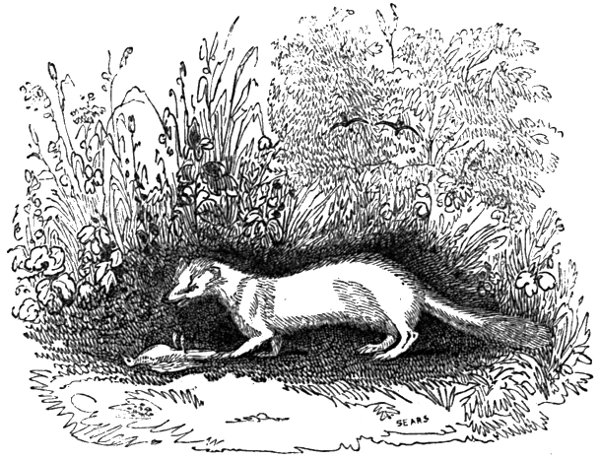
This animal, which is equally agile and mischievous with the weasel in pursuit and destruction of the hare, and all other sorts of game, poultry, and eggs, has, from its habits and the small difference in shape from the weasel, been often described under the same denomination. Its height is about two inches; the tail five and a half, very hairy, and at the points tipped with black; the edges of the ears and ends of the toes are of a yellowish white; in other respects it perfectly resembles the weasel in colour and form. In the most northern parts of Europe the stoat regularly changes its colour in winter, and becomes perfectly white, except the end of the tail, which remains invariably black. It is then called the ermine: the fur is valuable, and sold in the country where caught, from two to three pounds sterling per hundred. The animal is either taken in traps, made of two flat stones, or shot with blunt arrows.
The stoat is sometimes found white during the winter season in Great Britain, and is then commonly called the white weasel. Its fur, however, having neither the thickness, the closeness, nor the whiteness, of those which come from Siberia, is, with us, of little value.
To destroy these worst of all four-footed vermin to game in its infant state, the following mode is recommended:—Provide small square-made steel traps, with a small chain and iron peg to fix them down; get two drachms of musk, shoot some small birds, and dip the tail of these birds in the musk; tie one on the plate of each trap, and set in the hedges, or where it is suspected they frequent: this will soon reduce the number, should it be ever so considerable: if it so happen, that no musk is immediately to be got, the trap must be baited with a bit of rabbit; and it should be remembered that this bait cannot be too stale.
Some time since, as Mr. Clarke, of Horndean, was going a few miles on foot, in the forest of Bere, to visit a friend, he observed a hare come into the green road before him, which seemed to be listening, and looking back for something which pursued her. He stood still, and hearing no dog, was curious to discover the cause of her alarm; when, to his great surprise, he discovered the object of it to be a small yellow red and white stoat, which hunted her footsteps with the utmost precision. He, wishing to know if so diminutive an animal could have a chance of coping with the great speed of the hare, retreated to a holm-bush hard by, where he was an attentive observer of this silent hunt for near two hours, during which, he is certain to have seen both hare and stoat at least forty times. They were frequently gone for five or ten minutes; but the hare, still unwilling to leave the place where she was found, came round again, and her little pursuer sometimes close at her heels. Towards the end of this remarkable chase, which became uncommonly interesting, the hare took advantage of the thickest covert the place afforded, and made use of all her cunning and strength to escape, but without effect; till at length, wearied out by the perseverance of the stoat, Mr. C. heard her cry for some time.
At last, the cries coming from one point, he concluded she was become the victim of the chase; on which he went to the spot, where he found the hare quite dead, and the stoat so intently fastened on her neck, as not to perceive his approach. The stoat, in its turn, now fell a victim to Mr. C’s stick; after which, he proceeded with both hare and stoat to the house of his friend.—Sporting Anecdotes.
Stock, s. The trunk, the body of a plant; a log; a post; the handle of anything; a support of a ship while it is building; a close neckcloth; a race, a lineage, a family. Vide Gun.
Stock, v. To store, to fill sufficiently; to fit a gun stock.
Stockdove, s. The ringdove.
Stockfish, s. Dried cod, so called from its hardness.
Stomach, s. The ventricle in which food is digested; appetite.
Stomach of Birds.—The stomach of birds forms them into two distinct natural classes: those with cartilaginous stomachs, covered with very strong muscles, called a gizzard; and those with membranaceous stomachs, more resembling that of carnivorous quadrupeds. The former is given to birds whose principal food is grain and seeds of various kinds, or other hard substances that require much friction to comminute, to assist which gravel is necessary; the latter is given to birds which feed upon flesh or fish, and whose digestion is accelerated more by the gastric juice than by the action of the stomach. Those of the first class digest or retain every substance swallowed; and those which eject or disgorge innutritious matter unavoidably taken in, such as feathers, fur, bones, &c., belong to the second class; as is conspicuous in the falcon (Falconidæ, Leach), and owl (Strigidæ, Leach), and others that feed on fish. Granivorous birds seem to possess a power of retaining the small stones taken into the gizzard, or evacuating them when they become polished and less useful, but cannot disgorge them. In a state of nature the quantity of gravel taken in must be regulated, no doubt, by the sensation of the stomach; but, extraordinary as it may seem, in domesticated animals those instinctive faculties are deranged. We have known instances where the whole cavity of the gizzard has been filled with gravel stones. We once remember part of a brood of young ducks, half grown, taking in such a quantity of gravel, as not only filled the gizzard but the craw, and even the gullet; they soon after died. Many species of birds possess a reservoir for food, called a craw, or crop, which seems to answer the same purpose as the first stomach in ruminating animals, and here it is that the food is softened and prepared for the stomach, or carried to the young.
DISEASES OF THE STOMACH.
Flatulent colic, gripes, &c.—This is a disorder of considerable importance, and often terminates in inflammation of the bowels, entirely from the circumstance of not being sufficiently understood. The symptoms are well known. The horse is very uneasy, paws his litter, looks round to his flanks, sometimes endeavours to kick his belly, gathers up his hind legs, and falls down rather suddenly, rolls upon his back, suddenly gets up again, and appears in extreme pain. The pulse is in its natural state, and the inner surface of the eyelids is not unusually red. The disorder comes on suddenly, the animal being previously in good health. The horse is sometimes costive, but not often, and in some cases the dung is rather loose. Bleeding can scarcely be considered an essential remedy in this complaint, because it is often cured without it. But it is a safe practice, as the distension of the bowels by the confined air may otherwise produce inflammation before relief is afforded. It should never therefore be omitted. The next thing to be done is to give some carminative medicine; and about a pint of brandy or gin and water is as good a carminative as can be given: on all common occasions it may be considered the best, because it is the most innocent as well as effectual. There are cases, however, where the stomach has been so injured by ill treatment, that a more powerful medicine is required. The following tincture should then be given in the dose I shall soon name. Brandy and water, however, that is, from four to six ounces of brandy to twelve ounces of water, should always be preferred, because it is sufficiently strong, in almost all cases, to answer the purpose. For it should be known that the strong medicines usually employed in this disorder, especially oil of turpentine and peppermint, pepper, large doses of ginger and grains of paradise and opium, though they generally afford relief, are sure to increase the disposition to the disorder by weakening the stomach. The weakest stimulant, therefore, that will afford relief with certainty should be preferred, and its repetition avoided for the future, by avoiding the causes which produced the disorder, and these will soon be pointed out.
It sometimes happens, and not unfrequently, that there is an accumulation of excrement in the cœcum, by which the valvular orifice is so completely obstructed, that it cannot be overcome by any efforts of the stomach, though excited by opium and the most powerful carminatives. Clysters in this case will always afford relief, if properly administered; that is, by means of a large ox’s bladder and a long pewter pipe, not less than fourteen or fifteen inches in length. The only clyster required is from half a pound to a pound of salt, and five or six quarts of warm water. This will excite the whole of the large bowels to action, and dislodge the fæces from the cœcum. By this means the animals may always be relieved, and without it he will in such cases certainly die.