INTRODUCTION. (continued 15)
Reading edition
The corncrake leaves the island before the winter, and repairs to other countries in search of its food, which consists principally of slugs, of which it destroys prodigious numbers; it likewise feeds on worms and insects, as well as on seeds of various kinds. It is very common in Ireland, and is seen in great numbers in the Island of Anglesea on its passage to that country. On its first arrival in England, it is so lean as to weigh less than six ounces, from which one would conclude that it must have come from distant parts; before its departure, however, it has been known to exceed eight ounces, and is then very delicious eating.
The female lays ten or twelve eggs on a nest made of a little moss or dry grass, carelessly put together; they are of a pale ash-colour, marked with rust-coloured spots. The young crakes are covered with black down; they soon find the use of their legs, for they follow the mother immediately after they have burst the shell.
This is deemed a bird of passage by all the writers: yet from its formation seems to be poorly qualified for migration; for its wings are short, and placed so forward, and out of the centre of gravity, that it flies in a very heavy and embarrassed manner, with its legs hanging down; and can hardly be sprung a second time, as it runs very fast, and seems to depend more on the swiftness of its feet than on its flying.
When we came to draw it, we found the entrails so soft and tender, that in appearance they might have been dressed like the ropes of a woodcock. The craw or crop was small and lank, containing a mucus; the gizzard thick and strong, and filled with small shell snails, some whole, and many ground to pieces through the attrition which is occasioned by the muscular force and motion of that intestine. We saw no gravels among the food: perhaps the shell snails might perform the function of gravels or pebbles, and might grind one another.
That it is a bird of passage there can be little doubt, though one would think it poorly qualified for migration, on account of the wings being short, and not placed in the exact centre of gravity: how that may be I cannot say, but I know that its heavy sluggish flight is not owing to its inability of flying faster, for I have seen it fly very swiftly, although in general its actions are sluggish. Its unwillingness to rise proceeds, I imagine, from its sluggish disposition, and its great timidity, for it will sometimes squat so close to the ground as to suffer itself to be taken up by the hand, rather than rise; and yet it will at times run very fast.
What Mr. White remarks respecting the small shell snails found in its gizzard, confirms my opinion, that it frequents corn fields, seed clover, and brakes or fern, more for the sake of snails, slugs, and other insects which abound in such places, than for the grain or seeds; and that it is entirely an insectivorous bird.—Bewick—White’s Selborne—Wood.
Laneret, s. A little hawk.
Lanigerous, a. Bearing wood.
Lanius (Linn.), s. Shrike, a genus thus characterised:—
Bill of middle size, strong, much compressed; the upper mandible strongly curved towards the point, where it forms a hook; the base without a cere, but furnished with coarse hairs directed forward; nostrils at the side of the base, almost round, half shut by a vaulted membrane, often in part concealed by the hairs; feet with the shank longer than the middle toe; three toes before and one behind, quite divided; wings, the first quill of middle length, the second a little shorter than the third and fourth, which are the longest in the wing.—Montagu.
Lanner, (Falco lanarius, Linn.; Le Lanier, Buff.) s. A species of hawk.
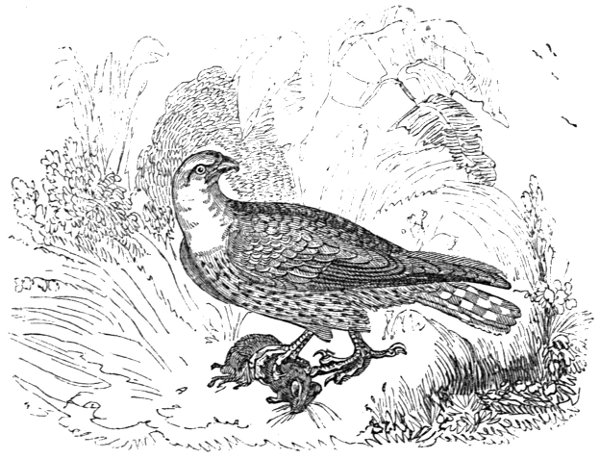
This bird is somewhat less than the buzzard. Its bill is blue; cere inclining to green; eyes yellow: the feathers on the upper part of the body are brown, with pale edges; above each eye there is a white line, which runs towards the hinder part of the head, and beneath it is a black streak pointing downwards towards the neck; the throat is white; the breast of a dull yellow, marked with brown spots; thighs and vents the same; the quill feathers are dusky, marked on the inner webs with oval spots of rust colour; the tail is spotted in the same manner; the legs are short and strong, and of a bluish colour.
The lanner is not common in England; it breeds in Ireland, and is found in various parts of Europe. It derives its name from its mode of tearing its prey into small pieces with its bill.—White.
Lansquenet, s. A common foot-soldier; a game at cards.
This game may be played by almost any number of people, although only one pack of cards is used at a time, during each deal. The dealer, who has rather an advantage, begins by shuffling the cards, and having them cut by any other person of the party; after which he deals out two cards on his left hand, turning them up; then one for himself and a fourth, which he places in the middle of the table for the company, called the rejouissance card. Upon this card any, or all of the company, except the dealer, may put their money, either a limited or unlimited sum, as may be agreed on, which the dealer is obliged to answer, by staking a sum equal to the whole that is put upon it by different persons. He continues dealing, and turning the cards upwards, one by one, till two of a sort appear; for instance two aces, two deuces, &c., which, in order to separate, and that no person may mistake for single cards, he places on each side of his own card; and as often as two, three, or the fourth card of a sort come up, he always places them in the same manner, on each side of his own. Any single card the company has a right to take and put money upon, unless the dealer’s own card happens to be double, which often occurs by this card being the same as one of the two cards which he first of all dealt out on his left-hand. Thus he continues dealing till he brings either their cards, or his own. As long as his own card remains undrawn he wins; and whichever card comes up first loses. If he draw or deal out the two cards on his left, which are called the hand-cards, before his own, he is entitled to deal again; the advantage of which is merely his being exempted from losing when he draws a similar card to his own immediately after he has turned up one for himself.
This game is often played more simply without the rejouissance card, giving every person round the table a card to put money upon. Sometimes it is played by dealing only two cards, one for the dealer and another for the company.—Hoyle.
Lantern, s. A transparent case for a candle; a lighthouse; a light hung out to guide ships.
Lap, v. To wrap or twist round anything; to involve in anything.
Lapdog, s. A little dog, fondled by ladies in the lap; generally a common nuisance.
In one of the ships of the fleet, that sailed lately from Falmouth, for the West Indies, went passengers, a lady and her seven lap-dogs, for the passage of each of which she paid thirty pounds, on the express condition, that they were to dine at the cabin-table, and lap their wine afterwards. Yet these happy dogs do not engross the whole of their good lady’s affection; she has also, in Jamaica, forty cats and a husband.—Country Newspaper.
Lapwing, Bastard Plover, or Pee Wit, (Tringa vanellus, Linn.; Le Vanneau, Buff.) s. A clamorous bird with long wings.
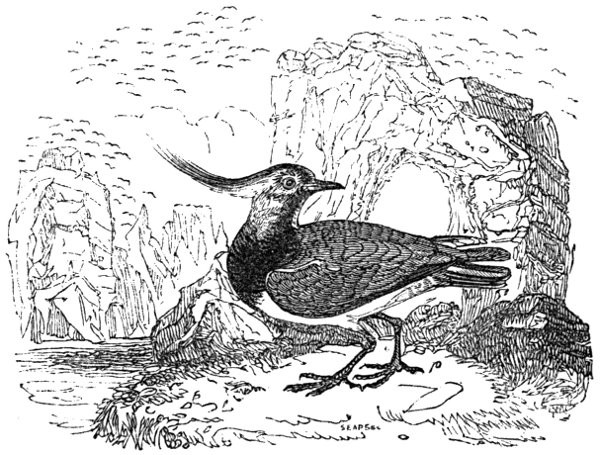
This bird is about the size of a pigeon. Its bill is black; eyes large and hazel; the top of the head is black, glossed with green; a tuft of long, narrow feathers issues from the back part of the head, and turns upwards at the end; some of them are four inches in length; the sides of the head and neck are white, which is interrupted with a blackish streak above and below the eye; and the back part of the neck is a very pale brown; the forepart, as far as the breast, is black; the back and the wing coverts are of a dark green, glossed with purple and blue reflections; the quills are black, the first four tipped with white; the breast and belly are of a pure white; the upper-tail coverts and vent pale chestnut; the tail is white at the base, and the rest of it is black, with pale tips; the outer feathers almost wholly white, the legs are red; claws black; hind-claw very short.
This bird is a constant inhabitant of this country; but as it subsists chiefly on worms, it is forced to change its place in quest of food, and is frequently seen in great numbers by the sea-shore, where it finds an abundant supply. It is everywhere well known by its loud and incessant cries, which it repeats without intermission whilst on the wing, and from which, in most languages, a name has been given it, imitative of the sound. The peewit is a lively, active bird, almost continually in motion; it sports and frolics in the air in all directions, and assumes a variety of attitudes; it remains long upon the wing, and sometimes rises to a considerable height; it runs along the ground very nimbly, and springs and bounds from spot to spot with great agility. The female lays four eggs of a dirty olive, spotted with black: she makes no nest, but deposits them upon a little dry grass hastily scraped together: the young birds run very soon after they are hatched: during this period the old ones are very assiduous in their attention to their charge; on the approach of any person to the place of their deposit they flutter round his head with cries of the greatest inquietude, which increase as he draws nearer to the spot where the brood are squatted; in case of extremity, and as a last resource, they run along the ground as if lame, in order to draw off the attention of the fowler from any farther pursuit. The young lapwings are first covered with a blackish down, interspersed with long white hairs, which they gradually lose, and about the latter end of July, they acquire their beautiful plumage. At this time they assemble in flocks, which hover in the air, saunter in the meadows, and after rain disperse among the ploughed fields. In October the lapwings are very fat, and are then said to be excellent eating. Their eggs are considered as a great delicacy, and are sold in London at three shillings a dozen.
The following anecdote communicated by the late Rev. J. Carlyle, is worthy of notice, as it shows the domestic nature of this bird, as well as the art with which it conciliates the regard of animals differing from itself in nature, and generally considered as hostile to every species of the feathered tribe. Two of these birds, given to Mr. Carlyle, were put into a garden, where one of them soon died; the other continued to pick up such food as the place afforded, till winter deprived it of its usual supply: necessity soon compelled it to draw nearer the house, by which it gradually became familiarised to occasional interruptions from the family. At length one of the servants, when she had occasion to go into the back-kitchen with a light, observed that the lapwing always uttered his cry ‘pee wit’ to obtain admittance. He soon grew more familiar; as the winter advanced he approached as far as the kitchen, but with much caution, as that part of the house was generally occupied by a dog and a cat, whose friendship the lapwing at length conciliated so entirely, that it was his regular custom to resort to the fireside as soon as it drew dark, and spend the evening and night with his two associates, sitting close by them, and partaking of the comfort of a warm fireside. As soon as spring appeared, he left off coming to the house, and betook himself to the garden; but on the approach of winter he had recourse to his old shelter and his old friends, who received him very cordially. Security was productive of insolence; what was at first obtained with caution, was afterwards taken without reserve: he frequently amused himself with washing in the bowl which was set for the dog to drink out of, and while he was thus employed, he showed marks of the greatest indignation if either of his companions presumed to interrupt him. He died in the asylum he had chosen, being choked with something he had picked up from the floor. During his confinement, crumbs of wheaten bread were his principal food, which he preferred to any thing else.
Lard, s. The grease of swine; the chief ingredient in composing ointments.
Lark, s. A small singing bird.
From the peculiar construction of the hinder claws, which are very long and straight, larks generally rest upon the ground; those which frequent trees perch only on the larger branches. They all build their nests upon the ground, which exposes them to the depredations of the smaller kinds of voracious animals, such as the weasel, stoat, &c., which destroy great numbers of them. The cuckoo, likewise, which makes no nest of its own, frequently substitutes its eggs in the place of theirs. The general characters of this species are thus described:—
The bill is straight and slender, bending a little towards the end, which is sharp pointed; the nostrils are covered with feathers and bristles: the tongue is cloven at the end; tail somewhat forked; the toes divided to the origin; claw of the hinder toe very long, and almost straight; the fore claws very short, and slightly curved.
Twirling for larks is a species of amusement peculiar to the French, and is thus described:—
These birds are attracted to any given spot in great numbers, by a singular contrivance, called a mirror.
This is a small machine, made of a piece of mahogany, shaped like a chapeau bras, and highly polished, or else it is made of common wood, inlaid with small bits of looking-glass, so as to reflect the sun’s rays upwards; it is fixed on the top of a thin iron rod, on an upright spindle, dropped through an iron loop, or ring, attached to a piece of wood to drive into the ground. By pulling a string, fastened to the spindle, the mirror twirls, and the reflected light unaccountably attracts the larks, who hover over it, and become a mark for the sportsman. In this way, says an old sportsman, I have had capital sport. A friend of mine actually shot six dozen before breakfast; while he sat on the ground he pulled the twirler himself, and his dogs fetched the birds as they dropped. However, I go on in the common way, and employ a boy to work the twirler. Ladies often partake of the amusement, on a cold dry morning, not by shooting, but by watching the sport: so many as ten or a dozen parties are sometimes out together, firing at a distance of five or six hundred yards, and in this way the larks are constantly kept on the wing. The most favourable mornings are when there is a gentle light frost, with little or no wind, and a clear sky; for when there are clouds, the larks will not approach. One would think the birds themselves enjoyed their destruction, for the fascination of the twirler is so strong, as to rob them of the usual fruits of experience; after being fired at several times, they return to the twirler, and form again into groups, above it; some of them even fly down, and settle upon the ground within a yard or two of the astonishing instrument, looking at it this way and that way, and all ways together, as if nothing had happened.—Sporting Anecdotes.—Bewick.
Larva, s. The enica or caterpillar.
Larus (Auctores), s. Gull, a genus thus characterised.
Bill long or middle sized, strong, hard, compressed, cutting, curved towards the point, the under mandible forming a saliant angle. Nostrils at the sides, in the middle of the bill, slit lengthwise, straight, pierced from part to part. Legs slender, naked to the knee; shank long; three toes before, wholly webbed; the hind toe free, short, and jointed high upon the shank. Tail with the feathers of equal length; wings long, the first quill almost of equal length with the second.—Montagu.
Lash, s. A stroke with anything pliant and tough; the thong or point of the whip; a leash, or string in which an animal is held.
Laudanum, s. A soporific tincture; liquid opium.
Laughing Gull (Larus ridibundus, Leisler), s.
Length fifteen, breadth thirty-seven inches; weight ten ounces. Bill and feet rich vermilion; irides hazel; round the eyes a few white feathers; lower part of the neck, tail, and belly white; the back and wings grey; primores white, the first with the outer margin black; the second tipped with black, and marked with a black spot on the inner web. In winter the head is white, with a black patch on the ear, and another in front of the eyes; under the wing blackish grey. Female similar. Nest, according to Wilson, in meadows and islands in fresh water lakes. Eggs three, olive, with dusky blotches. It leaves Scotland in winter, but is a permanent resident in England.
These birds appear to be subject to great variety, either from age or from change of season, and in those changes they have been described as different species. The red-legged gull of authors is only this bird before it is arrived at maturity; and there seems no doubt but the old birds lose the black on the head in the winter, and do not assume it again till the breeding season; but there is generally a little black about the ears; the bill and legs also lose their bright colour.
We have seen hundreds of these birds together in the winter, but have never seen one with a black head at that season. They appear in great abundance in the autumn, on the coast of Caermarthen and Glamorganshire, particularly about the mouths of rivers. At that time the head is white, in some mottled with brown, with a dusky spot behind the ear; the back and wing coverts in young birds are mottled with brown and white; the tail crossed with a dusky bar at the end; the bill and legs scarcely tinged with red. Towards spring the back begins to assume the ash-colour; then the wing coverts, and the bill and legs, obtain their proper colour; the black behind the ears spreads and meets behind, and on lifting up the feathers of the crown about the month of March, the stubs of the black feathers are to be observed. At this time also some few black feathers appear on the throat; but the perfect black head is not assumed during their stay in those parts. In Devonshire we have seen them complete in feather later in the spring, but never remember to have observed the same appearance in winter.
The laughing gull is said to breed in Lincolnshire in the fens, and in other parts of England, upon the borders of rivers.
Dr. Plott assures us, in his History of Staffordshire, that in his time these birds annually visited a pool in Staffordshire. He also assures us that they would not breed on any other land than that of the proprietor of the before-mentioned place; and that on the death of the owner, they deserted the pool for three years, but only retired to another estate belonging to the next heir.
The young birds were accounted good eating, and were taken by driving them into nets before they could fly; that fifty dozen were taken at a driving, and that five shillings per dozen was the usual price.
The young were kept alive and fattened on offal. It is also added that three drivings were generally made in a season; and that anciently as many were taken as produced a profit of fifty or sixty pounds.
No author mentions their being seen in winter, having at that time been made a distinct species under various denominations.
It makes a nest on the ground with rushes, dead grass, and such like materials, and lays three eggs, of an olivaceous brown, marked with rusty brown blotches.—Montagu.
Launcefish, or Sandlance, s. A sea fish which buries itself, on the recess of the tide, more than a foot deep in the sand. It is much used for baits.
Launch, v. To force into the sea; to rove at large.
Laurel, s. A tree, called also the cherry bay.
Lavaret, s. A bird; a lake fish.
Lavaret is a fish known in England by the name of shelley or fresh water herring, in Wales by that of gwinniad; in Ireland by that of pollan; and in Scotland by that of vangis. In colour it is most like a grayling, but with broader and larger scales; it is common in the large lakes of most Alpine countries, and is known at Geneva by the name of ferra; and I believe that the salmo ceruleus, or wartmann of Bloch, or the gang-fisch of the Lake of Constance, from a comparison that I made of it with the ferra, is a variety of the same fish. It sometimes is as large as two pounds, and when quite fresh, and well fried or boiled, is an exceedingly good fish, and carves like grayling. The lavaret of different lakes has appeared to me to vary in the number of the spines in the fins. One brought me from the Lake of Zurich, thirteen inches long and eight inches in girth, had twelve spines in the dorsal fin, fifteen in the pectoral fins, eleven in the ventral, thirteen in the anal, and eighteen in the caudal. The gang-fisch, from the Lake of Constance, which was of a bluer colour, but I think decidedly only a variety of the same fish, was seven inches and three-quarters long, and four in girth, had twelve spines in the dorsal fin, fifteen in the pectoral, eleven in the ventral, twelve in the anal, and eighteen in the caudal. A lavaret from the Traun See had twelve spines in the dorsal fin, seventeen in the pectoral, thirteen in the ventral fin, twelve in the anal fin, and twenty-four in the caudal fin. One from the Hallstadt See was a larger and broader fish, but did not differ from the lavaret of the Traun See, except in having two spines less in the tail. It is only taken with nets. It feeds on vegetables, and in the stomachs of those I have opened I have never found either flies or small fishes.—Salmonia.
Lawn, s. An open space between woods; fine linen.
Laxative, s. Medicines that open the bowels moderately, without stimulating them so much as to increase their secretions. They consist of castor, olive, or linseed oils; the neutral salts, common salt, and small doses of aloes, as in the following formula:—
Laxative Drench.
1. Castor oil 1 pint.
2. Sweet oil, or linseed, or rape oil 1 pint.
3. Epsom salt 6 to 12 oz.
Whey or gruel 1 quart.
Castor oil 6 to 12 oz.—Mix.
4. Powdered aloes 2 to 3 dr.
Carbonate of potash 2 dr.
5. Water 8 oz.
Castor oil 8 oz.—Mix.
Ball.
Aloes 3 to 4 dr.
Soap 3 to 4 dr.
Syrup enough to form a ball.
Lay, s. Grassy ground, meadow, ground unploughed.
Lea, s. Ground enclosed.
Lead, s. A soft heavy metal.
Many useful preparations are made from this metal; among which are the following:—
Acetate, or super-acetate of lead, commonly called sugar of lead, is used in making cooling lotions and eye-washes.
Red Lead, or Minium, is a red powder, made by mixing lead in a high degree of heat. It is used in the composition of plasters and charges.
White Lead is often employed in the composition of healing and softening ointment, for horses that are subject to cracked heels.
Lead, v. To fit with lead in any manner; to lead lines. Vide Lines.
Leader, s. One that leads or conducts; commander; one who goes first; foremost horse in a tandem or team.
League, s. A measure of length, containing three miles.
Lean, a. Meagre, wanting flesh; out of condition.
Lean, s. The part of flesh which consists of the muscle without the fat.
Leap, v. To pass over or into by leaping.
Leap, s. Bound, jump, act of leaping; space passed by leaping; an assault of an animal of prey; embrace of animals.
Leash, s. A brace and a half; a leather thong, by which a falconer holds his hawk, or a courser leads his greyhound; a band wherewith to tie anything in general.
Leash is a sporting term in use to imply the number three; as exceeding one, and not reaching two brace; for instance, a brace of hares, a leash of pheasants, and two brace of partridges. A brace of pointers, a leash of greyhounds, and two brace of spaniels. Custom, however, in this, as in most other things, admits of deviation and exception; in proof of which we say a brace of spaniels, a couple and a half of hounds, and two brace of pointers; a brace of snipes, a couple and a half of woodcocks, and two couple of rabbits. It is therefore consistent and sportsman-like to say a leash of birds (partridges), a leash of pheasants, a leash of hares, or any other article where two are termed a brace; but improper to call three a leash, where two of the kind are called a couple.
Leather, s. Dressed hides of animals.
Leech, s. A physician, a professor of the art of healing; a kind of small water serpent, which fastens on animals, and sucks the blood.
Leeward, a. Under the wind, on the side opposite to that from which the wind blows.
Leg, s. The limb by which animals walk, particularly that part between the knee and the foot in men.
The part of the limb between the knee and the fetlock consists of three bones—a large one before, called the cannon or shank, and two smaller or splint bones behind. The shank-bone is rounded in front, and flattened, or even concave behind. It is the straightest of the long bones, as well as the most superficially situated, for in some parts it is covered only by the skin. The upper head is flat, with slight depressions corresponding with the lower row of the bones of the knee. The lower head is differently and curiously formed. It resembles a double pulley. There are three elevations, the principal one in the centre, and one on each side; and between them are two slight grooves; and these so precisely correspond with deep depressions and slight prominences in the upper head of the larger pastern, and are so enclosed and guarded by the elevated edges of that bone, that when the shank-bone and the pastern are fitted to each other, they form a perfect hinge: they admit of the bending and extension of the limb, but of no lateral or side motion; which is a circumstance of very great importance in a joint so situated, and having the whole weight of the horse thrown upon it.
The smaller bones are placed behind the larger on either side; a slight projection only of the head of each can be seen in front. The heads of these bones are enlarged, and receive part of the weight conveyed by the lower row of the bones of the knee. They are united to the larger bone by the same kind of substance which is found in the colt between the bone of the elbow and the main bone of the arm; and which is designed, like that, by its great elasticity, to lessen the concussion or jar when the weight of the animal is thrown on them.
Lenitive, a. Anything applied to ease pain; a palliative.
Lepidoptera, s. An order of insects which have their wings imbricated with scales, as moths, butterflies, &c. &c.
Leporine, a. Belonging to a hare, having the nature of a hare.
Leprosy, s. A loathsome distemper, which covers the body with a kind of white scales.
Lethargy, s. A morbid drowsiness, a sleep from which one cannot be kept awake.
Level, v. To aim at, to bring the gun and arrow to the same direction with the mark.
Leveret, s. A young hare.
Lick, v. To pass over with the tongue; to lap, to take in by the tongue.
Ligament, s. A strong compact substance which unites the bones in articulation; anything which connects the parts of the body; bond, chain.
Ligature, s. Anything bound on; bandage; the act of binding; the state of being bound.
Lights, s. The lungs, the organs of breathing.
Limb, s. A member, a jointed or articulated part of animals.
Lime, s. A viscous substance drawn over twigs, which catches and entangles the wings of birds that light upon it; matter of which mortar is made; the linden tree; a species of lemon.
Limewater, s. Is made by pouring water upon quicklime.
Lime-water is recommended in diabetes. It is made by mixing lime with a large proportion of boiling water, stirring the mixture for some time, and afterwards pouring off the transparent liquor, which is to be carefully excluded from the air.
Limpit, s. A kind of shell-fish.
Linchpin, s. An iron pin that keeps the wheel on the axletree.
Line, s. Longitudinal extension; a slender string used in angling.
The most easy method of making hair into lines is, by a small engine, which is sold at most of the fishing-tackle shops. It consists of a large horizontal wheel, and three very small ones, inclosed in a brass box, about a quarter of an inch thick, and two inches in diameter; the axis of each of the small wheels is continued through the under side of the box, and is formed into a hook; by means of a strong screw, it may be fixed on any post or partition, and is set in motion by a small winch in the centre of the box; the process is soon acquired, and it is thus used:—Take as many hairs as you purpose the line shall contain, and divide them into three parts; each of these is to be tied to a piece of fine twine doubled, and fixed to the hooks which depend from the machine; then take the piece of lead which has a hook at its top, and after tying the three parcels of hair together at the loose end, hang the weight thereon: after this, cut three grooves in the inside of a cork at equal distances, and in each groove place a division of the hairs, that, by gently turning the engine, the links may turn with a greater evenness to the lead. As the links grow tighter, move the cork slowly upwards, and when the whole is sufficiently twisted, take out the cork and tie the link into a knot, and so proceed till the quantity of links wanted for a line are completed; observing to lessen the number of hairs in each link in such proportion as that the line may be taper. The links should then be laid for an hour into cold water; some persons, whether a hair starts or not, retwist them before they are made into a line, and more particularly when there is an odd hair in the number twisted. Some put the hair for ten minutes into warm water before working it into links.
In making lines, every hair in every link should be equally big, round and even, that the strength may be so proportionate that they will not break singly, but altogether: by carefully choosing the hairs, they will stretch and bear a much stronger force than when a faulty hair is included. Never strain the hair before twisting; the best will easily be selected by the eye, and two or three inches of the bottom part of the hair should be cut off, as it is generally defective. The links should be twisted very slowly, and not lie harsh, but so as to twine one with another, and no more, for a hard twisted line is always weak: by mixing chestnut, black, or any other coloured hair, the line may be varied at pleasure.
Lines of silk or hemp may be coloured by a strong decoction of oak bark, which it is believed resists the water, and adds to their durability: any shade of an excellent russet brown may be obtained according to the time they remain in the decoction, which should be used cold.
In leading of lines great care is needful to balance the floats so nicely that a very small touch will sink them. Some use for this purpose lead shaped like a barleycorn, but shot is better; and for fine fishing have a number of small in preference to a few large shot on the line; the lowest of either ought to be nine or ten inches from the hook.
Line, v. To cover on the inside; to put anything in the inside; to cover a bitch.
Ling, s. Heath; a kind of sea-fish.
Liniment, s. An application of a consistence rather thicker than oil, or transparent preparations, such as soap liniment.
The following formulæ are given as examples:—
SOAP LINIMENT.
Hard soap 1 oz.
Camphor 1 oz.
Oil of rosemary 1 oz.
Rectified spirit 1 pint.
Cut up the soap, and let it stand with the spirit until dissolved, then add the rest.
AMMONIA, OR VOLATILE LINIMENT.
Strong solution of ammonia 1 oz.
Olive oil 2 oz.—Mix.
To this, camphor, or oil of turpentine is sometimes added; and the solution of ammonia is joined, for some purposes, to the soap liniment. The soap liniment is the same as the celebrated opodeldoc, and may be either solid or fluid, according to the proportion of soap used; but it may be made also with soft soap, and is then fluid with a larger proportion of soap.—Vide Egyptiacum.
LINIMENT OF CAMPHOR, COMPOUND.
Camphor 2 oz.
Spirit of lavender 1 pint.
Solution of ammonia 6 oz.—Mix.
Solution of ammonia is named also liquid ammonia, and strong spirit of sal ammoniac.—See Embrocations.
LINIMENT FOR BAD THRUSHES AND CANKER.
1. Tar 4 oz.—Melt, and add
Muriatic acid 6 dr.
Verdigris 4 dr.
Mix, and continue stirring until it is cold.
2. Tar, melted 1 lb.
Strong sulphuric acid, by weight 2 oz.
Stir them well together for some time, and immediately before the mixture is used.
Link, s. A single ring of a chain; anything doubled and closed together; a chain, anything connecting; any single part of a series or chain of consequences; a torch made of pitch and hards; a thread of gut or horse-hair.
Linnet (Linaria linota, Cuvier), s. A small singing bird.
This species is subject to much variety with respect to the red markings which, at certain ages and seasons, are found upon the head and breast, and this has occasioned it to be multiplied into two distinct species by various ornithologists, all of whom seem to agree that the general colour of both are alike, but assert that the greater redpole has none of this colour upon the breast. On comparing the various authors who have given this as a distinct species, we find they all make it nearly the same as the redpole, but not quite so rufous on the upper parts. The principal distinction seems to be in the breast being of a fine crimson colour, and none of that colour on the head.
The male in full plumage has the bill bluish; irides hazel; the head light brown; the feathers on the crown darkest in their middle; sides of the neck inclining to ash-colour; the forehead rosy red; the back, scapulars, and coverts of the wings, fine deep rufous brown, lightest on the rump, and palest on the margin of each feather; the breast is brown, with more or less spots like that on the head; belly light rufous brown; vent almost white; quill-feathers dusky black, with more or less white on the exterior and interior webs, which forms a conspicuous bar of that colour on the wing; the tail is forked, the feathers, like those of the quills, black, margined with white, which colour predominates on the inner webs; coverts of the tail black, edged with grey; legs brown. The weight of the male is about five drachms, that of the other sex rather less. The plumage of the female is more dusky brown; the coverts of the wings rufous-brown; sides of the throat plain dirty white, the middle part streaked; breast and sides pale brown, with dusky streaks; quills and tail like the other sex, but the former not so deeply margined with white, and of course no perceptible bar on the wing.
These birds fly in flocks during winter, at which time the males have little or none of the red markings which, on the return of spring, they put forth.
This linnet is very common throughout Britain, extending as far as the Orkneys, where it is abundant. During the summer it resorts to waste land and commons, in the upper parts of the country, where it breeds. Furzy commons seem to be the favourite resorts of these birds during that season; the bushy furze being admirably adapted to conceal the nest from the prying eye, and sometimes a quickset or gooseberry-bush answers the purpose. The nest is composed of moss woven with wool, and lined with wool and hair, very neatly put together; the eggs are four in number, of a bluish white, with a few purplish specks and short lines; their weight from twenty-four to thirty grains. In the month of April they pair, and commence building their nest, and in May the first broods are hatched; but if the nest should be destroyed, they will build another as late as the month of August, appearing dissatisfied until the object of their visit is accomplished. During the time of nidification, and until the young are hatched, the song of the linnet, although short, possesses much sweetness. At once brilliant and soft, the song of the linnet consists of many irregular notes, tastefully put together in a clear and sonorous tone, which continues during the whole year, except at the moulting season. Besides its own natural note, it will soon acquire the notes of other birds, particularly the nightingale; and may be taught in a very short time to imitate any of our tunes, if they are whistled to it. After describing the mature bird, Bechstein says, “a male of three years old is distinguished in the spring, by the name of the red linnet (Linotte Sanguine); the forehead is then of a bright blood-red colour; the remainder of the head being of a reddish ash-colour; the top a little speckled with black. After the moulting in autumn, we no longer see the red upon the forehead, that colour being hid by the white feathers; the coverts of the breast then assume a deep brown-colour, and blackish spots begin to appear; the interior feathers on the breast, which were formerly red, are now of a brownish grey, mixed with red. In this plumage it is known by the name of the grey linnet.
“After the time of its second moulting, if we part the reddish grey feathers on the forehead and breast, we find that they are still red at the tips, and only hid by the yellowish white borders of the new feathers.”
In this state it is the rock or mountain linnet (Linotte de Roche).
“I have even,” he adds, “had these birds with the forehead and breast of a rich reddish yellow.” To this variety bird catchers give the name of the yellow linnet. These varieties of plumage do not occur with the female, which is besides considerably smaller. In addition to these, there are many changes produced by season and age; for instance, as the bird increases in age, the red colour on the head increases also.—Bechstein—Selby—Montagu.
Linseed, s. The seed of flax.
Linseed, or flax-seed, abounds with oil and mucilage, and is useful in the composition of those emollient drinks given in inflammations of the bladder and bowels, or complaints of the urinary passages. A strong mucilaginous drink may be made without bruising the seeds, either by decoction or infusion.
Linseed Cake is that part of the linseed which remains after the oil has been pressed out. It is employed to fatten cattle, and is given, occasionally, to horses. When ground it is sold as linseed meal and linseed powder, and often used in the composition of poultices.
Linseed Oil is sometimes employed as a laxative, and, though very inferior to castor, and even olive oil, may be occasionally substituted for it, on account of its being much less expensive. It is used in making pectoral emulsions, liniments, and ointments; but even for these purposes olive oil is preferable, on account of the drying quality of linseed oil.
Lint, s. The soft substance commonly called flax; linen scraped into soft woolly substance to lay on sores.
Lip, s. The outer part of the mouth, the muscles that shoot beyond the teeth; the edge of anything.
Litter, s. A kind of portable bed; a carriage hung between two horses; the straw laid under animals; a brood of young; any number of things thrown sluttishly about; a birth of animals.
Litter, v. To bring forth, used of beasts; to cover with things negligently; to cover with straw.
Liver, s. One who lives; one who lives in any particular manner; one of the entrails.
Livergrown, a. Having an increased liver.
Lizard, s. An animal resembling a serpent, with legs added to it.
Loach, s. A little fish.
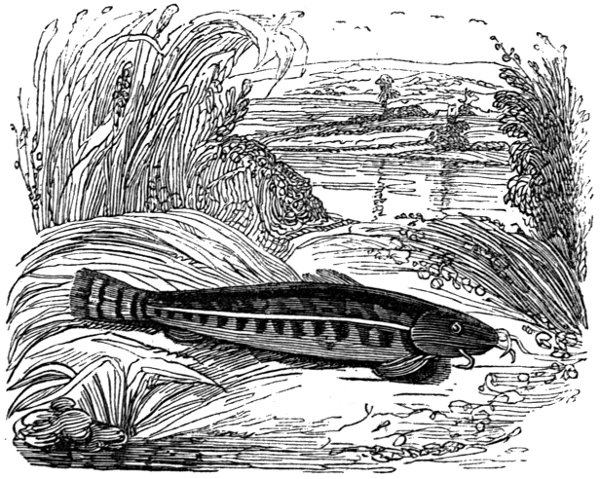
This little fish is found in small brooks among the gravel, or where there is a soil of mud and gravel together, with weeds, and in several of our rivers by the sides of sharp streams; it seldom rises to the top of the water, keeping at the bottom on the gravel, upon which it feeds, and is, on that account, in some places, called the groundling; it is frequent in the stream near Amesbury, in Wiltshire, where, out of frolic, the sportsmen swallow it down alive, in a glass of white wine.
It is a slimy fish without scales, and of rather a long make; the mouth is small, placed beneath, and has no teeth; it is bearded like the gudgeon and the barbel, having on the upper mandible six small beards, one at each corner of the mouth, and four at the end of the nose; the body is smooth and slippery, and almost of the same thickness; the colour of the head, back, and sides, is in some white, in others of a dirty yellow, very elegantly marked with large spots, consisting of numberless minute black specks; the pectoral, dorsal, and caudal fins are also spotted; the belly and ventral fins of a pure white; the tail broad, and rather rounded. One of the largest ever heard of by Mr. Pennant, was four inches and three quarters in length, but they seldom exceed three inches. The flesh of the loach is singularly nutritious, and from that circumstance, and its being equally grateful to the palate, it is recommended to the sick. The females, during summer, are generally full of spawn; these fish are to be taken with a very small red worm, the bait touching the ground. The loach is used as a bait for other fish, and for eels perhaps it is the best.
Load, v. To burden, to freight; to encumber; to charge a gun; to make heavy.
Load, s. The leading vein in a mine; the charge of a gun.
Loading.—Much as may be said on this important head, I shall attempt to explain it by one simple example: for instance, to load a single gun of six, or double gun of seven, eight, or nine pounds’ weight, take a steel charger, which holds precisely an ounce and a half of shot; fill it brimful of powder, from which first prime, and then put the remainder into the barrel; to this add the same measure bumperful of shot, and then regulate the tops of your flasks and belts accordingly.
Some little difference of charge will, of course, be required between a twenty-two and a fourteen gauge; and, in this, we may be guided by the shoulder, observing, at the same time, the proportion of each here recommended: but, unless the gun is very heavy, a gauge of fourteen will recoil more than one of twenty-two; so that, after all, the above charge might do equally well for both.
For those who have scales at hand, another way will be to ascertain this by weight; for instance, to the guns above mentioned, put one drachm and a half of powder, exclusive of priming, to an ounce and a half of shot. The proportion for a twelve pounds’ gun to be doubled; eighteen pounds’ trebled; twenty-four pounds’ quadrupled, &c. with one trifling deviation; viz.—the larger the gun the less should be the proportion of shot, as the larger and longer the calibre the more powder may be damaged in going down it.—Hawker.
Lob, s. Any one clumsy, or sluggish; a large worm.
Lobe, s. A division, a distinct part; used commonly for a part of the lungs.
Lobster, s. A small crustaceous fish, having a cylindrical body with a long tail and long antennæ. It is found on all the rocky coasts of the United Kingdom.
Lock, s. An instrument composed of springs and bolts, used to fasten doors and chests; the part of the gun by which fire is struck; a hug, a grapple; any enclosure; a quantity of hair or wool hanging together; a tuft; a contrivance to raise the water on a river or canal made navigable.
To dissect a gun-lock.—Place the lock on full cock, screw on the cramp, let down the cock, and the main-spring will fall off; replacing it when necessary, by letting down the cock, hooking the spring, full cocking, and then removing the cramp. I need not detail the mode of taking to pieces the whole of the lock; but I may remind you, that, in separating the cock from the tumbler, the turnscrew should on no account be placed between the cock and the lock-plate, but a small blow should be struck on the end of the tumbler, which may protrude through the cock, or, if level with it, the end of a turnscrew may be placed upon it, and the other end struck as a punch; while the plate of the lock itself, disencumbered of course of all the other movements, is held in the palm of the left hand, the turnscrew being held in its place by the finger and thumb of the same hand. In inserting the scear, it is well to remember that this is to be done after re-fixing the feather spring, by hooking the end in the tumbler before the re-adjustment of the mainspring, and pressing back the other end by force till the screw is put in its place. This, I confess, is somewhat more difficult than half securing the bridle, and putting on the feather spring last by pushing it into its place when the screw is through it, though not tight; but I like the first-mentioned of these ways the best. Let me recommend you to clarify the oil you use for the purpose of lubricating the locks, by filling the bottle with shot, drawing off the clear oil, and repeating the process again and again at your leisure. See here is some I have had eleven years, and you will observe it is free from that cloudy deposit which oil not thus or otherwise clarified contains, and which is apt to leave a black stain behind it. But we are to be up early—so good night.—Hints to Sportsmen.
Lockjaw, s.
Castration, nicking, docking, punctures, particularly of the feet; lacerations, and even contusions, will bring it on. I have seen it follow a fall, which presented nothing more than a moderate contusion in the shoulder. In America, it is not an unfrequent result of castration; and in some tropical climates compression of the cord in the operation must always be avoided, so apt is any irritation to produce it in these regions. It is considered as most apt to follow wounds of tendinous and ligamentous parts.
It commences usually by a certain stiffness about the throat, and difficulty in swallowing, or in turning the head, which soon extends itself to the jaws, and occasions a contracted state of the mouth, with the usual inclination to masticate, but painfully and imperfectly performed. As this increases, the jaws can hardly be separated at all, when farriers say the horse is ‘jaw set.’ By the tetanic action of the retractor muscle, the haw is drawn partly over the globe, at the same time that the tension of the other ocular muscles gives the eyes a vivid appearance and retroverted aspect, which ill accords with the more placid effect of a protruded haw. As the disease extends over the voluntary muscles of the trunk and extremities, the appearances are distressing in the extreme. The head is raised, the ears pointed forwards, the nostrils dilated, and the nose is carried out. The legs straddle wide, the tail is cocked, and quivers with the constant fatigue of the levator muscles; and the abdominal muscles are drawn tight over the belly, giving to the horse an appearance of having just completed some extraordinary exertion. The complaint presents a few moments of relaxation sometimes, from the extreme and powerful contractions of the over-strained muscles; while profuse sweats mark the distress and exertions of convulsion. The circulation is, in most instances, at first not much affected; but as the disease increases, the pulse quickens, and becomes tremulous and irregular. The respiration also gradually becomes hurried and irregular; costiveness is usually present, and the urine is sparingly made. In this state the suffering animal may remain from six to ten days, when, worn out by inanition and irritation, he often falls lifeless, or expires after a short state of convulsion.
The general curative practice in tetanic cases among veterinarians, foreign and English, of the present day, leans to the free use of the lancet, to complete opening of the bowels, and to a liberal administration of opiates, as being every one of them powerful antispasmodics singly, but in this painful affection proving doubly so conjointly; to which are added, blistering the spine; and the beneficial effects of this practice, as exemplified by experience, warrant its being at once proceeded on to the exclusion of every other, until it has totally failed.—Blaine.
Lodge, s. A small house in a park or forest; a keeper’s hut.
Loggats, s. A play or game, now called skittles.
Logwood, s. A wood much used in dyeing.
Loin, s. The back of an animal; loins, the reins.
The loins occupy the attention of all good judges in their consideration of a horse, and for the purposes of strength they can hardly be too broad: the back extends to the posterior part of a common sized saddle, and where the back ends, the loins begin. Sometimes, from a defect in the sacral processes of the vertebræ, this junction of the back and loins presents an indentation, as though the union was incomplete. This may be considered, in some degree, as a defect, inasmuch as it deprives the part of muscular attachment, and such horses are said to be badly loined. The strength of the loins depends on the length of the transverse processes of the lumbar vertebræ, which should be long, that there may be an extensive surface for the attachment of the muscles of the back: the muscles themselves should also be powerful on each side, giving width to the loins, and seeming by their enlargement, as it were, to swallow the back bone. When the protuberances of the ilium are very prominent, the horse is called ragged hipped, which is injurious to the appearance only, except in cases where it seems to arise from a paucity of muscle to fill up the intervening spaces. From the loins to the setting on of the tail, the line should be long and very slightly rounded; by which means, also, the distance between the hip and the point of the buttock will be considerable. This formation is peculiar to the improved or blood breed, and in every point of view appears the most perfect; for it affords a very increased surface for the insertion of the powerful muscles of these parts.—Blaine.
Longopen, s. The second long feather in the hawk’s wing.
Loo, s. A game at cards.
Loo or lue, subdivided into limited and unlimited loo, a game, the complete knowledge of which can be easily acquired, is played with five or three cards, though most commonly with five, dealt from a whole pack, either first three and then two, or by one at a time. Several persons may play together, but the greatest number can be admitted when played with three cards only.
After five cards have been given to each player, another is turned up for trump; the knave of clubs generally, or sometimes the knave of the trump suit, as agreed upon, is the highest card, and styled Pam; the ace of trumps is next in value, and the rest in succession, as at whist. Each player has the liberty of changing for others from the pack all or any of the five cards dealt, or of throwing up the hand in order to escape being looed. Those who play their cards either with or without changing, and do not gain a trick, are looed; as likewise is the case with all who have stood the game, if a flush occur, which obliges each, except a player holding Pam, or an inferior flush, to deposit a stake to be divided among the winners at the ensuing deal, according to the tricks which may then be made. For instance, if every one at dealing should stake half-a-crown, the tricks are entitled to sixpence apiece, and whoever is looed must put down half-a-crown, exclusive of the deal: sometimes it is settled that each person looed shall pay a sum equal to what happens to be on the table at the time. Five cards of a suit, or four with Pam, compose a flush, which sweeps the board, and yields only to a superior flush, or an equal one in the elder hand. When the ace of trumps is led, it is usual to say “Pam be civil,” the holder of Pam is then expected to let the ace pass.
When loo is played with three cards, they are dealt by one at a time, Pam is omitted, and the cards are not exchanged, nor permitted to be thrown up.—Hoyle.
Loom, s. A bird.
Loop, s. A double through which a string or lace is drawn, an ornamental double or fringe. Loops or Rings are placed along the fishing rod to conduct the line from the reel to the upper extremity.
Lord-warden, s. An officer in forestry.
Under him are two distinct appointments of officers, the one to preserve the venison of the forest, and the other to preserve its vert: the former term, in the language of the forest law, comprehends every species of game; the latter signifies every thing that bears a green leaf within a forest that may cover a deer, but especially great and thick coverts.
Lore, (Lorum, Linn.) in ornithology, is the space between the bill and the eye, which in the grebe genus is bare, but in other birds is generally covered with feathers.
Lorimer or Loriner, s. Bridle cutter.
Lot, s. Fortune; a chance; a die, or anything used in determining chances.
Lough, s. A lake, a large inland standing water.
Lowbell, s. A kind of fowling in the night, in which the birds are awakened by a bell, and lured by a flame.
Lowland, s. The country that is low in respect of neighbouring hills.
Lubricitate, v. To smooth, to make slippery.
Luck, s. Chance, accident, fortune, hap; fortune, good or bad.
Lug, s. A land measure, a pole or perch; a worm found by digging in oozy sand, an excellent bait for flat fish; the sail of a lugger.
Lugger, s. A fast-sailing vessel with three masts, much used for smuggling and privateering. They vary in size from fifty to one hundred and fifty tons, and are useful vessels for any purposes requiring dispatch.
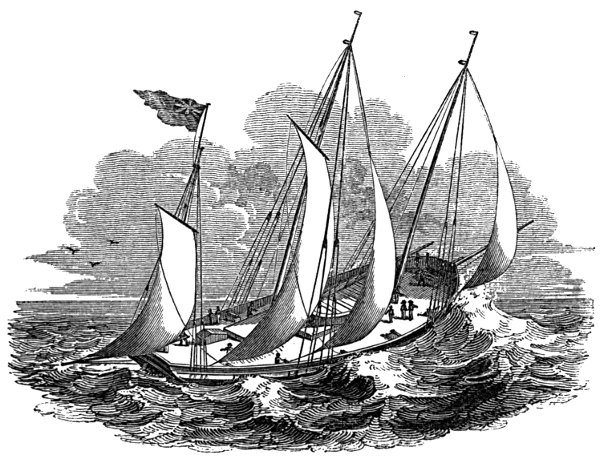
The lugger is, I think, the most inconvenient rig, especially for a yacht; the spars are so heavy that they require all hands to move them. They generally have two sets of lugs—large ones, which require dipping every time you tack; and small working lugs, which do not require dipping, the tack coming to the foot of the mast. The latter are generally used, except in making long reaches, as across Channel, &c. &c.
Another great objection to a lugger is, your decks are so encumbered with the spare spars and sails, which take up a great deal of room; besides the latter being exposed almost continually to the weather, which they must be while kept bent ready for setting; and, thirdly, a lugger is seldom fit to be altered to any thing but a schooner, not having breadth enough for one mast, which, after all, for beauty and speed, is the best: indeed, sailing men are so perfectly aware of this now, that you never see a schooner or lugger enter against a cutter at all near their tonnage. Take them to sea, and they might have a chance; though even there (setting aside accidents) I would back the cutter in a trial; but in fine weather or smooth water there is no comparison.—Sport. Mag.
Lumpfish, s. A sort of fish.
Lunar, a. Relating to the moon, under the dominion of the moon.
Lungs, s. The lights, the organs of respiration.
Each side of the cavity of the chest is occupied by soft, spongy, and slightly elastic masses, called lungs, having the heart appended between them. In a state of distension they completely fill the parietes of the thorax, to which their figure is exactly adapted. The lungs have a distinct division into a right and left mass, each of which presents deep fissures, partially dividing its substance into what are called its lobes. These divisions are not always the same in every subject, but in the majority of instances the right and largest lung presents three lobuli, the left two only. As already described, the pleura first lines the thoracic cavity, and is then reflected over the lungs, affording them a dense covering: a second reflection from each lung by a union of its laminæ, forms a septum, or a complete division of the chest, into two distinct cavities, and thus effectually shuts out all communication between one lung and the other, except by their vessels. The colour of the lungs varies considerably: in the colt they present a lively pinky hue; in the adult horse they are darker, and in very old subjects they have a greyish cast and granulated appearance.—Blaine.
Lurch, s. A term at cards.
Lurch, v. To win two games instead of one at cards.
Lurcher (Canis indagator), s. A dog.
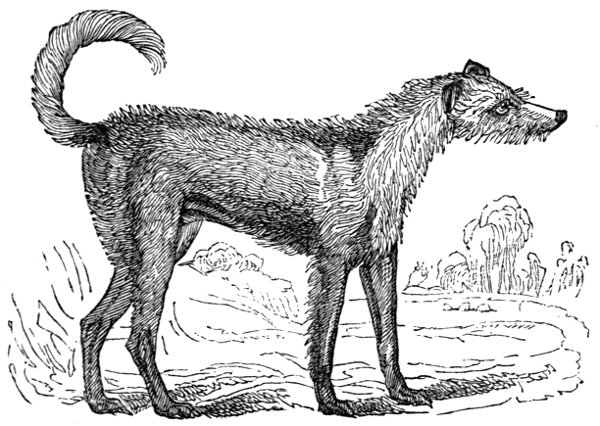
This variety is smaller than the greyhound, with its limbs stronger and shorter, the head less acute, with short, erect, and half-pricked ears; the whole body and tail are covered with rough coarse hair; it is grizzly about the muzzle, and is of a pale sand colour, or iron grey.
The lurcher is supposed to be originally produced, first, by a cross of the greyhound and harrier, and afterwards re-crossed with the terrier; hence the quickness of his scent, which he possesses in a strong degree. The habits of this dog lead him to concealment and cunning; and he is often employed in killing hares and rabbits under the cloud of night, for which nature seems eminently to have fitted him. When taken to the warren, he lies squat, or steals out with the utmost precaution, when he either sees or scents the rabbits feeding, and, like his progenitor, the greyhound, darts upon them with exceeding quickness, without barking or making the least noise. He is trained to bring the booty to his master, who often waits at some distance to receive it. One of these dogs will kill a great many rabbits in the course of a night. Bewick says, that they were so destructive, that they are now with great propriety proscribed, and the breed is almost extinct.
Lure, s. Something held out to call a hawk; any enticement.
The use of this important implement in breaking falcons, is thus described by Sir John Sebright:—
The hawk is to be fed upon the lure, being first made to come to it when held very near him, then when held a little farther off; it is to be next thrown upon the ground to a small distance, and thus he is to be brought by degrees to fly to it, and to seize it eagerly, however far it may be thrown.
An assistant is now to swing the lure at some distance from the falconer, who casts off the hawk.
It is to be thrown into the air when the hawk is flying towards it, but so that he cannot attain it until it falls to the ground, lest he should be hurt by striking it in his flight.
When this lesson has been repeated, until the hawk has become eager to take the lure, the assistant is to swing it as before, but is to take it into his hand when the hawk is coming; he is then to swing it again as soon as the hawk has passed; and finally, to throw it upon the ground, when the hawk is returning towards him.
In this way the hawk will soon be taught to fly round the falconer, bending his flight inwards when the lure is shown to him, or when he hears the call of the falconer, who should always halloo when he is luring. He may thus be made to follow the falconer wherever he pleases; this is called waiting on.
When the hawk has alighted upon the lure, the falconer is to walk round him, whistle to him while he is feeding, and reward him with a good meal when he is taken up.
It is thus that hawks are made obedient to the lure, and that they are exercised when they cannot be flown at game, but they must not be kept too long upon the wing, or they would acquire the habit of flying low; and it is the perfection of a slight falcon to soar as high as possible.—Sebright.
Lurid, a. Gloomy, dismal; a yellow colour bordering on a blue.
Lurk, v. To lie in wait, to lie hidden, to lie close.
Lurkingplace, s. Hiding place, secret place.
Lustre, s. Brightness, splendour, glitter; a sconce with lights; the space of five years.
Lusty, a. Stout, vigorous, healthy, able of body.
Luxate, v. To put out of joint; to disjoint; to displace a limb.
Luxation, s. The act of disjointing; anything disjointed; the displacing a limb.
Luxuriant, a. Exuberant, superfluous, plenteous.
Lymphatic, s. A vessel containing lymph.
Macaw, s. A foreign bird of the parrot kind; its plumage is very splendid, and its feathers valuable in tying salmon flies. Shop flies are frequently tied with imitation feathers, which, on exposure to the sun, become faded and useless.
Mackerel, s. A sea fish. Vide Sea Fishing.
Mackerel-gale, s. A strong breeze, favourable for killing mackerel.
Mad, a. Disordered in the mind; enraged, furious.
Madness, s. Distraction; fury, wildness, rage. Vide Hydrophobia.
Maggot, s. A small grub which turns into a fly.
Magnetic, a. Relating to the magnet; having powers correspondent to those of the magnet; attractive, having the power to draw things distant.
Magpie or Pianet (Corvus pica, Linn.; La Pie, Buff.) s. A bird.
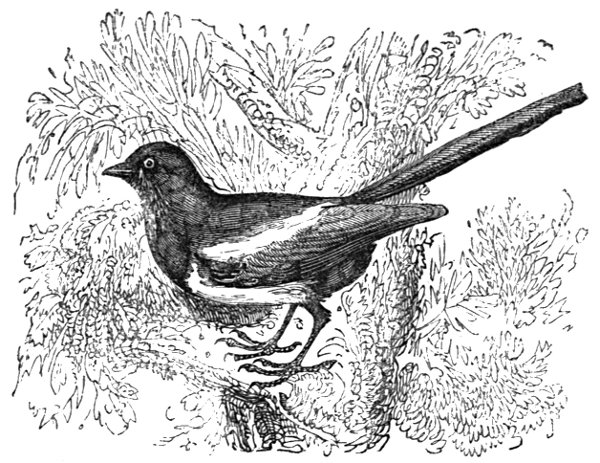
THE MAGPIE.
Its length is about eighteen inches; bill strong and black; eyes hazel; the head, neck, and breast are of a deep black, which is finely contrasted with the snowy whiteness of the under parts and scapulars; the neck-feathers are long, as are also those on the back, which extend towards the rump, leaving only a small space, of a greyish ash-colour, between them and the tail coverts, which are black; the plumage in general is glossed with green, purple, and blue, which catch the eye in different lights; the tail is very long, and rather wedge-shaped; the under-tail coverts, thighs, and legs are black: on the throat and part of the neck there is a kind of feathers, mixed with the others, resembling strong, whitish hairs.
This beautiful bird is everywhere common in England; it is likewise found in various parts of the continent, but not so far north as Lapland, nor farther south than Italy: it is met with in America, but not commonly, and is migratory there. It feeds, like the crow, on almost every thing animal as well as vegetable. The female builds her nest with great art, leaving a hole in the side for her admittance, and covering the whole upper-part with an interweaving of thorny twigs, closely entangled, thereby securing her retreat from the rude attacks of other birds: but it is not safety alone she consults; the inside is furnished with a sort of mattrass, composed of wool and other soft materials, on which her young repose: she lays seven or eight eggs, of a pale green-colour, spotted with black.
The magpie is crafty and familiar, and may be taught to pronounce words, and even short sentences, and will imitate any particular noise which it hears. It is addicted, like other birds of its kind, to stealing, and will hoard up its provisions. It is smaller than the jackdaw, and its wings are shorter in proportion; accordingly its flight is not so lofty, nor so well supported: it never undertakes long journeys, but flies only from tree to tree, at moderate distances.
To destroy magpies.—Wait till the female sits hard on her eggs; and then go, late in the evening, with some large shot in a duck-gun, by which means you may either take her as she flies out of the tree, or blow up the whole concern by firing through the nest.—Bewick—Hawker.
Magpie Hawking, s.
Magpies may be flown with eyess slight falcons, and afford excellent sport.
A down or common, where low trees or thorn bushes are dispersed at the distance of from thirty to fifty yards apart, is the place best calculated for this diversion.
When a magpie is seen at a distance, a hawk is immediately to be cast off. The magpie will take refuge in a bush the moment that he sees the falcon, and will remain there until the falcon arrives, with the hawk waiting on in the air. The magpie is to be driven from his retreat, and the hawk, if at a good pitch, will stoop at him as he passes to another bush, from whence he is to be driven in the same way, another hawk having been previously cast off, so that one or the other may always be so situated as to attack him to advantage.
The second hawk is necessary, for the magpie shifts with great cunning and dexterity to avoid the stoop; and when hard pressed, owing to the bushes being rather far apart, will pass under the bellies of the horses, flutter along a cart rut, and avail himself of every little inequality of the ground in order to escape.
Four or five assistants, besides the falconer, (who should attend solely to his hawks) are required for this sport. They should be well mounted and provided with whips; for the magpie cannot be driven from a bush by a stick; but the crack of a whip will force him to leave it, even when he is so tired as hardly to be able to fly. Nothing can be more animating than this sport; it is, in my opinion, far superior to every other kind of hawking. The object of the chase is fully a match for its pursuers—a requisite absolutely necessary to give an interest to any sport of this kind; and it has the advantage of giving full employment to the company, which is not the case in partridge-hawking.
The magpie will always endeavour to make his way to some strong cover; care, therefore, must be taken to counteract him, and to drive him to that part of the ground, where the bushes are farthest from each other. It is not easy to take a magpie in a hedge. Some of the horsemen must be on each side of it; some must ride behind, and some before him; for, unless compelled to rise, by being surrounded on all sides, he will flutter along the hedge, so as to shelter himself from the stoop of the falcon. Many requisites are necessary to afford this sport in perfection—a favourable country, good hawks, and able assistants.—Sebright.
Maid or Maiden-ray, s. A species of skate fish. They are amazingly plenty on the North West Coast of Ireland, and only used as food by the poorer classes.
Maize, s. Indian wheat.
Malanders, s. A dry scab on the pastern of horses.
Malanders is a disorder that attacks the back part, or flexure, of the knee joint, and depends upon a combination of mange and grease. It appears as a scurfy or scabby eruption, and is often very painful, causing some degree of lameness from the pain the animal feels in moving the joint. Sometimes it is not so considerable as to produce lameness, or any apparent inconvenience, but generally becomes troublesome and obstinate unless attended to. Salanders occur in the fore part, or flexure, of the hock joint, and are of the same nature as malanders. They should first be well washed with soap and water, and all the scurf and loose cuticle completely removed. They may then be cured by the following ointments:—
OINTMENT FOR MALANDERS AND SALANDERS.
No. 1. Ointment of nitrate of mercury, commonly named citrine ointment.
No. 2. Hog’s lard, two ounces; red precipitate, finely powdered, two drachms.
No. 3. Hog’s lard, four ounces; melt, and stir in Goulard’s extract, one ounce.—White.
Male, a. Of the sex that begets young, not female.
Male, s. The he of any species.
Malefeathers, s. Those on the breast of a hawk.
Mallard, s. The drake of the wild duck.
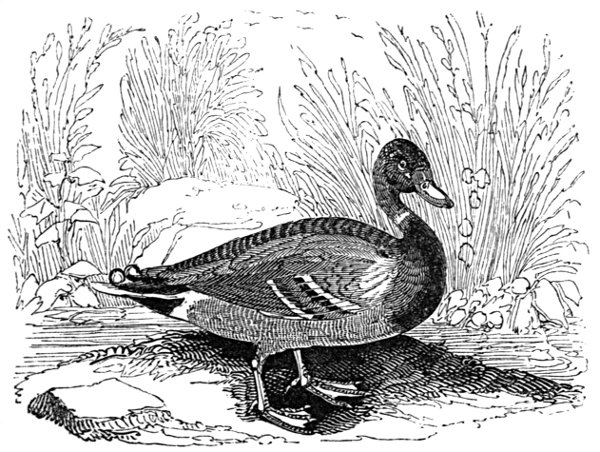
The mallard, or wild-drake, weighs from thirty-six to forty ounces, and measures twenty-three inches in length, and thirty-five in breadth: the bill is of a yellowish-green colour, not very flat, about an inch broad, and two and a half long, from the corners of the mouth to the tip of the nail: the head and upper-half of the neck, are of a glossy, deep, changeable, green, terminated in the middle of the neck by a white collar, with which it is nearly encircled: the lower part of the neck, breast, and shoulders, are of a deep vinous chestnut: the covering scapular feathers are of a kind of silvery white; those underneath, rufous; and both are prettily crossed with small waved threads of brown: wing-coverts ash; quills brown; and between these intervenes the beauty-spot (common in the duck tribe) which crosses the closed wing in a transverse, oblique, direction; it is of a rich, glossy, purple, with violet or green reflections, and bordered by a double streak of black and white. The belly is of a pale grey, delicately pencilled and crossed with numberless narrow-waved, dusky lines, which, on the sides and long feathers that reach over the thighs, are more strongly and distinctly marked: the upper and under tail-coverts, lower part of the back, and rump, are black; the latter glossed with green: the four middle tail-feathers are also black, with purple reflections, and, like those of the domestic drake, are stiffly curled upwards; the rest are sharp pointed, and fade off to the exterior sides, from a brown to a dull white; legs, toes, and webs red.
The plumage of the female is very different from that of the male, and partakes of none of his beauties, except the spot on the wings. All the other parts are plain brown, marked with black. She makes her nest, lays from ten to sixteen greenish-white eggs, and rears her young generally in the most sequestered mosses or bogs, far from the haunts of man, and hidden from his sight among reeds and rushes. To her young helpless unfledged family (and they are nearly three months before they can fly), she is a fond, attentive, and watchful parent, carrying or leading them from one pool to another, as her fears or inclinations direct her; and she is known in this country to use the same wily stratagems to mislead the sportsman and his dog, as those before noticed respecting the partridge.
Like the rest of the duck tribes, the mallards, in prodigious numbers, quit the north at the end of autumn, and, migrating southward, arrive at the beginning of winter in large flocks, and spread themselves over all the loughs and marshy wastes in the British isles. They pair in the spring, when the greatest part of them again retire northward to breed; but many straggling pairs stay with us: they, as well as preceding colonists of their tribes, remain to rear their young, who become natives, and continue with us throughout the year.—Bewick.
Malleable, a. Capable of being spread by beating.
Malmsey, s. A sort of grape; a kind of wine.
Malt, s. Grain steeped in water and fermented, then dried on a kiln.
Malt is very serviceable to horses that are recovering from fever: it is useful, also, when the system is weakened by large abscesses which discharge copiously, and in almost every case depending on debility.
It appears to be easy of digestion, and very nutritious, though not so stimulating as oats. Green malt has been recommended for improving the condition of horses, and giving them a smooth, glossy coat. Infusion of malt is sometimes given with advantage to sick horses; but they generally require to be drenched with it, which is a great inconvenience.—White.
Malt, v. To make malt.
Mammalia, s. The first class of animals in the system of Linnæus.
Manage, v. To carry on; to train a horse to graceful action; to tame or break hawks in.
Manchineel, s. A large tree, a native of the West Indies; a dyewood.
Mandible, s. The jaw, the instrument of manducation.
Mane, s. The hair which hangs down on the neck of horses.
When a horse’s mane stares or lies irregularly, it should he neatly platted; leaded at the ends, and kept damp with a wet sponge.
Maned, a. Having a mane.
Mange, s. The itch or scab in cattle.
The canine mange is a chronic inflammation of the skin, dependent, in some instances, on a morbid constitutional action: it is infectious also, from miasms produced from animal exhalations; and it is notoriously contagious from personal communication with one affected. It is not, however, so completely contagious, in all its varieties, as is supposed, for I have known dogs to sleep with affected ones for some time without becoming mangy; but in the majority of cases it is otherwise; and in some the predisposition to it is such, that almost simple and momentary contact will produce it. The mange which is received by contagion is more readily given to another than that which is generated. The uniform presence of animalculi within the psoric pustules has revived the idea that it originates in the attack of acari.
Mange is also hereditary. A bitch, lined by a mangy dog, is very liable to produce mangy puppies; but the progeny of a mangy bitch is certain to become affected sooner or later; and I have seen puppies covered with it when a few days old. The morbid action by which mange is generated is excited in various ways, and by various causes. When a number of dogs are confined together, the acrid effluvia of their transpiration and urine begets a miasm productive of a virulent mange, very difficult to be removed. Close confinement, with salted food, is even more certainly productive of mange; thus dogs who have come from distant countries, on ship-board, are generally affected with it. Very high living, with little exercise, is a frequent cause: a state nearly approaching to starvation is also not unfavourable to it. In both these apparent contrarieties, the balance between the skin and the digestive functions is not preserved, and the disease follows as a necessary consequence. The disease has some permanent and fixed varieties; it has also some anomalies; but the pruritus or itching is common to all.
The scabby mange, one of the most common forms under which this eruptive complaint appears, is an extension of the secretory pores of the skin in very minute red vesicles, that at first are distinct, but as they extend become pustular, confluent, and scabby. Sometimes simple linear cracks of the cuticle seem to pour out a serous fluid, which concretes into scab. It is occasionally confined to the back; at others it is found principally in the joints of the extremities.
The red mange, so called from a redness of both skin and hair in the parts affected, is likewise not unfrequent, and partakes much of an herpetic character. In this variety there is less pustular eruption, but nearly the whole skin of the body, particularly in white-haired dogs, is in a state of active inflammation: it is also hot to the feel, and itches intolerably. In the red mange, the hair itself becomes morbidly affected, and alters in its colour, particularly about the extremities: it also falls off, and leaves the skin bare, much thickened, and puckered into stubborn wrinkles. Dogs with the strong coarse hair called wired are very liable to this state; in which a magnifying glass applied will often detect innumerable minute ulcerations, covered by furfuraceous scales.
Acute mange.—Besides that variety just noticed, there is yet a more directly acute form of the complaint, which puts on an appearance not unlike erysipelas in some instances; in others it is a pure erythema, or red efflorescence; but more frequently it is accompanied with some ulceration. It commences by a direct febrile attack, with panting heat, and restlessness; next some part of the body (usually the head) begins to swell, which, the second or third day, gives place to ulceration of the nose, eyelids, lips, ears, neck, &c. This ulceration proves superficial, but extensive; and continues a longer or a shorter period, as the treatment is more or less judicious. Bleeding, aperients, and febrifuges, form the constitutional remedies: the topical ones are tepid fomentations the first two days; and, when the tumefaction has given place to ulceration, the application of a cooling unguent of superacetate of lead (sugar of lead), with spermaceti ointment, will be proper. What remains of the affection, in a week or ten days’ time, may be treated as common mange.
Mange is apt to be considered more troublesome than hurtful, which is a great error; for it is not only invariably hurtful, but very often fatal also: when long continued, it frequently ends in dropsy. It sometimes diseases the mesenteric glands, and the subjects of it die tabid: neither in any case can it be neglected with impunity. In sporting dogs it is injurious to their qualities as well as their health: their scent invariably becomes impaired, and their general powers are always weakened by its irritation.
The following formulæ are adapted for the first described form of mange:—
No. 1. Powdered sulphur, yellow or black 4 oz.
Muriate of ammonia (sal ammoniac), crude powdered ½ oz.
Aloes, powdered 1 dr.
Venice turpentine ½ oz.
Lard, or other fatty matter 6 oz.—Mix.
Or,
No. 2. Tobacco in powder ½ oz.
White hellebore in powder ½ oz.
Sulphur in powder 4 oz.
Aloes in powder 2 dr.
Lard, or other fatty matter 6 oz.
Or,
No. 3. Powdered charcoal 2 oz.
Sulphur powdered 4 oz.
Potash 1 dr.
Lard, &c. 6 oz.
Venice turpentine ½ oz.
Or,
No. 4. Sulphuric acid (oil of vitriol) 1 dr.
Lard 6 oz.
Tar 2 oz.
Powdered lime 1 oz.
Or,
No. 5. Decoction of tobacco 3 oz.
Decoction of white hellebore 3 oz.
Oxymuriate of quicksilver (corrosive sublimate) 5 gr.
Dissolve the corrosive sublimate in the decoctions, which should be of a moderate strength; when dissolved, add two drachms of powdered aloes, to render the mixture nauseous, and prevent its being licked off, which ought to be very carefully guarded against: the best means for this purpose is a muzzle having a very fine wire capping or mouth-piece, which will effectually prevent the dog from getting his tongue applied to the ointment, which would prove his almost certain destruction.
The formulæ for red mange are as follow:—
No. 6. Of either of the ointments already prescribed, 1, 2, or 3 6 oz.
Mercurial ointment, mild 1 oz.—Mix.
Or,
No. 7. Powdered charcoal 1 oz.
Prepared chalk 1 oz.
Superacetate, or sugar of lead 1 dr.
White precipitate of quicksilver 2 dr.
Sulphur 2 oz.
Lard 5 oz.
In some cases, the mange ointment, No. 4, alternated with No. 6, one being used one day, and the other the next, will be found beneficial. In others, benefit has been derived from the wash, No. 5, united with lime water. In slight cases of red mange, the following has been found singularly successful:
No. 8. Oxymuriate of quicksilver (corrosive sublimate) powdered 6 gr.
Sulphuretted potash (liver of sulphur) ½ oz.
Lime water 6 oz.—Mix.
The third variety requires a considerable difference in the treatment. When the little spongy openings, piercing the cellular tissue, will admit of it, they should be injected, by means of a very minute syringe, with the wash No. 8. The general surface should also be anointed with the following:
No. 9. Ointment of nitrated quicksilver 2 dr.
Superacetate of lead 1 scruple.
Washed flowers of sulphur ½ oz.
Lard 1 oz.—Mix.
For the Red Mange.—Two ounces of white hellebore in powder, mixed in one quart of the grounds of strong beer, made warm; rub the dog well all over, and dry it in with a good fire; be careful that it does not touch his eyes: put the dog in a warm place, and keep him from water four hours after the application.—Blaine.
Mangel Wurzel, s. A kind of beet, shaped like a carrot, but larger. It is excellent fattening winter fodder. In Germany it has been used for human food in times of scarcity; hence its name, which literally means “the root of scarcity.”—Crabbe.
Manger, s. The place or vessel in which animals are fed with corn.
Manginess, s. Scabbiness, infection with the mange.
Mantling, s. In falconry, the lowering of a hawk’s feathers down to her feet.
Maple-tree, s. A tree frequent in hedge-rows.
Maple is much used in making gun-stocks, and, from the closeness of its grain, and its being susceptible of a high polish, is generally preferred by gun-makers to every other wood. Of late, to stain stocks black has become very fashionable, and come into general use among the leading gun-makers.
Mare, s. The female of a horse.
Maritime, a. Performed on the sea, marine; relating to the sea, naval; bordering on the sea.
Mark, s. A token by which anything is known; anything at which a missile weapon is directed; the evidence of a horse’s age; a sum of thirteen shillings and fourpence; a character made by those who cannot write their names.
Marksman, s. A shot; a man skilful to hit a mark.
Marl, s. A kind of clay, much used for manure.
Marrow, s. An oleaginous substance contained in the bones.
Marsh, s. A fen, a bog, a swamp; a morass; a snipe haunt.
Marsh Mallow, s. A plant useful in making mucilaginous or emollient drinks, clysters, or fomentations.
The root is the best part, and, if carefully dried, may be kept a long time. These mucilaginous drinks are useful when the bowels or bladder are inflamed or irritated by strong physic, or when there is any pain in the urinary passages. They should be given frequently in the course of the day, and may occasionally be made the vehicle for more active medicines. Any thing which contains mucilage in sufficient quantity may be employed for the purpose of making emollient drinks.—White.
Marshy, a. Foggy, fenny, swampy; produced in marshes.
Marten, s. A large kind of weasel, whose fur is much valued; a kind of swallow that builds in houses, a martlet.
This is the most beautiful, and the most destructive to pheasants, of the British beasts of prey. The marten is about eighteen inches long, the tail ten, or, if measured to the end of the hair at the point, where it is also the thickest and darkest, twelve inches; the head is small, and elegantly shaped: the eyes are lively, and all its motions agile and graceful; the ears are broad, rounded and open; the back, sides, and tail, are covered with a fine thick ash-coloured down at bottom, with long hair intermixed, of a bright chestnut, tipped with black, giving a darkish brown appearance to the whole; the head brown, with a slight cast of red; the legs and upper side of the feet, chocolate—the under sides are covered with similar thick down, to the body; the feet are broad; the claws white, large, and sharp, but incapable of being, at pleasure, sheathed or dilated; they are well suited for climbing trees, in which, in this country, it constantly resides: the throat and breast are white; belly of the same colour with the back, except being rather paler; but martens vary in their colours, inclining, more or less, to ash colour, according to their age, or the seasons of the year they are taken in.
The skin and excrements of this animal have an agreeable, musky scent, and are free from that disgusting rankness which distinguishes the other species of this genus, as the pole-cat, &c. The fur is valuable, and much used to line or trim the gowns of magistrates, aldermen, &c. The marten lives in the woods, and in winter very often shelters itself in magpies’ nests, breeds in the hollows of trees, and brings from four to six young ones at a time; they are brought forth with their eyes unopened, but quickly arrive at a state of perfection. The female has but a small quantity of milk in proportion to her size, but she amply compensates for this natural defect by bringing home eggs and live birds to her offspring, thus early habituating them to a life of carnage and plunder. As soon as the young are able to leave the nest, they are led by the dam through the woods, where the birds at once recognise their enemies, and fail not to attend them, as they do the fox, with every mark of animosity and terror. When taken young, the marten is easily tamed, is extremely playful and good-humoured; its attachment, however, is not to be relied on if it gets loose, for it will immediately take advantage of its liberty, and retire to the woods, its natural haunts. A farmer in the parish of Turling, in Essex, was famous for taming this animal, and had seldom less than two. Some years since, one used to run tame about the kitchen of the Bald-faced Stag inn, on Epping forest.
M. Buffon affirms of a marten that he had tamed (it should seem but imperfectly), that it drank frequently, sometimes slept two days successively, and at other times continued as long awake. When preparing for sleep, it folded itself round, covering its head with its tail. He describes its motions as so violent, incessant, and troublesome, that it was necessarily kept chained. After escaping from its fetters, and returning once or twice, it at last went entirely away.
The pine marten (whose skin is considered of a far superior quality to the common), which is distinguished by a yellow throat and breast, and of which such numbers are sold at the Hudson’s Bay Company’s sales—at one of which, 12,370 good skins, and 2360 damaged ones, were sold; and about the same time the French brought into the port of Rochelle, from Canada, no less than 30,325 skins—is sometimes found in Wales, in the counties of Merioneth and Carnarvon. In Scotland it is the only kind of marten; where it inhabits the fir forests, frequently usurping the drays or nests of the squirrel, building its own nest at the top of the trees, and produces seven or eight young at a birth.
The marten’s food is poultry, game, and small birds; it will not eat mice, rats, and moles, and is said to feed also on grain, and to be extremely fond of honey. It is said to be a great enemy to cats, and will even attack the wild cat, which, although much stronger, is always worsted, and often killed in the combat, and a contest is sure to take place whenever they meet.
The scent of the marten is very sweet to hounds, and it is the best animal to enter young fox-hounds at. The marten, by running to the thickest bushes it can find, teaches hounds to run cover, which is of infinite service to them. When closely pursued, it climbs a tree, and its agility is astonishing, for though it falls frequently from a tree into the midst of a pack of hounds, each intent on the catching it, the instances are very few of a marten being caught by them in that situation. They are not found in any great numbers; the most ever met with by the compiler, was in the large woods near Rayleigh, in Essex.
They attack the pheasants when at roost, and make great havoc. The steel trap, baited with a piece of pheasant or wood-pigeon, will generally be successful. Some prefer the box trap (such as is used in warrens), which should be baited with a bird in the centre, and the feathers strewed through the inside of the trap, from one end to the other; but a more certain way of catching them, in a park or cover paled in, is the following: as they constantly run the pales and posts to dry themselves in the morning, have a groove cut in some of the posts and gate-posts where they run, sufficient to contain a strong hawk or rat-trap; the trap must be set in this groove, without a bait: in leaping upon the place, they are sure to be taken. A small chain should be fixed to the trap, and fastened to the post.
The common house cat, turned wild, is another mortal foe to pheasants, and does more mischief than many sorts of naturally wild vermin. In Moulsham Thrift, a large cover belonging to Sir H. St. John Mildmay, sixteen of these animals were killed by a pack of fox-hounds, in four days, drawing the cover for foxes. They may be destroyed in traps, like the marten; but the bait must be sprinkled with valerian, and if the hutch or box-trap be used, valerian should be scattered in and about the trap, which will certainly allure them, for of this drug they are immoderately fond.
Another way to take either the wild or the pole cat, is to set box-traps in the bottom of the ditches, or under walls or pales, with the ends of the traps fenced up, for four or five yards aslant, and two or three yards wide at the entrance, with earth, bushes, or broken pales, so that the vermin shall not pass without entering the traps. This is the method used by warreners. When the traps are so placed, a trail of rabbits’ paunches should be drawn from one trap to another, and the baits are red herrings half broiled. Each end of the traps is to be rubbed with them, and a part of the herring is to be afterwards hung upon the nail over the bridges of the traps. This is a mode that will cause great destruction amongst them. A thin bag, sufficiently large to admit an end of the trap, is to be provided and slipped over it, when any of the traps are sprung, and by rattling at the other end of the trap, the creature will spring into the bag; for without precaution, if it be a wild cat, the moment the light is admitted, it will fly in the face of the person opening it. By having both ends of the box-traps painted white, and rubbed over with the entrails of any animal, the hares will be deterred from entering, at the same time it will allure the vermin to go into the traps.
Martlet, s. A kind of swallow; the bank swallow.
Industry of Birds.—Dr. Steel, who lives near the mineral springs of Saratoga, in New York, has ascertained that the bank swallow (hirundo riparia) knows how to vary, according to necessity, the construction of its nest. If it finds sandy banks, it bores holes in them, and thus forms for its future family a commodious habitation, into which none of their enemies can enter. When this resource is wanting, it approaches the houses, and, although less accustomed to man than the swallow of the windows, it attaches its nest to granaries, farm-yard sheds, and similar edifices; and then, it being necessary to build instead of to dig, it selects materials, transports them, and puts them in their proper places. It thus appears that this species of swallow has not essentially the habits indicated by its specific name; but that it will live contentedly wherever it can find food, safety, and the charms of society; for isolated families, or solitary nests, are never seen. A little colony, which established itself in the neighbourhood of Saratoga in 1828, increased so rapidly that in 1830 it consisted of several hundreds of nests.
For some time after they appear, the hirundines in general pay no attention to the business of nidification, but play and sport about, either to recruit from the fatigue of their journey, if they do migrate at all, or else that their blood may recover its true tone and texture after it has been so long benumbed by the severities of the winter. About the middle of May, if the weather be fine, the martin begins to think in earnest of providing a mansion for its family. The crust or shell of this nest seems to be formed of such dirt or loam as comes most readily to hand, and is tempered and wrought together with little bits of broken straws to render it tough and tenacious. As this bird always builds against a perpendicular wall without any projecting ledge under, it requires its utmost efforts to get the first foundation firmly fixed, so that it may safely carry the superstructure. On this occasion the bird not only clings with its claws, but partly supports itself by strongly inclining its tail against the wall, making that a fulcrum; and thus steadied, it works and plasters the materials into the face of the brick or stone. But then that this work may not, while it is soft and green, pull itself down by its own weight, the provident architect has prudence and forbearance enough not to advance her work too fast; but by building only in the morning, and by dedicating the rest of the day to food and amusement, gives it sufficient time to dry and harden. About half-an-inch seems to be a sufficient layer for a day. Thus careful workmen when they build mud walls (informed at first perhaps by this little bird) raise but a moderate layer at a time, and then desist; lest the work should become top-heavy, and so be ruined by its own weight. By this method in about ten or twelve days is formed an hemispheric nest with a small aperture towards the top, strong, compact, and warm; and perfectly fitted for all the purposes for which it was intended. But then nothing is more common than for the house sparrow, as soon as the shell is finished, to seize on it as his own, to eject the owner, and to line it after its on manner.