INTRODUCTION. (continued 22)
Reading edition
Formerly, when seal-oil and skins were of value, some persons on the coast made the pursuit of the animal a profession. There is one of these persons living near the Sound, a miserable, dwarfish, red-bearded wretch, whom you would consider hardly equal to grapple with a salmon, and yet he secures more seals than any hunter in the district. His method of effecting it is singular; he uses neither gun nor spear, but kills the animal with a short bludgeon, loaded at the end with lead.
Adjacent to the seal-killer’s residence there is a large rock, uncovered at half-tide, and this appears the most favourite haunt for the animal to bask upon. The rock is easily approached from the main land, and on a sunny day, when the wind favours the attempt, the hunter, undressed, and armed with his bludgeon, silently winds among the stones, and steals upon his sleeping prey. Wary as the creature is, the Red Dwarf seldom fails in surprising him, and with astonishing expertness generally despatches him with a single blow.—Wild Sports.
Seamew, s. A fowl that frequents the sea; one of the gull tribe.
Sear, v. To burn, to cauterise.
Secondary, s. In ornithology, the second feather in the wing.
Sedge, s. A growth of narrow flags, a narrow flag.
Sedgy, a. Overgrown with narrow flags.
Seer, s. A gunlock spring.
Seine, s. A net used in sea-fishing.
Serpentine, a. Resembling a serpent; winding like a serpent.
Serrated, a. Formed with jags or indentures, like the edge of a saw.
Seton, s. A seton is made when the skin is taken up with a needle, and the wound kept open by a twist of silk or hair, that humours may vent themselves. Farriers call this operation in cattle, rowelling.
Setons consist of tape, threads, or lamp cotton passed under the skin, and smeared with digestive ointment. The instrument employed for conveying these under the skin is named a seton needle, and may be purchased at the instrument makers. When lamp cotton is used, it can be withdrawn gradually, thread by thread, which on some occasions is desirable. Setons are preferable to rowels, being more convenient and equally efficacious.—White.
Setter, s. One who sets; a dog who beats the field, and points the bird for the sportsmen.
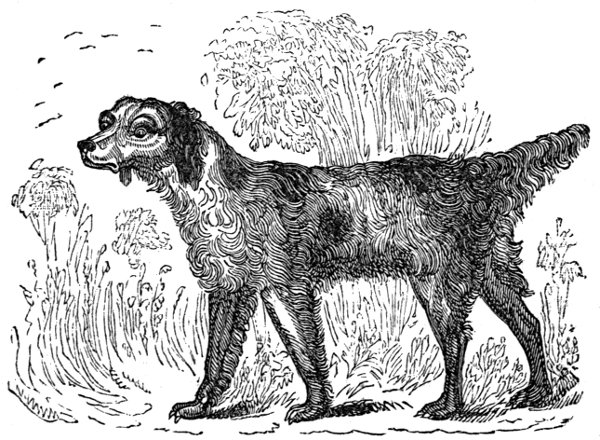
The Old English Setter. (Canis Index, variety α.)—This breed was originally produced between the Spanish pointer and the large water spaniel, and was famous on account of his steadiness and exquisite sense of smelling; the hair over the whole body was much more curled than that of the present breed, which has been considerably lightened by the additional cross of the springer; he was also much more steady than the improved variety, but then he had not the same speed to recommend him. Fine dogs of this kind were also produced by a cross with the stag and blood hounds. They united great strength, considerable swiftness, and were used for the chace in some few instances.
The English Setter (Canis Index, variety β), is a breed produced between the Spanish pointer, the English water spaniel and springer, which, by careful cultivation, has attained a high degree of perfection as a sporting dog. He has an elegant figure, and a very pleasing diversity of colour; added to this, his skin is covered with beautifully curled hair, very villous on the lower margin of the tail; being altogether an extremely handsome dog, and quite unrivalled by any of the canine species.
The setter has all the excellent qualities of the pointer, with a greater degree of speed and natural vivacity of temper; he, however, is not so easily broken in as the pointer, and requires a certain degree of training every year, to make him continue staunch. There are, however, various instances of setters being self-taught, as the following example will show:—The black and tan small setter bitch which I have (says Mr. Torry), was originally out of the Duke of Bedford’s breed, and both she and her mother inherit the utmost natural sagacity as sporting dogs. At ten months old, and before she had got a lesson in breaking, or had seen game killed, she was taken to the moors for the first time, and on finding a bird, was perfectly steady at her point, backed, and did not run the game. The gentleman who was with me wounded a bird, and it fell at a considerable distance. The pup, unknown to us, had kept her eye upon it, and, to our astonishment, after we had loaded, and again ordered our dogs to range, she went direct to the spot where the bird fell, found and fetched it to my friend’s feet. This happened in August, 1825.
The setter ranges with great speed, and is a very hardy dog. Many prefer him to the pointer, and if water is plentiful, he is certainly more useful, for his feet are much better defended against the sharp cutting of the heath than those of the pointer, as he has a great deal of hair growing between the toes and round the ball of the foot, of which the latter is almost destitute. Besides, he unquestionably ranges much faster, and can endure much more fatigue. He can also serve in thick coverts, where a pointer will not enter; and, on this account, is useful in woodcock shooting, where springers or cockers are not kept.
Formerly the setter was used for the purpose of taking partridges with a draw-net, and was generally taught to squat down when the game was within a proper distance—hence the name setter. They are now, however, trained to point in the same manner as the spaniel. It is said that Robert Dudley, Duke of Northumberland, was the first person who broke a setter to the net.
There is not a country in Europe that can boast of finer setters than Ireland; they are there called English spaniels, and differ widely from the setters of England and Scotland. They are not esteemed in Ireland unless their colour be either a deep chestnut and white, or all red; a black and white setter, or any colour but red, or red and white, would not be looked upon or reputed well bred, allowing them to be ever so good. It matters not whether they are all red, or red and white; but those esteemed most have a black nose, and a black roof to their mouth,—as most sportsmen conceive the black nose to be finer and superior to any other. Sir William Barker, Mr. Oliver of Castle Oliver, Mr. Macarthy of Spring House, and many other gentlemen in Ireland, have the most beautiful and steady of this kind. A circumstance occurred, with respect to the steadiness and discipline of some of this breed, which the compiler was an eye-witness to:—Colonel Macdonald being on a visit at Mr. Oliver’s, during the grousing season, and going out one day, took out with him five brace of setters; on getting to the mountains, one of the dogs found some birds, all the rest backed in at once, upon which Colonel Macdonald called to the last dog to take the lead, and in that manner he drew the dogs alternately, until the last became first, and fixed the birds, which had run nearly a mile. These dogs in general fetch a long price; Mr. Macarthy got two hundred guineas for a brace of them, and a gentleman in the north of Ireland was known once to have given, for a dog and bitch of this sort, to his tenant, the renewal of a lease of a farm for nine hundred and ninety-nine years, which if this lease had expired, would have cleared to the landlord above two hundred and fifty pounds a year. The compiler himself sold a brace of setters, in the year 1801, for two hundred guineas, to a Captain Baggot.—Brown—Thornhill.
Settingdog, s. A dog taught to find game, and point it out to the sportsmen.
Shad, s. A kind of fish.
Shaft, s. An arrow, a missile weapon; a narrow, deep, perpendicular pit; anything straight.
Shag, Skart, Scarfe or Green Cormorant, (Pelicanus graculus, Linn.; Le petit Cormorant, ou le Nigaud, Buff.) s.
The form, the aspect altogether, the outward conformation of all the parts, the character, manners, and habits, and places of abode, of this species, are nearly like those of the cormorant; but they do not associate, and these make their nests on the rugged, shelvy sides and crevices of the rocky precipices or projecting cliffs which overhang the sea, while the others make theirs on the summits above them; and these are at once distinguished from the others by the greenness of the upper, and brownness of the under plumage, and also in being of a much less size—the largest shags weighing only about four pounds, and measuring nearly two feet six inches in length, and three feet eight in breadth. The bill is of a more slender make, but nearly as long as that of the cormorant; the head, in the male, is crested in the same manner; the middle claw is serrated; and its tail, consisting of twelve stiff feathers stained with green, is also of the same form and hoary or dirty appearance as that of the cormorant; the crown of the head, hinder part of the neck, lower back, and rump, are of a plain black, or very dark green, shining like satin; the upper back, or shoulders, together with the scapulars and wings, are nearly of the same colour, but with a tinge of bronze brown, and each feather is distinctly edged with purple glossed black; the under parts are clouded with dusky dirty white, and brown.—Bewick.
Shaggy, a. Ruggedly hairy, rough, rugged.
Shagreen, s. The skin of a kind of fish, or skin made rough in imitation of it.
Shambling, a. Moving awkwardly and irregularly.
Shank, s. The middle joint of the leg, that part which reaches from the ankle to the knee; the bone of the leg; the long part of any instrument; long part of a fishhook.
Sheep, s. The animal that bears wool.
Sheep, s. The animal that bears wool.
To break a Sheep-biting Dog.—Take some wool off a sheep’s rump, steep it in train oil, put it in the dog’s jaws, and sew up his mouth. For killing poultry, boil a chicken in its feathers, take it hot from the boiler, squeeze the water from it and put it into his jaws, and tie them together.
“I have a fine pointer,” said a gentleman to his friend, “staunch as can be at birds, but I cannot break him from sheep.” His reply was, that the best way would be to couple him to the horns of an old ram, and leave him in a stable all night, and the discipline he would receive would prevent his loving field-mutton again. The same person meeting the owner of the dog some time afterwards, accosted him thus: “Well, sir, your pointer is now the best in England, no doubt, from my prescription.” “Much the same, sir, for he killed my ram, and ate a shoulder!”—Sporting Anecdotes.
Sheldrake, or Burrough Duck, (Anas Tudorna, Linn.; La Tudorne, Buff.) s.
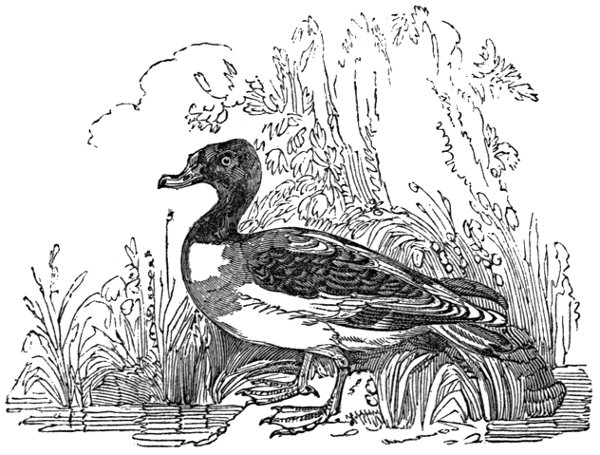
The male of this prettily marked species is somewhat larger than the mallard, measuring about two feet in length, three and a half in breadth, and weighing, commonly, two pounds ten ounces. The bill is red, with the nail and nostrils black; the upper mandible is broad, flat, and grooved on the edges towards the point, where it has rather a cast upwards; it is also depressed in the middle, and raised into a knob or tubercle at the base. The head and upper part of the neck are of a glossy dark or bottle green; the lower part of the neck, to the breast, is encircled with white, and joined by a broad band of bright orange bay, which is spread over, and covers the breast and shoulders. The back, wing-coverts, rump, upper tail-coverts, and sides of the belly, to the vent and tail, are white; a dusky stripe, tinged with rufous, runs along the middle from the breast, the whole length of the belly; part of the scapulars next the wings are black, and those next the body white; the bastard wing, and some of the first primary quills, are black; the exterior webs of the next adjoining ones are glossed with gold green, which forms the speculum or beauty-spot of the wings; this spot is bounded and partly covered by the orange webs of the three succeeding quill-feathers, which separate it from the scapulars. The tail is white, but some of its feathers are tipped with black; the legs pale red.
The female is less than the male, and her plumage is not so vivid and beautiful. She makes her nest, and rears her young, underground, in the rabbit-holes which are made in the sand-hills near the sea shore: it is chiefly formed of the fine down plucked from her own breast: she lays from twelve to sixteen roundish white eggs, and the incubation lasts about thirty days. During this time, the male, who is very attentive to his charge, keeps watch in the day-time, on some adjoining hillock, where he can see all around him, and which he quits only when impelled by hunger, to procure subsistence. The female also leaves the nest, for the same purpose, in the mornings and evenings, at which times the male takes his turn, and supplies her place. As soon as the young are hatched, or are able to waddle along, they are conducted, and sometimes carried in the bill, by the parents, to the full tide, upon which they launch without fear, and are not seen afterwards out of tide-mark until they are well able to fly; lulled by the roaring of the flood, they find themselves at home amidst an ample store of their natural food, which consists of sand-hoppers, sea-worms, &c. or small shell-fish, and the innumerable shoals of the little fry which have not yet ventured out into the great deep, but are left on the beach, or tossed to the surface of the water by the restless surge.
If this family in their progress from the nest to the sea, happen to be interrupted by any person, the young ones, it is said, seek the first shelter, and squat close down, and the parent birds fly off; then commences that truly curious scene dictated by an instinct analogous to reason, the same as has been already noticed in the mallard and the partridge; the tender mother drops at no great distance from her helpless brood, trails herself along the ground, flaps it with her wings, and appears to struggle as if she were wounded, in order to attract attention, and tempt a pursuit after her. Should these wily schemes, in which she is also aided by her mate, succeed, they both return when the danger is over, to their terrified motionless little offspring, to renew the tender offices of cherishing and protecting them.
These birds are sometimes watched to their holes, which are dug up to the nest, whence the eggs are taken and hatched, and the young reared by a tame duck.
In this way many gentlemen, tempted by the richness of their garb, have their ponds stocked with these beautiful birds; but as they are of a roving disposition, and are apt to stray, or to quit altogether such limited spots, it is generally found necessary to pinion or disable a wing to secure them. The sheldrake has been known to breed with the common duck; but it is not well ascertained whether the hybrids thus produced will breed again or not.
This species is dispersed in greater or less numbers, over the warm as well as the cold climates, in various parts of the world; they are met with as far north as Iceland in the spring, and in Sweden and the Orkney Islands in the winter. Captain Cook notices them, among other sea fowl, on the coast of Van Diemen’s Land; and they have been seen in great numbers at the Falkland Islands. Although they are not numerous on the British and the opposite shores, yet they are common enough in the British Isles, where they remain throughout the year, always in pairs, and occasionally straggle away from the sea coasts to the lakes inland.—Bewick.
Shell, s. The hard covering of anything; the external crust; the covering of a testaceous or crustaceous animal; the covering of the seeds of siliquous plants; the covering of kernels; the covering of an egg.
Shellfish, s. Fish invested with a hard covering, either testaceous, as oysters, or crustaceous, as lobsters.
Sherry, s. A kind of sweet Spanish wine.
Shetland Pony, s. A horse peculiar to the Shetland isles.
Although the Shetland ponies are exceedingly diminutive in size, they are in other respects excellent. There have been instances of these animals whose height from the foot to the shoulder scarcely exceeded three feet, and a man of ordinary size and strength can lift one of them from the ground with great ease.
The general form of these ponies is very elegant, and their body is thicker and more compact than that of a blood-horse; they have small legs and large manes, their bones are exceedingly small, as is also their head, and that part of the neck which joins to it, the most common colours are grey, bay, and black. The latter are esteemed the hardiest, whilst those that are pied seldom prove good. They sometimes live to the age of thirty years and upwards, notwithstanding the little care that is bestowed on them in sheltering them from the cold, which, in the climate of the Shetland Islands, is peculiarly severe in the winter: but from the circumstance of their being compelled to live out of doors during even the severest months of the year, great numbers are occasionally frozen to death. At this season, when the ground is entirely covered with snow, the wretched animals are compelled to seek subsistence on the sea-weeds, which, once in every twelve hours, are left exposed by the tide.—Illustrations of Natural History by Le Keux.
Shin, s. The forepart of the leg.
Shingles, s. A kind of tetter or herpes that spreads itself round the loins.
Ship, s. A ship may be defined a large hollow building made to pass over the sea with sails; a vessel with three masts. Vide Yacht.
Shittlecock, s. A cork stuck with feathers, and driven by players from one to another with battledoors.
Shoal, s. A crowd, a multitude, a throng; a shallow, a sand bank; a number of fishes.
Shoaly, a. Full of shoals, full of shallow places.
Shock Dog (Canis Fotor), s. A lady’s dog.
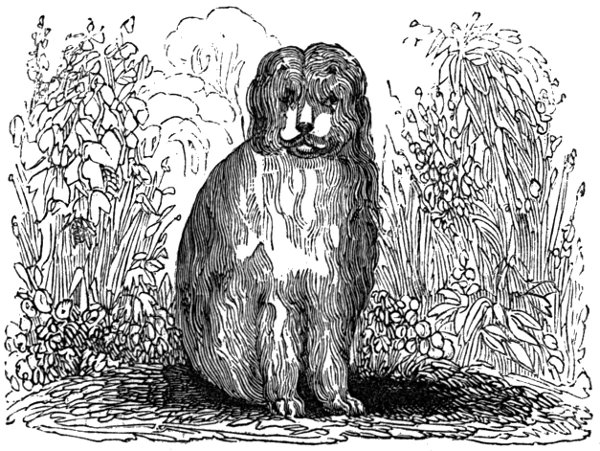
This variety is probably a breed betwixt the king Charles’s dog and the small water spaniel, to which last it seems most nearly allied. It has long and slightly curled hair, and its eyes are almost hid in the curls. It is of a small size, and is used in this country and on the continent as a lap-dog. It is a useless little animal, seeming to possess no other quality than a faithful attachment to its mistress.
I have never seen one of these diminutive little creatures which would take the water, although they possess all the requisites for swimming. This may probably be accounted for from the frequency of their immersion in that element, contrary to their inclination, for the purpose of washing them.
Shoe, s. The cover of the foot; the iron plate which defends a horse’s hoof.
Shoe, v. To fit the foot with a shoe; to cover at the bottom.
Shoeing, v. To affix the shoe to the hoof.
The Preparation of the Foot.—We will suppose that the horse is sent to the forge to be shod. If the master would occasionally accompany him there, he would find it much to his advantage. The old shoe must be first taken off. We have something to observe even on this. It was retained on the foot by the ends of the nails being twisted off, turned down, and clenched. These clenches should be first raised, which the smith seldom takes the trouble thoroughly to do; but after going carelessly round the crust, and raising one or two of the clenches, he takes hold first of one heel of the shoe, and then of the other, and by a violent wrench separates them from the foot, and by a third wrench, applied to the middle of the shoe, he tears it off. By this means he must enlarge every nail hole, and weaken the future hold, and sometimes tear off portions of the crust, and otherwise injure the foot. The horse generally shows by his flinching that he suffers by the violence with which this preliminary operation is performed. The clenches should always be raised or filed off; and where the foot is tender, or the horse is to be examined for lameness, each nail should be partly punched out. Many a stub is left in the crust, the source of future annoyance, when this unnecessary violence is used.
The shoe having been removed, the smith proceeds to rasp the edges of the crust. Let not the stander-by object to the apparent violence which he uses, or fear that the foot will suffer. It is the only means he has, with safety to his instruments, to detect whether any stubs remain in the nail-holes, and it is the most convenient method of removing that portion of the crust into which dirt and gravel have insinuated themselves.
Next comes the important process of paring out, with regard to which it is almost impossible to lay down any specific rules. This, however, we can say with confidence, that more injury has been done by the neglect of paring, than by carrying it to too great an extent. The act of paring is a work of much more labour than the proprietor of the horse often imagines; the smith, except he be overlooked, will give himself as little trouble about it as he can; and that, which in the unshod foot would be worn away by contact with the ground, is suffered to accumulate month after month, until the elasticity of the sole is destroyed, and it can no longer descend, and the functions of the foot are impeded, and foundation is laid for corn, and contraction, and navicular disease, and inflammation. That portion of horn should be left on the sole, which will defend the internal parts from being bruised, and yet suffer the external sole to descend. How is this to be measured? The strong pressure of the thumb of the smith will be the best guide. The buttress, that most destructive of all instruments, being banished from the respectable forge, the smith sets to work with his drawing knife, and he removes the growth of horn until the sole will yield, although in the slightest possible degree, to the very strong pressure of his thumb. The proper thickness of horn will then remain.
If the foot has been previously neglected, and the horn is become very hard, the owner must not object if the smith resorts to some means to soften it a little; and if he takes one of his flat irons, and, having heated it, draws it over the sole, and keeps it a little while in contact with it. When the sole is thick, this rude and apparently barbarous method can do no harm, but it should never be permitted with the sole that is regularly pared out.
The quantity of horn to be removed in order to leave the proper degree of thickness will vary with different feet. From the strong foot a great deal must be taken. From the concave foot the horn may be removed until the sole will yield to a moderate pressure. From the flat foot little need be pared; while the pumiced foot will spare nothing but the ragged parts.
The paring being nearly completed, the knife and the rasp of the smith must be a little watched, or he will reduce the crust to a level with the sole, and thus endanger the bruising of the sole by its pressure on the edge of the seating. The crust should be reduced to a perfect level all round, but left a little higher than the sole.
The heels will require very considerable attention. From the stress which is thrown on the inner heel, and from the weakness of the quarter there, it usually wears considerably faster than the outer one; and if an equal portion of horn were pared from it, it would be left lower than the outer heel. The smith should, therefore, accommodate his paring to the comparative wear of the heels, and be very careful to leave them precisely level.
If the reader will recollect what we have said of the intention and action of the bars, he will readily perceive that the smith should be checked in his almost universal fondness for opening the heels, or, more truly, removing that which is the main impediment to contraction. That portion of the heels between the inflection of the bar and the frog should scarcely be touched, at least nothing but the ragged and detached parts should be cut away. The foot may not look so pretty, but it will last longer without contraction.
The bar likewise should be left fully prominent, not only at its first inflection, but as it runs down the side of the frog. The heel of our shoe is designed to rest partly on the heel of the foot, and partly on the bar, for reasons that have been already stated. If the bar is weak, the growth of it should be encouraged, and it should be scarcely touched at the shoeing until it has attained a level with the crust. We recal to the recollection of our readers the observation which we have before made, that the destruction of the bars not only leads to contraction by removing a powerful impediment to it, but by adding a still more powerful cause in the slanting direction which is given to the bearing at the heels, when the bar does not contribute to the support of the weight.
It will also be apparent that the horn between the crust and the bar should be carefully pared out. Every horseman has observed the relief which is given to the animal lame with corns when this angle is well thinned; a relief, however, which is but temporary, for when the horn grows again and the shoe presses upon it, the torture of the animal is renewed.
The degree of paring to which the frog must be subjected will depend on its prominence, and on the shape of the foot. The principle has already been stated, that it must be left so far projecting and prominent, that it shall be just within and above the lower surface of the shoe, it will then descend with the sole sufficiently to discharge the functions which we have attributed to it. If it be lower it will be bruised and injured; if it be higher it cannot come in contact with the ground, and thus be enabled to do its duty. The ragged parts must be removed, and especially those occasioned by thrush, but the degree of paring must depend entirely on this principle.
It appears, then, that the office of the smith requires some skill and judgment in order to be properly discharged; and the horse proprietor will find it his interest occasionally to visit the forge and complain of the careless, or idle, or obstinate, and reward, by some trifling gratuity, the expert and diligent. He should likewise remember that a great deal more depends on the paring out of the foot than on the construction of the shoe; that few shoes, except they press upon the sole, or are made outrageously bad, will lame the horse; but that he may be very easily lamed from ignorant and improper paring out of the foot.
The putting on of the Shoe.—The foot being thus prepared, the smith looks about for a shoe. He should select one that as nearly as possible fits the foot, or may be altered to the foot. He will sometimes care little about this, for he can easily alter the foot to the shoe. The toe-knife is a very convenient instrument for him, and plenty of horn can be struck off with it, or removed by the rasp, to make the foot as small as the shoe; while he cares little, although by this destructive method the crust is materially thinned where it should receive the nail, and the danger of puncture is increased, and the danger of pressure upon the sole is increased, and a foot so artificially diminished in size will soon grow over the shoe, to the hazard of considerable or permanent lameness.
While choosing the shoe we must once more refer to the shape of our pattern shoe; the web is of equal thickness from toe to heel. A shoe, thinner at the heel than at the toe, by letting down the heel too low, is apt to produce sprain of the flexor tendon, and a shoe thicker at the heels than at the toe is fit only to elevate the frog, to the destruction of its function, and to its own certain disease, and also to press upon and to batter and to bruise that part of the foot which is soonest and most destructively injured.
The Hinder Shoe.—In forming the hinder shoe it should be remembered that the hind limbs are the principal instruments in progression, that in every act of progression, except the walk, the toe is the point on which the whole frame of the animal turns, and from which it is propelled. This part, then, should be strengthened as much as possible; and, therefore, the hinder shoes are made broader at the toe than the fore ones, and the toe of the foot, which is naturally broader than that of the fore-foot, is still further widened by rasping. Another good effect is produced by this, that the hinder foot being shortened there is less danger of overreaching or forging, and especially if the shoe be wider on the foot surface than on the ground one; and thus the shoe is made to slope inward, and is a little within the toe of the crust.
The shape of the hinder foot is somewhat different from that of the fore foot; it is straighter in the quarters, and the shoe must have the same shape. For carriage and draught horses generally, calkins may be put on the heels, because the animal will be thus enabled to dig his toe more firmly into the ground, and urge himself forward, and throw his weight into the collar with greater advantage. But the calkins must not be too high, and they must be of an equal height on each heel; otherwise, as has been stated with regard to the fore feet, the weight will not be fairly distributed over the foot, and some part of the foot or of the leg will materially suffer. The nails in the hinder shoe may be placed nearer to the heel than in the fore shoe, because, from the comparative little weight and concussion thrown on the hinder feet, there is not so much danger of contraction.
Different kinds of Shoes.—The shoe will vary in substance and weight with the kind of foot, and the nature of the work. A weak foot should never wear a heavy shoe, nor any foot a shoe that will last longer than a month. Here, perhaps, we may be permitted to caution the horse-proprietor against having his cattle shod too much by contract, unless he binds down his farrier or surgeon to remove the shoes once at least in every month; for if the contractor, by a heavy shoe and a little steel, can cause five or six weeks to intervene between the shoeings, he will do so, although the feet of the horse must necessarily suffer. The shoe should never be heavier than the work requires. An ounce or two in the weight of the shoe will sadly tell before the end of a hard day’s work. This is acknowledged in the hunter’s shoe, which is narrower and lighter than that of the hackney with even smaller feet than the hunter; and it is more decidedly acknowledged in the racer, who wears a shoe only sufficiently thick to prevent it from bending when used.
The Hunting Shoe.—The hunter’s shoe is different from that of the hackney in shape as well as weight. It is not so much bevelled off as the common concave seated shoe. Sufficient space alone is left for the introduction of a picker between the shoe and the sole, otherwise, in going over heavy ground, the clay will get in, and by its tenacity loosen, and even tear off the shoe. The heels likewise are somewhat shorter, that they may not be torn off by the toe of the hind-feet when galloping fast, and the outer heel is frequently and injudiciously turned up to prevent slipping. The reader will remember what we have just said of this. If calkins are necessary, let, at least, both heels have an equal bearing.
The Bar-Shoe.—A bar-shoe is a very useful contrivance. It is the continuation of the common shoe round the heels, and by means of it the pressure may be taken off some tender part of the foot and thrown on another which is better able to bear it, or more widely and equally diffused over the whole foot. It is principally resorted to in cases of corn, the seat of which it perfectly covers—in pumiced feet, the soles of which may be thus elevated above the ground and secured from pressure—in sand-crack, when the pressure may be removed from the fissure and thrown on either side of it—in thrushes, when the frog is tender, or is become cankered, and requires to be frequently dressed, and the dressing can by this means alone be retained. In these cases the bar-shoe is an excellent contrivance, if worn only for one or two shoeings, or as long as the disease requires it to be worn, but it must be left off as soon as it can be dispensed with. If it be used for the protection of a diseased foot, however it may be chambered and laid off the frog, it will soon be flattened down upon it; or if the pressure of it be thrown on the frog to relieve the sand-crack or the corn, that frog must be very strong and healthy which can long bear the great and continued pressure. More mischief is often produced in the frog than previously existed in the part which was relieved. It will be plain that in the use of the bar-shoe for corn or sand-crack, the crust and the frog should be precisely on a level, and the bar should be the widest part of the shoe, to afford as extended bearing as possible on the frog, and therefore less likely to be injurious. Bar-shoes are evidently not safe in frosty weather; they are never safe when much speed is required from the horse, and they are apt to be wrenched off in a heavy, clayey country.
Tips are short shoes reaching only half round the foot, and worn while the horse is at grass to prevent the crust being torn by the occasional hardness of the ground, or by the pawing of the animal; and the quarters at the same time being free, the foot disposed to contract has a chance of expanding and regaining its natural shape.
The Expanding Shoe.—Our subject would not be complete if we did not describe the supposed expanding shoe. It is either seated or concave like the common shoe, with a joint at the toe, by which the natural expansion of the foot is said to be permitted, and the injurious consequences of shoeing prevented. There is, however, this radical defect in the jointed shoe, that the nails occupy the same situation as in the common shoe, and prevent, as do the nails of the common shoe, the gradual expansion of the sides and quarters, and allow only of a hinge-like motion at the toe. This is a most imperfect accommodation of the expansion of the foot to the action of its internal parts, and even this accommodation is afforded in the slightest possible degree, or rather can scarcely be afforded at all. Either the nails fix the sides and quarters as in the common shoe, and then the joint at the toe is useless; or, if that joint merely opens like a hinge, the nail-holes in the shoe can no longer correspond with those in the quarters which are unequally expanding at every point; and, therefore, there will be more stress on the crust at these holes, which will not only enlarge them, and destroy the fixed attachment of the shoe to the hoof, but will often tear away portions of the crust. This has, in many cases, been found to be the effect of the jointed shoe: the sides and quarters of the foot have been broken until it has become difficult to find nail-hold. This shoe, to answer the intended purpose, should consist of many joints, running along the sides and quarters, which would make it too complicated and expensive, and frail for general use.
While the shoe is to be attached to the foot by nails, we must be content with the concave seated one, taking care to place the nail-holes as far from the heels, and particularly from the inner heel, as the state of the foot and the nature of the work will admit; and where the country is not too heavy nor the work too severe, even omitting the nails on the inner side of the foot. Shoes nailed on the outer side, and at the toe, are more secure than some would imagine, while the inner quarter will be left free, to prevent contraction, or to arrest its progress.
The attempt, however, to lessen the evils produced by shoeing is most praiseworthy; and men like Mr. Bracey Clark deserve the respect and thanks of the public, although their labours may not be crowned with success. Every contrivance permanently to fix the shoe on the foot without the use of nails, has failed; but a make-shift shoe has been contrived, and is to be procured at most saddlers, which is easily carried in the pocket, and put on in a minute or two if a shoe is lost in hunting or on the road; and which will remain securely attached to the foot, and prevent injury to it, during a journey of thirty or forty miles.
Felt or Leather Soles.—When the foot is bruised or inflamed, the concussion or shock produced by the hard contact of the elastic iron on the ground gives the animal much pain, and causes a short and feeling step, or even lameness, and aggravates the injury or disease. A strip of felt or leather is sometimes placed between the seating of the shoe and the crust, which, from its want of elasticity, deadens, or materially lessens the vibration or shock, and the horse treads more freely, and is evidently relieved. This is a very good contrivance while the inflammation or tenderness of the foot continues, but a very bad practice if constantly adopted. The nails cannot be driven so surely or so securely when this substance is interposed between the shoe and the foot; the contraction and swelling of the felt or leather, from the effect of moisture or dryness, will soon render the attachment of the shoe less firm; there will be too much play upon the nails; the nail-holes will enlarge, and the crust will be broken away.
After wounds or extensive bruises of the sole, or where the sole is thin and flat and tender, it is sometimes covered with a piece of leather, fitted to the sole, and nailed on with the shoe. This may be allowed as a temporary defence of the foot; but there is the same objection to its permanent use from the insecurity of fastening, and the strain on the crust, and the frequent chipping of it: and there are these additional inconveniences, that if the hollow between the sole and the leather be filled with stopping and tow, it is exceedingly difficult to introduce them so evenly and accurately as not to produce some partial or injurious pressure—that a few days’ work will almost invariably so derange the padding as to produce partial pressure—that the long contact of the sole with stopping of almost every kind will produce, not a healthy, elastic horn, but horn of a scaly, spongy nature; and that if the hollow be not thus filled, gravel and dirt will insinuate themselves, and cause unequal pressure, and eat into and injure the foot.—The Horse.
Shoot, v. To discharge anything so as to make it fly with speed or violence; to discharge from a bow or gun; to let off; to perform the act of shooting; to germinate; to be emitted; to protuberate; to jut out; to pass as an arrow; to feel a quick pain.
Instructions in Shooting—But (to be brief, which is here my study) allow me to suggest an humble attempt for the instruction of the complete novice, first, let him take a gun that he can manage, and be shown how to put it to his shoulder, with the breach and sight on a level, and make himself master of bringing them up to a wafer.
Then, with a wooden or bone driver (instead of a flint) let him practise at this mark; and when he thinks he can draw his trigger without flinching, he may present the gun to your right eye, by which you will see, at once, if he is master of his first lesson. In doing this he must remember, that the moment the gun is brought up to the centre of the object, the trigger should be pulled, as the first sight is always unquestionably the best.
Then send him out to practise at a card with powder, till he has got steady, and afterwards load his gun, occasionally, with shot, but never let the time of your making this addition be known to him; and the idea of it being, perhaps, impossible to strike his object, will remove all anxiety, and he will soon become perfectly collected.
The intermediate lesson of a few shots at small birds may be given; but this plan throughout must be adopted at game, and continued, in the first instance, till the pupil has quite divested himself of all tremor at the springing of a covey, and observed in the last, till most of his charges of shot have proved fatal to the birds. If he begins with both eyes open, he will save himself the trouble of learning to shoot so afterwards. An aim thus, from the right shoulder, comes to the same point as one taken with the left eye shut, and it is the most ready method of shooting quick.
Be careful to remind him (as a beginner) to keep his gun moving, as follows: before an object, crossing; full high for a bird rising up, or flying away very low; and between the ears of hares and rabbits running straight away. All this, of course, in proportion to the distance; and if we consider the velocity with which a bird flies, we shall rarely err by firing, when at forty yards, at least five or six inches before it. Till the pupil is au fait in all this, he will find great assistance from the sight, which he should have precisely on the intended point, when he fires. He will thus, by degrees, attain the art of killing his game in good style, which is to fix his eyes on the object, and fire the moment he has brought up the gun. He may then ultimately acquire the knack of killing snap shots, and bring down a November bird the moment it tops the stubble, or a rabbit popping into a furze-brake, with more certainty than he was once used to shoot a young grouse in August, or a partridge in September.
Many begin with very quick shooting, and kill admirably well, but are often apt not to let their birds fly before they put up their guns, and therefore dreadfully mangle them, and, I have already observed, are not such every-day shots as those who attain their rapid execution on a slow and good principle.
As shots in the field, at game, Mr. Jenkins, near Petworth, Sussex, and Cottingham, who was formerly gamekeeper to Lord Roos, are perhaps the best. The former has killed twenty brace of partridges in a day, at forty shots, without selecting the shots, but took them fairly as they happened; and in four days’ shooting, has never missed. The latter I was out with when he killed, in two days, forty-three successive shots (many of them in covert) at partridge, pheasant, woodcock, and hare; and his style of shooting, when open, and he could give time, was most regularly deliberate.
Should different guns be employed, the shooter should have all the locks made, if possible, to require exactly the same pull to bring them to action; there is nothing deceives or disconcerts him more than shooting one day with a stiff, and the next with an easy going lock; the transition from that which goes off with a slight, to that where a hard touch is necessary, will often cause the most expert to miss his bird.
If a rival shooter (some stranger) races to get before you, push him hard for a long time, always letting him have rather the advantage, and then give him the double without his seeing you. Having done this, go quietly round (supposing you have been beating up wind); and, on reaching the place where you began, work closely and steadily the whole of the ground or covert that you have both been racing over, and you will be sure to kill more game than him, who is beating and shooting in haste, through fear of your getting up to him; and (if the wind should rise) driving the dispersed, and consequently closest lying birds to your beat, as fast as he finds them.
Beware of the muzzle of the gun being kept hanging downwards; when so carried, the shot is apt to force its way from the powder, especially in clean barrels; if it happens that a space of sixteen or eighteen inches is thus obtained, and the gun fired with its point below the horizon, it is ten to one but the barrel bursts. There are other perilous consequences besides those that generally accompany the disruption of a barrel, for the men, horses, and dogs, are in perpetual danger of being shot when a gun is carried in the before-mentioned pendent manner.
When a gun begins to exhibit symptoms of having done its work, the sooner a man discards it the better. An injured barrel or enfeebled lock may prove fatal to the owner or his associates. Accidents every day occur, and very lamentable consequences proceed, from a culpable neglect in retaining arms which should be declared unserviceable and disused.
I had once a favourite gun, which from constant wear and tear exhibited unequivocal weakness in the locks, and which I had been earnestly recommended by a veteran sportsman to condemn. On a cold and rainy day, I was with my friend O’M——, shooting woodcocks in the heath, and having sprung several, which from the severity of the weather were wild as hawks, we marked them into a ravine, and determined to tie up the dogs and endeavour to steal upon them. To keep my gun dry I placed it under the skirt of my jacket, with the muzzle pointing downwards. My companion and our attendant were busy coupling the dogs, when the gun exploded, and the charge passing between O’M——’s bosom and the back of a dog he was in the act of securing, buried itself at the foot of the keeper, covering him with mud and gravel. From the close manner in which we were all grouped, how the shot could have entered the ground without killing men or dogs, or both, was miraculous. I was desperately frightened, and from that moment forswore for ever, the use of weakened locks and attenuated barrels.
In March, 1799, Sir John Swinborne, having flashed off his gun, which was single barrelled with a patent antechambered breech, proceeded to the dog-kennel; in his opinion, at least five minutes must have elapsed before he began to load; having primed, he poured the charge from the top of the flask into the barrel, when the whole copper flask, containing nearly a pound of gunpowder, instantly exploded. A large piece of copper struck the right eye, and injured the bone above, so that it continued to exfoliate for two years. The lock remained at half bent, and it cannot be doubted that some tow, which had been left in the barrel or chamber, continued on fire from the time of flashing off, and occasioned the misfortune.
In every instance but one, where the particulars have been ascertained, of the numerous accidents of the above description, the explosion has happened upon the second time of pouring powder into the barrel on that day; which is strong evidence of the cause here suggested.
The following sporting precepts may be serviceable to inexperienced shooters:—
First—If you or your dog should, at any time, get a severe blow, let the wounded part be instantly fomented with water, as hot as can be borne, for at least half an hour, and you will thereby reduce your suffering, or impediment from sport, to at least half its duration.
Secondly—If you burn yourself in shooting, or otherwise, wrap the part affected immediately in cotton, the application of which, it has been proved, acts like magic with a burn.
Thirdly—If you should take cold, bathe your feet in hot water; if a little salt or bran is, or both are, added, so much the better. Get into a bed warmed, with a little brown sugar sprinkled on the coals, and take some whey, or whatever you can get to promote perspiration.
Fourthly—Never fast too long, and avoid, whenever you can, fagging too hard.
Fifthly—Never go out with quite an empty stomach, to wait for wild fowl, particularly in the morning. Should you wish to start before any one is up, you might always have left for you over night, a crust of bread, or a biscuit, with a glass of milk, which, with a little sugar, nutmeg, ginger, and the yolk of an egg, may be good in a moment, and this is better than what is called a “doctor,” (rum and milk), because you then dispense with taking spirit in a morning, the very bad habit of which, should always be avoided, except in a country where the chances of ague might justify your taking a little purl.
Sixthly—Never sit down in wet feet, or with wet clothes on any part of your body, but, if a change is not at hand, keep in motion, or go to bed, till one can be procured. Or, if you want to start again, when refreshed, first wet your feet with either spirits or essence of mustard, and then be as quick as possible in taking your refreshment. Many people prefer applying the spirit to the inside, instead. This is not so well, because spirit alone always flies to the head, while strong beer, on the contrary, would warm the body.
I shall here conclude, under this head, with the multum in parvo advice of the great Dr. Boerhaave; keep the body open, the head cool, and the feet warm.—Hawker—Daniel—Wild Sports.
Shooter, s. One who shoots; an archer, a gunner.
Shortwinged, a. Having short wings. So hawks are divided into long and short winged.
Shot, s. The act of shooting; the flight of a shot; the charge of a gun; bullets or small pellets for the charge of a gun; anything discharged from a gun, or other instrument; a sum charged, a reckoning.
Shot.—The choice of this article is highly worthy of the sportsman’s care. It should be equal, round, and void of cavities. The patent milled shot is, at this time, to be preferred to all other sorts, and is in such general use, that the instructions which here follow on the size of shot to be adopted in the different chases, must be understood to relate to the patent shot only.
The difference, however, which subsists between the sizes of patent and of common shot, will be hereafter shown by means of a table, denoting the number of pellets contained in a given weight of each, so that in cases where the former cannot be procured, it will be easy to adopt the rules there laid down, to the latter, by only taking the same number of grains in the common, as directed to be used for the patent shot.
It is extremely important for the success of the chase, that the sportsman should proportion the size of his shot, as well to the particular species of game he means to pursue, as the season of killing it. Thus in the first month of partridge-shooting, shot No. 1, should be used; for since, at this time, the birds spring near at hand, and we seldom fire at more than the distance of forty yards, if the shooter takes his aim but tolerably well, it is almost impossible for a bird at this distance to escape in the circle or disk which the shot forms.
Hares also, at this season of the year, sit closer, and being at the same time thinly covered with fur, may easily be killed with this sized shot at thirty or thirty-five paces.
In snipe and quail-shooting this sized shot is peculiarly proper, for, in using a larger size, however true the sportsman may shoot, yet he will frequently miss, the objects being so small that they have great chance of escaping in the vacant spaces of the circle or disk. Yet there are many sportsmen who shoot snipes, quails, and fieldfares, in countries where they abound, with the sizes six and seven of the common shot, the last of which is called mustard-seed.
About the beginning of October, at which time the partridges are stronger in the wing, No. 3 is the proper shot to be used. This size seems to be the best of any; it preserves a proper medium between shot too large and that which is too small, and will kill a hare from the distance of thirty-five or forty paces, and a partridge at fifty, provided the powder be good. It will serve also for rabbit-shooting. In short, it is excellent for all seasons, and many sportsmen use no other the season round.
It is true that distant objects are frequently missed for want of large shot, but then these bear no proportion to the number that are daily missed, by using shot of too large a size, especially with the feathered game. If a man was to shoot constantly with shot number five, for one partridge which he might chance to kill with a single pellet at the distance of eighty paces, he would miss twenty birds at eighty paces, which would in such case escape in the vacant spaces of the circle. But if the sportsman expressly purposes to shoot wild ducks or hares, then indeed he had better use the number five. However, in shooting with a double barrel gun, it may be prudent to load one of the barrels with large shot for the necessary occasions, and if in any case large shot is required, number five will be found to be better than any other, for its size is not so large as to prevent it from garnishing or being equally spread in the circle, and it can at the same time perform, in effect, all that a larger sized shot can do, which garnishes but very little, if any at all.
In order, therefore, to show clearly, and at one view, the comparative difference in garnishing of shot of different sizes, we here subjoin a table which indicates the number of pellets precisely composing an ounce weight of each sort of shot, the patent and the common, commencing at the smallest size in each.
PATENT SHOT.
Pellets.
No. 8 1 ounce 620
7 — 480
+ — 300
1 — 220
2 — 180
3 — 157
4 — 105
5 — 83
COMMON SHOT.
Pellets.
No. 7 1 ounce 350
6 — 260
5 — 235
4 — 190
3 — 140
2 — 110
1 — 95
Shot compared according to Hawker:—
MOULD SHOT.
No. of pellets to 1 oz.
L G 5½
M G hardly 9
S G 1
S S G 15
S S S G 17
PATENT SHOT.
No. of pellets to 1 oz.
A A 40
A 50
B B 58
B 75
1 82
2 112
3 135
4 177
5 218
6 280
7 341
8 600
9 984
10 1726
The pleasure of using and counting the dust shot I leave to those who recommend it.
The shot of different manufacturers varies much in size: for example, an ounce of No. 7, from Messrs. Walker and Parker, amounts to 341 pellets; and the same weight, from Mr. Beaumont (late Preston), 398; and in some places the numbers are reversed.
Many sportsmen recommend the use of unglazed shot; others wet their shot with oil. I have tried both these plans repeatedly, but could not find sufficient advantage in either to justify my recommending them. The object of both is to prevent the gun from leading; and as they can do no harm, I should if a choice readily offered, prefer using the shot unglazed, or oiled, for the chances of any trifling advantages which may be thereby derived.
If I mistake not, you are shooting grouse with No. 4.
Agilis. I was told that so large a bird required large shot.
Peritus. No doubt there is greater difficulty in reaching a vital part through a large opposing substance than a small one; but you must remember that at this season the whole plumage of birds has not yet grown, the muscles and sinews are not yet so strong and firm as they will be; and the flight of all birds is slower than in winter; on such account I would use much smaller shot now than later in the season; and indeed you will find sevens now as efficient as fours will be in two months’ time. You must remember that to bring down a bird you must either strike it in a vital part, or impede its flight, and the fewer the shots that strike, the less likely you are to attain that object. I once fired a small bullet through a black cock, and he flew so far that he was only found by accident afterwards. But I will repeat to you my ideas as to the sizes of shot best calculated both for England and Scotland, as we are upon the subject:—
Partridge, hare.—From September 1 to October 1, No. 7.
Partridge, hare, woodcock, rabbit, pheasant.—From October 1 to the end of the season, No. 6.
Ducks.—No. 5 or 4.
Roe deer.—B B at all times.
Grouse—From August 12 to September 1, No. 7; from September 1 to September 25, No. 6; from September 25 to the end of the season, No. 5.
Black game.—From August 20 to September 1, No. 7; from September 1 to September 10, No. 6; from September 1 to October 10, No. 5; from October 10 to the end of the season, No. 4 or 5, as the gun may shoot close or scatter: if it scatter, the smaller shot of the two.
The greater or lesser diameter of the bore cannot produce any sensible difference in the closeness or wideness with which the shot is thrown, provided the charge he the same in both pieces. We have subjected this matter to the test of experiment, and the result has accordingly been that a barrel of 22 or 24, which is the largest calibre usually employed in fowling-pieces, threw its shot as closely as one of the smallest calibre, viz. of 30 or 32.
There is a curious circumstance attending the shot of barrels, which is, that sometimes the grains of lead, instead of being equally distributed over the space they strike, are thrown in clusters of ten, twelve, fifteen, or more, whilst several considerable spaces have not a single grain in them; sometimes a cluster of this kind consists of one-third or one-half of the charge, and it also happens sometimes, though more rarely, that the whole charge collects itself into one mass, so as to pierce a board near an inch thick, at the distance of forty or forty-five paces. Small barrels are said to be more liable to this than large ones, and M. de Marolles says that this is especially the case when barrels are new, and when they are fresh washed. He mentions a double-barrelled piece of 52 calibre, which was particularly liable to this clustering and lumping of the shot, but adds that the same thing did not happen to him with other barrels of 26 and 28 calibre, which he had used before. The lumping also may perhaps depend upon the wadding employed.
With regard, then, to the extraordinary closeness with which some pieces are said to throw the shot, we certainly shall not take it upon us to assert that persons who speak of them wish to deceive us; but we do most firmly believe that they deceive themselves, and that their accounts proceed either from their belief that a gunsmith, by superior skill and care, is able to make such, or from their once having seen a piece accidentally lump its shot in the manner described above. The result of our experience, however, is very unfavourable to this prevailing opinion, for we do affirm that after having fired at a mark times without number, we have never yet found a barrel, which, at the distance of fifty paces, would throw its whole charge with regularity, we will not say into the breadth of a hat, but into a space of three feet square.
Patent Shot.—It is a fact stated to have been determined by repeated observation, that a bird killed with patent shot will turn green twenty-four hours sooner than one killed at the same time with the common shot; and this accelerated putrefaction is said to arise from the quantity of copperas used in preparing the lead for this particular manufacture.—Essay on Shooting—Hawker—Hints to Grown Sportsmen.
Shot Belt.—Always have the tops of your shot belts made to fit nicely into the muzzle of your gun; by which means, in the process of drawing your charge, you can empty your shot into them without losing a grain.—Hawker.
Shotten, a. Having ejected the spawn.
Shovelboard, s. A long board on which they play by sliding metal pieces at a mark.
Shough, s. A kind of shaggy dog, a shock.
Shoulder, s. The joint which connects the arm to the body; the upper joint of the foreleg of a beast; the upper part of the back; the shoulders are used as emblems of strength.
Shoulderbelt, s. A belt that comes across the shoulder.
Shouldershotten, a. Strained in the shoulder.
Shoulderslip, s. Dislocation of the shoulder.
Shoveller, s. A bird of the duck tribe.
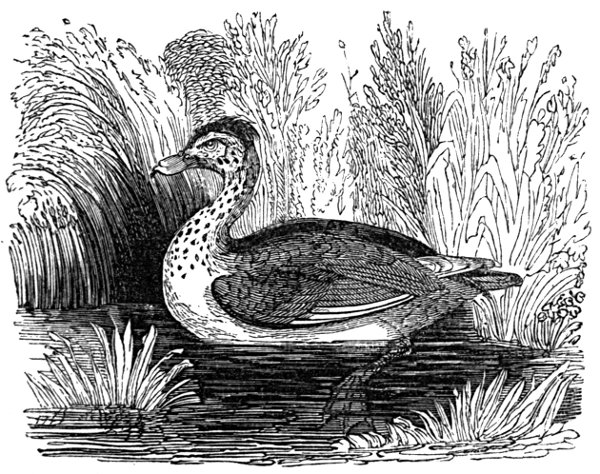
Blue Wing Shoveller, Kertlucock, or Broad Bill (Anas Clypeata, Linn.; Le Souchet, Buff.)—The shoveller is less than the wild duck, commonly weighing about twenty-two ounces, and measuring twenty-one inches in length. The bill is black, three inches long, very broad or spread out, and rounded like a spoon at the end, with the nail hooked inward, and small.
The female is smaller than the male, from which she also differs greatly in the colours of her plumage, the coverts and spangle-spot on her wings being less brilliant, and the other parts composed of white, grey, and rusty, crossed with curved dusky lines, giving her much the appearance of the common wild duck. She makes her nest, lined with withered grasses, on the ground, in the midst of the largest tufts of rushes or coarse herbage, in the most inaccessible parts of the shaky marsh. She lays ten or twelve pale, rusty-coloured eggs; and as soon as the young are hatched, they are conducted to the water by the parent birds, who watch and guard them with the greatest care.
They are at first very shapeless and ugly, for the bill is then almost as broad as the body, and seems too great a weight for the little bird to carry. Their plumage does not acquire its full colours until after the second moult.
It has not yet been ascertained whether the shoveller breeds in England, where, indeed, it is a scarce bird.
This species is of so wild, shy, and solitary a disposition, that all attempts hitherto made to domesticate them have failed.
The anas muscaria of Linnæus (Le Souchet à ventre blanc of Brisson) differs only from this in having the belly white, and is considered merely as a variety of the same species.
Red-breasted Shoveler.—Size of a common duck. This species is sometimes taken in the decoys of Lincolnshire.—Bewick.
Shrewmouse, s. A mouse of which the bite was anciently supposed venomous.
Shrill, a. Sounding with a piercing, tremulous, or vibratory sound.
Shrimp, s. A small crustaceous vermiculated fish; a little wrinkled man, a dwarf.
Shrub, s. A small tree; spirit, acid, and sugar, mixed.
Shufflecap, s. A play at which money is shaken in a hat.
Shuttlecock, s. A cork stuck with feathers, and beaten backward and forward.
Shy, a. Cautious; keeping at a distance, unwilling to approach.
Sickly, a. Not healthy, disordered; faint, weak, languid.
Sidesaddle, s. A woman’s seat on horseback.
Sieve, s. Hair or lawn strained upon a hoop, by which flour is separated from bran; an implement to winnow corn.
Sift, v. To separate by a sieve; to separate, to part.
Sight, s. Perception by the eye, the sense of seeing; act of seeing or beholding; eye, instrument of seeing; aperture pervious to the eye, or other points fixed to guide the eye, as the sight of a quadrant, gun, &c.
Silicious, a. Made of hair.
Silken, a. Made of silk; soft, dressed in silk.
Silver, s. A white and hard metal, next in weight to gold. It is harder but not so malleable: it ignites before it melts, and requires intense heat to fuse it.
Silver, a. Made of silver; white like silver; having a pale lustre; soft of voice.
Sinew, s. A tendon, the ligament by which the joints are moved.
Sinewed, a. Furnished with sinews; strong, firm, vigorous.
Sinewy, a. Consisting of a sinew; nervous, strong, vigorous.
Siphon, s. A pipe through which liquors are conveyed.
Sire, s. A father; it is used of beasts, and particularly horses.
Sitter, s. One that sits; a bird that broods.
Size, s. Bulk, comparative magnitude; condition; any viscous or glutinous substance.
Skate, s. A flat sea fish; a sort of shoe armed with iron, for sliding on the ice.
Skegger, s. Skeggers are the produce of such sick salmon as might not go to sea.
Skein, s. A knot or thread of silk wound; a knot of gimp or gut.
Skin, s. The natural covering of the flesh; hide, pelt, that which is taken from animals to make parchment or leather.
Skin, v. To flay or divest of the skin.
Skirt, v. To border, to go along the edge, as to skirt a cover.
Skittish, a. Shy, easily frighted; wanton, volatile; changeable, fickle.
Skittle, s. A piece of wood like a sugar loaf used in the play of skittles.
Skittles, s. A game called ninepins.
Skua (Lestris catarractes, Temminck), s. A species of eagle.
This species is rather superior in size to the raven; weight three pounds; length two feet; the bill is an inch and three quarters long, black, and much hooked at the end; is covered, for more than half its length, with a kind of black cere; the upper part of the head, neck, back, and wings, deep brown; the feathers margined with ferruginous; about the forehead and chin tinged with ash-colour; the breast, and all beneath, pale dusky ferruginous; the quills are brown, white at the base; tail deep brown; roots and shafts white; the legs are black, rough, and scaly; talons black, strong, and much hooked.
This is a bold rapacious bird, and preys on the lesser gulls, as well as fish; it is said to attack the eagle, and even man, if he approaches their nest. It breeds in the Orkney Islands, and is much esteemed in the Isle of Foulah, from a supposition that it defends the flocks from the eagle: it is rarely seen in the south. One in the museum of Dr. Latham, was killed at Greenwich; and the only other instance we are furnished with, of this species being observed in the south of England, was shot at Sandwich, in Kent, in the winter of 1800.—Montagu.
Skulk, v. To hide, to lurk in fear or malice.
Skull, s. The bone that encloses the head; a shoal of fishes, herrings particularly.
Skycolour, s. An azure colour, the colour of the sky.
Skylark (Alauda arvensis, Linn.), s. A lark that mounts and sings.
The length of this species is seven inches; bill dusky; the base of the upper mandible yellowish; the feathers on the top of the head are dusky, bordered with rufous brown; they are rather long, and erectable in form of a short crest; the hind part is plain, inclining to ash-colour; on the upper parts of the body the feathers are reddish brown, darker in their middle, their edges pale; the under parts are dirty buff-colour, darkest on the neck and breast, which parts are streaked with dusky; quills brown, lighter on the outer webs and tips; the tail is dusky brown, the two middle feathers darkest, with light rufous margins; the outer feather is white on the outer web and tip of the inner; the second feather white on the outer web only; the third is inclining to white on the margin of the outer web; legs dusky in old birds, but lighter in young; claws dusky; the hind one very long and straight.
This bird is common in the greater part of this kingdom, but most plentiful in the more open and highest cultivated situations abounding with corn, and rarely seen on the extended moors at a distance from arable land. The nest is placed on the ground, amongst grass or corn; it is formed of dry grass and other vegetable stalks, lined with a fine dry grass.—Montagu.
Skyrocket, s. A kind of firework, which flies high, and burns as it flies.
Slam, v. To win all the tricks in a hand at whist.
Slaver, s. To be smeared with spittle; to emit spittle.
Sled, s. A carriage drawn without wheels, generally used upon the ice.
Sledge, s. A large heavy hammer; a carriage without wheels, or with very low wheels.
Sleek, a. Smooth, glossy; the state of a horse’s or dog’s skin when in condition.
Sleep, s. Repose, rest, suspension of the mental powers, slumber.
Sleep of Birds.—Like horses and some other quadrupeds, a great number of birds sleep standing; the perchers, (Insessores, Vigors,) for example, usually sleep standing on one leg upon some tree, bush, or other elevation, with the head turned behind, and the bill thrust under the feathers on the back, or under the wing. Indeed, these appear to be the general habits of the whole race of birds, in regard to their mode of resting and sleep; for the duck and goose, although they do not perch, will frequently sleep standing on one leg upon the ground, with their heads turned round, and the bills under the wing. Poultry, although they invariably perch, if a perch can be obtained, do not, when sleeping, rest usually on one leg; but they sink down with their bodies upon the perch, having their legs compressed under them. The sky lark sleeps upon the ground with his legs also similarly compressed. It is probable also that all the tribes of birds, even the perchers, occasionally sink down with their bodies resting on the perch during their soundest sleep. What is very remarkable in the structure of their feet and legs is, that the greater the weight upon the muscles, the more firmly the claws grasp whatever they lay hold of; hence the cause that birds do not fall down in sleep, although most of their senses are dormant.
The motion of the branches of trees produced by the wind increases, doubtless, the disposition for sleep in many birds; this may be exemplified in the common fowl; for placing its bill under the wing, even in broad day-light, and swaying it to and fro in the hand for a very short time, will produce sleep. Most of the tribe of birds sleep during the night; but there are many exceptions to this. Owls in particular are, during the night, much more active than in the day; their sight, similar to that of cats, appears to serve them best in the dark. Many of the duck tribe are not only wakeful, but feed during the night; so also do the nightjars. The nightingale, and a few other song-birds, are also wakeful while in song, during at least some portion of the night.—Montagu.
Slime, s. Viscous mire, any glutinous substance.
Slimy, a. Overspread with slime; viscous, glutinous, as the skin of an eel.
Sling, s. A missile weapon made by a strap; a kind of hanging bandage.
Sling, v. To throw by a sling; to throw, to cast; to hang loosely by a string; the strap attached to a rifle, and used by the marksman to steady his aim when a rest is not to be had.
Slip, v. To let loose; to throw off anything that holds one; to unloose a greyhound.
Slip, s. The act of slipping, a false step; mistake; a twig torn from the main stock; a leash or string in which a dog is held; an escape; a long narrow piece.
Slipknot, s. A bow knot, a knot easily untied.
Sloop, s. A small ship.
Slot, s. The track of a deer.
Slough, s. A deep miry place; the skin which a serpent casts off at his periodical renovation; the part that separates from a foul sore.
Slow, a. Not swift, not quick of motion; late, not happening in a short time; not ready, not quick; dull, inactive.
Slug, s. An idler, a drone; a kind of slow creeping snail; a cylindrical or oval piece of metal shot from a gun.
Smell, v. To perceive by the nose; to find out by mental sagacity.
Smell, s. Power of smelling; the sense of which the nose is the organ; scent.
Smelt, s. A small sea fish. It is of the salmon species, and in the spawning season ascends the rivers in great numbers.
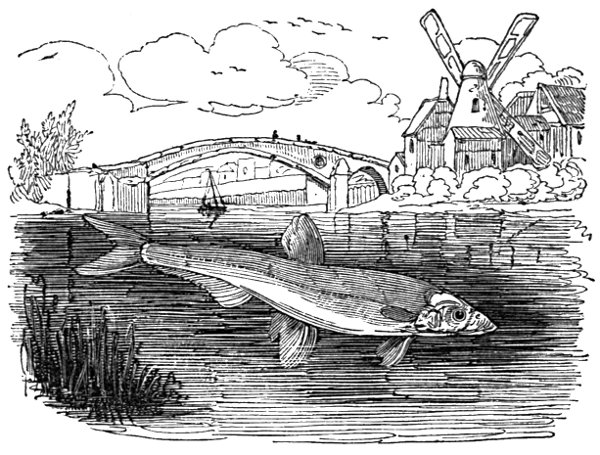
The smelt derives its name from having, in the opinion of some, the scent of a violet, of others, that of a cucumber; they are met with in the seas that wash our coasts the whole year, and seldom go far from shore, except when they ascend the rivers, which they do with the tide; and in certain of which it is remarked, that they appear a long time before they spawn, being taken in abundance in the Thames and Dee in November and two succeeding months; in other rivers not until February, and in March and April they spawn, and are very prolific; after which they all return to the salt water, and are not seen in the rivers until the next season. It has been observed, that they never come into the Mersey so long as there is any snow water in its current; and that in the spring and beginning of summer they will run further up than in the decline of the year; they are also to be met with in the docks that are opened for the reception of ships. The smelt is of a very beautiful form and colour, the head is transparent, and the skin in general so thin that with a good microscope the circulation of its blood may be seen; the irides are silvery, the pupil of a full black, the under jaw is rather prominent, in the front of the upper are four large teeth, those in the sides of both are small; in the roof of the mouth are two rows, and on the tongue two others of large teeth; the colour of the back is whitish, with a cast of green, beneath which it is varied with blue, and then succeeds a beautiful gloss of a silvery hue; the scales are small and readily drop off; the tail is forked; the flesh is tender, and of a delicate taste. These fish vary greatly in size, the largest Mr. P. ever heard of was thirteen inches long, and weighed half a pound; they are often sold in the London streets under the name of dried sparlings, being split and dried, and are recommended by the gentlemen who take their gills of a morning, as adding to the wine a particular relish.
The smelt is to be angled for (when the tide runs up is preferable) with a paternoster line, having five or six hooks as many inches from each other, and baited differently. The best bait is very small fresh shrimps (not boiled), or the tail of a boiled one; next to these are gentles and red paste; also that made of boiled shrimps, fine white bread, and a little honey; cadis, blood-worms; and they will sometimes take a bit of their own species; some crumbs of bread steeped in water should be now and then thrown in to keep them together.
Walton mentions, that, many years since, in the month of August, such vast quantities of smelts came up the Thames, that women and children became anglers for them; and that in one day, between London bridge and Greenwich, not fewer than 2,000 persons were thus employed.
Smerlin, s. A fish.
Smith, s. One who forges with his hammer; one who works in metals.
Smithy, s. The workshop of a smith.
Snaffle, s. A bridle which crosses the nose; a kind of bit for a bridle.
Snaffle, v. To bridle, to hold in bridle, to manage.
Snake, s. A serpent of the oviparous kind, distinguished from the viper. The snake’s bite is harmless.
Snap, v. To break at once; to break short; to bite; to catch suddenly and unexpectedly.
Snap, s. The act of breaking with a quick motion; a quick eager bite; a catch.
Snappish, a. Eager to bite; peevish; sharp in reply.
Snare, s. Anything set to catch an animal, a gin, a net; anything by which one is entrapped or entangled. The wire by which hares and rabbits are poached; horsehair loops to take small birds.
Snare, v. To entrap, to entangle.
Snarl, v. To growl, as an angry animal.
Snet, s. obs. The fat of a deer.
Snipe, s. A small fen fowl with a long bill.
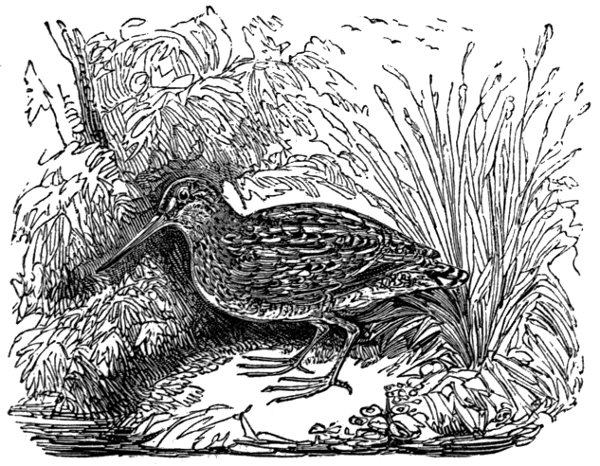
The weight of this species is about four ounces; length near twelve inches; the bill three inches long, dusky; in some the base is lighter, flattish, and rough at the end; irides dusky; crown of the head black, with a longitudinal light rufous line down the middle; from the base of the upper mandible another line of the same colour passes on each side over the eyes; between the bill and eye is a dusky line; the throat white; cheeks, neck, and upper breast, mottled with black and light ferruginous; the back and scapulars are black, barred with ferruginous-brown, and striped with yellowish buff-colour, in longitudinal lines; the quills are black, the first edged with white; the secondaries tipped with the same; those next the body are, with their coverts, striated, and barred with light ferruginous; lower breast and belly white; vent brown; upper tail coverts brown, barred with black; the tail consists of fourteen black feathers, barred and spotted with dull orange-red towards the end, with a narrow bar of black near the tip, where it is pale rufous; legs vary; in some dusky or lead-colour, others green.
This is a plentiful species in most parts of England; and is found in all situations, in high as well as low lands, depending much on the weather. In very wet times it resorts to the hills; at other times frequents marshes, where it can penetrate its bill into the earth after worms, which are its principal food.
Some few remain with us the whole year, and breed in the more extensive marshes and mountainous bogs. We have frequently taken the young before they could fly, in the north of England, and in Scotland. Near Penryn, in Cornwall, there is a marsh where several breed annually, and where we have taken their eggs, which are four in number, of an olivaceous colour, blotched and spotted with rufous-brown; some with dusky blotches at the larger end. The nest is made of the materials around it; coarse grass, and sometimes heath. It is placed on a stump or dry spot, near a plash or swampy place; the eggs like those of the lapwing, placed invariably with their ends inwards, being much pointed; their weight three drachms and a half.
In the breeding season, the snipe changes its note entirely from that it makes in the winter. The male will keep on wing for an hour together, mounting like a lark, uttering a shrill, piping noise; it then descends with great velocity, making a bleating sound, not unlike an old goat, which is repeated alternately round the spot possessed by the female, especially while she is sitting on her nest. This bird has been met with in almost every part of the world.
Great Snipe, (Scolopa Media).—Size between the woodcock and snipe; weight eight ounces; length sixteen inches; bill four inches long, and like that of the woodcock; crown of the head black, divided down the middle by a pale stripe; over and beneath each eye another of the same; the upper part of the body very like the common snipe; beneath white; the feathers edged with dusky black on the neck, breast, and sides; and those of the belly spotted with the same, but the middle of it is plain white; quills dusky; tail reddish, the two middle feathers plain, the others barred with black; legs black. He adds, “this is a rare species.” A fine specimen of it was shot in Lancashire, now in the Leverian Museum, said also to have been met with in Kent.
There are a good many snipes in the vicinity of that place; the marshes, however, frequented by those birds, are not very extensive, and may easily be hunted in much less than a day; but if a person be well acquainted with the ground, better snipe shooting is hardly to be met with in any country. As a proof of this, I have bagged upwards of thirty brace of those birds in seven or eight hours. These were either the common or double snipe, as I was careless of wasting my powder and shot about the jack or half snipe.
The double or solitary snipe, I usually found singly, or at most in pairs. They were generally so fat as hardly to be able to fly; indeed, if flushed, their flight was usually very short, and they presently settled again. They were nearly twice as large as the common snipe, and from their heavy and steady flight they presented the easiest mark possible. They are considered to be most delicious eating; four couple was the greatest number of those birds that I ever killed in Sweden in any one day. They were by no means plentiful in the vicinity of Gottenburg.
The double snipe is a bird of passage, and among those which arrive the latest; in colour speckled grey, with a long bill. At the end of July, when the meadows are mowed, the shooting of these birds with the pointer commences, and continues till towards the end of September. They may also be shot during the spring; but I have observed this has diminished the autumn shooting. In the whole round of sporting, this affords one of the greatest pleasures. These birds are easy to shoot; and in some places, fifty or sixty, and considerably more, may be shot in a day, particularly in autumn, when they are so fat that they almost burst their skins. They are most delicious eating.
In the heather surrounding a small lake in the island of Hoy, in the Orkneys, I found in the month of August, in 1817, the nests of ten or twelve couple of snipes. I was grouse shooting and my dog continually pointed them, and as there were sometimes three young ones and two old ones in the nest, the scent was very powerful.
Snipes are usually fattest in frosty weather, which I believe is owing to this, that in such weather they haunt only warm springs, where worms are abundant, and they do not willingly quit these places, so that they have plenty of nourishment and rest, both circumstances favourable to fat. In wet open weather they are often obliged to make long flights, and their food is more distributed. The jack-snipe feeds upon smaller insects than the snipe, small white larvæ, such as are found in black bogs, are its favourite food, but I have generally found seeds in its stomach, once hempseed, and always gravel. I know not where the jack-snipe breeds, but I suspect far north. I never saw their nests or young ones in Germany, France, Hungary, Illyria, or the British Islands.
In 1828, in the drains about Labach, in Illyria, common snipes were seen in the middle of July. The first double snipes appeared the first week in September, when likewise woodcocks were seen; the first jack-snipe seen, did not appear until three weeks later than the 29th of September. I was informed at Copenhagen, that the jack-snipe certainly breeds in Zealand, and I saw a nest with its eggs, said to be from the island of Sandholm, opposite Copenhagen, and I have no doubt that this bird and the double snipe sometimes make their nests in the marshes of Holstein and Hanover. An excellent sportsman and good observer informs me, that in the great royal decoy, or marsh preserve, near Hanover, he has had ocular proof of double snipes being raised from the nest there; but these birds require solitude and perfect quiet, and, as their food is peculiar, they demand a great extent of marshy meadow. Their stomach is the thinnest among birds of the scolopax tribe, and, as I have said before, their food seems to be entirely the larvae of the tribuæ, or congenerous flies.
Snipe Shooting.—Snipes when plenty afford very excellent sport, it being allowed to be the pleasantest, on account of the quick succession of shots; this is also the best shooting for practice, seldom failing to make indifferent shots most excellent ones. There is no shooting that presents such a variety of shots, scarcely any two being alike.
These birds usually fly against the wind, therefore every snipe-shooter should walk down it, as by that means the bird, if he rises before him, will fly back, and coming round him, describe a kind of circle; or at least his flight, for a certain distance, will not lengthen the shot, allowing him a certain time to cover the bird and take good aim; for if he gets up before him, and should by chance go down the wind, or from him, it is then the most difficult shot. It will be proper, in this case, to let the bird get a little distance from him, as then he will fly steadier and the slightest grain will fetch him to the ground.
When shooting snipes in the vicinity of Gottenburg, one’s sport mainly depends on the weather. If it blows hard from the westward, a strong current sets into the river from the North Sea; this impedes its course, and causes it to overflow its bounds, in which case many of the marshes become partially overflown, when the snipes, from finding little shelter, usually lie light, and are difficult to approach. If, on the countrary, the wind should be moderate, or from the eastward, and the water consequently low, those birds have abundance of cover, and it is easy therefore to get within range of them.
Pointers are made use of by many in shooting this species of birds, and, what is very singular, although these birds are so diminutive, in comparison with game which pointers are most accustomed to, yet they will stand equally staunch to them; even to the jack-snipe, which is the smallest of these birds. If you make use of a pointer it ought to be a very old staunch one, for two reasons; the first is, that this diversion not only spoils young ones, but slacks their mettle, as the points come so fast upon them, that if they become habituated to snipes, they will not look for other game, by reason of their getting a number of points without any exertion; secondly, a young pointer will be too quick for the snipe,—on the contrary, an old one would not be able to go out of a very slow pace, and, if under good command, will give the most satisfaction. When these birds are very plenty, the snipe-shooters never make use of a dog, as they always walk them up, which is found to answer best, and afford the most sport.
A pointer that is much used for grouse or partridge, should never be taken out snipe or pheasant shooting; for if he once gets accustomed to snipes, he will often baulk you on the moors in the grousing season; for as snipes are frequently met with at that time on them, if he points one, he may often give you a good walk and trouble, before you get to him, supposing it is game, and you are not a little mortified to find it only a snipe: and if accustomed to pheasants, he will be always puzzling about hedges, and not beat his ground as he ought to do. An old pointer may also be made use of for pheasants, as well as snipes.
The jack-snipe (Vide Judcock) is esteemed the most difficult shot, although he seldom, on rising, makes any twistings or twinings, and will alight or pitch again, after being fired at, within a couple of hundred yards. Every sportsman that has been much accustomed to snipe-shooting, will allow, that a jack-snipe will suffer himself to be fired at twenty times in the same field, and will pitch each time so close to the shooter, that he frequently conceives that he has wounded him. They lie so close, that a staunch pointer might remain at his point until the moon changed, as this bird will not rise until forced to do so. A most curious circumstance which occurred respecting a jack-snipe that was sprung several times by a Mr. Molloy, formerly a quarter-master of the 64th regiment, while he was quartered at Geneva barracks, Ireland, is well worth relating: he regularly, after his duty was done, or if he could possibly obtain leave for a day, used to equip himself for shooting, and always sprung this jack-snipe, at which he fired and followed, and the bird used to pitch so close to him at times, that he was confident he had shot it, and used to run to take it up, when, to his great surprise, it would rise and fly a little farther; he actually acknowledged he fired, one day, eighteen times at this bird, and after shooting at it for the whole season, he happened to be crossing the bog it lay in, when he put it up, and exclaiming, “there’s my old friend,” threw his stick at it, and killed it on the spot. Whenever, after, any of his brother officers found a jack-snipe, they were always sure to say, “there goes Quartermaster Molloy.”
In Ireland, in the bottoms of the county of Limerick, about Charleville, these birds are in the greatest abundance, as it is not uncommon to hear of a person shooting twenty brace of them in the morning. The late Sir George Dunbar, of the 14th regiment of Light Dragoons, when quartered at Charleville, won a considerable wager by shooting forty-three brace between ten o’clock in the morning and four in the afternoon; and what appears still more extraordinary is, that although there are so many sportsmen about that place, who follow these birds, and others who net them, yet you find always enough of sport the day following; for there seem to be as many snipes, after two months’ destruction, as there were at the beginning of the season. The compiler himself has shot twenty brace, frequently, in a day, in the county of Cork; and, in the county of Limerick, has fired so often, that he has been forced to wait for the barrel of the gun to cool, before he durst attempt to reload.—Thornville—Daniel—Lloyd—Latham—Grieff.
Snort, v. To blow through the nose, as a high-mettled horse.
Snoud, s. The finer part of the line to which, in sea-fishing, the hook is immediately attached.
Soap, s. A substance used in washing.
Soar, v. To fly aloft, to tower; to fly without visible action of the wings.
Soar, s. Towering flight; the flight of the eagle and falcon.
Soar Hawk, s. So termed from the time she leaves the eyrie until she mews her feathers.
Sociable, s. A kind of phaeton, with two seats facing each other, and a box for the driver.
Soil, s. Dirt, spot, foulness; land, country; dung, compost; cut grass given to cattle; to take soil, in hunting; to go into water.
Solder, v. To unite or fasten with any kind of metallic cement; to mend, to unite anything broken.
Solder, s. Metallic cement.
Sole, s. The bottom of the foot; the bottom of the shoe; the part of any thing that touches the ground; a kind of sea fish. Soles will take a bait freely; but they are generally taken with a trawl net.
Solid, a. Not fluid; not hollow, compact, dense.
Soluble, a. Capable of dissolution or separation of parts.
Solund or Solan Goose, s. A fowl in bigness and feather very like a tame goose, but his bill longer. Vide Puffin.
Song, s. Anything modulated in the utterance; a ballad, a poem, lay, strain; poetry, poesy; notes of birds; an old song, a trifle.
Song of Birds.—As the song of birds is not allowed to be the effect of love, by an honourable author on the subject of singing birds (Daines Barrington), we shall endeavour to elucidate this matter from experiments on birds in their natural wild state; and also endeavour to prove that their notes are innate, contrary to that author’s opinion. That confined birds will learn the song of others they are constantly kept with, there is no doubt; but then it is generally blended with that peculiar to the species. In the spring, the very great exertions of the male birds in their vociferous notes are certainly the calls to love; and the peculiar note of each is an unerring mark for each to discover its own species. If a confined bird had learned the song of another, without retaining any part of its natural notes, and was set at liberty, it is probable it would never find a mate of its own species; and even supposing it did, there is no reason to believe the young of that bird would be destitute of its native notes; for if nestling birds have no innate notes peculiar to the species, and their song is only learned from the parent bird, how are we to account for the invariable note each species possesses, when it happens that two different species are bred up in the same bush, or in one very contiguous, or when hatched or fostered by a different species.