INTRODUCTION. (continued 10)
Reading edition
Forehead, s. That part of the face which reaches from the eyes upwards to the hair: impudence, confidence, assurance.
To observe the form and effect of the forehead, it will be necessary to get before the horse. It is the space extending from the roots of the ears, and between the eyes, which being broad and flat, having a feather or star in the centre, constitutes a degree of beauty, and may be supposed to have a cross of the Arabian in the blood. If a horse having a wide flat forehead, has the advantage of a full prominent spirited eye, they at the first approach afford no small indication of excellence; and, upon nearer inspection, a corresponding symmetry is expected to follow.—Taplin.
Forelegs, s. That part of a horse beginning at the lower extremity of the shoulder blade before, and the elbow behind.
The forelegs consist of what are termed the arms (or thighs), which extend to each knee; the shank-bone from the knee to the fetlock joint; the fetlock bone is continued from thence to the coronary bone, in part fills the cavity, or box of the hoof, being lodged in the coffin-bone, supported by the nut-bone behind; these last are deposited in the membraneous mass denominated the inner sole, the whole being terminated by the bottom of the hoof, the frog, and the outer sole. The forelegs, to be uniform (in a front view), should be wide at the upper part next the breast, strong and broad in the arm, bony below the knee, free from splents, a broad sound hoof, firm sole, and a frog without thrushes.—Taplin.
Forelock, s. The hair that grows from the forepart of the head.
Forest, s. A wild uncultivated tract of ground, with wood.
Forester, s. An officer of the forest; an inhabitant of the wild or woody country.
The forester is an officer sworn to preserve the vert and venison within his walk, and not to conceal but to attach all offenders, to present the offences and attachments in the next court of attachments, or swainmote, and to take care of the lawing of dogs.
Forge, s. The place where iron is beaten into form; a place where horses are shod.
Forge, v. To form by the hammer.
Fowl, s. A winged animal, a bird.
Fowl, v. To kill birds for food or game.
Fowler, s. A sportsman who pursues birds.
Fowling-piece, s. A gun for birds.
Fox, s. A wild animal of the dog kind, remarkable for his cunning.
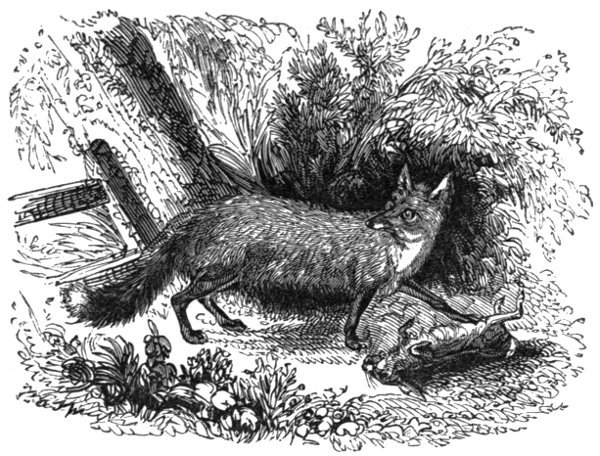
The fox is a native of almost every quarter of the globe, and is of such a wild nature, that it is impossible fully to tame him. He is esteemed the most sagacious and most crafty of all beasts of prey. The former quality he shows in his mode of providing himself an asylum, where he retires from pressing dangers, where he dwells, and where he brings up his young: and his craftiness is discovered by his schemes to catch lambs, geese, hens, and all kinds of small birds. The fox, if possible, fixes his abode on the border of a wood, in the neighbourhood of some farm or village: he listens to the crowing of the cocks, and the cries of the poultry; he scents them at a distance; he chooses his time with judgment; he conceals his road as well as his design; he slips forward with caution, sometimes even trailing his body, and seldom makes a fruitless expedition. If he can leap the wall, or get in underneath, he ravages the court-yard, puts all to death, and retires softly with his prey, which he either hides under the herbage, or carries off to his kennel. He returns in a few minutes for another, which he carries off and conceals in the same manner, but in a different place. In this way he proceeds till the progress of the sun, or some movements perceived in the house, advertise him that it is time to suspend his operations, and to retire to his den. He plays the same game with the catchers of thrushes, woodcocks, &c. He visits the nets and bird-lime very early in the morning, carries off successively the birds which are entangled, and lays them in different places, especially by the sides of highways, in the furrows, under the herbage or brushwood, where they sometimes lie two or three days; but he knows perfectly where to find them when he is in need. He hunts the young hares in the plains, seizes old ones in their seats, digs out the rabbits in the warrens, discovers the nests of partridges and quails, seizes the mother on the eggs, and destroys a vast quantity of game. He is exceedingly voracious, and, when other food fails him, makes war against rats, field-mice, serpents, lizards, and toads. Of these he destroys vast numbers, and this is the only service that he appears to do to mankind.
When urged by hunger, he will also eat roots or insects; and the foxes near the coasts will devour crabs, shrimps, or shell-fish. In France and Italy they do incredible mischief, by feeding on grapes, of which they are excessively fond.
We are told by Buffon, that he sometimes attacks bee-hives, and the nests of wasps, for the sake of what he can find to eat: and that he frequently meets with so rough a reception, as to force him to retire, that he may roll on the ground and crush those that are stinging him; but having thus rid himself of his troublesome companions, he instantly returns to the charge, and obliges them at length to forsake their combs, and leave them as a reward of his victory. When pressed by necessity he will devour carrion. “I once,” says M. Buffon, “suspended on a tree, at the height of nine feet, some meat, bread, and bones. The foxes had been at severe exercise during the night; for next morning the earth all round was beaten, by their jumping, as smooth as a barn-floor.”
The fox exhibits a great degree of cunning in digging young rabbits out of their burrows. He does not enter the hole, for in that case he would have to dig several feet along the ground, under the surface of the earth; but he follows their scent above, till he comes to the end, where they lay, and then scratching up the earth, descends immediately upon, and devours them.
Pontoppidan informs us, that when the fox observes an otter go into the water to fish, he will frequently hide himself behind a stone, and when the otter comes to shore with his prey, he will make such a spring upon him, that the affrighted animal runs off, and leaves his booty behind. A certain person, continues this writer, was surprised on seeing a fox near a fisherman’s house, laying a parcel of storks’ heads in a row: he waited the event; the fox hid himself behind them, and made a booty of the first crow that came for a bit of them.
The fox prepares for himself a convenient den, in which he lies concealed during the greater part of the day.
This is so contrived, as to afford the best possible security to the inhabitant, being situated under hard ground, the roots of trees, &c. and is besides furnished with proper outlets, through which he may escape in case of necessity. This care and dexterity in constructing for himself a habitation, is, by M. Buffon, considered as alone sufficient to rank the fox among the higher order of quadrupeds, since it implies no small degree of intelligence.
The fox, (says he,) knows how to ensure his safety, by providing himself with an asylum to which he retires from pressing dangers, where he dwells, and where he brings up his young. He is not a vagabond, but lives settled in a domestic state. This difference, though it appears even among men, has greater effects, and supposes more powerful causes, among the inferior animals. The single idea of a habitation, or settled place of abode, the art of making it commodious, and concealing the avenues to it, imply a superior degree of sentiment.
He is one of those animals that, in this country, are made objects of diversion in the chase. When he finds himself pursued, he generally makes towards his hole, and penetrating to the bottom, lies till a terrier is sent in to him. If his den is under a rock, or the roots of trees, which is often the case, he is safe, for the terrier is no match for him there; and he cannot be dug out by his enemies. When the retreat to his kennel is cut off, his stratagems and shifts to escape are as surprising as they are various. He always takes to the most woody parts of the country, and prefers the paths that are most embarrassed with thorns and briers. He runs in a direct line before the hounds, and at no great distance from them; and, if hard pushed, seeks the low wet grounds, as if conscious that the scent does not lie so well there. When overtaken, he becomes obstinately desperate, and bravely defends himself against the teeth of his adversaries, even to the last gasp.
Dr. Goldsmith relates a remarkable instance of the parental affection of this animal, which, he says, occurred near Chelmsford:—“A she fox that had, as it should seem, but one cub, was unkennelled by a gentleman’s hounds, and hotly pursued. The poor animal, braving every danger rather than leave her cub behind to be worried by the dogs, took it up in her mouth, and ran with it in this manner for several miles. At last, taking her way through a farmer’s yard, she was assaulted by a mastiff, and at length obliged to drop her cub; this was taken up by the farmer.” And we are happy to add that the affectionate creature escaped the pursuit, and got off in safety.
Of all animals the fox has the most significant eye, by which is expressed every passion of love, fear, hatred, &c. He is remarkably playful, but, like all savage creatures half reclaimed, will on the least offence bite even those with whom he is most familiar.
He is never to be fully tamed; he languishes when deprived of liberty, and if kept too long in a domestic state he dies of chagrin. When abroad, he is often seen to amuse himself with his fine bushy tail, running sometimes for a considerable while in circles to catch it. In cold weather he wraps it about his nose.
In the northern countries there is a black fox, a variety of the common fox. The Kamschatdales informed Dr. Grieve that these were once so numerous with them that whenever they fed their dogs, it was a difficult piece of labour to prevent them from partaking. The doctor says, that when he was in Kamschatka, they were in such plenty near the forts, that in the night they entered them without any apparent apprehension of danger from the dogs of the country.
One of the inhabitants, he informs us, caught several of them in the pit where he kept his fish.
The mode usually adopted by the inhabitants for taking them is by traps baited with live animals; and, for the greater security, two or three of these traps are placed upon one hillock, that, whatever way the foxes approach, they may fall into one of them. This is found necessary, since those which have been once in danger, ever afterwards go so cautiously to work, as frequently to eat the bait without being seized. But, with all their cunning, when several traps are employed, it is difficult for them to escape. Their skins are very valuable.
Foxes, Anecdotes of.—Near the Falls of Clyde, on the summit of an awful precipice, a spot is shown where a fox once exhibited extraordinary cunning. Being hard pressed by the dogs, he seized in his teeth a fast hold of some pendulous shrub growing on the verge, threw himself across the brow of the precipice, and after remaining there until the scent was strong, he recovered the ground, and jumped into an adjoining thicket. Three couple of the leading hounds, in the eagerness of pursuit, actually rushed over the bank, and were dashed to atoms. It is said that the fox escaped. The anecdote is told and credited in the neighbourhood.
The old Duke of Grafton had his hounds at Croydon, and occasionally had foxes taken in Whittlebury forest, and sent up in the venison-cart to London; the foxes thus brought, were carried the next hunting morning in a hamper behind the duke’s carriage, and turned down before the hounds. In the course of this plan, a fox was taken from a coppice in the forest, and forwarded as usual. Some time after a fox was caught in the same coppice, whose size and appearance was so strikingly like that got at the same spot, that the keepers suspected it was the fox they had been in possession of before, and directed the man who took him to London, to inquire whether the fox hunted on such a day was killed, or escaped; the latter having been the case, the suspicion of the keepers was strengthened. Some short time after, a fox was again caught in the same coppice, which those concerned in the taking were assured was the fox they had bagged twice before; to be, however, perfectly able to identify their old acquaintance, should another opportunity offer, previous to his third journey to town, he had one ear slit, and some holes punched through the other. With these marks he was despatched to London, was again hunted, and escaped, and within a very few weeks was retaken in the same coppice; when his marks justified the keeper’s conjectures, in spite of the seeming improbability of the fact. It is with some concern, that the conclusion of this singular account is added, which terminates in the death of poor reynard, who was killed after a very severe chase, bearing upon him the signals of his former escapes, and which ought to have entitled him to that lenity and privilege which was formerly granted to a stag who had beat his royal pursuers.
Some curious instances have been related to me of the cunning evinced by foxes, not only in the preservation of their lives, but in procuring themselves food. A fox, which had been frequently hunted in Leicestershire, was always lost at a particular place, where the hounds could never recover the scent. This circumstance having excited some curiosity, it was discovered that he jumped upon, and ran along a clipped hedge, at the end of which was an old pollard oak tree, hollow in the middle. He crept into this hollow, and lay concealed till the alarm was over. His retreat, however, being discovered, he was driven from it and killed. Another fox selected a magpie’s nest as a place of retreat, and was discovered in consequence of a labouring man having observed a quantity of bones, feathers of birds, &c., on the ground under the nest. The following fact may be relied upon, extraordinary as it may appear. I received it from a gentleman of the strictest veracity, who communicated it to me very recently, on his return from the south of France, where he had been residing for some months. A friend of his, with whom he passed much of his time there, was in the habit of shooting in a part of the country where there was much wild and rocky ground. Part of this rocky ground was on the side of a very high hill, which was not accessible for a sportsman, and from which both hares and foxes took their way in the evening to the plain below. There were two channels or gullies made by the rains, leading from these rocks to the lower ground. Near one of these channels, the sportsman in question, and his attendant, stationed themselves one evening, in hopes of being able to shoot some hares. They had not been there long, when they observed a fox coming down the gully, and followed by another. After playing together for a little time, one of the foxes concealed himself under a large stone or rock, which was at the bottom of the channel, and the other returned to the rocks. He soon, however, came back, chasing a hare before him. As the hare was passing the stone where the first fox had concealed himself, he tried to seize her by a sudden spring, but missed his aim. The chasing fox then came up, and finding that his expected prey had escaped, through the want of skill in his associate, he fell upon him, and they both fought with so much animosity, that the parties who had been watching their proceedings came up and destroyed them both.
Stratagems of foxes to take water-fowl.—Amongst the devices of the fox to catch his prey, is that of sliding under water like a frog, only leaving his nostrils above the surface to take breath, in such places as that described by White, where he has observed water-fowl resort. This appears to me to have given origin to a curious legend which I have traced to Albertus Magnus, the celebrated naturalist of the middle ages. “When the fox,” says he, “is troubled with gnats or fleas, he taketh a mouthful of straw or soft hay, or hair, and so goeth into the water, dipping his hinder parts by little and little, then the insects betake themselves to his head, which he keepeth out of the water, which the fox feeling, dippeth or diveth also the same under water to his mouth, wherein he holdeth the hay as aforesaid, whereunto the flies run for sanctuary or dry refuge, which the fox perceiving, suddenly casteth it out of his mouth, and runneth out of the water, by this means easing himself of all those enemies.”—Jesse—Buffon—White of Selborne—Sporting Anecdotes.
Foxcase, s. A fox’s skin.
Foxchase, s. The pursuit of the fox with hounds.
Foxhound (Canis celer), s. A hound famous for the pursuit of foxes.
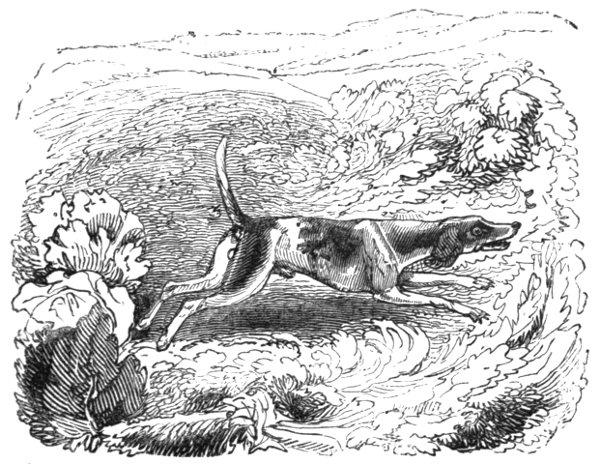
The muzzle of the fox-hound is rather long, and his head small in proportion to his body; his ears long and pendulous, though not so much as those of the blood-hound or stag-hound. His legs are very straight, his feet round and not too large, his chest deep, and breast wide, his back broad, his neck thin, his shoulders lie well back, his tail thick and bushy, and carried high when in the chase. His colour is generally white, variously patched with black in different parts of the body.
Mr. Daniel makes the following remarks on the choice of hounds. Most sportsmen have their prejudices as to the colour of their dogs. In an old distich it is said,
“So many men, so many minds,
So many hounds, so many kinds;”
and the choice of hounds in former times, as to colour and other points, is no bad commentary upon it; for we are gravely told, that white coloured dogs, especially those that were pupped without any spot upon them, although not generally good for all sorts of game, were excellent for the stag; that people from experience valued them, because of their natural instinct, being curious hunters, with admirable noses, and very good at stratagems; and, moreover, that they were less subject to diseases, by reason of a predominancy of phlegm which gave them a good temperament of body.
Black hounds were not to be rejected, especially when marked with white and not red spots, the whiteness proceeding from the phlegmatic constitution, which was supposed to ensure memory. They were at the same time more obedient, and were said to be good hunters, not frightened at water and so hardy as seldom to require the doctor.
Grey coloured hounds (supposing all suspicion of mongrelism to be removed) were to be coveted, on account of their cunning, never faltering, nor being discouraged in their quest. It is allowed that their noses were not the best, but being indefatigable, they pushed themselves forward; and it is presumed, from the above failing, that nine times out of ten they did more harm than good.
Yellow hounds, which are defined to be those having red hair, inclining to brown, possess too much choler to be much prized; were too giddy and resolute to hunt any animals that turned too much in their chase; were with difficulty taught, and not easily corrected; and, from their impatient temper, which hurried them beyond their strength, were very liable to diseases.
No country in Europe can boast of fox-hounds equal in swiftness, strength and agility, to those of Britain, where the utmost attention is paid to their breeding, education, and food. The climate also seems congenial to their nature; for, when taken to France or Spain, and other southern countries of Europe, they quickly degenerate, and lose all the admirable qualities they possess in this country:
In thee alone, fair land of liberty,
Is bred the perfect hound in scent and speed
As yet unrivall’d, while in other climes
Their virtue fails,—a weak degenerate race.
Somerville.
It is a trait in our national character to be fond of hunting. It was the occupation of our forefathers from the remotest posterity, and seems to have descended, with even increased ardour, down to the present day. Certainly there is no country that can boast of such expensive and convenient receptacles for the maintenance of fox-hounds as Great Britain. The kennel of the Duke of Richmond, at Goodwood, cost 19,000l. and Mr. Noel’s pack of hounds was sold to Sir William Lowther, Bart. for the large sum of 1,000 guineas.
The chief excellence in a pack of fox-hounds is the head they carry, taken collectively; and on this and the fineness of their noses depend their speed. Mr. Beckford says, “that hounds should go, like the horses of the sun, all abreast.” Five and twenty couple are a sufficient force at any time to be taken into the field; they are a match for any fox, supposing them steady and their speed nearly equal: too heavy dogs always do more mischief than service. Hounds that are meant to run well together should never have too many old ones amongst them. Five or six seasons are sufficient to destroy the speed of most dogs, although this depends much on constitution. We are informed of a spayed bitch, called Lilly, which ran at the head of Mr. Paxton’s harriers at Newmarket, for five seasons; a singular instance of undiminished speed.—Daniel—Beckford—Brown.
Foxhunter, s. A man whose chief ambition is to show his bravery in hunting foxes.
Foxtrap, s. A gin or snare to catch foxes.
Fracture, s. Separation of continuous parts; the breaking of a bone.
Fracture, v. To break a bone.
Fringilla (Illiger), s. The finch, a genus thus characterised:—
Bill straight and perfectly conical, short, hard, and sharp at the point; the ridge of the upper mandible rounded, and frequently advancing in an angle upon the forehead, the cutting edges of the under mandible bending a little inwards. Nostrils situated behind the horny bulging base of the hill, round, and hidden by the small frontal feathers. Wings short, having the third or fourth quill-feather the longest. Legs with the shank as short as, or shorter than, the middle toe, and with the toes divided.—Montagu.
Frog, s. A small animal with four feet, of the amphibious kind; the hollow part of the horse’s hoof. Vide Feet.
Frost, s. The last effect of cold, the power or act of congelation.
Frostbitten, a. Nipped or withered by the frost.
This effect of frost upon birds, took place in February, 1809, when a boy in the service of Mr. W. Newman, miller, at Legbourne, near Malling, went into a field, called the Forty Acres, and saw a number of rooks on the ground, very close together. He made a noise to drive them away, but they did not appear alarmed; he threw snow-balls to make them rise, still they remained. Surprised at this apparent indifference, he went in among them, and actually picked up twenty-seven rooks, and also in several parts of the same field, ninety larks, a pheasant, and a buzzard hawk. The cause of the inactivity of the birds, was a thing of rare occurrence in this climate; a heavy rain fell on Thursday afternoon, which, freezing as it came down, so completely glazed over the bodies of the birds, that they were fettered in a coat of ice, and completely deprived of the power of motion. Several of the larks were dead, having perished from the intenseness of the cold. The buzzard hawk being strong, struggled hard for his liberty, broke his icy fetters, and effected his escape.
Frostnail, s. A nail with a prominent head driven into the horse’s shoes, that it may pierce the ice.
Fry, s. The swarm of little fishes just produced from the spawn; any swarm of animals.
Fulica, (Brisson,) s. The coot, a genus thus characterised:—
Bill of middle size, strong, conical, straight, compressed, higher than broad at the base; ridge advancing upon the forehead, and expanding into a naked plate; points of both mandibles compressed and of equal length, the upper slightly curved, and widened at the base. Nostrils at the side, in the middle of the bill, slit lengthwise, half closed by a membrane which covers the widening, pierced from part to part. Legs long, slender, naked above the knee; three toes before and one behind; all the toes very long, and re-united at their base, and furnished on the sides with a scallopped membrane. Wings of middle size, the first quill shorter than the second and third, which are the longest in the wing.—Montagu.
Fulvous, a. A colour which may be described as brownish.
Fumigate, v. To smoke, to perfume by smoke or vapour; to medicate or heal by vapours.
Fumigation, s. Scents raised by fire; the application of medicines to the body in fumes.
Fumigations are used to prevent the spreading of epidemic distempers. When a stable is contaminated with glanders, the best means are to remove litter, hay, dust, &c., carefully, as well as the pail, collar, and every thing belonging to the infected horse. The rack and manger are to be well scraped, and afterwards washed with hot water and soft soap.
After this, the manger, &c. should be well washed with water; the floor or pavement of the stall is also to be carefully washed and swept, and finally the whole to be washed with slaked lime, and a solution of glue. Before horses are admitted into the stable, the following fumigation may be employed; the number of pans in which the materials are placed being adapted to the size of the stable.
Common salt 8 oz.
Magnesia, powdered 6 oz.
Let them be well mixed, and placed in an earthen dish; then pour on, gradually, four ounces of sulphuric acid. As soon as the latter is added, shut the door and windows. During the whole day the stable door and windows are to be kept shut; but at night they may be thrown open, that there may be no danger in entering the stable the next morning.—White.
Fundament, s. The back part of the body; the aperture from which the excrements are ejected.
Fungus, s. Strictly a mushroom; a word used to express such excrescences of flesh as grow out upon the lips of wounds, or any other excrescence from trees or plants not naturally belonging to them.
Fur, s. Skin with soft hair, with which garments are lined for warmth; soft hair of beasts found in cold countries; hair in general.
Fuse, v. To melt, to put into fusion.
Fusil, s. A firelock, a small neat musket.
Fustian, s. A kind of cloth made of linen and cotton.
Fustic, s. A sort of dye-wood brought from the West Indies.
Gadfly, s. A fly that stings cattle.
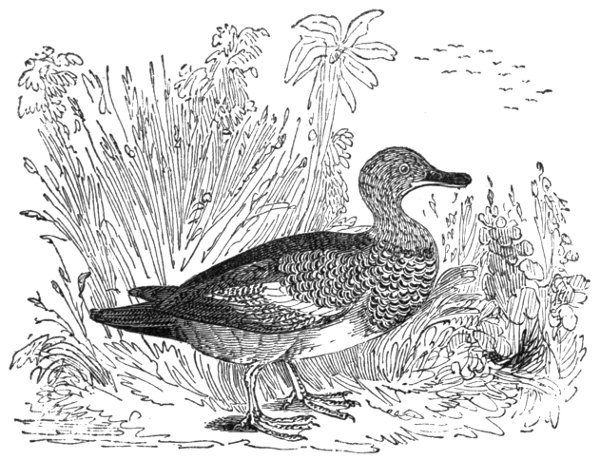
Gadwall, or Gray, (Anas strepera, Linn.; Le Chipeau, Buff.), s. a bird.
GADWALL.
The gadwall is less than the mallard, measuring about nineteen inches in length, and twenty-three in breadth.
Birds of this species breed in the desert marshes of the north, and remain there throughout the spring and summer. On the approach of winter they leave the European and Siberian parts of Russia, Sweden, &c., and, aided by the first strong north-east wind, commonly make their appearance about the month of November, on the French, British, and other more southern shores, where they remain till the end of February, and then return to their northern haunts. They are very shy and wary birds, feeding only in the night, and lurking concealed among the rushes in the watery waste during the day, in which they are seldom seen on the wing.
These birds show themselves expert in diving as well as in swimming, and often disappoint the sportsman in his aim; for the instant they see the flash of the pan, they disappear, and dive to a distant secure retreat.—Bewick.
Gaff, s. A harpoon, or large hook.
Gaggle, v. To make a noise like a goose; s. a flock of geese.
Galbanum, s. A kind of gum.
Gall, s. The bile, an animal juice remarkable for its supposed bitterness; the part which contains the bile; any thing extremely bitter; a slight hurt by fretting off the skin; an astringent medicine.
Galls are lacerations occasioned by the too tight pressure and friction of an uneasy and ill-fitted saddle, or heavy harness. They are seldom seen with either the judicious or enlightened; experience having taught both how to appreciate prevention. The prudent sportsman will never take his horse to the field, nor the humane driver his carriage-horse to the road, till personal examination has convinced him the necessary apparatus is not only firm, but proportionably easy; and this should become the more predominant in memory because it is natural to conclude, no man existing would, by neglect or inattention, give pain to the very animal from whose exertions he is to derive his own pleasure.
Injuries of this description, if unexpectedly sustained, should be immediately attended to; a repetition, and that so soon, upon the part so injured, is frequently productive of trouble, expense, loss of time, and disappointment. When the side of a horse is galled, as it sometimes is, by the girth buckle having been most improperly placed upon the edge of the pad, it is not unlikely, for want of early or proper attention, to terminate in a sitfast, and then can only be completely cured by extirpation with the knife. The withers being affected in the same way, and the saddle, or harness, continued in use, by which the injury is originally occasioned, the foundation of fistula may be laid, and will be likely to ensue. In all slight and superficial galls, two or three moistenings of the part with cold vinegar, will allay the inflammation, and harden the surface; but where the long-continued heat and friction has occasioned a destruction of parts, it must be dressed and managed as a wound, which can only be completely cured by incarnation.—White.
Gall, v. To hurt by fretting the skin.
Gallinaceous Birds, s.
A large portion of these seem to have left their native woods to crowd around the dwellings of man, where, subservient to his purpose, they subsist upon the pickings of the farm-yard, the stable, or the dung-hill; a cheerful, active race, which enliven and adorn the rural scene, and require no other care than the fostering hand of the house-wife to shelter and protect them. Some kinds, such as the partridge, the pheasant, and the like, are found only in cultivated places, at no great distance from the habitations of men; and, although they have not submitted to his dominion, they are nevertheless subject to his controlling power, and are the objects of his keenest pursuit: whilst others, taking a wider range, find food and shelter in the deepest recesses of the woods and forests, sometimes subsisting upon wild and heathy mountains, or among rocks and precipices the most difficult of access.
The characters of the gallinaceous genus are generally well known: most of the species are distinguished above all others for the whiteness of their flesh; their bodies are large and bulky, and their heads comparatively small; the bill in all of them is short, strong and somewhat curved; their wings are short and concave, and scarcely able to support their bodies, on which account they seldom make long excursions: their legs are strong, and are furnished with a spur or a knob behind.
Birds of this kind are extremely prolific and lay a great number of eggs: the young follow the mother as soon as hatched, and immediately learn to pick up the food, which she is most assiduous in showing them; on this account she generally makes her nest on the ground, or in places easy of access to her young brood.
The habitudes of the domestic breed of poultry cannot possibly escape observation; and every one must have noticed the fierce jealousy of the cock. It should seem that this jealousy is not confined to his rivals, but may sometimes extend to his beloved female; and that he is capable of being actuated by revenge, founded on some degree of reasoning concerning her conjugal infidelity. An incident which happened at the seat of Mr. B——, near Berwick, justifies this remark. “My mowers,” says he, “cut a partridge on her nest, and immediately brought the eggs (fourteen) to the house. I ordered them to be put under a very large beautiful hen, and her own to be taken away. They were hatched in two days, and the hen brought them up perfectly well till they were five or six weeks old. During that time they were constantly kept confined in an outhouse, without having been seen by any of the other poultry. The door happened to be left open, and the cock got in. My housekeeper, hearing her in distress, ran to her assistance, but did not arrive in time to save her life; the cock, finding her with the brood of partridges, fell upon her with the utmost fury, and put her to death. The housekeeper found him tearing her both with his beak and spurs, although she was then fluttering in the last agony, and incapable of any resistance. The hen had been, formerly, the cock’s greatest favourite.”—Bewick.
Gallinula (Latham), s. A genus thus characterised:—
Bill shorter than the head, compressed, conical, higher than broad at the base; ridge advancing upon the forehead and dilating in some species into a naked plate; point of both mandibles compressed, and of equal length; the upper slightly curved, the nasal groove very large, the under forming an angle. Nostrils at the sides, in the middle of the bill, slit lengthways, half shut by a membrane which covers the nasal groove, and pierced from part to part. Legs long, naked above the knee; three toes before and one behind, the fore toes long, divided, and furnished with a very narrow border. Wings of middle size, the first quill shorter than the second and third, which are the longest in the wing. The latter does not hold in some foreign species.—Montagu.
Gallop, v. To move forward by leaps, so that all the feet are off the ground at once; to move fast.
Gallop is one pace of the horse, well known by that general name; though it will admit of gradational distinctions. A canter is the slowest gallop, in which a horse bears most upon his haunches, but lightly on the bit: it is a pace which spirited good-tempered horses seem to enjoy, and is peculiarly calculated for the accommodation of a lady. A rating gallop is the increase of action to such pace as the peculiar horse may or can go with ease at his rate in common strokes, without being exerted to speed; and this is the hunting gallop of thorough-bred horses, who will always lay by the side of hounds at it, without being in the least distressed. A brushing gallop upon the turf, implies an increased degree of velocity, but not equal to utmost speed.—Taplin.
Gallop, s. The motion of a horse when he runs at full speed.
Galloper, s. A horse that gallops.
Galloway, s. A horse not more than fourteen hands high.
Galloway is the name given to that useful kind of small horse from thirteen to fourteen hands high; they are rarely to be seen of exact symmetry, uniform strength, and adequate action; but, if well bred, their qualifications and endurance of fatigue exceed description.
Gambet, (Fringa Gambetta, Linn.; La Gambette, Buff.) s. A bird.
This is the Chevalier Rouge of Brisson, and the Red-legged Horseman of Albin. For want of a specimen of this bird, the following description is borrowed from Latham:—
“Size of the Greenshank: length twelve inches, bill of a reddish colour, with a black tip; the irides yellowish green; head, back, and breast cinereous brown, spotted with dull yellow; wing coverts and scapulars cinereous, edged with dull yellow; prime quills dusky; shaft of the first white; tail dusky, bordered with yellow; legs yellow. This inhabits England, but is not common; has been shot on the coast of Lincolnshire. Known in France; but is there a rare bird. Has a note not unlike the whistle of a woodcock; and the flesh is esteemed. Inhabits Scandinavia and Iceland; called in the last Stelkr. It has also been taken in the Frozen Sea between Asia and America.”—Bewick.
Gambrel, s. The hind leg of a horse.
Game, s. Sport of any kind; jest, opposed to earnest; merriment; a single match at play; field sports, as the chase; animals pursued in the field.
In choosing game, young birds may be distinguished by the softness of their quills, which in older ones will be hard and white. The females are, in general, preferable to the males; they are more juicy, and seldom so tough. For example, a hen pheasant or a duck is to be preferred to a cock pheasant or mallard. The old pheasants may be distinguished by the length and sharpness of their spurs, which, in the younger ones, are short and blunt. Old partridges are always to be known, during the early part of the season, by their legs being a pale blue, instead of a yellowish brown; so that, when a Londoner receives his brace of blue-legged birds in September, he should immediately snap their legs, and draw out the sinews, by means of pulling off the feet, instead of leaving them to torment him, like so many strings, when he would be wishing to enjoy his repast. This remedy of making the leg tender removes the objection to old birds, provided the weather will admit of their being sufficiently kept; and indeed they are then often preferable, from having a higher flavour.
If birds are overkept their legs will be dry, their eyes much sunk, and the vent will become soft and somewhat discoloured. The first place to ascertain if they are beginning to be high is the inside of their bills, where it is not amiss to put some heather straw or spice, if you want them to keep for any length of time. Birds that have fallen in the water, or have not had time to get cold, should never be packed like others, but sent openly, and dressed as soon as possible.
A peculiar culinary mode of perfuming their birds was observed at the table of the King of Tunis, who landed at Naples to have an interview with Charles the Emperor. They were stuffed with odoriferous drugs and spices to such an expense, that the cooking of one peacock and two pheasants, dressed after this fashion, amounted to a hundred ducats, and when they were carved, not only the dining-room, but all the apartments of his palace, and even the adjoining streets, were filled with the aromatic vapour, which was not presently dispersed.—Hawker—Daniel.
Gamecock, s. A cock bred to fight.
Game-egg, s. An egg from which fighting cocks are bred.
Gamefowl, s. Game cocks and hens.
Game fowls are too well known to require a particular description. Their plumage, particularly the red, is most beautiful and rich; their size somewhat below the common, and their symmetry and delicacy of limbs to be compared with those of the race-horse and the deer, or in more strict analogy, with the wild species of their own genus. The ancients kept gamecocks for the same purpose as the moderns, and there is a game breed at present existing in India; but I have not hitherto obtained any information as to the origin of our game breed, which has been established during many centuries in this country. Their flesh is of the most beautiful white, and superior to that of all other breeds of domestic fowls, for richness and delicacy of flavour; but the extreme difficulty of rearing the chickens, from their natural pugnacity of disposition, which shows itself at the earliest possible period, deters most breeders, excepting those who breed for the cock-pit. I have many times had whole broods, scarcely feathered, stone-blind from fighting, to the very smallest individuals; these rival couples moping in corners, and renewing their battles on obtaining the first ray of light. On this account few can be reared, and as this disposition, to a certain degree, prevails in the half-bred, it prevents crossing with the game cock, otherwise a great improvement. The game eggs are smaller than common, finely shaped, and extremely delicate.
Philanthropists are in the habit of declaiming much against the practice of cock-pit battles, but, on reflection, the cruelty of that sport will be found among the least, wherein the feelings of animals are concerned; since fighting, in the gamecock, is a natural and irresistible passion, and can never take place against his will; and since those engaged in regular combat upon the arena would do so voluntarily, and with equal ardour, did they meet in the desert. Another and similar mistake is the supposed additional cruelty of arming the heels of the cock with steel, which, on the contrary, conduces to shorten the period of their sufferings.—Moubray.
Gamekeeper, s. A person who looks after game, and sees it is not destroyed.
Gamekeepers are subject to the full penalties of unqualified and unlicensed persons, as well as to actions of trespass, if they outstep the bounds of the manor for which they are appointed.
Only one can be appointed to each manor.
Deputation of a Gamekeeper.—The deputation granted to a gamekeeper must be registered with the clerk of the peace, within twenty days after it was granted, and a certificate taken of the same, under penalty of 20l. The deputation for one gamekeeper holds good till another is appointed. If a new gamekeeper is appointed within the year, the game certificate of the former keeper, may be transferred to him for the remainder of the year, and this must be done free of all expense, by the clerk to the commissioners of the district.
Form of a Deputation.—(To be written on a 1l. 15s. stamp).
Know all men, by these presents, that I of , in the county of , Esquire, lord of the manor of , in the same county, have nominated, deputed, and appointed, and by these presents do nominate, depute, and appoint of , yeoman, to be gamekeeper of and within my said manor of with full power, license, and authority to pursue, take, and kill any hare, pheasant, partridge, or other game whatsoever, in and upon my said manor of , for my sole and immediate use and benefit, and also to take and seize all such guns, bows, greyhounds, setting dogs, lurchers, ferrets, trammels, lowbells, trays, or other nets, hare-pipes, snares, or other engines, for the pursuing, taking, or killing of hares, rabbits, pheasants, partridges, or other game, as shall be used within the precincts of my said manor, by any person or persons, who by law are prohibited to keep or use the same. In witness whereof I have hereunto set my hand and seal this day of , 18 (Signature and seal.) Sealed and delivered in presence of
(The signature of one witness, specifying his place of abode, is sufficient).
Game-laws, s.
Hares may be killed at any time of the year. Pheasants from the 1st of October to the 1st of February. Partridges from the 1st of September to the 1st of February; penalty for killing them at other times 5l. Grouse from the 12th of August to the 10th of December. Black game (in Devonshire, Somersetshire, and the New Forest) from the 1st of September to the 10th of December. Black game (everywhere else) from the 20th of August to the 10th of December. Bustards from the 1st of September to the 1st of March; penalty for killing at other times 20l., or not less than 10l., for the first offence, and for every subsequent offence 30l., or not less than 20l.
Any person taking or killing game on Sundays or Christmas-days to forfeit, for the first offence, not more than 20l. nor less than 10l.; for the second offence from 30l. to 20l., and for the third and every subsequent offence 50l.
An unqualified person, killing, can only be convicted of one penalty in a day. That is, an unqualified person, or even a poacher, would have no more to pay for killing fifty head of game in the same day, than he would for killing one. Though the poacher, or unqualified person, would be liable to the other penalties, viz. 5l. each for every head of game which he sold, offered for sale, or which had even been found in his possession; and if a dog or gun (or any other engine) was used in the destruction of game, he would also be liable to 20l. penalty, provided he had not taken out a sporting certificate.
If a person go in pursuit of game with a dog and gun, he can only be charged with one offence, and convicted in one penalty for both. (7 Term Reports, 152.)
Killing from seven o’clock at night to six in the morning, between the 12th of October and 12th of February, and from nine at night to four in the morning, from the 12th of February to the 12th of October, (besides the other penalties before named) first offence, not more than 20l. nor less than 10l.; second offence from 30l. to 20l.; third and subsequent, 50l.
Servant of a lord of a manor may kill, and yet the lord of the manor may not, unless he is qualified.
Informations for penalties, relative to the game laws, should be brought so far as the conviction to take place within three months.
A penalty may be either recovered by information before a justice of peace, or sued for in any of the courts of record at Westminster. In the latter case, the action must be brought within six months after the offence committed.
Rabbits, woodcocks, snipes, quails, and landrails, are made game only so far as relates to shooting them, for which, therefore, a certificate is required; but one without a certificate may catch, sell, or have them in his possession.
Wild fowl any one may shoot on the coast, from a public path, &c., &c.
A person, with neither qualification nor license, has a right to carry a gun, provided he does not use it for the destruction of game.
Game, Price of.
Anno, 1512. Anno, 1833.
Crane, Sixteen pence.
Heron, Twelve pence. Three to four shillings.
Mallard, Two pence. Three to five shillings.
Teal, One penny. Two shillings, to three shillings.
Widgeon, One penny. Eighteen pence to three shillings.
Shoveller, Sixpence.
Woodcock, One penny or three half-pence. Three to ten shillings.
Lapwing, One penny. Nine pence to a shilling a couple.
Sea gulls, (black- headed gulls,) One penny to three half-pence.
Sturts, (purrs,) Sixpence a dozen. Three pence each.
Quail, Two pence. Two to three shillings.
Snipes, Three pence a dozen. One shilling to two shillings each.
Shoveller, Sixpence.
Woodcock, One penny or three half-pence. Three to ten shillings.
Partridge, Two pence. Eighteen pence to three shillings.
Redshank, One penny. One shilling to fifteen pence.
Bittern, Twelve pence. Five to seven shillings.
Pheasant, Twelve pence. Four to eight shillings.
Rey, (land rails,) Two pence. Two to five shillings.
Curlew, Twelve pence. Two shillings (stone curlew three shillings).
Peacock, Twelve pence. Ten to twenty shillings.
Ruffs and Reeves, Four shillings if fatted, one shilling to two shillings if shot.
Knot, One penny. Two to three shillings.
Dottrell, One penny. Two shillings each.
Bustard, One to three guineas.
Terns, Four pence a dozen.
Small Birds, Twelve pence a dozen.
Gammon, s. The buttock of a hog salted and dried; a term at backgammon for winning the game.
Gander, s. The male of the goose.
Gangrene, s. A mortification, a stoppage of circulation followed by putrefaction.
Gangrene, v. To corrupt to mortification.
Gangrenous, a. Mortified, or betokening mortification.
Gannet, Gan, Soland, or Solan Goose, (Pelicanus bassanus, Linn.; Le Fou de Bassan, Buff.) s.
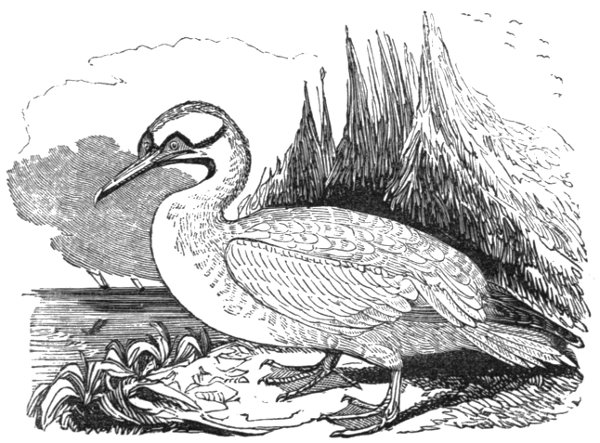
The gannet is generally about seven pounds in weight, three feet in length, and six in breadth. The bill is of a pale or lead-coloured blue, six inches long, a little jagged on the edges, strong and straight to the tip, which is inclined a little downwards; the upper bill is furnished with a distinct rib or ridge, running along from the tip nearly to its base, on each side of which it is furrowed, without any visible appearance of nostrils; the tongue is small, and placed far within the mouth, all the inside of which is black; a darkish line passes from the brow over the eyes, which are surrounded with a naked blue skin, and, like those of the owl, are set in the head so as to look nearly straight forward, and the extreme paleness of the irides gives them a keen wild stare. The gape of the mouth is very wide, and seems more lengthened by a slip of naked black skin, which is extended on each side from the corners beyond the cheeks; these features of its countenance, altogether give it the appearance of wearing spectacles. A loose black, bare, dilatable skin, capable of great distension, hung from the blades of the under bill, and extended over the throat, serves it as a pouch to carry provisions to its mate or its young. The body is flat and well clothed with feathers; the neck long; the crown of the head, nape, and, in some specimens, the hinder part of the neck, are of a buff colour; greater quills and bastard wings black, and the rest of the plumage white. The tail is wedge-shaped, and consists of twelve tapering sharp-pointed feathers, the middle ones the longest. The legs and feet are nearly of the same colour and conformation as those of the cormorant, but they are curiously marked by a pea-green stripe, which runs down each shin, and branches off along every one of the toes. The male and female are nearly alike, but the young birds, during the first year, appear as if they were of a distinct species, for their plumage is then of a dusky colour, speckled all over with triangular white spots.
The female makes her nest in the caverns and fissures, or on the ledges of the lowering precipice, as well as on the plain surface of the ground; it is formed of a great quantity of withered grasses and sea-weeds of various kinds, gathered with much labour from the barren soil, or picked up floating about upon the water. She lays three eggs, of a white colour, and somewhat less than those of a goose, although ornithologists assert that she will lay only one egg, if left to herself undisturbed, and that when this egg is taken away she then lays a second, and in like manner a third, which she is generally permitted to hatch, and rear the young one.
The male and female hatch and fish by turns; the fisher returns to the nest with five or six herrings in its gorget, all entire and undigested, which the hatcher pulls out from the throat of its provider, and swallows them, making at the same time a loud noise.
These birds are common on the coasts of Norway and Iceland, and are said to be met with in great numbers about New Holland, and New Zealand; they breed also on the coasts of Newfoundland, and migrate southward along the American shores as far as South Carolina; they are noticed, indeed, by navigators, as being met with, dispersed over both hemispheres, which are probably one great family spread over the whole globe; but their greatest known rendezvous is the Hebrides and other solitary rocky isles of North Britain, where their nests, in the months of May and June, are described as so closely placed together, that it is difficult to walk without treading upon some of them; and it is said that the swarms of the old birds are so prodigious, that when they rise into the air, they stun the ear with their noise, and overshadow the ground like the clouds.
At the small island of Borea, Martin says, “The heavens were darkened by those flying above our heads; their excrements were in such quantity, that they gave a tincture to the sea, and at the same time sullied our boat and clothes.” Besides this small island of Borea, and St. Kila, noticed by Martin, Pennant and other writers mention the isle of Ailsa, in the Frith of Clyde; the Stack of Souliskerry, near the Orkneys; the Skellig Isles, off the coast of Kerry, Ireland; and the Bass Isle, in the Frith of Forth. This last-mentioned isle is farmed out at a considerable rent, for the eggs of the various kinds of water-fowl with which it swarms; and the produce of the solan geese forms a large portion of this rent; for great numbers of their young ones are taken every season, and sold in Edinburgh for about twenty-pence each, where they are esteemed a favourite dish, being generally roasted, and eaten before dinner. On the other bleak and bare isles, the inhabitants, during a great part of the year, depend for their support on these birds and their eggs, which are taken in amazing quantities, and are the principal articles of their food. From the nests placed upon the ground the eggs are easily picked up one after another, in great numbers, as fast as they are laid; but in robbing the nests built in the precipices, chiefly for the sake of the birds, the business wears a very different aspect: there, before the dearly earned booty can be secured, the adventurous fowler, trained to it from his youth, and familiarised to the danger, must first approach the brow of the fearful precipice, to view and to trace his progress on the broken pendent rocks beneath him: over these rocks, which (perhaps a hundred fathoms lower) are dashed by the foaming surge, he is from a prodigious height about to be suspended. After addressing himself in prayer to the Supreme Disposer of events, with a mind prepared for the arduous task, he is let down by a rope, either held fast by his comrades, or fixed into the ground on the summit, with his single cord, his pole-net, his pole-hook, &c.; and thus equipped, he is enabled, in his progress, either to stop, to ascend or descend, as he sees occasion. Sometimes by swinging himself from one ledge to another, with the help of his hook, he mounts upwards, and clambers from place to place; and, at other opportunities, by springing backwards, he can dart himself into the hollow caverns of the projecting rock, which he commonly finds well stored with the objects of his pursuit, whence the plunder, chiefly consisting of the full-grown young birds, is drawn up to the top, or tossed down to the boat at the bottom, according to the situation, or concurring circumstances of time and place. In these hollows he takes his rest, and sometimes remains during the night, especially when they happen to be at such vast and stupendous heights. To others of less magnitude the fowlers commonly climb from the bottom, with the help of their hooked poles only, by which they assist, and push or pull up each other from hold to hold, and in this manner traverse the whole front of the frightful scar. To a feeling mind the very sight of this hazardous employment, in whatever way it is pursued, is painful; for, indeed, it often happens that these adventurous poor men, in this life-taking mode of obtaining their living, slip their hold, are precipitated from one projection to another, with increasing velocity, and fall mangled upon the rocks, or are for ever buried in the abyss beneath.
The sailors sometimes catch these birds by fastening a fresh herring on a floating plank, against which the gannet’s neck is broken, when furiously pouncing on his prey.—Bewick—Martin.
Garganey, (Anas querquedula, Linn.; Le Sarcelle, Buff.) s.
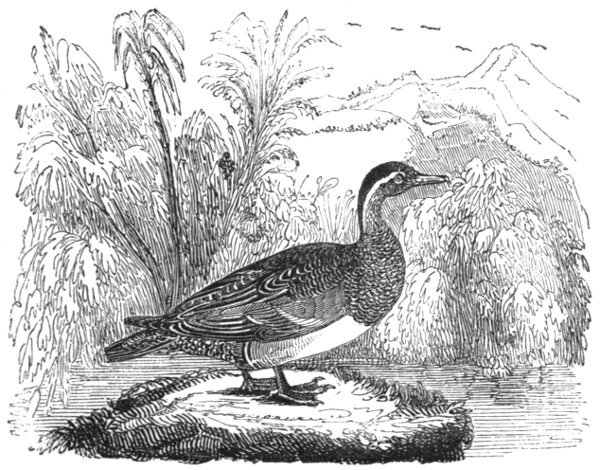
This species, which is only a little bigger than the teal, is clothed with an elegant plumage, and has altogether a most agreeable and sprightly look. It measures about seventeen inches in length, and twenty-eight in breadth. The bill is of a dark lead colour, nearly black; the irides light hazel. From the crown of the head, over the nape of the neck downwards, it is of a glossy brown, chin black; brow, cheeks, and the upper fore part of the neck, reddish chestnut, with vinous reflections, and sprinkled all over with numerous small pointed white lines. A white stripe passes over each eye, and slanting backwards, falls down on each side of the neck, the lower part of which, with the breast, is light brown, pretty closely crossed with semicircular bars of black; the shoulders and back are marked nearly the same, but on a darker ground: the scapulars are long and narrow, and are striped with ash-colour, black, and white. The belly in some, is white; in others, pale reddish yellow; the lower part of it, and the vent, mottled with dusky spots; the sides are freckled and waved with narrow lines of ash-coloured brown, more and more distinctly marked towards the thighs; behind which, this series of feathers terminates in a riband, striped with ash, black, white, and lead-coloured blue.
The coverts of the wings are of an agreeable bluish ash, margined with white; next to this, the exterior webs of the middle quills are glossy green, tipped with white, and form the beauty-spot or spangle of the wings, to which the white tips make a border; the primary quills are ash-brown, edged with white; tail dusky; legs lead colour. The foregoing description was taken from a male bird in full and perfect plumage. This sex is furnished with a labyrinth.
The female has an obscure white mark over each eye; the rest of the plumage is of a brownish ash colour, not unlike the female teal; but the wing wants the green spot, which sufficiently distinguishes these birds.
It has not yet been noticed whether any of this species ever remain to breed in England, where, indeed, they are rather a scarce bird.—Bewick.
Gargle, v. To wash the throat with some liquor not suffered immediately to descend.
Gargle, s. A liquor with which the throat is washed.
Garlick, s. A plant, sometimes used in chronic cough.
Garran, s. A small horse, a hobby; a wretched horse. (An Iricism.)
Gash, v. To cut deep, so as to make a gaping wound.
Gash, s. A deep and wide wound; the mark of a wound.
Gasp, v. To open the mouth wide to catch breath; to emit breath by opening the mouth convulsively.
Gasp, s. The act of opening the mouth to catch breath; the short catch of the breath in the last agonies.
Gate, s. A frame of timber upon hinges to give a passage into enclosed grounds; a moveable part of a fence made of iron or timber.
Gaudy, a. Showy, splendid, tinselled.
Gauge, s. A measure, a standard.
Gaunt (Podiceps cristatus, Latham), s. A species of bird.
A full-grown male gaunt weighs between two and three pounds; length about two feet. The bill is two inches and three quarters long, dusky brown along the ridge of the upper mandible and at the point; the rest reddish flesh-colour; irides and lore crimson. The head is much enlarged by a crest of a dusky colour, standing up on each side; the cheeks and throat are surrounded by long feathers of a ferruginous colour; from the bill to the eye is a black line, above which is a white one; the chin is white; the hind part of the neck, and upper part of the body and wings, dusky brown; the under part of the neck, breast, and all beneath, beautiful glossy white; the primary quill-feathers dusky; some of the inner ones tipped with white, the rest are nearly all white, which, when the wing is closed, makes an oblique bar of that colour across it; legs dusky on the outside; some wholly dusky green.
This bird is indigenous to England; it breeds in the meres of Shropshire and Cheshire, and in the fens of Lincolnshire. The nest is large, composed of a variety of aquatic plants; it is not attached to any thing, but floats amongst the reeds and flags, penetrated by the water. The female lays four white eggs, about the size of that of a pigeon.—Montagu.
Gazehound, s. A hound that pursues not by the scent, but by the eye; an ancient name of the greyhound.
Gear, s. Furniture, accoutrements, dress; the traces by which horses or oxen draw; stuff.
Geld, v. To castrate, to deprive of the power of generation; to deprive of any essential part. Vide Castration.
Castration has a strange effect: it emasculates both man, beast, and bird, and brings them to a near resemblance of the other sex. Thus eunuchs have smooth unmuscular arms, thighs, and legs; and broad hips, and beardless chins, and squeaking voices. Gelt-stags and bucks have hornless heads, like hinds and does. Thus wethers have small horns, like ewes; and oxen large bent horns, and hoarse voices when they low, like cows; for bulls have short straight horns; and though they mutter and grumble in a deep tremendous tone, yet they low in a shrill high key. Capons have small combs and gills, and look pallid about the head like pullets; they also walk without any parade, and hover chickens like hens. Barrow-hogs have also small tusks like sows.
Thus far it is plain that it puts a stop to the growth of those appendages that are looked upon as its insignia. But the ingenious Mr. Lisle, in his book on husbandry, carries it much farther; for he says, that the loss of those insignia alone has sometimes a strange effect: he had a boar so fierce and amorous, that to prevent mischief, orders were given for his tusks to be broken off. No sooner had the beast suffered this injury than his powers forsook him, and he neglected those females to whom before he was passionately attached, and from whom no fences could restrain him.—White of Selborne.
Gelding, s. Any animal castrated, particularly a horse.
Gelid, a. Extremely cold.
Gelly, s. Any viscous body; viscidity, glue, gluey substance.
Gender, s. A kind, a sort, a sex.
Gender, v. To beget; to produce, to cause; to copulate, to breed.
Genet, s. A small well-proportioned Spanish horse.
Gentle, s. A maggot used in angling.
Those who live in or near London may buy them in proper condition for the day on which they wish to use them, but for the accommodation of those who reside in the country, remote from such convenience, the best modes of breeding them will be here mentioned, in order to prevent disappointment.
Coarse fish, such as chub and roach, may be laid in an earthen pot in the shade, and will soon be fly-blown. When the gentles are of a proper size (but not before), put some oatmeal and bran to them, and in two days they will be well scoured and fit to fish with, in about four more they become hard, assume a pale red colour, and soon after change to flies. The red ones should not be thrown away, as frequently roach and dace take these with a white one in preference to all other baits. Some have recommended a piece of liver suspended by a stick over a barrel of clay, into which the gentles fall and cleanse themselves; but clay will not scour them, and besides they fall from the liver before they have attained their full size. The aforementioned is a less disgusting plan; for a short time after oatmeal and bran are put to the gentles the fish in which they are bred will be found perfect skeletons, and may be thrown away. However, if they are to be bred from liver, it should be scarified deeply in many parts, and then hung up and nearly covered over, as in that way the flies will blow it better than when wholly exposed; in two or three days the gentles will be seen alive. The liver is then to be put into an earthen pan and there remain until the first brood are of full growth, a sufficient quantity of fine sand and bran (letting the liver remain) is then to be put into the pan, and in a few days they will come from the flesh, and scour themselves in it. The liver should then be hung across the pan and the latter brood will soon drop out and be fit for use; and by thus breeding them in October, and keeping them a little warmer than those bred in summer, until they arrive at their full growth, and afterwards putting them in the same pan into a dampish vault, they may be preserved for winter fishing.—Daniel.
Gentle, a. Soft, mild, tame, peaceable; soothing; pacific.
Genus, s. In science, a class of beings comprehending under it many species; as quadruped is a genus comprehending under it almost all terrestrial beasts.
Germ, s. A sprout or shoot.
Gestation, s. The act of bearing the young in the womb.
Get, v. To beget upon a female.
Getter, s. One who procures or obtains; one who begets on a female.
Gibbous, a. Convex, protuberant, swelling into inequalities; crooked-backed.
Gier-eagle, s. obs. An eagle of a particular kind.
Gig, s. Anything that is whirled round in play; a two-wheeled vehicle; a light boat.
Gigot, s. The hip joint.
Gill, s. A measure of liquids containing the fourth part of a pint.
Gills, s. The aperture at each side of the fish’s head; the flaps that hang below the beak of a fowl; the flesh under the chin.
Gimp, s. A kind of silk twist used in angling.
Gin, s. The spirit drawn by distillation from juniper berries and wheat. The Hollands Geneva is principally distilled in the neighbourhood of Rotterdam; English is produced from the oil of turpentine and malt spirits.
Ginger, s. An Indian root; the flower consists of five petals, shaped like those of the iris.
There are two sorts kept in the shops; the black and the white ginger: the latter is stronger, and preferred for culinary purposes, on account of its more pleasant flavour, but the former is considered cheaper, easily powdered, and more frequently used as a horse medicine.
I consider ginger as the most useful stimulant in the veterinary materia medica: when joined with aromatics, such as allspice, caraway seed, aniseed, cummin seed, &c., or their essential oils, it forms an efficacious cordial, and with emetic tartar and opium an excellent diaphoretic, for giving gloss to the coat, and relaxing the skin. Joined with bitters, it makes a good stomachic; with squills an expectorant, often relieving obstinate coughs.
Ginger is extremely beneficial in weakness and flatulency of the stomach; and assisted by other remedies, such as warm beer, it seldom fails of curing the flatulent colic, or gripes. See Carminatives.
The dose is from one drachm and a half to three drachms.
It should be recently powdered when used; but in a well-stopped bottle the powder may be kept a considerable time without losing its strength.—White.
Gizzard, s. The name given to the strong, muscular, and cartilaginous portion of the stomach in birds which feed on grain, which is so different from the membranous stomach of birds of prey (raptores). The gizzard receives the food which has previously been taken into the crop.
Glade, s. A lawn or opening into a wood.
Glair, s. The white of an egg.
Glance, v. To shoot obliquely.
Glanders, s. A disease incident to horses.
This is a contagious disorder, and one that is generally thought incurable. The great number of horses that have been destroyed by glanders, especially in the army, and in establishments where great numbers of horses are kept, has excited particular attention to the subject, especially in France and Italy, where many attempts were made, in the beginning of the last century, to discover a remedy for it. Lafosse, an eminent French veterinarian, considered it as a local disease, and thought he had discovered a successful mode of treating it, which consisted in perforating the bones which cover the frontal and nasal sinuses, and injecting through the openings astringent and other liquids. After this opinion had been published, some English farriers made trial of it, and by others detergent lotions were poured into the nostrils; the nose being drawn up for the purpose by means of a pulley. Attempts were also made to cure it by arsenical fumigations, and by burning out the swollen glands under the jaws, or sloughing them out by caustics. The various preparations of mercury, copper, iron, and arsenic, have likewise been tried, and after all the general opinion is that the glanders is incurable.
That the glanders is contagious has been clearly and indisputably proved by numerous experiments; and the manner in which it is propagated has likewise been satisfactorily demonstrated. At the same time it is generally believed that the glanders takes place also independent of contagion; but from what causes or circumstances it is then produced, no author has attempted to state precisely.
It has been said, in a general way, that close unwholesome stables, hard work, and bad provender, sudden changes from cold and wet weather to hot close stables, hard work, and insufficient keep, and, in short, any thing that will weaken the animal considerably, is likely to produce glanders or farcy. Hence post and stage horses are particularly obnoxious to this disease.
Mr. Russel, of Exeter, had, for many years, some glandered teams of horses constantly working from Plymouth to Exeter. But they were worked with moderation, well fed, and taken great care of. I attended these teams for several years, the horses generally looked well, and in excellent condition. Many of them lasted four or five years; and some fell off after a few months.
The symptoms of glanders are—1st, A discharge of glairy matter from one or both nostrils; generally from one only, and more frequently from the left than from the right nostril. 2d, A swelling of the glands or kernels under the jaw, or between the branches of the lower jaw, and generally on the side of the jaw corresponding with the affected nostril. In all other respects the animal is generally in health, and often sleek and in good condition.
Sometimes, however, the glanders is accompanied by a disorder of the skin, named farcy, and then the horse’s general health is often affected. Farcy has been considered, by many authors, as a distinct disorder. I have therefore noticed it in a separate article (see Farcy), though of opinion that it is always a symptom of glanders, whether it appear in a local, or in a constitutional form.
Glanders has been divided into two stages, the acute and the chronic, or the first and second stage. The acute glanders is generally attended with acute farcy, such as chancrous ulceration about the lips, face, or neck, with considerable and painful swellings on different parts, some of the swellings appearing as a corded vein: ulceration and swelling of the hind leg or sheath, or testicles, and sometimes of the fore leg, with corded veins, and farcy buds on the inside of the limb. The acute glanders often spreads rapidly, and either destroys the animal, or renders him such a pitiable and hopeless object, that the proprietor is generally induced to have him knocked on the head.
Chronic glanders is generally very mild in the first stage of the disorder, and does not affect the appetite, or the general health and appearance of the animal. Such horses, when properly fed and taken care of, and worked with moderation, will often continue in regular work for several years.
I have been in the habit of attending several teams of glandered horses since I left the army, and have known them last four or five years. Sometimes, however, they would go off in a few months; and whenever a glandered horse fell off much, and became unequal to his work, he was destroyed. Many glandered horses have been known to get rid of the disorder while working in these teams; and sound horses that have been put in occasionally, to fill up the teams, especially old horses, have escaped the disorder. It is this circumstance, as I have before stated, that has led many to believe that the glanders is not contagious.
The second stage of glanders is marked by ulceration within the nostrils, or an appearance in the matter which indicates ulceration, though sometimes too high up to be seen. The matter is in larger quantity, more glutinous, sticking about the margin of the nostril and upper lips, and sometimes obstructing the passage of air, so that the horse makes a snuffling noise in breathing. The matter is sometimes streaked with blood, and the horse sometimes bleeds from the nostrils in working. When this happens in the first stage of the disorder, however early it may be, it indicates the approach of the second stage. The matter begins to have an offensive smell, which it scarcely ever has in the first stage, though an offensive smell is by many supposed to be a decisive mark of glanders. In the second stage the matter generally runs from both nostrils; the glands under the jaw become larger, harder, and fixed more closely to the jaw-bone. They are also generally more tender than in the first stage; the inner comers of the eyes are mattery. The horse loses flesh and strength, stales more than usual, coughs, and at length dies in a miserable condition, generally farcied as well as glandered. It is with this disease as it was formerly with small pox inoculation, and is now with vaccination. If a person happens to meet with one or two cases, or suppose it were half a dozen, of a horse escaping the glanders after standing in a stable with one that is glandered, he thinks himself fully warranted in concluding that the disease is not contagious. Satisfied with this decision, he gives himself no further trouble about it, and pays no attention to any thing that may be said or written in opposition to his own opinion.
It is a remarkable circumstance, that glanders cannot be communicated by applying the matter which is discharged from the nose of a glandered horse to the nostrils of a sound horse, even though a piece of lint soaked in the matter be put up the nostrils, and kept in contact with the pituitary membrane for a short time; or even if the matter be thrown up the nostrils with a syringe. But, if the smallest quantity of matter be applied in the way of inoculation, either to the membrane of the nostrils, or to any part of the body, a glanderous ulcer will be produced, from which farcy buds and corded lymphatics will proceed. After a few weeks the poison will get into the circulation, and the horse will be completely glandered. The circumstance of glanders not being communicated by applying matter to the nostril, enables us to account for a horse escaping the disorder, as he sometimes does, after being put into a glandered stable, or standing by the side of a glandered horse. I believe, however, that glanders is frequently communicated by (accidental) inoculation; and that there is only one other way in which it can be communicated, that is, by swallowing the matter which flows from the nose of a glandered horse.—Vide Blaine.
A horse affected with glanders may inoculate himself, and thereby produce the farcy. I have known this happen to a horse while at grass. The horse had an itching in his hind leg, which led him to rub and bite the part, and, at the same time, rub on it the glanderous matter which flowed from his nostril. The possibility of this circumstance taking place may be easily proved by inoculating a glandered horse, in any part of his body, with some of his own matter. There are many ways in which a sound horse may be accidentally inoculated with the matter of glanders, for the slightest scratch in any part of the body is sufficient. Horses that are cleaned with a curry comb are very liable to be scratched in those parts where the bones are prominent, such as the inside of the hock or knee, the shank bones and the head. To such scratches glanderous matter may be applied by the hands of the groom after he has been examining the nose of a glandered horse, or wiping off the matter from his nostrils; or by the horse himself transferring glanderous matter from the nose of a diseased horse, or from the manger, or other part where any matter has been deposited, for horses are very fond of rubbing their noses against the manger or stall, and a glandered horse will generally try to rub off the matter from his nose against the manger, the rack, the stall, or against another horse; and if a sound horse happen to stand by one that is glandered, they will often be seen nabbing or gently biting each other, or rubbing noses. In short, having proved that glanders is thus communicated, we can conceive a variety of ways in which a horse may be accidentally inoculated.
The reader may form some idea of the extent of such losses when informed that large inn-keepers have been nearly ruined by them. I had occasion to condemn eight horses at one time, in one establishment, which, added to those already lost, amounted in value to five hundred pounds. In one regiment fifty glandered horses were shot in one day. The twenty-third French dragoons, when quartered in Italy, in March, 1809, had seventy-six horses at one time affected with glanders and farcy, or suspected of being so affected.
As I have demonstrated the manner in which glanders is communicated, it is needless to say any thing of the mode of prevention, except briefly observing, that it can only be accomplished by preventing any glanderous matter from coming near a horse, or mixing with his food or water; and that the only method of purifying an infected stable, is to remove every thing on which glanderous matter may have fallen, and to wash and scrape the fixtures, such as the rack and manger, thoroughly. I have in a former edition advised a fumigation with the gas which arises from a mixture of common salt, manganese, and oil of vitriol; because I have found that glanderous matter which has been exposed to this gas is rendered quite innocent, though an ass be inoculated with it; and I have directed the stable to be first thoroughly cleansed, because if any dry hard glanderous matter should remain, the water employed in cleansing the stable will have moistened it, and thereby enable the fumigation to mix with it, and destroy its poisonous quality.—White.
Glare, v. To shine so as to dazzle the eyes.
Glare, s. Overpowering lustre, splendour, such as dazzles the eye; a fierce piercing look.
Glass, s. An artificial substance made by fusing salts and flint or sand together, with a vehement fire; a glass vessel of any kind; a looking-glass; a glass to help the sight; an hour-glass, a glass used in measuring time by the flux of sand; a cup of glass used to drink in; the quantity of wine usually contained in a glass; a perspective glass.
Glassy, a. Vitreous; resembling glass, as in smoothness, lustre, or brittleness.
Glead, s. A kind of hawk.
Glen, s. A valley, a dale.
Glires, s. The fourth order of the class Mammalia in the Linnæan system. It includes animals with two foreteeth, a cutting one in each jaw, no tusks, and claws formed for running, as the hare, rabbit, &c.
Glow-worm, s. A small creeping insect with a luminous tail.
Glue, s. A viscous cement. The best is made from the parings of hides and other offals, by boiling them well in water, then straining off all impurities, and, lastly, boiling them again.
Glue, v. To join with a viscous cement; to unite.
Glute, s. The slimy substance in a hawk’s pannel.
Glyn, s. A hollow between two mountains.
Gnarl, v. To growl, to murmur, to snarl.
Gnash, v. To grind or collide the teeth.
Gnat, s. A small winged stinging insect.
Gnaw, v. To exercise the teeth.
Goar, s. Any edging sewed upon cloth.
Goat, s. An animal that seems a middle species between deer and sheep.
Godwit, s. A bird of particular delicacy.
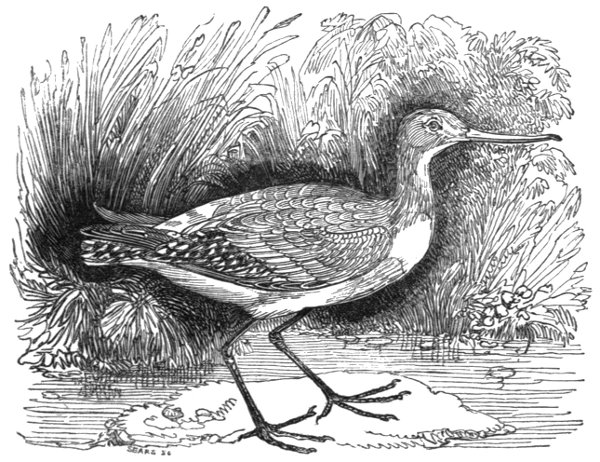
Buffon enumerates eight species of this division of the scolopax genus, under the name of barges, including the foreign kinds; and Latham makes out the same number of different sorts, all British. They are a timid, shy, and solitary tribe; their mode of subsistence constrains them to spend their lives amidst the fens, searching for their food in the mud and wet soil, where they remain during the day, shaded and hidden among reeds and rushes, in that obscurity which their timidity makes them prefer. They seldom remain above a day or two in the same place, and it often happens that in the morning not one is to be found in those marshes where they were numerous the evening before. They remove in a flock in the night, and when there is moonlight, may be seen and heard passing at a vast height.
Their bills are long and slender, and, like the common snipe’s, are smooth and blunt at the tip; their legs are of various colours, and long. When pursued by the sportsman, they run with great speed, are very restless, and spring at a great distance, and make a scream as they rise. Their voice is somewhat extraordinary, and has been compared to the smothered bleating of a goat. They delight in salt marshes, and are rare in countries remote from the sea. Their flesh is delicate and excellent food.
Common Godwit, Godwyn, Yarnhelp or Yarnhip.—(Scolopax ægocephala, Linn. La grande Barge Grise, Buff.)
The weight of this bird is about twelve ounces; length about sixteen inches; the bill is four inches long, and bent a little upwards, black at the point, gradually softening into a pale purple towards the base; a whitish streak passes from the bill over each eye; the head, neck, back, scapulars, and coverts, are of a dingy pale brown, each feather marked down the middle with a dark spot. The fore part of the breast is streaked with black; the belly, vent, and tail, are white, the latter regularly barred with black; the webs of the first six quill feathers are black, edged on the interior sides with reddish brown; the legs are in general dark coloured, inclining to a greenish blue.
The godwit is met with in various parts of Europe, Asia, and America; in Great Britain, in the spring and summer, it resides in the fens and marshes, where it rears its young, and feeds upon small worms and insects. During these seasons it only removes from one marsh to another; but when the winter sets in with severity, it seeks the salt marshes and the seashore.
The godwit is much esteemed by epicures as a great delicacy, and sells very high. It is caught in nets, to which it is allured by a stale or stuffed bird, in the same manner, and in the same season, as the ruffs and reeves.—Bewick.
Gold, s. The purest, heaviest, and most precious of all metals; money.
To dye fine bright Gold Colours.—First dye a very bright yellow with turmeric, lift out your stuff, and add a teaspoonful of madder; return it, and boil it about three minutes, and draw a part for the first shade; then put in a tablespoonful of turmeric, boil it up smartly; lift out your stuff and add better than a teaspoonful of madder; put it into the pot again, and boil it about seven minutes, and draw the second shade. For the third do the same, only adding some turmeric as before, and two teaspoonfuls of madder; or, if you see there is not a proper difference between the shades, add more madder, boil the wool in this ten minutes, and draw for the third shade. Add more turmeric, and three or four more teaspoonfuls of madder, or more, till you bring it near to a blood orange.
The lightest of these shades mixes the olive camel, the second the light rail, the third the dark rail and brown coughlan, and the fourth mixes the golden sooty. This is the best way to dye gold colours. Any man who is not a regular dyer can only be called a fancy dyer, and therefore can give no regular rules. If you are a judge of these colours, you will know by your eye when you get the proper shade. If the first two of them should not be enough of the gold, add more madder by pinches, lest you should overpower it. Divide each shade of the colours into two parts, for fine olives, bordering on muscle’s-beard. Put down a clean vessel with clean water, and put your lightest shade into it, first boiling in it about the size of a horse-bean of copperas. Throw in your stuff, be smart in passing it under your liquor, and in an instant you have a fine golden olive. Put in the size of a pea more of copperas, and put your next shade, and so on till all is done. You are to put in as much as two peas in the last. A little of the dark shade helps the March olive camel, and I have mixed out of these, with a little brown sable, a very good olive camel. All turmeric dyes, when put with binding stuff, stand well. Be careful your turmeric and madder be sound, if not, all is lost. Sound turmeric is very bright, and of a sweet smell. Sound madder is of an oily feel and a sweet smell, and is bright in colour; that which resembles brick-dust is bad, and gives no colour. The madder that is the best may be discovered easily by the taste.—Ancient Recipe.
Golden, a. Made of gold, consisting of gold; shining; yellow, of the colour of gold; valuable.
Golden Eagle. Vide Eagle.
The golden eagle is said to be not unfrequent in the mountainous parts of Ireland and Scotland. It breeds in the most inaccessible rocks, and lays three or four white eggs, Selby says two, of a greyish white colour, clouded with spots of reddish brown.
Smith, in the History of Kerry, says, a poor man in that county got a comfortable subsistence for his family, during a summer of famine, out of an eagle’s nest.
Pennant informs us it is frequent in Scotland, and adds, that it is very destructive to deer, which it will seize between the horns, and, by incessantly beating it with its wings, soon makes a prey of the harassed animal; that it builds in cliffs of rocks near the deer forests, and makes great havoc not only amongst them, but also the white hares and ptarmigans.
Willoughby gives a curious account of the nest of this species found in the woodlands, near the river Derwent, in the Peak of Derbyshire. He says it was made of large sticks, lined with two layers of rushes, between which was one of heath; that in it was one young and an addle egg, and by them a lamb, a hare, and three heath-poults.
Instances have been recorded of infants being carried to their nests; and in the Orkneys there is a law which entitles any person killing one of these birds, to a hen out of every house in the parish in which it is killed. They are remarkable for their longevity, and abstinence from food. Pennant mentions one enduring hunger for twenty-one days.
As we were sporting in the neighbourhood of Ben-Lomond, on the summit of the lesser mountains that form its base, a grouse, (Tetrao Scoticus), was wounded, and flew with difficulty eighty or a hundred paces. An eagle, apparently of this species, perceiving the laborious flight of the grouse, descended with rapid wing from the adjacent lofty cliffs, before our guns were re-loaded, and, in defiance of the shouts made to deter him, carried off his prey.
In another part of the Western Highlands of Scotland, we had an opportunity of witnessing the power of the flight of this bird in pursuit of its quarry. An old black-cock (Tetrao tetrix) was sprung, and was instantly pursued by the eagle, (who must have been on a neighbouring rock unperceived,) across the glen, the breadth of which was at least two miles. The eagle made several unsuccessful pounces, but as there was no cover and the bird large, it probably fell a victim in the end.—Smith—Pennant—Montagu.
Golden-eye (Anas clangula, Linn.; Le Garrot, Buff.) s.
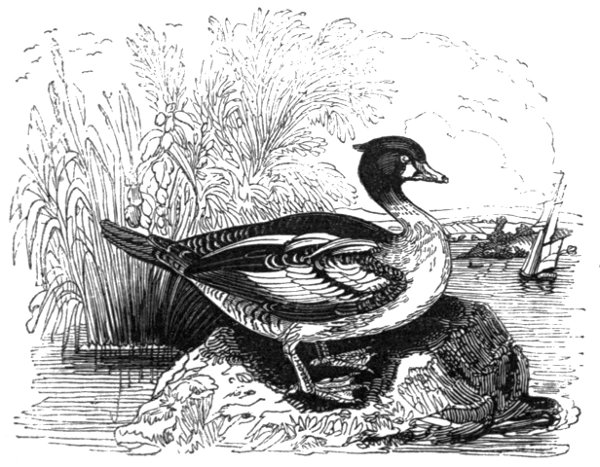
The weight of this species varies from twenty-six ounces to two pounds. The length is nineteen inches, and the breadth thirty-one. The bill is bluish-black, short, thick, and elevated at the base; the head large, slightly crested, and black, or rather of a glossy bottle-green, with violet reflections; a large white spot is placed on the space on each side between the corners of the mouth and the eyes, the irides of which are of a golden-yellow; the throat, and a small portion of the upper part of the neck, are of a sooty or velvet-black; the lower, to the shoulders, the breast, belly, and vent, white; but some of the side-feathers, and those which cover the thighs, are tipped with black; the scapulars white and deep black; of the latter colour are also the adjoining long tertial feathers, and those on the greater part of the back; the first fourteen primary quills, with all the outside edge of the wing, including the ridge and a portion of the coverts, are brownish black; the middle part of the wing is white, crossed by a narrow black stripe, which is formed by the tips of the lesser coverts; tail dark, hoary brown; legs short, of a reddish yellow colour, with the webs dusky; the inner and hinder toes are furnished with lateral webs; on the latter these webs are large and flapped. Willoughby says, “the windpipe hath a labyrinth at the divarication, and besides, above swells out into a belly or puff-like cavity.”
These birds do not congregate in large flocks, nor are they numerous on the British shores, or on the lakes in the interior. They are late in taking their departure northward in the spring, the specimens before mentioned being shot in April. In their flight they make they air whistle with the vigorous quick strokes of their wings; they are excellent divers, and seldom set foot on the shore, upon which, it is said, they walk with great apparent difficulty, and, except in the breeding season, only repair to it for the purpose of taking their repose.
The attempts which were made by M. Baillon to domesticate these birds, he informs the Count de Buffon, quite failed of success.
An extraordinary occurrence took place, March, 1810, near Drumburgh, a fisherman, placed a flounder-net in the river Eden, which is subject to the flux and reflux of the tide, and on his returning to take up his net, instead of finding fish, he found it loaded with wild ducks; during his absence, a fleet of these birds had alighted below the net, and on the flowing of the tide, were carried, from the contraction of the channel, with great impetuosity into the net, and were drowned. He caught one hundred and seventy golden-eyed wild ducks, supposed to be from the Orkneys, as very rarely any of that species frequent that part of the country.—Bewick.
Golden Oriole (Oriolus galbula, Linn.), s.
This is the only species ever found in England, a few instances of which only are on record. It is about the size of a blackbird: length nine inches and a half. The bill is brownish red; irides red. General colour of the plumage fine golden yellow; between the bill and eye a streak of black; the wings black, marked here and there with yellow, and a patch of the same in the middle of the wing; the two middle feathers of the tail are black, inclining to olive at the base, the very tips yellow; the base half of the others black, the rest yellow; legs lead-colour; claws black.
The female is of a dull greenish brown in those parts where the male is black. Wings dusky; tail dirty green; all but the two middle feathers yellowish white at the ends.
This beautiful bird is not uncommon in France, where it breeds. The nest is curiously constructed, in shape like a purse: it is fastened to the extreme forked branches of tall trees, composed of fibres of hemp, or straw mixed with fine dry stalks of grass, and lined with moss and liverwort. She is said to be so tenacious of her eggs as to suffer herself to be taken on the nest.—Montagu.
Goldfinch, (Carduelis communis, Cuvier,) s. A singing bird.
This beautiful bird is rather less than the chaffinch. The bill is white, with a black point; irides dusky; the forehead and chin rich scarlet; top of the head black; cheeks white, bounded with black; hind part of the head white; breast pale tawny brown; the coverts of the wings black; quill feathers dusky black, barred across with bright yellow; tips white; belly white; the tail feathers black; most of them marked with a white spot near their ends; legs whitish.
The female differs very little in plumage from the male: in general, the smaller coverts of the wings are not so black. Young birds are brown about the head for some time after they leave the nest, and are by some called grey-pates.
The goldfinch is subject to variety in confinement; sometimes wholly black; others black and white, or quite white. A variety is sometimes taken by the birdcatchers with white spots under the throat: such is termed a cheverel. It makes a very elegant nest, formed externally of bents, moss, and liverwort, woven together with wool; lined sometimes with wool or hair, covered with thistle down, or willow cotton.