INTRODUCTION. (continued 19)
Reading edition
Mr. Egg and Mr. Sykes have each got patents for powder flasks, in which, if a charge is blown up, all communication is so effectually prevented, that no farther damage can be done. I have seen the one of Mr. Egg repeatedly tried by himself. To do this, he dropped a red hot nail into the barrel, which, of course, instantly fired the measure put into it. He then unscrewed the top, and showed me the remainder of the powder in the horn, having only guarded his right hand by a shield of pasteboard, to avoid being burnt by the charge from the barrel.
The principle of it is so secure as to render it impossible for the powder in the flask to ignite, while in the act of loading, by the passage being completely cut off, from the lever being placed on the top of a strong plate instead of underneath. It also prevents the flash out of the barrel from injuring the hand, as the charger is fixed in an octant position, with a vent to let out the flame.
The springs of these powder horns must be kept very clean and free, or, like many ingenious patents, they will fall victims to the abuse of slovenly sportsmen. Mr. Egg says, he “begs leave to caution gentlemen of a trumpery Sheffield flask (sold in the shops), with an upright charger, not being calculated to answer the purpose intended, though it is an infringement on his patent.”—Hawker.
Powderhorn, s. A horn case in which powder is kept for guns.
As to your horn, the best thing you can do, when it remains pretty full at the end of a day, is to leave it in a very dry place in a warm room. For my own part, being persuaded that so much depends upon this, I always have my powder packed in half-pounds, a spare one of which I usually carry about me, and never open it until my horn is empty; and I am certain that more depends upon the quality and state of the powder than is usually ascribed to it.—Hints to Sportsmen.
Powdermill, s. The mill in which the ingredients for gunpowder are ground and mingled.
Powder Prover, s.
Powder Prover.—The proper “epreuvette” is very correctly made; the wheel on which the gradations are marked is large, and the spring strong, consequently the resistance to the force of the powder is considerable. The stronger it is the better; for without the resistance is strong, a correct proof cannot be obtained; because if not sufficiently strong to detain the powder in the chamber long enough for all the particles to ignite, many of them (especially in powder of good firm grain) will fly off unburnt, and of course a part only of the charge would be proved.
The part attached to the wheel of the epreuvette, which shuts the mouth of the chamber, should be so nicely adjusted, that on looking closely at the parts when in contact, no light can be seen between them; for if any light, there is of course so much vacancy, and consequently so much windage; and in proportion to the windage the proof will be lower, and therefore incorrect.
Three fires at least should always be made in proving, and the average taken as the mean amount, for variations frequently happen in fires immediately following each other, although made with considerable attention. Care should be taken after every fire to clean the chamber nicely, or otherwise the foulness left by the preceding discharge would lessen the space, by which the succeeding charge would become proportionally less.—Hawker.
Precipitate, s. A corrosive medicine made by precipitating mercury.
Red precipitate, nitric oxide of mercury, or red nitrated quicksilver, is a mild caustic, and an efficacious remedy in foul ulcers. It may be used alone, finely powdered and sprinkled on the affected part; or mixed with various ointments. It is made from quicksilver and nitrous acid, but is considerably weaker than a solution of that metal in nitrous acid. It becomes, however, a strong and very efficacious caustic, when dissolved in nitrous acid. This solution may also be mixed with unctuous substances, forming with them good detergent ointments; or it may be diluted with water so as to form a detergent lotion of considerable strength.—White.
Predaceous, a. Living by prey.
Preserve, s. Fruit preserved whole in sugar; a place set apart for breeding and protecting game.
To preserve Birds.—Large birds should be carefully skinned; the head, tail, and feet, left entire. The skin may then be either put into a vessel of spirits, or rubbed well on the inside with the following mixture:—One pound of salt, four ounces of alum, and two ounces of pepper, pounded together. Small birds may be thus treated:—Take out the entrails, open a passage to the brain, which should be scooped out through the mouth; introduce into the cavities of the skull and the whole body some of the above mixture, putting it also through the gullet and entire length of the neck; hang the bird in a cool, airy place, first by the feet, that the body may be impregnated by the salts, and afterwards by a thread through the under mandible of the bill, till it appears to be sweet; then expose it in the sun, or near a fire. After it is well dried, clean out what remains loose of the mixture, and fill the cavity of the body with wool, oakum, or any soft substance.
If you shoot a curious bird, and have not the means of getting it stuffed while fresh, you may preserve the skin of it for many months by putting therein dry tow and powdered ginger. May and June are the only months that you need fear the moth; and just then cedar shavings or camphor would be a good addition. To skin a bird, open him either on one side or down the back.
To send grouse any distance, put some pepper to the parts where they have been shot, as well as into their mouths, and then pack them carefully, separated from each other, and keep as air tight as possible in boxes of hops.—Hawker.
Prick, v. To pierce with a small puncture; to erect with an acuminated point; to set up the ears; to animate by a puncture or mark; to spur, to goad.
Pricket, s. A buck in his second year.
Prickle, s. A small sharp point.
Prickly, a. Full of sharp points.
Prime, v. To put in the first powder, to put powder in the pan of a gun.
Primero, s. A game at cards.
Privateer, s. A ship fitted out by private men to plunder enemies.
Produce, s. Product, that which anything yields or brings.
Produce Stakes. Vide Racing.
Projectile, s. A body thrown forward with violent force, as a stone from a sling, or a ball discharged from a cannon.
Proof, s. Evidence, testimony, convincing token; test, trial, experiment; firm temper, impenetrability; armour hardened till it will abide a certain trial.
Proof of Barrels.—There has been lately cast in the foundery at Ruelle, near Angoulême, a cannon, after a model differing a little from that formerly adopted, and which has been submitted to an extraordinary trial, called “proof to the utmost.” This trial, the result of which was to burst the piece, was composed of two series, one of fifty, the other of fifty-seven shots, in which the charge was successively increased, so that the quantity of powder in the charge was raised to twenty-eight pounds instead of six, and the number of balls amounted to twelve. For the last six shots they succeeded in filling the barrel entirely with clay over the balls; and besides, in some of the last shots they secured each by four iron wedges, fastened on in such a manner that the number of these wedges was sixteen for the 106th shot, and as many for the last.
Prophylactic, s. A preventive against canine madness.
The oldest prophylactic with which we are acquainted is suction. We have very ancient records of its employment, and, if we can believe these legends, a particular family enjoyed the privilege, or devoted themselves to this process of drawing, by the application of the mouth to the wound, the poison inserted by a venomous animal. A ligature has also been recommended to stop the progress of the rabid poison, but, according to the present theories, it can have no preventive efficacy whatever.
Cold-bathing, but particularly sea-bathing, as a preventive, is a practice also of great antiquity, and, even yet, the uninformed classes place implicit reliance on it. Its incapability of insuring safety was, however, early noted; and Palmerius, Ambrose Parey, Desault, and others, were at much pains to discredit the practice: nevertheless, both hot and cold bathing long retained some powerful advocates. However respectable the authorities in its favour, the lamentable experience of many who have trusted to its efficacy, even when performed, as Van Swieten has it, ad sufficationem usque, but too well proves. Among the well informed, therefore, no reliance is now placed on it.
Mercury has long been employed as a prophylactic. Sauvages must have been greatly deceived by its ill-deserved reputation. Sir G. Cobb’s famous Tonquin remedy, so highly extolled by Claude Duchoisee, in India, was prepared from the native and factitious cinnabars, with musk. Turpeth mineral, which is a sub-sulphate of this metal, was highly extolled by Tissot, and has been very generally used among the dogs of this country. Many other authorities of note have extolled the preventive efficacy of mercury, from its power in counteracting the effects of the syphilitic poison; but as it has entirely failed in man and beast, under every advantage of administration, so it has ceased to be relied on as solely sufficient to guard the constitution. Neither has arsenic any more claim to the character of a preventive than it has as a curative.
Dr. Mead’s pulvis antilyssus, composed of lichen cinereus and black pepper, has wholly lost its reputation, although, during his practice, he expressed a wish that he knew as certain a preventive for any other disease. The Ormskirk remedy is also another striking proof how easily a reputation may be gained, and how undeservedly: for although palpable instances of its failure are numerous, it once enjoyed great reputation, and is even yet occasionally trusted to. The water plantain (alisma plantago) has also proved one of those unfortunate articles offered to notice, which only served to raise hopes it was doomed never to realise. As it came recommended by a Russian counsellor of state, M. Jalowsky, at the express direction of his government, it met with a cordial reception, and a full trial in England and elsewhere, but everywhere it proved fallacious, both as a preventive and cure.
To enumerate all the other articles, particularly of the vegetable world, that at some period or other have been deemed prophylactics, would be endless. Among the most popular we may mention the eglantine, or wild rose (rosa sylvestris, Linn.), pimpernel (anagallis), deadly nightshade (atropa belladonna), rue (ruta), garlic (allium sativum), sage (salvia), daisy (bellis), vervain (subena), fern (polypodium), wormwood (artemisia arborescens), mugwort (artemisia vulgaris), betony (betonica), and the tree-box (buxus).—Blaine.
Prowl, v. To wander for prey, to plunder.
Prowler, s. One that roves about for prey.
Prune, v. To dress, to prink; to smooth a bird’s feathers.
Prussian Blue, s. A dark blue pigment obtained from bullock’s blood, carbonate of potash, vitriol of iron, alum, and muriatic acid.
Prussic Acid, s. A deadly poison.
Puet, s. A kind of water-fowl.
Puffin, Coulterneb, Mullet, Sea Parrot, Pope, or Willcock, (Alca arctica, Linn.; Le Macareux, Buff.) s. A water-fowl; a kind of fish; a kind of fungus filled with dust.
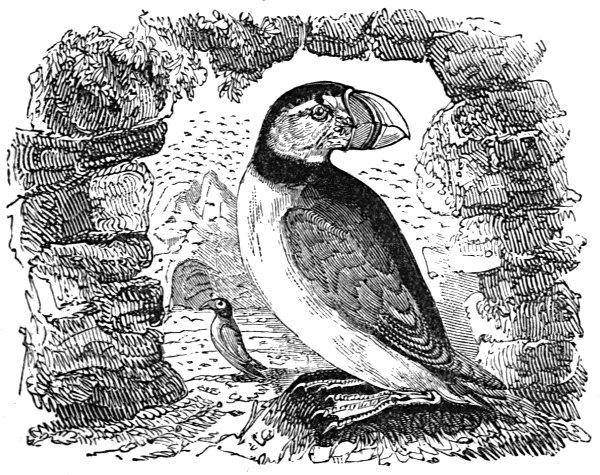
The puffin weighs about twelve ounces, and measures twelve inches in length, and twenty-one in breadth. Its singular bill looks not unlike a kind of sheath slipped over both mandibles; and, from its appearance, the bird is not improperly named coulterneb, or knife-bill. At the base, where it is about an inch and a half in depth, it is rimmed with a white callous border, the two corners of which project above the brow, and below the chin. It is about the same in length, curved towards the point, compressed vertically, very flat, and transversely furrowed on the sides; the half of it adjoining to the head is smooth, and of a fine lead-coloured blue; the other part, to the tip, red: the nostrils are placed in long narrow slits, near the edge of the bill; the corners of the mouth, when closed, are curiously puckered, and form a kind of small star, or rose; the eyes are protected by small callous protuberances, both above and below; the edges of the eye-lids are crimson; irides grey; the chin and cheeks are white, bordered with grey—the latter much puffed up with feathers, which makes the head look large and round. From behind the corner of each eye the feathers are curiously separated, forming a narrow line, which reaches to the hinder part of the head: the crown of the head, hinder part of the neck, and upper part of the plumage, are black, and a collar of the same colour encircles the neck; the under parts are white; the tail consists of sixteen feathers; the legs are reddish orange.
The puffin, like others of the same genus, takes wing with great difficulty, and walks upon the whole length of the leg and foot, with a wriggling awkward gait. In tempestuous weather it takes shelter in caverns and holes in the nearest rocks, or in those made by the rabbit on the beach among the bent grass, in which it sits dozing, in snug security, till the return of the calm weather; for these birds cannot brave the storm, and it is not uncommon, when they have been overtaken by it, to find them drowned and cast on shore. Various kinds of fish, such as small crabs, shrimps, sprats, and also seaweeds, are said to be the food upon which they live; but it is evident from the structure, great strength, and sharpness of the bill, that they are furnished with powers to crush and pluck out other kinds of shell-fish, which ornithologists have not noticed.
The female makes no nest; she deposits her single whitish-coloured egg upon the bare mould, in a hole, dug out and formed in the ground, by her mate and herself, for that purpose; or in those which they find ready made by the rabbits, whom they easily dislodge. The parent birds are very attentive to their young, which they will defend to the last, by severely biting whatever enemy attempts to molest them, and will suffer themselves to be taken rather than desert them: and yet, notwithstanding this uncommon attachment, when the day of migration comes, the young, which are not able to fly, are left behind, and mostly perish of want, or are destroyed by birds of prey.
The bite of these birds is very severe: one sent to the author in a box, covered with netting, caught hold of the finger of a poor man, and brought away the fleshy part, as if it had been cut out with a knife; but they may be tamed, and soon become familiar. They are fed on fish and other animal substances.—These birds are spread over various parts of the northern world, and are met with on almost all the rocky cliffs on the coasts of Britain and Ireland, and on many of the surrounding isles, in immense numbers. They congregate in flocks of magnitude, regulated by the accommodations afforded them at their breeding places, at which they first assemble early in April, but do not settle to prepare for the business of incubation till May. They hatch their young in the beginning of July; from which time until nearly the middle of August, they are employed in returning and rearing their brood: when this is accomplished, the whole associated swarm leaves the place at once, and pursues its route to other regions, more suited to their future exigencies, there to spend the remainder of the varied year.
Astonishing emigration of puffins.—A most extraordinary event took place at the great island of Arran, lying at the mouth of the bay leading to Galway, in Ireland, some years ago. The stupendous cliffs to the southwest of the island, which, from time immemorial, had been the place of resort, or rather the natural habitation of such numbers of rock-birds or puffins, as is almost incredible, were at once deserted, on the 24th of June, by that entire species of fowl, which abandoned their nests, eggs, and young ones, and went off to sea. The like incident is said to have happened forty years before, and no reason whatever could be assigned for these most extraordinary derelictions.
Puffy, a. Windy, flatulent; tumid, turgid; out of wind.
Pug, s. A kind name for a monkey, or anything tenderly loved.
Pug Dog (Canis Pricator, Gmelin), s.
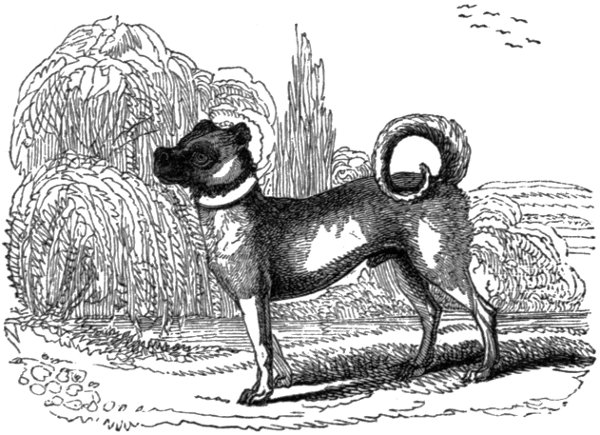
This variety is so nearly allied to the bull-dog (from which he is descended by a cross with the small Danish) in form and general appearance, that a detailed description is quite unnecessary. The chief difference is in its size, being much smaller, and its tail curled upon its back. It differs extremely in another particular, which is in courage, this animal being as timid as the other is valiant.
This dog was formerly very common in many parts of Great Britain, but is now becoming very scarce, from the circumstance, we have no doubt, of its being so useless. It may be prized as a pet, but certainly not for its beauty. Although its admirers in this country are becoming very limited in number, we are informed by Mrs. Piozzi, that in Italy it is a great favourite, more particularly at Padua.
There is a Sunday market at Moscow, where German pug dogs, which are so dear in London, can be bought for a sum of money equivalent to a shilling.
Pullet, s. A young hen.
Pulse, s. The motion of any artery as the blood is driven through it by the heart, and as it is perceived by the touch; vibration; leguminous plants.
It seems, by the nicest observations, that the pulsations of a healthy horse seldom exceed from forty to forty-five in a minute; exceeding which, in any material degree, there is then reason to believe inflammatory heat is predominant in the frame, and that fever is rapidly advancing in proportion to the increased velocity of the blood.
Pulverise, v. To reduce to powder, to reduce to dust.
Pumice, s. A light and spongy cinder of some fossil. It is ejected from volcanic mountains, or procured in melting glasses.
Punch, v. To bore or perforate by driving a sharp instrument.
Punch, s. A pointed instrument, which, driven by a blow, perforates bodies; a liquor made by mixing spirit with water, sugar, and the juice of lemons or oranges; an implement for cutting out hat or card waddings.
To make Punch.—A wine-glass nearly full of best refined lump sugar pounded. Twelve ditto of cold spring water, a lime, and half a lemon, (or if no lime, a whole lemon, which might yield about half a wineglassful of juice). Two wineglasses brim full of old Jamaica rum. Let the sugar be well melted, and the lemons thoroughly amalgamated with it and the water, before you add the spirit.
It is better to make the punch with boiling water the night before it is required for use. Strain it in the morning, and place the bottles in a well or stream of water, sheltered from the sun. When wanted at dinner time, you will have a cooler and much more mellow beverage than if the water had been taken from the spring.—Hawker—Wild Sports.
Puncture, s. A hole made with a sharp point.
Pungent, a. Pungent, sharp on the tongue, acrid; piercing, sharp, acrimonious, biting.
Punt, s. A light flat boat for fishing and shooting.
Dressing for Punts and Canoes.—To keep gunning punts and canoes from leaking, or, as those who use them call it, weeping, melt a pint of tar with a pound of pitch, and either half a pint of common oil, or a proportional quantity of suet. You have then only to pour a little of this mixture into the seams of your punt, and, instead of bedaubing her all over the bottom, as we did in the old school, seven or eight years ago, have the bottom painted with one or two coats of red lead, which will last much longer, and with which the boat rows much lighter.
White resin and mutton suet is even a better dressing, and by far the lightest of any.
Punt Shooting.—The punt shooters (men who earn their livelihood in winter by attacking the wild fowl, night and day, according as the tide serves) kill great numbers. The pursuit is hazardous, especially when there is much ice in the river, by which they sometimes get encircled, and then can only float with the current, and are kept often two or three tides before they can extricate themselves, and their punt is ill calculated to sustain pressure against its sides, which are not twenty inches high from the surface of the water; in this the punter by night drops down with the tide, or uses his paddles after the fowl; he knows their haunts, and takes every advantage of wind, tide, moon, &c.; his gun, which carries as much as a little cannon, is laid with the muzzle over the stem of the punt, in a hitch, which regulates the line of aim: at the bottom of the punt he lies upon his belly, and gets as near the rout of fowl that are upon the water as possible; when within the range of his gun, he rattles with his feet against the bottom of his punt, and when the fowl begin to spring at this unexpected sound, at that moment he pulls the trigger, and cuts a lane through their ranks, he instantly follows the direction of his shot, and gathers up those that are killed, or just expiring, for very seldom he makes it answer to row after fowl only wounded. He then charges his gun, and drifts further down the river, in hopes of a second, third, and successive shots. By this mode a man has brought home from fourscore to an hundred wild fowls, of various kinds, in one night’s excursion; and this will not seem an exaggerated account, when the multitudes which, in hard frosty weather, with the wind at east or north-east, haunt the Blackwater river are known. The numbers that are seen in their day-flights, and the noises of the various kinds of a night, are almost beyond belief: to the compiler, prepared as he was to behold amazing quantities, they exhibited far beyond what he was led to expect, and to others who have seen their throngs, the astonishment has been perhaps still greater. A punt shooter of the name of Bowles, has been known to clear upwards of an hundred pounds in a season by his gun; the wild fowl were sold to the higlers, &c., at two shillings a couple, one with the other; allowing his expenses to be only thirty pounds, here were two thousand six hundred birds brought home; an immense destruction, when the whole period allotted for it does not much exceed five months. Forty-two wigeons have been killed at a single shot in the day-time, and the difficulty of approaching the great flocks of fowl in the light is tenfold. A man, in whose punt the compiler was, got eighteen wigeons at one shot, and many that were crippled, escaped. If in the day, or at night, the punters get a shot at the fowl at feed upon the ooze, they tie on their plashes (similar to the mud-pattens used in Hampshire), and collect their spoil.
The best time for this shooting is the first or second day’s thaw after a sharp frost, and when deep snow has long covered the ground; the fowl are then flying in every direction to dabble in the fresh water, which then appears all around inviting them. Another favourable opportunity is at the commencement of a frost, with the wind strong at east, and a sleet or snow falling: if the guns can but be kept dry, there is no complaint about the using them, and the fowl in such weather always fly lower than when the atmosphere is clear.—Daniel—Hawker.
Pup, v. To bring forth whelps, used of a bitch bringing young.
All dogs that are much domesticated and confined, appear particularly subject to difficulty in bringing forth; consequently during pregnancy much exercise should be given, as nothing tends more to easy parturition than full exercise. Sometimes the constitution itself, in these tender and artificial breeds, is not equal to the exertion of labour; and sometimes false presentation increases the obstruction. Whenever a difficulty in pupping occurs, which has existed more than four or five hours, the bitch should be examined by means of a finger passed up the vagina; and, if any portion of a pup should be found to present itself, so as to be within reach of the finger, a skein of worsted ought, if possible, to be fastened around it; and, during the throes, or labour pains of the animal, it should be gently drawn away. If it cannot be reached in this way, a little longer time may be allowed; but, after all, should it not advance, a pair of forceps may be used to assist the extraction. It is a good practice to give a laxative as soon as any symptoms of pupping appear; and, when delivery seems much delayed, it will be prudent, in all cases, to bathe in warm water, and to give nutriment if the labour is protracted: occasional doses of laudanum united with æther must be given if any convulsive appearances come on. The patience of bitches in labour is extreme, and their distress, if not relieved, is most striking and affecting. Their look is, at such times, particularly expressive, and apparently imploring.—Blaine.
Puppy, s. A whelp, a progeny of a bitch; a name of contempt to an impertinent fellow.
Purgative, a. Cathartic, having the power to cause evacuation downwards.
Purge, v. To cleanse, to clear from impurities; to evacuate the body by stool; to have frequent stools.
Purge, s. A cathartic medicine, a medicine that evacuates the body by stool.
Purl, s. A kind of medicated malt liquor, in which wormwood and aromatics are infused.
Purple, a. Red, tinctured with blue.
Purple, v. To make red, to colour with purple.
Pursenet, s. A net of which the mouth is drawn together by a string.
Pursiness, s. Shortness of breath.
Purulent, a. Consisting of pus or the running of wounds.
Pus, s. The matter of a well-digested sore.
Puss, s. The fondling name for a cat; the sportsman’s term for a hare.
Pustule, s. A small swelling, a pimple, an efflorescence.
Pustulous, n. Full of pustules, pimply.
Put, s. A clown; a vulgar game at cards.
Put, played with a complete pack, generally by two people, sometimes by three, and often by four, is a game at which the cards rank differently from all others, tray being the best, next the deuce, then ace, king, and so on in the usual order, as at whist. After cutting for deal, &c., at which the highest put card wins, three cards, by one at a time, are given to each player, then the game is played in the following way. If the non-dealer throw up his cards he loses a point; if he play, and the dealer do not lay down another to it, he gains a point; but should the dealer either win the same, pass it, or lay down one of equal value, forming what is styled a tie, the non-dealer is still at liberty to put, that is play, or not, and his opponent then only gains a point; then if both parties agree to go on, whoever gains all the tricks or two out of three, wins five points, which are the game; if each player win one trick, and the third be a tie, then neither party scores.
Four-handed put differs only in this, that on both sides, one of the players gives his best card to his partner, who lays out one in lieu of it, and the game is afterwards played as in two-handed put.
If the dealer turn up any of his adversary’s cards in dealing another deal may be demanded; but if he turn up his own he is to abide by it. Should a faced card occur, the pack must be shuffled and dealt again. When more cards than necessary are given to the non-dealer, he may either claim a fresh deal, or have the extra cards drawn; but should the dealer give himself too many, then his opponent is entitled to a point, and may either have another deal, or draw the supernumerary cards. Bystanders ought never to interfere, under penalty of paying the stakes. Either party saying, I put, must abide the event of the game, or pay the stakes.—Hoyle.
Putrefaction, s. The state of growing rotten; the act of making rotten.
Puttock, s. A buzzard.
Puzzle, v. To perplex, to confound, to embarrass, to entangle.
Pyrotechny, s. The art of managing fire; the art of making fireworks.
Quack, v. To cry like a duck; to act the part of a boasting pretender to physic, or any other art.
Quadrangular, a. Square, having four right angles.
Quadrille, s. A game at cards.
The game of quadrille is played by four persons, with forty cards; the four tens, nines, and eights, are discarded from the pack; the deal is made by distributing the cards to each player, three at a time, for two rounds, and once four to each, beginning with the right-hand player, who is the elder hand.
The stakes, consisting of several equal billets or contracts, comprising the counters and fish, are distributed among the players, who agree upon the value thereof, and upon the number of tours, which are usually ten. After the trump is named, the right-hand player leads, and should the ombre, either alone or with a friend, win all the tricks, he gains the vole, or, if six tricks, the game; but if he get only five tricks he loses by remise, and if only four, by codill. The game, consolation, matadores, bastos, and other payments, are variously regulated, according as the game is won or lost. The holder of either or both of the red aces, is entitled to a fish for each.
SOME SHORT RULES FOR LEARNERS.
1. When you are the ombre, and your friend leads from a mat, play your best trump, and then lead the next best the first opportunity.
2. If you possess all the trumps, keep leading them, except you have other certain winning cards.
3. If all the mats should not be revealed by the time you have won six tricks, do not risk playing for the vole.
4. When you are the friend called, and hold only a mat, lead it, but if only a mat, guarded by a small trump, lead the small one; though when the ombre is last player, lead the best trump you have.
5. Punto in red, or king of trumps in black, are good cards to lead when they are your best, and should either of them succeed, then play a small trump.
6. When the ombre leads to discover the friend, if you hold king, queen, and knave, put on the knave.
7. Preserve the called suit, whether friend or foe.
8. When playing against a lone hand, never lead a king, unless you have the queen, nor change the suit, nor permit, if possible to prevent it, the ombre to be last player.
9. Call on the strongest suits, except you have a queen guarded, and, if elder hand, you have a better chance than when middle hand.
10. A good player may succeed better with a weaker hand, when either elder or younger, than if middle hand.
THE RANK OF THE CARDS WHEN NOT TRUMPS.
CLUBS AND SPADES.
King,
Queen,
Knave,
Seven,
Six,
Five,
Four,
Three,
Deuce.
————
In all 9.
HEARTS AND DIAMONDS.
King,
Queen,
Knave,
Ace,
Deuce,
Three,
Four,
Five,
Six,
Seven.
————
In all 10.
THE RANK AND ORDER OF THE TRUMPS.
CLUBS AND SPADES.
Spadille, the ace of spades.
Manille, the deuce of spades or of clubs.
Basto, the ace of clubs.
King,
Queen,
Knave,
Seven,
Six,
Five,
Four,
Three.
————
In all 11.
HEARTS AND DIAMONDS.
Spadille, the ace of spades.
Manille, the seven of hearts or diamonds.
Basto, the ace of clubs.
Punto, the ace of hearts or diamonds.
King,
Queen,
Knave,
Deuce,
Three,
Four,
Five,
Six.
————
In all 12.
N.B. Spadille and basto are always trumps, by which the red suits have one trump more than the black.
There are three matadores, viz.—spadille, manille, and basto, which force all inferior trumps; but if an ordinary trump be led, you are not obliged to play a matadore; though, if spadille be led, and you hold manille or basto unguarded, you must play it; also, if manille be led, and you have basto unguarded, that must be played.
1. The first thing, after seeing the cards, is to ask leave; to pass; or play sans prendre; and if you name a wrong trump you must abide by it.
2. If all the players pass, he who holds spadille is obliged to play what is called forced spadille; but though he should not make three tricks, he is not basted.
3. The player who calls a king, ought to have a fair probability of winning three tricks, to prevent being basted.
4. Therefore, such games only are set down as give a fair chance to win by calling a king, with directions at the end of each what to lead.—Hoyle.
Quadruped, s. An animal that goes on four legs, as, perhaps, all beasts.
Quadruple, a. Fourfold, four times told.
Quagmire, s. A shaking marsh.
Quail, (Tetrao Coturnix, Linn.; Le Caille, Buff.) s. A bird of game.
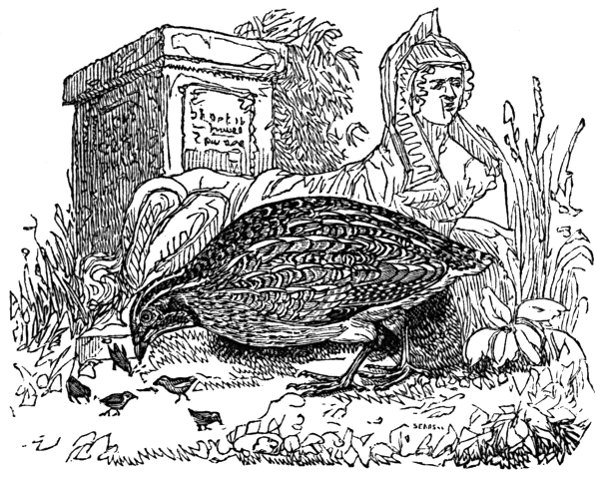
THE QUAIL.
The length of the quail is seven inches and a half. Bill dusky; eyes hazel; the colours of the head, neck, and back, are of a mixture of brown, ash-colour, and black; over each eye there is a yellow streak, and another of the same colour down the middle of the forehead; a dark line passes from each corner of the bill, forming a kind of forget above the breast; the scapular feathers are marked by a light yellowish streak down the middle of each; the quills are of a lightish brown, with small rust-coloured bands on the exterior of the feathers; the breast is of a pale rust-colour, spotted with black, and streaked with pale yellow; the tail consists of twelve feathers, barred like the wings; the belly and thighs are of a yellowish white; the legs pale brown. The female wants the black spots on the breast, and is easily distinguished by a less vivid plumage.
Quails are almost universally diffused throughout Europe, Asia, and Africa; they are birds of passage, and are seen in immense flocks traversing the Mediterranean Sea, from Europe to the shores of Africa, in the autumn, and returning again in the spring, frequently alighting, in their passage, on many of the islands of the Archipelago, which they almost cover with their numbers. On the western coasts of the kingdom of Naples, such prodigious numbers have appeared, that an hundred thousand have been taken in a day, within the space of four or five miles. From these circumstances it appears highly probable that the quails which supplied the Israelites with food, during their journey through the wilderness, were sent thither on their passage to the north, by a wind from the south-west, sweeping over Egypt and Ethiopia, towards the shores of the Red Sea.
Quails are not very numerous here; they breed with us, and many of them are said to remain throughout the year, changing their quarters from the interior counties to the sea coast. The female makes her nest like the partridge, and lays to the number of six or seven eggs of a greyish colour, speckled with brown. The young birds follow the mother as soon as hatched, but do not continue long together: they are scarcely grown up before they separate; or, if kept together, they fight obstinately with each other, their quarrels frequently terminating in each others’ destruction. From this quarrelsome disposition in the quail, it was that they were formerly made use of by the Greeks and Romans, as we use game-cocks, for the purpose of fighting. We are told that Augustus punished a præfect of Egypt with death, for bringing to his table one of these birds, which had acquired celebrity by its victories. At this time the Chinese are much addicted to fighting quails: in some parts of Italy it is likewise said to be no uncommon practice. After feeding two quails very highly, they place them opposite to each other, and throw a few grains of seed between them; the birds rush upon each other with the utmost fury, striking with their bills and heels till one of them yields.
In our way down to the beach, we observed a number of high poles erected at small distances in the low grounds. These the lad told us served to stretch their nets upon in the quail season. Capri has in all ages been celebrated for the prodigious number of quails caught there. The principal revenues of the bishop and of some convents, arise from the quails they send to Naples. In a good season, which lasts about three weeks only, 150,000, and in one day 12,000 have been taken. As birds of passage, they alight here merely to rest themselves in their flight to other countries; begin arriving in April, and continue till the middle of May. That period is a time of profit and rejoicing for the Capreans, every one being at liberty to shoot or catch as many as he can. Exhausted as the bird is, there is little difficulty in seizing him. The most common and productive method is, for one man to have a net, which he carries folded up on two poles, another drives the quails towards him, when the former instantly expands his net, and as soon as the birds strike against it, he turns the net with great dexterity, and confines them entangled as they are. They are then put into a bag, to preserve them alive, because the live ones fetch a double price at Naples. Very often, however, this pastime is attended with serious consequences; the bearer of the net, in twisting it round, frequently loses his balance, from the weight of the long poles, and is precipitated from the rocks. Even boys from the age of four amuse themselves by catching them with the hand in the bushes, and putting them under the netting which they constantly wear on their heads; and on their return home, the height of this animated head dress, as it affords the best proof of their success, is a matter of triumph among them. In Egypt, when these birds arrive in the month of September, I have more than once seen the Arabs killing and laming them, by throwing short sticks at them. During the time that the Capitani Bey blockaded the harbour of Alexandria with his Turkish squadron, one of the Greek sailors of his ship had caught two or three which had perched on the rigging. The mussulman rewarded him generously, and desirous of varying the hard fare which a blockading squadron has usually to sustain, by a more ample supply of such a delicate rarity, promised a piastre for every quail that should be brought him. In a few days the rigging, sails, and yards were covered with flocks of quails; great numbers were caught of course, and every one was brought into the cabin, as the price had been so liberally fixed. To escape the dilemma of either ruining his purse or breaking his promise, the Capitani Bey resorted to the alternative of standing out to sea, as by removing from the coast he got rid of the visits of these expensive strangers.
In January, 1806, Lord Fitzharris was returning from shooting, when close to the sea his dogs pointed, and he shot a quail; in the same field he killed a brace more, these consisted of a male, female, and young bird; they were fat and in exceeding good condition, and it was conjectured that the old birds had been disabled from pursuing their autumnal migration. A similar incident not having occurred to any sportsman, in that part of England, in some measure accounts for Mr. Pennant’s remark (which he made for its singularity), of a quail being shot in Kent, during the winter of 1781.—Bewick—Daniel—Letters from the Campagna Felice.
Quailpipe, s. A pipe with which fowlers allure quails.
Quarry, s. A square; game flown at by a hawk; a stone mine, a place where they dig stones; the ancient term for game, both winged and quadruped.
Quarry, v. To prey upon; to dig out stones.
Quart, s. The fourth part, a quarter; the fourth part of a gallon; the vessel in which strong drink is commonly retailed.
Quartan, s. The fourth-day ague.
Quarter, s. A fourth part; a region of the skies, as referred to the seaman’s card.
Quarter, v. To divide into four parts; to divide, to break by force; to divide into distinct regions; to traverse back and forward carefully as a pointer quarters a field.
Quassia, s. A powerful bitter, useful in weakness of the stomach.
Quick, s. The living flesh; sensible parts; plants of hawthorn.
Quicksilver, s. The vulgar name for mercury.
Quill, s. The hard and strong feather of the wing, of which pens are made; prick or dart of a porcupine; wing feathers of birds generally.
Quinary, a. Consisting of five.
Quint, s. A set of five; sequents of five; a term at cards, pronounced kent.
Quinze, s. A game at cards.
Quinze is a French game, usually played by two persons only, admired for its simplicity and fairness, depending entirely upon chance, being soon decided, and not requiring the attention of most other games on the cards, and therefore calculated for those who love to sport upon an equal hazard.
It is called quinze from fifteen being the game, made in the following manner:—first, the cards must be shuffled by the player, and when they have cut for deal, which belongs to him who cuts the lowest, they may be shuffled again, the dealer having the privilege to shuffle last: this being done, the adversary cuts, after which the dealer gives one card to his adversary and one to himself; if the adversary do not like his card, he has a right to have as many more given to him, one after the other, the pips of which will make 15, or come nearest to it, which are usually given from the top of the pack; for example, if he should have a deuce, and draw a five, which make seven, he should go on, in hopes of coming nearer to 15; if he then draw an eight, which makes just 15, and be elder-hand, he is sure of winning the game: but should he over-draw, and make above 15, he loses, unless the dealer does the same, in which case it is a drawn game, and they double the stakes; and thus go on till one of them has won the game by standing, and being 15, or the nearest to it, below that number, &c. At the end of each game, the cards are put up and shuffled, and the players cut anew for the deal, the elder hand constantly having the advantage.—Hoyle.
Quitter, s. A disease of the hoof. Vide Appendix.
Quitterbone, s. A hard round swelling upon the coronet, between the heel and the quarter.
Quiver, s. A case for arrows.
Quivered, a. Furnished with a quiver.
Quoit, s. Something thrown to a great distance, to a certain point; the discus of the ancients is sometimes called in English quoit, but improperly.
Quoit, v. To throw quoits, to play at quoits.
Quotidian, a. Daily, happening every day.
Rabate, v. In falconry, to recover a hawk to the fist again.
Rabbet, s. A joint made by paring two pieces, so that they wrap over one another.
Rabbit, s. A furry animal that lives on plants, and burrows in the ground.
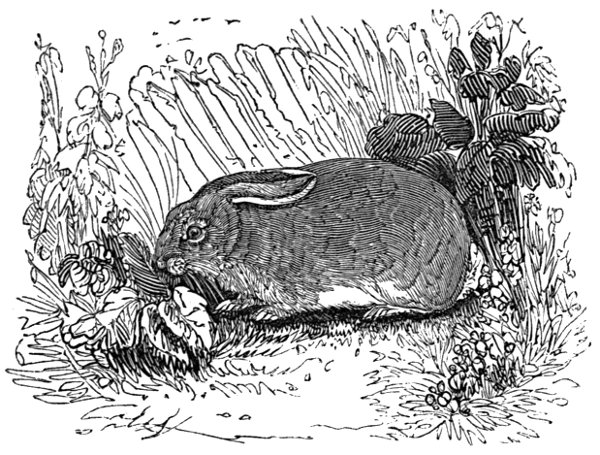
THE RABBIT.
Rabbit-keeping is practised by a few individuals in almost every town, and by a few in almost every part of the country; but thirty or forty years ago, there were one or two very considerable feeders near the metropolis, keeping each, according to report, from fifteen hundred to two thousand breeding does. These large concerns have ceased, it seems, long since, and London receives the supply of tame as well as wild rabbits, chiefly from the country.
The only considerable rabbit-feeders of whom I heard, some years since, were two gentlemen, the one resident in Oxfordshire, the other in Berks. The former fed some hundreds, and then, it was said, intended to double his stock. The huts were placed in a small building set apart for that purpose. The then stock produced one load of dung per week, two loads of which were sufficient to manure an acre of land. Three dozen of rabbits per week were sent to the London market, but keep and attendance reckoned, no other profit accrued, excepting the dung, the price of which used to be eight-pence per bushel, and I believe thirty-six bushels are reckoned a load. The Berks gentleman, according to the survey of that county, fed white rabbits, on account of the superior value of their skins, from their application of late years to the purpose of trimmings. Twenty does and two bucks were my largest stock.
The rabbit-house should stand upon a dry foundation, and be well ventilated. Exposure to too much humidity, whether externally or internally, is fatal to rabbits, which are liable to the rot like sheep, and from the same causes. The rains of 1799, which continued nearly four months, destroyed my stock of rabbits, which were hutted in a boarded shed, not well defended from the cold and moist air. Ventilation and fresh air are also necessary, where considerable numbers of these animals are kept, which will not else remain healthy, or prosper for any length of time: and even sudden mortality may ensue, from impure and stagnant air. A thorough draught or passage for the air is thence indispensable, and should be contrived in the building, with the convenience of shutting such opposite windows or doors in cold and wet weather.
The huts or hutches are generally placed one above another, to the height required by the number of rabbits, and the extent of the room. Where a large stock is kept, to make the most of room, the hutches may be placed in rows, with a sufficient interval between, for feeding and cleaning, instead of being joined to the wall, in the usual way. It is preferable to rest the hutches upon stands, about a foot above the ground, for the convenience of cleaning under them. Each of the hutches, intended for breeding, should have two rooms, a feeding and a bed-room. Those are single for the use of the weaned rabbits, or for the bucks, which are always kept separate.
When much green meat is given, rabbits make a considerable quantity of urine, and I have sometimes seen occasion to set the hutches sloping backwards a few degrees, a very small aperture being made the whole length of the floor, to carry off the urine. A sliding door in the partition between the two rooms, is convenient for confining the rabbits during the operation of cleaning; which, indeed, is a good argument for having all the hutches double, it being more troublesome to clean out a room with a number of rabbits in it, than with only one. It must not be forgotten, that the teeth of rabbits are very effectual implements of destruction to any thing not hard enough to resist them, and their troughs should be bound with something less penetrable than wood. As they are apt to scratch out their food, and dung in it, I have often thought it might be useful to adopt the feeding troughs with moveable boards, as well for rabbits as hogs.
The floor of the hutches should be planed smooth, that wet may run off, and a common hoe with a short handle, and a short broom, are most convenient implements for cleaning these houses. The object being to obtain the dung pure, for sale, no litter should be allowed; but on a farm where the dung is expended at home, the hutches should be littered with refuse hay or straw, perfectly dry. The rabbit-house to contain a tub for the dung, and a bin for a day’s supply of hay, corn, roots, or other food, which should be given in as fresh a state as possible.
As to the varieties of form and colour, in the rabbit, the short-legged, with width and substance of loin, generally few in number, and to be obtained only by selection, are the most hardy, and fatten most expeditiously, taking on fat both internally and in the muscular flesh. They have, besides, the soundest livers—the rabbits being generally subject to defects of the liver: they are the smallest variety. There is a very large variety of the hare colour, having much bone, length and depth of carcase, large and long ears, with large eyes, resembling those of the hare. They might well be taken for hybrid or mules, but from the objection of their breeding. Their flesh is high coloured, substantial, and more savoury than that of the common rabbit; and they make a good dish, cooked like the hare, which, at six or eight months old, they nearly equal in size. The large white, and yellow and white species, have whiter and more delicate flesh, and, cooked in the same way, will rival the turkey.
With respect to colour, I have always preferred the wild colour, and black, finding the skins of full as much worth as the white. The Turkish or French rabbit, with long white fur, differs little from the common varieties; nor did I find their skins of more value, either for sale or home use. I have been in the habit of drying the skins, for linings of night-gowns, and other domestic purposes; but have always found reason to prefer the short, close fur. The large above-mentioned—indeed any peculiar varieties—must be sought among the London dealers.
Of late years, in London, the term smut, has been applied as a mark of distinction in the rabbit. Thus, there are single and double smuts. The smut consists of a black spot on the side of the rabbit’s nose: when there are two black spots, one on each side of the nose, it constitutes a double smut. Generally, the rabbits are prized for the number of these black spots upon the head and body, and for the fineness and length and size of the ears, which occasions their falling about the head, in a manner different from the common rabbit. Black and tortoise-shell are the favourite colours.
Rabbits are divided into four kinds—warreners, parkers, hedgehogs, and sweethearts. Burrowing under ground is favourable, it appears, to the growth of fur; and the warrener, though a member of a subterraneous city, is less effeminate than his kindred who roam more at large. His fur is most esteemed, and after him comes the parker, whose favourite haunt is a gentleman’s pleasure-ground, where he usually breeds in great numbers, and not unfrequently drives the hares away. The hedgehog is a sort of vagabond rabbit, that travels, tinker-like, throughout the country, and would be better clad if he remained more at home. Sweethearts are tame rabbits, and their fur, though sleek, is too silky and soft to be of much use in the important branch of hat-making.
Breeding.—The doe will breed at the age of six months, and her period of gestation is thirty or thirty-one days. It should be premised, that the buck and doe are by no means to be left together; but their union having been successful, the buck must be immediately withdrawn, and the doe tried again in three days: in fact, with rabbits, this business is conducted on the same principle as in the stud. Like chickens, the best breeding rabbits are those kindled in March. Some days before parturition, or kindling, hay is to be given to the doe, to assist in making her bed, with the flue, which nature has instructed her to tear from her body for that purpose. She will be at this period seen sitting upon her haunches, and tearing off the flue, and the hay being presented to her, she will, with her teeth, reduce and shorten it to her purpose.—Biting down of the litter or bed, is the first sign of approaching pregnancy. The number produced, generally between five and ten; and it is most advantageous always to destroy the weak or sickly ones, as soon as their defects can be perceived, because five healthy and well-grown rabbits are worth more than double the number of an opposite description, and the doe will be far less exhausted. She will admit the buck again with profit at the end of six weeks, when the young may be separated from her and weaned. Or the young may be suckled two months, the doe taking the buck at the end of five weeks, so that the former litter will leave her about a week before her next parturition.
A notion was formerly prevalent, of the necessity for giving the buck immediately after the doe had brought forth, lest she should pine, and that no time might be lost; and if it were intended that no time might be lost in destroying the doe, such, indeed, would be the most successful method. Great care should be taken that the doe, during her gestation, be not approached by the buck, or indeed by any other rabbit; as, from being harassed about, she will almost certainly cast her young. One doe in a thousand may devour her young; a sign that she ought to be otherwise disposed of. Some does admit the buck with difficulty, although often apparently in season; such should be immediately fattened off, since it can never be worth while to keep an objectionable individual for breeding, of a stock to be produced in such multitudes. Should the doe be weak on her bringing forth, from cold caught or other cause, she will drink beer-caudle, as well as any other lady; or warm fresh grains will comfort her; a malt mash; scalded fine pollard, or barley-meal, in which may be mixed a small quantity of cordial horse-ball.
Feeding.—Upon a regular plan, and with sufficient attendance, it is better to feed three times than twice a day. The art of feeding rabbits with safety and advantage is, always to give the upper-hand to dry and substantial food. Their nature is congenial with that of the sheep, and the same kind of food, with little variation, agrees with both. All weeds, and the refuse of vegetation, should be banished from rabbit feeding. Such articles are too washy and diuretic, and can never be worth attention, whilst the more solid and nutritious productions of the field may be obtained in such plenty, and will return so much greater profit. Rabbits may, indeed, be kept, and even fattened upon roots, good green meat, and hay; but they will pay for corn; and this may be taken as a general rule. Rabbits which have as much corn as they will eat, can never take any harm from being indulged with almost an equal portion of good substantial vegetables. However, the test of health is, that their dung be not too moist. Many, or most, of the town feeders never allow any greens at all; the reason, I suppose, because they feed almost entirely on grains. The corn proper for rabbits:—oats, peas, wheat; pollard, and some give buck-wheat, The greens and roots, the same as our cattle crops, namely carrots, Jerusalem artichokes, and if potatoes, baked or steamed. Lucerne, cabbage-leaves, clover, tares, furze. I have had them hoven, from eating rape; and not improbably, mangold might have a similar effect. Clover and meadow-hay, pea and bean straw.
Rabbits are generally sold from the teat, but there is also a demand for those of larger size, which may be fattened upon corn and hay, with an allowance of the best vegetables. The better the food, the greater weight, better quality, and more profit, which I apprehend to be generally the case in the breeding of all animals. Some fatten with fresh grains and pollard. I have tried all wheat, and all potato oats, comparatively; but could find no difference in the goodness of the flesh. The rabbit’s flesh being dry, the allowance of succulent greens may tend to render it more juicy; and I suppose the old complaint of the dryness of the flesh in Devon beef, entirely fed by hay, might be remedied in the same way. Rabbits are in perfection for feeding at the fourth or sixth month; beyond which period their flesh becomes more dry, and somewhat hard. It requires three months, or nearly so, to make a rabbit thoroughly fat and ripe; half the time may make them eatable, but by no means equal in the quality of the flesh. They may yet be over fattened, as appears by specimens exhibited a few years since, at Lord Somerville’s show, which were loaded with fat, without and within, like the best feeding sheep; and at the late London cattle show, two were exhibited, one of them exceeding the weight of fifteen pounds.
Castrated rabbits might be fattened, no doubt, to the weight of upwards of ten, or even fifteen pounds, at six or seven months old. The operation should be performed at the age of six or seven weeks. I have not succeeded in castrating the rabbit, but am informed it is successfully practised in the land of capons, namely, Sussex, near Chichester, where on the average, not one in three hundred is lost by the operation, which is performed at five or six weeks old.
In slaughtering full-grown rabbits, after the usual stroke upon the neck, the throat should be perforated upwards, towards the jaws, with a small-pointed knife, in order that the blood may be evacuated, which would otherwise settle in the head and neck. It is an abomination to kill poultry by the slow and torturing method of bleeding to death, hung up by the heels, the veins of the mouth being cut; but still more so the rabbit, which in that situation utters horrible screams. The entrails of the rabbit, whilst fresh, are said to be good food for fish, being thrown into ponds.
By 7 & 8 Geo. IV. if any person unlawfully and wilfully, in the night time, take any hare or coney, in any warren or ground lawfully used for the keeping thereof, whether enclosed or not, every such person shall be guilty of a misdemeanour; and persons guilty of the same offence in the day time, or using any snare or engine, are subject to a penalty of five pounds. But this does not extend to the taking, in the day time, any conies on any sea bank or river bank in Lincolnshire, so far as the tide shall extend, or within a furlong of such bank.
Ampthill Rabbit Bazaar.—I have stated at the commencement of this article, that the large concerns had generally ceased. Of late, one has arisen at Ampthill, Beds; upon a more extensive scale than ever before attempted, established by J. H. Fisher, Esq., an agent of his Grace the Duke of Bedford. Upon so extensive a plan, indeed, is this new undertaking, that it may well be styled our grand National Rabbit Bazaar. The building, situated upon an eminence, is square, somewhat resembling barracks, with a court withinside the walls, and with thirty acres of fine light land adjoining, under culture of those crops known to be best adapted to the nourishment and support of rabbit-stock. It was proposed to keep between four and five thousand breeding does, which number is probably now complete. The young rabbits, from seven to nine weeks old, are sent to Newgate and Leadenhall markets, fifty to sixty dozens, weekly. The quantity of dung produced, which is reserved with the utmost care, and free from any extraneous substances, must be very considerable. A number of men and boys are employed in the concern, under the direction of an experienced foreman, and the utmost regularity of attention observed with respect to management, feeding, and cleanliness.
This bazaar has been honoured by the visits of persons of the highest rank; of his Royal Highness the Duke of Clarence, his Grace the Duke of Bedford, Lord Holland, Lord Vernon, and a number of ladies and gentlemen.
The wold warreners catch their rabbits with fold-nets, with spring-nets, and with “tipes,” a species of trap.
The fold-nets are set about midnight, between the burrows and the feeding grounds; the rabbits being driven in with dogs, and kept inclosed in the fold until morning.
The spring-net is generally laid round a haystack, or other object of inducement for rabbits to collect in numbers.
The tipe or trap is a more modern invention; it consists of a large pit or cistern, covered with a floor, with a small trap door nicely balanced, near its meuse. It used to be set by a haystack, but since turnips are now grown for the winter food, in an inclosure within the warren, the trap is placed within the wall of this inclosure. For a night or two the rabbits are suffered to go through the meuse, and over the trap, that they may be familiarised to where the turnips are grown, after that the trap-door is unbarred, and the number wanted are taken. In emptying the cistern, the rabbits are culled, the fat ones are slaughtered, and the others turned upon the turnips to improve.
In shooting a rabbit, always consider the foremost half of him as your target, or he will probably be shot in a slovenly manner; and if there is an earth near, most likely scramble to it, and make his escape.—Moubray—Daniel.
Rabid, a. Fierce, furious, mad.
Race, s. A generation, a collective family; a particular breed; contest in running; course on the feet; progress, course.
Racing, v. A contest of speed, in which horses are commonly employed.
It is believed that horse-racing was known and practised by the Anglo-Saxons, but most probably confined to persons of rank and opulence, and followed only for amusement sake.
The first indication, however, of a sport of this kind occurs in the description of London, written by Fitzstephen, who lived in the reign of Henry II. He tells us, that horses were usually exposed for sale in West Smithfield; and, in order to prove the excellency of the most valuable hackneys and charging steeds, they were matched against each other; his words are to this effect—“When a race is to be run by this sort of horses, and perhaps by others, which also in their kind are strong and fleet, a shout is immediately raised, and the common horses are ordered to withdraw out of the way. Three jockeys, or sometimes only two, as the match is made, prepare themselves for the contest; such as being used to ride know how to manage their horses with judgment: the grand point is, to prevent a competitor from getting before them. The horses, on their part, are not without emulation, they tremble and are impatient, and are continually in motion: at last the signal once given, they strike, devour the course, hurrying along with unremitting velocity. The jockeys, inspired with the thoughts of applause and the hopes of victory, clap spurs to their willing horses, brandish their whips, and cheer them with their cries.”
In the middle ages there were certain seasons of the year when the nobility indulged themselves in running their horses, and especially in the Easter and Whitsuntide holidays.
It is certain, that horse-races were held upon various holidays, at different parts of the kingdom, and in preference to other pastimes. “It had been customary,” says a Chester antiquary, “time out of mind, upon Shrove Tuesday, for the company of sadlers belonging to the city of Chester, to present to the drapers a wooden ball, embellished with flowers, and placed upon the point of a lance; this ceremony was performed in the presence of the mayor, at the cross in the ‘Rodhee,’ or Roody, an open place near the city; but this year,” continues he, “the ball was changed into a bell of silver, valued at three shillings and sixpence, or more, to be given to him who shall run the best, and the farthest on horseback, before them upon the same day.”
Here we see the commencement of a regular horse-race, but whether the courses were in immediate succession, or at different intervals, is not perfectly clear; we find not, however, the least indication of distance posts, weighing the riders, loading them with weights, and many other niceties that are observed in the present day.
Races something similar to those above mentioned, are described by Butcher, as practised in the vicinity of the town of Stamford, in Lincolnshire. “A concourse,” says he, “of noblemen and gentlemen meet together, in mirth, peace, and amity, for the exercise of their swift running-horses, every Thursday in March. The prize they run for is a silver and gilt cup, with a cover, to the value of seven or eight pounds, provided by the care of the alderman for the time being; but the money is raised out of the interest of a stock formerly made up by the nobility and gentry, which are neighbours and well-wishers to the town.”
Running horses are frequently mentioned in the registers of the royal expenditures. It is notorious, that king John was so fond of swift horses and dogs for the chase, that he received many of his fines in the one or the other; but at the same time it does not appear that he used the horses for any purposes of pleasure, beyond the pursuits of hunting, hawking, and such like sports of the field.
In the reign of Edward III. the running-horses purchased for the king’s service, were generally estimated at twenty marks, or thirteen pounds six shillings, and eightpence each; but some few of them were prized as high as twenty-five marks. An entry appears, dated the ninth year of this king’s reign, which states, that the king of Navarre sent him as a present two running-horses, which I presume were very valuable, because he gave the person who brought them no less than one hundred shillings for his reward.
In the reign of James I. public races were established in many parts of the kingdom; and it is said that the discipline and modes of preparing the horses upon such occasions were much the same as are practised in the present day. The races were then called bell courses, because, as we have seen above, the prize was a silver bell.
At the latter end of the reign of Charles I. races were held in Hyde Park, and at Newmarket. After the restoration, horse-racing was revived and much encouraged by Charles II., who frequently honoured this pastime with his presence; and, for his own amusement, when he resided at Windsor, appointed races to be made in Datchet mead. At Newmarket, where it is said he entered horses and run them in his name, he established a house for his better accommodation; and he also occasionally visited other places where horse-races were instituted.
About this time it seems, that the bells were converted into cups, or bowls, or some other pieces of plate, which were usually valued at one hundred guineas each; and upon these trophies of victory the exploits and pedigree of the successful horses were most commonly engraved. William III. was also a patroniser of this pastime, and established an academy for riding; and his queen not only continued the bounty of her predecessors, but added several plates to the former donations. George I. instead of a piece of plate, gave a hundred guineas, to be paid in specie.
RULES OF RACING.
Horses take their ages from May-Day; that is, a horse foaled any time in the year 1828, will be deemed a year old on the 1st of May, 1829.
Four inches are a hand. Fourteen pounds are a stone.
Catch weights are, each party to appoint any person to ride without weighing.
A post match, is to insert the age of the horses in the article, and to run any horse of that age, without declaring what horse, till he come to the post to start.
A Handicap Match, is A, B, and C, to put an equal sum each into a hat; C, who is the handicapper, makes a match for A and B, who, when they have perused it, put their hands into their pockets, and draw them out closed; then they open them together, and if both have money in their hands, the match is confirmed; if neither have money, it is no match. In both cases, the handicapper draws all the money out of the hat; but if one has money in his hand, and the other none, then it is no match; and he that has money in his hand is entitled to the deposit in the hat.
Free Handicap is an expression which frequently appears in race lists, the meaning of which is, that a number of horses being named, a weight is placed against the name of each, by the clerk of the races, or some disinterested person, who is well acquainted with the performances of the horses. These weights are supposed to be such as will bring all the horses as nearly on a par as possible; and the list containing them being handed to the owners of each horse, they accept or decline according as they imagine the chances are for or against them.
Horses not entitled to start without producing a proper certificate of their age, if required, at the time appointed in the articles, except where aged horses are included, and in that case a junior horse may enter without a certificate as to age, provided he carry the same weight as the aged.
No person shall start more than one horse of which he is the owner, either wholly or in part, and either in his own name or in that of any other person, for any race for which heats are run.
The horse that has his head at the ending-post first, wins the heat.
For the best of the plate where three heats are run, the horse is second that wins one heat.
For the best of heats, the horse is second that beats the other horse twice out of three times, though he does not win a heat.
Where a plate is won by two heats, the preference of the horses is determined by the places they get in the second heat.
Where a plate or subscription is given for the winner of the best of three heats, a horse, to win the prize, must be the actual winner of two heats, even though no horse appear against him for both or either of the heats.
When three horses have each won a heat, they only must start for a fourth, and the preference amongst them will be determined by it, there being before no difference amongst them.
In running of heats, if it cannot be decided which horse is first, the heat goes for nothing, and they may all start again, except it be between two horses that had each won a heat.
If a rider fall from his horse, and the horse be rode in by a person who is sufficient weight, he shall take his place the same as if his rider had not fallen, provided he go back to the place where the rider fell.
Jockeys must ride their horses to the usual place for weighing the riders, and he that dismounts before, or wants weight, is distanced; unless he be disabled by an accident which should render him incapable of riding back, in which case he may be led or carried to the scale.
Horses’ plates or shoes not allowed in the weight.
Horses running on the wrong side of a post, and not turning back, are distanced.
Horses drawn before the plate is won are distanced.
Horses are distanced if their riders cross or jostle.
All complaints of foul riding must be made before or at the time the jockey is weighed.
No distance in a fourth heat.
A confirmed bet cannot be off but by mutual consent, except in the case hereinafter mentioned.
Either of the betters may demand stakes to be made, and on refusal declare the bet to be void.
If a better be absent on the day of running, a public declaration of the bet may be made on the course, and a demand whether any person will make stakes for the absent party, and if no person consent to do so, the bet may be declared void.
Bets agreed to be paid or received in London, or any other specified place, cannot be declared off on the course.
If a match or sweepstakes be made for any specified day in any race-week, and the parties agree to change the day to any other in the same week, all bets must stand; but if the parties agree to run the race in a different week, all bets made before the alteration shall be void.
The person who lays the odds has a right to choose a horse or the field; when a person has chosen a horse, the field is what starts against him; but there is no field without one horse starts against him.
Bets and stakes made in guineas are paid in sovereigns.
If odds are laid without mentioning the horse before the race is over, the bet must be determined by the state of the odds at the time of making it.
Bets made in running are not determined till the plate is won, if that heat be not mentioned at the time of running.
A bet made after the heat is over, if the horse betted on does not start, is void.
Bets determined, though the horse does not start, when the words “play or pay,” are made use of in betting.
Where two horses run a dead heat for a sweepstakes or plate, and the parties agree to divide the stakes equally, all bets between those two horses, or between either of them, and the field, must be settled by the money betted being put together and divided equally between the parties. If, after the dead heat, an equal division of the stakes be agreed upon, then the money betted shall be put together, and be divided between the parties in the same proportion as the stakes shall have been divided. If a bet be made on one of the horses that run the dead heat against a horse that was beaten in the race, he who backed the horse that ran the dead heat wins half his bet. If the dead heat be the first event of a double bet, the bet shall be void.
Bets made on horses winning any number of races within the year shall be understood, however the expression may be varied, as meaning the year of our Lord.
Money given to have a bet laid shall not be returned, though the race be not run.
Matches and bets are void on the decease of either party before the match or bet is determined.
A horse walking over or receiving forfeit shall not be deemed a winner.
An untried stallion or mare is one whose produce has never run in public.
A maiden horse or mare is one that has never won.
Feather Weight.—A horse carries feather weight, when the terms of the race allow the owner to place what rider he pleases on his back: he consequently procures the lightest eligible jockey possible, who weighs neither before nor after the race.
Give and take plates, are weights for inches: twelve hands to carry a stated weight, all above to carry extra, in the proportion of seven pounds to an inch.—Strutt—Turf Expositor.
Racecourse, s. Ground over which a race is run. The principal are—
Ascot Heath. A circular course, exactly two miles, the last mile of which forms the Old Mile. The New Mile is straight, rising all the way, and measures 7 fur. 150 yds. The T. Y. C. (part of the New Mile) is 3 fur. 95 yds.
Buxton. A circular course of one mile.
Chelmsford. An oval course, thirty yards short of two miles; but by starting between the distance post and the winning chair, it becomes two complete miles.
Chester. A circular course of one mile. It is a complete flat, and perhaps the pleasantest course in England for spectators.
Doncaster. A circular course of 1 mile, 7 fur. 70 yds. The other courses are formed of portions of this circle, namely, Red House Inn, 5 fur. 164 yds. T. Y. C. 7 fur. 189 yds. Fitzwilliam Course, 1 mile, 4 fur. 10 yds. St. Leger Course, 1 mile, 6 fur. 132 yds. Two Mile Course, 2 miles, 25 yds. Four Mile Course, (twice round) 3 miles, 7 fur. 219 yds.
Egham. A flat oval course, 66 yds. short of 2 miles.
Epsom. Two miles, the last mile and a half of which is the Derby and Oaks Course. The Craven Course is one mile and a quarter of the same ground. Epsom Course can be properly called neither circular, oval, nor triangular.—It is altogether one of the worst courses in England.
Knutsford. A flat circular course of one mile.
Lancaster. A circular mile course, and good turf.
Leeds. A circular course of 1 mile, 2 fur. 48 yds. There is also a straight course, through the centre of the circular one, of 2 fur. 158 yds., which, uniting with each half of the circle, forms two other courses, in the form of a sector, the one 1 mile, 11 yds., the other 1 mile, 135 yds.
Liverpool. The Old Course is an oval mile, flat, and very good turf. The New Course is one mile and a half, forming an ill-defined oblong square; and though nearly flat, is a very distressing course for horses. It is a new establishment, races were held upon it this year (1829) for the first time. The form is bad—it is too elongated, and in consequence causes the horses, for a great part of the length, to be too far distant. The Old and the New Course are situated at the distance of two miles asunder.
Manchester. An oval course of 7 fur. 184 yds. The Cup Course is 2 miles, 168 yds. The T. Y. C. 5 fur. 184 yds. There is a hill, and the course is by no means of the best description.
Newcastle. A sort of square of 1 mile, 6 fur. 132 yds.
Newton. A triangular course of one mile.
Nottingham. A circular course of 1 mile, 2 fur. and 11 yds.
Oxford. Flat, oval course, 2 miles all but a distance.
Pontefract. An oval course, formed on the gentle declivity of rising ground, 2 miles, 1 fur.
Preston. An indifferent oval course, one mile.
Stockbridge. An oval course, rather hilly, the last three quarters of a mile in a straight line. There is one straight mile, and also a circular course of about one mile and a quarter; the latter is called the New Course.
York. T. Y. C. 5 fur. 59 yds. Mile Course, 1 mile, 8 yds. Last mile and quarter, 1 mile, 2 fur., 15 yds. Last mile and half, 1 mile, 4 fur., 18 yds. Last mile and three quarters, 1 mile, 5 fur., 160 yds. Two-mile Course, 1 mile, 7 fur., 85 yds. Four-mile Course, 3 mile, 7 fur., 24 yds. York Course is situated upon low ground, and, in consequence, becomes very heavy in wet weather.—Turf Expositor.
Racehorse, s. A horse bred to run for prizes.
There is much dispute with regard to the origin of the thorough-bred horse. By some he is traced to both sire and dam to Eastern parentage; others believe him to be the native horse, improved and perfected by judicious crossing with the Barb, the Turk, or the Arabian. “The Stud Book,” which is an authority acknowledged by every English breeder, traces all the old racers to some Eastern origin; or it traces them until the pedigree is lost in the uncertainty of an early period of breeding. If a pedigree of a racer of the present day be required, it is traced back to a certain extent, and ends with a well-known racer;—or, if an earlier derivation be required, that ends either with an eastern horse, or in obscurity.
It must, on the whole, be allowed, that the present English thorough-bred horse is of foreign extraction, improved and perfected by the influence of the climate, and by diligent cultivation. There are some exceptions, as in the case of Sampson and Bay-Malton, in each of whom, although the best horses of their day, there was a cross of vulgar blood; but they are only exceptions to a general rule. In our best racing stables, and, particularly in the studs of the Earls of Grosvenor and Egremont, this is an acknowledged principle; and it is not, when properly considered, a principle at all derogatory to the credit of the country. The British climate, and British skill, made the thoroughbred horse what he is.
Whatever may be the truth as to the origin of the race-horse, the strictest attention has for the last fifty years been paid to pedigree. In the descent of almost every modern racer, not the slightest flaw can be discovered: or when, with the splendid exception of Sampson and Bay-Malton, one drop of common blood has mingled with the pure stream, it has been immediately detected in the inferiority of form, and deficiency of bottom, and it has required two or three generations to wipe away the stain, and get rid of its consequences.
The racer is generally distinguished by his beautiful Arabian head;—his fine and finely-set-on-neck;—his oblique, lengthened shoulders;—well-bent hinder legs;—his ample, muscular quarters—his flat legs, rather short from the knee downward, although not always so deep as they should be;—and his long and elastic pastern. These are separately considered where the structure of the horse is treated of.
The racer, however, with the most beautiful form, is occasionally a sorry animal. There is sometimes a want of energy in an apparently faultless shape, for which there is no accounting; but there are two points among those just enumerated which will rarely or never deceive, a well-placed shoulder, and a well-bent hinder leg.
It has been imagined that the breed of racing horses has lately very considerably degenerated. This is not the case. Thorough-bred horses were formerly fewer in number, and their performances created greater wonder. The breed has now increased twenty-fold, and superiority is not so easily obtained among so many competitors. If one circumstance could, more than any other, produce this degeneracy, it would be our absurd and cruel habit of bringing out horses too soon, and the frequent failure of their legs before they have come to their full power. Childers and Eclipse did not appear until they were five years old: but many of our best horses, and those perhaps, who would have shown equal excellence with the most celebrated racers, are foundered and destroyed before that period.
Whether the introduction of short races, and so young horses, be advantageous, and whether stoutness and usefulness may not thus be somewhat too much sacrificed to speed: whether there may be danger that an animal designed for service may, in process of time, be frittered away almost to a shadow of what he was, in order that at two years old, over the one-mile-course, he may astonish the crowd by his fleetness,—are questions that more concern the sporting man than the agriculturist; and yet they concern the agriculturist too, for racing is principally valuable as connected with breeding, and as the test of breeding. Vide Training.
Racer, s. A Runner, one that contends in speed.
Rack, s. An engine of torture; extreme pain; the clouds as they are driven by the wind; a wooden grate in which hay is placed for cattle; arrack, a spirituous liquor.
Racket, s. An irregular clattering noise; the instrument with which players strike the ball.
Rackets, s. A fine manly game, in which a small ball and cat-gut implement are used.
Raffle, s. A species of game or lottery, in which many stake a small part of the value of some single thing, in consideration of a chance to gain it.
ODDS ON A RAFFLE WITH NINE DICE, OR THE
HIGHEST IN THREE THROWS WITH THREE DICE.
It is 10077695to1,that you54
1007768..1,do not53or more.
183229..1,throw52—
45809..1,51—
14093..1,50—
5032..1,49—
2016..1,48—
886..1,47—
422..1,46—
215..1,45—
116..1,44—
66..1,43—
39..1,42—
very near 39½
24½..1,41—
15¾..1,40—
10½..1,39—
7¹/₇..1,38—
very near 5..1,37—
3½..1,36—
2⁶/₁₁..1,35—
or 28..11,
11..6,34—
9..7,35—
It is exactly equal that you throw 32 or more.—Hoyle.
Ragstone, s. A stone so named from its breaking in a rugged manner; the stone with which they smooth the edge of a tool new ground and left ragged.
Rake, v. To gather with a rake; to heap together and cover; to fire on a ship in the direction of head and stern; a veterinary operation.
Raking, a. An operation performed on a horse.
Raking.—This consists in introducing the hand into the horse’s rectum, and drawing out any hardened dung that may be there. It may be necessary in costiveness or fever, if a clyster pipe cannot be obtained; but an injection will better effect the purpose, and with less inconvenience to the animal. The introduction of the hand into the rectum is, however, useful to ascertain the existence of stone in the bladder, or the degree of distension of the bladder in suppression of urine, for the bladder will be easily felt below the gut; and at the same time, by the heat of the intestine, the degree of inflammation in it or in the bladder may be detected.—Blaine.
Ram, s. A male sheep.
Rammer, s. An instrument with which anything is driven hard; the stick with which the charge is forced into the gun.
Rana, s. That class of animals in the Linnæan system to which the frog and the toad belong.
Random, a. Done by chance, roving without direction.
Range, v. To place in order; to pass over; to rove at large.
Range, s. Anything placed in a line; excursion; room for excursion; compass taken in by anything excursive; line of a shot.
Ranger, s. One that ranges; a rover; a dog that beats the ground; one whose business it is to rechase the wild beasts from the purlieus of the forest, and to present offences within the forest.
Rapacious, a. Given to plunder, seizing by violence.
Rape, s. Something snatched away; a plant, from the seed of which oil is expressed.
Rash, a. Hasty, precipitate. An efflorescence on the body, a breaking out.
Rasp, v. To rub to powder with a very rough file.
Rasp, s. A large rough file, commonly used to wear away wood.
Rat, s. An animal of the mouse kind that infests houses and ships.
Ratafia, s. A fine liqueur, prepared from the kernels of apricots and spirits.
Ratan, s. An Indian cane.
Rate, s. The pace of a setter, pointer, or horse.
Rate, v. To value at a certain price; to chide hastily and vehemently.
Ratsbane, s. Poison for rats; arsenic.
Ravel, v. To entangle, to involve, to perplex.
Raven, s. A large black fowl; a bird of prey.
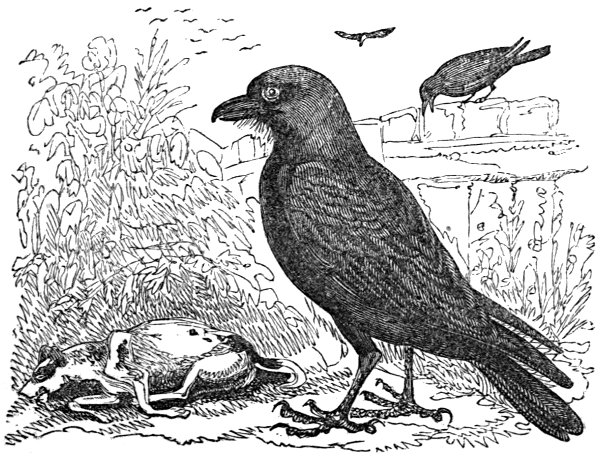
Raven or Great Corbie Crow. (Corvus Corax, Linn.; Le Corbeau, Buff.)—This is the largest of this kind; its length is above two feet; breadth four. Its bill is strong and very thick at the base; it measures somewhat more than two inches and a half in length, and is covered with strong hairs or bristles, which extend above half its length, covering the nostrils: the general colour of the upper parts is a fine glossy black, reflecting a blue tint in particular lights; the under parts are duller, and of a dusky hue.
The raven is well known in all parts of the world, and in times of ignorance and superstition, was considered as ominous, foretelling future events by its horrid croakings, and announcing impending calamities: in those times the raven was considered as a bird of vast importance, and the various changes and modulations of its voice were studied with the most careful attention, and were made use of by artful and designing men to mislead the ignorant and credulous. It is a very long-lived bird, and is supposed sometimes to live a century or more. It is fond of carrion, which it scents at a great distance; it is said that it will destroy rabbits, young ducks, and chickens: it has been known to seize on young lambs which have been dropped in a weak state, and pick out their eyes while yet alive: it will suck the eggs of other birds; it feeds also on earthworms, reptiles, and even shell-fish when urged by hunger.
It may be rendered very tame and familiar, and has been frequently taught to pronounce a variety of words: it is a crafty bird, and will frequently pick up things of value, such as rings, money, &c. and carry them to its hiding place. It makes its nest early in the spring, and builds in trees and the holes of rocks, laying five or six eggs, of a pale bluish green colour, spotted with brown. The female sits about twenty days, and is constantly attended by the male, who not only provides her with abundance of food, but relieves her in turn, and takes her place in the nest.
The natives of Greenland eat the flesh, and make a covering for themselves with the skins of these birds, which they wear next their bodies.
In 1808, a raven was kept at the Red Lion, Hungerford: a gentleman’s chaise, in turning into the yard, ran over the leg of his Newfoundland-dog, and while examining the injury done, Ralph was evidently a concerned spectator. When the dog was tied up, under the manger with the horses, Ralph attended upon him with particular kindness: this was so marked, that it was observed to the hostler, who said, that he had been bred from his pin-feather in intimacy with a dog, that the affection between them was mutual, and that all the neighbourhood had been witnesses of the acts of fondness they had conferred upon each other. This dog also had his leg broke, and during the long time he was confined Ralph waited upon him and carried him provisions daily; by accident the hostler shut the stable door, and Ralph was deprived of the company of his friend the whole night, but in the morning the bottom of the door was found so pecked, that Ralph would, in another hour, have made his own entrance port.—Bewick.
Ravenous, a. Furiously voracious, hungry to rage.
Raw, a. Not subdued by fire; not covered with the skin; sore; immature; unseasoned; bleak, chill.
Ray, s. A beam of light; a genus of the class amphibia, including the skate, sturgeon, thornback, and torpedo.
Rebound, s. The act of flying back in consequence of motion resisted.
Recharge, s. Among hunters, a lesson which the huntsman winds on the horn when the hounds have lost their game.
Recheat, s. A lesson which the huntsman winds on the horn when the dogs are at fault, to bring them back from pursuing a counterscent.
Recipe, s. A medical prescription.
Recoil, v. To rush back from resistance; the rebound of a gun.
Recoil.—Whatever retards the exit of the charge operates like an increase of lead, and, by confining the force of the explosion the more to the barrel, produces a greater recoil, hence partly it is, that in proportion as the barrel becomes foul within by repeated firing, the recoil increases. A piece will recoil if, from the breach plug being made too short, there remain some turns of the screw not filled up, these hollows, wherein a part of the powder is lodged, forming an obstacle that confines and retards the explosion. A barrel mounted on a stock that is very straight, will recoil more than when mounted on a stock that is considerably bent, as the curvature serves to break and deaden the force of the recoil; and, sometimes also, a fowling piece will recoil from the shooter applying it improperly to his shoulder, for if the butt is not applied closely to the shoulder, or is applied so as to be supported only at a single point, the recoil will be much more sensibly felt, than when the hollow of the butt embraces the shoulder, and is firmly supported by the weight of the body. Guns are observed to recoil more after being fired a number of times, than they did at the beginning. The matter which is left on the inside of the barrel after the explosion, and which increases on every discharge, attracts moisture very quickly, especially if the saltpetre employed in the powder was not well purified from the admixture of common salt which it contains in its rough state. This moisture becomes considerable after a few discharges, and, being formed into vapour by the heat during the explosion, adds its expansive effort to that of the inflamed powder, and greatly increases the agitation and recoil. Owing to this cause, probably, rather than to that before mentioned, arises the recoil, from some turns of the breech screw not being filled up by the breech plug, and thereby affording a lodgment to moisture.—Essay on Shooting.
Rectified Spirit, s. Alcohol, or spirit of wine.
This is obtained in a dilute state from fermented liquors by distillation, and is afterwards rectified or concentrated, by repeating the operation two or three times. Rectified spirit is the basis of many useful embrocations, for strains, bruises, &c. It dissolves camphor and all the resins very readily: hence we have camphorated spirit, opodeldoc, Friar’s balsam, &c. Mixed with an equal quantity of water it forms what is termed proof spirit, which is the liquid generally employed for making tinctures. Rectified spirit is often used undiluted as an embrocation for strains; and, when the injury is deeply seated, may be serviceable. I think, however, it is rendered more efficacious by the addition of soap, ammonia and camphor, or oil of rosemary. Rectified spirit is never employed as an internal remedy in the horse; though fermented liquors, such as beer, porter, or wine, have been often given with advantage, in cases which required cordials. Horses, that have been so fatigued with a long chase or journey as to refuse their food and appear quite exhausted, are much refreshed by taking a cordial ball in half a pint of beer, and feed soon after with great alacrity. The advantage thus derived is merely temporary, as they are not by this treatment rendered adequate to another chase or journey quicker than they would otherwise be.