INTRODUCTION. (continued 20)
Reading edition
Red, a. Of the colour of blood, of one of the primitive colours.
Redbreast, s. A small bird so named from the colour of its breast, called also a Robin.
This well-known species of warbler needs little description. The upper parts are of a yellowish brown, tinged with ash-colour; forehead and from chin to breast of a deep rufous orange; belly and vent whitish; the plumage of both sexes are alike; the nestling-feathers of young birds are spotted; and they do not possess the red on the breast for two or three months after they leave the nest.
It is said to be a migrative species, but from no other reason than their more frequent and numerous appearance about our habitations in the winter, when the woods and fields are destitute of insects; it is then they seek the protection of man, and are so tame as to enter doors and windows, and pick up the crumbs fallen from the table; here they too frequently fall a sacrifice to the watchful cat.
“The redbreast,” says Fleming, in a letter to Colonel Montagu, “is only occasionally observed in Zetland after gales of wind.” Whether in spring or autumn, or at what season, is not mentioned; but most probably in the latter, when those which breed in the more northern parts of the European continent may be shifting their quarters, and, by accident, are driven from Norway. It sings throughout the winter, except in severe weather. About the beginning of April it prepares a nest in some mossy bank or out-building, composed of dead leaves, green moss, and stalks of plants, lined with hair; and lays from five to seven whitish eggs spotted with rust-colour and cinereous; their weight about twenty-six grains.—Montagu.
Red Deer, s. The stag, the greater deer. Vide Stag.
Redlead, s. Minium.
Redpole, s. A bird of the finch tribe, so called from a red spot on the crown of the head.
This bird is less than the common linnet and twite, and although like them, subject to a partial change of colour at a particular season, may be readily distinguished from them, as well by other peculiar characteristics as by its inferiority of size, weighing about two drachms and a half; length five inches; the bill is of a light colour, inclining to dull yellow; irides hazel; the forehead is of a purplish red; the feathers of all the other parts are dusky, margined with rufous-brown; chin black; throat and breast pink; sides streaked with dusky; belly white; quills and tail dusky, edged with pale brown; in some the rump is tinged with pink; legs dusky.
The female differs in being somewhat lighter above, and in the colour on the head, which is not so bright, sometimes yellowish. This sex has the black spot on the chin, but none of the pink on the breast and throat. In confinement they lose the pink colour on the breast at the first moulting; at the second the colour on the head changes to a greenish yellow. Bechstein had a male, the head of which turned to a fine gold colour after the third moulting. The young birds are destitute of the pink feathers; and indeed the males are subject to as much variety as the linnet, and sometimes have no red at all on the breast.
This species is very generally diffused throughout Europe; but its native regions seem to be the northern parts. They reach Germany in great flocks towards the end of October, and again retire in the months of March and April.—Montagu.
Redshank, Red-legged Horseman, Pool Snipe, or Sand Cock, (Scolopax calidris, Linn.; Le Chevalier aux Pieds rouges, Buff.) s. A bird.
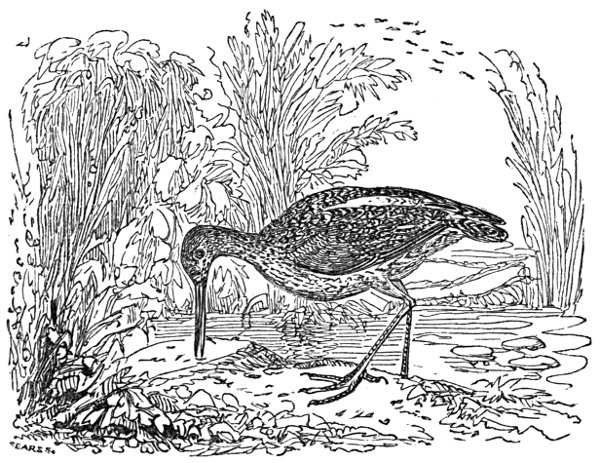
This bird weighs about five ounces and a half: its length is twelve inches, and breadth twenty-one. The bill, from the tip to the corners of the mouth, is more than an inch and three quarters long, black at the point, and red towards the base: the feathers on the crown of the head are dark-brown, edged with pale rufous; a light or whitish line passes over and encircles each eye, from the corners of which a dark-brown spot is extended to the beak: irides hazel; the hinder part of the neck is obscurely spotted with dark-brown, on a rusty ash-coloured ground; the throat and forepart are more distinctly marked or streaked with spots of the same colour: on the breast and belly, which are white, tinged with ash, the spots are thinly distributed, and are shaped something like the heads of arrows or darts. The general appearance of the upper parts of the plumage is glossy olive-brown; some of the feathers are quite plain, others spotted on the edges with dark-brown, and those on the shoulders, scapulars, and tertials are transversely marked with the same coloured waved bars, on a pale rusty ground: the bastard wing and primary quills are dark-brown; the inner webs of the latter are deeply edged with white, freckled with brown, and some of those quills next the secondaries are elegantly marked, near their tips, with narrow brown lines, pointed and shaped to the form of each feather; some of the secondaries are barred in nearly the same manner, others are white; back white; the tail-feathers and coverts are beautifully marked with alternate bars of dusky and white; the middle ones slightly tinged with rust colour; legs red, and measure from the end of the toes to the upper bare part of the thigh, four inches and a half.
This species is of a solitary character, being mostly seen alone, or in pairs only. It resides the greater part of the year in the fen countries, in the wet and marshy grounds, where it breeds and rears its young. It lays four eggs, whitish, tinged with olive, and marked with irregular spots of black, chiefly on the thicker end. Pennant and Latham say, it flies round its nest, when disturbed, making a noise like a lapwing. It is not so common on the sea-shores as several others of its kindred species.
Ornithologists differ much in their descriptions of the redshank, and probably have confounded it with others of the red-legged tribe, whose proper names are yet wanting, or involved in doubt and uncertainty. Latham, in his supplement, describes this bird as differing so much in its summer and winter dress, and its weight, as to appear to be of two distinct species. There is reason to believe that several species of the scolopax and tringa genera, which have not been taken into the list of British birds, appear occasionally in Great Britain, and that this circumstance, together with the difference of age and sex, has occasioned much confusion.
Red-legged Godwit, Spotted Snipe or Barker, Spotted Redshank. (Scolopax Totanus, Linn.; Le Chevalier Rouge, Buff.)—The length of this bird, from the tip of the bill to the end of the tail is twelve inches, and to the end of the toes, fourteen inches and a half; its breadth, twenty-one inches and a quarter, and its weight about five ounces two drachms, avoirdupoise. The bill is slender, measures two inches and a half from the corners of the mouth to the tip, and is for half its length, nearest to the base, red, the other part black: irides hazel; the head, neck, breast, and belly are spotted in streaks, mottled and barred with dingy ash-brown and dull white, darker on the crown and hinder part of the neck: the throat is white, and lines of the same colour pass from the upper sides of the beak over each eye, from the corners of which two brown ones are extended to the nostrils: the ground colour of the shoulders, scapulars, lesser coverts, and tail, is a glossy olive-brown; the feathers on all these parts are indented on the edges, more or less, with triangular-shaped white spots. The back is white; the rump barred with waved lines of ash-coloured brown, and dingy white; the vent-feathers are marked nearly in the same manner, but with a great portion of white: the tail and coverts are also barred with narrow waved lines, of a dull ash-colour, and, in some specimens, are nearly black and white. Five of the primary quills are dark-brown, tinged with olive; the shaft of the first quill is white; the next six are, in the male, rather deeply tipped with white, and slightly spotted and barred with brown: the secondaries, as far as they are uncovered, when the wings are extended, are of the same snowy whiteness as the back. The feathers which cover the upper part of the thighs, and those near them, are blushed with a reddish or vinous colour: the legs are of a deep orange red, and measure, from the end of the middle toe-nail to the upper bare part of the thigh, five inches and a half.—Bewick.
Redwing, s. A bird.
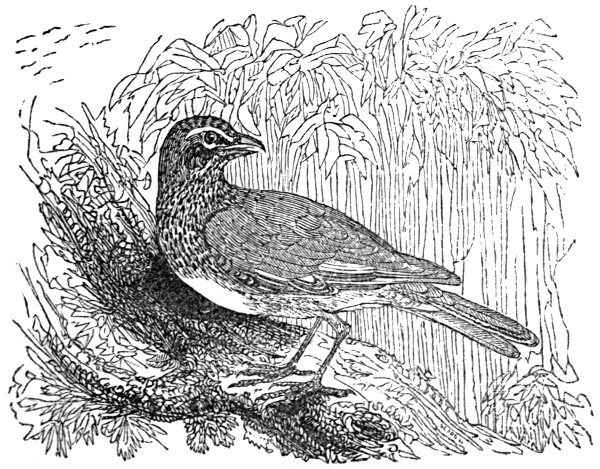
Redwing, Swinepipe, or Wind Thrush. (Turdus Iliacus, Linn.; Le Mauvis, Buff.)—This bird is not more than eight inches in length. The bill is of a dark-brown colour; eyes deep hazel; the plumage in general is similar to that of the thrush; but a white streak over the eye distinguishes it from that bird: the belly is not quite so much spotted, and the sides of the body, and the feathers under the wings, are tinged with red, which is its peculiar characteristic; whence also it derives its name.
These birds make their appearance a few days before the fieldfare, and are generally seen with them after their arrival; they frequent the same places, eat the same food, and are very similar to them in manner. Like the fieldfare, they leave us in the spring, for which reason their song is quite unknown to us; but it is said to be very pleasing. The female builds her nest in low bushes or hedges, and lays six eggs, of a greenish blue colour, spotted with black.
This and the former are delicate eating: the Romans held them in such estimation that they kept thousands of them together in aviaries, and fed them with a kind of paste, made of bruised figs and flour, and various other kinds of food, to improve the delicacy and flavour of their flesh; these aviaries were so contrived as to admit light barely sufficient to direct them to their food; every object which might tend to remind them of their former liberty was carefully kept out of sight, such as the fields, the woods, the birds, or whatever might disturb the repose necessary for their improvement. Under this management these birds fattened, to the great profit of their proprietors, who sold them to Roman epicures for three denarii, or about two shillings sterling, each.
A redwing was taken up, November 7th, 1785, at six o’clock in the morning, which, on its approach to land, had flown against the light-house at Tynemouth, and was so stunned that it fell to the ground and died soon after; the light most probably had attracted its attention.
When redwings appear on the eastern coast, they as commonly announce the approach of the woodcock, as does the arrival of the wryneck that of the cuckoo, in the south.—Bewick—Daniel.
Reed, s. A hollow knotted stalk, which grows in wet grounds; a small pipe; an arrow.
Reek, s. Smoke, steam, vapour; a pile of corn or hay.
Reel, s. A turning frame upon which yarn is wound into skeins from the spindle; an implement for winding up the angler’s line.
Reeve, s. The female of the ruff.
Refuse, s. That which remains disregarded when the rest is taken.
Regarder, s. obs. The regarder is a ministerial officer of the forest, sworn to make regard there as usual, to view and enquire of all the officers within the forest of vert or venison, and of concealments or defaults of the forester, or other officers of the forest.
Rein, s. The part of the bridle which extends from the horse’s head to the driver’s or rider’s hand; used as an instrument of government, or for government.
Rein, v. To govern by a bridle; to restrain, to control.
Reins, s. The kidneys, the lower part of the back.
Relay, s. Horses on the road to relieve others.
Remove, s. Change of place; the act of changing place; a step in the scale of gradation; act of putting a horse’s shoes upon different feet.
Rendezvous, s. Assembly, meeting appointed; place appointed for an assembly.
Rendezvous, v. To meet at a place appointed.
Rennet, s. The ingredient with which milk is coagulated, in order to make cheese.
Renounce, v. To disown, to abnegate; a term in card playing.
Repellent, s. An application that has a repelling power.
Repercussion, s. The act of driving back, rebound.
Reptile, a. Creeping upon many feet.
Reptile, s. An animal that creeps upon many feet.
Resinous, a. Containing resin, consisting of resin.
Respiration, s. The act of breathing; relief from toil.
Rest, s. Sleep, repose; cessation from disturbance; cessation from bodily labour.
Rest, v. To lay as on a support; to steady a gun when taking aim.
Restharrow, s. A plant.
Restiff, a. Unwilling to stir; resolute against going forward; stubborn.
Restiveness, s. Obstinate reluctance; viciousness in a horse.
Restorative, s. A medicine that has the power of recruiting life.
Reticle, s. obs. A small net.
Reticulated, a. Made of net-work.
Retina, s. The optic nerve which receives the image of the object in vision.
Rheum, s. A thin watery matter oozing through the glands, chiefly about the mouth and eyes.
Rheumatism, s. A painful distemper supposed to proceed from acrid humours.
Acute general rheumatism, or rheumatic fever, is inflammation of the muscular system, and has been already noticed under the head founder, or chill. There is, however, a different kind of rheumatic affection I have sometimes met with, in which the joints are affected; generally, I believe, the hock joint; but probably the other joints are equally liable to this affection. It is sometimes accompanied with a morbidly irritable state of the stomach and bowels, and if a strong or even a common purgative is given in such a case, there will be danger of its producing inflammation of these parts. The same irritable state of the stomach and bowels is sometimes observable also in chills, as they are termed, and when the hind-leg is suddenly attacked with inflammation and swelling, after violent shivering and fever. In all such cases, though physic is often necessary, that is, when the bowels are in a costive state, yet it is likely to do great harm unless in a moderate dose, and guarded with cordials or opium. The following ball may be given on such occasions: it must be observed, however, that copious bleeding is the essential remedy, and must precede every other.
PURGATIVE WITH OPIUM, OR CORDIAL CATHARTIC.
Barbadoes aloes 4 to 5 dr.
Ginger 1 dr.
Hard soap 3 dr.
Syrup enough to form the ball.
The affected parts may be fomented and rubbed with some stimulating liniment or embrocation.—White.
Rhubarb, s. A medical root, slightly purgative, referred by botanists to the dock.
Rib, s. A bone in the body, any piece of timber or other matter which strengthens the sides; a slip of iron attached to gun barrels for strength or ornament.
Ribbed, a. Furnished with ribs; enclosed as the body by ribs.
Rick, s. A pile of corn or hay regularly heaped up and sheltered from wet.
Rickets, s. The rickets is a distemper in children, from an unequal distribution of nourishment, whereby the joints grow knotty, and the limbs uneven; a disease in horses.
Rickets is very like to tabies, in all its causes, and also in some of its appearances and effects; it is common to the same breeds, and is both occasional and hereditary. It is occasional when it meets with the circumstances of confinement, bad air, filth, and unwholesome food, or the milk of an unhealthy mother. Many whelps are born with the predisposition, among the fancy breeds in the confined parts of great cities and large towns, particularly pugs and the smaller sorts of bull dogs: there is also a breed of wry-legged terriers which without doubt originated in ricketty specimens, which were afterwards cultivated for particular purposes, principally rabbit-hunting. The affection often appears soon after birth; and shows itself by the slow development of the body, except in the head, belly, and joints, all of which enlarge at the expense of the rest of the parts: particularly it attacks all the joints of the extremities; these swell into protuberances, probably from a sympathy in the constitution to make up by bulk what the bones want in ponderosity, but which is not effected; for, deprived of their earthy solidifying principles, they yield to the superincumbent weight, and the cylindrical ones particularly become crooked. Cleanliness, good air, free exercise, and wholesome food, will commonly prevent it in the future breeds of such dogs as have shown a disposition to it. As a cure, an invigorating diet added to these, with the occasional use of tonic bitters if the appetite fails, or the digestion should appear defective, will answer the intention.—Blaine.
Ride, v. To travel on horseback; to travel in a vehicle; to be borne, not to walk; to manage a horse; to be supported, as ships on the water.
Rider, s. One who is carried on a horse or in a vehicle; one who manages or breaks horses.
In Riding.—Jockeys may be divided into several classes: namely, the southern jockeys, the northern jockeys, and the dirty jockeys. The first class are those which are seen at Newmarket, Ascot, Epsom, and indeed in most of the races in the southern counties, and also at Doncaster. The second class attend the Yorkshire meetings, and what, for the sake of distinction, I will call the northern circuit. The third or dirty class, are met with still farther to the north, in Westmoreland, Cumberland, &c. and are remarkable for their slovenly, dirty, and unworkmanlike appearance:—it is no uncommon occurrence to see these wretched apologies for jockeys (at Kendal for instance) ride in dirty jackets, dark greasy corduroys, and gaiters of a similar complexion. Mr. Thomas Simpson’s jockey frequently appears thus, though Mr. Simpson is wealthy and highly respectable; but evidently not very scrupulous on the score of cleanliness. The southern jockeys, much to their credit, appear on horseback with a neatness and cleanliness bordering upon elegance; and their performance is, for the most part, of a superior order—superior, in fact, to their rivals of the north; they are illiterate ignorant men, with little exception: though, in private, they affect a mysterious, but plebeian importance, and would willingly be thought a sort of semi-gentlemen, which, however, their very attempt to assume such a character renders impossible. There is much less of this ridiculous and ignorant affectation in the northern jockeys, who yet seem, it must be confessed, not nearly so anxious about their appearance on horseback (as far as relates to the advantage of dress,) as their brethren of the south.
The question next arises as to which are the best workmen. The southerns, beyond a doubt; that is, speaking generally: but, it must be admitted, that there are some excellent northern jockeys, who would lose little by the comparison with either Chifney, Robinson, Dockeray, or any of the most favourite riders of the present day. Buckle is now grown old, and does not often appear; otherwise, I should place him at the head of the list. H. Edwards must be classed, I imagine, amongst the northern jockeys; he has a good seat, good hands, and a good head; and is altogether an excellent rider: I am doubtful if his superior is to be found. T. Shepherd, a northern jockey, has a good head, and I have always admired his riding; I think his abilities have generally been much underrated. Lear is a promising young northern jockey; but he must be careful not to let his self-opinion and overbearing temper supersede the plain uncultivated sense he possesses. Templeman is what may be called an improving jockey: he has a good seat, and I have frequently been much pleased with his performances. He rode Dr. Faustus (Sir T. Stanley’s) remarkably well at the Liverpool summer meeting, and I thought won the cup—I was not singular in this opinion: the judge, however, decided in favour of Velocipede. I never recollect observing a horse better managed than Forth managed his own horse Frederick, when running this year (1829) at Epsom, for the Derby. He had betted to a considerable amount upon Exquisite (also his own horse, and came in second) particularly with Mr. Crockford; but shifted his money the evening before running on Frederick, and thus became a winner to a very considerable amount. There are many very awkward jockeys, possessing but very slender requisites for the profession which they have embraced; to point them out, however, by name, would appear ill-natured and invidious.
It is some dozen years or more since “old Billy Pierse” quitted the avocation of a jockey. This man I always considered as a very superior rider—as one of the best I ever saw. In stature he was one of the shortest of his fraternity: but he was a sort of dwarf Hercules: he was able to give his horse a pull without any perceptible movement of his body; and of all the jockeys I ever saw, not one sat so steadily upon his horse. He never acquired the fame of Chifney; though there are those who think his merits were equal, if not superior to that celebrated jockey:—such is the opinion of one gentleman, in particular, whose superior judgment I have frequently experienced and very much admired.
What I have denominated the “dirty jockeys,” are little worthy of consideration. They are very indifferent riders, but made up of trick and cunning; and ready at any time to put in practice their sinister arts for the purposes of deception, swindling and fraud.
I have not the least doubt, were this description of jockeyship entirely superseded, it would give very general satisfaction to the true friends of the turf. In the first place, with the exception of Lord Wilton, Mr. White, and some others, there are few gentlemen but what make a poor, or perhaps ridiculous, figure in riding a race. When gentlemen are to ride, it seldom happens that the patience of the multitude is not put to the test: if the preparations for gentlemen riders are not more complex than those of the professed jockeys, they cannot be either so well defined, or so direct, since they occupy a period of time of at least six times the duration. But this is by no means the worst of the business:—the system is liable to very gross abuse; and a class of men contrive to insinuate themselves into it, who have very meagre pretensions indeed to the character of gentlemen, and whose operations are, for the most part, merely a cloak for the basest purposes. I have often been surprised, that those genuine or sterling gentlemen who choose to contend in the race, are not more scrupulous as to the persons in whose company they thus appear: accustomed as they are to the turf, they cannot be unconscious, surely, that men frequently are seen as gentlemen riders, who are not only destitute of every honourable feeling, but whose exertions are in furtherance of a system of swindling, base and degrading, and utterly incompatible with the best interests of the turf. Also, a number of these men cannot come fairly under the description of amateur riders, since they go from race to race throughout the season, and are in the constant habit of riding, which they understand as well as the regular jockeys. What chance has a mere amateur against such competitors?
As to jockeys riding to order, nothing can be more correct or judicious, when such orders are intended to bring out the horse, so as to make the most of his powers, and to win if possible; but many cases have no doubt occurred of an opposite description, where the horse possessing the qualities to win, has been ridden purposely to lose. Yet, I am inclined to think, that suspicion has not unfrequently been expressed without just grounds. It should be recollected that horses vary considerably in their running, unaccountably so at times, either from latent disease, or other inexplicable cause; and therefore before a jockey is accused of wilfully riding to lose, the matter should be very dispassionately considered. Generally speaking, a jockey is very anxious to win, and I should be more inclined to suspect him of foul riding in order to win, than premeditatedly riding to lose, unless he had betted largely against the horse, and this is much more likely to occur where the jockey happens to be the owner of the horse, than under ordinary circumstances.—Turf Expositor.
Ridge, s. The top of the back; the rough top of anything; a steep protuberance; the ground thrown up by the plough; the top of the roof rising to an acute angle; ridges of a horse’s mouth are wrinkles or risings of the flesh in the roof of the mouth, running across from one side of the jaw to the other.
Ridgling, s. A ram half castrated.
Ridingcoat, s. A coat made to keep out the weather.
Rifle, s. A gun whose barrel is only constructed to shoot bullets.
I have made many experiments, and thought a good deal, by way of ascertaining the best calibre for answering the particular or general purposes to which the rifle may be applied. We all know that the resistance of the air is the chief obstacle which projected bodies have to encounter. It is so very great, that the range of projected spheres is more regulated by the degree of this resistance than by the velocity they receive from the powder,—the increased velocity of the ball being met by a geometrically increased ratio of atmospheric resistance. The larger bullets, therefore, having less surface in proportion to their mass, are, proportionately, much less resisted; so that the flights of the larger exceed those of the lesser, in more than the proportion of their respective diameters. For instance, a thirty-two pound shot, whose diameter is about six inches, will, with even a less proportionate charge of powder, and at an equal elevation, range half as far again as a nine pound, whose diameter is four inches. The proportion which the surface of a sphere bears to its mass, increasing in a geometrical ratio to the decrease of its diameter—the smaller the sphere, the greater is the proportionate resistance it meets with in its flight. At length, we find that small particles of the heaviest metals, becoming, as it were, nearly all surface, will actually float in the atmosphere, or remain suspended for a considerable time in the lightest fluids. Hence it is, that from the same piece, and with a similar charge of powder, we shall find that the range of an ounce of bird shot will regularly extend with the increased size of the shot employed, until, in progression, we get to the ounce bullet itself, which fits the piece; and which, by the by, at an elevation, would not be impelled further if projected from a twenty-four pound cannon.
The theory of the air’s regular resistance to the onward progress of the bullet, must also be applied to the irregular action of the wind across the line of its flight; which action also increases in the ratio of the decrease of the weight of the bullet. At the distance of 315 yards I have found a strong cross wind to cause a rifle bullet of nineteen to the pound to diverge from three to four feet. On the other hand, I have used a rifle carrying a bullet of ten to the pound, which, with the same wind, did not, at the same distance, diverge more than about one foot. In constructing a butt for rifle practice, regard should, therefore, be had to the more usual direction of the wind; and, as far as the locality will allow, the butt should be placed so as to have the wind more frequently in the line of the range, either way, than across it.
For general, and especially for military purposes, such large rifles as the last mentioned would, coupled with the ammunition, be found too heavy. The rifles commonly used in the United States carry, I am told, a bullet of thirty-two to the pound. The adoption of so small a calibre, I take to have been occasioned by the use of the rifle being, in that country, originally and generally confined to the interior of thick forests, wherein it seldom happens that an object is to be fired at beyond the distance of one hundred yards; and where, moreover, the wind is much less felt than in an open country.
Under the above circumstances, the half-ounce rifles are quite adequate to their purpose; but in a more open, and especially in a mountainous country, the calibre of rifles should be considerably larger. In a hilly country, you are often in the actual presence of the enemy, and capable of greatly annoying him, at distances at which, on a plain, the view is interrupted and confined by the least considerable of surrounding objects. In a hilly country, occasions are perpetually offering, wherein long rifle ranges would cause considerable mischief to your opponents. Such long ranges can never be obtained, nor depended on, with the half-ounce rifles of the Americans and Tyrolese.
If the foregoing observations are founded on fact, it is easy to decide what sort of rifle should be applied to a particular purpose. With respect to general purposes, I am inclined to fix on the calibre of one ounce, or sixteen bullets to the pound. The English government rifles are of nineteen or twenty to the pound; to which calibre there is little objection, especially as it is the same as that of the cavalry carbines and pistols. However, I could advance several reasons,—I do not call them very important ones,—for preferring the French regulation; according to which all the fire-arms of all the different corps, both of cavalry and infantry, are of one and the same calibre, of sixteen bullets to the pound.
With respect to the rifle, at least, I would most strenuously recommend the substitution of percussion for flint locks; over which the advantages of the former are as great as the latter are superior to the huge wheel and pyrites locks of two centuries ago. In comparison to the percussion gun, the very best flint one absolutely hangs fire, and one out of twenty is usually a miss-fire. A cap is put on much quicker than a flint lock is primed; there is no time lost in changing flints; and if Mr. Joyce’s percussion powder be used, there is no foulness or corrosion whatever; lastly, the rifles at present in use might be converted into copper caps at a trifling expense, and new copper cap locks will cost less than flint ones. The only objection to the change (and I own it is a very great one indeed), is the blind prejudice of custom.
To render the use of the copper cap piece still more eligible, especially for military purposes, there should be no lateral vent-hole in the breech, but in lieu of it, a broad convex-headed screw; which, upon being withdrawn, opens a passage into the chamber under the nipple, of an eighth of an inch in diameter.
By this simply contrivance,—which I have applied to all my own guns, rifles, and pistols,—should any obstruction occur, either from wet or dirt, which cannot be removed by merely probing the nipple, it will infallibly he cleared out by removing the screw, scooping out the passage into the chamber, putting a little powder therein, and firing it off, after having probed the nipple and replaced the screw. The aperture formed by the removal of the screw, greatly adds to the facility of washing the barrel.
Instead of the brush and brass wire pricker, required for the present flint-lock service, the use of percussion pieces would make it necessary to substitute a little instrument of steel, resembling the letter T; one half of the horizontal part being a four, or, what is perhaps better, a three-sided pricker, or probe, of about one-twentieth of an inch diameter. The other half of the horizontal piece forms a kind of little scoop, corresponding to the diameter of the lateral screw above mentioned; upon the removal of which it is to be employed. The centre piece, or foot of the T, is a turnscrew, surmounted by a little ring to attach it to the jacket. As, however, the instrument will not be often wanted, perhaps it had better be kept in the trap of the rifle stock, in the inside of which I attach it, by a thong, to a little screw staple.
Some persons recommend that, instead of the lateral screw above described, the nipple itself should be taken out, in case of obstruction, or for the purpose of washing the barrel. This is not only ineffective, but highly improper, as it requires the use of a particular shaped key or pincer to screw the nipple; whereas, such things as will turn a screw, or serve the purpose of a pricker, are to be found everywhere.
The percussion powder for the caps, should by all means be composed of the nitrate of mercury, first brought into use by Mr. F. Joyce, of Old Compton Street. This, instead of having the slightest tendency to corrode the piece, would rather appear to possess an anti-oxidating property; for I have repeatedly found that, having fired upwards of twenty rounds with this percussion powder, and laid the piece by for a month without the least cleansing, it has been, at the expiration of that time, as perfectly free from the least speck of rust as the day it came new from the maker’s shop. This would certainly not be the case even with a common flint lock; but as for the common percussion powder, composed of superoxygenated muriate of potash, it actually corrodes the parts of a gun as much as a drop of nitric acid itself; in fact, upon combustion it evolves, and leaves a residuum of that active fluid upon the iron. The consequent rapid destruction of the parts is such as would, especially in military service, occasion great inconvenience.
I have often compared notes, and reflected upon the respective advantages belonging to the magazine and copper cap locks, either for military or sporting purposes. Of magazine locks hitherto invented, the best and simplest is that by Forsyth, with the magazine sliding upon a plane, in which is the touch-hole, being connected with the cock by a bridle, which causes it to follow or precede its motions. For military use, this lock has the advantage over the copper cap, inasmuch as it saves the time and attention required for priming; nothing else being required than to cock and pull the trigger. In rifle practice, the use of this lock will more than retrieve the small additional portion of time which it requires to push down even my rifle cartridge, above what it takes to drop a cartridge into a common musket, with all its windage. On horseback, the advantages of such magazine locks are still more evident and important; as every one knows what an awkward loss of time and powder the operation of priming a flint lock occasions to a horseman in motion; whereas, with the magazine, containing thirty or forty primings, and a swivel ramrod, a carbine or pistol may be loaded with the same speed and precision on horseback, at a trot or a gallop, as when sitting in a chair. It is certainly easier to put on a copper cap than to prime a flint lock; but, with the magazine, there is no priming operation at all. With the common corrosive percussion powder above spoken of, the magazine lock certainly becomes very unfit for military purposes; for after having fired a shot or two, without subsequent cleaning, the lock will be nearly immovable the day after. However, in the late Spanish campaign of 1823, I had several magazine rifles and pistols, and no other than the corrosive percussion powder; but the officers and men to whom I entrusted them were so proud and so careful of them, as to keep them always in the most perfect order. Anyhow, it is evident that, for cavalry officers at least, the percussion magazine locks are undoubtedly, to be preferred; and, for both officers and men, I will observe, en passant, that it is far better to have one double pistol, than two, or half a dozen, single ones; and that whether one or two pistols be used, they should, upon going into action, he secured by a thong to the sword-belt; so as, in case of need, to be instantly disposed of by being dropped over the left shoulder. By having only one pistol, one holster may be converted into a convenient pouch. It is essential that, in double pistols, carbines, or rifles, the axis of the barrels should be perfectly parallel from breech to muzzle. If this be strictly attended to, it is not of much consequence whether they be disposed as in a fowling-piece, or, as it is called, “under and over.” One “under and over” pistol, eight inch barrels (the upper one rifled), nineteen bore, swivel ramrod, with a movable spring butt, to be kept in the other holster when not in use, is an excellent weapon for an officer. The movable butt must also serve the purpose of a mallet in loading the rifled barrel. Three or four slight taps will send the ball home: for, particularly on horseback, a rifle-barrelled pistol cannot well be loaded by pushing with so small a ramrod. With the smooth barrel, the party may fire away, either with ball or buck-shot cartridges, as fast as he pleases.
The copper cap offers the advantage of somewhat greater simplicity, and consequently less liability to derangement; and above all, it is, with the application of wax as hereafter described, perfectly water-proof. For the rifle service, therefore, it might perhaps, in one point of view, be preferable to the magazine; and certainly it is so in every respect for fowling pieces; in the use of which protection from the rain is of much more importance than the gain of a few seconds in loading, and where none of the inconveniences of priming on horseback are experienced. Duelling pistols should decidedly be copper caps. With such pistols there is no occasion whatever for a magazine; and I have found that a delicate trigger cannot be subjected to the slightest casual pull or strain of the magazine stirrup, without great liability to accident.
A remarkable defect in all the rifle-shooting that I have ever seen, is the improper construction of the ramrod, which is much too light. From this it results, that either the bullet is inserted with too little constriction to ensure its revolving on its axis to the end of an extensive flight; or, upon a tighter fit being attempted, much time and awkward exertion are expended in driving it properly “home.”
The friction to be overcome in forcing a bullet into a rifle is, in some respects, analogous to that of a wedge or a nail in entering a piece of wood. Nobody would think of driving a nail or a wedge by mere pressure or pushing, which would not effect the object with a thousand times the force that would suffice in the shape of percussion or impingement. To load a rifle with a mallet is out of the question, especially for military purposes; but I find that the very best effect is produced by having the ramrod of solid brass, considerably heavier than the iron ones of the government rifles. I have also a bit of hard wood, turned into the shape of a pestle, acutely convex at the thick end; and to qualify it for hasty use, I fasten it by a string to the button of my jacket. With this I give the ball a smart tap, which drives it below the centre of its circumference into the grooves of the barrel. If the latter be perfectly clean, the bullet will go down all the way by mere pushing; but this will not be the case after a few shots have been fired, unless the bullet be smaller than it should be. Any how, the ramrod ought always to be flung down once or twice, in conclusion—as the particular ring or jar, so produced, furnishes the only true criterion of the bullet being really “home.”
The ramrod being of the proper weight, and the end applied to the bullet being nearly equal to its calibre and well countersunk, the bullet will be moved by it with a few easy percussions; and should the barrel be ever so foul towards the breech, one or two flings with such a ramrod will send the bullet “home” with the assured ring. Neither a wooden nor a light metal ramrod will produce this effect after a few shots.
The ramrods I have had constructed for my own use are of solid brass, of about half an inch diameter except the end applied to the bullet, which, for a couple of inches, is so large as just to fit easily into the barrel. This large end is bored conically out, so as to contain between two and three drachms of powder, which, in leisure shooting, serves to introduce the charge with the rifle reversed. The ball-drawer, when required, screws into the other end of the rod.
The government rifle ramrods, might, for economy’s sake, be made of iron; but they should be much heavier than they are. It is absolutely necessary to good and quick rifle shooting, that the bullet should be driven into the mouth of the piece by a stroke of some sort or other, previously to the use of the ramrod. Should the little wooden pestle mentioned above be deemed inconvenient in military practice,—which I opine it is not,—a similar effect might be produced by a tap with the round button-like end of the present rifle ramrods; though, for the sake of the barrel, I would recommend that this button should be of soft copper. Were it made more convex, it would drive the bullet further in.
It is evident, that for actual service, the practice cannot be rendered too simple. So I only just mention, en passant, that in my own cartridge pouch, twelve cartridges, to be used first, are made with thicker cotton, which, for distinction’s sake, is red or blue. So, as the barrel becomes foul, I get to the other cartridges, of somewhat easier introduction. I have found it very pleasant even to divide my cartridges into three different fits—red, blue, and white. A rifle, however, deteriorates in accuracy of shooting, in proportion to the number of shots fired without cleaning the barrel. For the foulness accumulating mostly towards the breech, forms there a certain degree of constriction and obliteration of the grooves, into which part the bullet being forced, no longer fits the other and greater portion of the barrel, so to ensure its spinning upon its axis to the end of a long range. After twenty-five shots, without cleaning, at 315 yards, in very dry weather, I have found the bullets begin to deviate a little; as they no longer struck the target on the side which had come foremost from the barrel.
With respect to the rifleman’s cartridge-pouch, it should certainly be placed in front, buckling round the waist with a broad strap. The great thickness or projection which is given to the English rifle-pouches has many inconveniences; one of which is, that the weight, being concentrated into one almost cubic mass, causes great fatigue and annoyance, and perhaps injury, to the bearer. So far from having any such shape, I have found that the pouch ought to be so flat, as only to contain one row of tin tubes for cartridges, twenty-four of which occupy a space of about fourteen inches from hip to hip. The tubes being about five inches long, open at each end, but divided in the middle by a diaphragm, contain two cartridges each. When the uppermost row is consumed, to get at the others, it is only required to draw out the tubes, and reverse them in the pouch. If the cartridges are closed up, according to the method recommended in another part of this Treatise, they may, from the increased diameter of the folded end, be made to stick more or less firmly in the reversed half of the tubes, when these are drawn out to be turned. The pouch covers up with a flap of flexible leather, saturated with linseed oil, and secured at pleasure with a round button and loop. At one or both ends of the pouch is a little leathern bag, which may contain one or more packets of spare cartridges. I prefer, however, the method I have observed amongst the Calabrians and Corsicans, who, had they rifles, would be the most formidable skirmishers in the world. Their pouches go all round the body; though sometimes it is, as it were, a double pouch, with only small intervals at each hip, occupied by a bayonet on one side, and a middling-sized pistol on the other. From having only one row of tubes, these pouches are so little protuberant, as to be scarcely more perceptible, under or over the jacket, than a simple belt would be. When the cartridges are exhausted in front, the pouch is easily slipped round as much as required. Moreover, the weight being so distributed all round the body, gives scarcely any incumbrance; and I have found it a further improvement to partially support it by braces, worn under the jacket or waistcoat. Slips from the usual trouser suspenders will answer the purpose.
I must yet add a few words, by way of recommending some essential alterations in the method of exercising the troops to the use of that weapon, which will in most respects apply to the musket, carbine, and pistol.
In all the rifle or musket practice that I have ever seen or heard of, the men are made to fire at a target of about three feet diameter, placed before a bank or mound of earth, which receives all the missing bullets. Nothing can be more ineffectual in the way of instruction than this method! Every shot which misses the target, might as well have been fired vertically in the air, for any instruction it can have afforded to the firer! Even those bullets which do strike the target, will furnish no precise criteria of experience, unless the actual mark of each be immediately pointed out to the man who fired it.
The butt, or rather wall, for teaching rifle or musket shooting, should be at least twelve feet square, or rather twelve feet broad and twenty high. It should be covered entirely with cast-iron plates, of about three quarters of an inch thick. A convenient movable butt may be composed of a rectangular frame of wood, traversed like a window-frame, by pieces of wood at right angles or diagonally, having holes at the intersections for the admission of flat-headed bolts, by which the four corners of the cast-iron plates, corresponding to the size of the square divisions, will be secured to the frame, in close connexion with each other. Such a butt being set up endways, need only be connected, by a pulley at the top, to a couple of poles fixed in the earth, or to the top of a movable triangle. Any inclination, either forwards or backwards, may be given to it by means of the pulley. If it be inclined backwards at an angle of eighty to eighty-five degrees, the bullets, at medium and short ranges, will be reflected upwards nearly perpendicularly in the air.
The ground in front of the butt should be well levelled to the distance of about thirty yards, and covered with sifted road-scrapings, in preference to turf, gravel, or sand.
As unnecessary waste should in all cases be avoided, there is no reason why the recovery of the bullets should not be attended to. The best way to insure this, is to give the surface of the butt an inclination forward, of about ten degrees upon the horizontal line, which will cause the bullets to be reflected downwards upon the smooth ground in front. The recovered lead might be given as the perquisite of the marker, or to the best shot at the drill.
A little on one side, and about five yards in advance of the butt, there should be a little screen, or epaulement, behind which a man might safely stand to perform the office of marker. This marker must be provided with a pot of lamp-black and water, with a brush affixed to a long stick, and a pot of whitewash. He must also have a bit of chalk, or a box of various coloured wafers, to mark the shots. To prepare the butt for shooting, it must be blackened all over. An object is then to be designated in the middle, either with whitewash, or with one or more sheets of white paper, according to the distance, and to the proficiency of the men who are to practise.
Instead of a circular object or target, I recommend, for military practice, a perpendicular parallelogram of two, four, six, twelve, or more inches broad, and one, two, three, or five feet high. If such a figure be made with whiting on the black butt, the bullets will make very distinct marks upon it, while those which miss it will leave white ones on the butt. If paper be used, care must be taken that it be not moved about by the wind. Pieces of thick wrought iron, of the shape and dimensions last described, to suit the different distances, &c., whitened and hung up against the butt, form excellent targets, especially for distant shooting. A loud gong-like clang announces the stroke of a bullet, while the marker may pretty well indicate, with a stick blackened at the end, its precise situation. He will also point out the site of those unresponsive shots which do not hit the mark. The presiding officer should use a telescope. This method will obviate the necessity of perpetually walking up to the target, which occasions much loss of time, confusion, and danger.
As I have always observed that it gives most satisfaction to the firer, when he sees the object fired at actually knocked down from its situation, this result might easily be obtained either with plates of plaster of Paris, or with metal ones. It may be also well to observe, that a bright red is undoubtedly the colour which can be seen at the greatest distance, and consequently the properest for a bull’s-eye.
Every shot being marked, and pointed out to the man who fired it, he will always be able to form a criterion by which to regulate his next attempt. Men might as well be made to shoot at a bottle in the dark, as to practise without knowing where the bullet strikes—except when they may chance to hit the bull’s-eye! I will venture to assert, that five shots fired with care, comparison, and reflection, will produce more improvement than fifty expended in the usual irrational manner.
It is particularly requisite to attend to the perpendicular line; and that no shot be allowed to count, which strikes the butt at more than five feet from the ground. In service, it is far better that the bullet should fall rather short, than that it should go over the adversary’s head; as, in the former case, if it be on tolerably level ground, and in the right perpendicular direction, there is a great probability of its hitting him by the ricochet.
Both in rifle and pistol-shooting, an absurd custom prevails, of pointing the piece upwards, and bringing it down to a level with the object to be fired at. Instead of this practice, to which there are many objections, the piece should, previously to being cocked, be pointed downwards, at less than a yard from the foot of the firer. It is then to be steadily raised up in the line of the object, and when within a certain distance from the proposed level, the trigger (if not a detent) should be gradually pressed, according to the knowledge which the firer has of it, so that it may just go off without any pull at the desired moment. While the piece is in motion upwards, the perpendicular line described will be true and steady; and the quicker the motion the truer the line. When the perpendicular motion ceases, the horizontal vacillation begins. The aim, therefore, should not be prolonged beyond the arrival of the sight at the intended level; but whenever it is so, the piece must be lowered below it, and brought up again.
I have invented, says the Colonel, a simple method of rendering copper caps perfectly water proof. It consists in dipping the open rim, or base of the cap, into green taper wax, melted in a plate over a lamp. The melted wax must not be so deep as to spread into the cap up to the percussion powder at its extremity, but only so high as to form a slight lining of the wax around its inner base. This will suffice to cause the cap to close hermetically over the nipple; so that, provided it be not cracked, and the gun have no lateral vent-hole (which it ought not to have), the loaded piece may be put, over the lock, into a pail of water, without affecting either the cap or the charge. For sporting purposes, it is sufficient to have a few such caps in store, for wet weather. For military use, the whole of the caps might be so prepared at the laboratories.
Two rifle guns of the manufactory, the one valued at a hundred, the other at twenty-five guineas, were next loaded, and fired by General Beaumont and another person against my rifle, called Caroline, the distance agreed on being one hundred yards. General Beaumont’s first shot hit the bull’s eye, upon which he was highly complimented; mine in return was an inch from it, and high odds were consequently in favour of the General. The succeeding shots were as follows:—
General Beaumont’s second shot missed, and went over the iron plate three feet square.
Colonel Thornton’s ditto near the bull’s eye.
General B’s third shot below the iron, and struck the ground.
Colonel T’s ditto hit the bull’s eye.
General B’s fourth shot struck to the left of the plate thirteen inches from the mark.
Colonel T’s ditto near the mark.
General B’s fifth shot went over the mark.
Colonel T’s ditto within one inch of the bull’s eye.
The other rifle, shot by a person belonging to the manufactory, did not succeed better than General Beaumont, and the decision was consequently given in my favour. The rifle I shot with on this occasion, was the workmanship of Mr. Sluden, of Cockspur Street.
During the late war in 1775, a company of riflemen, formed from the backwoodsmen of Virginia, was quartered here (Lancaster in New England), for some time. Two of them alternately held a board, only nine inches square, between his knees, while his comrade fired a ball through it from a distance of one hundred paces. The board is still preserved, and I am assured, by several who were present, that it was performed without any manner of deception.—Maccerone—Thornton, &c.
Rigid, a. Stiff, not to be bent, unpliant, inflexible.
Ring, s. A circle; a circle of gold or some other matter worn as an ornament; a circular course; a circle made by persons standing round; a number of bells harmonically tuned; the sound of bells or any other sonorous body; a sound of any kind; a hunting term.
Ringbone, s. A hard callous substance growing in the hollow circle of the little pastern of a horse; it sometimes grows quite round like a ring.
Ringdove, Cushat, or Quest, (Columba palumbus, Linn.; Le Pigeon ramier, Buff.) s. A kind of pigeon.
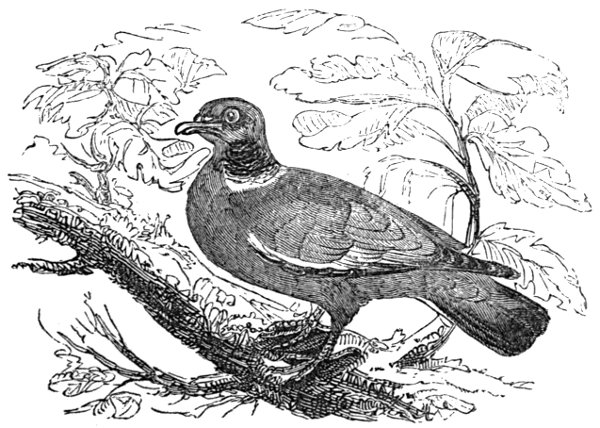
This is the largest of all the pigeon tribe, and measures above seventeen inches in length. The bill is of a pale red colour; the nostrils are covered with a mealy red fleshy membrane; the eyes are pale yellow; the upper parts of the body are of a bluish ash-colour, deepest on the upper part of the back, the lower part of which, the rump, and forepart of the neck and the head, are of a pale ash-colour; the lower part of the neck and are of a vinous ash-colour; the belly, thighs, and vent are of a dull white; on the hinder part of the neck there is a semicircular line of white (whence its name) above and beneath which the feathers are glossy, and of a changeable hue in different lights; the greater quills are dusky, and all of them, excepting the outermost, edged with white; from the point of the wing a white line extends downwards, passing above the bastard wing; the tail is ash-colour, tipped with black; the legs are red, and partly covered with feathers; the claws black.
The ring dove is very generally diffused throughout Europe; it is said to be migratory; but that it does not leave us entirely we are well convinced, as we have frequently seen them during the winter on the banks of the Tyne, where they constantly breed in the spring. The nest is composed of small twigs, so loosely put together, that the eggs may be seen through it from below.
The female lays two white eggs, and is generally supposed to have two broods in the year. They feed on wild fruits, herbs, and grain of all kinds; they likewise are very fond of the roots of the pernicious weeds so well known to farmers under the name of whickens; the Triticum repens, or couch-grass, is the principal one; their flesh is very delicious when they have fed upon these, but it soon acquires an unpleasant flavour when they have lived upon turnips, which, from necessity, they are driven to eat in severe winters. The ring dove has a louder and more plaintive sort of cooing than the common pigeon, but is not heard except in pairing time, or during fine weather.
The ring dove or wood pigeon is the largest species in England, weighing about twenty ounces, and is too well known to need particular description as to its plumage.
The major part of them, in respect to this kingdom, are emigrants, departing elsewhere at the latter end of the year, and returning early in the spring. In the beginning of winter they assemble in large flocks, and leave off their plaintive cooing, which they commence in March, when they pair; they chiefly inhabit the woods, and build in the tops of trees, making a large, loose, and flat nest, with dry sticks and bents; they breed twice in the year, first in April; the second brood appears most numerously in August; they seldom lay more than two eggs, larger but alike in colour to other pigeons, and sit fourteen days before the young are hatched. Wood pigeons are excellent eating, except when they feed on turnips and rape. They are useful in coverts that are made preserves for pheasants, by immediately taking alarm if any person enters them after they have roosted, and quitting the trees upon which they had settled for the night, they fly about in great commotion. The gamekeepers know how to profit by this sort of intelligence in their search after intruders.—Daniel.
Ring Ousel, (Turdus Torquatus, Linn.; Le Merle à Plastron Blanc, Buff.) s.
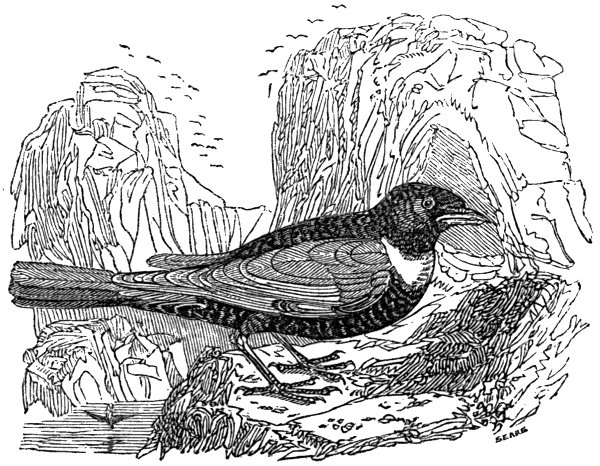
This bird very much resembles the blackbird; its general colour is of a dull black or dusky hue; each feather is margined with a greyish ash colour; the bill is dusky; corners of the mouth and inside yellow; eyes hazel; its breast is distinguished by a crescent of pure white, which almost surrounds the neck, and from which it derives its name; its legs are of a dusky brown. The female differs in having the crescent on the breast much less conspicuous, and in some birds wholly wanting, which has occasioned some authors to consider it as a different species under the name of the rock ouzel.
Ring ousels are found in various parts of this kingdom, chiefly in the wilder and more mountainous districts of the country. Their habits are similar to those of the blackbird; the female builds her nest in the same manner, and in similar situations, and lays four or five eggs of the same colour; they feed on insects and berries of various kinds, are fond of grapes, and Buffon observes during the season of vintage are generally fat, and at that time are esteemed delicious eating. The same author says that in France they are migratory. In some parts of this kingdom they have been observed to change places, particularly in Hampshire, where they are known generally to stay not more than a fortnight at one time.
On the 13th of April, I went to the sheep-down, where the ring-ousels have been observed to make their appearance at spring and fall, in their way perhaps to the north or south; and was much pleased to see three birds about the usual spot. We shot a cock and a hen; they were plump and in high condition. The hen had but very small rudiments of eggs within her, which proves they are late breeders; whereas those species of the thrush kind that remain with us the whole year, have fledged young before that time. In their crops was nothing very distinguishable, but somewhat that seemed like blades of vegetables nearly digested. In autumn they feed on haws and yew-berries, and in the spring on ivy-berries. I dressed one of these birds, and found it juicy and well-flavoured. It is remarkable that they make but a few days’ stay in their spring visit, but rest near a fortnight at Michaelmas. These birds, from the observations of three springs and two autumns, are most punctual in their return; and exhibit a new migration unnoticed by the writers, who supposed they never were to be seen in any of the southern counties.—Bewick—White’s Selborne.
Ringstreaked, a. Circularly streaked.
Ringtail, s. A kind of kite.
Rinse, v. To wash, to cleanse by washing. In case of canine bite, to instantly wash the wound in water, is the very simplest and most effective preventative.
Rippling, s. A moving roughness on the surface of a running water.
River, s. A land-current of water larger than a brook.
The rivers in England amount to three hundred and twenty-five, though others enlarge their number to four hundred and fifty.
Shooting Wildfowl on a River, &c.—For killing common wild ducks that frequent a river, you have only to go a little before sunset; place yourself against any dark bush or bank, and there wait patiently, and out of sight, till they come down and fly round you, which they will generally do several times before they drop into the stream or marshes.
As wild ducks most frequently betake themselves to the springs and rivers about dusk, you have no occasion to wait for them longer than just the last hour, or half, before dark; but if they have been much disturbed or shot at, they will not always fly sufficiently early to be seen, though you may plainly hear the shrill and somewhat melancholy sound of their wings. If, however, the twilight is followed by a full moon, these birds will often withhold coming to the river till the moon has completely risen, in which case you might have to wait till an hour or two after dusk; but then the sport is considerably better, and will last much longer, with the additional advantage of your having continued good light for shooting.
Wild ducks generally come to the same place, unless they have been shot at, or there should be a change of wind and weather.
It often happens that wild ducks, dunbirds, and other fowl, come down at night to large rivers, ponds, or lakes, which are so deeply surrounded by floating reeds, that no one can approach the water; and the birds, aware of this, do not lower their flight till they come near them. So far from this defying the shooter, it is one of the finest opportunities that can be afforded for death and destruction. Let him sit in a small punt or canoe, fore and aft among the rushes, where towards dusk he will be so completely hid, that he may either shoot at birds flying within pistol shot, or wait for a good chance on the water; from whence (his boat being hid on each side, and foreshortened to the only point of view) he will be pretty sure to escape the observation of the birds.—Hawker.
Rivet, s. A fastening pin clinched at both ends.
Rivulet, s. A small river, a brook, a streamlet.
Roach, s. A fish peculiar to fresh water.
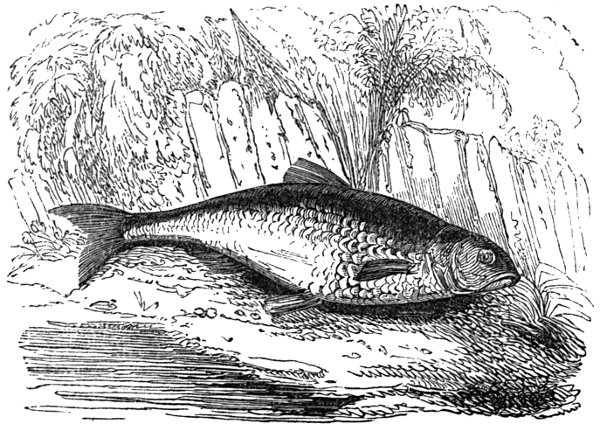
Roach is a handsome fish either in, or fresh out of the water; it inhabits many of our deep, still rivers; affecting, like the others of this genus, quiet waters; it is gregarious, keeping in large shoals; it has a small head, a leather mouth, which is round, and also small, with the teeth in the throat; large eyes, the circle of which resembles gold colour, and the iris red; the roach is deep, but thin, and the back elevated; the scales are large, and easily fall off; the fins are in general red, particularly whilst in perfection; as they may also be known to be by the smoothness of the scales, which, when out of season, feel like the rough side of an oyster-shell: the side-line bends much on the middle, towards the belly, and the tail is a little forked. It is so silly a fish, that it has acquired the name of the water sheep.
Many ways are recommended to catch this fish by angling, when in deep waters, near piles of bridges, flood-gates, &c.: in hot weather, a May or ant-fly is to be sunk by a little lead, within a few inches of the hook, near the sides of these posts or piles; this is to be pulled up very leisurely; a roach will generally attend the fly to the surface, there gaze on it for a moment, and then take it.
Stern fishing, is by fixing a boat (for without, roach of any size are hardly to be caught,) to the stern of a vessel returned from a voyage, whose bottom is foul, and furnished with insects, which the fish greedily devour. The line should not exceed four feet, the float be within a foot of its top, and the rod very short; the bait to be three or four gentles, and dropt close to the ship’s sides, not allowing the bait to swim more than eight or nine feet; begin at the first of the ebb-tide, and for two hours the roach will bite freely.—Daniel.
Road, s. Large way, public path; ground where ships may anchor.
Roadster, s. A hackney, a horse kept for the road.
The hackney, more than any other variety of horse, adds to our health and comfort; we ride him for amusement, and he transports us long distances on our personal avocations. On some only of these occasions speed is desirable; but on all safety is indispensable; and next to that, is the ease with which his motions are performed. These requisites remove the hackney still further than the hunter from that form which best suits the purposes of the racer. In the hackney, therefore, we scrutinise his fore quarters with the same attention that we pay to the hinder parts of the racer; for, as to the purposes of the latter, the fore parts are subordinate to the hinder, so in the hackney, speed being infinitely less important than either ease or safety, and particularly the latter, it is essential that his fore parts be so formed as to ensure these properties. And here it may not be irrelevant to inquire, on what does the safety of action mainly depend? Is it on any particular care of the animal himself in his progression? or does it necessarily arise out of certain peculiarities in his formation, dependent on such an elevation of his feet as will ensure his not stumbling by any erroneous placing of them? The close observer, I think, will answer, that both are concerned: many horses go safely, and yet by no means elevate their legs high; but such are attentive to their steps; and when they see stones or other risings in their path, carefully avoid them. In my early practice I was called on to examine a horse intended for the French court, at the stables of that veteran dealer Choppin. I objected to the horse that he went close to the ground, which even his owner could not deny: but he still argued, that, although he appeared to go near the ground, yet that he was particularly safe in all his paces; and, as a lure to the purchase, would have offered a bet, that on the roughest ground he would not make one trip. As the animal in all other respects was desirable, ground purposely stony in the extreme was chosen, over which he was tried; and it was singular to remark, that in every pace he accommodated the elevation of his feet exactly to the elevations of surface they were to pass over; but it was with a kind of frightful nicety to the observer. On the same ground, many high actioned horses, from inattention to the matters on it, might have tripped by meeting any unusual rising; or, by placing one of the feet on a rolling stone, might have fallen altogether. But it is not hence meant to argue, that the most careful hackney, which does not naturally elevate his feet, is a desirable one. Horses, it is true, are in a great degree crepuscular, and see in a very moderate light. But would such a horse be safe to ride at a brisk trot along an uneven road in a dark night? Or even in a long day, might not fatigue bring his feet down without his usual caution?
The fore-hand of the hackney, therefore, should be elevated, and his shoulder by all means must be oblique; so that he may not only lift up his feet, but also ride pleasantly and lightly in hand, as it is termed by horsemen. To which latter valuable quality it is also essential that he have a neck of just proportions, and that his head be particularly well placed on it, so as to afford him room for flexing himself to the action of the bridle, which, in the hands of a good rider, will sometimes constrain him to throw himself on his haunches, and at others to carry himself forward for more speedy progression. The remainder of the fore limbs ought to present a perfectly vertical line to the pastern, which should have such length and obliquity, and such only, as shall bring the toe directly under the point of the shoulder. The body should be circular, neither long nor very short; his saddle-placing good, his flank on a plane nearly with the rest of his carcass, his loins wide, and his croup gently curved only, to allow of a graceful setting on of the tail. From hence downwards, the principles already laid down when treating on the exterior formation generally, will apply; particularising only, that for this variety of horse a good foot ought never to be dispensed with. Height is not so essential in the hackney as in the hunter; it need never to exceed fifteen hands two inches: in most cases it may, with more propriety, range between fourteen hands three inches, and fifteen hands one inch. Altogether, his frame should be compact, without being in the least clumsy; and with this form, the more breeding he shows, short of full blood, the better.—Blaine.
Roan, a. Bay or sorrel, with grey or white spots interspersed.
The roans, of every variety of colour and form, are composed of white mixed with bay, or red, or black. In some it seems to be a natural mixture of the colours; in others it appears as if one colour was powdered or sprinkled over another. They are pretty horses for ladies or light carriages, and many of them easy in their paces, but they do not usually display much blood, nor are they celebrated for endurance. If they should have white fore legs, with white hoofs, they are too often tender-footed, or become so with even a little hard work.—The Horse.
Roar, v. To cry as a lion or other wild beast; to cry in distress; to sound as the wind or sea; to make a loud noise.
Roaring, s. A disease in horses.
The causes of roaring, which I shall here use as a type of the whole, are remote and proximate. The remote causes are mostly inflammation, acute or chronic, in the tracheal tube itself. Occasionally it is brought on by the effects of inflammation on other parts, as of the salivary glands in strangles, or of those abscesses which not unfrequently occur in violent catarrh in the vicinage of the pharynx. Structural alteration in the lungs, as hepatisation, has occasioned it (Percivall’s Lectures, vol. ii. p. 256). Obstructions accidentally formed by exostoses, cicatrisations, &c., or extraneous substances lodged in the cavities leading to the trachea, may any of them occasion it. Barriere notices a case of roaring dependent on the lodgment of a piece of riband within one of the nasal fossæ; and Godine another, brought on by a displaced molar tooth. The proximate cause might, with propriety, include these accidental obstructions, but they are mainly to be looked for in an extravasation, partial or extensive, of coagulable lymph; which, becoming organised, forms a permanent obstruction. When it is extensively spread over the larynx, it produces wheezing; when it constringes the rimaglottis, a whistling sound is the consequence, and is often heard in our own respirations under catarrh, or in the ordinary respirations of some asthmatic persons. Whoever has handled the throats of many old horses, must have observed the hardened state of the larynx, which almost resisted all attempts to what is termed ‘cough them.’ This ossification of the laryngeal cartilages is not an uncommon cause; and a similar state in the cartilages of the trachea is productive of it also. A very common case also of roaring is a band of lymph stretched across the tracheal tube; at others, an internal ring of the same matter simply diminishes its diameter. The obstruction is sometimes so considerable as to excite piping or roaring on the slightest exertion; in general cases, however, roaring is only exerted when forcible inspirations and expirations are made; for it is, I believe, equally produced by the one as by the other. Mechanical obstructions to free respiration may eventually be productive of roaring: the custom of tightly reining in our carriage-horses, there is reason to think, produces it often; and Mr. Sewell is of opinion, that the practice of using tight throat-lashes, or neck-straps, may lead to it. In furtherance of which opinion, it may be recollected, that horsemen have a very general supposition that crib-biting ends in roaring, in thick wind, or in broken wind: may not the tight collar-strap also here tend to the former of these affections? The custom of ‘coughing’ horses, and so frequently as it is practised in fairs, may be readily supposed as a cause. A horse passes from fair to fair, having his unfortunate throat brutally pinched thirty or forty times each day. Is it to be wondered at if inflammation take place, and adhesive deposit follow?
The treatment must be regulated by circumstances, but the principal indication is to remove the remote causes in the early stages, and to obviate the effects in the latter. If active inflammation be going on, bleed and blister; and if tumefaction of the neighbouring parts have occasioned it, attempt their reduction. Elevate the head as much as may be. Mr. Sewell recommends a seton in the neighbourhood of the obstruction when known; and in desperate cases he observes, that tracheotomy has been performed with considerable advantage; but the extreme difficulty of detecting the exact situation of the obstruction, will prevent its being generally adverted to.—Blaine.
Rock-doe, s. A species of deer.
Rock Pigeon, s. (Columba livia, Brisson.)
Ornithologists seem to differ in opinion concerning the rock and stock pigeon; though it appears almost impossible to conceive them a distinct species. In those described under such names there seems to be so much similitude, except what may be expected from a species half reclaimed, and frequently returning to their natural wild habits again, that we cannot but consider them as one and the same species.
The rock dove is considered to be the origin of our tame pigeons, as it is said to possess the white on the lower part of the back, in which part the stock dove is described to be ash-coloured, and that this last is rather larger. But these variations we have observed in pigeons killed in their native haunts amongst the rocks on our coasts; and our dove-cote pigeons frequently have no white on the back. It is therefore probable many of our common species, after having been bred in a pigeon-house contiguous to such rocky situations, return to their natural habits, and there produce some variation in colour.
The bird now before us we killed on the cliffs in Cauldy Island, in South Wales. It weighed eleven ounces; length thirteen inches and a half; breadth twenty-two; the bill is brown, inclining to purplish-red; point dusky; irides light yellow; the head dark bluish ash-colour; neck and breast glossed with green and copper, as viewed in different lights, most conspicuous on the sides and back of the neck; the upper part of the back and wing coverts pale ash-colour; across the middle of the greater coverts is a broad band of black, and another of the same on the ends of the secondary quills, running into each other on those feathers nearest the body; the greater quills are dusky, dashed with ash-colour, the outer ones darkest, and all of them most so towards the tips, slightly edged on their exterior webs with white; the lower part of the back white; the rump and tail dark bluish ash-colour, the ends of the latter black; the two exterior feathers whitish on the outer webs towards the base; the sides under the wings, and under wing coverts, white; the belly bluish ash-colour; legs red.
These birds have sometimes appeared in prodigious flocks in winter, frequenting our beech woods for the sake of the mast or seed of that tree. These flights, however, are less numerous and less frequent of late years. Sometimes they are seen in company with our common pigeons, at the barn doors, in severe winters; and are said to be known by their inferior size and darker colour.
The only place where I have ever seen the rock dove in a wild state, was at Howford, near Mauchlane, in Ayrshire, where two or three pairs nestled on the cliffs of the romantic rocks overhanging the river, but in situations so inaccessible, that I never knew them robbed by the most daring boys. It would be hard to say whether these had strayed from some neighbouring dove-cote, or had originally come thither from some wild brood; though the former is not so probable, as instances, I believe, are rare, of domestic pigeons voluntarily deserting their birth place.—Montagu—Rennie.
Rocket, s. An artificial firework.
Rocksalt, s. Mineral salt.
Rod, s. A long twig; anything long and slender; an instrument for measuring; an instrument of correction made of twigs; an implement for angling.
The wood for fishing rods should be cut about Christmas (and some insist that if left in the open air for twelve months afterwards it will season better, than if stowed in a dry place). Hazel is the wood generally procured for this purpose, and of all the sorts that of the cob-nut grows to the greatest length, and is, for the most part, straight and taper; the butt-end should rather exceed an inch in diameter; but of whatever wood the rod is composed, the shoots for stocks, middle pieces, and tops, must be of proper size, well-grown, and as free from knots as possible. The tops should be the best rush-ground shoots, without knots, and proportionally taper; the excrescent twigs are to be cut off, but not close, for fear of hurting the bark, which ought never to be touched with a knife or rasp; for, although they will dress neater, it considerably weakens them: these pieces are to be kept free from wet until the beginning of the following autumn, when such as are wanted to form a rod should be selected, and, after being warmed over a gentle fire, set as straight as possible, and laid aside for two or three days, when they must be rubbed over with a piece of flannel and linseed oil, which will polish and fetch off any superfluous bark; they are then to be bound tight to a straight pole, and so kept until the next spring, when they will be seasoned for use; (some, however, prefer keeping them from eighteen months to two years, before they are made up); they are then to be matched together in just proportion, in three, four, or more parts, according to the width of the water, or the wish of the maker; taking care that the different joints fit so nicely, if ferruled, that the whole rod may move as if it were but one piece. If the parts are not ferruled, observe, that they must be cut to join each other with the utmost exactness, and neatly spliced with glue, boiled very gently in strong quick lime-water, keeping it stirred until it becomes smooth and all alike, and then are to be whipped over the glued part with waxed thread.
Elder, holly, yew, mountain ash, and hip briar, are all natives; the former, prepared as follows, is by some thought to excel any of the latter; a branch of the elder tree of three years’ growth is to be cut about the third week in November; it is then with a saw to be separated at every joint; sometimes, when the branch is exactly straight, a length of two joints may be made, for the two shoots which spring from each joint grow alternately from the different sides; these double lengths should be taken from the biggest end of the branch, and will be near three quarters of a yard long; one of these will make the thick end of the top; the other joints are split into four, shaving off the bark and the pith, and every joint tied by itself; the thick end of every piece should be placed towards the butt of the rod; after being split, the pieces should be tied together, and kept a year at least to season; when wanted, they should be first planed and rasped taper, and square; the edges then filed off exactly round and smooth; the splice must be rubbed very thin with shoe-makers’ wax, filling the outside of the joint so, that when wrapped close with fine white silk, the splice may not be bigger than the joint is, an inch above it. The hip briar is easily found in hedges of old inclosures, which have not been plashed for many years; but it should be thoroughly seasoned before it is split, or the small pieces will be apt to warp in drying; it is cut into lengths of eight or ten inches for tops, spliced or glued together; after which they are properly tapered with planes and fine rasps, finished off with sandpaper, and the joints wrapped with silk well waxed; a small piece of whalebone is added to the wood, spliced and wrapped in a similar manner; to this finish, however, some gentlemen object, and wonder at the prevalent custom of loading rods with eight or ten inches of whalebone at the top, since that particular part should be light and elastic; and they contend, that the whalebone is dull, heavy, and much too flexible; the Scotch fishing rod makers use tortoise shell at the end of their tops, and it is lighter and springs better than whalebone.
The reed or cane rod, on account of its lightness and elasticity, is the best for fishing at the bottom, whether with a running line or float, especially when angling for those fish which bite tenderly, as roach and dace; of these some are contrived to go into the butt, and make a walking stick, others are composed of many short joints; all of which are inclosed in a bag. The tackle shops have a variety of these; but in purchasing a reed or cane rod, be careful that it strikes well, and that the bark which grows round the joints, is not rasped into; a very common fault which the rod makers are guilty of; and the consequence of which is, that it is thereby rendered weaker at the joints than elsewhere, and there being no bark to repel the wet, it soon rots, and whenever a large fish is hooked, certainly breaks. Another thing to be observed is, that the medium between the ferrule and the joint that goes in, is not cut too fine; if it is, and a good fish is struck, it is odds but a part of the rod, line, and fish, are all lost together.
The rod composed of the hazel will not do for fly-fishing, the least wet being apt to warp and render it crooked.
Another rod for fly-fishing, is recommended to be of two parts, without ferrules, and the lower longer than the upper, with the small end of the former, and the large end of the latter, cut long, and to fit nicely as for splicing; it may be tied together at the water side with common shoemakers’ common waxed thread; this is by far the best, for throwing the line with freedom and accuracy; and for easing it in playing the fish when hooked, the spring will be superior, if properly made, to that of the other sort of rods: upon leaving off fishing the rod should be untied, and the string wrapped round the two parts, for carrying it more conveniently.
Yew, especially the white of it, makes a fine top, and the best forest yew is to be got in Wales; but unless very well chosen, frequently turns out brittle, from its numerous knots. Holly is liable to the same objection; all kinds of wood should be cut in winter when the sap is descended into the root, and kept a year or two, oiling them now and then with linseed oil, and placing them in such a position, that they acquire no bend, which should they do, it may be rectified by holding them over a gentle fire. Of foreign woods, the hiccory from America, will work into handsome and good tops; but the bamboo, or hollow cane, from the West Indies, is to be preferred; in making a top of the latter, care should be taken to preserve the outside, that being its most elastic part; at the extremity of all tops, there should be a loop of hair or a ring for fastening the line to.
A rod of twelve feet, unless the wind be extremely unfavourable, will cast a fly-line of fourteen yards, but if it is to carry a reel line, fourteen feet will be preferable; it is useless to encumber yourself with an unnecessary weight of wood, as the great advantage of a light rod is, that with either hand you can use it, and thus be enabled to cast your fly under bushes, hollow banks, &c., where the best trout generally lie, without endangering the tackle; the shorter the joints, of course it will be more portable, but the fewer there are, the better it will open a fly line.
The great defect in most rods is, that the play is in the middle, owing to that part being too weak, and like a waggon whip; with a rod of this kind, it is impossible to strike or command a fish of any size.
Rods should not be kept in too dry a room; the practice of steeping them in water before using, is bad, and will soon spoil them; the rubbing the tops with sweet oil twice or thrice in the season will preserve them in a serviceable state, and if the rod be hollow, tie a rag to the end of a stick, dip it in linseed oil, and rub it well about the inside of the different joints.—Daniel.
Roe, s. A species of deer; the female of the hart; the eggs of fish; that of the male fish is called the soft or melt; that of the female the hard or spawn.
Roller, s. Anything turning on its own axis, as a heavy stone to level walks; bandage; in saddling, the broad fillet, with two or more straps and buckles to secure the saddle or sheet.
Rollypooly, s. A corruption of roll ball into the pool, a sort of game, in which when a ball rolls into a certain place it wins.
Rood, s. The fourth part of an acre in square measure; a pole, a measure of sixteen feet and a half in long measure.
Rook, s. A bird resembling a crow; it feeds not on carrion but grain; a piece at chess.
This bird is about the size of the carrion crow, and, except its more glossy plumage, very much resembles it. The base of the bill and nostrils, as far as the eyes, is covered with a white scabrous skin, in which it differs from all the rest, occasioned, it is said, by thrusting its bill into the earth in search of worms; but as the same appearance has been observed in such as have been brought up tame, and unaccustomed to that mode of subsistence, we are inclined to consider it as an original peculiarity. We have already had occasion to observe, that they are useful in preventing a too great increase of that destructive insect the chafer, or dor-beetle, and thereby make large recompense for the depredations they may occasionally commit on the corn-fields. Rooks are gregarious, and fly in immense flocks, at morning and evening, to and from their roosting places, in quest of food. During the breeding time they live together in large societies, and build their nests on trees close to each other, frequently in the midst of large and populous towns. These rookeries, however, are often the scenes of bitter contests; the new-comers are frequently driven away by the old inhabitants, their half-built nests torn in pieces, and the unfortunate couple forced to begin their work anew, in some more undisturbed situation. Of this we had a remarkable instance in Newcastle: in the year 1783, a pair of rooks, after an unsuccessful attempt to establish themselves in a rookery at no great distance from the Exchange, were compelled to abandon the attempt. They took refuge on the spire of that building, and although constantly interrupted by other rooks, built their nest on the top of the vane, and brought forth their young, undisturbed by the noise of the populace below them; the nest and its inhabitants turning about with every change of the wind. They returned and built their nest every year on the same place, till 1793, soon after which the spire was taken down.
The minute description of rooks is needless; the rooks may always be known from the carrion crow, by their being in flocks, whereas the crows go only in pairs; and also by the white colour of the bill, and from their being bare of feathers upon that part in which the crow is well clothed.
The rook is a gregarious bird, being sometimes seen in numbers so as almost to darken the air in their flight, which they regularly perform morning and evening, except in the breeding time, when the daily attendance of both male and female is required for incubation, or feeding the young; and it is observed they do both alternately. They begin to build in March; one bringing materials, while the other watches the nest, lest it should be plundered by its brethren: they lay five or six eggs, of a pale green colour, marked with small brownish spots. After the breeding season, rooks forsake their nest-trees, going to roost elsewhere; but return to them in August, and again in October, when they repair their nests. The young birds are very good when skinned, steeped in milk, and afterwards put into a pie. Hawker recommends cold water instead of milk.
There is one trait in the character of the rook which is, I believe, peculiar to that bird, and which does him no little credit; it is the distress which they exhibit when one of them has been killed or wounded by a gun, while they have been feeding in a field or flying over it. Instead of being scared away by the report of the gun, leaving their wounded or dead companion to his fate, they show the greatest anxiety and sympathy for him, uttering cries of distress, and plainly proving that they wish to render him assistance, by hovering over him, or sometimes making a dart from the air close up to him, apparently to try and find out the reason why he did not follow them.
“While circling round and round,
They call their lifeless comrade from the ground.”
If he is wounded, and can flutter along the ground, the rooks appear to animate him to make fresh exertions by incessant cries, flying a little distance before him, and calling to him to follow them. I have seen one of my labourers pick up a rook so wounded, which he shot at for the purpose of putting him up as a scare-crow in a field of wheat; and while the poor wounded bird was still fluttering in his hand, I have observed one of his companions make a wheel round in the air, and suddenly dart past him so as almost to touch him, perhaps with a last hope that he might still afford assistance to his unfortunate mate or companion. Even when the dead bird has been hung, in terrorem, to a stake in the field, he has been visited by some of his former friends, but as soon as they found that the case was hopeless, they have generally abandoned that field altogether.
When one considers the instinctive care with which rooks avoid any one carrying a gun, and which is so evident, that I have often heard country-people remark that they can smell gunpowder, one can more justly estimate the force of their love or friendship in thus continuing to hover round a person who has just destroyed one of their companions with an instrument, the dangerous nature of which they seem fully capable of appreciating.