INTRODUCTION. (continued 3)
Reading edition
Better, s. One that lays bets or wagers.
Bevy, s. A flock of quails.
Bile, s. A thick, yellow, bitter liquor, separated in the liver, collected in the gall bladder, and discharged by the common duct; a sore angry swelling.
Bill, s. The beak of a fowl; a kind of hatchet with a hooked point.
Billiards, s. A kind of play upon a flat surface, with cues, maces, and balls.
In order to play billiards well, attention must be given at first to the method of holding the mace; to the position in which the player should stand, and the manner of delivering the hall from the mace; but these are much more easily acquired by observation or by the direction of a good player, than by any possible written rules. A person who plays with his right hand must stand with his left foot foremost; and on the contrary he who is left-handed must stand with his right foot foremost, by which he will stand more steady and firm. Immoderate bursts of passion, and even fretting at trifling disappointments in the game, are usually found very prejudicial to the player; his nerves, being affected, it is impossible for him to make the stroke with that steadiness and nicety the game requires.
The games usually played till lately were the white winning and the red winning carambole games, but the winning and losing carambole game is now very fashionable.
The different games of billiards are—
The white winning game, played with two white balls, is twelve in number, when two persons play, and fifteen when four play; scored (independently of forfeitures) from winning hazards only.
The white losing game, also twelve in number, played with two white balls, is the reverse of the winning; the points being scored from losing and double, or winning and losing hazards.
The white winning and losing game is a combination of the two preceding; all balls put in by striking the adversary’s ball first, reckon towards the game.
The preceding games should be introductory to the knowledge of those with three or more balls, which are more complicated and difficult.
Choice of balls, in which the player chooses his ball each time, an incalculable advantage, generally played against the losing and winning game.
The bricole game, signifies, being required to strike a cushion, from whence the ball is to rebound so as to hit that of the adversary, reckoned equal to giving eight or nine points. When both parties play bricole, the game is ten, scored from bricole hazards, and forfeitures.
The bar-hole game, so styled because the hole which the ball should be played for is barred, and the player strikes for another hole. When this is played against the common game, the advantage to the last-mentioned is calculated at six points.
One-hole, in which all halls that go into one hole are counted, and the player who best lays his ball at the brink of that particular hole, has the advantage. The lead should be given from that end of the table where the last hazard has been made.
Hazards, so styled as depending entirely upon making hazards, no account being kept of the game. Many persons may play at a table with balls that are numbered, though to avoid confusion seldom more than six play at once. The person whose ball is put in pays a fixed sum for each hazard to the player, and he who misses pays half the same to him whose ball he played at. The only general rule is not to lay any ball a hazard for the next player, which may best be done by always playing upon him whose turn is next, and either bringing his ball close to the cushion, or putting it a distance from the rest.
The doublet game is ten in number, played with two balls, most commonly against the white winning game, and no hazard is scored unless made by a reverberation from the cushion, calculated as equivalent to giving five points.
The commanding game, where the adversary fixes upon the ball which the striker is to play at, reckoned equal to having fourteen points out of twenty-four: usually given by a skilful player against the common game of an indifferent one.
The limited game is very seldom played. In it the table is divided by a line, beyond which, if the striker pass his ball, he pays forfeit.
The red or winning and losing carambole game consists of twenty-one or twenty-four points, reckoned from caramboles, and from winning and losing hazards, equally; both white and red. Each of the white hazards and the carambole counts two; the red hazard three points.
The winning carambole (or red) game is sixteen or eighteen in number, obtained (independently of the forfeitures which every game has peculiar to itself), by winning hazards and carom only.
The losing carambole is nearly the reverse of the winning, and consists of sixteen or eighteen points, made by caramboles, losing and double hazards; counted as in the winning and losing game.
N.B. The simple carambole is only a trifling variation from the above.
The carambole games are played with three balls; one red which is neutral, and termed the carambole: the other two white: one of them allotted to each player. The carambole is placed upon a spot on a line even with the stringing nail at the bottom of the table, and after leading from the upper end the striker is either to make the winning or losing hazard, according to the particular game, or to hit with his own ball the other two successively; for which stroke, called a carambole or carom, he obtains two points.
The Russian carambole varies from the common carambole in the following particulars:—
The red ball is to be placed upon the usual spot; but the player, at the commencement of the game, or after his ball has been holed, is at liberty to place it where he pleases. The leader, instead of striking at the red ball, should lay his own gently behind the same, and the opponent may play at either of them; if the said opponent play at and hole the red ball, he scores three; then the red ball is to be replaced upon the spot, and the player may take his choice again, always following his stroke till both balls are off the table; he gains two points for every carambole; but if in doing that he hole his own ball, then he loses as many as otherwise he would have obtained; and if he strike at the red ball, and should carambole and hole that ball and his own, he loses five points; and when he holes all three balls he loses seven, which respective numbers he would have won had he not holed his own ball.
The caroline or carline game is played either on a round or square table with five balls, two white, one red, another blue, and the caroline ball yellow. The red ball is to be placed on its usual spot, the caroline ball exactly in the middle of the table, and the blue ball between the two at the lower end of the table. The striking spot is at the upper end, in a parallel line with the three balls. The game is 42, scored from caramboles and hazards; the red hazard counts three, the blue two, and the yellow, when holed in the caroline or middle pocket, is reckoned at six points.
The four game consists of two partners on each side at any of the common games, who play in succession after every winning hazard lost.
The cushion game consists in the striker playing his ball from the top of the baulk cushion, instead of following his stroke upon the table, and is generally played in the winning, or winning and losing game, reckoned equal to giving six points.
Fortification Billiards, for an account of which see Hoyle.
As the red, or winning and losing game, is that most commonly played, and as its regulations are, with trifling exceptions, applicable to all the others, the following will be found a correct code of the general laws of billiards. For tables of the odds, and a description of particular games, the reader is referred to the later editions of Hoyle.
Rules &c. in the winning and losing carambole game.—1. The game commences by stringing for the lead and choice of balls.
2. In stringing, the striker must place his ball within the striking ring; and, if his adversary desire it, must stand within the limits of the corner of the table.
3. He who, after playing at the bottom cushion, brings his ball nearest to the cushion, at the upper or baulk end of the table, wins the lead, and chooses his ball.
4. After the first person has strung for the lead, if the adversary who follows should make his ball touch the other, he loses the lead.
5. By holing his own ball, either in stringing or leading, the player loses the lead.
6. Should the leader follow his ball, with either mace or cue, beyond the middle hole, it is no lead; and his adversary may make him lead again.
7. The leader must place his ball within the ring, between the striking nails or spots at the upper end of the table: and the same must be observed after every losing hazard has been got.
8. The red ball is to be placed on the lower of the two spots, at the bottom of the table.
9. When either of the white balls has been holed, &c., it must be replaced in, and played from the striking ring, as at the commencement of the game.
10. When the red ball has been holed or forced over the table, it must be replaced on the same spot as at the beginning of the game, and the present striker is bound to see it thus replaced, otherwise he cannot win any points while it is off the spot, and the stroke he may make is deemed foul.
11. If the striker do not hit his adversary’s ball, he loses one point; and if by the same stroke he pocket his own ball, he loses three points and the lead.
12. If the striker force either of the balls over the table, he loses the lead.
13. If the striker force his own, or either of the other balls over the table, after having made a carambole or hazard, he gains nothing, and also loses the lead.
14. If the striker hit both the red and his adversary’s ball with his own ball, this is called a carambole or carom.
15. If the striker with his own hole his adversary’s ball, he wins two points.
16. If the striker hole the red ball, he wins three points.
17. If the striker hole his own off his adversary’s ball, he wins two points.
18. If the striker hole his own off the red ball, he wins three points.
19. If the striker hole both his adversary’s and the red ball, he wins five points.
20. If the striker, by playing at the red ball, hole his own and the red ball, he wins six points.
21. If the striker, by hitting the white ball first, hole both his own and the adversary’s ball, he wins four points.
22. If the striker, by striking at the red ball first, hole both his own and his adversary’s ball, he wins five points: three for holing his own ball off the red, and two for holing the white ball.
23. If the striker play at his adversary’s ball first, and hole his own ball and the red, he wins five points: two for holing his own ball off the white, and three for holing the red ball.
24. If the striker play at his adversary’s ball, and hole it, at the same time that he pockets both his own ball and the red, he wins seven points: two for holing his own ball off the white, two for holing his adversary’s, and three for holing the red ball.
25. If the striker play at the red, and hole his own ball off the same, and the red ball, and his adversary’s ball, by the same stroke, he wins eight points: three for holing his own ball off the red, three for holing the red, and two for holing the white ball.
26. If the striker make a carambole, and by the same stroke pocket his adversary’s ball, he wins four points: two for the carambole, and two for the white hazard.
27. If the striker make a carambole, and pocket the red ball, he wins five points: two for the carambole, and three for the red hazard.
28. If the striker should carambole, and hole both the red and his adversary’s ball, he gains seven points: two for the carambole, two for the white, and three for the red ball.
29. If the striker make a carambole by striking the white ball first, and hole his own by the same stroke, he wins four points: two for the carom, and two for the white losing hazard.
30. If the striker make a carambole by striking the red ball first, and by the same stroke pocket his own ball, he wins five points: two for the carambole, and three for the red losing hazard.
31. If the striker play at the white ball first, and should make a carambole, and also hole his own and his adversary’s ball, he wins six points: two for the carambole, and two for each white hazard.
32. If the striker play at the red ball first, and carambole, and should likewise hole his own and his adversary’s ball, he gains seven points: two for the carom, three for the red hazard, and two for the white hazard.
33. If the striker should carambole by playing first at the white ball, and also hole his own and the red ball, he wins seven points: two for the carom, two for the white losing hazard, and three for the red winning hazard.
35. If the striker should carambole by striking the white ball first, and hole his own and his adversary’s, and the red ball, he wins nine points: two for the carambole, two for each of the white hazards, and three for the red hazard.
36. If the striker should carambole by striking the red ball first, and by the same stroke hole his own and the red, and his adversary’s ball, he gains ten points: two for the carambole, three for red losing, three for the red winning, and two for the white winning hazard.
37. After the adversary’s ball is off the table, and the two remaining balls are either upon the line, or within the stringing nails or spots, at the upper end where the white balls are originally placed in leading, it is called a baulk; and the striker, who is to play from the ring, must strike the opposite cushion, to make his ball rebound, so as to hit one of the balls in the baulk—which if he do not, he loses one point.
38. It sometimes happens, after the red ball has been holed or forced over the table, that one of the white balls so occupies its place, that it cannot be put upon its proper spot without touching the same. In such a case, the marker must hold the red ball in his hand, while the striker plays at his adversary’s ball, and immediately afterwards replace the red on its proper spot, so that it may not prevent a carambole, &c.
39. If the striker play with the wrong ball, it is a foul stroke.
40. If the striker be going to play with the wrong ball, no person ought to discover it to him, except his partner, when they are playing a double match.
41. If the striker play with the wrong ball, and his adversary should not discover it, he may reckon all the points gained by the stroke, and the marker is obliged to score them.
42. If the striker, after having made a hazard or carom, move with his hand or stick either of the balls which remain upon the table, the stroke is deemed foul.
43. If a ball be found to have been changed during the game, and it is not known by which player, the game must be played out with the balls as they then are.
44. No one has a right to take up or otherwise move a ball, without permission of the adversary.
45. If a striker touch his ball with the instrument twice, the stroke is foul.
46. If a striker be impeded in his stroke by his adversary or a spectator, he has a right to recommence the stroke.
47. If the striker should accidentally move his own ball, without intending at the time to make a stroke, he loses no point; but the adversary may replace the ball.
48. If the striker touch his ball, and make his mace or cue go over or past it, he loses one point.
49. If either of the players, in the act of striking, happen to move his own, the adversary’s, or the red ball, from the place it occupied on the table, it is a foul stroke.
50. When the striker’s, and either of the other balls are so close as to touch, and in playing the former off, the latter is moved from its place, the stroke is considered foul.
51. If the striker, in attempting a stroke, do not touch his ball, it is no stroke, and he must strike again.
52. If, when the balls are very near each other, the striker should make his ball touch the other, it is to be considered a stroke, though not intended as such.
53. If the striker play upon a ball which is still running, the stroke is foul.
54. Whoever stops a ball when running, loses the lead; if his adversary do not like the ball he has to play at the next stroke.
55. Whoever retains his adversary’s cue or mace, when in the act of striking, makes the stroke foul.
56. If the striker interrupt the course of his own ball, when running towards a hole, after having made a miss, and it is the opinion of the marker that it would have entered the pocket, had it not been interrupted, he loses three points.
57. And if the striker should interrupt, stop, or put his adversary’s ball out of its course, when running towards or into a hole, he is subjected to the same forfeiture.
58. If the striker, after having made a hazard, or carambole, interrupt the course of his own ball, the stroke is foul, and he cannot score any of the points he may have thus made.
59. He who blows upon a ball when running makes the stroke foul; and if his own ball were running towards a hole, or near a hole, and he be seen by his adversary to blow upon it, he loses two points.
60. If the striker play with both feet off the ground, the stroke is deemed foul.
61. Whoever strikes the table when the ball is running, makes the stroke foul.
62. If the striker throws his mace or cue upon the table so as to baulk his adversary, he causes him to make a foul stroke.
63. If a ball be made to go extremely near the brink of a hole, and after sensibly standing still, falls into it, the striker wins nothing, and the ball must be put on the same brink where it stood before the adversary makes his next stroke; and if it should fall into the hole at the instant the striker hath played upon his ball, so as to prevent the success of his stroke, the striker’s and the adversary’s balls must be placed in the same relative position, and the striker play again.
64. He who will not play the game out, loses the same.
65. If a person agree to play with the cue, he is obliged to play with it during the whole of the game or match; but if no agreement have been made, he may at any time change it for the mace, and vice versâ. But when the parties agree to play mace against cue, the mace player has no right to use a cue, nor has the cue player any right to use a mace, without permission.
66. When a person agrees to play with a cue, he must play every ball within his reach with the point thereof; and if he should agree to play with the butt of the cue, he has no right at any time to play with the point without permission. Also, when the parties agree to play point and point of the cue, neither of them has any right to use the butt: but every person who plays with a cue, may use occasionally a long one, and in such case he may play with the point of a long cue or a mace.
67. If the striker should make his mace or cue touch both balls at the same time, it is deemed a foul stroke, and if discovered by the adversary, he wins nothing for any points he might make by the stroke, and the adversary may break or part the balls.
68. Whenever a foul stroke is made, it is at the option of the adversary either to part the balls, and play from the striking ring, as at the beginning, or, if the balls happen to be in a favourable position for himself, to suffer the preceding striker to score the points; which the marker is obliged to do in every case where the balls are not broken.
69. The adversary only is bound to see that the striker plays fair, which, if he neglect, the striker wins all the points he may have made by that particular stroke, and the marker is obliged to score them.
70. No person has a right to discover whether a stroke be fair or foul until asked, unless during a four match; and in that case none but the player or his partner has a right to ask it.
71. Should a dispute arise between the players concerning the fairness of a stroke, the marker alone is authorised to decide, and from his decision there is no appeal: but if he happen to be incompetent, the majority of the disinterested company then present should decide the dispute.
72. Whoever proposes to part the balls, and his adversary agrees, the person who made the proposal loses the lead.
73. No person in the room has a right to bet more than the odds on a hazard or a game; but if he err through ignorance, he should appeal to the marker, or the table of the odds. Each person who proposes a bet should name the precise sum; and also should be extremely careful not to offer a bet when the striker has taken his aim, or is going to strike; and no bet ought to be proposed on any stroke, that may have any tendency to influence the player. If A propose a bet which is accepted by B, it must be confirmed by A, otherwise it is no bet. If any bets be laid on the hazard, and the striker should lose the game by a miss, at the stroke in question, it cannot be a hazard, the game being out by a miss. In all cases the betters are to abide by the determination of the players, and the betters have a right to demand their money when their game is over.
74. Every person ought to be very attentive, and listen for the stroke, before he opens the door of a billiard-room.
75. The striker has a right to command his adversary not to stand facing or near him, so as to annoy or molest him in his stroke.
76. Each party is to take care of his own game, and his adversary has no right to answer any questions; as, if the ball be close?—if he touch the ball? &c.
77. The marker should make those persons who do not play stand from the table, and give room for the players to pass freely round.
78. Those who play ought to be particularly careful and attentive to their strokes, when any bets are depending thereon: but even should they play carelessly, the bets must, in every case, be decided by the event.
79. No person has any right to discover to the player in what manner he may play his ball. And if it be done, and discovered by the adversary, he may prevent the striker from scoring the points he has made by the stroke. Neither, after a stroke has been played, has any one a right to detect any error the striker may have committed.
The Dutch Baron.—A few years since the gentlemen of the green cloth were put out of cue, by a hero of the hazard table imported from the continent by one of the squad, who, while he pretended to be playing the losing game, was shrewdly suspected of going snacks in all that rolls into the pocket.
The Dutch baron was introduced by his friend, who happened to have known him at Hamburgh. He played in a crowd of billiard amateurs and professors, many of whom were raw, and lost about one hundred and fifty guineas with the utmost sang froid. Upon his retiring, his friend told the company he was a fine pigeon, a Dutch baron, who had emigrated from Holland, with immense property, and who would as readily lose ten thousand pounds as ten guineas. “Who is he?” was eagerly inquired. “A Dutch baron, as rich as a Jew,” was answered in a whisper.
No Batavian ever laid out an hundred and fifty guineas so well as the Dutch baron. The whole corps of riflemen flocked around him like a swarm of fish at a piece of bread. But little P——, well known at Bath, who thought he best knew how to make his market, like a man of business, applied to the baron’s friend to have the first plucking. The friend, as a great favour, engaged to use his influence; little P—— was at the billiard table the first man in the morning, that he might secure the play in his own hands. The baron came: to it they went; little P—— kept back his play: the Dutch baron played but poorly. Fair strokes he often missed; but whenever he was at an important point he won as if by accident. On they went—Hambletonian and Diamond. Little P—— was afraid of frightening the baron, by disclosing the extent of his play; the baron played so as to persuade every one he knew little of the game. The contest was who should play worst at indifferent periods, and who, without seeming to play well, should play best at important points. The baron won all on great occasions, till little P—— had lost about £100. But the baron managed so well that no one thought he could play at all, and although little P—— was sickened, yet the bait of 150 guineas found plenty of customers. Some of them, the greatest adepts in the kingdom, gave the baron, at starting, three points in the game; but the baron’s accidental good play was so superior, whenever a stake was down, he at last gave three points to those who had given him three points, and still beat them—by accident; and before the billiard knowing ones at Bath would stop, the baron had won nearly ten thousand pounds, with which he made a bow, and came to London.
But this Dutch nobleman’s fame travelled almost as fast as himself, and he was found out; not, however, till he had sweated some of the most knowing gentlemen of the cue.
He concealed his play so well, that no one could form an idea of its extent. To the best billiard players he gave points, and always won on important occasions. He seemed to be a very conjurer, commanding the balls to roll as he pleased; and there was nothing to be named, that it is not supposed he could accomplish.
And who was the Dutch baron? In Hamburgh, he was the marker at a billiard table!—Hoyle—Anecdotes of Play.
Bin, s. A place where corn or wine is deposited.
Biparous, a. Bringing forth two at a birth.
Biped, s. An animal with two feet.
Bipennated, a. Having two wings.
Bird, s. A general term for the feathered kind, a fowl.
The term of life varies greatly in birds, and does not seem to bear the same proportion to the time of acquiring their growth, as has been remarked with regard to quadrupeds.
Most birds acquire their full dimensions in the course of a few months, and are capable of propagation the first summer after they are hatched. In proportion to the size of their bodies, birds possess more vitality, and live longer, than either man or quadrupeds: notwithstanding the difficulties which arise in ascertaining the age of birds, there are instances of great longevity in many of them. Geese and swans have been known to attain to the age of seventy and upwards; ravens are very long-lived birds—they are said sometimes to exceed a century; eagles are supposed to arrive at a great age; pigeons are known to live more than twenty years; and even linnets, and other small birds, have been kept in cages from fifteen to twenty years.
Every part of their frame is formed for lightness and buoyancy; their bodies are covered with a soft and delicate plumage, so disposed as to protect them from the intense cold of the atmosphere through which they pass; their wings are made of the lightest materials, and yet the force with which they strike the air is so great, as to impel their bodies forward with astonishing rapidity, whilst the tail serves the purpose of a rudder, to direct them to the different objects of their pursuit. The internal structure of birds is no less wisely adapted to the same purposes: all the bones are light and thin, and all the muscles, except those which are appropriated to the purpose of moving the wings, are extremely delicate and light; the lungs are placed close to the back-bone and ribs, the air, entering into them by a communication from the wind-pipe, passes through, and is conveyed into a number of membranous cells which lie upon the sides of the pericardium, and communicate with those of the sternum. In some birds these cells are continued down the wings, and extended even to the pinions, thigh-bones, and other parts of the body, which can be filled and distended with air at the pleasure of the animal.—Vide Air Cells.
It seems evident that this general diffusion of air through the bodies of birds is of infinite use to them, not only in their long and laborious flights, but likewise in preventing their respiration from being stopped or interrupted by the rapidity of their motion through a resisting medium. Were it possible for man to move with the swiftness of a swallow, the actual resistance of the air, as he is not provided with internal reservoirs similar to those of birds, would soon suffocate him.
The migration of birds would appear miraculous, did we not know their extraordinary power of flight. Speaking of this, Bewick says—“If we can suppose a bird to go at the rate of only half a mile in a minute, for the space of twenty-four hours, it will have gone over, in that time, an extent of more than seven hundred miles, which is sufficient to account for almost the longest migration; but, if aided by a favourable current of air, there is reason to suppose that the same journey may be performed in a much shorter space of time. To these observations we may add, that the sight of birds is peculiarly quick and piercing; and from the advantage they possess in being raised to considerable heights in the air, they are enabled, with a sagacity peculiar to instinctive knowledge, to discover the route they are to take, from the appearance of the atmosphere, the clouds, the direction of the winds, and other causes; so that, without having recourse to improbable modes, it is easy to conceive, from the velocity of their speed alone, that most birds may transport themselves to countries lying at great distances, and across vast tracts of ocean.”
In speaking of the flight of birds, Mr. Rennie says—“Their capability of performing flights much longer than there is any necessity for supposing, may be proved by numerous facts. Even a sparrow has been calculated to fly at the rate of not less than thirty miles an hour, and many experiments prove that the eider duck can fly ninety miles in the same time. The common kite (falco milvus) has been observed to pass, without great exertion, over a space of a quarter of a league, in a minute; and it could fly, with ease, from Cape Pruth to the Land’s End, in a single day. M. Audubon, the distinguished ornithologist, has shot the passenger pigeon of America, and on dissection, found its stomach full of fresh rice, which, to have resisted the digestive process, must have been swallowed not many hours preceding its death, but could not have been obtained within eight hundred miles of the place where it was killed. Though the nightingale, the willow-wren, and other birds of passage, fly with only half the swiftness, they may easily arrive in most parts of the south of Europe, or the north of Africa, in a few days.”—Bewick—Rennie—Montagu.
Bird, v. obs. To catch birds.
Birdbolt, s. A small arrow with three heads, which was anciently discharged at birds from a cross-bow.
Bird-catcher, s. One that makes it his employment to take birds.
Bird-catching, s. The act of taking birds or wild fowl, whether for food, for the pleasure of their song, or for their destruction, as being pernicious to the husbandman, &c. The methods are by birdlime, nets, decoys, &c. See Birdlime, Decoys, Nets, &c.
In the suburbs of London there are many persons, who, during the months of October and March, get their livelihood by an ingenious, and we may add, a scientific, method of bird-catching, which is totally unknown to other parts of Great Britain. The reason of this trade being confined to so small a compass, arises from there being no considerable sale for singing birds except in the metropolis; and as the apparatus for their purpose is heavy, and must be carried on a man’s back, it prevents the bird-catchers going to above three or four miles’ distance. This method of bird-catching must have been long practised, as it is brought to a most systematic perfection, and is attended with very considerable expense. The nets are a most ingenious piece of mechanism, are generally twelve yards and a half long, and two and a half wide; and no one, till he becomes eye-witness of the puller’s success, would imagine that a bird, which is so very quick in all its motions, could be caught by the nets flapping over each other. The wild birds fly, as the bird-catchers term it, chiefly during the month of October, and part of September and November, as the flight in March is much less considerable than that of Michaelmas. The several species of birds do not make their appearance precisely at the same time during the months of September, October, and November. The pipet, a small species of lark, but inferior to the others in singing, for example, begins to fly about Michaelmas, and then the woodlark, linnet, goldfinch, chaffinch, greenfinch, and other birds of flight, succeed; all of which are not easily caught, or in any numbers at any other time, and more particularly the pipet and the woodlark. These birds, during the Michaelmas and March flights, are chiefly on the wing from day-break to noon, though there is afterwards a small flight from two till night, but this is so inconsiderable, that the bird-catchers take up their nets at noon. It well deserves the attention of the naturalist whence these periodical flights of certain birds arise. As the ground, however, is ploughed during the months of October and March for sowing the winter and spring corn, it should seem that they are thus supplied with a profusion both of seeds and insects, which they cannot so easily procure at any other season. It has been observed, too, that, during their sitting, they fly always against the wind; hence, there is great contention amongst the bird-catchers, who shall gain that point. If, for example, it is westerly, the bird-catcher who lays his nets most to the east, is sure almost of catching every thing, provided his call birds are good; a gentle wind to the south-west generally produces the best sport. The bird-catcher generally carries with him five or six linnets, of which more are caught than any other singing-bird, two goldfinches, two greenfinches, one woodlark, one redpole, a yellow hammer, titlark and aberdevine, and perhaps a bullfinch; these are placed at small distances from the nets, in little cages. He has besides what are called slur-birds, which are placed within the nets, are raised upon the slur, and gently let down at the time the wild bird approaches them. The slur is a moveable perch to which the bird is tied, and which the bird-catcher can raise at pleasure by means of a long string fastened to it. The slur-birds generally consist of the linnet, goldfinch, and greenfinch, which are secured to the slur by what is called a brace, which secures the bird without injuring the plumage. It is a sort of bandage, formed of a slender silken string, fastened round the body, and under the wings, so as to hinder the bird from being hurt, let it flutter ever so much. As it has been found that there is a superiority in birds that are in song, the bird-catchers contrive that their call-birds should moult before the usual time. They therefore, in June or July, put them into a box, quite close under two or three folds of blankets, and leave their dung in the cage to raise a greater heat, in which state they continue, being perhaps examined but once a week to have fresh water. As for food, the air is so putrid, that they eat little during the whole state of confinement; which lasts about a month. The birds frequently die under the operation, and hence the value of a stopped bird, as the bird-catchers style it, rises greatly. When the bird has thus prematurely moulted, he is in song whilst the wild birds are out of song, and his note is louder and more piercing than that of a wild one; but it is not only in his note he receives an alteration, the plumage is also improved. The black and yellow in the wings of the goldfinch, for example, become deeper and more vivid, and acquire a beautiful gloss, which is not to be seen in the wild bird. The bill, which, in the latter, is black at the end, in the stopped bird becomes white and more taper, as do its legs; in short, there is as much difference between a wild and a stopped bird, as there is between a horse kept in body-clothes, and one at grass. When the bird-catcher has laid his nets, he disposes his call-birds at proper intervals. There is a most malicious joy in these call-birds, to bring the wild ones into the same captivity, which may likewise be observed with regard to decoy ducks. (See Decoy.) Their sight and hearing infinitely excel those of the bird-catcher. The moment they see a hawk they communicate the alarm to each other by a plaintive note, nor will they then jerk or call though the wild birds are near. But at any other time, the instant that the wild birds are perceived, notice is given by one to the rest of the call-birds, as by the first hound that hits on the scent, to the rest of the pack, after which follows the same sort of tumultuous joy. The call-birds, while the bird is at a distance, do not sing as a bird does in a chamber; they invite the wild ones by what the bird-catchers call short jerks, which, when the birds are good, may be heard at a great distance. The ascendancy by this call is so great, that the wildest bird is stopped in his flight; and, if not a sharper, as the bird-catchers style a bird acquainted with the nets, lights boldly within twenty yards perhaps of three or four bird-catchers, on a spot which, otherwise, it would not have taken the least notice of. Nay, it frequently happens, that if only half a flock are caught, the remainder will immediately after light in the nets, and share the same fate, and should only one bird escape, that bird will suffer itself to be pulled at till it is caught, such a fascinating power have these call-birds.
Here it is worth mentioning, that the bird-catchers frequently lay considerable wagers whose call-bird can jerk the longest, as that determines the superiority. They place them opposite to each other, by an inch of candle, and the bird who jerks the oftenest before the candle is burnt out, wins the wager. There have been instances of a bird giving 170 jerks in a quarter of an hour; and of a linnet, in such a trial, persevering in its emulation till it swooned from the perch. Birds, when near each other, and in sight, seldom jerk or sing. They either fight, or use short and wheedling calls; the jerking of these call-birds, therefore, face to face, is a most extraordinary instance of contention for superiority in song.
Various methods are used to catch different kinds of birds. The bullfinch, though not properly a singing bird, or a bird of flight, as it does not move farther than from hedge to hedge, yet, as it sells well on account of its learning to whistle tunes, and sometimes flies over where the nets are laid, the bird-catchers have often a call-bird to ensnare it, though most of them can imitate the call with their mouths. It is remarkable that the female bullfinch answers the purpose of a call-bird as well as the male, which is not experienced in any other species of bird taken by the London bird-catchers. The nightingale is not a bird of flight, in the sense in which the bird-catchers use the term. Like the robin, wren, and many other singing birds, it only moves from hedge to hedge, and does not take the periodical flights in October and March. Those who catch these birds make use of small trap-nets, without call-birds, and are considered as inferior in dignity to other bird-catchers, who will not rank with them. The arrival of the nightingale is expected by the trappers in the neighbourhood of London, the first week in April; at the beginning, none but cocks are taken, but in a few days the hens make their appearance, generally by themselves, though sometimes with a few males. The latter are distinguished from the females, not only by their superior size, but by a great swelling of their vent, which commences on the first arrival of the hens. They are caught in a net-trap, the bottom of which is surrounded with an iron ring; the net itself is rather larger than a cabbage-net. When the trappers hear or see them, they strew some fresh mould under the place, and bait the trap with a meal-worm. Ten or a dozen have been thus caught in a day. The common way of taking larks (Vide Lark) is in the night, with nets called trammels. These are usually made of thirty-six yards in length, and about six yards over, with six ribs of pack-thread, which at the ends are put upon two poles about sixteen feet long, and made lesser at each end. These are to be drawn over the ground by two men, and every five or six steps the net is made to touch the ground, otherwise it would pass over the birds without touching them. When they are felt to fly up against the net, it is clapped down, and then all are safe that are under it. The darkest nights are best for this sport; and the net will not only take larks but all other birds that roost on the ground. In the depth of winter people sometimes take great numbers of larks by nooses of horse-hair. The method is this:—Take 100 or 300 yards of pack-thread; fasten at every six inches a noose made of horse-hair; at every twenty yards the line is to be pegged down to the ground, and so left ready to take them. The time to use this is when the ground is covered with snow, and the larks are to be allured to it by some white oats, scattered all the way among the nooses. They must be taken away as soon as three or four are hung, otherwise the rest will be frightened, but though the others are scared away just where the sportsman comes, they will be feeding at the other end of the line, and the sport may be thus continued for a long time. Those caught in the day are taken in clap-nets of fifteen yards long, and two and a half broad, and are enticed within their reach by bits of looking-glass, fixed in a piece of a wood, and placed in the middle of the nets, which are put in a quick whirling motion by the string the larker commands; he also makes use of a decoy-lark. These nets are used only till the fourteenth of November, for the larks will not dare to frolic in the air except in fine sunny weather, and of course cannot be inveigled into the snare. When the weather grows gloomy, the larker changes his engine, and makes use of a trammel-net, twenty-seven or twenty-eight feet long, and five broad, which is put on two poles eighteen feet long, and carried by men under each arm, who pass over the field and quarter the ground like a setting dog; when they hear or feel a lark hit the net, they drop it down, and so the birds are taken. Linnæus observes, that the male chaffinches fly by themselves, and in the flight precede the females, but this is not peculiar to them. When the tit-larks are caught in the beginning of the season, it frequently happens that forty are taken and not one female among them, and probably the same would be observed as to other birds (as has been done with relation to the wheatear) if they were attended to. Experienced bird-catchers tell us, that such birds as breed twice a year, generally have in their first brood a majority of males, and in their second, of females, which may, in part, account for the above observation.
Birding-piece, s. A gun to shoot birds with; an ancient fowling-piece.
Birdlime, s. A glutinous substance spread upon twigs, by which the birds that light upon them are entangled.
Birdlime is prepared in different ways. The best birdlime is made of the middle bark of the holly boiled seven or eight hours in water, till it is soft and tender, then laid in heaps in pits in the ground, and covered with stones, the water being previously drawn from it, and in this state left for two or three weeks to ferment, till it is reduced to a kind of mucilage. This being taken from the pit, is pounded in a mortar, to a paste, washed in river water, and kneaded, till it is free from extraneous matters. In this state it is left four or five days in earthen vessels, to ferment and purify itself, when it is fit for use. It reddens tincture of litmus. Exposed to a gentle heat, it liquifies slightly, swells in bubbles, becomes grumous, emits a smell resembling that of animal oils, grows brown, but recovers its properties on cooling, if not heated too much. The residuum contains sulphate and muriate of potash, carbonate of lime, and alumina, with a small portion of iron.
The misletoe affords a juice superior to that of the holly; and if a young shoot of the common alder be cut through, a stringy juice will draw out in threads, and follow the knife like birdlime, or the juice of the holly.
When birdlime is to be put in wet places, the common birdlime is apt to have its force soon taken away. It is necessary, therefore, to have recourse to a particular sort, which, from its property of bearing water unhurt, is called water birdlime, and is prepared thus: Take a pound of strong birdlime, wash it in spring water till the hardness is all removed; then beat it well, that the water may be well separated, so as not a drop remains; then dry it well, and put it into an earthen pot, add to it as much grease as will make it run, with two teaspoonfuls of strong vinegar, one spoonful of oil, and a small quantity of Venice turpentine; let the whole boil for some minutes over a moderate fire, stirring it all the while; then take it off, and, when there is occasion to use it, warm it, and cover the sticks well with it. This is the best sort of birdlime for snipes, and other birds that frequent wet places.
The most successful method of using birdlime is this:—Cut down the branch of any bushy tree, whose twigs are thick, straight, and smooth. The willow and the birch tree afford the best of this kind. Let all the superfluous shoots be trimmed off, and the twigs all made neat and clean; they must all be well covered with the birdlime, within four inches of the bottom: no part of the bark where the lime should come must be left bare; but it is a nice matter to lay it on properly, for if it be too thick it will give the birds a distaste, and they will not come near it; and if there be too little of it, it will not hold when they come there. When the bush is thus prepared, it must be set up in some dead hedge, or among bushes near the outskirts of a town, or the like, in the spring, for these places are the resort of small birds at that time. If it be used in summer, the bush must be placed in the midst of a quickset hedge, or in whitethorn trees, near fields of corn; and, in the winter, the proper places are about stacks of corn, hovels, barns, and the like. When the lime-bush is thus planted, the sportsman must stand as near it as he can without being discovered, and with the mouth, or otherwise, make such notes as the birds do when they attack or call to one another. The time of day for this sport is from sunrise to ten o’clock, and from one to sunset. Another very good method of bringing the birds together is by a stale. A bat makes a very good stale, but it must be fastened so as to be in sight at a distance. An owl is a still better stale, for this bird never goes abroad but it is followed by all the small birds. They will gather together in great numbers about it, and having no convenient place to sit on but the lime-bush, many will be taken. If a living owl or bat is not to be had, the skin stuffed will serve the purpose, and will last twenty years. Some have used the image of an owl carved in wood, and painted in the natural colours, and it has been found to succeed very well.
Birds, Method of Preserving.
Various methods have been attempted for preserving birds from putrefaction, so as to retain their natural form and position, as well as the beauty of their colours and plumage. A good antiseptic for animal substances has been much inquired after, as, for want of it, many curious animals, and birds particularly, from foreign parts, entirely miscarry, and others of the finest plumage are devoured by insects. The following improved method by Dr. Lettsom seems to be the least troublesome, and the most complete. After opening the bird by a longitudinal incision from the breast to the vent, dissecting the fleshy parts from the bones, and removing the entrails, eyes, tongue, and brains, (which in large birds may be extracted through the eye-holes with a surgeon’s directar,) the cavities and inside of the skin are to be sprinkled with the powders mentioned below. Glass eyes, which are preferable to wax, are then to be inserted, and the head stuffed with cotton or tow, and a wire is to be passed down the throat through one of the nostrils, and fixed on the breast bone. Wires also to be introduced through the feet, up the legs and thighs, and inserted into the same bone; next fill the body with cotton to its natural size, and sew the skin over it; the attitude is lastly to be attended to, and whatever position the subject is placed in to dry, it will be retained afterwards. The dyeing compound is as follows:—
Corrosive sublimate ¼ lb.
Saltpetre, prepared or burnt ½ lb.
Alum, burnt ¼ lb.
Flowers of sulphur ½ lb.
Camphor ¼ lb.
Black pepper 1 lb.
Tobacco, ground coarse 1 lb.
Mix the whole, and keep it in a glass vessel, stopped close. Small birds may be preserved in brandy, rum, arrack, or first runnings; though the colour of the plumage is liable to be extracted by the spirit. Large sea-fowl have thick strong skins, and such may be skinned; the tail, claws, head, and feet are carefully to be preserved, and the plumage stained as little as possible with blood. The inside of the skin may be stuffed as above. Kuckahu observes, (in the Phil. Trans. vol. ix. p. 319.) that “Baking is not only useful in the fresh preservations, but will also be of very great service to old ones, destroying the eggs of insects; and it should be a constant practice, once in two or three years, to bake them over again, and to have the cases fresh washed with camphorated spirit, or the sublimate solution, which would not only preserve collections from decay, much longer, but also keep them sweet.” But Dr. Lettsom remarks that, “Baking is apt to crimp and injure the plumage, unless great care be used, and, therefore, the proper degree of heat should be ascertained by means of a feather, before such subjects are baked.” And he prescribes as the best preservative, boxes well glazed; and he adds, “When the subject is to be kept for some time in a hot climate, it should be secured in a box filled with tow, oakum, or tobacco, well sprinkled with the sublimate solution.” In Guiana, the number and variety of beautiful birds is so great, that several persons in the colony advantageously employ themselves, with their slaves and attendants, in killing and preserving these animals for the cabinets of naturalists in different parts of Europe. The method of doing this, as related by Mr. Bancroft, (in his Nat. Hist. of Guiana,) is, to put the bird which is to be preserved in a proper vessel, and cover him with high wines, or the first running of the distillation of rum. In this spirit he is suffered to remain for twenty-four or forty-eight hours, or longer, till it has penetrated through every part of his body. When this is done, he is taken out, and his feathers, which are no ways changed by this immersion, are placed smooth and regular. It is then put into a machine, made for the purpose, among a number of others, and its head, feet, wings, tail, &c. are placed exactly agreeable to life. In this position they are placed in an oven, very moderately heated, where they are slowly dried, and will ever after retain their natural position without danger of putrefaction.—Ency. Lond.
Biscuit, s. A kind of hard, dry bread, made to be carried to sea; a composition of fine flour, almonds, and sugar.
Bishop, s. A cant word for a mixture of wine, oranges, and sugar.
Bishop, v. To bishop a horse, is to remove, by filing, the distinguishing marks by which the teeth indicate the age. It was a very common practice some years since, and is still resorted to by low horse dealers. It will, however, by carefully observing other indiciæ of age, be easily detected. See Age of Horse.
Bistort, s. A plant called snake-weed. The roots are a very powerful astringent. It has also styptic properties.
Bistoury, s. A surgeon’s instrument, used in making incisions.
Bit, s. The iron part of the bridle which is put into the horse’s mouth.
Bit, v. To put the bridle upon a horse.
Bitch, s. The female of the dog kind.
Bitches should be allowed to breed, nor is it good for their health to prevent it; for nature almost invariably punishes extraordinary deviations from her established laws, of which the reproductive system is one of the most important. Breeding, therefore, is so much a healthy and necessary process, that bitches prevented from it rarely remain unaffected by disease. Bitches in heat are very cunning, and often elude all but the greatest vigilance in their attempts to escape in search of a mate; and thus, for want of due caution, many frustrate the hopes of their owners in the desired breed; and many others meet their death by becoming lined by a dog so extremely disproportionate in size that the mothers are found unable to bring forth. Impregnation takes place sometimes at the first copulation, in others not until the second, third, or fourth; and in some cases it has been known, from decided proofs, that impregnation did not ensue until the seventh warding. Dogs should be suffered, therefore, to remain together some days to insure prolific intercourse. It is not easy to detect whether bitches are in pup until the fourth or fifth week after warding; about which time the teats enlarge, the flanks fill, and the belly assumes a fulness and rotundity unnatural to it at others. Pupping usually comes on the sixty-second, sixty-third, or, at farthest, on the sixty-fourth day. A quarter or half an hour, and sometimes a longer time, intervenes between the expulsion of each fœtus.
Dogs are certainly capable of superfœtation; that is, impregnation may take place at more than one warding, and that by distinct mates.
It would appear that this mental impression, which is perhaps usually raised at some period of œstrum, always recurs at that period, and is so interwoven with the organisation even, as to become a stamp or mould for some, if not all, of her future progeny. I had a pug bitch whose constant companion was a small and almost white spaniel dog, of Lord Rivers’ breed, of which she was very fond. When it became necessary to separate her, on account of her heat, from this dog, and to confine her with one of her own kind, she pined excessively; and notwithstanding her situation, it was some time before she would admit of the attentions of the pug dog placed with her. At length, however, she did so; impregnation followed, and at the usual period she brought forth five pug puppies, one of which was elegantly white, and more slender than the others. The spaniel was soon afterwards given away, but the impression remained; for at two subsequent litters (which were all she had afterwards) she presented me with a white young one, which the fanciers know to be a very rare occurrence.
The Rev. R. Lascelles, in his Letters on Sporting, p. 250, relates a case of a greyhound bitch, intrusted to the care of a servant, which whelped one perfect greyhound and six complete curs: the curs were the likeness of the dog she domesticated with in common; the single one resembled the greyhound she was taken to during her heat. There is little reason, therefore, to doubt that the bitch had been previously lined by the cur, and the single greyhound pup was the effect of superfœtation.
Sportsmen incline to the opinion, that the male pups are more strongly tinctured with the external form of the father than of the mother, and vice versâ; but though instances may occur to favour such a conclusion, it is not a uniform occurrence.—Blaine.
Bite, v. To crush or pierce with the teeth; to cut, or wound.
Bite, s. The seizure of anything by the teeth; the act of a fish that takes the bait; a cheat, a sharper.
Bittern; Bog Bumper; Bittern Bum, or Mire Drum; (Ardea Stellaris, Linn.; Le Buton, Buff.) s. A bird with long legs, which feeds upon fish.
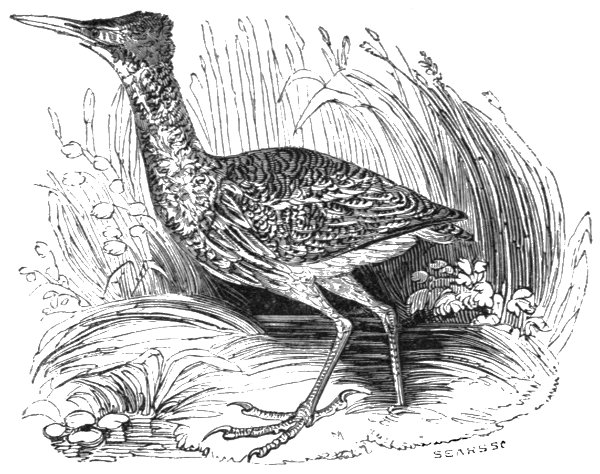
The bittern is nearly as large as the common heron; its legs are stronger, body more plump and fleshy, and its neck is more thickly clothed with feathers. The beak is strong at the base; straight, sharp on the edges, and gradually tapers to an acute point; the upper mandible is brown, the under inclining to green; the mouth is wide, the gape extending beyond the eyes, with a dusky patch at each angle: the irides are yellow. The crown of the head is somewhat depressed, and covered with long black feathers; the throat is yellowish white; the sides of the neck pale rust colour, variegated with black, in spotted, waved, and narrow transverse lines, and on the forepart the ground colour is whitish, and the feathers fall down in less broken and darker lengthened stripes. These neck-feathers, which it can raise and depress at pleasure, are long and loose, and, inclining backwards, cover the neck behind; those below them, on the breast to the thighs, are streaked lengthwise with black, edged with yellowish white: the thighs, belly, and vent, are of a dull pale yellow, clouded with dingy brown. The plumage on the back and wings is marked with black zigzag lines, bars, and streaks, upon a ground shaded with rust colour and yellow. The bastard wings, greater coverts, and quills, are brown, barred with black. The tail, which consists only of ten feathers, is very short; the legs are of a pale green, bare a little above the knees; the claws, particularly those on the hind toes, are long and sharp, the middle ones serrated.
The female is less than the male; her plumage is darker, and the feathers on her head, breast, and neck, are shorter, and the colours not so distinctly marked. She makes an artless nest, composed chiefly of the withered stalks and leaves of the high coarse herbage, in the midst of which it is placed, and lays from four to six eggs, of a greenish white colour.
The bittern is a shy solitary bird; it is never seen on the wing in the day time, but sits, commonly with the head erect, hid among the reeds and rushes in the marshes, where it always takes up its abode, and from whence it will not stir, unless it is disturbed by the sportsman. When it changes its haunts, it removes in the dusk of the evening, and then rising in a spiral direction, soars to a vast height. It flies in the same heavy manner as the heron, and might be mistaken for that bird, were it not for the singularly resounding cry which it utters from time to time while on the wing; but this cry is feeble when compared to the hollow booming noise which it makes during the night time, in the breeding season, from its swampy retreat.
The bittern, when attacked by the buzzard, or other birds of prey, defends itself with great courage, and generally beats off such assailants; neither does it betray any symptoms of fear, when wounded by the sportsman, but eyes him with a keen undaunted look, and, when driven to extremity, will attack him with the utmost vigour, wounding his legs, or aiming at his eyes with its sharp and piercing bill. It was formerly held in much estimation at the tables of the great, and is again recovering its credit as a fashionable dish.
The Little Bittern, (Ardea Minuta, Linn. Le Blongois, Buf.) in size is not much larger than the throstle, measuring only about fifteen inches in length. From the corners of the mouth, a black stroke extends across the under side of the cheeks; and a patch of black, glossed with green and edged with chestnut, covers the crown of its head. On the back, rump, and scapulars, the feathers are dark brown, edged with pale rusty coloured red; the sides of the neck, and the breast are of the same colours, but the brown on the middle of each feather is in narrower streaks. The belly is white: the hinder part of the neck is bare, but the long feathers on the forepart lie back and cover it. The tail is short, and of a black green colour, edged and tipped with tawny: the legs dirty green. The little bittern has seldom been met with in Great Britain.
The above drawing and description were taken from an ill-stuffed specimen in the Wycliffe Museum.—Bewick.
Bitumen, s. A fat unctuous matter dug out of the earth, or scummed off lakes.
Black, a. Of the colour of night; dark.
Black, s. A black colour; mourning.
To dye a good black.—First make your stuff a very dark blue: then make a very strong dye of strawall and walnut bark; boil the wool in this for six hours. Take out the stuff, and clean out the dye-pot, and make a fresh dye of strawall, logwood dust, or a good quantity of chips, with some madder and Brazil dust: boil in this two hours, and pour off your liquor. Clean your pot, and put in liquor again with the stuff, and when hot, pour in a quart of urine, at least eight days’ old, and boil in this half an hour. Having dissolved in some of the boiling liquor the size of a hazel-nut of copperas, lift out your stuff, and pour in this liquor—boil it well, and all is done. If any brown or purple should appear between you and the light, put down some clean water, and boil it, adding to it one, two, or three tea spoonfuls of salt of tartar, and throw in your stuff for a few minutes. This is a long way for black dyeing, but the best for fishing. Let your dye-pot be large, or it will run over when you add the copperas; keep your dye-pot constantly full of water.—Ancient Recipe.
Blackbird, s. The name of a bird.
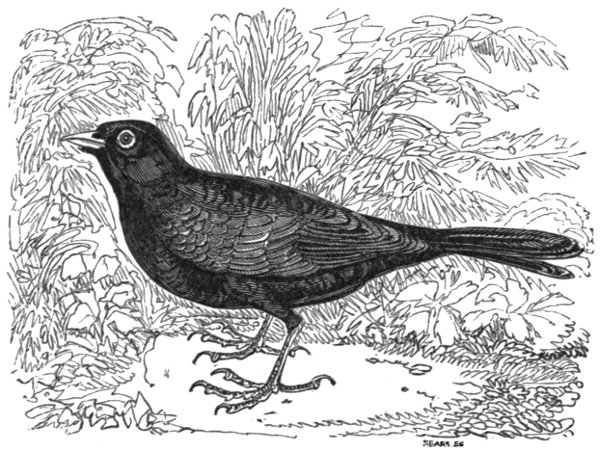
The length of the blackbird, or ouzel, (Turdus Merula, Linn.—Le Merle, Buff.) is generally about ten inches. Its plumage is altogether black; the bill, inside of the mouth, and edges of the eye-lids, are yellow, as are also the soles of the feet; the legs are of a dirty yellow. The female is mostly brown, inclining to rust colour on the breast and belly; the bill is dusky, and the legs brown; its song is also very different, so that it has sometimes been mistaken for a bird of a different species.
The males, during the first year, resemble the females so much, as not easily to be distinguished from them; but, after that, they assume the yellow bill, and other distinguishing marks of their kind. The blackbird is a solitary bird, frequenting woods and thickets, chiefly of evergreens, such as holly, pines, firs, &c., especially where there are perennial springs, which together afford it both shelter and subsistence. Wild blackbirds feed on berries, fruits, insects, and worms; they never fly in flocks like thrushes; they pair early, and begin to warble nearly as soon as any other of the songsters of the grove.
The female builds her nest in bushes, or low trees, and lays four or five eggs, of a bluish green colour, marked irregularly with dusky spots. The young birds are easily brought up tame, and may be taught to whistle a variety of tunes; for which their clear, loud, and melodious tones are well adapted. They are restless and timorous birds, easily alarmed, and difficult of access. But Buffon observes, that, “they are more restless than cunning, and more timorous than suspicious, as they readily suffer themselves to be caught with bird-lime, nooses, and all sorts of snares.” They are never kept in aviaries; for, when shut up with other birds, they pursue and harass their companions in slavery unceasingly: for which reason they are generally confined in cages apart. In some counties of England, this bird is called simply the Ouzel.—Bewick.
Blackcap, s. A small singing bird.
Black Cock, s. (Tetrao tetrix, Linn.) Known also as the heath-cock and heath-poult.
This species sometimes weighs as much as four pounds; length about twenty-three inches, bill dusky, irides hazel; the head, neck, and whole body, are of glossy blue-black, particularly about the neck, breast, and rump; over the eye the bare scarlet skin is granulated; the coverts of the wings dusky brown, the four first quill feathers black, the next white at the bottom, the lower half and tips of the secondaries white, under wing coverts white; the thighs are dark brown, sometimes marked with a few white spots; the tail consists of sixteen black feathers; the exterior ones bend outwards, and are much longer than those in the middle, which makes the tail very forked; the under tail coverts pure white; legs covered with hair-like feathers of a dark brown, speckled with grey; toes pectinated.
The female weighs about two pounds; the plumage is very different from that of the male; the general colour is ferruginous, barred and mottled, with black above, the under parts paler, with dusky and brown bars; the tail-feathers are straight and even at the end, variegated with ferruginous and black.
The black grous is at present confined to the more northern parts of this kingdom, population and culture having driven them from the south, except in a few of the more wild, uncultivated parts; in the New Forest in Hampshire, Dartmoor and Sedgmoor in Devonshire, and the heathy hills in Somersetshire, contiguous to the latter. It is also found in Staffordshire, and in North Wales, and again in the North of England; but no where so plentiful as in some parts of the highlands of Scotland. The males are polygamous, and fight desperately for the females.
In the month of April the male places himself on an eminence as soon as it is light in the morning, crows and claps his wings, on which the females resort to his station. After the courting season the males associate peaceably together, in small packs; are fond of woody, heathy and mountainous situations; but will occasionally visit the corn-fields in the autumn, retiring almost wholly to the woods in the winter, and perching on trees.
The female lays six or seven dirty-white eggs, blotched with rust-colour, about the size of those of a pheasant. These are deposited amongst the highest heath, without much appearance of a nest.
The young follow the female for some time. The males are scarcely distinguishable from the other sex till they are above half grown, when the black feathers begin to appear first about the sides and breast. Their food is chiefly the tops of heath and birch, except when the mountain berries are ripe, at which time they devour bilberries and cranberries most voraciously.
A supposed hybrid bird of this species has been described under the following synonimes:—
Tetrao Hybridus, Tetra Tetrix, Spurious Grous.
This bird has been described by Linnæus and others as a distinct species, or mixed breed between the black and wood grous. It is said to differ from the black grous in having reddish spots on the neck, breast, wings, and thighs, and in being of a superior size. It is said to have been formerly met with in Scotland.—Montagu.
Black-tail, s. The ruff or pope; a small fish.
Bladder, s. That vessel in the body which contains the urine; a blister, a pustule.
Blade, s. The spire of grass; the green shoots of corn. The sharp or striking part of a weapon or instrument.
Bladebone, s. The scapula, or scapular bone.
Bladed, a. Having blades or spines.
Blain, s. A pustule, a blister.
Blank, s. A void space.
Blank-day, s. A sporting term, used when a cover is drawn without success. It is also applied when shooters are kept in-doors by severity of weather, tired dogs, &c.
Blay, s. A small whitish river-fish; a bleak.
Blaze, s. A flame, the light of the flame; a white mark upon a horse.
Blaze, v. To blazon; to inflame; to fire.
Bleak, s. A small river fish.
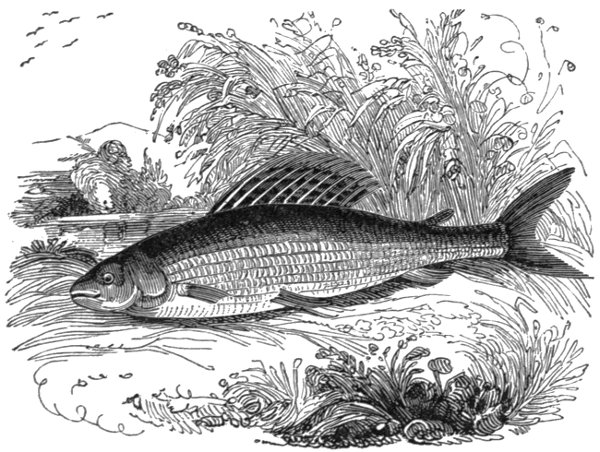
The bleak is seldom more than six inches long; the head is small, and the skull transparent; the eyes are large, with a blood coloured spot on the lower side; the irides of a pale yellow; the under jaw the longest; the gills silvery; the body is slender, greatly compressed sideways, not unlike that of the sprat: the back is green; the sides and belly silvery; the fins pellucid; the lateral line rather crooked; the scales are large, and fall off very easily; the tail is much forked.
Some call the bleak the water swallow, on account of its nimbleness in catching flies; they are very restless, their haunts being sometimes in deep still water, at the sides and tails of streams, where the water shelves off, and makes a gentle eddy; at others in the streams, which may be observed by their swimming near the surface, and their very active manner of taking and diverting themselves with small flies, and insects. In angling for the bleak, the tackle must be very fine, with four or five small hooks, so placed above each other as not to entangle, and swimming by the assistance of a small quill float, rather deeper than mid-water, and baited variously, as with a gentle, bloodworm, caddis, the house-fly, (or any fly they are observed at the moment to feed upon,) and a very small bit of red paste, throwing in now and then some malt grains, or chewed bread, to keep them together; always remembering, wherever ground bait is used, it should be inferior to the hook-baits: thus two or three at a time may be taken, for they are so eager as to leap out of the water at the bait. Should the day be cold and cloudy, a single gentle, or cadis, upon the hook is then best, sunk about two foot under water.
Another way of taking bleak is by whipping from a boat, or the bank-side in fresh streams, with a rod six feet, and a line twice as long, using an artificial black gnat, a fly of a very sad brown colour, or the small dace-flies; they not only yield much sport, but are very instructive to the young fly-fisher.—Daniel.
Bleed, v. To lose blood; to run with blood; to drop as blood; to let blood.
Bleeding.—This operation is frequently required in the diseases of horses; and if employed seasonably, and to a sufficient extent, is the most efficacious remedy we are acquainted with. When a horse appears dull and heavy, and indifferent about his food, by bleeding we often prevent a fever. If a horse is bled at the commencement of a cold, the complaint generally proves moderate, and of short continuance. In all cases of internal inflammation, or symptomatic fever, bleeding is the most essential remedy, provided the operation be performed at an early period, and the blood drawn in sufficient quantity. In such cases I have often taken away six quarts or more, and repeated the operation the same or the following day when it appeared necessary. By bleeding copiously at first, those formidable diseases are crushed at once; while by suffering them to proceed or become at all violent, which they will do unless this practice is adopted (or if only a small quantity of blood is drawn), they generally prove fatal: nor will bleeding then be of any service.
Bleeding is either general or local: that is, it is done either so as to affect the system in general, or a particular part only. For general bleeding, the jugular or neck vein is most convenient.
When the vein is firmly pressed with the fingers of the left hand, the blood is prevented from descending, and that part of the vein which is above the fingers is considerably distended, and becomes very conspicuous. In this state it may be easily opened with a lancet held in the right hand. The vein will continue to bleed as long as the pressure below is continued.
Farriers bleed with a fleam, which, though apparently a clumsy method of operating, is certainly safer than the lancet in unskilful hands. In topical bleeding, a vein is chosen as near as possible to the affected part, or the vessels covering the part are opened: in the inflammation of the eye, for example, it is done by scarifying the inner surface of the eyelid, or by opening a small vein which is easily seen going from the inner corner of the eye towards the nose. I do not think, however, that either of these operations do any good; indeed that of scarifying the eyelids is often, I believe, injurious.
A graduated tin vessel, capable of containing six or seven quarts, is very convenient for the purpose of receiving the blood; every pint being marked on the inside of the vessel, so that the quantity of blood that is taken off may be exactly known. The blood should always be preserved, that we may judge from its appearance of the nature of the disease, and whether it is proper or not to repeat the operation. When it continues fluid a considerable time, it denotes an inflammatory state of the system. Should a whitish or light buff-coloured jelly appear on its surface, after it has coagulated or settled, and should this jelly be of considerable thickness, rather firm, not easily penetrated by the finger, we may be satisfied that the horse’s complaint is inflammatory; that bleeding was a proper remedy; and that, if the symptoms continue, the operation may be repeated with advantage: but if the blood coagulates quickly, is uniformly of a dark liver colour, loose and easily broken, with a considerable quantity of water upon its surface, it denotes debility, and shows that the disease arises from a weakness of the system; that instead of bleeding, tonic and cordial medicines are to be employed, with every thing that may tend to restore the animal’s strength.
In order to judge correctly by the appearance of the blood, it should be drawn from a large orifice, and not suffered to run down the sides of the vessel which receives it. The first quantity that is drawn should be put aside for examination, and not shaken or disturbed in any way until it has perfectly coagulated.
When bleeding is employed as a preventive, or in any slight complaints, from two to three quarts may be taken off, according to the horse’s strength and condition; but in cases of internal inflammation, or fever, a more copious evacuation is necessary.
When horses are taken from camp or grass, and put into warm stables, they are very subject to inflammatory complaints and dangerous fevers: under those circumstances, moderate bleeding now and then will prevent such diseases. Horses that are getting into condition, as it is termed, are liable to similar disorders, unless moderate bleeding is occasionally employed. I am inclined to believe, however, that it is a bad practice to bleed often upon trifling occasions; it is liable to induce a plethora or fulness of habit, whereby a horse is rendered more susceptible of disease than he would otherwise be. Moderate purging and regular exercise, with a proper regulation of diet and temperature, are fully adequate to the prevention of disease on those occasions; but these are too often neglected.
It has been asserted that it is seldom necessary to pin up the orifice, which is made in the skin by bleeding. I grant there is not often any danger to be apprehended from its bleeding again; but unless it is pinned up, that is, unless the lips of the wound are brought into contact, and kept in that situation, by passing a pin through the edges of the skin, and twisting a little tow round it, as is generally done by farriers, inflammation and swelling will sometimes take place in the wound, and matter will form in consequence. The fleam has been found upon many occasions, particularly for opening the neck vein, a better instrument than the lancet; the latter makes an orifice in the skin, scarcely larger than the vein; and as the horse is generally a little restless, the blood soon gets between the skin and the vein, plugging up the orifice in the latter, and sometimes diffusing itself in the cellular membrane, so as to cause a swelling. The lancet, however, in skilful hands is a neater method, and more convenient for horses that are very shy and difficult to be bled in the common way.
Dogs may be conveniently bled by the jugular or neck vein, with a fleam, or with a common lancet; but the latter is much preferable. A ligature being put round the lower part of the neck, and the head being held up, the vein will swell and protrude itself on each side of the windpipe, about one inch from it. It will, however, be necessary previously to cut the hair away, if it be very thick; after which, the puncture can be easily made with a lancet, the operator leaning over the dog. Nothing is necessary, in general cases, to stop the bleeding, but to remove the ligature; nor is any pin, plaister, or bandage, requisite for the orifice. When circumstances such as the want of a regular operator, or when the amateur is called on to deplete his own dog suddenly, as in the field, when the means of venesection by the neck are not at hand; in any such case the ear may be punctured, or an incision may be made on the inner side of the flap of it, choosing, if possible, the course of a vein for the puncture, but avoid passing the instrument through the ear. Or the tail may be cut in desperate cases; but, when this is done, it is better to cut off a small piece than to merely make an incision underneath; for I have seen, when this has been injudiciously done, the whole tail in a state of mortification.
The quantity of blood drawn should be regulated by the size of the dog: for a very small dog, one or two ounces are sufficient; for a middling sized dog, three or four ounces; and for a large dog, five, six, seven, or eight ounces, according to the size and strength of the patient, and the nature of the disease he labours under.—White.—Blaine.
Blemish, v. To mark with any deformity; to tarnish.
Blemish, s. A mark of deformity, a scar.
Blight, s. Mildew; anything nipping or blasting.
Blind, a. Without sight, dark; a sconce.
Blindness, s. Want of sight; ignorance.
Blink, v. To wink; to see obscurely. A dog is termed blinked when rendered useless in the field, from timidity occasioned by alarming him by a shot, severity, or other ill-usage.
Blister, s. A pustule formed by raising the cuticle from the cutis; any swelling made by the separation of a film or skin from the other parts.
Blisters are medicines that inflame the skin, and cause watery bladders to rise upon its surface: the most useful of this kind is the cantharis, or Spanish fly, (lytta vesicatoria) which forms the principal ingredient in all our blisters. There are others, however, which are generally mixed with it as auxiliaries; as hellebore, euphorbium, turpentine, and sublimate.
Blisters are much used in veterinary medicine, and are extremely efficacious in dispersing callous swellings, the consequence of strains, bruises, &c.
In inflammation of parts remote from the surface, they are of great service. When the internal parts of the foot are inflamed, relief is generally obtained by blistering the pastern, provided the subordinate or auxiliary remedies are not omitted, such as paring the sole, soaking the horny part of the foot in warm water, or applying a poultice to it, and giving a dose of physic. When the lungs are inflamed, blistering the sides freely is an excellent remedy, especially when we feel doubtful as to the propriety of further bleeding.
Blistering is employed also for curbs, windgalls, spavins, &c.
Broken knees, unless skilfully treated, leave a callous swelling on the part; for the removal of which, blistering is employed. When blisters are properly made, and free from any caustic ingredients, such as sublimate, vitriolic acid, &c., there is no danger of destroying the hair; and if the first blistering does not prove effectual, it may be repeated until the desired effect is produced.
Before a blister is applied, the hair should be closely cut off, or even shaved off, if the situation of the diseased part will admit of its being done without wounding the skin; but good scissors, or shears, if skilfully used, will answer the purpose sufficiently. If the skin is scurfy it may be washed with flannel, soap, and warm water, and be made perfectly dry before the blister is applied. Blisters are generally employed in the form of ointment, but on some occasions they are preferred of a thinner consistence, or in the form of liniment, or even still thinner or more fluid, and are then named liquid blisters. Though a variety of ingredients are used in blisters, the cantharis or Spanish fly is the best; and if not injured by long keeping, or adulterated, is the only blistering ingredient required for common purposes.
The following formulæ are recommended by Mr. White.
BLISTER OINTMENT.
Hog’s lard 4 oz.
Oil of turpentine 1 oz.
Powdered cantharides 1 oz.—Mix.
Melt the lard by a gradual heat; remove it from the fire, and stir in the turpentine, then add the cantharides, and continue stirring until it is cold.
Or,
Hog’s lard 6 oz.
Oil of rosemary ½ oz.
Oil of origanum 2 dr.
Powdered cantharides 6 dr.
Solution of sublimate in muriatic acid, one fluid drachm or sixty minims.
Mix as above.
Or,
Oil of turpentine 2 oz.
Sulphuric acid, by weight 1 oz.
Mix cautiously, under a chimney, or in the open air, and avoid the suffocating vapour which will arise. When perfectly united, add hog’s lard, from six to eight ounces, or more, according to the strength required. When a blister is wanted, take two ounces of this ointment, and rub up with it from two to three or four drachms of recently powdered cantharides. This ointment may be made still stronger by the addition of a little calomel or sublimate at the time it is wanted; but the latter must be used only in a small proportion, and with caution, as it is apt to ulcerate the skin, and cause sloughing and a permanent blemish. It should therefore be applied to a small surface only, as in bone spavin or splent. Neither the cantharides nor the calomel, or sublimate, should be kept ready mixed with the above ointment, as it is probable they would undergo some change, and be rendered inert after a little time. The above recipes may be varied by substituting mercurial ointment, oil of bay, or any other unctuous substance for hog’s lard, or oil of origanum, for oil of turpentine. And if a more solid form is desired, it may be obtained by the addition of a little bees-wax, suet, or resin.
BLISTERING LINIMENT.
Olive oil 4 oz.
Oil of turpentine 1½ oz.
Oil of origanum ½ oz.
Recently powdered cantharides. 1 oz.—Mix.
Or.
Olive oil 4 oz.
Oil of turpentine 1 oz.
Oil of rosemary, and oil of origanum of each ½ oz.
Solution of sublimate 1 dr.
Recently powdered cantharides 1 oz.
Mix.
LIQUID BLISTER.
Boiling water 6 oz. to 8 oz.
Powdered cantharides 1 oz.
Macerate for twenty-four hours, and then add rectified spirit of wine, four ounces; solution of corrosive sublimate in muriatic acid, one drachm. To be kept well corked for two or three weeks before it is used: it may then be either strained through blotting paper, and used as a transparent tincture, or merely shaken up and employed as it is. The solution of sublimate should be added at the time the blister is used.
Rectified spirit 2 oz.
Liquid ammonia 2 oz.
Oil of turpentine, origanum, or rosemary (either) 1 oz.
Powdered cantharides 6 dr. to 1 oz.
Mix.
After a blister has been applied to the legs or hocks, the litter should be removed, and the horse’s head should be confined or tied to the rack, to prevent his rubbing the part with his nose; but this may be done better by putting what is termed a cradle or necklace round his neck; he may then be turned loose into a box and exercise himself, which is very desirable after blistering. It is necessary to keep the cradle on for about a fortnight, as they are apt to gnaw the part or injure the skin, when the effect of the blister is going off, and an itching only remains.
The following is a convenient method of making a blister, when the other ingredients cannot be obtained:—Take of the blistering plaster, sold by druggists, two ounces, melt or rather soften it by a gentle heat, and mix with it oil of turpentine from half an ounce to one ounce.
Blistered Heel.—If your heel should become galled by walking in a water, or any other boot, you will immediately remedy the inconvenience by applying a piece of gold-beater’s skin, and over that a little court plaster, in order doubly to defend the part. But even in this trifle there is a right and wrong way of going to work. Instead of cutting with scissors, and merely wetting the plaster, let it be for a moment heated by the fire, as well as wetted, being previously stamped with a wadding punch; by which means, from having no angles, or corners, it will stick as fast as your own skin; provided that, when on and dry, you put over it a little cold cream, or any kind of grease, in order to repel the damp.
The application that has been usually recommended to me by surgeons is a diachylon plaster, which, in cold weather, curls up and torments you so much in walking, that you soon become lame again, and then wish the doctor at Jericho. Go to Godfrey’s or some other first-rate chemist, in order to get the sticking plaster in perfection, as many a one has poisoned his skin by not having the genuine article.
I have been prevented by an accident from accompanying the party; and though my wound be “not so deep as a well, nor so wide as a church door,” it still renders me hors de combat. I blistered, or rather neglected a blistered heel: and the fag of yesterday has so excoriated the surface, as to make it imperative upon me to lie by for a little. Antony engages to effect a perfect cure by tomorrow; and here I remain tête-à-tête with the otter-killer.
The old man proceeded skilfully enough; he lanced the blisters, and then applied the cuticle which covers a sheep’s kidney, and which is very similar in appearance and effect to what we call “gold-beaters’ leaf.” This application prevented the heel from being frayed by the stocking. To the remainder of the foot, he rubbed a hot mixture of tallow and whiskey; and his remedy was “the sovereignest thing on earth,” for in twelve hours the cure was effected.—White—Hawker—Blaine—Wild Sports of the West.
Blister, v. To rise in blisters; to raise blisters by some method.
Block, s. A short heavy piece of timber; a sea term for a pulley.
In Falconry, a solid piece of wood, shaped like a sugar loaf, with the six upper inches broken off, whereon the hawk perches, being tied to it by the leash, which goes through the last link of a small iron swivel fixed in its side.—Campbell.
Blood, s. The red liquor that circulates in the bodies of animals.
Blood, v. To stain with blood; to inure to blood, as a hound.
In essential characters and properties, blood is the same in all animals: in some, it wants the colouring matter, but it is invariably red in the higher orders, though the intensity of its hue varies with circumstances, the principal instance of which is that afforded between the venous and arterial; where it is, in the former, almost purple, but in the latter a bright scarlet.
The specific gravity of the blood is very differently estimated, it being subject to increase and decrease at different times. Disease and emaciation make it lighter, while in the contrary states, from its more perfect organisation, it is found heavier. If water be estimated at 1000, the specific gravity of blood may be reckoned at 1050; from which it may, however, be increased to 1120. Venous blood is heavier than arterial, as 1052 is to 1049; but these data vary.
The temperature of the blood in the horse is about 100°; in the ox, 102; and in the sheep, 103: but various circumstances tend to increase or decrease it. Arterial blood is usually one or two degrees warmer than venous: Mr. Vines, I believe, rates the difference much higher. Some diseases reduce the heat of the blood, and ardent inflammations are also capable of augmenting it. The quantity that an animal contains, in proportion to his bulk, has been endeavoured to be ascertained: but the results have been various. Very fat animals are found usually to have proportionally less than lean ones; and in those in a state of close confinement, the quantity is found to be smaller than in the wild; but it is evident, that as the calculation must be in a degree imaginary, from that which will remain in the vessels, so the real quantity is not easy to estimate. A medium sized horse has lost forty-four pounds without apparent injury, and most of them will lose one-fifteenth of their total weight before life becomes extinct: it may, therefore, be presumed that it forms one-tenth of the whole: Mr. Percivall thinks one-eighth.
Blood-hound (Canis Sanguinarius), s. A hound that follows by the scent.
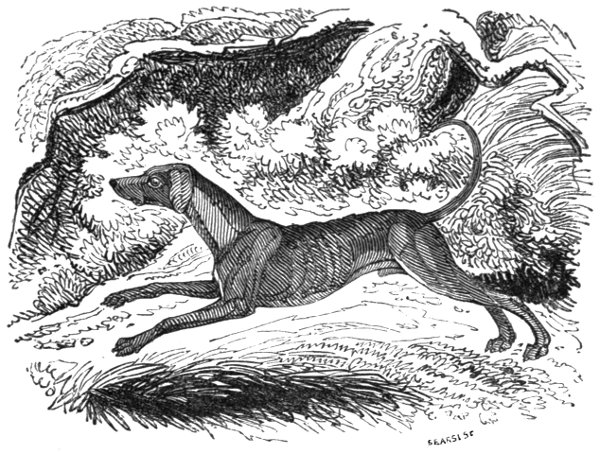
In the darker ages the blood-hound had the fabulous reputation of pursuing naturally with unerring precision, and of taking murderers, robbers, and other depredators, if he were laid on the footsteps of those intended to be pursued, within a certain given time. We, however, cannot give our assent to the character thus ascribed to him, although experience has taught us, that all sorts of hounds may be broken in to follow any kind of scent, when resolutely taught that they are to run on no other.